Measuring the quality of a
work schedule
Guidelines to develop a tool to evaluate work
schedules
C.M.J. Aitink
21-05-2014
Master thesis Business Administration
iii
Acknowledgements
This thesis is the last part of my studies at the University of Twente. After a bachelor in Psychology, the master Business Administration went by really fast. Especially the last few months, related to my thesis were over before I knew it. That is because I enjoyed working on it. It taught me that I can challenge myself and it felt really satisfying to know I brought it to a good end.
For all the help with my thesis, I want to thank Hauke Sie of Integral. He was a good sparring partner for me and helped me generate new ideas that could be useful for my thesis. Also, I want to thank him for welcoming me to Integral, where I could work on my thesis in a business setting. This way I could get a taste of the business life. Further I want to thank Willem Boersma en Esther Renes from Integral for their help on my thesis. From an additional sparring partner to helping me to get the output I needed, you were there for me.
To get information, I performed several interviews. I also had to perform pilot studies. To be able to do those things, I needed some help from different organizations and experts. I want to thank all the people that participated to my interviews and pilot studies. I could not have finished my thesis without them.
v
Abstract
The present research is commissioned by Integral. Integral is a Dutch software company that develops employee scheduling software. The goal of this research is to formulate guidelines that can be used to develop a tool that will be able to evaluate work schedules. The guidelines are presented as a list of criteria. The content of the criteria is determined through a literature study and interviews.
The interviews are held with scientific experts (n=5) and practitioners (n=5). They are asked about what they thought were important aspects when evaluating a work schedule. Further questions were about the relative importance of these aspects. Regarding to the relative important of the different aspects, there was no general view. Therefore it is concluded that the importance can vary between organizations. The first design of the guidelines is tested through a pilot study. In this pilot study, work schedules of three organizations were evaluated with the help of organizations that use the scheduling software of Integral: Checks. After the pilot study, a few minor changes were made to the design. The result of the present research is a set of guidelines to develop a tool to evaluate work schedules. The criteria listed are divided between six different categories: work-life balance, flexibility, health, legal regulations, predictability and finance. The evaluation of work schedules can be performed while looking from three different perspectives: the employee perspective, the organizational perspective and the customer perspective. To be able to use this tool, organizations have to follow three steps. Step 1: select criteria, step 2: give standards to criteria, step 3: weight criteria and categories.
Table of contents
Acknowledgements ... iii
Abstract ... v
1. Introduction ... 1
1.1. Research questions ... 2
1.2. Research design ... 3
2. Literature review ... 5
2.1. Tool design... 5
2.2. Tool content ... 6
2.2.1. Work-life balance ... 7
2.2.2. Flexibility ... 8
2.2.3. Health ... 10
2.2.4. Legal regulations ... 12
2.2.5. Predictability ... 14
2.2.6. Finance ... 15
2.3. Conclusion ... 16
3. Methodology ... 18
3.1. Research design ... 18
3.2. Interviews ... 18
3.3. Data analysis ... 19
3.4. Design ... 19
3.5. Pilot study ... 20
4. Results from the interviews ... 21
4.1. Interviews with scientific experts ... 21
4.2. Interviews with practitioners ... 24
5. Design ... 27
5.1. First design ... 27
5.2. Results from the pilot study ... 28
5.3. Final design ... 30
6. Discussion ... 33
6.1. Limitations ... 33
6.2. Recommendations ... 34
6.3. Conclusion ... 36
References ... 37
Appendix A: Interview scheme scientific experts ... 42
Appendix B: Interview scheme practitioners ... 44
Appendix C: First design of the guidelines (English) ... 46
Appendix D: First design of the guidelines (Dutch) ... 49
1
1.
Introduction
A lot of organizations employ one or more planners to make work schedules. When scheduling employees, planners must determine how many employees perform certain tasks at a certain time. Beforehand, the planners must gather and weigh a lot of information and interests against each other. When an organization makes a schedule to plan their employees’ working hours, a lot of things have to be taken into account (Van Wezel & Jorna, 2001).
The present research is commissioned by Integral, a Dutch software company. Integral develops employee planning software for organizations in the Netherlands called Checks. The director wanted to know how work schedules can be evaluated, so in the future they might be able to build a tool to evaluate work schedules.
But why is it important to be able to evaluate a work schedule? De Snoo, Van Wezel and Jorna (2011) state that managers would like to evaluate their work schedule. This way, it is easier to detect gradual changes in work schedules. In the Netherlands, it is a discussion that frequently came back in the last few years, due to an aging population and a higher retirement age (Goudswaard et al., 2013). Regarding that discussion, the health of the older employees can be of importance. But that is not the only priority. Satisfaction of the employees regarding to their work schedule is also important. The quality of a work schedule can be a reason to stay with a company or to leave. This can be of importance when the working population becomes smaller and employees become harder to find.
Worthen, Sanders and Fitzpatrick (1997, p8) define evaluation as “to determine the merit or worth of something”. In the present research, guidelines to develop a tool will be formulated by which the value of a work schedule can be determined. These guidelines can be used to give an evaluation to work schedules. Because different stakeholders might be affected by a work schedule, the evaluation will be from different perspectives. When for example organizations evaluate work schedules on aspects only they are interested in, the interests of employees may be overshadowed. These guidelines can help to find a balance between stakeholders.
2 tool focuses on the physical and social aspects that are influences by work schedules (Jansen & Baaijens, 2007). In contrast to the tool of Verbiest et al. (2013), the RRPA aims to quantify work schedule characteristics (Jansen en Baaijens, 2007). But both tools still have the restriction that they only focus on the health aspects of employees.
The present research aims to broaden the previous research. The ultimate goal is to formulate guidelines that can be used to develop a tool that will be able to evaluate work schedules on different aspects, not only health. With this tool, work schedules can be given a grade, so a gradual decline or progress can easier be detected. Verbiest et al. (2013) and the RRPA focused specifically on the health of the employees. But aren’t there more aspects that influence how good a schedule is? Another extension is that the present research also looks at different stakeholders that might be influenced by a schedule. What, for example, might be good for an organization, does not necessarily have to be good for the employees.
The guidelines presented in this research can in the future result in an actual tool. When this tool would be available for organizations, they can evaluate their work schedules on different aspects and compare them with each other. Then they can see where the work schedule is weak and can be improved. This way, organizations can optimize their work schedule to fit with their needs and priorities. Comparing different work schedules from the past can be relevant, for example, to see whether there is a downwards trend or not.
1.1. Research questions
To be able to formulate guidelines to develop a tool, several questions have to be answered. The main research question that has to be answered is:
How can a work schedule be evaluated and which aspects are important to achieve this?
This leads to the following sub questions: 1. What are the criteria a tool must meet?
2. Who are relevant stakeholders that are influenced by a work schedule? 3. Which aspects influence the quality of a work schedule?
Not every aspect has to have the same impact on a schedule or is of the same importance. To give a proper evaluation to a schedule, the different aspects can be given a weight. This leads to the next research questions:
4. What is the relative importance of each aspect?
5. Does the importance of the aspects differ between different stakeholders?
To achieve the ultimate goal, to make guidelines that can be used to make a tool that will be able to evaluate work schedules on different aspects, the next research question has to be answered:
1.2. Research design
This research aims to formulate
evaluate their work schedule. Because it
research. To make sure the research is properly conducted, the steps from the Verschuren and Hartog (2005) (see figure 1)
In the first hunch phase, problem identification is done by Integral. They commissioned this research to get insight in the criteria needed to evaluate a work schedule.
formulated. In the requirements
requirements are the functions the intended product should have to reach the formulated goal. User requirements are requirements that future
requirements are limitations set by the environment. A held to perform the requirements phase.
knowledge and is forming a foundation to the guidelines
interviews will be conducted to extend the information found in the literature and to get a different perspective on work scheduling. The interviewees
practitioners. In the structural specifications phase, the results from the requirements phase will be used to make a first draft of the design
be combined to come up with an idea for a design and the content of this design. phase, a prototype of the design will be realized. A
Figure 1: The designing cycle (Verschuren & Hartog
First hunch
Prototype Implementation
Evaluation
aims to formulate guidelines to develop a new tool that can be used by organizations to . Because it can result in a new product, this research is a design oriented research. To make sure the research is properly conducted, the steps from the
(see figure 1) will be followed.
phase, problem identification is done by Integral. They commissioned this research to get insight in the criteria needed to evaluate a work schedule. Building on this idea,
quirements phase, first a number of requirements must be specified. Functional requirements are the functions the intended product should have to reach the formulated goal. User requirements are requirements that future users can have when using the intended product. Contextual requirements are limitations set by the environment. A literature study and several
to perform the requirements phase. The literature study will be performed to get and is forming a foundation to the guidelines to develop a tool. After
to extend the information found in the literature and to get a different perspective on work scheduling. The interviewees will be several scientific experts and several In the structural specifications phase, the results from the requirements phase will be used to make a first draft of the design. The information from the literature study and the interviews wi be combined to come up with an idea for a design and the content of this design.
phase, a prototype of the design will be realized. A document will be created to manually evaluate work ing cycle (Verschuren & Hartog, 2005).
First hunch Requirements Structural specifications Prototype 3 a new tool that can be used by organizations to , this research is a design oriented research. To make sure the research is properly conducted, the steps from the designing cycle of
4 schedules. In the implementation phase, a pilot study will be performed in three organizations. Several work schedules will be evaluated using the first design. In the last phase, the evaluations phase, the pilot studies will be evaluated. Errors that may come up will be fixed and the final proposal will be presented. The present research is commissioned by Integral, a Dutch software company with Dutch customers. That is why the research will focus on the Netherlands. This means that the focus of the interviews will lie on the Dutch market. Also, the Dutch legislation will be used.
5
2.
Literature review
To be able to formulate guidelines to develop a tool, first there has to be done research to functional requirements of a tool. Because how can one decide what should be the content of a tool, when it is not clear which form the content should have? That is why the first section of this chapter is a literature review about the tool design. The second section of this chapter is a literature review related to the content of the tool.
2.1. Tool design
To answer the question what characteristics a software tool must have, the ISO 9126 quality model can be used. The model consists of six quality characteristics: functionality, reliability, usability, efficiency, maintainability and portability (Losavia et al. 2004). The characteristics are described in table 1.
There are also some software criteria that need to be taken into account. This is because the end product of this research, the guidelines to a tool, must be applicable in practice. Integral commissioned that the guidelines must be able to count something. It is the most important software related restriction that is relevant to this research. This could mean that relevant information has to be excluded. Still, it is relevant to explore all the information available, to also be able to show which relevant information is missing.
[image:13.595.64.534.471.730.2]Now the characteristics the tool must have are clear, the design of the tool must be explored. To do this, a few examples of tools are given to see how different tools are equipped. The first example is the Practice Guidelines Development Cycle of Browman et al. (1995). They wanted to make a tool that Table 1: Characteristics of the ISO 9126 quality model
Characteristic Description
Functionality The capability of the software product to provide functions which meet
stated and implied needs when the software is used under specified conditions (what the software does to fulfill needs).
Reliability The capability of the software product to maintain its level of
performance under stated conditions for a stated period of time.
Usability The capability of the software product to be understood, learned, used
and attractive to the user, when used under specified conditions (the effort needed for use).
Efficiency The capability of the software product to provide appropriate
performance, relative to the amount of resources used, under stated conditions.
Maintainability The capability of the software product to be modified. Modifications may
include corrections, improvements or adaptations of the software to changes in the environment and in the requirements and functional specifications (the effort needed to be modified).
Portability The capability of the software product to be transferred from one
environment to another. The environment may include organizational, hardware or software environment.
6 facilitated the systematic development of cancer treatment practice guidelines. The tool was presented as a number of steps that had to be taken to produce guidelines. The steps are: select/frame clinical problem, generate evidence-based recommendation, ratify evidence-based recommendation, formulate practice guidelines, independent review, negotiate practice policies, adopt guideline, policies, schedules review. Because it is a cycle, the last step leads back to the first step. This is to update the guidelines and make sure they don’t become obsolete (Browman et al., 1995).
The second example is the Employability Skills Assessment Tool. The function of this tool is to select the best candidate in a selection procedure. All candidates will get scores and the candidate with the highest score will get the job. The Employability Skills Assessment Tool is designed using a number of steps: identifying items, weight factor, determining skills score and validate tool (Rasul et al., 2012).
The third example is the School-Wide Evaluation Tool (SET). This tool is used to assess school-wide positive behavior support. It consists of 28 items that are divided in 7 categories. Each of these items could get a score of 0, 1, or 2. Then the scores of the 7 categories and the total summary score can be calculated (Horner et al., 2004).
2.2. Tool content
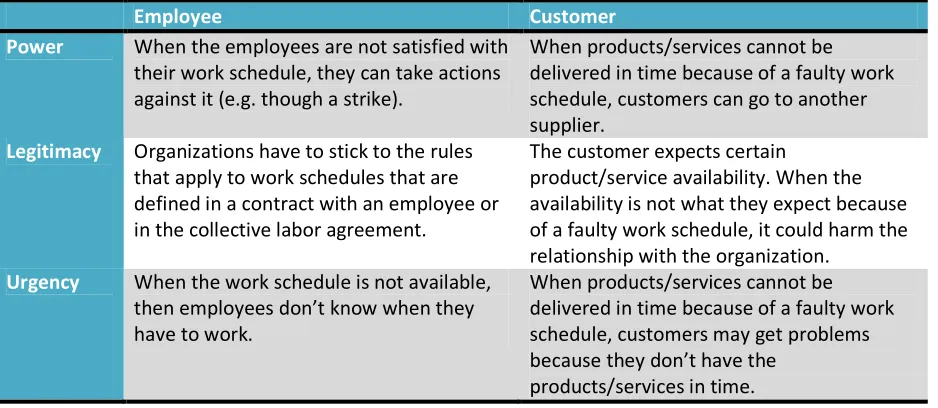
[image:14.595.67.536.516.720.2]In the literature, different researches focus on different perspectives. But which perspectives are important? The stakeholder theory of Mitchell, Agle and Wood (1997) states that the most important stakeholders are the ones who have three key features: power, legitimacy and urgency. Second are the stakeholders who have two of the three key features and the least important stakeholders only have one key feature. This research focuses on the stakeholders that have all three key features. The organization is the centre point in this case. The different stakeholders will be compared to that. This leads to the employees and the customers as additional perspectives. The explanations of the relationship to the organization with regards to power, legitimacy and urgency can be found in Table 2. Table 2: Key features of the most important stakeholders.
Employee Customer
Power When the employees are not satisfied with
their work schedule, they can take actions against it (e.g. though a strike).
When products/services cannot be delivered in time because of a faulty work schedule, customers can go to another supplier.
Legitimacy Organizations have to stick to the rules
that apply to work schedules that are defined in a contract with an employee or in the collective labor agreement.
The customer expects certain
product/service availability. When the availability is not what they expect because of a faulty work schedule, it could harm the relationship with the organization.
Urgency When the work schedule is not available,
then employees don’t know when they have to work.
When products/services cannot be delivered in time because of a faulty work schedule, customers may get problems because they don’t have the
7 To show that there are also stakeholders who don’t have all three key features, the suppliers and stockholders are also analyzed as an example. Suppliers do have power (late delivery can result in less work and a change in the work schedule), but they don’t have legitimacy or urgency in relation to the organization’s work schedule. Stockholders do have urgency. This relates to the loss of profit when products cannot be delivered in time because of a faulty work schedule. There can be power when the stockholders want to change the work scheduling process, but there is no legitimacy.
That employees and customers are the most important stakeholders next to the organization can also be found in the literature on work schedules. Some research looks at work schedules from the view of the employee (e.g. Haus & Smolensky 2006; FNV Bondgenoten, 2009b; Jeffrey Hill et al., 2011), some research looks from the view of the organization (e.g. Bambra et al., 2008; Galinsky, Sakai & Wigton, 2011; Bard & Purnomo, 2005) and some research looks from the view of the customer (e.g. Zang, Vonderembse & Lim, 2003). What is best for the employee does not necessarily have to be the best for the organization, or the customer.
When there is focused on three different perspectives, research has to be done to find how to satisfy these groups. After a brainstorm session, which included Integral and the researcher, it was concluded that the intended criteria had to be divided into categories and a few possibilities of categories were formulated. With these possibilities in mind, a literature study is performed. It is comparable to the example of the previously mentioned School-Wide Evaluation Tool, which categorized 28 items into 7 categories (Horner et al., 2004). The categories in mind were adapted, supplemented and refined and the result is six categories: work-life balance, flexibility, health, legal regulations, predictability and finance. In the next six sections, different aspects, seen form different perspectives are explained.
2.2.1. Work-life balance
Employee perspective
8 2.2.2. Flexibility
Employee perspective
Flexibility in the eyes of the employees is “the ability of workers to make choices influencing when, where, and for how long they engage in work related tasks” (Jeffrey Hill et al., 2011, p. 152). There are different motives for the employees to use the flexibility offered. First, there are personal motives. The employees can manage their different roles in different lives better. They can schedule their work time around their children, doctor appointments, errands, or they can reduce travel time (Shockley & Allen, 2012). The theory of Maslow lies on the basis of this behavior. People strive for higher-order needs. 3rd in row on the pyramid of Maslow is “belongingness and love needs” (Gleitman, Reisberg & Gross, 2007). These social needs can be achieved through flexibility. Second, there are more work related motives. Employees may increase their productivity when they are in an environment where they are less distracted or where they perceive increased creativity. Although the focus in the literature is more on the personal motives, there is evidence that work related motives are a bigger motivation to use the flexibility offered (Shockley & Allen, 2012).
There are several ways to induce flexibility: in time and in place. One way of flexibility in time is flextime. With flextime, employees can choose for themselves when they start their workday and when they end it. Most of the time there are some restrictions. Employees have to make a full day, for example eight hours, and there might be a core time where everyone has to be present (Baltes et al., 1999). For example, employees can arrive between 08.00 and 10.00 and they can leave between 16.00 and 18.00. Between 10.00 and 16.00 everyone is present. Another example of flexibility in time is a compressed workweek. Here the weekly hours are divided over fewer days. For example, when a normal work week is 40 hours in five days, employees work eight hours a day. In a compressed workweek, an employee can choose to work four days with ten hours a day (Baltes et al., 1999). Other flexibility options are being able to take a longer period off, or the ability to take regular time of to, for example, care for children or an elderly relative (Jeffrey Hill et al., 2011). A third type of flexibility in time is working part-time. With this mechanism employees have the ability to work fewer hours than the traditional 40 hour workweek. Flexibility in place can be achieved by for example working from home. This can be part time home, part time in the office, or full time working at home. Another option is to change worksites between the options of the employer. When the employer has several offices on several locations, an employee can choose to work on a different location for a period of time. A way to make workplace flexibility possible is with the use of technology, for example a virtual office (Jeffrey Hill et al., 2011). All these types of flexibility can be beneficial for the social needs of the employees. But when an actual schedule has to be made because there have to be employees present at certain times, these types of flexibility are not always possible.
9 be filled, but the employees can fill in their own names with the shifts they want. The fourth type is matching. Matching is a lot like shift picking, but there are no shifts in the schedule yet. There is only an occupancy rate and the employees can insert their preferences. The employer will then make a schedule, matching the occupancy rate and the preferences as good as possible. The fifth and last one is self-scheduling. The employees of a team will determine who will do which activity at what time. How they fill the schedule is completely up to them, but it has to be in between the boundaries of the organization (NCSI, 2009). Methods that increase the control of employees over their work schedules are likely to have a positive effect on health (Garde et al., 2013), job satisfaction and organizational commitment (Lyness, Gornick, Stone & Grotto 2012). However, some methods work better than others. This is also related to the environment (Garde et al., 2013). While Dutch literature shows a lot of research on it, there are not many organizations who implemented the last dimension: self-scheduling (NCSI, 2009).
There are some negative effects to work place and work time flexibility for employees. Those who make use of the flexibility get offered fewer promotions, smaller salary increases and more negative performance evaluations (Galinsky, Sakai & Wigton, 2011). Another negative effect is the disruption of an employee’s personal life. While it is expected that the work-life balance can be managed better with the flexibilities offered, there is also some evidence that this might work adversely. Because there are no fixed times where the employees can be reached, it is assumed that they can always be reached. This might blur the line between work and home life (Galinsky, Sakai & Wigton, 2011; Shockley & Allen, 2012), which in its turn increases work pressure (Demerouti, Bakker & Bulters, 2004; Lu & Kao, 2013). With self-scheduling, a negative effect for the employees is that the work schedule is not available for a long period of time. Garde et al. (2013) found that when employees are used to knowing their work schedule months in advance, they react negatively to the shortened availability of their work schedule.
Organizational perspective
10 There are also ways to look at flexibility from the organization’s perspective. One way is to generate workforce flexibility. That way, employees can work in different functions, which makes it easier to fill gaps when there is an increase in work or when there are employees absent. Also the number of options increases when making a new work schedule (Wright & Bretthauer 2010). The use of flexible employees generates a higher performance, quality improvements, better customer service and a higher learning curve (Hopp & van Oyen, 2004). A second form of flexibility is the use of contingent workers next to the full-time employees. With these employees, organizations can fill the gaps when the demand is high and they don’t have excess employees when the demand is low. These fluctuations are very common with types as “just in time” production (Jeffrey Hill et al., 2011). But these fluctuations can also be handled without contingent workers. This can be done with the use of an annual hour system. With this system employees work more hours when there is more work and less hours when there is less work. The work hours can be different every week, but must match yearly to the contract (NCSI, 2009). This system can also be applied to work that fluctuates with the seasons.
Customer perspective
When looking from the customers’ perspective, an organization can be seen as flexible when they can meet the customers’ demands. Zang, Vonderembse and Lim (2003) state two types of flexibility. Volume flexibility and mix flexibility. With volume flexibility, the demand is set in numbers. How many of a certain product the customer wants at a specific time. With mix flexibility, the demand is set in certain preferences that change the product. Can a product be adapted to the needs of the customer? Volume flexibility and mix flexibility influence customer satisfaction in a positive way. One of the factors influencing these two types of flexibility is labor flexibility (Zang, Vonderembse & Lim, 2003). Labor flexibility can be divided into numerical flexibility (can the number of workers be changed), workforce flexibility (how many types of tasks can the workers perform), financial flexibility (can schedules be easily adapted) and work group flexibility (how do the employees cope with the changes) (Ramasesh & Jayakumar 1991). Zang, Vonderembse and Lim (2003) found that workforce flexibility is one of the major influences on volume flexibility and mix flexibility.
2.2.3. Health
Employee perspective
To make a schedule workable for the employees, organizations can look at the effects of the schedule on employees’ health. The focus can be on restricting long working hours, or when shift work is used, how to minimize the negative effects.
11 Shift work is a term that refers to two or more teams of employees that work on different hours to extend the time of operation. This way, organizations can extend their hours beyond office hours and may even extend to 24 hours a day. In most industrialized countries, shift workers make up at least one fourth of the working population (Akerstedt, 1990). While shift work has the big advantage of getting more work done in a shorter period of time, there are also some disadvantages, especially for the employees working in the shifts that are beyond the conventional office hours. A lot of studies focus on the biological factors of the body while investigating the effects of working with shifts. Especially the circadian rhythm plays a big role (Haus & Smolensky, 2006; Akerstadt, 1990; Bamra et al., 2008; Harrington, 2001; Van Amelsfoort et al., 2004). So first, the circadian rhythm will be explained and later the effects of disrupting it.
Circadian rhythms are rhythms that last about a day. The human body has several of these rhythms, coexisting with each other. Examples are: sleeping time, frequency of eating and drinking, body temperature, secretion of hormones, volume of urination, and sensitivity to drugs. The average natural rhythm of a human is 24.2 hours. It is adaptable to rhythms between 23 and 25 hours, but not to extremes like 28 hours (Kalat, 2007). While rhythms are stable, they can be changed, for example through difference in light. Humans can adapt to an average of one hour difference a day (Akerstedt, 1990).
When this is translated to working in shifts, and especially night shifts, there will be a shift in the rhythm of the body. But not all rhythms will adapt. The body will develop an own rhythm, apart from the working rhythm and the night/day rhythm. There are different rhythms present at the same time, which are not in balance. This is called desynchronization (FNV Bondgenoten, 2009a). It is also the difference between working night shifts and a jetlag. With a jetlag, the whole rhythm is reset in another time zone (Haus & Smolensky 2006). Desynchonization does not only apply to the rhythms within the body, also to the social rhythms. For example, when an employee has children, the rhythms of the parent do not align with the rhythms of the children. This makes it even more difficult to adapt (Haus & Smolensky 2006). The main problem of shift workers is getting enough sleep. It is difficult to get enough sleep before an early shift, because the body is not ready to sleep yet early in the evening. Also staying asleep after a late shift is difficult, because the body already wants to wake up at a certain time (Akerstedt, 1990). Other problems are digestive problems, emotional problems, stress related illnesses (Bambra et al., 2008), pregnancy problems, heart and vascular diseases (FNV Bondgenoten, 2009a) and even an increase in the change of breast cancer and colorectal cancer are reported (Haus & Smolensky 2006). Furthermore, employees on rotating shift work have a higher chance of injury on the work floor (Bambra et al., 2008).
12 way the disruption of the circadian rhythm will be minimal and there will be fewer problems with sleep deprivation. Also should the length of the nightshift not be longer than 8 hours. The combination of a nightshift with overtime will increase the problems arising with nightshifts (FNV Bondgenoten, 2009a). One might think of the solution to take permanent night shifts. This will decrease the constant disruptions of the circadian rhythm. But this is not recommended because of external influences on the body. The fact that light and dark influences play a large role and most of the time the social aspects of our life do not correspond with that of the nightshift, will prevent some aspects of the circadian rhythm to adapt completely. There will be a permanent desynchronization (FNV Bondgenoten, 2009a).
Another effect on health can be the use of breaks during the work time. Research agrees that breaks have a positive effect on the reduction of fatigue, which in turn improves the well being of the employees (e.g. Boucsein & Thum, 1997; Tucker, 2003; Arlinghaus et al., 2012). This can for example result in more time spent on a task without getting injured (Arlinghaus et al., 2012) or working more efficiently (Chen et al., 2010). Verbiest et al. (2013) recommend taking a minimum of the breaks that are legally obligated, because there is still a lack of evidence concerning the optimum break schedule. Several studies found that an increasing work pressure also has an effect on work-life balance and exhaustion. But this relationship also works the other way around. When there is a negative work-life balance, this influences work pressure negatively (Demerouti, Bakker & Bulters, 2004; Lu & Kao, 2013). Because they influence each other, a downwards negative spiral can arise.
Organizational perspective
Consequences of limited health of the employees lead to disadvantages for the company. Several studies found that the performance of workers decreases in the night (Akerstedt, 1990; FNV Bondgenoten, 2009a; CIRCADIAN Netherlands, 2011). In that time more mistakes are made (Bjerner, 1955) or employees work more slowly (Browne, 1949). Also, because of the previous mentioned health problems, the absenteeism will increase (Bambra et al., 2008).
2.2.4. Legal regulations
Organizational perspective
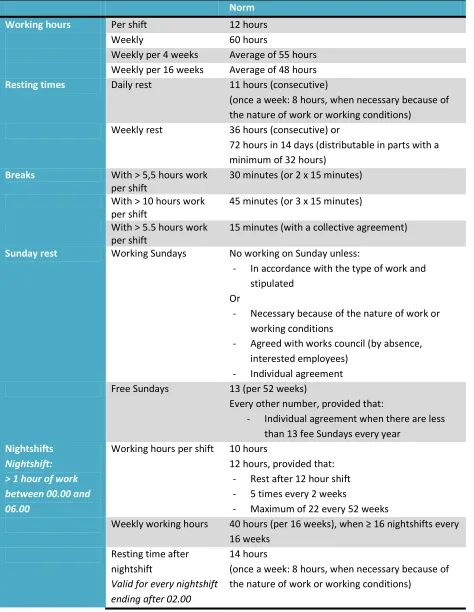
To prevent employees from being exploited, the government has restrictions on several subjects regarding work schedules. When these restrictions are validated, there are precautions the in the form of a fine (with a maximum of €11.250 for a person and €45.000 for a corporation) or a criminal prosecution (Ministerie van Sociale Zaken en Werkgelegenheid, 2010).
13 Table 3: Overview of the “arbeidstijdenwet”
Norm
Working hours Per shift 12 hours
Weekly 60 hours
Weekly per 4 weeks Average of 55 hours Weekly per 16 weeks Average of 48 hours
Resting times Daily rest 11 hours (consecutive)
(once a week: 8 hours, when necessary because of the nature of work or working conditions)
Weekly rest 36 hours (consecutive) or
72 hours in 14 days (distributable in parts with a minimum of 32 hours)
Breaks With > 5,5 hours work
per shift
30 minutes (or 2 x 15 minutes) With > 10 hours work
per shift
45 minutes (or 3 x 15 minutes) With > 5.5 hours work
per shift
15 minutes (with a collective agreement)
Sunday rest Working Sundays No working on Sunday unless:
- In accordance with the type of work and stipulated
Or
- Necessary because of the nature of work or working conditions
- Agreed with works council (by absence, interested employees)
- Individual agreement Free Sundays 13 (per 52 weeks)
Every other number, provided that:
- Individual agreement when there are less than 13 fee Sundays every year
Nightshifts Nightshift: > 1 hour of work between 00.00 and 06.00
Working hours per shift 10 hours
12 hours, provided that: - Rest after 12 hour shift - 5 times every 2 weeks
- Maximum of 22 every 52 weeks
Weekly working hours 40 hours (per 16 weeks), when ≥ 16 nightshifts every 16 weeks
Resting time after nightshift
Valid for every nightshift ending after 02.00
14 hours
14 Resting time after ≥
nightshifts
46 hours Maximum length series
When a minimum of one in that series is a
nightshift
7
8, when there is a collective scheme
Maximum number
For nightshifts ending after 02.00
- 36 nightshifts per 16 weeks - 140 nightshifts per 52 weeks
- 38 hours between 00.00 and 06.00 every 2 serried weeks
Consignment Consignment
prohibitation
- 14 consignment free days every 4 weeks - 2 x 2 days every 4 weeks no consignation and
no labor Working hours per 24
hours
13 hours Working hours per week
in case of nightly consignment
Applies when per 16 weeks 16 times or more consignment is imposed between 00.00 and 06.00
- Average of 40 hours (per 16 weeks) Or
- Average of 45 hours (per 16 weeks), if: - 8 hours continuous rest before a new shift
starts (in case of last call between 00.00 and 06.00)
Or
- 8 hours continuous rest in the 18 hours following 06.00 (when the last call was between 00.00 and 06.00 and was directly followed by a new shift)
Source: Ministerie van Sociale Zaken en Werkgelegenheid (2010).
2.2.5. Predictability
Regular work schedules are highly predictable. Workdays are always the same and during the day (STV Innovatie & Arbeid, 2005; FNV Bondgenoten, 2009b), for example a 9 to 5 workday. Irregular work schedules do not per se have to be less predictable. When someone is working shifts in an organization that uses repeating work schedules, the employees know beforehand when they have to work. A work schedule is predictable when appointments can be made in the long term (FNV Bondgenoten, 2009b).
Employee perspective
15 has to be available is arranged in the collective labor agreement. When this is not arranged, the law provides a safety net. It states that by absence of a collective labor agreement, the schedule has to be available 28 days beforehand. When this is not possible due to circumstances, only the resting times have to be available (Arbeidstijdenwet, Artikel 4.2, 2014).
Organizational perspective
So a predictable work schedule is preferred. But what if the environment gets disrupted? Organizations work most of the time with long term schedules when planning their employees into different shifts. But when there are certain influences that make it impossible or unwise to stick to the original schedule, changes have to be made (Bard & Purnomo, 2005). The schedule has to be modified to match the real-time situation to deal with changes in demand or resources (Hur, Mabert & Bretthauer, 2004). Examples of change in resources are absenteeism or equipment failure (Bard & Purnomo, 2005). Mismatch between capacity and demand is expensive, but changing the schedule also costs money. It is important to keep the changes between the published schedule and the realized schedule to a minimum. Not only because that is cheaper, but also because there is a change in preference from ‘keeping the wishes of the employees in mind’, to ‘how can the schedule fit the demand’ (Bard & Purnomo, 2005). There has been done a lot of research to invent models that minimize the need for changes in a schedule (e.g.Clarke, 1998; Bard & Purnomo, 2005). A solution to minimize changes in a schedule is robust planning. With robust planning, the schedule is more resistant to disruptions. The disruptions are calculated to happen, before they happen. One way of robust planning is increasing the absorbing capacity of the schedule. A second way of robust planning is increasing the recovery capacity of the schedule (Jespersen-Groth et al., 2009). In conclusion, it is not beneficial for the employer or for the employee that schedules change. Therefore, the less schedules have to change, the better they are.
Customer perspective
The theory of Maslow can also be applied to the customers’ view of predictability. The basic safety need, security is applicable here (Gleitman, Reisberg & Gross, 2007). When, for example an elderly woman needs caring, and hires an organization to care for her at home, she might feel safer when she has a limited number of caregivers who help her in and out of her bed than when there is a new person every day. These customers might prefer a predictable schedule with few changes.
2.2.6. Finance
Organizational perspective
16 (Browne, 1997). Overstaffing gives extra expenses and understaffing leads to a lower quantity or quality and gives the impression that the customer needs are not important (Adenso-Díaz, González-Torre & García, 2002). So it is important to strive for a perfect match between capacity and demand to minimize costs and maximize quality. Not only should there be thought off demand when making a schedule, also when hiring employees. When there is not enough work to let all the employees work all their contract hours, organizations are still legally obligated to pay the employees their normal fee, as if they had worked all their contract hours (Burgerlijk wetboek, Artikel 7:628, 2014). A planner should pay attention that all the contract hours are worked, before giving other employees extra hours.
Second, a bit related to the previous factor, overtime should be minimized. Though there is no legal obligation in the Dutch law to pay overtime or additional payment, in a lot of collective labor agreements it is discussed and there are agreements that indicate additional payment on top of the regular hourly wages (e.g. Collectieve Arbeidsovereenkomst voor het Technisch Installatiebedrijf, 2011; Collectieve Arbeidsovereenkomst voor het Beroepsgoederenvervoer over de weg en de verhuur van mobiele kranen, 2012; HEMA CAO, 2013; Collectieve Arbeidsovereenkomst voor de Bouwnijverheid, 2013). This leads to the conclusion that in a lot of cases overtime is more expensive than regular time, so if one strives to a schedule that is financially attractive, overtime must be minimized.
Third, also not legally determined, but discussed in collective labor agreements, is additional pay with non-standard working hours. There are some individual boundaries, but in a lot of collective labor agreements, there are regulations for additional pay for working non-standard working hours (e.g. collectieve arbeidsovereenkomst voor het Technisch Installatiebedrijf, 2011; Collectieve Arbeidsovereenkomst voor het Beroepsgoederenvervoer over de weg en de verhuur van mobiele kranen, 2012; HEMA CAO, 2013; Collectieve arbeidsovereenkomst voor de Bouwnijverheid, 2013). This leads to the conclusion that in a lot of cases, scheduling non-standard working hours is more expensive than scheduling standard working hours. When possible, non-standard working hours should be avoided, or expensive employees should be avoided in these shifts.
2.3. Conclusion
A literature study is performed to find out how the guidelines to the tool must be structured and what the content should be. When making the guidelines to a tool, the characteristics a tool must have should be taken into account. A tool must be functional, reliable, usable, efficient, maintainable and portable. When designing this research, the tool examples mentioned in section 2.1 can be combined. A part of the Practice Guidelines Development Cycle can be used to develop the criteria that are on the basis of the present guidelines. The steps that can be used are: generate evidence-based recommendation, ratify evidence-based recommendation, and formulate practice guidelines.
17 As mentioned in section 2.2, the content structure will be formed after the example of the School-Wide Evaluation tool. Six different categories are formed: work-life balance, flexibility, health, legal regulations, predictability and finance. These categories will contain several criteria that can be used to evaluate a work schedule. The categories are still very broad. There have to be made a few choices regarding the information that will be used. With the help of the interviews and the possible software constraints provided by Integral, the information will be specified to be able to use it in a tool.
18
3.
Methodology
3.1. Research design
As mentioned before, this research is a design oriented research. It follows the design cycle containing: first hunch, requirements, structural specifications, prototype, implementation and evaluation. The design cycle is presented in Figure 1 on page 7. The first hunch phase was already described in chapter 1. Integral commissioned this research and on that basis a research goal was formulated. The requirements phase started with the literature study and was completed with the interviews. In the structural specifications phase, a first draft of the design was made. Then prototype was made to be able to implement the design in a pilot study. Last, the pilot study was evaluated and a final proposal was drafted.
3.2. Interviews
To complete the requirements phase after the literature study, ten interviews were conducted.Five of these interviews were with scientific experts from different institutions that deal with scheduling problems on a regular basis or have done research on the matter. The scientific experts came from an employees’ organization (n=1), an employers’ organization (n=1), research institutes (n=2) and a consultancy bureau (n=1). This way, there was a view from the employees’ side, a view from the employers’ side and three general views. The scientific experts from the research institutes were doing research to the quality of work schedules around the time of the interviews. This means that they were up to date to the subject and could provide the present research with valuable and up to date information. The other three scientific experts were dealing with schedules as a part of their daily work. The interviews with the scientific experts took about one hour.
To also get a view from the work floor, five interviews were conducted with practitioners. These practitioners make, or used to make, personnel schedules for their organization. The practitioners were customers of Integral and came from different sectors: healthcare (n=1), production (n=2) and service (n=2). These interviews also took about one hour.
A few days before the interviews took place the interviewees received a brief document that contained some information about the subjects that would be discussed. This way, the interviewees had more time to think about the subjects and what they possibly could add to the interview. Prior to the interview it was asked if it was possible that the interview was recorded and that the information given in the interview was allowed to be published. When the interviews were typed, the interviewees received the output of the interviews so that they could check the output given.
19 The interviews with the practitioners were structured the same way as the interviews with the scientific experts. The only difference is that these interviews had an adapted interview scheme. This interview scheme, also in Dutch, can be found in Appendix B.
3.3. Data analysis
The data from the interviews was analyzed qualitatively. First, the interviews were transcribed, so the data could be analyzed easier. The interviews with the scientific experts were analyzed separately from the interviews with the practitioners. That is because the interviews had a different interview scheme, which caused the interviews to have a different structure, and also generated other information. The method that was used to analyze the transcribed interviews was open coding, as prescribed by Boeije (2005). The program Atlas.ti 7.0 is used in this process. This program allows the user to mark entries and code them. Multiple codes can be given to an entry, and text can be selected more than one time, so sentences can be used in different entries. The codes used were generally based on the findings in the literature. The categories from the literature section (work-life balance, flexibility, health, legal regulations, predictability and finance) were used to indicate what the entry was generally about. Because there could be given multiple codes to one entry, it was also indicated what the topic within the category was. When the entry contained new information that could not obviously be related to one of the categories it got a new code that was not related to any category. Next to that, there was indicated if the entry had relevance for the employees, the organization or the customer. Last, there was differentiated if the entry was adding information to the literature study, or if it gave information regarding the weight of the different subjects or how to measure the subjects.
After the coding, the program could organize the entries so they were sorted by the codes given to them. This way, an overview of all the information of the different interviews was sorted by subject, actor, or type of information, depending on the selected codes. The information was studied, to see if there was information that could complement the literature review, and to sort the categories on importance. To do that, there was examined if there were general views that dominated, or if there were contradictions. After analyzing the interviews, the requirements phase was finished.
3.4. Design
In the execution of the structural specifications phase, the results from the interviews and the literature study were combined to formulate guidelines to develop a tool. These guidelines were formulated as a list of criteria that can be used to grade work schedules.
20 criteria will be assigned weights, but also the categories. This way, not all the categories have to have the same effect on the overall evaluation (Reinshagen, 2007). To be able to assign weights, the data has to give sufficient knowledge. When this is not the case, it is impossible to perform a MCA (Reinshagen, 2007). With regards to this research, there was not enough data to give a clear view and assign weights. That is why this process became the responsibility of the organizations that will use the tool.
3.5. Pilot study
The implementation phase is performed through a pilot study. Hevner et al. (2004) formulated several design evaluation methods: observational, analytical, experimental, testing and descriptive. The method used in the present research was testing, specifically functional testing. The testing is executed through a pilot test, to see if the formulated guidelines to develop a tool were built in a way that they can be used. The guidelines were taken to 3 organizations and periodically schedules were evaluated. The periods differed, depending on the schedule cycle the organization was using. The organizations were selected and had to fit a few criteria. They were customers of Integral and were using the planning software “Checks” (made by Integral), and the database had to be hosted by Integral, so an employee of Integral could obtain the output that was relevant to evaluate the schedule. The organizations came from 3 different sectors: logistics, government institution and healthcare.
21
4.
Results from the interviews
A total of ten interviews were conducted: five interviews with scientific experts and five interviews with practitioners from several organizations. Below are the results of these interviews. First, the results from the interviews with the scientific experts will be discussed and after that, the results from the interviews with the practitioners.
4.1. Interviews with scientific experts
In the interviews with the scientific experts the first question was what they thought were important influences on a work schedule. In general the information from the literature study was confirmed, but there were also a few additions made. First, an overview of different shift schedules. In general, there can be made a distinction between a continuous and a non continuous work schedule. With a continuous work schedule, the production is seven days a week, 24 hours a day. In this production time there are a lot of possibilities, but a five shift schedule is used a lot. In this work schedule employees work two mornings, two evenings and two nights, then they have four days off. Within this work schedule, variations can be made. For example, between the mornings and the evenings, the employee has one day off and at the end of the cycle, three days. With a non continuous work schedule, the production is only during the week. Depending on the production time that is needed, a two shift schedule or a three shift schedule can be applied. With the three shift schedule, the cycle repeats every three weeks. In these weeks, employees will work one week mornings, one week evenings and one week nights. This work schedule can be forwards or backwards rotating. The two shift schedule is built the same way as the three shift schedule, but there are no night shifts, which makes the scheduling cycle only two weeks. There are also organizations that have too much production for a three shift schedule, but not enough for a five shift schedule. For these organizations, a semi continuous work schedule can be an option. In this work schedule there is an additional day of production in the weekends (mostly on Saturdays) and this is a variant on the five shift schedule. There are a lot of other work schedules, but these are the most general. In general, a forwards rotating five shift schedule is seen as the healthiest for employees and a backwards rotating three shift schedule is seen as the most stressful for employees. But not all organizations can import a five shift schedule, because of their production size.
A second addition is that there is recently more focus on the employability of the employees. In current times of an aging population, there will be a lot more elderly employees in the near future. Especially in production, where the more stressful schedules are in place. On top of that, the retirement age is going up to 67. Because of these changes, there is a higher focus on the health of the employees.
“Especially working night shifts can be a seen as a large negative influence on health.”
22 able to perform other tasks, that not require nightshifts, employees can change to a task that has a smaller implication on their health. To achieve this, more flexibility has to be built in the work schedule, so employees are able to receive training, internally or externally.
Third, there is a belief that implementing flexibility in a lot of production companies is impossible. But other views on the matter say that it is possible.
“Well, I think that there is a lot more possible than they initially suggest.”
One only has to look different to the process. A possible solution can be that the work is assigned to the employees instead of employees to the work. This might not always be possible, but there could be more possible than is thought in the recent beliefs. An example can be that maintenance can be scheduled when there is a mechanic. Another example is when there are broken shifts; other tasks can be assigned to the employee to complete the time. Flexibility is more and more a factor that organizations have to take into account. The younger employees who came into the market recently, want more flexibility. It is of more and more importance. But young employees are not the only one who want flexibility. Also, older employees do. Because the younger employees move up and the older employees will grow from beneath, eventually all employees will want more flexibility. But it seems that change is a threshold for a lot of organizations to make work schedules more flexible. When people are used to something, they don’t want to change it. Not even when this change is supposed to make it better for them.
Some smaller additions to the literature are the following. In the literature workforce flexibility is namely related to the organization. But also the employee can benefit from this. The work will be less monotonous. Further, the aspect of finance is not only of importance to the organization. The employee is also influenced by finance. Not in the way the organization is, but with surcharges. These surcharges play a big role in the lives of a lot of employees and will influence the decision to work for example night shifts or not. But while surcharges are positively seen by the employees, organizations rather not have them. The last addition to the literature is that working weekends can be a constraint on the private life of employees. The preference is to have the weekends off. When that is not always possible, only working one day every weekend could be a solution, but this should be avoided. As much whole weekends off as possible should be an aspiration.
After the additions were made to the literature, the scientific experts were asked which aspects were the most important. In general, the scientific experts see flexibility as an aspect that is very important to the employees. Especially the influence on their own work schedule is mentioned.
“Employees have to have the idea that they can influence their schedule. That is important.”
23 Table 4: Overview of general aspects that influence the employees’ perspective, sorted by interview, held with scientific experts.
Interview 1 Interview 2 Interview 3 Interview 4 Interview 5
Most important
- Flexibility - Flexibility - Predictability - Finance
- Flexibility
Second place - Predictability - Predictability
- Finance
Last place - Health - Health - Health
“These days, there are arrangements that your health is bought off. You know it is not good for your health, but you agree with it, because you make that much more money.”
Table 4 gives an overview of the general aspects that influence the perspective of employees to whether a schedule is good or not. The aspects are sorted by importance, according to the interviews.
For the organizations, the scientific experts do not have a general overall view. One expert says that finance is one of the most important aspects. Another says that it is the last step. A view that is generally accepted is that health is of more and more importance to the organization. This is due to the previously mentioned aging population and the up going retirement age. Within the health aspect, the most important factor seems to be nightshifts. These shifts have the most negative influence on the health of employees. Table 5 gives an overview of the general aspects that influence the perspective of organizations to whether a schedule is good or not. The aspects are sorted by importance, according to the interviews. The customer was not mentioned a lot. But when mentioned, the scientific experts agreed that customers want a high quality product, at a low rate, when they need it. This means that flexibility is important, no mistakes have to be made and the production costs have to be low.
[image:31.595.67.534.645.726.2]Last, the scientific experts were asked how the different aspects could be measured. A few suggestions were made. Within the health aspect, the number of night shifts can be measured. This can be in different settings, different nightshifts in a row or different nightshifts in a year. The optimum is 0, but advised is not more than 2 in a row. Also early arrival can be measured. Advised is to not schedule arrival times earlier than 07.00 AM. Another factor is the forward or backward rotation of the schedule. When looking at flexibility for the employees, there were a few suggestions to the measurement of the influence of a schedule. There can be made a distinction to individual and collective influence. With the Table 5: Overview of general aspects that influence the organizations’ perspective, sorted by interview, held with scientific experts.
Interview 1 Interview 2 Interview 3 Interview 4 Interview 5
Most important - Finance - Law - Health - Finance - Flexibility - Predictability
Second place - Flexibility
- Health
- Law - Health
24 individual influence, there are three types of influence. The first is influence on the amount of work hours. This influence takes place with the realization of the contract, so this is not of importance to this research. The second influence is the influence on the long term schedule. The third influence is the influence on the short term. Can there be made changes in the short term to fit the needs of employees? Or can employees refuse working overtime?
The financial aspect seen from the organization can be measured from the costs of a schedule. This means the total amount of salary that will be paid in that period. A specific number can be set, for example the mean of schedule costs made in the last year, corrected for inflation. When the costs are below this number, it is a good financial schedule and when the costs are above this number, it is a bad financial schedule.
4.2. Interviews with practitioners
25 Third, the practitioners were asked what they thought were the most important influences on a work schedule, seen from employees and organizations. When looking at the influences that are important to the employees, flexibility, and work-life balance are mentioned as important aspects. With regards to flexibility, the practitioners did not agree about the way that employees had to influence their schedule. Especially self scheduling was not positively seen by every practitioner. This may be related to their own experiences. The positive view came mostly from practitioners in organizations that already know more about the matter.
“Eventually self scheduling, that would be the ultimate form.”
The negative view came mostly from practitioners in organizations that know little about self scheduling and give their employees little or no influence on their schedule.
“Take it from me, it isn’t going to work. Then a war will break out. Because someone is going to say: but you are always that day off.”
The step to complete self scheduling in the last case may be too big. When looking at the financial aspect, employees seem to be willing to “buy off” their health when receiving surcharges.
“People think of one thing: money.”
This means that employees rate financial compensation higher than health. Another aspect mentioned is predictability. According to several practitioners, it is important to the employees to know when they have to work. They also thought that employees do not care as much about their long term health. One of the practitioners thought that could be because they could not feel it instantly. And when they feel that their health was going down, they cannot relate it to their work schedule. Table 6 gives an overview of the general aspects that influence the perspective of employees to whether a schedule is good or not. The aspects are sorted by importance, according to the interviews.
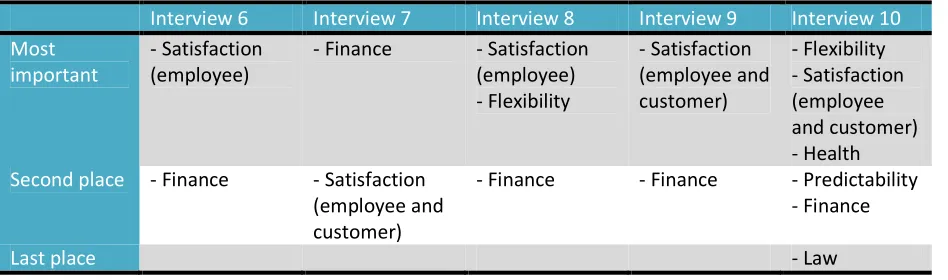
What most practitioners saw as the most important influences for the organization were satisfaction and flexibility. Health was also mentioned. The law was not seen as a big influence, because it was easy to stay within the boundaries. What stood out was that the financial aspect was not seen as the most important, as long as the organization performed well. When this was not the case, the practitioners thought that the financial aspect would play a larger role. The organization of one of the practitioners saw that it was not performing as well as it used to. To make sure the company stayed healthy, they had a reorganization. In this reorganization, the schedule and the scheduling process changed. This is the Table 6: Overview of general aspects that influence the employees’ perspective, sorted by interview, held with practitioners.
Interview 6 Interview 7 Interview 8 Interview 9 Interview 10
Most important - Flexibility - Predictability - Finance - Work-life balance - Work-life balance - Flexibility
- Work life balance - Flexibility
- Flexibility
[image:33.595.66.531.651.723.2]26 Table 7: Overview of general aspects that influence the organizations’ perspective, sorted by interview, held with practitioners.
Interview 6 Interview 7 Interview 8 Interview 9 Interview 10
Most important
- Satisfaction (employee)
- Finance - Satisfaction (employee) - Flexibility
- Satisfaction (employee and customer)
- Flexibility - Satisfaction (employee and customer) - Health
Second place - Finance - Satisfaction
(employee and customer)
- Finance - Finance - Predictability - Finance
Last place - Law
organization mentioned earlier, where the employees previously had more influence on the schedule than they now have, because the organization now looks more at the financial aspect of a schedule than to the employee satisfaction. Their priorities have changed. This shows that there are different priorities for different organizations in different situations. Table 7 gives an overview of the general aspects that influence the perspective of organizations to whether a schedule is good or not. The aspects are sorted by importance, according to the interviews. The customer was also here not mentioned a lot. But when mentioned, also the practitioners agreed that customers want a high quality product, at a low rate, when they need it.
4.3. Conclusion
27
5.
Design
The original goal of this research was to formulate guidelines to a tool that can evaluate schedules. These guidelines would then be given a weight, because not all guidelines may be evenly important. But from the data, there was not enough information available to assign the weights and the information that was available, was contradicting. Also, there was an example that suggested that there may be different situations that ask for different weights. Besides that, not all criteria are of importance to all situations. When there are no nightshifts, it is not important to know if they have an impact on the health of employees. That is why the design is slightly changed.
5.1. First design
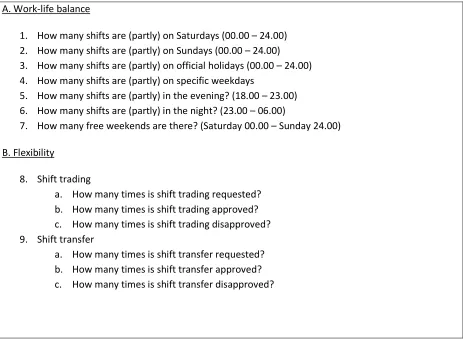
The guidelines are presented as a list of criteria. These criteria are based on the information found in the literature and the interviews. A choice had to be made regarding the extent of information that is applicable in practice to evaluate a work schedule. In consultation with Integral, the choice is made to only include criteria from which the output can be retrieved from the actual schedule. The criteria are formulated in a way that most of the needed output could be made available by Checks, the scheduling software of Integral. The criteria are also formulated to get the total amount per schedule. When relevant, the mean per employee can be calculated. To see if there is an evenly distribution among the employees, the standard deviation can be calculated to see how much spreading there is between the employees.
The criteria are divided under the categories that are presented in the literature study: work-life balance, flexibility, health, legal regulations, predictability and finance. In the category “work-life balance”, criteria are formulated that are about the general wishes of employees. When these wishes are granted, employees should in general be able to combine their work with their personal life. In the category “flexibility”, criteria are formulated regarding the influence of the employees on their work schedule and the capability of a schedule to cope with emergencies. In the “health” category, the health of the employees is taken into account. This can be physical health, but also the capability of the employees to work when they get older and may not be able to perform heavy physical work. This is why the employability of employees is categorized in “health”. In the category “legal regulations”, the criteria indicate the categories in the “arbeidstijdenwet”, the law regarding working hours. In the category “predictability”, the changes that are made to the published schedule are measured. In the last category, “finance”, are all criteria that relate to financial results. The criteria can be found in Appendix C. Because the guidelines will be used in the Netherlands, the criteria are translated in Dutch. The Dutch criteria can be found in Appendix D.
Organizations have to follow a few steps before they are able to use the criteria to evaluate their work schedules. The steps are explained below but can be summarized as:
Step 1: Select criteria