The link between work related basic need satisfaction and
subjective well-being in the residential care
Tim Junge
University of Twente
Faculty of Behavioural, Management and
Social sciences (BMS)
Supervisors:
Noortje Kloos (MSc)
Abstract
Objective: The main objective of this study was to investigate the link between satisfaction of
the need for autonomy, competence and relatedness at work as proposed by self-determination
theory and subjective well-being among nurses in the residential care. Furthermore, it tested
whether balanced satisfaction of the work related needs has a connection with well-being.
Methods: The design of this study was by questionnaire survey, taken in four different nursing
homes in the Netherlands. 121 members of the nursing staff participated in this study,
answering three questionnaires measuring the work related needs, satisfaction with life and
positive and negative affect. The absolute differences between the need satisfaction scores
were summed to create a score that represents balance among the needs.
Results: The analysis confirmed the theory of STD. Need satisfaction was related to
subjective well-being. Furthermore, each need was particularly important for one part of
subjective well-being. Relatedness related most strongly to satisfaction with life, competence
to positive affect and autonomy was related to less negative affect. The needs were nearly
perfectly balanced among this sample. Balanced need satisfaction and well-being were not
correlated with each other.
Conclusion: Although this study was not able to support the link between balanced need
satisfaction and well-being, each need was related to a specific part of well-being and should
Introduction
Mental health is an important issue for workers in the health care sector. The absence of mental health not only leads to psychological ill-being among the health care providers but this ill-being also impairs the quality of care due to lowered functioning (Gärtner,
Nieuwenhuijsen, van Dijk, & Sluiter, 2010; Letvak, Ruhm, & McCoy, 2012). This study focused on nurses in residential care as a target group because this sector probably faces the biggest increases in demand with a constantly aging population and increases in degenerative diseases like dementia (Lokkerbol, & Smit, 2013; CSHA, 1994). There is a great need for these nurses who are essential for the quality of care in residential care (Kayser-Jones, 1989). Mental ill-being of nurses leads to general and medication errors, less patient safety and less patient satisfaction (Gärtner et al., 2010).
Mental health as defined by the world health organization (WHO, 2014) is ‘a state of well-being in which every individual realizes his or her own potential, can cope with the normal stresses of life, can work productively and fruitfully, and is able to make a
contribution to her or his community’. This definition highlights the importance of not only the absence of psychological ill-being but the existence of the positive dimension of
well-being which enables people to cope effectively with their environment. This
regular retirement age of 65 due to dissatisfaction and high pressure at work. This is
particularly alarming considering there is a constantly rising demand for nurses in our modern society (Lokkerbol, & Smit, 2013).
This study used the construct of subjective well-being to assess the well-being of nurses. This construct measures both positive and negative affect as well as overall life satisfaction (Diener, 1984). The idea behind this construct is that the individual evaluates the worthiness of one’s life.
This study aimed to assess subjective well-being in the context of self-determination theory developed by Ryan and Deci (2000). According to this theory, basic psychological needs are basis for human flourishing and well-being. The fulfilment of innate psychological needs is the key to feeling intrinsically motivated, self-regulation and well-being that, among others results, is effective coping with stressful events. Van den Broeck, Vansteenkiste, de Witte, Soenens and Lens (2010) applied the three basic psychological needs of autonomy, competence and relatedness to the workspace. Autonomy describes the degree to which one feels free to schedule and determine the procedures to carry out certain tasks. The worker can feel autonomous even in cases of relying on others as long as he/she is provided with
meaningful reasons to work in a certain manner (Soenens et al., 2007). Competence refers to the effectiveness of one’s interaction with the environment. Competent people feel capable to engage and learn from challenging tasks and adapt to changing environments. Relatedness describes the need for belongingness and connectedness with others. Related individuals feel that they are part of a community at work and have meaningful relationship within that workspace. According to self-determination theory (Ryan & Deci, 2000), all three needs are fundamentally important for well-being, and they may be compared to nutrients that create
one of the needs causes significant constraints in well-being. Although work related need satisfaction has been widely researched and the link to well-being has been confirmed multiple times (Baard, Deci, & Ryan, 2004; Gillet, Fouquereau, Forest, Brunault, & Colombat, 2012; Van den Broeck et al., 2010), the unique relation of work related need satisfaction and subjective well-being has not yet been researched in a nursing setting. Identifying a need to be particularly important for the well-being of nurses can act as an indicator for future well-being interventions in this sector. In accordance with this theory the first two hypotheses for this research were:
1. Work related basic need satisfaction is positively related to subjective well-being.
2. Each basic need has a unique positive relation to subjective well-being.
This nutrient metaphor further applies to the balance hypothesis from Sheldon and
Niemiec (2006, 2009) which was also tested for in this study. The hypothesis states that
satisfying the three needs equally effects subjective well-being more positively than the same
total satisfaction but with unequally satisfied needs. In their study Sheldon and Niemiec
(2009) showed that balance among the needs had unique positive relation with well-being,
independent of need satisfaction. The concept relates back to the nutrient metaphor: Not only
is every nutrient important for growth, but feeding the nutrients equally leads to greater
3. Balanced work related basic need satisfaction has a unique positive relation to well-being.
Methods
The design of this survey was a questionnaire survey, taken online via the survey platform
Qualtrics. The survey was taken with nurses from four different nursing homes, all of them
belonging to one care group. Participants were approached by the researcher via e-mail. Their
participation was rewarded with half an hour of work disbursed.
Participants
A total amount of 121 nurses took part in this survey. The nurses were all working with frail
older adults in four different nursing homes in the Netherlands. 116 participants were female
and 5 were men, which makes for a 24/1 ratio. Most of them were working as third level
nurses, working 17 and 24 hours per week on average. The age of the participants ranged
from 16 to 65, with an average age of 42 (SD = 12.1). Around 80 percent were living in a
relationship, sharing an apartment. Around three-quarter of these couples were raising
children. 8 participants’ parents had an immigrant background.
Material
This research was part of a bigger survey in which various questionnaires were filled in by the
participants. For this particular study, only the questionnaires testing subjective well-being
and work related need satisfaction were important and are discussed in the following section.
Well-being
In order to measure the subjective well-being of the participants, there were two
questionnaires taken. To measure the affective component of well-being the modified
The 16 items in this scale consist of a number of emotionally related terms like “loving,
affectionate, friendly”. Participants rated on a scale from 1 (not at all
) to 7 (very intense) how
much they related to these emotions in the past. Five items make up for the subscale of
positive affect (“joyful, happy, amused”) (Dibbets, & Evers, 2017). Another eight describe the
negative affect of a participant (“angry, irritated, mad”). Together, these 13 items make for the
affective well-being. There are three more items describing general arousal that were not used
for further analysis. Negative affect showed a good reliability with a Cronbach’s alpha of .84.
The subscale for positive affect showed only the minimum reliability of .65. If the item
‘moved’ was deleted, reliability increased to .84 like the negative affect scale. The item was
still kept because a reliability of .65 is still acceptable and the theoretical concept shall not be
corrupted by deleting one out of four items.
The second scale measuring the cognitive part of well-being was Satisfaction with
Life Scale (SWLS; (Diener, Emmons, Larsen, & Griffin, 1985). This scale measured the overall life satisfaction with five items (“The conditions of my life are excellent.”). Participants rate their agreement with the statements on a scale ranging from 1 (totally disagree
) to 5 (totally agree). This scale is very reliable with a Cronbach’s alpha of .90.
Need satisfaction
To measure need satisfaction at work, the Dutch Work Related Basic Needs Satisfaction Scale
(W-BNS; Van den Broeck et al., 2010) was taken. This scale consists of 18 items total, which
are rated on a scale from 1 (totally disagree
) to 5 (totally agree). Higher scores indicate a
higher need satisfaction. The 18 items are divided into three subscales consisting of six items
each. The need for autonomy makes the first subscale (e.g. “I feel free to do my job the way I
master my tasks at my job.”). The last subscale describes the need for relatedness (e.g. “At
work, I feel part of a group.”). There were means calculated for every subscale. All three
subscales showed to be reliable with alpha coefficient of .77 for autonomy, .74 for
competence and .73 for relatedness.
Balance hypothesis
In order to test for balance, there was a balance score calculated in line with Sheldon and
Niemiec (2006). The score indicates the difference among the three needs. First, there were
pairs formed of all possible need combinations (autonomy-relatedness;
autonomy-competence; competence-relatedness). The total difference among each pair was
summed with the other total differences which makes for a score ranging from 0 (equal need
satisfaction, perfect balance) to 8 (maximum imbalance among need satisfaction). The actual
score was subtracted from the maximum score of 8 with the result that a high score equaled
high balance in need satisfaction.
Analysis Plan
Mean replacement was used to treat single missing values among participants who completed
the survey apart from that one value. The value was replaced by the participant’s mean
response on that scale. According to the first hypothesis, need satisfaction is positively
correlated to subjective well-being. A correlation analysis was run in SPSS. The correlations
between each need satisfaction subscale and both the affect subscales and satisfaction with
life were analyzed. Correlation coefficients of r ≤ .
29 indicate a weak correlation, r ≤ .49 a
moderate one and r ≥ .
50 a strong correlation (Cohen 1988). To test the second and third
hypotheses, there were three multiple regression analysis conducted with each the three needs, autonomy, competence and relatedness, as independent variables and the two well-being
that each individual need has a unique relation with well-being when controlling for the other
two needs. First, the reliability of the calculated beta coefficients in this model were tested by
calculating variance inflation factors (VIF). Values above 10 indicated multicollinearity
among the independent variables and thereby unreliable beta coefficients (Alin, 2010). The
beta coefficients linked to VIF’s above 10 would be removed for the analysis. The third
hypothesis stated that balance among the needs has a unique relation with well-being,
independent of general need satisfaction. To test the hypothesis, the model from the second
hypothesis was re-conducted with the balance score added as another independent variable.
VIF’s above 10 again indicated multicollinearity and would have been removed.
Results
Descriptive statistics
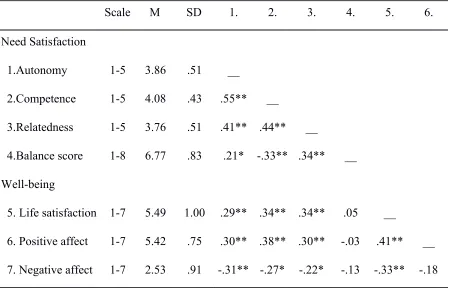
Table 1. contains the means and standard deviations of all three questionnaires and the
computed balance score, measuring the difference among the three need satisfaction scores.
First, the three needs exhibited high similarity. The needs autonomy (M =
3.86, SD = .51),
competence (M =
4.08, SD = .43) and relatedness (M = 3.76, SD = .51) had similar means
and standard deviations. This similarity can be observed in two further aspects: First, the
needs were moderately to strongly correlated with each other (r
= .41; r = .44; r = .55).
Second, the balance score had a very high mean (M =
6.77, SD = .83) with a maximum of 8,
which indicates that work related need satisfaction is very well balanced among respondents
in this sample. Looking further into the balance score, correlation analysis revealed on one
side that autonomy was weakly positive correlated (r
=.21) to balanced need satisfaction and
relatedness (r =
.34) moderately positive. On the other side, being competent was moderately
negative correlated (r =
Looking at well-being measurements, satisfaction with life and positive affect behaved very similarly in this sample. Both scales satisfaction with life (M =
5.49, SD = 1)
and positive affect (M =
5.42, SD = .75) were scored similarly high on the 7-point likert scale,
around 1.5 away from the maximum of 7. The two scales were also moderately related to each other (r =
.41). In contrast to the other two scales, negative affect scores were scored on the
other end of the 7-point likert scale (M =
2.53, SD = .91), even though they were around 2.5
away from the minimum. Correlating negative affect with satisfaction with life and positive affect, the analysis revealed satisfaction with to be significantly related only, with a moderate correlation (r =
[image:10.596.70.519.399.689.2] -.33).
Table 1. Means, standard deviations and correlations among the questionnaires
Scale M SD 1. 2. 3. 4. 5. 6.
Need Satisfaction
1.Autonomy 1-5 3.86 .51 __
2.Competence 1-5 4.08 .43 .55** __
3.Relatedness 1-5 3.76 .51 .41** .44** __
4.Balance score 1-8 6.77 .83 .21* -.33** .34** __
Well-being
5. Life satisfaction 1-7 5.49 1.00 .29** .34** .34** .05 __
6. Positive affect 1-7 5.42 .75 .30** .38** .30** -.03 .41** __
7. Negative affect 1-7 2.53 .91 -.31** -.27* -.22* -.13 -.33** -.18
*p < .
Hypothesis testing
Hypothesis 1.
The first hypothesis stated that need satisfaction has a positive relation with
subjective well-being. Table 1. showed that all three needs had a significant positive
correlation with all three parts of subjective well-being. Satisfaction with life and positive
affect showed similar strongly significant correlations with the three basic needs. Satisfaction
with life was weakly correlated with autonomy (r
= .29) and moderately correlated with
competence and relatedness (r
= .34). Positive affect was moderately correlated with
autonomy (r
= .30), competence (r = .38) and relatedness (r = .30). Negative affect was
negatively correlated to the needs. Besides being negative, the correlations were less strong than the correlations of satisfaction with life and positive affect with the needs. Competence and relatedness were weakly related to negative affect (r =
-.27; r = -.22). Autonomy had a
moderate relation to negative affect (r =
-.31). All three needs were significantly related to the
three well-being measurements. The first hypothesis was thereby confirmed.
Hypothesis 2.
The hypothesis stated that each need has a unique relation with
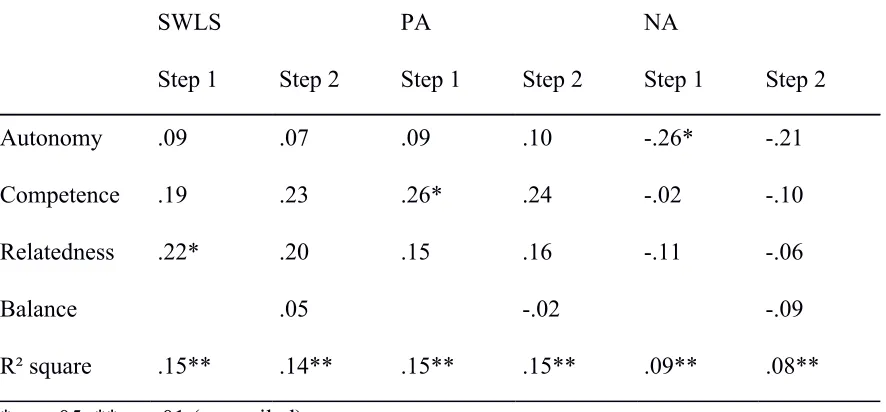
well-being. The multiple regression analyses in Table 2 under Step 1 show the models for this
hypothesis. All the VIF scores were below 3 which indicated that there was no
multicollinearity among the independent variables. The three needs made for 15 percent of the
variance in satisfaction with life and positive affect scores. The model for negative affect was
weaker with need satisfaction explaining 9 percent of the variance in negative affect.
Controlling for the other needs, each need was significantly unique related to one of the
well-being scales. The need for relatedness was uniquely positive related to satisfaction with
life, the need for competence with positive affect and autonomy negatively with negative
Table 2. Standardized coefficients beta from the multiple regression analysis of satisfaction with life (SWL), positive (PA) and negative affect (NA) on competence, autonomy and relatedness (Step 1) and the balance score (Step 2)
SWLS PA NA
Step 1 Step 2 Step 1 Step 2 Step 1 Step 2
Autonomy .09 .07 .09 .10 -.26* -.21
Competence .19 .23 .26* .24 -.02 -.10
Relatedness .22* .20 .15 .16 -.11 -.06
Balance .05 -.02 -.09
R² square .15** .14** .15** .15** .09** .08**
*p < .
05. **p < .01 (two tailed).
Hypothesis 3.
According to the third hypothesis, balanced need satisfaction would
predict well-being, independent of need satisfaction. Adding balance to the model, VIF‘s were
still below 3 for all three models. The analyses presented in Table 2. Step 2 showed that
balanced need satisfaction did not have a unique relation with any of the three subjective
well-being measurements. Interestingly, when balance was added to the model the beta
coefficients of competence increased especially for negative affect from Step 1 ( =
-.02) to
Step 2 ( =
-.10) while the other related even less to subjective well-being. Still, balanced
satisfaction of the needs did not have any uniquely significant relation with subjective
Discussion
This research first aimed to reconfirm the link between work related need satisfaction and
general subjective well-being in the context of SDT (Ryan & Deci, 2000). In line with earlier
research (Baard et al., 2004; Gillet et al., 2012; van den Broeck et al., 2010) there was a link
found between work related need satisfaction and general subjective well-being. All three
needs were found to be related to all three parts of subjective well-being. The three needs
were yet less strong related to negative affect than to the positive affect and satisfaction with
life. This is in line with earlier general need satisfaction research among residents in the
geriatric care (Custers, Westerhof, Kuin, & Riksen-Walraven, 2010; Kloos et al., 2018) that
found the link between general need satisfaction and negative affect to be less strong than the
link with satisfaction with life.
Looking at unique relations, nurses in the residential care felt particularly satisfied
with life when they felt related to their colleagues at work. This might be due to the fact that
being a nurse is a very social job in general. People with this career might define their
satisfaction with life more in the light of their relationships. In that sense, nurses would feel
more satisfied with life when they were related to their colleagues at work. Nurses who felt
competent at work also felt more positive emotions. That might be because positive affect and
success are closely related to each other (Lyubomirsky, King, & Diener, 2005). The authors found that not only lead the experience of positive emotions to success but the effect exists the other way round as well. Ruble, Dalrymple and McGrew (2012) explain in their book that success leads to a feeling of competence which might explain the correlation between
would also experience fewer negative emotions. Stress and burn-out research at work
indicated that autonomy is a key factor in reducing stress and preventing burn-out (Karasek et al., 1998; Bakker, Demerouti & Euwema, 2005; Constable & Russell, 1986). As stress is closely related to negative affect (Watson, Clark, & Tellegen, 1988), that might be a possible explanation that nurses who feel autonomous at work also experience less negative emotions.
Last, this study aimed to test the balance hypothesis in a work setting. Balanced need satisfaction was not related to nurses well-being. It was still interesting that competence, which had a negative correlation with balance, became stronger related to well-being when the model controlled for balance. In contrast to this research, earlier research on balance was able confirm the link between balance and well-being(Sheldon & Niemiec, 2006; Sheldon et al., 2009; Kloos et al., 2018). Yet, the balance scores in this particular sample were very high with little variance. The fact that nurses had very little variability in their need satisfaction profiles might have led to the result that the relation was not measurable in this sample.
Earlier literature (Vallerand, 1997; van den Broeck et al., 2010) discussed the mixture of general and domain specific measurement tools in SDT research. They found that work related need satisfaction is less strongly related to general well-being than to the more domain specific work related well-being. The models built from two domain specific measurement tools will be a lot stronger as there are less other variables explaining the variance of well-being.
with clients, the scale might has to be adjusted so that it also includes the relationship with clients that might add to the feeling of relatedness.
The last weakness concerns the modified differential emotions scale (mDes) that was used to measure both positive and negative affect in this study. The subscale for positive affect consisted of five items. The item ‘moved’ impaired the internal consistency of the scale and the scale was a lot more reliable without it. It was kept because the scale was still
acceptably reliable with it and the theoretical construct should not be decreased by taking out one out of five items. This still raises questions of the usability of this particular subscale.
Despite the limitations, this study provides knowledge about the well-being and the role of the basic psychological needs within the workspace of nurses in the residential care. It was the first to test the unique relation between the work related needs and the general
subjective well-being of nurses in the residential care. Furthermore, it was the first time that the relation of balanced need satisfaction and well-being was tested within the work field. The outcomes provide implications for both further research in the field of self-determination theory (Ryan & Deci, 2000) and the application at work in the residential care to enhance nurses’ well-being. Further research needs to investigate whether the very high balance scores that were found come forth due to this specific caregiver sample, or because the construct of
work related need satisfaction is more balanced than the general need satisfaction.
Furthermore, it should be considered to use work related well-being scales to create stronger
models whose results are more reliable.
This research showed that every work related basic psychological need has a
significant role in one component of nurses’ well-being. In practice, management in
Supportiveness of the management plays a major role in strengthening the need for autonomy
in nursing homes (Karlsson, Ekman, & Fagerberg, 2009; Mrayyan, 2004). Karlsson and
colleagues state that listening to the nurses and providing supervision and competence
development plays a key role in the development of autonomy. The need for competence is
not just about skills but also about the feeling of the individual to be able to tackle the tasks at
work (Van den Broeck et al, 2010). As a consequence, a workload that exceeds the resources
of a nurse leads to lowered satisfaction of the need for competence. Seeing that a very high
workload is a widespread issue in healthcare sector (Aiken, 2002; Leiter & Maslach, 2009; Lu, While, & Barriball, 2005), employing enough staff is essential to keep the individual workload at tolerable level so that the individual can feel competent.
This study has shown that the three basic psychological needs of autonomy,
competence and relatedness play an important role in the well-being of nurses in the
residential care. Seeing that there is a constantly rising demand for nurses (Lokkerbol, & Smit, 2013), it should be a central consideration of nursing home management to support the three basic needs among today’s nursing staff to keep nurses healthy, prevent turn-over and
References
Aiken, L. H. (2002). Hospital Nurse Staffing and Patient Mortality, Nurse Burnout, and Job Dissatisfaction. JAMA: The Journal of the American Medical Association
.
https://doi.org/10.1001/jama.288.16.1987
Alin, A. (2010). Multicollinearity. Wiley Interdisciplinary Reviews: Computational Statistics
.
https://doi.org/10.1002/wics.84
Baard, P. P., Deci, E. L., & Ryan, R. M. (2004). Intrinsic Need Satisfaction: A Motivational Basis of Performance and Weil-Being in Two Work Settings1. Journal of Applied Social Psychology
. https://doi.org/10.1111/j.1559-1816.2004.tb02690.x
Bakker, A. B., Demerouti, E., & Euwema, M. C. (2005). Job resources buffer the impact of job demands on burnout. Journal of occupational health psychology
, 10(2), 170.
Cohen, J. (1988). Statistical power analysis for the behavioral sciences. 2nd.
Constable, J. F., & Russell, D. W. (1986). The effect of social support and the work environment upon burnout among nurses. Journal of human stress
, 12(1), 20-26.
Custers, A. F. J., Westerhof, G. J., Kuin, Y., & Riksen-Walraven, M. (2010). Need fulfillment in caring relationships: Its relation with well-being of residents in somatic nursing
homes. Aging and Mental Health
. https://doi.org/10.1080/13607861003713133
Dibbets, P., & Evers, E. A. (2017). The influence of state anxiety on fear discrimination and extinction in females. Frontiers in psychology
, 8, 347.
Diener, E. (1984). Subjective well-being. Psychological Bulletin,
95(3), 542.
Diener, E., Emmons, R. A., Larsen, R. J., & Griffin, S. (1985). The Satisfaction With Life Scale. Journal of Personality Assessment
. https://doi.org/10.1207/s15327752jpa4901_13
Dysvik, A., Kuvaas, B., & Gagné, M. (2013). An investigation of the unique, synergistic and balanced relationships between basic psychological needs and intrinsic motivation. Journal of Applied Social Psychology
. https://doi.org/10.1111/jasp.12068
Gärtner, F. R., Nieuwenhuijsen, K., van Dijk, F. J. H., & Sluiter, J. K. (2010). The impact of common mental disorders on the work functioning of nurses and allied health
professionals: A systematic review. International Journal of Nursing Studies
.
https://doi.org/10.1016/j.ijnurstu.2010.03.013
Gillet, N., Fouquereau, E., Forest, J., Brunault, P., & Colombat, P. (2012). The Impact of Organizational Factors on Psychological Needs and Their Relations with Well-Being. Journal of Business and Psychology
. https://doi.org/10.1007/s10869-011-9253-2
assessments of psychosocial job characteristics. Journal of occupational health psychology
, 3(4), 322.
Karlsson, I., Ekman, S. L., & Fagerberg, I. (2009). A difficult mission to work as a nurse in a residential care home–some registered nurses’ experiences of their work situation. Scandinavian Journal of Caring Sciences
, 23(2), 265-273.
Kayser-Jones, J. (1989). The environment and quality of care in long-term care institutions. NLN publications
, (20-2292), 87-107.
Kloos, N., Trompetter, H. R., Bohlmeijer, E. T., & Westerhof, G. J. (2018). Longitudinal Associations of Autonomy, Relatedness, and Competence with the Well-being of Nursing Home Residents. The Gerontologist
. https://doi.org/10.1093/geront/gny005
Leiter, M. P., & Maslach, C. (2009). Nurse turnover: The mediating role of burnout. Journal of Nursing Management
. https://doi.org/10.1111/j.1365-2834.2009.01004.x
Letvak, S., Ruhm, C. J., & McCoy, T. (2012). Depression in hospital-employed nurses. Clinical Nurse Specialist
. https://doi.org/10.1097/NUR.0b013e3182503ef0
Lokkerbol, J., & Smit, F. (2013). Versterken van Mentaal Kapitaal in de Zorg—Een
Strategische Verkenning (Enhancing Mental Capital in Care—A Strategic Exploration). Trimbos-instituut, Utrech
.
Lu, H., While, A. E., & Louise Barriball, K. (2005). Job satisfaction among nurses: A literature review. International Journal of Nursing Studies
.
https://doi.org/10.1016/j.ijnurstu.2004.09.003
Lyubomirsky, S., King, L., & Diener, E. (2005). The benefits of frequent positive affect: Does happiness lead to success?. Psychological bulletin
, 131(6), 803.
Maurits, E. E. M., de Veer, A. J. E., & Francke, A. L. (2012). Werkdruk en werktevredenheid van belang voor kunnen doorwerken tot pensioen. NIVEL. Retrieved from
https://www.narcis.nl/publication/RecordID/publicat%3A1002256
Mrayyan, M. T. (2004). Nurses’ autonomy: influence of nurse managers’ actions. Journal of advanced nursing
, 45(3), 326-336.
OL, O. (1994). Canadian Study of Health and Aging: study methods and prevalence of dementia. Can Med Assoc J
, 150(6).
Raab, K. (2014). Mindfulness, Self-Compassion, and Empathy Among Health Care Professionals: A Review of the Literature. Journal of Health Care Chaplaincy
.
https://doi.org/10.1080/08854726.2014.913876
Ruble, L. A., Dalrymple, N. J., & McGrew, J. H. (2012). Collaborative model for promoting competence and success for students with ASD
Ryan, R. M., & Deci, E. L. (2000). Self-determination theory and the facilitation of intrinsic motivation, social development, and well-being. The American Psychologist
.
https://doi.org/10.1037/0003-066X.55.1.68
Schaefer, A., Nils, F., Philippot, P., & Sanchez, X. (2010). Assessing the effectiveness of a large database of emotion-eliciting films: A new tool for emotion researchers. Cognition and Emotion
. https://doi.org/10.1080/02699930903274322
Sheldon, K. M., Abad, N., & Omoile, J. (2009). Testing Self-Determination Theory via Nigerian and Indian adolescents. International Journal of Behavioral Development
,
33
(5), 451–459. https://doi.org/10.1177/0165025409340095
Sheldon, K. M., & Niemiec, C. P. (2006). It’s not just the amount that counts: Balanced need satisfaction also affects well-being. Journal of Personality and Social Psychology
.
https://doi.org/10.1037/0022-3514.91.2.331
Soenens, B., Vansteenkiste, M., Lens, W., Luyckx, K., Goossens, L., Beyers, W., & Ryan, R. M. (2007). Conceptualizing parental autonomy support: Adolescent perceptions of promotion of independence versus promotion of volitional functioning. Developmental Psychology
. https://doi.org/10.1037/0012-1649.43.3.633
Vallerand, R. J. (1997). Toward A Hierarchical Model of Intrinsic and Extrinsic Motivation. Advances in Experimental Social Psychology
.
https://doi.org/10.1016/S0065-2601(08)60019-2
Vandenbroeck, S., Vanbelle, E., De Witte, H., Moerenhout, E., Sercu, M., De Man, H., ... & Godderis, L. (2013). Een onderzoek naar burn-out en bevlogenheid bij artsen en verpleegkundigen in Belgische ziekenhuizen.
Van den Broeck, A., Vansteenkiste, M., De Witte, H., Soenens, B., & Lens, W. (2010). Capturing autonomy, competence, and relatedness at work: Construction and initial validation of the Work-related Basic Need Satisfaction scale. Journal of Occupational and Organizational Psychology
. https://doi.org/10.1348/096317909X481382
Watson, D., Clark, L. A., & Carey, G. (1988). Positive and Negative Affectivity and Their Relation to Anxiety and Depressive Disorders. Journal of Abnormal Psychology
.
https://doi.org/10.1037/0021-843X.97.3.346
Watson, D., Clark, L. A., & Tellegen, A. (1988). Development and validation of brief measures of positive and negative affect: the PANAS scales. Journal of personality and social psychology
, 54(6), 1063.
WHO. (2014). Mental health: a state of well-being. WHO
. Retrieved from