1
How can MedTech start-ups overcome the
second Valley of Death?
A holistic multiple case study to identify factors that potentially affect
the duration of the commercialization phase of MedTech start-ups that
focus on exploiting new & innovative medical devices.
Master Thesis Business Administration
Specialization: Entrepreneurship, Innovation & Strategy
Faculty of Behavioural, Management and Social Sciences
Bram Gerhardus Jacobus ten Bok
S1501666
Contact e-mail: [email protected]
First supervisor:
PD Dr. Rainer Harms
Second supervisor:
Dr. Tamara Oukes
External supervisor:
Jurgen Kruiper
In cooperation with:
Oost NL
2
Preface
This thesis represents months of blood, sweat and tears (sometimes of joy), ups, downs, and everything in between. It represents the personal growth from a young student towards a young professional. Finishing this thesis means that an ‘era’ has come to an end and that a new part of my life is about to start. Before moving on to the thesis itself, I would first like to thank a couple of people. First, I would like to dedicate this Master Thesis to my father, who showed me that giving up is never an option for a ten Bok to consider. Second, I would like to thank the rest of my family and friends for supporting me for the past 8 months when things were quite rough. Third, I would like to thank my internal supervisors, PD Dr. Rainer Harms and Dr. Tamara Oukes for their time and feedback. And last, but certainly not least, I would like to specifically thank my external supervisor Jurgen Kruiper and all my other colleagues at Oost NL who made me feel more than welcome during my stay and gave me the opportunity to improve my professional capabilities.
B.G.J. ten Bok
3
Glossary
Clinician:A clinician is a health care professional that works as a primary care giver of a patient in a
hospital, skilled nursing facility, clinic, or patient's home. A clinician diagnoses and treats patients. https://en.wikipedia.org/wiki/Clinician
End-user:in line with the literature of Shah & Robinson (2009), the researcher often refers to the patient as
‘end-user’.
CE-marking:The letters ‘CE’ appear on many products traded on the extended Single Market in the European
Economic Area (EEA). They signify that products sold in the EEA have been assessed to meet high safety, health, and environmental protection requirements. When you buy a new phone, a teddy bear, or a TV within the EEA, you can find the CE mark on them. CE marking also supports fair competition by holding all companies
accountable to the same rules. https://ec.europa.eu/growth/single-market/ce-marking_nl
Clinical study (trial): are research studies performed in people that are aimed at evaluating a medical, surgical,
or behavioral intervention. They are the primary way that researchers find out if a new treatment, like a new drug or diet or medical device is safe and effective in people. Often a clinical trial is used to learn if a new treatment is more effective and/or has less harmful side effects than the standard treatment.
https://www.nia.nih.gov/health/what-are-clinical-trials-and-studies
Holistic case study:a case study in which the researcher looks at the entity of interest as a whole and does not
focus on specific sub-units as objective of analysis (Yin, 2003).
Lead-user:in line with the literature of Shah & Robinson (2009), the researcher often refers to the clinician as
‘lead-user’.
Medical Technology:Medical technology can be considered as any technology used to save lives in individuals
suffering from a wide range of conditions. In its many forms, medical technology is already diagnosing, monitoring and treating virtually every disease or condition that affects us.
http://www.medtecheurope.org/what-is-medtech
Medical device:Medical device means any instrument, apparatus, implement, machine, appliance, implant,
reagent for in vitro use, software, material or other similar or related article, intended by the manufacturer to be used, alone or in combination, for human beings, for one or more of the specific medical purpose(s) of:
• diagnosis, prevention, monitoring, treatment or alleviation of disease, • diagnosis, monitoring, treatment, alleviation of or compensation for an injury,
• investigation, replacement, modification, or support of the anatomy or of a physiological process, • supporting or sustaining life,
• control of conception,
• disinfection of medical devices
• providing information by means of in vitro examination of specimens derived from the human body; and does not achieve its primary intended action by pharmacological, immunological or metabolic means, in or on the human body, but which may be assisted in its intended function by such means.
http://www.who.int/medical_devices/full_deffinition/en/
Operational cashflow break-even:The point at whicha firm's net cash inflow resulting directly from its regular
operations (disregarding extraordinary items such as the sale of fixed assets or transaction costs associated with issuing securities) is equal to the total amount of fixed and variable expenses.
https://www.nasdaq.com/investing/glossary/c/cash-flow-from-operations
https://study.com/academy/lesson/accounting-break-even-operating-cash-flow.html
4
Abstract
With over 12,200 patent applications filed with the European Patent Office and currently 27,000 active medical technology companies in Europe, one could say that the medical technology industry (€385bn in Europe) is not only practically relevant, but also economically (MedTech Europe, 2017). Nevertheless, the path towards successful commercialization is, compared to other industries, extremely long, complex and difficult. The speed at which a start-up is able to complete the stage from regulatory approval up to commercial success is not only very important for the entrepreneur, but it will also tell participating investors how soon, and if, they will be able to make a return on their initial investment. For MedTech start-ups this specific stage can be identified as what Wilson, et al. (2018) would describe as the ‘Second Valley of Death’. The alarming large variance in the length of this stage for MedTech start-ups, 1 to 10 years, indicates that this stage is a rather unclear and complex one that needs more investigation (Wijk, van. M., 2014). Chiesa & Frattini (2011) acknowledge this problem by stating that although the commercialization phase is a critical stage in the technological innovation process, it is still considered as the least well managed phase of the entire innovation process.
This study will specifically focus on MedTech start-ups that develop rather new and highly innovative medical devices. These devices are interesting, because these are the ones that are mainly plagued by complex reimbursement routes and time-consuming clinical tests. Furthermore, due to their innovativeness, it is also harder to establish acceptance of the clinician for these devices, than for devices that show similarities with existing solutions. Finally, it are specifically those new and innovative medical devices that seem to fall into the trap of the ‘Second Valley of Death’ and are facing a rather long commercialization trajectory.
In order to overcome the commercialization phase, more in-depth knowledge is needed on what factors play an important role during this stage and affect its duration. Therefore, the following research question will be addressed: “What factors affect the duration of the commercialization phase (from the point of adopting CE-marking up until the point of operational cash flow break-even) of MedTech start-ups that focus on exploiting new, innovative medical devices?” To put some more focus on this research, this study looked at the commercialization phase from two perspectives, namely that of investment professionals and that of healthcare(-related) professionals. Ultimately, the purpose of this study was to: (1) Build a conceptual model that visually represents the commercialization phase from the point of CE-adoption (regulatory approval) up until the operational cashflow break-even point (commercial success), (2) which is linked to the factors that according to the literature and experience of investment & healthcare(-related) professionals play an important role during this phase and (3)can serve as a guide for investors/entrepreneurs to successfully move through this phase without having to encounter unnecessary delay.
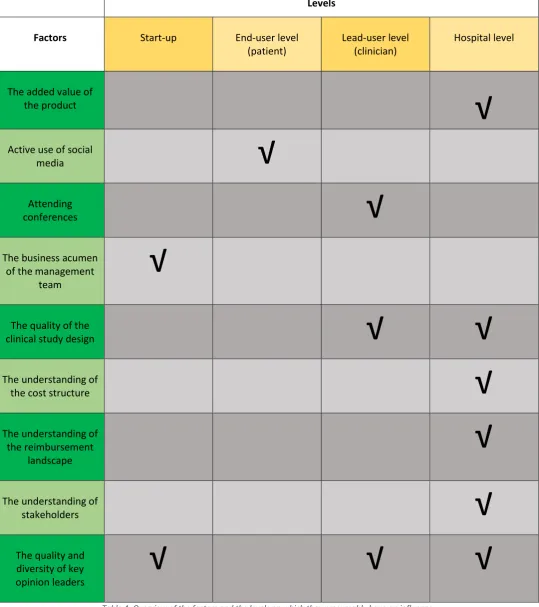
To answer this research question, the researcher first conducted an extensive systematic literature review on the topic of medical technology commercialization. Based on this systematic literature review, several propositions were initiated that form the foundation of this research. These propositions were subsequently used as a guideline for the 10 semi-structured interviews that followed. In total, 9 factors were found that could possibly affect the duration of the commercialization phase (from the point of CE-marking up until operational cashflow break-even), namely: the added value ; the active use of social media ; attending conferences ; the business acumen of the management team ; the quality of the clinical study design ; the understanding of the cost structure ; the understanding of the reimbursement landscape ; the understanding of stakeholders ; the quality and diversity of the key opinion leaders.
5
Table of contents
Preface ... 2
Glossary ... 3
Abstract ... 4
1. Introduction ... 7
1.1. Background & problem statement ... 7
1.2. Research goal, scope & question ... 8
1.3. Academic & practical relevance ... 9
1.4. Outline of the thesis ... 9
2. Theoretical Framework ... 10
2.1. Systematic literature review ... 10
2.1.1. Define ... 10
2.1.2. Search & Select ... 10
2.1.3. Analyze ... 11
2.1.4. Present ... 12
3. Methodology ... 15
3.1. Research Design ... 15
3.2. Selection ... 16
3.3. Data collection ... 18
3.3.1. Preparing the semi-structured interview ... 18
3.3.2. Conducting the semi-structured interview ... 19
3.3.3. Reliability & validity ... 19
3.4. Data analysis ... 20
4. Results ... 23
4.1. Timeline of commercialization ... 23
4.2. The product ... 26
4.3. Awareness ... 32
4.4. Management Team ... 39
4.5. Clinical study ... 42
4.6. Healthcare funding ... 44
4.7. Stakeholders ... 48
4.8. Network ... 51
4.9. Overview of factors & levels ... 55
4.10. Medical Device Roadmap (conceptual model) ... 56
5. Conclusion and discussion ... 58
6
5.7. Practical implications ... 64
5.8. Academical implications ... 64
5.9. Discussion, limitations & future research ... 65
6. Bibliography ... 66
7. Appendices ... 68
A. Search stage – Systematic Literature Review ... 68
B. Analyze stage – Systematic Literature Review ... 82
C. Personal Interview guide – Participant 1,2,3,4,5 ... 84
D. Personal interview guide – Participant 6... 89
E. Personal interview guide – Participant 8... 93
F. Open Coding ... 96
G. Axial Coding (Phase I) ... 98
H. Axial Coding (Phase II) ... 100
7
1.
Introduction
1.1.
Background & problem statement
With over 12,200 patent applications filed with the European Patent Office and currently 27,000 active medical technology companies in Europe, one could say that the medical technology industry (€385bn in Europe) is not only practically relevant, but also economically (MedTech Europe, 2017). Nevertheless, the path towards successful commercialization is, compared to other industries, extremely long, complex and difficult. Not only should end-user preferences and needs be understood, but also requirements of hospitals, insurance companies and government should be taken into consideration during the development process of the medical technology. What makes it even harder to assess these needs is that before a MedTech start-up can bring its device to the market, it must first obtain a certificate (e.g. CE or FDA) to proof user-safety and effectiveness and in some occasions is also plagued by time-consuming clinical tests (Pellikka, et al., 2007). Due to this the medical technology industry faces large uncertainties until devices are tested in the actual environment (Pietschz & Paté-Cornell, 2008). As a result, the average time-to-market for a MedTech start-up is generally longer than that of regular technology startups (Lettl, et al., 2008). According to information from Wijk, van, M. (2014) the phase from regulatory approval up until commercial success can vary between MedTech start-ups from 1 to 10 years.
As known from a variety of sources, adopting regulatory approval is a very important milestone for a MedTech start-up, because after certification they are allowed to start selling their product on the market (Kramer et al., 2012). This means that the start-up can start to make its own revenues and is not solely reliant on the financial resources of investors. Therefore, the speed at which a start-up completes the stage from regulatory approval up to commercial success is not only very important for the entrepreneur, but it will also tell participating investors how soon, and if, they will be able to make a return on their initial investment. The longer it takes before a start-up can fully rely on internal financial resources, the more external finances are needed to keep the start-up running and the riskier these investments will become. For MedTech start-ups this specific stage can be identified as what Wilson, et al. (2018) would describe as the ‘Second Valley of Death’. The alarming large variance in the length of this stage for MedTech start-ups, 1 to 10 years, indicates that this stage is a rather unclear and complex one that needs more investigation.
What makes this situation even more worrisome is that innovative science, such as medical technology, is usually developed by academia and scientists that lack an understanding of this commercialization process and the basic skill set that is required for success (Scanlon & Lieberman, 2007). Innovators usually have little experience in the market and thus lack the necessary ‘know-how’. The problem is thus not the invention itself, but how to translate this invention into a stream of economic returns (Gans & Stern, 2003). Chiesa & Frattini (2011) acknowledge this problem by stating that although the commercialization phase is a critical stage in the technological innovation process, it is still considered as the least well managed phase of the entire innovation process.
8
1.2.
Research goal, scope & question
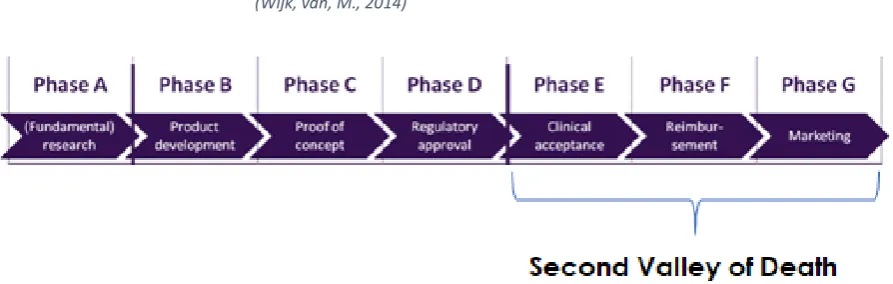
As mentioned in the problem statement by Wijk, van, M. (2014) the phase from regulatory approval up until commercial success can vary from 1 to 10 years, which brings a lot of uncertainty for not only the entrepreneur, but also the investor. This research will thus focus on this specific part of the commercialization phase (see figure 1), namely on the phase between the MedTech start-up adopting regulatory approval up until the moment of commercial success. Furthermore, this study will focus on those MedTech start-ups that tend to commercialize rather new and innovative mecical devices as they are often plagued by complex reimbursement routes and time-consuming clinical trajectories. It are namely those new and innovative medical devices that seem to fall into the trap of the second Valley of Death and are facing a rather long commercialization trajectory.
As this research is conducted under European legislation, regulatory approval for this research is equal to the start-up adopting a CE-mark for its product. Adopting regulatory approval is an important milestone for MedTech start-ups, because after certification they are allowed to start selling their product on the market and can start to make their own sales revenues.
As commercial success is a rather subjective term and in order to make this success measurable, in this study one will use the moment of the start-up achieving operational cashflow break-even as a measurement point for commercial success. This point is chosen, because achieving operational cashflow break-even means that there is enough traction within the market for the start-up to fully rely on internal finances, instead of relying on external financing from investors. As a result, this stage is not only very important for the entrepreneur, but the course of this stage will also tell involved investors whether they will be able to get a return on their investment.
Nevertheless, the supposed variance in the length of this stage of 1 to 10 years, indicates that this stage is a rather complex one. For MedTech startups this specific stage can be identified as what Wilson, et al. (2018) would call the ‘Second Valley of Death’. In order to overcome this stage, more in-depth knowledge is needed on what factors play an important role during this stage and affect its duration.
Therefore, the following research question will be addressed:
[image:8.595.75.522.250.392.2]“What factors affect the duration of the commercialization phase (from the point of adopting CE -marking up until the point of operational cash flow break-even) of MedTech start-ups that focus on exploiting new, innovative medical devices?”
9 To put some more focus on this research, this study will look at the commercialization phase from two perspectives. First, investment professionals from different backgrounds (e.g. investment managers from venture capital funds, government funds and business angels) will be interviewed to identify factors that according to these investors play a crucial role during this part of the commercialization phase. As a result of these interviews, one will not only identify important factors but also try to point out the discrepancies between the existing literature and the knowledge from everyday experience. Secondly, the same will be done again, only this time the healthcare(-related) professionals will be interviewed. These professionals are closely related to the procurement-, acceptance- and diffusion-processes of the medical technology and can provide the researcher with in-depth and essential insight in the commercialization process.
Finally, the purpose of this study is to:
(1) Build a conceptual model1 that visually represents the commercialization phase from the point of CE-adoption (regulatory approval) up until the operational cashflow break-even point (commercial success), (2)which is linked to the factors that according to the literature and experience of investment & healthcare(-related) professionals play an important role during this phase and (3) can serve as a guide for investors/entrepreneurs to successfully move through this phase without having to encounter unnecessary delay.
1.3.
Academic & practical relevance
As mentioned in the previous section, not a lot of knowledge exists on how MedTech start-ups can successfully commercialize their products. Next to that, most of the existing literature focuses on the first valley of death, which is the phase in which a start-up must attract enough financial resources to move from proof-of-concept into a marketable product. Nevertheless, not much is known about the second valley of death that most MedTech start-ups seem to struggle with, which is the phase in which the start-up must start to generate a steady source of sales. This research will try to add to the existing literature about the second valley of death for start-ups. This study has practical relevance as it will give MedTech start-ups a better impression of how to validate their own product and how to achieve market wide adoption by approaching the commercialization phase with more knowledge than in past endeavors. Furthermore, it will also give investors (e.g. venture capitalists, business angels, banks and government) more hold on how they should approach MedTech start-ups. This study could help investors to get a better understanding on the validation of MedTech start-ups and in what way they could help their portfolio companies to commercialize their products and work towards a successful exit.
1.4.
Outline of the thesis
The rest of the research is structured as follows. In the next chapter a systematic literature review will be performed to see what factors might influence the commercialization phase of MedTech start-ups/medical devices, according to the literature that is currently existing. At the end of the systematic literature review a selection will be made of the factors and frameworks that will be used in this study. Chapter three contains the methodology and will explain how the factors from chapter two will be analyzed and will give more information about the sample used for this study. Chapter four will describe the results and the analyses performed on the interviews. The final chapter of this research will provide the overall conclusion of the study and will touch on the limitations, implications and directions for further research.
1 Conceptual, meaning that it is based on qualitative data and has yet to be statistically validated, which can be
10
2.
Theoretical Framework
In this section a systematic literature review will be conducted, to see what factors according to the existing literature could play a role during the commercialization phase of the MedTech start-up.
2.1.
Systematic literature review
According to Wolfswinkel et al. (2013) a better legitimization of the choices made during the review process of the literature enhances the value of the review as it makes the research more useful and replicable. Thus, instead of just picking some frameworks in a rather random fashion a more systematic approach will be used as proposed by Wolfswinkel et al. (2013) which finds its roots in the Grounded Theory approach of (Glasser & Strauss, 1967). The article of Wolfswinkel et al. (2013) proposes five-stages for conducting a good systematic literature review. The review consists of the following five-stages: define, search, select, analyze and present.
2.1.1.
Define
In this step of the systematic literature review, one will define the criteria for either inclusion or exclusion of a certain article in the dataset (Wolfswinkel et al., 2013). To set a certain time-frame, all the articles under consideration must have been published within the last five decades. Furthermore, the relevance, times cited, and impact factor have a leading role throughout this systematic search. These variables will be especially important when it comes to the selection of theoretical frameworks. When searching for articles to only get an impression on the status quo of medical technology or to start a certain exploratory stream of thought this is of less importance. In that case also less prominent articles or white papers can be taken into consideration. During this search journals will be preferred over books. Next to that this systematic research will focus on the fields of Business, Management, Policy, Innovation, and Healthcare, Medicine and Biotechnology. Subsequently this study will only take articles into consideration that are derived from Web of Science, Google Scholar and Scopus.
Finally, one can state that this research basically evolves around two central themes, namely 1) medical technology and 2) the commercialization/adaption/acceptance/assessment of (high) technology. Articles that fall into the general theme of ‘medical technology’ will not be considerate if there is no sign that it may possess any valuable information that is connected to the aforementioned second theme. Therefore, a search will be done on the following individual or combination of keywords: MedTech, medical technology, innovation, diffusion of innovation, technology commercialization, break-even, venture capital, technology acceptance, technology adoption, product-market strategy, exploitation, start-up and time-to-market. A combination of the above used keywords would look as follows; e.g. ‘medical technology’ AND ‘start-up’ or ‘medical technology’ AND ‘commercialization’.
2.1.2.
Search & Select
11 one will also check the last box of the previous table to determine whether, after a quick first scan, an article seems to be useful or not (see appendix A).
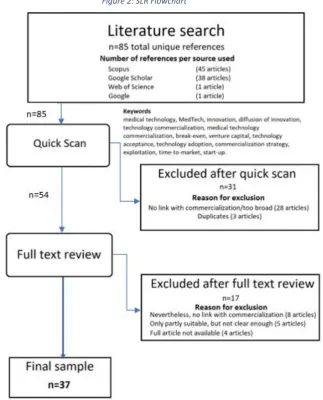
After scanning all the articles individually and filtering out the doubles the total sample of articles in the dataset consists of 54 articles. These 54 articles fit the boundaries of the research setting as described earlier. See appendix A for an overview of all the exact combinations of keywords.
2.1.3.
Analyze
After the previous section one ended up with an unstructured stack of the articles, thus in this phase one will perform the ‘analysis’ based on the Grounded Theory. In this phase the articles will be analyzed by using open coding (Wolfswinkel, et al. 2013). In short this means that the author will read all the articles very closely and look what the underlying concepts of the articles are and how they fit the research question of this study. “The ultimate goal of open coding is to identify a set of categories or a bird’s eye image of the study’s findings, with a set of theoretical and methodological insights attacted” (Wolfswinkel, et al., 2013, p. 50).
In appendix B, an overview is given of the articles in which they are categorized and connected to concepts that have been developed after analyzing the articles as proposed above. The articles, concepts and the connections between the individual articles will be explained in detail in section 2.1.4. If an article is marked red, this means that after a more careful analysis it appeared not to be useful for this research. When an article is marked orange, this means that the article is only partly applicable for this research, or only under certain conditions. In total 37 articles appeared to be useful for this research, of which 5 can only be deemed as useful under certain conditions.
[image:11.595.134.458.422.823.2]The complete systematic literature review is visually presented in the following flowchart:
12
2.1.4.
Present
In this section the articles, concepts and connection between the individual articles will be explained more in detail. Each of the following paragraphs will try to give more insight about a specific piece of theory that, according to the literature and the rationale of the author, could possibly affect the duration of the commercialization phase of the medical devices. Thus, after each paragraph a proposition will be formulated to reflect how a specific factor might influence the commercialization process according to the current perception of the researcher. Subsequently, to give some more structure and to show the different layers of this research, each proposition will be connected to the level (e.g. hospital level, start-up level, etc.) on which it seems to have an effect. Finally, these propositions will be used during the interviewing process to challenge the participants about these different topics and to get a better understanding of what role they play during the commercialization phase and how they are intertwined with each other.
2.1.4.1. Development rationale & hospital adoption
In order to know how to commercialize medical technology in a successful way, one must know on what grounds a certain technology is adopted by hospitals. The article of Greer (1985) proposes that hospitals generally make this decision based on three distinctive streams of rationale, namely: medical-individualistic, fiscal-managerial and strategic-institutional. The medical-individualistic perspective puts the most emphasis on the value that is created for the patient by looking for technologies that maximize patient welfare and minimalize risk. In this case, classic literature such as the diffusion of innovations of (Rogers, 1965; 2003) seems best applicable. The fiscal-managerial perspective puts emphasis on values such as profitability and predictability and proposes a manner of decision-making that is based on rational and quantitative analysis. The strategic-institutional perspective embodies a broader view and looks at how a certain technology might change the organization as a whole. Teplensky et al. (1995) later questioned this theory of Greer (1985) by stating that these decision systems are not as much mutually exclusive, but complementary to each other. Teplensky et al. (1995) proposed three views that in some way resemble the perspectives of (Greer, 1985). The first perspective, links hospital adoption to the anticipated financial returns. In this case expected profitability is the prominent value that depends whether a hospital will adopt a new medical technology. Thus, technology under consideration should be able to shorten patients stay at the hospital or decreases costs. In the second perspective, cost does not seem to play a role per se. What is specifically important in this perspective is that the technology under consideration must boost the hospital its image. Thus, capital-intensive technology is adopted in order to claim the position of technological leader in the hope that it will attract physicians and patients. The third perspective puts most emphasis on the needs and wishes of the patient. Hospitals and physicians in this case look at the clinical needs of the patients they serve and do not consider alternatives that are financially a better choice or would add more to the hospital its image.
13 technologies before they are being taken into consideration for reimbursement (Mot, et al., 2017). To conclude, it could be that MedTech start-ups mainly look to provide the perfect clinical solution to an existing problem or need from the perspective of the patient. By doing that they forget the importance of cost on an organizational level. Eventually one ends up with an excellent product that is too costly for hospitals to adopt. This mismatch could explain why the path towards successful commercialization is for some start-ups very long and difficult.
• Proposition 1: It could be that there is a mismatch between the a) rationale on which the product is developed by the start-up and b) the rationale on which new technology is adopted by the hospitals.
Based on the above, the researcher expects that the rationale on which the product is developed by the start-up will mainly have an influence on the hospital-level.
2.1.4.2. The role of end- & lead-user involvement
Another aspect that receives a lot of attention in the existing literature is the role that lead-users/end-users should have in the development phase of the medical technology in order for it to become a success (Shah & Robinson, 2007, 2009 ; del Campo et al., 1999 ; Lettl et al., 2008 ; Cain & Mittman, 2002 ; Chatterji et al., 2008).
In their research Shah & Robinson (2009) classify medical device users in two categories, namely: 1) end-users (patients) and 2) lead-users (professional users). In Shah & Robinson (2009) they built on their previous work, again stressing that the acceptance by end-users is crucial for the device its longevity. Even if the product is perfectly manufactured or recommended by healthcare professionals, it will only work if it is accepted by the end-user, the patient. In that same article they use the example of how asthma patients played a crucial role in the development phase of building what we now know as the inhaler. Nevertheless, the importance for this study is aimed at the commercialization phase. Thus, it would be valuable to test in what way patients can influence the diffusion of the medical technology in the commercialization phase. In that line of thought the article of Cain & Mittman (2002) propose that due to the increased access to medical information via the Internet, patients are more aware and involved in what is going on in the field of healthcare. Subsequently, patients are also better informed when it comes down to their own medical conditions and thus could take a pro-active role in expressing their needs for a certain treatment towards their physicians.
To conclude, it could be that medical technology start-ups are not making a lot of use of social media to engage with both lead- and end-users. If that is the case, then they might also not benefit from the possible positive side effects such as engagement with key opinion leaders and early adopters, whom can increase their chances of diffusion & market adoption and thus a timely commercialization.
• Proposition 2: It could be that MedTech start-ups do a) not make enough use of social media and thus are b) not sufficiently engaged with both end- & lead-users.
Based on the above, the researcher expects that the engagement with social media by the start-up will mainly have an influence on, both, the end- & lead-user level (patient & clinician).
14 understanding the needs of not only patients but also of the physicians that actually use the technology, will increase the potential for commercial success. The article of Chatterji et al. (2008) also acknowledges that practicing doctors are an important source of external knowledge on unmet needs and customer preferences. Furthermore Chatterji et al. (2008) also discovered that innovations that are patented by doctors or with the participation of doctors, receive more citations and had higher generality scores than corporate inventions.
Nevertheless, again, a lot of the focus is put on the early development phase of the medical technology. For this research, it would be particularly interesting to see what role physicians could play in the commercialization phase. To discover what impact physicians can make on the purchase-decision of hospitals it thus would be interesting to see in what way physicians engage with medical technology and how they inform themselves on new technology. The article of Escarce (1996) proposes that the main sources of information for physicians about new medical technologies are journals, conferences and informal discussions with peers. Journals and conferences are particularly important as the first sources of information for a physician to become aware of a new technology. Discussion with peers become valuable in a later stage, namely to diffuse a certain technology from one hospital to another (Escarce, 1996).
Whereas the latter is quite difficult to influence, a company can proactively make an effort into getting published and to make an appearance at conferences. First, a publication in a well-known journal could give a medical technology start-up the chance to prove clinical validity. When clinical validity is proved, this could make the device more eligible for reimbursement which could spark the interest of clinicians and motivate them to recommend the device to the hospital they work for. Second, attending conferences could not only give the start-up the opportunity to present their product, but also to extend their professional network and to team-up with credible partners. Being present in those surroundings could therefore also be perceived as a measure of validation for clinicians. This altogether could indicate that both, publications and appearances at conferences could function as catalysts for a timely commercialization.
• Proposition 3: It could be that a publication in a journal a) is seen as a measure of validation that could lead to b) a better chance of being adopted by clinicians.
• Proposition 4: It could be that attending conferences a) is seen as a measure of validation that could lead to b) a better chance of being adopted by clinicians.
Based on the above, the researcher expects that, although getting published and attending conferences could ultimately affect the hospital its adoption decision, it will first and foremost have an influence on the lead-user level (clinician).
2.1.4.3. The role of the academic background of the entrepreneur
15 the ability of the business community to successfully communicate with the scientists to exploit their innovative ideas.
As medical technology is often developed by either researchers or clinicians, it could be that their main focus is on doing research and development of the technology itself, but that there is a lack of attention for the commercial aspect of the business. Therefore, it could be that they are not sufficiently informed on the market, its competitors and are not able to set up a good sales operation. This lack of business acumen could possibly explain why the path towards successful commercialization is for some start-ups very long and difficult.
• Proposition 5:It could be that most of the entrepreneurs behind the MedTech start-ups have a) a strong research background which leads to b) a lack of business acumen and subsequently c) a bad sales operation.
Based on the above, the researcher expects that the strong research background of the entrepreneurs will mainly manifest itself in how successful the start-up will be in its commercial endeavours and thus that it will be influential on the start-up level.
3.
Methodology
3.1.
Research Design
In order to know what type of research design is applicable for this specific research, one first must determine the nature of the research. Robson (2002) points out that the research design is based on its research purpose, which can be either: exploratory, descriptive or explanatory. Nevertheless, it is also possible that a research can have more than just one purpose.
To be clear, this study revolves around the following research question:
“What factors affect the duration of the commercialization phase (from the point of adopting CE-certification up until the point of operational cash flow break-even) of MedTech start-ups that focus on exploiting new medical devices?”
This question is asked with the purpose to:
(1)Build a conceptual model that visually represents the commercialization phase from the point of CE-adoption (regulatory approval) up until the operational cashflow break-even point (commercial success), (2) which is linked to the factors that according to the literature and experience of the investment & healthcare(-related) professionals play an important role during this phase and (3)can serve as a guide for investors/entrepreneurs to successfully move through this phase without having to encounter unnecessary delay.
This research is therefore on the one hand an exploratory study, but on the other hand a descriptive one. Firstly, it is exploratory as it tries to find out “what is happening; to seek new insights; to ask questions and to assess phenomena in a new light” (Robson, 2002, p. 59), by investigating what factors might play a role on the phase mentioned above. Secondly, it is descriptive as it tries to “portray an accurate profile of persons, events or situations” (Robson, 2002, p. 59), by describing the possible role of these factors and by developing a visual representation of this specific phase in order to provide more in-depth insight for investors and entrepreneurs.
16 phenomenon within its real-life context using multiple sources of evidence”. Case studies can be applicable to: individuals, communities, social groups, organizations and institutions and events, roles, relationships and interactions. Saunders et al. (2009) describe that a case study is able to answer the questions ‘why?’, as well as ‘what?’ and ‘how?’. As we want to explore ‘what?’ factors seem to play a role in the commercialization phase and describe ‘how?’ they seem to affect the commercialization phase in the eyes of investment & healthcare(-related) professionals, a case study seems to be the right research strategy for this study.
Yin (2003) describes that a case study can have four types of design, that consist of two dimensions. First, a case study can either analyze a singular case, or multiple cases. Second, the unit of analysis can be of either a holistic (one unit of analysis) or an embedded design (multiple units of analysis). A single case study is often used to analyze an extreme or unique case. A multiple case study can be used to establish whether the findings in one case, also seem to occur in another one (Saunders et al., 2009). For this study the researcher wants to discover whether there is consensus between the two groups of participants, about what factors play an important role during the commercialization phase of the MedTech start-up. Thus, to discover whether such a consensus actually seems to exist, multiple cases are analyzed. Regarding the second dimension, this study deals with one specific unit of analysis, namely those MedTech start-ups that try to commercialize medical devices. Within each case the MedTech start-up is analyzed in its entirety and no sub-units (e.g. departments) are subject to analysis. Therefore, the chosen research design is that of a holistic multiple case study.
3.2.
Selection
As mentioned in the previous section one would focus on two groups, namely; professionals that represent the investor perspective and professionals that represent the healthcare perspective. Therefore, one must select organizations that are a good representation of the population as a whole and have the highest probability to come up with meaningful insights. First, to get a complete view on the investor perspective, one would select governmental investment funds, private investment funds and venture capital funds. Second, to get a complete view on the hospital perspective, one would select professionals that play an important role in the procurement, introduction and implementation of new medical technology in the hospital setting. As mentioned earlier, the researcher will only discuss these MedTech start-ups that specifically commercialize relatively new and innovative medical devices and not simply all MedTech start-ups in general.
Investment professionals Participant 1
• Investment professional
• Almost 2 decades of experience in listed, fund in fund, private equity and venture capital.
• For 7 years focus on healthcare innovations
• Managing partner of a VC-fund that has been initiated by a Dutch insurance company
• The fund invests in early stage highly innovative medical- and healthcare start-ups that are looking for an investment for product development and market introduction.
Participant 2
• Investment professional with broad experience in pharmaceutical & biotech industry.
17
• Authored many peer reviewed scientific papers and book chapters on pharmacology and drug development.
• Currently managing partner at a venture capital fund that invests in early-stage private companies that aim to develop and commercialize innovative medical products for diagnosis, cure, care or prevention.
Participant 3
• Seasoned investment manager that has over 15 years of experience within the field of Venture Capital and for the past 10 years has been focusing specifically on the healthcare industry.
• Currently managing partner of an early stage fund for Dutch healthcare innovations.
Participant 4
• Investment manager with 15 years of international experience of which the past 10 years he has been devoting himself to the fields of life sciences, medical technology and healthcare.
• Currently active as an investment director for a Dutch private equity group that is specifically focused on healthcare and medical technology innovations.
Participant 5
• Senior investment manager with almost 13 years of experience in the field of healthcare & life sciences.
• Before this, he operated in the oil & gas industry and banking environment.
Healthcare(-related) professionals Participant 6
• Senior purchase officer of a Dutch academic hospital.
• 30+ years’ experience in buying medical technology & devices
Participant 7
• For the past years this person has been working as innovation manager for a hospital that provides specialized healthcare in several medical domains.
• Has a deep understanding of how insurance companies affect the purchase decision of hospitals, as he was responsible for doing the contract negotiations with them in the name of the hospital.
Participant 8
• For the past three years, this person has been the CEO of a medical university spin-off company that helps other MedTech start-ups/scale-ups regarding their medical innovations and technologies.
• The company assists medical-based companies in all stages of development with the analyses of patient needs, healthcare gains, and possible market opportunities regarding their medical solutions.
18
Table 1: Description of participants
3.3.
Data collection
To see whether the formulated propositions in section 2.1.4. indeed, play a role in the commercialization phase and to see whether there are any discrepancies between the literature and the practical experience of the groups, but also individually between the two groups (entrepreneurs & hospital professionals) one must collect more in-depth data. A highly sufficient method to collect this data, is by conducting interviews. One can conduct several different forms of interviews, namely: structured interviews, semi-structured interviews and unstructured in-depth interviews.
The most suitable form for this specific research is to conduct data via audio-recordedsemi-structured interviews. This data is quantitively analyzed and can be used to understand the ‘what’ the ‘how’, but also the explorative aspect, namely the ‘why’ (Saunders et al., 2009). “In semi-structured interviews the researcher will have a list of themes and questions to be covered, although these may vary from interview to interview” (Saunders et al., 2009, p. 320). This flexibility is extremely useful as on the one hand one wants to explore whether the factors that are derived from the existing literature indeed seem to play a role in the phase at issue, but on the other hand one also wants to see whether the investors and entrepreneurs perceive factors that are not mentioned in the existing literature yet. To get more in-depth insight it is also useful to make adjustments from case to case in order to link with the organizational context and to build on previous interviews.
3.3.1.
Preparing the semi-structured interview
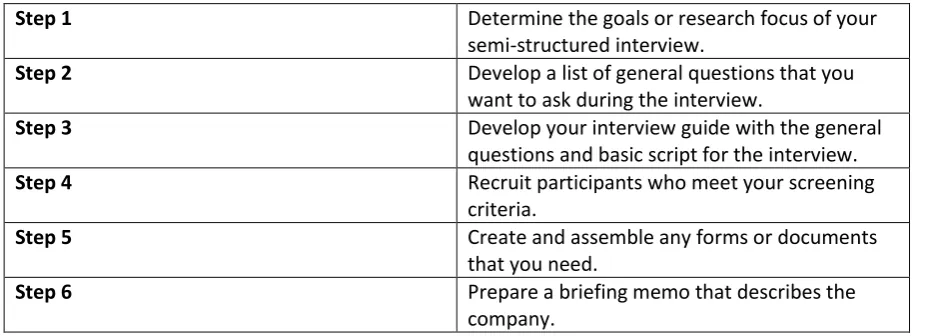
Wilson (2014) describes the following steps to prepare a semi-structured interview:
Step 1 Determine the goals or research focus of your semi-structured interview.
Step 2 Develop a list of general questions that you want to ask during the interview.
Step 3 Develop your interview guide with the general questions and basic script for the interview.
Step 4 Recruit participants who meet your screening criteria.
Step 5 Create and assemble any forms or documents that you need.
[image:18.595.69.532.553.721.2]Step 6 Prepare a briefing memo that describes the company.
Table 2: Preperation of semi-structured interview (Wilson, 2014)
Due to the window of opportunity, there is no time available to conduct pilot interviews, therefore step 7 & 8 as described by Wilson (2014) have no value for this research.
Participant 9
• Senior engineer who has extensive experience at a very large international strategist in the sector of medical devices.
Participant 10
19
3.3.2.
Conducting the semi-structured interview
Wilson (2014) describes the following steps that are important when conducting a semi-structured interview:
Step 1 If possible meet with the participant(s) prior to the interview and provide an overview of the general plan.
Step 2 When you meet each respondent, ask where you should sit.
Step 3 Review the interview process briefly with each participant. Mention the following things:
a) A brief description of the interview topic and goals, the stages of the interview process, recording and ethical issues, cutting short some discussions and prompting.
b) The amount of time that is used for the interview.
c) Determine what to do if the participant has to answer the phone or leave momentarily.
d) What you will be doing with the data and if and how they will get a summary of the results.
Step 4 Begin the interview with some warm-up or introductory questions that are easy, nonthreatening, and relevant.
Step 5 During the main part of the interview, you will begin with questions on the interview schedule that you want everyone to answer and then ask the remaining questions.
Step 6 Signal aclear end to the conversation by thanking the participant, putting away note-taking materials, and turning off any recording devices.
Table 3: Conducting semi-structured interview (Wilson, 2014)
3.3.3.
Reliability & validity
20 quality of the interviews the participants will receive a list of themes that will play a role during the interview.
Another concern when using semi-structured interviews is the potential threat to validity. Or in other words, “if the findings are really about what they appear to be about” (Saunders et al., 2009, p. 157). As this research is of a qualitative nature, it is mainly important to improve internal validity. Which means that one must make sure that there are no flaws in the research design. External validity refers to the generalizability of the study. As the research question is of an explorative nature and as the purpose of this study is to build a conceptual model, generalizability is of less relevance. Generalizability would be of importance in an additional study if one would want to statistically test the conceptual model.
3.4.
Data analysis
The first step that must be taken if one wants to analyze qualitative audio-recorded data is to transcribe it, reproduce it in written language. This will be done by listening to the conversation and literally type down what is being said. Not only will this reduce any potential bias, but it will also help one to deeply understand not only what is being said, but also how it is being said and in what context. Next, the actual analysis of the data can follow either a deductive or an inductive approach. A deductive approach means that the researcher has made use of existing theoretical frameworks to determine the research question and its objectives. The upside from using a deductive approach is that “it will link your research into the existing body of knowledge in your subject area, help you to get started and provide you with an initial analytical framework” (Saunders et al., 2009, p. 490). An inductive approach means that you will start to collect data right away and analyze it whilst collecting. This approach is completely explorative in its nature and is mainly used to develop hypothesis that can be tested in additional research. Nevertheless, although the researcher may commend to one of the two approaches, it is most likely that in practice a research is most likely to combine elements of both (Saunders et al., 2009).
For this research one could indeed say that both approaches are relevant and will be used. On the hand, a deductive approach will be used to see whether the propositions developed in section 2.1.4. are also perceived as relevant by investors and hospital professionals in relation to the phase ‘from CE-adoption to operational cashflow break-even’. On the other hand, this research also uses an indicative approach to see whether there are also other relevant factors that are not mentioned in the literature yet, but according to the investors and hospital professionals seem to play a role in the phase ‘from CE-adoption to operational cashflow break-even’. Next to that, it is also inductive as it tries to explore whether there are differences between the perspectives of investors and medical professionals and how they value certain factors in importance from practical experience.
22
Timeline of research
CE-mark Relatively easy to adopt
Operational cashflow
break-even Potential most important
Duration commercialiation
Network
Key Opinion Leaders
Always the same
KOL(s) Biased KOL(s)
Common clinician
missing Bad understanding of support base
Board of Commissioners Investor claims commissioner seat Commissioners with wrong motivation
Strategist(s) Fit with portfolio
Investors
Clinical study
Too small budget No inhouse knowledge
Lack of experience
Wrong expectations of hospital
Wrong design of study Too much focus on quantity
Healthcare funding
Bad understanding costs
Product pricing non-transparant
Bad understanding of reimbursement
process(es)
Too much focus on insurance firms
Bad understanding role Dutch Healthcare
Institute
Management team Research background
Lack of experience commercialization Underestimation trajectory
Lack of business acumen
Bad sales operation / wrong decisions / no
strategy
The product
Developing from
problem (+) Focus on lead-user
Fulfills medical unmet need & adds value
Faster commercialization
trajectory
Developing from
solution (-) Bad understanding of lead-user No real need
Long commercialization
trajectory
Costs & benefits should be 'close'
Cost effectiveness
Uniqueness IP & competition
Stakeholders
Conservativeness
Bad understanding of
stakeholders Wrong information is given
Lack of knowledge about healthcare workprocesses
Bad understanding of organizational impact & implementation
Awareness (Buzz)
Socia media Not being used a lot due to riskiness Mostly applicable to inform patient & create buzz
Publications Most important source for clinician
Conferences
Need to go often
[image:22.595.136.458.26.840.2]23
4.
Results
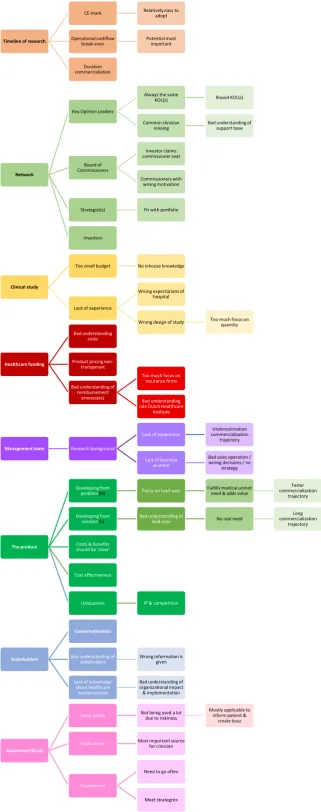
In this section the most important results of the interviews are presented and discussed. The goal of the interviews, again, is 1) to see whether the factors mentioned in the propositions of section 2.1.4. also play a role in this specific phase of the commercialization process and 2) to explore whether there are more factors that have not been adopted in the existing literature, but according to the participants could possibly play a role in the commercialization phase from CE-mark (regulatory approval) up until operational cashflow break-even (commercial success). To not steer the interview in favour of the propositions and to leave room for an open discussion, which has a positive effect on the explorative nature of this research, a semi-structured interview approach has been used.
In the following section the results will be presented. The results are based on the themes (the product ; management team ; awareness ; clinical study ; healthcare funding ; stakeholders ; network) that according to the coding-process play the most important role in the overall context of this research. Therefore, the propositions as mentioned in section 2.1.4. will be discussed alongside these themes. By doing this the researcher tries to really reason from what is being said and meant and not by what is being expected upfront from its own point of view. The goal is thus to not only present an overview of the participants their perspectives, but also to give a better understanding of the coherence between the different topics and an impression on the bigger picture. If applicable the propositions from section 2.1.4. will be refined, extended or discarded. Due to the explorative nature of this research, there is also a possibility that new propositions are formulated in this section. If the participant does not really address the question/topic, his or her response is left out of the results.
4.1.
Timeline of commercialization
Before moving on to the different themes and the proposition, this section briefly reflects on the timeline of the research to see whether the troublesome commercialization formulated in the introduction of this research is perceived the same by professionals from everyday experience. As the timeline of the research is something that directly impacts the investors and because they probably will have the most interesting insight in this topic, this section will focus on their reactions only. The researcher started the interviews by asking how the participants felt about the proposed timeline of the research (from CE-marking up until operational break-even) and if they also perceived this timeline as one that deserves more attention.
Participant 1 reflects:
“In the past year we did 15 investments, which takes me to yoursecond question ‘do you recognize this?’ Yes, I recognize it.[…]. I have learned that the technological development itself, it can take a while, but eventually that will work out. The biggest challenge is to get it into the market, and uhm, that is very difficult.”
Participant 2 confirms that indeed adopting CE is not enough to realize sales and points out that from that moment on, there is still a long way to go:
“.. and that is the big crux, that, especially in the past, the point of adopting CE and actually having enough evidence to sell your product, those are two different moments. […]. Because why would an
insurance firm or hospital put money on the table? They want to see that the business case is proven. And that takes an awful lot of time and that aspect is extremely underestimated by most companies.
24 When asked a bit more in detail if the point of CE-adoption is being valued as an important milestone, this same participant mentions the following:
“Look, getting approval is important, because then at least you showed that you have addressed a
couple of risks which will make the authorities say ‘hey, we don’t see any reason why this can’t be allowed on the market’. But really… the biggest hurdle in my opinion is not there, but in the next
phase which you also show, that it adds value.”
When asked the same question participant 3 mentions the following:
“No, absolutely not. I know that some may think that it is important. But uhm, let me put it like this. I never witnessed a company going broke, because they weren’t able to get a CE-mark for their product. It takes some effort and then you will get it. I have never seen that somebody wasn’t able to get it.”
The reactions from the participants seem to confirm that although CE is important, it is not really seen as a hurdle that brings a lot of challenges. The biggest challenge as perceived by the participants is the phase after CE-adoption, in which the start-up must start to generate sales and become a commercially stable company. These reactions seem to imply that ‘the second valley of death’ as described in the literature is also perceived by the professionals in the field.
The researcher also asked how the participants feel about the chosen point of operational cashflow break-even and if this holds any importance to them.
Participant 1 mentions the following:
“Yes, that is an important milestone for sure. Or, milestone… Look there are different milestones.
[…]. If you mean is it a milestone, like a happening, then yes... cashflow... without a doubt! Because, up until that point you are constantly looking at your runway, what is our burnrate per month? How far can we get with our money? So, once you achieve cashflow break-even then it is a very big relief.”
Participant 2mentions that his focus is not on becoming cashflow break-even, but that he puts emphasis on creating value. He elaborates:
“[…]. No, no, no. […] Look, if you are going to steer on becoming cashflow break-even then you are quite possibly not investing on value creation to its fullest potential. You are focusing on cashflow break-even where you keep costs low and try to sell as much as possible to achieve that cashflow break-even. But that does really match well with value maximization. There you possibly want to invest upfront, to perhaps, get active in more countries or do more studies.”
Participant 3 seems to have a somewhat similar view on the topic by stating that cashflow break-even is sometimes also a choice and that the potency of being cashflow break-break-even is more important than actually being it:
“What occurs at a certain moment in time is that one can potentially become break-even. That moment is way more important than the fact of actually being it. Because sometimes if it is very successful, then you just want to invest more money to penetrate the market even more.”
25
“Achieving the point of operational cashflow break-even is the hardest aspect of a company. So yes,
that’s right! Yes, I recognize it and I also recognize the challenge that comes with it.”
The reactions of the participants seem to confirm that also the point of operational cashflow break-even is one that bears importance to them. In fact, the reaction of participant 1 is quite similar to the situation that is formulated in the introduction of this study. Namely that up until the point of operational cashflow break-even, capital injections from the investors are a necessity to keep the business running. Here it is interesting to see that participant 2 and 3 put some nuance on the operational cashflow break-even point. What they seem to mean is that the operational cashflow break-even is not a goal on its own, but that utilizing on its potency is, which could eventually result in operational cashflow break-even. Participant 3 perhaps formulates this the clearest by saying that the moment of potentially being break-even is more important than actually being it.
Finally, the participants were asked if they recognized the variaton between start-ups regarding the speed of commercialization.
When asked if a strong variation is perceived when it comes to achieving the point of commercial success, participant 2 reacts:
“Yes, definitely. Especially the point of commercial success… So, the point that one can potentially
‘become’ break-even.”
Participant 5 adds to this by saying:
“Yes, I recognize the issue and the fact that it is very hard to make comparisons. Some go fast, and
others go slower.”
Nevertheless, the investors also critically reflect that although they recognize variation within their own portfolios, that they can’t make any significant statement about this for the whole population of MedTech start-ups.
Participant 1 replies:
“Well, we don’t have... We don’t have an extraordinariylarge portfolio, but yes they differ.”
Participant 2 mentions:
“It simply takes very long... it takes long to make all the necessary steps which we just discussed. But
26
• Proposition 1: It could be that there is a mismatch between the a) rationale on which the product is developed by the start-up and b) the rationale on which new technology is adopted by the hospitals.
4.2.
The product
The first recurring theme that seems to play a role in the commercialization phase from CE-adoption (regulatory approval) up until operational cashflow break-even (commercial success) is ‘the product’. Alongside this theme, the first proposition as formulated in section 2.1.4. will be discussed. To repeat, the researcher argued that MedTech start-ups are mainly focused to provide the perfect clinical solution to an existing problem or need, solely from the perspective of the patient. By doing that it could be that they forget the importance of cost on an organizational level. Thus, eventually one ends up with an excellent product that is too costly for hospitals to adopt. This mismatch could explain why the path towards a successful and timely commercialization is for some start-ups very long and difficult. In this rationale, the following proposition was formulated:
For this proposition the goal of the interviews was to find out which aspects/characteristics of the product are being valued the most by both groups; investment professionals and medical professionals. Furthermore, the researcher wanted to know how the participants perceive the trade-off between added value and costs and how this affects the adoption decision by hospitals. Altogether this information could indicate whether there is a possible mismatch.
The researcher asked the participants if there are certain aspects that they ideally see occur in the business case of the product and what they personally value as extremely important.
Participant 1 reflects:
“From the moment that the proposition is brought in, I immediately want to know ‘who is the end -customer and how can you make sure that the sales are already secured from the start.’ It could be
that the customer is already involved in the development process, it also could be that there are
already some contracts (…). […]. If you would ask the market then a lot of times they will say ‘yes, that’s something that I want, andthis is my turnover and such and such’, but if they will actually buy it, that’s second thing. There can be a difference between those two things.”
When asked if there are more things that he values as important he elaborates:
“Well, the difference between a need-to-have and a nice-to-have. There are a lot of products, a lot
of innovations, of which I think ‘yes, they have some important benefits, but uhm... What its really
about is ‘is the user is dissatisfied?’ What matters is that the user thinks that the current situation is unacceptable. When the user is still comfortable with the old situation, then he will not be motivated
to use something new.”
The reaction from participant 1 seems to suggest that, indeed, there are products being developed by start-ups that do not really match with the needs from the user. Or in his own words, that are more a nice-to-have then a need-to-have.
Participant 2 shares his view:
“We focus really strong on the added value of the product. Will the product add value in a market five years from now? So, the competitive position. Does it have added value for patients, but also for
27 practice. How is it perceived by clinicians, nurses, by whoever works with it? You really should stay
in touch with them, because you can learn a lot in the sense of like ‘does your product perform good
or not, are there any improvements to be made, what are the issues, irritiations etcetera.”
Here it is interesting to see that participant 2 stresses the importance of understanding both, the perception of the patient but also of the clinician.
Participant 3 mentions that it is very important to reason from the problem and not from the technology itself:
“Well at least they must reason from the healthcare and not from the technique. I think that that is the most important thing. So, if they reason like ‘this is how it works right now in healthcare, this is
were it always goes wrong and we can improve that by doing this’, to me that is a much more trustworthy story then ‘we are from the University of Twente and we developed a new technology which we think fits best here. First, we thought that we had to be in aerospace, but now we have
pivoted towards healthcare.’ I get really nervous, really fast, when I hear stories like that.”
Later in the conversation he again mentions multiple times that good products are created by those who really understand their user. He also mentions that this is something that goes wrong quite often:
“Look, the biggest problem arises if you develop the wrong product. It is so often, that they develop
something and then later reflect ‘yeah we thought that it would work, and we went to the market, but apparently they want this or that’. If that happens, you can start over again.”
Here it is interesting to see that participant 1 and 3 seem to touch on a similar issue. Namely, that in some cases products are developed that are not really created from an urgent need, but more from what the entrepreneur expects that the market needs. This implicates some sort of disconnect between the supplier and the buyer.
Participant 4 stresses the importance of creating a product that is also easy to implement.
“I think that... yes well, if it replaces an existing product. If it is an alternative for an existing device, then its easier to commercialize it. In other words, it should be as close as possible to the existing situation. That will make the transition, the implementation and acceptation smaller. On the other hand, the disadvantage about that. Is it unique enough? Does it really improve something? So, the ideal proposition is one that really brings a significant improvement opposed to the existing situation, but that fits really well in the market qua acceptance, qua sales trajectories, qua reimbursement,
etc.”
Participant 5 also feels that the product should address an unmet need:
“What problem is this device going to solve? Because, the bigger the problem, or the unmet medical
need, the higher the chance is to succeed. Because then it will be easier to get people to support you. So, clinicians that will adopt it and you will also have faster regulatory trajectories when there is a
big unmet medical need then when this is not the case. So, everything starts with ‘how big is the unmet medical need?”