http://wrap.warwick.ac.uk
Original citation:
Perks, O. F. J., Hammond, Simon D., Pennycook, Simon J. and Jarvis, Stephen A..
(2011) Should we worry about memory loss? ACM SIGMETRICS Performance
Evaluation Review, Vol.38 (No.4). pp. 69-74. ISSN 0163-5999
Permanent WRAP url:
http://wrap.warwick.ac.uk/45684
Copyright and reuse:
The Warwick Research Archive Portal (WRAP) makes this work by researchers of the
University of Warwick available open access under the following conditions. Copyright ©
and all moral rights to the version of the paper presented here belong to the individual
author(s) and/or other copyright owners. To the extent reasonable and practicable the
material made available in WRAP has been checked for eligibility before being made
available.
Copies of full items can be used for personal research or study, educational, or not-for
profit purposes without prior permission or charge. Provided that the authors, title and
full bibliographic details are credited, a hyperlink and/or URL is given for the original
metadata page and the content is not changed in any way.
Publisher’s statement:
"© ACM,2011. This is the author's version of the work. It is posted here by permission of
ACM for your personal use. Not for redistribution. The definitive version was published in
: ACM SIGMETRICS Performance Evaluation Review, Volume 38 (Number 4). pp. 69-74
(2011)
http://dx.doi.org/10.1145/1964218.1964230
”
A note on versions:
The version presented here may differ from the published version or, version of record, if
you wish to cite this item you are advised to consult the publisher’s version. Please see
the ‘permanent WRAP url’ above for details on accessing the published version and note
that access may require a subscription.
Should We Worry About Memory Loss?
O. Perks, S.D. Hammond, S.J. Pennycook and S.A. Jarvis
Department of Computer ScienceUniversity of Warwick, UK
{
ofjp, sdh, sjp, saj
}@dcs.warwick.ac.uk
ABSTRACT
In recent years the High Performance Computing (HPC) in-dustry has benefited from the development of higher density multi-core processors. With recent chips capable of execut-ing up to 32 tasks in parallel, this rate of growth also shows no sign of slowing. Alongside the development of denser micro-processors has been the considerably more modest rate of improvement in random access memory (RAM) ca-pacities. The effect has been that the available memory-per-core has reduced and current projections suggest that this is still set to reduce further.
In this paper we present three studies into the use and measurement of memory in parallel applications; our aim is to capture, understand and, if possible, reduce the memory-per-core needed by complete, multi-component applications. First, we present benchmarked memory usage and runtimes of a six scientific benchmarks, which represent algorithms that are common to a host of production-grade codes. Mem-ory usage of each benchmark is measured and reported for a variety of compiler toolkits, and we show>30% variation in memory high-water mark requirements between compilers. Second, we utilise this benchmark data combined with run-time data, to simulate, via the Maui scheduler simulator, the effect on a multi-science workflow if memory-per-core is reduced from 1.5GB-per-core to only 256MB. Finally, we present initial results from a new memory profiling tool cur-rently in development at the University of Warwick. This tool is applied to a finite-element benchmark and is able to map high-water-mark memory allocations to individual program functions. This demonstrates a lightweight and ac-curate method of identifying potential memory problems, a technique we expect to become commonplace as memory capacities decrease.
Keywords
Memory, Multi-core, Tracing, Workflow, Simulation
1.
INTRODUCTION
In recent years the High Performance Computing (HPC) in-dustry has benefited from the development of higher density multi-core processors. Where only a decade ago multiple processors would have been required to execute programs concurrently, today a single processor chip is able to execute 32 or more processes in parallel. Alongside this substantial growth in compute resource has been a much more modest rate of improvement in memory speeds and DRAM-chip ca-pacities. The effect has therefore been not only a growing
disparity between processor performance and memory, but also a sharp decrease in the amount of memory available to each individual processor core. Although this disparity has been well documented, in particular following Wulf and McKee’s coining of the term “memory-wall” paper [16], re-search investigating the impact of declining memory capac-ity per processing element is still very rare.
An investigation into the runtime changes resulting from a reduced amount of memory per core may also have fur-ther benefits than just being able to quantify any increase in execution time. System memory represents a significant up-front cost in the procurement of high-performance comput-ing systems. Dependcomput-ing on the type, capacity and quality of memory required for a system, prices may vary between $20 and $75 per GB. When installed in every node of a typical HPC cluster the cost can be significant. Techniques which enable the memory requirement to be reduced may therefore have direct influence on the level of capital expenditure.
Another concern is the power required by memory chips to remain active. Despite recent initiatives to reduce the power consumption of memory subsystems - DDR3 chips provide a reduction in power consumption of 30% compared with equivalent speed and capactiy DDR2 [8] - memory is still responsible for a large proportion of system power. The total power consumption needed for one TFLOP of processing power currently lies at between 320 and 1600 Watts [6].
Such evidence provides a compelling case as to why HPC practitioners should be concerned with memory. In this pa-per we present a systematic course of action with which to investigate memory use and the impact on runtime of changing memory configurations. Our aim is to be able to measure, understand and experiment with the memory requirements of mixed-science workloads, with a particular interest in the trade-off between increased or reduced mem-ory capacity and its impact on scientific delivery; we would like, if possible, to reduce memory costs, but in order to do this there is a need to understand the associated cost.
We begin the paper by documenting a series of compiler-memory studies, employing compiler toolkits from PGI, GNU, Intel and Sun (now Oracle) and thememPprofiling tool - a lightweight memory usage analysis tool specifically targeted for the heap profiling of parallel (MPI) applications [2]. We analyse the difference in reported memory high water mark (HWM) between codes built with different compilers; in some cases the HWM exhibited by differently compiled code is potentially significant.
cluster, we present a study which investigates the impact of a reduction in available memory-per-core. In order to cope with a reduction in per-core-memory a distributed code must be run over more processor cores in order to obtain the same amount of memory. Whilst this is possible for codes with a good problem decomposition, some program compo-nents such as lookup tables and MPI overheads are fixed, or worse, increase with more processor cores. By artificially fixing the maximum amount of memory-per-core, and com-bining this with runtime data for different core counts, we are able to assess the impact on runtime for a mixed-science workflow when per-core memory capacity is reduced. In or-der to ensure that this replicates the behaviour of genuine clusters we employ the Maui scheduler simulator [1] to gen-erate completion times and workflow information.
In the final part of this paper we analyse a single scientific code using new memory tracing tools being developed at the University of Warwick. Our tools allow the memory usage of individual functions to be tracked throughout execution, giving an insight into how the HWM of this specific code is generated. Analysis such as this is likely to become com-monplace as memory capacities become smaller and memory accesses become proportionally more expensive when com-pared to processing costs.
The specific contributions of this work are:
• We present a comparison of the memory requirements of six established scientific benchmarks and applications when compiled with common high performance toolkits. This analysis provides a potential first step in lowering the memory requirements of a code by switching to an alternative compiler toolkit. In our experience this is rare in many HPC sites as users have long-held preferences for particular compiler frameworks and therefore very few have evaluated the performance or memory usage of al-ternatives. Studies such as this are of significant use in identifying the likely benefits associated with new tools and educating users in these benefits;
• We utilise workflow simulations of benchmarked memory usage and runtime data from a variety of scientific codes to examine the likely impact on workflow completion time when the available memory-per-core is artificially limited. Given that the HPC industry expects to see significant growth in the number of processor cores, but only mod-est improvement in memory capacity, this study provides insight into the potential effect on HPC workflows in the future;
• We employ a new memory profiling toolkit currently un-der development to analyse the allocation of memory in-side a finite-element benchmark. Our tool is able to record the breakdown of memory to program functions and to map these temporally over the course of execution. If HWM memory requirements are to become problematic, as a number of HPC experts believe, analysis of this kind will become commonplace.
The remainder of this paper is organized as follows: Sec-tion 2 describes related work, including general issues of power consumption, programming for memory optimization and a discussion of memory profiling tools; in Section 3 we present a compiler study in which the HWM for a num-ber of applications is investigated under different compiler
builds; Section 4 presents a series of studies using the Maui scheduler simulator that show the impact on scientific de-livery of a reduction in memory per core; Section 5 presents the memory tracing of a finite element benchmark using a new memory profiling tool currently in development at the University of Warwick. Section 6 concludes the paper and documents further work.
2.
RELATED WORK
In most programs, 20-40% of the instructions reference mem-ory [7]. Memmem-ory has therefore been subject to much scrutiny over the past 30-40 years. Wulf and McKee’s classic work on the “Memory Wall” [16] describes the problems associated with dynamic random access memory (DRAM): the rate of improvement in microprocessor speed exceeds the rate of im-provement of DRAM memory speed; resulting in a point at which system performance is totally determined by memory speeds (the so-called Memory Wall). Since the mid 1990s, when this landmark paper was written, several attempts at innovation have been made. These include coupling mem-ory with the processor [13], aggressive on-chip cache hier-archies [9] (such as that seen in the IBM BlueGene series) and 3-D DRAM [12], where memory stacks are situated in close proximity to the microprocessor in order to reduce wire delay between the two.
Generations of architectural innovation have led to lower memory latencies and increased memory bandwidth. De-spite this, the power consumption of synchronous DRAM continues to be of concern, particularly in large server- and HPC-environments. Recent DARPA commissioned stud-ies [11] on the challenges for ExaFLOP computing report that the power needed for memory grows linearly with the number of chips (but that the power for the interconnect stays constant) and that memory power grows in relation to the peak FLOP/s per chip. There is clearly benefit therefore in adopting smaller amounts of higher speed memory, and finding ways in which we can trade computation for stor-age [14]. Previous approaches have been documented using external memory algorithms [15]; such approaches are likely to increase with the general adoption of GPGPUs. Content-aware memory management has also been shown to deliver up to 22% reductions in memory consumption without code modification [5].
Several supporting tools exist to assess memory use. The Performance API (PAPI) allows hardware counters on most modern microprocessors to be accessed; this in turn allows dynamic memory usage information to be collected. Low-level architectural measurements are then correlated with the source/object code through events. A number of high-level tools have been built on top of PAPI, including the HPCToolkit, OpenSpeedShop, PerfSuite, Scalasca, Vampir and TAU. An alternative to PAPI is Valgrind, an instru-mentation framework on which dynamic performance anal-ysis tools can be built. The current Valgrind distribution contains a number of production tools, including a mem-ory error detector, a heap profiler and a cache and branch prediction profiler. Valgrind also contains a second heap profiler that examines how heap blocks are used.
From Description POP LANL Ocean modelling
miniFE SNL Unstructured finite element
Sweep3D LANL 3D particle transport wavefront
phdMesh SNL Unstructured mesh contact search
MG NASA Algebraic multigrid solver
[image:4.595.74.272.51.220.2]LAMMPS SNL Classic molecular dynamics
Table 1: Application Benchmarks
GNU Intel PGI Sun Var.
POP 33.62 33.67 35.32 - 5.07%
miniFE 180.35 180.34 237.21 180.52 31.53%
Sweep3D 158.34 158.38 158.37 158.34 0.03%
phdMesh 73.64 73.64 91.05 - 23.64%
MG 254.76 255.13 255.01 255.45 0.27%
LAMMPS 58.73 59.23 60.08 58.69 2.37%
Table 2: Memory HWM (MB) for application benchmarks using four different compilers
each process in the execution and returns aggregated statis-tics for later analysis.
3.
MEMORY AND COMPILER CHOICE
In typical HPC environments the choice of a compiler toolkit is dictated largely by those purchased for the system (since not all toolkits provide the backends necessary for code gen-eration) historical preference and, commonly, code runtime performance. We however approach compiler choice from an alternative angle - that of memory usage. At the outset this might seem an odd choice, in that the memory require-ments of codes are largely dictated by the programmer’s use of program data objects, however, some variation can be identified. Our experience with other full science appli-cations studied with our industry partners is that bench-marked HWM figures vary considerably when more com-plex codes and problem data sets are assessed. In one re-cent study of an application a variation of over 225% was reported in HWM between using one compiler and another. Table 1 presents six mixed-science benchmarks and appli-cations, which cover algorithms and activities common to large computing installations. Memory and runtime bench-marking of each code is performed on an IBM cluster housed at the Centre for Scientific Computing (CSC) at the Univer-sity of Warwick. The cluster comprises 240 dual-Intel Xeon 5160 dual-core nodes each sharing 8 GB of memory (giv-ing 1.92 TB in total). Nodes are connected via a QLogic InfiniPath 4X, SDR (raw 10 Gb/s, 8 Gb/s data) QLE7140 host channel adapters (HCAs) connected to a single 288-port Voltair ISR 9288 switch, with a core-to-HCA ratio of 4:1. Each compute node runs the SUSE Linux Enterprise Server 10 operating system and has access to the IBM GPFS parallel file system. For our study we use the Oracle So-laris Studio 12.2 tool suite (formerly Sun Studio), the Intel C/Fortran 11.1 compiler suite, GNU 4.1.2 and PGI 10.6, in conjunction with OpenMPI 1.4.2 and the PBS Pro sched-uler.
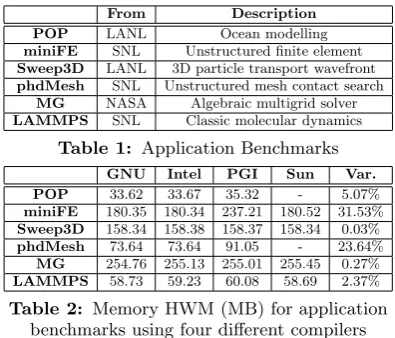
Table 2 shows the effect of compiler choice on memory consumption (HWM) for the benchmarks in question. All benchmarks were compiled using the-O3optimisation flag to replicate the behaviour of many HPC users. In each case seen in Table 2, the application benchmarks are run at a fixed core count; 16-cores executed as a 4-node, 4-cores-per-node run. In some cases the difference in HWM is small, 0.03% for Sweep3D. In other cases, phdMesh and miniFE, for example, the difference is significant - 23.64% and 31.53%
0 100 200 300 400 500 600 700 800
16 32 64 128 256 512 1024 2048
Runtime
(
s
)
[image:4.595.321.555.52.363.2]Number of processor cores (P) POP MiniFE Sweep3D phdMesh MG LAMMPS
Figure 1: Runtime for the six applications on LLNL Hera
0 200 400 600 800 1000 1200 1400 1600
16 32 64 128 256 512 1024 2048
Memory
Consumption
(
M
B
)
Number of processor cores (P) POP MiniFE Sweep3D phdMesh MG LAMMPS
Figure 2: Memory high water mark (HWM) for the six applications on LLNL Hera
respectively. No one compiler consistently outperforms the others in terms of memory HWM. There is also no dis-cernible trend that might inform compiler choice in general. While this might seem inconclusive, it does suggest one conclusion - application developers must investigate com-piler choice.
4.
MEMORY AND WORKFLOW
The growth in the number of processing cores per processor chip and slower growth in memory capacities makes it likely that future clusters will exhibit similar architecture layouts to today but will do so with higher core counts and lower amounts of memory per processor-core. In this environment, the scaling of memory will be achieved through the execution of codes at larger core counts, yielding potentially slower runtime but enabling the code to actually be executed. The effects of higher-core count jobs may be lower machine effi-ciency and the potential lengthening of workflow execution time. With this in mind we are interested in whether it is: (a) possible to continue to run scientific workflows with lower amounts of memory and (b) what the impact of this is on the completion time of a multi-application workflow.
In order to provide a more realistic base on which to con-duct experiments we make two assumptions: First, that the workload is mixed science, motivating the use of all six benchmarking codes seen in the previous section, and sec-ond, we utilise the Maui scheduler simulation to ensure that the resulting job schedule is representative of how a genuine cluster would execute its workflow.
consist-Application WF-1 WF-2 WF-3
POP 40% 20% 15%
miniFE 10% 30% 10%
Sweep3D 15% 5% 35%
phdMesh 15% 10% 0%
MG 10% 20% 25%
LAMMPS 10% 15% 15%
[image:5.595.325.549.51.187.2]Total 100% 100% 100%
Table 3: The three workflows used in this study (Workflows 1 to 3) and their composition of jobs
ing of high-performance multi-core CPUs – four-way AMD 2.3GHz Opteron quad-core CPUs (16 cores per node), 32 GB memory per node (2 GB per core). An InfiniBand DDR high-speed interconnect is used for communication between nodes and exemplifies a typical large capacity HPC resource (127 TFlop/s peak).
The runtime and memory requirements for our six applica-tions on Hera can be found in Figures 1 and 2 respectively. As found earlier in this paper, the memory scalability of these codes (as they strong scale) varies considerably. In most cases, the memory consumption decreases as the core count (for an application) increases; it is also true that in most cases the parallel efficiency of the application decreases as the number of cores increases. Thus high core-count jobs decrease run time and parallel efficiency and, when this is coupled with other jobs in the system, the number of avail-able runtime configurations decreases; this will typically in-crease the overall runtime of a workflow. It is also the case that requests for a higher number of cores typically spend a longer time queueing; this effect we are able to expose directly using the Maui scheduler.
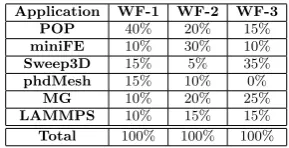
To assess the impact on scientific delivery we combine, through simulation, the benchmarked data into three ex-ample workflows (Table 3) in which the mix of jobs is var-ied. Note thatphdMesh is excluded from Workflow 3 (WF-3) as this permits analysis of memory configurations below 650MB per core. During the simulation each job is submit-ted in such a way that its runtime requirements satisfy an artificially imposed limit on the amount of memory available per core. We initially set our memory-per-core at 1.5GB, as this corresponds to the maximum usage seen in Figure 2, and then reduce this to 1280 MB, 1024 MB, 768 MB, 682 MB, 512 MB and 256 MB per core. Many of these cases may seem unlikely, but the choice of 682MB is representative of a hex-core processor with 4GB of memory, for example.
4.1
Using the Maui Scheduler Simulator
To ensure that we replicate as realistic a test environment as possible we use the Maui [1] scheduler (Version 3.3.0) in simulation mode. The scheduler simulator is is designed to allow users to safely evaluate arbitrary configurations, but in this case it allows us to simulate a production environ-ment with various different memory restrictions. We use 2048 cores of Hera as a basis for our simulated machine (de-fined using a Maui resource trace file), and our simulated workflows consist of 1000 jobs in the proportions defined in Table 3 (defined by a Maui workload trace file). We main-tain the existing polling system in Maui, replicate normal use by specifying wall-times in excess of known execution time, and allow the scheduler to backfill jobs where possi-ble. Since the simulator does not allow us to submit extra jobs while the simulation is running, we must include the complete job list at the start and rely on polling to ensure a stream of jobs to the system. This imposes two constraints
Flag Value
RPOLLINTERVAL 00:00:30
BACKFILLPOLICY BESTFIT
RESERVATIONPOLICY CURRENTHIGHEST
NODEALLOCATIONPOLICY MINRESOURCE
JOBNODEMATCHPOLICY EXACTNODE
SIMINITIALQUEUEDEPTH 16
SIMJOBSUBMISSIONPOLICY CONSTANTJOBDEPTH
Table 4: Maui simulator configuration variables
Skew 0.25 Skew 0.5 Skew 0.75
Workflow 1 17.94% 13.21% 9.78%
Workflow 2 27.76% 18.32% 12.67%
Workflow 3 12.36% 8.09% 4.19%
Table 5: Percentage Runtime Increase When Moving from 1536MB to 682MB Per-Core
on our experiments: (i) that the jobs must be submitted in a specified order – we therefore repeat the experiments a number of times with different job orderings to reduce exper-imental bias; (ii) jobs must be allocated a specific core count when staged – we discuss this further in the next section. Additional Maui configuration values are found in Table 4.
Even when applications are memory constrained they can still be run on various core counts. Typical users will often not select core counts for their jobs optimally. We therefore base the selection of application core count in our workflows on a partitioned Gaussian distribution. The distribution determines how probable it is to select a particular core count; askewfactor is introduced to adjust this distribution – a skew of 0.25 will ensure that the distribution has a bias towards core counts that are closer to the minimum, a skew of 0.75 will ensure that there is a more even distribution between possible configurations. As we see from the results, the trends are similar no matter what skew factor is used, but this does allow us to consider how users behave (using more cores or fewer cores, usage policies restricting job size, charging models etc.) and therefore what effect this may have on the interpretation of the results.
4.2
Results
We compare the time-to-completion for three different mixed-science workflows as the available memory per core is re-duced. Results are shown with three different core-count selection skew factors (0.25, 0.5 and 0.75) with an identi-cal Maui scheduler simulator configuration used throughout. Each experiment is averaged over ten runs (with randomly generated job ordering in each case) to reduce the effect of any one specific job ordering.
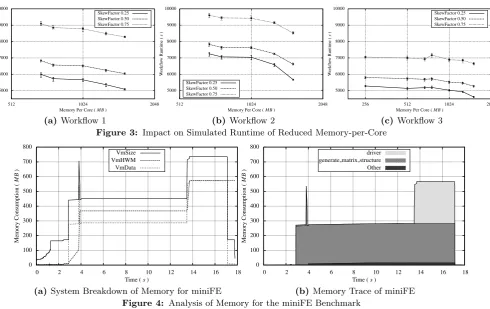
The results for the three different workflows can be found in Figures 3a, 3b and 3c respectively. For each, the av-erage workflow completion time is plotted as a trend line with maximum and minimum times reported as range-bars. Several observations can be made regarding these results:
• In general, decreasing the available memory per core in-creases the overall runtime. However, this is not a mono-tonically increasing function, see Figure 3c, for example - in this case the changing core-counts of jobs submitted can create significant decreases in machine efficiency;
[image:5.595.100.245.52.126.2]5000 6000 7000 8000 9000 10000
512 1024 2048
W
orkflo
w
Runtime
(
s
)
Memory Per Core (MB)
SkewFactor 0.25 SkewFactor 0.50 SkewFactor 0.75
(a) Workflow 1
5000 6000 7000 8000 9000 10000
512 1024 2048
W
orkflo
w
Runtime
(
s
)
Memory Per Core (MB)
SkewFactor 0.25 SkewFactor 0.50 SkewFactor 0.75
(b)Workflow 2
5000 6000 7000 8000 9000 10000
256 512 1024 2048
W
orkflo
w
Runtime
(
s
)
Memory Per Core (MB)
SkewFactor 0.25 SkewFactor 0.50 SkewFactor 0.75
[image:6.595.63.554.57.366.2](c)Workflow 3
Figure 3: Impact on Simulated Runtime of Reduced Memory-per-Core
0 100 200 300 400 500 600 700 800
0 2 4 6 8 10 12 14 16 18
Memory
Consumption
(
M
B
)
Time (s) VmSize VmHWM VmData
(a) System Breakdown of Memory for miniFE
0 100 200 300 400 500 600 700 800
0 2 4 6 8 10 12 14 16 18
Memory
Consumption
(
M
B
)
Time (s) driver generate matrix structure Other
(b) Memory Trace of miniFE
Figure 4: Analysis of Memory for the miniFE Benchmark • The rate of increase (in runtime as the memory per core
drops) is not constant. This suggests that there may exist opportunities for decreasing memory per core with little impact on scientific delivery, if the workflow mix and sys-tem usage profiles allow. Table 5 shows that the impact of moving from 1536 MB/core to 682 MB/core may be a little as 4.19%;
• Workflow mix makes a difference. Table 5 shows that the impact of moving from 1536 MB per core to 682 MB per core (skew 0.25) can be between 12.36% and 27.76% depending on the workflow mix;
• Table 5 also demonstrates that the user’s usage patterns are also important. In workflow 2 the percentage increase in runtime can vary by as much as 15.09% depending on how users select core counts.
5.
MEMORY USAGE ANALYSIS
The use of analyses such as those described in Sections 3 and 4 highlight that (i) compiler choice may impact the HWM for individual applications, and (ii) that it is pos-sible to calculate in the context of scientific applications the impact of reducing memory-per-core. In this section we present a new tool which is allowing us to determine
whyan application has such a memory HWM. Our aim is that by understanding and capturing memory usage in this way we can improve the future memory requirements of our applications.
Typically, low-level tools such as PAPI and Valgrind might be used to perform cache analysis or to identify memory-performance related problems (e.g. cache thrashing or TLB-page misses) with a tool such asmemP being used at a much
higher level. In this section we analyse the memory be-haviour of the miniFE finite element benchmark using a pro-totype tool currently being developed at the University of Warwick. The purpose of this analysis is to identify which functions within the code contribute the most to memory usage without requiring significant instrumentation or com-plex tool configuration, as is the case with many system debuggers or profilers. We note that memP claims to have some support for this level of analysis, but our experience has been that this is difficult to obtain. Our tool intercepts each change in memory state through the catching of mem-ory allocation and deallocation calls, recording the operating system reported memory state as well as the program stack. Post-execution analysis of the trace allows us to track each individual allocation and deallocation within the program, attributing the memory requested to each program func-tion. Thus we are able to assess memory allocations at a finer level of granularity (than the whole program) without creating significant overhead in the runtime of the applica-tion. Since we also only activate our tracer on changes in the memory state, the tool creates very little overhead during compute-intensive regions of code execution.
of memory are required with peaks of nearly 600MB shortly after the start and in the driver block at towards the end. In our experience many applications demonstrate memory spikes and peaks during specific functions in which data is copied and manipulated, raising the prospect of being able to optimise their memory usage through the generation and processing of data inline (as opposed to explicit allocation, copying and processing). We are currently engaged in fur-ther work investigating the potential use of our tool is diag-nosing such memory optimisation opportunities within sev-eral industry codes.
6.
CONCLUSIONS
The declining amounts of memory-per-core arising from the increasing density of multi-core processors and more modest improve in memory capacities has the potential to radically change the way in which HPC applications may need to be constructed. Currently programmers may enjoy as much as 4GB or more of memory per processing core, but future sys-tems may reduce this to 1GB or less. Combined with the high up-front cost of memory during procurement and the additional running costs due to powering large amounts of memory, there is a compelling case for analysing and im-proving current memory usage.
In this paper we present three separate studies into the use of memory for distributed MPI codes. Our first study inves-tigates the impact that compiler choice can make on memory usage. We demonstrate memory HWM differences of up to 32% for simple benchmarks. In some industry codes we have studied, compiler choice can increase memory HWM by as much as 225%. Where the memory required can be made available within machine resources, users will no doubt pri-oritise the fastest compiler toolkits. Therefore, we demon-strate that a memory study is also an important aspect of understanding code performance - all to often this is over-looked by users who assume that memory use is identical across all compilers. As memory resources become more constrained this will no doubt need to change.
In our second study we use benchmarked runtime perfor-mance and HWM memory data to assess the impact on sci-entific delivery of a decrease in memory-per-core. We show that there is a relationship between decreased memory per core and an increase in runtime but that, in some cases at least, this is not necessarily a monotonically increasing function. The rate of increase is also not constant and the composition of the workflow as well as usage profile will have an impact on the results. The issues we expose here help to demonstrate that with appropriate data (scheduler logs, scaling graphs for individual applications and HWM data) it is possible to calculate the likely impact on a reduction in memory per core for large supercomputing resources.
The final study in this paper utilises a new memory pro-filing and tracing tool currently in development at the Uni-versity of Warwick. This tool is able to intercept memory-state changing events such as allocations and deallocations to record memory usage at a per-function level. We have demonstrated excellent levels of correlation with the HWM and VmData statistics obtained from the Linux kernel giv-ing confidence in our tools’ ability to provide high levels of code coverage. The purpose of presenting this tool is to show that where individual applications show potential problems (perhaps using techniques such as those seen in studies 1 or 2), tools are becoming available that can help map these
problems to specific entities in the application itself. Al-though declining memory-per-core will no doubt cause dif-ficulties for some applications, we are becoming well placed to identify these difficulties in advance and to change the development of applications before such problems become significant.
Our appeal to Programme Managers is simple: Applica-tion scientists may demand 4 GB/core. Measure current usage with tools such asmemP; investigate different compiler options if possible. Then investigate the potential impact of reducing memory; clearly this will have some overhead, but the trade-off between more CPU hours and lower total cost of ownership may be a price worth paying.
Acknowledgements
We are grateful to Scott Futral, Jan Nunes and the Liver-more Computing Team for access to, and help in using, the Hera machine located at the Lawrence Livermore National Laboratory. We also acknowledge support of the Centre for Scientic Computing at the University of Warwick and the UK Science Research Investment Fund.
7.
REFERENCES
[1] Maui Cluster Scheduler, 2010.
http://www.clusterresources.com/products/ maui-cluster-scheduler.php.
[2] memP, 2010.
http://sourceforge.net/projects/memp/. [3] S. Biswas et al. PSMalloc: Content Based Memory
Management for MPI Application. InProceedings of the 10th MEDEA workshop on MEmory performance:
DEaling with Applications, systems and architecture,
pages 43–48, New York, NY, USA, 2009. ACM. [4] D. Dunning, R. Mooney, P. Stolt, and B. Casper.
Tera-Scale Memory Challenges and Solutions.Intel
Technology Journal, 13(4):80–101, 2009.
[5] J. Hennessy and D. Patterson.Computer Architecture
- A Quantitative Approach. Morgan Kaufmann, 2003.
[6] Hewlett-Packard.DDR3 Memory Technology, 4 2010. [7] S. Iyer et al. Embedded DRAM: Technology Platform
for the Blue Gene/L Chip.IBM J. Res. Dev., 49:333–350, March 2005.
[8] P. Kogge et al. ExaScale Computing Study:
Technology Challenges in Achieving Exascale Systems. Technical report, DARPA, September 2008.
[9] G. H. Loh. 3D-Stacked Memory Architectures for Multi-Core Processors.SIGARCH Comput. Archit. News, 36:453–464, June 2008.
[10] D. Patterson et al. A Case for Intelligent RAM.
Micro, IEEE, 17(2):34 –44, 1997.
[11] H. D. Simon. The Greening of HPC - Will Power Consumption Become the Limiting Factor for Future Growth in HPC? HPC User Forum, October 2008. [12] J. S. Vitter. External Memory Algorithms and Data
Structures: Dealing with Massive Data.ACM
Comput. Surv., 33(2):209–271, 2001.
[13] W. A. Wulf and S. A. Mckee. Hitting the Memory Wall: Implications of the Obvious.Computer