Patient preference regarding timing of discharge after elective
percutane-ous coronary intervention: a best-worst scaling.
The PRETOD study
Lieke A. van Herk
1, MSc; Clemens von Birgelen
2, MD, PhD; Marlies M. Kok
2, MD; Marieke G. M. Weernink
1; Janine A.
van Til
1, PhD
1. Department of Health Technology and Services Research, MIRA, Institute for Biomedical Technology and Technical Medicine, University of Twente, Enschede, The Netherlands; 2. Department of Cardiology, Thoraxcentrum Twente, Medisch Spectrum Twente, Enschede, The Netherlands
A R T I C L E I N F O A B S T R A C T
Keywords:
Timing of discharge Patient preference
Percutaneous coronary intervention (PCI) Personalized healthcare
Best-worst scaling case 1
Background: With the continuous improvement of stent techniques and antiplatelet drugs, same-day discharge
is both feasible and safe in selected patients undergoing elective percutaneous coronary intervention. While the majority of the patients go home happily after the procedure, other patients feel hesitant about early discharge.
Objectives: The primary objective of this study was to explain patient preference regarding the timing of
dis-charge after elective percutaneous coronary intervention by using a best-worst scaling approach. Secondary ob-jective was to explore a potential association between preference and anxiety measured by the generalized anx-iety disorder 7-item scale. Additionally, potential associations with sociodemographic-, clinical-, and procedural-characteristics and preference were explored.
Methods: Through literature review and expert consultation, thirteen objects were identified that could possibly
influence preference for timing of discharge. A patient sample who underwent coronary angiography and/or percutaneous coronary intervention (n=118) at Thorax Centrum Twente, the Netherlands, participated in the study. Conditional logit models were fitted to estimate the relative importance of each belief in influencing pa-tients’ preference. Univariate analysis was performed to identify a potential association between preference and anxiety and other sociodemographic-, clinical-, and procedural-characteristics.
Results: The majority of patients prefer same-day discharge (n=78; 66.1%). Patients considered feeling more at
ease, feeling calmer, and the presence of family and friends to be the most important reasons for their preferred timing of discharge. Least important reasons for patient preference were presence of fellow-patients, and per-forming daily activities. Subgroup analysis showed that the estimated object importance was different across the same-day discharge and overnight-hospital stay preference groups. No statistically significant association was found between anxiety and preference, however, preference was found a statistically significant association be-tween procedure type and preference for timing of discharge.
Conclusion: Although same-day discharge after elective percutaneous coronary intervention is feasible and
safe, this study shows that some patients prefer overnight-hospital stay. This study implies that patients are dis-charged home the same day despite their preference for overnight-hospital stay. In order to provide patient cen-tered care, healthcare professionals should not only consider a medical discharge checklist but also patient pref-erence for timing of discharge. In addition, healthcare professionals should ascertain reasons for patients to be hesitant against same-day discharge, so that barriers for same-day discharge could be overcome.
Abbreviations
AP Angina Pectoris
BWS Best-Worst Scaling B-W Best minus Worst
CABG Coronary Artery Bypass Grafting CAD Coronary Artery Disease CAG Coronary Angiography
CCS Canadian Cardiovascular Society COPD Chronic Obstructive Pulmonary Disease CTO Chronic Total Occlusion
DM Diabetes Mellitus
GAD-7 Generalized Anxiety Disorder 7-item scale MI Myocardial Infarction
ONS Overnight-Hospital Stay
OR Odds Ratio
PCI Percutaneous Coronary Intervention
SDD Same-Day Discharge
Introduction
With the continuous improvement of stent techniques, increased use of the radial approach, and more potent antiplatelet drugs, same-day discharge (SDD) is both feasible and safe in selected patients undergoing elective percutaneous coronary intervention (PCI)1-3. Previous research has shown that SDD does not result in additional complications com-pared to overnight-hospital stay (ONS)3.
SDD may reduce healthcare costs incurred by elective PCI-proce-dures. The savings in healthcare costs ranged from €258 to €1,141 per pa-tient, without any harm to the same-day discharged PCI patients3,4. In ad-dition, PCI as a day case procedure might reduce logistic constraints on hospital resources by minimizing problems with bed availability1.
around the patient, put the patient in control, and respect patient prefer-ences6. Furthermore, patient’s perception of quality of healthcare increas-ingly reflects the extent to which their preferences are taken into account7. In practicing evidence based medicine, evidence alone is never sufficient to make a clinical decision: patient’s values and preferences should be taken into account when decision makers trade off the benefits and risks of alternative health strategies8.
Only limited research is done in patient preference for timing of dis-charge. This limited research indicates that most patients prefer SDD after elective PCI3,5. However, when interested in patient preference, not only the stated preference is of importance, but also the underlying patient per-spectives, beliefs, expectations and goals for health and life that explain the preference8. Yet, no data is available on reasons and beliefs underlying preferences for timing of discharge.
Patient’s ability to handle stress, as well as anxiety of not being mon-itored, is another issue with SDD5. Therefore, the research hypothesis is that: patient preference differs across patients with different levels of anx-iety. To our knowledge no research has been done to identify, all together, the extent to which the level of anxiety and other patient characteristics, beliefs and perspectives are associated with a specific preference for tim-ing of discharge. When healthcare professionals can predict patient pref-erence regarding timing of discharge based on patient-, clinical-, and pro-cedural-characteristics, patient-centered discharge decision making could occur.
Therefore, the aim of this study is to explain patient preference re-garding timing of discharge after elective PCI by conducting a preference-elicitation survey. Secondary objective of this study is to explore whether self-reported anxiety levels are associated with patient preference. Addi-tionally, potential associations with sociodemographic-, clinical-, and pro-cedural-characteristics and preference will be explored.
Methods
Study design
In this study a quantitative cross-sectional design was used, in which a sample of patients provided their preference by using a com-puter-administered questionnaire. Patients were recruited to complete the PRETOD questionnaire while waiting in the intervention center to be dis-charged. Before the study began, the research protocol was submitted for consideration, comment, guidance and approval by the Research Ethics Committee. The Research Ethics Committee and the board of directors provided their approvals for administering the questionnaire.
Study population
In May and June 2016, this study was performed in a consecutive series of patients who underwent an elective CAG- or/and PCI-proce-dure at Thorax Centrum Twente, the Netherlands. Patients were included into the study when scheduled to undergo elective PCI or CAG, or when patients were scheduled to undergo a diagnostic CAG with ad hoc PCI. Participation was optional and patients could choose not to participate in this research or to withdraw.
Scheduled patients within the research period were excluded when-ever (i) patients had no angina pectoris (AP) prior to inclusion, (ii) urgent PCI was performed because of an ST-elevated myocardial infarction (MI),
(iii) a CAG or PCI was required as part of a regular work-up for another treatment like heart valve repair, invasive treatment of heart rhythm dis-ease, or implementation of cardiac devices like a pacemaker or an im-plantable cardioverter defibrillator (ICD) as part of another study, (iv) re-nal insufficiency requiring pre- and post-hydration occurred and there-fore required an ONS, (v) known with an intolerance for the used contrast fluid, in which case the patient might be required to stay overnight after the procedure, (vi) patients had insufficient knowledge of Dutch lan-guage, or (vii) patients had a cognitive impairment.
Sample size calculation
It is not yet possible to calculate power levels for Case 1 Best-Worst Scaling (BWS) and the associated minimum desired sample sizes, because the properties of some estimators, for example BWS scores, have yet to be formally proved9. Sample sizes in the range of 1,000 to 2,000 respondents will lead to small confidence intervals (CIs), even if the experimental de-sign is not efficient. However, research by Orme (2010) showed that many conjoint analysis applications in health included samples sizes of 100 to 300 respondents10. On the basis of this research, the minimum sample size was set at 100 respondents. However, a larger sample size was desirable in order to reduce the CIs.
Data collection
Data was collected by designing and administering a questionnaire. The first part of the questionnaire consisted of thirteen questions about sociodemographic patient characteristics, including: gender, age, proce-dure type, nationality, education level, living status, employment status, travel distance to the hospital, anxiety, discharge status, satisfaction with procedure and satisfaction with hospital stay. Anxiety was measured by the generalized anxiety disorder 7-item scale (GAD-7), a brief measure for assessing generalized anxiety disorder. This anxiety scale ranges from 0 to 21 points. At a cut point score of 10, sensitivity (89%) and specificity (82%) are optimal. Increasing scores on the GAD-7 are strongly associated with multiple domains of functional impairment (Short Form-20 Health-Related Quality of Life Scales). Anxiety was classified by levels of anxiety severity: minimal (0-4), mild (5-9), moderate (10-14), and severe (15-21)11. The second part of the questionnaire was conducted to elicit patient preference regarding timing of discharge after their current PCI. Patients who underwent CAG were asked to imagine that they underwent PCI that day. This question was completed under the assumption that patients themselves could choose their timing of discharge after PCI. Both patient groups could choose between two options: SDD or ONS.
which every object appeared the same number of times (Balanced) and every object co-appeared with every other object the same number of times (Orthogonal).
Through literature review and consultation with patients and healthcare professionals, thirteen objects were selected that possibly influ-ence patient preferinflu-ence2,5,13. Table 1 shows the list of objects that emerged as important objects.
The BWS consisted of 13 choice tasks. In every BWS task, four ob-jects were shown and patients were asked to pick one object that was most important and one that was least important for their preferred timing of discharge. A pilot test of the questionnaire was carried out with six people at the same age category as the patient population to ensure that the ques-tions and direcques-tions were clear.
Before completing the questionnaire, patients were provided with two pieces of information: (i) an information letter regarding the goal, de-sign, burden, and advantages of this study, access to medical records, and privacy; and (ii) an informed consent to give the researcher access to med-ical records. Of patients who gave written informed consent, clinmed-ical- and procedural- characteristics were collected from medical records to explore a potential association with preference. Clinical-characteristics included:
comorbidity (diabetes mellitus (DM), chronic obstructive pulmonary
dis-ease (COPD), hypertension, and depression); coronary history (prior MI, prior CAG, prior PCI, and prior coronary artery bypass grafting (CABG));
type AP; and AP classification. Procedural-characteristics for both groups
included access-site; significant coronary artery disease (CAD); and chronic total occlusion (CTO). For patients who underwent PCI, addi-tional procedural-characteristics were collected, including: dilatation; number of lesions treated per patient; and lesion type.
Data analysis
Data was presented by frequencies and percentages for dichoto-mous and categorical variables. Age was reported as mean ± standard de-viation, including minimum and maximum. Potential differences in soci-odemographic-, clinical- and procedural-characteristics between the
PCI-and CAG-group were identified by a Chi-square test PCI-and Fisher’s exact tests for dichotomous and categorical variables and by a Student’s t-test for continuous variables.
To investigate patient beliefs that explain patient preference, most important and least important choices were counted and ordered by best minus worst (B-W) scores9. These totals were rescaled to the number of respondents and the standard deviations were calculated. Positive values of B-W indicate that the objects were chosen more frequently as best than as worst and vice versa14. Furthermore, for the individual BWS scores the median and interquartile range were determined. Finally, boxplots were created to provide a visual representation of the results.
Conditional (fixed effects) logistic regression was performed to ana-lyze BWS data in detail. By means of this analysis, object importance re-garding timing of discharge was determined. Instead of coefficients, ORs were calculated in order to present the BWS data more easily. The larger the odds ratio of an object, the more often that object was valued as most important by patients, compared to the reference object. In addition, sub-group analysis by preference (SDD and ONS) was performed in order to explore whether subgroups valued objects differently.
[image:3.595.36.292.186.405.2]Eventually, associations between anxiety and other patient charac-teristics (including for example gender, age, and education) and prefer-ence for timing of discharge were examined by using univariate analysis. To account for possible confounders and to identify independent predic-tors, a logistic regression model with preference as the dependent variable was conducted. The analyses were conducted by using SPSS 23 and Stata 13. All statistical tests were two-tailed. P values less than 0.05 were consid-ered statistically significant.
Table 1 Objects included in the BWS. Object Description in questionnaire
Comfortable environment13 I feel more at ease on the chosen place.
Deal with stressful situation13 I feel calmer on the chosen place.
Contact with family and friends The presence of family and friends. Contact with fellow-patients The presence of fellow-patients. Safety I feel safer on the chosen place. Taking care of family or pets The care for family of pets that I have to
take.
Resumption of daily life My daily activities I need to perform, such as work.
Quality of care The quality of care I receive at the selected spot.
Complication2 The risk of a complication after procedure.
Privacy I have more privacy on the chosen place. Provision of information The speed and ease with which I am in
contact with the nurse or doctor. Perceived expectation2 This is common practice.
Control over health5 Control of my health.
Admitted patients for elective CAG or/and
PCI
143 eligible patients
122 patients enrolled
118 patients included in data analysis
62 elective
CAG-patients 56 elective PCI patients
Outcome assessment
Ineligible patients due to:
· No angina pectoris
· ST-elevated MI at presentation
· Procedures as part of regular work-up
· Renal insufficiency
· Known intolerance for contrast fluid
· Language barrier
· Cognitive impairment
Dropped out patients due to:
· Declined to participate (7)
· Physically unable (3)
· Logistic reasons (11)
Excluded patients from analysis due to:
· 4 Screening failure (4)
Complete questionnaires
[image:3.595.307.549.436.758.2]Results
Recruitment
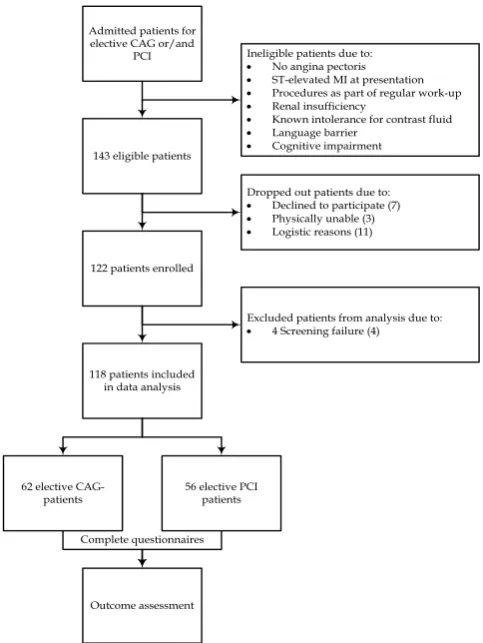
Of the 143 eligible and invited patients, a total of 122 patients com-pleted the PRETOD Questionnaire. Figure 1 displays a flowchart of the recruitment procedure and the response of participants to the invitation. Reasons for eligible patients not to participate were: lack of interest, phys-ically unable, or lost to follow-up. Among the 122 patients who completed the questionnaire, 4 patients were excluded from analyses, because these patients were hospitalized in a referring hospital for several days prior to the current procedure, which could have impacted their preference.
Sample characteristics
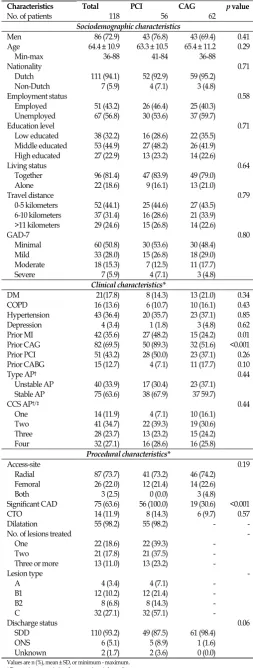
Table 2 displays sociodemographic-, clinical- and procedural-char-acteristics of the patient population and separatelyof the PCI- and CAG-groups. Most patients were male (72.9%), of Dutch descent (94.1%), mid-dle educated (44.9%) and had a minimal level of anxiety (50.8%). The mean age was 64.4 years.
Between PCI- and CAG-patients, there were no statistically signifi-cant differences in sociodemographic characteristics. However, patients in the PCI-group had statistically significant experienced a prior MI than patients in the CAG-group (48.2% vs. 24.2%, p = 0.01) and had undergone more often a prior CAG (89.3% vs. 51.6%, p < 0.001). In both types of pro-cedures, the majority was carried out via radial access (73.2% in the PCI-group and 74.2% in the CAG-PCI-group, p = 0.19).
Preference scores
The majority of the total respondents prefer SDD (66.1%; n=78). However, there was a statistically significant association between proce-dure types and preference (p < 0.001). PCI-patients prefer SDD more often (87.5%; n=49) than CAG-patients (46.8%; n=29). The degree of association between procedure and preference is between weak and moderately strong (Cramer’s V = 0.430).
Model estimation
118 PRETOD questionnaires were used in the BWS analysis, giving rise to 1,534 choice situations. Estimates of object importance, by best and worst counting, are presented in Table 3. Feeling more at ease was chosen as the most important reason for patients’ preference for timing of dis-charge (1.35) and while performing daily activities was chosen as least im-portant reason for patients’ preference for timing of discharge (-1.58).
[image:4.595.306.560.78.748.2]Figure 2, Figure 3 and Figure 4 show the boxplots of the individual BWS scores for both preferences, and separately for SDD and ONS. Figure 2 shows that patients value feeling more at ease, feeling calmer, and the presence of family and friends more often as most important reason for their preference, compared to the other objects. The evaluation of the re-ceived quality of care was more equally divided compared to other ob-jects, because the object shows the smallest variability. On the other hand, patients value presence of family and friends, feeling safer, performing daily activities, the risk of a complication after procedure, and control over patients’ health with a higher variability, which implicates that patients value these objects less equal. Therefore, boxplots of individual B-W
Table 2 Characteristics of the study population.
Characteristics Total PCI CAG p value
No. of patients 118 56 62
Sociodemographic characteristics
Men 86 (72.9) 43 (76.8) 43 (69.4) 0.41 Age 64.4 ± 10.9 63.3 ± 10.5 65.4 ± 11.2 0.29
Min-max 36-88 41-84 36-88
Nationality 0.71
Dutch 111 (94.1) 52 (92.9) 59 (95.2) Non-Dutch 7 (5.9) 4 (7.1) 3 (4.8)
Employment status 0.58 Employed 51 (43.2) 26 (46.4) 25 (40.3)
Unemployed 67 (56.8) 30 (53.6) 37 (59.7)
Education level 0.71
Low educated 38 (32.2) 16 (28.6) 22 (35.5) Middle educated 53 (44.9) 27 (48.2) 26 (41.9) High educated 27 (22.9) 13 (23.2) 14 (22.6)
Living status 0.64
Together 96 (81.4) 47 (83.9) 49 (79.0) Alone 22 (18.6) 9 (16.1) 13 (21.0)
Travel distance 0.79
0-5 kilometers 52 (44.1) 25 (44.6) 27 (43.5) 6-10 kilometers 37 (31.4) 16 (28.6) 21 (33.9) >11 kilometers 29 (24.6) 15 (26.8) 14 (22.6)
GAD-7 0.80
Minimal 60 (50.8) 30 (53.6) 30 (48.4) Mild 33 (28.0) 15 (26.8) 18 (29.0) Moderate 18 (15.3) 7 (12.5) 11 (17.7) Severe 7 (5.9) 4 (7.1) 3 (4.8)
Clinical characteristics*
DM 21(17.8) 8 (14.3) 13 (21.0) 0.34 COPD 16 (13.6) 6 (10.7) 10 (16.1) 0.43 Hypertension 43 (36.4) 20 (35.7) 23 (37.1) 0.85 Depression 4 (3.4) 1 (1.8) 3 (4.8) 0.62 Prior MI 42 (35.6) 27 (48.2) 15 (24.2) 0.01 Prior CAG 82 (69.5) 50 (89.3) 32 (51.6) <0.001 Prior PCI 51 (43.2) 28 (50.0) 23 (37.1) 0.26 Prior CABG 15 (12.7) 4 (7.1) 11 (17.7) 0.10
Type AP† 0.44
Unstable AP 40 (33.9) 17 (30.4) 23 (37.1) Stable AP 75 (63.6) 38 (67.9) 37 59.7)
CCS AP†/‡ 0.44
One 14 (11.9) 4 (7.1) 10 (16.1) Two 41 (34.7) 22 (39.3) 19 (30.6) Three 28 (23.7) 13 (23.2) 15 (24.2) Four 32 (27.1) 16 (28.6) 16 (25.8)
Procedural characteristics*
Access-site 0.19
Radial 87 (73.7) 41 (73.2) 46 (74.2) Femoral 26 (22.0) 12 (21.4) 14 (22.6) Both 3 (2.5) 0 (0.0) 3 (4.8)
Significant CAD 75 (63.6) 56 (100.0) 19 (30.6) <0.001 CTO 14 (11.9) 8 (14.3) 6 (9.7) 0.57 Dilatation 55 (98.2) 55 (98.2) - - No. of lesions treated -
One 22 (18.6) 22 (39.3) - Two 21 (17.8) 21 (37.5) - Three or more 13 (11.0) 13 (23.2) -
Lesion type -
A 4 (3.4) 4 (7.1) - B1 12 (10.2) 12 (21.4) - B2 8 (6.8) 8 (14.3) - C 32 (27.1) 32 (57.1) -
Discharge status 0.06 SDD 110 (93.2) 49 (87.5) 61 (98.4)
ONS 6 (5.1) 5 (8.9) 1 (1.6) Unknown 2 (1.7) 2 (3.6) 0 (0.0)
Values are n (%), mean ± SD, or minimum - maximum. * Two patients are missing due to no given informed consent.
† One patient is missing due characteristic to not recorded in medical record.
‡ CCS: Canadian Cardiovascular Society Grading scale: (i) angina only during strenuous or prolonged physical
Figure 2 Boxplots of individual best-worst scores for both preferences
Figure 3 Boxplots of individual best-worst scores for same-day discharge
Figure 4 Boxplots of individual best-worst scores for overnight-hospital stay
Table 3 Estimates of object importance by best worst counting.
Objects B-W totals Rescaled B-W Std. dev. Rescaled B-W Median Interquartile range
Comfortable environment 159 1.35 1.75 1 0 to 3 Deal with stressful situation 112 0.95 1.50 1 0 to 2 Family contact 106 0.90 2.23 1 -1 to 3 Patient contact -184 -1.56 1.46 -2 -3 to -1
Safety 41 0.35 1.93 0 -1 to 2
Care for family -61 -0.52 1.85 -1 -2 to 0 Resumption of daily life -186 -1.58 1.83 -2 -3 to 0 Quality of care 58 0.49 1.37 0,5 0 to 1
Complication -9 -0.08 2.17 0 -2 to 1
Privacy -8 -0.07 0.89 0 -1 to 1
Provision of information 8 0.07 1.74 0 -1 to 1 Perceived expectations -88 -0.75 1.88 -1 -2 to 0 Control over health 52 0.44 1.95 0 -1 to 2
Table 4 Conditional logistic regression model.
Objects Faction OR 95% CI p >|z|
Comfortable environment Total SDD ONS 4.52 6.75 3.97 3.71 5.21 2.68 5.49 8.74 5.89 <0.001 <0.001 <0.001 Deal with stressful situation Total
SDD ONS 3.64 4.26 5.63 3.00 3.33 3.75 4.41 5.44 8.45 <0.001 <0.001 <0.001 Family contact Total
SDD ONS 3.55 6.97 1.69 2.93 5.37 1.15 4.31 9.05 2.49 <0.001 <0.001 <0.001 Patient contact Total
SDD ONS 1.02 0.94 1.29 0.84 0.74 0.90 1.23 1.19 1.86 0.84 0.61 0.17 Safety Total
SDD ONS 2.72 1.54 19.08 2.25 1.21 12.29 3.29 1.95 29.60 <0.001 <0.001 <0.001 Care for family Total
SDD ONS 1.74 2.00 1.61 1.44 1.58 1.11 2.09 2.53 2.33 <0.001 <0.001 0.01 Resumption of daily life Total
SDD
ONS REFERENCE Quality of care Total
SDD ONS 2.93 2.14 12.21 2.42 1.69 7.99 3.55 2.71 18.66 <0.001 <0.001 <0.001 Complication Total
SDD ONS 2.21 1.15 18.23 1.83 0.91 11.75 2.66 1.45 28.29 <0.001 0.25 <0.001 Privacy Total
SDD ONS 2.19 3.24 1.35 1.82 2.54 0.93 2.64 4.12 1.96 <0.001 <0.001 0.12 Provision of information Total
SDD ONS 2.36 1.53 12.04 1.95 1.21 7.88 2.85 1.93 18.40 <0.001 <0.001 <0.001 Perceived expectations Total
SDD ONS 1.55 1.87 1.33 1.29 1.48 0.90 1.87 2.37 1.95 <0.001 <0.001 0.15 Control over health Total
[image:5.595.49.282.601.751.2]scores for SDD and ONS are presented. Figure 3 shows that the most im-portant reasons for patients to prefer SDD are feeling more at ease, feeling calmer, and the presence of family and friends. On the other hand, least important reasons for patients to prefer SDD are the presence of fellow-patients and performing daily activities. Figure 4 shows that the boxplots of individual B-W scores for ONS overlay less, meaning that patients as-sign distinct values to the objects. The two most important reasons for pa-tients to prefer ONS are feeling safer and control over papa-tients’ health.
While, patients value three objects as least important for their ONS pref-erence, including: the presence of fellow-patients, performing daily activ-ities and commonality of the preferred timing of discharge.
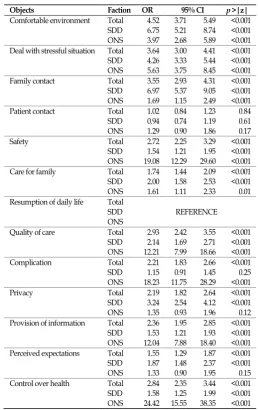
Table 4 shows the relative importance of each object associated with preference for timing of discharge by a conditional logistic regression model. The importance of each object was estimated relative to “resump-tion of daily life” which was rated as least important object. Patients value feeling more at ease 4.5 times higher than the performance of daily activi-ties (OR 4.52, p < 0.001). Feeling calmer and the presence of family and friends are the second and third most important reasons, and are valued 3.6 and 3.55 times higher, respectively, than performing daily activities (OR 3.64, p < 0.001; OR 3.55, p < 0.001). All other objects seem to be of in-termediate importance except for the presence of fellow-patients, which is close to the reference object (OR 1.02, p 0.844).
Subgroup analysis shows that the estimated importance of each ob-ject relative to the reference is different across the SDD and ONS prefer-ence groups, also shown in Table 4. The results from the SDD group anal-ysis show that patients value the presence of family and friends and feel-ing more at ease 7 and 6.7 times higher than performfeel-ing daily activities (OR 6.97, p < 0.001; OR 6.74, p < 0.001). The presence of fellow-patients was valued 0.94 times as high as the reference (OR 0.94, p <0.605). The results from the ONS group analysis show that the control over patient’s health, feeling safer and the risk of a complication after the procedure are valued 24.4, 19.1 and 18.2 times higher than performing daily activities (OR 24.4,
p < 0.001; OR 19.1, p < 0.001, OR 18.2, p < 0.001). On the other hand, patients
with a preference for ONS value presence of fellow-patients, to have more privacy, and the commonality of the preferred timing of discharge close to the reference (OR 1.3, p < 0.169; OR 1.3, p < 0.119; OR 1.3, p <0.149), meaning that patients value these objects more often as least important to prefer ONS.
Associations between patient characteristics and preference scores
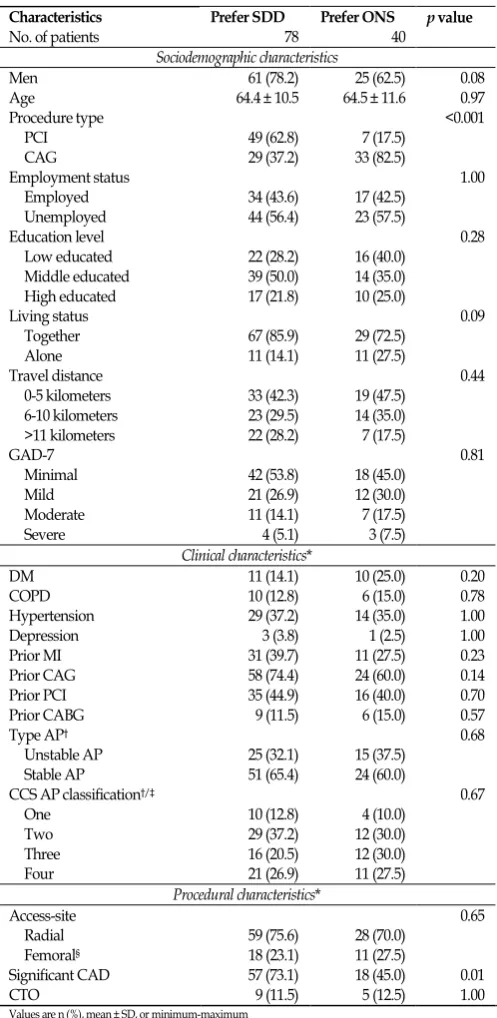
Table 5 presents the univariate analysis of associations between var-ious characteristics and preference. There is no statistically significant
asso-ciation between anxiety and preference (p = 0.81). However, analysis shows five associations with a p value ≤ 0.15, including: gender (p = 0.08); procedure type (p < 0.001); living status (p = 0.09); prior CAG (p = 0.14); and significant CAD (p = 0.01).
Of these five characteristics a logistic regression model was made to ascertain the effect on the likelihood that participants have a preference for overnight-hospital say. The logistic regression model was statistically significant χ2 (5) = 26.6, p < 0.001 and explained 28.4% (Nagelkerke R2) of the variance in preference. Procedure type was statistically significant in the model (p < 0.001), meaning that patients who undergo a CAG-proce-dure have 10.1 higher odds to prefer ONS than patients who have had a PCI-procedure. Other variables were not statistically significant in the lo-gistic regression model.
Discussion
Interpretation of results
[image:6.595.39.288.200.710.2]The aim of this study was to assess reasons and beliefs underlying patient preference for timing of discharge after elective PCI. This study shows that the majority of patients prefer SDD after elective PCI and that Table 5 Univariate analysis for association.
Characteristics Prefer SDD Prefer ONS p value
No. of patients 78 40
Sociodemographic characteristics
Men 61 (78.2) 25 (62.5) 0.08 Age 64.4 ± 10.5 64.5 ± 11.6 0.97 Procedure type <0.001
PCI 49 (62.8) 7 (17.5) CAG 29 (37.2) 33 (82.5)
Employment status 1.00 Employed 34 (43.6) 17 (42.5)
Unemployed 44 (56.4) 23 (57.5)
Education level 0.28
Low educated 22 (28.2) 16 (40.0) Middle educated 39 (50.0) 14 (35.0) High educated 17 (21.8) 10 (25.0)
Living status 0.09
Together 67 (85.9) 29 (72.5) Alone 11 (14.1) 11 (27.5)
Travel distance 0.44
0-5 kilometers 33 (42.3) 19 (47.5) 6-10 kilometers 23 (29.5) 14 (35.0) >11 kilometers 22 (28.2) 7 (17.5)
GAD-7 0.81
Minimal 42 (53.8) 18 (45.0) Mild 21 (26.9) 12 (30.0) Moderate 11 (14.1) 7 (17.5) Severe 4 (5.1) 3 (7.5)
Clinical characteristics*
DM 11 (14.1) 10 (25.0) 0.20 COPD 10 (12.8) 6 (15.0) 0.78 Hypertension 29 (37.2) 14 (35.0) 1.00 Depression 3 (3.8) 1 (2.5) 1.00 Prior MI 31 (39.7) 11 (27.5) 0.23 Prior CAG 58 (74.4) 24 (60.0) 0.14 Prior PCI 35 (44.9) 16 (40.0) 0.70 Prior CABG 9 (11.5) 6 (15.0) 0.57
Type AP† 0.68
Unstable AP 25 (32.1) 15 (37.5) Stable AP 51 (65.4) 24 (60.0)
CCS AP classification†/‡ 0.67
One 10 (12.8) 4 (10.0) Two 29 (37.2) 12 (30.0) Three 16 (20.5) 12 (30.0) Four 21 (26.9) 11 (27.5)
Procedural characteristics*
Access-site 0.65
Radial 59 (75.6) 28 (70.0) Femoral§ 18 (23.1) 11 (27.5)
Significant CAD 57 (73.1) 18 (45.0) 0.01 CTO 9 (11.5) 5 (12.5) 1.00
Values are n (%), mean ± SD, or minimum-maximum * Two patients are missing due to no given informed consent.
† One patient is missing due to characteristic not recorded in medical record.
‡ CCS: Canadian Cardiovascular Society Grading scale: (i) angina only during strenuous or prolonged
phys-ical activity; (ii) slight limitation, with angina only during vigorous physphys-ical activity; (iii) symptoms with eve-ryday living activities, moderate limitation; (iv) inability to perform any activity without angina or angina at rest, severe limitation15.
beliefs and reasoning for preference differs across preference groups based on received procedure.
The main reasons for patients to prefer SDD were presence of family and friends, feeling more at ease, and feeling calmer. The two least im-portant reasons to prefer SDD were resumption of daily life and presence of fellow-patients. However, it was expected that resumption of daily life would be important to this preference group. An explanation for this un-expected outcome is that the term ‘work activities’ was used in the de-scription of this object. The facts that the majority of patients were unem-ployed and advise was given to rest for three days, might explain the out-come.
The main reasons for patients to prefer ONS were the control over patients’ health, feeling safer, and the risk of a complication after treat-ment. The two least important reasons to prefer ONS were presence of fellow-patients and performing daily activities.
Prior to this research, it was hypostasized that preference for timing of discharge is different across different levels of anxiety. The results of this study indicate that preference does not differ across the different lev-els of anxiety. I.e. patients with severe anxiety did not prefer ONS more often than patients with minimal anxiety. However, patients who pre-ferred ONS did list the reasons related to perceived and actual safety as important drivers for their preference.
While patients in the CAG- and PCI-group did not differ statistically significant on the basis of sociodemographic characteristics, most clinical and procedural related characteristics, an unexpected difference in prefer-ence between these groups was found. The CAG-group stated to prefer SDD less often than the PCI-group. This result might implicate that CAG-patients are reluctant towards a PCI procedure or might had difficulty im-agining what it is like to undergo a PCI-procedure.
Results from previous studies
The results of this study indicate that the majority of patients prefer SDD, this is in agreement with the study other studies3,5.
A pilot randomized controlled trial (RCT) by Kim et al. (2013) re-ported that SDD was preferred by most patients undergoing elective PCI via femoral access5. Of the 150 patients and 148 patients randomized to SDD and ONS, 80% and 68% stated to prefer SDD if they had another PCI. In this study patients with sub-optimal angiographic outcomes and clini-cal complications during PCI were excluded. Secondly, patients indicated for more than 3 stents were excluded. Moreover, the study was limited to patients younger than 65 years of age and type A or B lesions5.
In the RCT of Heyde et al. (2007), 704 patients completed a patient satisfaction questionnaire in which patients were asked for their prefer-ence for timing of discharge in the event of repeat PCI3. Patients random-ized to SDD preferred SDD in 73% of the cases versus 32% of ONS pa-tients. However, patients were excluded whenever: (i) scheduled to un-dergo CAG with possible ad hoc PCI; (ii) guiding catheters >6F in diame-ter, elective glycoprotein IIb/IIIa receptor blockers, or long-term systemic anticoagulation were used; (iii) lived >60 minutes away from intervention center3.
In the intervention center where this research was performed, SDD is already common practice and only 5% of the total patient population was not discharged the same-day as the procedure. Keeping in mind that the previously mentioned studies were RCTs, the findings of preference
for patients randomized to SDD are compared to the findings in this study. Previous studies showed a slightly higher percentage of patients with a preference for SDD: 80% and 73% against 66% of the total patients with a preference for SDD in this study. However, when considering pa-tient preference for SDD in papa-tients who have undergone elective PCI, the percentage is higher (87.5%), which may be caused by the fact that SDD is already common practice.
Remarkably, the percentage of PCI patients with a preference for SDD in this study is higher while: (i) no exclusion based on age, (ii) no exclusion of C lesions, (iii) no exclusion of CTO’s, (iv) no exclusion of pa-tients with clinical complications, (v) no exclusion of papa-tients with ad hoc PCI when scheduled for CAG occurred. This means that previous studies used a relatively healthy population and our study population might rep-resent the overall patient population more completely. In addition, our study explained underlying reasons for a specific preference by a BWS.
Study strengths
BWS overcomes many of the reliability issues that are inherent with simple rating scales14. In addition, by using a BWS more information could be obtained compared to discrete choice experiments and less bur-den was placed on the patient than a full ranking of all choice options16. By forcing patients to choose one most and one least preferred reason in every choice set, rich information on the relative importance of the beliefs and reasons was provided. Variation in choice set size was avoided by using a BIBD.
It was attempted to prevent confounding, by excluding patients who were hospitalized in a referring hospital for several days prior to the current procedure, which could have impacted their preferred timing of discharge greatly. Selection bias was prevented by including all patients who have undergone a CAG- or PCI-procedures during the entire study period.
The feasibility of the questionnaire was improved by a pilot study with six participants, before the PRETOD questionnaire was introduced. This resulted in a few textual changes.
Study limitations
Notwithstanding these new insights, this study has several limita-tions that must be taken into consideration while interpreting the results. One concern is the limited total number of patients in the study, causing bounded subgroup analysis for the association between the different lev-els of anxiety and preference with respondents per subgroups ranging from three to forty-two.
While the concept, value and usage of patient preference in healthcare is well recognized, the implementation poses a challenge to pa-tients17. This challenge is also recognized in the present study. Patients of-ten presumed clinicians’ preeminence in the decision on timing of dis-charge.
So, although a pilot study was conducted, the feasibility of the ques-tionnaire was slightly limited. The former two issues led to the decision to assist patients with completing the questionnaire. The face validity of the questionnaire is therefore preserved. However, a disadvantage of this method is that patients could choose socially desirable answers, e.g. on the GAD-7 questions. In addition, questionnaires were completed in a com-mon room with de presence of fellow-patients. Therefore, patients who have expressed their preference publicly could have influenced fellow-patients.
Implications for policy and clinical implications
Several recommendations are made for future research. First, simi-lar studies should be conducted with a simi-larger sample size to confirm our outcomes. Second, this study should be repeated in other hospitals and other countries to check whether the conditions of the hospital and coun-try might influence the preference. Third, to our knowledge all sociodem-ographic-, clinical-, and procedural-characteristics that could influence preference are included in this study. However, other characteristics should be identified in order to predict patient preference for timing of discharge based of patient characteristics. Last, anxiety was measured by GAD-7 which is a general measurement tool. This means that anxiety need not necessarily had to be related to the PCI-procedure. Therefore, we recommend to repeat this study with a measurement tool that measures anxiety specifically related to the procedure.
Within the context of the findings presented in this study, two spe-cific practice- and policy-related issues emerged that healthcare profes-sionals might consider as they provide healthcare to PCI-patients. First, make clear during the patient information sessions that SDD is safe in the majority of patients undergoing elective PCI. Only if patients truly under-stand potential risks and benefits, patient’s stated preference will reflect their real preference18. So, patient education about safety of SDD after elec-tive PCI is crucial in ensuring the success of a SDD program2. A supple-mentary implication to policy is that policymakers should ensure that pa-tient information leaflets are equivalent to practice. Current information leaflets imply that ONS is common practice.
Second, discharging of patients should not be done solely based on clinical features, but sociodemographic characteristics of patients and their preference should be considered too. For example, in this study 50% (n=11) of patients who live alone, compared to 30% (n=29) of patients who live together prefer ONS. It is recommended to establish a support system for patients who live alone to overcome problems of self-reliance and un-certainty. Healthcare professionals should support family care or arrange home care for patients who life alone. If no social safety net could be ar-ranged, ONS should be considered.
Conclusion
This study shows that the majority of patients prefer SDD after elec-tive PCI and that reasoning for preference differs across preference groups. The main reasons for patients to prefer SDD were presence of family and friends, feeling more at ease, and feeling calmer. The two least important reasons to prefer SDD were performing daily activities and the presence of fellow-patients. The main reasons for patients to prefer ONS
were the control over patients’ health, feeling safer, and the risk of a com-plication. The two least important reasons to prefer ONS were the pres-ence of fellow-patients and performing daily activities. No statistically sig-nificant association between anxiety and preference was found.
This study implies that patients are discharged home the same day despite their preference for ONS. In order to provide patient centered care, healthcare professionals should not only consider a medical discharge checklist but also patient preference for timing of discharge. In addition, healthcare professionals should ascertain reasons for patients to be hesi-tant against SDD, so that barriers for SDD could be overcome.
References
1. Banning, A.P., Ormerod, O.J.M., Channon, C.J., McKenna, W., Orr, W., Boulton, B., Bashir, Y., & Forfar, J.C. (2003) Same day discharge following elective percutaneous coronary intervention in patients with stable angina. Heart, 89, pp. 665-666.
2. Abdelaal, E., Rao, S.V., Gilchrist, I.C., Bernat, I., Shroff, A., Caputo, R., Costerousse, O., Pancholy, S.B., & Bertrand, O.F. (2013) Same-Day Discharge Compared with Overnight Hospitalization After Uncomplicated Percutaneous Coronary Intervention: A Systematic Review and Meta-Analysis. JACC: Cardiovascular Interventions, 6(2), pp. 99-112.
3. Heyde, G.S., Koch, K.T., Winter, R.J. de, Dijkgraaf, M.G.W., Klees, M.I., Dijksman, L.M., Piek, J.J., & Tijssen, J.G.P. (2007) Randomized Trial Comparing Same-Day Discharge with Overnight Hospital Stay After Percutaneous Coronary Intervention: Results of the Elec-tive PCI in Outpatient Study (EPOS). Circulation, 115, pp. 2299-2306. 4. Rinfret, S., Kenneday, W.A., Lachaine J., Lemay, A., Rodés-Cabau,
J., Cohen, D.J., Costerousse, O., & Bertrand, O.F. (2010) Economic Impact of Same-Day Home Discharge After Uncomplicated Trans-Radial Percutaneous Coronary Intervention and Bolus-Only Abciximab Regimen. JACC: Cardiovascular Interventions, 3 (10), pp. 1011-1019.
5. Kim, M., Muntner, P., Sharma, S., Choi, J.W., Stoler, R.C., Wood-ward, M., Mann, D.M., & Farkouh, M.E. (2013) Assessing Patient-Reported Outcomes and Preferences for Same-Day Discharge After Percutaneous Coronary Intervention: Results from a Pilot Random-ized, Controlled Trial. Circulation, 6, pp. 186-192.
6. Berwick, D.M. (2002) A user’s manual for the IOM’s ‘Quality Chasm’ Report. Health affairs, 21 (3), pp. 80-90.
7. Ransom, E.R., Joshi, M.S., Nash, D.B. & Ransom, S.B. (2008) The
Healthcare Quality Book: Vision, Strategy, and Tools. Chicago.
8. Guyatt, G., Rennie, D., Meade, M.O., & Cook, D.J. (2008) Users’
Guides to The Medical Literature: A Manual for Evidence-Based Clinical Practice (second edition). United States of America: The McGraw-Hill
Companies.
9. Louviere, J.J., Flynn, T.N., & Marley, A.A.J. (2015) Best-Worst Scaling:
theory, methods and applications. Cambridge University Press:
Cam-bridge.
10. Orme, B. K. (2010) Getting Started with Conjoint Analysis: Strategies for
Product Design and Pricing Research. Second Edition, Madison, Wis.:
Research Publishers LLC.
11. Spitzer, R.L., Kroenke, K., Williams, J.B., & Löwe, B. (2006) A brief measure for assessing generalized anxiety disorder: the GAD-7.
JAMA Internal Medicine, 166 (10), pp. 1092-1097.
12. Thurstone, L.L. (1927) A law of comparative judgment. Psychological
Review, 34, 273-286.
14. Adamsen, J.A., Rundle-Thiele, S., & Whitty, J. A. (2013) Best-Worst scaling… reflections on presentation, analysis, and lessons learnt from case 3 BWS experiments. Market & Social Research, 21(1), pp. 9-27.
15. Campeau, L. (2002) The Canadian Cardiovascular Society grading of angina pectoris revisited 30 years later. Canadian Journal of
Cardi-ology, 18 (4), pp. 371-379.
16. Flynn, T.N., Louviere, J.J., Peters, J.T., & Coast, J. (2007) Best-worst scaling: What it can do for health care research and how to do it.
Journal of Health Economics, 26, pp. 171-189.
17. Brennan, P.F., & Strombom, I. (1998) Improving Health Care by Un-derstanding Patient Preferences: The Role of Computer Technol-ogy. Journal of the American Medical Informatics Association, 5(3), pp. 257-262.