University of Warwick institutional repository: http://go.warwick.ac.uk/wrap
This paper is made available online in accordance with
publisher policies. Please scroll down to view the document
itself. Please refer to the repository record for this item and our
policy information available from the repository home page for
further information.
To see the final version of this paper please visit the publisher’s website.
Access to the published version may require a subscription.
Author(s):
S. Araujo-Betancor, B. T. Gänsicke, H.-J. Hagen, T. R.
Marsh, E. T. Harlaftis, J. Thorstensen, R. E. Fried, P. Schmeer,
and D. Engels
Article Title: HS 2331+3905: The cataclysmic variable that has it all
Year of publication: 2005
Link to published article:
http://dx.doi.org/10.1051/0004-6361:20041736
/
c
ESO 2005
Astrophysics
&
HS 2331+3905: The cataclysmic variable that has it all
S. Araujo-Betancor
1,, B. T. Gänsicke
2,, H.-J. Hagen
3, T. R. Marsh
2,
E. T. Harlaftis
4, J. Thorstensen
5, R. E. Fried
6, P. Schmeer
7, and D. Engels
31 Space Telescope Science Institute, 3700 San Martin Drive, Baltimore, MD 21218, USA e-mail:[email protected]
2 Department of Physics, University of Warwick, Coventry CV4 7AL, UK
3 Hamburger Sternwarte, Universität Hamburg, Gojenbergsweg 112, 21029 Hamburg, Germany
4 Institute of Space Applications and Remote Sensing, National Observatory of Athens, PO Box 20048, Athens 11810, Greece 5 Department of Physics and Astronomy, Dartmouth College, 6127 Wilder Laboratory, Hanover, NH 03755-3528, USA 6 Braeside Observatory, PO Box 906, FlagstaffAZ 86002, USA
7 Bischmisheim, Am Probstbaum 10, 66132 Saarbrücken, Germany
Received 26 July 2004/Accepted 27 September 2004
Abstract.We report detailed follow-up observations of the cataclysmic variable HS 2331+3905, identified as an emission-line object in the Hamburg Quasar Survey. An orbital period of 81.08 min is unambiguously determined from the detection of eclipses in the light curves of HS 2331+3905. A second photometric period is consistently detected at P 83.38 min,
∼2.8% longer than Porb, which we tentatively relate to the presence of permanent superhumps. High time resolution photometry exhibits short-timescale variability on time scales of5−6 min which we interpret as non-radial white dwarf pulsations, as well as a coherent signal at 1.12 min, which is likely to be the white dwarf spin period. A large-amplitude quasi-sinusoidal radial velocity modulation of the Balmer and Helium lines with a period∼3.5 h is persistently detected throughout three seasons of time-resolved spectroscopy. However, this spectroscopic period, which is in no way related to the orbital period, is not strictly coherent but drifts in period and/or phase on time scales of a few days. Modeling the far-ultraviolet to infrared spectral energy distribution of HS 2331+3905, we determine a white dwarf temperature of Teff10 500 K (assuming Mwd=0.6 M), close to
the ZZ Ceti instability strip of single white dwarfs. The spectral model implies a distance of d=90±15 pc, and a low value for the distance is supported by the large proper motion of the system,µ=0.14yr−1. The non-detection of molecular bands and the low J, H, and K fluxes of HS 2331+3905 make this object a very likely candidate for a brown-dwarf donor.
Key words.stars: binaries: close – stars: individual: HS 2331+3905 – stars: novae, cataclysmic variables
1. Introduction
In the current standard model of cataclysmic variable (CV) evolution (see King 1988) the systems evolve to shorter or-bital periods, reach a minimum period at∼70 min and then begin to evolve back to longer orbital periods. As a CV ap-proaches the minimum period, the mass of the donor star
Based in part on observations made with the NASA/ESA Hubble
Space Telescope, obtained at the Space Telescope Science Institute, which is operated by the Association of Universities for Research in Astronomy, Inc., under NASA contract NAS 5-26555, on observa-tions made at the 1.2m telescope, located at Kryoneri Korinthias, and owned by the National Observatory of Athens, Greece, and with the Isaac Newton Telescope and William Herschel Telescope, which are operated on the island of La Palma by the Isaac Newton Group in the Spanish Observatorio del Roque de los Muchachos of the Instituto de Astrofisica de Canarias.
Visiting Astronomer, German-Spanish Astronomical Center,
Calar Alto, operated by the Max-Planck-Institut für Astronomie, Heidelberg, jointly with the Spanish National Commission for Astronomy.
decreases until it can no longer sustain hydrogen burning. The low mass secondary star becomes increasingly degenerate, en-tering the brown dwarf regime. Kolb (1993) estimated that 70% of all CVs should have such “substellar” secondaries. Despite these large predicted numbers, only a handful of CVs are cur-rently believed to harbour a brown dwarf donor, with WZ Sge, EG Cnc and EF Eri being among the best candidates (Littlefair et al. 2003; Patterson 1998; Beuermann et al. 2000). So far, for none of them does a compelling proof of the degenerate nature of the star exist. The discrepancy between the observed and predicted numbers of brown dwarf CVs could be due to selec-tion effects: because of the low mass transfer rates predicted for these systems they may be substantially fainter than most CVs and may have very rare outbursts. Alternatively, it may also be that the standard theory is wrong , and that CVs have either not reached the period minimum where their donors become de-generate (King & Schenker 2002), or they may even die before reaching the period minimum (Patterson 1998).
In order to be able to test properly any of these hypothe-ses we need to reduce the observational biahypothe-ses that afflict the
Table 1. Log of observations.
Photometry
Date UT time Filter Exp. [s] # Frames
40 cm Braeside Observatory
2000 Sep. 25 04:35–12:29 R 50 510 2000 Sep. 28 05:26–10:54 R 85 211 2000 Oct. 03 02:21–12:01 R 95 338 2001 Nov. 21 04:13–08:44 C 85 152 2001 Nov. 22 02:43–08:45 C 55 302 2003 Oct. 12 02:19–11:44 C 55 552 2003 Oct. 13 02:36–11:30 C 55 542 2003 Oct. 15 03:56–11:23 C 55 446
1.2 m Kryoneri Observatory
2002 Oct. 15 18:41–22:39 C 30 340 2002 Oct. 16 17:29–22:13 C 25 429 2003 Aug. 14 22:56–02:52 C 10 1029 2003 Aug. 15 23:14–02:57 C 10 1012 2003 Aug. 16 23:33–03:06 C 10 980 2003 Aug. 17 23:32–03:04 C 10 948 2003 Aug. 18 22:23–03:01 C 10 1249 2003 Aug. 19 22:09–03:04 C 10 1311 2003 Aug. 20 21:56–03:07 C 10 1432
4 m WHT/ULTRACAM
2003 Nov. 10 19:23–22:00 u 1 10013 2003 Nov. 10 19:23–22:00 g 1 10013 2003 Nov. 10 19:23–22:00 r 1 10013
current CV population to a minimum. This is the main purpose of an undergoing large-scale search for CVs using the Hamburg Quasar Survey (HQS; Hagen et al. 1995; Gänsicke et al. 2000, 2002, 2004; Araujo-Betancor et al. 2003; Rodríguez-Gil et al. 2004). One of our most recent discoveries, HS 2331+3905 (HS 2331 thereafter), was selected as a CV candidate on the basis of its spectral characteristics in the HQS. Specifically, its HQS spectrum displays the strong Balmer emission lines that suggest ongoing accretion in CVs.
In this paper we present the results of follow-up spec-troscopy and photometry of HS 2331 obtained over three years, which confirm the CV nature of this object and unveil a very unusual picture. In Sect. 2 we describe the photometric and spectroscopic (ground and space) observations and data re-duction and calibration. The analysis of the photometry and ground-based spectroscopy is presented in Sects. 3 and 4. In Sect. 4 we also present a model for the spectral energy distri-bution of HS 2331, from which we derive a temperature for the white dwarf and distance to the system. Finally, in Sect. 5, we use our findings in trying to construct a preliminary picture of the nature of HS 2331.
2. Observations and data reduction
2.1. Photometry
2.1.1. Braeside observatory
[image:3.595.57.283.109.409.2]Differential R-band CCD photometry of HS 2331 was ob-tained at the Braeside Observatory immediately following the
Table 1. continued.
Spectroscopy
Date UT time Grating Exp. [s] # Spectra
2.2 m Calar Alto/CAFOS
2000 Sep. 20 00:50 B-200 600 1 2000 Sep. 20 01:05 R-200 600 1 2000 Sep. 23 21:20–02:30 B-100 600 24 2000 Sep. 24 00:22–03:37 B-100 600 16 2000 Sep. 24 03:47–04:27 R-100 600 3 2003 Sep. 11 22:16–04:20 G-100 600 28 2003 Sep. 15 02:28–04:35 G-100 600 12 2003 Sep. 16 23:48–04:04 G-100 600 23
2.5 m Isaac Newton Telescope/IDS
2002 Aug. 26 02:37–03:60 R632V 600 9 2002 Aug. 28 00:33–01:56 R632V 600 9 2002 Sep. 01 04:16–04:47 R632V 600 4 2002 Sep. 02 03:09–03:41 R632V 600 4
Hubble Space Telescope/STIS
2002 Oct. 24 11:34 G140L 700 1
2.4 m MDM Hiltner
2003 Oct. 12 07:28–08:15 600 420 7 2003 Oct. 13 07:38–08:17 600 420 6 2003 Oct. 14 08:03–08:59 600 420 8 2003 Oct. 15 02:51–10:48 600 420 21 2003 Oct. 16 03:45–04:40 600 420 8
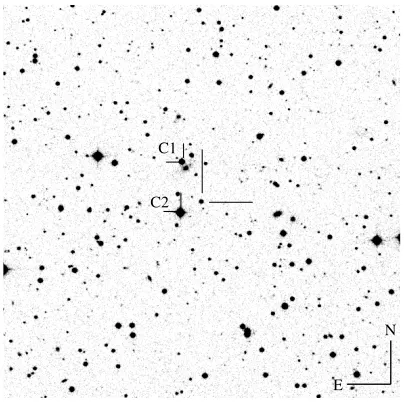
identification of its CV nature in September–October 2000 (Sect. 2.2.1), using a 0.4 m reflector equipped with a SITe 512 CCD camera (Table 1). HS 2331 was again observed from Braeside in November 2001 and October 2003, on both oc-casions in white light. The data were bias-subtracted, dark current-subtracted and flat-fielded in a standard fashion, and instrumental aperture magnitudes of HS 2331 were derived rel-ative to USNO–A2.0 1275–18486676 (R=14.6, labelled “C1” in Fig. 1). The mean magnitude of HS 2331 during the 2000 ob-servations was R16.5.
The Braeside CCD light curves of HS 2331 display peri-odic variability with an amplitude of∼±0.1 mag (Fig. 2), which has consistently been detected in all three years covered by our observations. The morphology of the photometric modulation is best described by a double-humped pattern with a period of
∼80 min. The relative strength of the two humps varies sub-stantially between the individual nights. The 2003 data reveal narrow absorption dips centred on some of the observed min-ima between the humps.
2.1.2. Kryoneri observatory
C1
C2
[image:4.595.51.253.84.285.2]E N
Fig. 1. 10×10Finding chart of HS 2331, obtained from the Digitized Sky Survey 2. The coordinates of the CV areα(2000)=23h34m01.6s,
δ(2000) = +39◦2141.4. Differential magnitudes of HS 2331 were obtained relative to the comparison stars C1 (USNO–A2.0 1275– 18486676) and C2 (GSC 0323100595).
observations (Fig. 2), displaying a double-humped structure with a period of ∼80 min. The higher time resolution data obtained in August 2003 provide stronger evidence for the absorption dips detected in the Braeside observations, and clearly reveal additional short-term variability on a time scale of∼5 min (e.g. August 14; Fig. 2). In addition the changes of the shape of the double-humped structure are more pro-nounced than in the Braeside observations. On August 19, one of the humps is extremely weak, on August 20 both humps have nearly equal amplitude.
2.1.3. ULTRACAM on the William Herschel telescope
The highest time resolution and signal-to-noise ratio CCD pho-tometry was obtained on November 10, 2003 using the 3-beam ULTRACAM CCD camera (which takes CCD data in three colour channels simultaneously, Dhillon et al. 2002) on the William Herschel Telescope. HS 2331 was observed with a 1 s time resolution, using Sloan u,g, and rfilters. The data were reduced with the ULTRACAM pipeline. Differential magni-tudes of HS 2331 were obtained relative to GSC 0323100595 (labelled “C2” in Fig. 1), and converted to apparent magnitudes using observations of the Sloan standard SA100-280, which was observed at the end of the night. The mean magnitudes of HS 2331 were u=16.1,g=16.3 and r=16.0. These val-ues are subject to some small systematic uncertainty related to the yet uncalibrated colour terms accounting for the differences between the ULTRACAM and Sloan setups.
The ULTRACAM light curves impressively confirm the presence of variability on a time scale of∼5 min seen in the Kryoneri data, as well as additional variability on even shorter time scales (Fig. 3).
2.2. Optical spectroscopy
2.2.1. Calar Alto
HS 2331 was identified as a CV from low-resolution spec-troscopy obtained at the Calar Alto 2.2 m telescope on September 20, 2000. The CAFOS focal reductor spectrograph was used in conjunction with the standard SITe CCD. A sin-gle pair of blue/red identification spectra was obtained with the B-200 and R-200 grating through a 2slit (see Table 1). The wavelength range of the combined spectra extends from 3500 to 10 000 Å at a spectral resolution of approximately 10 Å. The online reduction of the identification spectra using the CAFOS quick look context within MIDAS immediately revealed the CV nature of HS 2331 by the presence of broad double peaked Balmer and He I emission lines in the spectra.
Time-resolved follow-up spectroscopy of HS 2331 was carried out during the same observing run, on September 23 and 24, 2000. A total of 43 spectra of 600 s each were ob-tained during the two nights, which were mainly photometric except for very thin cirrus during the last ∼1.5 h of the sec-ond night (Table 1). The B-100 grism was used along with a 1.5 slit to obtain 40 spectra with a useful wavelength range of 3500–6300 Å and a spectral resolution of∼4 Å. In addi-tion, 3 red spectra were acquired during the second night, us-ing the R-100 grism with a 1.5 slit width. The red spectra cover a wavelength range of 6000 to 9200 Å at a spectral reso-lution of∼4 Å. Mercury-cadmium, helium-argon and rubidium arcs were taken regularly throughout both nights to provide for the wavelength calibration. Data from the flux standards G191B2B andζCas were also obtained to correct for the in-strument response of the “blue” and “red” spectra respectively. The CAFOS acquisition image were taken with a Johnson V fil-ter in order to correct the spectra for slit losses.
All spectra were reduced in a standard manner using the
Figaropackage within the Starlink software collection. The bias level was subtracted from the calibration and object im-ages using the median from a set of unexposed frames. Dome flat field images, taken with the same set up as the object frames, were used to remove pixel to pixel variations. The spectra were then optimally extracted (Horne 1986) and sky line subtracted. A fourth-order polynomial was fitted to obtain the dispersion relation for each of the arc spectra, giving an rms smaller than 0.1 Å in all cases. Each target spectrum was then wavelength-calibrated by interpolating two neighboring arc spectra to account for the possible drift of the wavelength-to-pixel scale. The instrumental response function was com-puted as the ratio of a spline fit to the line-free continuum of the B-100/R-100 spectra of the flux standards to the flux-calibrated data from Filippenko & Greenstein (1984) and Oke (1990). All target spectra were flux-calibrated and corrected for atmospheric extinction using this response function.
Fig. 2. Sample light curves of HS 2331 based on differential CCD photometry obtained at the 40 cm Braeside Observatory (left) and at the 1.2 m Kryoneri Observatory (right).
Fig. 3. Light curve of HS 2331 obtained at a time resolution of 1 s with theg-filter using ULTRACAM on the WHT.
from the HQS direct plate, and with the brightness level of all our photometry (Sect. 2.1). A grand average spectrum of HS 2331 was created by combining the mean of all “blue” and “red” spectra from the flux-calibrated (and corrected for atmo-spheric extinction) B-100/R-100 data set. This average spec-trum was then scaled to V = 16.4, as determined from the CAFOS acquisition images to account for possible slit losses (Fig. 4). The applied correction of0.2 mag is comparable to the intrinsic variability of HS 2331, and indicates that the ab-solute error in our flux calibration is≤20%.
A further set of observations were obtained in September 2003 at the 2.2 m Calar Alto telescope. This time the G-100 grism was used which together with a slit width of 1.2 provided a wavelength range of 4240−8300 Å and a spectral resolution of∼4.1 Å (Table 1). These spectra were reduced in an analogous fashion as described above.
The spectrum of HS 2331 (Fig. 4) displays broad double-peaked Balmer and HeI emission lines, suggesting an origin
in the accretion disc. The higher series of the Balmer lines are
Fig. 4. Mean, flux-calibrated “blue” and “red” spectra (Calar Alto
[image:5.595.322.566.541.727.2]Table 2. EW and FWHM (corrected for the instrumental resolution)
of the strongest Balmer emission lines and of the strongest FUV lines.
Line EW [Å] FWHM [km s−1] FWHM [Å] Hα 185±14 1312±5 28.7±0.1 Hβ 75±9 1475±6 23.9±0.1 Hγ 40±4 1583±7 22.9±0.1 Hδ 30±13 1403±7 19.2±1.1 CIV 234±14 2478±19 12.8±0.1 SiIV 52±13 3749±236 17.5±1.1 CII 67±12 2476±68 11.0±0.3 CIII 111±19 2500±51 9.8±0.2 NV 42±15 2417±48 10.0±0.2
flanked by extremely broad absorption troughs, which are rem-iniscent of the Stark-broadened absorption lines observed in the high-gravity atmospheres of cool white dwarfs (the width of the absorption lines are too wide to be of accretion disc ori-gin). The red part of the spectrum does not contain any spectral features that could be ascribed to the emission of the secondary star.
Table 2 lists the equivalent widths (EW) and full width at half maximum (FWHM, corrected for the instrumental re-sponse), of Hα–Hδ. The EW and the FWHM measurements were obtained by fitting a single Gaussian in all cases. Average spectra were used for the Balmer lines: Calar Alto 2000 for Hδ and Calar 2003 for Hα–Hδ.
2.2.2. 2.5 m Isaac Newton telescope
A total of 26 spectra of 600 s each, spread out over a week, were obtained in August–September 2002 (Table 1). We used the Intermediate Dispersion Spectrograph (IDS) on the 2.5 m Isaac Newton Telescope (INT), at the Roche de los Muchachos observatory in La Palma. The IDS was equipped with the R632V grating and the 2048×4100 pixel EEV10 detector. Using a slit width of 1.5 the setup provided an unvignetted wavelength range of∼4400 Å−6800 Å and a spectral resolu-tion of∼2.3 Å. Copper-Argon wavelength calibrations (arcs) were obtained at the beginning and end of each observation block of HS 2331. The reduction procedure applied to this data set is identical to the one applied to the Calar Alto/CAFOS data above.
2.2.3. 2.4 m Hiltner telescope
Most recently, we observed HS 2331 from the 2.4 m Hiltner telescope at MDM observatory (Table 1). We obtained a to-tal of 50 spectra of 420 s each in October 2003. The modular spectrograph combined with the 600 line mm−1 grating and a
SITe 2048×2048 CCD detector, yielded a spectral dispersion of∼2.0 Å pixel−1 from 4000 to 7500 Å. The reduction
[image:6.595.53.252.120.243.2]tech-nique applied to this set of data is as explained in Thorstensen et al. (1998).
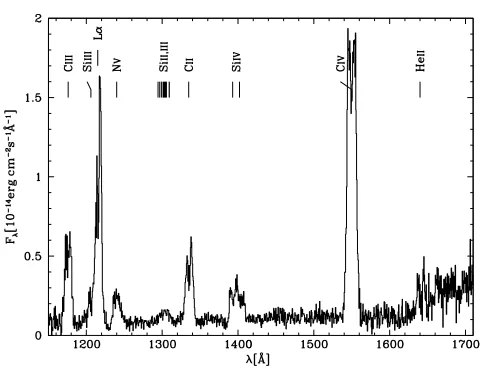
Fig. 5. HST/STIS spectrum of HS 2331.
2.2.4. Hubble space telescope
Far-ultraviolet (FUV) spectroscopy of HS 2331 was obtained with the Hubble Space Telescope/Space Telescope Imaging Spectrograph (HST/STIS) on October 24, 2002 as part of an ongoing snapshot survey of CVs. The observations were ob-tained using the G140L grating and the 52 ×0.2 aperture, providing a spectral resolution of R ≈ 1000 over the wave-length range 1150−1710 Å. The data were pipeline-processed within IRAF using CALSTIS V2.13b. The F28 ×50LP mag-nitude of HS 2331 measured from the STIS CCD acquis-tion image confirms that the system was at its usual bright-ness level during the FUV observations. The STIS spectrum (Fig. 5) contains the mixture of low and high-ionisation emis-sion lines often observed in CVs: CIIIλ1176, SiIIIλ1206,
NVλλ1239,43, CIIλ1335, a broad complex of SiIII near
1300 Å, SiIVλλ1394,1403, CIVλλ1548,51 and probably
HeIIλ1640. The emission line flux ratios are within the normal
range observed in CVs (Mauche et al. 1997; Gänsicke et al. 2003). Several of the lines contained in the STIS are double-peaked, again suggesting an origin in an accretion disc. The EW and FWHM of the strongest lines in the STIS spectrum were estimated by fitting a Gaussian to the observed line profiles, and the results are reported in Table 2. Correcting the FWHM for the separation of the CII, CIVand SiIVdoublets results in
line widths which are comparable to those of the Balmer lines, suggesting a common origin of the FUV and optical emission lines.
The continuum flux underlying the emission lines is slightly increasing towards the red, with a sudden upturn in flux at wavelengthsλ >∼1650 Å.
3. Analysis: Photometry
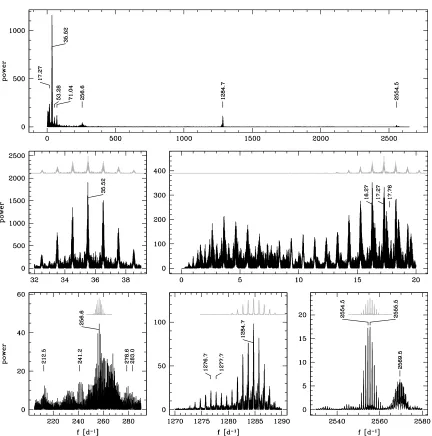
Fig. 6. Scargle periodograms computed from the CCD photometry of HS 2331. Top panel: the entire frequency range sampled by the Kryoneri
2003 data, which represents the largest and best sampled data set to investigate periodicities on time scales of∼2 d to∼30 s. Middle panels: close-ups of the power spectra calculated from all available photometric data (Table 1). The left panel shows a coherent signal at 35.52 d−1. Shown in gray is the window function of the entire data set, shifted to the frequency of the strongest peak. We interpret this signal as twice the orbital frequency, as the orbital light curve is dominated by a double-hump structure (Fig. 7). The right panel shows several signals in the low-frequency range. Practically no power is detected at the orbital frequency (i.e. 17.76 d−1or 81.08 min), but a strong signal is found at 17.27 d−1(83.38 min) and the one-day alias at 16.27 d−1(88.51 min). Bottom panels: close-up views of the high-frequency signals in the Scargle periodogram computed from the Kryoneri 2003 data only. As in the middle panels, the gray line shows the alias structure resulting from the sampling of our observations. Clear signals are detected at 5.61 min (256.6 d−1), 1.12 min (1284.7 d−1), and 0.56 min (2555.5 d−1).
light curve to account for night-to-night variations in the over-all brightness of the system and more importantly of the dif-ferent detectors/filters used during the observations. The peri-odogram of HS 2331 calculated from the Kryonery 2003 data, the largest and best sampled photometric data set, (Fig. 6; top panel) contains a multitude of signals, as anticipated by our vi-sual inspection of the light curves (Sect. 2.1).
The strongest peak is located at 35.52 d−1 (40.54 min), a
weaker signal is centred on∼17.27 d−1(83.38 min), and some
power is also found at 53.28 d−1 (27.03 min) and 71.04 d−1 (20.27 min). In the high-frequency range there is a strong
peak at 1284.7 d−1 (1.12 min) and a weaker one at 256.6 d−1
(5.61 min).
3.1. The orbital period
Figure 6 shows a close-up view of the Scargle periodogram of the∼40 min signal (middle left panel). The strongest peak is lo-cated at 40.542632±0.000008 min (35.518168±0.000007 d−1)
Fig. 7. HS 2331 entire photometric data set folded over 81.08 min
(upper panel) and re-sampled into bins of 100 points (bottom panel). The light curves are repeated over two cycles for clarity.
the 40.54 min signal indicates a very high degree of coherence, suggesting that it is related to a stable “clock” within the binary system, such as the binary orbital period or the white dwarf spin period.
Folding the entire 4 years worth of photometry over ex-actly twice the 40.54 min signal, i.e. 81.08 min, results in an average light curve (Fig. 7) that unambiguously recreates the morphology observed in the individual light curves (Figs. 2 and 3): a double-humped modulation with a narrow dip. Dips of such shape are observed either in strongly magnetic CVs, when the magnetically funnelled accretion stream passes in front of the white dwarf, or as grazing eclipses of the hot spot in the accretion disc in non-magnetic CVs. Stream eclipses in mag-netic CVs are relatively unstable features as the location of the stream within the binary frame changes as a function of the mass transfer rate and therefore we favour the latter scenario as the cause of the narrow dips.
The light curve of HS 2331 (Figs. 2 and 7) bears a striking resemblance to that of one of the most (in)famous and thor-oughly studied short period CVs: WZ Sge (see e.g. Fig. 1 of Patterson et al. 1998). Both objects exhibit double humps in their light curves, in both cases one of the humps appear to suffer from sporadic absorption events, and both systems show a sharp and relatively shallow eclipse. From the strict coher-ence of the 40.54 min, the detection of periodically recurrent eclipses, and the close analogy to WZ Sge, we conclude that the orbital period of HS 2331 is 81.08 min, and we define the following eclipse ephemeris
φ0=HJD 2 451 812.67765(35)+0.05630921(1)×E (1)
[image:8.595.29.273.83.260.2]where phase zero corresponds to the time of mid eclipse. Higher harmonics of the orbital period are clearly visible in the periodogram (Fig. 6) at 27.03 min (53.28 d−1) and 20.27 min (71.04 d−1).
Fig. 8. HS 2331 entire photometric data set folded over 83.38 min
(upper panel) and re-sampled into bins of 100 points (bottom panel). The light curves are repeated over two cycles for clarity.
3.2. Quiescent superhumps?
Only a weak signal is detected at the orbital period of 81.08 min (Fig. 6, middle right). This is not too much of a surprise because of the double-humped structure of the orbital modulation, which shifts most power to half the orbital period. Surprising is, however, the detection of a relatively strong signal close to Porb,
with a period of either83.38 min (17.27 d−1) or88.51 min
(16.27 d−1). Both these 1-day aliases are of similar strength,
and their relative power varies between different observing runs. In contrast to the 35.52 d−1orbital signal (Fig. 6, middle
left), the periodogram around the 83.38 min/88.51 min signals is extremely complex, displaying significant substructure in ex-cess to the window function, suggesting either the presence of more than one periodicity and/or a lower degree of coherence. Figure 8 shows the light curve folded over the 83.38 min signal detected in the periodogram of Fig. 6 (middle-left panel). The absence of eclipses in this folded light curve clearly rules out the 83.38 min signal (and its aliases) being the orbital period.
The separation of the 83.38 min signal and the orbital pe-riod of 81.08 min is conspicuously close to those observed for the superhump period in a large number of short period dwarf nova (e.g. Patterson 2001). In fact, the period excess found in HS 2331, = (Psh−Porb)/Porb = 0.028, is similar
Table 3. High-frequencies signals detected in the photometry of
HS 2331+3905.
Kryoneri WHT
f clear f u g r
[d−1] [mmag] [d−1] [mmag] [mmag] [mmag]
205.7 3.6 206 9.6 6.7 7.4
212.5 4.5 216 15.0 10.1 11.2
213.2 4.8
226 14.2 11.9 12.1
241.2 6.4
256.6 10.0 266 36.3 20.2 22.1
278.6 4.9
283.0 3.6 288 11.7 7.7 8.6
474 6.6 5.3 4.8
535 7.2 6.6 6.5
1029.1 2.6 1021 8.5 6.8 6.9
1276.7 7.0
1284.7 15.8 1283 35.1 20.7 20.6 2554.5(†) 6.2 2554 7.6 9.4 6.2
2569.5 3.7 2570 11.0 4.4 6.2
(†)The 1-day aliases at 2555.5 has nearly equal power.
3.3. Higher frequencies: White dwarf pulsations and spin?
As mentioned above, the periodogram of HS 2331 contains a number of distinct signals at high frequencies (Fig. 6), most pronounced at 5.61 min (256.6 d−1) and 1.12 min (1284.7 d−1). We have inspected in more detail the periodogram computed from the 2003 Kryoneri data, which provides the longest cover-age at a high time resolution, as well as from the ULTRACAM observations, which has the highest time resolution but covers only∼2.5 h. Table 3 lists the frequencies and amplitudes of all signals that are unambiguously detected in the two data sets. The fact that most signals are detected over long periods of time rules out the CV-typical flickering to explain their origin.
The extremely complex power spectrum in the range around∼5 min is indicative of a combination of many fre-quencies. Such a structure is reminiscent of the patterns de-tected in the power spectra of ZZ Ceti stars, non-radially pul-sating white dwarfs with a hydrogen-rich atmosphere. They are found in a narrow range of effective temperatures, 12 500 K≥ Teff ≥10 700 K, and show multiperiodic variations with
ampli-tudes reaching up to∼0.3 mag and periods ranging from∼100 to∼1200 s (Clemens 1993). Resolving the rich frequency spec-trum of ZZ Ceti stars related to the various pulsation modes, their harmonics, and various linear combinations of modes re-quires alias-free uninterrupted multi-longitude observing cam-paigns (e.g. Kepler et al. 2003). In the case of HS 2331, the sampling of our 2003 Kryoneri run introduces too much of an alias structure (Fig. 6) to allow a secure identification of all the various frequencies.
Whereas our short ULTRACAM run is not very useful in identifying the frequencies present in HS 2331, these data show that the power of the∼5 min variability increases to-wards the blue, which is what would be expected for ZZ Ceti pulsations. Untypical for ZZ Ceti pulsations are the additional large-amplitude signals detected at extremely high frequen-cies (Fig. 6). The shortest period observed in any ZZ Ceti star is 70.9 s in G 185–32 (Castanheira et al. 2004). Our detection of power at the first harmonic of the 1.12 min signal seems to rule out a conventional ZZ Cet pulsation as the origin of the high-frequency signals. Yet another stable clock available in a CV is the spin of the white dwarf, and we tentatively suggest that the 1.12 min and 0.56 min signals are related to the white dwarf spin period and its first harmonic, respectively. Intriguing is the doublet-like structure of the 1.12 min and 0.56 min sig-nals (Fig. 6). Fast rotation of the white dwarf will result in extremely non-linear perturbations of the pulsation frequen-cies, and may be responsible for this structure. Alternatively, the doublet-structure may reflect a sideband frequency, as typ-ically observed in intermediate polars. The choice of the lower frequency alias in the doublets is somewhat ambiguous: assum-ing that 1277.7 d−1and 2555.5 d−1 are the true frequencies of
the doublet and its first harmonic, the implied beat frequency is 7 d−1, which is nearly identical to the spectroscopic period
found from the radial velocity variations of the Balmer emis-sion line wings (Sect. 4).
4. Analysis: Spectroscopy
4.1. Radial velocities
Radial velocities were measured using the convolution tech-nique first outlined by Schneider & Young (1980) and devel-oped by Shafter (1983).
The emission line profile is convolved with two Gaussians of equal FWHM (of the order of the wavelength resolution) but with opposite signs. The peaks of the Gaussians are separated by a distance chosen in order to measure as far out as possible into the wings, while still retaining an adequate signal-to-noise level. By doing this we ensure that the measured radial veloc-ities trace the inner part of the accretion disc, where one may hope to find an azimuthally symmetric structure that traces the orbital motion of the white dwarf. Prior to the actual radial ve-locity measurement the spectra were transformed into the he-liocentric rest frame.
4.1.1. The end of a myth...
Radial velocity variations were measured for each individual observing run (Table 1) using the strongest Balmer lines as well as He Iλ5875 and He I 4471. In all cases the Gaussians sepa-ration was set to values between 2600 km s−1and 3000 km s−1.
Fig. 9. Left panel: scargle periodograms of the individual data sets (see Table 1) and of all the data combined together. Right panel: radial
velocity curves of the individual data sets and of all the data sets combined together, folded over the highest peak in their respective Scargle periodograms (shown on the left). The zero phase is taken to be the first point in each of the data sets respectively and the curves are repeated twice for clarity.
opted against Hβbecause of the potential contamination from the nearby He lines) and Hαfor all the other runs.
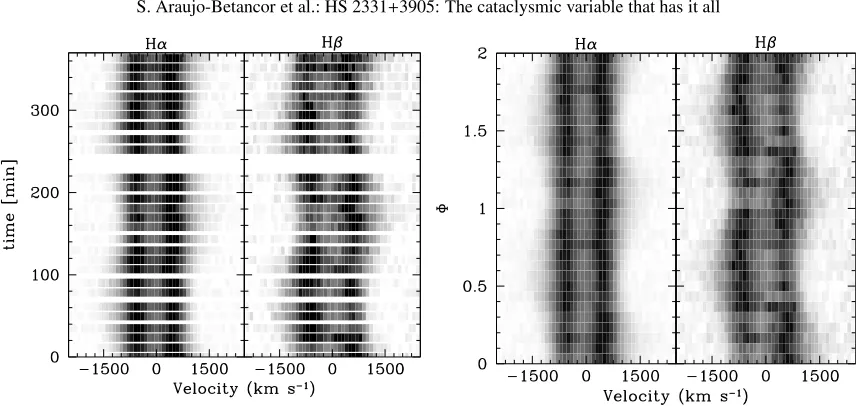
Figure 9 shows the periodograms and the corresponding ra-dial velocity curves folded over the highest peaks detected in each of the data sets. The bottom panel shows the periodogram and folded radial velocity curve obtained when combining all data. The Calar Alto 2000 data show a smooth sinusoidal ra-dial velocity variation with an amplitude of∼220 km s−1 and a period of 3.53 h, which is not anywhere close to the orbital period determined from the eclipses! This makes HS 2331, to our knowledge, the first CV in which the dominant radial ve-locity variation is not modulated on the orbital period. With HS 2331, there are now four CVs in which the photometric modulation and the spectroscopic modulation are significantly different; the other three being FS Aur, GW Lib and Aqr1 (see Table 2 of Woudt et al. 2004). The origin of the second period in these systems is much of a mystery as the∼3.5 h periodic-ity in HS 2331, but contrary to HS 2331, in FS Aur, GW Lib and Aqr1 the spectroscopic variation is believed to be orbital. Figure 10 shows the trailed spectra of Hαand Hβobtained from the observing night with the largest data set (i.e. Calar Alto 2003, Sep. 11; Table 1) in minutes and phase folded with the
orbital period respectively. The 3.45 h period is clearly seen in the wings of the Balmer emission lines.
Fig. 10. From left to right: trail spectra of Hαand Hβcomputed from the largest data set within an observing night (i.e. Calar Alto 2003, Sep. 24; see Table 1), and the same Hαand Hβtrail spectra but this time folded over the orbital period (i.e. Porb=81.08 min). The white stripes in the trail spectra of the left panel are caused by lack of observations during the corresponding times.
Fig. 11. Left panel: from top to bottom, Scargle periodograms of the detrended Calar Alto 2000 and Calar Alto 2003 spectroscopic data sets
and a combination of both sets (i.e. Calar Alto 2000, 2003). The radial velocity measurements were detrended by subtracting a sine wave with their respective highest peak value (see the left panel of Fig. 9) as the frequency. The combined Calar Alto (2000, 2003) Scargle periodogram in the bottom panel was computed after detrending the data sets individually. Right panel: detrended radial velocity curves folded over the orbital period obtained from the photometry in Sect. 3 (i.e. 17.76 d−1 or 81.08 min). The zero phase in these curves corresponds to the photometric zero phase as defined in Sect. 3 and the curves are repeated twice for clarity. Also shown on the top right panel is the best fit to the detrended radial velocity curve (see text for more details).
no strong preference for any of the aliases found in the range
∼4 d−1−10 d−1.
We conclude that a persistent large-amplitude radial veloc-ity variation with a period of∼3.5 h is present in HS 2331, how-ever, this variation is not coherent and its period and/or phase drifts on time scales of days.
4.1.2. ...sanity refound
The fact that the dominant radial velocity variation in HS 2331 does not occur on the orbital period is most surprising, and alarming, as radial velocity variations measured from the emis-sion lines are routinely used not only to determine the orbital
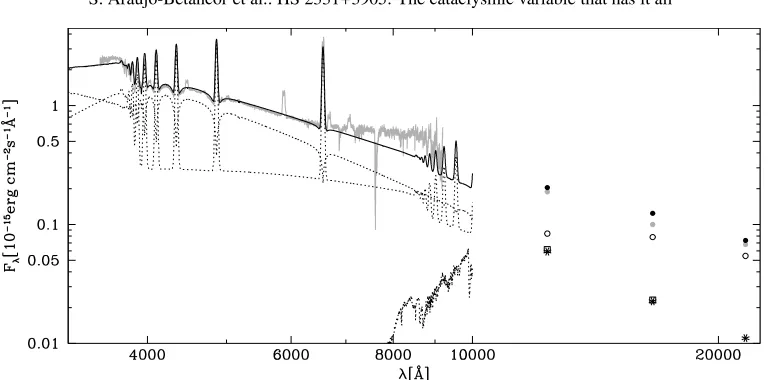
[image:11.595.103.529.320.518.2]Fig. 12. Three component model to the optical-IR spectral energy distribution of HS 2331. Plotted in gray are the observed average spectrum
from Fig. 4 along with the 2MASS J, H, and K fluxes (filled circles). Plotted in dotted lines are the white dwarf model (open squares denote the IR fluxes), the isothermal slab model representing the optically thin disc emission (stars denote the IR fluxes), and the spectral contribution of a L2 donor star (open circles denote the IR fluxes). The sum of the three components is shown as black solid line and as black filled circles.
the case of the 2003 data. The main difference between the two data sets is the extent of the observations. While the 2000 data were obtained during two consecutive nights, the 2003 data was obtained during three nights spanning a total of six nights. As the dominant radial velocity variation drifts on times scales of a few days, detrending with a sine with a fixed period will be-come increasingly imperfect with increasing length of the ob-serving run. Hence, the residual low-frequency power in the case of the 2003 data reflects the imperfection of the applied detrending.
Folding the detrended radial velocities over the orbital pe-riod (i.e. 81.08 min) results in a sinusoidal radial velocity curve (Fig. 11; right panel), which is smoother for the 2000 data than for the 2003 data, probably again a result of the cleaner de-trending possible for these observations. The consistent detec-tion of the 81.08 min period both, in the photometry and in the spectral radial velocity variations lends further support for our conclusion that this is indeed the orbital period of HS 2331.
A sine fit to the folded detrended radial velocities of the Calar Alto 2000 data (top right panel of Fig. 11) results in an amplitude of32 km s−1, a systemic velocity of∼1 km s−1, and
a phase offset with respect to mid eclipse of∼13◦. The ampli-tude, interpreted as radial velocity of the white dwarf K1 as it is
commonly done, is entirely consistent with what is observed in short-period CVs (e.g. Thorstensen & Fenton 2003). The phase offset with respect to the expected motion of the white dwarf is most likely related to the fact that the eclipse is caused by an obscuration of the hot spot in the accretion disc, and not of the white dwarf itself. In addition, even in “well-behaved” CVs the broad wings of the emission lines do not necessarily exactly trace orbit of the white dwarf, most likely because of slight asymmetries in the disc.
4.2. A model for the spectral energy distribution
We have combined our optical data with the 2MASS J, H, and K magnitudes of HS 2331 (Fig. 12), and modeled the optical/IR
spectral energy distribution (SED) with a three-component model comprising: (1) a synthetic white dwarf spectrum to ac-count for the observed broad Balmer absorption lines. A grid of model spectra covering Teff = 8000−15 000 K was
calcu-lated with TLUSTY and SYNSPEC (Hubeny 1988; Hubeny & Lanz 1995). We fixed the surface gravity to logg = 8.0, corresponding to Mwd 0.6 M, and the photospheric
abun-dances to 0.1 of their solar values. (2) The emission of an isothermal and isobaric slab with a finite depth to account for the observed Balmer emission lines and any associated con-tinuum. This model is described in detail in Gänsicke et al. (1997, 1999). In brief, the free parameters for the generation of this component were the temperature of slab and the column density of the slab along the line of sight. The temperature ac-counts for the ionisation/excitation of the lines and the optically thick blackbody envelope, and the column density determines the ratio in optical depth between continuum and lines, i.e. the equivalent width of the lines. (3) A late-type spectral template to account for the emission of the secondary star in HS 2331. The library of templates covered spectral types M 0.5 to M 9 from Beuermann et al. (1998) and L0 to L8 from Kirkpatrick et al. (1999, 2000). The L-dwarf type stars were normalized to surface fluxes using the radii and distances given by Dahn et al. (2002), the M-dwarf templates provided by Beuermann were already normalized in this way.
We started by approximately modeling the observed broad Balmer absorption lines with a white dwarf model, which sug-gested Teff ∼ 10 000 K and a white dwarf flux contribution
of∼80% at 5000 Å (Fig. 12). The next step was to extrap-olate the white dwarf model established in this way into the FUV wavelength range covered by STIS (Fig. 13). Interpreting the sudden flux up-turn at wavelengthsλ >∼ 1650 Å as pho-tospheric emission from the white dwarf we refine the white dwarf temperature to Teff 10 500±250 K. The red end of the
Fig. 13. Gray line: the STIS FUV spectrum of HS 2331 from Fig. 5.
Black line: the white dwarf model from Fig. 12 extended into the STIS range. The spectrum of a∼10 500 K white dwarf reproduces well the sudden increase of flux observed longwards of 1600 Å.
of our white dwarf model implies a distance of∼90 pc. The systematic error in this distance estimate depends primarily on the assumed white dwarf mass, assuming a mass in the range 0.4−0.9 M results in d = 90±15 pc. A low distance to HS 2331 is supported by the large proper motion of the star, µ 0.14/yr−1, which has been derived from the
compari-son of the DSS1 and DSS2 images of the system. An isother-mal/isobaric slab with a temperature of T = 6500 K and a surface density of Σ = 1.8×10⁻²g cm−2 accounts well for the observed Balmer emission and the Balmer jump, and con-tributes∼20% of the flux at 5000 Å. Assuming d = 90 pc the area of this simple “disc” component is comparable to the size of the white dwarf Roche lobe. The red end of our opti-cal spectrum shows no evidence for the TiO absorption bands that are observed in CVs where the late-type donor star sig-nificantly contributes to the red/near-IR spectrum. In the last step of our SED modeling we add the spectral contribution of the secondary, assuming R2 = 8×109cm (corresponding to
Porb =81.08 min and q = Mwd/Msec =9; see Sect. 5.1). The
flux limit imposed by the 2MASS J, H, and K measurements constrain the spectral type of the secondary to be∼L2 or later (Fig. 12).
Whereas our three-component model of the FUV-to-IR SED of HS 2331 is overall rather satisfying, two regions of excess flux are observed: the FUV continuum below∼1600 Å significantly exceeds the predicted white dwarf flux (the simple “disc” model and the secondary contribute no flux in the FUV), and the optical continuum in the range∼7000−9000 Å exceeds the flux of the sum of all three components. We believe that the most likely explanation for this excess flux is that our model for the disc emission is too naive – we just assume a single tem-perature/density pure hydrogen slab. The FUV emission lines clearly indicate that the disc contains hotter regions, which will contribute to some extent to the FUV continuum. The excess flux observed at the red end of our optical spectrum may be related to the Paschen continuum of a somewhat colder part of
the disc. It is likely that a multi-temperature/density model of the quiescent disc could account for the observed excess flux, however, we feel that the number of additional free parameters does not warrant this exercise.
5. Discussion
Before discussing the nature of the system, we briefly sum-marise the results of our analysis.
1. HS 2331 has been identified as a CV because of its emission lines detected in the HQS.
2. Coherent low-amplitude eclipses detected over four years unequivocally determine the orbital period to be Porb =
81.08 min. The mean light curve of HS 2331 bears extreme similarity to that of WZ Sge.
3. The optical and FUV spectrum of HS 2331 is dominated by the photospheric emission of a white dwarf with Teff
10 500 K.
4. The power spectrum of our optical photometry contains a number of significant signals in the range 5−6 min, which we interpret as non-radial ZZ Ceti pulsations.
5. Additional signals are found at periods of 1.12 min and 0.56 min, which we tentatively identify as the spin period of the white dwarf and its first harmonic.
6. The distance of the system is d90±15 pc, derived from modelling the emission of the white dwarf. This low dis-tance is consistent with the high proper motion of the sys-tem,µ0.14/yr−1.
7. Combining our optical spectroscopy of HS 2331 with the 2MASS J, H, and K magnitudes of the system, and adopt-ing d =90 pc and a mass ratio of q= Mwd/Msec =9 (see
below, Sect. 5.1), we find that the donor star must be of extreme late spectral type, L2 or later.
8. Our extensive optical photometry consistently contains a strong signal at a period somewhat longer than Porb.
Selecting the alias of that pattern which is closest to Porb
gives 83.38 min, which is 2.8% longer than the orbital pe-riod.
9. Our spectroscopic data set reveals consistently the presence of large-amplitude radial velocity variation with a period of∼3.5 h. However, this radial velocity modulation is not strictly coherent, but appears to drift in either period or phase on a time scale of days.
10. After detrending the radial velocity measurements with a 3.5 h sinusoid, a radial velocity variation with a period of 81.08±0.04, i.e. Porb, is detected with an amplitude of
32 km s−1.
5.1. The evolutionary state of HS 2331+3905
campaigns carried out since September 2000 have found HS 2331 near V 16.5. The CCD-equipped 0.37 m Rigel Telescope of the University of Iowa has been used to moni-tor HS 2331 on 16 nights in October to December 2003 and on 15 nights in May/June 2004, finding the system at an in-strumental magnitude of 16.4±0.1. Additional visual moni-toring of HS 2331 has been carried out during∼250 nights since March 2003 using a 8 Schmidt-Cassegrain telescope, with no gaps in the coverage being longer than one week. On no occasion has the star been detected, with a limiting mag-nitude of∼13.5±0.5. In many aspects, HS 2331 resembles the well-studied short-period dwarf nova WZ Sge, which shows extremely bright superoutbursts every 2–3 decades. If this anal-ogy were correct, we would predict an outburst magnitude for HS 2331 of V9−10.
Yet another indication of HS 2331 being an old evolved CV is the very late spectral type of the secondary star. Assuming a white dwarf mass of 0.6 Mand a secondary mass of 0.07 M (as it may be realistic for Msec near the minimum period), i.e.
q 9, and a distance of 90 pc, our model for the SED of HS 2331 suggests a spectral type later than L2 (Sect. 4.2), which makes this system one of the best candidates for a brown dwarf donor. Detailed infrared spectroscopy will be required to test this hypothesis.
Using the same stellar mass assumption and an inclination of75◦, based on the detection of grazing eclipses in the opti-cal light curve, the radial velocity variation of the white dwarf is expected to be K1 36 km s−1, which is consistent with the
amplitude of the 81.08 min radial velocity variation detected in the spectroscopy, after detrending the data for the dominant 3.5 h modulation (Sect. 4.1.2).
5.2. A permanent superhumper?
From our four years of photometric data, HS 2331 appears to be a permanent superhumper with a likely superhump period of Psh=83.38 min, i.e. a period excess (Psh−Porb)/Porb=2.8%.
This finding is exceptional, as superhumps are normally de-tected during superoutbursts of SU UMa type dwarf novae or in some nova-like variables during their high states, i.e. al-ways during phases of high mass transfer in the accretion disc. Superhumps are thought to be related to the precession of tidally unstable eccentric accretion discs in close binaries with extreme mass ratios (e.g. Osaki 1985; Murray 1998).
If our interpretation of the photometric signal is correct, and indeed Psh =83.38 min, the implied period excess of 2.8%
is not particularly small (Patterson 2001), somewhat arguing against an extreme mass ratio in HS 2331. However, consider-ing the unique nature of HS 2331, it is not clear if Patterson’s relation can be directly adopted for this system.
The strangest and most disconcerting observational fact about HS 2331 is without doubt the detection of a dominant radial velocity variability with a period of 3.5 h, which does not correspond to the orbital motion of the system. This pe-riodicity resulted from measuring changes in the wings of the Balmer emission lines and therefore reflects variability in the inner disc region of the systems, however we have at
present no explanation for the physical origin/significance of its 3.5 h period. Again, in a very speculative approach, we sug-gest that the period (or phase) drift of this radial velocity varia-tion may be related to the presence of permanent superhumps. The precession period of the accretion disc implied by the or-bital period and the superhump period is∼2 d, which is com-parable to the time scale on which the 3.5 h radial velocity variation varies. An intensive spectroscopic campaign cover-ing several of the putative precession cycles could test this hypothesis.
Another important conclusion from the radial velocity anal-ysis is that care should be taken when implicitely assuming that the dominant radial velocity variation detected in cata-clysmic variables (and related objects) reflects the orbital pe-riod. Whereas this is contrary to the customary approach for the past decades, the results obtained for HS 2331 are a clear warning that this custom could occasionally lead to wrong in-terpretations.
5.3. The brightest CV white dwarf pulsator
Until recently, only a single CV containing a white dwarf pulsator has been discovered: GW Lib (van Zyl et al. 2000, 2004). GW Lib is only partially understood, due to the lack of a proper mode identification of the observed pulsation fre-quencies, and more severely, due to the circumstance that the temperature of its white dwarf, Teff = 14 700 K, is
ac-tually significantly above the blue end of the ZZ Ceti insta-bility strip (Szkody et al. 2002). Three additional CVs con-taining pulsating accreting white dwarfs have been discovered in the SDSS: SDSS J013132.39–090122.3, SDSS J161033.64– 010223.3, and SDSS J220553.98+115553.7 (Warner & Woudt 2003; Woudt & Warner 2004).
We have shown that HS 2331 exhibits the photometric be-haviour typical of ZZ Ceti pulsators, showing a multiperiodic and complex power spectrum in the range ∼60 s to ∼300 s. With V 16.5, HS 2331 is by far the brightest CV white dwarf pulsator, making it the prime target for detailed follow-up studies. The white dwarf temperature implied by the SED of HS 2331 (Teff 10 500 K, assuming Mwd 0.6 M,
Sect. 4.2) is just slightly below the red end of the ZZ Ceti insta-bility strip for single white dwarfs (e.g. Bergeron et al. 2004). The ultra-short periods detected in HS 2331, with periods of 1.12 min and 0.56 min which are too small for conventional g-mode pulsations, remains a puzzle. One possible solution is to assume that 1.12 min is the white dwarf spin period, and 0.56 min its first harmonic. Polarimetry and X-ray detection of the 1.12 min period would be the ultimately proof of this hypothesis.
6. Conclusion
We have discovered a new short orbital period CV, HS 2331, which displays an overwhelming wealth of observable phenomena, and we encourage detailed follow-up studies over all wavelength ranges and time scales to exploit the opportu-nities that this system offers for an improved understanding of CV evolution and accretion onto white dwarfs.
Acknowledgements. We thank the referee, Patrick Woudt, for a prompt and helpful report. S.A.B. acknowledges support from NASA through grants GO-9357 and GO-9724 from the Space Telescope Science Institute, which is operated by AURA, Inc., un-der NASA contract NAS5-26555. B.T.G. was supported by a PPARC Advanced Fellowship, The HQS was supported by the Deutsche Forschungsgemeinschaft through grants Re 353/11 and Re 353/22. We are very grateful to Klaus Beuermann and Davy Kirkpatrick for giving us access to their spectral templates for M- and L-dwarfs. We would also like to thank Pablo Rodriguez-Gil, Matthias Schreiber, Klaus Beuermann, Luisa Morales, Dean Townsley, Lars Bildsten and Phil Arras for helpful discussions and to Spiridon Kitsionas for a care-ful reading of the manuscript. P. Schmeer is very gratecare-ful to Robert Mutel and his students for scheduling some of the CCD monitoring of HS 2331. We thank the director of the Calar Alto observatory for the generous allocation of discretionary time for this project.
References
Araujo-Betancor, S., Gänsicke, B. T., Hagen, H.-J., Rodriguez-Gil, P., & Engels, D. 2003, A&A, 406, 213
Bergeron, P., Fontaine, G., Billères, M., Boudreault, S., & Green, E. M. 2004, ApJ, 600, 404
Beuermann, K., Baraffe, I., Kolb, U., & Weichhold, M. 1998, A&A, 339, 518
Beuermann, K., Wheatley, P., Ramsay, G., Euchner, F., & Gänsicke, B. T. 2000, A&A, 354, L49
Castanheira, B. G., Kepler, S. O., Moskalik, P., et al. 2004, A&A, 413, 623
Clemens, J. C. 1993, Baltic Astron., 2, 407
Dahn, C. C., Harris, H. C., Vrba, F. J., et al. 2002, AJ, 124, 1170 Dhillon, V., Marsh, T. R., Kelly, J., et al. 2002, in The Physics of
Cataclysmic Variables and Related Objects, ed. B. T. Gänsicke, K. Beuermann, & K. Reinsch, ASP Conf. Ser., 261, 672
Filippenko, A., & Greenstein, J. L. 1984, PASP, 96, 530
Gänsicke, B. T., Araujo-Betancor, S., Hagen, H.-J., et al. 2004, A&A, 418, 265
Gänsicke, B. T., Szkody, P., de Martino, D., et al. 2003, ApJ, 594, 443 Gänsicke, B. T., Beuermann, K., de Martino, D., & Thomas, H.-C.
2000, A&A, 354, 605
Gänsicke, B. T., Beuermann, K., & Thomas, H. C. 1997, MNRAS, 289, 388
Gänsicke, B. T., Hagen, H. J., & Engels, D. 2002, in The Physics of Cataclysmic Variables and Related Objects, ed. B. T. Gänsicke, K. Beuermann, & K. Reinsch, ASP Conf. Ser., 261, 190
Gänsicke, B. T., Sion, E. M., Beuermann, K., et al. 1999, A&A, 347, 178
Hagen, H. J., Groote, D., Engels, D., & Reimers, D. 1995, A&AS, 111, 195
Horne, K. 1986, PASP, 98, 609
Hubeny, I. 1988, Comput. Phys. Comm., 52, 103 Hubeny, I., & Lanz, T. 1995, ApJ, 439, 875
Kepler, S. O., Nather, R. E., Winget, D. E., et al. 2003, A&A, 401, 639
King, A. R. 1988, QJRAS, 29, 1
King, A. R., & Schenker, K. 2002, in The Physics of Cataclysmic Variables and Related Objects, ed. B. T. Gänsicke, K. Beuermann, & K. Reinsch, ASP Conf. Ser., 261, 233
Kirkpatrick, J. D., Reid, I. N., Liebert, J., et al. 1999, ApJ, 519, 802 Kirkpatrick, J. D., Reid, I. N., Liebert, J., et al. 2000, AJ, 120, 447 Kolb, U. 1993, A&A, 271, 149
Littlefair, S. P., Dhillon, V. S., & Martín, E. L. 2003, MNRAS, 340, 264
Mauche, C. W., Lee, Y. P., & Kallman, T. R. 1997, ApJ, 477, 832 Murray, J. R. 1998, MNRAS, 297, 323
Oke, J. B. 1990, AJ, 99, 1621 Osaki, Y. 1985, A&A, 144, 369 Patterson, J. 1998, PASP, 110, 1132 Patterson, J. 2001, PASP, 113, 736
Patterson, J., Richman, H., Kemp, J., & Mukai, K. 1998, PASP, 110, 403
Rodríguez-Gil, P., Gänsicke, B. T., Araujo-Betancor, S., & Casares, J. 2004, MNRAS, 349, 367
Scargle, J. D. 1982, ApJ, 263, 835
Schneider, D. P., & Young, P. 1980, ApJ, 238, 946 Shafter, A. W. 1983, ApJ, 267, 222
Szkody, P., Gänsicke, B. T., Howell, S. B., & Sion, E. M. 2002, ApJ, 575, L79
Thorstensen, J. R., & Fenton, W. H. 2003, PASP, 115, 37
Thorstensen, J. R., Taylor, C. J., & Kemp, J. 1998, PASP, 110, 1405 Townsley, D. M., Arras, P., & Bildsten, L. 2004, ApJ, 608, L105 Townsley, D. M., & Bildsten, L. 2003, ApJ, 596, L227
van Zyl, L., Warner, B., O’Donoghue, D., et al. 2004, MNRAS, 350, 307
van Zyl, L., Warner, B., O’Donoghue, D., et al. 2000, Baltic Astron., 9, 231
Warner, B., & Woudt, P. 2003, in Variable Stars in the Local Group, ed. D. Kurtz, & K. Pollar, in press [arXiv:astro-ph/0310072] Woudt, P. A., & Warner, B. 2004, MNRAS, 348, 599