The precision with which a fly lands on the rim of a teacup, the reliability with which a honeybee repeatedly returns to a nectar-bearing patch of flowers and the ease with which a foraging Saharan desert ant finds its way back home indicate that insects, despite their relative simplicity, possess visual systems that are capable of high performance. How is this performance achieved? Some of these strategies are described below, in relation to specific tasks of navigation and flight control that would appear to tax a small nervous system which carries fewer than one-hundredth of 1 % as many neurones as the human brain.
Flying through the middle of a gap: the centring response When a bee flies through a hole in a window, it tends to fly through its centre, balancing the distances to the left and right sides of the opening. Bees, like most insects, possess very small interocular separations and therefore cannot rely on stereoscopic vision to measure distances to objects or surfaces (Collett and Harkness, 1982; Horridge, 1987; Srinivasan, 1993). How, then, does the bee fly through the middle of the hole? One possibility is that it simply balances the speeds of image motion on the two eyes as it flies through the opening. To investigate this hypothesis, we trained bees to enter an
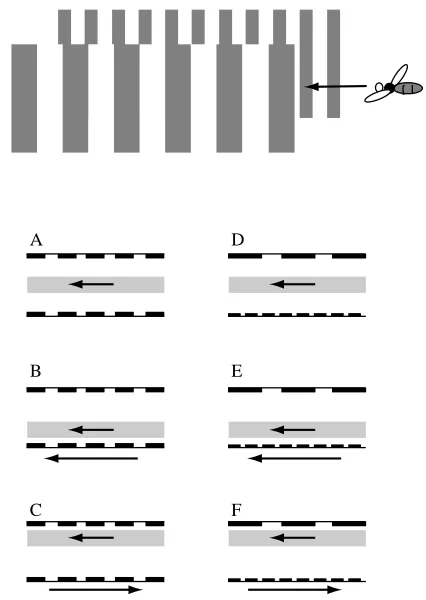
apparatus which offered sugar solution at the end of a tunnel 40 cm long, 20 cm high and 12 cm wide (Kirchner and Srinivasan, 1989). Each side wall carried a pattern consisting of a vertical black-and-white grating of period 5 cm (Fig. 1A). The grating on one wall could be moved horizontally at any desired speed, either towards the reward or away from it. After the bees had received several rewards with the gratings stationary, they were filmed from above as they flew along the tunnel. When both gratings were stationary, the bees tended to fly along the midline of the tunnel, i.e. equidistant from the two walls (Fig. 1A). But when one of the gratings was moved at a constant speed in the direction of the bees’ flight – thereby reducing the speed of retinal image motion on the eye viewing the moving grating relative to the other eye – the bees’ trajectories shifted towards the side of the moving grating (Fig. 1B). When the grating moved in a direction opposite to that of the bees’ flight – thereby increasing the speed of retinal image motion on that eye relative to the other – the bees’ trajectories shifted away from the side of the moving grating (Fig. 1C). These findings demonstrate that when the walls were stationary, the bees maintained equidistance by balancing the apparent angular speeds of the two walls or, equivalently, the speeds of the retinal images in the two eyes. A lower image speed on one eye was evidently taken to mean that the grating
Printed in Great Britain © The Company of Biologists Limited 1996 JEB0118
Recent research has uncovered a number of different ways in which bees use cues derived from optic flow for navigational purposes. The distance flown to a food source is gauged by integrating the apparent motion of the visual world that is experienced en route. In other words, bees possess a visually driven ‘odometer’ that is robust to variations in wind load and energy expenditure. Bees flying through a tunnel maintain equidistance to the flanking walls by balancing the apparent speeds of the images of the walls. This strategy enables them to negotiate narrow passages or to fly between obstacles. The speed of flight in a tunnel is controlled by holding constant the average image velocity as seen by the two eyes. This avoids potential
collisions by ensuring that the bee slows down when flying through narrow passages. Bees landing on a horizontal surface hold constant the image velocity of the surface as they approach it. This automatically ensures that flight speed decreases with altitude and is close to zero at touchdown. The movement-sensitive mechanisms underlying these various behaviours seem to be different, qualitatively as well as quantitatively, from those mediating the well-investigated optomotor response.
Key words: optic flow, insect, honeybee, compound eye, movement perception, odometry.
Summary
HONEYBEE NAVIGATION EN ROUTE TO THE GOAL: VISUAL FLIGHT CONTROL
AND ODOMETRY
M. V. SRINIVASAN1, S. W. ZHANG1, M. LEHRER2 ANDT. S. COLLETT3
1Centre for Visual Science, Research School of Biological Sciences, Australian National University, PO Box 475, Canberra, ACT 2601, Australia, 2Abteilung Neurobiologie, Zoologisches Institut der Universität Zürich, Winterthurerstrasse-190, CH-8057 Zürich, Switzerland and 3Sussex Centre for Neuroscience, School of Biological
Sciences, University of Sussex, Brighton BN1 9QG, UK
on that side was farther away and caused the bee to fly along a trajectory closer to it. A higher image speed, in contrast, had the opposite effect.
Were the bees really measuring and balancing image speeds on the two sides as they flew along the tunnel, or were they simply balancing the contrast frequencies produced by the succession of dark and light bars of the gratings? This question was investigated by analysing the flight trajectories of bees when the two walls carried gratings of different spatial periods (10 cm and 2.5 cm). When the gratings were stationary, the trajectories were always equidistant from the two walls, even when the spatial frequencies of the gratings on the two sides – and therefore the contrast frequencies experienced by the two eyes – differed by a factor of as much as four (Fig. 1D). When one of the gratings was in motion, the trajectories shifted towards or away from the moving grating (as described above) according to whether the grating moved with or against the direction of the bees’ flight (Fig. 1E,F). These results indicate that the bees were indeed balancing the speeds of the retinal images in the two eyes and not the contrast frequencies. The above findings are true irrespective of whether the gratings possess square-wave intensity profiles (with abrupt changes of intensity) or sinusoidal profiles (with gradual intensity changes) and irrespective of whether the contrasts of the gratings on the two sides are equal or considerably different (Srinivasan et al. 1991). In further experiments, the speeds of bees flying through the tunnel were measured and used in conjunction with the known speed of the moving grating to calculate the expected positions of the flight trajectories along the width of the tunnel, on the assumption that the bee balances the angular velocities of the images in the two eyes. The predicted positions agreed well with those observed experimentally (Srinivasan et al. 1991), thus confirming this hypothesis.
Taken together, the above findings suggest that the bee’s visual system is capable of computing the apparent angular speed of a grating independently of its contrast or spatial-frequency content. It is worth noting that, if movement cues are to be exploited to estimate the range of a surface, it is necessary to use a mechanism that measures the speed of the image independently of its geometrical structure. Such a mechanism is what the bee evidently uses to navigate through the middle of a gap between, say, two vertical branches of a tree regardless of the textural properties of the bark on the two sides.
The mechanism that mediates the centring response is quite different from that mediating the well-known ‘optomotor response’. When an insect is placed inside a rotating striped drum, it tends to turn in the same direction as the drum, thereby stabilising its orientation relative to the surroundings. The optomotor response helps the insect to maintain a straight course. The characteristics of the optomotor response have been investigated quite extensively (Reichardt, 1969; Wehner, 1981) and the neural basis of the response is now well on the way to being understood (Hausen and Egelhaaf, 1989). The optomotor response is driven by a mechanism which is sensitive primarily to the contrast frequency of the stimulus and which, therefore, confounds the angular velocity of a striped pattern with its
spatial period (Reichardt, 1969). The centring response, however, is mediated by a mechanism that is sensitive primarily to the speed of the stimulus, regardless of the spatial structure of the stimulus or the contrast frequency that it produces. Further experiments, in which bees were exposed to patterns moving in various directions whilst flying through tunnels, indicate that, unlike the mechanism mediating the optomotor response, the mechanism underlying the centring response is insensitive to the direction of image motion (Srinivasan et al. 1993). In this respect, the movement-sensitive mechanism mediating the centring response appears to be similar to that employed by peering locusts to gauge the distance of targets (Wallace, 1959; Sobel, 1990). Additional evidence, obtained using more complex visual stimuli, indicates that the centring response and the optomotor response are mediated by distinct movement-detecting mechanisms (Srinivasan et al. 1993).
Visual control of flight speed
In the previous section we showed that image motion experienced by the lateral regions of the two eyes can be used to negotiate narrow gaps or to fly between two potential
A
B
C
D
E
[image:2.609.333.546.348.648.2]F
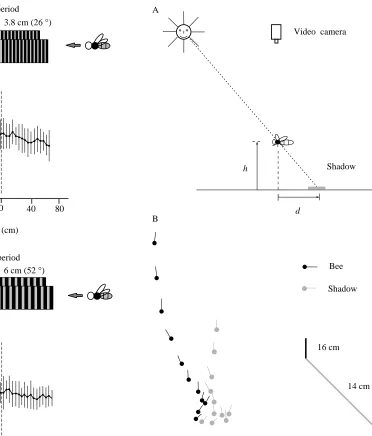
obstacles. Do bees monitor the apparent velocity of the surrounding environment to control other aspects of locomotion, such as flight speed? The experiments illustrated in Figs 2 and 3 suggest that this is indeed the case. In Fig. 2, bees are made to fly through a tapered tunnel lined with black-and-white vertical stripes to collect a reward of sugar water at the other end. The bees slow down as they approach the narrowest section of the tunnel and accelerate when the tunnel widens beyond it. In fact, the variation of flight speed is very close to that expected if the bees were to hold the angular velocity of the image in the lateral eye region constant as they fly though the tunnel (dashed line in Fig. 2C). It seems that the bees strive to hold the angular velocity of the image on the wall constant, despite the changes in the angular period of the stripes that accompany the narrowing and widening of the tunnel. This hypothesis is confirmed by the experiments shown in Fig. 3, where bees are made to fly through tunnels of constant width in which the spatial period of the stripes changes abruptly at the halfway point. The bees maintain a constant speed of flight all the way through the tunnel, thus indicating an ability to measure the angular velocity of the image accurately, irrrespective of its spatial structure. Visual control of flight speed is therefore achieved by monitoring and regulating the apparent motion of the visual panorama using a movement-sensitive mechanism that is capable of measuring the angular velocity of the image. A similar conclusion was drawn by David (1982), who investigated visual control of flight speed in the fruitfly Drosophila.
Is it useful to control flight speed by regulating image speed? An obvious advantage of such a strategy is that it would ensure that the bee automatically slows down when negotiating a narrow passage. In addition, it would provide the bee with a simple, safe strategy for landing, as discussed below.
Executing smooth landings
How does a bee execute a smooth touchdown on a horizontal surface? Flight trajectories of landing bees were studied by training bees to collect a reward of sugar water on a horizontal, textured wooden surface, and then removing the reward and video-filming from above the landings that the bees made on the surface in search of the food. The experiments were conducted outdoors on a clear day with the sun at an elevation of approximately 45 ˚. This arrangement allowed the height of the bee to be monitored in terms of the horizontal distance between the bee and its shadow on the wooden surface (Fig. 4A). Height was calibrated in terms of the length of the shadow cast by a vertical rod of a known height (Fig. 4B). This technique, first employed by Zeil (1993), enabled the trajectory of the landing bee to be captured in three dimensions.
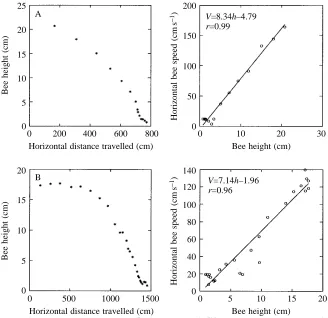
A typical trajectory of a landing bee is shown in Fig. 4B. Analysis of such trajectories reveals that the forward speed of the bee decreases steadily as the bee’s height above the surface decreases (Fig. 5). In fact, forward speed is approximately proportional to altitude, indicating that the bee is holding the angular velocity of the image of the surface roughly constant as the surface is approached. This technique
may be a simple way of controlling flight speed during landing and ensuring that its value is close to zero at touchdown. The advantage of such a strategy is that control of flight speed is achieved without explicit knowledge of height. Landing bees maintain image angular velocities ranging between 400 and 600 ˚ s21, as revealed by analysis
of a number of trajectories.
Measuring distance flown: a visually driven odometer It is well established that foraging honeybees can gauge the distances travelled to food sources (for a review, see von Frisch, 1967). However, the mechanisms by which they carry
0
–35 25
38 cm 12 cm
100 cm
Reward Window
Top view
50 100
0
Flight velocity (cm s
−1)
Position (cm) A
B
[image:3.609.321.559.236.669.2]C
out this odometry have remained enigmatic and controversial (Heran, 1956; Neese, 1988; Goller and Esch, 1990; Esch et al. 1994). Very recently, we have investigated whether bees can estimate and learn short distances flown under controlled conditions in the laboratory. Bees were trained to enter a tunnel and collect a reward of sugar solution at a feeder placed in the tunnel at a fixed distance from the entrance (Fig. 6A). The walls and floor of the tunnel were lined with black-and-white
stripes perpendicular to the tunnel’s axis. During training, the position and orientation of the tunnel were changed frequently to prevent the bees from using external landmarks to gauge their position in the tunnel. The bees were then tested by recording their searching behaviour in a fresh tunnel which carried no reward and was devoid of any scent cues. Analysis of the test data is described in the legend to Fig. 6B,C. Bees trained in this way showed a clear ability to search for the reward at the correct distance (Fig. 7).
How were the bees gauging the distance flown? Experiments investigating this question yielded the following results. (i) We found that trained bees search at the correct
80 40 0 40 80 0 50 100 150
Stripe period 12 cm (78 °) 3.8 cm (26 °)
Position (cm)
Flight velocity (cm s
−1)
A
80 40 0
40 80 0 50 100 150
3.8 cm (26 °) 6 cm (52 °)
Position (cm) B
Stripe period
Flight velocity (cm s
[image:4.609.164.536.68.504.2]−1)
Fig. 3. Variation of flight speed in tunnels of constant width, lined with gratings in which the spatial period changes abruptly in the middle. The bees maintain a nearly constant flight speed regardless of whether the stripe period increases (A) or decreases (B). The curves depict mean ±S.E.M. of flight speed measured in 3 cm bins, for 18 flights (A) and 21 flights (B).
h
d
Bee
Shadow
16 cm
14 cm B
A
Video camera
[image:4.609.59.317.76.556.2]Shadow
distance from the tunnel entrance even when the entrance aperture to the tunnel is reduced in size or when the length of the tunnel is extended. This behaviour indicates that the bees are not using the visual angle subtended by the entrance or the rear wall to gauge their position in the tunnel (data not shown). (ii) Trained bees search at the correct distance even when the spatial period of the stripes lining the tunnel is changed. Therefore, distance is not gauged by counting the number of stripes or other features passed whilst flying through the tunnel (Fig. 8A). (iii) Trained bees search at the correct distance even when flying against a headwind or with a tailwind, created by a fan placed at the other end of the tunnel (Fig. 8B). In fact, the bees behave as though they overcompensate for the wind, flying slightly farther into the tunnel in a headwind and stopping slightly shorter than the true position of the reward in a tailwind. In a headwind, bees fly more slowly and take longer to reach the estimated location of the reward. The opposite is true in a tailwind. The average times elapsed between entry into the tunnel and the first U -turn are 7.2±2.6 s in still air, 10.1±2.7 s in a headwind of 0.7 m s21and 5.9±1.8 s in a tailwind of 0.65 m s21. Therefore,
distance is not estimated in terms of time of flight or other correlated parameters, such as number of wingbeats or energy consumption. (iv) When bees trained in a tunnel of a given width are tested in a narrower tunnel, they search at a shorter distance from the entrance; when tested in a wider tunnel, they search at a farther distance (Fig. 8C). This finding suggests that the bees gauge distance flown by integrating the speed of
the images of the walls and the floor on the eyes whilst flying through the tunnel. (v) This hypothesis is confirmed in experiments in which image motion is eliminated by using axially oriented stripes on the walls and floor. The bees then display no ability to gauge distance travelled and search uniformly over the entire length of the tunnel (Fig. 8D). The behaviour of the bees in this experiment was strikingly different from that in the other experiments. Here, upon entering the tunnel the bees flew directly to the other end, without turning or even pausing near the former location of the reward. After making a U-turn at the far end, they flew straight back to the entrance. They then exited the tunnel and re-entered it to repeat the above procedure over and over again. Clearly, removal of image-motion cues completely disrupted the bees’ ability to localize the position of the reward. This dramatic loss in performance also argues strongly against the participation of non-visual cues, such as energy consumption, duration of flight or wingbeat counts, in estimating distance flown.
These findings reveal that bees possess a visually driven odometer that measures distance flown by integrating the motion of the image of the visual panorama. They confirm the findings of a recent study that presented indirect evidence supporting a similar conclusion (Esch and Burns, 1995). The results of the experiment of Fig. 8A suggest that, in carrying out this function, the bee’s visual system measures the speed of the image largely independently of the structure of the image.
A
20
15
10
5
0 25
Bee height (cm)
150
100
50
0 200
Horizontal bee speed (cm
s
−
1)
200 400 600 800 0
Horizontal distance travelled (cm)
10 20 30
0
Bee height (cm)
V=8.34h–4.79 r=0.99
15
0 5 10 20
Bee height (cm)
120
20 40 60 80 100
0 140
Horizontal bee speed (cm
s
−
1)
500 1000 1500 0
Horizontal distance travelled (cm)
5 10 15 20
0
Bee height (cm)
[image:5.609.238.566.424.742.2]V=7.14h–1.96 r=0.96
Fig. 5. Analysis of flight trajectory whilst landing on a horizontal surface, shown for two bees (A) and (B). In each case, the left-hand panel shows the relationship between height (h) and horizontal distance travelled, whilst the right-hand panel shows the relationship between horizontal flight speed (V) and height (h). The landing bee holds the angular velocity of the image of the ground approximately constant at 8.34 rad s21(480 ˚ s21) in A and approximately 7.14 rad s21(410 ˚ s21) in B, as calculated from the slopes of the linear regression lines.
Ibbotson (1991) reports the existence of visual interneurones in the bee that respond to movement of patterns in the front-to-back direction on each eye. These neurones produce spike frequencies that increase approximately linearly with pattern velocity. Further investigation is needed, however, to establish whether the responses of these neurones are insensitive to pattern structure. If neurones do indeed exist that produce an instantaneous spike frequency proportional to instantaneous image velocity, then the distance travelled along a fixed route could be monitored simply by keeping track of the number of spikes produced.
Our findings do not imply that vision is the sole mechanism by which bees estimate how far they have travelled. The role of other cues, such as energy expenditure, remains controversial (Neese, 1988; Goller and Esch, 1990; Esch et al. 1994; Kirchner and Braun, 1994). Although it is unlikely that energy consumption can be used as a reliable measure of distances as short as those in our experiments (which are traversed in a few seconds), one cannot rule out the importance of such cues in measuring flight over large distances. Unlike energy-based odometry, however, vision-based odometry has the advantage that it is not affected by the presence of wind or by the load of nectar that the bee carries. But visual odometry, as described here, would work accurately only if the bee were to maintain a constant height and follow a fixed route each time it flies to its destination (or if a follower bee follows the same route as a dancing scout bee). This requirement is because the speed of image motion would depend upon the distances to the ground and to the various laterally located objects that are passed on the way to
the goal. The consequences of varying these distances are illustrated in the experiments of Fig. 8C.
A recent study suggests that bees may even be able to ‘count’ the number of landmarks passed en route to a feeding station to determine how far they have travelled (Chittka and Geiger, 1995). But this counting does not seem to be the case with the bees flying past stripes, as demonstrated in Fig. 8A. Desert ants foraging in a featureless landscape also seem to use integrated image motion as one cue to estimate distance travelled, although idiothetic cues may play a role as well
100
50
0 150
Relative frequency
0 5 10 15 20
[image:6.609.245.558.75.365.2]Position in tunnel Reward
Fig. 7. Searching location of bees trained as in Fig. 6 in a tunnel lined with black-and-white stripes perpendicular to the tunnel’s axis. Bees, trained to find a reward in section 9 of the training tunnel (see Fig. 6A), are tested in a fresh tunnel which carries no reward. In this and subsequent figures, the inverted arrowhead denotes the former position of the reward. The trained bees search for the reward at the correct distance from the tunnel entrance, as shown by the mean searching location (h) and the mean spatial distribution of the search (121 flights).
20 cm
3.35 m 22 cm
Reward Training
A
1 2 3 4 5 6 7 8 9 10 11 12 13 14 15 16
x x
x x
B
1 2 3 4 5 6 7 8 9 10 11 12 13 14 15 16 Mean = (x1+x2+x3+x4)/4
C
Section number Test (top view)
1 3 4
[image:6.609.347.517.518.637.2]2
Fig. 6. Experiments investigating the ability of bees to gauge distance flown. Bees are trained to fly into a tunnel 3.35 m long, 22 cm wide and 20 cm high to find a reward of sugar water placed at a fixed location (A). They are subsequently tested in an identical but fresh tunnel which carries no reward. The training and test tunnels are lined with black-and-white stripes of period 4 cm, are covered by a transparent sheet of Perspex and are subdivided into 16 sections for the purpose of analysis (B). In the tests, the bee’s behaviour whilst searching for the reward is recorded by noting the locations of its first, second, third and fourth U-turn, x1, x2, x3and x4, respectively (B). The
(Ronacher and Wehner, 1995). Interestingly, the ants’ estimation of distance does not appear to be affected by the burden that they carry (Wehner, 1992).
Conclusions
It is well known that honeybees use celestial as well as
landmark-based cues to navigate to a goal. These cues help set the direction of flight, help monitor progress to the goal, provide intermediate beacons at which to aim and aid in pinpointing the target when the bee is in its vicinity (for reviews, see von Frisch, 1967; Wehner, 1992; Collett et al. 1993). In addition, a number of visual cues are used to control flight in a ‘moment-to-moment’ fashion to ensure that the bee
B A
100
50
0 150
Relative frequency
100
50
0 150
Relative frequency
0 5 10 15 20
0 5 10 15 20
Position in tunnel
Position in tunnel Reward
Tail wind
Train/test
Head wind Tests with wind
Variation of stripe period Reward
Half period
Train/test Double period
D C
100
50
0 150
Relative frequency
100
50
0 150
Relative frequency
0 5 10 15 20 25
0 5 10 15 20
Position in tunnel
Position in tunnel Reward
Axial
Train/test Tests with axial stripes
Variation of tunnel width Reward
Wider tunnel Train/test Narrower
[image:7.609.57.563.73.475.2]tunnel
stays on course, flies at safe speeds, avoids obstacles and makes a smooth landing at the target. Here we have concentrated on the latter cues. The classically studied optomotor response ensures that the bee stays on course by minimising the apparent rotation of the visual environment (for a review, see Reichardt, 1969). The neural mechanisms subserving this response are well described (for a review, see Hausen and Egelhaaf, 1989). More recent work, described here, suggests that visual control of flight is aided by a number of additional, hitherto unexplored, movement-sensitive mechanisms. Flying bees negotiate narrow passages successfully by balancing the speeds of the images of the flanking walls. Speed of flight is controlled by regulating image velocity, thereby ensuring low speeds whilst passing through narrow gaps. Smooth landings on surfaces are achieved by holding image velocity constant as the surface is approached, thus ensuring low flight speeds at touchdown. Finally, flying bees are able to gauge distance travelled by integrating the optic flow generated by the visual panorama. In all of these tasks, the visual system of the bee displays a capacity to measure the speed of the image independently of the texture of the image. The challenge now is to unravel the neural basis of these navigational feats.
References
CHITTKA, L. AND GEIGER, K. (1995). Can honey bees count landmarks? Anim. Behav. 49, 159–164.
COLLETT, T. S., FRY, S. N. ANDWEHNER, R. (1993). Sequence learning
by honeybees. J. comp. Physiol. A 172, 693–706.
COLLETT, T. S. AND HARKNESS, L. I. K. (1982). Depth vision in animals. In Analysis of Visual Behavior (ed. D. J. Ingle, M. A. Goodale and R. J. W. Mansfield), pp. 111–176. Cambridge, MA: MIT Press.
DAVID, C. T. (1982). Compensation for height in the control of
groundspeed by Drosophila in a new, ‘Barber’s Pole’ wind tunnel.
J. comp. Physiol. A 147, 485–493.
ESCH, H. E. ANDBURNS, J. E. (1995). Honeybees use optic flow to measure the distance of a food source. Naturwissenschaften 82, 38–40.
ESCH, H. E., GOLLER, F. ANDBURNS, J. E. (1994). Honeybee waggle
dances: the ‘energy hypothesis’ and thermoregulatory behaviour of foragers. J. comp. Physiol. B 163, 621–625.
GOLLER, F. ANDESCH, H. E. (1990). Waggle dances of honey bees: Is distance measured through energy expenditure on outward flight?
Naturwissenschaften 77, 594–595.
HAUSEN, K. ANDEGELHAAF, M. (1989). Neural mechanisms of visual course control in insects. In Facets of Vision (ed. D. G. Stavenga
and R. C. Hardie), pp. 391–424. Berlin, Heidelberg: Springer-Verlag.
HERAN, H. (1956). Ein Beitrag zur Frage der Wahnehmungsgrundlage der Entfernungsmessung der Bienen. Z. vergl. Physiol. 38, 168–218.
HORRIDGE, G. A. (1987). The evolution of visual processing and the construction of seeing systems. Proc. R. Soc. Lond. B 230, 279–292.
IBBOTSON, M. R. (1991). A motion-sensitive visual descending neurone in Apis mellifera monitoring translatory flow-fields in the horizontal plane. J. exp. Biol. 157, 573–577.
KIRCHNER, W. H. ANDBRAUN, U. (1994). Dancing honey bees indicate the location of food sources using path integration rather than cognitive maps. Anim. Behav. 48, 1437–1441.
KIRCHNER, W. H. AND SRINIVASAN, M. V. (1989). Freely flying
honeybees use image motion to estimate object distance.
Naturwissenschaften 76, 281–282.
NEESE, V. (1988). Die Entfernungsmessung der Sammelbiene: Ein energetisches und zugleich sensorisches Problem. In The Flying
Honeybee: Aspects of Energetics. Biona Report (ed. W.
Nachtigall), pp. 1–15. Stuttgart, New York: Fischer Verlag. REICHARDT, W. (1969). Movement perception in insects. In
Processing of Optical Data by Organisms and by Machines (ed. W.
Reichardt), pp. 465–493. New York: Academic Press.
RONACHER, B. ANDWEHNER, R. (1995). Desert ants Cataglyphis fortis use self-induced optic flow to measure distances travelled. J. comp.
Physiol. A 177, 21–27.
SOBEL, E. C. (1990). The locust’s use of motion parallax to measure
distance. J. comp. Physiol. 167, 579–588.
SRINIVASAN, M. V. (1993). How insects infer range from visual motion. In Visual Motion and its Role in the Stabilization of Gaze (ed. F. A. Miles and J. Wallman), pp. 139–156. Amsterdam: Elsevier Press.
SRINIVASAN, M. V., LEHRER, M., KIRCHNER, W. ANDZHANG, S. W. (1991). Range perception through apparent image speed in freely-flying honeybees. Vis. Neurosci. 6, 519–535.
SRINIVASAN, M. V., ZHANG, S. W. ANDCHANDRASHEKARA, K. (1993).
Evidence for two distinct movement-detecting mechanisms in insect vision. Naturwissenschaften 80, 38–41.
VONFRISCH, K. (1967). The Dance Language and Orientation of Bees. Cambridge, MA: Belknap, Harvard.
WALLACE, G. K. (1959). Visual scanning in the desert locust
Schistocerca gregaria, Forskal. J. exp. Biol. 36, 512–525.
WEHNER, R. (1981). Spatial vision in insects. In Handbook of Sensory
Physiology vol. VII/6C (ed. H. Autrum), pp. 287–616. Berlin,
Heidelberg: Springer-Verlag.
WEHNER, R. (1992). Arthropods. In Animal Homing (ed. F. Papi), pp. 45–144. London: Chapman & Hall.