J. exp. Biol. (1978), 73, 65-83 6 5 With 13 figures
Printed in Great Britain
ENDOTHERMY IN AFRICAN DUNG BEETLES DURING
FLIGHT, BALL MAKING, AND BALL ROLLING
BY GEORGE A. BARTHOLOMEW
Department of Biology, University of California, Los Angeles, California 90024,
AND BERND HEINRICH
Department of Entomological Sciences, University of California, Berkeley, California 94620
(Received 8 June 1977)
SUMMARY
1. Body temperatures of diurnal and nocturnal rolling and non ball-rolling dung beetles (in particular the genera Scarabaeus, Kheper,
Gymno-pleurus and Heliocopris) were studied in the field in Kenya.
2. The beetles were conspicuously endothermic during flight, ball making, and ball rolling. When at rest, their body temperatures did not differ significantly from that of their surroundings. They did not always generate high body temperatures while walking. However, they sometimes warmed up prior to walking and subsequently maintained a large difference between body and ambient temperatures.
3. The nocturnal species, S. laevistriatus, was conspicuously endothermic during ball making and ball rolling, often maintaining thoracic temperatures of 40 °C or more in an ambient temperature of 25-26 °C. In this species, the velocity of ball rolling increased linearly with body temperature from 5 cm/sec at 28 °C to 18 cm/sec at 40 °C.
4. The take-off temperatures of dung beetles increased with body mass up to 2*5 g. In beetles larger than 2-5 g metathoracic temperatures at take-off ranged from 40 to 44 CC and were independent of mass.
5. Flight temperatures showed essentially the same pattern as take-off temperatures, increasing with mass up to about 42 °C at 2-5 g and being independent of mass thereafter.
6. Both flight and take-off temperatures increased with wing-loading up to about 35 iV/m2, but were independent of wing loading from 35 to 65 N/m2.
7. In each of the species for which we had an adequate sample, wing load-ing increased linearly with body mass. Partial correlation analysis suggests that metathoracic temperature is more dependent on body mass than on wing-loading.
8. During periods of endothermy, metathoracic temperature exceeded prothoracic temperature, and abdominal temperature was lower than that of either the prothorax or metathorax.
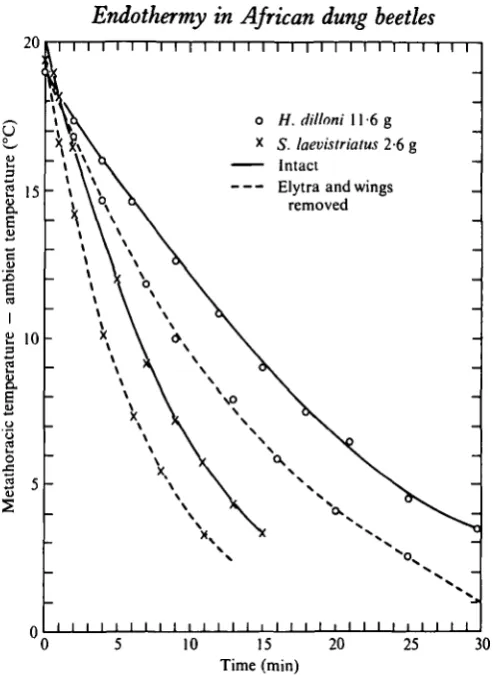
9. Cooling rate was inversely related to body mass. The removal of elytra and wings caused the cooling rate to increase by about one-quarter.
66 G. A. BARTHOLOMEW AND B. H E I N R I C H
metathoracic temperature is a necessary condition for take-off and flight in the larger species.
I I . Mechanisms of heat production and the evidence for thermoregula-tion are discussed.
INTRODUCTION
In recent years endothermic control of body temperature has been studied exten-sively in moths, bees (see review of Heinrich, 1974), and dragonflies (May, 1976). However, endothermy in beetles has received less attention, partly because it is difficult to obtain adequate samples of large beetles except in the tropics, and partly because beetles, particularly large ones, are usually reluctant to fly under laboratory conditions and insect endothermy is primarily associated with flight.
Neither of these constraints apply to the dung beetles associated with the large mammalian herbivores of East Africa. These members of the family Scarabaeidae offer an extraordinarily attractive opportunity for studying closely related species ranging in mass from a few milligrams to more than 20 g. They are strong and willing fliers and in the rainy season are locally extremely abundant during both the day and night.
METHODS
Body temperatures were measured with 40-gauge copper-constantan thermocouples threaded into hypodermic needles (o.d. = 0-05 mm) and glued in place so that the couple was in the orifice of the needle. Temperatures were read to the nearest 0-5 °C using an Omega Engineering Thermocouple Thermometer. Body temperatures during take-off, flight, ball making, and ball rolling were measured within 1-2 s of capture. First the thermocouple probe was inserted into the centre of the metathorax (either from the side or ventrally from the base of the third pair of legs) until the highest temperature was encountered. The probe was then inserted into the prothorax from the dorsal surface of the neck, and into the abdomen between a posterior pair of sternites.
Take-off temperatures were obtained from beetles that were knocked to the ground after having attained a height of 10-15 cm. Temperatures of diurnally flying beetles were measured as they arrived at fresh elephant, rhinoceros, buffalo, or giraffe dung. Temperatures of nocturnally flying beetles were measured at a butane lantern, or at electric lights. The beetles were knocked down while in flight, or picked up immed-iately after landing.
Ball-rolling velocities were timed with a stop watch to the nearest second. Distance travelled was measured to the nearest cm on firm, level, bare soil. Dung-ball tempera-tures, diameters, and masses were measured immediately after velocity was deter-mined. Masses were measured to the nearest tenth of a gram with Pesola spring balances.
Beetles of mass less than 2 g were weighed to the nearest mg with a Roller-Smith torsion balance. Those of mass more than 2 g were weighed to the nearest 100 mg on a Pesola spring balance.
Endothermy in African dung beetles 67
were cut out, and weighed to the nearest 0 1 mg. The mass of each cut-out was con-verted to area by comparison with the mass of known areas of photocopy paper.Metathoracic temperatures during warm-up were measured using beetles captured at dung piles or at electric lights. After capture they were held for several hours until body temperatures approximated ambient. Forty-gauge copper-constantan thermo-couples were inserted to the approximate centre of the metathorax through a hole punched into the metathorax from the side. The thermocouple leads were bent over the elytra and glued down with masking tape. Thirty-gauge thermocouple extension wires at least 2 m long were used to allow the beetles free movement as they walked around on a stone floor in shade or in the dark until they attempted to take-off. The temperatures were read to the nearest 0-2 °C at intervals (timed with a stop watch) from an S-B Systems thermocouple thermometer.
Cooling rates were determined using animals that had been killed in ether. Thermo-couples were implanted in the metathorax as described above immediately after etherization. The animals were heated to 50 °C in a water-jacketed metal container and then allowed to cool in still air while their metathoracic temperatures were recorded at frequent intervals.
All measurements were made in December 1977 in Tsavo East National Park of Kenya, at, or within 10 km of, the Research Station near the Voi Gate.
Species studied
We measured body temperature at take-off and during flight in any species we could catch, but concentrated most of our attention on six species (Table 1). One of these,
Heliocopris dilloni, a nocturnal form, digs its tunnels beneath dung piles and pulls the
dung directly down into its tunnels. The other five species form the dung into balls, roll them away and bury them beneath the soil. One of these species, Scarabaeus
laevistriatus, is nocturnal (peak activity shortly after dusk). The other four, Kheper
aegyptiorum, K. platynotus, Scarabaeus catenatus, and Gymnopleurus laevicollis, started their activity about 2 h after sunrise and continued active throughout the day, but with diminishing intensity in the late afternoon.
RESULTS
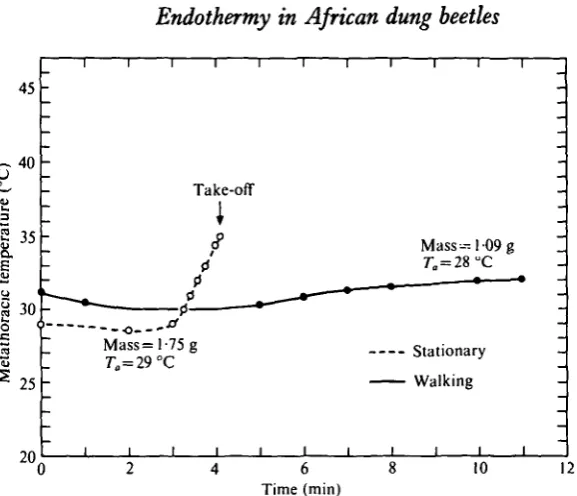
The body temperatures of dung beetles at rest either on the surface or underground did not differ significantly from that of their surroundings. However, when making dung balls, rolling dung balls, preparing to take off, or flying, the prothoracic, meta-thoracic and abdominal temperatures in both the nocturnal and diurnal species were much higher than ambient temperature. Nevertheless, elevated body temperature was not an obligatory result of activity per se.
Walking
68
G. A. BARTHOLOMEW AND B. HEINRICH45
U 40
-'8 30
I
20
1
-"••"•*2i»,
I
1
• • I 1
p'
. , i ,
1 1 i i
i i i i Take-off
\
/
<S
cr
7>23°C
i n i i
i i i i i i
-Stationary Walking
-Mass=12-5
T
a=n°c
-i -i -i -i -i -i "
10 12 14 16
Time (min)
Fig. i. Pre-flight warm-up and metathoracic temperature during continuous walking in
Heliocopris dilloni, showing the independence of body temperature from locomotor activity.
45 "
O 40
-130
25 "
_ 1 1 i 1 1
-I Mass = 3-98 g
-i -i -i -i -i
> ^ — ^ ^
y
S Mass=410g
7;=23OC
1 I I I I
1 i i i i
Take-off I
j+X Take-off 7
i i
i I
1
Stationary Walking
1 1 1 1
I
.8 Time (min)
10 12 14 16
Fig. 2. Endothermically increased body temperature in Scarabaeus laevistriatus, showing elevated but variable body temperatures during walking.
temperature of walking beetles sometimes became conspicuously elevated and oscillated over a range of several °C (Fig. 2).
Pre-flight warm up
Endothermy in African dung beetles
69
45
u 40
20
Take-off
Stationary Walking
10 12
[image:5.451.70.359.47.295.2]Time (min)
Fig. 3. Pre-flight warm up and prolonged endothermically elevated body temperature during terrestrial locomotion in S. catenatus.
weighing 117 g warmed 37 °C/min at an ambient temperature of 23 °C (Fig. 1) and took off when its metathoracic temperature reached 42 o °C.
Intact beetles showed no externally visible movements during warm-up. However, when we removed the elytra and wings vigorous dorso-ventral pumping movements of the exposed flexible dorsal surface of the abdomen were visible. During warm-up these respiratory movements presumably supported the high levels of aerobic metabolism in the metathoracic muscles (Miller, 1966; Bartholomew & Casey, 1977).
Take-off
Flight intention behaviour was clear-cut and conspicuous. Immediately before attempting to take off, the beetles wiped their eyes and antennae with their front legs, then elevated their elytra, unfolded their wings, and lifted off almost vertically into the air.
G. A. BARTHOLOMEW AND B. HEINRICH 46 44 42 40 38 36 34 32 30 28 26
1 1 1
+
V +
— / o
• Y * /A / — A A /
I
A/
"1/
*
— / A
Jr
fc«* A
' i l l o o + 4 + -H-I T o 1 1 o + A 42 38 U o
^ 3 4 30 26 I X X i i -#
- . & *
• l i ?
) i i X y 1 1 4 * i i Body 1 X X i i • ** • 10 mass I X X 1 1 i i (g) 1 I X X X X X
1 1 1
JS—
• • ~
a = 28-3- 6=5-39-r=0-83l Af=56 I
I I I "
20 I | i X X 1
1 1 '
X 1 , X — _ -_
, , 1 6 8 10
Body mass (g)
12 14 20
Fig. 4. The relation of metathoracic temperature at take-off to body mass. The least squares regression lines are fitted to data for beetles with a mass less than 2-5 g. The insert repeats on expanded scales the data for the small beetles; a = Y intercept, 6 = slope, r = correlation coefficient, N = sample size. Data in the insert are plotted without reference to species. In the main graph species symbols are: x , H. dilloni; +, S. laevistriatus; • , S. catenatus; O, K.
platynotus; A, unidentified scarabaeids; V> K. aegyptiorum.
Table i. Principal species of dung beetles studied. All except H. dilloni are ball rollers
Heliocopris dilloni (Guerin) Scarabaeus laevistriatus (Fairmaine) Scarabaeus catenatus (Gerstaecker) Kheper aegyptiorum (Latreille) Kheper platynotus (Bates)
Gymnopleurus laevicollis (Fairmaine) X 9369 3 -3°3 1628 2232 3724 o-n6
Body mass (g) Range 3-10-20-50 1-90-5-40 0-468-3-70 0-630-3-90 1-518-5-940 0-075-0-152 S.D. 3166 0 7 2 2 0-494 0 7 9 0 0 8 3 0
O-O2I beetles 29 137 129 58 83 2 1
x lmc or
activity Night Night Day Day Day Day
noteworthy that unlike bees and moths all five species of dung beetles had abdominal temperatures 5-6 °C above ambient at time of take-off (see Discussion).
Flight
Metathoracic temperatures during flight equalled or exceeded those at take-off in the species for which we obtained adequate sample (Tables 2, 3). As it did at take-off, metathoracic temperature increased rapidly with increasing body mass up to about 25 g and was virtually independent of mass above 2-5 g (Fig. 5).
Endothermy in African dung beetles
7
1Table 2. Body temperatures (°C) in Scarabaeus laevistriatus during different activities at night. Air temperatures, 23-0-27-0 °C {mean = 24-8 °C)
Prothorax Metathorax Abdomen
X S.D. N S.D. N X S.D. N
Take-off Flight Ball making Ball rollin
2 0 8 366 35'8 516 368 2-45 361 323 29 36 32 32
41-4 1-06 30 41-6 1-95 40 3 9 9 293 33 3 8 4 383 35
32-8 2-86 30 32-S 179 36 3 3 0 193 32 31-5 2-21 32
u
0 u _ £ u 0 13 1 •5 Met a HO 44 42 40 38 36 34 32 30 28 if -_ -_ • A, A - 4 k. A7
ZAA i M
_ A Ik ~" # • • 0 ft ^BflB
••
A • / •*l
/
.7
A*
/ A / A A 1 1 0 RW
7 1 -* -«• + -» • 0 +v +
. + -Hf Hr4»oo»
• *T + H - 0
+ A 1 0 1 A h + 0 + 0 -H- 1-1 0 0 46 42 38 34 30 26 1 X X X
_ 1 1
_ "— • 3 1 1 X X X
1 1 1
>
1 1 1 10 Body 1 X X 1 1 .*» T*
•
1 1 mass1 1 1 xl
—
x —
-1 -1 -1 -1 m 1 _
K • * *n :
-•
« = 3O-5 : r = 0 81 I ^ = 1 1 0 ;
1 1 1 1 1
20 — — — -— — ( ,8 )
1 1 I I
6 8 Body mass (g)
10 12 14
Fig. 5. The relation of metathoracic temperature during flight to body mass in dung beetles. Insert and symbols as in Fig. 4.
each of the five species metathoracic temperature during flight was 5-6 °C higher than prothoracic temperature and the abdomen was cooler than either of the two thoracic segments.
Wing loading and body temperature
Metathoracic temperature increased with increasing wing load during take-off and flight. The rise in temperature was curvilinear up to about 42 °C where wing loading was about 35 Njm? (357 mg/cm2). Thoracic temperature was essentially independent of wing loading above 35 Nfm2 (Fig. 6). The slope of the increase of metathoracic temperature on wing load appears to be steeper during flight than during take-off, but the distribution of wing loading in the take-off sample makes it difficult to quantify the apparent difference.
G. A. BARTHOLOMEW AND B. HEINRICH • } y ra n 8. E w U IDB J O . £
s
2 40 44 42 40 38 36 34 32 30 281 1 1 1 1 1 1 1
-_ — — — —
-f 1 1 1 1 1 1 1
11 1 II 1 1 I 1 1 1 | 1
< • • • • • • X • • •
9 X * *
• XXX
» «ft » * X • X « X
x» • • • •
• • • • X
1 1 f 1 1 1 1 1 1 1 1 1 11
1 1 1 1 1 1 1 1 1 1
>
# • 4P x • • MM • « • X«K*
• * • •
• X • •
X
• X
• x x
• *
1 1 1 11 II 1 1 1 i I I ii w I
X • •
• «•*•*)•(»
X ) • •
M(9 ]K Mi
X X X X *
X X X • •
X
I M I M I I 1 1
XX 1
•
X
• •X X X X 1, • X ,
g i n
X X XX IK • X X 01 1 1 X X 11
11111 II 1 1 1 1 1 1 1 11 1 1 1 1 1 1 1
X — — X — -— — —
1 1 1 1 1 1 1 1 1 1 1 11 1 1 1 1 1 1 1 11 1
10 20 30 40 50 Wing loading (N/m2)
60 70
Fig. 6. Relation of metathoracic temperatures at take-off ( x ) and during flight ( • ) to wing loading in dung beetles. To convert 7V/m2 to mg/cm8, divide by 0-098065.
70
-i -i -i r n i i i i i i i r
\ x x ; x
*
a ft r N o K.plalynotus 18-9 701 0-87 18 v K. aegyptiorum 27-7 5-51 0-76 13
+ S. laevistriatus 19-2 4-58 0-82 58 • S. catenates 15-3 8-87 0-87 43 X H.dilloni 11-5 2-71 0-88 28
A Unidentified _ — _ —
10 12 14 Body mass (g)
16 18 20
Take-of f
ME
T
Bal l makin g (shade ) Bal l rollin g (sun ) (shade )Tabl
e 3
.
Metathoracic Kheper platynotusX 414 409 33-8 38-S 36-3
S.D . 21 9 1 3 4 2-4 7 1-6 3 3° 4
N 7 11 22 7 20
T a 28 9 27 2 30-3 30-0 27 8 : temperatures during different Kheper aegyptiorum
X 399 41-8 312 379 331
S.D . J V 20 8 6 i-6 o 7 31 2 1 3 23 4 1 1 26 8 2 1 T a 27 8 26 3 28 0 26 5 26 1 activities of four species of dung Scarabaeus catenatus X 38 0 41 2 28 4 37-2 3i-9 S.D . 2-6 4 12 7 23 8 25 6 3 5 2
N 4 37 19 29 32
T a 25 3 25-7 26 2 28 0 26-0 beetles Heliocopris dilloni X S.D . 40 2 15 3 42-6 1-5 6 — — — —
N 19 10 — —
T a 2 5 4 25 0 — —
74 G. A. BARTHOLOMEW AND B. H E I N R I C H
body mass or wing loading. However, partial correlation analysis suggests that body mass is the more important. For beetles with a mass of less than 2-5 g, when the effect of wing loading is removed, the partial correlation coefficient for metathoracic tempera-ture (take-off and flight combined) and mass is 0-459. For the same group when the effects of mass are removed, the partial correlation coefficient for metathoracic temperature and wing loading is only 0-165.
It is noteworthy that within species wing loading increased linearly with mass (Fig. 7), whereas metathoracic temperature did not (Fig. 5). This contrasting set of relationships can be interpreted as evidence for physiological regulation of temperature during flight (see Discussion).
Although the smaller and more lightly wing-loaded beetles had the lowest body temperatures during flight, their control and manoeuverability exceeded that of the larger and more heavily wing-loaded species. The smaller beetles (< 500 mg) flew with the agility of flies when they reconnoitered a dung pile. They usually landed lightly and directly on the dung, sometimes taking off to shift location by 5-10 cm. In contrast the larger species usually landed heavily on the ground a metre or more downwind from the dung and then approached it on foot. The large beetles were also reluctant to resume flight after having landed.
Ball making and ball rolling
Day-flying species. The metathoracic temperatures of the diurnal species, K. platynotus, K. aegyptiorum, and S. catenates, while making dung balls in the shade of
trees averaged about 3 °C above the temperature of the dung in which they were working, but were much lower than during flight (Table 3).
As soon as a beetle completed making a dung ball, it rolled the ball one to ten or more metres away from the dung pile and buried it in the soil. When beetles were in the shade the difference between air and metathoracic temperatures during dung-ball rolling averaged 6-0-8-5 °C. In sunshine this difference averaged 8-5-11-5 °C (Table 3). The body temperatures of the beetles rolling dung balls were obviously increased endogenously and then further elevated by solar radiation. However, even while exposed to the sun their average metathoracic temperature during ball rolling was 2-5-4-0 °C lower than during flight. During ball making and ball rolling in shaded areas metathoracic temperatures were always higher than those of the prothorax, while prothoracic temperatures were higher than those of the abdomen. In sunshine the differences in temperature between the three body segments tended to diminish and sometimes disappeared completely, presumably because solar radiation heated all sec-tions of the body and obscured the difference caused by endothermic heat production.
Legend to Fig. 8 A, B, C and D.
Fig. 8. A, Kheperplatynotus making dung balls. The two balls in the centre are fully formed, and a beetle is smoothing the lower one prior to rolling it away. A third ball (right) is still under construction in the interior of the dropping. Note the dry fibrous material (lower right) remaining where beetles have already removed balls. The hand and camera are included for scale. B, K. platynotus pushing a freshly made dung ball to which sand grains are beginning to adhere. Continued rolling smooths the surface and coats it with a hard layer of sand and soil particles. C, Pair of K. platynotus, one riding the dung ball, the other pushing it. D, Pair of
Journal of Experimental Biology, Vol
Fig. 8
Fig. 8. For legend see facing page.
Journal of Experimental Biology, Vol. 73
Fig. 8
- a c
cm
s
Endothermy in African dung beetles
75
45
40
35
ffl 30
25
o
Metathorax Prothorax
Metathorax
N=l Gymnopleurus
laevicollis
Abdomen
Kheper platynotus
45
40
35
30
25
Fig. 9. Temperatures of pairs of rollers. See Table i for body masses and Fig. 8 for photo-graphs. K. platynotus was measured in the shade (Ta = 23-31 °C, mean 27-5 °C). G. laevicollis was measured in hazy sunshine (Ta = 29-32 CC, mean 30-8). N indicates number of pairs in each sample. The vertical line shows the range; the horizontal line is the mean. The rectangle encloses the interval ± 2 x S.E. of mean.
Night-flying species. At night, any excess of body temperature over that of the
environment in an animal as small as a beetle is almost certainly due to endothermic heat production. Therefore, we examined the body temperature during terrestrial activity of Scarabaens laevistriatus, the only large ball-rolling beetle active at night in our study area. 5. laevistriatus differed from the diurnal species of similar size in the rapidity of its movements during ball making and ball rolling. The diurnal species often appeared lethargic and seemed to work in a leisurely manner, usually requiring from 10 to 30 min to make a dung ball. In contrast, the nocturnal species, S.
laevis-triatus, worked swiftly, sometimes with almost frenzied haste and often formed a dung
ball and rolled it away in less than 2 min.
During ball making and ball rolling, as during take-off and flight, the prothoracic temperature of S. laevistriatus was significantly lower than that of the metathorax, but significantly higher than that of the abdomen. Moreover, the temperature of each of these body segments varied only slightly with type of activity. The only conspicuous temperature difference associated with type of activity was found in the metathorax; during flight metathoracic temperature averaged 16-8 °C above air temperature while during ball rolling it averaged 13-8 °C above (Table 2).
Ball rolling by pairs of beetles. In view of the often conspicuous endothermic
7
6
G. A. BARTHOLOMEW AND B. HEINRICH251 | | | | i | | | | | | | | | i i i i i 125
30 35 40 Metathoracic temperature (°C)
45
Fig. io. The least squares regression of ball-rolling velocity on metathoracic temperature in the nocturnal scarabaeid, S. laevistriatus. Mean body mass, 3-271 g. Mean mass of dung balls, 347 g. Ta = 23-27 °C. Other symbols as on Fig. 4.
force for rolling (Fig. 8C). In the second species, Gymnopleurus laevicollis, both members of the pair roll the ball, one pushing and one pulling (Fig. 8D). In G.
laevicollis the metathoracic temperatures of the pusher and the puller did not differ
significantly (P = < 0-05). In K. platynotus, however, the prothoracic and meta-thoracic temperatures of the pushers were both significantly higher than those of the riders - in the shade at an air temperature of 28 °C, the metathoracic temperatures of the rollers averaged 37-6 °C, whereas those of the riders averaged 31-4 °C (Fig. 9). Abdominal temperatures were also slightly higher in the rollers than the riders, but this difference was not statistically significant. Since both rollers and riders were exposed to the same dung and air temperatures and there was no direct solar radiation, it seems clear that while engaged in the strictly terrestrial activity of ball rolling the more active member of each pair of beetles experienced endothermically elevated temperatures.
Ball-rolling velocity
Endothermy in African dung beetles
77
u H.dillnni 11-6S. laevistriatus
Intaci
Elytra and wing
10 15
Time (min)
Fig. i i . Arithmetic plot of cooling rates of beetles before and after removal of wings and elytra. Curves fitted by eye.
relation to ball-rolling velocity in K. aegyptiorum, K. platynotus, S. catenatus and
S. laevistriatus.
Thoracic temperature was the only parameter on which ball-rolling velocity was significantly dependent. This dependence was most clearly shown in S. laevistriatus, probably because of its wide range of body temperatures (28-43 °Q- Over this range, ball-rolling velocity increased linearly with thoracic temperature from 5 cm/sec to 20 cm/sec (Fig. 10).
[image:15.451.95.344.49.387.2]G. A. BARTHOLOMEW AND B. HEINRICH
I I I I I I I I I I I I I I I I I I I I I I I I I I I I I I I I I I I I I I I I
i i i I i i i I I i I I i i i I i i i i i i i I I I i I I i i i i I i I I I i I I
10 15 20 25
Time (min)
30 35 40
Fig. 12. Semilogarithmic plot of cooling rates in H. dilloni of different sizes. Slopes determined by method of least squares. The data for the n-6 g beetle are the same as in Fig. n .
mass of dung ball (slope = 0-005, r" = 0-069, N = 14). Presumably friction is the major determinant of the work required to roll a dung ball on firm level ground; under the conditions of measurement this parameter was not sufficiently related to ball mass to affect the length or frequency of the roller's stride which of course determine the velocity with which the ball is rolled.
Cooling rates
Endothermic temperature regulation requires that rates of heat production and heat loss be approximately balanced. We were unable to measure the heat production of the beetles we studied, but it was possible to measure their cooling rates in still air and cooling rate can be used as an index of heat loss.
If ambient temperature remains constant the temperature of a passively cooling object of homogeneous structure (in this case a freshly etherized beetle) decreases exponentially (Fig. 11). Such exponential cooling curves become straight lines when plotted semilogarithmically (Fig. 12) and their slopes can be converted to cooling rates, in this case °C min-1 "C"1, by multiplying them by 2-303, the natural logarithm of 10 (see Bakken, 1976 a, b, for a detailed analysis).
Endothermy in African dung beetles
79
0-60
00
j= 010 § 0 0 8 006
004
y=o-22A-0'586
r = 0-98 # = 2 2
1 1 1 1 1 1 1 1 1 1 1 1 1 1 1
0-2 10
Body mass (g)
Fig. 13. The least squares regression of the log-transformed data for cooling rate on body mass in five species of scarabaeids. Symbols as in Fig. 4.
Unlike moths and bees, the cooling rates of which have been examined in some detail (see for example, Church, i960; Bartholomew & Epting, 1975; Heinrich, 1975; May, 1976), beetles are not covered with a layer of insulating pile. During terrestrial activity, however, the air spaces under the elytra of beetles should afford significant insulation to the dorsal surface of the metathorax and abdomen. We examined the insulating effects of the sub-elytral space by measuring the cooling rates of H. dilloni and S. laevistriatus with bodies intact and then with the elytra and wings removed. The removal of the elytra and wings caused the slope of the cooling curve to increase by 26-28 % (Fig. 11). From this we infer that at least during terrestrial activity the air spaces beneath the elytra afford substantial reduction of heat loss from the dorsal surface of the pterothorax and abdomen.
DISCUSSION
Endothermy in beetles has received relatively little attention although its existence has been documented for more than 35 years (Krogh & Zeuthen, 1941; Krogh, 1948). However, the importance of thoracic temperature in matching the physiological and physical aspects of the flight system has been clearly shown (Machin, Pringle & Tamasige, 1962; Leston, Pringle & White, 1965) and it has been demonstrated that endothermically elevated temperatures occur under circumstances where flight or preparation for flight are not involved (Bartholomew & Casey, 1977).
80 G. A. BARTHOLOMEW AND B. H E I N R I C H
size, heat production and body temperature are often not closely coupled in insects. However, this coupling is obvious in large dung beetles. Their size reduces rate of temperature change, and they have several clearly different and often prolonged activities that are both energy-demanding and readily observed - walking, ball making, ball rolling and flight.
The occurrence of endothermically elevated body temperatures in beetles during terrestrial activity as well as during flight is probably related to the fact that in insects one set of muscles may serve two or more quite different functions. For example, in orthopterans the flight muscles participate in walking movements (Wilson, 1962) and in singing (Bentley & Kutsch, 1966). Since different activities generate, and perhaps require, different muscle temperatures, several temperature levels, each associated with a particular pattern of activity, seem possible within the same complex of muscles. Thus, elevation of thoracic temperature could increase not only the speed and power of wing movements, but could also enhance the speed and power of leg movements. In the large tropical dung beetles it appears that flight can be sustained only after the flight muscles reach temperatures of about 42 °C (Fig. 5), but these beetles can walk in a co-ordinated manner when the same muscle are at 25 CC. Thus, walking per se required no elevation of body temperature above the ambient temperature which during our study did not fall below 23 °C. Moreover, even the largest beetles we measured would walk continuously for many minutes without increasing either prothoracic or metathoracic temperature more than 1 °C above ambient (Fig. 1), and in many cases body temperature decreased while the beetles were walking (Fig. 2). Indeed, rapid and sustained increases in temperature usually took place only when the beetles were stationary. Since thoracic muscles can be bi-functional it may not be possible for a beetle to warm at the maximum rate, which almost certainly involves high frequency, essentially isometric contractions (Leston et al. 1965; Bartholomew & Casey, 1977) while some of the muscles are involved in the much lower frequency contractions associated with walking. Such a situation is analogous to the incompati-bility of simultaneous powerful shivering and co-ordinated locomotor activity in mammals.
Endothermy in African dung beetles 81
Clearly, there is a premium on rapidity of ball building and speed of rolling it from areas of high beetle density in and around the dung. This is particularly true at night when the number of beetles active is many times greater than during the day. The selective advantage of high body temperature during terrestrial activity in 5.laevistria-tus appears to be a simple function of Q10 - the higher its temperature the faster its ball building and ball rolling and the greater its success in exploiting the supply of dung which is both erratic in occurrence and ephemeral. If the 5. laevistriatus we observed had operated with a body temperature equal to ambient temperature (in this case, 26 °C), their ball-rolling speed would have been 3 cm/sec. However, their body temperature was frequently above 40 °C, and at this temperature ball-rolling speed was almost 20 cm/sec (Fig. 10). Assuming that the same sevenfold increase in rate applied during ball making, the advantage of high body temperature during this activity is equally clear. With a body temperature of 40 °C 5. laevistriatus required only 1-5-5 m m t 0 form a dung ball. At 26 °C, 10-35 m m would have been required, and during this interval other beetles could have used up the available dung. In this nocturnal species, endothermically elevated thoracic temperatures facilitate both rapid ball making and quick removal of the ball from the area of activity, minimizing both scramble competition and interference competition. We often saw beetles being robbed of partly or completely constructed balls by conspecifics. The competition for balls was often intense and the vigour and strength of both aggressive and defensive activities presumably increase with increasing body temperature.
Functional considerations
In most conspicuously endothermic insects the body surface is covered with an insulating pile and the abdomen is physically and physiologically isolated from the flow of heat from the thorax. In dung beetles, however, there is no insulating pile and the abdomen is broadly confluent with the thorax. It is noteworthy that abdominal temperature in dung beetles is more similar to thoracic temperature and follows it more closely than is the case in the other endothermic insects that have been studied. Nevertheless, the cooling rates of dung beetles are only slightly higher than those of saturniid and sphingid moths of similar size (Bartholomew & Epting, 1975). Our data suggest that the absence of insulating pile is partly compensated for by the elytra and wings which form an insulating air space that covers the entire dorsal surface of the metathorax and abdomen (Fig. 11), and presumably functions in a manner similar to the subcuticular air sacs of dragonflies (May, 1976).
Temperature regulation versus temperature control
Endothermically elevated temperatures are of course not, of themselves, evidence for regulation of body temperature. The elevated temperatures in beetles may not be a regulated state, but a temporary equilibirum resulting from a uniform sustained level of activity in a relatively constant ambient temperature, or a byproduct of the work done to carry out a given pattern of behaviour. If physiological temperature regulation is involved body temperature should remain uniform over a substantial range of ambient temperatures and power inputs
82 G. A. BARTHOLOMEW AND B. HEINRICH
lines of circumstantial evidence suggest that the endogenously achieved high body temperature associated with their flight is a regulated state.
(1) Flight temperature increases with mass up to 2-5 g but is independent of mass from 2-5 to 20 g. This despite the fact that the cooling constant (Fig. 13) of a dead 2*5 g beetle is about 3-4 times that of a 20 g beetle. When body temperature is constant heat production equals heat loss, and heat loss is equal to the product of the cooling con-stant, body mass, and the specific heat of the body. From this we infer that during flight the larger beetles must actively dump heat. If this were not so, the heat produc-tion during flight of a 20 g beetle could not be more than about 2-5 times that of a 2-5 g beetle. This is extremely unlikely because the oxygen consumption of beetles at rest increases with body mass to the 088 power, while during sustained terrestrial activity it increases with mass to the I-I power (Bartholomew & Casey, unpublished). Even if the smaller of these exponents applied during flight, heat production of a 20 g beetle would be 6 times that of a 2*5 g beetle.
(2) In theory power input, and therefore heat production, should increase directly with wing loading. We found that thoracic temperatures during flight were indepen-dent of wing loading in beetles weighing more than about 2 g (Fig. 6), whereas wing loading increased directly with mass over the entire range of size measured (Fig. 7). From this we infer that the large beetles actively lose some of the heat they generate as a result of their heavy wing loading.
On the basis of these considerations we suggest that during flight the body tempera-ture of beetles smaller than 2 g is a passive function of the balance between the rates of heat production and heat loss with no special regulating mechanisms involved, but that in beetles larger than 2 g, body temperature during flight is regulated by control of heat loss particularly from the dorsal surface of the abdomen. The relationship we observed between thoracic temperature of flying beetles as a function of body mass is similar to that of moths (Bartholomew & Heinrich, 1973), most of which are insulated with pile. The thoracic temperature of moths, however, asymptotically reached 40 °C at a mass of less than 1 -o g.
Endothermy in African dung beetles 83
REFERENCES
BAKKEN, G. S. (1976a). An improved method for determining thermal conductance and equilibrium body temperature with cooling curve experiments. J. Thermal Biol. I, 169-175.
BAKKEN, G. S. (19766). A heat transfer analysis of animals: unifying concepts and the application of metabolism chamber data to field ecology, jf. Theor. Biol. 60, 337-384.
BARTHOLOMEW, G. A. & CASEY, T. M. (1977). Endothermy during terrestrial activity in large beetles.
Science 195, 882-883.
BARTHOLOMEW, G. A. & EPTING, R. J. (1975). Allometry of post-flight cooling rates in moths: a comparison with vertebrate homeotherms. J. exp. Biol. 63, 603-613.
BARTHOLOMEW, G. A. & HEINRICH, B. (1973). A field study of flight temperatures in moths in relation to body weight and wing loading. J. exp. Biol. 58, 123—135.
BENTLEV, D. R. & KUTSCH, W. (1966). The neuromuscular mechanism of stridulation in crickets (Orthoptera: Gryllidae). J. exp. Biol. 45, 151-164.
CHURCH, N. S. (i960). Heat loss and the body temperatures of flying insects. II. Heat conduction within the body and its loss by radiation and convection. J. exp. Biol. 37, 186-212.
HALFFTER, G. & MATTHEWS, E. G. (1966). The natural history of dung beetles of the subfamily Scarabaeinae (Coleoptera, Scarabaeidae). Folia Ent. Mexicana 12-14, 1-312.
HEINRICH, B. (1974). Thermoregulation in endothermic insects. Science 185, 747-756.
HEINRICH, B. (1975). Thermoregulation in bumblebees. II. Energetics of warm-up and free flight.
J. Comp. Physiol. 96, 155-166.
KROGH, A. (1948). Determination of temperature and heat production in insects. Z. vergl. Physiol. 31, 274-280.
KROGH, A. & ZEUTHEN, E. (1941). The mechanism of flight preparation in some insects. J. exp. Biol. 18,
1-10.
LESTON, D., PRINGLE, J. W. S. & WHITE, D. C. S. (1965). Muscular activity during preparation for flight in a beetle. J. exp. Biol. 42, 409-414.
MACHIN, K. E., PRINGLE, J. W. S. & TAMASIGE, M. (1962). The physiology of insect fibrillar muscle. IV. The effect of temperature on beetle flight muscle. Proc. Roy. Soc. B. 155, 493-499.
MAY, M. L. (1976). Thermoregulation and adaptation to temperature in dragonflies (Odonata: Anisoptera). Ecol. Monogr. 46, 1-32.
MILLER, P. L. (1966). The supply of oxygen to the active flight muscles of some large beetles, jf. exp.
Biol. 45, 285-304.