J. Exp. Biol. (1972), 56, I39-IS3 I 3 9
toWi 13 text-figures
Printed in Great Britain
TRANSEPITHELIAL POTENTIAL
CHANGES DURING STIMULATION OF ISOLATED
SALIVARY GLANDS WITH 5-HYDROXYTRYPTAMINE
AND CYCLIC AMP
BY MICHAEL J. BERRIDGE AND WILLIAM T. PRINCE
Unit of Invertebrate Chemistry and Physiology, Department of Zoology, Downing Street, Cambridge, and Department of Pharmacology,
Hills Road, Cambridge {Received 21 May 1971)
INTRODUCTION
The action of many hormones is thought to be mediated by cyclic 3',5'-adenosine monophosphate (cyclic AMP). The intracellular concentration of cyclic AMP depends on the balance which exists between its synthesis by adenyl cyclase and its degradation by phosphodiesterase (PDE). The current concept is that hormones act to alter this balance by stimulating adenyl cyclase, thus accelerating the conversion of ATP into cyclic AMP (Robison, Butcher & Sutherland, 1968). The result of a successful hormone-receptor interaction is thus translated into an increase in the intracellular concentration of cyclic AMP, which in turn is responsible for mediating the further actions of the hormone. The effects of many hormones can be simulated by the direct application of cyclic AMP (Robison et al. 1968). Any attempt to explain how hormones act will therefore depend on an understanding of the mode of action of cyclic AMP.
One important locus for the action of cyclic AMP appears to be the cell membrane. The action of catecholamines on the membrane potential of Purkinje cells and vascular smooth muscle is mediated by cyclic AMP (Somlyo, Haeusler & Somlyo, 1970; Siggins et al. 1971). The ability of vasopressin to increase the permeability of toad bladder and collecting ducts of the mammalian kidney also depends on cyclic AMP (Orloff & Handler, 1962; Grantham & Burg, 1966). This compound may also be involved in the control of ion and water transport by the pancreas (Johnson et al. 1970), gastric mucosa (Harris & Alonso, 1965), Malpighian tubule (Maddrell, Pilcher & Gardiner, 1971) and insect salivary gland (Berridge, 1970). We have used isolated salivary glands from adult blowflies, Calliphora erythrocephala, as a model system to study this role of cyclic AMP in the control of ion and water transport.
140 M. J. BERRIDGE AND W. T . PRINCE
PR
LP
SB
SL
SC
Pen recorder
SGN
SB
(6)
Fig. 1 (a). Diagram of the perspex chamber used to record the transepithelial potentials of isolated salivary glands. The gland lay in a groove connecting the perfusion bath (PB) with the saliva bath (SB). The middle bath contained liquid paraffin (LP). The closed end of the sali-vary gland (SG), which was continuously perfused with saline (arrows), was supported on agar blocks (A) and held in position by silk ligatures (SL) inserted into Vaseline. Agar bridges (AB) were connected to each outer chamber.
(b). The circuit diagram of the system used for measuring transepithelial potentials. CE,
Transepithelial potential changes in salivary glands 141
luggest that 5-HT may have a direct effect on ion transport in addition to raising the intracellular level of cyclic AMP by stimulating the enzyme adenyl cyclase.
A preliminary account of these studies has been reported elsewhere (Berridge & Prince, 1971).
METHODS
The salivary glands of adult Calliphora consist of two long tubes which extend down the length of the body (Oschman & Berridge, 1970). All the experiments described below were carried out on that portion which lies in the abdomen. Rate of fluid secre-tion was determined by a technique originally devised to study isolated Malpighian tubules (Ramsay, 1954).
For the electrical measurements salivary glands were set up in a perspex perfusion chamber which had three parallel baths (Fig. 1). The two outer baths contained saline and were insulated from each other by liquid paraffin in the middle chamber. The salivary gland lay in a narrow groove connecting all three compartments such that the closed end was in the perfusion bath while the open end lay in the other outer bath. The position of the gland in the bath was maintained by silk ligatures tied around each end and inserted in Vaseline seals on the outer wall of each perfusion chamber (Fig. 1 a). The lumen of the gland was open to the saliva bath through a nick made immediately behind the silk ligature.
The one outer bath was constantly perfused with physiological saline. A six-way ball-and-socket tap (Sattelle, 1971) was placed close to the perfusion bath so as to reduce the time required to change from one solution to another. The six polyethylene tubes entering the tap were connected to saline reservoirs. The volume of the perfusion bath was 0-3 ml and the perfusion rate was approximately 5 ml/min. By studying the change in resting potential of salivary glands during the infusion of solutions with different potassium concentrations it was possible to estimate that a new solution reached the gland 1 sec after opening the tap and a new equilibrium was established 5-10 sec later. Since very large concentrations of cyclic AMP are required to stimulate salivary glands, the cost of continuously perfusing this compound was prohibitive. Consequently, a slightly different technique was used to introduce this compound into the perfusion bath. The perfusion was stopped and while draining the control saline the cyclic AMP solution was injected directly into the bath so that the level remained constant. Cyclic AMP was removed by restarting the perfusion with control saline. 5-HT applied in the same way produced a normal response.
Each outer bath was connected to a calomel electrode through a KCl-agar bridge. The transepithelial potential was obtained by monitoring the potential difference between the two calomel electrodes on a Keithley electrometer connected to a pen recorder (Fig. 1 b). There is little voltage attenuation down the length of the gland because the responses recorded using this technique were identical to those obtained by inserting a micro-electrode into the lumen near the closed end of the gland and measuring the potential with reference to the outside bathing medium (unpublished observation).
isethionate, and calcium and magnesium were introduced as sulphates. Phenol rec? ( < o-oi niM/1) was routinely included in all salines to provide a continuous check on the pH of the solutions which were all maintained between 7-0 and 7*4.
RESULTS
The electrical response of isolated salivary glands to $-HT
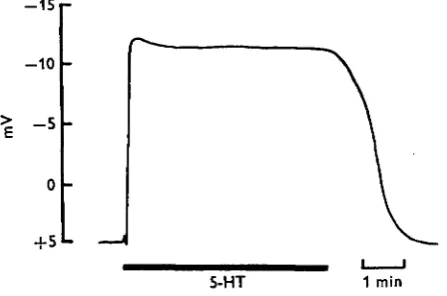
When isolated salivary glands were set up in the bath and perfused with control saline, the lumen was 4-0 + i-o mV positive with respect to the outside. 5-HT (icr8 M) caused a sudden reversal of the potential and the lumen became i 2 - i ± i - i mV negative within 3-5 sec (Fig. 2). The lumen remained negative for as long as 5-HT remained in the bath and there was no evidence of fatigue or de-sensitization even if 5-HT stimulation was continued for 1 h or more. Maintenance of a constant potential during continuous stimulation with 5-HT resembled earlier observations that rate of
-15r-- 1 0
+51
[image:4.451.112.336.257.405.2]-S-HT 1 min
Fig. 2. The effect of 5-HT (io~8 M) on the transepithelial potential (mV) of an isolated salivary gland. The potential of the lumen was measured with respect to the bathing medium and 5-HT was perfused over the gland for the duration of the long bar.
secretion could be maintained for over 6 h (Berridge, 1970). In most cases a small decrease in potential (2-3 mV) was observed after the peak value had been held for 5—10 sec (Fig. 2). The potential returned to the unstimulated level approximately 2 min after 5-HT was removed. The nature of this recovery phase appeared to be related to the length of treatment with 5-HT.
Transepithelial potential changes in salivary glands 143 %>{ prolonged experiments. If glands failed to produce this characteristic response to
short treatments with 5-HT they were replaced with fresh glands.
The extent of the positive undershoot was found to be related to the length of
-30 r
20
-1 min
Fig. 3. The transepithelial potential response of the gland to repeated io sec applications of S-HT (io-8 M).
- 3 0
t-- 2 0
- 1 0
0
+ 10
+ 20
+ 30
+40
+ 50 I- 7-5 10
• 15 30
Fig. 4. The potential response of isolated glands when 5-HT (io~8 M) was applied for different
treatment with 5-HT. If glands were treated for different times with a constant con! centration of 5-HT, the positive undershoot increased progressively with the length of 5-HT treatment (Fig. 4).
All the responses to 5-HT illustrated in Figs. 2-4 were very much faster than the increase in rate of fluid secretion which had been recorded previously (Berridge, 1970). In order to compare these two events more precisely, the rate of fluid secretion was measured on the same glands in the same perfusion chamber as was used to obtain the potential measurements. The gland was placed in the perfusion bath and the open end
100
90
80
8
708
£
60s
'x 50
40
30
20
10
0L=g.—8—-t--^
S-HT 1 min
Fig. 5. A comparison of the change in rate of fluid secretion ( £ ) and the transepithelial potential response (O) produced during a 3 min infusion of io~9 M 5-HT (horizontal bar). The secretory and potential responses have been expressed as a percentage of the maximal response.
Transepithelial potential changes in salivary glands
Effect of $-HT concentration on the electrical response
If the steady-state potential recorded across the gland is related to fluid secretion, then the former should show a dose-dependent relationship similar to that obtained earlier for the rate of secretion (Berridge, 1970). Of the two salivary glands obtained from each fly, one was used to measure the rate of secretion while the other was set up
- 1 0
+10
+20 - 2 0
- 1 0
+10
+20
1x10"' 2x10-' 3x10"'
.(f) 1 min
[image:7.451.70.372.158.367.2]5x10"' 1x10-* Sx10-»
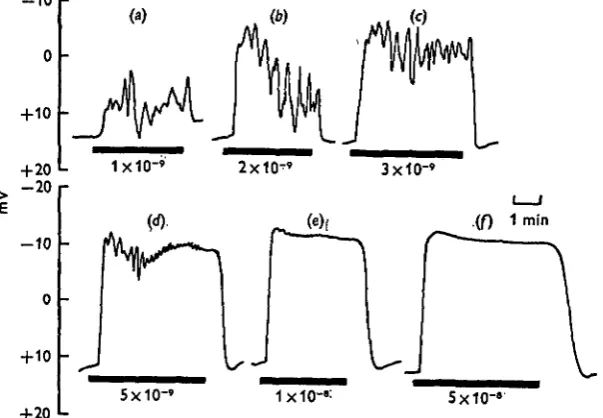
Fig. 6. The potential responses of the gland to different concentrations of 5-HT. The concen-trations of 5-HT are given below the bars, indicating the duration of 5-HT perfusion.
100 r
8.
2
E => E
10-' 10"8 Log 5-HT concentration (M)
10"'
Fig. 7. The log dose-response relationship between 5-HT concentration and the secretory (O) and potential ( 0 ) responses expressed as a percentage of the maximal response to 5-HT.
for potential measurements. The same 5-HT solutions could be used to test both parameters. The change in rate of fluid secretion was expressed as a percentage of the maximum rate and plotted against the log of the 5-HT concentration as described previously (Berridge, 1970).
[image:7.451.114.333.410.559.2]146 M. J. BERRIDGE AND W. T. PRINCE
The effect of different concentrations of 5-HT on the potential across salivary gland™ is illustrated in Fig. 6. At low 5-HT concentrations the responses were very variable. There was the normal initial increase in negativity. However, the potential did not stabilize at a new level as observed previously (Fig. 2), but began to oscillate (Figs. 6 a-c). At these low doses the oscillations were of large amplitude and low frequency. As the concentration of 5-HT increased, the amplitude declined but the frequency in-creased (Fig. 6d, e). At higher doses of 5-HT there were no oscillations and the poten-tial remained at a steady value (Fig. 6/). We have attempted to quantify these results by estimating the area under each response during an arbitrary 2 min period following the addition of 5-HT. The responses were copied on to tracing paper and the relevant area was cut out and weighed. Each response was then expressed as a percentage of the response obtained for a maximal dose of 5-HT and was plotted against the log of the 5-HT concentration for direct comparison with the results obtained from the rate measurements (Fig. 7). The points for rate of secretion and changes in potential lie on the same sigmoid curve. As the secretory and electrical responses are dose-dependent over the same concentration range, these experiments suggest that the electrical events associated with the action of 5-HT are closely linked to the changes in ion flux which must occur during changes in rate of fluid secretion.
The electrical response of isolated salivary glands to cyclic AMP
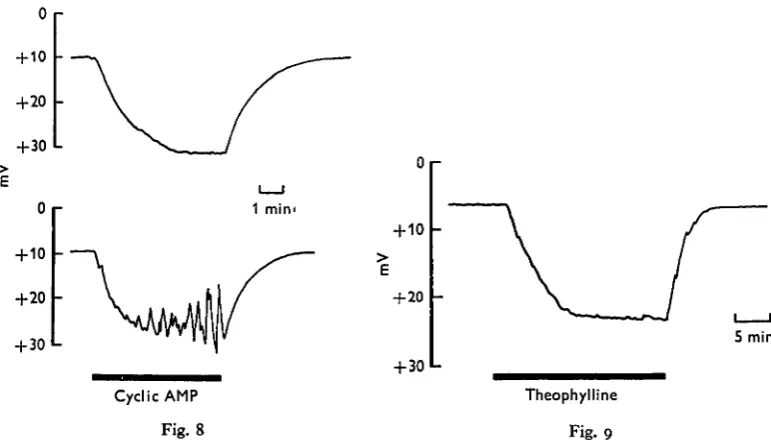
Cyclic AMP can exactly simulate the ability of 5-HT to stimulate fluid secretion (Berridge, 1970). However, the potential response to cyclic AMP was very different to that just described for 5-HT. After applying io~2 M cyclic AMP the luminal potential became more positive instead of going negative (Fig. 8). The increase in positivity had a half-time of 45 sec, which closely resembles the time course for the onset of fluid secretion induced by cyclic AMP (Berridge, 1970). The potential became stabilized at the increased positive potential but approximately half of the glands developed oscilla-tions (Fig. 8).
When cyclic AMP was removed from the perfusion bath the potential returned to the unstimulated level in 1-2 min. The recovery from cyclic AMP had a time course simi-lar to that observed after 5-HT application. 5-HT was capable of completely over-riding the hyperpolarizing effect of cyclic AMP as the addition of 5-HT during the application of cyclic AMP immediately resulted in a large increase in negativity.
The electrical response of isolated salivary glands to theophylline
The methyl xanthine theophylline, which is a potent inhibitor of the enzyme phosphodiesterase which degrades cyclic AMP (Butcher & Sutherland, 1962), can indirectly lead to an increase in cyclic AMP concentration. When salivary glands were perfused with io~2 M theophylline there was no change in potential for 3-5 min but thereafter the potential gradually became more positive and became stabilized after 10-15 m m (Fig- 9)- The potential returned to the unstimulated level 2-3 min after removing theophylline.
>
E
. Transepithelial potential changes in salivary glands 147
* arlier in control saline except that the potential never recovered from the bottom ofthe positive undershoot. When a second short dose of 5-HT was applied, the luminal potential went negative and then returned to the same positive potential. Only when theophylline was removed from the perfusion bath did the potential return to the unstimulated level.
Theophylline is capable of potentiating the secretory response of the gland to 5-HT (Berridge, 1970). The effect of theophylline on the electrical response to a
sub-Or
+10
+20
+30 L
0
+10
+20
+30
«-1 mini
Cyclic AMP
Fig. 8
+ 10
+20
+ 30 L
5 min
Theophylline
Fig. 9
Fig. 8. Transepithelial potential responses to cyclic AMP (io~2 M). The lower trace illustrates the oscillations which developed in approximately half of the glands tested.
Fig. 9. The transepithelial response to theophylline (io~a M) applied for 25 min (horizontal bar).
- 2 0
r-1 min
0.
+10 +20
+ 30 5-HT 1 min
[image:9.451.33.419.158.378.2]Theophylline Fig. 10
Theophylline Fig. 11
Fig. 10. The effect of io~a M theophylline on the transepithelial potential response to io"8 M 5-HT. Theophylline was applied for the duration of the long bar and 5-HT was added for 1 o sec at each short bar.
[image:9.451.59.394.441.589.2]threshold dose of 5-HT was therefore tested. io~10 M 5-HT applied in normal saline produced no effect on the potential, but when applied during treatment with io~2 M theophylline there was a sudden change in potential. Instead of showing the charac-teristic increase in negativity usually associated with the action of 5-HT, the potential went positive (Fig. 11) and displayed oscillations resembling those observed during the action of cyclic AMP. Although 5-HT was perfused for only 1-5 min, the oscil-lations continued for the remainder of the theophylline infusion.
Salivary glands apparently suffer no ill-effects from theophylline because normal 5-HT responses can be induced after the glands have been treated for 30 min with this drug. The effect of theophylline can be immediately reversed by applying 5-HT, and the normal increase in negativity is obtained (Fig. 10).
-20 r
- 1 0
> E
+10
+20 L 1 min
[image:10.451.138.310.219.350.2]5-HT
Fig. 12. The potential response of salivary glands to 5 -HT (long bar) during perfusion with an isethionate saline (chloride-free). During the course of 5-HT perfusion the isethionate saline was briefly (1-5 minutes) replaced with the normal saline containing chloride.
The electrical response to 5-HT in a chloride-free saline
When all the chloride in the medium was replaced with less permeant anions (isethionate and sulphate), the electrical response to 5-HT was opposite in polarity and much slower (half-time of 30 sec) than that in normal saline (cf. Figs. 2, 12). The positive potential was rapidly reversed to give the normal negative potential when isethionate was temporarily replaced with chloride (Fig. 12). During the removal and addition of chloride the very large potential changes were completed in less than 2 sec. When 5-HT was removed from the isethionate perfusion fluid the potential returned to the unstimulated level.
DISCUSSION
t
ature of these effects can be analysed on the basis of the potential changes whichTransepithelial potential changes in salivary glands 149
occur when salivary glands are stimulated with 5-HT or cyclic AMP.During stimulation of secretion the transepithelial potential responses recorded across the gland probably reflect the large net increase in ion flux towards the lumen. The following discussion depends on the assumption that an increase in lumen nega-tivity results from an increase in anion movement whereas an increase in posinega-tivity is caused by an increase in cation movement. 5-HT causes an increase in lumen nega-tivity and may thus increase anion transport. However, when salivary glands are treated with cyclic AMP the lumen becomes positive, which would indicate that cyclic AMP stimulates cation transport. A similar increase in positivity is observed when salivary glands are treated with theophylline, which is also capable of stimulating fluid secre-tion (Berridge, 1970). Theophylline may reduce the breakdown of cyclic AMP by
Blood
M
Cell Lumen [image:11.451.100.334.233.412.2]5-HT
Fig. 13. Diagram illustrating the dual action of 5-HT. Interaction of 5-HT with the cell, pre-sumably at a specific receptor site located on the basal plasma membrane (stippling), leads to a rapid stimulation of both anion and cation transport. The former action is independent of cyclic AMP (c. AMP) whereas stimulation of cation transport involves at least two steps with cyclic AMP as an intermediary. The latter action of 5-HT depends on stimulating the enzyme adenyl cyclase (AC) which synthesizes cyclic AMP from ATP. The subsequent increase in cyclic AMP concentration is then responsible for stimulating cation transport. The role of cyclic AMP in the control of fluid secretion is summarized elsewhere (Berridge, 1970, fig. 14). The cyclic AMP level in the cell can be increased independently of 5-HT by either adding cyclic AMP to the bathing medium or by using theophylline to inhibit its breakdown by the enzyme phosphodi-esterase (PDE). Both these procedures result in an increase in positivity because cyclic AMP will stimulate cation transport in the absence of the 5-HT-dependent stimulation of anion transport.
150 M. J. BERRIDGE AND W. T. PRINCE
that produced by cyclic AMP. When 5-HT was applied for a short 10 sec period 5 biphasic response was produced. The lumen first went negative. Then the potential went rapidly positive and returned slowly to the resting potential. Also, when chloride was replaced by the less permeant anion isethionate the lumen did not go negative on addition of 5-HT but went positive. These results indicate that, when the increase in anion movement is not expressed, the action of 5-HT on cation transport can be seen. It is this action of 5-HT that can be simulated by cyclic AMP and theophylline and may therefore use intracellular cyclic AMP as an intermediate (Fig. 13). Under normal conditions the action of 5-HT on anion movement which causes lumen negativity apparently overrides any potential effect arising from the parallel increase in cation transport. Although there is little doubt that cyclic AMP plays a central role in media-ting the action of many hormones (Robison et al. 1968), these salivary gland studies suggest that hormones may effect certain aspects of cell function without the media-tion of cyclic AMP.
The two actions of 5-HT, which can be distinguished by treating salivary glands with 5-HT in the presence or absence of chloride, have different time courses. The half-time for the increase in positive potential produced by 5-HT in chloride-free saline, which can be interpreted as reflecting the increase in intracellular cyclic AMP concentration, was approximately 30 sec, which is much longer than the time required for the initial negativity produced by 5-HT in normal saline. The different time course for the two actions of 5-HT may explain the lag time which occurs between the rapid increase in negativity (half-time of 5 sec) and the subsequent increase in fluid secretion (half-time of 35 sec). A similar delay has been observed when acetylcholine stimulates fluid secretion in the mammalian pancreas (Hickson, 1970). Careful observations on salivary glands indicate that the delay is not due to the time required to develop sufficient secretion pressure to force fluid out of the lumen because there was no discernible change in the diameter of either the lumen or the whole gland. A much more likely explanation is that the delay is accounted for by the time required to activate the transport processes necessary for fluid secretion. Since the action of 5-HT on anion movement is completed very rapidly, the delay probably depends on the time required to raise the concentration of cyclic AMP sufficiently to activate cation trans-port. It has just been argued that the increase in positive potential produced by 5-HT in a chloride-free saline reflects an increase in cyclic AMP concentration. The half-time for this increase in positive potential was approximately 30 sec, which is very similar to the half-time (35 sec) for the increase in rate of fluid secretion. The half-time for the change in cyclic AMP concentration deduced by this very indirect method is similar to that observed by direct measurements during the action of adrenocorticotropic hormone (ACTH) on the adrenal (Grahame-Smith, Butcher, Ney & Sutherland, 1967), electrical stimulation of brain slices (Kakiuchi, Rail & Mcllwain, 1969) and the action of epinephrine on heart and skeletal muscle (Namm, Mayer & Maltbie, 1968; Lyon & Mayer, 1969).
There-I
bre, as 5-HT leaves the perfusion bath and the negativity starts to decline, cyclicTransepithelial potential changes in salivary glands 151
AMP will begin to stimulate cation transport thus accounting for the sudden and large positive undershoot. The extent of the positive undershoot will depend on the intracellular concentration of cyclic AMP and is thus related to the time of exposure to 5-HT (Fig. 4). During very short exposures to 5-HT there will be enough time to alter anion movement but there will be little activation of adenyl cyclase and hence no increase in the intracellular concentration of cyclic AMP which is necessary to produce the positivity when 5-HT leaves the bath. The slow return to the unstimulated poten-tial during recovery of the positive undershoot may reflect the gradual destruction of cyclic AMP by the phosphodiesterase.The results with theophylline support the hypothesis that 5-HT has two actions in this tissue only one of which is mediated by cyclic AMP. Theophylline inhibits phosphodiesterase in many tissues (Butcher & Sutherland, 1962; Breckenridge, 1970). When applied to salivary glands theophylline causes a gradual increase in positivity which requires 10-15 m m t o reach a maximum (Fig. 9). If theophylline inhibits phosphodiesterase in this tissue the build-up of cyclic AMP within the cell caused by this drug would depend on the resting rate of cyclic AMP synthesis. If the synthesis of cyclic AMP by unstimulated adenyl cyclase is low then the slow change in potential produced by theophylline would be expected. If 5-HT stimulates the synthesis of cyclic AMP then the response to 5-HT applied during theophylline application should show both an acceleration and a prolongation of the cyclic AMP-mediated part of the response. Thus, when io~8 M 5-HT was added for a short time to a gland bathed in io~2 M theophylline the potential went negative as in normal responses but then went rapidly positive and remained at a positive potential (Fig. 10). The theophylline-induced increase in positivity, which normally takes 10-15 m m t 0 develop fully, could thus be developed much faster when the slow turnover of the unstimulated adenyl cyclase was briefly enhanced by 5-HT. There was only slight recovery before theo-phylline was washed off. Theotheo-phylline therefore prolonged the positive undershoot and had no effect on the negative phase of the response. The results support the hypothesis that the action of 5-HT causing positivity uses cyclic AMP as a mediator. In conclusion, our results provide further evidence to implicate cyclic AMP in the sequence of events which occur during the action of many diverse hormones and may also be relevant to current attempts to understand the action of biogenic amines on non-excitable transporting epithelia such as pancreas, mammalian salivary gland and avian salt gland. Stimulation of fluid secretion by 5-HT depends on two distinct actions (Fig. 13). One result of a successful hormone-receptor interaction is an increase in cyclic AMP concentration which then stimulates cation transport. The other action of 5-HT, namely a stimulation of anion movement, can occur independently of cyclic AMP. This action of 5-HT might be mediated by calcium (Prince, 1971). The dual action of 5-HT on salivary glands suggests that hormones may have effects on cells other than those mediated by cyclic AMP.
SUMMARY
1. The role of cyclic AMP in mediating the action of 5-HT on salivary glands has been studied by measuring transepithelial potentials.
after treatment with 5-HT (io~8 M). Both the potential and the secretory responses tS 5-HT are dose-dependent over the same concentration range.
3. The electrical response of salivary glands to cyclic AMP is qualitatively different to that of 5-HT; instead of going negative the potential goes more positive.
4. An increase in positive potential is also observed after treatment with theophylline (io~2 M), or when glands are stimulated with 5-HT in a chloride-free saline.
5. These results are consistent with the idea that 5-HT has two actions. One is to stimulate the enzyme adenyl cyclase to synthesize cyclic AMP, which, in turn, stimu-lates cation transport. The other is to increase anion transport by a mechanism which is independent of cyclic AMP.
We would like to thank Dr P. A. Lawrence for reading the manuscript and Dr A. W. Cuthbert for useful discussions during the course of this work. W. T. Prince was in receipt of an M.R.C. scholarship for training in research methods.
REFERENCES
BERRIDGE, M. J. (1970). The role of 5-hydroxytryptamine and cyclic AMP in the control of fluid secre-tion by isolated salivary glands. J. exp. Biol. 53, 171-86.
BERRIDGE, M. J. & PATEL, N. G. (1968). Insect salivary glands: stimulation of fluid secretion by 5-hydroxytryptamine and adenosine 3',s'-monophosphate. Science, N.Y. 162, 462-3.
BERRIDGE, M. J. & PRINCE, W. T. (1971). The electrical response of isolated salivary glands during stimulation with 5-hydroxytryptamine and cyclic AMP. Phil. Trans. Roy. Soc. Lond. B (in the Press). BRECKENRIDGE, B. M C L . (1970). Cyclic AMP and drug action. A. Rev. Pharmac. 10, 19-34.
BUTCHER, R. W. & SUTHERLAND, E. W. (1962). Adenosine 3',s'-phosphate in biological materials. I. Purification and properties of cyclic 3',s'-nucleotide phosphodiesterase and use of this enzyme to characterize adenosine 3',5'-phosphate in human urine. J. biol. Chem. 237, 1244-50.
GRAHAME-SMITH, D. G., BUTCHER, R. W., NEY, R. L. & SUTHERLAND, E. W. (1967). Adenosine 3',5'-monophosphate as the intracellular mediator of the action of adrenocorticotropic hormone on the adrenal cortex. J. biol. Chem. 242, 5535-41.
GRANTHAM, J. J. & BURG, M. B. (1966). Effect of vasopressin and cyclic AMP on permeability of iso-lated collecting tubules. Am. J. Physiol. 211, 255-9.
HARRIS, J. B. & ALONSO, D. (1965). Stimulation of the gastric mucosa by adenosine-3',5'-monophos-phate. Fedn Proc. 24, 1368-^6.
HICKSON, J. C. D. (1970). The secretion of pancreatic juice in response to stimulation of the vagus nerves in the pig. J. Physiol., Lond. 206, 275-97.
JOHNSON, M., SHERRATT, H. S. A., CASE, R. M. & SCRATCHERD, T. (1970). The effects of secretin, pancreozymin and acetylcholine on the concentration of adenosine 3':s'-cyclic monophosphate in cat pancreas. Biochem. J. 120, 8 P.
KAKIUCHI, S., RALL, T. W. & MCILWAIN, H. (1969). The effect of electrical stimulation upon the accumulation of adenosine 3',s'-phosphate in isolated cerebral tissue. J. Neurochem. 16, 485-91. LYON, J. B. & MAYER, S. E. (1969). Epinephrine induced formation of adenosine 3',5'-monophosphate
in mouse skeletal muscle. Biochem. Biophys. Res. Commun. 34, 459-64.
MADDRELL, S. H. P., PILCHER, D. E. M. & GARDINER, B. O. C. (1971). Pharmacology of the Malpighian tubules of Rhodnius and Carausius: the structure-activity relationship of tryptamine analogues and the role of cyclic AMP. J. exp. Biol. 54, 779-804.
NAMM, D. H., MAYER, S. E. & MALTBIE, M. (1968). The role of potassium and calcium ions in the effect of epinephrine on cardiac cyclic adenosine 3',s'-monophosphate, phosphorylase kinase and phos-phorylase. Mol. Pharmacol. 4, 522-30.
ORLOFF, J. & HANDLER, J. S. (1962). The similarity of effects of vasopressin, 3'-s'-AMP (cyclic AMP) and theophylline on the toad bladder. J. din. Invest. 41, 702-9.
OSCHMAN, J. L. & BERRIDGE, M. J. (1970). Structural and functional aspects of salivary fluid secretion in
Calliphora. Tissue and Cell 2, 281-310.
PRINCE, W. T. (1971). The ionic basis of fluid secretion in the salivary gland of the blowfly. Ph.D. thesis, University of Cambridge.
RAMSAY, J. A. (1954). Active transport of water by the Malpighian tubules of the stick insect, Dixippus
Transepithelial potential changes in salivary glands 153
.OBISON, E. A., BUTCHER, R. W. & SUTHERLAND, E. W. (1968). Cyclic AMP. A. Rev. Biochem. 37, 149-74.
SATTELLB, D . B. (1971). The ionic basis of neuronal function in fresh-water gastropods. Ph.D thesis, University of Cambridge.
SIGGINS, G. R., OLIVER, A. P., HOFFER, B. J. & BLOOM, F. E. (1971). Cyclic adenosine monophosphate
and norepinephrine: effects on transmembrane properties of cerebellar Purkinje cells. Science, N. Y. 171, 192-4.