On the Road to Developing Knowledge
A study on the Effectiveness of Management Development
Programmes
Author
Martien Wierenga (S 0063924)
29th January 2010, Enschede
iii
It has taken me over six years of studying to get where I am today. These years have been amazing. I have met many interesting people and learned a lot about psychology, doing research and also myself. In September 2009 I was eager to start doing my own research project. Little did I know about how difficult it would be sometimes. Despite, or maybe because, of some trying situations I have learned very much on how to perform research, how to write a descent research paper and how to add my own ideas in the mix.
I could not have done this project without the guidance of my main supervisor, Joost Ardts. He came up with the basic idea of this study and had worked on it for over a year when I came along. To introduce me to the subject he invited me to Berenschot in Utrecht. This wonderful trip was fun and very inspiring. During our meetings Joost always managed to help me think of solutions, guide my thoughts and answer all my questions. At the same time he also encouraged me to develop my own point of view. With his input I learned to think more like a researcher.
I would also like to thank my second supervisor, Piety Runhaar, for her sharp comments and critical review of my paper. Her point of view has been very helpful in developing a more logical story and structuring the contents of my theoretical framework.
Additional to the help from my supervisors, there were many people in my private life who have also enabled me to graduate. They have supported me and believed in me, and for this I love you all. Special thanks go to Karin Platenkamp, Janieke van den Berg and Maike van Doorn for their friendship. They gave me love and strength to continue when I needed it the most.
I would also like to thank Robbin Laarman and Janneke Boeije for their thoughts on my research project and correcting my paper. Without them, this report would contain many strange sentences. Last but not least I would also like to thank my parents who have supported me in everything I did, and never doubted my ability to bring it all to a good end.
Martien Wierenga,
v
This study aimed to provide insight into the mechanism that determines the effectivity of management development programmes (MDPs) across industries. After reviewing literature on learning and motivation, the following research question was formulated:
What is the impact of personality characteristics on the outcome measures and how do the MD
characteristics affect this relationship?
This question was divided into three hypotheses by means of the theory of planned behaviour, the social learning theory and the goal setting theory. Both direct relations between characteristics of the participants and the MDP on the outcome measures, as well as a moderator effect of the MD characteristics were hypothesized.
Information on the variables in this study and demographic variables, was obtained by means of a questionnaire. It was distributed within five companies from different industries. Hypotheses were tested using correlational and hierarchical regression analyses.
Two out of three personality characteristics have a positive effect on MD outcomes. Results show that participants who score high on self-efficacy and learning goal orientation, also have higher scores on affective commitment, MD satisfaction, intrinsic MDP benefits and organizational MDP benefits.
vi
Samenvatting
Het doel van dit onderzoek was om meer inzicht te creëren in wat de effectiviteit van ‘management development programmes’ (MDPs) bepaald, onafhankelijk van het bedrijf of de sector waarin het geïmplementeerd is. Aan de hand van literatuur over leren en motivatie is de volgende onderzoeksvraag geformuleerd:
Wat is de impact van persoonskenmerken op de uitkomsten van het programma en wat is de
invloed van MD kenmerken op die relatie?
Aan de hand van de ‘theory of planned behaviour’, de ‘social learning theory’ en de ‘goal setting theory’, is die vraag opgedeeld in drie hypothesen. Er werd een directe positieve relatie tussen persoonskenmerken en de uitkomsten verwacht, evenals een directe positieve relatie tussen MD kenmerken en uitkomsten. Ook werd een modererend effect van MD kenmerken op de relatie tussen persoonskenmerken en uitkomsten verwacht.
Informatie over de variabelen in deze studie en demografische kenmerken is verzameld door middel van een vragenlijst. Deze is verspreid onder deelnemers van MDPs in vijf verschillende bedrijven in vier sectoren. Correlatie analyses en hiërarchische regressie analyses zijn gebruikt om de hypothesen te testen.
Twee van de drie persoonskenmerken bleken een positieve relatie te hebben met de MD uitkomsten. Deelnemers die hoog scoorden op ‘self-efficacy’ en ‘learning goal orientation’ scoorden ook hoog op ‘affective commitment’, ‘MD satisfaction’, ‘intrinsic MDP benefits’ and ‘organizational MDP benefits’.
1
Chapter 1: Introduction
In today’s rapidly changing economy, globalisationand technological advancements have placed a rising emphasis on the development of new and improved products, processes and technology. To stay ahead in this increasingly competitive market, companies have to work hard to adapt to the changing environment and keep their competitiveadvantage. An example of how companies try to cut down on costs and keep efficiency as high as possible is by the movement of production from Europe to countries where wages are several times lower. But these days, low expenses and high productivity are not enough for organizations to stay ahead of the competition. They have to continuously predict and anticipate change, making creativity and innovation to develop products and services indispensable. Utilizing the skills of a workforce has therefore become a major source of competitive advantage (George & Jones, 2008). The resulting quest in Europe and the Netherlands for high-educated workers and talents to participate in the innovative battle has made knowledge an important factor in the new knowledge economy (Kessels, 2004).
Job-relevant knowledge, in terms of individual talents, capacities, skills and expertise (Malhotra, 2000), is often viewed as a resource that can help companies improve their performance and gain profits (George & Jones, 2008). It is of great importance for keeping performances high and it determines the ability of an organization to adapt to changing circumstances (Collins & Holton, 2004). In economic terms, application of knowledge in the workplace adds more value to products than traditional resources, like funds, primary products or working hours. A leading position in the current market therefore depends on the organizations’ ability to attract, generate, integrate and utilize valuable competences (Kessels, 2004). Knowledge lies within human beings, so workers within the organization are one of its’ main resources. Venkatraman and Subramaniam (2002) underline this important fact: they suppose a significant and direct relationship between the combined talents of employees and organizational performance.
On the Road to Developing Knowledge Chapter 1: Introduction
2
can rely on timely availability of qualified and motivated employees’ is what Jansen, VandeVelde and Mul (2001, p.106) call a management development programme. This way companies try to develop and manage knowledge in order to maintain and increase knowledge productivity. Training is defined by Aguinis and Kraiger (2009) as: ‘the systematic approach to affecting individuals’ knowledge, skills, and attitudes in order to improve individual, team and organizational effectiveness’. It can be implemented as part of a MDP and in this study the term training will be used as an example of a component of the programme.
Annually companies spend significant amounts of money on the development of workers, in the hopes of reaching a long term competitive advantage as a result of their investment (Alam, Gale, Brown & Kidd, 2008; Anquinis & Kraiger, 2009). Reasons for this investment are the many advantages associated with training programmes: they are supposed to increase productivity, can be used as a method of informing new employees about organizational priorities, goals and values (Arthur, Bennett, Edens & Bell, 2003) and can reduce expensive employee behaviour like turnover and absenteeism (Maurer Weiss & Barbeite, 2003). Even though this may sound wonderful, in many organizations the decision to implement a MDP is still a leap of faith: the return on investment (ROI) in terms of financial criteria is difficult to determine. This could be an important reason why top managers do not take the programmes as seriously as they probably should (Alam et al., 2008).
The current economic crisis has increased the need for organizations to cut back on expenses to make ends meet. As a consequence, one of the first things companies cut back on is their educational budget (Crisis is het moment om te investering in opleidingen, n.d.). ‘Training for its own sake’ is contrary to today’s business goals (Aguinis & Kraiger, 2009), so if a training programme is not demonstrably proven effective, it might be wise to stop pouring money into it. But will cutting back on educational expenses in difficult times not be counterproductive when development programmes do what they are designed to do, namely improve the expertise of a workforce (Crisis is het moment om te investering in opleidingen, n.d.).
3
Previous Research
A bulk of research can be found on training effectiveness (Collins & Holton, 2004; Haccoun & Saks, 1998). Aguinis and Kraiger (2009) for example performed a meta-analysis of an extensive amount of literature on the subject and found training, or development, has a positive impact on individual and team performance, in terms of relevant job behaviours, attitudes, motivation and empowerment. Training is an established method for enhancing the productivity of employees and to socialize new personnel (Arthur et al., 2003). Also employees can benefit from training, for example in terms of their career advancement (Blau et al., 2007).
Training evaluation studies have traditionally focussed on the changes observed in employees’ on-the-job-behaviour, and whether these changes could be ascribed to the training experience (Collins & Holton, 2004; Haccoun & Saks, 1998). Some of these studies were done in laboratory settings and focus their attention on just one specific type of training. This makes training effectiveness depend on the training delivery method and task or skill being trained (Aguinis & Kraiger, 2009). In organizations it is common to first do a needs assessment to see what knowledge and skills need to be developed for a group of employees to perform better. Needs assessments form the basis for developing or choosing the training and also for its’ evaluation. To see whether a specific training was useful, needs assessment is a good evaluation method (Spector, 2003). However, when one is interested in what makes MDPs involving different trainings for different groups in different organizations more or less effective, a problem arises. First of all there is a problem of generalisability of evaluation results. For example, a high score on independence might be good after training focussed on autonomy, but not so good after training aimed at developing cooperative behaviour. Second, by using training goals as evaluation criteria, no knowledge is gained on the underlying process responsible for making the training a success.
On the Road to Developing Knowledge Chapter 1: Introduction
4
should be a consequence of training, and thus the learning goals to be achieved in training, are not the same for every job or organization. Kirkpatricks model offers no solution for this problem of how results of training evaluation could be translated to other settings. So for each programme a specific evaluation will have to be designed to assess its specific goals, which is cost-ineffective and makes it difficult to compare programmes and trainings. Tracey et al. (2001) additionally mention the knowledge acquisition process, to which little research has paid attention and which is oversimplified by Kirkpatrick. In his approach, knowledge acquisition is measured as changes in verbal knowledge, but the actual learning process is not assessed.
Even though workplace expertise is crucial for organizations to maximizing performance and adapt effectively to changes in the business world, knowledge on the nature of the process that makes employees experts, often remains unclear (Arthur et al., 2003; Tracey et al., 2001). To help clarify the issue and to provide points of support on how to study the effectiveness of MDPs, a discussion of literature on learning and motivation to learn will follow.
Participant learning and motivation
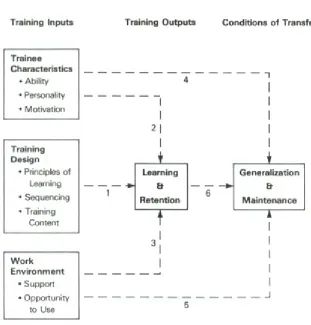
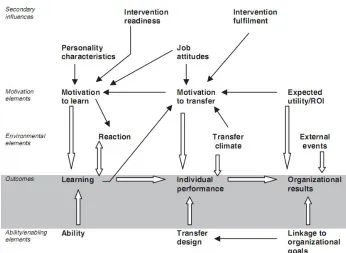
Common to all MDPs is the fact that participants are supposed to learn knowledge or skills that, for example, will allow them to perform better at their job or prepare them for a new assignment. ‘The application, generalisability and maintenance of newly-learned knowledge and skills’ is what Coetsee and Eiselen (2006, p. 56) refer to as transfer of learning.It is one of the key aspects in establishing a learning organization, enabling organizations to make use of the skills and knowledge learned by workers during training (Coetsee & Eiselen, 2006). A large number of factors have been found to influence learning transfer in organizational settings. Baldwin and Ford (1988) for example developed a model on transfer of training, similar to the concept of learning transfer (Coetsee & Eiselen, 2006), in Appendix A, indicating that learning and subsequent transfer is determined by a combination of individual and environmental characteristics. Holton, Bates and Ruona (2000) also developed a model on the learning transfer system, which incorporates four important mechanisms of the learning transfer process. At the centre of this model is the motivational level, as can be seen in Appendix B.
5
learning settings; you cannot be smart unless you want to be smart (Kessels, 2004). Training motivation is defined by Colquitt, LePine and Noe (2000, p. 678) as ‘the direction, intensity and persistence of learning-directed behaviour in training contexts’ is defined as training motivation’. It determines the direction, focus and level of effort a trainee invests in participating in a training programme (Wiethoff, 2004). Their ‘desire to use the knowledge and skills mastered in the training programme on the job’ (p. 125) is what Gegenfurtner et al. (2009) call transfer motivation. Remarkably little research has pursued a complete understanding of what factors influence peoples’ involvement in learning and development activities in a work setting (Colquitt et al., 2000; Maurer, Weiss & Barbeite, 2003).
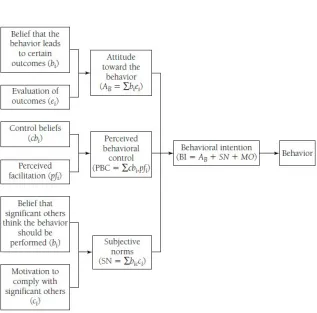
One theory concerning motivation to take action and determinants to learn is the Theory of Planned Behaviour (TPB), explained in more detail in Chapter Two. It places great emphasis on the person x situation interaction in predicting motivation and behaviour, as can be seen in Appendix C. Gegenfurtner et al. (2009) apply the TPB to HRD and training settings. They believe that someone’s attitudes toward a training programme predict their transfer motivation. In their study they provide empirical support for that hypothesis, underscoring the usefulness of the TPB to training settings. Because trainings are implemented as part of a MDP, the results are also of interest to this study. More attention will be paid to this and two other motivational theories in Chapter Two.
On the Road to Developing Knowledge Chapter 1: Introduction
6
Current Study
Motivation is predicted by individual and situational factors (Ajzen, 1988, 1991). It will be included indirectly in this study (see also Chapter Two) because the focus here lies with (a) the participant of the MDP and (b) the environment they find themselves in, in predicting the effectiveness of MDPs.
The participant
Motivation to learn is to a large extent caused by attitudes internal to a person (Connor & Norman, 2005; Gegenfurtner et al., 2009). In research on training and organizational performance individual factors have been included to assess training motivation and outcomes (Seibert, Kraimer & Crant, 2001; Tracey et al., 2009). By far, self-efficacy and perceived control are the most studied (Haccoun & Saks, 1998). An example is the study done by Maurer et al. (2003) on involvement in work-related learning and development. They found that a person who is positively oriented towards employee development, beliefs in his own capability to participate (scores high on self-efficacy). This self-efficacy belief is related to attitudes and intentions to participate, thus increasing the likelihood that someone will participate. Another approach to individual differences is when Kirkpatricks’ model is used to evaluate trainings. In those studies self-efficacy is often included as an attitudinal outcome measure (Haccoun & Saks, 1998).
Colquitt et al. (2000) found that personality characteristics have a subordinate role in the literature on training evaluation. They also report recommendations of other researchers on a need to study the different influences predictive personality characteristics can have on individual learning and behaviour in training settings. So in line with this previous research on the influence of a person on learning transfer and motivation, this study will therefore include several personality characteristics of participants of MDPs. Specifically, this study will take a look at participants’ attitudes in learning situations and what this means for the effectiveness of MDPs.
The environment
7
interest here. To determine what influences the effectiveness of MDPs, it is important to find a way to differentiate between relevant characteristics of the programmes. In previous research, features like the type of skill or knowledge being trained or the training delivery method, are often used to make a distinction between programmes (Aguinis & Kraiger, 2009). For example, in their meta-analysis Aguinis and Kraiger (2009) mention a study by Linou and Kontogiannis (2004) in which they compared the performance of groups receiving (a) either high-level or low-level information and (b) theoretical or diagnostic training. However, in the current study the content of the programme cannot be used as a characteristic of the MDP since it does not allow for the direct comparison of different programmes in different organizations. What is needed are features of programmes that are always present, independent of its design.
Common to all programmes is their most basic goal: to teach workers knowledge or skills. In order to reach that goal the learning environment (the programme) should support the learning process (Kessels, 2004). For example, available rolemodels will shape participants’ behavioural expectations, which in turn influence behavioural intentions and probably subsequent behaviour (Schifter & Ajzen, 1985; Bandura, 1977b). So rather than focussing on the content of the programme, this study will assess features of the MDP that have an influence on the learning process of participants.
Evaluation criteria
The final piece of the puzzle in determining the effectiveness of MDPs are the outcomes used for evaluation. When can a MDP be called effective? Aguinis and Kraiger (2009) as well as Arthur et al. (2003) found that the benefits of training varied depending on the evaluation and the training method used, as well as on the type of skills being trained. The programme would be judged as effective when participants’ scores on those specific skills were increased. But for a study on the effectiveness of management development programmes in general, effectiveness should be assessed by using criteria independent from training content (Collins & Holton, 2004). After all, a training aimed at improving organizational citizenship behaviour will concentrate on different skills than a leadership development programme. Their evaluation criteria would therefore also differ, making it impossible to compare their results.
On the Road to Developing Knowledge Chapter 1: Introduction
8
impossible to accurately calculate a ROI when it comes to MDPs. Collins and Holton (2004, p.219) describe organizational performance as: ‘the effectiveness of an organization in achieving outcomes as identified by its strategic goals or the realization of a return of investment’. This definition provides the open door which is needed to state that performance of an organization involves more than just realizing ROI. Therefore in this study the effectiveness of MDPs will be judged on other criteria that have proven to affect organizational performance. This way the effectiveness of the programmes will be based on their usefulness for the company, without the need to measure ROI.
Research Question & Summary
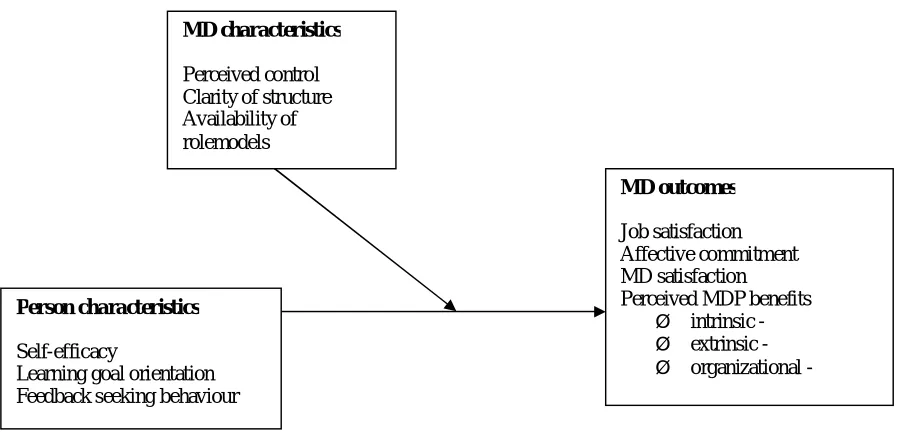
Combining theory on learning and motivational transfer, it has become clear that the interaction between a person and his or her environment is of importance when looking at the effectiveness of a MDP. Chapter Two will continue discussing this interaction. This study’s first goal is to provide more insight into the black-box that exists in the literature today on the process that determines the effectiveness of MDPs. The research model used in this study (Figure 1) summarizes the framework used to gain insight into that process.
Literature indicates that companies take MDPs for granted and rarely evaluate their effect (Collins & Holton, 2004). The second aim of the present study is therefore to provide a framework that can be used to assess the effectiveness of different MDPs. Advantages are twofold: the costs of evaluation will be less high and it will provide a basis for comparing different programmes, even across industries.
The research question the current study will answer is:
What is the impact of personality characteristics on the outcome measures and how do the
management development (MD) characteristics affect this relationship?
9
Figure 1: Summary
Outline
Chapter Two will provide a more extensive overview of existing research, forming the rationale for choosing the variables in this study based on three theories on learning and motivation, finally formulating three hypotheses. In Chapter Three information about the research sample and method, applied data analyses methods and the questionnaire can be found. Chapter Four outlines the results and finally in Chapter Five the meaning of the results for this study and the HRD practice will be explained, followed by suggestions for further research.
Chapter 2: Theoretical Framework
By discussing the TPB, the Social Learning Theory (SLT) and the Goal Setting Theory (GST), it will become clear which constructs are relevant for the current study and thus will be included as participant characteristics, MD characteristics or outcome variables. Research on the connection between those variables will lead to three hypotheses and the subsequent research model used in this study.
MD outcomes
Job satisfaction Affective commitment MD satisfaction
Perceived MDP benefits
Ø intrinsic -
Ø extrinsic -
Ø organizational -
Person characteristics
Self-efficacy
Learning goal orientation Feedback seeking behaviour
MD characteristics
On the Road to Developing Knowledge Chapter 2: Theoretical Framework
10
Theory of Planned Behaviour
The TPB is designed to predict human behaviour in a variety of contexts. It states that behaviour is the direct result of people’s intentions to perform behaviour. Behavioural intentions in turn, are determined by three motivational factors: attitudes, subjective norms and perceived behavioural control (Ajzen, 1988, 1991). Attitudes are formed by a person’s evaluation of the outcomes of behaviour (Schifter & Ajzen, 1985). Take for example exercise, which can be viewed in either positive (get healthy) or negative (get tired) terms, depending on the individual. Someone who evaluates exercise in terms of its’ positive outcomes will more likely have the intention to exercise than someone who expects negative outcomes. Their attitudes toward the behaviour differ, resulting in different behavioural intentions. Subjective norm refers to the perceived social pressure to perform behaviour (Schifter & Ajzen, 1985). Perceived behavioural control describes the opportunities and obstacles an individual faces in performing behaviour (Wiethoff, 2004). The theory states that the more favourable attitudes someone has towards a behaviour are, combined with more favourable subjective norms and greater perceived control, the stronger behavioural intentions will be. These three motivational factors are all inherent to the individual. By adding actual control to the model, the environment is also included as a determinant of behaviour (Connor & Norman, 2005). Together, perceived behavioural control and intentions are the main predictors of behaviour. Depending on the actual control people have in a given situation, it is not necessary to measure both perceived behavioural control and intentions (Ajzen, 1991).
Factors in the environment determine individuals’ control beliefs: individuals’ perception of factors likely to influence their performance. These beliefs in turn determine someone’s perceived behavioural control (Connor & Norman, 2005). Wiethoff (2004) interprets Ajzen’s (1991) definition of perceived behavioural control as ‘one’s perception of the ease or difficulty of performing a behaviour and it is often used as a substitute to measuring actual control (Ajzen, 1991). Translating this to the current study, perceived control can be included to measure the amount of control that participants perceive to have over the content of their programme. Therefore it will be included as a characteristic of the environment.
11
This indicates it is useful for participants to have information on the contents of the programme. A MDP usually consists of several elements, for example the opportunity to participate additional courses after completing a beginners’ course. Knowledge about this structure might allow participants to see opportunities and possible resources that otherwise would be hidden to them. Therefore, clarity of structure of the programme will also be included as a characteristic of the environment.
The TPB and the SLT appear to have common ground. For example, useful information about the MDP might also come from others in the environment, a notion which will be elaborated in discussing Bandura’s (1977b) SLT. Also, the concept of perceived behavioural control is very compatible with perceived self-efficacy in the social cognitive theory and SLT (Ajzen, 1991). Even the connection between motivational factors and perceived control in the TPB, and the relation between outcome expectations and self-efficacy in the SLT, are very much alike (Schifter & Ajzen, 1985). Therefore the additional value of SLT for the present study will be explained next.
Social Learning Theory
On the Road to Developing Knowledge Chapter 2: Theoretical Framework
12
Through the process of social comparison, others in the environment are selected to serve as rolemodels for one’s own behaviour. Seeing this role model behave in a certain manner and experience certain consequences, will lead individuals to expect the same consequences when they would do the same (Bandura, 1977b). This way, social modelling not only enables people to learn without trial and error, it also motivates them through behavioural outcome expectations (Connor & Norman, 2005). Later research supports this mechanism (Hurtz & Williams, 2009). Hurtz and Williams (2009) for example found that significant others can influence people to participate in development activities. Translating this mechanism to the present study, the availability of rolemodels in the learning environment will be included as an environmental (i.e. MDP) characteristic.
The second factor that determines motivation to perform behaviour in the SLT is self-efficacy. Bandura (1977a, p. 193) describes perceived self-efficacy as ‘the conviction that one can successfully execute the behaviour required to produce the outcomes’. It is concerned not with the skills one has, but with judgments of what one can do with whatever skills one possesses. Perceived self-efficacy can be seen as a personal sense of control over the environment: people with high self-efficacy believe their actions will have an effect, which gives them the ability to exert control over life-events (Connor & Norman, 2005). By this definition it corresponds to the notion of perceived control in the TPB, however, here the focus lies within the individual and not the environment. Since Bandura (1977a) introduced the term, it has become one of the central constructs in psychological and HRD research and appears to be a determinant in predicting both motivation to learn and training outcomes (Colquitt et al., 2000). Therefore, and because of its’ association with perceived control, self-efficacy will be included as a characteristic of the participant in the current study.
13
Goal Setting Theory
Goal-setting theory (GST) concentrates on the issue of how to motivate people to do their best. Just asking them to do so does not produce an increase in effort, so what does? GST provides an explanation in stating that goals affect motivation by means of four mechanisms: (a) directing attention, (b) energizing people, (c) increasing level of persistence and (d) indirectly affecting people’s task-relevant actions (Locke, 1981; Locke & Latham, 2002). Goals are the objects or aims of an action. It is what the individual wants to accomplish, they serve as self-incentives and guides to behaviour (Bandura, 1977b).
According to VandeWalle and Cummings (1997) as well as Locke and Latham (2002), people can have either a performance goal orientation or a learning goal orientation in achievement settings. Having a learning goal orientation means having ‘the tendency to develop competences by acquiring new skills and mastering new situations’ (VandeWalle & Cummings, 1997 p. 391), which indicates high levels of motivation to learn (Colquitt et al., 2000). It is considered to be a trait inherent to individuals, and it has an impact on how someone approaches achievement situations (VandeWalle & Cummings, 1997). Because of the effect of learning goal orientation of individuals on motivation and performance in learning settings it will be included in this study as a characteristic of the participant.
On the Road to Developing Knowledge Chapter 2: Theoretical Framework
14
Therefore, feedback seeking behaviour will also be included as a characteristic of participants in the MDP.
MD Outcomes
Why the effectiveness of MDPs should be assessed by variables related to organizational performance was discussed in Chapter One. Predictors and to be predicted variables should be compatible (Ajzen, 1991), so since all independent variables in this study are attitudinal variables, the evaluation criteria for the programmes should be as well. Job satisfaction, affective commitment, MD satisfaction and MD benefits (intrinsic, extrinsic and organizational) satisfy both conditions and will therefore be the outcome measures used in this study.
Job satisfaction
Individuals spend a lot of time at work and have a great variety of experiences in that setting. As such, an employee has an emotional reaction towards different aspects of the work environment. Job satisfaction is an indicator of the extent to which an individual enjoys his/her job (Pool & Pool, 2006). High job satisfaction among employees is negatively related to undesirable organizational outcomes like for example turnover (Lambert, Hogan & Barton, 2001; Pool & Pool, 2006). The work environment is an important influence on the job satisfaction of employees (Lambert et al., 2001), and MDPs are part of the work environment, so translated to the current study it can be reasoned that job satisfaction will also be determined by MD characteristics. Because it is determined by the environment as well as the individual and also its relation to organizational outcomes (George & Jones, 2008), job satisfaction will be included as an outcome measure.
Affective commitment
15
(Colquitt et al., 2000; Ellemers, DeGilder & VandenHeuvel, 1998). Characteristics of the organization strongly influence what kind of people will become committed to it. Socially responsible employees will be more likely to become committed to an organization that shares their responsible norms and values. Also, the organization should be committed to the employee as well (George & Jones, 2008). The degree of commitment an individual feels is seen as the link between them and the employing organization: a certain level of commitment is needed for employees to stay with the company. Research has proven it to have significant diminishing effects on turnover rates and absenteeism (Allen & Meyer, 1990; Ellemers et al., 1998; Vandenberghe, Bentein & Stinglhamber, 2004), and it has an indirect positive impact on job~ and organizational performance (Vandenberghe et al., 2004). People who feel attached to the organization might for example voluntarily increase their work effort in order to reach organizational goals (Ellemers et al., 1998). So commitment is determined by the combination of individual and organizational characteristics, and it has an indirect relation to organizational performance. Therefore it will be included as an outcome measure in this study.
MD satisfaction
A direct answer on of how a participant values the programme overall, is useful information. Research indicates that a positive relation exists between satisfaction with instructional methods and motivations for training transfer. Since employees’ motivation to transfer training is a determinant of the MD effectiveness (Gegenfurtner et al., 2009), MD satisfaction will be included as an outcome measure.
Perceived MDP benefits
Participants invest time and energy in a programme so they probably expect to benefit from it in some way. Their perceptions of the benefits of the programme are therefore included as outcome measures in this study. Three categories of benefits will be included:
- Intrinsic benefits: involve personal benefits, important to the worker, like joy in the work one performs or discovering the boundaries of one’s capabilities.
On the Road to Developing Knowledge Chapter 2: Theoretical Framework
16
- Organizational level benefits: involves benefits any-one except the participant (the organization, peers, subordinates and supervisors) receives from the programme (Maurer, Lippstreu & Judge, 2008).
Person Characteristics
Several constructs, inherent to the individual, were proven to be relevant behavioural elements in educational settings. Self-efficacy, feedback seeking behaviour and learning goal orientation will therefore be included in the current study to characterize the participants. An elaboration on these variables will provide the rationale for the first hypothesis.
Self-efficacy
17
Learning goal orientation
Locke (2002) states that goals affect the direction, duration and intensity of actions. Individuals with a learning goal orientation believe that effort will lead to success (VandeWalle & Cummings, 1997) and that they can improve their abilities by putting in more effort. It also indicates a positive attitude to having new experiences (Brett & VandeWalle, 1999). So when a person who scores high on learning goal orientation finds him/herself in an achievement situation, he/she will make an effort, have a solution-oriented attitude, persists in the face of obstacles, will actively attempt to improve and learn, and will enjoy the challenge (Kessels, 2004; VandeWalle & Cummings, 1997). Research indicates that learning goal orientation has a positive effect on outcomes in achievement situations, like for example satisfaction (Aguinis & Kraiger, 2009; VandeWalle, Cron & Slocum Jr., 2001) and performance (Locke & Latham, 2002). In the context of the current study, similar results are expected to be found.
Feedback seeking behaviour
In a rich learning environment, the social context can function as support for participants. It has been shown that employees who actively participate in improving processes become committed and feel responsible (Howell, 2001). For work related learning this implies that participants who actively participate in the learning process will start to feel responsible for improving that process. Feedback can enhance an individuals’ understanding of how others evaluate their behaviour (Ashford, 1986). This way it can serve as a guide to choosing the right performance strategies and as a motive to increase performance (Ashford & Tsui, 1991). It is a necessary resource for individuals to be able to achieve goals (VandeWalle & Cummings, 1997) and for learning to occur (VanWoerkom, 2003). Seeking feedback from others will improve your learning productivity (Kessels, 2004). Therefore, feedback seeking behaviour will be included in the present study as a characteristic of the participant. It is expected that participants who actively seek feedback improve their learning, which should lead to higher MD benefits. The initial active attitude of the participant will probably be reflected in higher affective commitment and job as well as MD satisfaction.
On the Road to Developing Knowledge Chapter 2: Theoretical Framework
18
Hypothesis 1: Participant characteristics are positively related to the outcome measures
MD characteristics
As stated in the introduction, in order to apply the results of this study to more than one MDP it is important to use variables that can be found and measured in most MDPs and are relevant to behaviour in learning situations. Reviewing the TPB, SLT and GST, three important characteristics of the learning environment emerged as relevant to the current study: clarity of structure, perceived control and availability of rolemodels.
Perceived control
The relevance of perceived control for individuals in learning situations was explained in the review on the TPB. The concept of control in a MDP will become clear by taking the typology of Jansen et al. (2001) into account. According to them, the goals and objectives of MD are twofold. On one hand ‘the aim of MD is to look after the interests of the organization’ (Jansen et al., 2001, p.107) by filling in key positions for example. This point of view, which is termed organizational development (OD) is closely linked to the organizational strategy. In this case the individual participant must settle for what is best for the organization. On the other hand, MD can also have a strong individual orientation, which the authors have named personnel development (PD). Strong emphasis on PD means that the organization pays a lot of attention to the personal growth and development of participants of the MDP, giving them control over the content of the programme. Combining this framework with the TPB (Ajzen, 1991) it can be argued that when individuals are allowed to exert control over their own MDP they will be more motivated to exert effort. Participants might even view their freedom to determine part of their own development as a sign of confidence from their employer, which might enhance their commitment to the organization for example. Therefore high perceived control is expected to have a positive relation to the outcome measures used in this study.
Clarity of structure
19
a study performed by Benson, Finegold and Mohrman (2004) where they describe a human resource management (HRM) system as it ideally should be designed. The most important factor is the existence of a logical structure within the HRM system. All aspects concerning employee management should be aligned to yield maximal results from the implemented practices. Research done by Ardts (2002) substantiates the idea that clarity of structure is important, by pointing towards the importance and benefits of a logical learning sequence as experienced by newly hired employees. MDPs can be viewed as part of HRM practices, but as stated in the definition in Chapter one, MDPs are also systems of personnel practises themselves. Only MDPs focus solely on the development and training of employees. They usually consist of more than one course or training and therefore it can be reasoned that a logical structure within a MDP might be a factor of influence on its results, just like Benson et al. (2004) claim is the case within HRM systems. So the structure of a learning experience should be logical and succeeding courses should have a clear common purpose to reach maximum effect. A distinct MDP structure will be beneficial because it makes sense to workers: they know what they are doing and why. Most importantly, participants should know of this structure. Otherwise they lack knowledge to build expectations. Therefore clarity of structure of the MDP for its’ participants should lead to positive effects in terms of MDP outcomes.
Availability of rolemodels
On the Road to Developing Knowledge Chapter 2: Theoretical Framework
20
traditional view of the construct (Gibson, 2004) which makes the results from Hegstad and Wentling (2004) useful for the current study. Other people to learn from, to be inspired by and to guide employees in the development of knowledge, skills and values might be of significant influence on their learning experience. An environment which supports learning and performance should clearly benefit from the presence of rolemodels. Therefore it is expected to have a positive relation with the outcomes measures used in this study.
The MD characteristics included in this study probably have a positive effect on learning and outcomes. Therefore, the second hypothesis is:
Hypothesis 2: MD characteristics are positively related to outcome measures
Person x Situation Interaction
As explained in Chapter One, the interaction between a person and his/her environment is of central importance in a learning context. Researchers have stressed the significance of this relation and recommend that additional research is needed (Colquitt et al., 2000). Aguinis and Kraiger (2009) for example, mention several studies and meta-analyses on learning transfer and the effectiveness of development activities, that have found indicators of potential moderators. They recommend additional research should be done on the effects of moderators in development settings. Earlier research done by Colquitt et al. (2000) also suggests the existence of moderators, but finding out what the moderators could be did not lie within the scope of their research.
Combining the probably positive influence of the MD characteristics included in this study on the outcome measures, with the recommendations and results of Aguinis and Kraiger (2009) and Colquitt et al. (2000), a moderating effect of the MD characteristics is expected in the current study. This interpretation of the person x situation interaction in learning environments leads to the third and final hypothesis:
Hypothesis 3: MD characteristics strengthen the relation between personality characteristics
21
Chapter 3: Method
In this Chapter an overview of the research design will be provided, followed by an elaboration of the structure of the questionnaire and concluded by an explanation of the data analyses methods used.
Research design
This is a quantitative study with a cross-sectional survey design. The research sample used consists of respondents who were recruited from five companies in four lines of business: transport, steel, finance and a temp-agency. All respondents were participants in a MDP at the time data was collected. The survey was administered once within each company.
Participants
384 Questionnaires were dispersed, of which 223 (58%) were returned and could be used in this study. The age of participants varied between 23 to 59 years, with an average of 36 years. 65.2% Of the respondents were male. The majority of participants reported to have a university degree (62%) or a higher vocational degree (29%) and were working in middle management (50.3%). 20.3% Occupied a lower management position and also 20.3% worked in higher management, 9.2% indicated to have another management position. On average, participants were working at the company for 7.1 years (sd = 5), of which they spend 2.3 years in their current position (sd = 1.3).
Procedure
On the Road to Developing Knowledge Chapter 3: Method
22 Questionnaire
The questionnaire used to measure all constructs which were chosen in Chapter Two as well as several demographic variables, was constructed mostly from existing scales which were occasionally modified for use in the context of MDPs. Unless otherwise indicated, all items were scored by a five- point Likert scale, ranging from ‘strongly disagree’ (1) to ‘strongly agree’ (5).
Part 1- Person characteristics
The first part of the questionnaire consisted of 34 items measuring self-efficacy and learning goal orientation. Feedback seeking behaviour was included in the MD characteristics section of the questionnaire, reported in the next paragraph.
Self-efficacy was measured by five items derived from Maurer & Tarulli (1994). An example of an item is: ‘I could succeed and learn as well as the next person in a class designed to improve skills’. For part of the sample, these items were translated into Dutch. The Cronbach alpha coefficient (α) is .70.
Learning goal orientation measures participants’ desire to exert extra effort in a learning situation in order to increase their knowledge and skill. It was measured by six items derived from VandeWalle and Cummings (1997). An example of an item is: ‘I often look for opportunities to develop new skills and knowledge’ (αCronbach = .75).
Part 2 - MD characteristics
This second part includes 17 items, measuring clarity of structure, availability of rolemodels, perceived control and feedback seeking behaviour.
Clarity of structure was measured using a scale developed by Ardts (2002) to assess the extent to which new hires experienced their socialisation process as a clear sequence of learning experiences. An example of an item is: “The MD-activities within my organization do not constitute a clear sequence of learning activities”. Originally the scale consisted of six items, but factor analyses found two factors. One item, which also correlated poorly with the other five, was therefore excluded from the scale. The final scale consists of five items and is very reliable (αCronbach = .79).
23
one's own programme’. Originally the scale consisted of eight items and had a Cronbach alpha coefficient of .63. Factor analyses showed three separate factors and two items which did not seem to fit the scale. Deleting these items resulted in a αCronbach of .65 and one factor.
Rolemodels was measured by a single item: “Through the MD-programme, there are many opportunities to learn from others”. There is no evidence of an appropriate scale to measure the availability of rolemodels in existing literature, but as for example job satisfaction shows (Wanous, Reichers & Hudy, 1997; Dolbier, Webster, McCalister, Mallon & Steinhardt, 2005),one item can be successfully used as a scale.
Feedback seeking was measured by three items which were rated on a deviating five-point Likert scale (never; 1-3; 4-5; 6-7; 8 or more times). An example of an item is: ‘Asked for feedback from my supervisor’ (αCronbach= .83).
Part 3 - Outcome measures
The third part of the questionnaire contains the dependent variables used to assess the effectiveness of the programmes. In total 18 items measure job satisfaction, MD satisfaction, affective commitment and MD benefits.
Job satisfaction was assessed using one item: ‘In general, I am satisfied with my current job’. It is derived from Hackman & Oldham (1976) and previous studies have proven its validity (Wanous et al., 1997; Dolbier et al., 2005).
MD satisfaction was also measured using a single-item: ‘In general, I am satisfied with the management development programme I am part of’. This item is a reformulation of the valid single-item used to measure job satisfaction.
Affective commitment was assessed by five items originally developed by Allen and Meyer (1990; 1996), and translated to Dutch by Gilder, Van den Heuvel, and Ellemers (1997). It measures the emotional attachment of participants to their employing organization. An example of an item is: ‘I feel a sense of belonging to this organization’(αCronbach = .81).
On the Road to Developing Knowledge Chapter 3: Method
24
getting promotion to higher level jobs with better pay and reward’. For intrinsic benefits αCronbach
= .70, for extrinsic benefits αCronbach = .80, for organizational benefits αCronbach = 0.66.
Part 4 - Personal data
The questionnaire also includes items on biographic, background and other demographic information. Included as control variables are: organization, gender (1=male, 2=female), age (years), educational level (1=lower vocational, 2=higher vocational, 3=university, 4=other), and tenure with the organization (computed for amount of years and months).
Data analyses
First all items were checked to see if a high score on an item correspond to a high score on the underlying construct. Three items in the scale measuring clarity of structure, one item in the self-efficacy scale, one in the intrinsic MDP benefits scale and one in the extrinsic MDP benefits scale, were all negatively formulated with respect to the other items. These were recoded. Next the data was first for outliers. A few type errors and erroneous data were detected and replaced by values for missing data. Confirmatory factor analysis was performed to check if the intended scales could be constructed from the items. Also, reliability analysis was performed by calculating Cronbach alpha for each scale. Factor analyses combined with reliability analyses resulted in exclusion of one item on clarity of structure and two items belonging to perceived control. After this, the final scales were constructed by summarizing the items.
25
Chapter 4: Results
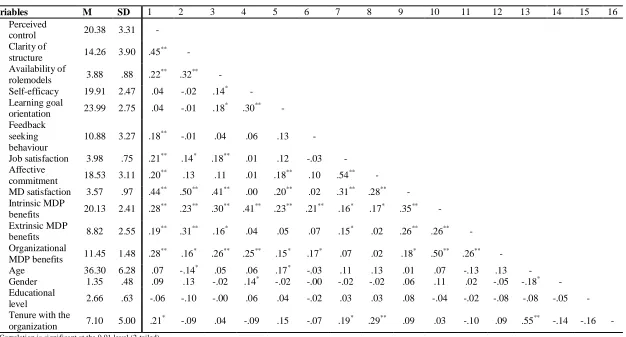
Results of the statistical analyses used to test for all three hypotheses are summarized in several tables. In order to improve readability of this report, the tables are included in Appendix D. Table 1 summarizes means and standard deviations, as well as correlations between all variables used in this study. This data is used to illustrate associations between the variables. For the regression analyses, results are reported by outcome variable. The regression analyses tests for moderator effects.
On the Road to Developing Knowledge Chapter 4: Results
26
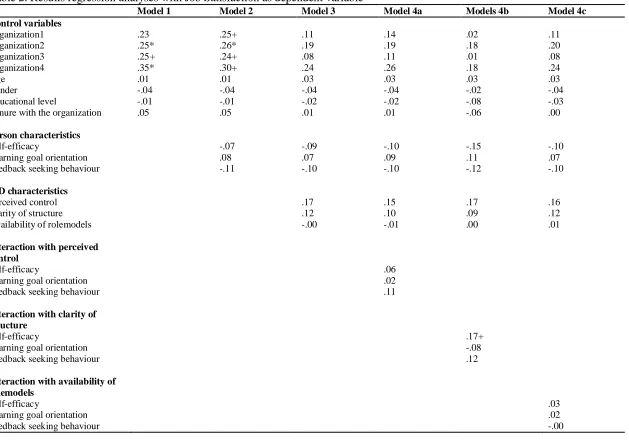
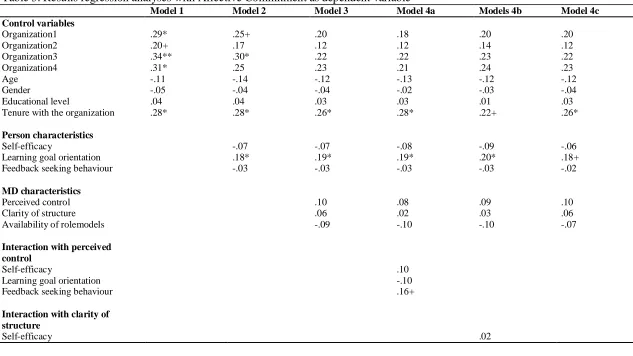
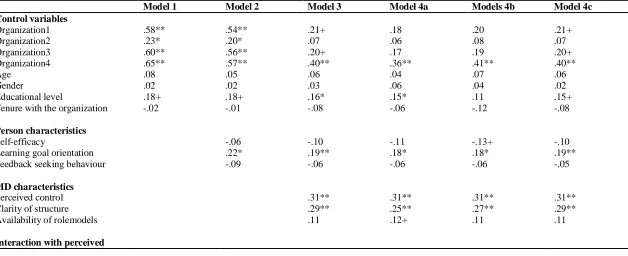
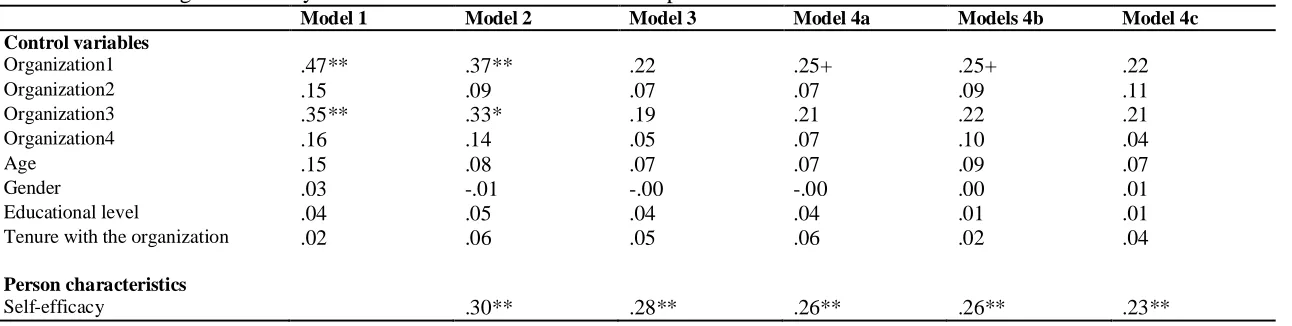
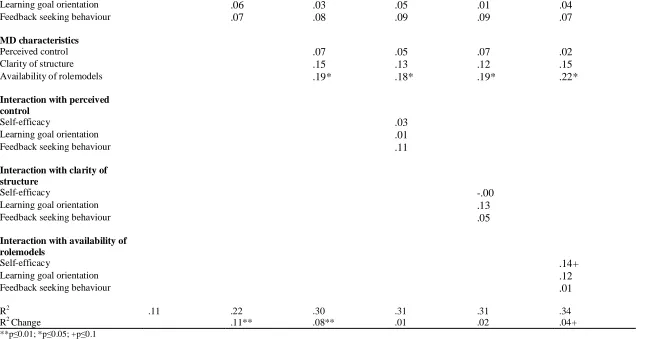
The control variables explain between 6% and 23% of variance in the outcome measures. The person characteristics add between 1% and 11% of variance in the outcome measures. For MD satisfaction and intrinsic MDP benefits this contribution is significant. In model 3 MD characteristics are included as well. They account for an additional 1 to 23% of variance, which is significant for job satisfaction (△R2=.05, p<.1), MD satisfaction (△R2=.24, p<.01), intrinsic MDP benefits (△R2=.08, p<.01), extrinsic MDP benefits (△R2=.16, p<.01) and organizational MDP benefits (△R2=.15, p<.01).
Results for Hypothesis 1
The first hypothesis assumed a relationship between all person characteristics and the outcome measures. As can be seen in Table 1 in Appendix D, correlational analyses indicates most person characteristics are positively associated to the outcome measures. Intrinsic and organizational benefits are significantly related to all person characteristics. Of the three person characteristics, learning goal orientation is significantly related to most MD outcomes. A significant and positive correlation exists between learning goal orientation and affective commitment (r=.18, p<.01), MD satisfaction (r=.20, p<.01), intrinsic MDP benefits (r=.23, p<.01) and organizational MDP benefits (r=.15, p<.05). Self-efficacy is significantly related to intrinsic MDP benefits (r=.41, p<.01) and organizational MDP benefits (r=.25, p<.01). Feedback seeking also shows a significant positive correlation with intrinsic MDP benefits (r=.21, p<.01) and organizational benefits (r=.17, p<.05). None of the person characteristics are significantly related to job satisfaction or extrinsic MDP benefits.
27
Results for Hypothesis 2
The second hypothesis assumed a positive relationship between all MD characteristics and the outcome measures. Table 1 shows a positive correlation for all MD characteristics with all MD outcomes, all 18 associations were positive and 16 were also significant (ranging from r=.11, ns
to r=.50, p<0.01). Regression analyses confirm a part of these relations.
Both perceived control (β= .31, p<0.01) and clarity of structure (β= .29, p<0.01) are significantly and positively related to MD satisfaction. Structure is also significantly and positively related to extrinsic MDP benefits (β= .34, p<0.05) and organizational MDP benefits (β= .19, p<0.10). Additionally perceived control is positively related to extrinsic MDP benefits (β= .19, p<0.10) and organizational benefits (β= .23, p<0.05). Availability of rolemodels is strongly related to intrinsic MDP benefits (β= .19, p<0.05) and also positively to organizational MDP benefits (β= .16, p<0.10). No significant relationships were found for job satisfaction and affective commitment, as can be seen in Table 2 and 3. Model 3, in which the MD characteristics are included, explains a significant amount of additional variance in MD satisfaction and all three types of MDP benefits: job satisfaction (△R2=.05, p<.1), MD satisfaction (△R2=.24, p<.01), intrinsic MDP benefits (△R2=.08, p<.01), extrinsic MDP benefits (△R2=.16, p<.01) and organizational MDP benefits (△R2=.15, p<.01). This means that hypothesis two can be confirmed for the most part.
Results for Hypothesis 3
The third and final hypothesis assumed MD characteristics to moderate the relation between person characteristics and outcome measures. Results were summarized in six tables, which can be found in Appendix D.
On the Road to Developing Knowledge Chapter 5: Conclusions
28
The moderating effect of perceived control accounts for a significant additional amount of variance in MD satisfaction (△R2= .03, p<.1). Moderation of the availability of rolemodels adds a significant amount of variance to intrinsic MDP benefits (△R2= .04, p<.1). All other moderator effects did not add significantly to the variance in the outcome measures. This means that hypothesis three can be confirmed for all MD characteristics but not in combination with all relationships between person characteristics and outcomes.
Chapter 5: Conclusions
This study aimed to provide insight into the mechanism that determines the effectiveness of MDPs across industries. Many studies on training can be found (Collins & Holton, 2004; Haccoun & Saks, 1998, Tracey et al., 2001) and prove it to be beneficial to individuals (Blau et al., 2007) as well as to organizations. Most studies however focus on reaching training content only and therefore more insight into the underlying process is needed (Arthur et al., 2003; Colquitt et al., 2000; Maurer et al., 2003). In development programmes participants are supposed to learn something. By discussing the learning process and studies on transfer motivation it became clear that an interaction between personal and environmental factors might be crucial to the mechanism this study tried to clarify. Three motivation theories, the theory of planned behaviour, the social learning theory, and the goal setting theory were used to identify relevant constructs. A summary of the hypothesized relations and variables was provided by the research model on page 9 in Chapter One.
Discussion
The main purpose of this study was to add to the knowledge on what determines the effectiveness of MDPs. This was investigated by means of the main research question:
What is the impact of personality characteristics on the outcome measures and how do the MD
characteristics affect this relationship?
29
characteristics and outcomes. Learning goal orientation and self-efficacy together emerged as the strongest predictors of four out of six MD outcomes.
Self-efficacy emerged as a significant and strong predictor of intrinsic and organizational MDP benefits participants perceive to gain from the programme. This indicates that a strong belief in their own capabilities enables employees to benefit from the programme in terms of what they find important to gain from it themselves. They are also able to use the programme to become better employees, colleagues and managers. These results correspond to Bandura’s SLT (1977b), which states that self-efficacy not only motivates people to learn but it also enables them to exert control over their environment to create positive outcomes.
Learning goal orientation is significantly and positively related to both affective commitment and MD satisfaction. This indicates that employees who like to learn new skills are more satisfied with the opportunity to learn and commit more to the organization that provides this opportunity by letting them participate in a MDP.
Strikingly, feedback seeking behaviour does not directly predict any of the outcome measures included in this study. Locke and Latham (2002) indicate feedback seeking behaviour to enable people to determine their position towards their goals. It was reasoned in Chapter Two that employees who actively seek feedback are motivated to reach their goals, which would translate into positive effects on outcomes. The results of this study do not support this line of reasoning. Locke’s GST characterizes feedback seeking behaviour to be useful when one is trying to reach goals. Since learning goals are not assessed as outcome measures in this study, perhaps the outcome variables included did not provide a good measure for the advantages feedback seeking behaviour can provide in learning settings. Or maybe factors in the environment are cancelling out the effect of feedback seeking behaviour. This issue will be discussed later in this Chapter.
Second, results provide support for the assumption that the MD characteristics were positively related to the outcome measures, yet the effect was not found for all outcome variables. Together the MD characteristics significantly predict four out of six MD outcomes. Perceived control and clarity of structure are the strongest predictors.
On the Road to Developing Knowledge Chapter 5: Conclusions
30
feel they are able to control (part of) the content of their MDP, are more satisfied by it. They apparently feel good about the programme. Having this sense of control also makes them expect higher pay or promotions as a result of participating and they believe it will make them better managers, colleagues and employees.
Rolemodels was significantly and positively related to all MDP benefits. So when the MDP encompasses rolemodels for participants to learn from, they perceive to gain from participating in terms of personal joys and in terms of benefits to the organization. This supports Bandura’s idea of social modelling (1977b) as was explained in Chapter Two.
When the structure of the MDP is more clear to participants, they will develop feelings of satisfaction towards the programme. This is indicated by the positive significant relation found between those two constructs. Knowledge on how the programme is structured also makes them expect to gain higher pay and more promotions, become better employees as a result of participating.
Five out of six outcome measures are (also) significantly predicted by the interaction between the participant and characteristics of the MDPs.
A small significant effect was found for the interaction between self-efficacy and clarity of structure on job satisfaction, suggesting that participants who are more confident about their own ability to deal with any situation will be more satisfied with their job when they understand the structure of their MDP better.
31
(VandeWalle & Cummings, 1997) do not appreciate the freedom to shape their own learning environment. Literature on feedback seeking and learning goal orientation indicates that these two constructs are complementary, since feedback can serve as an informational resource into determining ones current position in the process of reaching a goal (Locke &Latham, 2002). These results for MD satisfaction therefore contrast with the literature and each other.
Intrinsic MDP benefits are predicted by self-efficacy and the availability of rolemodels in the programme, as well as by the interaction between these two constructs. The added variance of the interaction is significant, suggesting that participants who believe in their own abilities will benefit from access to rolemodels, in terms of creating more interesting and enjoyable work for themselves.
All three MD characteristics and self-efficacy predict organizational MDP benefits. Small significant effects were also found for the interaction between learning goal orientation and perceived control and for learning goal orientation and clarity of structure, with organizational MDP benefits. These results indicate that participants who enjoy mastering new skills and believe they can improve their abilities through effort, will benefit from understanding the structure of their MDP and from being able to control part of its content and purpose. Advantages will be gained in terms of participants becoming better employees, colleagues and managers, which will benefit the organization.
To summarize, the effectiveness of MDPs was for a large part predicted by person as well as situational factors, the latter in terms of MD characteristics. Important characteristics of participants are a) learning goal orientation, especially combined with perceived control and rolemodels, and b) self-efficacy, especially when combined with a clear structure and rolemodels. Feedback seeking behaviour of participants is only relevant when they perceive to have control over their environment.
Practical implications
On the Road to Developing Knowledge Chapter 5: Conclusions
32
For individuals who have a tendency to actively seek feedback, it is important that the MDP allows for them to determine part of its content. Literature indicates individuals can base future actions towards reaching their goals on information from feedback (Locke & Latham, 2002). Without the freedom to determine what the next step should be, information from feedback might be useless. This is most important for participants’ satisfaction with the programme and their affective commitment to the company.
Individuals with a learning goal orientation are generally committed and satisfied with the MDP. For this to translate into organizational benefits, participants should be able to exert control over the content of their MDP. Yet giving these people control over the content of the programme diminishes the effect for satisfaction.
As for the programme, all three included characteristics contribute to its effectiveness in their own way. They complement each other, so in designing a programme, attention should be paid to all three. Considering the moderator effects with the relations between participant characteristics and outcomes, perceived control and availability of rolemodels can be labelled most important.
Limitations and Suggestions
33
sources of information should be included, like for example archival data on employee salary and supervisor ratings on job performance.
Second, there are some limitations and suggestions for further investigations concerning the research model. Results show the MD characteristics to be good predictors of the outcome measures. Also, the hypothesized relations were often not found. Feedback seeking behaviour for example, did not predict any of the outcome measures, which might suggest it is not suited as a person characteristic in this study. As mentioned earlier, it might also mean that other evaluation criteria should be included that are more suited to measure the advantages feedback seeking behaviour potentially offers in learning situations. Job satisfaction was not predicted by any of the independent variables, except for a small effect of the interaction between self-efficacy and the clarity of structure. This suggests job satisfaction is not very suited as an evaluation variable for the effectiveness of MDPs.
Third, the present study included MD characteristics as a moderator in the research model, but the MD characteristics more often predicted the outcomes directly than interact with person characteristics. Therefore, additional research is needed on these variables in the context of MDPs. The results that were found indicate the constructs included in this study are of relevance. However, an appropriate evaluation for the advantages of feedback seeking should be included. Further research should also look at the relationship between learning goal orientation and perceived control with MD satisfaction, especially taken together. Last, a suggestion for further research also concerns other research models of these variables, for instance mediator effects.
References
Ajzen, I. (1985). From intentions to actions: A theory of planned behavior. In J. Kuhl & J. Beckman (Eds.), Action-control: from cognition to behavior (pp. 11-39). Heidelberg: Springer.
Ajzen, I. (1991). The theory of planned behavior. Organizational behavior and human decision processes, 50, 179-211.
On the Road to Developing Knowledge References
34
led project management professional development programme: A case study in project management education and success management. International Journal of Project Management, 26, 223-237.
Allen, N. J. & Meyer, J. P. (1990). The measurement and antecedents of affective, continuance and normative commitment to the organization. Journal of Occupational Psychology, 63, 1-18.
Allen, N. J. & Meyer, J. P. (1996)Affective, continuance, and normative commitment to the organization: An Examination of Construct Validity. Journal of Vocational Behavior, 49, 252- 276.
Anguinis, H. & Kraiger, K. (2009). Benefits of training and development for individuals and teams, organizations and society. Annual Review of Psychology, 60, 451-474.
Ardts, J. C. A. (2002). All is well that begins well: a longitudinal study of organizational socialization. (Doctoral Thesis) VU University Amsterdam, Netherlands.
Arthur Jr., W. J., Bennett Jr., W., Edens, P. S. & Bell, S. T. (2003). Effectiveness of training in organizations: a meta-analysis of design and evaluation features. Journal of Applied
Psychology. 88(2), 234-245.
Ashford, S. J. (1986). Feedback-seeking in individual adaptation: a resource perspective. Academy of Management Journal, 29(3), 465-487.
Ashford, S. J. & Tsui, A. S. (1991). Self-regulation for managerial effectiveness: the role of active feedback seeking. Academy of Management Journal, 34(2), 251-280.
Baldwin, T. T. & Ford, J. K. (1988). Transfer of training; a review and directions for future research. Personnel Psychology, 41, 63-105.