exp. Biol. 147, 421-438 (1989) 4 2 1 inted in Great Britain © The Company of Biologists Limited 1989
A NOVEL GABA RECEPTOR IN THE HEART OF A PRIMITIVE ARTHROPOD, LIMULUS POLYPHEMUS
BY JACK A. BENSON
R & D Plant Protection, Agricultural Division, R-1093.P.47, CIBA-GEIGY Ltd, CH-4002 Basel, Switzerland
Accepted 20 July 1989
Summary
1. The isolated, intact heart of the marine arachnid Limulus polyphemus continues to beat in vitro for many hours. Application of ^aminobutyric acid (GABA) decreased the heart beat frequency with a threshold of 3 x l O ~7m o i r1 and an EC50 of 2.0±0.6xlO"5moll"1 (mean±s.D., N = 8). At l O ^ m o l l "1 and above the heart beat was completely and reversibly inhibited.
2. The agonist potency profile of the Limulus heart chronotropic GABA receptor was very similar to that of the vertebrate GABAA receptor: muscimol > ZAPA>GABA=TACA>isoguvacine>THIP>3-aminopropane sulphonic acid> imidazole-4-acetic acid = /J-guanidino proprionic acid~5-aminovalerate. In con-trast, the antagonist profile differed dramatically: bicuculline, pitrazepin and SR 95103, as well as the channel blocker picrotoxin, were without effect at concentrations up to 10"4moll~1.
3. The benzodiazepines clorazepate, flunitrazepam, flurazepam and diazepam, as well as the barbiturate sodium pentobarbital, were without effect on the GABA response, suggesting that the Limulus heart GABA receptor is not complexed with the benzodiazepine and barbiturate modulatory subunits that characterize vertebrate GABAA receptor.
4. The GABAB ligands baclofen, phaclophen and kojic amine were inactive on the heart. However, 3-aminopropyl-phosphonous acid (CGA147 823), a potent and highly selective GABAB agonist, was the most active of the compounds tested. It inhibited the heart beat with a threshold of about SnmolP1, an ECsoof 4.0±2.7xlCT7moir1, and produced total inhibition of the heart at 10~5moir1. CGA 147 823 was inactive on the locust thoracic somal GABA receptors.
5. cis-4-aminocrotonic acid (CACA), the ligand defining a proposed GAB Ac-type receptor, was inactive on the heart.
6. The GABA-induced inhibition of the heart beat was enhanced by pretreat-ment with the GABA uptake inhibitor nipecotic acid but not with sodium valproate or /J-alanine.
7. The Limulus heart chronotropic GABA receptor appears to be of a hitherto undescribed type that differs in pharmacology from the vertebrate GABAA and GABAB receptors as well as from the well-defined GABA receptors on the
422 J. A. BENSON
somata of locust neurones and the muscle fibres of insects and the nematode
Ascaris.
Introduction
Florey (1954) extracted a substance from the mammalian nervous system (Factor I) that had an inhibitory action on the crayfish stretch receptor. He showed that Factor I was largely y-aminobutyric acid (GABA) (Bazemore et al. 1956) and that both Factor I and GABA slowed and stopped the heart beat of the crayfish Astacus, an effect antagonized by picrotoxin (Florey, 1957). At about the same time, Burgen and Kuffler (1957) demonstrated that GABA inhibited the endogen-ous rhythmic activity of the isolated cardiac ganglion from the neurogenic heart of a primitive marine arachnid Limulus polyphemus, the horseshoe crab. GABA is now recognised as the inhibitory neurotransmitter for the skeletal neuromuscular junction of crustaceans, insects and other arthropods, and it has inhibitory effects on some central neurones in these groups (Robinson and Olsen, 1988). GABA is equally important as an inhibitory neurotransmitter in vertebrate nervous systems where the GABA receptors so far described fall mostly into two categories, GABAA receptors and GABAB receptors (reviewed by Johnston, 1986). These receptor types are extremely well characterized pharmacologically and thus provide a starting point for the analysis of the pharmacology of GABA receptors in other phyla. Molecular genetic studies suggest that the GABAA and GABAB receptors are the products of different gene families, but classification of invertebrate GABA receptors still depends entirely on pharmacological criteria. The heart of Limulus continues to beat for many hours when it is isolated intact and maintained in circulating physiological saline, and it responds chronotropi-cally and inotropichronotropi-cally to several biogenic amines and neuropeptides (Watson and Augustine, 1982). When the heart is exposed to GABA, the heart beat frequency and amplitude decrease (Pax and Sanborn, 1967; Abbott et al. 1969a). This report defines the pharmacology of the novel receptor type mediating the chronotropic effect of GABA on the heart beat. A preliminary note on this work has appeared previously (Benson, 1988a).
Materials and methods
Male and female specimens of Limulus polyphemus, with carapace widths of 15-25 cm, were obtained from the Department of Marine Resources at the Marine Biological Laboratory, Woods Hole, Massachussets and maintained in circulating artificial sea water (Instant Ocean) at 15°C.
Limulus heart GABAergic pharmacology 423
trimmed off the heart, which was then stretched by about 20% of its length and pinned at both ends onto a wax surface in a plastic chamber (volume 30 ml). To measure contractions, a force transducer (Grass FT03) was connected by means of a hooked pin to the lateral boundary of the heart mid-way along its length. The heart was additionally pinned down at the lateral boundary opposite the transducer connection to improve the mechanics of the force transduction. The resulting contraction records were displayed on a polygraph recorder (Grass 79D). The preparation was continuously superfused at a rate of lSmlmin"1 with a physiological saline consisting of (in mmolP1): NaCl, 445; CaCl2.6H2O, 10; MgCl2.6H2O, 46; KC1, 12; and Hepes, 5 (pH7.4).
All test solutions were made up shortly before application. Poorly soluble test compounds were dissolved first in dimethylsulphoxide (DMSO) and then diluted with physiological saline. DMSO by itself was without effect on the heart beat at concentrations 10 times higher than those used here. The test compounds were purchased from Sigma except for the following: muscimol, isoguvacine, THIP, 3-aminopropane sulphonic acid, CGA147823, baclofen, kojic amine, phaclofen, flunitrazepam, sodium valproate (synthesized at CIBA-GEIGY Ltd), TACA, ZAPA, CACA (purchased from Tocris Neuramin), GAB A, piperazine, piperi-dine-4-carboxylic acid (purchased from Fluka), SR 95103 (gift from Sanofi), pitrazepin (gift from Sandoz), clorazepate, flurazepam (gifts from Hoffmann-LaRoche) and sodium pentobarbital (purchased from Serva). The chemical names corresponding to abbreviations and code numbers are given in Table 1.
The experimental protocols were as follows. First, all the compounds were tested several times at 10"4moll~1 for GABA-mimetic effects on the heart beat frequency. Those that were GABA agonists were further tested in an ascending series of concentrations, without intervening washes, to provide dose-response curves. Each concentration was perfused through the recording chamber for lOmin. The control frequency was taken from the 3min preceding application of the first dose of the test compound, and the response was measured over the last 3min of application of each concentration. For the conditions and compounds used in these experiments, the response measured was at a steady state. There was little evidence of desensitization of the GABAergic response. A similar lack of desensitization has been reported for the responses to the biogenic amines (Augustine et al. 1982).
424 J . A . B E N S O N
(and repeated at 30-min intervals, if necessary) to determine the reversibility of any effects of the test compound, together with the stability of the GABA response. Although the magnitude of the GABA-induced frequency decrease varied somewhat from heart to heart, it was remarkably constant when the same dose of GABA was applied repeatedly to the same heart. This means that highly reliable control experiments could be carried out by using the protocol described above. The controls and response magnitudes in these experiments were measured as for the agonists.
Results
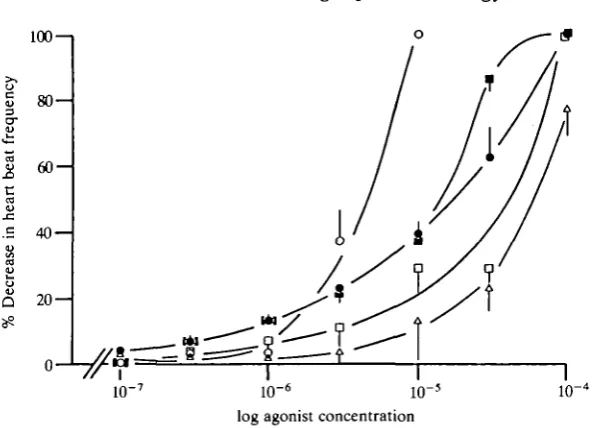
When the isolated heart was superfused with 2xlO~5moll~1 GABA, the frequency of the heart beat decreased by about 50% and there was also a small, transient decrease in the contraction amplitude (Fig. 1). The response was rapidly reversed by supervision of the heart with control saline. It is not known whether different GABA receptor types mediate the chronotropic and inotropic com-ponents of the GABA response, but the present work is directed at the chronotropic response only. The dose-response curve shows that the threshold concentration was about 3xlO~7moll~1 and the EC50, calculated from individual dose-response curves, was 2.0±0-6xlO~5moll"1 ( ± S . D . , 7V=8, Table 1A; Fig. 2). At 10~4moll~l and above the heart beat was completely but reversibly inhibited.
The test compounds were grouped according to their known activities as agonists, antagonists and modulators at the vertebrate GABAA, GABAB and
Control
•••ttiilll
lmin
2xlO"3moir1 GABA
Wash
Fig. 1. Chart records of the GABA-induced decrease in heart beat frequency. The first trace shows the heart beat in control saline. The second trace illustrates the onset
of the action of 2xlO~5moll~' GABA applied at the beginning of the trace. In the
Table 1. GABAergic pharmacology of the Limulus heart Agonism Antagonism Compound ECSO+s.~. Frequency change No. of % block of Concentration No. of (moll-') at 10-~mol I-' expts GABA response tested (mol I-') expts A Putatively non-specific GABA agonists GABA 2.0k0.6~
lo-'
-99f 2 % 8 - - 0 Guanidino acetic acid 4.5f 0.9~ lo-' -89t-7 % 3 NE 3 xlo-'
2 PGuanidino -30+13 % 3 NE lo-', 3 proprionic acid Methapyrilene -11f 7% 5 NE 1 Piperazine NE 7 NE lo-4 4 Norvaline NE 2 NE lo-4 1 B Putatively non-specific GABA blockersBrucine 1-(m-chloropheny1)- piperazine Emetine
C
Specific
GABAA
blockers
Picrotoxin Bicuculline
methiodide
Pitrazepin SR
95103
D
Specific
GABAA
agonists
Muscimol ZAPA TACA Isoguvacine THIP 3-Aminopropane sulphonic
acid
Imidazole-4-acetic
acid
5-Aminovalerate Isonipecotic
W W W
Z Z Z
"3 m
4 4 7
7
x x El; 4
; y y E l w l
m 1 1 4 w
4
4 El
W W W W W
Table 1. Continued J Other compounds
Glycine Strychnine Norleucine Taurine Lindane
NE 3 NE 1 NE 4 NE 10-4 4 NE 1 NE 10-4 1 NE 5 NE 3 Excitatory (lo-', 5 NE l0-~-10-~ 6 NE=no effect. ECm=median effective concentration. Norvaline=~-2-aminopentanoic acid, L-maminovaleric acid.
Brucine=l0,lldimethoxystrychnine. SR
95103=2-(carboxy-3'-propyl)-3-amino-4-methyl-phenylpyridzinium chloride. ZAPA=(Z)-3-[(aminoiminomethyl)-thio]-prop-2-enoic acid. TACA=trans-4-aminocrotonic acid.
TH1P=4,5,6,7-tetrahydroisooxazolo-[5,4-c]-pyridin-3-ol. 5-Aminovalerate=5-aminopentanoic
acid. Isonipecotic acid=piperidine-4-carboxylic acid. Phaclofen=3-amino-2-(4-chloropheny1)-prop phosphonic acid. CGA 147 823=3-aminopropyl-phosphonous acid. Baclofen=Lioresal, b-(p-chlorophenyl)-GABA. Kojic amine=2-aminomethyl-5-hydroxy-4H-pyran-4-one. CACA=cis-4-aminocrotonic acid. Clorazepate=dipotassium hydroxide 7-chloro-2,3-dihydro-2-oxo-5-phenyl-1H-l,4-~nzodizepin-3-~r~xy1ate.
Flurazepam=7-chloro-l-[2-(diethylamino)ethyl]-5-(o-fluorophenyl)-l,3dihydro-2H-l,4-~modizepin-2-one. Diazepam=7-chloro-l,3-dihydro-l-methyl-5-phenyl-2H-l,4-benzodiazepin-2-one. nor leu cine=^-2-aminohexanoic
acid,
L-cr-aminocaproic
acid.
Lindane=
428 J. A. BENSON
GAB Ac receptors, and ranked within these groups in descending order of their potency on the Limulus heart (Table 1). The confidence limits given in Table 1 represent the mean±standard deviation of the EC50 values from individual dose-response curves.
Several reportedly non-specific GABA agonists were tested to determine whether any of them was more potent than GABA itself (Table 1A). Only guanidino acetic acid had an effect on the heart with a potency comparable to that of GABA. /2-Guanidino proprionic acid was weakly active at 10~4moll~1, as was methapyrilene, whose precise mode of GABAergic action is not known. It could be a partial agonist or antagonist at the GABAA receptor (Dalkara et al. 1986). Piperazine, an important anthelmintic that activates GABA channels on Ascaris muscle with a potency about one-hundredth that of GABA (Martin, 1985), had no effect on the heart at 10~4molP1. Norvaline, which shows some GABAergic effect at 10~4moll~1 and above on insect muscle (Scott and Duce, 1987), was completely inactive on the heart at 10~4moll~1.
Of the three GABA blockers with undetermined specificity (Table IB), only brucine acted as an antagonist on the heart, reducing the GABA responses by an average of about 25% when applied at 10~4moll~\ Brucine completely blocks the effect of GABA on [35S]TBPS-binding at the GABAA receptors in the rat hippocampus and l-(m-chlorophenyl)-piperazine acts similarly but with lower potency (Dalkara et al. 1986). Emetine, which was excitatory on the heart, is a weaker, partial blocker in the same system.
The original defining property of the GABAA receptor is specific antagonism by bicuculline (Hill and Bowery, 1981). Pitrazepin is also a selective antagonist and is more potent than bicuculline (Gahwiler et al. 1984). Bicuculline and pitrazepin were without effect on the Limulus heart receptor either as antagonists or agonists (Table 1C). A similar lack of effect was observed for SR95103, one of the few GABAA-specific competitive antagonists to retain the flexibility of the GABA moiety (Chambon et al. 1985).
The GABAA receptor gates a Cl~ channel that is blocked by picrotoxin. This compound had no effect on the response of the heart to GABA, even after prolonged exposure at 10~4moll~1. The GABA response of locust thoracic neurone somata is totally blocked by picrotoxin at less than 10~6moll~1 (Lees et al. 1987).
Limulus heart GABAergic pharmacology
429J5 lOO—i
8 0
6 0
-.5 40 —
20 —
10"
I I
10"6 10"5
log agonist concentration
1
[image:9.451.75.373.63.277.2]10"4
Fig. 2. Dose-response curves for the decrease in heart beat frequency induced by GABA and the active GABAA agonists. ( • ) GABA, N=6; (O) muscimol, N=3; ( • ) ZAPA, N=3; (•) TACA, N=3; (A) isoguvacine, N=3. The points indicate the means and the vertical bars represent the standard errors where these are large enough to extend beyond the points. The concentrations are measured in moll"1.
slightly less potent than GABA. A similar result has been reported for the insect muscle GABA receptor (Scott and Duce, 1987). However, THIP showed significant activity only at high concentrations. 3-Aminopropane sulphonic acid was only feebly active at 10~4molP1 (as at many invertebrate GABA receptors, Simmonds, 1983), and imidazole-4-acetic acid and 5-aminovalerate were ex-tremely weak but, nevertheless, active. Their rank order of potency on the heart was almost identical to that on the GABAA receptors of cultured mouse spinal neurones: muscimol > GABA « TACA > isoguvacine ~ THIP > 3-aminopropane sulphonic acid ~ /S-guanidino proprionic acid = 5-aminovalerate > imidazole-4-acetic acid (Barker and Mathers, 1981). Isonipecotic acid, reputedly active selectively at GABAA receptors (Krogsgaard-Larsen etal. 1985), was inactive on the heart. ZAPA has become available relatively recently. It is more potent than muscimol at the low-affinity binding site of the GABAA receptor (Allan et al. 1986) and was more active than TACA but less active than muscimol on the heart.
The folded isomer of TACA, CACA, was inactive on the heart (Table 1G). CACA-binding is the defining characteristic of a proposed baclofen- and bicucul-line-insensitive GABAc receptor (Drew et al. 1984; Johnston, 1986).
430 J. A. BENSON
lOO—i
u Q
6 0
2 0
-OH
OC C
3-aminopropyl-phosphonous acid (CGA147 823)
7/ I 10"9
I I 10~8 10"7
log CGA 147 823 concentration I
10"6 I
lO"5
Fig. 3. Dose-response curve for the decrease in heart beat frequency induced by CGA 147823 (3-aminopropyl-phosphonous acid). The points indicate the means and the vertical bars represent the standard errors where these are large enough to extend beyond the points (N=3, except for the lowest two concentrations which are single
measurements). Concentrations are measured in moll"1.
Dutar and Nicoll, 1988). It also had no agonistic or antagonistic action on the heart at concentrations up to 10~3moll~1 (Table IE). Kojic amine was designed as a GABAA agonist but in fact is primarily active as an agonist at GABAB receptors (Krogsgaard-Larsen et al. 1985). It had no effect either as an agonist or an antagonist on the heart (Table IF).
Limulus heart GABAergic pharmacology
Control
431
Wash
10 moll nipecotic acid
10"4moll"' nipecotic acid+2xl(T5moll"1 GABA
JJJL
Wash
2 x K r5m o i r ' GABA
[image:11.451.106.316.54.428.2]Wash 1 min
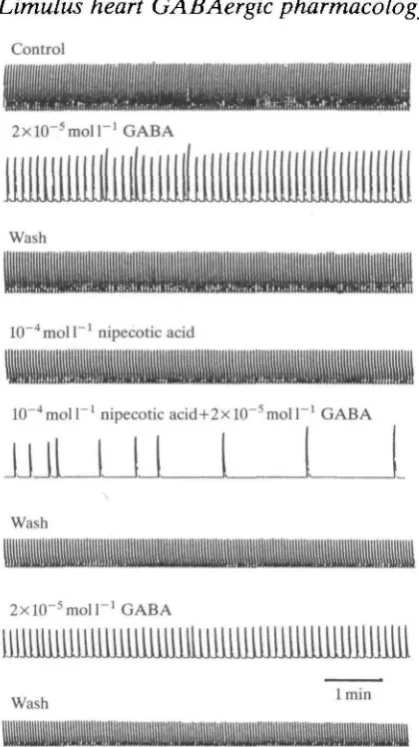
Fig. 4. Chart records showing the enhancement of the GABA-induced decrease in heart beat frequency by nipecotic acid. 'Wash' traces illustrate the steady-state heart beat following re-application of the control saline. The vertical axis is an arbitrary measurement of the heart beat amplitude.
tested on the heart for modulatory effects on the GABA response (Table 1H). They were all without effect: the GABA responses in the presence of the putative modulators were not significantly different from those in control saline.
Nipecotic acid, a specific inhibitor of GABA uptake (Krogsgaard-Larsen and Johnston, 1975), had no agonistic effect in the absence of GABA but produced a dramatic enhancement of the GABA response of the heart (Table II and Fig. 4). In contrast, sodium valproate and ^S-alanine, which are also GABA uptake inhibitors in some systems, were ineffective on the heart. yS-AJanine had no effect by itself on the heart, although it is reported to evoke a GABA-mimetic effect on
432 J. A. BENSON
Table 1J presents the results of experiments testing the effects of a selection of compounds that might be expected to be active on a GABA receptor/chloride channel complex. Glycine is an important mammalian neurotransmitter that activates a receptor/chloride channel complex strongly homologous in primary structure to both the GABAA receptor and the nicotinic acetylcholine receptor (reviewed by Betz and Becker, 1988). Strychnine potently antagonizes the vertebrate glycine receptor (Betz and Becker, 1988) and the locust thoracic neurone somal nicotinic receptor (Benson, 1988c). Neither glycine nor strychnine was active on the heart GABA receptor, and nor were taurine and norleucine, possible GABA agonists. Lindane, an insecticide that blocks an insect neuronal GABA response at 1 0 "4m o i r1 (Wafford et al. 1988), probably by acting on the Cl~ channel, did not block the GABA response in the heart, but had an excitatory effect at 1CT5 and 10""4moll"1.
Discussion
Limulus heart GABAergic pharmacology 433
receptors in lobsters and crabs would be useful in determining whether they belong to the same subtype as the Limulus heart receptor. A picrotoxin-insensitive GABA response has been described in fish retinal horizontal cells but this response is blocked by bicuculline (Hankins and Ruddock, 1984).
The GABA receptors in the Limulus heart differ from those in the Limulus CNS, which appear to be similar in many respects to those on insect neurones and thus, probably, GABAA type receptors (James et al. 1978; Roberts et al. 1981; Walker et al. 1981; Walker and Roberts, 1982). Whereas the GABA response of the heart was unaffected by picrotoxin, GABA hyperpolarizes neurones in the CNS of Limulus by activating a Cl~ conductance that is blocked by low concentrations of this compound. As on the heart, muscimol is more potent than GABA and isoguvacine is about equipotent. However, THIP and piperidine-4-carboxylic acid (isonipecotic acid) are approximately equipotent with GABA in the CNS but were much weaker (THIP) or inactive (isonipecotic acid) on the heart. Bicuculline and baclofen were inactive on both the CNS and heart.
Another important characteristic of the vertebrate GAB AA receptor is that it is associated with benzodiazepine and barbiturate regulatory sites that are absent from GABAB receptors. The Limulus heart receptor appears to have no benzodiazepine or barbiturate allosteric regulatory sites associated with it (Table 1H). The presence of benzodiazepine binding sites in arthropods was first demonstrated in housefly thorax muscles (Abalis et al. 1983). Similar binding sites were later identified on neuronal membranes from insects (Robinson et al. 1985; Lummis and Sattelle, 1985b). At the same time, it was shown electrophysiologi-cally that locust thoracic neurone somata possess functional benzodiazepine receptors and that functional barbiturate receptors also modulate the GABA responses of these insect neurones (Lees et al. 1985, 1987). Scott and Duce (1987) observed barbiturate potentiation of the insect muscular GABA response and Shimahara et al. (1987) demonstrated potentiation by a benzodiazepine of GABA single-channel activation in cultured insect neurones. This is additional evidence that these insect GABA receptors belong to the GABAA superfamily. Robinson et al. (1986) found insect benzodiazepine binding sites that differ in pharmacological detail from that of the vertebrate GABAA receptor. It is therefore conceivable that the Limulus receptor is complexed with allosteric sites that are insensitive to the compounds tested in the experiments reported here. Nevertheless, the most plausible conclusion from the data is that the Limulus heart receptor is not closely related to the other members of the GABAA family.
The Limulus heart receptor is insensitive to the GABAB diagnostic agonist, baclofen, and is not blocked by phaclofen, a weak but highly specific GABAB antagonist. The pharmacology of the Limulus receptor GABA recognition site thus clearly differs from that of the vertebrate GABAB receptor. However, CGA147 823 was 10 times more potent than muscimol on the heart, and in the vertebrate brain it is a highly specific GABAB agonist. This compound has no onistic or antagonistic GABAergic effects at concentrations of up to
I
4434 J. A . B E N S O N
sensitivity to GABA (J. A. Benson, unpublished data). This is perhaps the mosi striking difference between the GABA recognition site pharmacological profiles of the Limulus heart and the locust CNS, and illustrates the remarkable diversity to be found among receptors for the same transmitter within a single phylum. A definitive answer on whether the Limulus receptor could belong to the same superfamily as the GABAB receptor awaits biochemical clarification of the r61e, if any, of cyclic GMP as a second messenger in the Limulus GABA response, or determination of the amino acid sequence of the receptor protein. On the basis of purely pharmacological data, however, the Limulus receptor is clearly not closely related to the vertebrate GABAB receptor.
A GABA receptor that does not fit the GABAA/GABAB classification is the GABA-activated Cl~-ionophore that occurs in Ascaris muscle cells. On this preparation, the rank order of agonist potency is ZAPA > GAB A > TACA > muscimol > imidazole-4-acetic acid «isoguvacine > guanidino acetic acid > 3-guanidinoproprionic acid = 5-aminovalerate > CACA > THIP (Holden-Dye et al. 1988). Although showing similarities in the relative potencies for several of these compounds, the Ascaris muscle receptor profile differs from that of the Limulus heart with respect to the low potencies of muscimol (about 25 % that of GABA) and THIP (about 0.5 % that of GABA). ZAPA is the only compound reported so far to have a potency at the Ascaris receptor equal to or slightly greater than that of GABA (Holden-Dye and Walker, 1988), and in this respect it resembles the heart. Also, as in the heart, picrotoxin, pitrazepin and bicuculline are inactive (Wann, 1987), as are baclofen, glycine, /5-alanine and taurine (Holden-Dye etal. 1988). In contrast, 3-aminopropane sulphonic acid (10~3molP1) is inactive on the Ascaris muscle receptor but showed agonistic activity at 10~4moll~1 on the heart (Table ID). High doses of piperazine are reported to activate single GABA channels on Ascaris muscle (Martin, 1985) but this compound is inactive on the heart (Table 1A). There is clearly an overall similarity in several critical respects between the Ascaris muscle and the Limulus heart receptors: the differences appear to be real but occur in the details of the relative potencies of the agonists.
Simmonds (1983) hypothesized that invertebrates possess only 'simple' GABA receptors that do not form part of a complex including allosteric regulatory sites. This is not the case in the insects, but the Limulus heart chronotropic GABA receptor does seem to fit this concept well. In addition to lacking the regulatory sites, the Limulus receptor has a pharmacological profile that differs markedly from those of both GABAA and GABAB vertebrate receptors, and it is insensitive to the diagnostic agonist of the proposed GABAC receptor. It does not match the pharmacology of the GABA receptors of Limulus central neurones, locust thoracic neurones, insect muscle or the GABA receptor on the muscle fibres of the nematode Ascaris.
Limulus heart GABAergic pharmacology 435
be acting similarly in the Limulus heart, effectively increasing the amount of GABA available by reducing its uptake. /S-Alanine, an inhibitor of GABA uptake into glia in many preparations, including the insect nervous system (Beadle et al. 1987), was without effect. GABA uptake is therefore probably a neuronal phenomenon in the heart.
The precise role in physiological cardioinhibition played by the GABA receptor characterized here is not settled. Pax and Sanborn (1967) discounted the possibility that GABA could be the transmitter released by the inhibitory cardioregulatory nerves because stimulation of the nerves had both negative chronotropic and inotropic effects, whereas they thought that GABA affected primarily the frequency. The experiments described here, and previous data (Abbott et al. 1969a,b), show that GABA reduces both the amplitude and the frequency of the heart beat. These effects, which mimic stimulation of the inhibitory cardioregulatory nerves in every way, appear to be mediated solely by the cardiac ganglion, where GABA causes a reduction in the frequency and duration of the bursts recorded as well as in the number of cardiac ganglion units firing during a burst (Abbott et al. 1969a). GABA has no effect on the neuromuscular EPSP or heart muscle contractility (Abbott et al. 1969£>). These observations strongly suggest that the inhibitory cardioregulatory nerves release GABA in the cardiac ganglion and that the changes in burst characteristics account for both the chronotropic and the inotropic effects on the heart beat. Unfortunately, Pax and Sanborn (1967) also showed that picrotoxin blocks the effects of stimulation of the inhibitory cardioregulatory nerves but, as the above results confirm, does not block the action of GABA. This means that if GABA has a physiological role in the Limulus heart, it is more likely to be as a blood-borne neuromodulator acting on the cardiac ganglion neurones than as a cardiac inhibitory neurotransmitter.
The author thanks Drs R. J. Walker and L. Holden-Dye for helpful information on GABA pharmacology, and Professor P. Krogsgaard-Larsen for useful com-ments on the manuscript.
References
ABAUS, I. M., ELDEFRAWI, M. E. AND ELDEFRAWI, A. T. (1983). Biochemical identification of putative GABA/benzodiazepine receptors in house fly thorax muscles. Pesticide Biochem. Physiol. 20, 39-48.
ABBOTT, B. C , LANG, F. AND PARNAS, I. (1969a). Physiological properties of the heart and cardiac ganglion of Limulus polyphemus. Comp. Biochem. Physiol. 28, 149-158.
ABBOTT, B. C , LANG, F., PARNAS, I., PARMLEY, W. AND SONNENBLICK, E. (19696). Physiological and pharmacological properties of Limulus heart. Experientia (Suppl.) 15, 232-243. ALBERT, J., LINGLE, C. J., MARDER, E. AND O'NEIL, M. B. (1986). A GABA-activated
chloride-conductance not blocked by picrotoxin on spiny lobster neuromuscular preparations. Br. J. Pharmac. 87, 771-779.
436 J. A. BENSON
AUGUSTINE, G. L, FETTERER, R. AND WATSON, W. H. (1982). Amine modulation ot the neurogenic Limulus heart, /. Neurobiol. 13, 61-74.
BARKER, J. L. AND MATHERS, D. A. (1981). GABA analogues activate channels of different duration on cultured mouse spinal neurons. Science 212, 358-361.
BAZEMORE, A., ELLIOTT, K. A. C. & FLOREY, E. (1956). Factor I and y-aminobutyric acid.
Nature, Lond. 178, 1052-1053.
BEADLE, C. A., BERMUDEZ, I. & BEADLE, D. J. (1987). Aminoacid uptake by neurones and glial cells from embryonic cockroach brain growing in vitro. J. Insect Physiol. 33, 761-768. BENSON, J. A. (1988a). The GABA response of the isolated heart of Limulus polyphemus
exhibits novel pharmacology. Soc. Neurosci. Abstr. 14, 382.
BENSON, J. A. (19886). Bicuculline blocks the response to acetylcholine and nicotine but not to muscarine or GABA in isolated insect neuronal somata. Brain Res. 458, 65-71.
BENSON, J. A. (1988c). Transmitter receptors on insect neuronal somata: GABAergic and cholinergic pharmacology. In The Molecular Basis of Drug and Pesticide Action - Neurotox
'88 (ed. G. G. Lunt), pp. 193-206. Amsterdam: Elsevier Biomedical.
BENSON, J. A., SULLIVAN, R. E., WATSON, W. H. AND AUGUSTINE, G. J. (1981). The neuropeptide proctolin acts directly on Limulus cardiac muscle to increase the amplitude of contraction. Brain Res. 213, 449—454.
BERMUDEZ, I., BOTHAM, R. P. AND BEADLE, D. J. (1988). High- and low-affinity uptake of amino acid transmitters in cultured neurones and muscle cells of the cockroach, Periplaneta
americana. Insect Biochem. 18, 249-262.
BETZ, H. & BECKER, C.-M. (1988). The mammalian glycine receptor: biology and structure of a neuronal chloride channel protein. Neurochem. Int. 13, 137-146.
BOWERY, N. G., HILL, D. R., HUDSON, A. L., DOBLE, A., MIDDLEMISS, D. N., SHAW, J. & TURNBULL, M. (1980). (—)Baclofen decreases neurotransmitter release in the mammalian CNS by an action at a novel GABA receptor. Nature, Lond. 283, 92-94.
BREER, H. AND HEILGENBERG, H. (1985). Neurochemistry of GABAergic activities in the central nervous system of Locusta migratoria. J. comp. Physiol. A 157, 343-354.
BURGEN, A. S. V. AND KUFFLER, S. W. (1957). The inhibition of the cardiac ganglion of Limulus
polyphemus by 5-hydroxytryptamine. Biol. Bull. mar. biol. Lab., Woods Hole 113, 336.
CAZALETS, J. R., COURNIL, I., GEFFARD, M. ANDMOULINS, M. (1987). Suppression of oscillatory activity in crustacean pyloric neurons: implication of GABAergic inputs. J. Neurosci. 7, 2884-2893.
CHAMBON, J.-P., FELTZ, P., HEAULME, M., RESTLE, S., SCHLICHTER, R., BIZIERE, K. AND WERMUTH, C. G. (1985). An arylaminopyridazine derivative of y-aminobutyric acid (GABA)
is a selective and competitive antagonist at the GABAA receptor site. Proc. natn. Acad. Sci.
U.S.A. 82, 1832-1836.
DALKARA, T., SAEDERUP, E., SQUIRES, R. F. AND KRNJEVIC, K. (1986). Iontophoretic studies on rat hippocampus with some novel GABA antagonists. Life Sci. 39, 415-422.
DINGWALL, J. G., EHRENFREUND, J., HALL, R. G. AND JACK, J. (1985). Substituted propane-phosphonous acid compounds. European Patent Application. Publication number 0 181833. DINGWALL, J. G., EHRENFREUND, J., HALL, R. G. AND JACK, J. (1987). Synthesis of
y-aminopropylphosphonous acids using hypophosphorous acid synthons. Phosphorus and
Sulfur 30,571-574.
DREW, C. A., JOHNSTON, G. A. R. AND WEATHERBY, R. P. (1984). Bicuculline-insensitive GABA receptors: studies on the binding of (—)baclofen to rat cerebellar membranes.
Neurosci. Letters 52, 317-321.
DUTAR, P. & NICOLL, R. A. (1988). A physiological role for GABAB receptors in the central nervous system. Nature, Lond. 332,156-158.
FISZER DE PLAZAS, S. & DE ROBERTIS, E. (1973). Hydrophobic proteins isolated from crustacean muscle having glutamate and y-aminobutyrate receptor properties. FEBS Lett. 33, 45—48. FLOREY, E. (1954). An inhibitory and an excitatory factor of mammalian central nervous system,
and their action on a single sensory neuron. Arch. Int. Physiol. 62, 33-53.
FLOREY, E. (1957). Further evidence for the transmitter-function of Factor I.
Naturwissenschaften 44, 424-425. M
Limulus heart GABAergic pharmacology 437
clamped CA3 pyramidal cells in hippocampal cultures. Proc. natn. Acad. Sci. U.S.A. 82, 1558-1562.
GAHWILER, B. H., MAURER, R. & WUTHRICH, H. J. (1984). Pitrazepin, a novel GABAA antagonist. Neurosci. Lett. 45, 311-316.
HANKTNS, M. W. & RUDDOCK, K. H. (1984). Electrophysiological effects of GABA on fish retinal horizontal cells are blocked by bicuculline but not by picrotoxin. Neurosci. Lett. 44, 1-6.
HILL, D. R. AND BOWERY, N. G. (1981). 3H-Baclofen and 3H-GABA bind to bicuculline-insensitive GABAB sites in rat brain. Nature, Lond. 290, 149-152.
HOLDEN-DYE, L., HEWITT, G. M., WANN, K. T., KROGSGAARD-LARSEN, P. AND WALKER, R. J. (1988). Studies involving avermectin and 4-aminobutyric acid (GABA) receptor of Ascaris suum muscle. Pestic. Sci. 24, 231-245.
HOLDEN-DYE, L. AND WALKER, R. J. (1988). ZAPA, (Z)-3-[(aminoiminomethyl)thio]-2-propenoic acid hydrochloride, a potent agonist at the GABA-receptors on the Ascaris muscle cell. Br. J. Pharmac. 95, 3-5.
JAMES, V. A., RROGSGAARD-LARSEN, P. & WALKER, R. J. (1978). The action of conformationally restricted analogues of GABA on Limulus and Helix central neurones. Experientia 34,
1630-1631.
JOHNSTON, G. A. R. (1986). Multiplicity of GABA receptors. In Benzodiazepine/GABA Receptors and Chloride Channels: Structural and Functional Properties (ed. R. W. Olsen & J. C. Venter), pp. 57-71. New York: Alan R. Liss.
KERR, D. I. B., ONG, J., PRAGER, R. H., GYNTHER, B. D. AND CURTIS, D. R. (1987). Phaclofen: a peripheral and central baclofen antagonist. Brain Res. 405, 150-154.
KROGSGAARD-LARSEN, P., FALCH, E. AND HJEDS, H. (1985). Heterocyclic analogues of GABA: chemistry, molecular pharmacology and therapeutic aspects. Prog. Med. Chem. 22, 67-119. KROGSGAARD-LARSEN, P. AND JOHNSTON, G. A. R. (1975). Inhibition of GABA uptake in rat
brain slices by nipecotic acid, various isoxazoles and related compounds. J. Neurochem. 25, 797-802.
KROGSGAARD-LARSEN, P., JOHNSTON, G. A. R., LODGE, D. AND CURTIS, D. R. (1977). A new class of GABA agonist. Nature, Lond. 268, 53-55.
LEES, G., BEADLE, D. J., NEUMANN, R. & BENSON, J. A. (1987). Responses to GABA by isolated insect neuronal somata: pharmacology and modulation by a benzodiazepine and a barbiturate. Brain Res. 401, 267-278.
LEES, G., NEUMANN, R., BEADLE, D. J. AND BENSON, J. A. (1985). Flunitrazepam enhances responses induced by 4-aminobutyric acid and muscimol in freshly dissociated locust central neuronal somata. Pesticide Sci. 16, 534.
LUMMIS, S. C. R. AND SATTELLE, D. B. (1985a). Insect central nervous system y-aminobutyric acid. Neurosci. Lett. 60, 13-18.
LUMMIS, S. C. R. AND SATTELLE, D. B. (19856). Binding sites for 4-aminobutyric acid and benzodiazepines in the central nervous system of insects. Pesticide Sci. 16, 695-697. LUNT, G. G., ROBINSON, T. N., MILLER, T., KNOWLES, W. P. AND OLSEN, R. W. (1985). The
identification of GABA receptor binding sites in insect ganglia. Neurochem. Int. 7, 751-754. MARDER, E. & PAUPARDIN-TRITSCH, D. (1978). The pharmacological properties of some
crustacean neuronal acetylcholine, y-aminobutyric acid, and L-glutamate responses. /. Physiol., Lond. 280, 213-236.
MARTIN, R. J. (1985). y-Aminobutyric acid- and piperazine-activated single-channel currents from Ascaris suum body muscle. Br. J. Pharmac. 84, 445-461.
NEUMANN, R., LEES, G., BEADLE, D. J. AND BENSON, J. A. (1987). Responses to GABA and other neurotransmitters in insect central neuronal somata in vitro. In Sites of Action for Neurotoxic Pesticides (ed. R. M. Hollingworth & M. B. Green), pp. 25-43. Washington, DC: American Chemical Society.
438 J. A. BENSON
ROBINSON, T. N., LUNT, G. G., BATTENBY, M. K., IRVING, S. N. AND OLSEN, R. W. (1985;.
Insect ganglia contain [3H]flunitrazepam-binding sites. Biochem. Soc. Trans. 13, 716-717.
ROBINSON, T., MACALLAN, D., LUNT, G. AND BATTERSBY, M. (1986). y-Aminobutyric acid receptor complex of insect CNS: characterization of a benzodiazepine binding site. /. Neurochem. 47, 1955-1962.
ROBINSON, T. N. AND OLSEN, R. W. (1988). GABA. In Comparative Invertebrate
Neurochemistry (ed. G. G. Lunt & R. W. Olsen), pp. 90-123. London, Sydney: Croom
Helm.
SCOTT, R. H. AND DUCE, I. R. (1987). Pharmacology of GABA receptors on skeletal muscle fibres of the locust (Schlstocerca gregaria). Comp. Biochem. Physiol. 86C, 305-311. SHIMAHARA, T., PICHON, Y., LEES, G., BEADLE, C. A. AND BEADLE, D. J. (1987).
Gamma-aminobutyric acid receptors on cultured cockroach brain neurones. /. exp. Biol. 131,231-244. SIMMONDS, M. A. (1983). Multiple GABA receptors and associated regulatory sites. Trends
Neurosci. 6, 279-281.
TAKEUCHI, A. AND ONODERA, K. (1972). Effect of bicuculline on the GABA receptor of the crayfish neuromuscular junction. Nature, New Biol. 236, 55-56.
WAFFORD, K. A., LUMMIS, S. C. R. AND SATTELLE, D. B. (1988). Block of an insect CNS 4-aminobutyric acid (GABA) receptor by cyclodiene and cyclohexane insecticides. Pesticide
Sci. 24, 338-339.
WALKER, R. J., JAMES, V. A., ROBERTS, C. J. AND KERKUT, G. A. (1981). Studies on amino acid receptors of Hirudo, Helix, Limulus and Periplaneta. Adv. Physiol. Sci. 22, 161-190. WALKER, R. J. AND ROBERTS, C. J. (1982). The pharmacology of Limulus central neurons.
Comp. Biochem. Physiol. 72C, 391-401.
WANN, K. T. (1987). The electrophysiology of the somatic muscle cells of Ascaris suum and
Ascaridia galli. Parasitology 94, 555-566.