For Peer Review
Development and process evaluation of an educational intervention to support primary care of problem alcohol
among drug users
Journal: Drugs and Alcohol Today
Manuscript ID: Draft
Manuscript Type: Research Paper
Keywords: general practice, family medicine, alcohol, methadone, study & teaching, brief intervention
For Peer Review
Development and process evaluation of an educational intervention to support primary
care of problem alcohol among drug users
Abstract
Purpose: This paper describes the development and process evaluation of an educational
intervention, designed to help general practitioners (GPs) identify and manage problem
alcohol use among problem drug users.
Methodology: The educational session was developed as part of a complex intervention
which was informed by the Medical Research Council framework for complex interventions.
A Cochrane review and a modified Delphi-facilitated consensus process formed the
theoretical phase of the development. The modelling phase involved qualitative interviews
with professionals and patients. The training’s learning outcomes included alcohol screening
and delivery of brief psychosocial interventions and this was facilitated by demonstration of
clinical guidelines, presentation, video, group discussion and/or role play.
Findings: Participants (N=17) from three general practices and local medical school
participated in four workshops. They perceived the training as most helpful in improving
their ability to perform alcohol screening. Most useful components of the session were the
presentation, handout and group discussion with participants appreciating the opportunity to
share their ideas with peers.
Value: Training primary healthcare professionals in alcohol screening and brief psychosocial
interventions among problem drug users appears feasible. Along with the educational
workshops, the implementation strategies should utilise multi-level interventions to support
these activities among GPs.
Key words: general practice / primary care, alcohol, methadone, screening, brief intervention,
Study & teaching
For Peer Review
Development and process evaluation of an educational intervention to support primary
care of problem alcohol among drug users
Introduction
This paper describes the development and process evaluations of an educational intervention
to help general practitioners (GPs) identify and manage problem alcohol use among problem
drug users. The educational intervention is part of a complex intervention to promote
screening, brief intervention and referral to treatment by GPs. It was developed within the
‘PINTA’ programme aiming to establish feasibility of Psychosocial INTerventions for
Alcohol use among problem drug users in primary care. As a pilot study, the PINTA project
aims to establish feasibility and acceptability of the intervention to patients and professionals
by estimating rates of recruitment, consent and follow up for a definitive randomised
controlled evaluation (RCT). The future trial’s key outcome measure will be that GPs in the
eight intervention practices which receive the complex intervention will have higher
proportions of patients who are i) screened, ii) treated and/or iii) referred to a specialist
treatment and who are iv) negative for problem alcohol use, than those in the eight control
practices which do not receive the complex intervention.
Knowledge of addiction medicine among medical students, residents and doctors is low
(O’Brien and Cullen, 2011, Betterton et al., 2004), but can be improved with ‘interactive
didactics’ (Brown et al., 2013). A systematic review established the effectiveness of
interactive workshops for psychosocial addiction treatments and recommended this method
for future studies (Walters et al., 2005). Randomised trials tested various methods for helping
clinicians learn psychosocial interventions, including motivational interviewing and brief
alcohol interventions (Miller et al., 2004, Chossis et al., 2007). Subsequent studies continue
to show feasibility of training clinicians in interventions that should help their patients “make
For Peer Review
healthy choices easier” (Baer et al., 2004, Smith et al., 2007, Brennan et al., 2013). None of
these studies, however, focussed specifically on alcohol among illicit drug users.
In summary, educational interventions that promote screening / treatment for problem alcohol
use have been evaluated and demonstrated as promising tools to help practitioners adopt
these new practices. However, disengagement of health care professionals from addiction
care has been also attributed to a lack of confidence, motivation or negative attitudes towards
alcohol or drug users (Babor and Higgins-Biddle, 2001, Klimas et al., 2012b). Several studies
effectively approached these deficits by utilising innovative approaches to resident
skill-building. Motivational enhancement therapy was used to increase resident physicians’
engagement in addiction education (Hettema et al., 2009). Proficiency checklists provided
instant feedback boosting students’ confidence during educational sessions on brief
interventions (Cole et al., 2012). Vocational and training schemes with patients who are
homeless and patients with problem drug use helped to shift trainees’ attitudes towards
working with these populations (Betterton et al., 2004, Puskar et al., 2012). This effect seems
bidirectional, as another study showed that experiences and attitudes of residents and students
influence voluntary service with homeless populations (O'Toole et al., 1999).
Incorporating recommendations of the cited studies, our educational intervention was focused
on improving participants’ knowledge, skills and attitudes towards addressing alcohol among
problem drug users. The aims of this study were:
i. To develop an educational intervention that enables GPs to deliver brief psychosocial
interventions for problem alcohol use among problem drug users,
ii. To determine its feasibility, acceptability and usefulness in practice.
For Peer Review
MethodologySetting/ participants
In Ireland, addiction treatment is currently provided by specialist addiction treatment services
and by primary care. Methadone substitution is the most common addiction treatment
provided by GPs in primary care; currently 277 GPs prescribe methadone to 3199 patients
nationwide (Farrell and Barry, 2010). To prescribe methadone, GPs are subject to clinical
audit and must complete special training, with GPs providing methadone treatment for 15 or
more patients subject to more regular audit and advanced training. GPs who prescribe
methadone for less than 15 patients are referred to as ‘level one’ GPs, and those prescribing
for 15 or more as ‘level two’ GPs (Ryder et al., 2009).
The study was conducted in two cities in Ireland with high social deprivation areas, Dublin
and Limerick. We invited five GP Clinical Teachers, University of Limerick (UL), and three
GP Principals at three teaching / research practices, affiliated with UL Graduate Entry
Medical School (UL-GEMS), or University College Dublin, to participate.
Fifteen GPs, one practice nurse and one GP trainee took part in the sessions. There were five
Level 1 methadone prescribers in our sample and two GPs stated that there were both Level 1
and Level 2 prescribers in their practices. The mean number of GPs in their practices was five
(3-9). Ten participants described their practice as providing care to mostly GMS patients
(eligibility for Ireland’ General Medical Services, which provides free primary care
determined on the basis of inability to pay) and two worked in a mixed practice. Seven
participants had other healthcare professionals involved in the care of problem drug users in
their practice, in two cases specified as a nurse/ nurse psychotherapist. They were from the
practices at which the GP clinical teachers or GP principals worked at.
Description of the educational session as part of the complex PINTA intervention
For Peer Review
Development of the complex intervention for the PINTA feasibility study was guided by the
Medical Research Council (MRC) framework for developing complex interventions
(Campbell et al., 2000), which advocates core phases to the development of health services
interventions. The preclinical and theoretical stages of the intervention development
established that opioid substitution treatment in primary care should also include
interventions that address problem use of alcohol and other illicit drugs. In particular, a
national cross sectional study reported 35% of patients attending GPs for methadone
treatment also had problem alcohol use (Ryder et al., 2009) while findings from a subsequent
qualitative study highlighted the need for an educational intervention to address this problem
in primary care (Field et al., 2011).
The subsequent, modelling phase brought about formulation of clinical guidelines, informed
by the findings of qualitative interviews, expert opinion through a Delphi-facilitated expert
consensus process and a Cochrane Systematic Review (Klimas et al., 2012a), which are being
evaluated in the PINTA feasibility study and the protocol was published elsewhere (Klimas et
al., 2013). Data from this feasibility evaluation will inform design of the final exploratory
stage, where effectiveness of the intervention in primary care will be tested by conducting a
cluster randomised controlled trial.
The aim of the educational session, described in the current study, was to enable GPs /
practice nurses deliver alcohol screening / brief interventions. The key learning outcomes of
the educational session were to teach GPs how to screen for and deliver a brief psychosocial
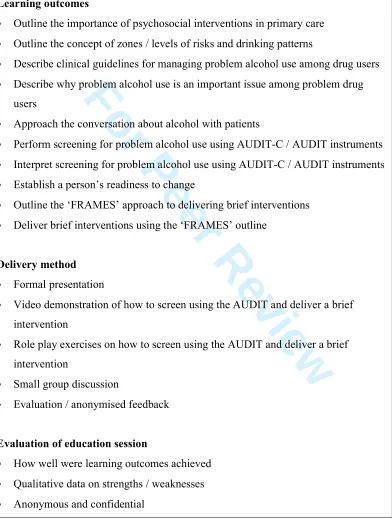
intervention around problem alcohol use in problem drug users. A full list of the learning
outcomes can be found in Figure 1.
For Peer Review
Content of the session was drawn from previous work of the research team, as well as from
two recent initiatives conducted among general patient population in UK (Kaner et al., 2013)
and US (Muench et al., 2012).
<insert Figure 1 here>
The four sessions were delivered by one or two of the co-authors of this paper (WC, JK, KL
or LM) in a group setting, taking approximately 45 minutes, with an average of four
participants in each. Three sessions were practice-based and one was delivered at the medical
school. Delivery methods utilised during the sessions included a formal presentation, a video
demonstration of how to screen using the AUDIT and deliver a brief intervention, a role play
exercise on how to screen using the AUDIT and deliver a brief intervention, a small group
discussion and an evaluation / anonymised feedback. A manual for the trainers was
developed before delivery of the session in collaboration with a member of the research team
(RA) who previously led the national alcohol aware practice service initiative (Anderson et
al., 2006). The sessions were accredited for Continued Medical Education (CME) purposes
by the Irish College of General Practitioners.
Session evaluation
Following each session, participants were asked to complete a structured evaluation, which
elicited quantitative (practice / practitioner characteristics, self-reported achievement of
learning outcomes, usefulness of the session) and qualitative data (acceptability of the
session, learning needs and suggested improvements).
Findings
Evaluation of the educational session
For Peer Review
Perceived knowledge / ability of conducting alcohol screening and brief intervention was
measured using a five point likert-type scale (4= strongly agree – 0= strongly disagree) where
participants were asked to rate their ability/ understanding of 10 learning outcomes of the
session (e.g. ‘As a result of the session, I am better able to outline the importance of
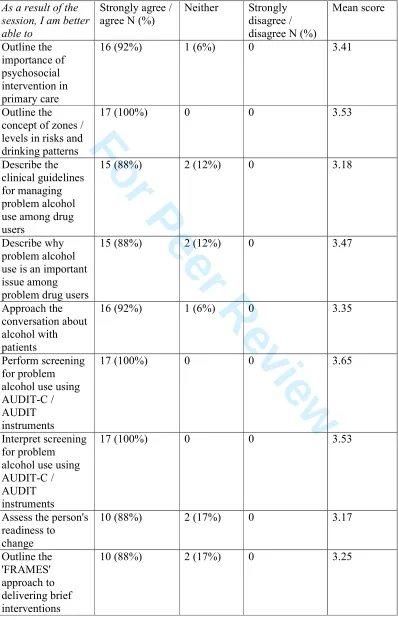
psychosocial interventions in primary care’). The mean knowledge/ ability score was 30.9
(SD= 6.09), the highest rated learning outcome was “Perform screening for problem alcohol
use using AUDIT-C / AUDIT instruments” (3.65, SD= 0.49) the lowest was “Assess the
person's readiness to change” (3.17, SD= 0.72).
Usefulness of the session was evaluated using a five point likert-type scale (4= strongly agree
– 0= strongly disagree) where participants were asked to rate the usefulness of five delivery
methods utilised during the session (e.g. ‘The following were useful in helping me achieve
these outcomes - presentation’). The group mean for the usefulness score was 16.4 (SD=
2.35), the most useful delivery method was small-group discussion (3.53, SD= 0.51), the least
useful delivery method was simulation/ role-play (2.82, SD= 0.73; NB. Role play was not
conducted in two sessions). For a complete list of knowledge and usefulness ratings, see
Table 1.
<insert Table 1 here>
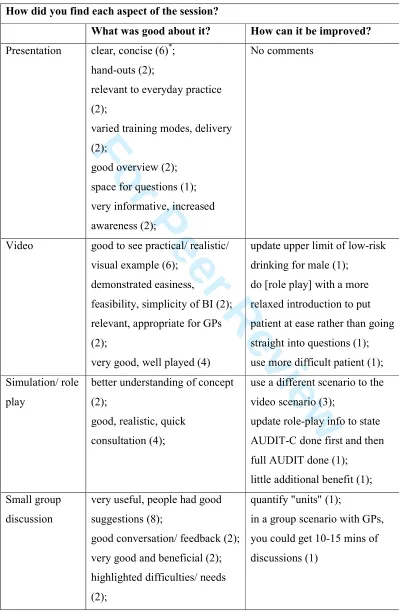
Acceptability of the session to participants was assessed with open-ended questions which
asked participants to write what was good (bad) about each of the five delivery methods
utilised during the session. The characteristic of the presentation which participants most
liked was “clarity and conciseness”. They had no negative feedback about presentation.
The characteristic of the video which participants most liked was that it was “good to see a
practical, realistic and visual example” and they also appreciated that it was “well played”.
For Peer Review
Some suggested that the next role play is done “with a more relaxed introduction to put
patient at ease rather than going straight into questions”. The characteristic of the role play
which participants most liked was that it represented a “realistic and quick consultation”.
Three suggested “use of a different scenario to the video scenario”. The participants felt the
small-group discussion was very useful because “people had good suggestions”, “good
conversation and feedback”. One commented about the length of such discussion in a real
training situation with GPs.
The characteristic of the guideline demonstration which participants most liked was that it
was “always handy to check you are doing right thing”. Two needed the demonstration to be
more specific and more time for this to be allocated.
Finally, trainees were given an opportunity to comment on their educational needs or provide
suggestions for improvement of the session. Table 2 summarizes participants’ answers to
these questions.
<insert Table 2 here>
Would any other educational interventions or activities help participants?
Only six responded to this question, indicating that “more simulation or role play may be
helpful” and each should be given “a case example and feedback from others re suggestions
for improvement”. Other comments about additional educational activities are listed in Table
2.
Suggestions for improvement of the education session in general
While, four trainees reported that the session “was useful / don't feel any changes are
required”, one needed “more guidance with guidelines” and one suggested to “repeat this
after trial of AUDIT score / brief intervention” (See Table 2).
For Peer Review
DiscussionA CME-approved educational workshop to enable GPs screen for or treat problem alcohol
use among problem drug users was received favourably. Most useful components of the
training were presentation, handout and group discussion with participants appreciating the
opportunity to share their ideas with their peers.
Our findings support the literature which highlights the potential of educational workshops,
using ‘interactive didactics’ and videos, as feasible and acceptable means of improving
knowledge of addiction medicine among medical doctors and interns (Brown et al., 2013,
Walters et al., 2005, Muench et al., 2012). Satisfaction and acceptability of our education by
medical professionals was comparable with previous research (Hettema et al., 2009, Lester et
al., 2005), attesting to the utility of involving GPs and nurses into the development of
educational interventions. We’ve ensured that their views are included via qualitative
interviews conducted in the pre-clinical and modelling stages of intervention development
(Field et al., 2011). In this study, some aspects of the educational session were more helpful
than has been reported in other literature, i.e. sharing ideas with peers vs. gaining new
insights (Lester et al., 2005). It could be speculated that this was due to the specific focus of
our session or a limited availability of addiction education workshops for GPs in Ireland
(O’Brien and Cullen, 2011). Only a handful of GPs in the regions under study have been
exposed to training in alcohol awareness (Anderson et al., 2006) and for many GPs in Ireland,
talking about their ideas in a group format may be of great value in itself. The ‘MRC
framework for health service interventions was successfully applied to develop the complex
intervention, as in previous studies conducted in primary care (Paul et al., 2007, Lester et al.,
For Peer Review
2005, Cullen et al., 2006). The development procedure also showed feasibility of engaging
medical students in the design and evaluation of educational sessions for medical professions,
and thus bridging the gap between undergraduate and postgraduate medical education
(O'Regan et al.).
The brevity of the training developed in this pilot project is one of its novel and valiant
features. The decision to keep the educational session so brief was influenced mainly by the
prequel to this study, which used qualitative interviews with 68 primary care professionals
and patients, and found, consistently with international literature, that lack of time is a key
barrier to implementation of psychosocial interventions for problem alcohol use in primary
care (Babor and Higgins-Biddle, 2001, Field et al., 2011). The session aimed for attaining
the maximum possible transfer of knowledge, while keeping the time requirements minimal,
thus increasing acceptability of the intervention for professionals. That none of the
participants complained about the shortness of the session suggests that it was accepted well
and has delivered what it set out to do. On the other hand, the response to the role play was
somewhat tepid. Why might this be the case? Possibly, it could take people a little while to
warm up to role play in a group, and feel comfortable with it. However, this interpretation
should be taken with caution because not all participants were exposed to the role play and
only six provided feedback about this component.
The current study is limited in several ways. Our sample was atypical in terms of its
composition, size and sampling method which all may have biased the generalisability of our
findings. They may not be generalizable to the larger population of GPs involved in
methadone treatment. The health care professionals participated voluntarily, were not obliged
to take part in the training or utilise the new learning in practice. Everybody in the
For Peer Review
participating practices was invited to the sessions via a formal letter, but not all clinicians
took up the training opportunity and we did not measure practice attendance rates. Therefore,
we may have recruited only motivated ‘enthusiasts’ who felt more confident and competent
in addressing alcohol issues with patients. In the absence of a skills assessment before the
session, the true impact of the training on participants’ knowledge and skills may have
remained hidden. Finally, the sessions were led by multiple facilitators which influenced the
content and format of sessions to a small degree. Our core focus on application of a validated
framework for development of complex interventions (MRC), together with acquisition of
both qualitative and quantitative feedback from participants, suggest a compelling potential
value of the intervention for evaluation in future feasibility studies and clinical trials.
Conclusion
Training GPs and other primary care professionals in screening, brief intervention and
referral to treatment for problem alcohol use among problem drug users is feasible. Along
with educational workshops, implementation strategies should utilise level,
multi-faceted interventions to support these activities among GPs. Further research involving a
complex intervention which incorporates these elements is a priority; if feasible, such
research could have implications for the role of general practice in the management of
alcohol use disorders among problem drug users and other vulnerable groups.
For Peer Review
AcknowledgementsThe authors wish to thank study participants and colleagues from UL GEMS, Jennifer
Fitzgerald, Geoff McCombe and Laoise Hogan and PINTA project steering group. KL used
this research for partial fulfilment of his Year 3 Special Study Module at the Graduate Entry
Medical School, University of Limerick.
Source of funding
Health Research Board of Ireland funded the study (Grant ID: HRA-HSR-2012-14).
Conflicts of interest
None reported.
For Peer Review
ReferencesANDERSON, R. J., COLLINS, C., DALTON, Y., DORAN, G. & BOLAND, M. 2006.
Alcohol aware practice service initiative. Final report - August 2006., Dublin, Irish
College of General Practitioners.
BABOR, T. F. & HIGGINS-BIDDLE, J. 2001. Brief Intervention For Hazardous and
Harmful Drinking. A Manual for Use in Primary Care, Geneva, WHO.
BAER, J. S., ROSENGREN, D. B., DUNN, C. W., WELLS, E. A., OGLE, R. L. &
HARTZLER, B. 2004. An evaluation of workshop training in motivational
interviewing for addiction and mental health clinicians. Drug and Alcohol
Dependence, 73, 99-106.
BETTERTON, J., HAYWOOD, J., HEAVERSEDGE, J. & GERADA, C. 2004. Developing
new roles for general practitioners: senior house officer posts caring for patients who
are homeless or have substance misuse problems. Education for Primary Care, 15,
58-63.
BRENNAN, C., NEWTON, M., WOOD, F., SCHUG, S. A., ALLSOP, S. & BROWNE, A.
L. 2013. Training general practitioners in remote Western Australia in a method of
screening and brief intervention for harmful alcohol use: A pilot study. Australian
Journal of Rural Health, 21, 72-79.
BROWN, A. T., KOLADE, V. O., STATON, L. J. & PATEL, N. K. 2013. Knowledge of
addiction medicine among internal medicine residents and medical students. Tenn
Med, 106, 31-3.
CAMPBELL, M., FITZPATRICK, R., HAINES, A., KINMONTH, A. L., SANDERCOCK,
P., SPIEGELHALTER, D. & TYRER, P. 2000. Framework for design and evaluation
of complex interventions to improve health. BMJ, 321, 694-6.
CHOSSIS, I., LANE, C., GACHE, P., MICHAUD, P. A., PECOUD, A., ROLLNICK, S. &
DAEPPEN, J. B. 2007. Effect of training on primary care residents' performance in
brief alcohol intervention: a randomized controlled trial. J Gen Intern Med, 22,
1144-9.
COLE, B., CLARK, D. C., SEALE, J. P., SHELLENBERGER, S., LYME, A., JOHNSON, J.
A. & CHHABRIA, A. 2012. Reinventing the Reel: An Innovative Approach to
Resident Skill-Building in Motivational Interviewing for Brief Intervention.
Substance Abuse, 33, 278-281.
For Peer Review
CULLEN, W., STANLEY, J., LANGTON, D., KELLY, Y., STAINES, A. & BURY, G.
2006. Hepatitis C infection among injecting drug users in general practice: a cluster
randomised controlled trial of clinical guidelines' implementation. Br J Gen Pract, 56,
848-56.
FARRELL, M. & BARRY, J. 2010. The Introduction of the Opioid Treatment Protocol,
Dublin, Health Service Executive.
FIELD, C. A., KLIMAS, J., CULLEN, W., BARRY, J., BURY, G., KEENAN, E., LYONS,
S. & SMYTH, B. P. 2011. Exploring healthcare professionals experience and attitudes
towards screening for and treatment of problem alcohol use among drug users
attending primary care. ADEGS/AUDGPI Scientific Meeting, 20-21.1.2011. Dublin,
Ireland.
HETTEMA, J. E., SORENSEN, J. L., UY, M. & JAIN, S. 2009. Motivational Enhancement
Therapy to Increase Resident Physician Engagement in Substance Abuse Education.
Substance Abuse, 30, 244-247.
KANER, E., BLAND, M., CASSIDY, P., COULTON, S., DALE, V., DELUCA, P.,
GILVARRY, E., GODFREY, C., HEATHER, N., MYLES, J., NEWBURY-BIRCH,
D., OYEFESO, A., PARROTT, S., PERRYMAN, K., PHILLIPS, T., SHEPHERD, J.
& DRUMMOND, C. 2013. Effectiveness of screening and brief alcohol intervention
in primary care (SIPS trial): pragmatic cluster randomised controlled trial. BMJ, 346.
KLIMAS, J., FIELD, C.-A., CULLEN, W., O'GORMAN CLODAGH, S. M., GLYNN
LIAM, G., KEENAN, E., SAUNDERS, J., BURY, G. & DUNNE, C. 2012a.
Psychosocial interventions to reduce alcohol consumption in concurrent problem
alcohol and illicit drug users. Cochrane Database of Systematic Reviews [Online].
Available:
http://onlinelibrary.wiley.com/doi/10.1002/14651858.CD009269.pub2/abstract.
KLIMAS, J., FIELD, C.-A., CULLEN, W., OGORMAN, C., GLYNN, L., KEENAN, E.,
SAUNDERS, J., BURY, G. & DUNNE, C. 2013. Psychosocial interventions to
reduce alcohol consumption in concurrent problem alcohol and illicit drug users:
Cochrane Reviewa. Systematic Reviews, 2, (12 January 2013).
KLIMAS, J., FIELD, C. A., BARRY, J., BURY, G., KEENAN, E., LYONS, S., SMYTH, B.
& CULLEN, W. 2012b. Commentary on ‘The research translation problem: Alcohol
screening and brief intervention in primary care – Real world evidence supports
theory’. Drugs: Education, Prevention, and Policy, 19, 88-90.
For Peer Review
LESTER, H., TAIT, L., KHERA, A., BIRCHWOOD, M., FREEMANTLE, N. &
PATTERSON, P. 2005. The development and implementation of an educational
intervention on first episode psychosis for primary care. Med Educ, 39, 1006-14.
MILLER, W. R., YAHNE, C. E., MOYERS, T. B., MARTINEZ, J. & PIRRITANO, M.
2004. A randomized trial of methods to help clinicians learn motivational
interviewing. J Consult Clin Psychol, 72, 1050-62.
MUENCH, J., JARVIS, K., BOVERMAN, J., HARDMAN, J., HAYES, M. & WINKLE, J.
2012. Tilling the Soil While Sowing the Seeds: Combining Resident Education with
Medical Home Transformation. Substance Abuse, 33, 282-285.
O'REGAN, A., CULHANE, A., DUNNE, C., GRIFFIN, M., MCGRATH, D., MEAGHER,
D., O'DWYER, P. & CULLEN, W. Integrating postgraduate and undergraduate
general practice education: qualitative study. Education for Primary Care, 24,
158-164.
O'TOOLE, T. P., HANUSA, B. H., GIBBON, J. L. & BOYLES, S. H. 1999. Experiences and
attitudes of residents and students influence voluntary service with homeless
populations. Journal of General Internal Medicine, 14, 211-216.
O’BRIEN, S. & CULLEN, W. 2011. Undergraduate medical education in substance use in
Ireland: a review of the literature and discussion paper. Irish Journal of Medical
Science, 180, 787-792.
PAUL, G., SMITH, S. M., WHITFORD, D., O'KELLY, F. & O'DOWD, T. 2007.
Development of a complex intervention to test the effectiveness of peer support in
type 2 diabetes. BMC Health Services Research, 7, 136.
PUSKAR, K., GOTHAM, H. J., TERHORST, L., HAGLE, H., MITCHELL, A. M.,
BRAXTER, B., FIORAVANTI, M., KANE, I., TALCOTT, K. S., WOOMER, G. R.
& BURNS, H. K. 2012. Effects of Screening, Brief Intervention, and Referral to
Treatment (SBIRT) Education and Training on Nursing Students’ Attitudes Toward
Working With Patients Who Use Alcohol and Drugs. Substance Abuse, 34, 122-128.
RYDER, N., CULLEN, W., BARRY, J., BURY, G., KEENAN, E. & SMYTH, B. P. 2009.
Prevalence of problem alcohol use among patients attending primary care for
methadone treatment. BMC Fam Pract, 10, 42.
SMITH, T., BOTELHO, R. & MATHERS, N. 2007. Making healthy choices easier: an
evaluation of a motivational practice workshop. Education for Primary Care, 18,
76-83.
For Peer Review
WALTERS, S. T., MATSON, S. A., BAER, J. S. & ZIEDONIS, D. M. 2005. Effectiveness
of workshop training for psychosocial addiction treatments: a systematic review. J
Subst Abuse Treat, 29, 283-93.
For Peer Review
Tables and FiguresFigure 1: Learning outcomes, delivery method / content and initial evaluation of the session
Learning outcomes
• Outline the importance of psychosocial interventions in primary care
• Outline the concept of zones / levels of risks and drinking patterns
• Describe clinical guidelines for managing problem alcohol use among drug users
• Describe why problem alcohol use is an important issue among problem drug
users
• Approach the conversation about alcohol with patients
• Perform screening for problem alcohol use using AUDIT-C / AUDIT instruments
• Interpret screening for problem alcohol use using AUDIT-C / AUDIT instruments
• Establish a person’s readiness to change
• Outline the ‘FRAMES’ approach to delivering brief interventions
• Deliver brief interventions using the ‘FRAMES’ outline
Delivery method
• Formal presentation
• Video demonstration of how to screen using the AUDIT and deliver a brief
intervention
• Role play exercises on how to screen using the AUDIT and deliver a brief
intervention
• Small group discussion
• Evaluation / anonymised feedback
Evaluation of education session
• How well were learning outcomes achieved
• Qualitative data on strengths / weaknesses
• Anonymous and confidential
For Peer Review
Table 1 Self-reported ratings of knowledge or ability of conducting alcohol screening and
brief intervention and usefulness of the session
As a result of the session, I am better able to
Strongly agree / agree N (%)
Neither Strongly
disagree / disagree N (%)
Mean score Outline the importance of psychosocial intervention in primary care
16 (92%) 1 (6%) 0 3.41
Outline the concept of zones / levels in risks and drinking patterns
17 (100%) 0 0 3.53
Describe the clinical guidelines for managing problem alcohol use among drug users
15 (88%) 2 (12%) 0 3.18
Describe why problem alcohol use is an important issue among problem drug users
15 (88%) 2 (12%) 0 3.47
Approach the conversation about alcohol with patients
16 (92%) 1 (6%) 0 3.35
Perform screening for problem alcohol use using AUDIT-C / AUDIT instruments
17 (100%) 0 0 3.65
Interpret screening for problem alcohol use using AUDIT-C / AUDIT instruments
17 (100%) 0 0 3.53
Assess the person's readiness to change
10 (88%) 2 (17%) 0 3.17
Outline the 'FRAMES' approach to delivering brief interventions
10 (88%) 2 (17%) 0 3.25
For Peer Review
Deliver briefinterventions using the 'FRAMES' outline
10 (88%) 2 (17%) 0 3.25
The following were useful in helping me achieve these outcomes
Strongly agree / agree N (%)
Neither Strongly
disagree / disagree N (%)
Mean score
Presentation 16 (94%) 1 (6%) 0 3.47
Video 15 (88%) 2 (12%) 0 3.41
Simulation / Role play
11 (65%) 6 (35%) 0 2.82*
Q & A 17 (100%) 0 0 3.53
Guideline demonstration
15 (88%) 2 (12%) 0 3.18
* NB. Role play was not conducted in two sessions
For Peer Review
Table 2 – Acceptability of the educational sessionHow did you find each aspect of the session?
What was good about it? How can it be improved?
Presentation clear, concise (6)*;
hand-outs (2);
relevant to everyday practice
(2);
varied training modes, delivery
(2);
good overview (2);
space for questions (1);
very informative, increased
awareness (2);
No comments
Video good to see practical/ realistic/
visual example (6);
demonstrated easiness,
feasibility, simplicity of BI (2);
relevant, appropriate for GPs
(2);
very good, well played (4)
update upper limit of low-risk
drinking for male (1);
do [role play] with a more
relaxed introduction to put
patient at ease rather than going
straight into questions (1);
use more difficult patient (1);
Simulation/ role
play
better understanding of concept
(2);
good, realistic, quick
consultation (4);
use a different scenario to the
video scenario (3);
update role-play info to state
AUDIT-C done first and then
full AUDIT done (1);
little additional benefit (1);
Small group
discussion
very useful, people had good
suggestions (8);
good conversation/ feedback (2);
very good and beneficial (2);
highlighted difficulties/ needs
(2);
quantify "units" (1);
in a group scenario with GPs,
you could get 10-15 mins of
discussions (1)
For Peer Review
Guidelinesdemonstration
becoming familiar again (3);
good to have hand out, clear
flow charts (3);
useful summary (3), e.g. “very
helpful as would not get time to
source guidelines myself”;
make more obvious/ specific
(2);
not done/ more time for
discussing guidelines (2);
use traffic light to illustrate
process (1);
Would any other educational interventions / activities help participants?
• each give a case example and feedback from others re suggestions for
improvement
• more simulation / role play may be helpful
• not sure/ no (2x)
• an up to date list of local alcohol services & telephone Nos. Already have
many of them; [Are they] still current services / tel. numbers? Also number for
private alcohol counsellors if any known (or, if not, as a lot to ask for any of
above my jobs to sources them really)
• interactive online learning with maybe MCQ [Multi-choice questions]
Suggestions for improvement:
• it was useful / don't feel any changes are required (4x)
• more guidance with guidelines
• repeat this after trial of AUDIT score / brief intervention *
Numbers in brackets indicate how many participants reported about the particular item