Concrete: Construction’s Sustainable Option
Cite this paper as follows:
O’Kelly B.C. 2008. Development of a test method towards assessing the soundness of concrete aggregates in service. Proceedings of the Seventh International Congress on
Concrete: Construction’s Sustainable Option, Dundee, Scotland, 8th–10th July, 2008, Vol. 3, pp. 137 – 142.
Development of a test method towards assessing the soundness of concrete
aggregates in service
Dr. Brendan C. O’Kelly
Lecturer in Civil Engineering
Department of Civil, Structural, and Environmental Engineering Museum Building, Trinity College Dublin, Dublin 2, Ireland.
Tel. +353 1896 2387 Fax. +353 1677 3072 [email protected]
ABSTRACT. The magnesium sulphate soundness (MSS) test is used to assess the soundness of coarse aggregate in the loose state. However, the use of the MSS test methodology in assessing the performance of aggregates set in mortar can be inconclusive as salt weathering and densification (filling of the pore voids) also occurs for the mortar matrix. Hence, the aggregate particles should ideally be set in an inert and impermeable matrix material whose stiffness properties are comparable with that of the mortar in high-strength concrete.
A new specimen preparation method in which the aggregate particles are set in an Epoxy adhesive resin is presented. Proving tests were conducted on natural limestone gravel (nominally 10-mm in size). The exposed surfaces of the gravel particles were tested using the same methodology as the MSS test. The gravel particles alone experience the effects of salt weathering which were quantified by gravimetric measurements and by careful visual inspection. The 28-day compressive strengths of the Epoxy resin and the mortar matrix in high-strength concrete were similar. However, dissimilarities in the stiffness characteristics were responsible for some internal micro-cracking of the resin specimens. Further studies using other synthetic resins that more clearly match the stiffness response of the mortar matrix are necessary to perfect the technique.
Keywords: Aggregate, Epoxy resin, Concrete, Soundness, Test, Test method.
INTRODUCTION
The soundness of an aggregate is a measure of its ability to resist degradation under repeated wetting and drying or freeze-thaw action. The standard magnesium sulphate soundness (MSS) test [1] is carried out on the coarse aggregate in the loose state. The freeze-thaw action is simulated in the test by five cycles of immersion in a supersaturated magnesium sulphate solution and oven drying. The salt solution that permeates the pore voids of the aggregate crystallise on oven drying, producing expansive bursting pressures. Previous studies to determine the performance of coarse aggregates set in concrete using the MSS test methodology were reported by O’Kelly [2]. However, assessments of the weathering effects based on gravimetric measurements alone (as per the standard MSS test) proved inconclusive. Salt weathering (progressive softening and disintegration) and densification of the mortar matrix also occurred. The densification was caused by the filling of the pore voids with residual crystalline salt and/or expansive reaction products. Instead, the soundness was largely assessed on the basis of a visual inspection of any exposed aggregate particles.
The aim of the research was to develop a new specimen preparation method that would allow more accurate MSS testing of concrete aggregates. The aggregate particles are set in an Epoxy adhesive resin; a chemically inert and water resistant material that has excellent adhesion, durability, toughness and heat resistance properties. Proving tests were conducted on natural limestone gravel.
The Young’s modulus of concrete is a function of the relative stiffness and the proportions of its different constituents. Ideally, the aggregate particles under study would be set in a matrix material whose stiffness characteristics are similar to that of the mortar matrix (typically 10– 30 GPa). Hence, compression tests were also conducted on specimens of ordinary Portland cement concrete and resin materials to compare their compressive strength and stiffness properties.
MATERIALS AND METHODS
Materials
Epoxy adhesive resin
Epoxy or polyepoxide is a thermosetting epoxide polymer that cures when mixed with a catalyzing agent. The thermoplastic (liquid) resin has a viscosity of about 0.34 Pa.s at a temperature of 25°C and can be poured or cast without air inclusions. The transition from the liquid to the solid state on adding the catalyzing agent occurs relatively quickly at ambient laboratory temperature. A semi-transparent resin (David’s Fastglas resin) was used in the present study. Crystal clear resins are also commercially available.
Concrete
EXPERIMENTAL METHODS
Soundness Testing of Aggregates set in Resin
Five Epoxy resin specimens (30.0-mm in diameter and typically 50.0-mm in length and 35 g in mass) were prepared in moulds. The specimen size was considered adequate for embedding a single aggregate particle (10-mm nominal size) bearing in mind the relative cost of the resin material. Proving tests were conducted on rounded, carboniferous limestone gravel particles of glacial origin that were of proven soundness in-service. One of the test specimens comprised resin only (control specimen) while the other four comprised a single gravel particle set in the resin.
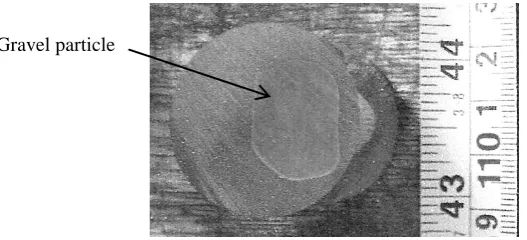
[image:3.595.130.394.319.439.2]The gravel particles were thoroughly washed in distilled water and oven-dried at a temperature of 105–110oC. The particles were then added to the liquid resin and the particles, having a higher specific gravity, sink to the bottom of the moulds. After being allowed to harden over a period of 28 days, an electric saw was used to cut across the specimen (reducing its overall length by about 5 mm) to expose the gravel particle (Figure 1).
Figure 1 Test specimen of aggregate set in resin material.
The test specimens were then subjected to five cycles of immersion in a supersaturated salt solution and oven drying following the MSS test methodology [1]. Each cycle comprised, in turn, immersion in a magnesium sulphate solution at a temperature of 20±2oC for a period of 17±5 hours; removal from the solution and drip drainage over a period of 2±¼ hours; oven drying at a temperature of 105–110oC for a period of at least 24 hours, and cooling at ambient laboratory temperature for a period of 5 ± ¼ hours. The specimens were thoroughly rinsed with tap water at the end of the final cycle. The specimen dry mass corresponding to each of the five cycles was recorded. The performance of the exposed gravel particles were also carefully examined by the naked eye during the course of the tests.
Strength and Stiffness of Concrete and Resin Materials
Standard compression tests were conducted on the concrete and resin mixes to determine typical 28-day compressive strength and stiffness properties of the materials. The concrete specimens comprised three 100-mm cubes and two cylinders (100.0-mm in diameter and 200.0-mm in length) that had been prepared from the same concrete batch. The resin specimens comprised three cylinders (30.0-mm in diameter and 50.0-mm in length) that were also manufactured from the same batch of material. The concrete specimens were allowed to cure under water and the resin specimens were allowed to harden (exothermic reaction) in air at ambient laboratory temperature over a period of 28 days before testing.
The compressive strength was determined by axially loading the concrete cubes and the resin specimens to failure [3]. The stiffness properties were determined from the stress-strain responses recorded on axially loading the cylindrical specimens at a rate of 0.6±0.4 N/mm2/s [4]. Three cycles of loading were applied in which the specimens were subjected to one-third of the mean compressive strength (determined previously from the concrete cubes) and maintained at this load level for 60 seconds before unloading again to a minimum stress of 4 kPa. The axial and lateral strain responses were recorded using two orthogonal strain gauges that had been glued to the surface of the specimen over its central gauge length.
EXPERIMENTAL RESULTS
Soundness Testing
The following were observed from a carefully inspection of the specimens by the naked eye:
o Some air voids were introduced in the resin as the gravel particles sank in the liquid material during the specimen preparation.
o Some internal micro-cracking of the resin matrix occurred for the specimens that contained gravel particles during the oven drying and cooling phases of the MSS tests (Figure 2a). However, there was no evidence to suggest that the salt solution had entered these cracks. The control specimen comprising resin alone did not experience any micro-cracking (Figure 2b).
o The most significant weathering effects due to the MSS tests were concentrated in a thin band next to the original surface of the gravel particles (Figure 2a). There was no evidence that particle de-bonding had occurred.
(a) Specimens containing gravel particles.
(b) Specimen comprising resin material only.
Figure 2 Test specimens at the end of the soundness tests.
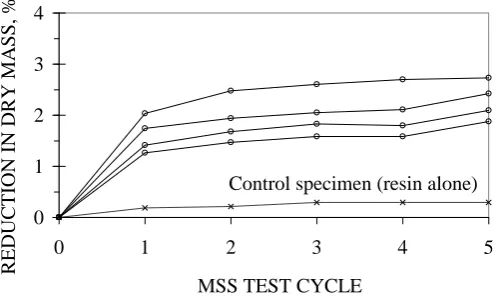
Figure 3 shows the percentage reductions in the dry masses of the five specimens (including the control specimen) at the end of each immersion and drying cycle of the MSS test. The four specimens containing gravel particles experienced a gradual but steady reduction in dry mass.
0 1 2 3 4
0 1 2 3 4 5
MSS TEST CYCLE
REDU
CTIO
N I
N D
RY MA
S
S
, %
Control specimen (resin alone)
Figure 3 Reduction in the specimen dry mass during the MSS tests.
Strength and Stiffness
The concrete and resin specimens had consistent densities of 2390 and 1130 kg/m3, respectively. The mean values of the 28-day compressive strength measured for the concrete and resin specimens were 48 and 45 N/mm2, respectively, although there was significant variability in the compressive strength values (37–58 N/mm2) of the resin material.
The stiffness of the materials was characterised by the Young’s Modulus and Poisson’s ratio values which were calculated from the applied stress and resulting axial and lateral strain responses of the cylindrical specimens. The concrete material had a Young’s modulus value of 24.5 GPa and a Poisson’s ratio value of 0.2. The resin material had a Young’s modulus value of about 6.1 GPa at low stress (micro-strain) levels, decreasing to about 3.3 to 5.0 GPa at larger strains, and a Poisson’s ratio value of 0.46 (typical value for elastomers).
ANALYSIS AND DISCUSSION
The compressive strengths measured for the Epoxy resin and the concrete were similar. However, the stiffness properties of the two materials were significantly different. The resin (David’s Fastglas) had typical Young’s modulus and Poisson’s ratio values of 3.3–6.1 GPa and 0.46, respectively, whereas the concrete had values of about 24 GPa and 0.20, respectively. The dissimilarity in the stiffness characteristics was most likely responsible for some internal micro-cracking experienced by the resin specimens that contained gravel particles. Furthermore, the salt weathering would most likely have caused slightly greater disruptive effects for the aggregate particles set in resin since the resin matrix has less stiffness and will therefore offer less resistance than mortar to the bursting pressures that develop within the aggregate particles. Further studies using other commercially available synthetic resins that more closely match the stiffness characteristics of the mortar in high-strength concrete are necessary to perfect the technique.
CONCLUSIONS
1) A new method of assessing the soundness of aggregate set in concrete has been presented. The exposed surface of aggregate particles that have been set in an Epoxy adhesive resin are tested using the same methodology as the magnesium sulphate soundness test.
2) The aggregate particles alone experience the effects of salt weathering which are quantified by gravimetric measurements and by careful visual inspection of the test specimens.
3) The compressive strengths of the Epoxy resin and the mortar in high-strength concrete are similar. However, the dissimilarities in the stiffness characteristics of the two materials were responsible for some internal micro-cracking of resin specimens containing gravel particles. Further studies using other synthetic resins that more clearly match the stiffness characteristics of mortar, are necessary to perfect the technique.
ACKNOWLEDGEMENTS
The author would like to kindly acknowledge David Martin, George Jones and Eoin Dunne for carrying out the laboratory tests.
REFERENCES
1. BS812: PART 121. Testing Aggregates: Method for Determination of Soundness, British Standards Institution, London, 1989.
2. O’KELLY B C. Study of the performance of natural gravel of marginal soundness in concrete. Proceedings of the Seventh International Congress on Concrete: Construction’s Sustainable Option, 8–10 July, Dundee, Scotland, 2008.
3. BS1881: PART 116. Testing Concrete: Method for Determination of Compressive Strength of Concrete Cubes, British Standards Institution, London, 1983.