THE ECONOMIC AND SOCIAL RESEARCH INSTITUTE COUNCIl,. 1987 - 1988
"I’OM;~S F. (~) COFAIGI{. I’rr~tFtent of Institute
’1). ]:. Nh’AI.I~ESI~. }].COMM., M.A., M.ECON.SC.. I’1-].1).. Cbatrmant!f the Council
D..J BUCKLEY, Vice President and General Manager. Merck. Sharp and Dohme (Ireland) Ltd., Co Tippemrv
I. CONNEI.LAN. B.E.. C ENG.. M.I.i’.I.. Dbecto~ General, Cbnfedemtion o[ hinh InduatEr
¯ S EAN C RaM l EN. B,A., Strma9’, Department of Finanre
MICHAEl. P CUI)I)Y. M,AGR.SC.. PH.I).. Iqofes~m,Department ~t[ Etonomics, Univtvd(r College. Cahvar
G. DEAN. M.D.. F.R.C.P.
MARGARET DOWNF.S. R.COMM.. F.C.A.. CenJultant, C’oopei~ and Lrbrand
MAURICE F, I)O’~’I.E, B.A., B I.., (hmerno~, Central Bank of Ireland P. ~,V F[.ANAGAN, SecretaEL Department of fDalth.
NJ. GIBSON. B,SC,(ECON ). PHI),. I#o.l’iee-Chanrello., Unit, osio, of Uhwt, Coleraine
PATRICK A, HAI.I,. B.E.. M.S.. I)IP.STA’I’., DirectoroJReJearch, Institute of Public .,Idministmtion.
MICHAEL F, KEFC;AN. B.A, B.COMM., D.P.A., FA.P.M.. Sccrelarv. Depaament of Labour
’KIERAN A. KENNED’~’. M.ECON SC.. D.PHII,.. PH.I)., Diwcwr ~![ Institute
T P I.INEIIAN. H.F... B.SC. Directm. Central A’tati*ttcl Office P. LYNCII. M.A., M.R.I.A.
°EUGENE McCARTHY. M.SC,(ECON.). I) F.CON.SC., Director, b~derated Union of Empl~re,~.
.IOHN .J. McKAY. B.S(~:.. D.P.A., B.COMM.. M.I~CON.SC.. Cble[ E~a’utive Office1, Ca. Cavan I’~cational l’2ducatien Committee
’D. N EVI N. General Secmar)’, ht]~h Co~¢~eaJ of Trade Unions.
REV.J.R.M. NOLAN. M A . I).1).. ~.l.A.(Cantab.). Pmfe~ol. Department of Log& and Pzyehologr, Uniuersit), College, Dublin.
JOYCE O’CONNOR. B.SOC.SC,. NI.SOC.SC.. I’I-I.D.. Direao~. Social Re, earth Centre. College of Ilumanitie4. National Inrtitute for II~qher Education. Lhnedek.
F.IAURICE O’(’;RAI)Y. M.SC(MGNT). Direaor General. huh Managevnent Institute
D. P. O’MAHONY. M,A , PH.D.. B.L. I#ojeJsot. Department r(E~onom,~. University (~)dl£~e. Cork
S.S H EEH Y. B.AG R .SC.. P H. D.. Professor, Department of Applied Agricultural Economies. Unit,erxiO, College, Dublin.
.I- SP ENC F R. B.SC .( EC( )N. ), Profe~Jol. Department of Eeonomw~. The Queen !~ Unie,ersitr, Belfa~t
T. C. "I’ONER. H (;()MM . hi.B.A.. Managing Director. BIVG Led
"B. M. "~VALSH, B.A. M,A.. I’HA).. Pmfea~o~, National E¢enomi£~ ofheland
and Applied Economtc]. Universltv College. Dublin. T. ;VALSH. M,AGR.5C.. PII.D., I).SC., M,R,I,A.
’REV C K. ;VARD. B.A.. S.’I’.I... I’H.D.. Profesror. Department of A’oct¢ll Science. UniverdO, College, Dublin.
"T. K. WHITAKER, M,SC,(ECON). D ECON.5;C., LI..D.
DISABILITY BENEFIT REFORM: RATIONALISATION OR SUBSIDISATION?
Copies of this paper may be obtained from The Economic and Social Research Insthute (Limited Company No. 18269), Registered Office: 4 Burlington Road, Dublin 4.
Price I R£4.00
DISABILITY BENEFIT REFORM: RA TIONA LISA TION OR SUBSIDISA TION?
GERARD HUGHES
© THE ECONOMIC AND SOCIAL RESEARCH INSTITUTE DUBLIN 1988
Acknowledgements
Chapter 1 2 3 4 5 CONTENTS General Summary INTRODUCTION
THE DISABILITY BENEFIT SCHEME, CRITICISMS AND RATIONALISATION PROPOSALS
2.1 The Disability Benefit and Invalidity Pension Schemes
2.2 Criticisms of the Disability Benefit Scheme 2.3 Proposals for Rationalising the Disability Benefit
Scheme
2.4 Trade Union and Employer Responses 2.5 Reasons for Reform of the Disbility Benefit
Scheme
ASSESSMENT OF ARGUMENTS FOR REFORM 3.1 Use and Cost of Incapacity Schemes
3.2 International Data on Sickness Absence 3.3 Abuse of the Disability Benefit Scheme
3.4 Market Failure and the Growth of Occupational Sick Pay Schemes
3.5 The Disability Benefit Scheme and the Incentive to Work
3.6 Conclusion
EXPERIENCE WITH STATUTORY SICK PAY IN THE UNITED KINGDOM
4.1 Introduction
4.2 The Case fox" Statutory Sick Pay in the United Kingdom
4.3 Evaluations of Statutory Sick Pay in the United Kingdom
APPENDIX Page
Minister for Social Welfare’s Announcement of Govern-ment’s Decision to Transfer Responsibility for Short-term
Sickness Benefit to Employers. 72
Table
2.1
2.2
3.1
3.2 3.3
3.4 3.5
3.6 3.7
4.1 4.2
4.3 4.4
LIST OF TABLES
Absence rates in some companies reported in the
press since 1980 13
Allegations in the press of abuse of the Disability
Benefit and Medical Referee schemes since 1980 16 Recipients of incapacity benefit, number of payments made, number of weeks for which benefit was paid,
and number insured for all benefits, 1954-86 25 Frequency, duration and rate of incapacity, 1954-86 28 Expenditure on incapacity benefits, GNP, expenditure as a per cent of GNP, average expenditure per claim
in current and constant (1970) prices, 1953-86 32 Outcome of Disability Benefit claims referred for a
second medical opinion, 1955-86 38
Regression of the percentage of claims rejected on the percentage of claimants summoned for a second medical examination during the periods 1955-78,
1955-86, and 1979-86 39
Overall estimates of coverage by sick pay scheme 43 Weekly income in work and out sick for single and
married men and replacement ratios after three weeks
on Disability Benefit from July 1988 49
Impact of SSP on public funds , 1986/87 (when
extended to 28 weeks) (DHSS accounting format) 60 Impact of SSP on employers, 1986/87 (when extended to 28 weeks) (DHSS accounting format) 61 Impact of SSP on employers’ direct costs (at 1983/84
rates) (DHSS accounting format) 62
Impact of SSP on employees, 1986/87 (when
LIST OF CHARTS Page
3.1
3.2
3.3
3.4
3.5
3.6 3.7
3.8 3.9
3.10
3.11 3.12
Number of recipients of DB, and DB plus IP on 31 December, 1954-86
Number of DB, and DB plus IP payments in year ended 31 March or 31 December, 1954-86
Number of weeks illness for which DB, and DB plus IP were paid in year ended 31 March or 31
December, 1954-86
DB, and DB plus IP spells per 1,000 persons at risk, 1954-86
Days on DB, and DB plus IP per person at risk, 1954-86
DB rate, and DB plus IP rate on 31 December, 1954-86
Expenditure on DB and IP in current and constant (1970) prices in year ended March or December,
1953-86
Annual expenditure on DB, and DB plus [P as a percentage of GNP, 1953-86
Average expenditure per claim on DB plus IP in current and constant (1970) prices, 1954-86 Outcome of Disability Benefit claims referred for
second medical opinion, 1955-86
Distribution by duration of Disability Benefit spells terminated in 1986
Replacement ratios by income group for single and married men after three weeks on DB from July 1988
26 26
27 29
29 30
33 33
34
39 46
CIE CIF CII
DB DEPD DHSS FUE IP
NESC OSP
PRSI RR SSP TFA
ABBREVIATIONS Coras Iompair Eireann
Construction Industry Federation Confederation of Irish Industry Disability Benefit
Dall Eireann, Parliamentary Debates Department of Health and Social Security Federated Union of Employers
Invalidity Pension
National Economic and Social Council Occupational Sick Pay
Pay Related Social Insurance Replacement Ratio
GENERAL SUMMAR Y
Proposed New State Sick Pay Scheme
The Minister for Social Welfare announced in a Press Release in July 1987 that the Government has decided to introduce a new sick pay scheme which ,,’,’ill transfer responsibility for the payment of sickness benefit to employers for the first 13 weeks of illness. The new scheme is to be introduced as soon as practicable. It will be referred to it in this paper as the Statutory Sick Pay scheme.
At present both the state and many employers provide income maintenance for employees who are absent fi’om work due to illness. The state sick pay benefits are provided through the Disability Benefit scheme administered by the Department of Social Welfare and the employer sick pay bcnefiis arc provided through occupational sick pay schemes.
The broad outline of the new scheme indicates that employers will be required by statute to maintain the earnings of employees through a company sick pay scheme as close as possible to normal earnings. In return for taking over this responsibility from the state employers ",’,,ill be compensated for sickness payments made to employees. The precise amount and method of compensation are to be worked out in discussion with employers.
Smaller employers will be exempt from the new scheme because of time difficulties which it would be likely to impose on them. Their employees will continue to be covered by the Disability Benefit scheme. The Government intends that all employers will eventually participate in the new scheme. Responsibility for sickness payments to those whose illness lasts more than 13 weeks will continue to be exercised by the
Department of Social Welfare.
At present these are the only details whicfm the Government has made public about time new scheme and it appears that it does not expect to
make any further information available bclbre final details of the scheme are announced. However, it seems fi’om the broad outline of the new scheme that it is modelled on time British Statutory Sick Pay schemc which was introduced by time Conservative Government in 1983.
It transferred responsibility for sick pay for the first 8 weeks illness from the state to employers. The British scheme has been in existence for nearly 5 years and some assessments of its effectiveness have now been made. They suggest that it has not resulted in the reductions in Government expenditure and public service staff numbers which the
British Government hoped for. They also suggest that the scheme may have resulted in additional costs to the Exchequer through subsidisation of some employers’ sick pay costs.
There is no indication in the broad outline of the Irish Statutory Sick Pay scheme that its design has been influenced by these findings. It would be a pity if we simply took the British scheme as a model without making use of their experience to modify our Statutory Sick Pay scheme in ways which will avoid the problems to which the British scheme is prone.
Possible Objectives of Reform
The Government has not issued any policy papers to explain what the objectives of the new scheme are, how it resolved the policy questions which must have arisen in connection with the proposal, and what gains and losses it expects to accrue to the various parties likely to be affected by the new arrangements. There is a danger that the adoption of an inappropriate method of compensating employers for administering the new scheme combined with the absence of clear objectives for the scheme may result in a lost opportunity to reduce sickness absence and to cut public expenditure on sickness benefit.
Since the Government has not explained in detail what its intentions are this paper reviews the background and development of the proposal for a Statutory Sick Pay scheme to see if objectives can be identified from the public discussion which has taken place about the need to reform the Disability Benefit scheme. It appears from this discussion that the main objectives which underlie the proposal to introduce Statutory Sick Pay are:
(i) to reduce public expenditure on sickness benefit by lowering the sickness absence rate;
(ii) to cut down on abuse of the DB scheme by claimants who are not genuinely ill;
(iii) to eliminate duplication in the administration of sick pay whereby both the state and the employer make sickness benefit payments;
(iv) to enable Disability Benefit to be taxed in order to reduce excessive replacement ratios.
Assessment of Arguments for Reform
As no evidence has been presented by the Government on the significance of these objectives the evidence which is available in various sources relating to the performance of the Disability Benefit scheme is
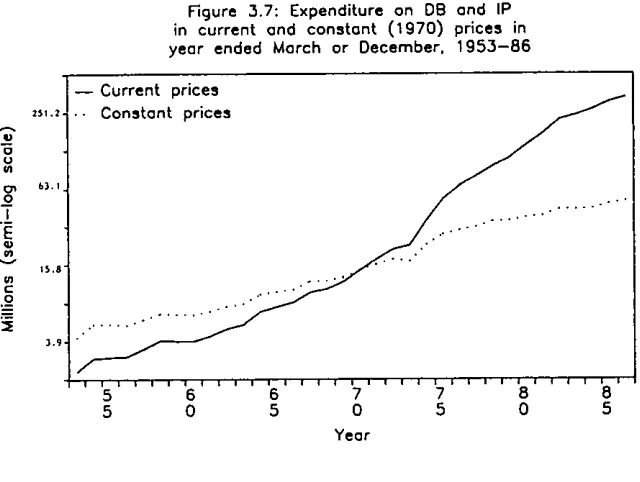
reviewed to see if it supports the case for reform. Examination of the performance of the Disability Benefit scheme from the early 1950s to the middle of the 1980s shows that the annual number of claims per 1,000 persons at risk has been noticeably reduced by the Department of Social Welfare in the last 8 years by a variety of methods designed to improve the efficiency of the procedures for identifying unjustified claims. However, the number of days for which each claim is paid per person at risk and the national sickness absence rate have not been reduced and the national sickness absence rate has increased from 10 per cent of the insured labour force in 1978 to over 11 per cent now. The evidence also shows that the cost of the DB scheme has more than tripled from less than £100 million in 1978 to over £330 million in 1986. This represents an increase of very nearly 50 per cent in real terms.
Comparisons of sickness absence data with countries which appear to have similar arrangements for income maintenance during illness as Ireland does show that the duration of illness per worker was considerably higher in Ireland than in other countries in the OECD. Thus, in 1981 there were 34 days of sickness absence per worker in Ireland, versus 23 in Sweden, 20 in the United Kingdom, 17 in Italy, and 14 in France. The international data also show that Ireland’s expenditure on sickness benefit as a percentage of GDP is high relative to other countries but that when expenditure on invalidity benefits is included its ranking is not exceptional. Although international comparisons are difficult because of differences in coverage and administration of sickness benefit schemes, the international data suggest that Ireland’s sickness absence problem is among the worst in the OECD.
The evidence relating to the cost and use of the Disability Benefit scheme indicates that the ol~jectives of reducing sickness absence and of cuuing public expenditure on sickness benefits are important and that a Statutory Sick Pay scheme could provide a means of giving employers
an incentive to reduce short-term sickness absence.
The argument for reforming the DB scheme because of the high level of abuse which is thought to exist does not receive much support fi’om the outcome of the referral of DB claims [br a second medical opinion under the medical referee scheme. The changes made in this scheme since the early 1980s have resulted in an improvement in the detection of unjustified claims frorn an average of 9 per cent in the years up to 1978 to about 14 per cent over the period 1980-86. While this figure is rather high it does not show that there is massive fl’aud in the DB scheme. It indicates that thc medical referee scheme can be quite effective
in identifying unjustified claims if it receives the resources which it needs to do its job properly.
The argument that there is duplication in the existing arrangements whereby both the state and the employer pay sickness benefit is supported for larger firms by the results of a national survey of occupational sick pay schemes undertaken in 1985 for the Department of Social Welfare. The survey showed that nearly three-fifths of the non-agricultural labour force are covered by an occupational scheme. The coverage rate was relatively high in larger firms and quite low in small firms. These differences in coverage rates may explain the Government’s decision to exempt small firms from the Statutory Sick Pay scheme.
The argument that the DB scheme itself and the exemption of DB from taxation provide a disincentive to work has been frequently made but very little evidence has been produced to support the case. There is an association between increases in sickness benefit payments and sickness absence rates but this does not mean that increases in these payments act as a disincentive to work. They may simply permit workers to take the time offwork which they need in order to return to full health. This, after all, is one of the primary objectives of income continuance plans whether publicly or privately provided.
The possible disincentive effect of DB payments has not, however, been overlooked by the authorities as they have reduced pay-related benefit three times in the last five years. The effect of these changes on the proportion of income from work replaced by transfer payments from the state while out sick can be shown by calculating replacement ratios for male employees in receipt of different incomes who are eligible for pay-related benefit. These calculations show that replacement ratios in excess of 100 per cent have now been eliminated for male employees with the exception of those who are at the bottom of the income scale. Hence, the argument for introducing Statutory Sick Pay in order to reduce excessive replacement ratios does not appear to be as strong as it was some years ago. However, the argument that it is necessary to tax Disability Benefit for reasons of tax equity remains strong.
Recent developments in connection with the taxation of short-term social insurance benefits in the United Kingdom, however, suggest that it may not be necessary to introduce a Statutory Sick Pay scheme to achieve this objective. The British Government has been able to modify the PAYE system in a way which allows the local social security office to act as an "employer" for tax purposes and it is possible that a similar method could be used to tax DB in lreland.
The main conclusion which the review of the evidence relating to the performance of the DB scheme leads is that the major objectives of reform should be to reduce sickness absence and to cut public expenditure on sickness benefit. A Statutory Sick Pay scheme could make a contribution to the achievement of these objectives by giving employers an incentive to control short-term sickness absence. Unfortunately, the method of compensation which the Government appears to favour in its Statutory Sick Pay scheme will not provide such an incentive. The reason is that employers are to be directly compensated in respect of payments for illness made to employees, probably by deduction of the relevant amount from their monthly PRSI payment to the Revenue Commissioners. This is the method of compensation used in the British Statutory Sick Pay scheme.
Experience with SSP in the UK
Studies of the operation of the British Statutory Sick Pay scheme have shown that compensating employers by allowing them to deduct the full cost of the statutory sickness benefit from their income tax and National
Insurance remittances to the Inland Revenue has led to the subsidisation of sick pay costs for employers who had an occupational sick pay scheme
before the introduction of the statutory scheme. It has also led to the elimination of financial benefits which were expected to accrue to the
British Exchequer, and to a smaller reduction in staff than was expected to take place in the Department of Health and Social Security.
Conclu$io?t$
The British experience with Statutory Sick Pay strongly suggests that if the Irish Government wishes to reap the advantages of a Statutory Sick Pay scheme it should stick to the original proposal to compensate employers for administering the scheme by a cut in the employer PRSI conntribution rate. If this is not done and a method of compensation adopted which is similar to that used in the British scheme the Irish Government could lose a lot of control over public expenditure on sickness benefit. Furthermore, there is a danger that this method of compensation could lead to the subsidisation of employers who already have occupational sick pay schemes.
If employers maintain their opposition to compensation by a cut in their PRSI contribution rate it would be better for the Government not to introduce the kind of Statutory Sick Pay scheme outlined by the Minister for Social Welfare in July 1987 because of the danger that the
scheme will subsidise rather than rationalise arrangements for income maintenance during illness.
There are other options available to the Government. It could reduce the period for which it wishes to make employers liable for Statutory Sick Pay from 13 weeks to 3 and compensate them with an appropriate reduction in the employer PRSI contribution rate. This would give most of the advantages which are expected to follow from making employers responsible for short-term claims. If there is abuse of sickness benefit it would allow employers to deal with the problem where it may be most acute as it is generally agreed that the shorter the duration of a spell of sickness absence the smaller is the medical component.
Another option would be to leave the existing Disability Benefit scheme as it is and consider (a) new measures which it might be possible to take to reduce the number and duration of both short- and long-term claims, and (b) the possibility of using the method of taxing payments to the unemployed in Britain to modify the Disability Benefit scheme in conjunction with the Revenue Commissioners to permit the taxation of this benefit within the existing PAYE system.
Chapter 1
INTR OD UC 7YON
The Minister for Social Welfare announced in a Press Release in July 1987 that the Government had decided to introduce a new short-term sick pay scheme which would transfer to employers its responsibility for the payment of sickness benefit to insured employees during short-term sickness absence. Although no date was given for the introduction of the new scheme it was reported in the Irish Press on August 11, 1987 that it would come into operation in April 1988. The new scheme has not yet been given a name but I will refer to it in this paper as the Statutory Sick Pay (SSP) scheme.
The Minister noted in his Press Release (reproduced in the Appendix) that at present both the state and many employers provide income maintenance for employees who are absent from work due to illness. The state sick pay benefits are provided through the Disability Benefit scheme administered by the Department of Social Welfare and the employer sick pay benefits are provided through occupational sick pay schemes. He said that the Government had considered the question of streamlining these arrangements and had agfeed to transfer responsibility to employers for sick pay for an initial period of 13 weeks.
The broad outline of the new scheme given in the Minister’s Press Release indicates that during this period employers will be required by statute to maintain the earnings of employees through a company sick pay scheme as close as possible to normal earnings. In return for taking over this responsibility from the state employers will be compensated for sickness payments made to employees. The precise amount and method of compensation is to be worked out in discussion with employers. Smaller employers will be exempt from the new scheme because of the difficulties which it would be likely to impose on them. Their employees will continue to be covered by the Disability Benefit scheme. The Government intends that all employers will eventually participate
in the new scheme. Responsibility for sickness payments to those whose illness lasts more than 13 weeks will continue to be exercised by the Department of Social Welfare.
public about the new scheme and it appears from a reply by the Minister for Social Welfare to a Parliamentary Question in the Dail in November 1987 (DEPD, Vol. 375, No.4, Col. 714) that it does not expect to make any further information available before final details of the scheme are announced. This may be quite soon as the Minister for Social Welfare indicated in a "Summary of Main Developments in 1987" in his Department at the end of December 1987 that "detailed working arrangements are currently being formulated by an inter-Departmental working group and will be put forward to the Minister in the first week in January." The Minister for Finance, Mr. MacSharry, announced during his Budget speech in the Dail on January 27, 1988 that this report is currendy under consideration and that "the Government are committed to the introduction of a scheme as soon as practicable."
Although final details of the new scheme have yet to be announced it seems from the broad outline which the Government has so far provided that the new scheme is modelled on the British Statutory Sick Pay scheme which was introduced by the Conservative Government in 1983. It transferred responsibility for sick pay for the first eight weeks illness from the state to employers. The British scheme has been in existence for nearly five years and some assessments of its effectiveness have now been made. They suggest that it has not resulted in the reductions in Government expenditure and public service staff numbers which the British Government hoped for. They also suggest that the scheme may have resulted in additional costs to the Exchequer through subsidisation of employers’ sick pay costs.
There is no indication in the broad outline of the Irish Statutory Sick Pay scheme that its design has been influenced by these findings. It would be a pity if we simply took the British scheme as a model without making use of their experience to modify our Statutory Sick Pay scheme in ways which will avoid the problems to which the British scheme is prone.
The Government’s decision to introduce a new sick pay scheme is an important development and its success or failure may influence the administration of other social insurance benefits in the future as has happened in the United Kingdom e.g., maternity benefit, industrial injury benefit. It is important, therefore, to ask what are the arguments for reforming the Disability Benefit scheme by introducing a Statutory Sick Pay scheme , what are the objectives of the new scheme, and does the evidence relating to the performance of the Disability Benefit scheme support these arguments and objectives? In view of opposition from employers to some features of the new scheme it is also important to
consider if there arc other means of achieving the main objectives of the new scheme.
Unfortunately the Government has not issued either a Green or White Paper in which these and other questions are considered. The new scheme may, therefore, be introduced with very little public discussion of the policy issues which the Government’s decision raises. It is also possihle that the solution which is being proposed to time problcnls which are associated with the Disahility Benefit scheme may create problems of its own which have not been taken into account in time broad outline
of the new schcnle.
Chapter 2
THE DISABILITY BENEFIT SCHEME, CRITICISMS AND RA 770NALISA TION PROPOSALS
2.1 The Disability Benefit and Invalidity Pension Schemes
The state first took responsibility fox" maintaining the income of insured workers during sickness in 1911 when the National Insurance Act covering insured workers in Britain and Ireland against loss of income due to unemployment and ill-health was passed by the House of Commons. The demand for sickness benefit in the years immediately after the Act was passed ",’.,as considerably greater than had been anticipated. Following the report of an interdepartmental committee which was set up in 1913 to investigate the problem of exeesslve claims a Medical Referee Scheme was introduced in 1916.
This scheme did not come into operation in Ireland because of its exclusion fi’om the 1911 Act’s medical care provisions "largely because of the opposition of the medical profession" in Ireland as Lyons (1973, p.668) notes. Following Independence, however, and acting on a recommendation in the interim report of the Committee of Inquiry into National Insurance and Public Health (Ireland, 1925) the Irish Government inu’oduced its own Medical Referee Scheme in 1925.
From 1911 to 1933 sickness benefit payments in Ireland were made by a variety of approved organisations, e.g., Trade Unions, Friendly Societies, [ndustrial I nsu rance Companies, under the superx, ision of the
Irish Insurance Commissioners. The payment of benefits higher than the statulory rates by the stronger approved organisations combined with high administration costs due to the duplication of services by different organisatlons in the same area led to the transfer of the powers and functions of the h’ish Commissioners to the Minister for Local Government and Public Health in 1933 and to the amalgamation of all approved organisations into the National Health Insurance Society. When tim Department of Social Welfare was established in 1947 responsibility for supervising National HeMth Insurance was transferred to the Minister for Social Welfare. The National Health Insurance Society was dissolved in 1950 and the Department of Social Welfare assumed
responsibility for the administration of sickness insurance (see Farley, 1964).
The 1952 Social Welfare Act combined the social insurance schemes for unemployment, sickness, old age, and other contingencies into a single unified scheme under the administration of the Department of Social Welfare. This Act substituted a single benefit, Disability Benefit, for the sickness and disablement benefits payable under the former National
Health Insurance schemes.
Although Disability Benefit was payable for an indefinite period the Government inu’oduced a new benefit, Invalidity Pension ([P), in 1970 which would be payable to those who are permanently incapable of work and who satisfy the social insurance contt’ibution conditions. In order to qualify for this benefit an insured person would normally have to be in receipt of Disability Benefit for at least 12 months before transferring onto Invalidity Pension. However, not everyone who has been in receipt of Disability Benefit for a year or more transfers to the Invalidity Pension scheme. At the end of December 1986, for example, ,t.4,840 or vet), nearly 57 per cent of all Disability Benefit recipients had been claiming Disability
Benefit for a year or more.
There are at least two reasons why these Disability Benefit claimants may not have transferred to the IP scheme. First, a special rnedical examination may be necessary to prove pernlancnt incapacity for work. Since the Invalidity Pension is payable indefinitely the medical examination may be more rigorous than would normally be the case for claimants under the Disability Benefit scheme whose incapacity would not be expected to be permanent. Second, Invalidity Pension is part of taxable income whereas l)isability Benefit is not. There may be an incentive for recipients of Disability Benefit who have another source of income, or whose spouse has an income, to remain on this benefit
rather than transferring to the Invalidity Pension scheme.
There appears to have been very little criticism of the Disability Bcncfit scheme until 1974 when the introduction of a pay-related supplement to the flat rate bcnefit reduced the cost to employees of going sick. This accentuated a number of features of the scheme which were criticised at sporadic intervals during the late 1970s and early 1980s.
2.2 Criticisms of the Disability Benefit Scheme (a) Use and Cost
In 1986 the Taoiseach, Dr. FitzGerald, ch’ew attention on a number of occasions to the effect which he thought high absenteeism rates were
having on employment and foreign investment. The Irish Times reported on October 4, 1986 that he had told students and staff at the Carlow Regional Technical College that "industrialists did not want to locate factories in circumstances where ’absenteeism rates in Ireland are deplorably high, far higher than in most other countries’". During his address to the Fine Gael Ard-Fheis, reported in the Irish 77mrs, October 20, 1986, the Taoiseach argued that the problem of absemeeism is:
a deterrent to new investment in job-creating industries. We all know that this is a major problem. The figures show that there is an average loss of three to four weeks’ work per person each },ear. Of course, stone of this must be due to genuine illness, as in every country. But who believes that the average worker in Ireland is ill for thre, or four weeks every year?
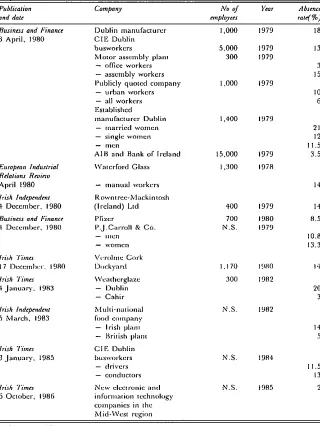
Although the Taoiseach did not refer to specific examples of high absenteeism numerous reports of the problem had appeared in the press during the 1980s. Some examples are given in Table 2.1.
This table shows that there was considerable variation in the absenteeism experienced by different companies with very low rates in financial and electronics companies and very high rates in manufacturing companies. Absenteeism rates were particularly high for married women prohably because they are left with the main rcsponslbility for coping with family problems. A number of the companies mentioned in the
table have unfortunately gone out of business. High absenteeism was alleged in some eases to be a factor which contributed to the financial difficulties which forced them to close down. Although some companies
have taken steps to bring their absenteeism problem under control, e.g., Waterford Glass, absenteeism continues to be a serious problem for many companies particularly in the industrial sector.
The high cost of the Disability Benefit scheme has come in for some criticism in recent years as Government and opposition parties have grappled with the question of where cuts in public expenditure can be made. The Irish Press reported on 10 December, 1986 that the Minister for Finance, Mr. Bruton, had proposed to his Cabinet colleagues that the pay-related element in Disability Benefit should be phased out as a way of saving money and cutting down on abuse but this was not acceptable to the Labour Ministers.
No evidence was cited by either the Taoiseach or the Minister for Finance to support their arguments that absenteeism in Ireland is excessive relative to other countries and that the cost of sickness absence
Table 2.1. Absence rates in some companies reported in the press since 1980
Publication C~mpan), No of }’ear Absence
,,,,d d.te empIoy,es ,~te( % )
Business and Finance Dublin manuJhcturcr 1,000 1979 18 3 April, 1980 CIE Dublin
busworkcrs 5.000 1979 13
Motor assembly plant 300 1979
-- office workers 3
-- assembly workers 15
Publicly quoted company 1,000 1979
-- urban workers 10
- MI workers 6
Established
manufacturer Dublin 1,400 1979
-- married ~.%’onle21] 2 ]
-- single women 12
-- men I 1.5
AIB and Bank of Irehmd 15,000 1979 3.5 European Industrial "~Vaterford Glass 1,300 1978
Relations Review
April 1980 -- manual workers 14
Irish Independent Rowntrec-Mackintosh
4 Dcccmlxr. 1980 (ireland) Ltd 400 1979 l,t
Business and Finante Pfizer 700 1980 8.5
,t December, 1980 P.J.Carrt]ll & C6. N.S. 1979
-- thegn ]0.8
-- women 13.3
Irish 7~tne~ Vtrrtl011c Cork
I 7 I)ect:mht:v, 1980 I)fJckyard I. 170 1980 14 InCh "l~)nes Weathcrglazc 300 1982
4 Januarr, 1983 - Dublin 20
-- Cahir 3
Irish Independent M uhi-national N.S, 1982 5 ~’larch, 1983 fi3¢3(I olrnp:m)"
-- h’ish pl:ml 14
-- British plant 5
Irish 7¥mes CI F. Dublin
3 Jm~uary. 1985 busworkers N.S. 198,1
- drivers 11.5
-- ColldtlCtOl’S 13
Irish 7¥mes New electronic and N.S. 1985 2
6 October, 1988 information lcchn~.~logy conlpanics in the M id-%Vcst rcgitm
N.S. not specified.
scheme and the cost of the scheme are published by the Department of Social Welfare and there are some international data available fi’om Eurostat and OECD sources on absenteeism. This information will be discussed in the next chapter where 1 will consider if there is any factual
basis For the concerns which have been expressed in connection with the high level of absenteeism in Ireland and the cost of public expenditure on sickness benefit.
(b) T~x Exemption of Disability Benefit
Disability Benefit, like all other social insurance benefits, was a flat-rate benefit until the introduction of a pay-related supplement in 1974. The combination of this supplement with the flat-rate payment, the tax exemption of Disability Benefit, the availability of tax refonds and dependants allowances for Disability Benefit claimants made it possible for some workers to have a higher income when they were out of work through illness than when they were at work.
Tile Federated Union of Employers quickly drew attention to this anomaly in the social welfare code (see FUE, 1973). After the pay-related benefit scheme came into operation in 1974 it argued that replacement ratios in excess of 100 per cent were providing a disincentive to work which was particularly strong in the last quarter of the income tax year. It urged the Government to find some means of bringing short-term social welfare benefits, i.e,, for unemployment and sickness, into the tax net.
Since the late 1970s a number of Governments have looked for ways oF responding to the demand for the taxation of short-term social insurance benefits. The first indication that short-term benefits would be taxed was given in 1978 in a Green Paper, Development for bull
Employment, when it was noted that incomes For some workers could be
higher during illness than during work. The Government announced that it was giving consideration to "treating income fi’om short-term social welfare benefits as taxable income in order to reduce the possibility of this happening" (Ireland, 1978, par. 7.21).
In a White Paper in the following year the Government stated that short-term social welfare benefits "should be taken into account fi-om the earliest practicable date in assessing tax liability" (Ireland, 1979, par. 6.23). Provision was then made in the Finance Act 1979 to tax short-term social welfare benefits from April 1980. It was estimated that this would bring in an extra £13 million in the tax year 1980/81 (DEPD, 23 May, 1979, coh 1306) However, the Minister for Finance announced during his 1980 Budget speech that the Government had reconsidered the matter and had decided that the proposal to tax these benefits should not be implemented. The reasons given were that the introduction of tax exemption limits in the Budget for low income persons would have
reduced the tax yield and that the widening of the tax bands had provided a greater incentive to insured workers to remain at work.
Ahhough the Minister did not say so another reason for rescinding the decision to tax short-term social welfare benefits could have been the administrative difficuhy of taxing these benefits under our cumulative PAYE tax system. While recommending that if an efficient method of ta:.:ing short-term benefits could be found it should be adopted, 1 estimated in an earlier paper on absence fi’om work (Hughes, 1982A, p.64) that if short-term social welfare benefits were to be taxed on a cumulative basis by the Deparualent of Social Welfare under the existing PAYE system it might be necessary to increase the Department’s staff by 20 per cent, or 650 employees, to do so.
1 noted that one way in which sickness benefits could be brought within the tax net without having to change the tax system would be to make the employer responsible for paying sickness benefit for a specified period as the British Government had proposed in a Green Paper (DHSS, 1980)
in 1980 and I suggested that this possibility was worth further investigation as it might also enable the Government to reducc public expenditure on sickness benefit.
l)cspite the advantages which it appearcd the transfer of responsibility for short-term sick pay to employers could have the Government continued to search for a solution to the problem of taxing Disability Benefit within the existing administrative arrangements. The Minister for Finance announced during his speech on the Coalition Government’s 1982 Budget that it had been decided to make short-term benefits liablc to tax fi’om April 1982 onwards. Because of administrative problems, however, hc said that these benefits could not bc taxed in the same veay as other income anti he announced that:
for convenience of administration, there will be art initial 20 per cent tax on the pay-related element of these benefits, withheld at the point of payment. Subsequently, the correct liability will be determined by the Revenue Commissioners and refunds made where appropriate. This arrangenaent will yiclcl £10.5 million in 1982. I[ is clear fi’om this statement tlaat the administrative problcnls involved in taxing short-term benefits in the same way as other income had not been overcome and that special measures were needed which would reduce the pay-related supplcment by 20 per cent for all eligible claimants irrespective of their tax liability. Thus, it seems to have been accepted that the problems posed in t,-Lxing slaort-tel-m benefits under a cumulative PAVE system could only be solved by breaching the cumulative principle.
Although it appeared from the Minister’s speech that overpayment of tax would be au tomatically refu nded by the Revenue Com m issioner’s at the end of the tax year it was made clear in the Principal Features of the Budget that refunds would only be made on application to the Revenue Commissioners. The Coalition Government’s proposal to tZLX short-term
social insurance benefits lapsed when the first 1982 Budget was defeated in the Dall.
(c) Abuse of the Disability Benefit Scheme and the Effect of the Scheme on the Incentive to Work
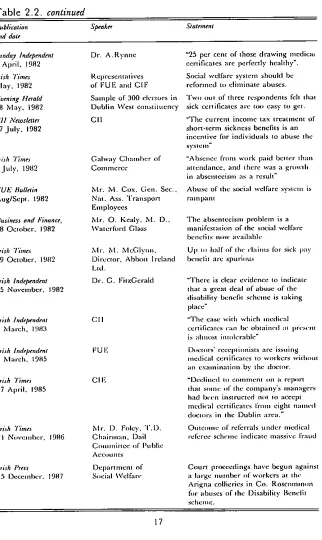
A number of employers, trade unionists, politicians, and doctors have alleged that the Disability Benefit scheme is subject to widespread abuse and that it also provides a disincentive to work which is particularly strong at the end of the tax year. These allegations have received considerable press coverage in recent years. The impression has been created that up to half of those receiving Disability Benefit are abusing the system and that medical certificates can be secured on demand irrespective of the applicant’s state of health. Some examples of the statements which have been made in the press in recent years about abuse of the Disability
[image:26.403.57.374.318.552.2]Benefit scheme are given in Table 2.2.
Table 2.2. Allegations in the press of abuse of the Disability Benefit and medical
referee schemes since 1980
Publication Speaker Slatonent
and date
Irish A4edical 7)’rues I)r. A. Rynnt" 4 .J;mu;irv. 1980
Irish Independent Pl’t)f, C, O’h[~l~¢ha 20 hmc. 1980 President, UCG Eucn[n~ Prrs,
16 Oclt,bcr, 1981 hiah Independent 8 March. 1982
Dr. C. MacNnm~l~ Vice PrcsldcnL Medical Union
h’i~h Medical As~,ci:lciol~ C;~’r~lr~ll Council
Sunday Independent FU E 28 March, 1982
.~nda)" Independent 28 March, 1982
Dt~:’lcu’s :trc bt’ing used by oct’Is to :;lay off work.
Opcralion nf the social well,ire systcln is ~lttrac0n8 a gro~’-’ing nunlbcr of abu~;~l-S.
Absenteeism reaches 20% in some in~l:ln~:cs in Ihc ’t t~ 8 week I×.riod I)~’l~t’¢ the end i~1’ Ihc iztx ycar tluc Io cxcmpdon of Dis~d)ility Bcnctit I’r~,m
Table 2.2. continued
Publication Speaker A)atement
and dale
Sunday Independent Dr. A.Rynne
4 April, 1982
Irish Time~ Representatives May. 1982 of FUE and C[F Evening IlaaM Sample of 300 doctors in 18 May. 1982 I)ubliu x.Vest constituency CII Newsletter C I 1
27 July. 1982
hilh 77mea Galway C:hamber of 6 July, 1982 Commerce
FUE Bulletin
Aug/Sept. 1982
Businezs and Finance, 28 Octob12r, 1982
Mr. M. Cox. Gem See.. Nat. Ass. Transport I~.in ployees
Mr. O. Kealy. M. D.,
’~Vat erfi~rd Glass Irish 77me.t Mr. M. McGlyun. 29 October. 1982 Director. Abl×m h’eland
Ltd.
Irish Independent Dr. G. FilzG12rald
15 November. 1982
hish Indel.cndent CI I 5 Marcb, 1!)83
hAh Independent FU E 6 March, 1985
I,Ah 77meJ CI E 27 April. 1985
IrAh 7"ime~
21 N,~vc,nber, 1986
hish Press
15 I)eceml:,4:r. 1987
Mr. I). Fo112y, T.I). Chairman. l)all Cc.nmin12c of Public
t~tt’t’oU n[~
I)12part m12nt o1" Social t*Nr121 farc
"25 per cent of dlosc drawing medicm certificate~: are perfectly healthy". Sockd w121filre system shoukl be rcforlned to 1dbnbmte abuses.
Two i)ul of three rt’slxmdenlS f12h Ihal sick 1:12rlt~al¢2!; are [otp 12asv to [~121. "*]’hf2 ¢urr~llt inconlc lax [rc~l[ll|42tl( of shorl-lerln sickness benel]l$ is an incentive for indivMuals to abuse th12
$y~;142il i"
"Absence from work paid bcm!r than
att12nd~ulc[2, ~l)ld there ~’as ~t ~[’o~vih
in absenteeism as a r12sub"
Abus12 of IhC st~2ial w121farc syslcul i:, ra31Tp~n(
The absent1212ism problem is a ulaniflJ~;lation of th12 serial welfare benellts ii,~v availabh:
Up tt) half of the chtims Ibr sick pay bcuct]l arc spurlt)us
It will be seen from Table 2.2 that the strongest allegations of abuse of the Disability Benefit scheme have come from business and employer organisations. These allegations are made in very general terms and they usually tend to exaggerate the seriousness of the problem. I f specific cases of abuse are reported to the Department of Social Welfare they are investigated. It is frequently found that allegations of abuse have no substance to them. The Minister for Social Welfare, Dr. Woods, for example, indicated in a report in the Irish Independent on August 5, 1982 that up to two-thirds of complaints investigated by his department’s Special Investigation Unit cannot be substantiated.
A solution to the alleged problem of abuse of the Disability Benefit scheme was proposed I~y FitzGerald (1983, p.76) when she noted that the scheme "has been the subject of the most vociferous complaints by employers about abuse". She argued that "at this stage of trade unionisation and with the spread of occupational sick pay schemes,... the state should not be too deeply involved in paying income maintenance for casual sick absences." Hence, she proposed that "if the employers who complain so much about absenteeism had to pay for the first two or three weeks of any sick absence, they could be in a better position to decide whether claims were genuine or not." If the first two weeks of all sick pay claims was paid by the employers she estimated that total spending on Disability Benefit would be reduced by 16 per cent and she argued that the Government could make indirect savings of over £6 million per year if employers were able to reduce claims lasting two weeks or more by 5 per cent. The administrative saving t9 the
Department of Social Welfare from handling 100,000 fewer claims each year was estimated to be around £1 million per year. However, she noted that the proposal to make employers responsible for short-term sick pay posed practical problems which would need further exploration. The main problems which she expected to arise were that:
I. Employers might look for a reduction in their PRSI contributions which could rnean that there would be no direct savings to the Exchequer.
2. Small employers might face problems unless they could pool risks in a group scheme with an insurance company.
2.3 Proposals for Rationalising the Disability Benefit Scheme
A number of suggestions for rationalising the Disability Benefit scheme have been made which have wider objectives than simply bringing this benefit into the tax net. As we have seen the main reason for
FitzGerald’s suggestion that employers should take responsibility for sick pay for the first few weeks illness was that it would give them the opportunity to take action on alleged abuse of the scheme about which employers had complained so much. My suggestion that the possibility of making employers responsible for short-term sick pay should be investigated was made because it appeared to provide a way in which sickness benefit could be taxed and also because it might lead to some
reduction in public expenditure on this benefit. Some further advantages which the suggested changeover to employer responsibility for short-term sick pay could have were outlined in a paper which I gave to an IMI conference on absenteeism in November 1982 ( Hughes, 1982B, p.36), l argued that the proposal to transfer responsibility for short-term sickness payments to employers might be advantageous as it could:
(a) eliminate duplication in existing arrangements and hence lead to a reduction in public expenditure on sickness benefit; (b) Iocalise the problem within each firm and encourage employers
and workers to take responsibility for dealing with it;
(c) give employers an incentive to cut down sickness absence rates by, for example, providing better screening procedures and health and safety measures.
Some of these arguments were also made by the Department of Social Welfare in documents outlining the thinking behind a proposal which the Government made for an employer sick pay scheme ",’,,hen the Taoiscach, Dr. G. FitzGerald, announced in the Dail on 23 October,
1985 that he had requested a meeting with the National Economic and Social Council (NESC) to discuss some proposals with the members. One of these proposals was "to overhaul the Disability Benefit Scheme with a view to reducing the costs of absenteeism" (NESC, 1986, p.l). The Taoiseach indicated, during his address to the NESC that a memorandmn outlining the thinking behind the proposal would be submitted by the Department of Social Welfare.
The Department’s memoraildum has not been published but the NESC summarised some of its salient points in its published response to the Government’s proposals (op. cil.) The proposal which the membc,’s of the NESC were asked to consider was that "responsibility for the first ten weeks of sickness payments be transferred to employers with an accompanying reduction of one percentage point in the rate of employers’ PRS[ and the creation ofemployers’ obligations under labour lass,." (op. cit., p.2)
allocation of resources arising from the clearer delineation of responsibility for sickness payments between the state scheme and employers’ occupational sick pay schemes. Reductions in absenteeism were expected to occur because:
(a) employers would have a very strong incentive to keep their expenditure on sick pay below the I per cent reduction in their PRSI payments which the Government was offering to compensate them for the extra costs which the new arrangements would impose on them;
(b) the taxation of sick pay and the elimination of tax rebates would reduce the incentive for employees to take advantage of the Disability Benefit scheme;
(c) the change from central to local control by individual enterprises would give greater responsibility to both employers and employees for attendance at work.
The Department noted in its memorandum that there were differences in the coverage of occupational sick pay schemes with the services sector having better coverage than manufacturing. It also noted that there is a strong positive correlation between coverage and firm size. It indicated that it had commissioned a national survey of occupational sick pay schemes and that it expected the results of this survey to be available shortly. The sectors where the incidence of sickness absence were highest were mining and turf and building and construction. The incidence was lowest in insurance and banking. The Department estimated that up to £2 million could be saved on administration costs by transferring responsibility for the first eight weeks’ sick pay from the state to the private sector but it did not give any estimate of the reduction in public expenditure which might be expected to result from this transfer. 2.4 Trade Union and Employer Responses
In its response to the Government’s proposal the consensus view of the NESC Council members (op. cir., p.3) was that the Disability Benefit scheme was in need of reform for several reasons including in particular "the possibility that the operation of the scheme may be contributing to the existing level of absenteeism". The Council saw merit in the Government’s proposal to allocate public resources more efficiently and to include short-term sickness benefit in taxable income. It argued,however, that there could be major problems in implementing the Government’s proposal because of the difficulty of getting small firms to comply with the requirement for a statutory sick pay scheme and also
because the proposal would cause the costs of certain firms to rise relative to those of other firms, e.g., the cost of occupational sick pay schemes were thought to be proportionately higher for small firms than for large and small firms which do not have.an occupational sick pay scheme would face an increase in their costs relative to firms which have such schemes.
The Council made two suggestions ",0hich it thought might help to get around these difficulties. The first was that small firms might be exempted from any statutory requirement to provide a sick pay scheme. The second was that the administrative savings which the state hoped to make from implementing its proposal might be shared with employers. It noted, however, that the Department of Social Welfare did not favour the exclusion of small firms because firms employing less than 10 people accounted for over three-quarters of all firms in the country and the operation ofa cutoffpoint for such firms would increase administrative costs~. The Council also noted that the Department felt that it would be difficult to find a mechanism for sharing the expected administrative savings of£1 to £2 million amongst employers. It observed that some firms were opposed to the provision of statutory sick pay because they favoured an unregulated environment in this regard. It commented that this attitude would create particular difficulties for the trade unions as they believed that any changes to the existing arrangements would have to incorporate a statutory obligation on employers to provide specified levels of sickness benefit. The Council concluded that tbc Government’s proposal merited further investigation but it pointed out that:
much more information is required, both on the operation of the existing scheme (including the interaction of the Disability Benefit scheme and occupational sick pay schemes) and the likely impact of the proposed new arrangements, before the Council could commit itself to supporting it (op. cir., p.5).
The kind of information which the Council said it required included time results of the national survey ofoccupational sick pay schemes being undertaken at the time by the Department of Social Welfare and time results of an examination, which was also being undertaken at the time, by the FUE of the interaction of the proposed changes with existing occupational sick pay schemes. It indicated that it would be glad to review time nmtter when this information became available.
I. The p~rcentage of tt~t~,l emplo~.’m,ent Is,cccJ~lnted for by such I]rnls would, ofcour~". I~.t- c(inslderalbl)- le,s thltn 7:5 per cent. Fir m~. empl’Jylng le~ th;,n 10 l:,*’~ple in manufacturing indust ~’ in 1981. fur example, aln~unt~J I<~ 37 i~er cent of the Iolal bul they accounled f~r le’~ than 5 Ix’r cent of total emplo)’ment in manufacturln~ (:~ee Ireland. 1986B, Tldlle 105).
The response by the FUE to the Government’s proposal was given in its Bulletin in April, 1986. The National Executive Council said that on the basis of the conclusions reached by a working party it had decided that "the proposal was unacceptable in its present form." It said that the FUE was concerned about the following points:
(i) the effect the proposal could have on costs;
(ii) the administrative and legal difficulties which it could create for employers;
(iii) the complexities which it could introduce into the relations between employers and employees.
Despite its reservations about the Government’s proposed S, tatutory Sick Pay scheme the FUE said that it was prepared to continu~ to look for a solution to the absenteeism problems which it believes are caused by the existing state sick pay scheme and the failure to integrate Disability Benefit with the tax system. It indicated its hope that the Commission on Social Welfare, which was then reviewing the operation of the Social Welfare system, would deal with the question of the taxation of short-term social welfare benefits.
The Commission on Social Welfare, however, did not make any positive proposals for the taxation of short-term social insurance benefits. In its report which was issued in July 1986 (Ireland, 1986A) it said that it was in favour of the Government’s proposal in principle. It endorsed the comments which had already been made about the advantages and disadvantages of the Government’s proposal and it added to them the fact that the number of new claims would be reduced from 4,500 per week to less than 1,000 according to the Department of Social Welfare. It also noted the improvement which could take place in the level of sick pay for single persons.
2.5. Reasons for Reform of the Disability Benefit Scheme
This review of the criticisms of the Disability Benefit scheme and the background to the Government’s decision to reform it by introducing a Statutory Sick Pay scheme suggests that the main reasons why it has been decided to reform the Disability Benefit scheme are:
(i) the Disability Benefit scheme may be contributing to a high level of sickness absence and to increasing Government expenditure on sickness benefit;
(ii) there is thought to be widespread abuse of the Disability Benefit scheme;
(iii) there is duplication in the arrangements for payment of sickness benefit because of the growth of occupational sick pay schemes; (iv) short-term social insurance benefits need to be brought into the tax net to reduce excessive replacement ratios and thereby improve the incentive to work.
One of the problems with these arguments for reform of the Disability Benefit scheme is that the Government has not brought together the kind of evidence which is needed to evaluate them. Some of the information which is needed to do so is available and the next chapter will bring it together to see if it supports the arguments which have been made for reform of the Disability Benefit scheme.
Chapter 3
ASSESSMENT OF ARGUMENTS FOR REFORM
3.1 Use and Cost oJ Incapacity Schemes
(a) Use of Incapacity Schemes
The introduction of the Invalidity Pension scheme in 1970 led to the removal from the Disability Benefit statistics of a significant number of long-term claimants. The omission of claimants transferring from the Disability Benefit scheme to the Invalidity Pension scheme could give a misleading impression of sickness absence trends. In order to avoid this problem in another paper (Hughes, 1982A, Appendix 1) I combined the data for the disability and invalidity schemes to give series on incapacity for the period 1954-78. These series have been updated to 1986 in the tables which follow2.
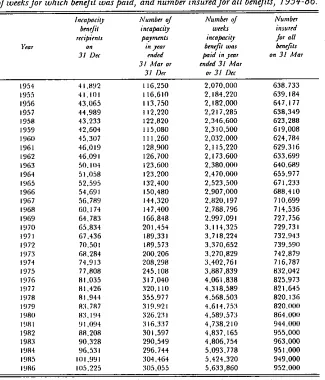
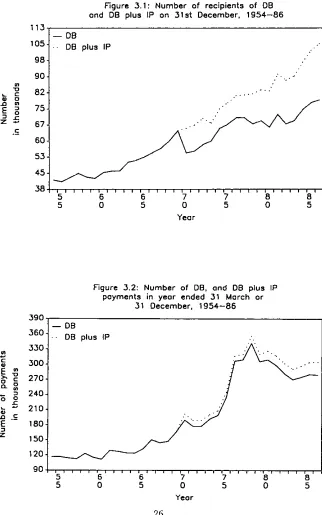
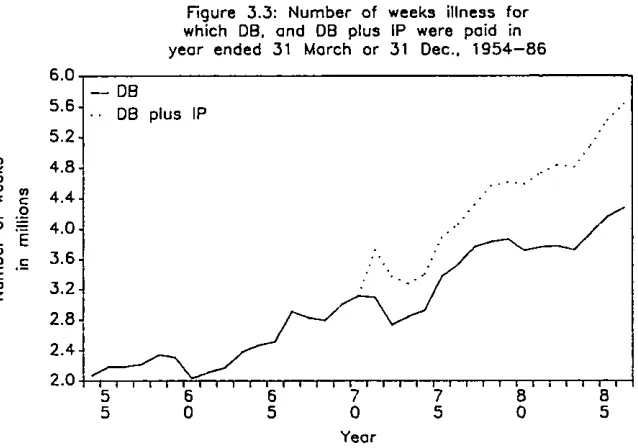
Table 3.1 and Figures 3.1,3.2, and 3.3 present data on the number of recipients of incapacity benefits, the number of incapacity payments, and the number of weeks illness for which these benefits were paid during the year for the period 1954-86. The number of recipients of incapacity benefit at the end of each year increased by two and a half times from 42,000 in 1954 to 105,000 in 1986; the number of claims paid also increased by about two-and-a-half times from 116,000 per year in 1954 to over 300,000 now with a peak in the number of claims paid in 1978 of nearly 356,000; the number of weeks for which incapacity benefit was paid in each year increased by nearly two-and-three-quarter times from 2.1 million weeks in 1954 to 5.6 million weeks in 1986.
Table 3.1. Recipients of incapacity benefit, number of payments made, number
of weeks for which benefit was paid, and number insured for all benefits, 1954-86.
Inrapadty Number of Number of Number benefit ineapadty weeks insured recipients payments incapacity Jot all
on in year benefit was benefits 31 Dec ended paid in ymr on 31 Mar
31 xl4ar or ended 31 ~4ar 31 Dec or 31 Dec
1954 41,892 116.250 2,070,000 658.735
1955 41.1{}1 tl6.610 2,184.220 639.184
1956 43.065 li3,750 2,182,000 647.177
1957 44,989 ll2,220 2,217,285 838,349
1958 ,13.233 122.820 2,346,600 623,288
1959 ’t2,604 115,080 2,310,500 619,008
1960 45,307 111,260 2,032,000 624,784
1961 46.019 128,900 2,115,220 629,316
1962 ,t6.091 126.700 2,173,600 633,699
1963 50.1(14 123.600 2,380.000 640.6A9
1964 51.058 123.200 2,470.000 655.977
1965 52.595 132,400 2,523.500 671,233
1966 54,691 150,480 2,907,000 688,410
1967 56,789 144,320 2,820. t97 710,699
1968 60,174 147,400 2.788.796 714,536
1969 64,783 166,848 2.997.091 727.756
1070 65.834 201,454 3.114,325 729,731
1971 67.436 189.331 3.718,224 732.943
1972 70.501 189.573 3,370,652 739,59(I
1!)73 68.284 200.206 3,270,829 742,879
1074 7’1.913 208,298 5,402,761 716,787
1975 77,808 245,108 3.887,839 832,042
1976 81,035 317,040 4.061.838 825.973
1977 81,426 320,110 4,318,589 821,645
1078 81,944 355,977 4.568,503 820.136
1979 83,787 319.92 t 4,614.753 820,000
1980 83,19’t 326.231 ’t ,589,575 864.00O
1981 01,094 3[6.337 4,738,210 944.000
1982 88.208 301,597 4,837,165 955,000
1983 90,328 290,549 4,806.754 963,000
1984 96.531 296.744 5,093.778 951.000
1985 101,99] 304,464 5,424,320 949.000
1986 105.225 305,055 5.633,860 952,000
,7ources: Report of the Delmrtmem of Social Welfare, 1954-58 to 1981-82; I)cpartmem of Social Welfare, Statlstical Information on Social Welfare S, roices, 1983 to 1986; Statistical Abstract, 1956 to 1977. Note: The year ended on the 31st b.’larch up to 1974 and on 31st December thereafter.
I13-Figure 3.1: Number of recipients of DB and D8 plus IP on 31st December, 1954-86
105- 98- 90- 82- 75- 67- 60- 53- 45-38
--D8
¯ . DB plus IP ,.’"
-’.. ~
5 6 6 7 7 8 8
5 O 5 0 5 O 5
Year
[image:36.403.57.380.31.282.2]390
Figure .3.2: Number of DB, and D8 plus IP payments in year ended .31 March or
31 December, 1954-86
9O
-- DB
¯ - DB plus IP
’s ... 6 ... 6 ... 7 ... 7 .... ’8 .... ’8’
5 O 5 O 5 0 5
Yeor
[image:36.403.55.377.34.549.2]6.0
Figure .3.3: Number of weeks illness for which DB, and DB plus IP were paid in year ended .31 March or .31 Dec., 1954-86
-- DB
5.6 .. O8 plus IP .’
5.2
43 ...".
¯~ g 4.4 ... "
"6 -- 4,0 E
.~ ,_= .3.6 = .3,2 Z
2.8
2.4
2.0 i ~ i L h i i q i ~ i i g ~ ~ L i u i i J i i i i ~ L i i i i i
5 6 5 7 7 8 8
5 0 5 0 5 0 5
Year
Some of these increases in the measures of use of the incapacity schemes
are due to increases in the number of employees who are insured against
income loss due to disability or invalidity. Since 1954, as Table 3. I shows, the number of insured workers has increased by about 50 per cent fi’om 639,000 to 952,000 in 1986.
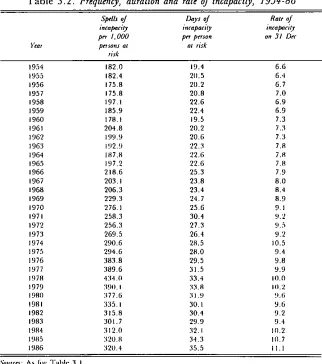
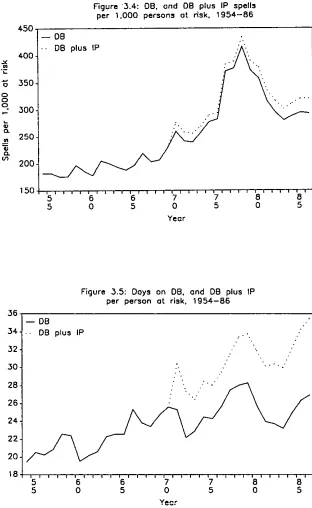
Table 3.2 and Figures 3.4, 3.5, and 3.6 present measures of use or the incapachy schemes which take account of the increase in the numl)er of employees covered for sickness benefits. Figure 3.4 shows dlat the nunlbcr of spells of incapacity per worker incrcasccl fi’om 182 per 1,000 in 1954 to a peak of 434 per 1,000 in 1978, dcclinccl to 302 per 1,000 in 1983 and then increased to its prcsem level of 320 per 1,000. l;’igure 3.5 shows that the number of days for which each incapacity claim was paid per person at risk was less than 20 in 1954, over 33 days in 1978 and very nearly 36 days in 1986. Figure 3.6 gives the time series data on the national incapacity rate. At the beginning of the period the incapacity rate was about 6V2 per cent of the insured labour force. It increased over the [bllowing 20 years to reach a peak of 10W per cent in 1974 dropped back to around 9//2 per cent in the [bllowing year and remained stable at about this level until 1983. Since 1984 the sickness absence rate has incn’cascd by around a halfa percentage point each year and this brought the rate trip to over I 1 per cent of the insured labour [brce in 1986.
Table 3.2. Frequency, duration and rate of incapacity, 1954-86
Spells oJ Days of Rntt of
ineapacit), incnpadt), inca~rit), per 1,000 per person on 31 Dec )~ear
persons at at risk risk
1954 182.0 19.4 6.6
1955 182,4 211.5 6.4
1956 175.8 20.2 6.7
1957 175,8 20.8 7.0
1958 197. I 22.6 6.9
1959 185.9 22.4 6.9
1960 178.1 19.5 7.3
1961 204.8 20.2 7.3
1962 199.9 20,6 7.3
1963 I !t2.9 22.3 7 .R
1964 187.8 22,6 7.8
1965 197.2 22.6 7.8
1966 218.6 25.3 7.9
1967 203. I 23.8 8.0
1968 206.3 23.4 8.4
1969 229.3 24.7 8.9
1970 276.1 25.6 9.1
1971 258.3 30.4 9.2
1972 256.3 27.3 9.5
1973 269.5 26.4 9.2
1974 290,6 28.5 10.5
1975 294,6 28.0 9.4
1976 383.8 29.5 9.8
1977 389.6 31.5 9.9
1978 .134.0 35.4 10.0
1979 390. I 33.8 10,2
1980 377.6 31.9 9.6
1981 335. I 30. I 9.6
1982 315.8 30.4 9.2
1983 301.7 29.9 9.,t
1984 312.0 32.1 10.2
1985 320.8 3,t.3 10.7
1986 320.4 35.5 I I. 1
5butceJ: As fiw Tablc 3.1.
450
-Figure 3.4: OB, and OB plus IP spells per 1,000 persons at dsk. 1954-86
400-
350-0 0 0
" 300.
250.
200.
150
-- OB ...
’=J ...6 ...6 ...7 ...7 ...8 .... ~’
5 0 5 0 5 0 5
[image:39.403.37.349.35.285.2]Year
Figure 3.5: Days on OB, end DB plus IP per person at risk, 1954-86 36
I
-- DB
34 .. DB plus IP
-~ 32 ~6 30
C o 28
(g
Q.
O~
o a
...’.
24 22 20
18 ’5 ...6 ...6 ...7 ...7 ...8 .... ,~ ’~’
5 0 5 0 5 0 5
Year
[image:39.403.35.347.36.544.2]11.2
Figure 3.6: OB rate, and OB plus IP rate on 31 December, 1954-86
-- D8
. DB plus IP
10.4- : ."
¯ , .," ;
¯ ". ,’’ ".
9.6- .. : ... ",.. ."
, "., ".,,
8.8-Q.
8.0.,
7.2
5 6 6 7 7 8
5 0 5 0 5 O
Year
The time series data on the use of the incapacity schemes clearly shows that there was a strong upward trend in the number of claims per worker up to 1978 but that this trend has been reversed since then. A 30 per cent drop occurred in the number of spells of incapacity per worker from 434 per 1,000 in 1978 to 301.7 per 1,000 in 1983. This drop has been partly offset by a 6 per cent increase in the number of spells from 301.7 per 1,000 in 1983 to 320.4 per 1,000 in 1986.
The big reduction which has been achieved in the number of claims per worker followed the adoption by the Department of Social Welfare from the end of the 1970s of a series of administrative measures designed to exercise a greater degree of control on payment of short-term social insurance benefits. The measures which were adopted to control the number of claims for Disability Benefit were enumerated by the Minister for Social Welfare, Dr. Woods, in a press release on December 2, 1982. They included the appointment of additional Medical Referees and an increase in the number of control staff in the Minister’s department dealing with applications for this benefit, more visits to the homes of claimants by the Department s s’ckness visitors, better procedures for selecting doubtful cases for referral for medical referee examination and earlier referral of such cases, greater use of penalty clauses where claimants do not attend for medical referee examination, and stricter control of late claims. [n addition to these measures the computerised
system of payment for Disability Benefit wimich came into operation in October 1982 has been used to set a time limit on all claims after which those still in payment are automatically listed for consideration by a medical referee.
Although the efforts which have been made to control the number of claims per worker have been successful Figures 3.5 and 3.6 show that there is still a strong upward trend in the duration and rate of incapacity. This upward trend continues despite the efforts which have been made over the years to care for and improve the working population’s health by considerable public expenditure on sickness benefits and health services.
Medically related factors, such as ill-health, changes in medical practice, and less toleration of relatively minor complaints, would be expected to play an important part in explaining increasing sickness absence although changes in geographical, organisational, and personal
factors could also explain some of the increase as Taylor (1979) notes in his paper on aspects of sickness absence.
Very few studies have been carried out in Ireland of time factors whicb influence the national sickness absence rate. Enquiries which 1 have made to the medical faculties in some of the universities have failed to turn up any studies which can account for the increase in the national sickness absence rate in recent years on medically related grounds. O’Hare and Walsh’s (1987) report for the Health Research Board on time activities of psychiatric hospitals shows that there has been a noticeable increase in admissions to such hospitals in the last decade and this suggests that there could be medical factors which arc associated with the increase in the sickness absence rate.
There is also medical evidence which suggests that increases in sickness absence in Dublin in certain areas of the city in particular years could be due to ill-health. Mortality data available to doctors in St. Jarnes’s Hospital suggests that in recent years air pollution in Dublin may have been responsible for an increase in illness clue to respiratory problems in the Winter (see the Irish Times, 18 June 1985).
A study of some of the non-medical factors affecting absenteeism in h’ish industry was carried out in 1971 by O Muircheartaigh (1975) but no major national stud), has appearecl since then. Further studies of changes in the medical and non-medical [’actors which may account for the change in time national sickness absence rate are needed if we are to identify those factors which it might be possible to control in order to reduce our sickness absence rate.