Assessment: Sources, Propagation,
and Effects of Strong Sound
Jürgen Altmann Experimentelle Physik III
Universität Dortmund, Dortmund, Germany
CORNELL UNIVERSITY PEACE STUDIES PROGRAM
OCCASIONAL PAPER #22
ISSN 1075-4857
Acoustic Weapons—A Prospective Assessment: Sources, Propagation, and Effects of Strong Sound
Jürgen Altmann
The Peace Studies Program was established at Cornell in 1970 as an interdisciplinary program concerned with problems of peace and war, arms control and disarmament, and more generally, instances of collective violence. Its broad objectives are to support graduate and post-doctoral study, research, teaching and cross-campus interactions in these fields.
Copies of Occasional Papers may be ordered from: Peace Studies Program
i
Abstract . . . iii
Preface . . . iv
1. Introduction . . . 1
1.1 Acoustic Weapons as Part of "Non-lethal" Weapons . . . 1
1.2 Some Historic Aspects of Acoustic Weapons . . . 3
1.3 Actual Developments . . . 6
1.4 Goals of This Report . . . 8
1.5 General Remarks on Acoustics . . . 9
2. Effects of Strong Sound on Humans . . . 10
2.1 General Remarks on the Ear . . . 10
2.1.1 Hearing and Hearing Damage . . . 10
2.1.2 Vestibular System . . . 15
2.2 Effects of Low-Frequency Sound . . . 15
2.2.1 Hearing Threshold and Loudness Perception at Low Frequencies . . . 15
2.2.2 Low-Intensity Effects of Low-Frequency Sound . . . 16
2.2.3 High-Intensity Effects of Low-Frequency Sound . . . 17
2.2.3.1 Effects on Ear and Hearing . . . 17
2.2.3.2 Effects on the Vestibular System . . . 18
2.2.3.3 Effects on the Respiratory Organs . . . 19
2.2.3.4 Other Effects . . . 20
2.2.4 Vibration Considerations . . . 20
2.2.4.1 Effects of Whole-Body Vibration . . . 20
2.2.4.2 Vibration Due to Low-Frequency Sound . . . 21
2.3 Effects of High-Intensity High-Frequency Audio Sound . . . 21
2.3.1 Effects on Ear and Hearing . . . 21
2.3.2 Non-Auditory Effects . . . 24
2.4 Effects of High-Intensity Ultrasound . . . 27
2.4.1 Auditory Effects . . . 27
2.4.2 Non-Auditory Effects . . . 28
2.5 Impulse-Noise and Blast-Wave Effects . . . 28
2.5.1 Auditory Effects . . . 30
2.5.2 Non-Auditory Effects . . . 33
3. Production of Strong Sound . . . 35
3.1 Sources of Low-Frequency Sound . . . 35
3.2 Acoustic Sources Potentially Usable for Weapons . . . 38
4. Protection from High-Intensity Sound, Therapy of Acoustic and Blast Trauma . . . 44
4.1 Protection from Sound . . . 44
4.2 Therapy of Acoustic and Blast Trauma . . . 45
5. Analysis of Specific Allegations with Respect to Acoustic Weapons . . . 46
5.1 Allegations Regarding Weapons Principles . . . 46
ii
5.1.3 Diffractionless Acoustic "Bullets" . . . 48
5.1.4 Plasma Created in Front of Target, Impact as by a Blunt Object . . . 51
5.1.5 Localized Earthquakes Produced by Infrasound . . . 52
5.2 Allegations Regarding Effects on Persons . . . 53
6. Conclusions . . . 54
6.1 Effects on Humans . . . 55
6.2 Potential Sources of Strong Sound . . . 56
6.3 Propagation Problems . . . 56
6.4 Further Study . . . 57
6.5 General Remarks . . . 57
Appendices . . . 60
A.1 Linear Acoustics . . . 60
A.2 Non-Linear Acoustics—Weak-Shock Regime . . . 64
A.3 Non-Linear Acoustics—Production of Difference Frequency, Demodulation . . . 68
A.4 Strong-Shock Regime . . . 70
A.5 Infrasound Beam and Other Propagation Estimates . . . 74
A.6 Infrasound from Non-Linear Superposition of Two Ultrasound Beams . . . 77
iii
Acoustic weapons are under research and development in a few countries. Advertised as one type of non-lethal weapons, they are said to immediately incapacitate opponents while avoiding permanent physical damage. Reliable information on specifications or effects is scarce, however. The present report sets out to provide basic information in several areas: effects of large-amplitude sound on humans, potential high-power sources, and propagation of strong sound.
Concerning the first area, it turns out that infrasound—prominent in journalistic articles —does not have the alleged drastic effects on humans. At audio frequencies, annoyance, discom-fort and pain are the consequence of increasing sound pressure levels. Temporary worsening of hearing may turn into permanent hearing loss depending on level, frequency, duration, etc.; at very high sound levels, even one or a few short exposures can render a person partially or fully deaf. Ear protection, however, can be quite efficient in preventing these effects. Beyond hearing, some disturbance in balance, and intolerable sensations, mainly in the chest, can occur. Blast waves from explosions with their much higher overpressure at close range can damage other organs, at first the lungs, with up to lethal consequences.
For strong sound sources, sirens and whistles are the most likely sources. Powered, e.g., by combustion engines, these can produce tens of kilowatts of acoustic power at low frequencies, and kilowatts at high frequencies. Up to megawatt power is possible using explosions. For di-rected use the size of the source needs to be on the order of 1 meter, and proportionately-sized power supplies would be required.
Propagating strong sound to some distance is difficult, however. At low frequencies, dif-fraction provides spherical spreading of energy, preventing a directed beam. At high frequencies, where a beam is possible, non-linear processes deform sound waves to a shocked, sawtooth form, with unusually high propagation losses if the sound pressure is as high as required for marked effects on humans. Achieving sound levels that would produce aural pain, balance prob-lems, or other profound effects seems unachievable at ranges above about 50 m for meter-size sources. Inside buildings, the situation is different, especially if resonances can be exploited.
Acoustic weapons would have much less drastic consequences than the recently banned blinding laser weapons. On the other hand, there is a greater potential for indiscriminate effects due to beam spreading. Because in many situations acoustic weapons would not offer radically improved options for military or police, in particular if opponents use ear protection, there may be a chance for preventive limits. Since acoustic weapons could come in many forms for
iv
This study was begun during a one-month research stay in November 1997 at the Peace Studies Program of Cornell University, Ithaca NY, USA. It was finished in spring 1998 at Experimentelle Physik III, Dortmund University, Germany.
I should like to thank the Peace Studies Program of Cornell University, in particular Judith Reppy, for inviting me as a guest researcher. I am also grateful to the John D. and Cather-ine T. MacArthur Foundation, Chicago IL, USA, for providing the funds for the Technical Arms Control Project of the Peace Studies Program which financed my stay at Cornell University, and to the Ministry of Science and Research of the State of Nordrhein-Westfalen, Germany for grant-ing funds to Universität Dortmund for a project on preventive arms control for new weapons technologies under which I finished this study. Finally, thanks go to Franz Fujara of Experi-mentelle Physik 3, Universität Dortmund, for acting as an applicant and supporting scientific-technical research of disarmament problems.
Jürgen Altmann April 1999
1 A condensed version of this report appears in J. Altmann, "Acoustic Weapons—A Prospective Assessment," Science
and Global Security, 1999.
2 Most of the information on non-lethal weapons comes from journalistic articles in the defense or general press. The following articles and books give an overview of various problems of non-lethal weapons and provide many refer-ences: R. Span, J. Altmann, G. Hornig, T. Krallmann, M. Rosario Vega Laso, and J. Wüster, "'Non-lethal' Weap-ons—Fantasy or Prospect of More Humane Use of Force?" (in German), Dossier Nr. 17, Wissenschaft und Frieden
(June 1994); R. Kokoski, "Non-lethal Weapons: A Case Study of New Technology Developments," in SIPRI Yearbook 1994: World Armaments and Disarmament (Stockholm/Oxford: SIPRI/Oxford University Press, 1994), pp. 367-86; S. Aftergood, "The Soft-Kill Fallacy," Bulletin of the Atomic Scientists (September/October 1994), pp. 40-45; A. Roland-Price, "Non-Lethal Weapons: A Synopsis," in "Improving the Prospects for Future International Peace Operations— Workshop Proceedings," U.S. Congress, Office of Technology Assessment, OTA-BP-ISS-167 (Washington, DC: U.S. Government Printing Office, September 1995); J. Altmann, "'Non-Lethal' Weapons," 46th Pugwash Conference on Science and World Affairs, Lahti, Finland, 2-7 September 1996 (to be published in Security, Cooperation and Dis-armament: The Unfinished Agenda for the 1990s [Singapore: World Scientific]) M. Dando, A New Form of Warfare— The Rise of Non-Lethal Weapons (London and Washington: Brassey's, 1996); N. Lewer and S. Schofield, Non-Lethal Weapons: A Fatal Attraction? Military Strategies and Technologies for 21st-Century Conflict (London and Atlantic City, NJ: Zed Books, 1997).
There are not many systematic and comprehensive publications by proponents of non-lethal weapons. The following references give some examples of proponents' writing: "Nonlethality: A Global Strategy Whitepaper" (Washington, DC: U.S. Global Strategy Council, 1992); J.B. Alexander, "Nonlethal Weapons and Limited Force Op-tions," presented to Council of Foreign Relations, New York, 27 October 1993; Milt Finger, "Technologies to Support Peacekeeping Operations," in U.S. Congress, Office of Technology Assessment (ibid.); G. Yonas, "The Role of Tech-nology in Peace Operations," in U.S. Congress, Office of TechTech-nology Assessment (ibid.); C. Morris, J. Morris, and T. Baines, "Weapons of Mass Protection—Nonlethality, Information Warfare, and Airpower in the Age of Chaos," Air-power Journal 9 (1) (Spring 1995), pp. 15-29; D.A. Morehouse, Nonlethal Weapons—War Without Death (Westport, CT and London: Praeger, 1996).
For a balanced view from inside the U.S. military, see J.W. Cook, III, D.P. Fiely, and M.T. McGowan, "Non-lethal Weapons—Technologies, Legalities, and Potential Policies," Airpower Journal 9 (Special Issue) (1995), pp. 77-91.
NLW developments for law-enforcement purposes are presented in considerable detail, e.g., in J. Alexander, D.D. Spencer, S. Schmit, and B.J. Steele (eds.), Security Systems and Nonlethal Technologies for Law Enforcement
Proc. SPIE 2934 (1997). 3 Morehouse (note 2).
4 E.g.: A.W. Debban, "Disabling Systems: War-Fighting Option for the Future," Airpower Journal 7 (1) (Spring 1993), pp. 44-50; Roland-Price (note 2).
1. Introduction1
1.1 Acoustic Weapons as Part of "Non-lethal" Weapons
Since the early 1990s there has been an increasing interest—mainly in the United States —in so-called non-lethal weapons (NLW) which are intended to disable equipment or personnel while avoiding or minimizing permanent and severe damage to humans. NLW are thought to provide new, additional options to apply military force under post-Cold War conditions, but they may also be used in a police context.2 Whereas some foresee a military revolution and "war
with-out death,"3 most analyses predict or prescribe that NLW would just augment lethal weapons,
arguing that in actual war both types would be used in sequence or in parallel.4 However, there
5 It seems that other Western industrialized countries are taking a wait-and-see approach, mainly doing paper studies to keep up to date; see Altmann 1996 (note 2); reports from Russia indicate that there is considerable interest in non-lethal weapons as well, examples including directed-energy weapons and an acoustic bullet. See: Kokoski (note 2), p. 373; M.T., "Russians Continue Work on Sophisticated Acoustic Weaponry," Defense Electronics 26 (3) (March 1994), p. 12.
6 These considerations may have been among the motives in the recent rethinking by the United States of its position towards laser blinding weapons. In June 1995 the Department of Defense was on the verge of buying 50 LCMS laser blinding rifles and planned to acquire 2,500 more. But in September 1995 it changed its policy, and in December 1995 (after the wording had been changed to accommodate US and other interests) the United States signed the new Addi-tional Protocol to the UN Convention on Prohibitions or Restrictions on the Use of Certain ConvenAddi-tional Weapons Which May Be Deemed to Be Excessively Injurious or to Have Indiscriminate Effects ("Certain Weapons Conven-tion," "Inhumane Weapons Convention") of 1980. See: "Blinding Laser Weapons: The Need to Ban a Cruel and Inhumane Weapon," Human Rights Watch Arms Project 7 (1) (September 1995); text of the Protocol in Trust and Verify, no. 62 (London: Verification Technology Information Centre, November/December 1995).
7 The Biological Weapons Convention of 1972 bans any hostile use of biological agents, irrespective of whether the target is a living organism or equipment; Finger (note 2) is wrong in this respect. See: Altmann 1996 (note 2); Cook et al. (note 2). However, the Chemical Weapons Convention of 1992 only prohibits toxic chemicals which can cause death, temporary incapacitation, or permanent harm to humans or animals.
8 The most prominent example is the case of laser blinding weapons, use of which fortunately was banned in 1995; see note 6.
9 See also B. Starr, "Non-lethal Weapon Puzzle for US Army," International Defense Review no. 4 (1993), pp. 319-20. 10 Morehouse (note 2), p. 119.
them lasers for blinding, high-power microwave pulses, caustic chemicals, microbes, glues, lubricants, and computer viruses.
Whereas at present it is mainly the United States that pushes research and development of these technologies,5 a new qualitative arms race in several areas could ensue if they were
deployed. There is also a danger of proliferation, which may "backfire" if such new weapons are used by opponents or terrorists.6 Some concepts would flatly violate existing disarmament
trea-ties, e.g., using microbes as anti-matériel weapons.7 Others could endanger or violate norms of
the international humanitarian law.8 Thus, there are good reasons to take critical looks at NLW
before agreeing to their development and deployment.
Such critical analyses have to consider scientific-technical, military-operational, and political aspects. To some extent, the latter two aspects depend on the first one. Well-founded analyses of the working of NLW, the transport/propagation to a target, and the effects they would produce, are urgently required. This holds all the more, as the published sources are remarkably silent on scientific-technical detail. Military authorities or contractors involved in NLW research and development do not provide technical information.9 There are also certain
dangers that—absent reliable information—poorly-founded views and promises by NLW pro-ponents get more political weight than warranted, or that decisions are being made based on a narrow military viewpoint.
As one general example of such promises note the statement:10 "The scientists involved
11 Such assessment of new military technologies is one part of preventive arms limitations; for examples of other tech-nologies see J. Altmann, "Verifying Limits on Research and Development—Case Studies: Beam Weapons, Electro-magnetic Guns," in J. Altmann, T. Stock, and J.-P. Stroot (eds.), Verification After the Cold War—Broadening the Process (Amsterdam: VU Press, 1994).
12 N. Broner, "The Effects of Low Frequency Noise on People—A Review," Journal of Sound Vibration 58 (4) (1993), pp. 483-500; O. Backteman, J. Köhler, and L. Sjöberg, "Infrasound—Tutorial and Review: Part 4." Journal of Low Frequency Noise and Vibration 3 (2) (1984), pp. 96-113. Broner cites J.F.J. Johnston, "Infrasound—a Short Survey" (Royal Military College of Science, England, 1971). Backteman et al. have copied the respective paragraph from Broner virtually identically, leaving out two sentences and two references, without giving the source.
13 R. Applegate, Riot Control—Materiel and Techniques (Harrisburg, PA: Stackpole, 1969), p. 273.
14 Applegate (note 13), pp. 271-73. In 1973 the British government bought 13 such systems for the use in Northern Ireland, but they seem to not have been used there. See C. Ackroyd, K. Margolis, J. Rosenhead, and T. Shallice, The Technology of Political Control, 2nd ed. (London: Pluto, 1980), p. 223-24.
15 Johnston (note 12), quoted in Broner (note 12). For the use of white noise on prisoners see also M. Lumsden, "Anti-personnel Weapons" (Stockholm/London: SIPRI/Taylor&Francis, 1978) and references given there.
neglects to take into account first, the laws of nature and second, the possibility of counter-measures by opponents.
Since NLW comprise many very different technologies, an in-depth analysis is needed for each type of weapon.11 The present report presents an analysis of acoustic weapons, with an
emphasis on low-frequency sound. Such weapons have been said to cause, on the one hand, dis-orientation, nausea, and pain, without lasting effects. On the other hand, the possibility of serious organ damage and even death has been mentioned—thus the "non-lethal" label does not hold for all possible types and uses. Table 1 lists a few allegations concerning acoustic weapons. Because many of these are based on hearsay and not on publicly documented cases, they cannot be taken as reliable information, but rather as indicators of directions where independent analysis is needed.
1.2 Some Historic Aspects of Acoustic Weapons
Whereas low-frequency sound was often used passively by armed forces to detect and locate artillery, nothing is known about actual weapon use by the military. Two infrasound review articles mention that there are indications that Great Britain and Japan had investigated this possibility, and then demonstrate that lethal use over some distance unrealistically high source powers (see 2.2.3.3 below).12
With respect to non-lethal use of low-frequency sound, a 1969 book on riot control al-ready mentioned that the theory of using sound as a weapon had been discussed in many scien-tific articles (which, however, the present author cannot confirm), that super- and subsonic sound machines had been tested for riot control, and that these machines had generally turned out to be too costly, too cumbersome and too unfocused.13 The only sound device discussed in some
detail, the "Curdler" or "People Repeller," was said to emit a shrieking, pulsating sound that, amplified by a 350-W amplifier, produced 120 dB at 10 m distance.14
16 Additional sources not included in the table: B. Starr, "USA Tries to Make War Less Lethal," Jane's Defence Weekly (31 October 1992), p. 10; A. Toffler and H. Toffler, War and Anti-War. Survival at the Dawn of the 21st Century
(Boston: Little, Brown and Co., 1993) (here: ch. 15, "War Without Bloodshed?") (quoted after the German translation: "Überleben im 21. Jahrhundert" [Stuttgart: DVA, 1994]); A.W. Debban, "Disabling Systems—War-Fighting Option for the Future," Airpower Journal 7 (1) (Spring 1993), pp. 44-50; Alexander (note 2); J. Barry and T. Morganthau, "Soon, 'Phasers on Stun'," Newsweek (7 February 1994), pp. 26-28; Kokoski (note 2); S. Aftergood, "The Soft-Kill Fallacy," Bulletin of the Atomic Scientists (September/October 1994), pp. 40-45; G. Frost and C. Shipbaugh, "GPS Targeting Methods for Non-Lethal Systems," Reprint RAND/RP-262 (1996) (reprinted from IEEE Plans 94); Cook et al. (note 2); Morehouse (note 2), p. 20, 119 ff.; Dando (note 2), pp. 11 ff; SARA report of 10 February 1995 (revised 13 February 1996); and other references as reported by W. Arkin, "Acoustic Anti-personnel Weapons: An Inhumane Future?" Medicine, Conflict and Survival 14 (4) (1997), pp. 314-26.
17 Lumsden (note 15), pp. 203-05.
18 "Army Tests New Riot Weapon," New Scientist (20 September 1973), p. 684; Ackroyd et al. (note 14), pp. 224-25. See also R. Rodwell, "'Squawk Box' Technology," New Scientist (20 September 1973), p. 667.
19 "Non-lethality" (note 2).
20 V. Kiernan, "War Over Weapons That Can't Kill," New Scientist (11 December 1993), pp. 14-16. 21 Lewer and Schofield (note 2), pp. 8 ff.
Scientist—in the context of reporting on weapons used by the British Army against protesters in Northern Ireland—wrote about successful tests of the "squawk box," a device said to emit two near-ultrasound frequencies (e.g., at 16.000 and 16.002 kHz) that would then combine in the ear
Table 1
Selected examples of alleged properties, effects, and targets of acoustic weapons from the avail-able literature.16
Sound Source Effects Targets Ref
Infrasound
May affect labyrinths, vertigo, imbalance, etc.; resonances in inner organs, e.g., heart, with effects up to death
Riot control (British use in Northern
Ire-land) 17
Infrasound from non-linear super-position of two ultrasound beams
(tested in Great Britain) Intolerable sensations Riot control 18
Infrasound
Incapacitation, disorientation, nausea, vom-iting, bowel spasms; effect ceases when generator is turned off, no lingering physical damage
Crowd/riot control, psychological
operations 19
Very low frequency noise Disorientation, vomiting fits, bowel spasms,uncontrollable defecation Enemy troops 20
Infrasound—tuned low frequency, high intensity
Anti-personnel: resonances in body cavities causing disturbances in organs, visual blur-ring, nausea—temporary discomfort to death.
Anti-material: embrittlement or fatigue of metals, thermal damage or delamination of composites; against buildings: shattering of
Sound Source Effects Targets Ref
22 P.R. Evancoe, "Non-Lethal Technologies Enhance Warrior's Punch," National Defense (December 1993), pp. 26-29. 23 M. Tapscott and K. Atwal, "New Weapons That Win Without Killing On DOD's Horizon," Defense Electronics (February 1993), pp. 41-46.
24 Starr (note 9).
25 "Army Prepares for Non-Lethal Combat," Aviation Week & Space Technology (24 May 1993), p. 62. 26 M.T. (note 5).
Infrasound from banks of very large speakers and high-power amplifiers not yet existing, requir-ing new coolrequir-ing design and new materials
Discomfort, disorientation, nausea, vomiting
Hostage rescue, crowd/riot control, psychological
operations 22
High-power, very low frequency acoustic beam weapon, being developed in conjunction with SARA, by ARDEC and LANL; phased-array setup allows smaller size, about 1 m3 (on small
vehicle); smaller later in the future
Discomfort like standing near large air horn (certain frequencies and intensities)
Protect U.S. over-seas facilities (e.g., embassies), riot control
23
Very-low frequency acoustic bul-let, emitted from antenna dishes, being investigated at ARDEC
Offensive capability against personnel in bunkers or vehicles 24 High-power, very low frequency
acoustic bullets from 1-2 m antenna dish
Incremental effects from discomfort to
death 25
High-frequency, non-diffracting (i.e., non-penetrating) acoustic bullet creates plasma in front of target
Blunt-object trauma
23 Baseball-sized acoustic pulse,
about 10 Hz, over hundreds of
meters, developed in Russia Selectable from non-lethal to lethal levels 26
"Deference tone" at intersection of two otherwise inaudible
beams, developed in Russia 26
ARDEC: U.S. Army Armament Research, Development and Engineering Center, Picatinny Arsenal, NJ, USA LANL: Los Alamos National Laboratory, Los Alamos, NM, USA
SARA: Scientific Applications and Research, Huntington Beach, CA, USA
27 "Army Tests" (note 18); Ackroyd et al. (note 14), pp. 224-25. See also "'Squawk Box' Technology" (note 18). 28 In a subsequent press conference, the British Army instead presented the 350-W amplifier/speaker system (see note 13) of which 13 copies had been bought, but "forgot" to invite the New Scientist reporter who had written the "squawk box" article, see R. Rodwell, "How Dangerous is the Army's Squawk Box?" New Scientist (27 September 1973), p. 730.
29 Ackroyd et al. (note 14), pp. 224-25.
30 M. Bryan and W. Tempest, "Does Infrasound Make Drivers Drunk?" New Scientist (16 March 1972), pp. 584-86; R. Brown, "What Levels of Infrasound Are Safe?" New Scientist (8 November 1973), pp. 414-15; H.E. von Gierke and D.E. Parker, "Infrasound," ch. 14 in W.D. Keidel and W.D. Neff (eds.), Auditory System—Clinical and Special Topics,
Handbook of Sensory Physiology, vol. V/3 (Berlin: Springer-Verlag, 1976), section VII. 31 Starr (note 9).
32 Tapscott and Atwal (note 23). See also http://www.pica.army.mil/pica/products/tbiwc.html.
33 Starr (note 9). See also http://www.sara.com/documents/future.htm. Similar information is provided by Tapscott and Atwal (note 23); they state that Los Alamos National Laboratory (LANL) is involved in acoustic beams, too, whereas Starr mentions LANL only for optical munitions and high-power microwave projectiles. A LANL brochure on non-lethal weapons contains the latter two, but not acoustic weapons: "Special Technologies for National Security" (Los Alamos, NM: Los Alamos National Laboratory, April 1993).
34 M.T. (note 5).
to form a beat frequency of, e.g., 2 Hz, said to be intolerable.27 The Ministry of Defence denied
the existence of the device.28 A later book assumed that it had never been fully developed.29 (For
a discussion of this possibility, see 5.1.2 below.)
At the same period, there was a series of articles stating marked effects of infrasound, such as dizziness and nausea at levels between 95 and 115 dB, which other experimenters, how-ever, could not confirm.30
U.S. forces used loud music to force M. Noriega out of his refuge in Panama in 1989.31
Since such sound applications work by annoying rather than by physical damage, they will not be further discussed here.
1.3 Actual Developments
The U.S. Army Armament Research, Development and Engineering Center (ARDEC) at the Picatinny Arsenal, New Jersey, is responsible for the Army effort in the Low Collateral Dam-age Munitions program.32 One project in low-frequency acoustics is a piston- or explosive-driven
pulser forcing air into tubes to produce a high-power beam, to be applied against small enclosed volumes; another deals with the possibility of projecting a non-diffracting acoustic "bullet" from a 1-2 m antenna dish using high-frequency sound. Both were to be done by Scientific Applica-tions and Research Associates (SARA) of Huntington Beach, California.33 Similar projects seem
35 SARA Report of 10 February 1995 (revised 13 February 1996) and other references as reported by Arkin (note 16). 36 With infrasound, no pain or nausea was observed even up to 172 dB; see section 2.2 below. With audible sound, there was no physical trauma and damage to tissues up to above 150 dB; see 2.3. Tens of meters are more realistic; see appendix A.5.
37 Note that the infrasound research seems to have been refocused recently; see J. Hecht, "Not a Sound Idea," New
Sci-entist 161 (2178) (20 March 1999), p. 17.
38 E.g., vertigo, nausea, and vomiting are ascribed to infrasound at 130 dB (correct: none to 172 dB, see section 2.2.3.2 below), and a blast wave would lead to eardrum rupture at 130 dB (correct: above 185 dB, see 2.5): Kap. 3.8, Konzept-beschreibungen akustischer Wirkmittel, pp. 307-333 in J. Müller et al., Nichtletale Waffen, Abschlußbericht, Band II, Dasa-VA-0040-95=OTN-035020, Daimler-Benz Aerospace, 30.4.1995.
or infrasound from two ultrasound fields, see 5.1.3 and 5.1.2 below). As with the U.S. projects, reliable public information is not available.
The most specific information available at present seems to be contained in the first few pages of a SARA report of 1996, as reported in a recent overview article:35
C With respect to effects on humans, some of the allegations are: Infrasound at 110-130 dB would cause intestinal pain and severe nausea. Extreme levels of annoyance or distrac-tion would result from minutes of exposure to levels 90 to 120 dB at low frequencies (5 to 200 Hz), strong physical trauma and damage to tissues at 140-150 dB, and instanta-neous blastwave type trauma at above 170 dB (for an explanation of the level unit decibel see section 1.5 below). At low frequencies, resonances in the body would cause hemor-rhage and spasms; in the mid-audio range (0.5-2.5 kHz) resonances in the air cavities of the body would cause nerve irritation, tissue trauma and heating; high audio and ultra-sound frequencies (5 to 30 kHz) would cause heating up to lethal body temperatures, tis-sue burns, and dehydration; and at high frequencies or with short pulses, bubbles would form from cavitation and micro-lesions in tissue would evolve.
C Under development are a non-lethal acoustic weapon for helicopter deployment (tunable 100 Hz to 10 kHz, range above 2 km, goal 10 km), a combustion-driven siren on a vehi-cle (multi-kilowatt power, infrasound), and an acoustic beam weapon for area denial for facilities housing weapons of mass destruction using a thermo-acoustic resonator, work-ing at 20-340 Hz.
C Using combustion of chemical fuel, scaling up to megawatt average power levels would be possible, with fuel tank storage capability—at fixed sites—for a month or more. C Acoustic weapons would be used for U.S. embassies under siege, for crowd control, for
barriers at perimeters or borders, for area denial or area attack, to incapacitate soldiers or workers.
It should be noted that several of the claims about effects do not stand critical appraisal, in particular for the infrasound and audio regions. The same holds for a range of kilometers.36 It
seems that SARA have taken earlier allegations at face value without checking their correctness.37
39 A. Dähn, "Angriff auf das Trommelfell," Berliner Zeitung, 24 March 1999.
40 Lumsden (note 15); L. Liszka, "Sonic Beam Devices—Principles," pp. 89-91 in Report on "Expert Meeting on Certain Weapon Systems and on Implementation Mechanisms in International Law," Geneva, 30 May-1 June 1994 (Geneva: International Committee of the Red Cross, July 1994).
41 Arkin (note 16).
42 My subject is only sound in air. Potential underwater applications, e.g., against divers or animals, need a separate study.
German Fraunhofer Institute was tasked to develop a prototype and test the deterring effect of strong sound.39
1.4 Goals of This Report
To my knowledge, acoustic weapons have not been the subject of detailed public scien-tific analysis. They were discussed in a section of a 1978 book and a 1994 conference contribu-tion, both motivated by humanitarian-law concerns; these, however, are rather short and non-quantitative.40 A very recent article is significantly more comprehensive, but relies heavily on
general statements from a firm engaged in developing acoustic weapons, the defense press, and military research and development institutions. The author calls for a "much more sophisticated and fuller understanding of the damage caused by high power acoustic beams" and asks the humanitarian-law community to involve itself in the assessment and debate.41
The present report is intended to contribute to that goal by presenting more, and more reliable, information, so that serious analysis of military-operational, humanitarian, disarmament, or other political aspects need not rely on incomplete or even obscure sources.42
This study is based on the open literature and my own theoretical analysis, without access to scientific-technical data gained in acoustic-weapons research and development, and without original experiments. Something may have been overlooked; at some points speculation is unavoidable; and some questions will remain open, hopefully to be answered by future work.
The questions to be answered are the following:
C What are the effects of strong, in particular low-frequency, sound on humans? C Is there a danger of permanent damage?
C What would be the properties of the sound sources (above all, size, mass, power requirement)?
C How, and how far, does strong sound propagate?
C Can we draw conclusions on the practical use by police or military?
43 For transient pressure variations the level is often defined using the maximum pressure occurring, not the rms value.
1.5 General Remarks on Acoustics
In a broad sense, any variation of air pressure in time constitutes sound. For a sinusoidal time course, the number of repetitions per time unit is called the frequency, measured in Hertz = 1/second. Usually, the frequency region below 20 Hz is called infrasound, but this is not an abso-lute hearing limit—sounds with lower frequencies can be heard and otherwise perceived if the pressure is high enough. To prevent misunderstanding with the term "audible," in this report the range from 20 Hz to 20 kHz will be called "audio." The hearing, pain, and damage thresholds decrease with increasing frequency between a few Hz and 20-250 Hz (see fig. 2 below); thus low-frequency effects will be much stronger at low audio frequencies than with infrasound proper. Therefore, despite the emphasis on infrasound in the journalistic articles, here the range from 1 to 250 Hz is denoted by "low frequency" and treated in common. For frequencies above 20 kHz, the usual term "ultrasound" will be used.
Pressure variations mean deviations from the average air pressure toward higher and lower values, denoted by over- and underpressure. Usually these deviations are much smaller than the air pressure; they are called sound pressure. Because sound pressure and intensity vary over many orders of magnitude, and because the human loudness sensation is approximately logarithmic, these physical quantities are often given as levels L in a logarithmic scale, in decibel units, where
and (1)
Lp =20 log(prms / pref)dB LI =10 log(Irms /Iref)dB
prms and Irms are the respective root-mean-square values of sound pressure (deviation from static air pressure, measured in Pascal) and sound intensity (acoustic power per area, proportional to sound pressure squared, measured in Watt/square meter). A ten-fold increase in pressure means a hundred-fold increase in intensity and an increment of 20 dB in level. For the reference values, in acoustics usually
and (2)
pref =20µPa Iref =10−12W m/ 2
are chosen. These values are about the human hearing threshold at 1 kHz, close to the frequency of highest sensitivity. Under normal conditions the acoustic impedence of air is 400 kg/(m2s). Using this value in eq. (A-6) yields an Irms equal to Iref.43 Levels will usually refer to these values in this report; frequency-weighted level scales incorporating human sensitivity, such as the dB(A), when used, will be denoted as such.
con-44 For a discussion of blast weapons, see, e.g., ch. 6 in Lumsden (note 15). 45 SARA (note 16).
46 H.-G. Boenninghaus with T. Lenarz, "Hals-Nasen-Ohrenheilkunde für Studierende der Medizin," 10. Aufl., (Berlin: Springer, 1996).
47 For much more detailed descriptions see, e.g., W.D. Keidel and W.D. Neff (eds.), "Auditory System—Anatomy, Physiology (Ear)," Handbook of Sensory Physiology, vol. V/1 (Berlin: Springer-Verlag, 1974).
version of frequencies that has been alleged to take place with acoustic weapons. If the overpres-sure is larger than the presoverpres-sure at rest, as, e.g., with blast waves from explosions, the shock speed becomes much faster, and the underpressure can no longer be of equal amplitude (strong shock). It seems problematic to count a blast-wave weapon as an "acoustic" one; otherwise many types of explosive shells, bombs, or fuel-air explosives would come under the same heading.44
How-ever, for the sake of completeness, because of the smooth transition from one to the other, and because blast waves have been mentioned in this context,45 strong shock is included into the
present considerations.
2. Effects of Strong Sound on Humans
Strong sound can temporarily or permanently reduce the hearing ability and affect the vestibular organ. At extreme levels, physical damage to organs of the ear can occur even with short exposure. At even higher levels, occurring practically only in overpressure pulses from explosions, other organs are injured, with the lung as the most sensitive one.
In this section, a few general properties of the ear and damage to it are described first (2.1). In the following parts, special emphasis is put on low frequencies (2.2) because their effects are less known than in the audio region, and because they are mentioned in many publi-cations on acoustic weapons. High-frequency audio sound (2.3) and ultrasound (2.4) are covered rather briefly. A special subsection treats shock waves, e.g., from explosive blasts (2.5).
Table 9 at the end of section 2 gives a simplified summary of the various effects in the different frequency ranges.
2.1 General Remarks on the Ear 2.1.1 Hearing and Hearing Damage
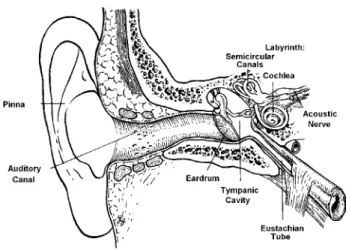
In the human ear (fig. 1),46 sound waves entering the ear canal set the eardrum into
48 Karl D. Kryter, "The Effects of Noise on Man" (New York: Academic Press, 1970, 1985), ch. 1; W. Melnick, "Hear-ing Loss from Noise Exposure," ch. 18 in C.M. Harris (ed.), Handbook of Acoustical Measurements and Noise Control
(New York: McGraw-Hill, 1991).
49 A.R. Møller, "The Acoustic Middle Ear Muscle Reflex," in Keidel and Neff (note 47).
Fig. 1 The human ear consists of three parts: external, middle, and inner ear. Sound waves reflected by the pinna and travelling in the auditory canal produce vibration of the eardrum (tympanic membrane). The three middle-ear ossicles (malleus, incus, and stapes) transfer this motion—increasing the pressure—to the oval window at the entrance of the labyrinth and to the perilymph inside. The resulting pressure wave travels into the cochlea, bending the basilar membrane which separates the cochlea longitudinally and carries the sensory hair cells. Their excitation is relayed to the brain by the acoustic nerve. Pressure equalization of the middle ear is possible via the Eustachian tube. The middle-ear muscles (not shown) can reduce the transmis-sion of the ossicular chain. The second part of the labyrinth is the vestibular organ with its cav-ities and semicircular channels for sensing motion. (Modified from ref. 46, used by permission of authors and publisher; original copyright: Springer-Verlag).
The middle ear contains mechanisms that can reduce the amount of vibration coupled to the inner ear, thus defining the limits of hearing and reducing damage from strong sound.48 At
very low frequencies, the Eustachian tube can provide pressure equalization. The aural reflex, which contracts muscles (m. tensor tympani and m. stapedius) in the middle ear about 0.2 s after the onset of strong noise, weakens the transmission of the ossicles.49 Due to the mechanical
prop-erties of the ossicles, frequencies above about 20 kHz are not transmitted.
50 Note that PTS can accumulate over a long time even if recovery from TTS occurs daily; see Kryter 1985 (note 48), pp. 271 ff. For a discussion of different approaches to exposure criteria see: Kryter 1970 (note 48), chs. 5, 6; Kryter 1985 (note 48), ch. 7; H.E. von Gierke and W.D. Ward, "Criteria for Noise and Vibrations Exposure," ch. 26 in Harris (note 48).
51 For chinchillas and cats a sensitivity higher by 18 dB has been mentioned by W.D. Ward, "Noise-Induced Hearing Damage," ch. 45 in M.M. Paparella et al. (eds.), Otolaryngology, 3rd ed., vol. II (Philadelphia: Saunders, 1991); for guinea pigs, Ward reports similar susceptibility as for humans, whereas Eldredge assumed 20 to 25 dB higher sensi-tivity: D.H. Eldredge, "Clinical Implications of Recent Research on the Inner Ear," Laryngoscope 70 (4) (April 1960), pp. 373-81.
52 Kryter 1970 (note 48), chs. 5 and 6; Kryter 1985 (note 48), ch. 7; Melnick (note 48); B. Berglund and P. Hassmén, "Sources and effects of low-frequency noise," Journal of the Acoustical Society of America 99 (5) (May 1996), pp. 2985-3002, and literature cited there.
53 Kryter 1970, 1985 (note 48).
54 See, e.g.: Kryter 1970, 1985 (note 48); K. D. Kryter, "Impairment to Hearing From Exposure to Noise," Journal of
the Acoustical Society of America 53 (5) (May 1973), pp. 1211-34, and the following discussion (pp. 1235-52); D. Henderson et al. (eds.), Effects of Noise on Hearing (New York: Raven, 1976); R.A. Schmiedt, "Acoustic Injury and the Physiology of Hearing," Journal of the Acoustical Society of America 76 (5) (November 1984), pp. 1293-1317; J.C. Saunders et al., "The Anatomical Consequences of Acoustic Injury: A review and Tutorial," Journal of the Acous-tical Society of America 78 (3) (September 1985), pp. 833-60, and five-year update, 90 (1) (July 1991), pp. 136-46; Melnick (note 48); Ward 1991 (note 51); H.-G. Dieroff, "Mechanisms of Noise-induced Injuries of the Inner Ear,"
Proceedings of the International Symposium on "Noise and Disease," Schriftenreihe des Vereins für Wasser-, Boden-und Lufthygiene no. 88 (Stuttgart and New York: G. Fischer, 1993), pp. 238-49.
damage" is somehow cumulative, exposure criteria have to include the duration and recovery time in addition to spectral composition and level.50
Whereas TTS can be studied with humans in experiments, for PTS one has to rely on people injured by accident, occupational noise, or the like. The other method is to do animal experiments—the results of which of course cannot directly be applied to humans. As animal species for model systems, often chinchillas, guinea pigs, or cats are selected (thought to be more sensitive than humans),51 but also dogs, monkeys, and—for blast waves—sheep have been used.
Which noises will produce more PTS (for higher level and/or longer duration) can be pre-dicted on the basis of the TTS.52 There are complicated schemes to quantitatively estimate PTS
from noise via expected TTS, reasoning that the PTS after 20 years of near-daily exposure is about the same as the TTS after 8 hours.53 PTS is thought to be produced by mechanical and
met-abolic processes damaging the sensory hair cells on the basilar membrane of the cochlea. PTS— as well as TTS—is relatively variable between subjects. Usually, it develops first and strongest at 4 kHz, then spreading to lower and higher frequencies. There is a considerable amount of lit-erature on all aspects of hearing damage, such as measuring and documenting it, understanding the physiological mechanisms, estimating the risks quantitatively, recommending limits for pre-ventive measures, considering acceptable damage, and percentages of people affected.54 Most
55 Note that sometimes also long-term injury comes under this heading, and damage from short exposure is called acute acoustic trauma. See, e.g, B. Kellerhals, "Acute Acoustic Trauma," Advances in Oto-Rhino-Laryngology 27 (1981), pp. 114-20.
56 Ward 1991 (note 51).
57 Loudness is measured by comparing subjective perception of tones at other frequencies with the one at 1 kHz. At 1 kHz, loudness levels in phone are defined to be equal to the respective sound pressure levels in decibels. See, e.g., A.M. Small, Jr. and R.S. Gales, "Hearing Characteristics," ch. 17 in Harris (note 48).
58 Melnick (note 48); Kryter 1970 (note 48), ch. 4. For the discomfort threshold see also S.R. Silverman, "Tolerance for Pure Tones and Speech in Normal and Defective Hearing," Annals of Otology, Rhinology and Laryngology 56 (3) (September 1947), 659-77.
59 Melnick (note 48); Kryter 1970 (note 48), ch. 4. For the pain threshold see also Silverman (note 58). At a slightly lower threshold there is a tickling sensation in the ear.
60 v. Gierke and Parker (note 30). 61 v. Gierke and Parker (note 30).
strong sound—this often comes under the name "acoustic trauma."55 Its inner-ear effects range
from some disarray of the hairs of the hair cells to complete destruction of the organ of Corti. Secondarily, ganglion cells and nerve fibers may degenerate.56 Details cannot be covered here;
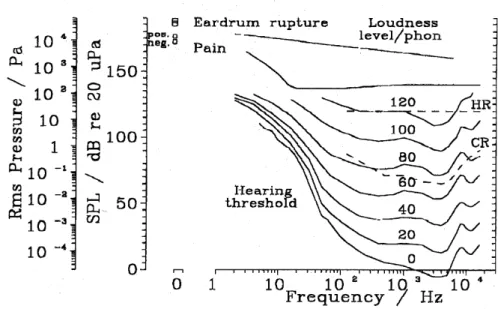
some aspects of short exposures to high levels will be mentioned in the following sections. Fig. 2 shows the human hearing threshold and curves of equal perceived loudness from very low to high frequencies.57 As can be seen, perceived loudness, measured in phones,
in-creases about logarithmically with sound pressure at each frequency. Also drawn are thresholds for damage effects to the auditory system which are important for judging acoustic weapons: C Thresholds of hearing hazard—above the first one there is a danger of permanent hearing
loss under certain conditions—noise level, duration, number and schedule of exposures, variables of the individual. Close to the threshold, the duration may amount to several hours of daily exposure over many years. Above the second threshold, at 120 dB where discomfort begins, there is a high risk of hearing loss even for short and few exposures (except impulse sounds).58
C Aural pain—this occurs above about 140 dB (200 Pa) throughout the audio region.59
However, in the infrasound range the threshold increases with falling frequencies to 160 and 170 dB (2 and 6 kPa). For static pressure, pain occurs above about 173 dB (9 kPa) of underpressure and about 177 dB (14 kPa) of overpressure.60 Pain is thought to occur
when the mechanical limits of the middle-ear system are transcended, and it is not direct-ly connected to sensitivity or hearing damage: damage can occur without pain and vice versa. However, under normal conditions exposure should be stopped when pain is felt. C Eardrum rupture—the threshold is at about 160 dB (2 kPa) in the audio region. For a step
to a static overpressure the threshold is at 186-188 dB (42-55 kPa peak).61 For rupture
62 F.G. Hirsch, "Effects of Overpressure on the Ear—A Review," Annals of the New York Academy of Sciences 152 (Art. 1) (1968), pp. 147-62 (here: pp. 155 ff.); Ward 1991 (note 51).
63 Binaural single-tone threshold 5-100 Hz (earphone exposure) from N.S. Yeowart and M.J. Evans, "Thresholds of au-dibility for very low-frequency pure tones," Journal of the Acoustical Society of America 55 (4) (April 1974), pp. 814-18. Also in N.S. Yeowart, "Thresholds of Hearing and Loudness for Very Low Frequencies," ch. 3 in W. Tempest (ed.), Infrasound and Low Frequency Vibration (London and New York: Academic Press, 1976), p. 50; above 100 Hz from Small and Gales (note 57). Binaural loudness curves 2-63 Hz (whole-body exposure) from H. Møller and J. Andresen, "Loudness of Pure Tones at Low and Infrasonic Frequencies," Journal of Low Frequency Noise and Vibra-tion 3 (2) (1984), pp. 78-87; 100 Hz and above: Small and Gales (note 57). For summary presentations of additional measurements at low frequencies see, e.g., Berglund and Hassmén (note 52). Hearing loss hazard curves from Melnick (note 48). Pain threshold curves below 100 Hz are given in H.E. von Gierke and C.W. Nixon, "Effects of Intense Infra-sound on Man," ch. 6 in Tempest (ibid.), p. 134; and v. Gierke and Parker (note 30), p. 604; above 100 Hz, e.g., in Small and Gales (note 57).
serves as a kind of fuse, reducing the pressure transmitted to the inner ear, and thus the potentially permanent inner-ear damage.62
64 "Motion Sickness," ch. 7 in M.J. Griffin, Handbook of Human Vibration (London and San Diego: Academic Press, 1990).
65 E.g., see the sensational article "The Low-Pitched Killer—Can Sounds of Silence Be Driving Us Silly," Melbourne
Sunday Press (7 September 1975), reproduced in Broner (note 12); see also note 30. Within science, it is interesting what Lumsden writes about a meeting of the British Association on the Advancement of Science where the "Director of the [British] Noise Abatement Society reported that at a research center at Marseille, France, an infrasound generator had been built which generated waves at 7 Hz. He said that when the machine was tested, people in range were sick for hours. The machine could cause dizziness, nervous fatigue and 'seasickness' and even death up to 8 km away (Associ-ated Press, Leicester, England, 9 September 1972)," Lumsden (note 15), p. 204. This obviously refers to Gavreau's work done at Marseille, see: V. Gavreau, R. Condat and H. Saul, "Infra-Sons: Générateurs, Détecteurs, Propriétés physiques, Effets biologiques," Acustica 17 (1) (1966), pp. 1-10; V. Gavreau, "Infrasound," Science Journal 4 (1) (January 1968), pp. 33-37.
66 Infrasound-provoked nystagmus was reported by M.J. Evans, "Physiological and Psychological Effects of Infrasound at Moderate Intensities," ch. 5 in Tempest (note 63), but could not be reproduced in other experiments: D.E. Parker, "Effects of Sound on the Vestibular System," ch. 7 in Tempest (note 63); v. Gierke and Parker (note 30); H. Ising, F.B. Shenoda, and C. Wittke, "Zur Wirkung von Infraschall auf den Menschen," Acustica 44 (1980), pp. 173-81. See also D.E. Parker, R.L. Tubbs, and V.M. Littlefield, "Visual-field Displacements in Human Beings Evoked by Acoustical Transients," Journal of the Acoustical Society of America 63 (6) (June 1978), pp. 1912-18.
2.1.2 Vestibular System
The vestibular system of the inner ear contains cavities (utricle and saccule) with sensors for linear accelerations and three semicircular channels for sensing angular accelerations. The vestibular system causes—via several, mostly sub-conscious channels in the central nervous system—eye movements and postural changes, and provides perception of motion and orienta-tion. The vestibular system is one of the sensor modalities responsible for motion sickness (the other two, the visual and somatosensory systems, are less relevant in the present context).64
The liquids (endolymph and perilymph) in the vestibular organs are connected to those in the spiral cochlea. Thus, acoustic stimulation of the balance organs is possible in principle, and this would be the mechanism for the alleged production of vertigo and nausea by infrasound. Effects and thresholds observed with humans and animals are discussed below for the different frequency ranges.
2.2 Effects of Low-Frequency Sound
In the 1960s and 1970s there was a wave of articles ascribing exaggerated effects to infrasound, not only in the general press.65 Much of this was anecdotal. In some cases, effects
observed in one laboratory could not be reproduced in another, e.g., concerning the evocation of nystagmus (involuntary eye movements) by infrasound.66 One reason may be production of
har-monics in test systems. Harhar-monics need to be controlled carefully, otherwise—because the sensi-tivity increases rapidly with frequency—they could influence the results.
2.2.1 Hearing Threshold and Loudness Perception at Low Frequencies
67 Thus, in the determination of the capabilities of hearing much care is needed to keep nonlinearities in sound produc-tion very low lest the externally generated harmonics at higher and better audible frequencies lead to erroneously high values. See v. Gierke and Nixon (note 63), pp. 122 ff.
68 For a discussion of this effect see v. Gierke and Parker (note 30), pp. 594 ff.
69 M.E. Bryans, "Low Frequency Noise Annoyance," ch. 4 in Tempest (note 63); Berglund and Hassmén (note 52). 70 H. Møller, "Annoyance of Audible Infrasound," Journal of Low Frequency Noise & Vibration 6 (1) (1987), pp. 1-17. 71 Berglund and Hassmén (note 52); K. Nishimura et al., "The Pituitary Adrenocortical Response in Rats and Human Subjects Exposed to Infrasound," Journal of Low Frequency Noise and Vibration 6 (1) (1987), pp. 18-28.
72 Nishimura et al. (note 71); K. Nishimura, "The Effects of Infrasound on Pituitary Adrenocortical Response and Gas-tric Microcirculation in Rats," Journal of Low Frequency Noise and Vibration 7 (1) (1988), pp. 20-33; Y. Yamasumi et al., "The Pituitary Adrenocortical Response in Rats Exposed to Fluctuating Infrasound," Journal of Low Frequency Noise and Vibration 13 (3) (1994), pp. 89-93.
73 R. Inaba and A. Okada, "Study on the Effects of Infra- and Low Frequency Sound on the Sleep by EEG Recording,"
Journal of Low Frequency Noise and Vibration 7 (1) (1988), pp. 15-19.
74 S. Yamada et al., "Physiological Effects of Low Frequency Noise," Journal of Low Frequency Noise and Vibration 5 (1) (1986), pp. 14-25.
about 50 Hz the hearing threshold increases steeply.67 It is often assumed that hearing below 20
Hz is due to non-linear production of harmonics in the middle ear.68
The strong increase of human sound sensitivity with frequency in the low-frequency region is evident in fig. 2. It is further important that the equal-loudness curves lie much closer at lower frequencies; this means that loudness perception increases much faster with sound pres-sure level here than at higher frequencies. Also the pain threshold is closer to the hearing threshold at low frequencies.
2.2.2 Low-Intensity Effects of Low-Frequency Sound
Effects of low levels of low-frequency sound are not relevant for weapons; they are men-tioned here only for the sake of completeness.
Annoyance by infrasound has occurred at widely differing levels, from 120 dB inside motor vehicles to below 60 dB in neighborhoods affected by industry sources.69 In a systematic
study annoyance seemed related to the loudness sensation, however.70 In some cases,
indirectly-produced audible rattling noise may be a main reason for annoyance.71 Stress hormones
in-creased in rats after infrasound exposure to 100-120 dB; in humans, this occurred only when subjects had not slept.72 Sleep was influenced somewhat by 80-100 dB low-frequency noise.73
Some people seem to be more sensitive to low-frequency sound (and/or rattling noises) than others, which may lead to stronger physiological responses.74
75 v. Gierke and Parker (note 30); A.R. Møller, "Function of the Middle Ear," ch. 15 in Keidel and Neff (note 47). 76 Table II and references in v. Gierke and Nixon (note 63); Table 5 and references in v. Gierke and Parker (note 30); D. Johnson, "The Effects of High Level Infrasound," in: H. Møller and P. Rubak (eds.), Conference on Low Frequency Noise and Hearing, 7-9 May 1980, Aalborg, Denmark (also NTIS ADA 081792, used here); Table I and references in Berglund and Hassmén (note 52).
77 C. Mohr, J.N. Cole, E. Guild and H.E. von Gierke, "Effects of Low Frequency and Infrasonic Noise on Man,"
Aero-space Medicine 36 (9) (1965), pp. 817-24 (here p. 822); Kryter 1970 (note 48), p. 229.
78 Mohr et al. (note 77). During the exposures above 40 Hz subjects wore ear protection so that ear pressure levels were markedly below 150 dB.
79 H.C. Sommer and C.W. Nixon, "Primary Components of Simulated Air Bag Noise and Their Relative Effects on Human Hearing," Report AMRL-TR-73-52 (Wright-Patterson Air Force Base, OH: Aerospace Medical Research Lab-oratory, 1973), cited after v. Gierke and Parker (note 30), section V; D.L. Johnson, "Hearing Hazards Associated with Infrasound," pp. 407-21 in R.P. Hamernik, D. Henderson and R. Salvi (eds.), New Perspectives on Noise-Induced Hearing Loss (New York: Raven, 1982) (also as NTIS ADA 110374, used here). Note, however, that there are a few documented cases of PTS, tinnitus, and disequilibrium from real airbag deployment: J.E. Saunders et al., "Automobile airbag Impulse Noise: Otologic Symptoms in Six patients," Otolaryngology—Head and Neck Surgery 118 (2) (1998), pp. 228-34.
80 v. Gierke and Parker (note 30).
2.2.3 High-Intensity Effects of Low-Frequency Sound 2.2.3.1 Effects on Ear and Hearing
The human auditory system seems to be relatively tolerant of low-frequency exposure, especially with infrasound where even at very high levels only some TTS and no PTS occurs (Table 2). Infrasound even reduces TTS from high-frequency noise because (quasi-)static load-ing of the middle ear reduces its transmission to the inner ear.75 It is likely that PTS observed,
e.g., in people exposed to low-frequency noise at the workplace is mainly due to higher frequen-cies that are also present.
Table 2
Auditory effects of low-frequency sound
Frequency / Hz Level / dB Duration Effect Ref
<1-20 125-171 minutes often TTS at audio frequencies,
recovery within 1/2 hour
76
3 or 23 130 1 h no TTS 77
low audible 90 many
hours
TTS, recovery after up to 2 days 76
# 40 140-150 0.5-2 min no PTS 78
Simulated airbag inflation: 79
infrasound part (c. 5 Hz) 165 peak 0.4 s no TTS
high-frequency part (0.5-1 kHz)
153 rms 0.4 s TTS 5-8 dB at 1.5-12 kHz
both parts together c. 170 peak 0.4 s TTS 2-3 dB at 1.5-12 kHz
Sonic boom (mainly 2-20 Hz)
162-171 peak
81 v. Gierke and Nixon (note 63).
82 v. Gierke and Nixon (note 63), p. 134; v. Gierke and Parker (note 30), p. 604. 83 Johnson (note 76).
84 D.J. Lim, D.E. Dunn, D.L. Johnson and T.J. Moore, "Trauma of the Ear from Infrasound," Acta Otolaryngologica (Stockholm) 94 (1982), pp. 213-31 (also NTIS ADA 121826, used here); Johnson (note 76).
85 Lim et al. (note 84); the human experiment had been done by one of the authors before the chinchilla results were known.
86 v. Gierke and Nixon (note 63); v. Gierke and Parker (note 30). At 6.5 kHz, a small rupture and blood in the external ear canal was observed with one experimenter after 5 minutes exposition to about 158 dB (1.6 kPa): H. Davis, H.O. Parrack, and D.H. Eldredge, "Hazards of Intense Sound and Ultrasound," Annals of Otology, Rhinology, Laryngology
58 (1949), pp. 732-38.
Of course, threshold shifts are not immediately felt by the individual and are thus irrele-vant as weapons effects, at least as far as the weapon designers and users are concerned. More relevant will be a pressure sensation, which develops at about 130 dB, independent of frequency. This may be due to negative pressure in the middle ear produced when the Eustachian tube opens only during the inward motion of the eardrum.81 Ventilation of the middle ear via the valsalva
operation—producing an overpressure in the mouth while holding one's nose and keeping the lips closed, which opens the Eustachian tubes from the nasal cavity and forces air into the middle ear—helps, but needs to be repeated constantly.
Even more impressive will be pain in the ear, which occurs at levels of 135 dB from 100 down to 50 Hz, slowly rising to 140 dB at 20 Hz and then fast increasing to about 162 dB at 2 Hz; for static pressure, pain sets in at 173-177 dB (see fig. 2).82
There seems to be only one example where long-term exposure to intense infrasound has produced permanent ear damage to humans: scars were observed on the eardrums of crew mem-bers of early German Diesel submarines.83 In animals, on the other hand, damage has been
pro-duced. Chinchillas, which have much thinner eardrums than humans and are known to be much more sensitive in the audible range, were exposed to frequencies between 1 and 30 Hz at levels 150-172 dB. Among the effects observed were: thinning, bleeding, and rupture of the tympanic membrane; hydrops and rupture of the saccular wall; blood in the cochlear scalae; rupture of the round-window membrane; degeneration of hair cells.84 With dogs and cats, less pathological
damage was observed. Thirty seconds of exposure to 172 dB infrasound did not even produce reddening in a human eardrum.85
The human eardrum ruptures above 42-55 kPa static pressure change (186-189 dB). Since for audio frequencies the threshold is assumed to be well over 160 dB (2 kPa), infrasound should lie somewhere in between the two values.86
2.2.3.2 Effects on the Vestibular System
87 Parker, in Tempest (note 66).
88 Evans (note 66). For a short discussion of the inconsistency see v. Gierke and Parker (note 30). 89 Ising et al. (note 66); v. Gierke and Nixon (note 63); v. Gierke and Parker (note 30).
90 v. Gierke and Nixon (note 63). 91 Mohr et al. (note 77).
92 v. Gierke and Nixon (note 63).
93 Including "held breath" up to 167 dB (4.8 kPa); v. Gierke and Nixon (note 63). 94 Mohr et al. (note 77).
95 Broner (note 12).
54 kPa (189 dB) resulted in eye movements.87 Reports on eye movements elicited in humans by
infrasound from 2 to 20 Hz at threshold levels of 140 to 110 dB88 could not be reproduced by
several other studies at levels from 130 to 140 dB, 142 to 155 dB, or even 172 dB.89
Balancing tests with humans showed no infrasound effects at levels from 110 to 140 dB.90 On the other hand, exposure to 150 to 155 dB at 50 to 100 Hz caused mild nausea and
giddiness.91 Marked effects were also observed with audio frequencies from 200 Hz to 2 kHz,
starting at levels of 120 dB (see 2.3.2). Thus, the vertigo and nausea effects ascribed to intense infrasound in the journalistic articles cannot really be confirmed for that frequency range. In the audio range, however, such effects do exist.
2.2.3.3 Effects on the Respiratory Organs
With infrasound of 0.5 Hz, decrease or even cessation of active respiration in anesthe-tized dogs was observed above 165 and 172 dB (3.6 and 8.0 kPa). This is less dramatic than it sounds, however, since the slow strong pressure variation acts as artificial respiration. Normal respiration returned after the infrasound ended, and no adverse after-effects were observed.92
Exposure to sonic booms (main energy in the infrasound region) between 154 dB (1.0 kPa) and 171 dB (6.9 kPa peak) did not lead to adverse effects on the human respiratory system.93
In the low audio frequency region below 50 Hz, exposure to levels up to 150 dB (0.63 kPa) caused chest-wall vibration and some respiratory-rhythm changes in human subjects, to-gether with sensations of hypopharyngeal fullness (gagging); these effects were felt as unpleas-ant, but clearly tolerable. Between 50 and 100 Hz, however, subjective tolerance was reached and exposure discontinued at 150 to 155 dB (0.63 to 1.1 kPa); respiration-related effects in-cluded subcostal discomfort, coughing, severe substernal pressure, choking respiration, and hypopharyngeal discomfort.94 Thus, the strongest respiratory effects will occur in the low audio
range (50 to 100 Hz), at levels of about 150 dB (0.6 kPa) and above.
Here it may be appropriate to take a short look at Broner's rough estimate for a deadly infrasound weapon mentioned in subsection 1.2.95 He used a too low value of 6 to 10 kPa for
96 Mohr et al. (note 77). 97 Mohr et al. (note 77).
98 Section VII.B. in v. Gierke and Parker (note 30); e.g., Gavreau et al. 1966 (note 65). 99 Section 2.2 in Griffin (note 64).
100 Section VII.B. in v. Gierke and Parker (note 30); see also: H. von Gierke, "Biodynamic Response of the Human Body," Applied Mechanics Review 17 (12) (December 1964), pp. 951-58; H. von Gierke, "Response of the Body to Mechanical Forces," Annals of the New York Academy of Sciences 152 (Art. 1) (1968), pp. 172-86.
could in principle be reduced by orders of magnitude by using a directed source, for infrasound wavelengths (e.g., λ=34 m at ν=10 Hz) its diameter would have to be unrealistically large, e.g., many hundreds of meters according to (A-13). Non-linear effects would have to be included, but the basic qualitative result remains valid (and holds similarly also for lower infrasound pressures for lesser effects) (see 5.1.1 below).
2.2.3.4 Other Effects
Several other effects were observed during exposure to intense low-frequency (30 to 100 Hz) sound at levels around 150 dB. Among these were increased pulse rates, cutaneous flushing, salivation, and pain on swallowing. Two subjects suffered from transient headache, and one of these also from testicular aching. The visual field vibrated and acuity was reduced. Speech sounds were modulated, but there was no significant decrease in intelligibility. Subjects showed marked fatigue after exposure. Brief infrasound had no effect on visual acuity, on the other hand.96 Also, motor tasks and speech production were not influenced.97
2.2.4 Vibration Considerations
It is sometimes maintained that infrasound sets organs in motion similarly to external vi-bration applied to the body.98 Whereas there are similarities, there are also important differences.
2.2.4.1 Effects of Whole-Body Vibration
For vertical vibratory excitation of a standing or sitting human body, below 2 Hz the body moves as a whole. Above, amplification by resonances occurs with frequencies depending on body parts, individuals, and posture. A main resonance is at about 5 Hz where the greatest discomfort is caused; sometimes the head moves strongest at about 4 Hz. The voice may warble at 10 to 20 Hz, and eye resonances within the head may be responsible for blurred vision be-tween 15 and 60 Hz.99 In-phase movement of all organs in the abdominal cavity with consequent
variation of the lung volume and chest wall is responsible for the resonance at 4-6 Hz.100
subjec-101 Section 5.3 in Griffin (note 64), and references quoted there. 102 See note 100.
103 If the sound pressure would affect only a part of the body surface, sideward movement and shear waves in the tissue would result with much greater energy deposition.
104 Kryter 1970 (note 48); Melnick (note 48). 105 Silverman (note 58); Small and Gales (note 57).
tive tolerance was reached at 35 m/s2 at 1 Hz, 20 m/s2 from 4 to 8 Hz, and 65 m/s2 at 20 Hz. No lasting effects were observed.101
2.2.4.2 Vibration Due to Low-Frequency Sound102
Air pressure variations impinging on the human body produce some vibration, but due to the large impedance mismatch nearly all energy is reflected. At low frequencies where the body dimensions are smaller than the wavelength, e.g., above 2 m for frequencies below 170 Hz, the same momentary pressure applies everywhere, and the tissue behaves as a viscoelastic fluid with much lower compressibility than air.103 The exceptions are where enclosed air volumes render
the body surface softer, as in the ear, where 90% of the impinging energy is absorbed, or at the lungs, where the chest wall or the abdomen can move more easily if external pressure/force is applied.
Because the external pressure simultaneously produces air flow through the trachea into and out of the lungs, the inner pressure counteracts the chest wall and abdomen movements. The system acts much more stiffly than with unidirectional vibratory excitation, and the resonance (with the highest velocities per sound pressure and thus highest tissue strains) is at 40 to 60 Hz instead of one tenth of that value.
2.3 Effects of High-Intensity High-Frequency Audio Sound 2.3.1 Effects on Ear and Hearing
As stated, there is a vast amount of literature on hearing damage due to noise in the audio region. PTS is mainly seen and studied for occupational exposure over a decade and more, from weighted levels of below 80 dB(A) to usually less than 120 dB(A).104 The sensitivity to TTS and
PTS follows roughly the loudness contours. Long-term-exposure PTS is usually strongest, and develops fastest, at 4 kHz, then in the range 3 to 6 kHz, relatively independent of the noise spec-trum at the workplace.
In the present context, however, the questions relate to short exposures at potentially higher levels. With respect to effects desired by weapons designers, one should recall that
throughout the audio range, discomfort begins at about 120 dB, and pain occurs above about 140 dB.105