iW
h, f*
til
-ttj
a If :iJ i i 1 If «g( e !
tatl
^ i - x . 1
a
•
Jj-7 ]
i
\
j
* j
1
_ I
f-*
-—"T
B e f o r e y o u o r d e r c h e m i c a l s a g a i n , s t o p a n d t h i n k .
I f you've been ordering from the same chemical
suppliers for years, stop and think about it. You could
be getting better quality and much more reliable
service at a better price.
Carolina has been supplying chemicals to the
scientific community for over 30 years. We keep
thousands of chemical products in stock year-round,
so you're assured of getting what you need, and at
competitive prices. And our professional staff has the
experience and dedication to make sure you get what
you need when you need it—our service is
unsurpassed.
We carry over 25,000 catalog items in addition to
chemicals, so we're also your best "one-stop" source
for other science teaching products as well. So when
you put together your next chemical order, start a new
habit—the Carolina habit.
Want more information? Write us or call our Customer
Service Department at 919 584-0381.
G e t t h e C a r o l i n a h a b i t .
Carolina Biological Supply company
2700 York Road
Burlington, North Carolina 27215
Today's academic laboratory is a m o d e r n
facility t h a t t r a i n s s t u d e n t s
for c a r e e r s in t h e high
tech-nology job m a r k e t . Such a
laboratory needs equipment
a n d supplies t h a t a r e as
sophisticated a s t h e laboratories t h a t
will one day employ these s t u d e n t s . Matheson
h a s a complete selection of g a s e s a n d equipment
for t h e m o d e r n laboratory. W e have m o r e t h a n
80 different g a s e s a n d p r e p a r e g a s mixtures to
y o u r specifications. No m a t t e r which g a s or
mixture you use, Matheson h a s regulators,
W
h
o
S
a
y
s I t ' s
a
n
I
v
o
r u
T
o
w
e
r
?
flowmeters, a n d other equipment
to control t h e m properly.
Safety in t h e laboratory is
important. To aid you in t h e
safe handling a n d s t o r a g e
of gases, w e have flash
a r r e s t e r s , toxic g a s detector systems, hand
t r u c k s a n d cylinder stands. W e also have a
system for buying back e m p t y lecture bottles
so t h a t you won't be stuck with a disposal
problem. Keep y o u r s t u d e n t s in t h e forefront
of technology. Send for a catalog describing
o u r products, prices a n d specifications.
Matheson belongs in the m o d e m laboratory.
BSgatheson
• • G a s Products
World Leatief *n Specialty Gases &30 Seaview Drive, Secaucua, NJ 07094
Circle No, 15 on Readers' Inquiry Card
idea
A way to bore a smooth, uniform, straight, properly
sized hole in a rubber stopper —quickly, easily, safely
and with any desired orientation.
Required are{1)a
novel cutter grooved to
bring fresh lubricant to
the cutting edge and
other areas of the cutter:
stopper interface
con-tinuously during the
boring operation and (2)
a modified drill press
which drives the cutter
and sets its orientation to
the stopper.
Put these two together
and you have our Power
Boring Machine— a real
skin and temper saver
which belongs in any
laboratory doing even a
moderate volume of
cus-tom boring of stoppers.
We have lileraiure on the Sargent-Welch Power Borer. For your copy, phone, write or circie the reader service number.
Anyone who has bored
a rubber stopper by hand
knows that it is a case of
trading hard work for
poor results. At best, the
hole is ragged,
non-uniform and frequently
crooked.
Custom boring need
not be so frustrating an
experience. With our
Power Boring Machine
stoppers (and corks) are
bored perfectly-with a
straight, smooth, uniform
bore-quickly, safely and
Clean power Cut bore contrasts with one bored manually
effortlessly—and even
off-center or at an angle,
as desired.
A large selection of
interchangeable cutters
provides the exact bore
size for every application
and corks and rubber
stoppers of any size can
be accommodated. Hole
sizes start at 3 mm and
range to 22 and 32 mm
for stoppers and corks,
respectively.
The Power Boring
Machine includes six
commonly used cutters,
three holders for small
stoppers, a bottle of
lubricant, an ejecting rod,
a cutter sharpener and a
3-wire cord and plug.
S-23207 POWER BORING MACHINE—Portable, Electric, Sargent-Welch. For 115 volt, 60 Hz A.C 675.00
A34
ISH& SARGENT-WELCH SCIENTIFIC COMPANY
7300 NORTH UNDER AVENUE • SKOKIE, ILLINOIS 60077 • (312) 677-0600
Anahelm/Blrmlngham/Chicago/ClevelaiMJ/Dallas/Donver/DetroH/Springliek), N.j./Toronto/Monlreal
J. J. LAGOWSKI, Editor
University ol Texas at Austin Austin, Texas 7S712
Assistant Editor:
Debora Ann Bittaker
Editorial Assistants
Linda Davis Kyle George V. Oliver Rebecca Chambers Marie S. Stephens
JAMES V. DEROSE
Publications Coordinator
ADVERTISING MANAGEMENT CENTCOM, LTD.
P.O. Box 231 25 Sylvan Road South Westport, Connecticut 06881 (2031226-7131
(For Hsf ot offices, see pags A40)
NEW PRODUCTS Shirley Sieratzki
Journal of Chemicai Education Centcom, t-td.
60 East 42nd St. New York, N.Y. 10165 (212)972-9660
Subscription Fulfillment Department
201h S Northampton Sts. Easton, Pa. 18042
SECONDARY SCHOOL EDITOR
Mickey Sarquis
Miami University-Middletown Middletown, OH 45042
ASSOCIATIONS EDITORS VaSuDev
California Association of Chemistry Teachers
Percy Ehrlich
New England Association of Chemistry Teachers
BOARD OF PUBLICATION Division of Chemical Education j . A. Sell
D. W. Brooks W. B. Cook G. A. Crosby D. A. Davenport M. H. Gardner D. Kofb W. J. Stratton
FEBRUARY 1984 Volume 61, Number 2
JOURflflL Of
Chemical Education
Owned anfl Published by the DIVISION OF CHEMCAL EDUCATION OF THE AMERICAN CHEMICAL SOCIETY
Articles in this Issue
The G. N. Lewis Symposium
93 The Research Style of Gilbert N. Lewis: Acids and Bases
Glenn T. Seaborg
101 The Generalized Lewis Acid-Base Theory: Surprising Recent
Developments Leo Brewer 104 G. N. Lewis and the Thermodynamics ol Strong Electrolytes
Kenneth S. Pitzer
108 Gilbert N. Lewis and the Beginnings of Isotope Chemistry
Jacob Bigeleisen
Articles of General Interest
The Cover
Each of the photographs shows six test tubes arranged in the f of Jo wing se-quence
Aqueous acid neutral base H+ water OH"
Non-AqiiBous acid neutral Base
solvent Et3N
1 0 0 1 1 7 1 1 9
129
133
136
137 143
1S8 173
Another Procedure for Writing Lewis Structures Thomas J. Clark The Effect of Neutral Ions on Acid-Base Balance Loyd E. Poplin The Bonds of Conformity: W. A. Noyes and the Initial Failure of the
Lewis Theory in America Martin D. Saitzman Equilibrium Binding and Steady-State Enzyme Kinetics: An Approach
Emphasizing Their Commonality H. Brian Dunford The Evaluation of Strain and Stabilization In Molecules using
tsodesmic Reactions Richard Fuchs Recommended Format for the Periodic Table of the Elements
American Chemical Society Committee on Nomenclature
Atomic Volume and Allot ropy of the Elements Charles N. Slngman Some Opportunities for Reinforcement of Learning among the
Subdfsciplines of Chemistry A. L. Underwood Models to Depict Hybridization of Atomic Orbitals C. T. Stubbiefield Error in the Minimum Free Energy Curve Grover Willis and David Ball
Features
To the test tubes in t i e lop set the indicator bromthymol blue has been added, to those in the bottom set brorncresol purple. The general slmiiarity, though not identity, of the indicator colors produced by the addition of acids and bases in the aqueous and non-aqueous systems is apparent. (Photo-graphs by George M. Bodner and Derek A. Davenport)
31 Editorially Speaking
146 Provocative Opinion: Trends and Issues in international Chemical Education Marjorie Gardner 155 Cooperative Education: Development of a Cooperative Education
Program at the University of Victoria Alexander McAuley 159 Real World of Industrial Chemistry: A Private Corporation as Part ol
a Chemistry Department: An Eleven-Year Synergism
Richard E. Bayer
161 Report ol the Polymer Core Course Committee: Polymer Samples for College Classrooms
Raymond B. Seymour and Gerald S. Kirshenbaum
164 Computer Series, 49: Bits and Pieces, 19 edited by John W. Moore 172 Tested Demonstrations edited by George L. Gilbert 181 Division of Chemical Education: Report of the ACS Examinations
Committee
(Continued on pane A36)
T h e
P a r r 1 4 5 1
S o l u t i o n
C a l o r i m e t e r
A convenient bench-top
instru-ment for measuring enthalpy
changes produced by chemical
reactions in solution, with
provision for conversion to a
semimicro bomb calorimeter.
A Multi-Purpose
Calorimeter
Utilizing a unique rotating
sample cell and a sensitive
electronic thermometer, the
1451 Solution Calorimeter
pro-vides a moderately priced and
easily operated instrument for
measuring:
• Heats of Reaction
• Heats of Solution
• Heats of Mixing
• Heats of Dilution
• Heats of Wetting
with a precision adequate for
most analytical and exploratory
research applications. Energy
changes ranging from 2 to 1000
calories in either liquid-liquid
or Squid-solid systems can be
measured in a straightforward
manner with results plotted on a
strip chart for easy interpretation.
Convertible to a Semimicro
Bomb Calorimeter
Taking advantage of its
com-pact case and precise electronic
thermometer, the 1451
calori-meter is easily converted to a
Parr 1421 Semimicro Bomb
Calorimeter for measuring heats
of combustion of small samples.
The semimicro bomb and all
parts needed for this conversion
are provided in a 1425
Conver-sion Set
For details, write or phone:
PARR
INSTRUMENT
COMPANY
211 Fifty-third Street, Moitne. IL 61365 309-762-7716
A45 Safety In the Chemical Laboratory edited by Malcolm M. Renfrew Chemical Management: A Method tor Waste Reduction
Stanley H. Pine
A53 Chemical Instrumentation In the Laboratory
edited by Frank A. Settle, Jr.
Choosing the Right Instrument: The Modular Approach, Part I
Howard A. Strobe!
A58 Out of the Editor's Basket edited by James A. Goldman A67 Book Reviews
Secondary School Chemistry
124
128 145 148 151
156 174 180
Chemical Principles Revisited: Tfce " 6 N + 2 Rule" lor Writing Lewis Octet
Structures Mehrin E. Zandier and Erach R. Talaty
Applications end Analogies edited by Ron DeLorenzo A New Approach to Overhead Projection Timothy L. Schaap
Chemical Bonds: The Role of the Humanities in the Teaching ot Chemistry Dominick A. Labianca View from the Classroom: "The Fundamental Things Apply As Time Goes By" Frank Cardulta
Delaware Science Olympiad John C. Cairns Chemical of the Month: NHric Add Sardul S. Pannu
What's Happening in Your Part of the Country?
Laboratory Experiments
177 Modification of a Microwave Oven for Laboratory Use
Judith Andrews and George F. Atkinson
179 Synthesis of Vitamin K Epoxlde: An Undergraduate Biochemistry Experiment M. Thierry-Palmer
Notes
176 A Convenient Method for the Preparation of 2,4-Dtnitrophenylhydrazones: Flavanone 2,4-DlnKroptienylhydrazone B. A. Howe!! 178 A Simple, Compact Nitrogen Bubbler R. M Baldwin and A. Rhodes
y; E*peftroenta, laboratory exercises, lecture demonstrations and cHies descriptions of lire use of chemicals, appa-lalus and Instrument are presented in THIS JOURNAL as Illustrative cl new, novel or improv&il jdeas or corscepis in chem'slry a»liucilon, and are directed a' qualified leaders. Alitrough every effort Is made to assure and encourage safe praolices aitf safe USB of chemicals, the JOURNAL OF CHEMICAL EDUCATION cannot assume rissponsiblrty for uses made o! IIS published maliKi-ete. We strongly urge aB those planning To use materials from ou* pageslo jT^ahe choices and to develop procedures for saborato-ty and classroom safely in accedence with local needs am) sltualtons.
s for publication, boohs for review, and mnesponOance regarding papers, proofs, ar>3 orders for reprints should be sent to the officg ol Iho Editor J. J. Laoowstd, Journal of Chemical Education, Dept. of Chemistry. University of Terns. Austin, To*. 7S? 12-Manuscripts lor Hie Seconds? School Socilon can lie sent dirscUy to: Ms. Mickey SarcnSs, MSi School Efllta, Journal of Chemical Education, Miami. UnWaslt¥-l**l«10«n, 021X1 Easl University Blvd., Wosetown. OH 45042. Authors iMrefew^B the MoOce to AiilhorelMoubBsr^ In December 1SB1. paoe 103G for correct format atvt style guLoellnes.
Subscription price lor Individuals: U.S.A. $20.00 par year, all other counviea $25.00 par year. Subscription price lor UbrarMa, IniHhiHans and cornpsntos: U.S.A. $40,00 per yesr: all other countries $46.00 per year. Single copies 16.00 US. $6,40 Foreign. Vrtums {12 copies tor a calendar year) S56.00. Singia copies 01 issues available tor the preceding 15 years onty. Orders tof subscriptions, single copies. remiHances " i d changes ot aSdress should be sent to Journal oi Chmnlcat Education, Subscriptton sod Book Order Department, 30th and Northampton Sts., Easton, Pa. 18043. Subscribers, requesting an address change must give 6 weeks notice, submit label with old address, and submit new address with zip code. Foreign rerrrittancss must be made toy International money order, bar* # a f t payable at a U.S. bar*, or UNESCO coupons.
Nocialms for copies of Journals last In the msllscanM altoweO unless such claims are received wlBiln slity (60>da*s of 0» dale of Issue; no ci&rVm can be allowed tor issues lost as a resuft ol insufficient notice of change of address. SBcom^clesfi postage paid HI Media. PB. ar»o atHflonal mailing office.
Tliree cumulative indexes are available: 26-Year Cumi^allKe Indan, Volumas 1 to 25; 10-Year CumutallKe M w , Volumes 26-35:10-Year Cumulative Index, Volumes 36-46. The selling price of saen cumulative Index, including postage and handling costs, is $9.50 US and $9.90 foreign. Prepaid orders should Be addressed lo Subscription and Book Otdei De-partment, Journal of Chemical Education, 20tb ana Northampton Streets. Easton, PA 18042.
© CopyrFgfit 1984 ty Division of Chemical Education, American Chemical Soclaiy
. I * . - - .
•
A Class
of One.
wmmmmm
r
iJifn^s- * n. si i
T
h
e
c
h
e
m
i
s
t
r
y
i
s right
F o r a d o p t i o n c o n s i d e r a t i o n , r e q u e s t
a n e x a m i n a t i o n p a c k a g e f r o m y o u r
r e g i o n a l H o u g h t o n Mifflin office.
C
h
e
m
i
s
t
r
y
D
a
r
r
e
l
l
D
.
M
a
r
k S .
E
b
b
i
n
g
W
r
i
g
h
t
o
n
W a y n e S t a t e U n i v e r s i t y C o n s u l t i n g E d i t o r
M a s s a c h u s e t t s
i n s t i t u t e of
T e c h n o l o g y
A b o u t 9 2 8 p a g e s
S t u d y G u i d e
L a b o r a t o r y M a n u a l
S o l u t i o n s M a n u a l
I n s t r u c t o r ' s M a n u a l
T r a n s p a r e n c i e s
C o m p u t e r - A s s i s t e d
B l a c k b o a r d ®
J u s t p u b l i s h e d
Houghton Mifflin
13400 Mi
dway ifoad, Dalias, Texas 75234 Penirington-Hopewell Road, Hopcwdl,
N
e
w Jersey 08525
1900 South Baiavia Avenue, Gtntva, Illinois 60134 777 California Avenue, Palo Alto, California 94304
Advertising in this issue
The companies listed below
evidence their Interest in chemical education by their presence as advertisers. This advertising brings to our subscribers information about new books, new and established laboratory equipment, and apparatus and instruments for both teaching and research. Get acquainted with the advertisers in your
Journal. Do not hestitate to write for their catalogs and literature. Use the
Readers' inquiry Cards found on the white insert at the back of this issue. When contacting advertisers by letter or phone, be sure to mention the Journal
of Chemical Education.
ON COUPONS IN ADS Readers who do not want to damage their issue by cutting out coupons found in some advertisements are requested to make a photo copy of the coupon for use in inquiring about items mentioned in the ad.
INDEX TO ADVERTISERS IN THIS ISSUE
CIRCLE
INQUIRY NO. ADVERTISERS PAGE NO.
CIRCLE
INQUIRY NO. ADVERTISERS PAGE NO.
1 Allyn 8 Bacon, inc A59
Direct Response Advertising, Inc. 2 The Benjamln/Cummings Publishing
Company, Inc AS1 36 Brooks/Cole Publishing Company A60 4 Carolina Biological Supply Company IFC
26 COMPress A46
Advertising Assistance, Inc.
>n Cross Educational Software A70
29 Gllian Instrument Corporation AS7
S.M. Sachs S Associates, Inc.
IX Gustavus Adotphus A70 6 D. C. Heath and Company A42-A44
ix Houghton Mlffiin Company A3S-A39, A47, A69
Houghton Advertising
25 institute for Scientific information A41
Greene Towns Associates, Inc.
10-11 Instrument for Research & Industry A46. A70
Kenyon Boag Associates
XX JSS Software A70
30 Laboratory Craftsmen. Inc A57 24 LKB Research OBC
Jarman, Spitzer 8 Felix, Inc.
14 MacMillan Publishers A6B
Ffamm Advertising. Inc.
15 Matheson A33
Kenyon Hoag Associates
1B McGraw-Hill Book Co./Coliege Division A61 Media Buying Services Internationa), Inc.
31 Pan- Instrument Company A36
USA Chicago. Inc.
33 Programs for Learning, Inc AS7
PFL Marketing Associates
17 Random House AB2 23 Sargent-Weich Scientific Co A34
Polyiech Advertising
3S Saunders College Publishing A64-A65 Doyle Dane Bornbach, Inc.
xx Spectrex Corporation A70
xx Thorn Smith, Incorporated A7Q Powder River Associates
32 Whatman Laboratory Products, inc./
Whatman Paper Division A37 Mulr Cornelius Moore, Inc.
20,21,22,27 John Wiley & Sons, Inc A43,AS5,A63,fBC
60S Advertising Group
28 Willard Grant Press A52
Advertising Management tor the Journal oicnemlcal Education
CENTCOM, LTD.
Thomas N. J. Koerwer, President James A. Byrne, Vice President Alfred L. Gregory, Vice President
Clay S. Holden, Vice President Benjamin W, Jones, Vice President
Robert L. Voepel, Vice President Joseph P. Stenza, Production Director
25 Sylvan Road South P.O. Box 231
Westport. Connecticut 06881 (Area Code 203) 226-7131 Telex No. 643310
ADVERTJSSNG SALES MANAGER James A. Byrne
ADVERTISING PRODUCTION MANAGER Joseph P. Stenza
SALES REPRESENTATIVES
NEW YORK: John F. Raftery, Centcom, Ltd., 60 East 42nd St., New York, N.Y.
10165. Telephone: 212-972-9660.
PENNSYLVANIA: Jt.hn F. Raftery, Centcom, Ltd, GSB Bidg., Suite 425. 1
Be*-mont Ave., Bala Cynwyd, PA. 19004. Telephone: 215-667-9666.
CONNECTICUT: John F. Raftery, Centcom, Ltd., 25 Sylvan Road South, P.O.
Box 231, Westport, CT 06881. Teteptone: 303-226-7131. Telex No. 643310.
OHIO: John F. Rattery. Cenlcwn, Ltd., 325 Front Street, Suite 2. Berea, OH.
44017. Telephone: 216-234-1333.
ILLINOIS: John F. Raftery. Michael J. Pak, Centcom, Ltd., 540 Frontage Rd.,
NorthfieW. !L. M0093. Telephone: 312-441-6383.
SAN FRANCISCO: Paul M. Butts, Centcom, Ltd.. Suite 112, 1499 Bayshore
Highway, Surllngame, CA 94010. Telephone: 415-692-1218.
LOS ANGELES: Clay S. Holden, Centcom, Ltd.. Newton Pacific Center, 3142
Pacific Coast Highway, Suite 200, Torrance, CA. 90505. Telephone: 213-325-1903.
UNITED KINGDOM: Heading, England--Malcolm Thiele, Techonmedia. Ltd.,
Wood Cottage, Shurlock Row, Reading BG10 0Q£. Berkshire, England. Telephone: 0734-343302.
Lancashire, England—Technomedla, Ltd., c/o Meconomics Ltd., Meconomics House, 31 Old Street, Ashton Under Lyne, Lancashire. England, Telephone: 061-308-3026,
CONTINENTAL EUROPE: international Communications Inc., Rue MaHar 1,4800
Verviers, Belgium. Telephone: (087) 22-53-B5. Telex No. 49263,
ASIA: Shuji Tanaka, International Media Representatives Ltd., 2-29 Toranomor
1-Chrome Minato-ku, Tokyo 105. Japan. Telephone: 502-0656.
E
f
f
i
c
i
e
n
c
y
E
x
p
e
r
t
I
f you are an educator in organic chemistry, you share
the same major concern as your colleagues in industry:
productivity. For peak efficiency in your teaching and
research, you need quick, easy access to the most current
organic chemistry literature. And you need a reliable
source of new research ideas—a source that wiil insure
against duplication of effort , . , You need the efficiency
expert: Current Abstracts of Chemistry & Index Chemcus®
(CAC&IC®).
Week after week, CAC&IC wili alert you to new
compounds reported in the chemical journal literature. In
minutes, you'll scan CAC&IC's structural diagrams to
locate compounds important to your own and your
students' research. That's because ISI®'s 22 chemical
indexers work hard to make your work easier . . . From a
base of over 110 chemistry journals, our indexers scan
over 1,000 articles per week for reports of new organic
compounds. Approximately 300 of those articles yieid the
desired information, and, on the average, CAC&IC alerts
you to 4,000 new organic compounds every week.
CAC&IC's graphic abstracts also alert you to biological
activities, analytical techniques, and new synthetic
methods.
And there's no better time than right now to subscribe
to CAC&IC—while the Institute for Scientific
Information® /Chemical Information Division (ISI/CID) is
offering substantial discounts off the regular $2,600 annual
subscription price to qualifying colleges and universities:
Subscribe now, and you'll also receive these FREE
extras: a seminar conducted at your own institution (North
America only) by an ISI chemical information lecturer; a
set of teaching materials, and a subscription to ANSA®
(Automatic New Structure Alert®), the customized monthly
substructure alerting service for organic chemists.
Put the efficiency expert to work for you! For more
information about this special CAC&IC offer, fill out the
coupon beiow and mail it today!
I |_J 1 1 ( & ! I need fast, easy access to new organic
| chemistry. Please send me a Current Abstracts of
• Chemistry & Index Chemicus® discount application,
! along with more information about your FREE
I extras tight away!
5 Name/Title
Organization/Department
if ynor enrollment is:
under 2000
2000 to 4999
over 4999
your CAC&IC subscription
costs only:
S 600
$1560
SI 750
Address
City/State
Country/Province
Telephone
r-Zip/Postal Code
D
< 3 S f f Institute for C U O I "formation
•St-'U Scientific Information" .XJoivision
Chemical Information Division Marketing
3501 Market St., Philadelphia, Pennsylvania 19104 U.S.A. Telephone: 1215) 386-0100, Cable: SCINFO, Telex: 84-5305
S19BI IS; TB-3Z91 Circle No. 25 on Readers' Inquiry Card
COLLEGE CHEMISTRY
WITH QUALITATIVE ANALYSIS
Seventh Edition
1984 Cloth 096 pages
GENERAL CHEMISTRY
Seventh Edition
1984 Cloth 932 pages
Henry F. Holtzclaw, Jr., University of Nebraska — Lincoln
William R. Robinson, Purdue University
William H. Nebergall
The Seventh Edition of College Chemistry and General Chemistry offers the most
read-able and the most effective introduction to chemistry a student will ever need. Along
with clear, solid coverage of modern chemical principles, this text carefully blends
descriptive and theoretical chemistry in a way that many texts have emulated but never
have quite equalled. Clear, step-by-step explanations guide students through even the
most difficult of concepts. And along with the extensive supplement package —
com-plete with software — there's just no comparison when it comes to individualized
stu-dent guidance and dependable teaching aids.
NEW! A software package, specially correlated to College Chemistry and General Chemistry.
INTRODUCTION TO GENERAL CHEMISTRY
by Professor Stanley Smith, University of Illinois;
Dr. Ruth Chabay; and Dr. Elizabeth Kean, University of Wisconsin
D. C. Heath is pleased to announce a unique new computer software package featuring the
integra-tion of page referenees to the Holtzclaw, Robinson, and Nebergail. The computer software is
avail-able by special arrangement with COMPress, Inc. to adopters of the Seventh Edition. The software
package consists of approximately 14 self-documenting diskettes compatible with the Apple® II Plus
and Apple® lie microcomputers. Color graphics and animation help to develop an intuitive feeling
for chemical concepts.
Introducing the most comprehensive
chemistry supplement program available —
THE HOLTZCLAW CHEMISTRY PACKAGE!
INSTRUCTOR'S GUIDE FOR
COLLEGE CHEMISTRY AND
GENERAL CHEMISTRY
Seventh Edition
Norman E. Griswold,
Nebraska Wesleyan University
1984 Paper 221 pages
STUDY GUIDE FOR
COLLEGE CHEMISTRY AND
GENERAL CHEMISTRY
Seventh Edition
Norman E. Griswold,
Nebraska Wesleyan University
1984 Paper 313 pages
PROBLEMS AND
SOLUTIONS FOR
COLLEGE CHEMISTRY AND
GENERAL CHEMISTRY
Seventh Edition
J.H. Meiser, Ball State University
F.K. Ault, Ball State University
H.F. Holtzclaw, Jr.,
University of Nebraska — Lincoln
W.R. Robinson, Purdue University
1984 Paper 277 pages
PROBLEMS AND
SOLUTIONS
SUPPLEMENT FOR
COLLEGE CHEMISTRY AND
GENERAL CHEMISTRY
Seventh Edition
ILF. Holtzclaw, Jr.,
University of Nebraska — Lincoln
1984 Paper 120 pages est.
BASIC LABORATORY STUDIES
IN COLLEGE CHEMISTRY WITH
SEMIMICRO QUALITATIVE
ANALYSIS
Seventh Edition
Grace R. Hered,
City Colleges of Chicago
1984 Paper 341 pages
For details or sample copies,
call us toll free; 800-225-1388
in Massachusetts, call collect:
617-863-1948
Providing a well-balanced and systematic
introduc-tion to organic chemistry through a skillful blend of
theory, mechanism, and synthesis.
O R G A N I C
C H E M I S T R Y
Seyhan N, Ege,
The University of Michigan
1984 Cloth 1163 pages
This student oriented and highly
motivational test, accompanied
by an innovative microcomputer
software program, makes the
study of a traditionally difficult
subject both relevant and
fasci-nating for science, pre-med, and chemistry students. The text
pro-vides direct and immediate exposure to basic concepts through
acid base chemistry while emphasizing the relationship between
structure and reactivity of organic compounds. A systematic topic
presentation features detailed use of mechanisms in structural
formulas, equations, and problems for immediate reinforcement.
Extensive use is made of the chemical properties and synthesis of
natural products chemistry which are integrated throughout the
text and in examples and problems. Outstanding problem sets,
offering over 1400 problems, derived from the most recent
litera-ture, provide extensive and weil-integrated applications.
Three valuable supplements that, add an exciting new
dimension to the study.
INTRODUCTION TO ORGANIC CHEMISTRY
Stanley G. Smith, University of Illinois
This unique computer software package features an integration of
chapter and page references to the Ege Organic Chemistry text.
Possibly the most ambitious series of programs yet written for the
microcomputer, this eight-disk series is compatible with Apple® II
Pius and Appie® He and will be available by special arrangement
with COMPress, Inc. to adopters of the text. The software
includes programs on Alkanes and Aikenes, Substitution
Reac-tions, IR and NMK Spectroscopy, Arenes, Aicohols, Aldehydes and
Ketones, Carboxylic Acids, and Chemrain (a chemistry game for
improving knowledge of organic reactions.)
STUDY GUIDE FOR ORGANIC CHEMISTRY
Seyhan N. Ege, Roberta Kleinman, and
Marjorie L.C. Carter
1984 Paper 1100 pages est.
An important aid to learning, the Study Guide contains detailed
solutions to all the problems along with explanations of concepts
used in arriving at the answers.
TRANSPARENCIES
A complete set of 8Vz x 11 acetate transparencies, reproduced in
2-colors directiy from the main text artwork, will be provided to
adopters of Organic Chemistry free of charge.
D. C. HEATH AND COMPANY
College Division
125 Spring Street
HEATH Lexington, MA 02173
A l s o a v a i l a b l e from D . C . H e a t h
Newly acquired from Springdale Publishing Company!
G E N E R A L C H E M I S T R Y
P R O B L E M S O L V I N G I
Russell S. Drago, University of Florida
1979 Paper 203 pages
This self-taught guide provides students with a
sys-tematic and dependable approach to solving
prob-lems commonly encountered in freshman chemistry.
Emphasizing similarities in the logic used to solve
dif-ferent types of problems, General Chemistry PrvMem.
Solving I simplifies the learning process and
mini-mizes the need for memorizing numerous equations
and facts. Topics are organ ized to separate
fundamen-tal and advanced material, making the hook useful to
students at all levels. Volume I concentrates on
Stoi-chiometry—-a critical first-year issue, gases, bonding,
and oxidation states. Answers are provided for the
over TOO practice problems which arc organized
topi-cally and vary in complexity. Key subjects covered
in the text include: Stoichiometry, Nomenclature,
Atomic Structure, Lewis Structures,
Oxidation-Reduc-tion, and Coliigative Properties.
Recently published!
O R G A N I C E X P E R I M E N T S
Fifth Edition
Louis F. Fieser
Kenneth L. Williamson, Mount Holyoke College
1983 Cloth 467 pages
Instructor's Guide
M O D E R N E X P E R I M E N T A L
O R G A N I C C H E M I S T R Y
John A. Miller and E. F. Neuzil, both of Western
Washington University
1982 Paper 752 pages
THEORY AND PRACTICE IN
THE ORGANIC LABORATORY
Third Edition
John A. Landgrebe, University of Kansas
1982 Paper 616 pages
GENERAL CHEMISTRY
PROBLEM SOLVING II
Steven S. Zumdahl, University of Illinois,
Urbana
1979 Paper 323 pages
The second volume of this self-taught guide to solving
problems in freshman chemistry incorporates the
same systematic approach and quality features found
in Volume 1. Problem Solving II stresses the solution
of equilibrium problems which constitute the bulk of
second semester studies. 82 self-tests and over 280
problems, complete with answers, are presented along
with practice problems (totalling over 275) at the
con-clusion of each chapter. Volume H includes coverage
of the following key subjects: Gaseous equilibria,
acid-base equilibria, titrations, indicators,
solubil-ities, thermodynamics, and electrochemistry. Both
volumes offer ample opportunity for mastering key
concepts and for practicing problem solving
tech-niques, leading to improved performance on quizzes
and examinations.
ORGANIC CHEMISTRY
A Brief Course
Fifth Edition
Walter W. Linstromberg, University of
Nebraska-Omaha
Henry E. Baumgarten, University of
Nebraska-Lincoln
1983 Cloth 512 pages
Laboratory Guide/Study Guide with Problems and
Solutions
ORGANIC EXPERIMENTS
Fifth Edition
Walter W. Linstromberg, University of
Nehraska-Omaha
Henry E. Baumgarten, University of
Nebraska-Lincoln
198S Paper 324 pages
PROBLEM SOLVING IN
GENERAL CHEMISTRY
Ronald A. DeLorenzo, Middle Georgia College
1981 Paper 482 pages
edited by MALCOLM M. RENKREW University oi Idaho Moscow, fdaho 83843
Chemical Management
A Method for Waste Reduction
Stanley H. Pine
California State University, Los Angeles, CA 90032
Chemicals! A word to which the public reacts with emotion, usually negative. For the laboratory instructor and researcher, chem-icals are the basis for their operations. Vet these scientists are faced with an increasing array of regulatory and social problems be-cause their work with chemicals can produce chemical wastes. Considerable effort and expense is being expended to properly dis-pose of those wastes. A large industry of waste disposers and regulatory advisors has devel-oped to face the many problems which have arisen.
For those of us who are involved with aca-demic or small industrial laboratories, the necessity to handle and dispose of chemicals properly has become a rather burdensome obligation. An approach to the problem which has been relatively neglected, partic-ularly in academic laboratories, is the man-agement of chemicals so as to minimise the generation of waste. In fact, the management of chemicals can have a broader impact than just waste reduction. The use of valuable sources (chemical compounds) will be re-duced, costs to the institution can be mini-mized, and the general efficiency of labora-tory operations will be improved.
Let us consider the beginning of the ac-quisition process for a chemical—purchasing.
Stanley Pine is Professor of Chemistry at
California State University. Los Angeles. He earned a PhD at UCLA ana spent a post-doctoral year at Harvard before joining the Cal State faculty In 1964. He has spent re-search sabbaticals at CalTech and at the University ot Strasbourg, France where he was a FiibrigM Visiting Professor. Pine is the University Chemical Safety Officer at Cal State, Los Angeies, and Is a 1963 recipient of the Governor's Safety Award. He is a member of the American Chemical Society Committee en Chemical Safety and Is the chairman of the ACS Task Force on RCRA.
T h e e c o n o m i c s of b u y i n g c h e m i c a l s (or a l -m o s t a n y o t h e r c o -m -m o d i t y ) is: -m o r e is c h e a p e r . W e c a n u s u a l l y b u y a 1-kg q u a n t i t y a t five o r six t i m e s t h e c o s t of a 100g q u a n -t i -t y . T h a -t is r e a s o n a b l e s i n c e p a c k a g i n g a n d h a n d l i n g of t e n c o n t a i n e r s costs c o n s i d e r a b l y m o r e t h a n s i m i l a r h a n d l i n g of o n e c o n -t a i n e r .
H o w e v e r , from t h e v i e w p o i n t of overall e c o n o m i c s a n d efficiency, is b u y i n g l a r g e a c -t u a l i y c h e a p e r ? W e s h o u l d a s k w h e -t h e r -t h a -t large, 1-kg q u a n t i t y is n e e d e d ? W i l l It b e c o n s u m e d in s o m e r e a s o n a b l e a m o u n t of t i m e ? H o w will t h e large c o n t a i n e r be s t o r e d ? L a r g e b o t t l e s t a k e u p c o n s i d e r a b l e s p a c e a n d t h e y n e v e r s e e m t o fit on t h e s t o r e r o o m shelves! A n d finally, if it is n o t u s e d u p , how a n d a t w h a t c o s t will t h e excess be d i s p o s e d of?
T h e l a s t question h a s b e c o m e t h e economic t h o r n for m a n y of u s . T h e c o s t s of safely a n d legally d i s p o s i n g of p a r t i a l l y filled a n d e v e n e x t r a u n o p e n e d c o n t a i n e r s of c h e m i c a l s is s t r a i n i n g t h e b u d g e t s of m a n y l a b o r a t o r y o p e r a t i o n s .
H o w foolish i t is t o p a y t o w a s t e v a l u a b l e r e s o u r c e s !
P u r c h a s e a n d i n v e n t o r y c o n t r o l is o n e way t o g e t a h a n d l e on t h e c h e m i c a l s u s e d by o u r i n s t i t u t i o n s . W e s h o u l d b u y only w h a t we will n e e d over a r e a s o n a b l e p e r i o d of t i m e . { T h e m a j o r c h e m i c a l s u p p l i e r s toll u s t h a t p a c k a g i n g size l a r g e l y d e p e n d s on c o n s u m e r d e -m a n d . )
W e s h o u l d k n o w w h e r e c h e m i c a l s a r e l o -c a t e d . F r o m a n e m e r g e n -c y p r e p a r e d n e s s view w e m u s t k n o w w h a t c h e m i c a l s a r e l o c a t e d in a specific l a b o r a t o r y or storeroom. As a m o d e l r e m e m b e r t h a t we h a v e clearly identified t h e l o c a t i o n of r a d i o a c t i v e m a t e r i a l s for m a n y , m a n y y e a r s .
I n v e n t o r y c o n t r o l p r o v i d e s t h e b a s i s for a n o t h e r i m p o r t a n t a s p e c t of c h e m i c a l m a n a g e m e n t — s h a r i n g c h e m i c a l s . All of us, u n -f o r t u n a t e l y , h a v e b e e n i n d o c t r i n a t e d with t h e i d e a t h a t o p e n e d b o t t l e s of c h e m i c a l s a r e n o t t o be t r u s t e d . I n m o s t c a s e s t h a t is n o t r e a -s o n a b l e . W e r e a d i l y b o r r o w c h e m i c a l -s from a n e i g h b o r i n g l a b o r a t o r y w h e n t h e y a r e n o t
a v a i l a b l e i n t h e c e n t r a l s t o r e r o o m . If p u r i t y is in question, a r a p i d s p e c t r a l analysis c a n be o b t a i n e d .
P a r t i a l l y u s e d b o t t l e s of c h e m i c a l s n o longer n e e d e d by one l a b o r a t o r y c a n be m a d e available to otiier labs of t h e i n s t i t u t i o n . T h i s r e q u i r e s s o m e c o o r d i n a t i o n , b u t n o t h i n g b e -y o n d t h e i n v e n t o r -y control s -y s t e m s t h a t m o s t of u s u s e ; i.e., s o m e k i n d of c a r d file s y s t e m . A n d as we m o v e i n t o t h e c o m p u t e r age t h i s i n v e n t o r y p r o c e s s c a n be m a d e m o r e a n d m o r e efficient. A t least o n e i n d u s t r i a l facility n o w u s e s a c o m p u t e r - l i n k e d s y s t e m a t e a c h l a b o r a t o r y d o o r to r e c o r d w h e n c h e m i c a l c o n t a i n e r s e n t e r a n d leave. I would guess t h a t m o s t c h e m i c a l l a b e l s will s o o n i n c l u d e a u n i v e r s a l b a r c o d e for r a p i d s c a n i d e n t i f i c a -t i o n .
W e m u s t be careful n o t t o let t h e s h a r i n g of c h e m i c a l s g e n e r a t e a safety p r o b l e m . D a t e t h e c h e m i c a l c o n t a i n e r s w h e n t h e y initially e n t e r t h e facility. I t m i g h t be helpful t o h a v e s e c o n d a r y d a t i n g a s a c h e m i c a l t r a v e l s from l a b t o lab. A n d a record of w h o h a s previously u s e d t h e c h e m i c a l could b e h e l p f u l if q u a l i t y is i n q u e s t i o n o r if p r o b l e m s a r i s e .
R e p a c k a g i n g of b u l k c h e m i c a l s is a n o t h e r c o n s i d e r a t i o n i n t h e e c o n o m i c s of c h e m i c a l m a n a g e m e n t . H e r e t h e b u l k b u y i n g a p p r o a c h is e m p l o y e d . M o s t i n s t i t u t i o n s a l r e a d y r e p a c k a g e b u l k s o l v e n t s .
T h e r e a r e h o w e v e r , c o s t s a s s o c i a t e d w i t h r e p a c k a g i n g . T h e p r a c t i c e r e q u i r e s a s u i t a b l e w o r k a r e a a s well as p r o p e r c o n t a i n e r s a n d labeling. S a f e t y i s a c r i t i c a l c o n s i d e r a t i o n . I w o u l d g u e s s t h a t t h e safety p r a c t i c e s in m o s t i n s t a n c e s of s o l v e n t r e p a c k a g i n g a r e r a t h e r m a r g i n a l .
O n - s i t e p u r i f i c a t i o n a n d r e d i s t r i b u t i o n of s o l v e n t s h a s b e e n c o m m o n i n m o s t E u r o p e a n l a b o r a t o r i e s . T h a t , i n p a r t , is a c o n s e q u e n c e of t h e very h i g h p r i c e ( c o m p a r e d t o t h e U.S.) of t h e s e m a t e r i a l s . T h o t t g h s a f e t y c o n s i d e r -a t i o n s for -a d i s t i l l -a t i o n f-acility -a r e q u i t e rig-o r rig-o u s , t h e ecrig-onrig-omics rig-of srig-olvent disprig-osal crig-ould m a k e r e c o v e r y p r a c t i c a l .
(Continued on page A4S)
New...from COMPress
O R G A N I C
S T E R E O
C H E M I S T R Y
J . P h i l i p B a y s
S t . Mary's College
T h e first s o f t w a r e p a c k a g e
to fully e x p l o r e t h e
con-c e p t s of s t e r e o con-c h e m i s t r y .
I n c l u d e s b o t h t u t o r i a l s a n d
a l a r g e n u m b e r of r a n d o m
-ly g e n e r a t e d p r o b l e m s to
test t h e u s e r ' s u n d e r s t a n d
-i n g of t h e c o n c e p t s
p r e s e n t e d . P r o v i d e s 6-10
h o u r s of c o m p u t e r - a s s i s t e d
i n s t r u c t i o n .
Contents
• S t e r e o c h e m i c a l Definitions
• A s s i g n i n g A b s o l u t e
C o n f i g u r a t i o n s
• F i s c h e r P r o j e c t i o n
C o n f i g u r a t i o n s
• 3 - D t o F i s c h e r P r o b l e m s
• F i s c h e r P r o j e c t i o n
P r o b l e m s
• T w o C h i r a l C e n t e r T u t o r i a l
• T w o C h i r a l C e n t e r
P r o b l e m s
• C y c l o h e x a n e
S t e r e o c h e m i s t r y
For the Apple IT*, II+, or He* with
48K memory and 3.3 DOS.
One diskette
(self'document-ing) $65.00
Order Your Copy Today!
Send payment (we pay
postage/handling on prepaid
orders) or authorized
pur-chase order to;
C O M P r e s s
P.O. Box 102
W e n t w o r t h , N e w H a m p s h i r e
0 3 2 8 2
6 0 3 - 7 6 4 - 5 8 3 1 / 5 2 2 5
/Qfety
M
a
n
y commerci
al concerns will now
pur-chase drums of used solvents for recycling.
There are also various methods for recycling
surplus (unwanted) but useful chemicals,
though this is usually directed toward large
industrial quantities. California, for example,
has a state-coordinated waste exchange
program. One hopes that procedures for
ex-changing bottles of chemicals between
dif-ferent laboratory facilities will become
gen-eral. Returning unopened bottles of reagents
to the original manufacturer is a concept that
is being discussed.
One last idea for academi
c institutions
re-lates to the instructional laboratories.
Eco-nomi
cs and safety suggest Uiat we minimise
the quantities of chemicals used for
experi-ments—wi
thi
n the limits of good education.
A
n extension of these ideas is included in the
laboratory book "Zero Effluent Laboratory"
by Corwi
n, Roth, and Morton, and first
in-troduced a few years ago at Brown
Universi-ty. The approach uses products as starting
materials for subsequent work and even
re-covets solvents, it seems reasonable that the
laboratory experience of students should
in-clude the understanding that it is possible to
handle chemicals safely and with the total
envi
Once all possibilities have been exhausted
ronment in mind.
for the use of surplus chemicals, then the end
of the management sequence becomes
dis-posal. But don't panic! Some chemicals can
be safely and legally disposed of on-site.
M
a
n
y materials, when properly neutralised
and diluted, can he added to tJie sanitary
sewer effluent. (Check your municipality for
local regulations.) Careful evaporation of
smail amounts of some solvents is another
met
hod for on-site disposal. The new
Na-tional Research Council book "Prudent
Practices for Disposal of Chemicals in
Lab-oratories" provides a broad spectum of ideas
in this regard.
Finally, those little bits of real waste
re-mai
ni
ng must be disposed of in a safe
envi-ronmentall
y sound manner. Retaining a
waste disposal contractor is the best approach
for most of us. But be sure that you know
your contractor. Remember that IJie
gener-ator ultimately shares the legal and financial
responsibility if its wastes are not disposed of
properly.
Management of chemicals should become
a way of life for all of us. The thoughtful
ap-proach to chemical handli
ng and disposal
will, I believe, show long term economi
c
ad-vantages and can go a long way in changing
the rather negative public i
mage of chemicals
and chemists. Innovative approaches to
compl
ex probl
ems have always been the
sci-entists mode of operation.
Girdle No. 26 on Readers' Inquiry Card
G L O W . B O X
t h e h a n d i e s t
l i g h t b o x e s
e v e r d e v e l o p e d
COOL AND UNIFORM ILLUMINATION
TWO SIZES:
S'A" i 11" and 11" » 17"
instruments tor
Research and industry
IDG Fianfclin Ave,, Cheltenham, Pa. 19012
Circle No. 10 on Readers' Inquiry Card
INSTRUMENTS FOR RESEARCH & INDUSTRY
IDS fBAKWJN Kit. • CHELTENHAM. Pt. 181111
F
o
r
m
u
l
a
f
o
r
s
u
c
c
e
s
s
.
B a s i c C o n c e p t s o f C h e m i s t r y
T h i r d E d i t i o n
A l a n S h e r m a n , S h a r o n J . S h e r m a n , a n d
L e o n a r d R u s s i k o f f
All o f M i d d l e s e x C o u n t y C o l l e g e
A b o u t 5 7 6 p a g e s • c l o t h • S t u d y G u i d e b y J a m e s R ,
B r a u n , C l a y t o n J u n i o r C o l l e g e • L a b o r a t o r y M a n u a l
I n s t r u c t o r ' s M a n u a l • T r a n s p a r e n c y M a s t e r s
J u s t p u b l i s h e d
A c l e a r n a r r a t i v e s t y l e a n d a s u p p o r t i v e a p p r o a c h m a k e
t h e S h e r m a n / S h e r r n a n / R u s s i k o f f t e x t h i g h l y w o r k a b l e f o r
s t u d e n t s w i t h little o r n o b a c k g r o u n d i n c h e m i s t r y a n d
m a t h e m a t i c s . T h e T h i r d E d i t i o n f e a t u r e s a n e x p a n d e d
p r o b l e m - s o l v i n g p r o g r a m : t h e n u m e r o u s w o r k e d - o u t
e x a m p l e s a r e f o l l o w e d i m m e d i a t e l y w i t h p r a c t i c e e x e r
-c i s e s f o r t h e s t u d e n t t o s o l v e . A n d t h e e n d - o f - -c h a p t e r
self-t e s self-t e x e r c i s e s h a v e b e e n d o u b l e d self-t o p r o v i d e a n a v e r a g e
of 6 5 p r o b l e m s p e r c h a p t e r .
A n e w c h a p t e r o n k i n e t i c s a n d e q u i l i b r i u m r o u n d s o u t a
c o m p l e t e c o v e r a g e o f t o p i c s f o r t h e i n t r o d u c t o r y
c h e m i s t r y c o u r s e .
For adoption consideration, request an examination package from your regional
Houghton tttfflin office.
Houghton Mifflin
WE PUT A LOT INTO THIS TEXT,
SO YOUR STUDENTS COULD GET
A LOT OUT.
Clarity—
exceptionally clear explanations of chemical concepts, developed at a level appropriate to introductory students.Logical Organization—
complex concepts developed from basic principles, with stoichiometry introduced early, in the text to enable students to perform quantitative iab experiments early in the course.Broad Range of
Problems—
a wealth of end-of- " ' chapter problems and review questions that incorporate examples of chemicals from student's everyday experience with nature or technology
Graphics-numerous photographs throughout the book plus 12 new pages of full-color photographs. "Trie graphics are exceltent and abundant."—Eileen Lewis,
Cafiada College
GENERAL CHEMISTRY
Principles and Structure
James E. Brady & Gerard E. Humiston
(0 47186739-X) 826 pp. 1983Descriptive
Chemistry—
"I was impressed by the manner in which the authors weave descriptive facts into the main body in addition to having several chapters on chemical periodic properties." —ft Kent Murmann,University of Missouri, Columbia
Special Features—
a detailed index to questions and problems, in-chapter worked-out examples, an emphasis on the use of units in problem solving by the factor-label method, and much more.Textbook
Supplements-instructor's Manual, Student Study Guide, Card File of Test Items, Solutions Manual, Lab Manual, Instructor's Lab Manual, Problem Exercises, Transparency Masters, plus an all-newMicrocomputerized Text Generator
Software Supplements—
Computer-Aided Instruction tor General Chemistry by William Butier
& Raymond Hough, both of the University of Michigan and The
Chemistry Tutor: Balancing Equations and Stoichiometry by Frank R
Rinehart, College of the Virgin Islands
Mora than 350
r
000 already have
For complimentary copies, write to Lisa Berger, Oept. 4-1652, or contact your local Wiley representative. For CAI sample disks, write to Bill Rosen, Dept. 4-1652. Please include address, course title, present enrollment, current text and supplements.
Circle No. 21 on Reatteis" Inquiry Card
JOHN WILEY & SONS, Inc.
605 Third Avenue, New >brk, NY 10158In Canada; 22 Worcester Road, flesdale, Ontario M9W i u
4-1652
Have you
used our
READERS'
INQUIRY
CARD
recently?
It was designed
to give you
better service
The following is
a partial list
of suggested
abbreviations
you may use
in filling out
this card
FOR TITLE
ASSOC PROF
RSCH ASST
GRAD STUD
INSTR
Sfl CHEM
CHEM TCHR
TCHN6 F E U
CHRMN
HEAD
FOR DEPT
CHEM
PHRM
PHYS
BIOL
BIOC
SCI
FOR SCHOOL
CLG
UNIV
HS
INST
J. CHEM. ED. 801 READERS ENQUIRY CARD Please print or type the following clearly:
[ • • M i r
INITIALS
LAST NAMEDEPT.
SCHOOL OR FIRM
STREET ADDRESS OR BOX IF USED
FEBRUARY 1984
This card CANNOT be processed after AUGUST 1984 Cards with Incomplete information cannot be processed.
c
CITY STATE
ZIP CODE (mandatory by P.O.)
TELEPHONE NO.
1 3 4 5 26 27 28 29 30 St 52 53 54 56 76 77 78 79 80
101 102 103 104 105 126 127 128 129 130 151 152 153 154 155 176 177 178 179 180
6 8 9 31 32 33 34 56 57 58 59 81 82 83 84
106 107 108 109 131 132 133 134 156 157 158 159 181 182 183 184
110 135 160 185
12 13
37 38
62 63 87 88
14 15
39 40
64 65 89 90
111 136 161 186
112 113 137 138 162 163 187 18S
114 115 139 140 164 165 189 190
16 17 41 42 66 67 91 92 93 116117 118 119 120 141 142 143 144 145
166 167 168 169 170; 191 192 193 194 1951
24 25 49 50 74 75 99 100
21 22 46 47 71 72 96 97
121 122 123 124 125 146 147 148 149 150 171 172 173 174 175 196 197 198 199 200
NO POSTAGE 5TAMP NECESSARY IF MAILED
IN THE UNITED STATES
BUSINESS REPLY CARD
FIRST CLASS PERMIT NO. 21 7 CLINTON. IOWA
POSTAGE WILL BE PAID BY ADDRESSEE
JOURflflL O f
Chemical Education
P.O. Box 2556
Clinton, Iowa 52735
PLEASE ENTER MY SUBSCRIPTION FOR
Individual Subscribers
N e w D Renewal •
ONE YEAR TWO YEARS THREE YEARS
D U.S. $ 80.00 D U.S. $ 36.00
a U S . $ 56.00
•CANADA PUAS & FOREIGN $ 25.00 •CANADA PUAS & FOREIGN $ 48.00 •CANADA PUAS & FOREIGN $ 71.00
Lfliraries, Institutions & Companies
ONE YEAR D U.S. $ 40.00 TWO YEARS D U.S. $ 76.00 THREE YEARS P U.S. $112.00
P 'CANADA PUAS & FOREIGN $ 45.00 D 'CANADA PUAS & FOREIGN $ 86.00 D -CANADA PUAS fi FOREIGN $127.00 ' Remit In U.S. funds, by International money order, or draft on a U.S. bank
Chock or Money Order MUST be enclosed.
Name, Position or Titfe, Firm or College. Street Address _
City. -State- . Z i p .
MAIL TO: JOURNAL OF CHEMICAL EDUCATION Subscription and Book Order Department 20th & NorihamDton Streets
Use other side
NO POSTAGE STAMP NECESSARY IF MAILED
« THE UNITED STATES
BUSINESS REPLY CARD
FIRST CLASS PERMIT NO. 217 CLINTON. IOWA
POSTAGE WILL BE PAID BY ADDRESSEE
JOURHflL OP
Chemical education
P.O. Box 2556
Clinton, Iowa 52735
J. CHEM. ED. 801 READERS INQUIRY CARD Please print or type the following clearty:
O C M X E T I
INITIALS TTTLE
LAST NAME
DEPT.
—i
j j
!
•!
j
SCHOOL OR FIRM
i
1
1
STREET AODRESS OR BOX IF USED
FEBRUARY 1984
This card CANNOT be processed after AUGUST 1984 Cards with incomplete intormafion cannoibe processed.
•
crTY H M XSTATEI
ZIP C O D E (mandatory by P.O.)
1 26 51 76 101 126 151 176 2 27sa
77 10S 127 15a 177 3 28 53 78 103 128 153 178 4 29 54 79 104 129 154 179 5 30 55 80 105 130 155 180e
31 56 81 106 131 156 181 7 3a 57 82 107 132 157 182 8 33 58 83 9 34 59 84 10 35 60 85 108 109 110 133 158 183 134 159 184 13S 160 18S 11 36 61 86 111 136 181 186 12 37 62 87 112 137 162 187 13 38 63 88 113 138 163 186 14 39 64 83 114 139 164 15 40 65 90 115 140 165 189 190 16 41 66 91 116 141 166 191 17 42 67 92 117 142 167 192 18 43 68 93 118 143 168 193 19 44 69 94 119 144 169 194 TELEPHONEao
45 70 95 120 145 170 195 21 46 71 96 121 146 171 196 22 47 72 97 122 147 172 197 23 48 73 98 123 148 173 198 NO 24 49 74 99 124 149 174 199 35 50 75 100 125 150 175 200PosHion or Tltte_ Firm or College-Street Address—
City .State- . Z i p
-NEW ADDRESS
Name-Posltton t» Tttle. fbm or College-Slreet Address..
Clly . Stats. Z i p
-TO: JOURNAL OF CHEMICAL EDUCATION Subscription and Book Order Department 2011) S Northampton Streets
CHANGE OF ADDRESS FORM
CUD ADDRESS (Attach mailing label, if available.)
Name .
Address
Abbreviations
The abbreviations listed here
should be used with the
appro-priate zip code when completing
a Readers' Inquiry Card in order
to expedite your requests.
AL Alabama
AK Alaska
AZ Arizona
AR Arkansas
CA California
CZ Canat Zone
CO Colorado
CT Connecticut
DE Delaware
DC District of Columbia
Ft Florida
GA Georgia
GU Guam
HI Hawaii
ID Idaho
IL Illinois
IN Indiana
IA Iowa
KS Kansas
KY Kentucky
LA Louisiana
ME Maine
MD Maryland
MA Massachusetts
Mt Michigan
MN Minnesota
MS Mississippi
MO Missouri
MT Montana
NE Nebraska
NV Nevada
NH New Hampshire
NJ New Jersey
NM New Mexico
NY New York
NC North Carolina
ND North Dakota
OH Ohio
I n C h e m i s t r y ,
B
c
n
j
a
m
i
n
/
C
t
i
m
m
i
n
g
s
E
v
e
r
y C l a s s !
F i r s t I n
G e n e r a l
' C h e m i s t r y . . .
^ • C H E M I C A L P R I N C I P L E S ,
F O U R T H E D I T I O N
D i c k e r s o n • G r a y • D a r e n s b o u r g •
D a r e n s b o u r g
# F i r s t i n
m\Preparatory
r C h e m i s t r y . . .
^ E S S E N T I A L S O F C H E M I S T R Y
^ j S t a l e y • W i l b r a h a m • M a t t a
F i r s t i n
O r g a n i c a n d
B i o l o g i c a l
C h e m i s t r y . . .
I N T R O D U C T I O N T O O R G A N I C A N D B I O L O G I C A L C H E M I S T R Y
W i l b r a h a m • M a t t a
a n d m o r e !
M a k e O u r T e x t s F i r s t i n Y o u r C l a s s !
E x a m i n e t h e s e a n d o t h e r first c l a s s t e x t s f o r y o u r s e l f
-c a l l toll-free:
( 8 0 0 ) 2 2 7 - 1 9 3 6 ( i n U . S . o n l y ) ;
( 8 0 0 ) 9 8 2 - 6 1 4 0 ( i n C A )
f \ T h e B c n j a m i n / C u m m i n g s P u b l i s h i n g C o m p a n y , I n c •
*
2 7 2 7 S a n d H i l l R o a d , M e n l o P a r k , C A 9 4 0 2 5
Cfrcto No. 2 on Readers' Inquiry Cant
T h e F u n c t i o n a l G r o u p
O r g a n i c C h e m i s t r y ,
2
n
d E d .
R a l p h J . F e s s e n d e n , U n i v e r s i t y of M o n t a n a
J o a n S . F e s s e n d e n , U n i v e r s i t y of M o n t a n a
Designed a n d w r i t t e n as a m a n a g e a b l e , coverabla t e x t for t h e introductory,
year-long science m a j o r s ' course.
950 t e x t p p . , 7 x JO, h a r d b o u n d , 1988
T e c h n i q u e s a n d E x p e r i m e n t s f o r O r g a n i c
C h e m i s t r y
R a l p h J . F e s s e n d e n a n d J o a n S. F e s s e n d e n
U n i v e r s i t y of M o n t a n a
Gives a full-year or two-term i n t r o d u c t i o n to t h e organic c h e m i s t r y
l a b o r a t o r y a n d includes b o t h theoretical a n d practical aspects of e x p e r i m e n t a l
t e c h n i q u e s .
411 t e x t p p . , 7 x 10, h a r d b o u n d , 1983
O r g a n i c L a b o r a t o r y T e c h n i q u e s
R a l p h J . F e s s e n d e n a n d J o a n S. F e s s e n d e n
U n i v e r s i t y of M o n t a n a
P r e s e n t s s t a n d a r d l a b o r a t o r y t e c h n i q u e s for c o u r s e s i n w h i c h t h e a c t u a l
organic l a b o r a t o r y e x p e r i m e n t s a r e provided by the i n s t r u c t o r or i n w h i c h
s t u d e n t s w o r k independently.
A p p r o x . 8 6 0 t e x t p p . , 7 x ID, p a p e r b o u n d , 1984
I n t r o d u c t i o n t o O r g a n i c C h e m i s t r y ,
3 r d E d .
W i l l i a m H . B r o w n , B e l o i t C o l l e g e
Suitable for a one-term i n t r o d u c t o r y c o u r s e in organic c h e m i s t r y for
h e a l t h a n d life science s t u d e n t s .
4 9 3 t e x t pp., 7Vi x 9 V., h a r d b o u n d , 1988
G e n e r a l , O r g a n i c a n d B i o c h e m i s t r y ,
2 n d E d .
W i l l i a m H . B r o w n , B e l o i t C o l l e g e
E l i z a b e t h P. R o g e r s , U n i v e r s i t y of I l l i n o i s , U r b a n a
A full-year or two-term s u r v e y of c h e m i s t r y designed for s t u d e n t s of the
life a n d h e a l t h sciences.
811 t e x t p p . , 7Vi x9V<, h a r d b o u n d , 1983
W I L L A R D G R A N T P R E S S
The specialist in science education 80 Park Plaia, Boston, MA 02116
topic/ In
chemical in/tr umentation
FRANK A . SETTLE, JR.edited byVirginia Military Institute Lexington, VA 24450
Choosing the Right Instrument; The Modular Approach
Parti
Howard A. Strobel
Duke University, Durham, NC 27706
In recent years two major developments have occurred in chemical instrumentation: first, the design and construction of instru-ments have become more complex; second, control and data-processing capabiiities have been revolutionized by the introduction of microprocessors. As a further complication in the choice of an instrument, manufacturers have now begun to emphasize the control and data processing aspect to the exclusion of any adequate description of the basic design. Undisputedly, instruments are used more intelligently when this use is based on an understanding of their design and operation. Such an understanding is greatjy enhanced through a modular or systems approach, which is basically a conceptual approach, it may be defined as the understanding of an instrument as a system, each module of which performs a needed function, such as detecting the signal from a sample, and not basically as a collection of integrated circuits, switches, optical slits, and other parts. It may appear to those unfamiliar with the modular way of viewing instruments that such an approach might be impossibly mathematical and ab-stract. A homely example wiil dispel the no-tion. We grow up familiar with a modular approach to our gasoline-operated automo-biles: we understand the automotive system to be a carburetor module through which a gasoline-air mixture is introduced to an in-ternal combustion engine module whose crankshaft connects through a gear reduction module and drive shaft to a differential gear
Howard Strobe! is a professor of
chem-istry at Duke University. He is a graduate of Washington State University and has worked on the Manhattan Project and at Brown University where he earned his PhD. His book. "Chemical Instrumentation," (Addi-son-Wesley) is slated to appear soon in a third edition. His research interests include nonaqueous ion exchange and study of solvent structure in mixed solvents.
a n d m o v i n g w h e e l s t h a t p r o p e l t h e v e h i c l e . A c o n c e p t u a l u n d e r s t a n d i n g s e e m s e s p e -c i a l l y i m p o r t a n t for i n s t r u m e n t u s e r s , t e a c h e r s of f u t u r e i n s t r u m e n t u s e r s , a n d for t h o s e writing i n s t r u m e n t b r o c h u r e s , w h o also h a v e a teaching r o l e . T h i s p a p e r i n t e n d s b a -sicaiiy t o p r e s e n t t h e m o d u l a r a p p r o a c h in a fashion t h a t will h e l p t h e user raise q u e s t i o n s t h a t will l e a d t o t h e c h o i c e of t h e m o s t effec-t i v e i n s effec-t r u m e n effec-t s for p a r effec-t i c u l a r a p p l i c a effec-t i o n s a n d t h e n a p p l y t h e m m o r e effectively. S u c h a p p l i c a t i o n s m a y i n v o l v e c h a r a c t e r i z i n g c h e m i c a l o r biological s y s t e m s , i d e n t i f y i n g s u b s t a n c e s , m e a s u r i n g c o n c e n t r a t i o n s , o r d e t e r m i n i n g m i c r o p h y s i c a i o r c h e m i c a l s t r u c t u r e .1
The Modular Approach
Taking a modular view means, as suggest-ed, that we consider instruments as systems. Incidentally, the widespread use of block diagrams reminds us that such devices have long been conceived and explained in terms of modules (2-5). To move toward this view it is useful to consider how a measurement on a sample is made. In the classical sense it in-volves completing Uie following sequential steps: (1) generation of an energy flow ("sig-nal"), (2) impinging the energy flow on the sample, (3) detecting the signal arising from interaction of the flow with the sample, (4) amplification of the signal as necessary, (5) processsing of the signal, (6) computation of analytica! information about the sample, and (7) display or read-out of the resutt(s). It is a modular approach that seems best to mesh this description of measurement with actual
1 Appropriate measurement techniques
must, of course, also be identified by the user. In selecting methods it is valuable to have access to an analysis of the potentialities of such methods. A fine example of such an evaluation is the brochure developed by re-search personnel of the Dow Chemical Company and published as "Modern Meth-ods of Research and Analysis" (/).
instruments.
In this context a module is considered to
be the group of components that performs a particular function, e.g., detection or
am-plification. If we open an instrument case, we will always see a myriad of resistors, wires, integrated circuits, slits, mirrors, filters, phototubes, transformers, and other com-ponents. By moving conceptually to a higher level, however, we can in effect ignore them. If we keep the function of a module in mind, it should be possible to identify its principal components. Only if we must calibrate or test a module and do not have access to teat points or circuits set up by the manufacturer are we likely to have to identify many parts. In the case of electronic modules our task is fortu-nately eased since many of them appear on individual circuit boards.
Is the implication that most instruments are made from a standard collection of mod-ules correct? Is it also true that oniy a fairly smali set of modules is important enough to study extensively? If the answer to both queries is affirmative, an important question remains. Can one successfully trace instru-ment specifications to like specifications for individual modules? All these questions can be answered "yes.'' It is even true that often one module sets a specification.
Furthermore, nearly all modules are types that wj3! appear in new instruments into the indefinite future. Improvements in design will enhance their operation but the modules will continue to perform the same function. In many cases both the original and improved version continue in use. A good example is the upgrading of the phototube to a photomul-tiplier tube; each type of detector haa found
[Continued on page A54)
This paper is based on a report, "An Overview of Instrument Modules and Chemical Instrumentation," developed for NSF Project SIINC (Scientific Instrumen-tation Information Network and Curricula), Prank A. Settle, Jr., Director, Virginia Mili-tary Institute, Lexington, VA 24450.
Instrumentation
its own area of application.
Modeling the Module: Genera) Properties
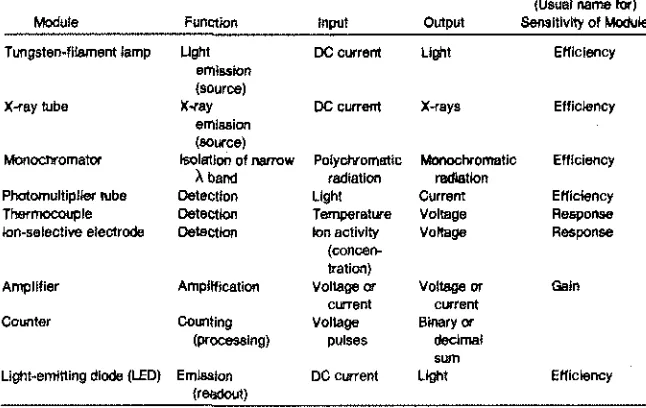
[image:24.612.255.578.36.240.2]What sort of a sub-system is a module? In Figure !, a common single-channel spectro-photometer is pictured as a train of modules. The names of the modules identify the functions they perform and show how the measurement steps described earlier can be implemented practically in a given case. Double and single arrows indicate the movement of optical and electrical "signal," respectively, from one module to the next. Not shown, since it is not part of the signal train, is the power supply which supplies dc electrical energy to several of the modules. Some comments ate in order.
The modules listed differ to a striking de-gree in complexity. For example, if a spec-trophotometer is to operate in the visible and near IR regions the continuous source of Figure 1 may be a tungsten-filament incan-descent bulb. We are generally familiar with the emission pattern of such bulbs, By con-trast, the monoehromator will be much more complex. It will consist of at least an entrance and exit slit, a dispersing device, such as a (diffraction) grating, several baffles, and a precision mechanism to vary the orientation
A Few Properties of Some Major Modules
Module
Tungsten-f Ifamerii lamp
X-ray tube Monocfromator Photomultipiter tube Thermocouple ion-sBlective electrode Amplifier Counter
Light-emitting diode (LED)
Function light emission {source) X-ray emission (source) Isolation of narrow
Xbartd Detection Detection Detection Amplification Counting (processing) Emission (readout) Input DC current DC current Polychromatic radiation Light Temperature ion activity (concen-tration) Voltage or current Voltage pulses DC current Output Light X-rays Monochromatic radiation Current Voltage Voltage Voltage or current Binary or decimaf sum Light
(Usual name lor) Sensitivity o! Module
Efficiency Efficiency Efficiency Efficiency Re