Thesis by
Fernando Cadena Cepeda
In Partial Fulfillment of the Requirements for the Degree of
Doctor of Philosophy
California Institute of Technology Pasadena, California
1977
ACKNOWLEDGMENTS
I would like to acknowledge my fiancee, Stephanie Smith, and thank her for her love and moral encouragement during my studies at Caltech. I would also like to thank her for her excellent typing of this thesis.
I am especially grateful for my advisor, Dr. James J. Morgan, for his interest and guidance in the preparation of this work.
I would also like to thank the Mexican Commission of Science and Technology, CONACYT, for financing my studies while in the United States.
I extend my deep appreciation to my parents, Mr. and Mrs. Raul Cadena, for their constant interest in my well being.
I am appreciative for the faculty of Environmental Engineering at Caltech for their excellent teaching.
I extend my grateful appreciation to my friends at Lake Avenue Congregational Church for their prayers and moral support.
ABSTRACT
Natural waters may be chemically studied as mixed electrolyte solutions. Some important equilibrium properties of natural waters are intimately related to the activity-concentration ratios (i.e., activity coefficients) of the ions in solution. An Ion Interaction Model, which is based on Pitzer's (1973) thermodynamic model, is proposed in this dissertation. The proposed model is capable of describing the activity coefficient of ions in mixed electrolyte solutions. The effects of
temperature on the equilibrium conditions of natural waters and on the activity coefficients of the ions in solution, may be predicted by means of the Ion Interaction Model presented in this work.
The bicarbonate ion, Hco3 -, is commonly found in natural waters. This anion plays an important role in the chemical and thermodynamic properties of water bodies. Such properties are usually directly rela-ted to the activity coefficient of HC03- in solution. The Ion Inter-action Model, as proposed in this dissertation, is used to describe indirectly measured activity coefficients of HC03- in mixed electrolyte solutions.
Experimental pH measurements of MCl-MHC03 and MCl-HzC03 solu-tions at 25°C (where M
=
~, Na+, NH4+, ca2+ or Mg2+) are used in this dissertation to evaluate indirectly the MHC03 virial coefficients. SuchHC03-within the experimental ionic strengths (0.2 to 3.0 m). The virial coefficients of KHC03 and NaHC03 and their respective temperature vari-ations are obtained from similar experimental measurements at 10° and 40°C. The temperature effects on the NH4HC03, Ca(HC03)2, and Mg(HC03)2 virial coefficients are estimated based on these results and the tem-perature variations of the virial coefficients of 40 other electrolytes.
TABLE OF CONTENTS
Chapter Title
l INTRODUCTION
2
3
l . l
1.2 1.3 1.4
The Bicarbonate Ion as a Main Component of Natural Waters
Thermodynamic Models
Evaluation of the Thermodynamic Models Thermodynamic Properties of M-HC03 Salts 1.5 Effects of Temperature on Aqueous Solutions'
Equilibria
THE ION INTERACTION MODEL 2.1
2.2 2.3
2.4
Literature Review General Equations
The Ion Interaction Theory for 2:2 Electrolyte Solutions
Example
TEMPERATURE EFFECTS ON THE THERMODYNAMIC PROPERTIES OF ELECTROLYTE SOLUTIONS
3.1 Thermal Effects on Electrostatic Interactions 3.2 Thermal Effects on Short-Range Interactions 3.3 Example
4 THE ACTIVITY COEFFICIENTS OF ALKALI AND ALKALINE EARTH BICARBONATES
4.1 4.2
The Carbonate System in Aqueous Solutions General Principles of the Bicarbonate Ion Activity Coefficient
Chapter Title Page
5
4.3
4.4
4.5
4.6
4.7
4.8
4
.
9
Theoretical Approach to YMHC03 in MCl-MHC03 Solutions
Theoretical Approach to YMHCOJ in MCl-MH2C03 Solutions
Experimental Procedures
Experimental Determination of the MHC03 Virial Coefficients
Temperature Effects on the MHC03 Virial Coefficients
Behavior of the Bicarbonate Ion in Mixed Electrolyte Solutions
Comparison of Experimental and Literature Values
PRACTICAL APPLICATIONS 5.1 Objective
5.2
The Thermodynamic Solubility Product of Gypsum5
.
3
The Solubility Product of Calcite5.4
Heat Exchanger Problem 5.5 Reverse Osmosis Problem6 CONCLUSIONS
Appendix Title
I VIRIAL COEFFICIENTS DEPENDENCE ON TEMPERATURE II FORTRAN IV COMPUTER PROGRAMS
REFERENCES
57
60
64
68
80
85 86
90 90 92
94
96 98
101
Table 2.1 3.1 3.2 3.3 4.1
4.2
4.34.4
4.5
4.64. 7 4.8
4.9
4.10 4.11 4.12 4.13 4.14 5.1LIST OF TABLES
Title Ct Values
d and e Values x 104
Temperature Dependence on the Activity and Osmotic Coefficients of NaCl Solutions
Dependence of
p
2
on TemperatureChemical Reactions and Equilibrium Equations for the Carbonate System in Water
Temperature Coefficients for the Carbonate System in Water
Equipment and Instruments Used in the Experimental Procedure
pRo Values in KHC03-KCl Solutions pRo Values in NaRC03-NaCl Solutions
pR0 Values in KCl-R2C03 and NaCl-R2C03 Solutions at 25°C
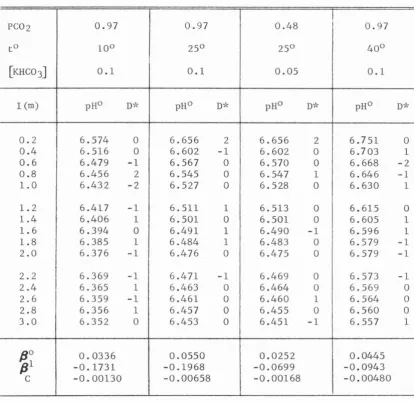
~pRo Values for MCl-R2C03 Solutions at 25°C pRo Measurements in NR4Cl-R2co 3 Solutions pR0 Values in CaCl2-R2C03 Solutions at 25oc pR0 Values in MgCl2-R2C03 Solutions at 250C Summary of the MHC03 Virial Coefficients Average ~{J/~T of MHC03 Electrolytes
Measured pR0 Values in the System~' Na+-RC03-, Cl-Comparison of Experimental pR0 Values
Thermodynamic Solubility Product of Gypsum at 25°C
Table 5.2
5.3
5.4
5.5 A.la A.lb A. 2 A.3a A.3b A.3c A.3d
A.4
A.5
Title
Thermodynamic Solubility Product of Gypsum from
0.5 to 6ooc
The Thermodynamic Solubility Product of Calcite at 25°C
Solubility Properties of Calcite and Gypsum in a Lake Water
Osmotic Properties of Seawater and Product Water Y Values of Some 1:1 Electrolyte Solutions
Y Values of Some 1:1 Electrolyte Solutions
Y Values of Some 1:1 and 1:2 Electrolyte Solutions Y Values of Some 1:2 Electrolyte Solutions
Y Values of Some 1:2 Electrolyte Solutions
Y Values of Some 1:2 Electrolyte Solutions
Y Values of Some 1:2 Electrolyte Solutions Y/X1 Values of Some 2:2 Electrolyte Solutions Y Values of Some 2:2 Electrolyte Solutions
Page
94
96
98 100 102 103 104 105
106
[image:8.584.93.493.87.481.2]Figure
3.1
3.2 3.3
3.4
3.5
3.6
3.7
4.1
4.2
LIST OF FIGURES
Title
Y vs.
x
1 Values for 1:1 Electrolytes Y vs. X1 Values for 1:2 ElectrolytesTemperature Variation of the First and Second Virial Coefficients of 1:1 Electrolytes
Temperature Variation of the First and Second Virial Coefficients of 1:2 Electrolytes
Y/X1 vs. X2/X1 for 2:2 Electrolytes Y vs. X1 Values for MgS04
Temperature Variation of the Second Virial Coefficient of 2:2 Electrolytes
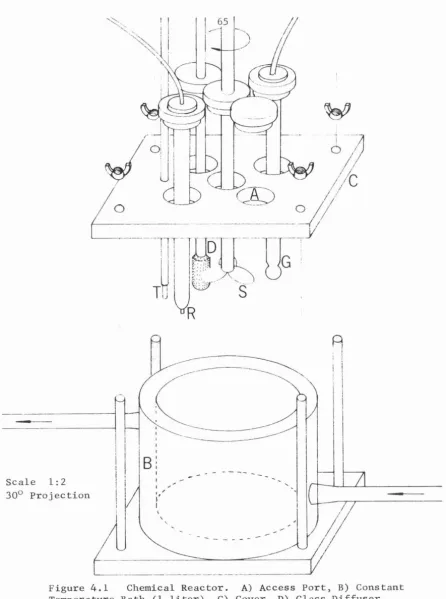
Chemical Reactor
Temperature Variation of the First and Second MHC03 Virial Coefficients
Page 36 37
39
40
46
48
50
65
Roman Capital Letters
A Debye-Huckel coefficient B Interaction function C Third virial coefficient D Finite pH difference E pH calibration error
Gex Excess Gibbs energy of mixing I Ionic strength
I* Pseudo-ionic strength
J Apparent molal heat capacity
K Thermodynamic dissociation constant Kip Thermodynamic ion product
Ksp Thermodynamic solubility product L Relative partial molal enthalpy M Specific cation
M1 Molecular weight of solvent P Pressure
R Gas constant S Solubility ratio T Absolute temperature
W Power consumption/flow rate X Specific anion
Roman Lower-Case Letters
a, a'
c, c'
d
e f
g
m
Any anion in solution
Activity of water
Coefficient
Any cation in solution
Coefficient
Coefficient
Debye-Hlickel function
Ionic strength function
Molal concentration
q, r, s Coefficients
t Temperature in °C
v 1 Partial molal volume of water
Greek Letters
a Coefficient
P
Virial coefficientY
Activity coefficient6
Incomplete dissociation factorE Dielectric constant of water
8
Like-charge virial coefficientV Number of moles
17
Osmotic pressurea
Standard deviation¢
Osmotic coefficient¢
J
Molal heat capacity ¢L Apparent molal enthalpy~ Triplets interaction coefficient
n
Osmotic membrane constantOperators
[
J
Molal concentration( ) Molal activity
E
Summation~ Difference
Chapter 1
INTRODUCTION
1.1 The Bicarbonate Ion as a Main Component of Natural Waters
The bicarbonate ion is commonly found in natural waters, and its
intrinsic properties are of importance in the study of water chemistry
equilibrium. Some of the basic chemical and physical properties of
this anion are reviewed below.
In nature the bicarbonate ion leaves or enters a solution via
one or more of many mechanisms. Among these are the processes of
photosynthesis-respiration, contact with the atmosphere and
precipitation-dissolution of carbonate and bicarbonate minerals. Due
to the common occurrence of these processes the bicarbonate ion is a
ubiquitous component of natural waters.
The bicarbonate ion exhibits amphoteric properties in aqueous
solutions, being the intermediate state of protonation of the carbonate
system. These important properties are directly related to the acid
and base neutralizing capacities of aqueous solutions. Often in nature
the bicarbonate ion is the main acid-neutralizing agent of the water
(i.e., alkalinity). The pH of a water solution is therefore dependent
on the concentration of bicarbonate ion.
Several thermodynamic models have been proposed to evaluate the
intrinsic characteristics of mixed electrolyte solutions. The general
following section. Natural waters may be considered as aqueous multi-component electrolyte solutions and therefore may be studied as such. Quantitatively, the concentration of the individual ions in natural waters varies widely from place to place, but their main components are usually the same. In natural waters the most commonly found cations are H+, Na+, K+, ca2+ and Mg2+, and in polluted waters NH4+. The anions usually present in natural water are oH-, cl-, HCOJ-, No3-, H2P04-, F-, S04 2-, C03 2 -, HP04 2- and P043 -. Therefore, the equilibrium properties of bicarbonate in natural waters may be studied by consider-ing HC0 3 as an individual component in a mixed electrolyte solution. A method is proposed in this work to evaluate accurately some important equilibrium characteristics of the bicarbonate ion in natural waters.
1.2 Thermodynamic Models
Several thermodynamic models have been proposed to predict the activity coefficients of mixed electrolyte solutions. These models give reasonable results for relatively simple multicomponent systems; however, few of them may be utilized in the calculation of the activity coefficients of electrolytes having more than four different ions in solution. The two most common methods of evaluating activity coeffi-cients of such complex electrolytes are the Ion Association Model and the Ion Interaction Model. The general characteristics and basic assumptions of these equilibrium models are presented below.
Association Model, which assumes the formation of ion pairs by
oppo-sitely charged ions (i.e., counter-ions). The Br~nsted-Guggenheim Ion Interaction Model is the alternate procedure employed in the evaluation
of several thermodynamic properties of aqueous solutions, including the activity coefficients of the individual ions in solution. The latter
method approaches this problem by assuming interactions among the ions
in solution.
The activity coefficient of any solute is defined as the
dimen-sionless ratio between its activity and concentration in solution.
Under very dilute conditions this ratio approaches unity. Stumm and
Morgan (1970) report that the Debye-Huckel theory, which considers only long-range electrostatic interactions between the ions, is accurate in
most cases for ionic strengths below 0.01 M. Deviations from the ideal
Debye-Huckel theory at higher ionic strengths are attributed to short
-range interionic forces. Different assumptions are used by the two basic models to account for deviations from ideality in concentrated
solutions.
The Ion Association Model assumes that deviations from the
Debye-Huckel theory are caused by differences in the ion sizes and/or
by the relatively strong binding of counter-ions to form ion pairs.
According to this model, the concentration of a specific type of ion
pair is directly proportional to the activity of its free counter-ion
components. The ion association criterion implies, then, a distinction
between the thermodynamic properties of both free ions and ion pairs.
con-sideration the presence of ion pairs, complicates considerably the
equilibrium calculations of mixed electrolyte solutions. Furthermore, tedious approximations have to be executed in order to satisfy the electroneutrality and mass balance conditions.
Several al ternate methods are used in the Ion Association Model to compute the activity coefficients of free ions in solution. The following methods are widely used in the computation of these
param-eters:
i) The extended Debye-Huckel equation, and ii) The Mean Salt method (Macinnes convention) .
The first method, which utilizes an adjustable parameter (ion size param-eter), permits one to evaluate analytically the activities of the in-dividual free ions. The accuracy of this method is dubious at ionic strengths above O.OSm, and should be used cautiously in concentrated solutions.
The Mean Salt method for obtaining the individual free ion
activity coefficients has lately come under strong criticism. By con-vention, this method assumes that the activity coefficient of the potassium ion is equal to that of the chloride ion at a given ionic strength, regardless of the nature of the other ions in solution. Whitfield (1974a),mentions,among others, the following disadvantage of
of this method:
"The widely employed Macinnes convention is ambiguous at ionic strengths greater than 0.1 M and contradicts anum-ber of conventional definitions of single ion properties in implying that the activity coefficient of the chloride ion is the same in all solutions of alkali and alkaline
A thermodynamic property of aqueous solutions, which is not well
understood, is the ion-pair activity coefficient. A great number of
techniques have been proposed to evaluate this parameter. The lack of
common grounds for the computation of the activity coefficients of ion
pairs is directly reflected on many other thermodynamic properties of
the solution as a whole.
Finally, in order to compute accurately the free ion activity
coefficients, i t becomes necessary to know precisely the value of the
ionic strength of the solution. Some researchers who utilize the Ion
Association Model evaluate the ionic strength of a solution by adding
the individual contribution of free ions to the contribution of ion
pairs. Other investigators claim that this is incorrect and evaluate
this parameter from the contribution of the individual ions' total
con-centrations. This discrepancy may lead to wide differences in the
pre-dicted value of the activity coefficients of both free ions and ion.
pairs.
The osmotic and activity coefficients of single electrolyte
solutions may be accurately predicted by the use of the Ion Interaction
Model. These parameters are evaluated by the addition of an
inter-action term to the Debye-Huckel function. (This theory is studied in
more detail in the next chapters.) The interaction term is a
semi-linear relationship of the molality of the solution, which
rapidly tends to linearity as the concentration of the electrolyte
increases. At a fixed temperature and pressure the slope of the
absolute value (i.e., deviation from ideality) is usually higher for multivalent electrolytes. Both the osmotic and activity coefficients
of mixed electrolytes may be accurately predicted by assuming that the
multiple interactions upon a specific ion are additive (Lewis and
Randall (1961)).
The simplest method to predict short-range interactions among
the ions is to assume linear i ty in the ion interaction term. This approach has yielded reasonable results for the activity coefficients
of systems as complex and concentrated as sea water (Whitfield (1973)). Recently Pitzer (1973) has proposed a more detai led, but at the same
time more complex, approach for the description of the osmotic and
activity coefficients of single electrolytes from infinite dilution to
6.0 m. The value of the interaction term in Pitzer's method is de-scribed by three virial coefficients which multiply an equal number of functions of the ionic strength of the solution. Pitzer and Mayorga (1973) have evaluated and published the values of the virial coeffi-cients of over 200 1:1, 1:2 and 1:3 electrolytes. The evaluation of
these coefficients was performed from measurements of the activity and
osmotic coefficients of single electrolyte solutions. In another
pub-lication Pitzer and Mayorga (1974) propose a mathematical approach to
the evaluation of these two thermodynamic properties in solutions con-taining 2:2 electrolytes.
between like-charged ions as well as triple-ion interaction. Higher order electrostatic terms for multivalent electrolytes may be described by the technique proposed by Pitzer (1975). Many ambiguities existing in the theory of strong acids may be resolved by using Pitzer's method in the analytical studies of these electrolytes (Pitzer and Silvester (1976)).
1.3 Evaluation of the Thermodynamic Models
The main objection to the use of the Ion Interaction Model in aquatic chemistry is the execution of lengthy mathematical manipula-tions, but the accuracy of the model more than compensates this objec-tion. In single electrolyte solutions the calculations involved in the Ion Interaction Model are probably more complex than those required by the Ion Association Model. However, for mixed electrolyte solutions, the opposite condition is often observed. This condition is due to the cumbersome approximations necessary to satisfy both the mass balance and electroneutrality constraints in the Ion Association Model.
1.4 Thermodynamic Properties of M-HCOJ Salts
In view of the chemical importance of the bicarbonate ion in natural waters i t becomes necessary to describe its thermodynamic be-havior by means of a sound equilibrium model. The model chosen in this work was the Ion Interaction Model utilizing the latest modifications by Pitzer and co-workers.
Many investigations have dealt with the problem of predicting the activity coefficient of the bicarbonate ion in the presence of various cations. Nonetheless, most of these investigations have dealt with the problem according to the Ion Association Model. The validity of this approach is directly related to the prediction accuracy of the free bicarbonate ion activity coefficient. This parameter is usually evaluated by means of either one of two techniques: by the extended Debye-Huckel equation or by interpolation of tabulated values. A pre-vious discussion of the effectiveness of the first technique to describe activity coefficients reveals that its validity is limited to very
dilute solutions. The tabular values of the free bicarbonate ion
In lieu of the Ion Association Model, Butler and Huston (1970)
have studied the activity of HC03- in NaCl solutions according to
Harned's Rule. Harned's Rule reduces to the simplified Interaction
Model at high ionic strengths. Other than this study little is known
about the interaction properties of the bicarbonate ion in natural
waters.
This dissertation presents a theoretical approach to the
deter-mination of the virial coefficients of HC03- in natural waters at
various temperatures. Based on this approach the virial coefficients
of various bicarbonate salts are evaluated from experimental results.
These salts included the following bicarbonate compounds: NaHC03,
KHC03, NH4HC03, Ca(HC03)2, and Mg(HC03)2. The cations of these salts
are the most important positively charged ions in natural and polluted
waters. Thus, the knowledge of their respective interaction
character-istics permits a more precise understanding of the equilibrium
condi-tions of most water bodies.
1.5 Effects of Temperature on Aqueous Solutions' Equilibria
Local, seasonal and diurnal temperature variations are often
observed in most natural phenomena. Temperature changes are of special
interest in natural waters because, in general, their thermodynamic
properties are temperature dependent. An example of these properties is the ion activity coefficient, which has a strong temperature
-trostatic function and the short-range interaction term are temperature functions.
Chapter 2
THE ION INTERACTION MODEL
2.1 Literature Review
The Ion Interaction Model was originally developed by Br¢nsted
(1927) who proposed that the thermodynamic properties of aqueous solu-tions could be evaluated from the interactive forces between the ions in solution. He assumed that interactions between oppositely charged ions would be dominant, thus neglecting like-charge ion interaction. Guggenheim (1936) made a distinction between the two terms in the acti-vity coefficient equation: the electrostatic interaction function and the short-range interaction term. He described the first function by
the Debye-HUckel equation, which he assumed depended only on the ionic strength and the temperature of the solution. He also assumed that the second term might be described by a polynomial function in concentra-tion with a linear leading term.
The emphasis of more recent publications has been the study of the short-range interaction term. Many researchers, including
Guggen-heim and Turgeon (1955), and Lewis and Randall (1961), have used a sim-ple approach to this problem. They have assumed that the interaction term may be described by a linear function in concentration. Whitfield
may be observed at low ionic strengths.
Pitzer (1973) has developed a mathematical model which takes
into consideration deviations from linearity. By considering like -charge interactions Pitzer and Kim (1974) have obtained excellent agreement between calculated and experimental measurements of the acti-vity and osmotic coefficients of mixed electrolytes. The theory deve l-oped by Pitzer (1973) for the Ion Association Model appears to be the most accurate technique for predicting the equilibrium conditions of mixed electrolytes. The basic principles of Pitzer's theory, along with some temperature considerations, are presented in this disse
rta-tion. For more detailed information the reader is referred to the
original publications.
2.2 General Equations
By convention, the ionic strength of a mixed electrolyte
solu-tion, I, is defined as follows:
where mi represents the molal concentration of any ion i in solution, and
Zi represents the valence of any ion i in solution.
(2.1)
The osmotic coefficient of a solution is intimately related to various thermodynamic properties of its component solvent and solutes. The activity coefficients of the solvent and the ions in solution are,
to the importance and interdependence of these thermodynamic proper-ties, a detailed study of the osmotic coefficient of mixed electrolyte solutions is presented in this dissertation.
Based on the Ion Interaction Theory, Pitzer and Kim (1974)
pro-pose the following equation for the osmotic coefficient,
¢,
of a mixedelectrolyte solution:
where
¢-
1£~
=
1
LID·
• l.J..
+
{"'a
f.
m ••
[e ••.
+
16~.·
+
f"'c
lfrcaa'
J
l
1
+
L2jf
(Debye-Hlickel function)(2.2)
(2.3)
A represents the Debye-HUckel coefficient. This coefficient
is a function of the temperature of the solution, T, and
is equal to 0.392 at 25°C, ~ o
+
{Jl
-a11fB111:x
=
/J
111:x MX e(2.4)
c, c' and M represent the names of the cations in solution, a, a' and X represent the names of the anions in solution.
represents the total molal charge of the solution,
C represents the third virial coefficient,
0
represents the interaction coefficient between like-charge ions.8'
""
88/f)
I
(2.5)~ represents the interaction coefficient for triplets.
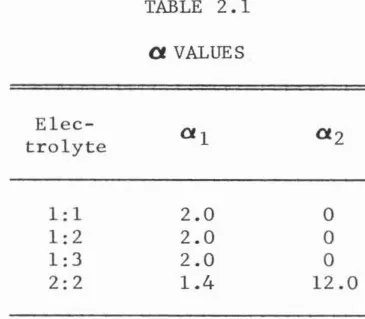
a l equals 2.0 for 1:1, 1:2 and 1:3 electrolytes, or
0I
equals 1.4 for 2:2 electrolytes.The virial coefficients of 227 pure aqueous 1:1, 1:2 and 1:3 electrolytes at 25°C are evaluated and presented by Pitzer and Mayorga
(1973) . Numerical values for some like-charge and triplets inter-action coefficients are listed by Pitzer and Kim (1974).
The long-range interaction effects on the osmotic coefficient
of a solution are mathematically simulated by the Debye-Huckel function, which is represented by the first term in equation (2.2). The remaining
terms in this equation simulate the short-range interaction effects on the osmotic properties of a solution.
Two important thermodynamic properties of aqueous mixed elec -trolytes, the osmotic pressure of a solution and the activity coeffi-cient of the solvent, may be computed from the osmotic coefficient of
the solution. Lewis and Randall (1961) propose the following two equations for the osmotic pressure of mixed electrolytes,
11
,
and theactivity of water, a 1:
ll
=
=
-M1
1000
Ml
1000
(2.6)
where R represents the gas constant and equals 1. 98726 cal/°K - mole, T represents the absolute temperature in Kelvin degrees, v
1 represents the partial volume of water. (v 1
=
18.0 cc/mol for an infinite dilution at standard temperature and pressure.) M1 represents the molecular weight of the solvent (18.0g/mol for water).
An electrolyte composed of a cation M with valence ZM and an anion X with valence Zx dissociates in water according to the reaction
(2.8)
where VM represents the number of cations of M per molecule of MX, and
Vx represents the number of anions of X per molecule of MX.
To satisfy the electroneutrality condition of the electrolyte MX i t is necessary that
(2.9)
The activity coefficient of the electrolyte MX in solution,
YMX>
is computed from the geometric mean of the activity coefficientof the cation
YM
and the activity coefficient of the anionYx :
(2.10)
where (2 .11)
Based on the Ion Interaction Theory, Pitzer and Kim (1974)
electrolyte MX in a multicomponent solution. This equation may be
easily resolved by symmetry into its two individual components, the
activity coefficients of the cation and the anion. The two equations
obtained by this procedure are presented below:
+
and
ln
Yx
+
\~me~ me' ( 1,/tee 'x e e'z2
~·
ma'()~a'
+
Xl:ma 2 a
where f
B I pl '
MX "" 81 {1)
+
z
2 ()'x ee'
)
2
1.2 ln (1
+
1.2,fl>]
(2.12)
(2.13)
(2.14)
(2.15)
2
(2.17)
=
Seemingly, the equations to calculate the osmotic and
acti-vity coefficients of a solution are very lengthy. Nevertheless, i t
must be remembered that at the given ionic strength of the electrolyte
solution,
f~,
f, g1 andg~
are constant. Therefore, the IonInteraction Model is a simple and accurate technique to calculate the
equilibrium properties of mixed electrolyte solutions.
The above equations are somewhat simplified in the case of the
dissolution of a single electrolyte. Since only one anion and one
cation are present in this type of solution, the contributions of
0,
0'
and ~ are non-existent. The equations which describe thethermo-dynamic properties of pure salt solutions are given by Pitzer and
Mayorga (1973). It was previously mentioned that these authors re
-port the values of the first, second and third virial coefficients of
227 1:1, 1:2 and 1:3 electrolytes. These parameters were obtained by least square analyses of various thermodynamic proper t ies of single
electrolyte solutions.
Pitzer and Kim (1974) suggest that in most practical cases
8
may be assumed to be constant over the ionic strength. In other words,
they assume
0'
to be equal to 0. Based on the above assumption theyare able to predict accurately the activity and osmotic coefficients
~utilized in such predictions.
The effect of
8'
on the thermodynamic properties of most mixed electrolytes is minor. However, if maximum accuracy is desired in the prediction of these properties i t becomes necessary to consider the variation of8
with the ionic strength. For complete information onthe dependence of the like-charge interaction coefficient with ionic strength, the reader is referred to work of Pitzer (1975).
2.3 The Ion Interaction Theory for 2:2 Electrolyte Solutions
The capability of an electrolyte to completely dissociate in a solvent is directly related to the electrostatic attraction between the counterions in solution. Obviously, this electrostatic attraction in-creases as the absolute value of the counterions' charges increase. The model presented thus far may be used to describe the thermodynamic properties of electrolyte solutions only in the case where the absolute values of the valences of one or both counterions are equal to one. The particular case of 2:2 electrolytes (which do not completely dis-sociate in aqueous solutions) is considered in this section.
The osmotic coefficients of various single divalent cation sulfates at 25°C, as experimentally determined by various researchers, were summarized by Pitzer (1972). These coefficients were successfully predicted by Pitzer and Mayorga (1974) by means of an interaction model, which takes into consideration incomplete electrolyte
the B¢, B and B' equations. Even though this approach gave excellent
results for single divalent cation sulfates i t failed to predict their
solubility product in seawater (Whitfield (1975a,b)). In these
publi-cations Whitfield utilizes a hybrid model (a combination between the
Ion Association Model and the Ion Interaction Model) which permits a
reasonable explanation of the difference between measured and
calcu-lated solubility products of sulfate salts in seawater. The hybrid
model proposed by Whitfield assumes simultaneously Pitzer and Mayorga's
compensation for ion association, as well as the existence of ion pairs
as individual entities.
Three conclusions may be drawn from the above works:
a) Pitzer and Mayorga's interaction model for incomplete
dis-sociation of divalent cation sulfates in aqueous solutions
works satisfactorily in the case of single salt solutions,
but fails to predict the thermodynamic properties of such
sulfate salts in mixed electrolyte solutions.
b) The inclusion of the extra interaction term in Whitfield's
hybrid model is redundant, for the purpose of this term is
to compensate for ion association.
c) The simplicity of the Ion Interaction Model is destroyed
when the particular problem of incomplete dissociation is
approached from the point of view of ion association. In
other words, if a hybrid model is utilized (by considering
ion pairs as individual components of the solution) tedious
balance and electroneutrality conditions of the solution.
A modification to Pitzer and Mayorga's work is proposed in
this dissertation. This modification permits one to compensate for
incomplete dissociation without implicitly considering ion pairing.
The thermodynamic solubility product of gypsum (i.e., CaS04 · 2H
20) in
a variety of mixed electrolyte solutions is studied in Chapter 5. The
prediction accuracy of this thermodynamic constant confirms the
vali-dity of the proposed modification. Following is presented the
pro-posed Ion Interaction Model for 2:2 electrolyte solutions.
The activity of an individual ion is reduced by a factor
6
ifincomplete dissociation occurs. The value of this factor varies from
unity for complete dissociation, to zero for nil dissociation. It is
assumed in this dissertation that 2:2 electrolytes in solution
asso-ciate to some extent, while 1:1, 1:2 and 1:3 electrolytes do not ex
-perience this phenomenon. The following empirical equation is p
ro-posed for
6
:
where
(2.19)
i represents the divalent cation M or the divalent anion X,
j represents the divalent anion X or the divalent cation M,
p
2 represents the association virial coefficient, which mustbe determined experimentally,
I* represents the pseudo-ionic strength of M and X. I .e.,
and [ 1 - ( 1
+
a
2vi
r;;:*
-
«
z
2~I*
)
e-
o2«
]
(2.21)Thus, the individual ion activity coefficient, compensated for incomplete electrolyte dissociation,
Y
!,
may be computed as follows:(2.22)
An extra term must be added to the B~ equation to compensate the osmotic coefficient for incomplete electrolyte dissociation. The proposed equation is as follows:
(2.23)
Values of
p
2 for various divalent cation sulfates are presented in Pitzer and Mayorga's work. The values of a, which are also those recommended in the aforementioned work are listed in Table 2.1.Elec
-trolyte
1:1 1:2 1:3
2:2
TABLE 2.1
a
VALUES2.0 2.0 2.0
1.4
0 0 0 12.0
[image:33.584.202.385.411.571.2]that due to the large value of a2, the exponential terms in both
equa-tions (2.21) and (2.23) rapidly tend to zero as the ionic strength
in-creases. In relatively concentrated single electrolyte solutions
(I> O.lm) the equations proposed in this dissertation predict that the effect of
P
2 on the solution osmotic coefficient is nil, while this effect reduces the lnYi
by a constant equal to 2P~j
mj/Ct~
I*Experi-mental measurements of the osmotic and activity coefficient of divalent
cation sulfate solutions confirm these trends (Pitzer (1972)).
2.4 Example
The purpose of the numerical example in this section is to
apply the Ion Interaction Model in order to calculate the thermodynamic
properties of a mixed electrolyte solution.
Statement: Marshall and Slusher (1966) report that the
solu-bility of gypsum (Caso4 • 2H2o) in a 0. 548 m NaCl solution at 25°C is 0.0372m/l. Calculate the thermodynamic solubility product of gypsum.
Solution: The molal concentrations of the ions in solution
are: 0.548
and mea
=
mS04 0.0372.The ionic and pseudo-ionic strengths of this solution are, according to equations (2.1) and (2.20), respectively:
I
=
~Xm..z? 1.-A.. l. = 0.6968mI*-~
(mMzM
2+
mxz/)
= 0.1488m(i.e., Na, Ca, Cl,
so
4 ), M represents Ca and X represents S04.The functions f(I), and
f~
may be computed from equations (2.14) and (2.3) respectively (at 25°C A 0.392):f - A
[
Ji
+
2 ln (1+
1.2 ..jf)J
1 + "1.2Jf 1.2 -0.6169
f~ ... - AJr
1
+
L2Ji
-0.1635The functions g 1 (I), g1' (I), and g 2 (I>'<) are then computed from equations (2.17), (2.18) and (2.21) respectively. The values of ~ and
a
2 (which are presented in Table 2.1) and the previouslycalcu-lated magnitudes of I and I* are the input parameters for these equations.
gl (I)
0.3568 for a1 2.0 0.4774 for
a
1 1.4a
1~I
2
[-
1+ (
1+
a
1.[I
+
~
eel
2 I ) e-a,.ffJ
-0.2417 for
a
1 2.0 - 0. 2391 fora
1 1.42
0.0980 for
a
2 = 12.0M X
p
o
plp
2
cNa Cl 0.0765 0.266 6.4 X lQ-4
Na
so
4 0.0196 1.113 2.0 x lo-3>'<Ca Cl 0.3159 1.614 -1.2xlo-4
Ca
so
4 0.2000 2.650 -55.7 0.0>'<Improved value by Pitzer and Kim (1974)
The values of most like-charge and triplet interaction
coeffi-cients, which are required in this example, are given by Pitzer and
Kim (1974) and Downes and Pitzer (1976). These values are as follows:
8Na,Ca 0.000
8c1,
so
4 -0.020
1/f,
Na,Cl,S04 0.004
1Jf,
Na,Ca,Cl 0.000
The B ~~>, B, B' and
6
parameters are described by the next fourequations (equations (2.23), (2.15), (2.16) and (2.19) respectively):
1/>
BMX P~.
+
pl
MXe -a1fX
+
p2
Mxe -a2.{FBMx
P~x
+
P~.
gl (I)B:.x
plgi
(I)lnc5i
=
/J~jm
.
g
(I*)l. J 2
The results obtained by applying these equations to the mixed
M X BcP B B'
Na Cl 0.127 0.172 -0.045
Na
so
4 1.878 0.417 -0.187Ca Cl 3.010 0.892 -0.272
Ca
so
4 1.021 1.465 -0.441ln6ca
=
ln680 -0.2031 4In order to solve the stated problem i t is not necessary to com-pute the activities of the sodium and chloride ions. Therefore, only
the activities of the calcium and sulfate ions are calculated in this
exercise. The osmotic coefficient of the solution and the activity of calcium and sulfate may be computed from equations (2.2), (2.12) and (2.13) respectively. The net effect of 8' on the calculated osmotic and activity coefficients is usually minor, and for most practical ap-plications may be ignored. Without much loss of accuracy one may assume that
8'
and the unavailable ~values are equal to zero. There-fore, the osmotic coefficient of the solution, and the uncompensated activity coefficients of the calcium and sulfate ions are computed as¢-
1Therefore,
¢
+
+
1Em-
.
~~
EmcE,
me'c c
..Ema
E
ma' a a' -0.099610.90039
[Bee'
+~,+
0~rna
Wee' a ][e ••.
+y(:·
0+
fmc 11tcaa' ] )
zM2 f
+
2~ma
[ BMa+
(
fmcZc ) CMaJ
+
2.,EmC6MC+
.Erne ..Ema ( ZM2B~a
+
ZMCc+
1/JMcac c a a .
l:i
..Ema ..Ema' (~0
+
1/JMaa'+
Z a a'a a'
1.5063
= - 2.0638
)
M Ca
X so
4 c Na, Ca c' Ca, Na a
=
Cl, so4 a' so4, Cl
i Na, Ca, Cl, so4
The compensated activity coefficients of the calcium and sul-fate ions are computed by inserting the appropriate values into equation (2.21):
ln~
lnY.
+
ln6.I
1.7094 for i Ca=
]. l.2.2669 for i so4 Therefore, y c
Ca 0.1810 "so4 0.1036
The activity of the solvent, water, may be evaluated from the
knowledge of the solution osmotic coefficient and the molality of the species in solution. From equation (2.7) one obtains:
Therefore,
Ml
¢J;'!llj_
1000 ].
- 0.0190 0.9812
(where M1 18.0)
Ksp m
ca
mso4
y
ca
c
Y.
sco4
a2l (2.24)Chapter 3
TEMPERATURE EFFECTS ON THE THERMODYNAMIC PROPERTIES OF ELECTROLYTE SOLUTIONS
3.1 Thermal Effects on Electrostatic Interactions
The thermodynamic properties of aqueous solutions are usually strongly dependent on temperature. The assumption that natural waters may be treated as mixed electrolytes under ideal conditions of
stand-ard temperature and pressure is often incorrect. Although pressure variations are of importance in chemical equilibrium, such variations
are of little importance in the study of surface waters, which are the
main concern of Environmental Engineering. The scope of this chapter is the study of the temperature effects on the thermodynamic
equili-brium properties of aqueous solutions at one atmosphere total pressure. Literature information on the temperature effects on
electro-lyte solutions equilibria is abundant. This information is usually
analyzed from the Ion Association Model point of view. Perhaps one of
the most complete works in this area is that of Helgeson (1967), who
calculates several thermodynamic properties of various electrolyte
Interaction Model is utilized to estimate thermal effects on Br~nsted acids' equilibria.
The Ion Interaction Model may be used to describe the thermo-dynamic proper t ies of aqueous solutions at variable temperatures. Lewis and Randall (1961) conclude that both the long-range
electrosta-tic attraction and the short-range interaction between ions in solution are temperature dependent. The electrostatic attraction terms for the osmotic and activity coefficients may be computed from equations (2.3)
and (2.14) respectively. The only temperature dependent parameter in these equations is the parameter A, which has a triple dependence on temperature. This parameter is a direct function of temperature, the
solvent dielectric constant and the coefficient of thermal expansion of the solvent (Lewis and Randall (1961)). The effect of temperature on
the volumetric expansion for water is unimportant when compared with the two other dependences, and i t is ignored in this disser tat ion.
The dielectric constant of water may be expressed as a poly-nomial function of temperature. A least-square criterion for curvi -linear regression may be utilized to evaluate the coefficients of this
polynomial. Utilizing the above criterion to fit a third-degree poly-nomial to the tabulated values of the dielectric constant of water
(Weast (1975)), the following equation is obtained:
where
E = 87.924- 0.40873t
+
1.01465 X l0-3 t 2 - 1.9365 X l0-6 t 3 (3.1)E represents the dielectric constant of water, and
t
=
T - 273.16 (3. 2)The coefficients in equation (3.1) are in close agreement with the values reported ear l ier by Harned and Owen (1958). The equation which describes the dependence of A with respect to temperature is given below (Robinson and Stokes (1959)):
A 1.400 X 10⁶
(ET)3/2 (3.3)
The temperature effects on the long-range electrostatic inte r-action terms (in the osmotic and activity coefficients equations) may be calculated by means of the three above relationships and equations (2.3) and (2.14). These thermal effects are often of higher magnitude than the ones observed for the short-range interaction terms. Follow-ing is presented a thermodynamic analysis of these secondary tempera -ture effects on the activi ty and osmotic coefficients of electrolyte solutions.
3.2 Thermal Effects on Short-Range Interactions
Several thermodynamic parameters are intimately related to the temperature effects on the interactive properties of ions in solution. Direct or indirect measurements of these properties may be utilized to compute the dependence of short-range interactions with respect to
Pitzer and Mayorga (1973) propose the following relationship for the excess Gibbs energy of mixing of single electrolyte solutions:
where
4AI
1.2 1n (1
+
1.2/i)
+
2m2 V.,.llx [P~x
+
P~x
g1 (I)+
P~x
(
&2 (I*)3
+
2m Z11 1111 C11xGex represents the excess Gibbs energy of mixing, m represents the molality of the solution, and
I* equals I for single electrolyte solutions.
(3.4)
The excess Gibbs energy of mixing is related to the relative apparent molal enthalpy of an electrolyte in solution by the fol lowing partial differential equation:
1 8(Gex/T)
m 8(1/T)
T,m
(3. 5)where ¢L represents the apparent molal enthalpy of an electrolyte in solution relative to infinite dilution.
Combining equations (3.4) and (3.5) one may express the tern-perature variation of the virial coefficients as a function of ¢L:
1
2
2m
v.,.vx
T=
{
aP?.x
+
{)T
{
~
+
3.333....!.. ln(l+
1.2../i)
m
8/J~x
g(I)+
O~x
(
g2 (I*)8T
OT
8A
8(1/T)
acMx
l
8TIT
(3. ~)
ob-ably even of less importance . I t is therefore assumed in this work that
8
C/
8T
=89/8T =81/f/()T
=
0. Assuming no variation of the Cvirial coefficient with temperature, equation (3.6) may be represented by a linear polynomial of the form:
where
y
y
bo
+
bl xl+
b2 x2represents the left side terms of equation (3.6),
(3. 7)
x1 and x2 represent the respective functions of I and I* in equation (3.6), and
b0 , b1 and b2 representi:}(3°/CJT,
8f3
1/()T and8{3
2/i}
T
respectively.It is important to remember that
{3
2 represents the ion pairing virial coefficient. In this study this coefficient differs from zeroonly in the case of 2:2 interaction. Thus,
of3
2/8T
is equal to zerofor 1:1, 1:2 and 1:3 electrolyte solutions. For such solutions, graphs of Y with respect to x 1 should yield points lying on straight lines in which the intercept, b0 , represents
8{3
°
/8T
and the slope of the line,b 1 , represents
8{3
1/i}T.
This graphical technique permits one to evaluater eadily the variation of the first two virial coefficients with re -spect to temperature. A more complete graphical method, which permits the simultaneous evaluation of b0 , b1 and b
2 for 2:2 electrolyte sol u-tions, is discussed later in this section.
Another important thermodynamic property, the relative partial molal enthalpy of an electrolyte in solution, is related to the
activ-ity coefficient of the electrolyte as follows:
where represents the partial molal enthalpy of an electrolyte
in solution relative to infinite dilution.
In single electrolyte solutions, the rate of variation of the
virial coefficients with respect to temperature may be also computed
from experimental measurements of L. This is obtained by
differen-tiating the individual components of equation (2.10) with respect to
temperature. Then by rearranging the terms in equation (3.8), the
following expression is obtained:
"
l
Lz,.zxl
[
Vf
2 ln ( 1+
1. 2,{f)
J
l
T4mV,.Vx VRT
+
1+1.2Vf+
1.2= a8~1
+
a~~!
( g, (I)+
e-a,.rr
)
aT
8T
2(3.9)
If the last term in the previous expression is ignored, this
expression may be represented by a linear polynomial of the form of
equation (3.7). Obviously, the values of Y,
x
1 andx
2 are those
of their corresponding functions in equation (3.9). As in the
pre-vious case, plots of Y against
x
1 values (for 1:1, 1:2 and 1:3 elec-trolyte solutions) should yield points on straight lines. Thesigni-ficance of the slope and intercept of the lines is the same as before.
Theoretically, the second derivative of the virial coefficients
with respect to temperature may be evaluated if either the relative
partial molal heat capacity or the relative apparent molal heat
capa-city are known. The respective equations for these two thermodynamic
(3.10) J
and (3.11)
where represents the molal heat capacity relative to infinite dilution, and
J represents the apparent molal heat capacity relative to infinite dilution.
Literature information on the numerical values of the heat capacity functions is rather limited. This information suggests that the variations of
¢L
andL
with respect to temperature are small in com-parison with their respective values, and for most electrolyte~ theymay be ignored. I t is assumed throughout this dissertation that both
¢L
andL
do not vary with temperature. In other words, i t is assumed that the second partial derivatives of the virial coefficients with respect to temperature are equal to zero.The functions Y,
x
1 and
x
2 in equation (3.7) may be evaluated from their respective terms in equations (3.6) and (3.9). The nume ri-cal values of Y,x
1 andx
2 for some important electrolytes are prese n-ted in tabular forms in the Appendix. Experimental results of¢
L
andL
at various ionic strengths are repor ted in several literature sources. Y values (computed from the experimental results of the 1:1 and 1:2electrolytes listed in the Appendix) are plotted in Figures 3.1 and 3.2 respectively. As expected, the data points follow a linear correlation,
150 100 50
0
-50
(oK-1)
I
iOI
I
l
6 6. 6. 6,. 6.
~.a•.
.
.
...
.
'T!1>
I>
I>
l>ot o~
.2.
~
f
t
~
$o~
~
~o
0 .2 0.3 ~ 1<1 ft.z
z
~ ~~
jlj ¢ .Kl..
..
~~
t
~
• 0 ~.
!
.~
~0~
;?!
+---.12!.,.
z
0.4
0.5
..
..
~ \]
~
t
j
~
~·
<t
0
D
~
0.6
·
~
0
.7
xl
(m-1 ) Figure 3.2 Y vs. X1 Values for 1 : 2 Electrolytes ,A Ba(N03) ~ Cs zS04 V Sr(NOJ) <>Rb 2 -.. Ca (N0 ,~ . Na2S0 • K2 S04 • BaBr ¢l SrBr
~Mg(NOJ) lSI.
Interaction Model or more probably to minor experimental errors. Re-gardless of the actual source of error in the graphical estimation of b0 and b 1 , its effect on the computation of both activity coefficients and osmotic coefficients of very dilute solutions is, for all practical purposes, insignificant. Deviations from ideality for extremely con-centrated 1:1 electrolyte solutions (X1 less than 0.15) in Figure 3.1 suggest that the assumption that8CR7f is equal to zero is probably in-correct. However, for less concentrated solutions linearity is pre-served. Thus, the above assumption is sound for ionic strengths below 3. 0 m.
The values of b0 and b 1 (i.e.,
8{3°/()T
and CJ{31 /()T) for 1:1 and 1:2 electrolytes were graphically calculated over the linear region in Figures 3.1 and 3.2 respectively. These values were then plotted against their respective virial coefficients at 25°C in Figures 3.3 and 3.4. The points in these figures were not labeled due to their relative closeness.Figures 3.3 and 3.4 illustrate that there exists a definite correlation between a specific virial coefficient and its variation with temperature. Further, this correlation appears to be linear
ati/aT
&(oK-1)
ali/aT
0.00
4
0
.
003
0
.
002
0.001
•
"
o
{3
°
points
•
f3
1
points
·
~
.
~
..
·
~
:
"--,
.
.
,
.
'-,
.
.
':::---...
.
,,
"-...
0
•
•
0
·
, 0'
oP
0
/
aTt
&
aP
Y
aT
(oK
-1
)
•
0.020
0.
solution without implicitly knowing the rates of change of the
indi-vidual virial coefficients with temperature.
The following linear equation approximately describes the rc-lationship between the ith virial coefficient, ~i, and 8~i/8T:
(3.12)
where i
=
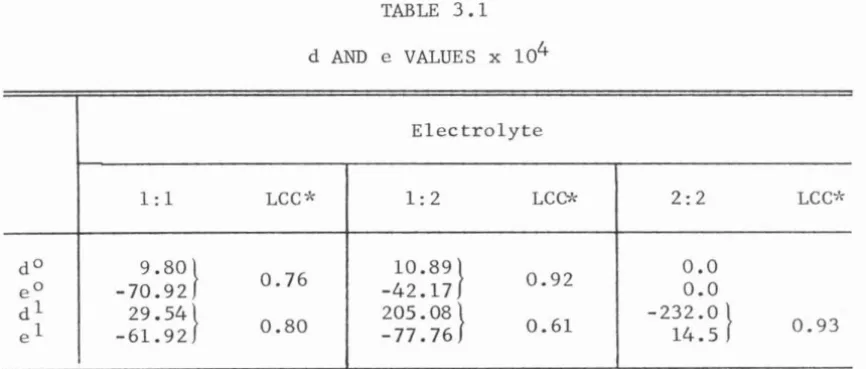
0, 1.In the previous equation, d and e correspond to the intercept
and the slope of the lines in Figures 3.3 and 3.4. Integration of
equation (3.13) with respect to temperature leads to the following
simple relationship:
(3.13)
Equation (3.13) permits the evaluation of a virial coefficient
at any temperature as a function of its virial coefficient at 25°C and
the solution temperature. The values of d and e for 1:1 and 1:2 elec -trolytes, as evaluated from a least-square analysis of the data points
in Figures 3.3 and 3.4, are presented in Table 3.1. The magnitudes of
d and e for 2:2 electrolytes are also presented in this Table. The
evaluation procedure for this last case is discussed later in this
section.
The linear correlation coefficients of the various sets of data suggest that the assumptions which led to the derivation of
equations (3.12) and (3.13) are reasonable. The degree of accuracy of
the proposed model may be sensed in more practical terms by comparing
solu-tions against the experimental ones. Publications on laboratory deter
-minations of the activity and osmotic coefficients of electrolyte
solutions at temperatures other than 25°C are rather scarce and often
incongruent. Literature information on the thermodynamic properties of
sodium chloride solutions at various temperatures is somewhat more
reliable for these properties have been thoroughly studied by several
investigators. The reported experimental activity and osmotic coeffi
-cients of sodium chloride solutions at temperatures between 0°C and
80°C and at concentrations as high as l.Om are listed in Table 3.2.
These two coefficients are calculated in this dissertation by means of
the d and e parameters for 1:1 electrolytes in Table 3.1. The results
of these calculations are presented in Table 3.2.
TABLE 3.1
d AND e VALUES x 104
Electrolyte
1:1 LCC>'< 1:2 LCC* 2:2 LCC>'<
do 9.80}
0.76 10.89} 0.92 0.0
eo -70.92 -42.17 0.0
dl 29.54} 205.08}
0.61 -232.0 } 0.93
el -61.92 0.80 -77.76 14.5
[image:54.587.82.515.386.570.2]t,°C
0
25
40
80
TABLE 3.2
TEMPERATURE DEPENDENCE ON THE ACTIVITY AND
COEFFICIENTS OF NaCl SOLUTIONS
I Ycalc
0.1 0.781
0.2 0.735
0.5 0.680
1.0 0.650
0.1 0. 776
0.2
o.
7320.5 0.679
1.0 0.655
0.1 0.783
0.2 0.727
0.5 0.676
1.0 0.655
0.1 0.755
0.2 0. 710
0.5 0.660
1.0 0.644
aHarned and Owen (1958)
bGibbard et al (1974)
YExp
0.78la
0.731
0.673
0.635
0. 778c
0.735
0.681
0.657
0. 774d 0. 729 0.677 0.658 0.758d 0. 711 0.659 0.640
cRobinson and Stokes (1959)
dEnsor and Anderson (1973)
<Peale 0.932 0.923 0.921 0.935 0.932 0.923 0.921 0.935 0.934 0.922 0.922 0.939 0.926 0.918 0.921
0.964
OSMOTIC ¢Exp 0.933b 0.921 0.911 0.915
0.932c
0.925 0.921 0.936 0.932d 0.924 0.923 0.940 0.927d 0.919 0.918 0.939
The calculated activity coefficients of NaCl in Table 3.2 are
in excellent agreement with the experimental ones over the studied
tern-perature domain. At 80°C a considerable discrepancy between
experi-mental and calculated osmotic coefficients is observed. This
[image:55.583.114.471.155.443.2]Nonetheless, for the range of temperature of most natural waters, the above assumption yields reasonable results. One may conclude from the results in Table 3.2 that the proposed simplified model may be used with high degree of certainty to compute the thermodynamic properties
of aqueous solutions at temperatures between 0°C and 40°C. At higher temperatures the usage of the model should be discreet .
Harned and Owen (1958) compiled the relative partial molal en -thalpies of dilute divalent cation sulfate solutions at 25°C. These values were used in this dissertation to calculate the Y variables, which correspond to the left side of equation (3.9). TheY variables, as well as their corresponding
x
1 andx
2 values, were computed in the Appendix. It was previously discussed in this section that for most practical cases the last term in equation (3.9) can be ignored. This assumption holds in the following mathematical derivations.Equation (3.9) is represented by the linear polynomial equation
(3.7). It is initially assumed in this dissertat ion that the b0 term (i.e.,
a{3
°
/a T), in equation (3. 7) is equal to zero. Ignoring bo, the following relationship is obtained when one divides this equation(3.14)
If the above assumptions are correct over the studied ionic
strength range, for a given electrolyte solution, a plot of Y/X1
In all cases linearity is preserved for X2/x1 between 0.04 and 0.27~
This domain of the abscissa corresponds to ionic strengths from 0.36
to 0.026m. Therefore, one may conclude that for this interval the
above assumptions are valid.
The intercept, b1, and the slope of any straight line, b 2 , in
Figure 3.5 correspond to 8~1/8T and8~2/oT respectively. Only two points are plotted for calcium sulfate in Figure 3.5 due to the limited
solubility of gypsum. It is unreasonable to attempt to evaluate b1 and
b2 for CaS04 from this limited information. The b 1 and b 2 parameters
for Caso4 were predicted according to a procedure described later in this section.
Experimental enthalpy information of concentrated divalent
cation sulfate solutions is extremely limited. The only available
publication on this type of information seems to be the work by Snipes
et al (1975). These researchers have evaluated the relative apparent
molal enthalpies of MgS04 at 40°C and up to 8.0m. The values of Y,
x
1 andx
2 for these Mgso4 solutions are evaluated in the Appendix.
An attempt is now made to determine the actual magnitude of b0 for
Mgso
4 solutions. The objective of such a determination is to demon-strate that for most practical cases the net effect of b0 on the ther-modynamic properties of aqueous solutions is negligible. Subtracting b2X 2 from equation (3.7) yields:
Y - b 2
x
2=
b0+
b1X1 (3.15)Graphically calculating b 2 from Figure 3.5 one obtains that b2
0.0 0
-.05
-.10
-.15
',
"
.
'Y
:"
·
'
'Y
' '•
• MgS04
• ZnS04
A CaS04
• CuS04
'Y
CdS04.36 .25 .16
_L_L _ I
(mol/kg)
Figure 3.5
'--,
'
"
0.2'
•
·
,
.
~
,
.
-'
~
·
~
-.,'
•
'
.
A " .
~'
' ' ' ....,,""
"-
','Y
"
"""
.....
'
'
·
.09 .04 .0256
- _j
__ L ____ ________ . I ---
then computed from the available information. The results of this computation are plotted as a function of
x
1 in Figure 3.6. The inte r-cept and slope of the best fit straight line in this figure correspond to b0 and b1 respectively. The effect of b2 on the value of the depen -dent variable in equation (3.15) may be visualized from the difference between the continuous and the dashed lines in Figure 3.6. The latter line represents a plot of the left side of equation (3.15) ignoring thecontribution of b 2 (i.e., b2
=
0.). The following important conclu -sions may be drawn from the graphical results in Figure 3.6:a) The effects of b2X2 on the left side of equation (3.15) are of importance, especially at low ionic strength. These effects are reflected on the linearity of the full points in Figure 3.6. The excellent linear correlation of such points demonstrates the validity of the proposed magnitude
of b 2 •
b) A least-square analysis of Y
+
b2X2 as a function ofx
1shows that b0 and b 1 equal 0.0006/deg and 0.0272/deg. The
assumption that one may neglect the effects of b0 in dilute solutions is confirmed by the relatively small value of b0 in comparison with b1. This assumption should yield accurate results up to ionic strengths as high as 2.0 or
3 .Om.
c) The value of b 1 calculated from the intercept of Figure 3.5
0.012
0.010
0.008
0.006
0.004
0.002
• Corrected for
{){J
2/
8
T
o Uncorrected for
ofJ2/
{)T/
.
7
/0
/
/
/
/
--
-
-•
/
,
/
/
-
-
0--o
.
ooo
L---
---
--~L-