Working Paper C5
Migration and Development in Albania
RUSSELL KING and JULIE VULLNETARI
Sussex Centre for Migration Research
December 2003
The UK Department for International Development (DFID) supports policies, programmes and projects to promote poverty reduction globally. DFID provided funds for this study as part of that goal but the views and opinio ns expressed are those of the author(s) alone.
Development Research Centre on Migration, Globalisation and Poverty Arts C-226, University of Sussex Brighton BN1 9SJ
Website: http://www.migrationdrc.org Email: [email protected] Tel: +44 (0)1273 873394 Fax: +44 (0)1273 873158
C O N T E N T S
1. Introduction 4
2. Background to Migration 6
2.1 The Political Background to the Albanian Exodus 7
2.2 Albanian Demography and its Relevance for Migration 9
2.3 Mapping Poverty in Albania 12
2.4 Migration in the Albanian Cultural Context 17
3. Trends and Patterns of International Migration 20
3.1 Historical Perspective 20
3.2 Figures 24
3.3 Characterisation of Albanian Migration 27
3.4 Reception and Integration in the Host Societies 32
4. Trends and Patterns of Internal Migration 39
4.1 Historical Perspective 40
4.2 Figures 41
4.3 Typologies of Internal Movement 42
5. Socio-Economic Impact of Migration 46
5.1 Remittances 47
5.2 Return Migration 49
5.3 Demographic Effects 50
5.4 Migration, Poverty Alleviation and Development in Albania – The Future 53
1. Introduction
Starting in 1990, Albania has witnessed one of the great emigrations of recent times; ten years later at least 600,000 Albanians, one in five of the population, were living abroad, mainly in Greece and Italy. An equally significant, but less well-documented internal redistribution of the population has taken place over the same time frame. This paper1 chronicles and interprets this multiple mass migration; it concludes by identifying important gaps in the research literature and some hypotheses and questions for future work. The paper is in several parts. Following this introduction, the second part describes the political, demographic, economic and cultural background of Albania’s post-communist transition, highlighting the key determinants of migration. The third and fourth parts look at Albanian international and internal migration respectively: topics covered include the chronology of movement, a review of the available statistics, and the geographical distribution of the migrants. In the fifth part of the paper we examine, within the constraints of the evidence available, the socio -economic impacts of migration. For internal migration this includes the hyper-rapid growth of the main Tirana-Durrës urban axis, coupled with rural depopulation, especially in the mountainous regions of the north and south of the country. For external migration, depopulation is again an important issue; but equally vital are the effects of remittances on the home country, at a variety of levels, together with the prospects for return migration and the developmental impulse that this might bring. Finally, we point to key gaps in the literature on Albanian migration and development, and from this identify some future research agendas.
The single most important background context for Albanian migration was the collapse of the communist or state-socialist regimes in Eastern Europe after 1989. The dismantling of the Iron Curtain was widely anticipated to be a precursor of a mass migration, given that emigration had been denied for so long, and reflecting the obvious economic divide between East and West (Layard et al. 1992). By and large, however, this apocalyptic view failed to materialise.
The major exception to this muted East–West migration, and the focus of this paper, has been Albania. Within the three years 1991–93, a mass flight of perhaps 200,000-300,000 Albanians took place, seeking refuge and work abroad, the overwhelming majority in Greece and Italy, Albania’s richest neighbours (see Figure 1). By the end of the decade, there were thought to be 800,000 Albanians living abroad (Barjaba 2000), an estimate which was revised to 600,000 when the
1 Parts of this paper draw on already -published work by one of the authors – see King (2003); King and Mai (2002); King,
results of the 2001 census became known (INSTAT 2002). These are rough estimates, as we shall see later, but broadly they are of the right order of magnitude. Much of the movement has been chaotic, clandestine and hence poorly recorded. But there is no doubting the overall scale of the Albanian exodus: perhaps no country in the world has been so deeply affected by emigration in the last fifteen years (King 2003: 284).
Figure1: Albania and its Neighbours: Main Migration Routes
2. Background to Migration
Albania gained its independence from Ottoman rule in 1912 and was internationally recognised when it joined the League of Nations in 1920. The years until World War Two were dominated by the conservative leadership of Ahmed Bey Zogu, first as president (1925–28), then as King Zog (until 1939). Zog’s dictatorial rule was marked by economic stagnation, although he helped create a modern school system and the country became more stable. Zog failed, however, to resolve the question of land reform, and the peasantry remained impoverished (Vickers 1995: 124-126).
During the later years of Zog’s rule, Italy exercised increasing influence over Albanian affairs so that the country was already de facto an Italian protectorate by the time that Italy invaded in 1939 (Mai 2003). Albania remained under Italian occupation until 1943, when German forces took it after the Italian surrender. During the war, nationalists, communists and monarchists in Albania resisted the German and Italian occupation with varying degrees of zeal and effectiveness. The nationalists and monarchists were least committed in this, so the communists eventually prevailed, seizing power and ousting the Germans in November 1944. Enver Hoxha was installed as the country’s new leader, a position he held, with absolute and commanding authority, until his death in 1985. The Hoxha regime launched a radical reform programme that destroyed the power of the landlords, nationalised all industry, banks and commercial properties, and created a state-controlled socialist society.
accounted for two-thirds of the total population, and for experiencing most of its urban growth by natural increase rather than through rural-urban migration. In fact, through most of the communist period Tirana, the capital, accounted for a decreasing share of total population in Albania (Carter 1986).
2.1 The Political Background to the Albanian Exodus
The origins of the Albanian exodus of the early 1990s lie in the domino effect of democratisation throughout Eastern Europe in those years, and in the severe political and economic chaos that the country suffered as an accompaniment to liberalisation.
Copying what they had seen happen in East Germany, in the summer of 1990 around 5,000 Albanians ‘invaded’ Western embassies in Tirana and were given exile in various EU countries. By scaling the walls of the embassy compounds and accessing foreign sovereign territory, albeit within their own country, Albanians were taking the first symbolic step towards asserting their long-denied right to emigrate. The lessons of the embassy crisis were not lost on the Albanian government, led since Hoxha’s death by the cautious reformer Ramiz Alia. The issuing of passports was liberalised, allowing a small-scale exodus to continue for the next few months.
The next act of the ‘Albanian drama’ occurred in March 1991 in the run-up to Albania’s first democratic elections (in which the Communist Party won two-thirds of the seats, based on its strength in rural areas). As political chaos threatened and the economy collapsed, 25,000 Albanians commandeered boats of all kinds and headed across the Straits of Otranto to Apulia, the closest region in Southern Italy (Figure 1). Caught unawares, the Italian authorities prevaricated. The Albanians were kept waiting on the quays at Brindisi and in military accommodation for some days before the Italian government decided to accept them (King and Mai, 2002: 164-167).
After the dramatic events of 1991, accompanied by the ‘double exodus’ to Italy and a larger but less-well documented migration to Greece, there was hope of a more prosperous and quiescent political future for Albania. Berisha was seen as a social and political reformer and the West heavily subsidised the ailing economy. During 1993–96 the country appeared to make striking economic progress; and some emigrants were returning and investing in their home country. The percentage change in real GDP exceeded 9 percent in every year during the four years 1993-96 inclusive (Korovilas 1998: 2). However, although the economy stabilised, it was clearly not able to supply enough jobs for all of Albania’s active population, especially the 70,000 young people annually entering the labour market. By the mid-1990s, approximately 20 percent of the working population had emigrated, yet unemployment was still at 20 percent.
In 1996–97 the political, and then quickly the economic, conditions in Albania began to deteriorate, sparking another phase of mass emigration. The 1996 elections, in which Berisha was re-elected with an overwhelming majority, were widely regarded as corrupt. Human rights watchers became worried about abuses in Albania, as Berisha placed restrictions on the press, the judiciary and opposition parties (Perlmutter 1998). The crisis deepened in the early months of 1997 when an elaborate system of pyramid investment schemes collapsed (Korovilas 1998). Around half of all Albanians had invested in these schemes, and the World Bank estimated Albanians’ lost savings at $1.2 billion, equal to half the country’s GDP in 1996 (Olsen 2000: 24). Much of the money invested in the pyramids had been capital accumulated by Albanian migrants working in Italy and Greece. Thus a large proportion of Albania’s emigrants and returnees were virtually bankrupted. The ensuing political protests led to a breakdown of law and order – see Lawson and Saltmarshe (2000) and Nicholson (1999a) for somewhat contradictory accounts of this period. Arms stores were looted, prisoners escaped and gangs seized control of much of the southern part of the country, particularly the important town of Vlorë, which quickly became the jumping-off point for clandestine shipments of Albanian (and other) migrants to Southern Italy (Perlmutter 1998).
territorial waters, brought this exodus to a close by the end of March, although tension became high when an Italian military vessel collided with a boatload of immigrants, leading to the drowning of a large number of Albanians.
By the end of the summer of 1997, sufficient order had been restored for the main state institutions to function again. A coalition government headed by the Socialist Party leader Fatos Nano helped to stabilise the situation by achieving a measure of political consensus. The Socialists have he ld the balance of power ever since, with Berisha’s Democrats in opposition. During 1998 there was a gradual return to normality, helped by the drafting and approval of a new constitution. However, during 1999, the arrival of more than half a million Kosovo Albanian refugees exacerbated instability in the northern part of Albania. Whilst the presence of NATO troops and large contingents of aid workers helped to maintain order and ease the burden of refugee movements on Albania’s poorest and most isolated region, continued instability in Kosovo has not helped to solve the problems of organised crime and migrant smuggling through Albania. On the whole, however, the years since 2000 have been a period of political quiet and modest rebuilding in Albania. The 2001 elections were tense but passed off without major incident and were pronounced broadly fair by international observers.2 A steady emigration still takes place to Italy and Greece, and increasingly too now to a variety of new destinations in Europe and North America and Australia.
2.2 Albanian Demography and its Relevance for Migration
More than 20 years ago the French demographer Alfred Sauvy (1980) pointed out that the population structure of Albania was substantially different from that of all other European countries. This statement is still true, although the characteristics of the country’s demographic uniqueness have changed somewhat in the meantime – partly due to migration. Albania’s population dynamics remain unique by European standards: only Turkey (not unequivocally a European country) comes
2
More recently, the October 2003 local elections provided a further test of the country’s political stability. The Socialist Party continued its electoral majority over the Democratic Party, although their respective shares of the vote – 33.4 percent and 30.1percent – were surprisingly close. The turnout, however, was only 52 percent. International observers – from the Council of Europe and the Organisation for Security and Cooperation in Europe – praised the elections ‘which built upon improvements made in previous elections and shared further progress towards compliance with international standards’. Despite some tensions around the southern town of Himara relating to an opportunistic alliance between the DP and the ethnic-Greek minority Union of Human Rights Party, the observers were ‘encouraged by the tremendous effort made by people at the grass-roots level to conduct an open and fair election’. The 2003 election results revealed an interesting link into internal migration. Albania’s traditional clan-based political structures ensure the dominance of the DP in the north and the SP in the south. The 10-15 percent increase in the DP vote in the south reflects population movement from the poorer pro-DP north to the more prosperous districts around the southern coastal towns (Vickers 2003). In her report on these elections Miranda Vickers goes on to diagnose some important remaining features of the Albanian political scene. ‘With each passing election,’ she writes, ‘Albanians are becoming increasingly apathetic towards the political process and towards their political leadership in particular’. Sali Berisha (DP) and Fatos Nano (SP) are
associated with the fear and uncertainties of the past decade: ‘with these two dinosaurs of the transition period still at the helm, the population has no belief that anything will change for the better’. No government has yet managed to
close. On the other hand, Albania’s failure to match European demographic norms does not mean it can simply be placed within the same class as those developing countries which record population growth rates of 2-3 percent or more. Many aspects of the social demography of Albania (life expectancy, infant mortality, literacy etc.) differentiate it from the ‘Third World’ (Gjonça, Wilson and Falkingham 1997).
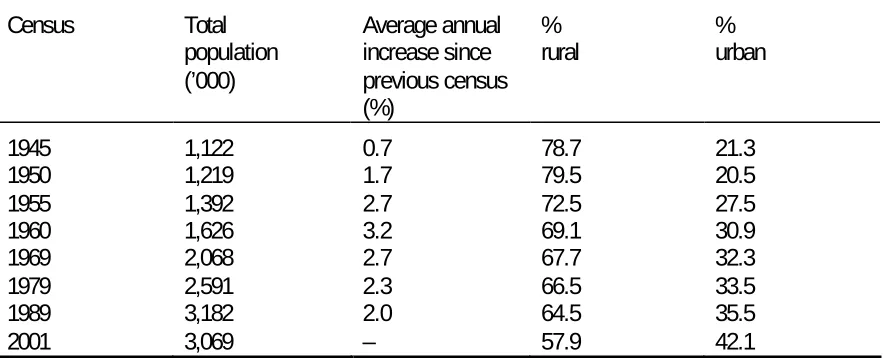
[image:11.596.88.530.452.631.2]Given that Albania’s annual growth of population peaked as recently as 1960 (at 3.3 percent), remaining high until the onset of emigration in the early 1990s, Albania’s demographic transition remains incomplete. It does not compare with the situation in most other European countries (including several former Eastern bloc states) which have already advanced into the second demographic transition of very low, sub-replacement fertility portending static, or even declining, and rapidly ageing populations. Interestingly Albania’s neighbours, Greece and Italy, are at the forefront of this second demographic transition; their total fertility rates of 1.5 and 1.3 children per woman in 1990 (cf. Albania 3.0) are amongst the lowest in the world (King 1997). Therefore, on simple demographic criteria, it might be suggested that the migration of young Albanians to these ageing societies makes some sense.
Table 1. Albanian Population at Each Census, 1945–2001
Census Total
population (’000)
Average annual increase since previous census (%)
%
rural % urban
1945 1,122 0.7 78.7 21.3
1950 1,219 1.7 79.5 20.5
1955 1,392 2.7 72.5 27.5
1960 1,626 3.2 69.1 30.9
1969 2,068 2.7 67.7 32.3
1979 2,591 2.3 66.5 33.5
1989 3,182 2.0 64.5 35.5
2001 3,069 – 57.9 42.1
Sources: INSTAT (2002: 19); Sjöberg (1991: 42).
increase.3 Annual population increase remained close to 3 percent throughout the 1950s and 1960s; only in 1990 did the rate move below 2 percent (it was 1.96 percent in that year). After 1990 mass emigration fundamentally changes annual population accounting; the detailed aspects of this impact will be described later in the paper, in section 5.3.
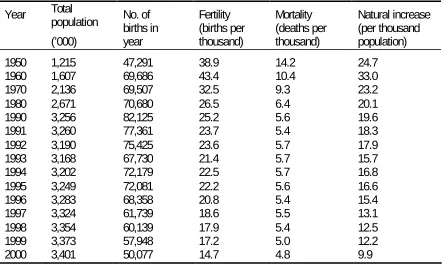
The decrease in the total population revealed by the 2001 census makes clear the impact of emigration. Given the continuing high rate of natural increase of the population during the 1990s (Table 2), the population would have been much higher in 2001 had emigration not occurred. Indeed, summing the annual excesses of births over deaths for the years 1990–2000 (INSTAT 2001: 8) gives a natural increase for the decade of about 550,000. If this is added to the 1989– 2001 intercensal decrease of 113,000, net emigration becomes 663,000. But this does not embrace the total net absence since the 2001 census included Albanian citizens who were temporarily abroad for a period of less than one year (INSTAT 2002: 79). Hence the figure of 800,000 emigrants, widely quoted in academic and government circles in Albania, seems equally plausible.
Table 2 chronicles elements of natural change at ten-year intervals between 1950 and 2000, with annual data for 1990–2000. These annual vital registration data were used to compute end -of-year population totals without reference to emigration: hence Table 2 in some senses contradicts the census data in Table 1. The annual number of births remained remarkably constant at 70,000– 80,000 from 1960 until 1995; by 2000 it had dropped to 50,000. Note that the total population figure for 2000, 3.4 million (Table 2), is substantially above the 2001 census figure of 3.07 million (Table 1) because of the failure to fully account for emigration before the census.
The continuing high number of annual births into the mid-1990s indicates a future supply of potential young emigrants for the next 10–20 years. Both in 1990 and in 2000, nearly one third of the population was under 15 years of age; the proportion is kept high by emigration’s removal of young-adult cohorts. Nevertheless the two-thirds decrease in the crude fertility rate between 1960 and 2000, with particularly rapid decline during the 1990s, indicates a choking-off of population growth over recent years – natural increase, for instance, halving over the decade 1990–2000.
3 Under the communist regime a pro-natalist ideology was propagated: the growth of the population was regarded as a
Table 2. Albanian Population: Birth, Mortality and Natural Increase, 1950–2000
Year Total
population (’000) No. of births in year Fertility (births per thousand) Mortality (deaths per thousand) Natural increase (per thousand population)
1950 1,215 47,291 38.9 14.2 24.7
1960 1,607 69,686 43.4 10.4 33.0
1970 2,136 69,507 32.5 9.3 23.2
1980 2,671 70,680 26.5 6.4 20.1
1990 3,256 82,125 25.2 5.6 19.6
1991 3,260 77,361 23.7 5.4 18.3
1992 3,190 75,425 23.6 5.7 17.9
1993 3,168 67,730 21.4 5.7 15.7
1994 3,202 72,179 22.5 5.7 16.8
1995 3,249 72,081 22.2 5.6 16.6
1996 3,283 68,358 20.8 5.4 15.4
1997 3,324 61,739 18.6 5.5 13.1
1998 3,354 60,139 17.9 5.4 12.5
1999 3,373 57,948 17.2 5.0 12.2
2000 3,401 50,077 14.7 4.8 9.9
Source: INSTAT (2001: 8).
2.2 Mapping Poverty in Albania
In this section we survey in some detail the nature, measurement and incidence of poverty in Albania. This provides the main causal factor for emigration and the setting against which migrants deploy their remittances and plan their return.
Poverty should be defined in culturally and historically specific terms, in order to understand the way migration responds to the perception of the deterioration of living standards, which go beyond
income-based conceptualisations of poverty. According to the study on Poverty in Albania
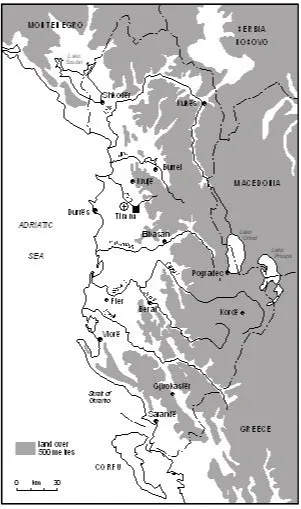
Figure 2: Albania: Location Map
cities that were industrial centres under the previous regime, such as Kukës, Elbasan and Korçë (see Figure 2). But the general economic situation is no better in rural Albania, where the farm sector underwent a deep transformation since political and economic reforms began in late 1991. In just a few years Albania went from 600 co-operatives and 110 state agricultural enterprises to about 440,000 private farms. Moreover, productivity decreased dramatically as land was fragmented into small and dispersed lots, irrigation facilities became obsolete or were irreversibly damaged and market facilities were dismantled. Only 30 percent of agricultural and livestock products are actually marketed. As a consequence of all these factors, agricultural production and rural living standards have fallen substantially, fuelled by unemployment and the absence of an adequate system of social protection (see Oxfam 2003).
According to official statistics (INSTAT 2002: 51, 53), the majority of the population, just over 50 percent, still works in agriculture, while other important employment sectors are construction and transport with 12.7 percent, trade with 11.6 percent, followed by industry wi th a mere 7.1 percent. The registered unemployment rate was 22.7 percent in 2001, with unemployment affecting young people in particular. Significantly, female unemployment, 28.4 percent, is higher than male unemployment, 18.8 percent. These figures are consistent with a general contraction and involution of Albanian women’s role in society at large in post-communist times. But we must not put too much faith in these statistics. There are many reasons to be cautious when referring to official employment data in Albania: for instance, all rural inhabitants who received land from privatisation are considered to be self-employed while there is no official data nor analysis about employment in the large informal sector of Albanian economy. Nor is there any official land registry.
The 2002 Human Development Report for Albania (UNDP 2002: 26-38) presents a wealth of
better in life expectancy and education than do other countries with similar HDI levels; the weakest element has always been GDP per capita (Gjonça, Wilson and Falkingham 1997). Regional tabulations show marked variations ranging between Tirana (HDI 0.822) and Kukës in the mountainous north-east (0.719).
If we refer to the parameters set by the UN-promoted Growth and Poverty Reduction Strategy, in absolute terms 46.6 percent of Albanians are below the poverty line of $2 per capita a day, while 17.4 percent are below the extreme poverty line of $1 per capita a day. Moreover, one in three families experiences problems with low-quality housing, while there are serious problems with potable water supply, sewage and roads, and a worrying increase in illiteracy rates in recent years (Albanian Centre for Economic Research 2002: 48).
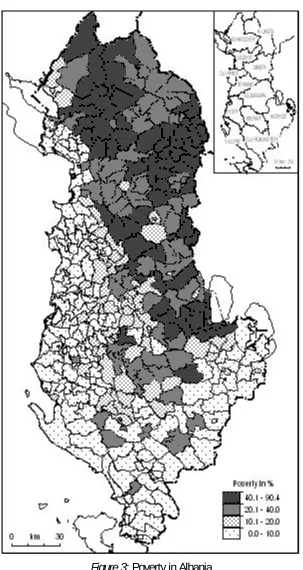
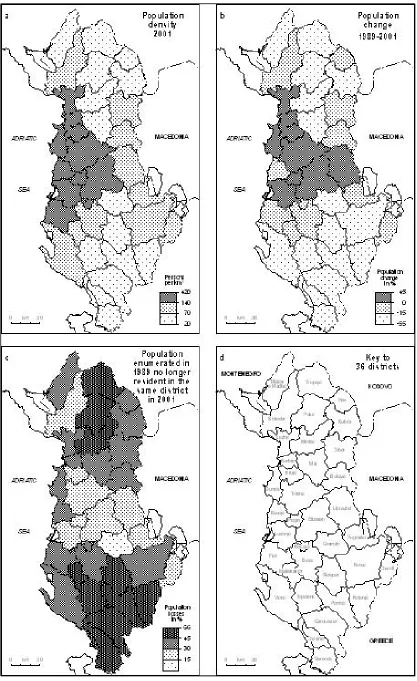
If this is true for the whole of Albania, it is also true that poverty is far more widespread in the country’s remote and rural areas. Poverty indicators in rural areas, compared to those in urban areas, are nearly double at every educational level while the chances of being poor are about six times higher for employed people living in rural areas than for employed people living in the urban areas. The UNICEF map of poverty in Albania, which measures at a fine spatial mesh of Albania’s communes and municip alities the incidence of poverty amongst local households, reveals the sharpness of the poverty divide between the rural, mountainous north and the interior, on the one hand, and the urbanised coast and the more prosperous rural south on the other (Figure 3). Data are often not available for peri-urban areas, most widespread around Tirana and Durrës, where economic circumstances tend to be often difficult and more unstable, and where the interlocking between internal and international out-migration is most visible, at least on the ground. Indeed, some of the rapidly growing peri-urban areas are even more impoverished than remote rural areas. Since these unofficial settlements around Durrës and Tirana are built by people who left rural areas, often far away, they lack infrastructure and basic social services. In most of these settlements young people have no access to education or work, and are forced to migrate in order to secure their own and their families’ survival (King, Mai and Dalipaj 2003: 68-71).
impact on poverty alleviation and is unable to prevent social exclusion or the necessity to migrate for survival.
Figure 3: Poverty in Albania
incomes, the poorest housing, the highest incidence of poverty, and the greatest reliance on state social assistance, of all areas of the country. However, not too much should be read into these regional indicators, since the picture is a fast-changing one, as the Census’s comparison of trends between 1989 and 2001 shows. For instance, illiteracy is quite low now, but (registered) unemployment increased dramatically, due to rapid economic liberalisation and the exposure of vulnerable groups to severe economic hardship. As the main industrial and productive activities (wood, mineral extraction and hydro-power stations) were either closed down or privatised during the abrupt transition, most families were left with no other resources than their agricultural land. Nowadays, many people live only by the income they make from the products they cultivate on the land area which was assigned to them in the post-communist period (Lawson, McGregor and Saltmarshe 2000; Saltmarshe 2001). Unfortunately, this is usually limited in quantity and of very low quality. Emigration of one or more younger family members is the best hope for family improvement.
2.3 Migration in the Albanian Cultural Context
There is a well-known Albanian proverb which states that ‘A man becomes a man out in the world, a woman becomes a woman over the cradle’. The word denoting ‘out in the world’ is kurbet which, originating from the Turkish gurbet, refers to a journey and sojourn in a foreign land, usually for work. This act of going away and being distant is much embedded in Albanian folklore (there are, for instance, many kurbeti folksongs) and originates in the travel and sojourn of Albanians within the borderless Ottoman Empire (Tirta 1999). According to Pichler (2002) these established practices of temporary labour migration were consistent with Albania’s agro-pastoral economic and socio-cultural history. Particularly in rural Albania, memory of such pre-communist mobility is still common, and this reference to kurbet, the ‘traditionalist’ term for migration, in memory, songs and narrative, gives cultural meaning to themes of movement, loss and sacrifice, which have acquired a new intensity in the post-communist years (Mai and Schwandner-Sievers 2003: 944-945).
‘economic refugees’ – obviously captures elements of both these latter two terms. This approach underlines the inextricability of Albanian migration from the economic plight of the country in the early 1990s, which was, in turn, a function of the chaotic political situation. In other words, Albanian migrants, at least in the early 1990s, and again in 1997, tended to view themselves as refugees rather than as ‘free’ emigrants taking an individualistic decision to migrate to a better labour market (Papailias 2003: 1064). On the other hand, as opposed to the problematic subjectivities inherent in the terms emigrant and refugjat, both loan words from the ‘West’, kurbet evokes a more neutral state of being distant. The common theme which connects all these definitions and interpretations is the separation from home and family and the sense of suffering and sacrifice that migratory absence entails.
Family is a very strong institutional structure in Albania, and one which usually occupies a very important place in the migration process (Hall 1994: 83-84). The socially-integrated, supportive family structures may have their advantages in the context of shared hardship and a common household strategy of migration for some family members, but they are generally predicated on strong patriarchal authority. In almost all cases, the person receiving the remittances and administering the whole of the family budget is the male head of the family. As within any patriarchal setting, women usually have an important function in the management of the material life of the household, but do not take part in the decision-making, except perhaps in a tokenistic way. However, with migration of sons comes a subtle inter-generational sharing of decision-making about the management and deployment of remittances. As far as the patriarchal and prescriptive nature of relationships within the household are concerned, these seem to be internalised by women and men alike.4
But the basic survival-bound character of the decisions to be taken makes the issue of management of power within the family look somewhat redundant, especially from the perspective of the family members. Usually it is the father who decides how to spend the money ‘for the sake of the family’. However, the person who remits can also be a leading actor in the decision-making process as the money sent home is often considered an investment for his own future; how it is used depends also on the real or imagined direction of the migrant life trajectory.5
4
Evidence for this, based on interviews with Albanian migrants in the UK and with migrant households remaining in Albania (with household members abroad), is provided in King, Mai and Dalipaj (2003: 54-57, 71-86).
5
The strength of the family has endured throughout the long transformation from pre- to post-communism, and the patriarchally-controlled family has remained a fundamental social institution in all parts of the country, although inevitably some dismemberment has taken place through large-scale emigration, as we will see later. Moreover, there are some regional differences in the way ‘family’ is experienced and expressed. Northern Albania is renowned for its social and cultural conservatism, reflected in the widespread presence of extended family households and in the resilience of customary law which regulates both the life-cycle of the family, including especially gender relations, and relations between extended families (Saltmarshe 2001). It is in the north that we see the strongest survival of the Kanun, a code of customary law dating from the fifteenth century.6 The Kanun bases its strength not on individual responsibility but on the institution of the extended family clan, with authority the exclusive prerogative of men. Such a model was inevitably personalistic and authoritarian, and legitimated the power of domination of the adult male within the institution of the family, leading to the utmost submission of women to men.7
The most extreme form of these values and traditions were challenged and partially suppressed by the communist regime, but a fundamental element of continuity must be noted: Albanian communism was essentially the dictatorship of one man (Enver Hoxha) over all Albanian men and women, locating him as the father-figure and moral guide of the ‘nation-family’ within the values of obeisance and submission that stem from the cultural background of the whole of Albanian society (Mai 2001a: 268). Communism formally sanctioned equality between men and women, but the hegemonic patriarchal mindset was never fully undermined. Indeed it re-emerged in new forms after 1990, when young men, especially, have reinvented some strategic aspects of the traditional Albanian heritage of patriarchy in order to serve their own needs and exploit young women in new ways – including trafficking them abroad for sex work (Mai 2001a). Meanwhile inter-family blood feuds have also been resurrected in the north, and have led to the emigration of some males who were in situations of danger.
6 There existed a number of variations on the Kanun in different parts of Albania; the version that has become the
definitive, codified statement is that of Lek Dukagjin, which also attempted to regulate blood feuds. Such practices survived until the 1920s and 1930s (Durham 1928), and have re-emerged, sometimes in mutated forms, since 1990 (Schwandner-Sievers 2001).
7 One exception to this generalisation was the case of the virgjeresha or ‘sworn virgins’ – women who dressed and
3. Trends and Patterns of International Migration
In this section of the paper we look solely at international migration. It needs to be stressed that, despite its sudden appearance, mass scale and clear rupture with the communist past of zero emigration, migration abroad did not start in 1990-91. Accordingly the first subsection below attempts a brief survey of earlier migrations. This survey is rather patchy because of limited documentation and source material. We then, in sections 3.2 and 3.3, turn to a chronology and enumeration of the post-1990 emigration, before characterising the shifting nature of the migration of the last decade or so in terms of different typologies. Finally, in 3.4, we look at the patterns of integration/non-integration of Albanian migrants in the main host countries to which they have migrated since 1990.
3.1 Historical Perspective
The major waves of Albanian migration have taken place round important historical and political events in the country. One of the earliest periods of emigration in the collective historic memory of the Albanians is situated in the second half of the fifteenth century, after Gjergj Kastrioti’s death (the national hero known as Skanderbeg) and the fall of his stronghold at Krujë to the Ottomans. Many Catholics, including close relatives of Kastrioti and others who had participated in the resistance against the Ottoman Turks, fled the country; they settled mainly in Italy, but also in Greece and along the Dalmatian coast. This migration has been described as ‘a religiously-motivated emigration, since the first Turkish occupation forced the Islamisation of the Christian Albanian population’ (Derhemi 2003: 1017). In Italy they joined some already established small Albanian communities, originating with the soldiers who had settled in Italy after having fought for the House of Aragon, three or four decades earlier (Armillotta 2001). This important historic Albanian diaspora, scattered across Southern Italy and Sicily, has its roots in this period. From generation to generation, the descendants of these Albanian émigrés, or the Arbëresh8 as they are known, have been able to preserve the Albanian language and traditions through five centuries. This emigration is considered to have come to an end by the second half of the eighteenth century (Armillotta 2001). Many Albanian-Italians were later to emigrate to the USA at the beginning of the twentieth century, where they would form part of the larger Albanian diaspora there (Hall 1994: 50).
8 The Arbëresh live in 49 towns and villages, dispersed among seven regions and nine provinces extending from the
Five centuries under Ottoman rule, which ended with the declaration of independence in 1912, were accompanied by different types of migration (Vickers 1995). Albanian young men were coercively recruited into the Ottoman cavalry and later on as infantry, and were sent to fight for the Empire, wherever war or skirmishes broke out. Albanian men were also recruited into the elite guard or the Janissaries, whose main residence was at the High Porte in Constantinople. Many Albanian men rose to occupy important positions in the Empire’s administrative and military ranks, in particular during the sixteenth and seventeenth century (Vickers 1995: 12). The Albanian Grand Viziers, such as Sinan Pasha, ruled in different corners of the Empire, some as far away as Syria (Vickers 1995: 14). Indeed, Mehmet Ali Pasha, the founder of modern Egypt, ruled as governor of Egypt for almost half a century. His dynasty came to a close with King Farouk I, who was reportedly of Albanian blood.
Many Albanians who were seen as a threat to the Ottoman rule were simply sent to exile in other Ottoman-occupied territories. Others, from more well-to-do families, went to study in places such as Romania, France etc. Yet other Albanians were forced to migrate due to the repressive policies and military campaigns of the Ottoman Turks. Those who left in large numbers were Christians, who had resisted the discriminatory policies of the Porte. This was the case of the Christians (Suliots) from Himara in the south, who fled to Greece after they were defeated by the Ottoman armies. Such was also the case of the Albanian Christians and the Vlachs from Voskopoja and Vithkuq in the south-east, who fled to Greece and Romania, after their city was razed to the ground (Vickers 1995: 20).
Following the disintegration of the Ottoman Empire, during the late nineteenth and early twentieth century, the contested lands along the present Albanian borders experienced considerable population displacement due to fighting. Large-scale population displacement also occurred during the Balkan Wars. This was also one of the most important periods of displacement of Albanians by the Serbs in what is today Kosovo. This period saw massive migration of ruined Albanian peasants in general, who emigrated to Turkey, Romania and Egypt, later to Greece, Bulgaria and Russia, and finally to France, America and Australia. Significant communities of Albanians formed in Istanbul (with some 60,000 Albanians), as well as in Romania, Egypt, Bulgaria and the USA (Pollo and Puto 1981: 108).
other areas of southern Albania. The immigrants were predominantly Orthodox young men who hoped to return home after they had made some money on the new continent (Ragaru 2002 drawing on Nagi 1988: 32-33). Most of them had a rural background and only a minority had received education. Boston became the main centre of settlement, and remained so until the 1970s, when New York took over.
In the 1920s, however, the pattern shifted to that of a family-dominated emigration and was more intensive. After the country’s independence in 1912, some emigrants returned to Albania, only to re-emigrate later for permanent settlement in the US. This time it was entire families, even entire villages, who migrated as well. During the 1920s and 1930s Albanian immigration to the USA increased, and it continued to originate predominantly from southern Albania, with only very few known cases coming from the north. By 1981, the number of Albanians in the United States was estimated at around 70,000 people, including those from Kosovo and Macedonia (Nagi 1988: 25).
Little is known about the migration of Albanians to Australia, although there are intriguing scattered remarks in Charles Price’s (1963) monograph on Southern Europeans in Australia (see also Hall 1994: 51-52). Even though rather small-scale, this migration is important because of its link with the Albanian migration to Australia in the post-communist period. After 1990, the majority of the Albanians who emig rated to Australia were family members or close relatives of the émigrés of the pre-1944 period. The Albanian community in Australia is small when compared to the one in USA – Albanians numbered 1500 according to the 1976 Australian census. However, there are some similarities between the two regarding timing, pattern and origin. Similar to the USA case, the emigration to Australia started around 1885. The Australian Department of Foreign Affairs and Trade (2003) considers the 1920s as the main period of Albanian immigration to Australia, with the arrival of over 1000 persons, nearly all men. By 1933 the community had decreased somewhat, but the male/female ratio was still seriously unbalanced with 766 males to just 4 females. The pattern then shifted to family migration, as in the case of the USA; in the late 1930s many Albanians in Australia were joined by their families, especially in the Shepperton area of Victoria, which has the largest Albanian community in Australia. These emigrants came predominantly from Korçë and Kolonjë, in south-east Albania.
emigration. Those who migrated were refugees from the wars as well as political opponents of the ruling governments as they replaced one another.
However, starting in 1944, Albania’s borders were sealed by the communist regime, which would result in only very few citizens being able to successfully cross to the ‘other side’ until 1989-90. The trickle of emigrants consisted solely of a few successful defectors, mainly political opponents of the regime, who generally established themselves in Europe, but sometimes in destinations such as the USA and Australia. For instance, in the 1950s a small anti -communist group managed to reach the United States, after having passed through Europe. Members and adherents of the major anti -communist parties – Partia e Legaliteti (Legality Party) and Balli Kombëtar (National Front) were among those in this group (Ragaru 2002). Additionally, during the early post-1944 period, a further 400 Albanian citizens are reported to have reached Australia (Australian Department of Foreign Affairs and Trade 2003).
In the light of this historical overview of international migration, it can be concluded that the post-communist migration of Albanians is not an isolated episode. Rather, the exploding emigration that took place after 1990 showed only too well that the period 1944-90 constituted an artificial interlude within this historical framework of the migration of the Albanian people.
Box 1. Chronology of Albanian Migration
International migration after the fall of the communist regime unfolded in four main episodes:
1. The ‘Embassy Migrants’, Summer 1990
During June–July 1990 around 5,000 Albanians sought refuge in Western embassies in Tirana. Eventually they were allowed to leave for the West. Italy was the main recipient. The Albanian authorities liberalised the issuing of passports and a small-scale exodus continued. Altogether, from the ‘embassy invasion’ until early 1991, some 20,000 left.
2. The Main Mass Exodus, March and August 1991
Chaos leading up to Albania’s first democratic elections (won by the Communists) led to the first ‘boat-people’ exodus to southern Italy in March 1991; 25,000 migrants were accepted and settled in Italy. A second boat exodus took place in August, but most of the 20,000 arrivals were repatriated. The Italian authorities argued that whereas the ‘first wave’ could be treated as refugees fleeing a tense political situation, the ‘second wave’ arrived after democratic elections and therefore could not be given refugee status. Meanwhile, a larger-scale but unquantified exodus took place to Greece; and clandestine migration continued to Italy. Altogether during 1991–93 an estimated 300,000 Albanians, one in ten of the population, left the country, the vast majority to Greece and Italy.
3. The Pyramid Crisis, Spring 1997
In the early months of 1997, the collapse of a pyramid scheme for the investment of private savings (including many emigrants’ remittances) led to a period of political and economic turmoil verging on civil war in some parts of the country. This chaos produced another boat exodus to Italy in early spring 1997. Initially 10,600 Albanians were accepted by Italy, but further sea-borne migrations were repulsed, sometime s in tragic circumstances, notably on 29 March 1997, when, as a result of a collision between an Italian coastguard vessel and a boatful of Albanian migrants, 87 people, many of them women and children, lost their lives. As before, larger but unregistered crossings of the Greek border took place. Albanian communities already established by onward migration in other EU countries, such as France, Germany and Belgium, were augmented by new arrivals and the evolving diasporic network spread to the UK.
4. Kosovo Crisis, 1999
Albania played host to 500,000 ethnic-Albanian Kosovan refugees entering through northern Albania; some have used Albania as a transit route to seek asylum in other countries, including the UK. The Kosovan refugee crisis destabilised the already fragile economic and demographic situation, especially in northern Albania, and many northern Albanians mixed themselves in with the Kosovan outward migration to other European asylum destinations.
3.2 Figures
government estimates of the total number of Albanian emigrants living abroad in 1999. The Albanian Ministry of Labour and Social Affairs estimated 800,000 emigrants, with 500,000 in Greece and 200,000 in Italy. In both these countries, the figures combined documented and an estimate of undocumented migrants: in Italy documented migrants were in the majority; in Greece, until recently, most Albanians were undocumented. Other countries hosting significant numbers of Albanians included Germany (12,000), the United States (12,000), the United Kingdom (5,000), Canada (5,000), Belgium (2,500), France (2,000), Turkey (2,000), Austria (1,000), Switzerland (1,000) and Australia (1,460). Some of these latter figures are likely to be underestimates, given the mobility of Albanian migrants, especially within Europe, and the rapid evolution of new migration channels and routes in recent years. Indeed, recently Albanians have migrated to Malaysia and Saudi Arabia, New Zealand and South Africa.
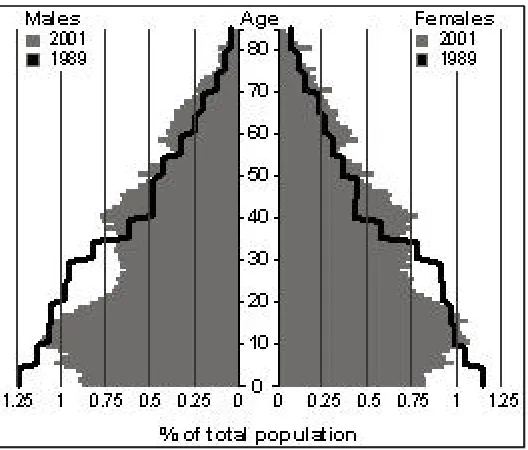
Figure 4: Age-Sex Pyramids, 1989 and 2001
3.3 Characterisation of Albanian Migration
Barjaba (2000) has characterised the ‘Albanian model’ of emigration as having the following features: recent (post-1990); intense (a rate of emigration much higher than any other Eastern bloc country); largely economically driven – a form of ‘survival migration’; a high degree of irregularity,
with many undocumented migrants; lots of to-and-fro movement, especially with Greece; and
dynamic and rapidly evolving, especially as regards new destinations and routes of migration. Let us critically evaluate each of these defining features.
First, in the light of the historical account of Albanian migration presented above, it can be suggested that the post-1990 emigration was not a sudden phenomenon, never experienced previously by the Albanians. As such, characterising the Albanian migration as ‘recent’ is perhaps temporally constrained. On the other hand, its characterisation as dynamic and rapidly evolving is more than justified in the light of recent data and other information.
Within the context of the Albanian migration gradually becoming more regular, it is important to mention that, in recent years, many more Albanians have sought and been able to use legal ways of emigrating, as compared to the early 1990s. These have been: the Diversity Visa programmes for the USA, the Skilled Worker Visa programme for Canada, family reunification after regularisation of a family member in the host country (particularly relevant for the Italian and Greek cases), more availability and better accessibility of scholarships for students to study abroad etc. The fact that the majority of the Albanian population had completed 12 years of education made the Diversity Visa programme arguably the most popular one in the country by being accessible to a broad category of would-be migrants, whereas the Skilled Worker Visa programme for Canada excluded unskilled individuals. However, both of these programmes provide the possibility of a family migration rather than individual movement, the former being the preferred situation for many.
Regarding the intensity of the emigration, Barjaba (2003: 165) maintains that this trend continues at present. However, this is difficult to ascertain for the last two-three years, considering that reliable figures in the host countries exist only from regularisations or applications for regularisation put forward by migrants who may have already been resid ing in the host country, without necessarily having arrived there recently. It is also the case that controls over the ‘migrant smuggling’ trade across the Adriatic, particularly between Vlorë and Otranto (refer back to Figure 1), have become much more effective in the last two years.
As well as individual migration trajectories sequenced in the way described above (first Greece, then Italy, then to other countries), it is also common for members of the same family to be distributed as emigrants in several countries, such as Italy, Greece, the UK and Germany. Clearly the sequencing of migration stages and the distribution of working family members in different countries governs the pattern and amount of remittances flowing back.
But as sons and daughters emigrate, they may get married and form their own families abroad, at which point their remittances are either lost or decrease markedly. The inevitability of this is accepted by the ‘residual family’ in Albania – after all, for their children to get married is exactly what they would want – but the big question that comes is whether they will return, and if so, to where in Albania. A return to the harsh mountains of northern and interior Albania is seen as obviously problematic, since the developmental potential of this region remains limited; resettlement in the more urbanised lowland of central Albania may be more attractive.
Typically, after a first phase in which the migrant sends home as much as he can to improve the living conditions of the entire family unit, he then starts investing in his own family project, building a separate household close to the parents' house.9 It is interesting to note how the purpose of houses built from remittances changes along with the migratory project. When the reality of returning becomes more unlikely, these houses become signifiers of belonging and proof of achievement, to be enjoyed only during visits or holidays.
At the same time, many Albanian families from the rural north and south pursue a parallel, internal migratory strategy to secure their long-term future in Albania. Regarding the interlocking of international migration and internal moves, there is evidence of a number of variations on this theme: international moves followed by internal migration, vice versa, and simultaneous and overlapping migrations by different family members (see King, Mai and Dalipaj 2003: 62-71). We deal more specifically with internal migration patterns in the next main section of this paper (section 4).
These complex typologies of movement and relocation are creative and rational responses to the geography of opportunity structures on the part of Albanian households and families – a kind of
9 We use the male gender here since, in this typical model of Albanian emigration, the main protagonists are nearly
it-yourself development in the face of limited opportunities for economic improvement in the home country, and in northern Albania especially (Nicholson 2001).
However, in recent years, Albanian migration has evolved from being almost exclusively a ‘survival migration’, to something more diverse. Thus, Albanians nowadays emigrate also to improve their economic situation, to secure a better future for their children, to access better professional opportunities, to pursue study opportunities abroad, and to escape the constraints of certain social practices and norms, such as in the case of women or other marginalised groups.
Participation of Albanian women in migration has increased in recent years in particular as a result of family reunification. This is an important change in the previously male -dominated pattern of Albanian contemporary migration, even though there is still no equal gender balance as such. Both for Greece and Italy, the main two destinations for Albanian migrants since 1990s, successive counts from regularisations and the 2001 census round show that, whilst females accounted for around 20 percent of total Albanian migrants in the early and mid -1990s, by 2000-01 the share was approximately 40 percent (King 2003). The majority of females have migrated as part of a family, either together with the family (especially migration to the USA through the Diversity Visa programme), or to Canada through the Skilled Worker Visa programme or following their husband/fiancé after he has established himself in a host country. The majority of (single) females who have migrated alone have done so to pursue their studies in different EU countries, as well as in the USA. Single females emigrating to work abroad through legal channels are still few, and mostly comprise the professional and highly skilled women, mostly from well-to-do families.
Albanian migration has evolved also from the point of view of the age structure of migrants. Whilst Albanian migration is still dominated by migrants of working age, whether they are men or women, this pattern has recently been enriched by the phenomenon of ‘migrating grannies’. These are grandparents joining the rest of the family (son or daughter) in the host country. This has been made possible through the regularisation of many migrants, who have then in turn opted for a family reunification in the host country. The importance of this phenomenon for the Albanian family has been significant in two aspects: economic and social/emotional. Having parents to look after the home and the children, particularly when they are at a pre-school age, allows both parents to work and have more free time for themselves, at a lesser financial cost. It also serves as a comfort zone, in particular in the context of Albanian society, where family is very important. Grandparents, on the other hand, enjoy being around and contributing to the raising of their grandchildren, as well as being with the family, rather than alone and even abandoned back in Albania. This has been the case of many other elderly, who have stayed behind and have no one to look after them. This parallel phenomenon of ‘orphan pensioners’, socially isolated in rural areas of Albania after all their children have emigrated, has been diagnosed as a serious social and welfare problem by the World Bank study on Albanian poverty (De Soto et al. 2003). Looking after the elderly in institutions is a new and underdeveloped phenomenon in Albania, as socially and financially it has always been the responsibility of their children to look after them. Unfortunately, this is very much an under-researched area, and we highlight this topic as one of the key points in a future research agenda in our concluding discussion to this paper.
Other interesting patterns of migration are observed in the Roma community, who migrate as a group, after having decided a group leader. They mostly take up seasonal work, which is a pattern of migration observed amongst Albanians in general, especially when migrating to Greece, and particularly for people living in villages close to the border. Most seasonal work is in agriculture. However, a huge demand for mainly unskilled labour has been created in Athens, due to the construction of the infrastructure which will support the upcoming Olympic Games in 2004. Athens is also the place where the majority of Albanian migrants are settled.
Those who work seasonally in Greece are not necessarily all unskilled. During the summer holidays many teachers, students and people working in the public sector go to Greece to work for the summer, mainly in agriculture. The earnings of three months’ work in Greece as a manual agricultural labourer are likely to be higher than a year’s salary for a village secondary school teacher in Albania. Many who take this option have to support their children at University, which has become close to impossible for families with state salaries, let alone for those who do not have any member of the family employed in the public sector.
3.4 Reception and Integration in the Host Societies
The integration of Albanians abroad – which means primarily in Italy and Greece – has been powerfully affected by perceptions created and maintained by the media and by politicians anxious to exploit the role of the media for their own ideological or vote-winning purposes. Here we take first the Italian reaction, which has been well documented (see Carzo and Centorrino 1999; Mai 2002b; Pozzi 1997); and then, more briefly, the Greek one. For both countries the conclusion is that, in reality, Albanians have achieved a remarkable and dynamic socio -economic integration, and they have done this despite an all-encompassing negative stereotyping from the two host societies.
The Italian response to the immigration of Albanians during the 1990s is a story in itself, above all driven by the media, which have played an unusually prominent role in constructing images of Albania, and Albanian immigrants, which have been highly ambiguous and contradictory, but on balance increasingly negative (King and Mai 2002).
and Manconi 1992: 65–68). However, right from the beginning a more patronising interpretation was also apparent: Albanians were portrayed as backward, abject, helpless. By the time the August 1991 wave arrived, the tone had completely changed. Benevolence and genuine pity turned to rejection and hostility, and the press discourse spoke constantly of an ‘Albanian invasion’ flooding the coastal towns of Italy. Albanians were projected as ungrateful, lazy and violent – an image reinforced by pictures of them cooped up in compounds, protesting against bureaucratically-delayed decisions on their future (Zinn 1996).
The pyramid crisis, the breakdown of law and order over much of Albania and the resultant exodus of spring 1997 brought a renewed Italian media feeding-frenzy, out of all proportion to the scale and seriousness of Albanian problems at a time when other world events (massacres in Algeria, earthquake in Iran…) were objectively more important. This media blitz deployed the full panoply of negative thematic images of Albania and Albanians: violence, chaos, backwardness, poverty, desperation, mass migration, child trafficking, prostitution, family breakdown – all of which, it was implied, were the exact opposite of the ‘good society’ of Italy. Dominant of all these stereotyping labels has been the equation between Albanians and ‘criminals’ (Silj, 2000).
Vehbiu and Devole (1996) interpreted the way Italian media framed Albanian migration and the presence of Albanians in Italy as a powerful ‘myth of the other’. The historical and social preconditions for this mythical construction are to be traced on the one hand in the new European political and cultural order that emerged after the end of the Cold War, and on the other in the highly ambivalent post-colonial relationship between Italy and Albania, echoing Fascist Italy’s military occupation of Albania from 1939 to 1943 (Mai 2003).
Second, the 1997 migration crisis – in which Italy initially accepted but then repulsed refugees from Albania’s economic and political chaos, preferring instead a high-profile military-humanitarian mission to Albania to restore order (and, of course, prevent further migrations) – coincided with Italy’s wish to reassert its prominent European identity in the run-up to economic and monetary union. Thus, under what Perlmutter (1998) calls the ‘politics of proximity’, the peace-keeping operation in Albania was designed to give Italy European credibility at a time when its EU partners were doubting both its commitment to Europe and its ability to satisfy EMU criteria.
And yet, despite media stereotyping as undesirables and criminals, and despite being, in public opinion polls, the immigrant group least favoured by Italians, Albanians have achieved considerable success in integrating into Italy. In many respects they are the immigrant nationality closest to Italians – geographically, somatically, linguistically and culturally. Whilst geographical proximity and phenotypical similarly are self-evident, culture and language need further explanation. Despite their half-century of communist rule and predominantly Islamic heritage,10 Albanians share many ‘Mediterranean’ cultural characteristics with Italians, as well as an experience of Italian colonialism. And as a result of their habit of secretly watching Italian television during the later years of communism, they are familiar both with Italian culture (or the television version of it) and the language. This subversive tuning into Italian culture undoubtedly conditioned their subsequent migratory projects since Italy represented, just a boat-ride away, Western utopia (Mai 2001b). On the other hand, these very same elements of similarity have simultaneously acted against acceptance and integration since, as many authors have pointed out (Mai 2002, 2003; Perlmutter 1998; Zinn 1996), Albanians recall in the Italian collective memory an earlier version of their own backwardness, poverty and necessity to migrate; more specifically they are a re -birth of Italy’s own ‘internal Other’, the Southern Italian migrant.
Concrete evidence for Albanians’ socio -economic integration in Italy is rather scattered, but recent research paints an increasingly positive picture. From empirical surveys (Campus 1999; Carchedi 2001; Da Molin 2001; King and Mai 2004; Melchionda 2003), the following picture emerges. First, Albanians have lower rates of unemployment than other immigrant nationalities. Secondly,
10
Albanians are employed in a variety of sectors. Relative to other groups, there is a concentration of males in industry and construction, but they are also found in many other manual jobs in farming, general labouring and low-grade service work. Females work mainly in domestic service, cleaning, baby-sitting and other service jobs. Especially in the construction sector and allied trades, there is a growing tendency to self-employment and small business formation, although it seems that Albanians are still less entrepreneurial than most other foreigner groups in Italy (Bonifazi and Sabatino 2003: 984). In cities and towns, some of the better educated migrants, with high-school diplomas and university degrees, are able to access higher-level technical and office jobs, though not always commensurate with their qualifications. There are also some 6,000 Albanian students enrolled at Italian universities, especially in Apulia (Bari, Lecce) and Rome. Although there is a brain drain of Albanian scholars and intellectuals to Italy, most of this type of migration goes to other European countries and North America (Gedeshi et al., 1999).
Other indicators of a relatively well-developed Albanian social integration in Italy are their wide spatial diffusion throughout the country, including a presence in many rural areas and small towns, and their high degree of informal social contact with Italians. Results from one study show that Albanians are more likely than any other migrant group to ask Italian friends to help them solve a problem (Carchedi and Gesano 2001: 50). Albanians are less likely to rely on charitable help, and more likely to work within the ‘Italian system’ to make progress and address their needs.
Demographically, too, Albanians have made some rapid progress towards a ‘normalisation’ of their profile (Bonifazi and Sabatino 2003). The proportion of females doubled during 1992–99, and Albanians now have higher percentages of married couples and children than longer-established migrant groups from North Africa such as Moroccans and Tunisians (King 2003). This family-oriented structure of Albanian migration is one which is completely overlooked by the popular imagery of the group. As Zinn and Rivera (1995) have shown in their study of Albanian women in Apulia and Basilicata, Albanian families, especially when they have young children, are rather readily accepted by their Italian neighbours and high levels of social integration are reached, facilitated by Albanians’ good command of Italian.
unaccompanied minors, often as young as 14 or 15, sent by their families to find work as independent migrants.11
Much of what has just been said about Albanians in Italy holds for Greece. Since 1990 Albanian migration to Greece has followed three main routes (Figure 1): the two main road crossings at Kakavi (leading to Ioannina) and Bilisht (leading to Kastoria and Florina), and the short sea link from Sarandë to Corfu. A fourth route goes via southern Macedonia to Thessaloniki. However, much movement has been clandestine, via mountain paths which cross the border in remote places (King, Iosifides and Myrivili 1998). There is, compared to Italy, a greater element of shuttle migration, which, as already noted, makes estimating the presence of Albanians in Greece difficult.12
Data on employment of Albanians in Greece are only indicative. The 1997 partial data quoted by Sintès (2001) show 30 percent in construction and public works, 19 percent in other manual jobs outside the building sector, 29 percent in domestic service, 11 percent in mechanical and repair work, 6 percent in catering and hotels, and 5 percent in other jobs. No gender breakdown is given, but it is certain that virtually all those in domestic service and many in the hotel sector are female. These figures therefore suggest that women constitute around a third of the Albanian workforce in Greece.
There is an obvious relationship between the spatial distribution of Albanians and the types of employment available. Urban areas such as Athens, Thessaloniki and Patras offer the possibility of year-round employment (albeit often in casual, temporary jobs); farming areas and tourist sites offer mainly seasonal work. Although there are no detailed data on the geography of Albanians’ labour in Greece, several qualitative studies combine to give a consistent overall picture (Droukas 1998; Fakiolas 2000; Hatziprokopiou 2003; Kasimis, Papadopoulos and Zacopoulou 2003; Lazaridis and Psimmenos, 2000; Lianos, Sarros and Katseli 1996).
11 This group has been the subject of some recent research and social study – see, e.g. Campani, Lapov and Carchedi
(2002); La Gamba (2000); Marzin (2000); Servizio Sociale Internazionale (2001), all of which shows, in various cities, that this is a phenomenon which is dominated by Albanian youngsters. In Rome, for example, 40 percent of immigrant unaccompanied minors are from Albania.
12 The shuttle migration takes various forms. From villages in southern Albania close to the border people move to work in
In rural Greece Albanians work in agriculture and general labouring, especially during summer when demand for fruit-picking and other labour-intensive tasks is high. Such has been the impact of Albanian immigrant labour that virtually all wage labour in Greek agriculture is now performed by migrants (Fakiolas 2003; Kasimis, Papadopoulos and Zacopoulou 2003). This implies a ubiquitous presence, but with particular concentrations in areas of intensive farming such as the plains of Thessaly or the olive groves of Corfu. Over time, Albanians have also found mo re stable types of rural work in sectors like animal husbandry, poultry farming, greenhouses and market gardening.
Secondly, many Albanians work in the largely seasonal tourist industry, located on the coasts and especially the islands. Both men and women are employed in tourist complexes, hotels and restaurants. They do a variety of jobs – as cleaners, kitchen staff, waiters, porters, gardeners, maintenance workers etc.
Finally, in Athens and other cities Albanians are employed as unskilled or semi-skilled labour in the construction industry, in hotels and restaurants, in small manufacturing or service concerns involved in activities such as clothing, removals or painting and decorating, and in personal services such as domestic cleaners, gardeners, baby-sitters, carers of elderly people etc. A number of Albanian girls and young women (and also boys) are procured by prostitution rings to work in the sex industry (Psimmenos 2000).
It can be seen that the vast majority of these jobs are low-skilled and insecure. Most are located in the informal economy where employers take advantage of Albanians’ illegal status. The recent regularisations have improved this situation somewhat. On the other hand the Greek employment market has to some extent bifurcated into ‘jobs done by immigrants’ and better-status work done by Greeks. Discrimination, exploitation and racism continue to be widespread, but tolerated by Albanians because of the dire economic conditions in their home country.
during and since the Ottoman Empire.13 The Greek reaction is also made more complicated by the presence, amongst the immigrants, of large numbers of ethnic-Greek Albanians who are treated more favourably than ‘other’ or ‘true’ Albanians, both in terms of their rights in Greece (automatically given visas and work permits) and the attitudes of the Greek population.14
The standard image of Albanians in Greece is that they are ‘cunning, primitive, untrustworthy’ … ‘dangerous’ and ‘criminals’ (Lazaridis and Wickens 1999: 648). The topic of Albanian criminality has been obsessively pored over by the Greek media, with the result that public opinion has been fundamentally changed. Given that police and court behaviour tends to reflect the bias of society at large, Albanians have been disproportionately targeted, leading to high numbers of reported arrests and prison inmates. Droukas (1998), who has made a special study of Albanian criminality, advises great caution when examining Greek crime statistics, stressing their unreliable and distorted nature. One of the most penetrating and wide-ranging analyses of Albanian migration to Greece is offered by Psimmenos and Georgoulas (2001). Two historical reference points are the millennial tradition of Balkan mobility (transhumance, nomadism, longer-distance migration), and the turning of Greece into a ‘Germany of the South’ with its reliance on temporary guestworkers for undesirable but essential jobs. Strong nationalism promotes a cultural division of labour based on genealogy, language and religion. The hegemonic power of the Greek ethnos creates a ‘social landscape of people in Greece that emphasises national identity as a framework for civil existence’, creating in turn an exclusionary straightjacket for minority, refugee and immigrant workers (Psimmenos and Georgoula 2001: 61). Triandafyllidou and Veikou (2002) develop the notion of a ‘hierarchy of Greekness’ in relation to Albanian immigration and recent Greek immigration policy. Next to Greek resident nationals come the Pontian (or Pontic) Greeks who are ‘repatriates’ from the former Soviet Union, to which they migrated in the early twentieth century from their historic Greek homeland of Pontos in Asia Minor. As members of the Greek diaspora, Pontian Greeks are given full citizenship status and other benefits that facilitate their integration into Greek society. Ethnic-Greek Albanians come next in the hierarchy: their ‘Greek nationality’ is recognised but they are not given full citizenship rights and are not officially encouraged to settle
13 The long-standing nature of anti-Albanian rhetoric in Greece is indicated in a study of their representation in the Greek
press in the early nineteenth century, where similar stereotypes of Albanians as ‘dangerous’, ‘bandits’, ‘criminals’ etc. are found (Skoulidas 2002).
14 The status and treatment of ethnic-Greek Albanians by the Albanian government has been a source of considerable