2518 JOURNAL OF LIGHTWAVE TECHNOLOGY, VOL. 21, NO. 11, NOVEMBER 2003
All-Optical TDM Data Demultiplexing at 80 Gb/s
With Significant Timing Jitter Tolerance Using
a Fiber Bragg Grating Based Rectangular Pulse
Switching Technology
Ju Han Lee, Member, OSA, Leif Katsuo Oxenløwe, Morten Ibsen, Member, OSA, Kim Skaalum Berg,
Anders T. Clausen, David J. Richardson, and Palle Jeppesen
Abstract—We demonstrate the use of fiber Bragg grating based pulse-shaping technology to provide timing jitter tolerant data de-multiplexing in an 80 Gb/s all-optical time division de-multiplexing (OTDM) system. Error-free demultiplexing operation is achieved with 6 ps timing jitter tolerance using superstructured fiber Bragg grating based 1.7 ps soliton to 10 ps rectangular pulse con-version at the switching pulse input to a nonlinear optical loop mirror (NOLM) demultiplexer comprising highly nonlinear dis-persion shifted fiber (HNLF). A 2-dB power-penalty improvement is obtained compared to demultiplexing without the pulse-shaping grating.
Index Terms—Demultiplexing, fiber gratings, optical fiber com-munication, optical fiber devices, optical pulse shaping, optical switches, optical time-division multiplexing.
I. INTRODUCTION
A
LL-OPTICAL time-division multiplexing (OTDM) system technology has developed significantly in recent years and has resulted in the demonstration of terabit-per-second single channel data rates [1]. As the data rates increase, and the return-to-zero (RZ) pulses used get correspondingly shorter, OTDM systems suffer increased sensitivity to source noise, and the effects of nonlinearity, group velocity dispersion (GVD), polarization mode dis-persion (PMD) and environmental sensitivity associated with the transmission line. These effects generally manifest themselves in terms of increased amplitude jitter, timing jitter and absolute timing drift at the receiver [2]. The synchronization requirements placed on the locally generated pulses required to control an optical demultiplexer at the receiver end can thus become a significant practical limiting issue. The key to obtaining sufficient timing jitter tolerance in such devices is to establish a rectangular switching window [3]–[5]. This reduces the absolute accuracy required forManuscript received December 2, 2002; revised March 17, 2003. This work was supported in part by the European IST Project TOPRATE (IST-2000–28657).
J. H. Lee, M. Ibsen, and D. J. Richardson are with the Optoelectronics Re-search Centre, University of Southampton, Highfield, Southampton, SO17 1BJ, U.K. (e-mail: [email protected]).
L. K. Oxenløwe, K. S. Berg, A. T. Clausen, and P. Jeppesen are with the COM Center, Technical University of Denmark, DK-2800 Kgs. Lyngby, Denmark.
Digital Object Identifier 10.1109/JLT.2003.819123
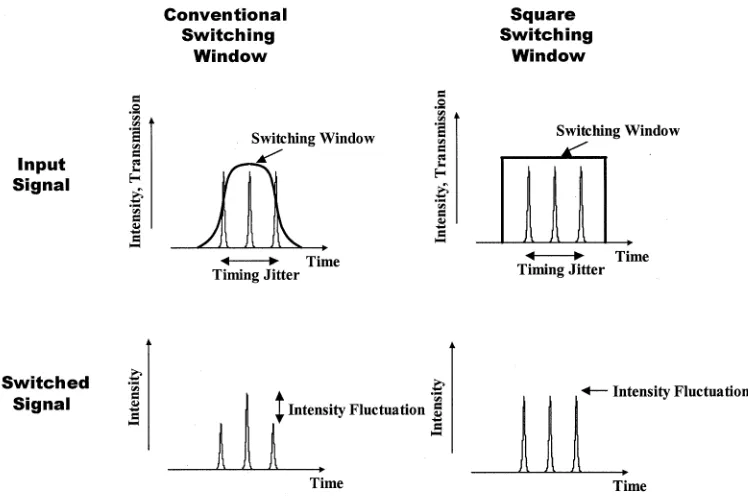
temporal bit alignment and allows for optimal resilience to timing jitter-induced errors. Fig. 1 shows a comparison of the operation of an optical switch with a conventional switching window (assumed to approximate to a Gaussian) and a switch with a rectangular shape switching window. Conventional optical switches are seen to generate a large intensity variation of the output signals as the relative timing drifts between the input and clock signals due to the window shape, which then result in a significant system power penalty. However, flat-top rectangular switching window enables us to operate the switching system with considerable tolerance to relative timing difference over relatively wide timing drift ranges. This provides increased resilience to timing jitter.
To this end a fiber based nonlinear optical loop mirror (NOLM) demultiplexing scheme that provides good ultrafast performance and tolerance to timing-jitter of either, or both, of the control and data signals has been demonstrated previously [4], [5]. These schemes use the difference in group velocity and the resultant walk-off between the control and data sig-nals within the nonlinear medium to define the rectangular switching window. This consequently requires tight specifica-tion and control of both the data and signal wavelengths, and the dispersion characteristics of the fiber despite relatively ease of implementation. Whilst this approach is applicable to fiber based switches it cannot be applied to switches based on highly nonlinear semiconductors and within which there are no appre-ciable dispersive propagation effects over the length scales of relevance. We have demonstrated a simple and robust method to generate a rectangular switching window within nonlinear optical devices based on pulse-shaping superstructured fiber Bragg gratings (SSFBG) [6]. In our first demonstration of this approach, 2.5 ps soliton control pulses were converted into 20 ps wide rectangular pulses through fiber Bragg gratings and then applied to optical switches based on either optical fiber or a semiconductor optical amplifier (SOA). Rectangular switching windows with error-free jitter tolerance were readily achieved. Recently, Schubert et al. demonstrated a pulse shaper based on both a HiBi fiber and a polarization beam splitter which can be used to obtain a rectangular switching window [7]. However, the polarization sensitivity of this approach could be a practical limiting issue for its application within real systems.
Fig. 1. Comparison of functionality between conventional switching window and rectangular shape switching window.
In this paper, we go on to demonstrate the use of SSFBG based rectangular pulse switching technology for data demul-tiplexing at a data rate of 80 Gb/s in a high-speed OTDM system. We convert 1.7 ps transform-limited soliton pulses from a harmonically mode-locked erbium fiber ring laser into 10 ps rectangular pulses using a polarization-insensitive pulse-shaping SSFBG. These pulses are then used to control a high-speed optical demultiplexer based on a NOLM. High-per-formance error-free demultiplexing operation with
timing jitter tolerance was achieved with 1 dB power penalty relative to the 10 Gb/s base rate back-to-back measurement. A 2-dB power-penalty improvement was also achieved with respect to data demultiplexing without the SSFBG.
II. PULSE-SHAPING SUPERSTRUCTURED FIBER
BRAGGGRATINGS
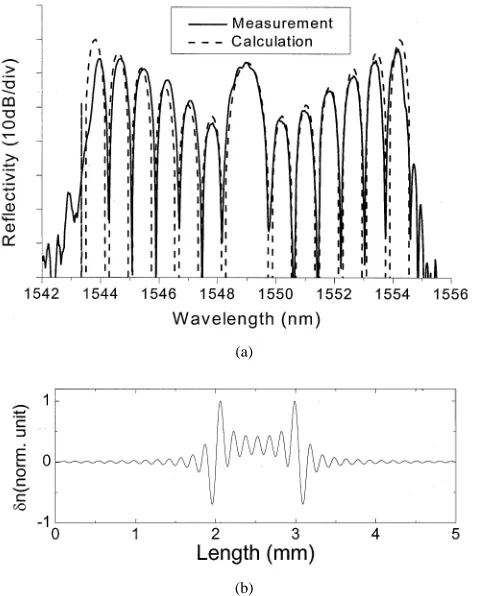
Since our SSFBG based pulse-shaping technique is a purely passive-filtering process, we require a well-defined input pulse form to filter and thereby reshape. For this experiment we used soliton pulses generated from a harmonically mode-locked erbium-doped fiber ring laser. The grating was designed and fabricated with the correct phase and amplitude reflectivity profile to convert the input 1.7 ps transform-limited soliton pulses into 10-ps rectangular pulses [8]. The refractive index modulation profile and the corresponding spectral response of the SSFBG are shown in Fig. 2. We accommodated 13 spectral lobes within the available 12 nm spectral bandwidth and apodized the output spectrum using a Gaussian profile to reduce temporal shape distortion (Gibbs phenomenon) due to the spectral truncation. The length of the grating was 5.1 mm, corresponding to in the time domain. Note the high ( ) spatial superstructure resolution required of the grating writing process as shown in Fig. 2(b). The fiber Bragg
grating based pulse-shaping technology generally requires a well-defined input pulse with an appropriate spectral shape. Although highly accurate alignment of the center wavelengths between the grating and the input pulse is essential to gen-erate the desired rectangular pulses in our experiment, the unique characteristics of our pulse-shaping grating such as wavelength stability and polarization insensitivity allow us to reliably generate high-quality rectangular pulses. The mea-sured optical spectrum of the pulses from the SSFBG is shown Fig. 3(a) together with that of the theoretically calculated single rectangular pulse. Excellent agreement between theory and experiment is obtained highlighting the quality of our grating writing process. We next characterized the rectangular pulses using a SHG autocorrelator ( ). The mea-sured and theoretically calculated triangular autocorrelation traces are shown in Fig. 3(b) and high-quality rectangular pulses with a 10-ps temporal width are clearly evident (see the inset of Fig. 3(b), where we show the calculated temporal shape of the rectangular pulses).
III. EXPERIMENTALSETUP FOR80-Gb/s OTDM DATADEMULTIPLEXING
2520 JOURNAL OF LIGHTWAVE TECHNOLOGY, VOL. 21, NO. 11, NOVEMBER 2003
(a)
[image:3.612.305.552.61.446.2](b)
Fig. 2. (a) The spectral reflectivity profile of the pulse-shaping SSFBG converting 1.7 ps soliton pulses into 10 ps rectangular pulses. (b) The corresponding refractive index modulation profile of the SSFBG.
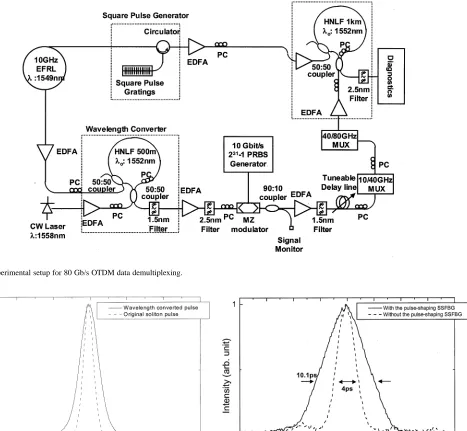
500-m long highly nonlinear fiber (HNLF) with a nonlinearity coefficient and a zero-dispersion wavelength . The output from a continuous wave (CW) external cavity feedback laser at an operating wavelength of 1558 nm was used as a probe signal for the wavelength converter. By appropriately setting the polarization of the light within the NOLM and filtering out the 1549 nm control pulses at the output port, we were able to generate a 10 GHz train of high-quality 3.3 ps pulses at 1558 nm. The measured autocorrelation traces of the wavelength-converted pulses and the original soliton pulses are shown in Fig. 5. Stable and synchronized data pulses were readily achieved using the HNLF-based NOLM. These wavelength converted pulses were modulated to provide a pseudorandom data sequence at 10 Gb/s using a high-speed modulator. The 10-Gb/s pseudorandom data stream was multiplexed upto an aggregate bit rate of 80 Gb/s using a two-stage passive multiplexer (MUX) and subsequently sent into the data port of the 80-Gb/s demultiplexer.
The high-speed data demultiplexer we used in this experiment was also based on NOLM using a 1-km length of the HNLF [10]. In order to properly demultiplex 3.3 ps data pulses without any additional power penalty, the NOLM was designed to generate a minimum FWHM switching window for the 1.7 ps soliton control pulse. This was achieved by careful selection of clock and data wavelength relative to zero-dispersion wave-length of the fiber in order to use the walk-off effect between the control and data pulses inside the NOLM. The 1558-nm 80 Gb/s data stream incident to the demultiplexer was passed through a
(a)
(b)
Fig. 3. (a) Optical spectrum of the rectangular pulses from the SSFBG described in Fig. 1. (b) SHG autocorrelation traces of the rectangular pulse; Inset: Theoretically calculated temporal shape of the rectangular pulse.
tuneable optical delay line to allow us to adjust the arrival time of the data pulses relative to the 1549-nm rectangular control pulses.
We performed switching window measurements by launching a CW probe signal into the data port of the demul-tiplexer and measuring the temporal width of autocorrelation traces. As shown in Fig. 6 a good switching window character-istic with a FWHM triangular trace was obtained using the rectangular control pulses, in contrast to a value of when driving the demultiplexer directly with pulses from the EFRL. These results show that we can expect a maximum10 ps timing jitter tolerance by using the rectangular control pulses.
[image:3.612.47.286.68.366.2]Fig. 4. Experimental setup for 80 Gb/s OTDM data demultiplexing.
Fig. 5. The measured autocorrelation traces of the wavelength-converted pulses and the original soliton pulses.
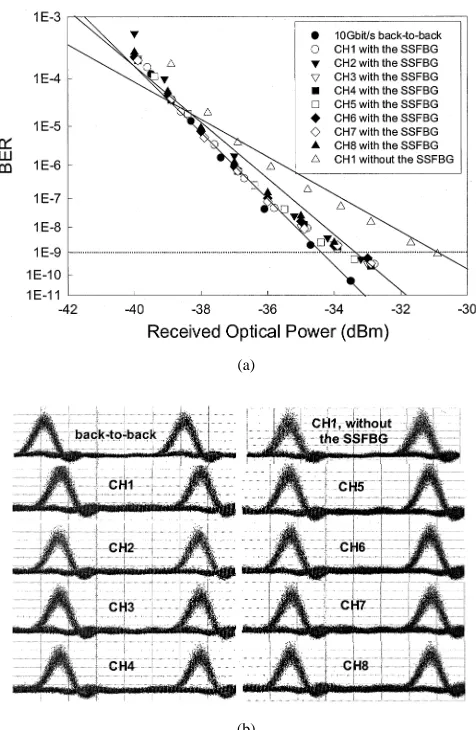
A 2-dB power-penalty improvement was also achieved with respect to data demultiplexing without the SSFBG. We at-tribute this penalty improvement to the enhanced tolerance to - timing drift inherent to our experimental setup caused by environmental temperature/air flow variations during this particular experiment. The corresponding eye diagrams are shown in Fig. 7(b). Both intensity noise and timing jitter are clearly evident in the eyes of channel number 1 using soliton control pulses without the pulse-shaping SSFBG compared to those of all eight channles under rectangular control pulses. Next, we measured the BER at a fixed received optical power of as a function of relative timing mismatches between control and data pulses and the results are shown in Fig. 8. Error-free performance was readily achieved
Fig. 6. The autocorrelation traces of the switching windows measured by launching a CW probe signal into the data port of the demultiplexer.
over a timing mismatch range for the rectangular pulse driven demultiplexer versus a range for the demultiplexer driven directly with the soliton pulses.
IV. CONCLUSION
[image:4.612.79.546.80.511.2]2522 JOURNAL OF LIGHTWAVE TECHNOLOGY, VOL. 21, NO. 11, NOVEMBER 2003
(a)
[image:5.612.46.284.64.429.2](b)
Fig. 7. (a) BER and (b) eye diagrams at032 dBm, on the 80 to 10 Gb/s demultiplexed signals as a function of received optical power under optimal time synchronization between control and data pulses.
Fig. 8. The BER measured at a fixed received optical power of031 dBm as a function of relative timing mismatch between control and data pulses.
can obtain significant OTDM demultiplexer performance enhancements simply by adding a SSBFG to the system. This
approach could be applied to 160 Gb/s OTDM systems since state-of-the art SSFBG technology should be capable of pro-ducing high-quality gratings capable of generating rectangular pulses with rise/fall time less than 1 ps.
ACKNOWLEDGMENT
The authors would like to thank OFS Denmark for providing the highly nonlinear fiber.
REFERENCES
[1] M. Nakazawa, “Tb/s OTDM technology,” in Proc. 27th Europ. Conf. Opt. Commun. (ECOC’2001), 2001, Tu.L.2.3, pp. 184–187.
[2] M. C. Gross, M. Hanna, K. M. Patel, and S. E. Ralph, “Reduction of power fluctuations in ultrafast optically time-division-multiplexed pulse trains by use of a nonlinear amplifying loop mirror,” IEEE Photon. Technol. Lett., vol. 14, pp. 690–692, 2002.
[3] K. Uchiyama and T. Morioka, “All-optical signal processing for 160 Gbit/s channel OTDM/WDM systems,” in Proc. Opt. Fiber Commun. Conf. (OFC’2001), 2001, ThH2.
[4] M. Jinno, “Effects of crosstalk and timing jitter on all-optical time-division demultiplexing using a nonlinear fiber Sagnac interferometer switch,” IEEE J. Quantum Electron., vol. 30, pp. 194–202, 1994. [5] N. A. Whitaker Jr., H. Avramopoulos, P. M. W. French, M. C. Gabriel, R. E. LaMarche, D. J. Di Giovanni, and H. M. Presby, “All-optical arbitrary demultiplexing at 2.5 Gbit/s with tolerance to timing jitter,” Opt. Lett., vol. 16, pp. 1838–1840, 1991.
[6] J. H. Lee, P. C. Teh, P. Petropoulos, M. Ibsen, and D. J. Richardson, “All-optical modulation and demultiplexing systems with significant timing jitter tolerance through incorporation of pulse-shaping fiber Bragg gratings,” IEEE Photon. Technol. Lett., vol. 14, pp. 203–205, 2002.
[7] C. Schubert, R. Ludwig, S. Watanabe, F. Futami, S. Ferber, J. Berger, C. Schmidt, and H. G. Weber, “Improved performance of a 160 Gbit/s fiber based all-optical switch using rectangular gating pulses,” in Proc. Europ. Conf. Opt. Commun. (ECOC’2002), 2002, P.8.3.7.
[8] P. Petropoulos, M. Ibsen, A. D. Ellis, and D. J. Richardson, “Rectangular pulse generation based on pulse reshaping using a superstructured fiber Bragg grating,” J. Lightwave Technol., vol. 19, pp. 746–752, 2001. [9] J. Yu, Y. Qian, P. Jeppesen, and S. N. Knudsen, “Broad-band and
pulsewidth-maintained wavelength conversion based on a high-nonlin-earity DSF nonlinear optical loop mirror,” IEEE Photon. Technol. Lett., vol. 13, pp. 344–346, 2001.
[10] K. J. Blow, N. J. Doran, and B. P. Nelson, “Demonstration of the non-linear fiber loop mirror as a ultrafast all-optical demultiplexer,” Electron. Lett., vol. 26, pp. 962–964, 1990.
Ju Han Lee received the B.S. degree in 1995 and
the M.S. degree in 1998, both in electronics engi-neering, from Seoul National University, Republic of Korea. He received the Ph.D. degree from the Op-toelectronics Research Centre (ORC), University of Southampton, United Kingdom, in 2003.
From 1999 to 2000, he was with Korea Venture Creative Investment (KVCi) Inc. as an analyst, where he was involved in analysis and investment on telecommunication technology. He joined the ORC in May 2000 and was a visiting researcher with the COM Center at Technical University of Denmark, from July 2002 to September 2002. His research interest includes optical fiber amplifiers (EDFA, Raman amp.), nonlinear all-optical switching, optical code division multiplexing (OCDM) systems, optical time division multiplexing (OTDM) systems, holey fiber, and nonlinear fiber optics. He is an author or coauthor of more than 50 journal and conference technical papers.
[image:5.612.49.285.509.677.2]Leif Katsuo Oxenløwe received the Bachelor’s
degree in physics and astronomy from the Niels Bohr Institute, University of Copenhagen, Denmark, in 1992. He received International Diploma of Imperial College, Imperial College of Science, Technology and Medicine, London, U.K., and the Master of Science degree from the University of Copenhagen in March 1998. He received the Ph.D. degree in March 2002 from the COM – Education and Research Center, Technical University of Denmark, working within the framework of the Statens Teknisk-Videnskabelige Forskningsråd (STVF) financed project Semiconductor COmponents for Optical signal Processing (SCOOP). The project involved system characterizations of newly developed devices for optical communications.
Morten Ibsen was born in Copenhagen, Denmark. He was educated in the areas
of physics, mathematics, and optical communications at the Institute of Physics and Astronomy, University of Aarhus, Denmark; the Optical Fiber Technology Centre, University of Sydney, Sydney, Australia; and the Optoelectronics Re-search Centre (ORC), University of Southampton, Southampton, U.K.
His research interests include specialized Bragg grating formation, nonlinear effects in Bragg gratings, devices using Bragg gratings, and application of these in telecommunications systems together with techniques for dispersion compen-sation in optical fibers. In these areas, he has received 12 patents and published more than 200 journal and conference papers. Currently, he leads a group for Bragg gratings research within the ORC.
Mr. Ibsen is a Member of the Optical Society of America (OSA) and the Institute of Electrical Engineering (IEE), U.K.
Kim Skaalum Berg received the M.Sc. degree in
electrical engineering in 2001 from the Technical University of Denmark (DTU).
Currently he is a Research Assistant in the Sys-tems Competence Area, Research Center COM — Education and Research Center, DTU. His research activities include high-speed optical time-division multiplexed systems in terms of pulse compres-sion, all-optical techniques for demultiplexing, and regeneration.
Anders T. Clausen received the M.Sc. degree from
Technical University of Denmark (DTU) in 1997. In the following three years, he was a Research Associate with Research Center COM — Education and Research Center, DTU, working specifically on the ACTS projects HIGHWAY, REPEAT, and ME-TEOR. Presently, he is participating in the European IST project TOPRATE. He is also pursuing the Ph.D. degree, focusing on techniques for ultrahigh-bit-rate OTDM systems.
David J. Richardson was born in Southampton, U.K., in 1964. He received
the B.Sc. and Ph.D. degrees from Sussex University, U.K., in 1985 and 1989, respectively.
He is currently Deputy Director of the Optoelectronics Research Centre, Uni-versity of Southampton. His current research interests include amongst others: holey fibers, high-power fiber lasers, short pulse lasers, optical fiber communi-cations, all-optical processing and switching, nonlinear optics, and the physics and applications of microstructured nonlinear/linear media. He has published more than 250 conference and journal papers in his 12 years at ORC, and pro-duced over 15 patents.
Palle Jeppesen received the M.Sc. degree in
elec-trical engineering in 1967, the Ph.D. degree in 1970, and the Dr.Sc. degree in 1978, all from the Depart-ment of Electromagnetic Systems (EMI), Technical University of Denmark (DTU).