Building a Flexible, Adaptable and
High Performance Culture
A Competency
Framework
for Managing
Change through
Partnership
Acknowledgements
The development of this competency framework for managing change through required extensive research and consultation. The data-gathering phase of the research utilised techniques that align with best practice in the field of job analysis. It comprised a review of literature and in-depth consultative inter-views involving a representative sample of individuals across public and private sector organisations.
The National Centre for Partnership and Performance wishes to acknowledge the contribution of the follow-ing in the development of this competency framework:
— individuals in public and private sector organisa-tions who participated in the interviews and focus groups and those who completed and returned validation questionnaires.
— the Western Health Board for giving the Centre permission to use the WHB competency framework for Change Facilitators as a basis from which to develop this framework for managing change through partnership.
— the support of Pearn Kandola, Occupational Psychologists who provided consultancy, training and quality assurance throughout the project.
Contents
1
A Competency Framework
for Managing Change through
Partnership
2
A Tool for Managing Change
through Partnership
2
Potential Benefits for Organisations
3
Competencies and Competency
Frameworks Defined
4
The Competency Framework for
Managing Change through
Partnership
6
Using the Framework as
a Tool for Managing Change
through Partnership
8
The Competency Framework in Action:
Some Practical Examples
12
Appendix
Acknowledgements
List of Publications
The National Centre for Partnership and Performance was
established by the Government in June 2001 to support and
facilitate change through partnership in the Irish workplace.
The Centre’s mission is to:
p
Support and facilitate Irish organisations in the private
and public sectors, to respond to change and to build
capability through partnership
p
Bring about improved performance and mutual gains
p
Contribute to national competitiveness, better public services,
higher living standards and a better quality of work life
In an environment of shifting economic circum-stances, organisations are striving to achieve the ability, flexibility and capacity to manage change in a way that maintains profitability and perform-ance, and protects competitiveness. Public sector organisations are also striving to respond to the challenges of supporting national competitive-ness and the demands of users for services of higher quality and greater accessibility. Increased globalisation, the rapid pace of change, and the requirement for organisations to foster creativity and innovation has highlighted the role of human resources as an enduring source of improved organisational capacity and competitive advantage.
Evidence is emerging that a partnership approach to managing change, characterised by involving and empowering employees, is an effective way to develop organisational flexibility and adaptability. Effective partnership approaches focus the efforts of everyone in the organisation on adaptability and flexibility, leading to improved performance and mutual gains. It helps people to develop their creativity and resourcefulness and creates
opportunities for staff involvement in decision-making. Partnership also increases employee awareness of the consequences of business decisions, and ensures that change and improved performance lead to mutual gains.1
Organisations seeking to manage change through partnership are often concerned that they attract, develop, and retain employees who will adapt to a flexible and participative organisational culture. To achieve this they need HR policies which result in having the right people, in the right roles, in the right numbers and at the right time. It is important for organisations to appoint, retain, train, motivate and promote individuals who make the most valid contribution; not only in the results they achieve, but also in terms of the way they work.
The extent to which an organisation has the ability to meet its strategic objectives is directly related to the competencies displayed by its employees. Competencies are generally defined as the knowledge, skills, behaviour and personal attributes that are necessary to produce effective performance in a certain role or task.
A competency framework is the term applied to a complete collection of competencies and behavioural indicators. The Centre has developed this competency framework to support organisa-tions undertaking a partnership approach to change. The competency definitions and behav-ioural indicators contained in the competency framework are drawn from the experience and knowledge of individuals in private and public sector organisations. The framework comprises a comprehensive set of skills and behaviours exhibited by employees and management when organisations achieve high performance through partnership.
This competency framework for managing change through partnership is intended to be one of a series of tools for organisations dealing with change issues, and is specifically targeted at organisations that wish to improve performance using a participative approach to change.
Organisations seeking to manage change, resulting in high performance, will find the com-petency framework a useful tool for improving a broad range of processes such as team working and joint problem solving, which are important dimensions of a partnership approach to change. The framework can also add value to organisation-al processes such as recruitment and selection, training and development, career development, performance management, and reward systems.
The promotion of the competencies contained in this framework as a core set of skills for all members of the organisation provides a clear statement of the skills and behaviours that individuals should display to undertake roles that will support change and high performance.
The framework can help to develop a core skill set that will assist employees to achieve organisation goals, using a partnership approach.
Continuous promotion and integration of the framework will provide individuals with clear and consistent messages about what behaviour and performance is expected and rewarded. In the longer term, this approach has the potential to impact and influence the culture of an organisation that will be characterised by a partnership approach
A Tool for Managing Change
through Partnership
Adapting and utilising this framework as a tool across a broad set of organisational activities and functions, will:
pthrough the use of a common and consistent
language, support organisations to develop a shared understandingof the potential of a collaborative approach to managing change, which will in turn lead to the alignment of business objectives with existing processes, resulting in improved performance and organi-sational capacity.
pfacilitate individualsand teams, who develop
the competence set outlined in the framework,
to be more effective when engaging in partner-ship approaches to change.They will be clear about what is expected of them and what the organisation values and rewards.
pprovide a useful benchmark for deciding the content and structure of training and development programmesthroughout the organisation.
pstrengthen organisational joint problem-solving, change facilitation and formal partnership activitiesby making them more transparent and inclusive.
pfacilitate the integration and mainstreaming of partnershipapproaches across all business processes so that an inclusive approach to managing change will become the norm.
psupport organisations to achieve competitive advantageby differentiating from other organi-sations not only on the basis of technical and/or knowledge competencies but also on the basis of their enhanced strategic capacity and superior performance in managing change and achieving successful outcomes through partnership.
psupport an organisation culture which recog-nises partnershipas the way we do thingsas opposed to something we do.
How are Competency
Frameworks Useful?
Competency frameworks are more thorough than the traditional job specification that provides information on the knowledge, skills and ability required for a particular role. More importantly they provide:
1. a statement of the behaviours that are expected, valued and rewarded in the workplace – individuals will be more likely to achieve high performance by having a clear understanding of the behaviour and approach that is expected of them.
2. a framework for integrating Human Resource Development processes such as selection, training and development, coaching and mentoring, succession planning, monitoring and evaluation of approaches to managing change.
3. a common and consistent language for discussing performance and potential at individual, group and organisational levels.
4. a means of matching people to work requirements and career opportunities.
Competencies and Competency Frameworks Defined
What is a Competency?
A competency is generally defined as the knowledge, skills, behaviour, qualities, and personal attributes necessary to produce effective performance in a certain role or task.
A competency comprises a definition, which is a statement outlining the under-lying principles of the role/task, and a set of behavioural indicators, which outline the skills and behaviours necessary to undertake the role/task effectively.
What is a Competency Framework?
A competency framework is the term applied to a complete collection of compe-tencies and behavioural indicators. They usually contain very detailed behavioural indicators related to specific roles and responsibilities. Competency frameworks usually take one of two forms:1. a customised, role-specific competency frameworkthat contains very detailed behavioural indicators related to specific roles and responsibilities.
The Competency Framework
for Managing Change through
Partnership
The framework provides a set of skills and behaviours that have been identified as necessary to engage in change through partnership. It comprises a set of ten competency definitions as outlined in Table 1. Each definition has an accompanying set of behavioural indicators which are detailed in the competency cards included in this pack.
The framework is a common or core competency frameworki.e., it is made up of the competencies that are appropriate to all roles and responsibili-ties across an entire organisation e.g., employees, managers, staff representatives, team members and team leaders.
Organisational and Business Awareness
definition
Maintains an evolving
under-standing of the organisation’s internal
and external environment. Builds the
case for partnership. Has an awareness
of the expectations and perspectives of
other stakeholders. Positions partnership
within organisational strategy, goals
and procedures.
Leadership
definition
Acts in the best interest of the
organisation, and its people, at all times.
Acts as a role model for an inclusive
approach to delivering change. Motivates
and encourages others to take ownership
of the change process. Develops and
drives a shared vision of the
organisa-tion’s future.
Championing Change through
Partnership
definition
Promotes the principles of
part-nership and its value as an approach to
managing change. Identifies and engages
partnership influencers and champions.
Develops individuals and groups and
empowers them to engage with change
issues through partnership.
Overcoming Barriers to Change
definition
Committed to facilitating
change through partnership. Is aware
of the internal and external factors
impacting on the success of the change
proposals. Reduces barriers to change
by building trust between people. Works
to overcome obstacles.
Table 1
Communication
definition
Ensures that partnership
issues, activities and their outcomes are
communicated to and understood by all.
Understands and meets the information
needs of different audiences. Listens
and responds appropriately in formal
and informal settings. Shares relevant
information with key stakeholders at
an early stage.
Building and Maintaining Relationships
definition
Develops and maintains good
working relationships across all levels of
the organisation. Uses formal and informal
networking to build trust between
stake-holders. Manages the different perceptions
of individuals and groups constructively.
Facilitates deliberation and consensus.
Ensures everyone involved in the change
process feels valued.
Influencing
definition
Demonstrates trustworthiness,
credibility and conviction in all activities.
Presents a clear and convincing case for
managing change through partnership.
Seeks and empathises with other points
of view. Uses appropriate communication
styles to secure consensus between
stakeholders.
Data Analysis and Innovative Thinking
definition
Engages in data and intelligence
gathering and analysis. Adopts an
improvement orientation approach to
partnership-centred activities. Recognises
and supports good ideas and innovative
approaches.
Problem Solving and Decision Making
definition
Anticipates and solves problems
using a consensus based approach.
Acknowledges the importance of building
shared understanding and objectives.
Identifies and implements creative
solutions in a group setting and engages
in consultative decision making.
Achievement Orientation
definition
Demonstrates commitment to
Using the Framework as a
Tool for Managing Change
through Partnership
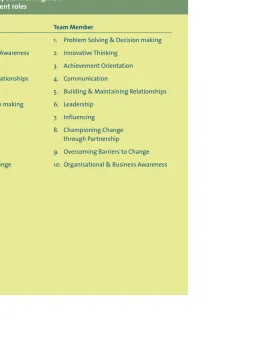
The framework provides a flexible tool that is adaptable across different roles and levels within an organisation. In other words, the competencies may be tailored to suit different roles and levels of responsibility. Some of the individual competencies and behavioural indicators may be of higher or lower importance depending on individual roles, tasks and responsibilities.
For example, if an organisation decides to introduce team working, it will be important to facilitate improved innovation and creativity, and for all members of the team to have a certain level of leadership qualities. However, this compe-tency may be ranked at a higher level for team leaders (see Table 2).
Team Leader
1. Leadership
2. Organisational & Business Awareness
3. Communication
4. Building & Maintaining Relationships
5. Influencing
6. Problem Solving & Decision making
7. Innovative Thinking
8. Achievement Orientation
9. Championing Change through Partnership
10. Overcoming Barriers to Change
Team Member
1. Problem Solving & Decision making
2. Innovative Thinking
3. Achievement Orientation
4. Communication
5. Building & Maintaining Relationships
6. Leadership
7. Influencing
8. Championing Change through Partnership
9. Overcoming Barriers to Change
[image:8.595.325.729.66.504.2]10. Organisational & Business Awareness
Table 2
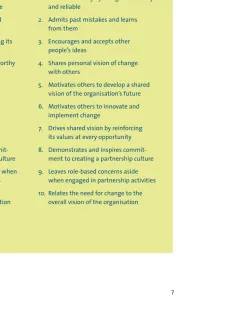
The behavioural indicators may also be prioritised differently depending on the specific roles and responsibilities of the team and team leader (see Table 3). Similarly, the communication competence may be applied to all roles within organisations. But it may be prioritised over some of the other competencies for team leaders, HR managers or staff representatives who are responsible for gathering support and driving change initiatives.
Team Leader
1. Motivates others to develop a shared vision of the organisation’s future
2. Motivates others to innovate and implement change
3. Drives shared vision by reinforcing its values at every opportunity
4. Builds credibility by being trustworthy and reliable
5. Admits past mistakes and learns from them
6. Shares personal vision of change with others
7. Encourages and accepts other people’s ideas
8. Demonstrates and inspires commit-ment to creating a partnership culture
9. Leaves role-based concerns aside when engaged in partnership activities
10. Relates the need for change to the overall vision of the organisation
Team Member
1. Builds credibility by being trustworthy and reliable
2. Admits past mistakes and learns from them
3. Encourages and accepts other people’s ideas
4. Shares personal vision of change with others
5. Motivates others to develop a shared vision of the organisation’s future
6. Motivates others to innovate and implement change
7. Drives shared vision by reinforcing its values at every opportunity
8. Demonstrates and inspires commit-ment to creating a partnership culture
9. Leaves role-based concerns aside when engaged in partnership activities
[image:9.595.362.756.108.472.2]10. Relates the need for change to the overall vision of the organisation
Table 3
1
The competency framework can be used as a tool
in recruitment and selection decisions
An organisation was recruiting a new employee whose
responsibility it would be to implement a new approach to
delivering customer service provision. In order to assess one
of the key competencies,
overcoming barriers to change
,
candidates were asked to make a brief presentation outlining
their views on what issues might arise that would prevent
planned changes from happening, and to identify their
approach to managing these issues.
The selection panel short listed two candidates and were
having difficulty trying to choose between them. One of the
panel members had a strong “gut feeling” about candidate A.
However, when the panel assessed the evidence provided
during the presentations against the
overcoming barriers
to change
behavioural indicators, it became obvious that
candidate B scored strongest on this competency. This
enabled the selection panel to come to an objective decision
as to who had the right skills for the role.
The Competency Framework in Action:
Some Practical Examples
The potential of the framework is more easily
understood when it is applied to every day situations.
The following are examples of how the framework
may be used by organisations, individuals and groups
to acquire and develop skills for managing change
2
The competency framework can be used to focus
personal training and development programmes
The nature of Mary’s work does not provide her with many
opportunities to communicate with people at different levels
in her organisation. She expresses an interest in becoming
a member of the strategy committee in her organisation
and discovers that
communication
is one of the key
compe-tencies for the role.
Mary is aware that there is an effective communications
course being made available to employees and informs her
HR manager of her keen interest in doing the course. She also
becomes involved in her organisation’s Health and Safety
committee and uses the opportunity to get to know more
people within the organisation and to develop her verbal and
written communication skills – often chairing meetings and
designing the committee’s monthly newsletter.
When the opportunity arises for Mary to put herself
forward as a member of the strategy committee, she will
have practical examples of her written and verbal
communi-cation skills and evidence of her participation on a formal
training course.
3
The competency framework can be used to highlight
team development needs
A partnership committee gets together to look at strengths
and areas for development within the team (as opposed to
the individual). The committee has arranged a session based
on the competency framework for managing change
through partnership. They examine each competency and
brainstorm their strengths and development needs around
each one. During the session it becomes evident that as a
group they are good at task-oriented competencies but lack a
good influencer.
As a result of the session, the committee arranges to
attend a training and development day that will include
a strong emphasis on the development of negotiation
4
The competency framework can be used to guide
individual feedback and development
During his annual review Tom, who is a team leader,
identi-fies his development needs in three competency areas —
Data Analysis and Innovative Thinking
;
Problem Solving
and Decision Making
; and
Building and Maintaining
Relationships
. He is requested to develop an action plan
that will address his developmental needs in these areas.
To make sure that his plan really meets his needs, Tom puts
together a short questionnaire based on the behavioural
indicators for the three competency areas and invites his
team members to complete the questionnaire.
The questionnaire responses and feedback enable him to
devise his own development and training needs and to put in
place an action plan that he will discuss and agree with his
manager. The action plan includes proposals to:
— attend a training course entitled
How to Network Successfully
.
— shadow one of his colleagues who has a reputation
for effective problem solving and coming up with
innovative solutions.
— arrange his work so that he has more time to locate,
read and analyse relevant information that will help
5
The competency framework can be used
to provide clarity of direction
Sheila and Michael have been working together for three
months on a partnership strategy committee. Sheila is a
team leader and Michael is a project executive. As part of a
team building exercise, they have been asked to prioritise the
three most important competencies for their own and each
other’s role. The following table shows the result:
Looking at the competency behavioural indicators, Sheila
was surprised to learn that Michael thought her style
of working was a little too independent. He described how
Sheila often made decisions with insufficient input from
Michael and the team.
Michael was surprised to learn that Sheila often felt that she
was the only person on the team who understood the bigger
picture properly. That was why she ranked
Organisational
and Business Awareness
so highly, and may be why she often
made decisions independently.
This competency-based team building exercise also helped
them to see why they also disagreed on the priority
compe-tencies for Michael’s role.
Sheila’s view of her priorities in her role as team leader
1. Leadership
2. Organisational & Business Awareness
3. Achievement Orientation
Michael’s view of Sheila’s priorities in her role as team leader
1. Problem Solving and Decision Making
2. Building and Maintaining Relationships
3. Leadership
Michael’s view of his priorities in his role of project executive
1. Communication
2. Building and Maintaining Relationships
3. Data Analysis & Innovative Thinking
Sheila’s view of Michael’s priorities in his role of project executive
1. Data Analysis & Innovative Thinking
2. Organisational & Business Awareness
The information gathered via the literature review and one-to-one interviews was recorded and analysed by the Centre’s project team. Ten broad competency definitions and accompa-nying behavioural indicators were drafted. These formed the basis for the next phase of the research that comprised validation focus groups and a postal questionnaire.
The Centre invited thirty people to meet and discuss the draft competency framework. They were divided into two groups representing the public and private sectors. The focus groups discussed the competencies and behavioural indi-cators and provided useful and relevant feedback. This feedback was synthesised and analysed by members of the project team who later adjusted the framework based on the level of consensus that existed within the groups.
A validation postal questionnaire was sent to 250 individuals representing 50 per cent of the Centre’s database. Seventy-three completed ques-tionnaires were returned representing a 28 per cent response rate. The results of the
questionnaire were very similar to the feedback trends that emerged from the focus group.
The results of both the focus groups and the ques-tionnaire were amalgamated into the final version of the competency framework.
National Centre for Partnership and Performance Publications
Building a Coalition for Change – Implementing the Health Strategy using a Partnership Approach
Partnership Guidance for the Unionised Commercial Sector – Working Together for hange and a Modern Workplace
Modernising our Workplaces for the Future – A Strategy for Change and Innovation 2002–2005
Strategic Planning Discussion Document and Executive Summary
Update Newsletter Issue 2
Update Newsletter Issue
Appendix
Methodology and Approach to the
Development of the Framework
A combination of secondary and primary research methods was used for the development of this competency framework. The extensive data-gathering phase of the research utilised techniques that align with best practice in the field of job analysis. It comprised a review of relevant literature and in-depth one-to-one interviews involving a representative sample of individuals across public and private sector organisations including:
pPartnership Committee Joint Chairpersons
pPartnership Committee Members
pPartnership Committee Co-ordinators
and Facilitators
pHR Specialists and Trainers
Acknowledgements
The development of this competency framework for managing change through partnership required extensive research and consultation. The data-gathering phase of the research utilised techniques that align with best practice in the field of job analysis. It comprised a review of literature and in-depth consultative interviews involving a representative sample of individuals across public and private sector organisations.
The National Centre for Partnership and
Performance wishes to acknowledge the contribu-tion of the following in the development of this competency framework:
— individuals in public and private sector organisa-tions who participated in the interviews and focus groups and those who completed and returned validation questionnaires.
— the Western Health Board for giving the Centre permission to use the WHB competency framework for Change Facilitators as a basis from which to develop this framework for managing change through partnership.
National Centre for Partnership and Performance
16 Parnell Square Dublin 1, Ireland
Organisational and Business Awareness
Competency
Maintains an evolving
under-standing of the organisation’s
internal and external environment.
Builds the case for partnership.
Has an awareness of the
expectations and perspectives of
other stakeholders. Positions
Definition
p
Is aware of the general business, social and
political environment, both internal and
external, in which the organisation operates
p
Is aware of the organisation’s IR and
ER processes and their relationship with
partnership activities
p
Understands the organisation’s formal
p
Aligns partnership activities with strategy
to achieve organisational fitness and high
business performance
p
Recognises opportunities for different
parts of the organisation to link up
and achieve change through partnership
p
Uses partnership processes to build
A Competency
Framework
for Managing
Change through
Partnership
Organisational and Business Awareness
Leadership
Championing Change through Partnership
Overcoming Barriers to Change
Communication
Building and Maintaining Relationships
Influencing
Data Analysis and Innovative Thinking
Problem Solving and Decision Making
Leadership
Competency
Acts in the best interest of the
organisation, and its people, at all
times. Acts as a role model for an
inclusive approach to delivering
change. Motivates and encourages
others to take ownership of
the change process. Develops
Definition
p
Demonstrates and inspires commitment
to creating a partnership culture
p
Leaves role-based concerns aside when
engaged in partnership activities
p
Builds credibility by being trustworthy
and reliable
p
Encourages others to come forward
with ideas for change
p
Motivates others to develop a shared
vision of the organisation’s future
p
Drives shared vision by reinforcing
its values at every opportunity
A Competency
Framework
for Managing
Change through
Partnership
Organisational and Business Awareness
Leadership
Championing Change through Partnership
Overcoming Barriers to Change
Communication
Building and Maintaining Relationships
Influencing
Data Analysis and Innovative Thinking
Problem Solving and Decision Making
Championing Change through Partnership
Competency
Promotes the principles of
partnership and its value as an
approach to managing change.
Identifies and engages
partner-ship influencers and champions.
Develops individuals and
groups and empowers them
Definition
p
Understands the principles underpinning
workplace partnership and the benefits
of partnership as an approach to change
p
Advocates the concept of managing
change through partnership throughout
the organisation
p
Promotes the organisation’s partnership
activities to key groups
p
Encourages involvement in
partnership activities
p
Seeks out and coaches partnership
champions and activists
p
Maintains momentum by highlighting
successful outcomes of the organisation’s
change process
A Competency
Framework
for Managing
Change through
Partnership
Organisational and Business Awareness
Leadership
Championing Change through Partnership
Overcoming Barriers to Change
Communication
Building and Maintaining Relationships
Influencing
Data Analysis and Innovative Thinking
Problem Solving and Decision Making
Overcoming Barriers to Change
Competency
Committed to facilitating change
through partnership. Is aware of
the internal and external factors
impacting on the success of
the change proposals. Reduces
barriers to change by building
trust between people. Works to
Definition
p
Understands and accepts the need for
organisational change
p
Believes that people are willing to change
p
Maintains a flexible approach when
responding to change issues
p
Determines levels of tolerance for change
in individuals and groups
p
Encourages dialogue, debate and
discussion using facilitation techniques
p
Facilitates change through partnership
with organisational stakeholders
p
Is assertive and self-confident
when discussing change issues
with interest groups
A Competency
Framework
for Managing
Change through
Partnership
Organisational and Business Awareness
Leadership
Championing Change through Partnership
Overcoming Barriers to Change
Communication
Building and Maintaining Relationships
Influencing
Data Analysis and Innovative Thinking
Problem Solving and Decision Making
Communication
Competency
Ensures that partnership issues,
activities and their outcomes
are communicated to and
understood by all. Understands
and meets the information needs
of different audiences. Listens
and responds appropriately in
Definition
p
Understands the issues, activities and
outcomes to be communicated
p
Conveys written and verbal information,
clearly and concisely, using different
organisational communication channels
(e.g. meetings, presentations, email,
intranet, newsletters, notice boards)
p
Circulates relevant information to
stakeholders in a timely manner
p
Invites and encourages people to
contribute their views
p
Responds in a sensitive manner to verbal
and non-verbal communication
A Competency
Framework
for Managing
Change through
Partnership
Organisational and Business Awareness
Leadership
Championing Change through Partnership
Overcoming Barriers to Change
Communication
Building and Maintaining Relationships
Influencing
Data analysis and Innovative Thinking
Problem Solving and Decision Making
Building and Maintaining Relationships
Competency
Develops and maintains good
working relationships across all
levels of the organisation. Uses
formal and informal networking
to build trust between
stake-holders. Manages the different
perceptions of individuals and
Definition
p
Builds and maintains trust by being
consistent in word and action
p
Listens to and empathises with other
peoples’ needs and concerns
p
Does not personalise issues
p
Shares knowledge and experience
p
Organises events to facilitate
relationship-building between individuals and groups
p
Networks within the partnership
community outside the organisation
p
Contributes to the resolution of conflict
between groups and individuals
A Competency
Framework
for Managing
Change through
Partnership
Organisational and Business Awareness
Leadership
Championing Change through Partnership
Overcoming Barriers to Change
Communication
Building and Maintaining Relationships
Influencing
Data Analysis and Innovative Thinking
Problem Solving and Decision Making
Influencing
Competency
Demonstrates trustworthiness,
credibility and conviction in all
activities. Presents a clear and
convincing case for managing
change through partnership.
Seeks and empathises with other
points of view. Uses appropriate
Definition
p
Assigns change issues to appropriate
decision-making fora
p
Presents well reasoned arguments
for change
p
Informs people about what the change
will mean to them
p
Reflects the views of each stakeholder
to ensure shared understanding
p
Uses negotiation and/ or mediation
techniques effectively when necessary
to build consensus
p
Motivates individuals and groups to
constructively reach consensus
A Competency
Framework
for Managing
Change through
Partnership
Organisational and Business Awareness
Leadership
Championing Change through Partnership
Overcoming Barriers to Change
Communication
Building and Maintaining Relationships
Influencing
Data Analysis and Innovative Thinking
Problem Solving and Decision Making
Data Analysis and Innovative Thinking
Competency
Engages in data and intelligence
gathering and analysis. Adopts an
improvement orientation approach
to partnership-centred activities.
Recognises and supports good
ideas and innovative approaches.
Definition
p
Actively seeks out relevant
information sources within and
outside the organisation
p
Demonstrates an ability to use
primary and secondary research tools
(e.g. interviewing, literature reviews,
survey questionnaires)
p
Uses idea generation techniques
(e.g. brainstorming) to develop innovative
approaches and encourage others to
provide ideas for change
p
Establishes Key Performance
Indicators to monitor the outcomes
of partnership activities
A Competency
Framework
for Managing
Change through
Partnership
Organisational and Business Awareness
Leadership
Championing Change through Partnership
Overcoming Barriers to Change
Communication
Building and Maintaining Relationships
Influencing
Data Analysis and Innovative Thinking
Problem Solving and Decision Making
Problem Solving and Decision Making
Competency
Anticipates and solves problems
using a consensus based
approach. Acknowledges the
importance of building shared
understanding and objectives.
Identifies and implements
creative solutions in a group
Definition
p
Keeps in touch with change issues
that may impact on organisational
performance
p
Brings issues and problems to the
attention of the team
p
Builds a shared understanding of issues
under discussion
p
Takes account of the perspectives of
a range of stakeholders before deciding
on a solution
p
Weighs up the costs and benefits
of specific solutions
p
Searches for a win-win solution
for the team
A Competency
Framework
for Managing
Change through
Partnership
Organisational and Business Awareness
Leadership
Championing Change through Partnership
Overcoming Barriers to Change
Communication
Building and Maintaining Relationships
Influencing
Data Analysis and Innovative Thinking
Problem Solving and Decision Making
Achievement Orientation
Competency
Demonstrates commitment to
successfully managing change
through partnership. Perseveres
despite setbacks and sustains
enthusiasm even when situations
become challenging. Meets goals
within deadlines.
Definition
p
Demonstrates enthusiasm for
partnership as the most suitable
approach to change issues
p
Demonstrates patience and persistence
when faced with navigating roadblocks
p
Makes provision for contingency to
overcome blocks and delays
p
Encourages experimentation in
a safe environment
p
Facilitates and seeks to implement
agreed decisions
p
Strives to meet goals and objectives
within agreed deadlines
A Competency
Framework
for Managing
Change through
Partnership
Organisational and Business Awareness
Leadership
Championing Change through Partnership
Overcoming Barriers to Change
Communication
Building and Maintaining Relationships
Influencing
Data Analysis and Innovative Thinking
Problem Solving and Decision Making