FM 100-14
Field Manual Headquarters
No. 100- 14 Department of the Army
Washington, DC, 23 April 1998
Risk Management
Contents
Page Preface. . . ii
Introduction. . . iii Chapter 1 Risk Management Fundamentals . . . 1-1 Background . . . 1-2
Principles. . . 1-3
Applicability . . . 1-4
Constraints . . . 1-7
Chapter 2 Risk Management Process . . . .2-0 The Five Steps: An Overview . . . 2-0
The Five Steps Applied . . . 2-2
Tools and Pitfalls . . . 2-19
Chapter 3 Risk Management Implementation. . . 3-0 Moral and Ethical Implications for Leaders . . . .3-0
Responsibilities . . . 3-1
Integration into Training and Operations . . . 3-7
Assessment of the Risk Management Process. . . 3-9
Appendix Examples of Risk Management Application. . . Appendix-1 Glossary. . . Glossary-0 References. . . References-0 Index. . . Index-1
Preface
FM 100-14 applies across the wide range of Army operations. It explains the principles, procedures, and responsibilities to successfully apply the risk management process to conserve combat power and resources. The manual applies to both Army and civilian personnel during all Army activities, including joint, multinational, and interagency environments.
The manual is intended to help commanders,1 their staffs, leaders,2 and managers develop a framework to make risk management a routine part of planning, preparing, and executing operational missions and everyday tasks. This framework will allow soldiers to operate with maximum initiative, flexibility, and adaptability. Although the manual’s prime focus is the operational Army, the principles of risk management apply to all Army activities. Army operations—especially combat operations—are demanding and complex. They are inherently dangerous, including tough, realistic training. Managing risks related to such operations requires educated judgment and professional competence. The risk management process allows individuals to make informed, conscious decisions to accept risks at acceptable levels.
This manual is not a substitute for thought. Simply reading it will not make one adept in building protection around a mission.3 Soldiers should compare the doctrine herein against their own experience and think about why, when, and how itapplies to their situation and area of responsibility. If the doctrine herein is to be useful, it must become second nature.
The proponent of this manual is HQ TRADOC. Send comments and recommendations on DA Form 2028 directly to Commander, US Army Training and Doctrine Command, ATTN: ATBO-SO, Fort Monroe, VA 23651-5000.
Unless this publication states otherwise, masculine nouns and pronouns do not refer exclusively to men.
1 The term commander as used herein refers to personnel in a command
position.
2 The term leader as used herein refers to commanders, personnel in the
chain of command (team, squad, section, platoon leader), and staff mem-bers having personnel supervisory responsibility.
Introduction
Risk management is not an add-on feature to the decision-making process but rather a fully integrated element of planning and executing operations... Risk management helps us preserve combat power and retain the flexibility for bold and decisive action. Proper risk management is a combat multiplier that we can ill afford to squander.
General Dennis J. Reimer Chief of Staff, Army 27 July 1995
The Army’s fundamental purpose is to fight and win the nation’s wars. For this purpose, the country gives the Army critical resources, including those most valuable—its sons and daughters. The Army uses its resources to generate overwhelming combat power to fight and win quickly, decisively, and with minimal losses. The Army’s inherent responsibility to the nation is to protect and preserve its resources—a responsibility that resides at all levels. Risk management is an effective process for preserving resources. It is not an event. It is both an art and a science. Soldiers use it to identify tactical and accident risks, which they reduce by avoiding, controlling, or eliminating hazards.
The Army introduced the risk management process into training, the operational environments, and materiel acquisition in the late 1980s. Risk management was originally perceived as solely a safety officer function. However, by the early 1990s, the Army established a goal to integrate risk management into all Army processes and activities and into every individual’s behavior, both on and off duty. Since the process was introduced, the personal involvement of commanders in preventing accidents—and their aggressive use of the process—have become driving factors in the steady downward trend in Army accidental losses.
Risk Management
Risk decisions are commanders’ business. Such decisions are normally based on the next higher commander’s guidance on how much risk he is willing to accept and delegate for the mission. Risk decisions should be made at the lowest possible level, except in extreme circumstances. Training operations, including those at combat training centers (CTCs), may be of such intensity that risk decision are retained at a higher level.
Chapter 1
Risk Management Fundamentals
Sizing up opponents to determine victory, assessing dangers and distances is the proper course of action for military leaders.
Sun Tzu, The Art of War, “Terrain”
Risk management is the process of identifying, assessing,
and controlling risks arising from operational factors and making decisions that balance risk costs with mission benefits. Leaders and soldiers at all levels use risk management. It applies to all missions and e n v i ro n m e n t s a c ro s s t h e w i d e r a n g e o f A r m y operations. Risk management is fundamental in developing confident and competent leaders and units. Proficiency in applying risk management is critical to conserving combat power and resources. Commanders must firmly ground current and future leaders in the critical skills of the five-step risk management process.
Risk Management
Army World War II 1942–1945
Korea 1950–1953
Vietnam 1965–1972
Desert Shield/ Storm1 1990–1991
Accidents Friendly Fire Enemy Action
56% 1% 43%
44% 1% 55%
54% 1% 45%
75% 5% 20%
1These numbers include the relatively long buildup time and short
period of combat action
BACKGROUND
Throughout the history of armed conflict, government and military leaders have tried to reckon with the effect of casualties on policy, strategy, and mission accomplishment. Government and military leaders consider battle losses from different perspectives. However, both must balance the following against the value of national objectives:
• Effects of casualties. • Impact on civilians.
• Damage to the environment. • Loss of equipment.
• Level of public reaction.
War is inherently complex, dynamic, and fluid. It is characterized by uncertainty, ambiguity, and friction. Uncertainty results from unknowns or lack of information. Ambiguity is the blurring or fog that makes it difficult to distinguish fact from impression about a situation and the enemy. Friction results from change, operational hazards, fatigue, and fears brought on by danger. These characteristics cloud the operating environment; they create risks that affect an army’s ability to fight and win. In uncertainty, ambiguity, and friction, both danger and opportunity exist. Hence, a leader’s ability to adapt and take risks are key traits. Chapter 2 of FM 100-5 provides information on the challenging circumstances of military operations during conflict.
[image:6.603.39.346.425.534.2]Historically, the Army has had more accidental losses, including fratricide (friendly fire), than losses from enemy action. See Figure 1-1. These accidental losses are the same types experienced in peacetime
FM 100-14
during training exercises. These losses are not caused by the enemy or an adversary. Factors include—
• An ever-changing operational environment.
• Effects of a fast-paced, high-operational tempo (OPTEMPO) and a high-personnel tempo (PERSTEMPO) on unit and human performance. Examples include leader or soldier error or failure to train or perform to standards.
• Equipment failure, support failure, and the effects of the physical environment.
PRINCIPLES
The basic principles that provide a framework for implementing the risk management process are—
• Integrating risk management into mission planning, preparation, and execution. Leaders and staffs continuously identify hazards and assess both accident and tactical risks. They then develop and coordinate control measures. They determine the level of residual risk for accident hazards in order to evaluate courses of action (COAs). They integrate control measures into staff estimates, operation plans (OPLANs), operation orders (OPORDs), and missions. Commanders assess the areas in which they might take tactical risks. They approve control measures that will reduce risks. Leaders ensure that all soldiers understand and properly execute risk controls. They continuously assess variable hazards and implement risk controls.
• Making risk decisions at the appropriate level in the chain of command.
The commander should address risk guidance in his commander ’s guidance. He bases his risk guidance on established Army and other appropriate policies and on his higher commander’s direction. He then gives guidance on how much risk he is willing to accept and delegate. Subordinates seek the higher commander’s approval to accept risks that might imperil the next higher commander’s intent.
Risk Management
APPLICABILITY
Risk management applies to all situations and environments across the wide range of Army operations, activities, and processes. Risk management is useful in developing, fielding, and employing the total Army force. Figure 1-2 summarizes the key aspects of risk management.
DEVELOPMENT
Development concerns include force design, manpower allocation, training and training developments, and combat and materiel developments (equipment and weapons systems) and battle laboratories.
Risk management assists the commander or leader in— • Conserving lives and resources and avoiding
unnecessary risk.
• Making an informed decision to implement a COA.
• Identifying feasible and effective control measures where specific standards do not exist.
• Providing reasonable alternatives for mission accomplishment.
Risk management does not—
• Inhibit the commander’s and leader's flexibility and initiative.
• Remove risk altogether, or support a zero defects mindset.
• Require a GO/NO-GO decision.
• Sanction or justify violating the law.
[image:8.603.35.342.243.528.2]• Remove the necessity for standard drills, tactics, techniques, and procedures.
FM 100-14
Force Design
Concerns include risks introduced in trade-off decisions that involve the design and equipping of—
• Tables of organization and equipment (TOE).
• Modification tables of organization and equipment (MTOE). • Tables of distribution and allowances (TDA) organizations.
Manpower Allocations
Concerns include shortfalls in manning that put unit readiness and full use of combat system capabilities at risk.
Training and Training Developments
Concerns include hazardous and critical training tasks and feasible risk reduction measures that provide leaders with the flexibility to safely conduct tough, realistic training.
Combat and Materiel Developments and Battle Laboratories
Concerns include providing a means to assist in making informed trade-off decisions such as—
• Balancing equipment form, fit, and function.
• Balancing the durability and cost of equipment and spare parts against their reliability, availability, and maintainability requirements.
• Determining the environmental impact.
• Determining whether to accept systems with less than the full capabilities prescribed in requirement documents and experimental procedures.
ARs 70-1 and 385-16 and MIL-STD-882 provide details on risk management application in the Army materiel acquisition process.
FIELDING
Fielding concerns include personnel assignments, sustainment and logistics, training, and base operations.
Personnel Assignments
Risk Management
Sustainment and Logistics
Concerns include enhancing one’s ability to determine support requirements, the order in which they should be received, and the potential impact of logistics decisions on operations.
Training
Concerns include helping leaders determine the—
• Balance between training realism and unnecessary risks in training.
• Impact of training operations on the environment.
• Level of proficiency and experience of soldiers and leaders.
Base Operations
Concerns include prioritizing the execution of base operations functions to get the most benefit from available resources. Examples include allocating resources for pollution prevention, correcting safety and health hazards, and correcting violations of environmental protection regulations. FM 20-400 provides specific guidance on environmental protection in military operations.
EMPLOYMENT
Employment concerns include force protection and deployment, operations, and redeployment.
Force Protection
Concerns include developing a plan that identifies threats and their associated hazards and balancing resource restraints against the risk.
Deployment, Operations, and Redeployment
Concerns include—
• Analyzing the factors of mission, enemy, terrain, troops, and time available (METT-T) to determine both tactical and accident risks and appropriate risk reduction measures.
• Determining the correct units, equipment composition, and sequence.
FM 100-14
CONSTRAINTS
Risk management does not convey authority to violate the law-of-land warfare or deliberately disobey local, state, national, or host nation laws. It does not justify ignoring regulatory restrictions and applicable standards. Neither does it justify bypassing risk controls required by law, such as life safety and fire protection codes, physical security, transport and disposal of hazardous material and waste, or storage of classified material. Commanders may not use risk management to alter or bypass legislative intent. However, when restrictions imposed by other agencies adversely affect the mission, planners may negotiate a satisfactory COA if the result conforms to the legislative intent.
Risk management assists the commander in complying with regulatory and legal requirements by—
• Identifying applicable legal standards that affect the mission. • Identifying alternate COAs or alternate standards that meet the
intent of the law.
Chapter 2
Risk Management Process
First reckon, then risk
Field Marshal Helmuth von Moltke
This chapter provides the essence of the five-step risk management process. It illustrates the application of each step to military operations through the factors of METT-T.
THE FIVE STEPS: AN OVERVIEW
Risk management is the process of identifying and controlling hazards to conserve combat power and resources.The five steps of risk management are—
• Step 1. Identify hazards.
• Step 2. Assess hazards to determine risks.
• Step 3. Develop controls and make risk decisions. • Step 4. Implement controls.
• Step 5. Supervise and evaluate.
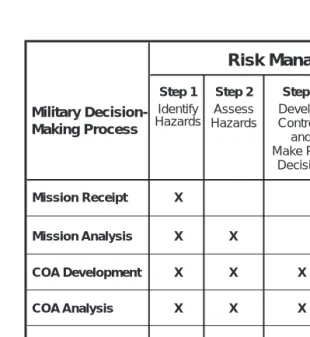
This five-step process is integrated into the military decision-making process as shown in Figure 2-1.
FM 100-40 provides insight into the context in which the risk management process is applied herein. Areas of particular interest in FM 100-40 include—
FM 100-14
Mission Receipt
Mission Analysis
COA Development
COA Analysis
COA Comparison
COA Approval
Orders Production
Rehearsal1
Execution and1 Assessment
Step 1 Identify Hazards
Step 2 Assess Hazards
Step 3 Develop Controls and Make Risk
Decision
Step 4 Implement
Controls
Step 5 Supervise and
Evaluate Military
Decision-Making Process
X
X
X
X
X
X
X
X
X
X X
X
X X
X X Risk Management Steps
X X X
X X X
1All boxes are marked to emphasize the continued use of the risk management
process throughout the mission
[image:13.603.43.353.72.408.2]Risk decisions should be based upon awareness rather than mechanical habit. Leaders should act on a keen appreciation for the essential factors that make each situation unique instead of from conditioned response. Throughout the entire operational continuum, the commander must consider US Government civilians and contract support personnel in his risk management process. Hazards can exist, regardless of enemy or adversary actions, in areas with no direct enemy contact and in areas outside the enemy’s or adversary’s
Risk Management
influence. The two types of risk that exist across the wide range of Army operations are tactical risks and accident risks.
• Tactical risk is risk concerned with hazards that exist because of the presence of either the enemy or an adversary. It applies to all levels of war and across the spectrum of operations.
• Accident risk includes all operational risk considerations other than tactical risk. It includes risks to the friendly force. It also includes risks posed to civilians by an operation, as well as an operations impact on the environment. It can include activities associated with hazards concerning friendly personnel, civilians, equipment readiness, and environmental conditions.
STEPS 1 AND 2
Steps 1 and 2 together comprise the risk assessment. In Step 1, individuals identify the hazards that may be encountered in executing a mission. In Step 2, they determine the direct impact of each hazard on the operation. The risk assessment provides for enhanced situational awareness. This awareness builds confidence and allows soldiers and units to take timely, efficient, and effective protective measures.
STEPS 3 THROUGH 5
Steps 3 through 5 are the essential follow-through actions to effectively manage risk. In these steps, leaders balance risk against costs—political, economic, environmental, and to combat power— and take appropriate actions to eliminate unnecessary risk. During execution, as well as during planning and preparation, leaders continuously assess the risk to the overall mission and to those involved in the task. Finally, leaders and individuals evaluate the effectiveness of controls and provide lessons learned so that others may benefit from the experience.
THE FIVE STEPS APPLIED
STEP 1. IDENTIFY HAZARDS
A hazard is an actual or potential condition where the following can occur due to exposure to the hazard:
• Injury, illness, or death of personnel.
FM 100-14
Hazards are sources of danger or risks due to enemy or adversary presence and other conditions not due to enemy or adversary capabilities. Hazards are found in all operational environments. Combat operations, stability operations, base support operations, and training present unique hazards for units involved in these kinds of missions. Hazards are identified during the first four steps of the military decision-making process: mission receipt, mission analysis, COA development, and COA analysis.
The ability of unit leaders and staffs to identify hazards is key. One reality of today’s missions is that the aspect of a hazard can change rapidly. Things of little risk initially can quickly become major threats due to unforeseen natural or man-made events. Leaders should be aware of this possibility. Complacency to the fact that existing controls may not continue to control hazards in rapidly changing situations should be viewed as a hazard in itself.
The factors of METT-T provide a sound framework for identifying hazards when planning, preparing, and executing operations. When applying risk management to METT-T during mission analysis, leaders and staffs should look for hazards that affect both tactical and accident risks. They must identify all hazards that may present significant risks to the mission.
Mission
Leaders first analyze the assigned mission. They look at the type of mission to be accomplished and consider possible subsequent missions. Certain kinds of operations are inherently more dangerous than others. For example, a deliberate frontal attack, because of the associated movement, is more likely to expose a unit to losses than would a defense from prepared positions. Identifying missions that routinely present great risk is imperative. Leaders also look for hazards associated with complexity of the plan such as—
• A scheme of maneuver that is difficult to understand or too complex for accurate communications down to the lowest level. • The impact of operating under a fragmentary order (FRAGO).
Enemy
Risk Management
defeat my operation?” Common shortfalls that can create hazards during operations against an enemy include failure to—
• Assess potential advantages to the enemy provided by the battlefield environment.
• Fully assess the enemy’s capabilities.
• Understand enemy collection capabilities and friendly vulnerabilities to those capabilities.
• Accurately determine the enemy’s probable COAs.
• Plan and coordinate active ground and aerial reconnaissance activities.
• Disseminate intelligence about the enemy to lower levels. • Identifying terrorist threats and capabilities.
Intelligence plays a critical part in identifying hazards associated with tactical risk. Intelligence-preparation-of-the-battlefield (IPB) is a dynamic staff process that continually integrates new information and intelligence that ultimately becomes input to the commander’s risk assessment process. Intelligence assists in identifying hazards during operations by—
• Identifying the opportunities and constraints the battlefield environment offers to threat and friendly forces.
• Thoroughly portraying threat capabilities and vulnerabilities. • Collecting information on populations, governments, and
infrastructures.
FMs 34-130 and 34-60, respectively, provide detailed information on IPB and on counterintelligence operations and multidiscipline counterintelligence analysis.
Terrain and Weather
In addition to those due to the enemy or adversaries, the most obvious hazards to military operations are due to terrain and weather. Terrain and weather affect the type of hazard encountered. When the enemy uses terrain to his advantage, the risk is clearly tactical. The aspects of terrain and weather may create situations where accident risks predominate. When looking at this from a purely mission perspective, familiarity of the unit with the terrain and its associated environment must be paramount. Basic issues include—
FM 100-14
Terrain. The five main military aspects of terrain—observation and fields of fire, cover and concealment, obstacles, key terrain and decisive terrain, and avenues of approach (OCOKA)—can be used to identify and assess hazards impacting on friendly forces. Chapter 2 of FM 100-40 has details on OCOKA. The terrain analysis includes both map and on-the-ground reconnaissance to identify how well unit capabilities and mission demands can be accommodated by the terrain.
• Observation and fields of fire. Hazards associated with this usually involve when the enemy will be able to engage a friendly unit and when friendly unit weapons capabilities allow it to effectively engage the enemy.
• Cover and concealment. Hazards associated with cover and concealment are created by the enemy’s ability to place direct or indirect fire on friendly forces.
• Obstacles. Hazards associated with obstacles may be accident or tactical. They may be due to natural conditions such as rivers or swamps or man-made such as minefields or built-up areas. • Key terrain and decisive terrain. Hazards are a marked advantage
terrain provides to the enemy if he controls such terrain or denies its use to friendly forces.
• Avenues of approach. Hazards associated with avenues of approach can affect both tactical and accident risks. Such hazards include conditions where an avenue of approach impedes deployment of friendly combat power or where it supports deployment of enemy combat power.
Weather. Weather works hand-in-hand with terrain to create hazards. To identify weather hazards, leaders and soldiers must assess the impact on operating systems. Mistakes include not considering the—
• Adverse effects of heat and cold hazards on the performance of soldiers.
• Effects of climate and weather on maintenance of vehicles and equipment before beginning an operation.
Risk Management
Troops
Leaders analyze the capabilities of available friendly troops. Associated hazards impact both the soldier and unit. Key considerations are level of training, manning levels, the condition and maintenance of vehicles and equipment, morale, availability of supplies and services, and the physical and emotional health of soldiers. Leaders and soldiers must be vigilant to the fact that hazards in these areas can adversely affect a mission, even when all tactical considerations point to success. Mission failure can be caused by—
• Hazards to the physical and emotional health of soldiers. Inadequate sanitation facilities, water purification capabilities, medical attention, and evacuation capabilities are key hazards that can arise from incomplete logistical planning. Care of troops requires long-range projections of all classes of supply, with close monitoring of mission changes that could impact availability or depletion of supplies. When beginning an operation immediately upon arriving in theater, hazards include not implementing measures to help soldiers overcome fatigue or acclimatize them to the geographical area and associated climate.
• Hazards to task organization or units participating in an operation.
Hazards include how long units have worked together under a particular command relationship. During stability operations, task organizations may change often. Hazards include poor communication, unfamiliarity with higher headquarters SOPs, and insufficient combat power to accomplish the mission. • Hazards associated with long-term missions. Long-term missions
include nation building, peacekeeping, or insurgency/ counterinsurgency operations. Hazards associated with these missions include the turmoil of personnel turnover, lack of continuity of leadership, inexperience, and lack of knowledge of the situation and the unit’s operating procedures. An especially insidious hazard is critical-skills atrophy that results from not performing METL-related missions.
Time Available
FM 100-14
time can result in shortages of time for subordinate and adjacent units to accomplish their mission.
Civilians
The commander’s legal responsibility is to consider hazards to, and safeguarding of, civilians in his area of operations. Civilians
include nongovernmental organizations (NGOs), private voluntary organizations (PVOs), US Government civilians, foreign national civilians, the media, and dislocated civilians put at risk by military operations. The commander must consider hazards that can occur across the range of operations, such as—
• In a wartime environment. The commander must consider the hazard of collateral damage which may result in creating new adversaries.
• In a peacetime environment. The commander must consider the political attitudes and previous actions of civilians in identifying hazards to friendly forces and the populace itself.
Adversaries are hostile elements other than the enemy that may be encountered during any operation. They present additional hazards. They may be organized opposition or individuals that challenge authority. They may include such diverse elements as rioters, criminals, rogues, or gangs that might want to harass a peace enforcement mission.
STEP 2. ASSESS HAZARDS
Step 2 completes the risk assessment. Risk is the chance of hazard or bad consequences. This step examines each hazard in terms of probability and severity to determine the risk level of one or more hazardous incidents that can result from exposure to the hazard. This step is conducted during three steps of the military decision-making process—mission analysis, COA development, and COA analysis. This step is also conducted after controls are developed.
Risk Management
Substep A
Leaders and staffs assess each hazard in relation to the probability
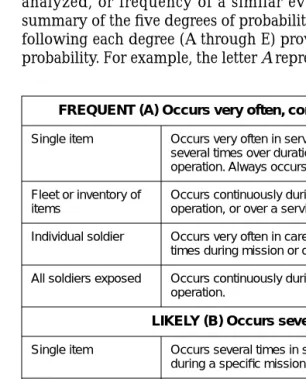
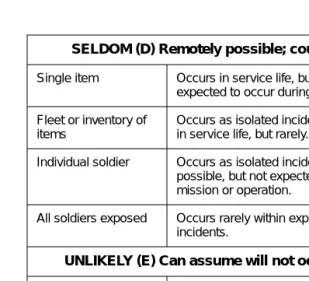
of a hazardous incident. The probability levels estimated for each hazard may be based on the mission, COAs being developed and analyzed, or frequency of a similar event. Figure 2-2 provides a summary of the five degrees of probability. The letters in parentheses following each degree (A through E) provide a symbol for depicting probability. For example, the letter A represents frequent probability.
FREQUENT (A) Occurs very often, continuously experienced
Single item Occurs very often in service life. Expected to occur several times over duration of a specific mission or operation. Always occurs.
Fleet or inventory of items
Occurs continuously during a specific mission or operation, or over a service life.
Individual soldier Occurs very often in career. Expected to occur several times during mission or operation. Always occurs.
All soldiers exposed Occurs continuously during a specific mission or operation.
LIKELY (B) Occurs several times
Single item Occurs several times in service life. Expected to occur during a specific mission or operation.
Fleet or inventory of items
Occurs at a high rate, but experienced intermittently (regular intervals, generally often,).
Individual soldier Occurs several times in career. Expected to occur during a specific mission or operation.
All soldiers exposed Occurs at a high rate, but experienced intermittently.
OCCASIONAL (C) Occurs sporadically
Single item Occurs some time in service life. May occur about as often as not during a specific mission or operation.
Fleet or inventory of items
Occurs several times in service life.
Individual soldier Occurs some time in career. May occur during a specific mission or operation, but not often.
[image:20.603.35.342.180.560.2]All soldiers exposed Occurs sporadically (irregularly, sparsely, or sometimes).
FM 100-14
Figure 2-2. Hazard Probability (continued)
Substep B
Substep B addresses the severity of each hazard. It is expressed in terms of—
• Degree of injury or illness.
• Loss of or damage to equipment or property. • Environmental damage.
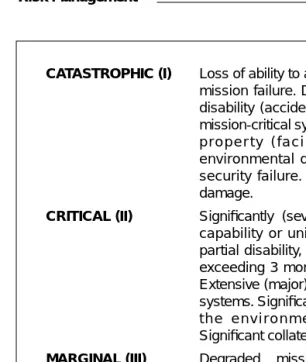
• Other mission-impairing factors such as lost combat power. The degree of severity estimated for each hazard may be based on knowledge of the results of similar past events. Figure 2-3 provides a summaryof the four degrees of hazard severity. TheRoman numerals in parentheses following each degree (I through IV) provide a convenient symbol for depicting severity. For example, I represents the catastrophic degree of severity.
SELDOM (D) Remotely possible; could occur at some time
Single item Occurs in service life, but only remotely possible. Not expected to occur during a specific mission or operation.
Fleet or inventory of items
Occurs as isolated incidents. Possible to occur some time in service life, but rarely. Usually does not occur.
Individual soldier Occurs as isolated incident during a career. Remotely possible, but not expected to occur during a specific mission or operation.
All soldiers exposed Occurs rarely within exposed population as isolated incidents.
UNLIKELY (E) Can assume will not occur, but not impossible
Single item Occurrence not impossible, but can assume will almost never occur in service life. Can assume will not occur during a specific mission or operation.
Fleet or inventory of items
Occurs very rarely (almost never or improbable). Incidents may occur over service life.
Individual soldier Occurrence not impossible, but may assume will not occur in career or during a specific mission or operation.
Risk Management
CATASTROPHIC (I) Loss of ability to accomplish the mission or mission failure. Death or permanent total disability (accident risk). Loss of major or mission-critical system or equipment. Major p r o p e r t y ( fa c i l i t y ) d a m a g e . S ev e r e environmental damage. Mission-critical security failure. Unacceptable collateral damage.
CRITICAL (II) Significantly (severely) degraded mission capability or unit readiness. Permanent partial disability, temporary total disability exceeding 3 months time (accident risk). Extensive (major) damage to equipment or systems. Significant damage to property or t h e e n v i r o n m e n t . S e c u r i t y f a i l u r e . Significant collateral damage.
MARGINAL (III) Degraded mission capability or unit readiness. Minor damage to equipment or systems, property, or the environment. Lost day due to injury or illness not exceeding 3 months (accident risk). Minor damage to property or the environment.
[image:22.603.39.346.56.419.2]NEGLIGIBLE (IV) Little or no adverse impact on mission capability. First aid or minor medical treatment (accident risk). Slight equipment or system damage, but fully functional and ser viceable. Little or no proper ty or environmental damage.
Figure 2-3. Hazard Severity
Substep C
FM 100-14
Risk Assessment Matrix Probability
Severity Frequent
A
Likely B
Occasional C
Seldom D
Unlikely E
Catastrophic
Critical
Marginal
Negligible I
II
III
IV
E
E
H
M
E
H
M
L
H
H
M
L
H
M
L
L
M
L
L
L
E – H – M – L –
Extremely High Risk High Risk
Moderate Risk Low Risk
experience, and judgment. Uncertainty can arise in the assessment of both the probability and severity of a hazardous incident. Uncertainty results from unknowns about a situation; from incomplete, inaccurate, undependable, or contradictory information; and from unforeseen circumstances. Therefore, assessment of risk requires good judgment. Figure 2-4 is a standardized matrix that can be used to assist in this process. Leaders and staffs enter the estimated degree of severity and probability for each hazard in Substeps A and B from the severity row and probability column, respectively. The point where the severity row and probability column intersect defines the level of risk. For example, if the hazard is estimated to have a critical severity (II) and a
likely probability (B), the level of risk is high (H).
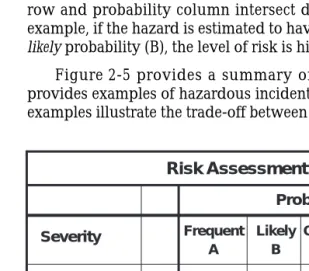
[image:23.603.44.353.270.541.2]Figure 2-5 provides a summary of the levels of risk. It also provides examples of hazardous incidents for each risk level. Several examples illustrate the trade-off between tactical and accident risks.
Risk Management
E - Extremely High: Loss of ability to accomplish the mission if hazards occur during mission. A frequent or likely probability of catastrophic loss (IA or IB) or frequent probability of critical loss (IIA) exists.
Example: A commander finds that one of his implied tasks to attack an objective involves crossing a normally shallow riverbed. After looking at the factors of METT-T, he discovers that three days of intense rain have raised the water level to rise above flood stage, with currents far in excess of his ability to safely ford with armored vehicles. After discussing COAs with his staff, he determines the accident risk is extremely high because of the likely probability and catastrophic severity of losing vehicles and killing soldiers. His conclusions are based on his experience with and knowledge of fording armored vehicles under the existing conditions of water depth and current speed.
H - High: Significant degradation of mission capabilities in terms of the required mission standard, inability to accomplish all parts of the mission, or inability to complete the mission to standard if hazards occur during the mission. Occasional to seldom probability of catastrophic loss (IC or ID) exists. A likely to occasional probability exists of a critical loss (IIB or IIC) occurring. Frequent probability of marginal losses (IIIA) exists.
Example: During a preplanned ambush, the leader discovers that the force he intends to ambush has significantly more combat power than his own force can accommodate. He realizes that he could only delay rather than destroy the enemy. He knows his casualty estimates would be very high if the enemy reorganized and counterattacked. He also knows that the size of the enemy force could seriously impact adjacent units conducting a movement to contact. He determines the situation is high risk because he estimates (based on his training and experience) there is a likely probability of the enemy reorganizing and counterattacking and the severity of loss to his unit would be critical.
M - Moderate: Expected degraded mission capabilities in terms of the required mission standard will have a reduced mission capability if hazards occur during mission. An unlikely probability of catastrophic loss (IE) exists. The probability of a critical loss is seldom (IID). Marginal losses occur with a likely or occasional probability(IIIB or IIIC). A frequent probability of negligible (IVA) losses exists.
Example: A commander in a defensive position receives a warning order to be prepared to counterattack if the enemy attacks again. He chooses to use pre-positioned ammunition caches to support his defense, as opposed to moving his ammunition resupply forward by truck. He determines that the severity of not having an immediate resupply of ammunition available during the counterattack will have a critical impact on his combat power. He realizes that if the enemy forces him to abandon his forward positions, the severity of the loss of his
FM 100-14
ammunition caches will critically impact his combat power. He considers that his unit is deployed in excellent defensive positions. He has repelled two attacks that resulted in the destruction of an estimated 50 percent of the enemy’s combat power. He receives information that the probability of the enemy attacking is likely, but that the probability of the enemy being reinforced and attacking in overwhelming force is remote (seldom). The commander concludes that the risk of conducting a counterattack with limited ammunition is greater than the moderate risk of the enemy pushing him back.
L - Low: Expected losses have little or no impact on accomplishing the mission. The probability of critical loss is unlikely (IIE), while that of marginal loss is seldom (IIID) or unlikely (IIIE). The probability of a negligible loss is likely or less (IVB through (IVE).
E x a m p l e : A mechanized task force (TF) conducting a movement to contact in a desert environment is overtaken by nightfall before reaching its limit of advance (LOA). The terrain along the axis of advance is flat and open. Visibility is about 800 meters under a clear sky illuminated by a full moon. Estimates put the enemy, which has been hastily withdrawing for the past three days, at approximately 30 percent strength. Contact has been light with no defensible terrain along the TF’s axis. The TF commander considers all the factors. In addition, the TF is 100 percent operational in using night vision devices. The TF commander estimates that it is unlikely that his unit will incur losses of critical severity by being surprised by the enemy or lose critical combat power due to an accident. He estimates the risk to his force in continuing a nighttime movement is low.
Figure 2-5. Levels of Risk (continued)
STEP 3. DEVELOP CONTROLS AND MAKE RISK DECISIONS Risk management is the recognition that decision making occurs under conditions of uncertainty. Decisions must remain consistent with the commander’s stated intent and offer a good expectation of success. The risk-taking skill requires competency as a prerequisite.
FM 100-7, Decisive Force: The Army in Theater Operations, May 1995
Step 3 is accomplished in two substeps: develop controls and make risk decisions. This is done during the COA development, COA analysis, COA comparison, and COA approval of the military decision-making process.
Substep A - Develop Controls
Risk Management
severity) of a hazardous incident. When developing controls, they consider the reason for the hazard not just the hazard itself.
Types of Controls. Controls can take many forms, but fall into three basic categories—educational controls, physical controls, and avoidance.
• Educational controls. These controls are based on the knowledge and skills of the units and individuals. Effective control is implemented through individual and collective training that ensures performance to standard.
• Physical controls. These controls may take the form of barriers and guards or signs to warn individuals and units that a hazard exists. Additionally, special controller or oversight personnel responsible for locating specific hazards fall into this category. • Avoidance. These controls are applied when leaders take positive
action to prevent contact with an identified hazard.
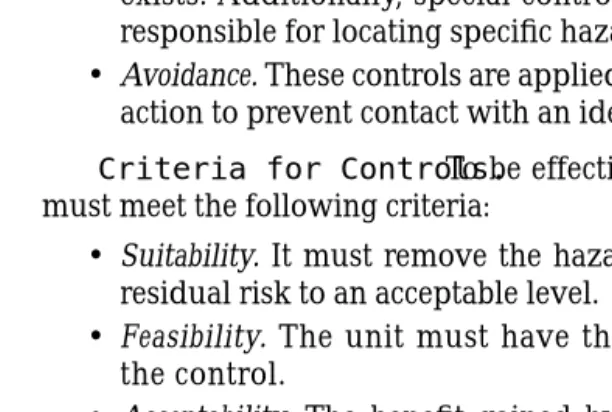
Criteria for Controls. To be effective, each control developed must meet the following criteria:
• Suitability. It must remove the hazard or mitigate (reduce) the residual risk to an acceptable level.
• Feasibility. The unit must have the capability to implement the control.
• Acceptability. The benefit gained by implementing the control must justify the cost in resources and time. The assessment of acceptability is largely subjective. Figure 2-6 gives criteria for determining acceptability of controls for each identified hazard.
Support Availability of adequate personnel, equipment, supplies, and facilities necessary to implement a suitable controls.
Standards Guidance and procedures for implementing a control are clear, practical, and specific.
Training Knowledge and skills are adequate to implement a control.
Leadership Leaders are competent to implement a control. Individual Individual soldiers are sufficiently self-disciplined to
[image:26.603.36.342.329.535.2]implement a control.
FM 100-14
Examples of Controls. Examples of controls include— • Engineering or designing to eliminate or control hazards. • Selecting a COA that avoids identified hazards.
• Limiting the number of people and the amount of time they are exposed to hazards, consistent with mission requirements. • Selecting personnel with appropriate mental, emotional, and
physical capabilities.
• Providing protective clothing, equipment, and safety and security devices.
• Providing such services as adequate sanitation facilities and water purification capabilities.
• Providing warning signs and signals.
• Scheduling vehicle and aircraft silhouette drills.
• Planning training, including rehearsals, rock drills, battle drills, and so forth.
• Programming communications links for key civilian organizations. • Establishing battlefield controls such as areas of operations and boundaries, direct fire control measures, fire support coordination measures, rules of engagement, airspace control measures, bridge classification, traffic control, and so forth. • Developing terrorist attack warning systems and response plans.
The key is to specify who, what, where, when, and how each control is to be used. For example—
• Planning and scheduling intensive threat and friendly vehicle identification refresher training for all antiarmor and air defense weapons crews before the mission reduces the probability of engaging a friendly vehicle or aircraft (fratricide).
• Programming installation of crashworthy passenger seats in the UH-60 Blackhawk, when mission circumstances do not indicate their removal, can reduce the severity of injuries in crashes. • Requiring soldiers to wear flak vests and helmets during
Risk Management
• Establishing strong continuity documents and planning overlap tours for key leaders facilitate smooth transitions during extended operations.
Residual Risk. Once the responsible leader develops and accepts controls, he determines the residual risk associated with each hazard and the overall residual risk for the mission.
• Residual risk is the risk remaining after controls have been selected for the hazard. Residual risk is valid (true) only if the controls for it are implemented. As controls for hazards are identified and selected, the hazards are reassessed as in Step 2 and the level of risk is then revised. This process is repeated until the level of residual risk is acceptable to the commander or leader or cannot be further reduced. See Figures A-3 through A-5. • Overall residual risk of a mission must be determined when more
than one hazard is identified. The residual risk for each of these hazards may have a different level, depending on the assessed probability and severity of the hazardous incident. Overall residual mission risk should be determined based on the incident having the greatest residual risk. Determining overall mission risk by averaging the risks of all hazards is not valid. If one hazard has high risk, the overall residual risk of the mission is high, no matter how many moderate or low risk hazards are present.
Substep B - Make Risk Decision
A key element of the risk decision is determining if the risk is justified. The commander must compare and balance the risk against mission expectations. He alone decides if controls are sufficient and acceptable and whether to accept the resulting residual risk. If he determines the risk level is too high, he directs the development of additional controls or alternate controls, or he modifies, changes, or rejects the COA.
FM 100-14
STEP 4. IMPLEMENT CONTROLS
Leaders and staffs ensure that controls are integrated into SOPs, written and verbal orders, mission briefings, and staff estimates. The critical check for this step, with oversight, is to ensure that controls are converted into clear, simple execution orders understood at all levels. Implementing controls includes coordination and communication with—
• Appropriate superior, adjacent, and subordinate units and those executing the mission.
• Logistics Civil Augmentation Program (LOGCAP) organizations and civilian agencies that are part of the force.
The media, NGOs, and PVOs must be included in coordination when their presence impacts or is impacted by the force.
Leaders must explain how supervisors will implement controls. Examples of control implementation include—
• Conducting vehicle and aircraft silhouette drills.
• Conducting rehearsals, rock drills, battle drills, and so forth.
• Conducting intensive threat and friendly vehicle
identification refresher training for all antiarmor and air defense weapons crews.
• Conducting orientation for replacement personnel.
• Installing and maintaining communications links for key civilian organizations.
• Operating in convoys of four vehicles minimum.
• Carrying weapons and wearing flak jackets and helmets when outside secure compounds.
STEP 5. SUPERVISE AND EVALUATE
Leaders must supervise the execution of their orders. The more untrained the troops, the more detailed this supervision must be.
Infantry in Battle, 1939
Risk Management
especially during long-term missions. Leaders maintain situational awareness. They guard against complacency to ensure that risk control standards are not relaxed or violated. To gain insight into areas needing improvement, leaders must continuously evaluate their units’ effectiveness in managing mission risks.
Supervise
Leaders supervise mission rehearsal and execution to ensure standards and controls are enforced. Techniques may include spot-checks, inspections, situation reports and brief-backs, buddy spot-checks, and close supervision. During the mission, leaders continuously monitor controls to ensure they remain effective. They modify them as necessary. Leaders and individuals anticipate, identify, and assess new hazards to implement controls. They continually assess variable hazards such as fatigue, equipment serviceability, and the environment. Leaders modify controls to keep risks at an acceptable level.
During sustained operations, leaders continue planning to ensure that controls emplaced at the beginning of the mission apply to changes in the operation’s current situation and to hazardous conditions. Leaders must maintain an extraordinary degree of discipline. They must avoid complacency, which can result from boredom and overconfidence. Leaders must ensure that soldiers do not relax their vigilance due to performing repetitive tasks—despite changing roles and missions, unit turbulence and turnover, and declining skills. Leaders maintain a close overwatch on controls put in place to reduce risks over a prolonged period. For example, during stability operations, land mine hazards may not be solved in the near term, but may require continual attention. Other examples of long-term hazards that may be encountered include—
• Climatic extremes.
• NBC and hazardous waste contamination.
• Diseases native to a particular area of operation or indigenous population.
• Terrorist threats.
Evaluate
After a mission, leaders and individuals evaluate how well the risk management process was executed. They—
FM 100-14
• Capture and disseminate lessons learned so that others may benefit from the experience.
• Consider the effectiveness of the risk assessment in identifying and accurately assessing the probability and severity of hazards that resulted in mission degradation.
• Determine whether the level of residual risk of each hazard and of the overall mission were accurately estimated.
• Evaluate the effectiveness of each control in reducing or removing risk, including whether controls were effectively communicated, implemented and enforced.
Leaders and individuals determine why some controls were ineffective and what should be done when the hazard is encountered again. A control may be altered; the way it is implemented or supervised may be changed to make it effective; or a completely different control may be more effective. Leaders must energize the system to fix systemic problems that hinder combat effectiveness.
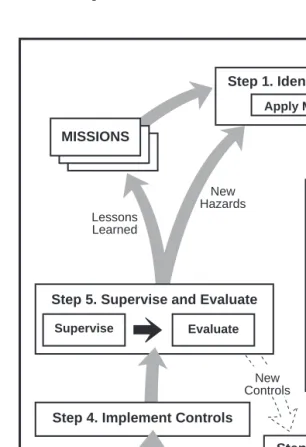
Figure 2-7 shows that the risk management process continues throughout a mission as well as from mission to mission. It is integral to the military decision-making process. Its application requires good judgment and intuitive analysis borne of confidence, experience, and situational awareness.
TOOLS AND PITFALLS
The appendix provides examples of risk management tools to help leaders assess identified hazards, develop controls, and make risk decisions. The tools should be tailored to suit particular situations and missions. The examples in Figures A-3 through A-5 are tools to manage risk at the tactical level. The example in Figure A-6 is a tool to manage risk at the operational level. Units may develop additional tools suitable for their needs.
Units train to a standard. They operate and train regardless of the degree of real or perceived difficulty. Risk reduction begins with commanders identifying their METLs. Commanders use the risk management process to assess the degree of risk related to each METL their unit must perform. From this assessment, risk reducing standard operating procedures evolve.
Risk Management
Step 1. Identify Hazards
Step 2. Assess Hazards
Determine risk level for each hazard and overall mission risk
Estimate probability
Estimate severity
1
As controls for hazards are identified and selected the hazards are reassessed as in Step 2
Step 4. Implement Controls Step 5. Supervise and Evaluate
Supervise Evaluate MISSIONS
New Controls New Hazards Lessons
Learned
Apply METT-T
Make decision
Step 3. Develop Controls and Make Risk Decision
Determine residual risk level for each hazard and overall residual mission risk1
[image:32.603.36.343.60.508.2]Develop controls
FM 100-14
Pitfalls arise when risk management tools are used without adaptation to the factors of METT-T. Using a standardized risk assessment card or checklist may be of some value initially in the mission analysis and COA development or in cases where a routine task is performed in an unchanging environment or static situation. However, such a tool used alone will not likely identify all hazards for every mission in a changing operational environment.
Chapter 3
Risk Management Implementation
It is imperative to develop twenty-first century leaders who trust their subordinates’ abilities and judgment. Such leaders must be willing to underwrite their subordinates’ honest errors and coach them on to excellence, without tolerating incompetence or laxity. We must recognize that Army leaders are not perfect, and that activity at the ragged edge of audacity sometimes leaves debris in its wake.
GEN William W. Hartzog Commanding General US Army Training and Doctrine Command
T h i s c h a p t e r p r e s e n t s t h e m o r a l a n d e t h i c a l implications of risk management. It outlines essential responsibilities and considerations necessary to effectively integrate and assess risk management within the Army. Leaders should tailor these essentials to develop specific how-to procedures suited to their circumstances, available resources, and mission.
MORAL AND ETHICAL IMPLICATIONS
FOR LEADERS
To be successful, risk management must be underwritten by the chain of command. Leaders should not expect that all missions will be accomplished with zero defects—free from errors, flaws, or less-than-perfect performance. Demanding such rigid standards leads to oversupervision and paralysis; it produces timid leaders, afraid to make tough decisions in crisis and unwilling to take risks necessary for success in military operations. A zero defects mindset creates conditions that will lead inevitably, in the larger sense, to failure in battle and higher casualties.Leaders are morally bound to support a subordinate’s decision to accept risks that are within his commander’s intent and guidance, as he understands it.
FM 100-14
accepts the responsibility along with his subordinate. Furthermore, risk management does not justify taking actions to facilitate an unethical or immoral action. FM 22-100 addresses the moral and ethical aspects of protecting the force within the overall framework of how to apply leadership at all levels to meet mission requirements.
Everyday as we respond to the nation’s needs, we expose our soldiers to hazards in uncertain and complex environments. We do this with the full knowledge that there are inherent risks associated with any military operation. The nature of our profession will not allow for either complacency or a cavalier acceptance of risk.
General Dennis J. Reimer Chief of Staff, Army
RESPONSIBILITIES
One critical task for all operations is minimizing risk. Every military plan must make this a priority. It is an inherent part of every mission and a basic responsibility of commanders. Whether for training or operational deployments, commanders issue clear risk guidance. Minimizing risk—eliminating unnecessary risk—is the responsibility of everyone in the chain of command. This responsibility runs from the highest commander, through his subordinate leaders, to the soldier.
The commander and his staff must look at tactical risks and accident risks. They use the same risk management process to manage both types. Commanders—with the assistance of their leaders and staffs—manage accident risks. Commanders determine how and where they are willing to take tactical risks.
Leaders and soldiers at all levels are responsible and accountable for managing risks by ensuring that hazards and associated risks are—
• Identified during planning, preparation, and execution of operations.
Risk Management
another and make risk decisions consistent with the higher commander’s guidance.
Sometimes commanders are not properly advised in situations where the assumption of risk may affect or imperil their units, the intent of their higher commander, or the operations of an adjacent unit. This is most often attributed to—
• The risk denial syndrome in which leaders do not want to know of the risk.
• A staff member who believes that the risk decision is part of his job and does not want to bother his commander or section leader. • A subordinate who does not fully understand the higher
commander’s guidance.
• Complacency—outright failure to recognize a hazard or the level of risk involved, or overconfidence in one’s abilities or the unit’s capabilities to avoid or recover from a hazardous incident. • Use of a standardized risk assessment tool, such as a risk assessment card, that is not tailored to the unit’s mission or adapted to the factors of METT-T and which may put missions in the routine low-risk category.
COMMANDERS
The commander directs the organization and sets priorities and the command climate (values, attitudes, and beliefs). Successful preservation of combat power requires embedding risk management into unit behavior. This requires commitment and creative leadership—innovative planning, careful management. It also requires the chain of command’s demonstrated support of the risk management process. Only then will the Army begin to capture the full power of risk management. Commanders establish a command climate favorable for risk management integration by—
• Demonstrating consistent and sustained risk management behavior through leading by example—habitually doing risk management—and actively participating throughout the risk management process.
FM 100-14
• Obtaining and providing to subordinates the necessary assets to control risk.
• Knowing their own limitations, their leaders’ and soldiers’ limitations, and their unit’s capabilities.
• Preventing a zero-defects mindset from creeping into their command’s culture.
• Allowing subordinates to make mistakes and learn from them. • Demonstrating full confidence in subordinates’ mastery of their
trade and their ability to execute a chosen COA.
• Keeping subordinates informed; consulting with subordinate leaders before making a decision, if feasible.
• Listening to subordinates.
Commanders are responsible and accountable for their own actions and those of units under their charge. Commanders must weigh the repercussions of casualties, damage to the environment, and loss of equipment. They must also consider the level of public reaction to loss against national, strategic, operational, or tactical objectives. Commanders are also responsible for keeping soldiers from falling into complacency. During sustained operations in particular, complacency can creep in as a result of accepting the status quo. For example, a unit can be deployed for several months and nothing may happen. The unit then gets very satisfied with itself and its performance. It gets conditioned to its initial circumstances—being well-armed, well-equipped, well-disciplined, and well-trained. It thinks it has risks under control and does not need to change. Such complacency, and the associated loss of situational awareness, can result in leaders and soldiers taking a gamble instead of a prudent risk. A risk is the accepted result of an informed decision; a gamble is an uninformed bet or guess on a hopeful outcome. Leaders and soldiers must clearly understand the difference.
Command is often exercised in conditions of uncertainty and ambiguity, where violence, danger, fear, and friction abound, and under the ever present time constraints driven by OPTEMPO. Risk decisions are frequently required by and dependent on the immediate situation. Judgment is required; a formula, rule, or checklist, by itself, is not appropriate under such circumstances.
Risk Management
through empowering leaders by pushing risk decisions as far down the chain of command as feasible within the next higher commander’s guidance. Commanders must insist that subordinates exercise their freedom of action to act decisively and aggressively to complete assigned missions and promote success of the larger force. Subordinates must consider hazards outside their assigned responsibilities that impact the mission. The result is to encourage coordination and communication—laterally and up and down the chain of command. This requires and encourages initiative, which demands well-trained, determined, disciplined soldiers.
Risk management is a two-way street. It is important that those involved in mission preparation and execution be fully aware of the amount of command involvement and actions necessary to control or remove hazards. The higher commander’s guidance specifies the degree of damage or risk to subordinate units that he is willing to accept during the current operation. Subordinates ensure they understand and implement their commander’s intent and guidance. If, during the planning process, the accident and/or tactical residual risk exceeds that which the higher commander is willing to accept, the subordinate informs his commander. He requests the resources necessary to mitigate the risk. If, during mission execution, the subordinate determines the risk is too great, he directs the development of additional or alternate controls or modifies or changes the COA. He should notify his next higher commander of his decision. Requiring subordinates to report to the higher commander when a risk decision point is reached during mission execution can result in paralysis.
FM 100-14
complete the Sava River bridge as quickly as possible. The commander assessed the situation and decided to call for a short rest period because his soldiers were tired and getting careless. Consequently, they completed the bridge ahead of schedule under the most difficult conditions imaginable and without injuries.
LEADERS
Many of the tasks identified for commanders apply to all leaders. Leaders’ specific responsibilities in managing risk include—
• Establishing clear, feasible risk management policies and goals. • Conducting detailed planning within time constraints; assessing
each mission and task in terms of its risk; continuously reassessing risk as the mission and conditions change and experience is gained.
• Making informed risk decisions and establishing and clearly communicating risk guidance.
• Training the risk management process. Ensuring subordinates understand the who, what, where, when, how, and why of m a n a g i n g r i s k a n d h o w t h e p ro c e s s a p p l i e s t o t h e i r circumstances and assigned responsibilities.
• Examining how subordinates manage risk and how soldiers protect themselves.
• Supervising and evaluating the unit’s execution of risk controls during the mission to correct areas needing improvement. • Advising his chain of command on risks and risk-reduction
measures.
• Providing subordinates with feedback on their performance and ways to improve.
• Assessing the effectiveness of their unit’s risk management program.
Risk Management
STAFFS
The chief of staff or executive officer is responsible for supervising integration of risk management across the staff. He coordinates development of risk reduction controls with emphasis on deconflicting controls that affect multiple functional areas and adjacent units. The staff officer helps the commander eliminate unnecessary risks by—
• Analyzing his functional area and applying risk management during the military decision-making process.
• Identifying constraints in the higher commander’s risk guidance. • Including hazards and their risks in the mission analysis briefing. • Including a risk assessment for the commander’s estimate. • Considering the risk assessment in the operations estimate. • Including risks and recommending ways to reduce their impact
in the staff estimate.
• Implementing risk controls by coordinating and integrating them into the appropriate paragraphs and graphics of the OPORD and into products such as SOPs and OPLANs.
• Establishing procedures and standards that are clear and practical.
• Determining the effectiveness of hazard/risk controls and continuously assessing their suitability, feasibility, and acceptability.
• Supervising, evaluating, and assessing the integration of risk management during an operation.
• Continuously identifying hazards, assessing initial and residual risks for each hazard, recommending control measures to reduce the risk to the force.
• Identifying and assessing hazards associated with complacency, especially during extended operations, and recommending appropriate actions to the commander.
FM 100-14
INDIVIDUALS
The level of expertise and maturity of the individual influence his proficiency in managing risk. Managing risk is subjective because its basis is individual judgment. Youngsoldiers are routinely charged with executing hazard controls and risk reduction measures. By nature, some them are impulsive risk takers. Their limited experience, coupled with an infallible attitude, can significantly increase the level of risk they are willing to accept. Their sense of indestructibility, motivation (esprit de corps), and willingness to achieve the mission at any cost also play a part.
Some soldiers and individuals ignore existing standards and improvise their own. Due to inexperience or complacency, they become susceptible to—
• Overestimating their ability to respond to or recover from a hazardous incident—they become overconfident.
• Underestimating the level of risk posed by a hazard.
It is imperative that individuals understand and execute controls implemented by leaders and staffs.
Individuals must maintain situational awareness and self-discipline when they perform their duties. They must—
• Understand and apply risk management.
• Execute controls directed by their leaders, that is, perform to standards.
• Carry risk management over into training and activities—both on and off duty.
• Look out for others—anyone has authority to halt something that is inherently unsafe.
INTEGRATION INTO TRAINING
AND OPERATIONS
ARFOR commanders/leaders must continuously employ risk management approaches to effectively preclude unacceptable risks to personnel and property, including protecting forces preparing for or en route to combat.
Risk Management
Integrating risk management into training and operations— • Preserves the lives and well-being of everyone.
• Conserves equipment, facilities, environmental resources, and combat power.
Risk management must not be treated as an afterthought. It must be planned for up front. Leaders and managers of materiel acquisition, base operations, and industrial operations must budget risk control costs up front at the level of expected payback over the duration of the activity, or the life cycle of materiel/weapons system.
When integrating risk management into sustained operations, leaders must consider increases in turbulence, personnel turnover, critical skill atrophy, and mission development. Leaders must continuously assess—
• The complexity of mission development and associated changing interrelationships with other agencies.
• The inclusion of civilian contractors, for example, LOGCAP, as part of the force.
• The presence of the media, NGOs, and PVOs.
These diverse elements need to be integrated into the risk management process.
Two key considerations relevant to managing risk in complex operational environments include—
• Understanding the culture of the indigenous population or society and its way of doing business. Leaders should respect their way of life and not interfere with local customs. Such interference could risk damage to relationships and increase the potential for introducing instability into the local society. Leaders must not, however, intentionally allow these considerations to endanger their force or its mission.
• The dynamics of managing risk and the way the leader and his subordinates manage risk. Leaders manage risk by—
— Having the right combination of well-trained, disciplined, well-armed, and well-equipped forces.
— Issuing clear guidance to minimize risk.
FM 100-14
— Maintaining situational awareness, especially of vulnerabilities.
— Avoiding unnecessary accident risk.
Risk management works best when incorporated into existing command training and operational planning cycles. They then act as risk management tools and provide for—
• Development of policy, goals, objectives, and priorities in the commander’s quarterly training guidance.
• The commander’s training assessment, by identifying hazards and risk controls.
• Systematic observation and assessment of the unit’s risk management performance and feedback into the training management cycle and SOPs.
Leaders and soldiers must have the skills, knowledge, and attitude to effectively manage risks inherent in all operations. Effective training helps soldiers become proficient. It qualifies them technically and tactically, and as leaders, to accomplish the mission without unnecessary risk.
Doctrine developers must integrate risk management into planning for all Army processes, especially the training management cycle defined in FMs 25-100 and 25-101. Unit leaders and their staffs must c