Abstract— Companies are facing manifold challenges while trying to implement Industrie 4.0, which are in great parts rooted in the complexity of Industrie 4.0 and its associated fields of research. Business models are changing due to technological and economic changes. The implementation of Industrie 4.0 in the value added process offers many potentials. In order for a company to differentiate itself from the competition service deliveries will be done through a dynamic business network and are increasingly becoming the main product rather than the product supplementation. In addition, business models have to be adapted to changing conditions or new concepts need to be developed.
The designed business model toolbox depicts the different elements and stages of development of business models. The application levels cover many business processes that may be affected by the implementation. For the development of new business models ideas processes from order intake to delivery, as well as processes in the supply chain and development are considered. This Toolbox can be used in workshops during the analysis and creativity phase to identify the company's maturity level in terms of Industrie 4.0 and to provide ideas for new business models. The Toolbocx Industrie 4.0 Business Models is easy to use and enables a systematical generation of ideas, which forms the starting point for further business models.
Index Terms— Business Models, Digital Transformation Process in Enterprises, Industrie 4.0
I. INTRODUCTION
he term Industrie 4.0 refers to the widespread entry of information and communication technology into production. Networking to an Internet of Things, Services and Data enables real-time adjustments to production processes. As a result, customer requirements can be implemented faster and more flexibly, and batch size 1 can be produced economically profitable [1]. Industrie 4.0 expresses two things: Firstly, a new level of value creation by the use of CPS, enabling communication and interaction between intelligent objects [2, 11]. Secondly, the version number 4.0 illustrates the drive for this industrial development through the Internet [3, 16]. The implementation of Industrie 4.0 into the company not only
Manuscript received July 23rd, 2018; revised August 10th, 2018. Mr. Yübo Wang is with the Department of Computer Integrated Design of the Technische Universität Darmstadt, Otto-Berdt-Str. 2, 64287 Darmstadt, Germany (phone: +49 (0) 6151-16-21845; fax: +49 (0) 6151-16-21793; email: [email protected]).
Ms. Thi Diem My Tran is with the Department of Computer Integrated Design of the Technische Universität Darmstadt, Otto-Berdt-Str. 2, 64287 Darmstadt, Germany (email: [email protected] ).
Prof. Dr.-Ing. Reiner Anderl is Head of the Department of Computer Integrated Design of the Technische Universität Darmstadt, Otto-Berdt-Str.°2, 64287 Darmstadt, Germany.
enables an improvement of the manufacturing process, but also an optimization of the entire value chain. According to Roth, there are opportunities in the areas production, human resource and alignment of the corporate strategy [4]. With regard to the production opportunities, integrated digital engineering enables the consideration of short-term and individual customer requirements in the production process. This also makes the production of very small quantities profitable. CPS-based ad-hoc networking allows creating dynamic business processes in terms of quality, time, risk, robustness, price and environmental compatibility. A rapid and flexible response to changing conditions is due to the real time availability of data and information possible. Companies can adapt their production according to the situation and by that increase their productivity. In addition, digital engineering can achieve resource effectiveness and efficiency. [4, 5, 12]
With regard to the opportunity area human resources, Industrie 4.0 offers an increase in the employability. The interaction of man and machine, as well as measures of work design and competence development, create new opportunities to benefit from the demographic change. Taking the diversity of employees into account new career models unfolds and thus ensures sustainable productivity and prevents skills shortage. Furthermore, there are new opportunities to reconcile work and private life through the use of intelligent assistance systems, which allow a flexible design of the work input [5, 14].
As digitization progresses, value-creation services are playing an increasingly more fundamental role. In the area of corporate strategy, new value creation potential arises through new services. The expansion and addition of the service portfolio gives companies the opportunity to expand their existing business model and create new ones. By linking intelligent services, the company can evolve from a product provider to a solution provider. [4, 13]
The progressive networking of production facilities for the realization of Industrie 4.0 Vision poses risks in IT and data security. Uncertainties regarding data quality, stability, interface and legal problems prevent companies from embarking upon the Industrie 4.0 path [4, 17]. Therefore, necessary security measures must be taken to build a secure production network that ensures secure data exchange.
IT safety and security are not synonymous. Safety as in functional safety of a system describes the characteristics that the actual functionality is equivalent to the target functionality and thus operability is guaranteed. Information security, on the other hand, describes the characteristic of a functionally reliable system. Systems only accept states that do not cause unauthorized information change or retrieval. Often, the security of a system is understood as data
Toolbox Approach for the Development of
New Business Models in Industrie 4.0
Y. Wang, T. Tran, and R. Anderl
security. Data security also describes the property of a functionally reliable system. But systems do not allow unauthorized access to system resources, especially data. This also includes measures for data backup, such as the creation of a backup copy to protect against data loss. [6, 15]
In the digital economy and the associated presence of information and communication technology, increasing consideration of IT security is required. The aim of IT security is the protection of electronically stored information and its processing. The term protection objective describes the characteristics and states of the stored information and systems that needs be protected. This includes confidentiality, authenticity, integrity, liability, anonymity, access. These objectives are provided by security mechanisms and security algorithms [7, 8].
II. STATE OF THE ART AND TARGET
A. Overview of Industrie 4.0 maturity model
The transfer of the Industrie 4.0 concept in the company requires a valuation option: A model that is suitable for the company to determine the maturity level of Industrie 4.0 in terms of various dimensions. There are three instruments that measure Industrie 4.0 in the company and support the company in implementing the digital transformation process in the company: the Toolbox Industrie 4.0, the Acatech Maturity Index [18] and the VDI Status Report [19]. These have a different depths of observation and a different scope of coverage.
The VDI status report creates an awareness of Industrie 4.0 in the company and addresses only individual processes in the company, whereas the Acatech Maturity Index is suitable for considering all processes in the company with all partner companies and offers the user the opportunity to classify themselves in development due to its extensive and specific questionnaire (see Fig.1). The VDMA guideline on
product, production and infrastructure also helps the user to classify himself in the development process and to implement the digital transformation in the company. However, business models are only addressed in the individual processes. A Toolbox Industrie 4.0 Business Model is missing, which covers all processes in the company and represents the middle course between the VDI status report and the Maturity Index of Acatech.
The Industrie 4.0 Toolbox is an instrument for supporting companies in mechanical and plant engineering in identifying potentials in relation to Industrie 4.0 and developing ideas for new business models. The current state is determined with the aid of the toolbox. It identifies the company's position in the market and its internal expertise in relation to Industrie 4.0. Based on this, creativity techniques are used to generate new ideas for new business models. The application of the toolbox takes place in the areas of production and product. [9]
The Industrie 4.0 toolbox consists of application levels (vertical level) that describe topics in which further development (horizontal level) is possible. The horizontal level is divided into five levels, with each level representing a state of technological development and the highest level representing the vision of Industrie 4.0. [10] This visualization provides viewers with a good overview of their skills in terms of Industrie 4.0 and facilitated identification of innovative development potential.
B. Target of the Toolbox Industrie 4.0 Business Model The Toolbox Industrie 4.0 Business Model can be linked to the other Toolboxes of Industrie 4.0. In doing so, a down or bottom-up strategy can be pursued. Through a top-down strategy this means that, an improvement in an application level in a Toolboxes Industrie 4.0 will suggest new business models in the Toolbox Industrie 4.0 Business Model, , which are now possible due to the development. The bottom-up strategy is the other way round. An improvement in the development level of an application
level in the Toolbox Industrie 4.0 Business Model makes suggestions about possible improvements in the development stages of the individual application levels in the individual Industrie 4.0 Toolboxes. Depending on what goal the enterprise pursues, the strategy needs to be adapted. A company that first wants to create an awareness of Industrie 4.0 follows the bottom-up strategy and builds a business model from an abstract idea to a detailed business model. General ideas for a business model can be generated and based on that, the business model for product, production and intralogistics can be developed detail. A company that already has experience and knowledge on Industrie 4.0 and already a particular product or production structure in mind, is advised to follow the top-down strategy.
As part of this work, a business model toolbox is to be developed, which aims to help SMEs identify the technological progress, strengths and competencies within the company. Furthermore, it serves as a guide to give
impulses for new business models and to develop business models tailored to the company’s capabilities, in order to realize chances, which are given by Industrie 4.0. [9]
III. TOOLBOX INDUSTRIE 4.0BUSINESS MODEL
The toolbox is an instrument to support the process of idea generation to realize the vision of Industrie 4.0. The horizontal level depicts the individual application levels, whereas the vertical level depicts the development levels.
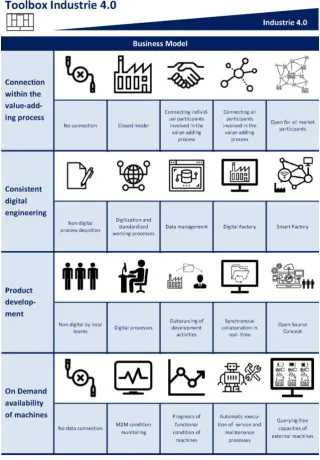
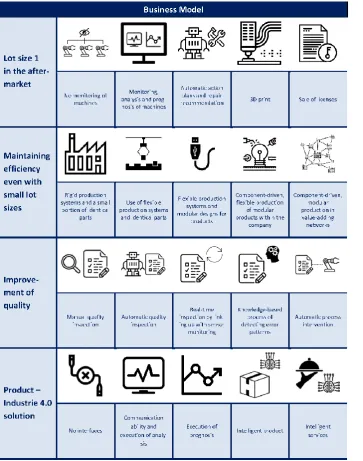
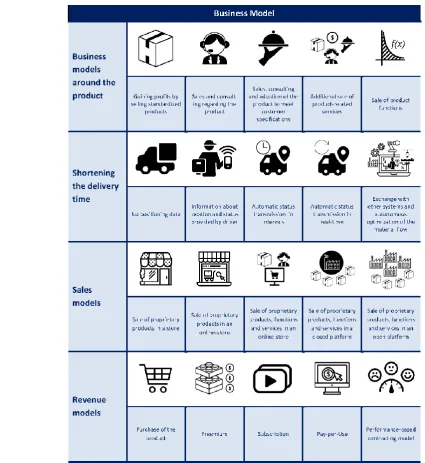
[image:3.595.139.460.292.753.2]The Business Model Toolbox consists of twelve application levels that describe topics in which further development is possible. These development stages are divided into five levels, with each level representing a state of technological development and the highest level representing the vision of Industrie 4.0 [10]. This visualization gives viewers a good overview of their competencies in terms of Industrie 4.0 and an easier identification of their innovative development potentials. The toolbox can be applied to different value creation
stages. From the optimization of the production to the sale of the product and even beyond. The goal is to create value for customers and generate new revenue. Depending on the stage of development, the individual application areas have different characteristics, which are explained below (see Fig.2, Fig.3, Fig.4).
A. Connection within the value-added process
The first application level ist connection within the value-added process. As digitalization progresses, cooperation and partnerships become more important. By networking within the company and with market participants both within and outside the value chain, synergies can be exploited. In addition, standardized processes, unified IT solutions and consistent file formats arise [9]. Building networks with suppliers and partners enables flexible and shared value creation. Processes are optimized, cost advantages realized and risks shifted. In the first development stage there are no networks in the company. Systems and machines are not able to communicate with each other since they are not connected to any IT infrastructure. All processes are isolated and are not interdependent. In the second stage, the company exists as a closed model. All processes within the company work in interaction with each other. Disruptions within a process chain that affect other processes can be better controlled at this stage. Every single system and machines are capable of communication and thus allows an uninterrupted process. In the next stages, it will be possible to integrate individual partners within the value chain due to consistent data formats. The company no longer exists as a closed model, but is open to a group of participants or in the fourth stage for all participants in the value chain. In the fifth stage of development, the company finds itself in an open marketplace model. No market participants are excluded. The company can act as a marketplace operator who provides the IT infrastructure or act as a participant in the marketplace. (Fig.2)
B. Consistent Digital Engineering
With increasing digitalization, integrated digital engineering is increasingly becoming more important. The entire business process - from product development and planning to production and operation - should be digitally reproducible to the greatest possible extent for an easier optimization. In the first stage there are neither standardized nor digitized procedures for documenting the processes. With the step into the Industrie 4.0 the digitization takes place and standardized work processes are introduced. Standard programs are used for planning to capture each business process, e.g. for the product development the CAx systems and the product data management systems or the enterprise resource planning systems. In the third development stage data, collected in the second stage, are concatenated and provided by data management. . A database stores all the information and data of the business process to which the user has access to with the respective application. Given the large number of different data formats and user groups, it can be problematic if the relevant data is not compatible with the programs of the users. For information and data access, information in the database must be entered in such a way that it can be used for every user directly for further planning steps. In the fourth stage, these data are used to create a digital image of
the real factory. In this digital factory, elements of the model can be changed for design and construction purposes. The goal is to transfer the results of the experiment to the real processes and to improve them. In this factory not only all processes and units are planned and visualized in a computer model, but also simulated. Through the realistic presentation in a virtual space, the viewer has the impression of being physically in this modeled environment and can better evaluate the production process, in particular the ergonomics of production. The highest development stage is the smart factory. The intelligent factory is able to independently organize and optimize itself without human intervention. Every single component of the intelligent factory is connected to one another and capable of communication. Thus, even small series can be produced profitably, which are otherwise only possible with mass products. (Fig.2)
C. Product development
The development of new products nowadays requires a way of working in which cooperation is computer-aided to keep up with the changing environmental and working conditions. This is considered in the application level product development. In the first stage, development takes place at the headquarters. Local teams work together non-digital. With the step into the second stage the work becomes increasingly digitized. An information exchange between individual team members can take place. In the third development stage, development tasks can be partially outsourced so that the company can focus on its core competences. The technology of the company has evolved to such an extent that external service providers can get access to the required information. Consistent digital data models are the basis for a cooperation. However, collaboration is often hampered by the impossibility of accessing a file simultaneously. Therefore, the next stage is reached when there is a synchronous operation. Changes in the file are adjusted in real-time for all users. For companies that want to scale fast, the open source concept is particularly interesting. In the fifth stage, development is decentralized and takes place on a platform. Involving users in the development process or transferring that task to the community not only helps to meet customer requirements better, but also reduces development time. Users can quickly provide feedback on the product, bringing the product to market faster while improving its quality. (Fig.2)
D. On Demand Availability of Machines
E. Lot size 1 in the after-market
Failures of machines lead to interruptions in production and thus cause high costs that can be avoided. Spare parts can mitigate the impact of a failure. However, these must be available and deliverable at all times. Lot size 1 in the aftermarket is therefore becoming increasingly important for industrial goods. In the first stage, a failure cannot be avoided. Therefore, spare parts must be stored, which in turn cause storage costs. Here, the size of the part and the duration of storage play a major role. Particularly critical and costly are spare parts of older products that are no longer produced. To reach the second stage, machines can be monitored and announce failures. This allows the operator to react in time and to adjust its production. The machine detects its condition and can make a prognosis about its functionality. If actions for service and maintenance are autonomously executed, the company is in the third stage of development. The use of 3D printing technology in the next stage will allow the production of complex spare parts in a short time. This can reduce stock
levels and a faster delivery. The highest level of development is aimed at selling spare parts licenses. The customer can print a defined number of parts against the purchase of this license and is therefore more flexible in its production. It also eliminates delivery time and delivery costs. (Fig.3)
F. Maintaining efficiency even with small lot sizes
[image:5.595.125.489.299.761.2]Efficiency with small batches is a decisive competitive factor. In many sectors, the interest in individual products is increasing. And so companies need to be able to adapt their goods to the different needs of their customers. However, this consideration increases the complexity of production processes. Flexible production systems and modular design for the products can be used to efficiently create customized products and reduce complexity in production. [9] In the first stage, the company has a rigid production system and only a small proportion of identical parts. The use of flexible production systems and identical parts enables a more efficient production process. The modular design of
the products significantly simplifies the complexity of the product and the manufacturing process. If the manufacturing process is component-driven, flexible and products are modular, the company is in the fourth development stage. At the highest level, this production structure is transferable throughout the value creation network. Products can be produced in high variety with low quantities at controllable costs and efficiently. Similarly, mass production can be combined with the desire for customized products through the use of modern information and communication technologies. (Fig.3)
G. Improvement of quality
A major advantage in the competition is a high-quality product. This means not only to offer a perfect quality product, but also to prevent faulty products from being circulated on the market. In the first development stage, the quality inspection is manually. Here, the traditional methods of quality management are used. The 100% exam or random sampling are exemplary methods for evaluation. At a higher level, the inspection is performed automatically. However, the response is delayed, which means that the process cannot be corrected immediately to fix the error, but only after completion of the examination. In the third stage, real time inspection takes place. With sensor monitoring, early fault detection is possible to reduce defective goods and rework, thereby reducing the cost of quality inspection. In order to avoid errors and the production of faulty products, machines must be able to process data from the quality inspection and the sensor monitoring with the aid of a knowledge-based error pattern recognition. The automatic intervention in and optimization of the process optimizes displays the fifth stage. There is no time lag between quality inspection and process adaptation. (Fig.3)
H. Product – Industrie 4.0 solution
Another important aspect is the product - Industrie 4.0 solutions. Technologies enable intelligent products by the use of CPS. Beyond the product, intelligent services can be offered with the help of software intelligence that processes generated data. This creates new service concepts such as benchmarks and optimization services, which creates added value for the customer. The first stage is a product without interfaces or functionalities. The product is unable to exchange information with other products or machines or unable to evaluate its condition. As soon as there is a connection, the second development stage has been reached. The product is capable of communication, can detect failures and transmit the condition. At a higher level the product executes prognosis on its functionality. The fourth stage depicts CPS-equipped products, which are able to communicate with other CPSs over the Internet or other data structures. The networking of systems allows independent and mutual coordination of the components in order to optimize the value creation process. At the highest development stage, intelligent products are combined with intelligent services. These data-driven services receive information from machines and sensors and enable services such as comparing products, services, and processes to provide optimization solutions. (Fig.3)
I. Business models around the product
In the ninth application level, business models around the product are depicted. Profits may be achieved by selling
standard products or by creating a customer value added with product-related services or with product customization. Industrie 4.0 opens the possibility to sell product functions. In the first stage of this application level, a standard physical product is solely sold. This describes the only way for the company to make profits. With the additional sale of consultant services to the product, the second stage of development is achieved. Products are being equipped with more and more functionalities, so that an introduction or counseling regarding the product is needed as a service. In the third stage, the individualization of the product is allowed. Companies allow customer to adapt the product according to their requirements. With the sale of additional product-related services, the fourth stage of development is reached. At the highest level, the company focuses on selling product functions rather than the physical product itself. (Fig.4)
J. Shortening the delivery time
Customer satisfaction can be increased by a shorter delivery time. A delay in the customer delivery may result in delaying the customer production process by causing a disturbance of the material flow. In the first stage, no location of delivery vehicles is possible. Delayed or premature delivery can neither be avoided nor announced. Information about the status of the delivery can be provided in the second stage by the driver. This person can use a communication medium to inform the customer or the company about his location. By equipping the delivery vehicles with RFID chips in the third stage vehicles and thus also the product can be identified and located. In defined intervals, this information is transmitted automatically. In the fourth stage, the transmission takes place in real time. Any delay or other disruptions in the supply chain will be reported directly. In this way the customer and the operator can adjust his value added process accordingly. In the fifth development stage, all systems are equipped to that extent that not only does the transmission of the information take place in real time, but all subsequent processes are automatically adapted and optimized. By reducing delivery times and thus increasing productivity, the manufacturer can demand higher prices. (Fig.4)
K. Sales models
The application level sales model represents different models for purchasing products. A classical way represents the purchase of the product in a store or an online store. At a higher development level, products, functions and services of selected market participants are offered. Customers get a wider range of products and can sort and select them by price and subjective criteria. In the first stage a company sells its product exclusively in a local store. The advantage is the personal contact with the customer and by that forming a strong relationship. However, this leads to rental costs. The sale of products in an online store allows the customer a more convenient ordering process. The customer is not restricted to any specified time periods to purchase the product. While the first two stages of development only relate to the physical product, the additional online sale of services and functions is considered in the third stage.
participants in a closed platform. In the fifth stage, the marketplace is open to all. The customer is able to compare the product in a benchmark and the platform operator can gain additional profits through the mediation of suppliers and buyers. (Fig.4)
L. Revenue models
The development in information and communication technology makes new revenue models possible. A classic model is the purchase of products. This is the first development stage in the toolbox. The property rights of the product are assigned to the customer against a payment. In the second stage, a more recent sales model is shown: the Freemium model. Here, a basic product is initially offered for free. Additional features and enhancements can be added for a fee. Through the free offer a broad customer base can be built. In order to generate revenue, the company can use two methods. The customer uses the free basic product and buys the paid premium service. Or the customer can use the basic product as well as the premium product free of charge
at first, and repurchases the premium product for a fee. In the third stage, customers subscribes service for a limited time frame for a regular payment. The fourth development stage is the Pay-per-Use model. Customers pay according to their usage behavior. At the highest development level, the performance-based contracting model determines the compensation on the basis of the result achieved and according to the performance provided by the machine. (Fig.4)
IV. HOW TO USE THE TOOLBOX
[image:7.595.56.482.300.764.2]According to Generic Procedure Model to Introduce Industrie 4.0 in SME, a workshop concept for generating new business models for Industrie 4.0 with the usage of the Toolbox Industrie 4.0 Business Model is developed below. [9] It is intended to help companies in the mechanical engineering sector recognize competencies and potentials related to Industrie 4.0 and to provide impulses for new business models. The generic process model for developing new business models for Industrie 4.0 consists of the five
phases: preparation phase, analysis phase, creativity phase, evaluation phase and introduction phase. The workshop accompanies the company during the analysis phase, the creativity phase and the evaluation phase on its path to Industrie 4.0 in order to generate impulses for the development of new business models. Within a limited time frame the participants of the workshop deal intensively with the topic business model and elaborate the workshop goals. The active participation of the members, as well as the visualization foster creativity and bring new insights.
A. Developing new Business Models in a Workshop
The generic procedure model is initiated with the preparation phase. The goal of this phase is to create a common understanding of Industrie 4.0 in order to prepare the project team for the next phase. As part of a workshop, the business activity for value generation are examined in the analysis phase. This serves as the basis for identifying potentials based on current business models. The creativity phase forms the core of the workshop concept. Using creativity techniques, such as brainstorming, the workshop participants identify ideas for new digital business models. These ideas are then analyzed discussed in the group. In the second phase of the creativity phase business models ideas for a closed as well as an opened platform a generated. In the evaluation phase ideas are prioritized and evaluated within the group in terms of market potential, resources and competencies. Following the workshop, a project team can elaborate the business model concepts in detail and implement them as projects in the introductory phase.
The Toolbox Industrie 4.0 Business Model is to be integrated into the analysis and creativity phase of the workshop to measure and determine the current and target development level of a company regarding Industrie 4.0. The Toolbox Industrie 4.0 Business Model covers processes from order intake to delivery, as well as the supply chain and engineering and helps companies in the analysis phase to identify and visualize the current state of development of each application level. In the creativity phase, questions related to the development of business models are future-oriented. The Toolbox Industrie 4.0 Business Model visualized the progress or the developmental leap that is aimed at, but also gives the user suggestions on possible business models.
B. Further research and development fields
It is also imaginable to connect the Toolbox Industrie 4.0 Business Model with IT security measures. A change in the development stage on an application level of the Toolbox Industrie 4.0 Business Model can automatically derive IT measures necessary to secure the business model and build a secure production network that ensures secure data exchange.
By connecting the different Toolboxes with one another and depending on the pursuit of the top-down or bottom-up strategy and the scope and detail of the key questions either only an awareness of Industrie 4.0 arises or a clear strategical guideline on how to implement the digital transformation process can be developed. Also, only certain processes in the company or all processes with all partner companies can be addressed.
C. Validation of the Toolbox
The validation of methods and the verification of the Toolbox Industrie 4.0 Business Model were conducted in four project formats. The first one is a holistic project format over one year, which includes the strategic positioning of the enterprises in the value creation network on the market, such as research project Cyber-physical Intralogistics systems for Flexible medium-volume production (CypIFlex). With the application level of the Toolbox Industrie 4.0 Business Model the medium-sized manufacturing enterprise of the project consortium was able to develop specific solutions and to subsequently implement these solutions successfully in a real production and intralogistics environment.
The second format is a compact workshop concept, which supports the enterprise to generate their own framework to implement Industrie 4.0 [4].
The third format transfers the Toolbox Industrie 4.0 Business Model to regular competence-building events in the project “Mittelstand Industrie 4.0 – Kompentenzzentrum” (MiT 4.0). MiT 4.0 is focusing on knowledge transformation from research projects to industrial approach with respect to Industrie 4.0. The fourth format is a coaching event for trainers, which imparts the methods and procedures to develop a corporate Industrie 4.0 workshop. This format is validated in several Industrie 4.0 train the trainer seminaries.
V. CONCLUSION
Business models are changing due to technological and economic changes. The implementation of Industrie 4.0 in the value added process offers many potentials. In order for a company to differentiate itself from the competition service deliveries will be done through a dynamic business network and are increasingly becoming the main product rather than the product supplementation. In addition, business models have to be adapted to changing conditions or new concepts need to be developed.
The designed business model toolbox depicts the different elements and stages of development of business models. The application levels cover many business processes that may be affected by the implementation. For the development of new business models ideas processes from order intake to delivery, as well as processes in the supply chain and development are considered. This Toolbox can be used in workshops during the analysis and creativity phase to identify the company's maturity level in terms of Industrie 4.0 and to provide ideas for new business models. The Toolbox Industrie 4.0 Business Models is easy to use and enables a systematical generation of ideas, which forms the starting point for further business models.
VI. REFERENCES
[1] Spath, Dieter; Ganschar, Oliver; Gerlach, Stefan; Hämmerle, Moritz; Krause, Tobias; Schlund, Sebastian (2013): Produktionsarbeit der Zukunft-Industrie 4.0: Fraunhofer Verlag Stuttgart.
[2] Kaufmann, Timothy (Hg.) (2015): Geschäftsmodelle in Industrie 4.0 und dem Internet der Din-ge. Der Weg vom Anspruch in die Wirklichkeit. 1. Aufl. 2015.
[3] Botthof, Alfons (Hg.) (2015): Zukunft der Arbeit in Industrie 4.0. Berlin, Heidelberg
[5] H. Kagermann, W. Wahlster, and J. Helbig (2013, April). Recommendations for implementing the strategic initiative Industrie 4.0. Securing the future of German manufacturing industry [Online]. Available: http://www.acatech.de/fileadmin/user_upload/Baumstruktu r_nach_Website/Acatech/root/de/Material_fuer_Sonderseiten/Industri e_4.0/Final_report__Industrie_4.0_accessible.pdf
[6] Eckert, Claudia (2013): IT-Sicherheit. Konzepte - Verfahren - Protokolle. 8. Aufl. München: De Gruyter.
[7] Bedner, Mark; Ackermann, Tobias (2010): Schutzziele der IT-sicherheit. In: Datenschutz und Datensicherheit-DuD 34 (5), p. 323– 328.
[8] Spitz, Stephan; Pramateftakis, Michael; Swoboda, Joachim (2011): Kryptographie und IT-Sicherheit. Grundlagen und Anwendungen. 2., überarbeitete Auflage. Wiesbaden: Vie-weg+Teubner Verlag [9] R. Anderl, A. Picard, Y. Wang, J. Fleischer, S. Dosch, B. Klee, and J.
Bauer, “Guideline Industrie 4.0 - Guiding principles for the implementation of Industrie 4.0 in small and medium sized businesses,” in VDMA Forum Industrie 4.0 2015.
[10] Y. Wang, G. Wang, and R. Anderl, “Generic Procedure Model to Introduce Industrie 4.0 in Small and Medium-sized Enterprises,” in
Lecture Notes in Engineering and Computer Science: Proceedings of
The World Congress on Engineering and Computer Science 2016, pp.
971-976.
[11]BITKOM, VDMA, and ZVEI (2015, April). Umsetzungsstrategie Industrie 4.0 – Ergebnisbericht der Plattform Industrie 4.0 [Online]. Available: https://www.bitkom.org/Publikationen/2015/Leitfaden/Um setzungsstrategie-Industrie-40/150410-Umsetzungsstrategie-0.pdf [12] T. Bauernhansl, M.. ten Hompel, and B. Vogel-Heuser, Industrie 4.0
in Produktion, Automatisierung und Logistik. Wiesbaden: Springer
Vieweg, 2014.
[13] Anderl, R., “Industrie 4.0 – technological approaches, use cases, and implementation,” Automatisierungstechnik, vol. 63, pp. 753-765, 2015.
[14] Plattform Industrie 4.0. (2014, April). Neue Chancen für unsere Produktion – 17 Thesen des Wissenschaftlichen Beirats der Plattform Industrie 4.0 [Online]. Available: http://www.its-owl.de/file admin/PDF/Industrie_4.0/Thesen_des_wissenschaftlichen_Beirats_In dustrie_4.0.pdf
[15] BMWi. (2012). IT-Sicherheit für Industrie 4.0 [Online]. Available: http://www.bmwi.de/BMWi/Redaktion/PDF/Publikationen/Studien/it-sicherheit-fuer-industrie-4-0-langfassung,property=pdf,bereich=bmwi 2012,sprache=de,rwb=true.pdf
[16] R. Anderl, “Industrie 4.0 - Advanced Engineering of Smart Products and Smart Production,“ in 19th International Seminar on High Technology 2014, Piracicaba, Brasil.
[17] R. Anderl, O. Anokhin, and A. Arndt, “Effiziente Fabrik 4.0 Darmstadt – Industrie 4.0 Implementierung für die mittelständige Industrie,“ in Industrie 4.0 grenzenlos, U. Sendler, Ed. Berlin, Germany: Springer Vieweg, 2016, pp. 121–136.
[18] Günther Schuh, Reiner Anderl, Jürgen Gausemeier, Michael ten Hompel, Wolfgang Wahlster (Hrsg.), Industrie 4.0 Maturity Index - Die digitale Transformation von Unternehmen gestalten, Berlin. [19] VDI-Statusreport 2018, Digitale Transformationprozess in