Abstract— Previous studies found that training significantly improved the comprehensibility of graphical symbols. The aim of this paper is to present a comprehensive review of symbol training in past 40 years. Three symbol-training methods (i.e. paired-associate learning, recognition training, recall training) that were commonly used by ergonomists or industrial designers are identified in this paper. Relationships between training methods and symbol comprehension are summarized. Experimental design and analysis for symbol-training studies are also described. This review would be helpful in formulating research plans and methodology for conducting other symbol-training studies.
Index Terms—graphical symbol, symbol-training method,
paired-associate learning, recognition training, recall training
I. INTRODUCTION
The term signs, icons, symbols, pictograms, pictographs, and glyphs often appear and appear to be interchangeably in the literature for depicting physical objects, concepts, or functions. Even though users may guess what an icon represents at the very first time, training could improve the process of understanding the meaning of an icon [1]. Blum and Naylor [2] defined training as ‘a process that develops and improves skills related to performance’. Bailey [3] identified training as ‘the systematic acquisition of skills, knowledge, and attitudes that will lead to an acceptable level of performance on a specific task in a given context’. The extent to which training brings desired or appropriate outcomes is called training effectiveness [4].
Prior researches revealed that training significantly improved the comprehension of the meaning of symbolic traffic signs [5], occupational safety symbols [6], industrial-safety and pharmaceutical symbols [7], service symbols [8], warning symbols in products [9], and hazardous material symbols [10]. In this paper, a comprehensive review on symbol-training in past 40 years is given and some current symbol-training methods are identified. Relationships between training methods and symbol comprehension are also presented. Experimental design and statistical analysis for symbol-training studies are also summarized. This review would be helpful in providing useful background information for formulating research plans and methodology for
Manuscript received 24, April, 2007.
Annie W.Y. Ng is currently a senior research associate of the Department of Manufacturing Engineering and Engineering Management, City University of Hong Kong, Kowloon Tong, Hong Kong (e-mail: [email protected]).
Alan H.S. Chan is now with the Department of Manufacturing Engineering and Engineering Management, City University of Hong Kong, Kowloon Tong, Hong Kong ( phone: (852) 27888439; fax: (852) 27888432; e-mail: [email protected]).
conducting further symbol-training studies. II. SYMBOL-TRAINING METHODS
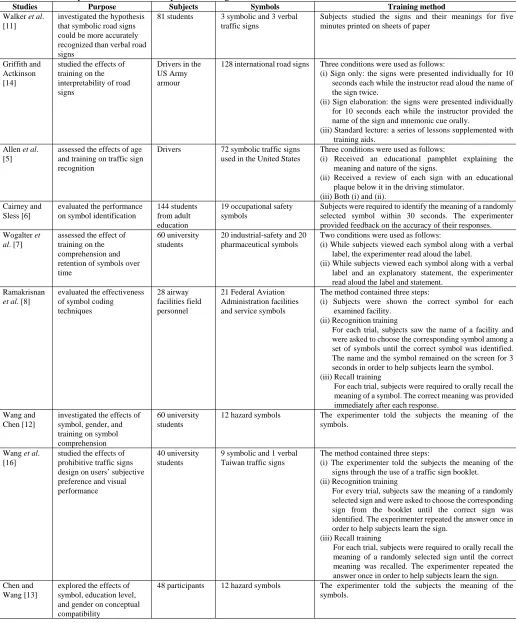
Table 1 presents a summary of studies related to symbol training in past 40 years. Three symbol-training methods have been commonly used by ergonomists or industrial designers. The first method is called paired-associate learning. With this method, the learning is done in pairs of a symbol and its meaning so that one member of the pair evokes recall of the other [5], [11] - [13]. Other than the option of providing a short phrase, other means such as a mnemonic cue [14], an explanatory statement explaining the nature of the concept or hazard [7], or a short paragraph describing an accident that results from failure to comply with the symbol [9] was also used.
The second method is called recognition training. Recognition is the ability ‘to identify something or someone that has been seen, heard, etc. before’ [15]. With this method of training, subjects were first informed of the meanings of all symbols. They then were given the meaning of a symbol and asked to choose the most appropriate symbol among the given selections in a trial. Feedback on the response accuracy was provided immediately [8] [10] [16].
The third method is called recall training. Recall means ‘bring something or someone back into the mind or recollect’ [15]. An earlier study of Brown [17] stated that the examination of distracters in recognition may produce some sorts of interference and Sternberg [18] indicated that recall tasks elicited a deeper level of learning than recognition tasks. In the recall training method, subjects were first notified about the meaning of the testing symbols and then orally recalled the meaning of every randomly selected symbol. Feedback on the accuracy of responses was given [8] [10] [16].
III. EFFECTS OF TRAINING METHODS ON SYMBOL COMPREHENSION
There does not appear to have been any research comparing the effectiveness of different symbol-training methods. However, there are a few studies about the relationship between paired-associate learning and symbol comprehension [5] [7] [9] [14]. A summary of these studies is given in the following paragraphs.
Griffith and Actkinson [14] assessed the influence of training on 128 international road signs comprehension for drivers in the United States Army armour. Three training conditions viz. sign only, sign elaboration, and standard lecture were employed in their study. In the sign only condition, the signs were presented individually for 10
Symbol Training in Past 40 Years
Annie W.Y. Ng and Alan H.S. Chan
IAENG International Journal of Applied Mathematics, 36:2, IJAM_36_2_7
______________________________________________________________________________________
Table 1 A summary of studies related to symbol training
Studies Purpose Subjects Symbols Training method
Walker et al. [11]
investigated the hypothesis that symbolic road signs could be more accurately recognized than verbal road signs
81 students 3 symbolic and 3 verbal traffic signs
Subjects studied the signs and their meanings for five minutes printed on sheets of paper
Griffith and Actkinson [14]
studied the effects of training on the interpretability of road signs
Drivers in the US Army armour
128 international road signs Three conditions were used as follows:
(i) Sign only: the signs were presented individually for 10 seconds each while the instructor read aloud the name of the sign twice.
(ii) Sign elaboration: the signs were presented individually for 10 seconds each while the instructor provided the name of the sign and mnemonic cue orally.
(iii) Standard lecture: a series of lessons supplemented with training aids.
Allen et al. [5]
assessed the effects of age and training on traffic sign recognition
Drivers 72 symbolic traffic signs used in the United States
Three conditions were used as follows:
(i) Received an educational pamphlet explaining the meaning and nature of the signs.
(ii) Received a review of each sign with an educational plaque below it in the driving stimulator.
(iii) Both (i) and (ii). Cairney and
Sless [6]
evaluated the performance on symbol identification
144 students from adult education
19 occupational safety symbols
Subjects were required to identify the meaning of a randomly selected symbol within 30 seconds. The experimenter provided feedback on the accuracy of their responses. Wogalter et
al. [7]
assessed the effect of training on the comprehension and retention of symbols over time
60 university students
20 industrial-safety and 20 pharmaceutical symbols
Two conditions were used as follows:
(i) While subjects viewed each symbol along with a verbal label, the experimenter read aloud the label.
(ii) While subjects viewed each symbol along with a verbal label and an explanatory statement, the experimenter read aloud the label and statement.
Ramakrisnan
et al. [8]
evaluated the effectiveness of symbol coding techniques
28 airway facilities field personnel
21 Federal Aviation Administration facilities and service symbols
The method contained three steps:
(i) Subjects were shown the correct symbol for each examined facility.
(ii) Recognition training
For each trial, subjects saw the name of a facility and were asked to choose the corresponding symbol among a set of symbols until the correct symbol was identified. The name and the symbol remained on the screen for 3 seconds in order to help subjects learn the symbol. (iii) Recall training
For each trial, subjects were required to orally recall the meaning of a symbol. The correct meaning was provided immediately after each response.
Wang and Chen [12]
investigated the effects of symbol, gender, and training on symbol comprehension
60 university students
12 hazard symbols The experimenter told the subjects the meaning of the symbols.
Wang et al. [16]
studied the effects of prohibitive traffic signs design on users’ subjective preference and visual performance
40 university students
9 symbolic and 1 verbal Taiwan traffic signs
The method contained three steps:
(i) The experimenter told the subjects the meaning of the signs through the use of a traffic sign booklet.
(ii) Recognition training
For every trial, subjects saw the meaning of a randomly selected sign and were asked to choose the corresponding sign from the booklet until the correct sign was identified. The experimenter repeated the answer once in order to help subjects learn the sign.
(iii) Recall training
For each trial, subjects were required to orally recall the meaning of a randomly selected sign until the correct meaning was recalled. The experimenter repeated the answer once in order to help subjects learn the sign. Chen and
Wang [13]
explored the effects of symbol, education level, and gender on conceptual compatibility
Table 1 A summary of studies related to symbol training (continued from the previous page)
Studies Purpose Subjects Symbols Training method
Lesch [9] studied age related differences and impact of training on comprehension and memory for warning symbols
92 participants 41 warning symbols used for labelling hazards associated with products
Three conditions were used as follows:
(i) Verbal label: subjects viewed each symbol along with a verbal label describing the meaning of the symbol. (ii) Explanatory statement: subjects viewed each symbol
with a verbal label and a brief statement explaining the nature of the hazard.
(iii) Accident scenario: subjects viewed each symbol with a verbal label and a short paragraph describing an accident that resulted from failure to comply with the symbol. Wang and
Chi [10]
investigated the effects of symbol, educational specialization, and training on symbol comprehension
60 university graduates
12 hazardous material symbols
The method contained three steps:
(i) The experimenter told the subjects the meaning of the symbols through the use of a hazard symbol label booklet.
(ii) Recognition training
For every trial, subjects saw the meaning of a randomly selected symbol and were asked to choose the corresponding symbol from the booklet. The experimenter provided feedback on the accuracy of their responses.
(iii) Recall training
For each trial, subjects were required to orally recall the meaning of a randomly selected symbol. The correct meaning was provided for any incorrect responses made.
seconds each while the instructor read aloud the name of the sign twice. In the sign elaboration condition, the signs were presented individually for 10 seconds each while the instructor provided the name of the sign and mnemonic cue orally. Standard lecture was a series of lessons supplemented with training aids. Performance on sign comprehension was shown to improve after training. But there were no statistically significant differences among the training conditions.
Allen et al. [5] investigated the effect of training on the understanding and retention of 72 symbolic traffic signs contained in the United States Manual on Uniform Traffic Control Devices for drivers. One group of drivers received an educational pamphlet explaining the meaning and the nature of the signs, one group received a review of each sign with an educational plaque below it in the driving stimulator, and one group received a combination of both. The results revealed that all the three training conditions increased comprehension and memory for the meaning of traffic signs. However, the differences amongst training conditions were insignificant.
Wogalter et al. [7] examined the influence of training on the understanding and memory of 40 industrial-safety and pharmaceutical symbols. Two paired-associate learning conditions were tested: verbal label condition and verbal label with explanatory statement condition. Thirty participants viewed each symbol along with a verbal label (i.e. for describing the meaning of the symbol) while the experimenter read aloud the label. Another 30 participants viewed each symbol along with a verbal label and an explanatory statement (i.e. for describing the nature of the concept on hazard), while the experimenter read aloud the label and statement. The results demonstrated that both conditions improved comprehension and memory for the meaning of test symbols. Surprisingly, comprehension and memory was no better when an additional explanatory statement was provided than when a verbal label alone. This may be attributed to the fact that (i)
subjects were not able to encode the explanatory statements satisfactorily, (ii) the retention measure was not sensitive enough to evaluate the consequence of the explanatory statements, (iii) the verbal label alone evoked retention to a near-ceiling effect, and (iv) the explanatory statements failed to provide additional memory codes other than those provided by the verbal labels.
Lesch [9] evaluated the effect of training on the comprehension and memory of 41 warning symbols used for labelling hazards associated with products. In addition to verbal label and explanatory statement conditions, an accident scenario condition was included as well. In the verbal label condition, subjects viewed each symbol along with a verbal label describing the meaning of the symbol. In the explanatory statement condition, subjects viewed each symbol with a verbal label and a brief statement explaining the nature of the hazard. In the accident scenario condition, subjects viewed each symbol with a verbal label and a short paragraph describing an accident that resulted from failure to comply with the symbol. It was found that the three training conditions significantly enhanced the understanding and retention of the meaning of warning symbols. The verbal label produced the best performance, followed by the explanatory statement, and then the accident scenario. There were two reasons for explaining the failure of the accident scenario condition to provide additional benefit relative to the explanatory statement and verbal label conditions: (i) the length of the scenarios and the large number of symbols trained might have over-loaded the memory and (ii) participants might not process the accident scenario sufficiently.
IV. EXPERIMENTAL DESIGN AND ANALYSIS FOR SYMBOL-TRAINING STUDIES
[12]. Subjects were measured before and immediately after training in pretest and posttet, respectively. For determining whether training effects maintained over time, another posttest was held one week [5] or one month [10] following the immediate posttest. To prevent subjects from retaining the meaning of test symbols in short-term memory through subvocal rehearsal, intervening task such as letter search task and demographic questionnaire [7], playing poker [10], and puzzle game [12] was performed immediately after training.
Posttest score, difference score, and percentage change are three common indicators of training effectiveness. Difference score is the change in score between posttest and pretest. Percentage change is the ratio of difference score to pretest score. It is not recommended for use in the analysis of pretest-posttest design [19] [20]. This is because firstly, the distribution of percentage change is usually non-normal and thus violates the assumptions of most parametric statistical tests. Secondly, percentage change would create a bias and overemphasize the performance improvement of the group with poorer baseline scores. Nevertheless, some recent studies have used this statistic in pretest-posttest design analysis [21] [22]. Newby [23] recommended gain ratio, which compares the actual improvement and the theoretical maximum room of improvement, for measuring the amount of learning achieved by a trainee during a training activity. Gain ratio was earlier used by Hovland et al. [24] and some recent education studies [25]-[29]. However, it has not been used in symbol-training research.
Three methods are recommended for studying data collected from pretest-posttest comparison group design: (i) posttest score approach, (ii) analysis of covariance approach, and (iii) difference score approach [30] [31]. Assuming that there are three treatment groups and one control group in a pretest-posttest design, subjects are randomly assigned to the groups prior to pretest, and each group is measured before and after training. With the first approach, an analysis of variance is performed using posttest score as the dependent variable and treatment condition as the independent variable. With the second approach, an analysis of covariance is conducted using pretest score as the covariate, posttest score as the dependent variable, and treatment condition as the independent variable. In the third approach, an analysis of variance is performed using difference score as the dependent variable and treatment condition as the independent variable. When the data to be analyzed in the pretest-posttest design are not normally distributed, nonparametic analyses should be undertaken. Posttest score approach is less powerful than the other two approaches as pretest scores are ignored during data analysis [31]. Girden [32] specified that when the regression coefficient of posttest score on pretest score equals one, difference score approach and analysis of covariance (ANCOVA) approach will produce the same F ratio, with difference score analysis being slightly more powerful due to the lost degrees of freedom with ANCOVA. When the regression coefficient is less than one, the error term will be smaller in ANCOVA, resulting in a more powerful test.
It was noted that performance may change from pretest to posttest without treatment through maturation, history, regression revisited, mortality, instrumentation, and testing [33]. Maturation denotes the natural physiological changes from pretest to posttest within the trainee such as fatigue, hunger, and growth. History specifies events other than the treatment that have occurred between pretest and posttest. For example, there may be an increase in room temperature.
Regression revisited refers to the situation where participants
are chosen on the basis of their extreme pretest scores. Regardless of whether there is a treatment, subjects whose scores are high (low) on the first assessment will probably show a decrease (an increase) in score when they are measured a second time. Mortality indicates a phenomenon occurring when fewer participants at posttest than pretest were measured.
Instrumentation denotes that the measuring instrument used
for posttest is different from the one used during pretest.
Testing refers to the situation where pretest has a positive
change on posttest performance. As performance may change from pretest to posttest without treatment, the above six factors should be considered in the design of pretest-posttest experiments for symbol-training studies.
V. CONCLUSION
In the paragraphs above, a comprehensive review on symbol training in past 40 years was presented. Three commonly used symbol-training methods, viz., paired-associate learning, recall training, and recognition training were identified. The effects of training methods on symbol comprehension were given. The experimental design and statistical analysis for symbol-training research were also described. This review would be helpful for the design of more user-friendly symbol training programs for use in industry.
REFERENCES
[1] R. S. Goonetilleke, H. M. Shih, H. K. On, and J. Fritsch, “Effects of training and representational characteristics in icon design,” International
Journal of Human-Computer Studies, vol. 55, 2001, pp. 741-760.
[2] M. L. Blum and J. C. Naylor, “Training and learning,” in Industrial
Psychology: Its Theoretical and Social Foundations, H. Wayne and G.
Murphy, Eds. New York: Harper & Row, 1968, pp. 237-275.
[3] R. W. Bailey, Human Performance Engineering: Designing High Quality Professional User Interfaces for Computer Products, Applications and
Systems. Upper Saddle River, N. J.: Prentice Hall PTR, 1996, pp.463-480.
[4] E. Salas, K. A. Burgess, and J. A. Canon-Bowers, “Training effectiveness techniques,” in Research Techniques in Human Engineering, J. Weimer, Ed. Englewood Cliffs, N. J.: Prentice Hall, 1995, pp. 439-475.
[5] R. W. Allen, Z. Parseghian, and P. G. Van Valkenburgh, “Simulator evaluation of age effects on symbol sign recognition,” Proceedings of the
Human Factors and Ergonomics Society 24th Annual Meeting. Santa
Monica, CA: Human Factors and Ergonomics Society, 1980, pp. 471-475. [6] P. Cairney and D. Sless, “Communication effectiveness of symbolic safety signs with different user groups,” Applied Ergonomics, vol. 13, no. 2, 1982, pp. 91-97.
[7] M. S. Wogalter, R. J. Sojourner, and J. W. Brelsford, “Comprehension and retention of safety pictorials,” Ergonomics, vol. 40, no. 5, 1997, pp. 531-542.
[8] A. S. Ramakrishnan, R. L. Cranston, A. Rosiles, D. Wagner, and A. Mital, “Study of symbols coding in airway facilities,” International Journal of
Industrial Ergonomics, vol. 25, 1999, pp. 39-50.
age-related differences and impact of training,” Journal of Safety
Research, vol. 34, 2003, pp. 495-505.
[10] A. H. Wang and C. C. Chi, “Effects of hazardous material symbol labeling and training on comprehension according to three types of educational specialization,” International Journal of Industrial
Ergonomics, vol. 31, 2003, pp. 343-355.
[11] R. E. Walker, R. C. Nicolay, and C. R. Steams, “Comparative accuracy of recognizing American and international road signs,” Journal of Applied
Psychology, vol. 49, no. 5, 1965, pp. 322-325.
[12] A. H. Wang and M. T. Chen, “Effects of symbolic pictorial, gender, and training on users’ comprehension for hazardous labels,” Journal of
Ergonomic Study, vol. 2, no. 1, 2000, pp. 81-88. (in Chinese).
[13] M. T. Chen and A.-H. Wang, “Effects of dangerous materials symbols, educational background, and gender on conceptual compatibility,”
Institute ofOccupational Safety and Health Journal, vol. 11, 2003, pp.
188-196. (in Chinese).
[14] D. Griffith and T. R. Actkinson, “International road signs: interpretability and training techniques,” Proceedings of the Human Factors Society 21st
Annual Meeting. Santa Monica, CA: Human Factors and Ergonomics
Society, 1977, pp. 392-396.
[15] B. Li, Oxford Advanced Learner’s English-Chinese Dictionary (Revised
extended 4th ed.). Hong Kong: Oxford University Press, 1999.
[16] A. H. Wang, H. S. Lin, and M. T. Chen, “Effects of prohibitive traffic signs design on drivers’ subjective preference and visual performance under different driving velocities,” Journal of the Chinese Institute of
Industrial Engineers, vol. 19, no. 6, 2002, pp. 105-115. (in Chinese).
[17] J. Brown, “An analysis of recognition and recall and of problems in their comparison,” in Recall and Recognition, J. Brown, Ed. London: Wiley, 1976, pp. 1-35.
[18] R. J. Sternberg, Cognitive Psychology. Belmont, CA; Australia: Thomson/Wadsworth, 2003, pp. 151.
[19] P. L. Bonate, Analysis of Pretest-Posttest Designs. Boca Raton: Chapman & Hall, 2000, pp. 75-90.
[20] A. J. Vickers, “The use of percentage change from baseline as an outcome in a controlled trial is statistically inefficient: a simulation study,” BMC
Medical Research Methodology, vol. 1, 2001.
[21] C. L. Loprinzi, J. C. Michalak, S. K. Quella, J. R. O’Fallon, A. K. Hatfield, R. A. Nelimark, A. M. Dose, T. Fischer, C. Johnson, N. E. Klatt, W. W. Bate, R. M. Rospond, and J. E. Oesterling, “Megestrol acetate for the prevention of hot flashes,” The New England Journal of Medicine, vol. 331, no. 6, 1994, pp. 347-352.
[22] H. Anderson, P. Hopwood, R. J. Stephens, N. Thatcher, B. Cottier, M. Nicholson, R. Milroy, T. S. Maughan, S. J. Falk, M. G. Bond, P. A. Burt, C. K. Connolly, M. B. Mclllmurray, and J. Carmichael, “Gemcitabine plus best supportive care (BSC) vs BSC in inoperable non-small cell lung cancer – a randomized trial with quality of life as the primary outcome,”
British Journal of Cancer, vol. 83, no. 4, 2000, pp. 447-453.
[23] T. Newby, Training Evaluation Handbook. Aldershot, Hants, England: Gower, 1992, pp. 249-250.
[24] C. I. Hovland, A. A. Lumsdaine, and F. D. Sheffield, Experiments on
Mass Communication. Princeton: Princeton University Press, 1949.
[25] R. R. Hake, “Interactive-engagement versus traditional methods: a six-thousand-student survey of mechanics test data for introductory physics courses,” American Journal of Physics, vol. 66, no. 1, 1998, pp. 64-74.
[26] K. Cummings, J. Marx, R. Thomton, and D. Kuhl, “Evaluating innovation in studio physics,” Physics Education Research: A Supplement to the
American Journal of Physics, vol. 67, no. 7, 1999, pp. S38-S44.
[27] E. F. Redish, and R. N. Steinberg, “Teaching physics: figuring out what works,” Physics Today, 1999, pp. 24-30.
[28] D. E. Meltzer, “The relationship between mathematics preparation and conceptual learning gains in physics: a possible “hidden variable” in diagnostic pretest scores,” American Journal of Physics, vol. 70, no. 12, 2002, pp. 1259-1268.
[29] T. L. N. Emerson, and B. A. Taylor, “Comparing student achievement across experimental and lecture-oriented sections of a principles of microeconomics course,” Southern Economic Journal, vol. 70, no. 3, 2004, pp. 672-693.
[30] D. M. Dimitrov, and P. D. Rumrill, “Pretest-posttest designs and
measurement of change,” Work, vol. 20, no. 2, 2003, pp. 159-165. [31] J. A. Gliner, G. A. Morgan, and R. J. Harmon, “Pretest-posttest
comparison group designs: analysis and interpretation,” Journal of the
American Academy of Child & Adolescent Psychiatry, vol. 42, no. 4,
2003, pp. 500-503.
[32] E. R. Girden, ANOVA: Repeated Measures. Newbury Park, Calif.: Sage, 1992, pp. 57-59.