Bat Mitigation Guidelines
for Ireland
Bat Mitigation Guidelines
for Ireland
Conor Kelleher
and
Ferdia Marnell
Citation:
Kelleher, C. & Marnell, F. (2006) Bat Mitigation Guidelines for Ireland. Irish Wildlife Manuals, No. 25. National Parks and Wildlife Service, Department of Environment, Heritage and Local Government, Dublin, Ireland.
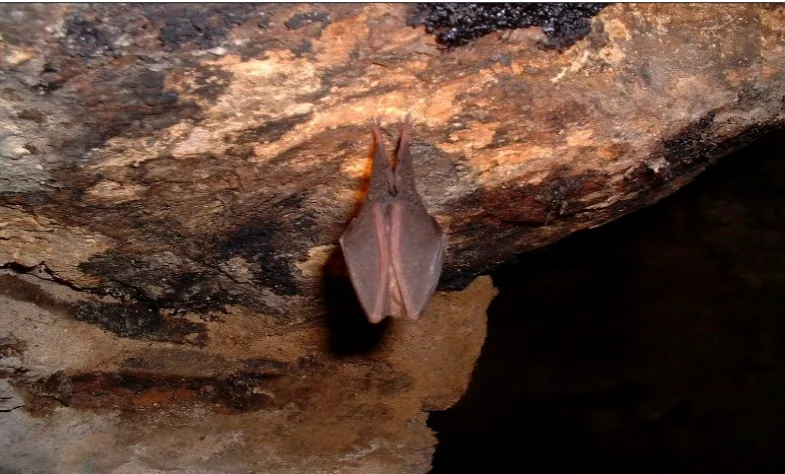
Cover photo: Brown long-eared bat(© Austin Hopkirk)
Irish Wildlife Manuals Series Editor: F. Marnell
© National Parks and Wildlife Service 2006
Key messages for developers
• Bats and their roosts are protected by Irish and EU law because all species have declined
and some are threatened or endangered.
• There are 10 known species of bats in Ireland, each with its own lifestyle and habitat
requirements. They use a wide variety of roosts, including buildings of all sorts, trees and underground places.
• Many bat roosts are used only seasonally as bats have different roosting requirements at
different times of the year. During the summer, females of all species gather in colonies to give birth and rear their young; these maternity roosts are often in places warmed by the sun. During the winter bats hibernate, often in places that are sheltered from
extremes of temperature.
• When planning a development it is advisable to check for the presence of bats as early
as possible so that any planning and licensing issues can be addressed before resources are committed. Bat surveys require specialist knowledge and equipment.
• Planning authorities are required to take account of the presence of protected species,
including bats, when considering applications for planning permission and may refuse applications on the grounds of adverse effects on these species or if an assessment of the impact of the development on protected species is inadequate. Planning conditions or agreements may be used to ensure the conservation status of protected species is maintained.
• A grant of planning permission does not constitute a licence or permit to disturb bats or
interfere with their breeding or resting places.
• Application may be made to the National Parks and Wildlife Service for a derogation
licence to permit actions affecting bats or their roosts that would normally be prohibited by law. The applicant must demonstrate that there is no satisfactory alternative and that the action will not adversely affect the favourable conservation status of the bats. Each case is considered on its particular circumstances, and an application may be refused.
• Mitigation to reduce or compensate for any impact of development is generally a
condition of the licence and must be proportionate to the impact. Mitigation measures will be proportionate to the impact and may require particular timing of operations, protection of existing roosts or the creation of new roosts to replace ones being lost. In some cases, a considerable period of time may be required to carry out this work. Monitoring of the effect of the mitigation is usually required.
• The protected species legislation applies independently of planning permission, so
licences are likely to be necessary for operations that affect bats but do not require planning permission.
• The National Parks and Wildlife Service strongly advises developers to seek the services
of a professional ecological consultant with appropriate experience in assessing bat populations when contemplating a development proposal that would affect bats or their roosts.
• This document gives generic technical advice on assessing impacts and developing
Figure 1 Main steps involved in ensuring that bat issues are properly considered in developments requiring planning permission
EVIDENCE OF USE BY BATS
PRESENT OR LIKELY TO BE PRESENT LICENCE GRANTED NPWS MINDED TO REFUSE PLANNING PERMISSION REFUSED PLANNING PERMISSION GRANTED
ABSENT OR HIGHLY UNLIKELY TO BE PRESENT
DEVELOPMENT PROPOSAL
USE EXISTING INFORMATION TO ASSESS PROBABILITY OF BATS BEING
PRESENT. SEE 4. & 5
COMMISSION DESK/FIELD SURVEY BY ECOLOGICAL
CONSULTANT. SEE 5.
CONTINUE WITH DEVELOPMENT; CONSULT NPWS IF BATS DISCOVERED DURING
WORKS. SEE 6.4
ASSESS IMPACTS, PLAN
MITIGATION (SEE 6, 7 & 8.) AND ADDRESS THE THREE KEY LICENCE CRITERIA: - PURPOSE - ALTERNATIVES
- EFFECT ON FAVOURABLE CONSERVATION STATUS. REJECT THE PROPOSAL UNLESS ALL CRITERIA ARE MET. SEE 2.2 FOR DETAILS
NPWS CONSERVATION RANGERS PROVIDE GENERIC
ADVICE ON SURVEYS, IMPACTS AND MITIGATION
SUBMIT PLANNING APPLICATION (INCLUDING MITIGATION PLAN, SEE 10.) TO LOCAL PLANNING AUTHORITY
REVISE & RESUBMIT, APPEAL, OR ABANDON SUBMIT LICENCE APPLICATION TO NPWS REVISE & RESUBMIT OR ABANDON DEVELOPMENT PROCEEDS, WITH MITIGATION NPWS PROVIDES
SITE-SPECIFIC ADVICE TO LOCAL PLANNING AUTHORITY
NO EVIDENCE OF BATS DESPITE
Contents
1 Introduction ... 9
1.1 Background ... 9
1.2 Conservation status of bats... 9
1.3 Legal status and its implications for developers ... 9
1.4 Development, mitigation and compensation ... 10
1.5 Responsibility for achieving successful outcomes... 10
2 Legislation and licensing... 12
2.1 Legislation ... 12
2.2 Derogation licences. ... 13
2.2.1 When is a licence required? ... 14
2.2.2 Actions affecting Special Areas of Conservation (SACs) ... 15
2.3 Interpretation and enforcement ... 16
3 Roles and responsibilities... 17
3.1 Introduction ... 17
3.2 National Parks and Wildlife Service ... 17
3.3 Developers and ecological consultants ... 17
3.4 Local Planning Authorities... 18
3.5 Other organisations ... 18
4 An introduction to bats ... 20
4.1 General ... 20
4.2 Roost requirements... 24
4.3 Habitat associations... 26
5 Survey objectives, methods and standards ... 27
5.1 The importance of a good survey... 27
5.2 Some general points on surveys ... 27
5.3 Setting survey objectives... 29
5.4 Survey area ... 29
5.5 Desk study ... 30
5.6 Field survey methods ... 30
5.6.1 Inspection of buildings or other structures ... 30
5.6.2 Inspection of trees ... 32
5.6.3 Use of bat detectors ... 32
5.6.4 Netting and harp-trapping ... 34
5.6.5 Radio-tracking... 34
5.6.6 Timing of surveys... 35
5.7 Survey standards ... 36
5.7.1 Presence/absence surveys... 36
5.7.2 Extent and pattern of usage ... 39
5.8 Interpreting and evaluating survey results ... 39
5.8.1 Low numbers and absence ... 39
5.8.2 Site, colony or population size class assessment... 39
5.8.3 Factors influencing survey results... 40
5.8.4 Site status assessment... 41
6 Predicting the impact of development ... 43
6.1 Introduction ... 43
6.2 Major types of impact and their effects on populations ... 43
6.2.1 Short-term impacts: Disturbance... 43
6.2.2 Long-term impacts: Roost modification ... 44
6.2.3 Long-term impacts: Roost loss... 44
6.2.4 Long-term impacts: Fragmentation and isolation ... 45
6.2.5 Post-development interference impacts ... 45
6.3 Temporal and spatial considerations ... 45
6.4 Poor data situations and ‘last-minute’ discoveries ... 46
6.5 Summarising the scale of site level impacts... 46
7 Planning mitigation and compensation ... 48
7.1 Why mitigate? ... 48
7.2 Key principles of mitigation... 48
7.3 Main components of mitigation ... 51
8 Mitigation and compensation methods ... 53
8.1 Introduction ... 53
8.2 Avoidance of disturbance, killing and injury ... 53
8.2.1 Remedial timber treatment ... 55
8.3 Avoiding damage to existing roosts ... 55
8.4 Incorporating existing roosts into refurbished buildings... 55
8.4.1 Roost size ... 56
8.4.2 Roost entrances ... 57
8.5 Incorporating new roosts into buildings... 57
8.6 Providing new roosts ... 58
8.6.1 Bat boxes ... 58
8.6.2 Bat houses or ‘bat barns’ ... 59
8.7 Post-development site maintenance and population monitoring... 65
8.7.1 Site maintenance ... 65
8.7.2 Population and usage monitoring... 65
9 Model examples ... 67
9.1 Introduction ... 67
9.2 Case Study 1: Building roost restoration 1... 67
9.2.1 Background ... 67
9.2.2 Description of works ... 67
9.2.3 Timing of works ... 68
9.2.4 Protection of access point and existing roost site... 68
9.2.5 Post-construction monitoring ... 68
9.3 Case Study 2: Building roost restoration 2... 69
9.3.1 Background ... 69
9.3.2 Description of works ... 69
9.3.3 Timing of works ... 69
9.3.4 Post-construction monitoring ... 70
9.4 Case Study 3: Church roost restoration and repair... 70
9.4.1 Background ... 70
9.4.2 Description of works ... 70
9.4.4 Protection of access points and existing roost site ... 71
9.4.5 Post construction monitoring ... 71
9.5 Case study 4: Replacement bat roost 1 – bat boxes ... 71
9.5.1 Background ... 71
9.5.2 Description of works ... 71
9.5.3 Post-project monitoring... 72
9.6 Case study 5: Replacement bat roost 2 – purpose built building ... 73
9.6.1 Background ... 73
9.6.2 Description of work... 73
9.6.3 Post-project monitoring... 73
9.7 Case Study 6: Replacement bat roost 3 – existing building restoration... 75
9.7.1 Background ... 75
9.7.2 Description of works ... 75
9.7.3 Timing of works ... 76
9.7.4 Post-construction monitoring ... 76
9.8 Case study 7: Altering an existing roost for public access... 76
9.8.1 Background ... 76
9.8.2 Description of works ... 76
9.8.3 Foreseen impacts on bats... 76
9.8.4 Mitigation measures ... 77
9.8.5 Post construction monitoring ... 79
10 Presenting mitigation plans ... 80
10.1 Recommended mitigation plan structure... 80
11 Acknowledgements... 83
12 Further reading ... 84
12.1 Literature on bat ecology, conservation and mitigation ... 84
13 Document information ... 87
13.1 Production notes ... 87
13.2 Revision history... 87
14 Appendix 1: Bat Species and Habitat Survey Timetable... 88
List of tables:
Table 4.1 Species associations with roost types... 25Table 5.1. Factors affecting the probability of bats being present. ... 28
Table 5.2. The applicability of survey methods. ... 36
Table 6.1. The scale of main impacts at the site level on bat populations. ... 47
Table 8.1 Optimum season for works in different types of roosts. ... 53
Table 8.2 Species-specific roost types. ... 56
Introduction
1
Introduction
1.1
Background
These guidelines have been developed to assist those involved with land-use planning and development operations (in the widest sense) where bats are known or suspected to occur. Although the emphasis is on developments that fall within the remit of the planning system, the guidelines apply equally to other sorts of developments and contain elements of good practice that apply to a wide range of situations. In developing these guidelines, we have drawn on a wide range of expertise, and believe that the advice given is the best that is
currently available. The basis for mitigation proposals is scientific experience and opinion and we hope that the publication of these guidelines will stimulate the collection of more
information about the success or failure of mitigation projects that can be used in improving mitigation and conservation measures for bats.
Although changes to both the planning system and wildlife legislation are made from time to time, many of the principles of survey and mitigation will continue to apply, though
developers should satisfy themselves that any proposals comply with current legislation.
These guidelines do not include the planning and development of national roads. For
information on the conservation of bats during the planning and construction of roads please see the National Roads Authority documents: Best Practice Guidelines for the Conservation of Bats in the Planning of National Road Schemes and Guidelines for the Treatment of Bats During the Construction of National Road Schemes (www.nra.ie).
1.2
Conservation status of bats
Populations and population trends in bats are particularly difficult to measure and there are few historical data on which to base any assessment of change. The fragmentary evidence available for Europe supports the view that bat populations have declined over the last century or so. In some cases, such as lesser horseshoe bats, contractions of range are well
documented, but as some species were not even described until relatively recently, historical data on distribution is lacking.
Because of their conservation importance and their value as biodiversity indicators Species Action Plans are being devised for all Irish bat species; these contain objectives relating to the maintenance and restoration of bat populations and habitats.
A national bat monitoring programme covering some, though not all, species is now in place, so some data about population trends are now becoming available. It is generally accepted that bat populations remain at risk and that the objectives of planning and licensing should be to prevent any further losses and this is reflected in national and EU law.
1.3
Legal status and its implications for developers
In view of their status across Europe, all species of bat have been listed on Annex IV of the EC ‘Habitats and Species Directive’ (see 2.1 Legislation) and some, such as the lesser
Introduction
their breeding sites and resting places are fully protected, and this has important implications for those who own or manage sites where bats occur.
Guidance on the consideration that Local Planning Authorities should give to nature conservation interests is contained in Directive 2001/42/EC of 27 June 2001, commonly known as the SEA Directive. The presence of a protected species is a material consideration when the authority is considering a developmental proposal. The protected status afforded to bats means planning authorities may require extra information (in the form of surveys, impact assessments and mitigation proposals), before determining planning applications for sites used by bats. Planning authorities may refuse planning permission solely on grounds of the predicted impact on protected species like bats. Designations of various kinds, both statutory and non-statutory, may further protect individual sites. Although the presence of bats does not in most instances preclude a land parcel from development, planning and licensing controls may limit the extent of disturbance, the timing of activities, and may well stipulate
compensatory measures. Planning conditions are often used to this end. However, the grant of planning permission does not authorise the disturbance of bats or interference with their breeding or resting places. A separate derogation licence is required.
1.4
Development, mitigation and compensation
In this document, the term ‘development’ is used to cover a wide range of operations that have the potential to impact negatively on bats and bat populations. Typical examples would be the construction, modification, restoration or conversion of buildings (some of which require planning permission), as well as infrastructure or mineral extraction projects (which may constitute permitted development and hence not require planning permission) and site clearance and demolition (which may not need planning permission). Likewise, the term ‘developer’ is used to cover individuals, companies or organisations responsible for undertaking these activities, and not simply members of the construction industry.
Where the proposed development will affect sites known to be used by bats, consideration needs to be given to the likely impact on the population(s). Even when planning permission is given, or the activity does not require such permission, the wildlife legislation, including the Habitats Regulations, applies; bats and their places used for breeding or resting are still protected. In some cases, this situation may be resolved by the issuing of a derogation licence to facilitate mitigation, which is the term used to cover measures to protect the bat population from damaging activities and to reduce or remove the impact of development. Normally, compensation for the loss of breeding or resting places is also required, and this often takes the form of roost creation, restoration or enhancement. Such a programme of mitigation and compensation should allow the conservation status of bats to be maintained or enhanced following development, thus meeting one of the licensing criteria (see 2.2 Exceptions and licensing). Note that in this document, the term ‘mitigation’ is generally used in its broad sense, to encompass both compensation and mitigation.
1.5
Responsibility for achieving successful outcomes
In order to successfully address development issues where bats are involved, a number of stages are necessary; these are outlined in Figure 1 and the roles of each key player are given in 3. Roles and responsibilities. The National Biodiveristy Plan confers general
Introduction
For developers: Sustainable Development should be a guiding principle when progressing proposals, and resolving wildlife issues requires specialist ecological knowledge. The National Parks and Wildlife Service (NPWS) recommends that developers seek the services of a professional advisor (ecological consultant) when protected species issues arise in connection with a proposed development. Contact details for ecological consultants can be obtained from a number of sources, including professional bodies. One such directory is: the
Directory of Ecologists and Environmental Managers (IEEM http://www.ieem.co.uk). Some consultants are also members of local bat groups which may be contacted via Bat
Conservation Ireland (046-9242886; www.batconservationireland.org).
For consultants: In order to successfully resolve most bat issues, consultants should have a sound knowledge of, and experience with, the species. A thorough grounding in bat ecology can be crucial to good survey and mitigation planning. Although a derogation licence to disturb bats for scientific purposes is not essential for every type of survey, it is strongly recommended that consultants possess such a licence so they do not need to withdraw if bats are found at a site. Consultants are expected to apply population ecology principles so that the local circumstances relating to a particular development proposal can be interpreted using these generic guidelines. The outline mitigation plan structure (see 10. Presenting mitigation plans) should be used where appropriate. It is expected that consultants will provide advice to clients, and information to the National Parks and Wildlife Service, planners and others, in an impartial and accurate manner. Should cases come to light where consultants appear to have wilfully or negligently misrepresented a situation or site details, the NPWS will consider bringing its concerns to the attention of the relevant client and, if applicable, the professional body. The Irish Government has emphasised its obligations under international wildlife legislation by making it an offence under Section 69 of the Wildlife Act 1976 (& amendment 2000) to knowingly or recklessly make false statements for the purpose of obtaining a licence, whether for oneself or for another.
General: These guidelines are intended to provide generic information and advice and are not meant to be taken as a rigid set of rules. Individual sites vary considerably in terms of species present, population status, roost type and so on, and the potential impacts of different types of development also vary, so it would be impossible to develop an all-encompassing document. Decisions should be made on a site-by-site basis. The methods described are those considered to be practical and effective based on past experience, but this does not mean that other methods are ineffective, inappropriate or unlawful. Similarly, the levels of mitigation effort suggested herein are based on available information, and do not necessarily constitute a statement of the lawful minimum. It would be for a court to decide whether an offence has been committed in any particular case. The legislation does not specify mitigation methods; it prohibits certain actions. Developers and their consultants may wish to take their own legal advice to provide an interpretation of the law. Notwithstanding the above caveats, these guidelines are currently the most detailed readily available source of information on
Legislation and licensing
2
Legislation and licensing
Note: The information given in this section is intended as general guidance on the law relating to bats and development, and is not comprehensive. When dealing with individual cases, readers should consult the full texts of the legislation, and obtain their own legal advice if necessary. Web addresses for the texts of legislation are given in 11. Further reading.
2.1
Legislation
2.1.1 The Wildlife Acts 1976 and 2000
All bat species are protected under the Wildlife Act (1976) and Wildlife [Amendment] Act (2000) which make it an offence to wilfully interfere with or destroy the breeding or resting place of these species; however, the Acts permit limited exemptions for certain kinds of development.
All species of bats in Ireland are listed on Schedule 5 of the 1976 Act, and are therefore subject to the provisions of Section 23, which make it an offence to:
• Intentionally kill, injure or take a bat
• Possess or control any live or dead specimen or anything derived from a bat • Wilfully interfere with any structure or place used for breeding or resting by a bat • Wilfully interfere with a bat while it is occupying a structure or place which it uses for
that purpose
2.1.2 The Habitats Regulations 1997-2005
The EC Directive on the Conservation of Natural Habitats and of Wild Fauna and Flora (Habitats Directive 1992), seeks to protect rare and vulnerable species, including all species of bats, and their habitats and requires that appropriate monitoring of populations be
undertaken. All species of bat found in Ireland are listed on Annex IV of the Directive, while the lesser horseshoe bat is further protected under Annex II. The latter Annex relates to the designation of Special Areas of Conservation (SACs). Inclusion on Annex IV (‘European protected species’) means that member states are required to put in place a system of strict protection as outlined in Article 12. The Habitats Directive is transposed into Irish law by the European Communities (Natural Habitats) Regulations 1997. These Regulations substantially strengthen the protection provided by the Wildlife Acts, and in particular they remove all of the exemptions provided in Section 23(7) of the Wildlife Act insofar as they relate to Annex IV species, including all species of bats. All bats species are listed on the First Schedule and Section 23 of the Regulations makes it an offence to:
• Deliberately capture or kill a bat • Deliberately disturb a bat
• Damage or destroy a breeding site or resting place of a bat
It is essential that developers note that, in regard to the third bullet point above, the onus of satisfying themselves that a development will not damage or destroy a breeding site or resting site of a bat rests with the developer, as the defence that the action was not done deliberately does not apply in this instance.
Legislation and licensing
derogation licence permitting any of the above activities “where there is no satisfactory alternative and the derogation is not detrimental to the maintenance of the populations of the species to which the Habitats Directive relates at a favourable conservation status in their natural range”.
Two of these circumstances are of particular interest to developers:
• “in the interests of protecting wild fauna and flora and conserving natural habitats” • “in the interests of public health and public safety, or for other imperative reasons of
overriding public interest, including those of a social or economic nature and beneficial consequences of primary importance for the environment”
Two, in addition to that in the bullet points above, are of particular interest to wildlife professionals working with bats
• “for the purpose of research and education, of repopulating and reintroducing these
species and for the breeding operations necessary for these purposes …”
• “to allow, under strictly supervised conditions, on a selected basis and to a limited extent,
the taking or keeping of certain specimens”.
It is worth noting that in some cases in which derelict buildings are being restored, there are opportunities to enhance conditions for bats and assure the availability in the future of suitable breeding and resting places. It is for this reason that the first of the four bullet points above may, in some circumstances, be relevant to developers.
Across Europe, bats are further protected under the Convention on the Conservation of European Wildlife and Natural Habitats (Bern Convention 1982), which, in relation to bats, exists to conserve all species and their habitats. The Convention on the Conservation of Migratory Species of Wild Animals (Bonn Convention 1979, enacted 1983) was instigated to protect migrant species across all European boundaries. The Irish government has ratified both these conventions.
2.2
Derogation licences.
Licences permit otherwise unlawful activities and can only be granted for certain purposes.
The National Parks and Wildlife Service issues derogation licences for scientific, educational and conservation purposes. Surveys for bats which involve otherwise unlawful acts (such as intentional disturbance or taking) may be authorised for scientific and educational purposes; this includes surveys of potential development sites.
A licence is required for the capture of bats for educational or scientific purposes, releasing a rehabilitated bat back to the wild, photography and filming near a breeding place and for retaining in captivity disabled bats which cannot survive in the wild.
In order to obtain a licence to allow the destruction of bat roosts etc, in advance of any otherwise legitimate development which may impact on the favourable conservation status of bats, Section 25 of the Habitats Regulations must be satisfied.
Legislation and licensing
resting places. Current NPWS advice is that there should be no net loss in local bat population status, taking into account factors such as population size, viability and connectivity. Hence, when it is unavoidable that a development will affect a bat population, the mitigation should aim to maintain a population of equivalent status in the area.
One of the key aims of the Directive is to encourage member states to maintain at, or restore to, favourable conservation status those species of community interest (Article 2(2)).
‘Favourable conservation status’ is defined in the Habitats and Species Directive (Article 1(i)). Conservation status is defined as “the sum of the influences acting on the species concerned that may affect the long term distribution and abundance of its population within the territory.” It is assessed as favourable when:
“population dynamics data on the species concerned indicate that it is maintaining itself on a long term basis as a viable component of its natural habitats, and
the natural range of the species is neither being reduced nor is likely to be reduced for the foreseeable future, and
there is, or will probably continue to be, a sufficiently large habitat to maintain its populations on a long term basis.”
Note that even though there is apparent overlap between the Wildlife Acts and the Habitats Regulations, they run concurrently. No action in relation to bats that would not be permitted under the Habitats Regulations may be licensed under the Wildlife Acts. Derogation licences granted under the Regulations include reference to the relevant provisions of the Wildlife Acts to ensure that all requirements for licensing are covered in the one document. It should also be noted that a licence only allows what is permitted within its terms and conditions; it does not legitimise all actions related to bats at a given site.
2.2.1 When is a licence required?
The National Parks and Wildlife Service is frequently asked by consultants whether a
derogation licence is required for a particular activity. Ultimately, however, this is a decision to be made by the consultant or client. A licence simply permits an action that is otherwise unlawful. To ensure that no illegal activities are undertaken, it is recommended that a licence is applied for if, on the basis of survey information and specialist knowledge, it appears that:
• the site in question is a breeding site or resting place for bats • the proposed activity could result in an offence
No licence is required if the proposed activity is unlikely to result in an offence. The advice given in this document should assist the consultant in arriving at a decision on this matter, though it must be recognised that determining whether a particular site is used as a breeding or resting place can be problematic for such mobile animals as bats. Note that if the proposed activity can be timed, organised and carried out so as to avoid committing offences then no licence is required (see also 8.3).
Examples of works that are likely to need a licence because they may result in the destruction of a breeding or resting place and/or disturbance of bats include:
• Demolition of buildings known to be used by bats
• Conversion of barns or other buildings known to be used by bats • Restoration of ruined or derelict buildings
• Maintenance and preservation of heritage buildings
Legislation and licensing
• Removal of trees known to be used by bats, when carried out as part of a development • Significant alterations to roof voids known to be used by bats
Examples of works that, if carefully planned, may not need a licence include:
Re-roofing, if carried out while bats are not present and the access points and roosting area are not affected;
Remedial timber treatment, carried out with the correct (non-toxic to bats) chemicals while bats are not present.
2.2.2 Actions affecting Special Areas of Conservation (SACs)
Particular statutory requirements apply to operations of activities to be carried out in SACs (including candidate SACs). For each designated site there is a list of notifiable actions which may not be carried out unless written consent has been given by the Minister (Regulation 14 of the Habitats Regulations 1997). Application for such consent is made to the National Parks and Wildlife Service regional staff. It may be refused, and if granted, there are likely to be mitigation requirements as a condition of the consent.
Furthermore, Regulation 18 of the 1997 Regulations prohibits operations or activities outside an SAC, but that are liable to have an adverse effect on the integrity of the site concerned, either alone or in combination with other operations or activities. The Regulations require the carrying out of an appropriate assessment in respect of such a proposed operation or activity. If the Minister, having regard to the conclusion of the assessment, is of the opinion that the operation or activity will adversely affect the integrity of the site concerned, the Minister shall make application to a court of competent jurisdiction to prohibit the continuance of the
operation or activity.
[image:15.595.72.474.194.442.2]It will be apparent, therefore, that a developer proposing to carry out any operation or activity that constitutes a notifiable action or that, even though outside the boundary of an SAC, may adversely impact on the integrity of that SAC, needs to ensure beforehand that all of the necessary consents and clearances are in place before the operation or activity commences.
Legislation and licensing
2.3
Interpretation and enforcement
As the legislation applies to a wide range of species, its provisions are generic in nature and there are no detailed definitions of, for instance, exactly what constitutes a ‘resting place’ for a bat, nor what has to be proved to establish that an act was wilful. Were a breach of the law to be alleged, a court would have to decide whether an offence did in fact occur. Note that under the Wildlife Acts wilful interference at a breeding site or resting place is an offence. However, there are currently no legal precedents that are helpful in interpreting what constitutes a place used for breeding and resting.
The National Parks and Wildlife Service Conservation Rangers are the main enforcement body for wildlife offences. The maximum penalty for summary conviction has been increased to €1,904 and/or 12 months imprisonment and, on indictment, is €63,487 and/or two years
[image:16.595.135.525.312.593.2]imprisonment.Note that fines may be imposed in relation to each offence committed, so operations involving many animals or repeated offences can potentially accrue large fines. In addition, items which may constitute evidence of the commission of an offence may be seized and detained.
Roles and responsibilities
3
Roles and responsibilities
3.1
Introduction
In order for bats to be protected successfully when development is planned, a number of organisations will need to interact. Each organisation has its own role, and in some cases its statutory duties, to carry out. This section spells out the roles and responsibilities of the main players connected with development, with the intention of promoting more effective liaison.
3.2
National Parks and Wildlife Service
The National Parks and Wildlife Service is the Government’s statutory nature conservation advisor. In the current context it has the following functions:
• Provision of advice to Local Planning Authorities on protected species issues, including
consultations on planning applications where bats are thought to occur;
• Provision of general advice to developers, consultants and others on protected species
cases (through documents such as the current one; NPWS Conservation Rangers may also provide site-specific advice, though this will vary with local circumstances);
• Provision of advice to Local Planning Authorities on forward planning (e.g.
commenting on Local Plans);
• Provision of generic advice to Local Planning Authorities, including the legal
background to protected species casework;
• Determining applications for licences for bat survey work (scientific and conservation
licences);
• Provision of advice about bats in dwelling-houses;
• Statutory consultee over planning issues affecting designated conservation sites; • Keeping and updating the National Lesser Horseshoe Bat Database;
• Management of National Parks.
Contact details (head office): The National Parks and Wildlife Service, Department of the Environment, Heritage and Local Government, 7 Ely Place, Dublin 2; Tel 01-8882000; Locall: 1890-202021; Fax: 01-8883272; web: www.npws.ie; Email:
[email protected] [for initial discussions about individual sites, the relevant local Conservation Ranger should be contacted; contact details for Rangers are available from the head office, website or within the State Directory section of local telephone directories].
3.3
Developers and ecological consultants
The developer and their advisor(s) share the responsibility for the following:
• Ensuring that they provide to Local Planning Authorities a satisfactory and accurate
assessment of application sites, including surveys for bats if their presence is suspected;
• Applying for a derogation licence to NPWS, should they judge one to be required; • Providing a sound and objective assessment of the potential impact of proposed
development on bat populations;
• Where necessary, designing and implementing a mitigation scheme that meets planning
and licensing requirements, and in particular will ensure as far as possible the long term future of any populations affected; such schemes should employ ‘best practice’;
• In many cases, monitoring affected populations after completion of development, as
Roles and responsibilities
3.4
Local Planning Authorities
Local Planning Authorities have the following roles:
• Ensuring that protected species issues are taken into account as a material consideration
when determining planning applications. This may involve refusal, deferral, conditions or agreements;
• Satisfying themselves that in submitting plans, developers have satisfactorily assessed
the presence of bats and the potential impact on bats of the proposed development
• Ensuring that protected species issues are taken into account in preparation of Local
Plans, etc. (this is best addressed through species protection policies in development plans);
• In order to achieve the above, developing means of assessing information on the
presence of bats, in order to better inform planning decisions; this may include
consultation with the National Biological Records Centre, ENGOs or liaison with local voluntary groups;
• Raise awareness of protected species in their area;
• According to information available, advising developers about statutory species
protection provisions affecting an application site;
• Enforcement of planning obligations.
3.5
Other organisations
[image:18.595.149.526.346.609.2]The National Biological Records Centre will have useful information on the location of bat roosts and can provide such details to consultants, developers and Local Planning Authorities. Contact details: National Biological Records Centre, Beechfield House, Waterford Institute of Technology Campus, Carriganore, Co. Waterford. Similarly, local bat groups often collect data and may be able to provide a more detailed assessment of status; some may also be willing to undertake bat surveys in advance of planning applications. These voluntary groups are associated with Bat Conservation Ireland, which has a national database on all known species’ roosts and sightings. Contact details: Bat Conservation Ireland, Deerpark House,
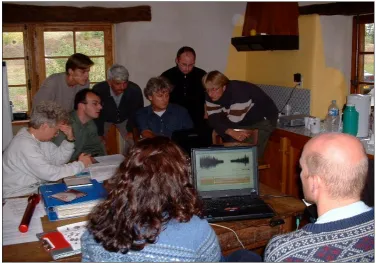
Figure 3. Training in bat ecology and
Roles and responsibilities
Tierworker, Kells, Co. Meath; Tel: 046-9242882; Email: [email protected] ; website: www.batconservationireland.org . The Vincent Wildlife Trust has details of lesser horseshoe bat in the west of Ireland and within its reserves. Contact details: Dr. Kate McAney, The Vincent Wildlife Trust, Donaghpatrick, Headford, Co. Galway; Tel/Fax: 093-35304; Email: [email protected] .
An introduction to bats
4
An introduction to bats
4.1
General
In order to understand the potential effects of development work and plan effective
mitigation, it is essential to have knowledge of bat ecology. This knowledge is likely to be most relevant to ecological consultants, whose role it is to undertake site surveys, predict impacts and propose mitigation. The National Parks and Wildlife Service and Local Planning Authority staff will also benefit from such understanding. This section is not intended as a comprehensive description of bat ecology, as consultants are expected to have developed their own knowledge through study and field experience. It is meant as a general introduction, mainly for developers, to the life-cycle of bats and aspects of their biology. A range of more detailed references is given in 12: Further reading.
Bats are the only true flying mammals. Like us, they are warm-blooded, give birth and suckle their young. They are also long-lived, intelligent and have a complex social life. Although they're often thought of as flying mice, they're not closely related to mice but form a special group of their own: the Chiroptera. World-wide, there are over 1,100 different sorts of bat, ranging from the tropical flying foxes, with a wing-span of almost 2 metres (6'), down to the hog-nosed bat of south-east Asia, which is little bigger than a large bumble-bee.
In Ireland, currently, there are 10 known species, of two families (Vespertilionidae and Rhinolophidae) all of which are small (many weigh less than a €2 coin) and eat insects and
spiders:
Vespertilionidae:
Common pipistrelle Pipistrellus pipistrellus
This species was only recently separated from its sibling, the soprano or brown
pipistrelle Pipistrellus pygmaeus, which is detailed below (Barratt, E. M., Deauville, R. Burland, T. M., Bruford, M. W., Jones, G., Racey, P. A. & Wayne, R. K., 1997). The common pipistrelle's echolocation calls peak at 45 kHz. The species forages along linear landscape features such as hedgerows and treelines as well as within woodland.
Soprano pipistrelle Pipistrellus pygmaeus
The soprano pipistrelle's echolocation calls peak at 55 kHz, which distinguishes it readily from the common pipistrelle on detector. The pipistrelles are the smallest and most often seen of our bats, flying at head height and taking small prey such as midges and small moths. Summer roost sites are usually in buildings but tree holes and heavy ivy are also used. Roost numbers can exceed 1,500 animals in mid-summer.
Nathusius' pipistrelle Pipistrellus nathusii
An introduction to bats
Leisler’s bat Nyctalus leisleri
This species is Ireland’s largest bat, with a wingspan of up to 320mm; it is also the third most common bat, preferring to roost in buildings, although it is sometimes found in trees and bat boxes. It is the earliest bat to emerge in the evening, flying fast and high with occasional steep dives to ground level, feeding on moths, caddis-flies and beetles. The echolocation calls are sometimes audible to the human ear being around 15 kHz at their lowest. The audible chatter from their roost on hot summer days is sometimes an aid to location. This species is uncommon in Europe and as Ireland holds the largest national population the species is considered as Near Threatened here.
Natterer’s bat Myotis nattereri
This species has a slow to medium flight, usually over trees but sometimes over water. It usually follows hedges and treelines to its feeding sites, consuming flies, moths, caddis-flies and spiders. Known roosts are usually in old stone buildings but they have been found in trees and bat boxes. The Natterer’s bat is one of our least studied species and further work is required to establish its status in Ireland.
Daubenton's bat Myotis daubentonii
This bat species feeds close to the surface of water, either over rivers, canals, ponds, lakes or reservoirs but it can also be found foraging in woodlands. Flying at 15 kilometres per hour, it gaffs insects with its over-sized feet as they emerge from the surface of the water - feeding on caddis flies, moths, mosquitoes, midges etc. It is often found roosting beneath bridges or in tunnels and also makes use of hollows in trees.
Whiskered bat Myotis mystacinus
This species, although widely distributed, has been rarely recorded in Ireland. It is often found in woodland, frequently near water. Flying high, near the canopy, it maintains a steady beat and sometimes glides as it hunts. It also gleans spiders from the foliage of trees. Whiskered bats prefer to roost in buildings, under slates, lead flashing or exposed beneath the ridge beam within attics. However, they also use cracks and holes in trees and sometimes bat boxes. The whiskered bat is one of our least studied species and further work is required to establish its status in Ireland.
An introduction to bats
Brandt’s bat Myotis brandtii
This sibling species to the whiskered bat is known from four recent specimens found to date in Cos. Wicklow, Cavan, Clare and Tipperary. A fifth specimen was identified in Killarney National Park, Co. Kerry in August 2005 (Kelleher 2005). Its status is unknown.
Brown long-eared bat Plecotus auritus
This species of bat is a ‘gleaner’, hunting amongst the foliage of trees and shrubs, and hovering briefly to pick a moth or spider off a leaf, which it then takes to a sheltered perch to consume. They often land on the ground to capture their prey. Using its nose to emit its echolocation, the long-eared bat ‘whispers’ its calls so that the insects, upon which it preys, cannot hear its approach (and hence, it needs oversize ears to hear the returning echoes). As this is a whispering species, it is extremely difficult to monitor in the field as it is seldom heard on a bat detector. Furthermore, keeping within the foliage, as it does, it is easily overlooked.
Rhinolophidae:
Lesser horseshoe bat Rhinolophus hipposideros
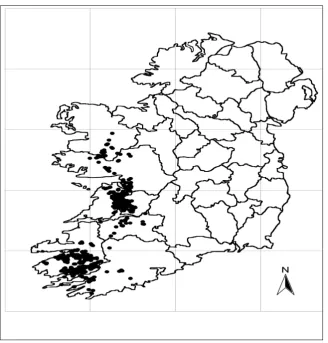
This species is the only representative of the Rhinolophidae family in Ireland. It differs from our other species in both habits and looks, having a unique nose leaf with which it projects its echolocation calls. It is also quite small and, at rest, wraps its wings around its body. Lesser horseshoe bats feed close to the ground, gleaning their prey from branches and stones. They often carry their prey to a perch to consume, leaving the remains beneath as an indication of their presence. The echolocation call of this species is of constant frequency and, on a heterodyne bat detector, sounds like a melodious warble. The species is confined to six counties along the Atlantic seaboard: Mayo, Galway, Clare, Limerick, Kerry and Cork – see Figure 2. The current Irish national population is estimated at 12,500 animals. This species is listed on Annex II of the EC Habitats Directive and 41 SACs have been designated in Ireland for its protection.
An introduction to bats
Bats have evolved a number of unusual features, mainly connected with their ability to fly. Their wings are formed from a web of highly elastic skin stretched over greatly elongated finger bones, the legs and tail, though their thumbs remain free to help them cling on when roosting. Bats have also developed a highly sophisticated echolocation system that allows them to avoid obstacles and catch tiny insects, even in complete darkness. When they're flying, bats produce a stream of high-pitched calls and listen to the echoes to produce a sound picture of their surroundings. Most of these echolocation calls are too high pitched for us to hear, but electronic bat-detectors that pick up these calls and turn them into sounds that we can hear are now widely used by specialists. In most cases, it is possible to identify the bat species from the type of sounds produced.
In cool climates such as Ireland, bats eat only insects and other invertebrates such as spiders, which they catch in flight or pick off water, the ground or foliage. Some bats specialise in catching large insects such as beetles or moths but others eat large numbers of very small insects, such as gnats, midges and mosquitoes, every night. Bats gather to feed wherever there are lots of insects, so the best places for them include traditional pasture, woodland, marshes, ponds and slow moving rivers.
[image:23.595.71.400.93.437.2]During the winter there are relatively few insects available, so bats hibernate. In September and October they put on weight and then, as the weather gets colder, they seek out appropriate sheltered roosts, let their body temperature drop to close to that of their surroundings and slow their heart rate to only a few beats per minute. This greatly reduces their energy requirements so that their food reserves last as long as possible. Bats don't hibernate right through the
An introduction to bats
winter but may wake up and go out to feed and drink on mild evenings when some insects are about. Even on very cold nights, bats may be seen on the wing as they move to more sheltered roosts. Waking up and flying in winter uses up lots of energy which the bats can't easily replace, so hibernating bats should not be disturbed as this might reduce their chances of surviving the winter.
Bats have a unique way of fitting their breeding cycle in with hibernation. They mate during the autumn and winter, but the female stores the sperm alive in her body and only becomes pregnant the following spring. Pregnancy lasts for six to nine weeks and can vary in length depending on the weather. Usually only one baby is born each year. This is looked after carefully and suckled for between four and five weeks until it is old enough to fly out and hunt for itself. Bats don’t build nests and don't bring food back to the roost to feed their young, so the baby lives only on its mother's milk until it is old enough to fly.
During this spring and summer period female bats gather together into maternity colonies for a few weeks to give birth and rear their babies. Once the baby is independent, the colony breaks up and the bats generally move to other roosts. Bats may gather together from over a large area to form these colonies, so any disaster at this summer breeding site can affect all the females from this area. Many of these maternity sites are used every summer and bats have a strong tradition of returning to the same site year after year.
Jan Feb Mar April May June July Aug Sept Oct Nov Dec
Figure 8. The bat year. Although there are species-specific differences, the bat year can be divided into the two major phases of breeding and hibernation, with other activities interspersed.
4.2
Roost requirements
Because their metabolic and social requirements vary throughout the year, most bats will use a variety of roosts of different types. Some species are particularly closely associated with tree roosts, the majority use a range of roosts which includes trees, buildings and underground sites and some species use primarily buildings and underground places. Classifying such sites can be difficult because of the varying conditions they provide and the way in which bats select sites. For example, Natterer’s bat has frequently been recorded in mortise joints in churches, old barns and similar buildings; from the bats’ perspective, such sites must appear very similar to crevices in trees underneath a thick tree canopy. Other species too, show a similar tendency to roost in contact with timber rather than stone or brick.
Some species, such as the brown long-eared bat, are frequently recorded in underground sites during the winter, but the small number of individuals recorded at any one site suggests that this common species does not depend heavily on underground sites. Rather few trees are ever
Maternity sites. Babies born in late-May/June,
independent by August Hibernation; activity in mild weather Mating & swarming sites Hibernation;
activity in mild weather
An introduction to bats
searched for bats and it seems likely that many species hibernate in tree cavities or under bark and so are significantly under-recorded.
The lesser horseshoe bat clearly has the strongest affinity with underground sites. In winter, it is rarely found in any other type of site and the species has even been recorded breeding underground, though the great majority of maternity sites are now in the roof voids of buildings. Other species which are considered typical hibernators in underground sites are Natterer’s bat, Daubenton’s bat, whiskered bat, Brandt’s bat and brown-long-eared bat.
Species Trees Buildings Underground
Maternity Hibernation Maternity Hibernation Maternity Hibernation Lesser horseshoe bat
Rhinolophus hipposideros
L L H M L H
Brandt’s bat
Myotis brandtii
L L H H? N H
Daubenton’s bat
Myotis daubentonii
M? L? M L M? H
Whiskered bat
Myotis mystacinus
M? M? H L N H
Natterer’s bat
Myotis nattereri
M? M? H L L H
Nathusius’ pipistrelle
Pipistrellus nathusii
H?
Common pipistrelle
Pipistrellus pipistrellus
M M H H N L
Soprano pipistrelle
Pipistrellus pygmaeus
M M H H N L
Leisler’s bat
Nyctalus leisleri
M M H L N N
Brown long-eared bat
Plecotus auritus
H H H H N M
Trees – includes all types of crevice and hollow as well as bat-boxes attached to trees
Buildings – above-ground areas, with an emphasis on roof voids and other areas warmed by the sun. Underground – anywhere that provides cool humid conditions buffered against rapid temperature change. Includes caves, mines, tunnels, souterrains, fortifications, cellars, ice-houses, lime kilns etc.
N – not recorded in recent times
L – low dependence; unusual, but has been recorded
M – some usage recorded, though perhaps not the most important type of site H – the most frequently recorded type of site for this species/activity
Table 4.1 Species associations with roost types.
An introduction to bats
as inside cavity walls, around window frames, under ridge-tiles and in cooler areas with stable temperatures.
4.3
Habitat associations
As well as suitable sites for roosting, bats also need suitable food resources. All species eat insects, or similar small invertebrates, though they hunt them in a variety of ways and a variety of places. Some species specialise in catching small insects in flight, some specialise in larger insects such as moths and beetles and some get part of their food by picking insects off foliage or even spiders’ webs. Understandably, the highest densities of bats occur where insects are most plentiful and surveys of hunting bats have shown that areas of wetland and woodland edges are particularly good for bats.
Bats need to be able to move freely around the countryside between roosts and feeding areas. Research has shown that many species, particularly the smaller ones, follow linear features, such as hedges, tree-lines or waterways, and are reluctant to cross wide open spaces. This behaviour means that activities which sever these sorts of connections are likely to have consequences for bats.
Recent studies using radio-tracking have shown that bats are very variable in the distances that they travel from their roosts to forage. For example, at some roost sites for Daubenton’s bats activity took place within 2 km of the roost whereas at other roosts some individuals travelled up to 19 km to forage. Brown long-eared bats appear to be a relatively sedentary species, with few individuals travelling more than 2 km whereas other species such as Leisler’s bat will frequently travel more than 5 km. Travelling distances are even greater between summer and winter roosting sites when distances of 100+ km have been recorded for certain species.
Survey objectives, methods and standards
5
Survey objectives, methods and standards
5.1
The importance of a good survey
The importance of a thorough site survey prior to considering development cannot be over-emphasised. The following descriptions of survey techniques and their correct application are aimed at assisting consultants (to appreciate the type of survey that is expected), the developer (to be assured that their consultant is recommending a survey to help them meet legal and policy requirements), and planning officers and National Parks and Wildlife Service staff (to be sure that an accurate assessment of the site and the extent of its bat interest has been made). Without a sound survey that includes an assessment of all available evidence, it is difficult to predict the likely impact of development.
From the developer’s perspective, the primary objective of a survey for protected species is to ensure that any development can proceed without breaking the law. The consequences of not carrying out a survey on sites which subsequently prove to have a significant protected species interest can be severe and may include delays, additional costs and, in exceptional cases, the cancellation or curtailment of projects.
5.2
Some general points on surveys
A survey for bats may be indicated when background information on distribution and occurrence suggests that they may be present. More detailed indicators are:
• any recent or historical records for bats on the site, or bat roosts in the general area,
though note that bats are very under-recorded;
• built structures, which appear to have a high probability of use by bats;
• underground structures such as abandoned mines, tunnels, souterrains, kilns, cellars or
fortifications which provide appropriate hibernation conditions;
• trees with a high probability of use by bats.
Some factors influencing the probability of particular places being used by bats are listed in Table 5.1. However, it should be emphasised that this can, at best, only highlight sites with a high probability of bats being present and the high mobility of bats means that it is virtually impossible to rule out any type of structure. In addition, regional variation in building styles and species’ distributions means that some local interpretation of these guidelines may be needed
It is the responsibility of the developer to produce, normally via a consultant, evidence on the presence of bats on a site at which works are proposed. It is for the consultant to decide on the level of survey required (taking these guidelines into account). The National Parks and Wildlife Service will not generally agree or endorse the methods and effort prior to a survey, as this is not the NPWS’s role, and site circumstances vary considerably. However, if the NPWS or the Local Planning Authority considers that insufficient survey work has been carried out to enable the determination of a planning or licence application, further work may be required of the developer and consultant. NPWS staff will generally visit sites only where there is an exceptional need to do so, so it is crucial that survey reports are thorough.
Survey objectives, methods and standards
Surveys must be carried out by licensed personnel, where there is a risk of bats being disturbed, and should not entail undue site damage or disturbance to roosts.
Factors affecting the probability of a building being used by bats in summer
Increase probability Disused or little used; largely undisturbed Large roof void with unobstructed flying spaces
Large dimension roof timbers with cracks, joints and holes Uneven roof covering with gaps, though not too draughty Entrances that bats can fly in through
Hanging tiles or wood cladding, especially on south-facing walls Rural setting
Close to woodland and/or water
Pre-20th century or early 20th century construction Roof warmed by the sun
Within the distribution area of horseshoe bats
Decrease probability Urban setting or highly urbanised area with few feeding places Small or cluttered roof void (esp. for brown long-eared bat) Heavily disturbed
Modern construction with few gaps around soffits or eaves (but be aware these may be used by pipistrelles in particular)
Prefabricated with steel and sheet materials Active industrial premises
Roof shaded from the sun
Factors affecting the probability of trees being used by roosting bats
Increase probability In ancient woodland or parkland Large trees with complex growth form
Species that typically form cavities, such as beech, willow, oak or ash
Visible damage caused by rot, wind, lightning strike etc. Loose bark providing cavities
Decrease probability Coniferous plantation with no specimen trees
Young trees with simple growth form and little damage
Factors affecting the probability of underground sites being used by roosting bats
Increase probability Large enough to develop stable temperature in winter High humidity
Undisturbed
Close to woodland or water (but note that bats will also use upland sites)
Many cracks and crevices suitable for bats Decrease probability Small and draughty
Heavily disturbed In urbanised areas
[image:28.595.69.533.106.709.2]Smooth surfaces with few roosting opportunities
Survey objectives, methods and standards
Survey reports are expected to:
• State what the survey objective was, what work was done, by whom, and when. A
suggested outline for survey reports within mitigation plans is given in 10. Presenting mitigation plans.
• Be clear and unambiguous, with appropriate evidence to support conclusions.
• Contain relevant raw data as well as processed data, and any negative results obtained • Contain contextual information, such as weather conditions, which may have affected
results
• Contain good site descriptions, plans and maps enabling a proper assessment of the
proposal.
• Include a summary which is understandable by people without detailed knowledge of
bats.
• Be accessible to third parties. Note that as survey reports are used in the
decision-making process for planning applications and licences, they should not be confidential.
5.3
Setting survey objectives
Before setting foot in the field, it is important to define the purpose of the survey; in other words, why is it being undertaken? In turn, objectives for field survey can be set, the two most common objectives in relation to development being:
• Presence/absence survey: is there evidence that bats use a particular site or structure? • Investigation of the type, extent and pattern of usage by bats as a precursor to the
development of a mitigation proposal.
The former may be a first stage, when assessing potential development sites and the latter will normally be required prior to determination of planning permission, to inform an opinion as to what effect development will have on a particular site (see 6. Predicting the impact of
development). In practice, the two objectives are often combined, particularly when the conservation significance of the site is low.
Presence/absence surveys may be further subdivided into surveys designed to detect whether bats are present on a site (and thus trigger a more detailed investigation) and surveys to demonstrate beyond reasonable doubt that bats are not present. Although these may appear to be similar objectives, the effort (sampling intensity) required to demonstrate the negative may be much higher than conventionally accepted to detect the positive.
5.4
Survey area
As a minimum, the survey should normally cover any land or structures which are proposed for development. For phased developments, the entire site should be surveyed, not just the area of the first phase, and considered as a whole unit when assessing impacts and possible mitigation. This will help to avoid the undesirable situation where mitigation methods
Survey objectives, methods and standards
protected, the effects of development proposals on these may be taken into consideration when assessing the impact of the proposal on the maintenance of favourable conservation status. Similarly, they may be taken into account by planning authorities, certainly where specially protected sites are involved. For example, the impact of planning proposals close to SACs (Natura 2000 sites) for bats is likely to receive close attention.
5.5
Desk study
The following sources can be consulted for existing information on local bat roosts (perhaps within 5 km of the area): Local Planning Authorities (e.g. on ‘constraint plans’), National Biological Records Centre, Bat Conservation Ireland, local bat group and, for lesser horseshoe data, NPWS. This consultation can result in lists of recent sightings and an indication of status and distribution in the general area. However, it should only be used as background information, because such archives are likely to become out-of-date quite quickly and should never be considered as a substitute for a field study.
5.6
Field survey methods
This section describes the main methods used to detect and record bats or evidence of bats. This manual does not provide a substitute for training and experience and should not be considered a definitive guide to bat surveys. Although a licence to disturb bats for scientific purposes is not essential when looking for previously unknown roosts, the requirement to withdraw if bats are discovered will limit the ability of the surveyor to carry out this work. For this reason, it is advisable for surveyors to be licensed.
5.6.1 Inspection of buildings or other structures
[image:30.595.72.460.520.754.2]The most commonly used survey method for both presence/absence surveys and detailed usage surveys is close inspection of sites or structures for bats or evidence of bats. To undertake such surveys to a high standard, surveyors need training and experience, both in identifying bats and knowing where bats, or signs of bats, are likely to be found. Surveys for signs can be carried out at any time of year, but bats are most likely to be seen or heard in roofs during the summer or autumn or seen in subterranean areas during the winter.
Survey objectives, methods and standards
A typical approach to surveying buildings would include the following elements:
• Allow sufficient daylight hours to permit a thorough inspection of each structure;
• Ensure that all parts of the structure can be inspected. This may require prior arrangement
with owners, occupiers, caretakers etc. Access and inspection equipment, such as ladders, binoculars and a good torch, should always be available;
• Carry out a risk analysis and ensure safe working methods are adopted;
• Ask appropriate people (owners, neighbours etc.) whether there is any history of bats
using the site;
• Carry out an external inspection of the structure looking for bat droppings on the ground
or stuck to walls, suitable entry and exit points around eaves, soffits, flashing, under tiles etc.;
• Carry out an internal inspection of the structure. This should focus particularly on areas
which provide appropriate environmental conditions for bats. This may include warm darker areas, joints and crevices in wood, ridge beams and hips as well as cool
subterranean areas suitable for torpor or hibernation. Listen for bats; be aware of the characteristic smell of a bat roost; examine floors, walls and structural elements for droppings; check for other signs of bat use, such as corpses or skeletons, oily marks (from fur) around possible access points and roost areas, lack of cobwebs along beams, feeding remains such as moth wings or other insect parts;
• Record any signs of bats found on a plan of the structure and collect samples of
droppings, bones or feeding remains for comparison with a reference collection.
Example: Specification for surveys in relation to planning applications affecting possible lesser horseshoe bat feeding habitat. Note that the objective is to detect commuting routes and feeding areas rather than roosts.
The following specification is recommended in relation to development proposals of 1ha or more within 4km of lesser horseshoe bat roosts. A similar specification may be appropriate for smaller development proposals, which because of disturbance (e.g. light and noise pollution) or proximity to a roost may be significant.
(i) Surveys should pay particular attention to known lesser horseshoe bat feeding habitat such as hedgerows, coppice, woodland fringe, tree lines and areas of scrub and pasture, and linear landscape features such as drainage ditches, earth banks, fencing, walls, hedges etc that may provide flight lines.
(ii) Surveys should be carried out on two separate evenings each month from May to September, as the bats’ favoured foraging areas may alter across the summer period.
(iii) Surveys should be carried out on warm (>10 °C, but >15°C in late summer), still evenings that provide optimal conditions for foraging (insect activity is significantly reduced at low temperatures). Details of temperature and weather conditions during surveys should be included in final report.
(iv) Surveys should cover the period of peak activity for bats from sunset for at least the next 3 hrs.
(v) Surveys should preferably be with broadband detectors as these provide a record of
echolocation signals, although appropriately tuned heterodyne detectors (105-111 kHz) will be sufficient. Details of echolocation should be provided within the final report along with details of the type of the detector used.
(vi) Surveys should be carried out by suitably qualified and experienced persons. Numbers of personnel involved should be indicated in any report and be sufficient to thoroughly and comprehensively survey the size of site in question.
Survey objectives, methods and standards
5.6.2 Inspection of trees
Surveying trees presents particular problems at any time of the year as bats will use a wide variety of roost sites in cavities, splits, cracks, knotholes and under loose bark, many of which are not easily detected from the ground. A careful survey using high-quality binoculars may pinpoint potential or actual roost sites and some species, most notably Leisler’s, may be quite noisy at times during the summer. Endoscopes may also be useful for inspecting likely cavities, though their use may be limited by the need for access equipment. Confirmation of the presence of bats may be attempted by using bat detectors for an emergence survey at an appropriate time of the year (see 5.6.3), but the nomadic nature of tree-dwelling bats means that the success rate is likely to be very low. Detector surveys just before dawn, which aim to detect bats returning to their roost, have a slightly higher chance of success as bats will often swarm around a roost for some time before entering.
5.6.3 Use of bat detectors
Bat detectors provide a sensitive way of detecting active bats in some situations and can be a useful adjunct to the search methods described in 5.6.1. Considerable expertise is needed to identify bats to the species level, though the technology to assist with this task has improved significantly in recent years. Guidance on the use of detectors is available from the UK Bat Conservation Trust (http://www.bats.org.uk/batinfo/batdets.htm) and this methodology is widely used in national surveys by Bat Conservation Ireland. Different types of detector are appropriate for different types of survey and broadband detectors are probably best for surveys of new areas.
The seasonal and daily pattern of bat activity and the use of different types of roost at
[image:32.595.72.302.385.694.2]different times of the year will impact on the appropriateness of this methodology. Handheld detectors can be used on visits to roosts between dusk and dawn during the summer (buildings and trees) or autumn (some underground roosts) to detect active bats entering or leaving the
Survey objectives, methods and standards
site. The optimum time for dusk surveys at buildings, particularly during early summer is for the two hours after the first bats emerge as this will cover the emergence period as well as the first return to the roost for some species. The time of first emergence varies between species, with Leisler’s leaving around sunset and Natterer’s bats leaving about 1 hour after sunset. Bats using underground sites during the summer may not emerge till much later, perhaps even 4 hours after dark. Towards dawn, many bats swarm outside their roosts and surveys
beginning about 90 minutes before sunrise and continuing until 15 minutes after sunrise (‘sunrise surveys’) are recommended. In autumn, it is possible to detect the social calls of males of some species of bats, notably Leisler’s and pipistrelles. Surveys at this time of the year should begin about 30 minutes after the species’ emergence time and it may be necessary to set the bat detector to record lower-frequency social calls.
Survey objectives, methods and standards
5.6.4 Netting and harp-trapping
Mist netting and the use of harp traps to catch bats are well-established research methods. However, it is rarely necessary to catch bats in flight for the purposes of surveys associated with development, although there may be occasions when the positive identification of species is required. These methods are invasive, time-consuming and require specialist
training. It would be wise to discuss survey requireme