the two zones, i.e.:
pHZ!"log([CS]org/Z#Kf##1!D0/Kr)/
([CS]org/Z\Kf\#1!D0/Kr) [13] where [CS]org/Z# and [CS]org/Z\ are the free CS con-centrations in the A# and A\ zones, respectively. When Kf#'Kf\, [CS]org/Z#([CS]org/Z\([CS]initial. Eqn [13] indicates that chiral resolution can be im-proved by increasingD0/Krand/or choosing the CS with a large Kf#/Kf\ value. It also implies that in-creasing the CS concentration will yield higher peak resolution.
Advantages of Chiral CCC
Countercurrent chromatography can be applied to the separation of enantiomers by dissolving a suitable chiral selector in the liquid stationary phase in anal-ogy to binding the CS to the solid support. The HSCCC technique has the following advantages over the conventional chromatographic technique using a solid stationary phase:
1. The method permits repetitive use of the same column for a variety of chiral separations by choosing appropriate chiral selectors.
2. Both analytical and preparative separations can be performed in a standard CCC column by adjusting the amount of CS in the liquid stationary phase. The method is cost effective especially for large scale preparative separations.
3. The separation factor and peak resolution can be improved by increasing the concentration of CS in the stationary phase.
4. The method is very useful for investigation of the enantioselectivity of the chiral selector including determination of formation constant and separ-ation factor.
5. pH-Zone-reRning CCC can be applied to chiral separation allowing a large scale separation in a shorter separation time.
See also: II/Chromatography: Chromatography: Instru-mentation. Chromatography: Liquid: Column Techonol-ogy. III/Chiral Separations: Amino Acids and Deriva-tives; Capillary Electrophoresis; Cellulose and Cellulose Derived Phases; Countercurrent Chromatography; Crys-tallization; Cyclodextrins ad Other Inclusion Complexation Approaches; Gas Chromatography; Ion-Pair Chromatog-raphy; Ligand Exchange ChromatogChromatog-raphy; Liquid Chro-matography; Molecular Imprints as Stationary Phases; Protein Stationary Phases; Supercritical Fluid Chromatog-raphy; Synthetic Multiple Interaction (‘Pirkle’) Stationary Phases; Thin-Layer (Planar) Chromatography. Zone Refining Countercurrent Chromatography.
Further Reading
Ma Y and Ito Y (1995) Chiral separation by high-speed countercurrent chromatography.Analytical Chemistry 67 (17): 3069-3074.
Ma Y, Ito Y and Foucault A (1995) Resolution of gram quantities of racemates by high-speed countercurrent chromatography.Journal of Chromatography A 704: 75-81.
Ma Y, Ito Y and Berthod A (1998) Chiral separation by high-speed countercurrent chromatography. In: Menet JM and Thiebaut D (eds),Countercurrent Chromato-graphy. New York: Marcel Dekker.
Crystallization
A. Collet, EDcole Normale SupeHrieure de Lyon, Lyon, France
Copyright^ 2000 Academic Press
Methods for obtaining optically active compounds in enantiopure form are commonly classiRed into three categories: utilization of chiral pool starting materials (stereoselective multistep synthesis), creation of chirality from achiral precursors (asymmetric syn-thesis) and separation of racemates into their enan-tiomer constituents (resolution). This last method can be carried out in a variety of ways: crystallization processes, chromatography of racemates on chiral stationary phases and kinetic resolution mediated by chiral reagents or enzymes.
The crystallization methods comprise several vari-ants: (1) direct crystallization of enantiomer mix-tures, (2) separation of diastereoisomer mixtures }the so-called classical resolution}and (3) crystalli-zation-induced asymmetric transformation. TheRrst two were discovered by Louis Pasteur in 1848 and 1853, respectively. The third was Rrst reported in 1913. At the turn of the 21st century, these methods are in wide use in laboratory-scale separations as well as in industry for the preparation of pharmaceutical and agrochemical active principles. To cite but a few examples, hundreds to thousands of tonnes of com-mercially important materials such as (!)-menthol, (S)-(#)-naproxen, L--methyldopa, D-phenylglycine
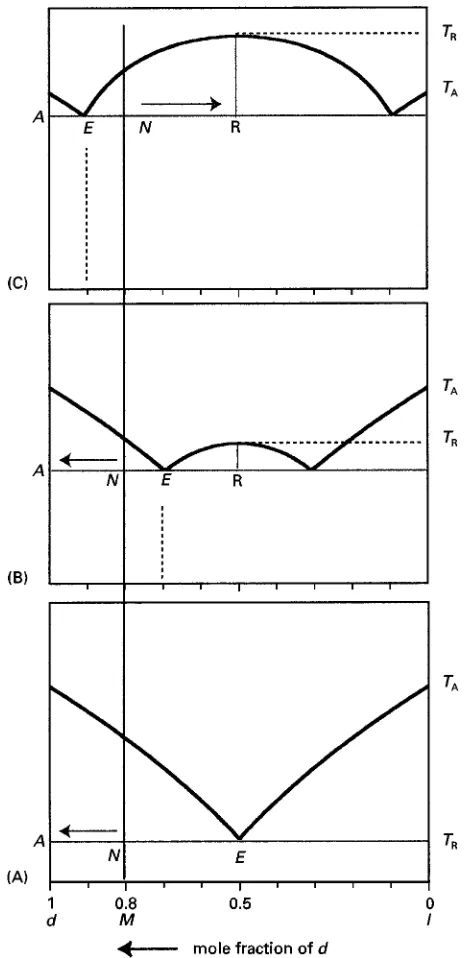
Figure 1 Binary melting point phase diagram for enantiomer systems. (A) Conglomerate; (b) racemic compound with TR(TA, eutectic atx"0.3 and 0.7; (c) racemic compound with
TR'TA, eutectic atx"0.1 and 0.9. On recrystallization, a solid
mixtureM in which the mole fraction of the major enantiomer (hered) is 0.8 (enantiomeric excess ee"60%) can give this enan-tiomer in pure form in cases (A) and (B), the maximum yield being given by the ratioNA/EA; in case (C) only the racemic compound can be obtained (see text).
In the context of enantiomer separations crystalli-zation techniques are attractive for several reasons. Firstly, in many instances they are more straightfor-ward and more economical than any other method. Secondly, these methods, once considered old-fashioned, have, during the past two decades, been greatly improved in their rationale and efRciency, as a consequence of a better knowledge of the properties upon which separations by crystallization are based: identiRcation of racemate types, utilization of phase diagrams describing solid}liquid equilibria. Thirdly, these methods apply not only to the resolution of racemates (i.e. 1 : 1 mixtures ofdandlenantiomers), they can also be used for obtaining pure enantiomers from nonracemic (partially resolved) mixtures, re-gardless of their origin. And Rnally, the so-called crystallization-induced asymmetric transformation overcomes the inherent 50%yield limitation of a res-olution, permitting up to 100%of a racemic material to be converted into one enantiomer in a single stage.
Enantiomer Mixtures
This section deals with crystallization methods allow-ing pure enantiomers to be prepared from partially resolved mixtures or from racemates without the help of any chiral auxiliary reagent.
Phase Diagrams of Enantiomer
Systems
We call enantiomer systems mixtures containing the two mirror-image d andl components in any ratio, either without solvent (binary (d,l) mixtures), or in the presence of a solvent (ternary (d,l,) mixtures). Depending on the nature of the crystal phases which may coexist with the liquid (melt or solution), three categories of enantiomer systems have been identiRed.
In the Rrst category, which represents 5}10% of cases, the enantiomers crystallize separately from one another (homochiral crystallization, spontaneous res-olution). A solid (d,l) system then consists of a mech-anical mixture of d and l crystals in a ratio corre-sponding to their respective mole fractions (x; 1!x). The melting point phase diagram shows a simple eutectic at x"0.5 (racemate composition). Such a (d,l) system is said to be a conglomerate of enantio-mers (Figure 1A). In a conglomerate, the racemate has a melting point about 30 K lower than those of its pure enantiomers. Its solid-state infrared spectrum is identical with the solid-state spectrum of a pure enan-tiomer, because the infrared spectrometer does not make a difference between right- and left-handed crystals. Since most binary mixtures of enantiomers
enantiomer, and R is the gas constant. This equation gives the melting temperature T of a mixture in which x represents the mole fraction of the major enantiomer:
lnx"HA
R
1 TA
!T1
In the second, main category of enantiomer sys-tems, representing 90}95%of cases, thedandl enan-tiomers crystallize together to form an ordered 1:1 compound, called a racemic compound (heterochiral crystallization). Typical binary phase diagrams corre-sponding to this case are shown Figure 1(B) and (C). The melting pointTRof the racemic compound can be either lower or higher than that of the pure enan-tiomers (however, on average, the difference between TR and TA rarely exceeds$20 K). The solid-state infrared spectrum of a racemic compound is different from that of a pure enantiomer. This is a simple way of distinguishing between a racemic compound and a conglomerate (in addition to the melting point cri-terion). In such systems, a partially resolved solid consists of a mechanical mixture of two crystal phases, the racemic compound, in amount r"2(1!x), and the enantiomer in excess, in amount ee"2x!1. In Figure 1(B) and (C) the liquidus curves for the enantiomer branches are calculated by means of the SchroKder}van Laar equation, while the racemic compound branch is calculated by a similar equation Rrst given by Prigogine and Defay, where TR and HR are the temperature and enthalpy of fusion, respectively, of the racemic compound:
ln 4x(1!x)"2HR
R
1 TR!
1 T
In the last category of enantiomer systems, called pseudoracemates, there is almost no chiral discrim-ination between thedandlspecies which co-crystal-lize more or less at random within the same lattice to form a solid solution. In a pseudoracemate, a par-tially resolved sample consists of a single crystal con-taining thed andlenantiomers in a ratio (x; 1!x). Such systems are, fortunately, not common. They may occur with rod-shaped or quasi-spherical mol-ecules (e.g. camphor). They do not lend them-selves easily to separation by crystallization tech-niques, and for this reason they will no longer be considered here.
Solubility Rules Derived from
Binary-phase Diagrams
In the absence of temperature- or solvent-dependent polymorphism, the solubility rules that govern the
behaviour of enantiomer mixtures on crystallization can be simply derived from the binary phase diagrams depicted in Figure 1. The component which can be obtained upon crystallization will be either the ra-cemic compound, or the enantiomer in excess, de-pending on the composition of the starting mixture with respect to the closest eutectic of the phase dia-gram. Thus, recrystallization of mixtureM, having x"0.8 (ee"60%) can give the major enantiomer in pure form in cases (A) and (B). The maximum pos-sible yield is given byNE/EA}60%in case (A), and only 33%in case (B). In case (C), recrystallization of Mcan only afford the racemate in a maximum yield NE/RE. In this case the enantiomeric enrichment takes place in the liquid, but under equilibrium condi-tions the highest attainable purity is that of the eutec-tic. In other terms, in a partially resolved conglomer-ate, it is always possible to recover the major enan-tiomer in a yield equal to theeeof the starting mater-ial, whereas in a racemic compound the outcome of the crystallization will depend on the enantiomeric composition of the starting material and on that of eutectic; even in relatively favourable cases such as that depicted in Figure 1(B), the maximum possible yield will be lower than theeeof the starting material.
Ternary Phase Diagrams
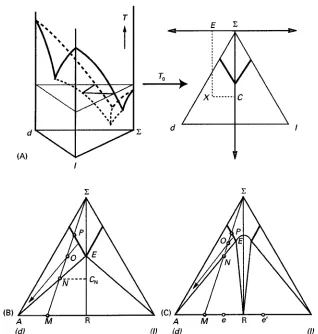
For applications in which accurate quantitative data are required (e.g. optimization of large-scale recrys-tallizations), it is preferable to utilize ternary (solubil-ity) phase diagrams (d,l,). Solubility phase dia-grams are 3D triangular prisms where each face is a binary melting point phase diagram, (d,l), (d,) and (l,). It is customary to convert this 3D repres-entation into a 2D one by keeping one of the variables Rxed, most often the temperature. Accordingly, a horizontal slice of the prism generates the usual triangular isotherm describing the solid}liquid phase equilibria at given T. This is illustrated in Fig-ure 2(A), for a conglomerate. In order to facilitate the use of such triangular isotherms, it is convenient to adopt a system of cartesian axes (C,E), whereC rep-resents the concentration andE the excess of enan-tiomer, expressed in the same dimensionless unit (generally in weight %); C and E are deRned as follows:
C" d#l
d#l#;100 E" d!l
Figure 2 (A) 3D-representation of ad, l,system and the corresponding 2D-isotherm, for a conglomerate. The composition of a ternary system X is conveniently defined by its cartesian coordinates (C, E ). Note that E/C"ee, the usual enantiomeric excess, defined asee"(d!l )/(d#l ); (B) and (C) represent ternary isotherms that correspond roughly to the binary phase diagrams (A) and (B) of Figure 1. On recrystallization, mixtureM will only afford the major enatiomer in pure form if the composition of the ternary system is comprised betweenN and P, the maximum yield being obtained for system N (see text). In diagram (C), e represents the ee of the ternary eutecticE.
individual enantiomer, unless special circumstances, such as common ion effects or aggregation phe-nomena, decrease or increase the solubility ratio with respect to its normal value. Figure 2(B) and (C) roughly correspond to the binary phase diagrams of Figure 1(A) and (B), respectively. On recrystallization of mixture M, the major enantiomer d can be ob-tained betweenNandP, for instance from systemO. However, the best yieldYin puredwill be obtained from systemN, at concentrationCN(in weight%):
Y"NE AE;
100 CN
For a conglomerate the above calculated yield is the same as that derived from the binary phase diagram, Y"NE/AE. For a racemic compound,Ycalculated from the ternary isotherm is usually very close to that derived from the binary phase diagram because in such systems the ee of the eutectic does not change
signiRcantly with temperature, except in the case of polymorphism or of solvation.
This is why information on the type of enantiomer system and, in particular, on the location of the eutec-tics in racemic compound phase diagrams is of great importance when the puriRcation of partially resolved mixtures by crystallization techniques is under-taken. When the phase diagram of the considered system is not favourable (e.g. as inFigure 1C), recrys-tallization should be avoided and it may be advisable to postpone the puriRcation to a next step, or to seek derivatives having more favourable phase diagrams. These concepts are particularly useful for the Rnal puriRcation of enantiomers prepared by asymmetric synthesis or chiral chromatography.
Direct Crystallization of Racemates
Figure 3 Principle of the entrainment process. In the cycle MNPQ, MN and PQ correspond to the crystallization of enantio-mersl and d, respectively; NP and QM correspond the loading of racemic material. In commercial processes, 20}90 crystallizations are commonly performed.
costly chiral auxiliary is required. Such resolutions only apply to conglomerates. Essentially two main types of methods are then available. In the Rrst of these the two enantiomers are allowed to crystallize simultaneously from a solution or melt which is al-ways close to the racemic composition. In the second, called entrainment, the crystallization of a single en-antiomer is promoted from a supersaturated solution or supercooled melt which is not allowed to come to equilibrium.
Simultaneous Crystallization
Although hand-sorting of the d and l crystals (as originally performed by Pasteur on sodium am-monium tartrate) can occasionally be a useful tech-nique, the localization of the crystallization of each enantiomer on suitably disposeddandlseeds repres-ents an improvement of greater practical interest. In small-scale preparations, one can utilize a small num-ber ofd and l seeds sufRciently separated from one another in the same crystallizer, and the large crystals which are eventually formed are collected manually. Large-scale applications utilize pairs of crystallization chambers, each one being loaded with a large amount of seeds of one enantiomer. The system is then con-tinuously fed with a circulating, slightly super-saturated, racemic solution. Such processes have been proven to be valuable for continuous large-scale pro-ductions such as those developed by Haarmann &Reimer for (!)-menthol (resolved as its benzoate), and Merck forL--methyldopa (resolved as its nitrile
precursor).
Entrainment
The entrainment method takes its origin in experi-ments performed by Gernez in 1866, showing that a supersaturated solution of sodium ammonium tar-trate, when seeded with a particle of (#) salt, only yielded crystals of that salt. The resolution by entrain-ment is a batch process, which rests on the control of the crystallization rates of the two enantiomers, and implies the utilization of ternary phase diagrams, such as that shown inFigure 3. A solutionM, super-saturated with respect of both enantiomers, and con-taining a small excess (Eg%) of one of them (here,l) is seeded with crystals of that enantiomer. Crystalli-zation is then allowed to proceed until the solution has reached composition N. At this point, the rota-tion of the solurota-tion is approximately equal and oppo-site in sign to that of the starting solution, and the lenantiomer that has crystallized amounts to twice its excess in the original solutionM(i.e.+2Eg%). At this stage, the crystals are separated off, and the same
weight of racemic material is added to theRltrate and dissolved by heating. This results in a new super-saturated systems of compositionP, symmetrical to M, where thedenantiomer is now in the same excess as was thelin the previous experiment. Seeding with the d form and crystallization up to Q then yields +2Eg%of d, and addition of the same weight of racemate allows the return toM, and so forth.
For low-melting conglomerates, the entrainment can also be effected without solvent, in a supercooled melt. Such processes are easily understood by means of the melting point phase diagrams, by considering the metastable extension of the liquidus curves below the eutectic temperature.
Diastereoisomers
The most widely used method for the separation of enantiomers, often called classical resolution, rests on the crystallization of diastereoisomers formed from a racemate (dl) and an enantiopure reagent (say, D), called a resolving agent:
dl#DPdD#lD
It is convenient to designate with lettersp(positive) andn (negative) the diastereoisomers resulting from reaction of the two constituents of like sign and opposite signs, respectively. In this convention, no account is taken of the sign of rotation of the dia-stereoisomers themselves, which, if needed, can be speciRed by adding a#or!subscript to thepand n descriptor. Accordingly, the above reaction yields a mixture of p (dD) and n (lD) diastereoisomers, which, for instance, can both be dextrorotatory, i.e. p# and n#. The opposite enantiomer (L) of the resolving agent would then afford with the same racemate the diastereoisomer pair p
\ (lL) and n\ (dL), mirror image of p# and n# (Marckwald principle). Note that the reciprocal resolution ofDL by, for instance,d, would yield a mixture ofp#(dD) andn\(dL).
Diastereoisomeric salts, formed from simple acid} base reactions, are central to such resolutions, al-though covalent diastereoisomers (esters, amides, etc.) are also occasionally resolvable by crystalliza-tion. To cite but a single example, the DSM company resolvesDL-phenylglycine by crystallization of its
dia-stereoisomeric salts with (#)-10-camphorsulfonic acid, to produce the D-enantiomer required for the
manufacture of the antibiotic ampicillin, at a scale of more than 1000 tonnes per year.
Diastereoisomeric inclusion complexes, in which the resolving agent is a chiral crystalline host lattice, represent an interesting alternative for the resolution of substances that cannot form salts, or do not pos-sess functional groups suitable for formation of covalent diastereoisomers.
Phase Diagrams and Solubility Rules
Diastereoisomerspandnare distinct compounds and exhibit different structures in the crystal state. It
fol-lows that all physical properties involving the crystal themselves and the crystal/liquid or crystal/gas equi-libria, such as melting points, solubilities, sublima-tion properties, crystal densities, etc., are different for the p and n species of a given pair. However, the possibility of separatingpandndiastereoisomers by crystallization of their 1 : 1 mixture, resulting from the reaction of a racemate with a resolving agent, does not depend only on the properties of the purep and n compounds: it rests primarily on the existence of favourable solid}liquid phase equi-libria for the binary (p,n) or ternary (p,n,) systems. The phase diagrams of diastereoisomer systems (Figure 4) are basically similar to those of enantiomer systems. There exist, however, several important differences between them: (1) the phase diagrams of diastereomer mixtures are not symmetri-cal; (2) in contrast to enantiomers, diastereoisomers preferentially form eutectics or solid solutions ( Fig-ure 4(A) and (C), respectively); (3) the occurrence of 1 : 1 (pn) addition compounds depicted in Fig-ure 4(B) is by far less than that of (dl) racemic compounds.
Only diastereoisomer systems forming eutectic phase diagrams are suitable for resolution by crystal-lization. In the solubility isotherm of Figure 4(A), 1 : 1 (p,n) mixtures will afford the pure less soluble diastereoisomer (herep) if the crystallization is car-ried out betweenNandP, for instance from solution O. The best yield however will be obtained from solutionN. This yield is given by:
Y"NE Ep;
100 CN
whereCNis the concentration of solutionN. Since the p/nratio in the ternary eutectic is usually close to that of the binary eutectic, Y is not very different from RE/AEin the melting point phase diagram. The best systems are those in which the eutectic is close to the edge of the phase diagram, and the maximum value ofY"50%is approached whenEis closed to one of the pure components. The occurrence of such good systems has been estimated at 20}25% of dia-stereoisomer mixtures. It is important to recognize that in such cases one or two crystallizations are normally sufRcient to obtain the less soluble dias-tereoisomer in pure form.
Figure 4 Melting point (left) and solubility (right) phase diagrams for diastereoisomer systems. (A) eutectic; (B) 1 : 1 addition compound; (C) solid solution. The arrows indicate the nature of the solid obtained from crystallization of a system of compositionO.
often, however, the enrichment is very modest and utilization of systematic fractional crystallization techniques is required. These techniques are very tedi-ous and time-consuming and this is why resolution of (p,n) systems forming solid solutions is not recom-mended unless alternative methods cannot be found. Note that diastereoisomeric lattice inclusion com-plexes are more prone to form solid solutions than the other types of diastereoisomers and often need re-peated crystallizations to reach good enrichments. In such cases rather than purify the diastereoisomers, it may be advisable to complete the puriRcation on the partially resolved enantiomers, along the lines in-dicated above.
Resolving Agents
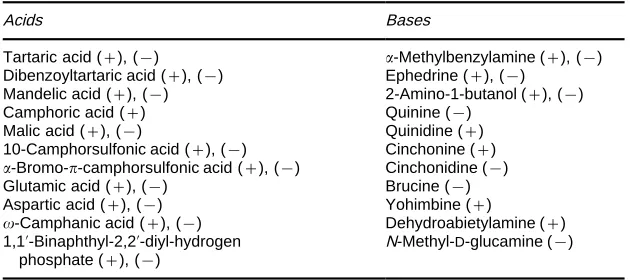
Table 1 Common resolving agents
Acids Bases
Tartaric acid (#), (!) -Methylbenzylamine (#), (!) Dibenzoyltartaric acid (#), (!) Ephedrine (#), (!)
Mandelic acid (#), (!) 2-Amino-1-butanol (#), (!)
Camphoric acid (#) Quinine (!)
Malic acid (#), (!) Quinidine (#)
10-Camphorsulfonic acid (#), (!) Cinchonine (#)
-Bromo--camphorsulfonic acid (#), (!) Cinchonidine (!)
Glutamic acid (#), (!) Brucine (!)
Aspartic acid (#), (!) Yohimbine (#)
-Camphanic acid (#), (!) Dehydroabietylamine (#) 1,1-Binaphthyl-2,2-diyl-hydrogen
phosphate (#), (!)
N-Methyl-D-glucamine (!)
diastereoisomers by chromatography or for analytical purposes (nuclear magnetic resonance spectroscopy) are not mentioned here. For important commercial applications, it may be appropriate to design new resolving agents: for example, the N-alkyl-D
-glucamine family (prepared fromD-glucose) has been
developed by Syntex as a substitute for cinchonidine for the large-scale resolution of naproxen (over 1000 tonnes per year). There are no clear guidelines allow-ing the prediction of a good resolvallow-ing agent for a given substrate. This is not really a serious problem because the number of available resolving agents, being very limited, generally allows systematized pro-tocols to identify the best ones very quickly.
Salts usually need polar solvents to crystallize, and a statistical survey of solvents used in over 800 such resolutions indicate that anhydrous or aqueous acetone and alcohols (ethanol, methanol, 1- and 2-propanol, 1-butanol), and water feature in 80% of cases. The presence of water may be necessary whenever the salts crystallize as hydrates. This is why 95%ethanol (rather than absolute ethanol) is to be preferred during the selection of a resolving agent.
Interesting achievements in the area of chiral host lattices have been reported during the last decade. A small number of chiral substances that form dia-stereoisomeric crystalline inclusion complexes with a variety of guests have been identiRed. In addition to the alkaloid brucine, which has been utilized for re-solving, at least partially, chiral halogenoalkanes (in-cluding CHFClBr) and, more recently, acetylenic alcohols and cyanohydrins, several new hosts have been discovered, among which readily available diols prepared from tartaric acid seem to have the greatest potential as resolving agents.
Crystallization-induced Asymmetric
Transformations
The 50%yield limit of a resolution can be exceeded if the diastereoisomers can be equilibrated in the
solu-tion (i.e.dD&lD) at a rate faster than the crystalli-zation of the least soluble one. Such a phenomenon wasRrst reported by Leuchs in 1913; he isolated in 94% yield a single diastereoisomeric salt after reac-tion of an easily racemizable racemic acid with brucine. In addition to the requirement that the diastereoisomers must epimerize easily, processes of this type can only be successful if the dias-tereoisomer system belongs to the eutectic type. In Figure 5, the starting material has composition O(overall concentrationC0). In the liquid phase, the composition of the diastereoisomer mixture in chem-ical equilibrium is indicated byL, which in the case shown is slightly shifted towards the nspecies. The Rnal equilibrium state is featured byN, representing the overall composition of the system at the end of the process. SystemNconsists of pure solidpin equilib-rium with liquidL. The yield in diastereoisomerpis proportional to LN/Lp, and can be derived fromC0and the composition of the liquid in equilib-rium (Ceq):
Y"(C0!Ceq) (100!Ceq);
100 C0
Accordingly, yields approaching 100%can only be obtained in poor solvents, in whichCeqis very small. Typically, Ceq"2 g% and C0"20 g% would give a Y of nearly 92%. In contrast to the case of a classical resolution, the yield does not depend directly on the location of the eutectic. However, it is the distance between the eutecticEand the equilibrium solutionL which provides the driving force for the process, and this is why, again, a eutectic close to the edges of the phase diagram is preferable.
Figure 5 Crystallization-induced asymmetric transformation of diastereoisomers. In the solubility isotherm shown,L represents the composition of the liquid in which the two diastereoisomers are in chemical equilibrium (here with a slight excess ofn). This liquid is itself in physical equilibrium with the solid, consisting of purep. After completion of the chemical and physical equilibrations, the starting systemO will be converted into the final system N, consisting of solid p in equilibrium with liquid L.
Crystallization-induced asymmetric transforma-tions of enantiomers forming conglomerates can also be carried out by combining entrainment techniques with simultaneous racemization of the substrate in the solution. Although a number of examples have been described, and a number of patents have been Rled, only a few processes of this type have reached commercial application.
Future Prospects
The understanding of phase equilibria in enantiomer and diastereoisomer systems is a central question, not only in view of its practical relevance to separation processes, but also because it may shed light on some of the mechanisms governing molecular recognition in condensed matter. Among the numerous unsolved questions, that of the prediction of racemate types is perhaps one of the most challenging. Recently, it has been shown that, in theory, conversion of racemic compounds into conglomerates could be achieved for some racemates by crystallization under high pres-sure. An experimental veriRcation of this prediction would be of great importance in extending the possi-bilities of resolving racemates by direct crystallization.
See Colour Plate 67.
Further Reading
Ahuja S (ed.) (1997)Chiral Separations,Applications and Technology. Washington, DC: American Chemical Society.
Collet A (1989) Optical resolution by crystallization methods. In: Krstulovic AM (ed.)Chiral Separations by HPLC. Chichester, UK: Ellis Horwood.
Collet A (1996) Optical resolution. In: Reinhoudt DN (ed.) Comprehensive Supramolecular Chemistry, vol. 10. Oxford: Pergamon.
Collet A, Brienne M-J and Jacques J (1980) Optical resolu-tion by direct crystallizaresolu-tion of enantiomer mixtures. Chem.Rev. 80: 215.
Collet A, Ziminski L, Garcia C and VigneH-Maeder F (1995) Chiral discrimination in crystalline enantiomer systems: facts, interpretations, and speculations. In: Siegel JS (ed.) Supramolecular Stereochemistry. NATO ASI Series. Dordrecht: Kluwer.
Collins AN, Sheldrake GN and Crosby J (eds) (1994) Chirality in Industry. Chichester, UK: Wiley. Ibid. (1997)Chirality in Industry II.
Eliel EL, Wilen SH and Mander N (1994)Stereochemistry of Organic Compounds. New York: John Wiley. Jacques J, Collet A and Wilen SH (1981) Enantiomers,
Racemates, and Resolutions. New York: John Wiley. Ibid. (1994)Reissue with corrections. Malabar, Florida: Krieger.
Toda F (1996) Diol, bisphenol, and diamide host com-pounds. In: MacNicol DD, Toda F and Bishop R (eds) Comprehensive Supramolecular Chemistry, vol. 6. Chichester, UK: Pergamon.
Weber E (1996) Shape and symmetry in design of new hosts. In: MacNicol DD, Toda F and Bishop R (eds). Comprehensive Supramolecular Chemistry, vol. 6. Chichester, UK: Pergamon.