NEW ECONOMY Section
LATEST DEVELOPMENTS
OF THE SHARING ECONOMY IN ROMANIA
Anda GHEORGHIU∗
Abstract. Sharing or Collaborative economy is a socio-economic system built on the concept of sharing physical and human resources. It includes the common creation, production, distribution, trade and consumption of goods and services by individuals and organizations, usually via Internet, through many platforms that nowadays operate in various sectors, such as: finance, transport, online skills, accommodation, particullarily residence renting.
There are many “unicorns” (private companies valued at at least $1 billion) activating in the sharing economy branch, such as: Uber, Airbnb, Palantir, Didi Kuaidi, WeWork, Lufax etc. Entrepreneurs activating in emerging countries, such as Romania, have tried recently to enter the market with innovative services of the sharing economy. The aim of this paper is to analyse the current stage of development of the Collaborative economy in Romania, in the European context, and draw the appropriate conclusions.
Keywords: Sharing economy, digital economy, Airbnb, Romania.
1. Introduction
Sharing economy (a term having as synonimes: collaborative consumption, collaborative economy, or peer economy) is an economic activity involving online transactions, that connect individuals and communities. This business model has changed they way people produce, consume, get funds, obtain services, distribute goods or get open or person- to-person education. The term "sharing economy" arose in the early 2000s, with new business models based on social technologies and a growing fear of the idea of exhaustion of natural resources.
There is a change of paradigm of the global economy, based on sharing economy, which can redefine fundamental values, hierarchies and behaviors. The promoter of this change is the “native digital” generation.
The number and importance of platforms that are based on this business model will, certainly, increase in the future years. This is happening amid the rising world population and resource depletion.
∗ Associate Professor, Faculty of Management, National University of Political Studies and Public Administration, email [email protected]
In an article published in the Journal of Entrepreneurship Education, Ertz, Durif, Arcand, define collaborative consumption as “the set of resource circulation systems which enable consumers to both obtain and provide, temporarily or permanently, valuable resources or services through direct interaction with other consumers or through a mediator”
[Ertz, Durif, Arcand, 2016].
The concept of sharing economy enables asset owners only partially to get in touch with those looking for these assets, Internet access being the most important element that has contributed to this new way of doing business. This new busniess model allows a better use of assets that would otherwise only be partially used, and gives those who have limited resources the opportunity to experience or use assets that are otherwise inaccessible. The concept of collaborative consumption has long existed: it has always been a common practice between friends, relatives or neighbors, but this concept has come out of the community area thanks to the expansion of the Internet communication around the world.
In 2018, the European Commission published a Study to Monitor the Economic Development of the Collaborative Economy in the EU. The study measured the level of progress of the collaborative economy of the EU-28 and estimated the size of the collaborative economy relative to the total EU economy to be EUR 26.5 billion similarly, with 394,000 persons was employed within this area. The largest markets are found in France (EUR 6.5603 billion), UK (EUR 4.6377 billion), Poland (EUR 2.7366 billion) and Spain (EUR 2.5243 billion). Romania’s collaborative economy plays a relatively insignificant role and is statistically approached by a market volume of EUR 87.7 million in 2016 [European Commission-Study to monitor the economic development of the collaborative economy at sector level in the 28 EU Member States, February 2018].
On the Internet, one can find many platforms that operate in various sectors, such as: finance, transport, online skills, accommodation, and particullarily residence renting. The highest volume of jobs in Romania is currently generated by the transport sector (especially ridesharing), followed by the accommodation sector, that generates the highest revenues.
There are many “unicorns” (private companies valued at at least $1
billion) activating in the sharing economy branch, such as: Uber,
Airbnb, Palantir, Didi Kuaidi, WeWork, Lufax etc. Most of these
companies are incorporated in USA and China, the two giants that
dominate now the Internet-based global companies, as can be observed in
table no. 1.
Table 1.
The most important “unicorns” operating in the global sharing economy.
Company Services Country of origin
Estimated value (2018) Uber ride-hailing service (transport network
company or TNC), speer-to-peer ridesharing, taxi cab hailing, food delivery, bicycle- sharing and other service
USA $72 billion
Airbnb online marketplace and hospitality service $38 billion Palantir software company that specializes in big data
analytics
USA $41 billion Didi
Kuaidi
transportation platform China $56 billion WeWork shared workspaces for technology startup
subculture communities
USA $42 billion Lufax online Internet finance marketplace China $18 billion Source: own estimations after data mining.
Worldwide, the collaborative economy has as main exponent Uber, the mobile application that initially wanted individuals to share with passengers the transport costs they have with their personal cars.
Subsequently, partner drivers were attracted into the business in order to gain from this activity. In the field of tourism, the sharing economy is best represented by the Airbnb, through which private individuals, homeowners, rent their real estate for a short period of time.
Some basic principles of the collaborative economy can be defined as follows: unused value is lost, waste as raw material, and access not property, transparent and free information, trust and reciprocity, urban density favors collaboration.
The city of Seattle now has six community libraries or community libraries. Many of the libraries are located in low-income and mixed- income areas, providing reasonable access to tools. This makes many stakeholders to benefit, from creating jobs to allowing families to take care of their own homes and to create flexible communities.
The Digital Economy and Society Index (DESI), a composite index
that summarises relevant indicators on Europe’s digital performance and
tracks the evolution of EU member states in digital competitiveness,
reveals that, currently, Romania, Greece and Italy have the lowest scores
on the DESI, as shown in Figure 1. This is an off-putting factor for the
development of the sharing economy in Romania. In addition, since at the
moment theres is a deficiency of a defined legislative framework, sharing
economy platforms do not have a high degree of trust among Romanian consumers.
The expansion of the sharing economy in Romania has therefore been determined by the presence of a few international platforms that operate at the national level. They act as benchmark for local players that have emerged in recent years; although they still have a small market, the good thing is that the trend is good, showing steady development of local entrepreneurs involved in the collaborative economy.
Figure 1. Digital Economy and Society Index, 2018 ranking.
Source: https://ec.europa.eu/digital-single-market/en/desi.
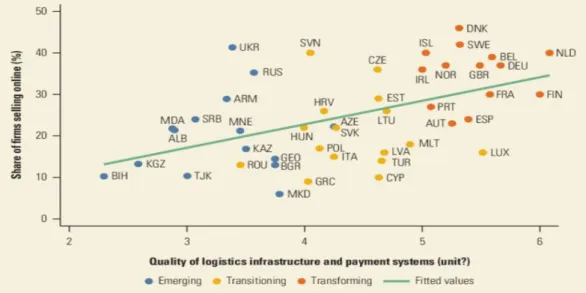
According to a recent raport of the World, Reaping Digital
Dividends: Leveraging the Internet for Development in Europe and Central
Asia, 2017, countries situated in Europe and Central Asia region are in a
unique position to reap the digital dividends. Moreover, instead of
protecting existing jobs by obstructing the spread of new technologies,
policies may concentrate on supporting those who lose their job to find
new job opportunities. Instead of a top-down attempt to control
information, policies may focus on reaping benefits of bottom-up
innovation, unleashed by improving access to internet and big data. The
same paper emphasises that the logistic infrastructure and payment system
is in a transitioning state in Romania, as presented in Figure 2. Some
solutions for improving this state are: developing lifelong learning
institutions, encouraging competition, e-commerce, on-line freelancing
[Tan, Winkler, Liaplina, Kelly, 2017].
Figure 2. Policies for creating the enabling environment for digital trade for emerging, transitioning, and transforming countries.
Source: World Bank, Reaping Digital Dividends: Leveraging the Internet for Development in Europe and Central Asia, 2017.
2. Car sharing
The "Car Sharing" practise becomes nowadays an alternative to regular taxi service or Uber-structured applications. One thought- provoking example is the Romanian company Getpony. It is a small company, started it 2015, that has developed an app which can be downloaded on smartphone. One can book a car, use it, pay 1 leu per minute, leave it whenever she or he finishes the job, the next citizen can use it, and the cycle resumes. The rate of payment varies depending on the model of the car and the duration of renting; the payment is made exclusively with the card. The investors started with an investment of 100,000 euros; in two years they have reached an investment of one million euros, and now they are trying to change the culture of urban transport in Cluj and Bucharest. The investors rely on a study pointing out that if a person drives less than 13,000 km per year, it is better to go to the car sharing system than to buy a car. The business started in 2015, by two young investors, who debuted on the market with 50 cars: Smart Fortwo, Volkswagen UP and Mini ONE. Later, they have aquired also luxury cars- BMW i3 and Mercedes S-Class.
The system is quite simple: the client downloads the application,
enter the personal details, along with a photo of the driving license – and
look for the nearest car in the area. The car can be reserved within 30 minutes to make sure another user does not reach it before the client.
The fee varies pending on the model of the car or the duration of rental, and the payment is made exclusively ellectronically. If the client takes the car with 25% (or less) fuel in the tank and fill it or washes the car, the client gets a bonus consisting of free minutes, as a reward. Drivers under the age of 23 pay extra for each race a fixed amount of 2.5 lei – a kind of fee for lack of experience.
Although the business is very promising, this small enterprise has encountered difficulties in the first three years of existence. While the net turnover had a steady growth (12 369 lei in 2015, 382 523 lei in 2016, 666 346 lei in 2017), the net profits have declined, including because of big debts, 4 614 850 lei in 2017). The net loss doubled in 2017 (from – 706 348 lei in 2016 to – 1 561 772 lei in 2017).
Table 2.
Main financial data of PONY CAR SHARING SRL (Romanian car sharing company).
Year Net Turnover
Net
Profit Debts Fixed
Assets
Current Assets 2017 666 346 lei –1 561 772 lei 4 614 850 lei 1 761 197 lei 280 986 lei 2016 382 523 lei –706 348 lei 4 111 086 lei 2 831 336 lei 290 822 lei 2015 12 369 lei –339 517 lei 442 688 lei 0 103 471 lei Source: Data collection from the official site of the Romanian Finance Minister,
http://www. mfinante.gov.ro/infocodfiscal.html, for the unique fiscal identification code 34729900 of PONY CAR SHARING SRL.
In an interview published in Ziarul de Cluj in 2016, Getpony manager, Demis Ghindeanu said that to cover most of the areas in Cluj, they would need 100 cars. In average, a car in the Cluj fleet is used only 30-40 minutes a day, while to reach the break even they have to spend a minimum of one hour.
3. Private equity sharing
According to Eurostat, in Romania, in 2017, only 6% of the
population has arranged accommodation on the internet from private
persons, through a site or app dedicated to these types of services. Romania
14%, respectively, in 2017. Regarding the transport services provided by private individuals, only 2% of Romanians have arranged such trips through a certain site or app and 1% through a dedicated site or app, below the EU average, where 8% of the population use such transport services, as shown in Figure 3.
Figure 3. Individuals arranging transport services online from another private individual, EU, 2017.
Source: Eurostat, 2017.
Two decades ago, in Romania, the time-sharing system became popular; it consisted in an arrangement in which a property is shared over the course of a year by multiple owners who enjoy the benefits and services of a tourist resort. This system is regulated by the Law no.
282/2004. A good exemple is that of the real estate Mervani, that offer time-sharing system in residences situated in good locations in the mountain area (Prahova Valley, Bran, Rasnov). But, recently, another trend becomes more popular-accomodation offered by private persons through on-line platforms, the most famous being Airbnb. Sursa Eurostat.
San Francisco-based Airbnb, which is valued at $30 billion, offers
accommodation around the world from shared rooms to Chateaus. Airbnb
hosts have earned more than $40bn across the 65,000 cities in 191
countries it operates in since the app was founded in 2008. But regulators
around the world have different approaches for this kind of business, some
encourage it (San Francisco, London, Amsterdam), while others (Paris,
Berlin) are more reluctant, fearing for public safety, health and limited
liability of these services. Airbnb is, in fact, a complex phenomenon that
has multifaceted aspects for each shareholder-for people renting out their
properties, for people who need a cheap room, when travelling, for the
local community and state, for Airbnb owner, as shown in the following SWOT analysis (Table 3).
Table 3.
SWOT analysis of Airbnb platform.
For people
renting out their properties
For people who need a cheap room,
when travelling
For the local community and
state
For Airbnb owner Strengths – the platform
allows people to earn money in a safely manner and be accessed by millions of potential clients – no trouble with
invoicing and finance – first night is
automatically paid
– lower Airbnb rates than the hotel rates
– can solve the problem of scarcity of rooms for rental, if the case
– lower labor costs, often by 30 percent, since it is not
responsible for social security
Weaknesses – the activity requires the owner flexible time for check- in, check-out, cleaning, socializing – unluckiness to
encounter difficult tourists, with
exaggerated requirements, who later post bad reviews
– no possibility to check the accommodation conditions, except from rating system (opinions from previous users)
– people working in the hotel industry losing their jobs or having diminished salaries – shrinking
profits for hotels and, consequently, lower taxes paid to the state and – no incomes for
health benefits, social security
– the system can crash if attacked by hackers (potential of loosing credibility and clients)
For people renting
out their properties
For people who need a cheap room, when travelling
For local community and state
For Airbnb owner
Opportunities – making new friends, meeting interesting people from different continents, culture and background – hosts from E.U.
can legally
– cheaper housing and rental options when travelling – making new
friends, meeting interesting people from different continents, culture and background
– opportunity for the local community to become more prosperous
– potential for expanding the business through the fantastic current development of social media and mobile technology
incomes to the local fiscal authority Threats – lack of income
predictability – untidiness, theft
risks
– deception, limited legal responsibility and amateurish service providers
– concerns as to the public security, health and limited liability – hotels argue
that Airbnb means unfair competition
– danger of being banned or muted by excessive or outdated regulation
Source: A Synthesis of the Sharing Economy in Romania and Russia, in book:
Knowledge Management in the Sharing Economy, Laurentiu-Mihai Treapăt, Anda Gheorghiu, Marina Ochkovskaya, ISBN 978-3-319-66890-1, pp. 66-67.
For a studio in Bucharest, the owner could get a maximum of 300 euros / month by renting in the classical system, while within the Airbnb system the owner can get even 500 euros / month, provided a good rating of the dwelling and the services offered. In this later case, the rent is not paid on a monthly basis, but on a daily basis. But the payment is not made directly to the owner. The tenant pays the required amount to Airbnb, which communicate the owner that the payment was made, and he will receive the money in his account one day after the customer's accommodation, after deducting a 3% charge from the tariff that Airbnb charges.
There is a timid attempt to replicate this business model-two Romanian businessmen have launched robnb.ro, a Romanian platform that offers not only accommodation, but also experiences. Robnb is translated into 28 languages and aims to promote Romania at national and international level.
On July 16, 2018, the European Commission and the EU Consumer Authorities have asked Airbnb to align its terms and conditions with EU consumer protection rules and be transparent in terms of price presentation.
Commissioner Jourová, Commissioner for Justice, Consumers and Gender Equality said: "More and more consumers book their holiday accommodation online and this sector has brought many new opportunities to holidaymakers. But popularity cannot be an excuse for not complying with EU consumer rules. Consumers must easily understand what for and how much they are expected to pay for the services and have fair rules e.g.
on cancellation of the accommodation by the owner. I expect Airbnb to follow up swiftly with the right solutions”.
Price presentations by Airbnb as well as the distinction made between
private and business entities providing accommodation services should be
in line with the requirements of EU law, in particular the Unfair Commercial Practices Directive. Therefore, Airbnb should: modify the way in which it presents the price information from the initial search on the Airbnb website to ensure that, whenever property is made available, the consumer is given the total price, which includes all applicable fees and charges, such as service charges and cleaning charges, or, if it is not possible for the final price to be calculated in advance, to be clearly informed by the consumer that it is possible to apply additional charges;
indicate clearly whether the offer is submitted by a private or professional entity in the accommodation sector, as consumer protection rules are different.
4. Ridesharing (carpooling)
UBER and Taxify provide the customer all the necessary information – route, location, driver name, car brand, since they rely a lot on the rating.
Both the passenger and the driver benefit from an anonymous and reciprocal feedback system that appears instantly at the end of the race.
These platforms provide some of the safest ways to travel, especially in majr cities of the world.
Pending on the number of hours spent using the app, a driver who works two or three hours a day can make in Romania an average of 1000-1500 lei per month and he has to pay around 260 lei as taxes paid in the accounts of the local budgets.
Uber has exceeded the threshold of 1 million users in Romania, after three years since it was launched in Bucharest. Taxify has over 15 million registered users globally in 25 countries. The company has recently received a $ 175 million investment, the main investor being Daimler, the company behind Mercedes-Benz. Taxify is one of Europe's most successful ride-sharing platforms, operating in over 20 countries and 40 cities. In Romania, it operates in Bucharest, Cluj and Timisoara.
BlaBlaCar is the most professional ride-sharing service available on the Romanian market. The service was set up in France in 2006 and currently has 30 million users in 22 countries. In order to use the service, the customer must look for the desired route between two cities and the results can be filtered according to a number of criteria: departure day, departure time, price, available car type or driver experience, maximum permissible luggage size etc.
4inmasina is a Romanian business; the principle of use is similar to
BlaBlaCar and allows a filtering of the results including the permission to
This is indeed a model of sharing economy, because there is no amount directly requested to make such a journey, as there is no mention of the cost of transport. However, most likely the driver asks for a sum to cover part of the fuel costs.
Autostopul is a similar business. Just like BlaBlaCar, the service allows the driver to set a specific price for the race, according to his or her own preferences. Unfortunately, as well as 4 in the car, this service has a low number of races, which prevents site development both as a number of registered drivers and as a number of customers registered in the system.
The ruling party submited in 2018 to the Parliament a draft law, on the authorization of online ridesharing platforms, such as Uber or Taxify, which will propose the taxation of these companies in Romania in relation to the turnover (the draft of the bill proposes a tax of 1%). In order to prevent tax evasion, ridesharing platforms will be obliged to report to National Agency for Fiscal Administration all intermediate rides, the representatives of the power accusing the fact that there are drivers not declaring all races. Cars will have to expose a special badge, and ridesharing on the territory of Romania will be subject to authorization by the Ministry of Transports. In order to obtain the authorization, the operator will submit to the Ministry of Transport, among others, the following documents and information: a financial risk insurance at the value of 50,000 Euro, a description of the features and functions of the digital platform and the way it works and its compliance with the requirements of the law as well as the indication of the web / internet address where it can be downloaded / installed for analysis / testing by the competent authority. This project is a result of the fact that an online platform may have its headquarters in another European country – such as Uber, based in the Netherlands – and, following the ridesharing service, for the 25% commission on the value of a ride, the company pays taxes in that state.
This taxation approach is not unique of its kind, since the European Commission wants to tax the revenues of large IT companies on the site of users, not at the company headquarters, with a share of between 1 and 5%.
These taxes are targeting companies like Google, Facebook, Amazon,
Twitter and Instagram and platforms such as Airbnb and Uber. Drivers of
motor vehicles are required to hold a certificate of professional competence
for the passenger transport services issued by the Romanian Road
Authority (ARR). Access will be granted to the digital platform only to
drivers who cumulatively fulfill the following conditions: – are at least
21 years of age and the certificate issued by the Romanian Road Authority
– have a category B driving license of at least 2 (two) years – presents the criminal record certificate.
5. Conclusions
In the Romanian legislation, there is now a gap on regarding the collaborative economy, so many of the companies in this field are left in a gray area and hesitate to invest in this field, although the potential of the market is huge. The more regulation is therefore needed, as the state authorities complain about the fact that giants such as Uber or Airbnb are shirking to be fiscally transparent, which raises questions about declaring incomes in the country where they earn this income. For the time being, international platforms like Airbnb or Uber, dominate the Romanian market, but there are some timid attempts of the local entrepreneurs to enter the market with their services. A very important challenge, especially for Romania, is the owner mentality; tradition and a tumultuous history have moldet people in such a way that they are very keen on the idea of being the owners of their goods. In the future, people will realize that owning goods is not always worth the effort. In this process of changing consumer behaviour and mentality a key role plays the young people. The digital generation is more and more numerically, travels a lot, it is connected with people from all over the world, and inevitably will impose a change in Romania as well.
REFERENCES
[1] Ertz Myriam, Fabien Durif, Manon Arcand, Collaborative Consumption:
Conceptual Snapshot at a Buzzword, Journal of Entrepreneurship Education 19(2):
1-23, December 2016, DOI: 10.2139/ssrn.2799884.
[2] Tan Shawn W., Hernan Winkler, Aleksandra Liaplina, Tim Kelly-Reaping Digital Dividends: Leveraging the Internet for Development in Europe and Central Asia, International Bank for Reconstruction and Development, The World Bank, ISBN:
978-1-4648-1025-1, 2017.
[3] Treapăt Mihai, Anda Gheorghiu, Marina Ochkovskaya, A Synthesis of the Sharing Economy in Romania and Russia, in book: Knowledge Management in the Sharing Economy, Laurentiu- ISBN 978-3-319-66890-1, pp. 66-67.
[4] European Commission-Study to monitor the economic development of the collaborative economy at sector level in the 28 EU Member States, 2018 https://
publications. europa.eu/en/publication-detail/-/publication/0cc9aab6-7501-11e8- 9483-01aa75ed71a1.
[5] European Commission – The Digital Economy and Society Index (DESI), 2018, https:// ec. europa.eu/digital-single-market/en/desi.
[6] European Commission-EU consumer rules: The European Commission and EU consumer authorities push Airbnb to comply Brussels, 2018, http://europa.
eu/rapid/press-release_IP-18-4453_en.htm.
[7] Ziarul de Cluj, PONY CAR este pe o pierdere enorma la Cluj. Esecul e recunoscut de Demis Ghindeanu, intr-un interviu din ZF: doar 2500 de clujeni au închiriat maşini în regim car-sharing, July 2016, https://www.ziardecluj.ro/pony-car-este- pe-o-pierdere-enorma-la-cluj-esecul-e-recunoscut-de-demis-ghindeanu-intr-un- interviu-din-zf-doar-2500-de-clujeni-au-inchiriat-masini-regim-car-sharinge Ziar de Cluj / 30 July 2016.