Optimal distribution power system reconfiguration
using Genetics Algorithms and Branch exchange
method
M. Belazzoug, K. Sebaa
LSEA, University of Medea Cité Ain D’hab, 26000, Médéa, AlgeriaH. Nouri
Power Systems, Electronics and Control Research Group Department of Engineering Design and Mathematics, University of West of England, Bristol, BS16 1QY, U.K.
Abstract— This paper uses Genetic Algorithms (GAs) and the
branch exchange method to solve the optimal reconfiguration in radial distribution systems subject to power loss reduction that determine the optimal switches. The GA is a relatively powerful intelligence evolution method for solving optimization problems. It is a population-based approach that is inspired from natural behavior of species. In this paper, GAs are applied to a realistic distribution system (106 buses) located in the Medea city (Algeria). For the comparison purpose, our method is validated with the classical Branch and Bound (B&B) method, widely used by the Distribution Companies. The results confirm the superiority of the GA.
Keywords -- GA; B&B; losses; loading and reconfiguration.
I. INTRODUCTION
In the Distribution Power System (DPS); to reduce the losses and improving the voltage profile the reconfiguration of DPS is an alternative way which not require any investment. This operation must be considered when planning the operation due to the high variable costs associated with these systems [1].
The problem of reconfiguration involves the definition of the states (open or closed) of the maneuverable switches attached to certain sections of the distribution network [2]. In the MV PDS these maneuver devices include (i) sectionalizing or normally closed (NC) switches and (ii) tie or normally open (NO) switches. This option is used to determine a radial network topology that minimizes as well as possible losses and voltage deviations [3].
As this problem includes combinatorial variable (0 and 1) with nonlinear objective function and constrained, models of integer nonlinear programming (INLP) are used. These models must consider the integer nature of the problem because the number of possible solutions grows exponentially with the number of discrete variables [4]. In addition, the
radial and connected topographies of the DPS present additional complexity for the solution techniques.
The heuristic-based methods have been proposed [5–11] in order to reduce the search space associated with reconfiguration problem.
The use of meta-heuristics for INLP problems give a well exploration of the search space. These algorithms permit the transition between local optima of the feasible region, as well as a more focused search in each subspace. Algorithms based on meta-heuristics, such as Genetic Algorithms [12–16], Simulated Annealing [17,18], Artificial Ant Colony [19] and Tabu Search [20,21], have been used to solve the problem of EDS reconfiguration. With the same purpose in mind, Ref. [22] presents an algorithm based on Artificial Immune Systems to reduce active power losses. In [23], a method based on the bacterial foraging optimization algorithm is proposed for DPS reconfiguration and loss minimization. Some modifications have been developed to retain the radial structure and reduce the searching requirements. The work in [24] presents a method for the reconfiguration and phase balancing of DPS based on a bacterial foraging approach using a fuzzy multi-objective function. Other family called Determinist techniques can be used to deal with this problem; these techniques are called Branch and Bound which is the extension of the simplex method to INLP.
In this paper, the comparison between GA and B&B algorithm for the problem of DPS reconfiguration will be discussed. Also, an application to a realistic DPS located in Medea, Algeria will be presented.
II. PROBLEM STATEMENT
A. Distribution Power System Structure
The structure of a network may defined by the constructive and invariant arrangement of all of its components: stations lines, cables etc...
In graphic terms, this structure is determined by:
- A finite set X={x1, x2, x3… xN} of elements called vertices or
buses. Where N is the total number of buses.
- A finite set X={b1, b2, b3… bM} of elements called links or
branches, where M is the total number of branches. Each branch allows to connecting the two components of a pair belonging to a subset of dimension M and included in the Cartesian product XX.
[image:2.595.106.215.247.352.2]
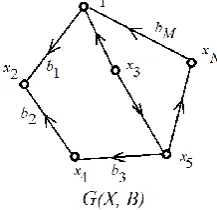
The sets correspond to the axiomatic definition of a graph, denoted G(X,B) [24], the orientation of each branch can be a priori any or indefinite (Fig. 1)
Fig. 1. Structure of a Distribution Power System
Network topology, synonym of its operating diagram corresponds to the permanent or temporary assembly of its components.
In graphic terms, this topology is associated with a sub-graph of G, defined by the set X and a set of links L such that L B. The links belonging to L mean that each of them can exchange a flow (current) between the two corresponding nodes. It said, in this case, that the link is in service. For each links in the complementary set, this exchange is interrupt intentionally and it said that the link is out of service.
In the case of distribution power systems, the partial graph is connected, i.e., it is possible to achieve, from a given node any other node via a path composed by the elements of L. In addition, the number of branches belonging to L is the total number bus minus one.
B. General mathematic formulation
The problem to solve is to determine the optimal exploitation schemes in accordance with specified criteria and constraints.In this section, it is proposed to express it mathematically.
For a distribution network defined by its structure, or by the its graph, it is associated to the set B a set Y and a set U such that: Y set of state variables representing the currents in the
branches
U set of decision variables representing the topologic stats of branches; such as ukU \ uk=1 if the branch
bk is switched on, otherwise uk=0.
Also, it is associated with the set X a set Z such as:
Z set of state variables representing the voltage at the nodes. According to this notation, an optimization problem can be formuled. Where the components of Y, Z and U should be defined (1).
min f(Y, Z, U) Objective function s.t.
f(Y, Z, U)=0 Kirchoff’s law
h(Y, Z, U)≤0 Security constraints (1) s(U) =1 Radiability
t(U) ≤ 0 Objective function
C. Kirchhoff equations
This constraint laid by the Lemma of Kirchhoff about the currents.
1 M
k ik k i
k
u a I J
(2)where
1 if is oriented to 1 if is oriented from 0 if is not an end of
k i
ik k i
i k
b x
a b x
x b
Ik is the current in the branch bk
Ji is the load current at the bus xi
This constraint also involves the continuity of service, ie the desire to fully meet the load at any node of the network. Since the solution of the optimization problem must ansure that the network is radial without isolating
any load buses, the second lemma of Kirchhoff about the tensions will be implicitly respected.
D. Radiality
This constraint is related to decision variables. It involves the conservation of the radially operation of the network.
1
1 M
k k
u N
(3)To complete the constraint [3]; It is necessary to impose the connectivity of the operating diagram. It can be expressed as follows:
, ( ) whether 1
i i j j
i j i j i j
b L b L
x x L L u u
(4)where L Li j is a path connecting the buses xi and xj and ui
denote the topological states of the branches of Li constituting
this path.
E. inequality constraints
1) Security: change the default, adjust the template as follows. These constraints imply only the state variables, namely the branches currents and the buses voltages, must not exceed the allowable limits.
max
k k k
I u I (5)
Where Ikmax is the thermal limit of current in the branch bk
Operators must ensure voltage as close as possible to the nominal voltage at each consumption point; the maximum tolerated deviation can vary from one company to another. Generally, the absolute value of this difference varies between 5 and 10% depending on the normal operation or failure mode of the network. The expression of this constraint is:
100 5%
in i in
V V V (6)
Vin, Vi are respectively the nominal voltage and the voltage
at the bus xi.
2) Number of switching operations: Due to failure of a branch, operators wish to restore the continuity of service using a backup operating scheme that is as close as possible to the original topology. This desire led to the limitation of the number of switching operations:
0
max 1
M
k k
k
u u
(7)0 k
u is the initial topology of the branch bk
max
is the maximum number of allowed switching
F. Objective function
1) Losses: It is inevitable and cause problems for both technical and economic. They can expressed according to the following expression
2 1
M
R k k k
k
f u R I
(8)Rk is the resistance of the branch bk
2) Load balancing: The load balancing results from the desire to exploit the network optimally by dividing current reserves uniformly.
max 2 1
( / )
M
I k k
k
f I I
(9)3) Maximum voltage deviation: the aim of this objective is to minimize the maximum voltage deviation
max / 1, ,
V in i in
f V V V i N (10)
III. GENETICS ALGORITHMS
Here, we descript the use of the GA to solve the problem of the reconfiguration of a DPS.
1) Fitness:
As the GA is an unconstrained optimization technique, when at least one constraine is violed the objective function is set to a very small value:
1
if all constraints are respected
othewese val L
(11)
Where L is a composite function of (8, 9 and 10). 2) codage:
The number of opened lines is equal Noff M N Nfeeder ,
where Nfeederis the number of feeders. Hence, Noff strings
should be used. Each string is coded by a binary way, with a length equal to:
fix(ln( )) 1M (12)
Where fix is a round towards zero function.
3) Initialization:
The starting population is chosed randomly. However, to ensure the research in the feasible space (especialy the respect of the constraint (4)) the original situation is used.
4) Branchs exchanging operator
The well known and elementary operation an DPS used by the exploitants is the load ripage, which consist of the balancing a load from a overloading branch to other lessloading branch. This operation is elementary and vital as it preserve the radiability and connectivity of DPS.
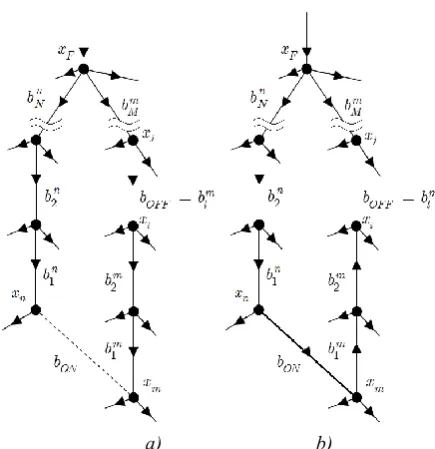
Let s(old) is the initial configuration of a DPS, the rippage consist of reaching a new configuration s(new) by closing an opened branch bON={xn, xm} and opening a closed branch
bOFF={xi, xj} that belongs to the same independent loop. This
elementary operation can be samarized by:
s(new) = s(old) (bON, bOFF) (13) xF is the feeder node or the the node that ensure the power
supply to the loop.
Considering that the load are modeled by a constant current (neglecting the capacitif effect of lines – short lines), only the currents related to the correspondant loop will be changed and consecontly only the voltage of the nodes in this loop will be change with the voltage of their aval nodes.
As the three objective functions fR, and fI fVare not in
conflict, we interest only in fR. The new value can be
calculated as following:
(new) (old) (new)
R R R
f f f (14)
( ) 2
( )
(old) (old)
( )
2 ( )
k n m ON
k n k m
new
OFF k
R
b L L b
OFF b L k k b L k k
f I R
I R I R I
(15)where
IOFF the current in branch bOFF
bk the resistance of branch bk
fR(new) a total Jole’s losses at the configuration s(new)
fR(old) a total Jole’s losses at the configuration s(old)
Ik(old) the current of the branch bkat the configuration s(old)
a) b) Fig. 2. Branches_exchanging_ s(new) = s(old)(b
ON, bOFF)
a) configuration s(old) b) configuration s(new).
For the voltage computation, the new values can be evaluated as:
(new) (old) (new)
g g g
V V V (16)
where
(new) (old)
( )
(new) (old)
if if
if and
( )
if and loop and loop
0 otherwise
k g
k g
k g m k n
OFF b L k g n
OFF b L k g j
n m g m j g
new
g OFF k k ON
b L L b L
e g
e e
e g
I Z L L
I Z L L
V V L L L L
V I Z Z Z
L L V V
x x
For the current computation, the new values can be evaluated as:
(new) (old) (new)
k k k
I I I (17)
where
( )
if if
0 othewise
OFF k n ON
new
OFF k m
k
I b L b
I I b L
Thereby, it is faster to calculat the new objective functions, when the exchange operation (mutation or crossover) occurs than at the end of the performance of GA operations, like in the case of all known GA.
5) Selection:
To maintaining the elite invidious having a great fitness function, the selection should be competitive. In this paper, the ‘roulette wheel selection’ scheme is used where each string
lodges an area of the wheel that is equal to the string’s share of the total fitness.
6) Adapred Mutation
At start the independent loops will identify, each independent loop contains only one open branch. From the open branch, the candidate branches is closed b={xk, xm} will be chosen
randomly, i.e. that have the probability less to Pm.
The branch to be opened b will be chosen based on the
Dynamic Neighborhood Strategy (DNS); from a set of branches in L Lk m . if s(old) is the current configuration, s(new) = s(old) (b
, b) is the first new configuration that ensure the
inequality :
f(s(new)) f(s(old)) (18) If (18) cannot be realized we keep the best b, i.e. that
minimize as well as possible f(.). In other hand, we can use the Maximum Neighborhood Strategy (MNS); the difference from DNS is that all the L Lk m branches will visited.
To speed up the mutation process, the function f(.) will be calculated only in the modified part of the network.
[image:4.595.37.288.347.475.2]Its purpose is to maintain diversity within the population and inhibit premature convergence. Mutation alone induces a random walk through the search (Fig. 4).
Fig. 3. Mutation in three independent loops (--- open arc in children chromosome, --- open arc in parent chromosome)
7) Adapted Crossover
The crossover operation is perform on random two invidious (that have the probability less to Pc) from the mating pool and produces two new invidious (children), each will result from one part of the parent string. Mutation gives a technique to generate new information into the knowledge base.
In Figure 4, the crossover with one point is presented, this point is chosen randomly. It is important here to identify the loops to permutated exactly the branches.
For example in Figure 4, if s1 (where (b1,x,b1,y,b1,z) are open)
and s2 (where (b2,x,b2,y,b2,z) are open) are the
configurations of the parent invidious. Hence, the children invidious will have the following configuration:
'
1 1 1, 2, 1, 2,
'
2 2 2, 1, 2, 1,
( , ) ( , )
( , ) ( , )
y y z z
y y z z
s s b b b b
s s b b b b
Fig. 4. Crossover with one point in three independent loops (--- open arc in Parent 1 chromosome, --- open arc in Parent 2 chromosome)
Unlike the simple GA where assessment is done after the crossover and mutation operations, in this work, the evaluation is done along the GA operations. This improves the convergence time of the algorithm.
IV. CASE STUDY
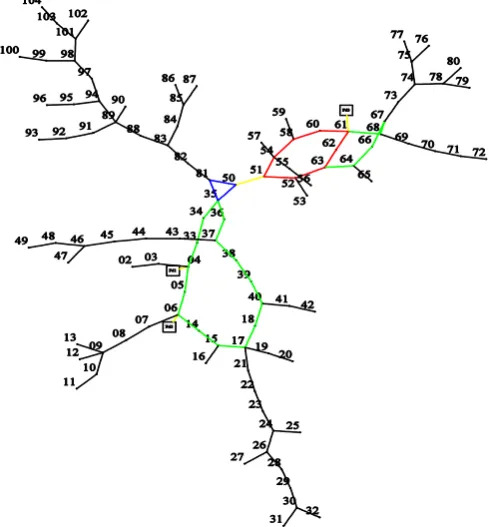
[image:5.595.312.540.61.239.2]The Distribution power system used is the 106 buses and 03 feeders LV (400 V) network of the R’mali Medea city (Figure 3).
Fig. 5. R’Mali P297 Power system - candidate lines to switch in color
Figure 6 show that this network contain six dependents loops. Hence, six lines should be switched off. To find these lines, the problem presented in (1) should be resolved, it is clear that it is an Integer Non Linear Programing (INLP) problem. The parameters of the Genetic Algorithms (GA) are described in the Table I.
Fig. 6. Comparison AGA-DNS and AGA
[image:5.595.300.565.332.643.2]For the comparison, the classical method B&B is used. The table 1, conform the superiority of the AGA and DNS then the B&B and the classical GA. Moreover, AGA-DNS is faster than the AGA. In addition, these two method go to the global optimal solution.
TABLE I GA PARAMETER
Parameter Values Parameter Values Population size 20 Crossover probability 0.01 Maximum generation 50 Mutation probability 0.10
TABLE II
COMPARISON GA AND B&B FOR R’MALI DPS
Method switched off lines fR in kW fI fV Simple
Genetic Algorithms
35-36 52-63 04-05 35-50 50-81 66-67
2.7666 1.0765 5.23%
Branch and
Bound 51-54 37-38 04-05 35-50 50-81 66-67
2.7811 1.0765 5.66%
AGA 38-39
35-81 51-52 04-05 35-50 66-67
2.5883 1.3274 4.92%
AGA -
DNS 38-39 35-81 51-52 04-05 35-50 66-67
2.5883 1.3274 4.92%
We have evaluated all the 6 35
C solutions and have determine that there are 18640 feasible solutions and the solution obtained with AGA and AGA-DNS is the global one.
[image:5.595.41.286.355.619.2]optimization of the two others. The simple GA is very time consuming due to searching on the unfeasible region, whoever AGA and AGA-DNS can solve this problem. From figure 6, the AGA-DNS is faster than the AGA. This is due to the improvement of the mutation process.
V. CONCLUSION
This paper proposes the application of a met-heuristic optimization technique called Genetic Algorithms (binary coded) for the reconfiguration of the Distribution Power System to minimize the loses, improving the load-ability and the voltage profile. For the comparison the Branch and Bound technique, which is used by the Algerian company, is implemented. To conclude, the GA is clearly superior to B&B. As the GA is very time consuming; AGA and AGA-DNS will improve this weakness due to the search tower the feasible space.
VI. REFERENCES
[1] Gonen T. Electric power distribution system engineering. 1st ed. New York: McGraw Hill; 1986.
[2] Sarfi RJ, Salama MMA, Chikhani AY. A survey of the state of the art in distribution system reconfiguration for system loss reduction. Electr Power Syst Res 1994;31(1):61–70.
[3] Kalantar M, Dashti R, Dashti R. Combination of network reconfiguration and capacitor placement for loss reduction in distribution system with based genetic algorithm. In: Proc 41st international universities power engineering conf Newcastle upon Tyne UK, vol. 1; 2006. p. 308–12.
[4] Khator SK, Leung LC. Power distribution planning: a review of models and issues. IEEE Trans Power Syst 1997;12(3):1151–9.
[5] Civanlar S, Grainger JJ, Yin H, Lee SSH. Distribution feeder reconfiguration for loss reduction. IEEE Trans Power Deliver 1988;3(3). p. 1227–3.[6] Baran ME, Wu FF. Network reconfiguration in distribution systems for loss reduction and load balancing. IEEE Trans Power Deliver 1989;4(2):1401–7.
[6] Goswami SK, Basu SK. A new algorithm for the reconfiguration of distribution feeders for loss minimization. IEEE Trans Power Deliver 1992;7(3):1484–91.
[7] Gomes FV, Carneiro Jr S, Pereira JLR, Vinagre MP, Garcia PAN. A new heuristic reconfiguration algorithm for large distribution systems. IEEE Trans Power Syst. 2005;20(3):1373–8.
[8] Gomes FV, Carneiro Jr. S, Pereira JLR, Vinagre MP, Garcia PAN, Oliveira EJ, Araújo LR. A new distribution system reconfiguration approach using optimal power flow technique and sensitivity analysis for loss reduction. In: IEEE Proc Power Engineering Society General Meeting San Francisco, CA, USA, vol. 1(1); 2005. p. 1–5.
[9] Raju GKV, Bijwe PR. An efficient algorithm for loss reconfiguration distribution system based on sensitivity and heuristics. IEEE Trans Power Syst 2008;23(3):1280–7.
[10] Oliveira LW, Oliveira EJ, Carneiro Jr S, Pereira JLR, Costa JS, Silva Jr IC. Optimal reconfiguration and capacitor allocation in radial distribution systems energy losses minimization. Int J Electric Power Energy 2010;32(8):840–8.
[11] Nara K, Shiose A, Kitagawa M, Ishihara T. Implementation of genetic algorithm for distribution systems loss minimum re-configuration. IEEE Trans Syst 1992;7(3):1044–51.
[12] Torres-Jimenez J, Guardado JL, Rivas F, Maximov S, Melgoza E. Reconfiguration of power distribution systems using genetic algorithms and spanning trees Proc electronics, robotics and automotive mechanics conference Cuernavaca morelos Mexico; 210. p. 779–784.
[13] Torres J, Guardado JL, Rivas-Dávalos F, Maximov S, Melgoza E. A genetic algorithm based on the edge window decoder technique to optimize distribution systems reconfiguration. Int J Electric Power Energy 2013;45(1):28–34.
[14] Mirhoseini S H, Hosseini SM, Ghanbari M, Ahmadi M. A new improved adaptive imperialist competitive algorithm to solve the reconfiguration
problem distribution systems for loss reduction and voltage profile improvement Electric Power Energy Syst 2014;55(1):128–43.
[15] Mazza A, Chicco G, Russo A. Optimal multi-objective distribution system reconfiguration with multi criteria decision making-based solution ranking and enhanced genetic operators. Int J Electric Power Energy 2014;54(1):255–67.
[16] Chiang H, Jean-Jumeau R. Optimal network reconfiguration in distribution system. Part 2: solution algorithms and numerical results. IEEE Trans Deliver 1990;5(3):1568–74.
[17] Zhigang M. Study on distribution network reconfiguration based on genetic simulated annealing algorithm. In: Proc China international conference electricity distribution guangzhou China; 2008. p. 1–7.
[18] Khoa TQD, Phan BTT. Ant colony search-based loss minimum reconfiguration of distribution systems. In: IEEE proc power india conference New Delhi, India; 2006. p. 6.
[19] Mori H, Ogita Y. A parallel tabu search based method for reconfigurations distribution systems. IEEE Proc Summer Power Eng Soc Meeting Seattle USA 2000;1:73–8.
[20] Mekhamer SF, Abdelaziz AY, Mohammed FM, Badr MAL. A new intelligent optimization technique for distribution systems reconfiguration. In: Proc international middle-east power system conference Aswan Egypt; 2008 397–401.
[21] Kumar KS, Jayabarathi T. Power system reconfiguration and loss minimization for an distribution systems using bacterial foraging optimization algorithm J Electric Power Energy Syst 2012;36(1):13–7.
[22] Hooshmanda R, Soltanib SH. Simultaneous optimization of phase balancing and reconfiguration in distribution networks using BF–NM algorithm Electric Power Energy Syst 2012;41(1):76–86.
[23] Boardman, J.T.; Meckiff, C.C.,”A Branch and Bound Formulation to an Electricity Distribution Planning Problem”, IEEE, Transaction on PAS, Vol. PAS-104, no 8, Aug., 1985, pp. 2112-2117.