Confidence in uncertainty: Error cost and
commitment in early speech hypotheses
Sebastian Loth1,2☯
*, Katharina Jettka3☯
, Manuel Giuliani4☯
, Stefan Kopp1,5, Jan P. de Ruiter6☯
1 Social Cognitive Systems, CITEC, Bielefeld University, Bielefeld, Germany, 2 Psycholinguistics, CITEC, Bielefeld University, Bielefeld, Germany, 3 Psycholinguistics, Linguistics and Literary Studies, Bielefeld University, Bielefeld, Germany, 4 Bristol Robotics Laboratory, University of the West of England, Bristol, United Kingdom, 5 Social Cognitive Systems, Faculty of Technology, Bielefeld University, Bielefeld, Germany, 6 Departments of Psychology and Computer Science, Tufts University, Medford, Massachusetts, United States of America
☯These authors contributed equally to this work. *[email protected]
Abstract
Interactions with artificial agents often lack immediacy because agents respond slower than their users expect. Automatic speech recognisers introduce this delay by analysing a user’s utterance only after it has been completed. Early, uncertain hypotheses of incremental speech recognisers can enable artificial agents to respond more timely. However, these hypotheses may change significantly with each update. Therefore, an already initiated action may turn into an error and invoke error cost. We investigated whether humans would use uncertain hypotheses for planning ahead and/or initiating their response. We designed a Ghost-in-the-Machine study in a bar scenario. A human participant controlled a bartending robot and perceived the scene only through its recognisers. The results showed that partici-pants used uncertain hypotheses for selecting the best matching action. This is comparable to computing the utility of dialogue moves. Participants evaluated the available evidence and the error cost of their actions prior to initiating them. If the error cost was low, the partici-pants initiated their response with only suggestive evidence. Otherwise, they waited for additional, more confident hypotheses if they still had time to do so. If there was time pres-sure but only little evidence, participants grounded their understanding with echo questions. These findings contribute to a psychologically plausible policy for human-robot interaction that enables artificial agents to respond more timely and socially appropriately under uncertainty.
Introduction
Face-to-face interactions between humans are the model for intuitive and social human-machine interaction (HMI). Humans respond sensibly and swiftly to their interlocutors’ utter-ances and establish immediacy in the interaction. This exchange of conversational turns sys-tematically minimises silence and overlapping talk [1]. The next speaker typically starts a1111111111 a1111111111 a1111111111 a1111111111 a1111111111 OPEN ACCESS
Citation: Loth S, Jettka K, Giuliani M, Kopp S, de Ruiter JP (2018) Confidence in uncertainty: Error cost and commitment in early speech hypotheses. PLoS ONE 13(8): e0201516.https://doi.org/ 10.1371/journal.pone.0201516
Editor: Cheryl Mary Corcoran, Icahn School of Medicine at Mount Sinai, UNITED STATES
Received: June 7, 2017
Accepted: July 17, 2018
Published: August 1, 2018
Copyright:©2018 Loth et al. This is an open access article distributed under the terms of the
Creative Commons Attribution License, which permits unrestricted use, distribution, and reproduction in any medium, provided the original author and source are credited.
Data Availability Statement: All relevant data are within the paper and its Supporting Information files.
speaking within a small time window ranging from 250 ms before and after the end of an utter-ance [2]. A preference for very brief periods of silence was found across cultures [3]. Precisely timed responses are conventionalised in human interaction. Thus, temporal misalignments constitute a signal to interlocutors [4], e.g. gaps may signal disagreement [5,6]. In HMI, pro-longed system response times slow down turn-taking, reduce the agent’s immediacy, cause annoyance, reduce user motivation [7,8] and users might falsely believe that they made a mis-take in how they were communicating with the system. Therefore, to be socially competent, an artificial agent has to respond with precise timing.
Humans achieve timely responses despite the fact that it takes approximately 600 ms for preparing and initiating the articulation of a single word [9–11]. More complex utterances require considerably longer [12]. Thus, understanding an utterance and planning a response occur concurrently for at least 400 ms. This implies that humans understand utterances incre-mentally [2]. Evidence suggests that they start trying to predict the end of an utterance by as much as 1250 ms [13]. The effects of incrementality are most apparent in mistakes, e.g. garden path sentences typically require a re-analysis [14,15]. Correct predictions enable the listener to estimate their interlocutor’s speech act ahead of time and to prepare a sensible and timely response [16,17]. But the mapping between utterances and speech acts is highly ambiguous. Thus, heuristics are required for identifying the intended speech act [4,18]. Both, predicting an utterance and heuristically estimating the speech act are imperfect processes, introduce uncer-tainty and might result in costly errors. Humans try to avoid errors with several strategies. First, humans account for larger parts of a discourse [17,19] and use knowledge about the sce-nario (e.g., scripts, see [20,21]) when forming predictions rather than relying only on local information. Secondly, listeners produce so-calledgroundingsignals to communicate their current understanding of an utterance to the speaker, e.g. they gesture [22] or gaze towards rel-evant objects [23,24] or objects that will become relevant [25,26]. These grounding signals enable speakers to adapt their utterances on-the-fly [27]. Thirdly, humans typically initiate their response after their interlocutors almost completed their utterances [22,28]. This enables them to compare their predictions to the actual utterance and to adapt their responses if needed. These mechanisms enable timely responses and reduce the risk of costly errors in incremental, predictive processing.
From their daily experience of interacting with other humans, users expect that artificial agents respond swiftly, sensibly and provide relevant grounding signals. But artificial agents have to rely on automatic speech recognisers (ASR). Recently, ASR performance exceeded human performance in conversational speech [29] and improved in noisy environments [30]. However, ASRs typically provide a final hypothesis about the speaker’s utterance only after 1.6 s [31] which is outside the +/- 250 ms window in human interaction. Incremental ASRs (ISR) deliver uncertain hypotheses while utterances unfold, e.g., Kaldi [32,33], Sphinx-4 [34], Google Voice API and Microsoft Speech Recognition APIs. Thus, they can enable artificial agents to respond more timely. However, early speech hypotheses are incomplete and uncertain. The hypotheses’ content may change as more material of the unfolding utterance has been ana-lysed. In contrast to humans, artificial agents cannot wait for the final and most certain ASR analysis without sacrificing the temporal advantage of an ISR. For example, a system trained with inverse re-inforcement learning to detect the end of a turn and initiate a speak or back-channel action showed an increase in the probability of responding to over 50% after about 1.0 s of silence [35]. However, a pause of 1.0 s is still large compared to a fluent interaction and does not include the time required by the ASR for recognising a pause. Thus, an artificial agent has to fully commit and initiate its response based on an early and therefore more uncertain speech hypothesis.
Forschungsgemeinschaft and the Open Access Publication Fund of Bielefeld University (http://oa. uni-bielefeld.de/en/publikationsfonds.html). The funders had no role in study design, data collection and analysis, decision to publish, or preparation of the manuscript.
Incomplete speech hypotheses have to be projected onto an utterance that is sufficiently informative for initiating an appropriate response. This has been achieved, e.g., by fitting a syntactic structure to a hypothesis, disambiguating syntactic ambiguities with knowledge about the scene and further projecting this onto a collection of fully annotated utterances [36,37]. This way the system guesses the full utterance and its semantic frame [38–40]. The early semantic information can be used for producing grounding signals [38,40]. Vice versa, processing the user’s actions during the artificial agent’s utterance enables the agent to estimate the user’s understanding [41,42], to adapt its utterance and to explicitly elicit user feedback if needed [43–45]. These accounts aim for integrating incremental hypotheses into a larger, mul-timodal model of intention recognition. The AIRBUS model [16,18] integrates multimodal inputs and prior knowledge with Bayesian updates over the probabilities of a set of intentions. This identifies the most likely speech act and how this deviates from the model’s prior expecta-tions at any moment in time. The architecture can be extended to capture the processing from basic units of computer perception to intentions in hierarchical layers [46,47]. Further improvements to ISRs were achieved by contextually boosting parts of the vocabulary [48] and estimating the end of an utterance, e.g., using morae in Japanese [49]. Furthermore, projecting incomplete onto full utterances magnifies the ISR’s uncertainty and in turn, the risk of a signif-icant revision that requires re-planning increases. Thus, dialogue managers have to balance the risk of costly errors with the benefit of more timely responses. In order to explicitly model uncertainty, dialogue managers shifted from Markov decision processes (MDPs) to partially observable MDPs (POMDPs, see [50,51] for introduction and [52] for review). These systems focussed on the uncertainty after the final analysis of an utterance and its corresponding n-best list of hypotheses in POMDPs [53,54] and recurrent neural nets [55]. However, the large training sets that are required with these models are often derived from simulated users. This limits the model’s performance to the quality of the simulation. Gaussian process policy opti-misation reduces the number of required dialogues by a magnitude to only 10,000s of dia-logues that are feasible to create with Amazon MTurk [56]. The policy trained with real input significantly outperforms simulator trained policies [56]. By using domain independent knowledge such as syntactic and lexical knowledge, Eshgi et al. [57] were able to demonstrate that as little as 5 dialogues were sufficient for training. Furthermore, their incremental word-by-word processing improved the quality of the dialogues but the incremental parses were based on text that did not change or update during the parse.
The abstract ’incremental unit’ (IU) model [58–61] explicitly addresses incremental speech hypotheses. It maintains a record of each hypothesis but it does not address efficiency and error cost. The incremental interaction manager [62] immediately performs a response action if it advances the dialogue. An ongoing action is stopped if an update triggers a more appropri-ate action. This model does not require tracing hypotheses but it may commit unnecessary errors. For example, prematurely closing the interaction with the user cannot easily be inter-rupted or undone. Erroneous closings require the user to start all over again and thus, have high error cost [63,64] whereas other types of actions that incur lower error cost could be trig-gered immediately. But there is no clear evidence on quantifying error cost and how it inter-acts with the users’ expectation on immediacy in the interaction.
hypotheses for grounding, planning ahead or for immediately performing actions, and sum-marised the results in an abstract interaction policy.
Ghost-in-the-Machine study
We conducted a real-time Ghost-in-the-Machine study (GiM, see [65,66]). The participants controlled a bartending robot that accepted orders from its customers and served the corre-sponding drinks. In contrast to typical Wizard-of-Oz studies, see [67] for review, the partici-pants cannot observe the scene through a video or audio link but have to rely on preprocessed sensor data including the ISR speech hypotheses. That means that the main participants in our study (ghosts) observed their bar customers through the robot’s eyes and ears and responded to them by selecting actions from the robot’s repertoire. In this study, we focus on their use of incremental speech hypotheses. These were real ISR hypotheses including mistakes induced by the customers (e.g., slips of the tongue) and any recognition mistakes, uncertainties and updates by the ISR.
The ghosts were familiarised with the interfaces of this GiM study. They were explained that the ISR hypotheses were real and subject to uncertainties and errors. But they were not instructed how they should interact with their customers. Thus, their actions approximate how they would use speech hypotheses themselves and by extension, how they expect others to use them. We hypothesised that the ghosts would rely on the early hypotheses for planning a response but not necessarily for initiating it. Furthermore, the evidence from human-human interaction suggests that mechanisms in interaction including turn-taking (i.e., timely responses) obey the same timing constraints independently from the potential error cost asso-ciated with a particular response.
We refer to the main participants controlling the robot asghostsand to the confederates placing the orders ascustomers.
Methods and materials
Conditions. In order to test whether the ghosts used early, uncertain speech hypotheses, we designed acertainand anuncertaincondition. Thecertaincondition reflected typical dia-logue managers or action planners where all data with a confidence level exceeding a threshold are treated as ground truth whereas other data are discarded. Thus, the ghosts were presented only final hypotheses that were displayed with the maximum confidence level. In theuncertain
condition all available data together with their true confidence level were presented, i.e. the ghosts had access to faster and additional information. A dialogue manager would have to integrate the confidence levels and the content of the hypotheses. By comparing the response times (RT) incertainanduncertaintrials, we studied how the presence of the additional early but uncertain speech hypotheses affected the ghost’s behaviour.
of a drink. Due to technical limitations, this action could not be interrupted and the drink could not be retracted. Thus, an erroneous serving was associated with high error cost. In con-trast, customers approaching the robotic bartender might not be familiar with its drinks menu. In this case, listing the menu was appropriate even if the customers did not ask for it. So the error cost was considerably higher for an erroneous drink serving than for an unsolicited enumeration of the drinks menu.
In a typical trial, the ghosts observed how the customers entered the area covered by the sensors and approached the bar. The ghosts initiated an interaction, the customers asked their question and placed their order(s), the robot served the drink(s), the interaction was closed and the customers left the scene with their drinks. All scripts are listed inS1 File.
In our study, the same two confederates acted as customers throughout the experiment. They staged scripted drink order scenarios for the robot (and by implication, for the ghosts controlling the robot). This procedure served to minimise user specific variation of the recog-nisers, especially the ISR. The assignment of the roles (bystander, group member, placing an order) and the choice of drinks (water, juice, coke) were counterbalanced between the confederates.
Participants. Seventeen participants (4 female, 13 male, age range 21–39, M = 28.5, Mdn = 27) were recruited out of the employees of fortiss GmbH in Munich, Germany (all with a background in IT or engineering). The participants were not familiar with the purpose of the study. They received 5€and a chocolate bar in exchange for their time and effort.
The study was conducted by scientists of Bielefeld University, Germany. Its procedures were approved by Bielefeld University’s Ethics Committee (EUB) under approval№4807. An informed written consent was collected prior to the experiment.
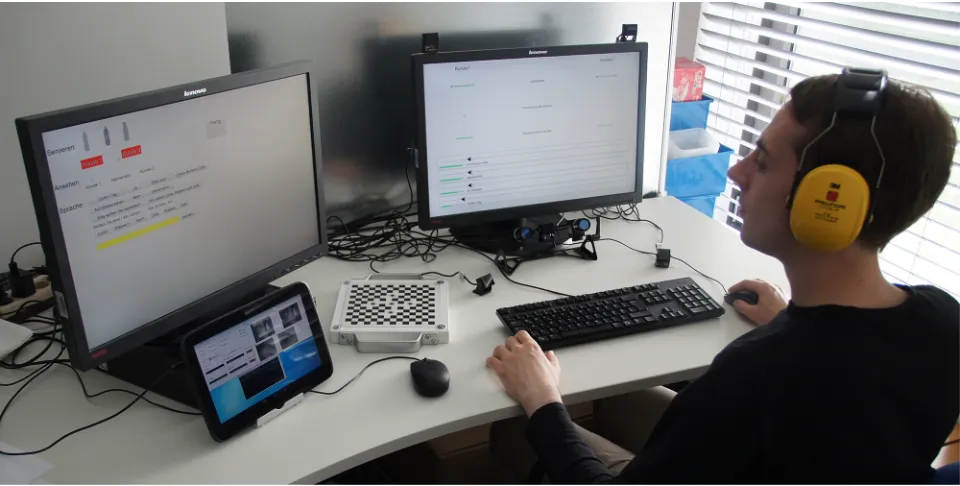
Apparatus. The participants were seated at a desk with two typical office screens (52 cm by 32 cm, 1920 by 1200 pixel), mouse and keyboard in a room separating them from the bar-tending robot. The first screen was positioned straight in front of the participants at a viewing distance of approximately 70 cm. It displayed the recogniser data. The participant’s eye gaze on this screen was recorded using a 60 Hz remote eye tracker [69] positioned below the centre of the screen. Data were recorded on the local computer at 60 Hz. Infrared illuminator pods were positioned on top of the screen, below the screen and in the central position between the cameras. Switching between the pre-installed pods speeded the process of finding a suitable illumination and tracking mode for each participant. The eye tracker could be calibrated to all participants satisfactorily for the purpose of this study.
The robot’s control interface was presented on the second screen which was positioned to the left hand side of the participants and outside of the eye tracker’s range. If the ghosts wished to control the robot, they had to turn left and away from the screen in front of them. Thus, even with a relatively coarse tracking precision, we were still able to reliably determine when the participants switched to the control panel and which recogniser data had been visually attended. The participants were shielded from distractions by portable blank screens around the desk and passive sound insulating headphones. An experimenter checked the functioning of the eye tracker through a tablet computer connected via WiFi. This experimenter stayed in the room in order to adjust the eye tracker if needed. It was obvious to the participants that they were not monitored directly or through the tablet. The setup is shown inFig 1.
The customers were tracked by a Microsoft Kinect unit. We implemented a tracking mod-ule that provided updates about the customers’ visibility, distance to the bar and their torso orientation based on the Kinect’s skeleton data. We implemented a speech recognition module that used the Microsoft speech recognition and implemented a Speech Recognition Grammar Specification (SRGS) containing only sentences related to the bar scenario. This included greetings, drink orders, clarifications, and sentences to conclude the interaction. The Kinect, the robot and the ghost’s interface were connected through a middleware at 20 Hz.
Ghost-in-the-Machine interface. The ghosts’ interface was a dedicated JAVA application that managed the flow of information to and from the middleware. It consisted of an informa-tion panel that showed the incoming recogniser data (Fig 3). This was displayed on the screen with the eye tracker straight in front of the ghosts. The screen on the left hand side displayed the control panel (Fig 4). Any selected robot actions were executed immediately. The remain-ing area on either screen was covered by a plain sremain-ingle coloured background. In contrast to previous off-line GiM studies [65,66], this design enabled the ghosts to engage directly with their customers and observe how they responded to their actions.
Information panel. The information panel was divided into two larger sections. In order to facilitate the ghosts’ real-time understanding, the upper part was limited to the most rele-vant information from computer vision [66]: the customers’ visibility, distance and body ori-entation. In theuncertaincondition, the progress bar for the customer’s visibility reflected the system’s confidence of having detected a person in the tracking area whereas in thecertain
condition the bar was either empty or full. The other progress bar indicating whether a cus-tomer is at the bar. It linearly mapped the cuscus-tomer’s distance between 0.8 and 0.3 m in the
uncertaincondition and a threshold of 0.6 m was used in thecertaincondition for switching
[image:6.612.96.576.77.320.2]between empty and full. The arrow indicator for the body orientation was not affected by the condition. The lower section of the information panel was dedicated to the ISR hypotheses. Up to four hypotheses were displayed with their content as plain text and a progress bar
Fig 1. Setting of the study. The setting for the ghost participants including the information panel, eye tracker, control panel and eye tracker control
screen. The participant wears passive noise insulating headphones.
indicating the ISR’s confidence. In addition, the utterance’s source direction as measured by the Kinect’s microphone array was depicted by a speaker symbol on a slider bar and indicated whether customer 1 or 2 had spoken. In thecertaincondition, only final hypotheses were dis-played and the progress bar was always set to full. In theuncertaincondition, all hypotheses were presented with their true confidence value.
[image:7.612.97.571.76.510.2]Time morphing. We presented the ISR data visually because an ergonomical and accurate auditory presentation of incrementally growing content and hypotheses that differ only in their confidence level is (almost) impossible. Due to smoothing and other post-processing ASRs are slow in producing hypotheses compared to a human listener. However, the ISR pro-duces hypotheses faster than humans can read and understand them. Visually understanding the presented speech hypotheses requires explicitly combining their spatial origin, certainty and content whereas these data are inherently combined when listening to an utterance. If the
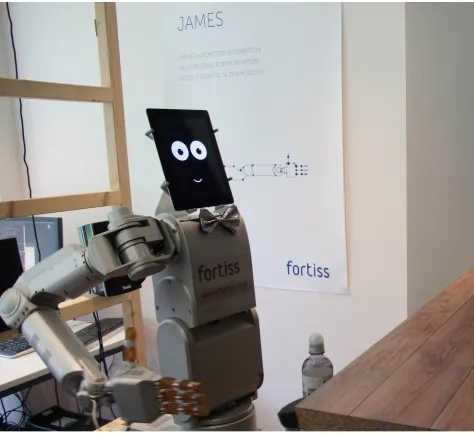
Fig 2. Bartending robot. The robot is shown at its bar about to grab a bottle of water for serving.
time span between two hypotheses is too short, we cannot distinguish whether the ghosts a) attended a fast stream of incoming information but could not process it, b) perceived the information as still unreliable and waited for more/better data, or c) wished to act but new information appeared and distracted them from doing so. Thus, in order to ensure that we can interpret our results, we extended the time span between hypotheses to a minimum of 1500 ms (seeS1andS2Videos for comparison).
[image:8.612.95.576.75.385.2]Displaying hypotheses was managed by entering all new hypotheses into a queue that main-tained their temporal order. The next hypothesis in the queue was displayed whenever the most recent hypothesis has been displayed for at least 1500 ms. Up to four hypotheses were presented in descending order of their confidence level. Since later hypotheses tended to be more confident, they typically entered the display at the top position. If the content and direc-tion of a new hypothesis matched with an already displayed item, the confidence level was updated. Some hypotheses entered the temporal queue but were never displayed because their confidence was too low. Old speech hypotheses were removed from the display or the queue after 4000 ms and the next hypothesis was displayed. The display in thecertaincondition was rarely affected by time morphing because each utterance was typically associated with one final hypothesis. The time morphing allowed the ghosts sufficient time for reading the hypoth-eses but it also slowed the speech recognition process, especially in theuncertaincondition. For this reason the customers could have perceived the ghosts’ responses as very slow. In order to mitigate this, the customers had an additional display of their own ISR hypotheses and were
Fig 3. Information panel for the ghosts. The panel covered the entire computer screen in front of the participants. Translations are provided in blue
and were not part of the experimental design.
instructed to wait patiently. None of the ghosts commented on the speed of the ISR nor did they appear to notice our manipulation.
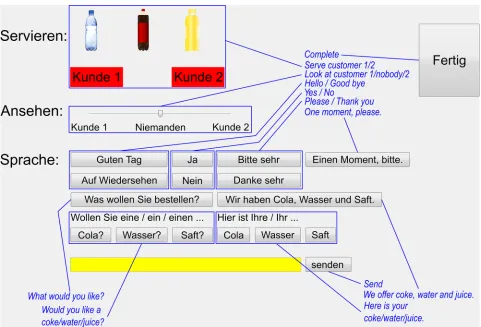
Control panel. The control panel (Fig 4) was arranged in three groups: serving, gazing and speaking. Serving a drink was achieved by dragging the respective bottle onto the custom-er’s serving zone and dropping it. The ghosts shifted the slider bar to either side for gazing at the respective customer or returned it to its neutral position. The slider remained at its posi-tion until the ghost changed it or the interface was reset at the end of a trial. The area below was dedicated to speech and included clickable pre-worded utterances. Below the buttons, the ghosts could type into a free text field for triggering an individual utterance. All actions were forwarded to the middleware and executed immediately. The ghosts could combine actions into a complex response by clicking several actions, e.g. by selecting a gaze direction and a speech utterance. However, the interface hindered the ghosts from selecting actions that could not be performed simultaneously, e.g. saying two things at once. This was achieved by locking buttons group-wise for as long as an action was ongoing, e.g. all speech related buttons were locked for as long as the robot was speaking. The ghosts were asked to press theComplete -but-ton if they felt they had served their customers and were ready for the next interaction. They were warned that pressing this button too early would abruptly terminate an ongoing interaction.
[image:9.612.96.577.67.394.2]Procedure. The participants (ghosts) were welcomed to the experiment, introduced to the bartending robot, the bar and the available drinks (coke, water and juice). They were shown
Fig 4. Control panel for the ghosts. The panel was shown in the upper left corner of the screen. The remaining screen was light grey matching the
panel’s background colour. Translations are provided in blue and were not part of the experimental design.
the office where the experiment was conducted, the equipment and their task. After introduc-ing the settintroduc-ing, the participants were asked to provide their written consent. If they agreed to partake in the study, they attended a presentation, introducing in detail the experiment, their task and how to use the interface. It emphasised that the sensor data were real and possibly unreliable. The eye tracker was calibrated for the screen in front of the participants.
Each trial started with a message on the ghost’s screen indicating that the robot was waiting for new customers. The confederates were presented the script of the trial on their interface at a position outside the robotic sensors’ scope. They started the trial through a wireless key-board. This cleared the message on the ghost’s display. The customers placed their orders according to the script, took their drinks and returned to their start position. The trial ended as soon as the ghost clicked theComplete-button. This triggered the message that the robot was waiting for new customers and informed the confederates about the next trial. In case of any problems, the experimenter in the room and the confederates communicated through an online chat and tried to rectify them.
The experimental session started with two practice trials in fixed order that were excluded from further analyses. In the first practice trial, a single customer approached the robot and ordered a single drink in thecertaincondition. In the second trial, two customers approached the robot and one of them ordered a drink in theuncertaincondition. After the practice trials, the ghosts were asked whether they felt confident with the task and whether anything in the display was unclear to them. In addition, the customers pointed out any problems through the chat connection. After the ghosts’ questions had been answered to their satisfaction, the twelve experimental trials were presented in system generated random order.
The introduction and calibration required about 20 min. The experimental session took about 25 to 30 min to complete so participants were scheduled for one hour sessions.
Results
[image:10.612.34.576.577.665.2]One participant was excluded from further analysis because the link between robot and control interface had broken down. We report data of 16 participants who completed 192 trials (excluding practice trials). The numbers of ordered, served and the trial-wise correctly served drinks are summarised inTable 1. The majority of drinks were served correctly indicating that the ghosts and their customers were able to establish a credible, successful dialogue. However, incorrectly identified speech utterances and whether the ghosts attended the information influenced the results, e.g. whether a group order was identified as one combined or two indi-vidual orders. In order to mitigate these effects, we adapted our analysis according to the data that were available to the ghosts. For example, if a customer ordered a juice but the ISR recog-nised two waters, we treated this as an order of two waters. If the ghost served the two waters,
Table 1. Number of scripted drink orders, drink orders detected by the sensors and number of correctly served drinks.
Type of order Condition Number of scripted orders Number of detected orders Number of correctly served orders Ratio of correctly served orders
Individual order Certain 96 124 115 93%
Uncertain 96 133 99 74%
Group orders Certain 32 19 18 95%
Uncertain 32 20 14 70%
Total number of drinks
Certain 160 162 151 93%
Uncertain 160 173 127 73%
A trial was scored as correct if the customers’ requests were served according to recogniser data. Only those drinks that were served in correct trials contributed to the number of correctly served drinks. Please note that a group order comprised of two drinks, thus 32 group orders contribute 64 drinks.
this drink order was scored as correctly served. Thus, we analysed how the ghosts responded to the speech hypotheses that they actually received from the ISR. It is important to note that we measured the actions of the participant with regard to the speech hypotheses and how they mitigated uncertainty rather than the quality of the ISR/ASR. The hypotheses could still update during the presentation and the ghosts could still make mistakes, e.g. by selecting the wrong drink compared to information that was available to them (seeTable 1). Consequently, the served drinks differed from the scripted dialogues. In particular, the number of group orders was smaller than scheduled. The customers were aware of technical mishaps through their information screen.
Acknowledging new customers
[image:11.612.36.586.82.220.2]In order to start an interaction, the ghosts had to identify new customers from the sensor data and communicate to them that they were ready to take their drink orders. We identified when the ghosts turned towards the control panel in order to select appropriate actions using the eye tracker data. The respective states of the indicators on the information panel are summarised inTable 2. For comparing thecertainanduncertaincondition, we summarised the continuous data in theuncertaincondition into categories. The customers’ visibility and distance to the bar were categorised into false (no indication on display), true (at the bar) and approaching (intermediate state). The customers’ torso orientation was presented as an arrow in both con-ditions. However, if the sensor detected their torso orientation, the customers were more or less looking towards the bar. Thus, we summarised the data as customers looking towards the bar (true) if the sensor was able to determine their torso orientation and as false otherwise. In the vast majority of cases, the ghosts acknowledged new customers if they were visible, at the bar, and faced the bar. The ghosts did not wait for a verbal utterance from their customers. The first action that the ghosts selected for the acknowledegement are summarised inTable 3.
Table 2. States of the indicators when the ghosts acknowledged new customers.
Indicator State Certain Uncertain
Number Percent Number Percent
Customer visible True 95 99% 96 100%
False 1 1% 0 0%
Customer at bar True 92 96% 89 93%
Approaching 0 0% 7 7%
False 4 4% 0 0%
Customer facing the bar True 93 97% 95 99%
False 3 3% 1 1%
Customer saying something True 8 8% 33 34%
False 88 92% 63 66%
https://doi.org/10.1371/journal.pone.0201516.t002
Table 3. First action that the ghosts selected for acknowledging their new customers.
Selected action Certain Uncertain
Number Percent Number Percent
Looking at customer 76 79% 70 73%
Verbal greeting 18 19% 22 23%
Other verbal utterance 1 1% 2 2%
No action 1 1% 2 2%
In ‘No action’ trials, the ghosts waited for the customers to place an order before initiating any action.
[image:11.612.33.581.606.683.2]Speech hypotheses
The response times (RT) were analysed only if the ghosts served the drinks correctly because an erroneous serving affected the time course of the entire trial. Out of 192 trials, we analysed the RTs of the 168 correctly served trials. We excluded three actions from the analysis that were correct but performed with very fast (26 and 105 ms) or extremely slow (210 s) RT after the first informative hypothesis. A total of 304 actions including drink servings and responses to questions about the menu were analysed.
In order to measure whether the ghosts used the early ISR hypotheses, their RT was mea-sured from the onset of a hypothesis on the display until they shifted away towards the control panel. The time span approximates the time required for reading and understanding the hypotheses and for deciding whether to initiate a response action or whether to wait for more or better data. In addition to making that decision, the content of the hypotheses had to be memorised because re-reading them required the ghosts to turn back to the panel. Other mea-sures would have included additional biases, e.g. the time until a click was performed includes biases from locating and positioning the mouse cursor on the control panel. In contrast, we relied on a shift of overt attention. The RTs were measured both from the onset of the first (RTfirst) and last (RTlast) informative hypothesis. The first hypothesis (RTfirst) was defined as the first hypothesis that included sufficient information in order to respond correctly to the customer’s request. The most recent hypothesis that the ghosts attended before turning away was defined as the last hypothesis (RTlast). In thecertaincondition, both metrics are often equal because only final hypotheses had been presented. However, in some cases the ISR marked two hypotheses as final. Also, if a ghost did not respond in the first instance, the cus-tomers repeated their utterance. In order to mitigate effects of individual differences in RT, a participant-wisez-score was computed and analysed (seeTable 4).
We used the statistical analysis program JASP [70]. We report the Bayes Factors from the respective ANOVAs andt-tests [71,72] that were obtained with a scale parameter of 1ffiffi
2 p for the
[image:12.612.36.577.487.679.2]Cauchy distribution serving as prior for the effect size [72]. In contrast to standard, frequentist statistical tests, Bayesian statistics also evaluates the amount of relative evidence in favour of
Table 4. Summary of the number of cases, response times (RT), the correspondingz-scores (z-RT), the number of hypotheses and their confidence levels as a
func-tion of the type of request and the condifunc-tion.
Individual orders Group orders Questions about menu
Certain Uncertain Certain Uncertain Certain Uncertain
Number of cases 115 98 17 14 28 32
M ofRTfirstin ms 8249 8501 10992 20970 4909 5573
SD ofRTfirstin ms 6561 6923 6677 20637 2821 6173
M ofz-RTfirstin ms 0.00 0.06 0.41 1.32 -0.56 -0.49
SD ofz-RTfirstin ms 0.91 0.93 0.64 1.63 0.42 0.81
M ofRTlastin ms 6191 3041 9423 5473 4838 3433
SD ofRTlastin ms 3493 3049 3369 5573 2835 2576
M ofz-RTlastin ms 0.36 -0.52 1.38 0.03 -0.03 -0.41
SD ofz-RTlastin ms 0.85 0.81 0.93 1.30 0.77 0.63
M of # of hypotheses 1.17 3.38 1.12 5.36 1.04 1.84
SD of # of hypotheses 0.46 1.46 0.49 3.32 0.19 0.95
M of confidence level 100 73 100 74 100 61
SD of confidence level 20 15 27
Only correct trials contributed to the measures. An individual order, a group order and a question were excluded for extremely fast/slow RT.
the null hypothesis. In addition, we used mixed model analyses [73,74] as implemented in the lme4 package [75] of R. The denominator degrees of freedom andp-values were estimated with the Kenward-Roger approximation in the lmerTest [76] and pbkrtest packages [77]. We considered an effect to be statistically significant if both statistical methods agreed. The effect size of the equivalentF-test [78] ort-test [78] was computed with GPower [79].
The mixed model analysed the type of request (individual order/group order/question about menu) with a Helmert contrast testing whether individual orders differed from group orders and whether the drink orders in general differed from questions about the menu. The condi-tion (certain/uncertain) entered this analysis as a nested factor under the type of request. In the Bayesian analysis, the type of request and the condition entered as two main factors and their interaction (means were aggregated for the Bayesiant-test). In some analyses, the discrepancy between the frequentistp-value and the Bayes factor [80] was large and in the unexpected direction, i.e., the BayesFactor appears as a more lenient. This was attributed to a) the nested factor in the mixed model resulted in less balanced group sizes compared to the main effects in the Bayesian analysis, and b) under these circumstances, the Kenward-Roger approximation forp-values is more conservative than a standard ANOVA whosep-values are lower but prob-ably underestimated [81,82]. The trials were scripted in pairs of acertainand a matched uncer-taintrial. However, due to errors and exclusions, the data set did not reflect the pairwise design. Thus, thecertainanduncertaintrials were analysed as independent samples.
Measured from the first hypothesis, there was a statistically significant effect of the type of request onz-RTfirst[F(2,53.276) = 3.514,p= .037,f= 0.16,BF10= 590.8]. TheBFindicated that group orders required more time than individual orders [BF10= 25.32] but the mixed model did not [t(24.13) = 1.149,p= .262,d= 0.22]. There was an unequivocal indication that the ghosts responded statistically significantly faster to questions than to drink orders [t(63.70) = 2.555,p= .013,d= 0.37,BF10= 340848]. There was no statistically significant effect of the con-dition (certain/uncertain) onz-RTfirst[F(3,26.175) = 0.626,p= .605,f= 0.08]. The Bayesian analysis revealed evidence against a main effect of the condition [BF10= 0.313] and its interac-tion with the type of analysis [BF10= 0.222].
There was a main effect of the type of request on the RT from the onset of the last hypothe-sisz-RTlast[F(2,34.37) = 13.453,p<.001,f= 0.30] in the mixed model analysis but not in the
BF[BF10= 2.591]. The contrasts showed that individual orders required statistically signifi-cantly shorterz-RTlastthan group orders [t(19.67) = 4.437,p<.001,d= 0.86,BF10= 193.8]. The mixed model indicated that questions were responded to faster than orders [t(44.71) = 4.378,p<.001,d= 0.63] but theBFdid not provide clear evidence [BF10= 1.606]. There was a statistically significant effect of the nested factor condition (certain/uncertain) onz-RTlast [F(1,19.62) = 21.336,p<.001,f= 0.46]. TheBFindicated the corresponding main effect on z-RTlast[BF10= 14.705] and interaction of the condition and the type of request [BF10= 3.558]. The effect of the condition was tested for each type of request and revealed thatz-RTlastin the
uncertaincondition were statistically significantly faster compared to thecertaincondition in
individual orders [t(11.10) = 6.711,p<.001,d= 0.93,BF10= 4.612e+6] and in group orders [t(35.18) = 4.330,p<.001,d= 1.62,BF10= 5.246]. In contrast to orders, there was no such an effect in questions about the menu [t(32.17) = 1.511,p= .141,d= 0.39,BF10= 1.829].
For further insights into how the ISR speech hypotheses were used, we analysed the uncer-taintrials with regard to the number of hypotheses and their confidence level. The type of request was analysed as above using a Helmert contrast in the mixed model. This showed a sta-tistically significant effect on the number of required hypotheses [F(2,84.46) = 14.946,p<.001,
required statistically significantly fewer hypotheses than orders [t(87.86) = 5.459,p<.001,
d= 1.10,BF10= 934930]. The type of request had a statistically significant main effect on the confidence level of the last attended hypothesis [F(2,45.94) = 3.523,p= .038,f= 0.23,BF10= 6.270]. There was no statistically significant difference between individual orders and group orders [t(35.12) = 0.015,p= .988,BF10= 0.376] and there was no unequivocally conclusive evi-dence for such a difference between orders and questions [t(41.77) = 2.283,p= .028,d= 0.46,
BF10= 1.694].
Fluency of the interaction
In order to estimate the fluency of the interaction, we analysed the time from the first visible customer action until the first drink had been served in each trial (seeTable 5). In individual orders, we have to distinguish between drink orders that were preceded by a question and those that were not. The condition (certain/uncertain) and whether a question preceded plac-ing the order entered the model as variables. There was a main effect of whether there was a question about the menu on the participantwisez-scoresof serving time [F(1,44.12) = 14.810,
p<.001,f= 0.34,BF10= 330.5] indicating that the initial question prolonged the interaction duration. There was no main effect of the condition [F(1,7.709) = 1.644,p= .237,BF10= 2.587]. The interaction of both factors was statistically significant [F(1,44.62) = 6.338,p= .015,
f= 0.22,BF10= 10.37]. This analysis indicated serving times were shorter in theuncertain com-pared to thecertaincondition if a question preceded the drink order. The group orders were not tested with respect to questions because only one group order was preceded by a question. This and another group order that was preceded by an individual order were excluded from this analysis. In the remaining 29 group orders, there was no effect of the condition on the
z-scoresof serving time [F(1,0.901) = 0.531,p= .610,BF10= 0.828].
Discussion
[image:14.612.40.577.98.200.2]All ghost participants reported that they enjoyed taking part in the study. They were immersed in the setting and were highly engaged in the task. This allowed us to investigate spontaneous decisions regarding social behaviour in a service encounter. In order to develop a cognitively plausible interaction policy, we had to assume that humans expect other humans and artificial agents to behave like they themselves would. This is supported by the fact that typical mistakes in human-human communication can be attributed to so-called “egocentric” assumptions of the interlocutors [83], i.e. humans draw conclusions about the knowledge and understanding of others based on their own experience. Speakers failed to systematically use syntactic struc-tures that are unambiguous to their listeners [84,85] and listeners systematically misinter-preted utterances with an egocentric bias [86]. Participants also used their own strategy for
Table 5. Number of cases, serving time (RT), their participant-wisez-scores and the corresponding standard deviations from the first appearance of the customers
until the first drink in the trial was served as a function of the type of request, preceding menu related questions and condition (certain/uncertain).
Individual orders Group orders Preceding question No question No question
Certain Uncertain Certain Uncertain Certain Uncertain
Number of cases 31 17 43 44 16 13
RT in ms 61169 43262 29911 29220 30504 46130 SD in ms 56001 24214 24754 8185 11605 26848
z-RT 0.72 0.14 -0.39 -0.27 -0.19 0.52
SD of z-RT 1.17 0.95 0.81 0.44 0.66 1.30
predicting the actions of others in social decision making, e.g., the prisoner’s dilemma or the give-some game [87–89]. The Bayesian rationale for this is that one’s own behaviour is a rea-sonable starting point for forming expectations [90]. In fact, one’s own behaviour is the only available data in anonymous one-shot social decisions [91]. The bar scenario is a brief, goal oriented social interaction whose participants typically do not know each other but they share prior knowledge about the situation. Thus, they would likely use their own behaviour for forming expectations about others in the same situation [88,92]. Assuming that others behave like yourself causes misunderstandings if the egocentric assumptions about others do not hold, e.g., if the speaker’s and the listener’s egocentric models differ [83]. We still suggest to model an artificial agent according to the participants’ (ghosts) own behavioural preferences. In this way, the artificial agent is similar to humans as it operates on egocentric assumptions. Thus, it could either produce the expected behaviour or commit a typically human mistake. However, whether the behavioural preferences of humans (e.g., as ghosts in the machine) are equal to their expectations on the behaviour of artificial agents remains an important question for fur-ther research.
Ecological validity
The study was designed as similar as possible to a real human-robot interaction at the bar. The ghosts perceived their human customers through real robot sensors and responded with robot actions. They also experienced the time pressure of a real-time interaction with their cus-tomers. The experiments were resource intensive and thus, conducted with a small number of participants. However, they provided insights into the socially appropriate strategies for miti-gating slow sensors, uncertainty and short response times.
The ecological validity was evaluated by comparing when the ghosts identified and how they addressed new customers in this study to previous findings. In real-life recordings of bars and in lab experiments [68] as well as in offline GiM studies [65,66], new customers were iden-tified if they were close to the bar and looked towards the bar or bartender. Real bartenders and lab participants preferred to initiate a verbal interaction before their customers said some-thing. We obtained very similar results with only one deviation, seeTable 2. In about of the interactions in theuncertaincondition, the ghosts acknowledged their new customers after they said something. We attributed this to the faster pace of displaying early, uncertain speech hypotheses in theuncertaincondition compared to the final hypotheses in thecertain condi-tion. Thus, the same RT could have preceded utterances incertainbut succeeded them in
uncertaintrials. Also, accidental sounds from the environment may have triggered early speech
hypotheses that were displayed inuncertainbut not incertaintrials. This can account for the small deviation from previous findings. Furthermore, we compared the type of action that the ghosts selected for acknowledging new customers to previous results. In this study, the ghosts looked at the new customers or greeted them verbally (Table 3) reflecting earlier results [66,68] in type and frequency of the selected actions. We concluded that the real-time GiM interface allowed the ghosts to interact with their customers socially appropriately. Thus, the collected data enable us to derive a cognitively plausible policy for using early, uncertain speech hypotheses in short social interactions with artificial agents.
Use of speech hypotheses
an utterance [31] than humans expect in conversation [2,5,6]. In order to use early ISR hypoth-eses in a psychologically plausible way, we have to identify when humans would rely on a partly processed utterance for initiating a response action. Humans recognise auditory utter-ances incrementally and provide grounding signals while it is still unfolding [22,28]. This serves as feedback to the speaker who can adapt her/his utterance and thereby ensure that the listener’s response action will be appropriate. In contrast to grounding, initiating a response requires that the listener has already committed to one interpretation of the utterance.
Utterance understanding and committing to one interpretation are rapid and elusive processes. In turn, it is difficult to identify when a human listener committed to a particular interpretation. In order to investigate when a human (ghost) initiates a response action, we extended the temporal gaps between the visual presentations of ISR hypotheses (time morph-ing). The delayed presentation of speech hypotheses provided the ghosts with sufficient time for reading, understanding and responding to the hypotheses. Time morphing combined with the GiM design enabled us to investigate whether, when and how humans use early, uncertain hypotheses with a slow motion variant of a typical ISR.
Error cost
The RT from the onset of the first hypothesis (RTfirst) indicated that questions about the menu were responded to faster than drink orders. We attributed this difference to the potential error cost of the respective response action. Error cost is represented by the required efforts for recti-fying the error and by the ‘loss of face’ associated with it [93]. The questions about the menu differed from the drink orders with regard to their error cost. Listing the short menu of three drinks was appropriate as a response to all questions about the menu and if new customers have just arrived at the bar. Thus, the error cost of listing the menu was small. In contrast, serv-ing the wrong drink or unsolicitedly servserv-ing a drink was not appropriate. Furthermore, the bartending robot had no option of retracting or replacing a drink once the action had been ini-tiated. Thus, the ghost would have had to apologise and negotiate an appropriate repair. Due to the restricted SRGS, the customers could not respond with the flexibility required for accepting or negotiating the ghost’s repair action. Consequently, rectifying an erroneous serv-ing was never successful in this study and resulted in a breakdown of the interaction. If the ghosts experienced this, a breakdown added to their perceived error cost. Such errors occurred in 12.5% of the trials that were excluded from further analyses. It should be noted that it is dif-ficult to detect and repair such breakdowns even without SRGS restrictions [94]. Thus, costly errors should be avoided and we discuss echo question as one measure to achieve this.
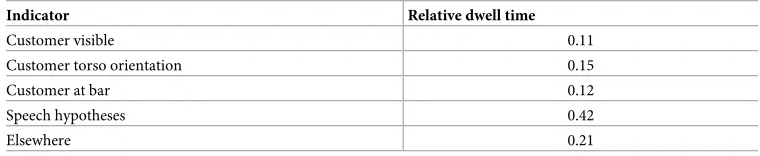
[image:16.612.197.577.88.166.2]In general, RT can be regarded as a compound of a baseline and a decision time, cf. [95]. In our study, the baseline was required for understanding hypotheses and preparing a response.
Table 6. Relative dwell times on indicators.
Indicator Relative dwell time
Customer visible 0.11
Customer torso orientation 0.15
Customer at bar 0.12
Speech hypotheses 0.42
Elsewhere 0.21
The relative dwell time was computed by dividing the time span that a participant dwelled on each indicator by the summed dwell time on the information panel, and averaging across participants. This analysis is comparably coarse because the tracking accuracy was reduced as a result of the large head turns.
The decision time is the additional time needed before committing to an action. The ghosts attended the information panel during this time. By doing so, they could gain access to addi-tional and/or better data, e.g. addiaddi-tional and more confident hypotheses in theuncertain
condition.
Answering questions about the menu was associated with low potential error cost and with the fastest RT in our study. Thus, these RT are mainly composed of the baseline (reading and understanding hypotheses) and only little decision time. Compared to answering questions, theRTfirstin drink servings were prolonged. The baseline was constant but the decision time was extended because the ghosts aimed for a higher level of confidence before initiating the serving due to the higher error cost of serving a drink compared to listing the menu. They achieved this higher confidence by a) trying to accumulate more evidence, i.e. additional and more confident speech hypotheses, and b) using echo questions (e.g., “A coke for you?”) for grounding their correct understanding in 62 out of 165 servings. Echo questions and the cus-tomer’s response increased the confidence in serving the correct drink. But choosing between serving the drink straight away and using an echo question added to the decision time. In con-trast to servings, the ghosts never grounded whether they should list the drinks menu but initi-ated this action immediately even if the data were only suggestive. In sum, the ghosts required greater confidence before committing to a serving than to listing the menu. They achieved this by waiting for additional and more confident speech hypotheses or explicit grounding. Thus, theRTfirstfor drink orders were slower than for questions.
The differences inRTfirstcannot be attributed to the ghosts’ efforts in identifying, planning or initiating the appropriate response action. TheRTfirstwere measured from the onset of the first informative speech hypothesis. Thus, theRTfirstdo not include a period of time where the ghosts were unable to identify their customers’ speech act and the corresponding response action. However, they include reading the speech hypotheses. But reading the interface was comparable across the types of requests and cannot explain the observed RT pattern. The RTs were measured until the ghosts shifted their gaze from the information panel towards the con-trol screen. The time required for finding the correct response button and navigating the mouse cursor were not included in the RT. Thus, differences in the spatial or visual saliency of the control buttons cannot account for the longer RT in drink orders than in questions. If any-thing, the drinks were represented by icons of bottles with a greater visual saliency than the text buttons. This would predict that listing menu required more time than serving a drink but the results showed the opposite pattern. Another possible explanation for the differences in
RTfirstis that the ghosts required more time for planning a serving than for listing the menu. This account also predicts that the time required for planning the serving of one drink (indi-vidual order) should be shorter than for two drinks (group order). However, there was no unequivocal statistical evidence inRTfirstthat indicated such a difference. Thus, the RT pattern cannot be explained by planning response actions.
independently of whether the speech hypotheses were more or less confident. In drink orders, the ghosts showed a prolongedRTfirstindicating that they accumulated evidence. But theRTlast measured from the last attended hypothesis showed that questions and drink orders required similar RTs once sufficient and confident data were available in theuncertaincondition. This shows that the time for reading and understanding the hypotheses was similar across requests but the decision time was dependent on the error cost of the response, and the number and the confidence of the speech hypotheses.
In sum, the ghosts tried to accumulate more and more confident data if the potential error cost was higher. This resulted in longer decision times in drink orders compared to questions about the menu.
Effect of uncertain hypotheses
The analysis ofRTfirstrevealed no difference with regard to whether early, uncertain hypothe-ses were displayed or not. This could indicate that the participants a) fully relied on the early data, or b) they were not able to distinguish between different types of hypotheses. The results showed that the number of attended speech hypotheses differed significantly between the types of requests in theuncertaincondition. This implies that the ghosts distinguished between confident and less confident hypotheses and that they used the hypotheses strategically depending on the potential error cost of their next action.
The strategic decision time can be estimated as the difference betweenRTfirstandRTlast. The questions about the menu provided the baseline for the analysis of theRTfirstbecause of their low potential error cost and the fast RT. Similarly, theRTlastto questions can serve as baseline with minimal decision time. In questions, theRTfirstandRTlastwere often measured from the same hypothesis because the ghosts often responded to the first hypothesis that indi-cated a question. In turn, there was no statistically significant difference between questions in
thecertainanduncertaincondition. Drink orders differed from questions with regard to the
number of speech hypotheses and their RT pattern. The ghosts attended more speech hypothe-ses in drink orders than in questions in theuncertaincondition. Also,RTlastwere shorter in
uncertaincompared tocertaintrials in drink orders indicating that the ghosts’ decision was
more dependent on the intermediate hypotheses. If they were available, the ghosts responded as fast as their baselineRTlast, i.e. with minimal decision time. This indicates that the preceding time was used for accumulating evidence and deciding whether and when to commit to an interpretation. In theuncertaincondition, intermediate hypotheses with similar content would support the ghosts’ confidence in the sensor data or provide counterevidence to their response plan. In thecertaincondition, the ghosts would have to rely on the absence of coun-terevidence. Thus, theirRTlastwas longer in thecertaincompared to theuncertaincondition.
The group orders’ time line differed from that of individual orders. First, the utterances were slightly longer than in individual orders. This required additional processing by the ISR, triggered more speech hypotheses and in turn, the time morphing slowed the presentation sig-nificantly. Secondly, the ghosts had to memorise and check possible updates on two instead of one drink while preparing their response. Despite those differences, theRTlastwere shorter when using early, uncertain hypotheses compared to using only final hypotheses. This advan-tage was similar to but smaller than in individual orders.
information about the end of a turn, are delayed compared to an unfolding user utterance but appear in fast succession. In order to develop a psychologically plausible policy for using incre-mental speech hypotheses, we slowed down the presentation of increincre-mental speech hypothe-ses. We demonstrated that the ghosts did not wait for a complete analysis of their customers’ utterances before initiating their response. If a request is plausible and the potential error cost is low, humans commit to their response. This suggests that humans would respond to utter-ances that they have not fully processed or only perceived partly. In order to fully understand the cognitive processes involved in using anticipated content, further experimental evidence is required. But our findings demonstrate that humans use early, uncertain ISR speech hypothe-ses and might expect others and artificial agents to do so.
Benefit of using early hypotheses
There was a clear benefit of using early, uncertain ISR hypotheses. The time span between the first hypothesis and a response (RTfirst, seeTable 4) was independent of whether the hypothesis was uncertain or final. But relative to the customers’ utterance, the ISR issues early, uncertain hypotheses about one to two seconds earlier than final hypotheses. Thus, the time span between the first and the final ISR hypothesis estimates how much faster a question was answered or a drink was served if uncertain hypotheses were available compared to when they were not.
There was no observable advantage of theuncertaincondition beyond the time difference between the first and the final speech hypothesis. However, ghosts’ workload was larger in the
uncertaincompared to thecertaincondition. The ghosts had to read additional hypotheses,
identify their confidence value, judge whether next hypotheses may change the current inter-pretation and select a response taking into account the available information and the potential error cost. These processes had to be repeated for each speech hypothesis, i.e. once in the cer-taincondition and multiple times in theuncertaincondition. This additional workload might have delayed the ghosts’ responses but it was necessary in order to benefit from integrating multiple hypotheses as converging evidence. It enabled the ghosts to pre-plan their response and to initiate it quickly once they had committed to an interpretation. Similarly, participants prepared their responses and waited for initiating them in interaction studies [28]. In this GiM study, this strategy was used specifically in drink orders that were associated with high error cost whereas questions were responded immediately. Thus, the increased workload in the
uncertaincompared to thecertaincondition might has hindered the ghosts from responding
more timely. In turn, the temporal difference between the ISR’s first and the final speech hypothesis only approximates how much faster a question was answered in theuncertain com-pared to thecertaincondition, i.e. the net benefit of using uncertain hypotheses.
Fluency of the interaction
In order to approximate the fluency of the interaction, we used the time span from the first visual information of the customers’ appearance until the first drink had been served [97]. This relatively coarse metric might be subject to influences including our own time morphing procedure. However, it approximates how fast the task of serving a drink had been achieved. Individual orders included trials with and without preceding questions about the menu (see
Table 5). Without a preceding question, the time until the first serving was almost equal in the
certainanduncertainconditions for individual and group orders. However, if a question
pre-ceded an individual drink order, there was a benefit of presenting early, uncertain hypotheses. This appears counterintuitive because questions contributed multiple additional hypotheses in
increase the required time in theuncertaincondition but it did not. First, the ghosts responded quickly to the first indication of a question. Thus, they did not attend all hypotheses. Secondly, the first hypothesis in thecertaincondition was a final hypothesis. Thus, it was issued a few seconds after the comparable uncertain hypothesis. Thirdly, after responding to the question, the ghosts had just explained the menu to their customers and expected a drink order. In turn, they might have spent less time for preparing or deciding on their actions. This study does not allow to distinguish between these options but we can conclude that theuncertaincondition benefited from the additional evidence about the customers’ utterances. That means that the time morphing and additional hypotheses did not reduce but improve the fluency of the dia-logue. In a computational model, the evidence from preceding dialogue moves could contrib-ute to the confidence of recognising current utterances and/or committing to an action.
Policy for human-robot interaction
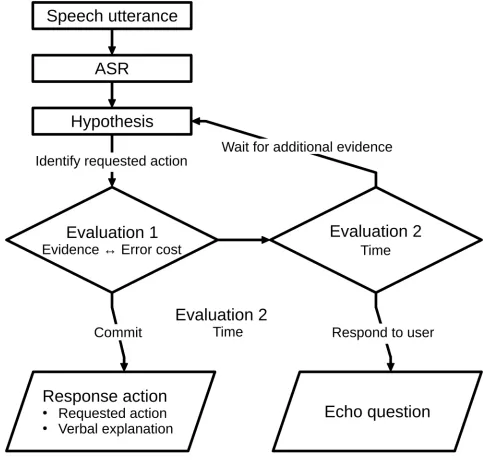
Typical interaction policies wait for the final hypothesis but this increases the response time to at least one second. As shown above, this delays turn-taking and disrupts the flow of the inter-action. Furthermore, users might interpret the pause as signalling that the artificial agent has not understood their utterance, they requested something that is outside of the machine’s scope, or that they have made a mistake in using the machine. Thus, we investigated human mitigation strategies for interacting through slow and sometimes erroneous robot sensors. The results of this study enable us to outline a policy for human-robot interaction inFig 5that a) uses early, uncertain speech hypotheses in a human-like way, and thereby, b) responds more timely to its users, and c) acts socially appropriately. In particular, we outline a social strategy for resolving situations where the best response action is associated with high error cost, the sensor data are uncertain and the user expects a timely system response.
The user’s speech utterance triggers the ASR that produces speech hypotheses as it pro-gresses with the analysis of the utterance. For each hypothesis, the dialogue manager identifies the response action that the user requested, e.g. [35,56]. The next step in our policy is to esti-mate the error cost that is associated with this action. Two factors contribute to this cost. First, the cost of repairing the performance of the response action if the user actually requested something else, i.e., the severity of the error. This could be approximated, e.g. as the number of actions or the time that is required for the repair. For example, verbally listing the menu is less severe than serving the wrong drink because the former is much easier to fix than the latter. Secondly, the cost of committing an error as such, i.e., the user might trust the system less irre-spectively of the error’s severity. This could be approximated as a constant cost per error.
Deciding whether and when to perform the response action is the most important aspect of this social policy. This evaluation is performed in two steps and considers three criteria: a) the error cost explained above, b) the available evidence, i.e. the number of converging hypotheses, their confidence value, and the dialogue state, and c) the time that has passed since the user’s utterance. The first step (Evaluation 1 inFig 5) compares the error cost and the evidence. If the error cost is very low, the agent should execute the response action. If the error cost is higher, the number of converging speech hypotheses and their confidence level have to be assessed. In addition, the preceding dialogue has to be considered. For example, whether the user utterance is a second part of an adjacency pair, such as an answer to a question or the confirmation of a preceding statement [1,98]. If the available evidence is sufficient compared to the error cost, the agent executes the response action. Otherwise, the time constraint is assessed in a second step (Evaluation 2 inFig 5). The evaluation will only arrive at this step, if the error cost is high and the evidence insufficient. If the timeliness constraints force the agent to perform a
wait for additional or better evidence with upcoming hypotheses until either new evidence is available or a response is due. This policy outlines when and how to proceed in the dialogue. Our knowledge about timing a response is very good but the precise statistics with regard to the quality of evidence from speech hypotheses are subject to future research. Relative to the GiM study, both evaluations take place in the decision time where the participants had to decide whether to commit to the response action, ask a question, or wait for more evidence.
[image:21.612.92.575.71.532.2]Echo questions are a socially appropriate way of gathering additional evidence and avoiding errors, e.g. “A coke for you?”, cf. [66]. In addition to questions, the ghosts explicitly grounded [27] their understanding in about 37% of the drink orders prior to the serving with echo state-ments, “Here is your coke.”. These echo utterances repeat the key content of the user’s
Fig 5. Flowchart of suggested human-robot interaction policy. The user’s speech utterance triggers the ASR that issues hypotheses about it.
Comparing the error cost of the response action to the evidence decides whether to wait, ask an echo question or perform the action.
utterance [99] and, if the repetition was erroneous, expose misunderstandings quickly by pro-viding the user an opportunity for corrections [42,44]. An echo question does not replace the response action but works towards more certainty with regard to it. For example, in Clark and Krych’s study [22], hearers poised their hand above the suspected target item before perform-ing the response action and graspperform-ing the target. Signallperform-ing agreement to an echo is typically achieved through small gestures (e.g., nodding) or short statements (e.g., “yes”) or similar. In contrast, disagreements tend to be mitigated, delayed and involve more verbal material [6,100] and thus, are easy to identify from recogniser data. Furthermore, disagreements most likely repeat the correct key content, e.g. “No, a water, please.” However, these questions do not fulfil the requirements of minimal repetition and minimising the number of turns. Thus, they are in conflict with many reward functions used for machine learning [52]. But using adaptive grounding [42] and social interaction strategies [97] improved the agent’s subjective ratings, dialogue success and surprisingly, the increased number of turns reduces the dialogue dura-tion. In sum, the explicit grounding strategy is socially appropriate, occurs frequently, is asso-ciated with minimal error cost and allows timely responses.
The social policy also requires that the response includes at least some action in the modal-ity of the user’s request. For example, serving of the drink in response to a drink order is suffi-cient from a functional perspective. However, our results suggest that performing a motor action is not enough but that the user expects a verbal response as well. Thus, at least a short verbal response is required, e.g. a short confirmation such as "Here you are." This serves the users’ expectations that a request receives a response in the same modality, i.e. a verbal request receives a verbal feedback. Maintaining the same modality reflects a human tendency to imi-tate conversation partners. For example, speakers adapt their choice of words [101,102], their pronunciation [103], prosodic features [104] but also their posture [105] to each other. This co-adaptation improves different metrics of perceiving interactions and rapport [102,105,106].
In sum, this social policy enables the robot to respond more timely, socially appropriately and in the user’s modality. The timely, human-like responses enhance the immediacy of the interaction. It is still difficult for the robot to initiate a response within a time window of 250 ms before and after the user’s end of turn given the delays in speech recognition, speech pro-duction and the robot actuators. However, this policy uses the early speech hypotheses and, as we have argued above, can improve the response speed in many cases. By relying on socially appropriate strategies and incorporating psychological principles, the robot’s behaviour satis-fies the users’ expectations on timing, manner and response selection. Thus, the artificial agent responds more timely and handles uncertainty more human-like.
Limitations of the study
The bar scenario involves multiple customers in front of the robot that may engage in different activities such as chatting or placing a drink order and challenges the robot to correctly inter-pret human social behaviour. This complex scenario is restricted by a bar script [107] of typical customer-staff interactions. This might have enabled the ghosts to anticipate the next moves of their customers even without sensor data. In addition, the SRGS was limited such that the speech recognition was biased towards the correct content. Thus, the ghosts could rely on both their knowledge about the script and the SRGS for improving their performance. But enhanc-ing perception by boostenhanc-ing or pre-activatenhanc-ing also reflects basic principles in human cognition [108,109] and has been successfully used in speech recognition, e.g. [48]. Thus, our results can generalise to other situations, especially to short-term dialogues that are governed by a script.