Evaluating and developing GP appraisal processes
Katherine Pollard
Richard Wharton
Centre for Learning and Workforce Research
In Health and Social Care
University of the West of England, Bristol
School of Primary Care,
Acknowledgements
We would like to thank all the general practitioners who participated in this study,
without whose co-operation its successful completion would not have been possible.
We would also like to thank administrative staff in both organisations and in BANES
PCT for their support during this study.
Steering Group for the Research Programme
Calpurnia Fox, School of Primary Care, Severn Deanery
Dr Michael Harris, School of Primary Care, Severn Deanery
Dr Bill Irish, School of Primary Care, Severn Deanery
Dr Jim Morrison, School of Primary Care, Severn Deanery
Dr Pam Moule, Faculty of Health and Life Sciences, University of West of England,
Bristol
Dr Katherine Pollard, Faculty of Health and Life Sciences, University of West of
England, Bristol
Abby Sabey, Faculty of Health and Life Sciences, University of West of England,
Bristol
Dr Pat Young, Faculty of Health and Life Sciences, University of West of England,
Bristol
Dr Richard Wharton, School of Primary Care, Severn Deanery
Research team
Dr Katherine Pollard (Project Manager)
Dr Richard Wharton
with support from Dr Pam Moule, Abby Sabey, Dr Pat Young, Dr John Albarran and Dr
Toity Deave
ISBN:
978-1-86043-458-7
Contents
Page no
Acknowledgements
1
Executive Summary
3
Introduction
3
Study aims
3
Methods
3
Main findings and points for consideration
4
Recommendations
6
Introduction
7
Study aims
8
Methods
9
Ethical approval
9
Research design
9
Data instruments and collection
9
Data analysis
11
Findings
12
Evidence checklist results
12
Differences between groups
12
Appraisal leads’ opinions
15
Focus group and interview findings
17
Feelings about appraisal
17
Problems identified
21
Suggestions for improving the appraisal process
36
The role of the Deanery in appraisal
57
Points for consideration
61
Appraiser role
61
Evidence required for appraisal
61
Sessional doctors
61
Appraisee age
62
Sharing expertise and experience
62
The role of the Deanery in appraisal
62
Executive summary
Introduction
This report details findings from a study undertaken by the School of Primary
Care, Severn Deanery and the School of Health and Social Care, Faculty of Health
and Life Sciences, University of the West of England, Bristol (UWE) between
November 2008 and November 2009 to evaluate and develop GP appraisal processes
in an area in the South West of England.
A process of licensing for all doctors practising medicine in the UK is currently
being implemented by the General Medical Council (GMC). All licensed doctors will
need to demonstrate at regular intervals that their practice meets the generic standards
set by the GMC, as described in
Good Medical Practice
(GMC 2006). Licensing will
involve a process of revalidation for individual practitioners. It is planned to incorporate
revalidation into the current appraisal processes for all medical professionals (GMC
2008).
Although a statutory requirement, GP appraisal has until recently had primarily a
formative, developmental purpose (DH 2002). Despite being obligatory, the uptake of
GP appraisal has been problematic and inconsistent (Martin et al 2003). To date, only
a limited amount of research or evaluation about GP appraisal has been published.
However, there is recognised tension between the concept of appraisal as both a
supportive developmental process and as a measure for judging fitness to practise.
Study aims
This study set out to evaluate existing evidence submitted by GPs for the
purposes of appraisal, and to explore how a model for appraisal could be developed
that meets the needs of revalidation but also acts as a developmental process for
individual GPs.
Methods
Both qualitative and quantitative methods were used for this study, in order to
provide both breadth and depth to the evaluation. Quantitative data sources comprised
all the appraisal evidence checklists used by appraisers in one Primary Care Trust
provides a basic template for recording the types of evidence a GP appraisee submits
for appraisal purposes, and whether the evidence submitted relates to an individual’s
personal practice, or to organisational practice within the GP practice as a whole. Data
were analysed using descriptive statistics. Comparative analysis of types of evidence
was conducted for appraiser, appraisee age and appraisee status.
Qualitative data were collected through 5 focus groups held with 23 attendees at a
GP appraisal stakeholder event hosted by the Deanery, and through interviews with all
the appraisal leads for PCTs within the Deanery’s geographical area (n=7). Data were
analysed thematically.
The study was approved by a University research ethics sub-committee.
Main findings and points for consideration
Findings from this study raise particular points for consideration in relation to the
appraiser role; the nature of evidence required for appraisal; the situation of sessional
doctors; appraisee age; sharing expertise and experience; and the role of the Deanery
in appraisal.
Appraiser role
Most focus group and interview participants were adamant that appraisal should
retain a strong developmental element. Clear definition of the role and appropriate
national training were seen as essential factors contributing to the success of the
process.
Evidence required for appraisal
A notable feature of the focus group data was the confusion expressed by many
participants about the nature and amount of evidence required for appraisal. Given the
perception that appraisal for revalidation is extremely time-consuming for individual
GPs, it was felt that having a clear brief about the evidence required is essential. The
revised RCGP guidelines published after these data were collected (RCGP 2009,
2010) may go some way to ameliorating this problem, particularly with respect to the
Sessional doctors
Many focus group participants and at least one appraisal lead were concerned that
sessional doctors would have problems collecting the required evidence for appraisal.
However, the data from this study also suggest that these problems can be addressed.
The checklist data revealed very few substantive differences between principal and
sessional doctors with regard to evidence submitted for appraisal. In particular, there
was no statistically significant difference between the proportions of principal and
sessional doctors who provided supporting information concerning their personal
practice in relation to significant events, data or audit collection, multi-source feedback
and complaints; this was notable, as these four areas have been identified as
potentially problematic for sessional doctors (RCGP 2009, 2010). A number of the
study participants were able to provide anecdotal evidence concerning innovative
practice among sessional doctors with respect to the collection of evidence for
appraisal, both at personal and collective levels. All these data, taken together,
suggest that sessional doctors’ problems in this regard may be overstated, as long as
appropriate support is provided by employing practices and PCTs.
Appraisee age
The stereotype of the older GP, near retirement and not computer-literate, and not
wishing to engage with appraisal, was present in the data. However, this was
counterbalanced by examples of exceptions, and concern expressed about some
younger, part-time GPs, whose personal circumstances do not support their
involvement in appraisal. No differences were found in the checklist data between
younger and older GPs with regard to the evidence they provided for appraisal. This
applied to all GPs, and also only to locum GPs. It appears that difficulties encountered
arise due to individuals’ particular circumstances or personalities, rather than because
they belong to a defined category of appraisee.
Sharing expertise and experience
A very strong feature of the qualitative data was the extent to which participants
enthused about the benefits they experience when presented with opportunities for
sharing expertise and experience. A number of suggestions concerning format were
The role of the Deanery in appraisal
There was no consistency with regard to participants’ opinions about the degree to
which the Deanery should be involved in the co-ordination of the appraisal process.
However, all the participants, both from the focus groups and the appraisal leads, were
clear that the Deanery has a valuable role to play in training and preparation for
appraisal for both appraisers and appraisees. They welcomed the idea that the
Deanery could provide fora for sharing expertise and experience, as well as providing
structured, dedicated preparation for appraisees. The Deanery was also thought to be
well placed to help address any lack of consistency among appraisers through
appropriate training.
Recommendations
1. Change the organisational culture of practices and trusts to encourage access
for sessional and locum doctors to Clinical Governance, Significant Event, Audit
and Data Collection, through meetings and improved communication. This
could be accelerated by including locum access as a quality criterion to be
reviewed at practice inspections by PCTs or by the Care Quality Commission.
2. Encourage, establish and facilitate fora and self directed groups for isolated
locums and sessional GPs.
3. Provide examples of innovative ways of collecting evidence for this group.
4. Establish new tools designed specifically for this group, such as patient and
colleague feedback.
References
DH (2002)
Appraisal for General Practitioners Working in the NHS.
DH, London.
GMC (2006)
Good Medical Practice.
GMC, London.
GMC (2008)
Relicensing.
http://www.gmc-uk.org/about/reform/relicensing.asp
Martin D, Harrison P, Joesbury H (2003)
Extending appraisal to all GPs
. ScHARR,
Sheffield.
RCGP (2009)
RCGP Guide to the Revalidation of General Practitioners. Version 2:0.
RCGP, London.
RCGP (2010)
RCGP Guide to the Revalidation of General Practitioners. Version 3:0.
Introduction
This report details findings from a study undertaken by the School of Primary Care,
Severn Deanery and the School of Health and Social Care, Faculty of Health and Life
Sciences, University of the West of England, Bristol (UWE) between November 2008
and November 2009 to evaluate and develop GP appraisal processes in an area in the
South West of England.
A process of licensing for all doctors practising medicine in the UK is currently being
implemented by the General Medical Council (GMC). All licensed doctors will need to
demonstrate at regular intervals that their practice meets the generic standards set by
the GMC, as described in
Good Medical Practice
(GMC 2006). Licensing will involve a
process of revalidation for individual practitioners. Should they specialise in a particular
area, confirmation that their practice meets required standards will also be required
from the relevant Royal College or Faculty (Shelly & Conlon 2008). It is planned to
incorporate revalidation into the current appraisal processes for all medical
professionals (GMC 2008).
Appraisal processes for GPs are currently being developed by the Royal College of
General Practitioners (RCGP) so that they will be fit for purpose in terms of
requirements for revalidation. GP appraisal typically involves an individual GP meeting
face-to-face with a trained appraiser who is also a GP. For revalidation, appraisees are
expected to produce a range of evidence over a five-year cycle to demonstrate that
they are meeting the GMC’s criteria for acceptable medical practice (RCGP 2009). GP
appraisal is expected to occur on an annual basis, and is organised and managed
through the primary care organisation in which an individual GP's practice is based.
Although a statutory requirement, GP appraisal has up to now had primarily a
formative, developmental purpose (DH 2002). Moreover, despite being obligatory, the
uptake of GP appraisal has been problematic and inconsistent (Martin et al 2003).
There are several issues around the introduction and use of the GP appraisal process.
These include:
- Expense incurred by primary care organisations
- Difficulties with the logistics of administering appraisals and processes
re-licensure and the need for appraisal also to meet developmental needs
- Uncertainties about the quality, appropriateness and type of evidence used to support
GP appraisal
- Limited opportunities for sessional and locum GPs to collect appropriate evidence.
To date, only a limited amount of research or evaluation about GP appraisal has been
published. However, there is evidence that some GP appraisers think that appraisal
should have a pass/fail element, and that appraisal should help decide about individual
appraisees’ fitness for revalidation (Kelly 2007). GPs have also reported being unsure
about what constitutes appropriate evidence for appraisal (Boylan et al 2005). In the
latter study, there was also concern about appraisers receiving appropriate training.
The study recommendations included provision of exemplar evidence material to
appraisees, and GP tutor help for appraisees with preparation for interview, compiling
evidence and completing forms. Recommendations from a study investigating PCT
Chief Executives’ concerns about appraisal include making appraisal more challenging
and developing training for appraisers (Walton 2007). Some appraisers have also been
found to need support to develop their communication and interpersonal skills
(Loughrey & Boylan 2008). In addition, over the last few years, there has been
discussion in the literature about the potential problems for non-principal GPs
concerning the appraisal process (Martin et al 2003, Martin 2004, Jelley et al 2007,
Ings and Preece 2009). In particular, it is feared that non-principal GPs may struggle to
collect the evidence required for revalidation, a possibility that has been acknowledged
by the Royal College of General Practitioners (2009).
Study aims
In light of the above, this study set out to evaluate existing evidence submitted by GPs
for the purposes of appraisal, and to explore how a model for appraisal can be
developed that meets the needs of revalidation but also acts as a developmental
Methods
Ethical approval
Ethical approval for the study was gained from a Research Ethics Sub-Committee in
the Faculty of Health and Life Sciences at UWE.
Research design
Both qualitative and quantitative methods were used for this study, in order to provide
both breadth and depth to the evaluation. Quantitative data sources comprised all the
appraisal evidence checklists used by appraisers in one PCT over one financial year.
The sample for the qualitative phase of the study comprised all attendees at a GP
appraisal stakeholder event hosted by the Deanery, and all the appraisal leads for
PCTs within the Deanery’s geographical area.
Data instruments and collection
The evidence checklist was designed when appraisal was still essentially a formative
process. This instrument provides a basic template for recording the types of evidence
an appraisee submits for appraisal purposes, and whether the evidence submitted
relates to an individual’s personal practice, or to organisational practice within the GP
practice as a whole (Figure 1). Whether or not an appraisee has reflected on particular
aspects of practice is also recorded on the checklist. PCT administrative staff
anonymised 123 checklists and coded them for appraiser, as well as status and age of
appraisee.
Qualitative data were collected through focus groups and interviews. At the
stakeholder event 23 participants in five focus groups (Table 1), each facilitated by a
non-medical academic, explored aspects of appraisal processes for revalidation,
triggered by questions concerning both the appraiser and appraisee perspective
(Figure 2). Individual semi-structured interviews were conducted with appraisal leads
from the seven PCTs covered by the Deanery. The interview was based on key
Good clinical Care (personal/organisational):
Case Reviews Significant events Data Collection or Audit QuoF and prescribing data
Maintaining Good Medical Practice (personal):
Personal learning log CPR/Child Protection
Membership of learning organisations
Relations with Patients/Colleagues (personal/organisational):
Patient Survey
Summary of Complaints ORStatement of No Complaints Information for patients eg practice leaflet
Multi source feedback (currently optional) Referrals and relations with secondary care
Reflection/appraisal in other roles (personal):
Research Teaching Management Probity Health
[image:11.612.135.416.69.364.2]Overview of achievements and challenges Updated PDP
Figure 1. Types of evidence whose submission is recorded on the GP appraisal checklist
Role Number
GP appraiser 17
GP appraisee 3
GP appraiser trainer 1
GP educator 1
GP appraisal manager 1
[image:11.612.105.437.408.533.2]Total 23
Table 1. Focus group participants at the GP appraisal stakeholder day
Figure 2. Questions explored during the focus groups at the GP appraisal stakeholder day
Hw How should the appraiser role be reconceptualised to satisfy the requirements of revalidation? b. What development/training needs do current appraisers have in this regard?
Data analysis
Checklist data concerning type of evidence, appraiser, appraisee age and appraisee
status were analysed using descriptive statistics. Comparative analysis of types of
evidence was conducted for appraiser, appraisee age and appraisee status, using the
Chi-square test, with significance P≤ 0.05 (Sim and Wright 2000). Qualitative data
Findings
Evidence checklist results
Findings concerning the evidence checklists incorporate both quantitative findings from
the checklists themselves, as well as qualitative findings from the appraisal lead
interviews. Interview respondents are represented by a research code: for example,
AL1 indicates Appraisal Lead 1.
Checklists were completed by 10 appraisers, each responsible for between 3 (2.4%)
and 20 (16.3%). The mean number of checklists completed by one appraiser was 12
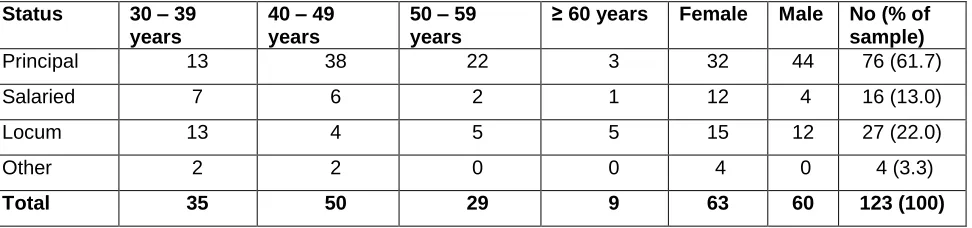
[image:13.612.71.557.325.439.2]and the median was 14. The characteristics of the 123 GP appraisees appear in
Table 2.
Status 30 – 39 years
40 – 49 years
50 – 59 years
≥ 60 years Female Male No (% of sample)
Principal 13 38 22 3 32 44 76 (61.7)
Salaried 7 6 2 1 12 4 16 (13.0)
Locum 13 4 5 5 15 12 27 (22.0)
Other 2 2 0 0 4 0 4 (3.3)
Total 35 50 29 9 63 60 123 (100)
Table 2. GP appraisees by status, age and gender
More appraisees aged between 40 and 59 years were principal GPs than those aged
over 60 years or under 40 years (75.9% vs 36.4%) (Χ
2=18.80, df=3, p<0.001). More
males than females were principal GPs (73.3% vs 50.8%) (Χ
2=7.41, df=2, p=0.025).
Differences between groups
Very few differences were found between GP groups, in terms of type of evidence
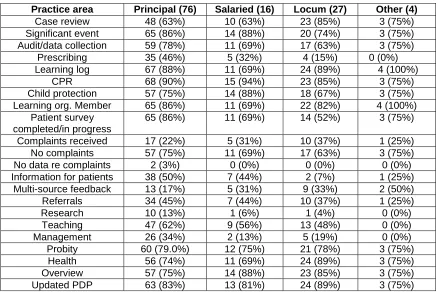
submitted for appraisal. Tables 3 and 4 show what personal and organisational
evidence was collected by GPs with different status, which appeared to be the most
Practice area Principal (76) Salaried (16) Locum (27) Other (4)
Case review 48 (63%) 10 (63%) 23 (85%) 3 (75%) Significant event 65 (86%) 14 (88%) 20 (74%) 3 (75%) Audit/data collection 59 (78%) 11 (69%) 17 (63%) 3 (75%)
Prescribing 35 (46%) 5 (32%) 4 (15%) 0 (0%) Learning log 67 (88%) 11 (69%) 24 (89%) 4 (100%)
CPR 68 (90%) 15 (94%) 23 (85%) 3 (75%)
Child protection 57 (75%) 14 (88%) 18 (67%) 3 (75%) Learning org. Member 65 (86%) 11 (69%) 22 (82%) 4 (100%)
Patient survey completed/in progress
65 (86%) 11 (69%) 14 (52%) 3 (75%)
Complaints received 17 (22%) 5 (31%) 10 (37%) 1 (25%) No complaints 57 (75%) 11 (69%) 17 (63%) 3 (75%) No data re complaints 2 (3%) 0 (0%) 0 (0%) 0 (0%) Information for patients 38 (50%) 7 (44%) 2 (7%) 1 (25%)
Multi-source feedback 13 (17%) 5 (31%) 9 (33%) 2 (50%) Referrals 34 (45%) 7 (44%) 10 (37%) 1 (25%)
Research 10 (13%) 1 (6%) 1 (4%) 0 (0%)
Teaching 47 (62%) 9 (56%) 13 (48%) 0 (0%) Management 26 (34%) 2 (13%) 5 (19%) 0 (0%) Probity 60 (79.0%) 12 (75%) 21 (78%) 3 (75%)
[image:14.612.66.504.69.361.2]Health 56 (74%) 11 (69%) 24 (89%) 3 (75%) Overview 57 (75%) 14 (88%) 23 (85%) 3 (75%) Updated PDP 63 (83%) 13 (81%) 24 (89%) 3 (75%)
Table 3. Personal evidence provided – numbers of GPs and percent of the sample
Practice area Principal (76) Salaried (16) Locum (27) Other (4)
Case review 7 (9%) 3 (19%) 1 (4%) 1 (25%)
Significant event 44 (58%) 11 (69%) 8 (30%) 3 (75%) Audit/data collection 44 (58%) 8 (50%) 4 (15%) 2 (50%)
QoF 59 (78%) 14 (88%) 9 (33%) 3 (75%)
Patient survey completed/in progress
21 (28%) 4 (25%) 7 (26%) 1 (25%)
Multi-source feedback 4 (5%) 0 (0%) 0 (0%) 0 (0%)
Referrals 12 (16%) 1 (6%) 1 (4%) 1 (25%)
Research 5 (7%) 0 (0%) 0 (0%) 0 (0%)
Teaching 4 (6%) 0 (0%) 0 (0%) 0 (0%)
Management 8 (11%) 1 (6%) 0 (0%) 0 (0%)
Table 4. Organisational evidence provided – numbers of GPs + percent of the sample
Significant events
68.8% of salaried GPs provided evidence of organisational significant events,
compared with 57.9% of principal GPs and only 35.5% of others, including locums
(Χ
2=6.13, df=2, p=0.047). There was no statistical difference in the proportions of GPs
from different groups with regard to evidence of personal significant events, and none
[image:14.612.47.494.416.563.2]providing both personal and organisational significant events evidence can be seen in
Table 5.
Status Principals Salaried Locum Other Total
No (% of group/sample)
34 (45%) 9 (56%) 5 (19%) 2 (50%. 50 (40.7%)
Table 5. Numbers/ proportions of GP groups providing evidence of both personal and organisational significant events.
Data collection/audit
57.9% of principal GPs provided evidence of organisational data collection or audit, in
contrast with 50% of salaried GPs and only 19.4% of others (Χ
2=13.18, df=2, p=0.001).
There was no statistical difference in the proportions of GPs from different groups with
regard to evidence of personal data collection/audit and none between principal and
non-principal GPs overall. Numbers/proportions of GP groups providing both personal
and organisational data collection/audit evidence can be seen in Table 6.
Status Principals Salaried Locum Other Total
No (% of group/sample)
[image:15.612.117.481.392.446.2]30 (39%) 5 (31%) 1 (4%) 2 (50%) 38(30.9%)
Table 6. Numbers/ proportions of GP groups providing evidence of both personal and organisational data collection/audit.
Patient surveys
78.9% of principal GPs provided evidence of personal patient surveys, in contrast with
only 53.2% of non-principal GPs (Χ
2=11.15, df=2, p=0.004). There was no statistical
difference in the proportions of GPs from different groups with regard to organisational
evidence of patient surveys and none between principal and non-principal GPs.
Numbers/proportions of GP groups providing both personal and organisational patient
survey evidence can be seen in Table 7.
No (% of group/sample)
[image:16.612.113.477.72.108.2]18 (24%) 3 (19%) 2 (7%) 0 (0%) 23 (18.7%)
Table 7. Numbers/ proportions of GP groups providing evidence of both personal and organisational patient surveys.
QoF/Prescribing and information for patients
46.1% of principal GPs provided evidence of personal prescribing, in contrast with
31.3% of salaried GPs and only 12.9% of other GPs (locums, flexible career scheme
GPs, GP retainers) (Χ
2=10.70,f=2, p=0.00). 87.5% of salaried GPs provided evidence
of organisational QoF, compared with 77.6% of principal GPs and only 38.7% of others
(Χ
2=18.54, df=2, p<0.001). 50% of principals provided evidence of personal information
for patients, in contrast with 43.8% of salaried GPs and only 9.7% of others (Χ
2=15.22,
df=2, p<0.001).
Appraisal leads’ opinions
Appraisal leads intimated that they found using evidence checklists helpful in order to
monitor the appraisal process:
AL4: It’s nice to see that the evidence is there and that there’s evidence of reflection. I don’t go so far as doing my impact assessment like the college might want me to do; but I’ve got checklists and examples ...
actually they want to tell us all the good things they have done and if you’re not careful you don’t leave room for that. So I like checklists to a point.
AL6: We do use that [the checklist], that’s part of it ... was it GP educator’s debate,
Focus group and interview findings
These findings are presented as four broad themes: feelings about appraisal; problems
identified; suggestions for improving the appraisal process; and the role of the Deanery
in appraisal. Focus group respondents are identified by a code: for example, R1
indicates Respondent 1.
Feelings about appraisal
Participants expressed mixed feelings about the enhanced process linked to
revalidation for GPs. A few individuals were extremely pessimistic both about its
feasibility and its validity. Some individuals also reported that some of their colleagues
were no longer happy to be appraisers, due to the changing nature of the process,
namely, the introduction of the summative element:
R11 (appraiser): Well it is an over-arching statement that it used to be a supportive role, but now there would be an element of judgement in it, which until now, it wasn’t an explicit element, but now it will be an explicit element of judgement on the data that we present. So that changing how – shall we say the dynamics between the appraiser and the appraisee significantly?
R21 (appraiser): You’ve still got two issues. One is this objective
presentation of an individual’s performance by the individual, which this is really. And the other one is the objective assessment of whether they’re any good.. ....When the next disaster strikes, and it will, and they go back through their revalidation process, they’re going to say ‘This process isn’t worth the paper it’s written on in terms of licensing people’s fitness to practice’.
disadvantages, I think that’s why it’s a disadvantage; because if you want people to expose their weak points and their fears, then if you’re also the policeman that clearly is a disincentive for them to expose them. So it takes a much more skilful appraiser to be helpful, rather than just a box ticker, which I think is a very real problem with revalidation-based appraisal,
R23 (appraiser): Some of the appraiser colleagues in my PCT have a big issue with this, going from formative to judgmental and I don’t care what you say, it is judgmental. We have shifted. The goalposts have moved and therefore I think there will be some people who are no longer comfortable to do it, because they are being asked to actually, not just be there as a sounding post and help people reflect on their own practice and make their own changes, but actually to say to them, ‘Sorry mate you’re not doing this right and therefore we’ve either got to do this, this and this to make sure that you do tick the boxes’.
AL3: Appraisal’s been a generally positive process for most GPs. It’s taken quite some years for them to get used to it and understand what’s expected and things, but many of them have embraced it and do find it as a good educational and developmental process to be going through. Obviously that aspect will continue and so those are the positive things that stay with it; but there’s the little bit of concern from us appraisers that now we’ll be having to do a lot more policing, maybe taking a lot more responsibility for being certain that things are put in place in terms of evidence. ... A lot of the appraisers come from an educational background, a lot of them are GP trainers, a lot of them are interested in teaching, so they’ve gone into the appraisal process with their teaching hats on. The idea of being a policeman is quite daunting to many of them although I think they will step up to the line – but it is a bit daunting for them.
The majority of the participants appeared to have accepted the changes, and were
positive about making the process fit for purpose. Some positive views were based on
a perception that appraisal could actually become fairer because of the summative
element:
are some people that produce wonderful appraisal material. ... And there are other people ... the effort is so minimal compared with the person who’s done such a good job, and I do feel that revalidation is going to allow us a little bit as appraisers to say, ‘You know really, you’re an intelligent person here, you’re a good GP, but actually you’re really not doing what you should be doing. You need to show me a little bit more’.
R22 (appraiser): You must have done your SEA [significant event audit]; must have done this, this and this, and provided that has happened then we can go on to talk about your CPD [continuing professional development] and how we develop you over the next year and how we do the formative stuff. So I think dividing it up into the summative and formative is actually very helpful.
AL7: I think there are some benefits to being linked to revalidation, in that because it’s a formal statutory, in inverted commas, process, there hopefully eventually will be some clear guidelines as to what has to be done as a minimum standard. So for GPs who are failing or who are likely to fail ... it will make it very clear that they have to meet those requirements, so that’s not optional.
Some participants felt that, for appraisers with an educational background, managing a
system that was both formative and summative would be unproblematic:
R6 (appraiser): They were talking this morning about the conflict between being formative and summative and actually I’m very familiar with that being a GP trainer, because that is exactly my role as a trainer. I’m a trainer, an appraiser, I’m an assessor, I’m a supporter, I’m a mentor - you have so many different hats as a trainer, that that doesn’t feel too uncomfortable as an appraiser.
There was also general agreement that appraisal would improve the public profile of
GPs, in that it would be seen to be helping to maintain practice standards:
has often taken the lead, whether it’s with the type of exams we produce, or the type of training we produce; the type of interviewing and selection and all that sort of thing; and I think this is an opportunity that I think we shouldn’t be afraid of....
Nonetheless, there was some scepticism and confusion as to whether the process, as
currently designed, would actually be able to improve and/or maintain standards. This
perception appeared also to be influenced by the ongoing delays in implementing
appraisal for revalidation. In four of the five focus groups, the opinion was expressed
that, even in its enhanced state, appraisal would probably not be able to detect the
problems associated with a doctor like Harold Shipman, a perception that was
discussed with the appraisal leads:
R19 (appraisal): The trouble is I think that is where the public perception of GPs’ performance, the political perception of what has happened, has got muddled and I think this is what revalidation is, probably getting that performance management element into the appraisal process.
AL2: I think the thing that is unhelpful at the moment is the shifting sands … long periods of confusion, and this has been going on for two years now and looks to go on for another two years yet, and I do think that’s a little bit destructive.
AL1: I don’t think appraisals were ever set out to catch a Shipman, nor that it should be, because the information made available to us during the
Problems identified
Problems with appraisal were identified for both appraisers and appraisees, with some
overlap between them. Participants were concerned with three main areas seen to
affect appraisers: accountability and consistency of standards; confusion about
process and requirements; and workload and impact on practice. There were four
problematic areas identified for appraisees: evidence required; morale, engagement
and continuity; the varying nature of GPs and GP practice; and resources and
workload.
Appraisers
Accountability and consistency of standards
Concern was expressed that an individual appraiser could be held accountable should
he/she conduct an appraisal with a GP who subsequently was revealed as being unfit
to practise. This concern was based on the lack of standardisation within the current
process, particularly around the evidence required:
R22 (appraiser): I think the appraiser role is becoming more – well the responsibility of it is greater, because I think as someone said earlier, that if there’s any doubt about a doctor’s performance and the GMC are involved, the appraisals will be looked at, the appraisers will be looked at by
inference, you know. So I think the responsibility role is much bigger.
AL3: At the moment you know we allow some laxity. If people’s portfolio is there or thereabouts, you usually say, ‘Well you could do this a bit better next year but you know, it’s quite close’; and we never think of not signing off the appraisal and being satisfied unless there’s something huge and glaring. Whereas I am sure that once we’re taking more responsibility for the
revalidation, relicensing process or pathway, although it’s not our final say so, I think we’ll be under a lot more pressure to be certain that things are done to a standard that maybe makes it more like a pass or fail than we’ve ever previously had to do.
There was also acknowledgement that currently most appraisers do not receive
appraisal is conducted in different geographical areas, although exceptions were noted
in both cases:
R9 (appraiser): One of the things I’d like to say is that I started off as an appraiser, did a course, have had a couple of meetings, maybe half a dozen or less meetings in the course of eight years and no-one has come along and said ‘Name you’re the worst appraiser in God’s earth, or you’re the best or whatever’, I’ve had no feedback.
R20 (appraiser): And we have to be doing broadly the same as elsewhere; I don’t think it’s acceptable that in one part of the Deanery the appraiser insists on every bit of that list being done, whatever it is, twelve items. And if it’s not there we don’t do the appraisal. That happens in some places. In our place, I’ll do an appraisal without any of that being there and try and work with the person to try and get them doing it for next year, or get them doing some of it. Now, that’s very different, and I think we have to agree across the region, across the Deanery, what’s acceptable and what isn’t.
AL3: Whenever I’ve gone to meetings I’ve been quite pleasantly surprised at how similar the attitude and behaviour of appraisers within different PCTs appears to be.
Suitable channels for dealing with ‘problem’ GPs were also sometimes unclear:
R8 (appraisee): There needs to be a system ... a transparent system, so that if a problem is flagged up, that the appraisee is aware of that and they are aware of what could happen to that information because of the implications for future practice. So perhaps the appraiser actually is going to need to notify someone – whose responsibility is it to tell the person has a concern? Presumably you identify it at the time, discuss it at the time, but what happens to that information and the implication to the individual? You need to be transparent in the processes that occur subsequently, you need to be transparent.
should be withdrawing and they should be going down the PCT performance path.
AL1: There hasn’t been a forum for these things to go to, other than practice, individual and PCT at the moment. So many people feel, you know, well it’s a colleague, I don’t want to hurt them, I don’t want to go to the PCT straight away ... there isn’t really any intermediary service.
Confusion about process and requirements
Many participants appeared to be confused about how the new appraisal process
would work, and what would actually be required of appraisers. For example, there
was confusion about the limits and scope of the appraiser role, as well as about credits
and the use of the electronic toolkit. However, the main point of confusion appeared to
hinge on what the ‘judgmental’ (that is, summative) element of the process would
entail, in terms of appraiser responsibility for identifying problems with individual GPs:
R18 (appraiser trainer): With the confusion that’s happened over appraisal, over the last ten years, there is this sort of drip, drip, drip bit, that the
message needs to keep interest in lots of different sources and consistently, and that I think still is not clear.
R19 (appraiser): That’s why I was asking, what’s the role of the appraiser in that? What summative role does the appraiser have in that? I understand the formative role, but at what point does that become [summative]?
R21 (appraiser): The system, sorry, is very unclear and unless we know what the fundamental philosophical objective of revalidation is, then we can’t judge it. Because we’re being told different things by different people.
R14 (appraisal): I mean there was a simple thing. You were talking about the credit system. And I had assumed there would be a system in place where I would know the number of credits I would have achieved. But you seem to be giving the impression that the appraiser would actually attribute credits to a piece of work.
and one uses another toolkit. One uses one way of interpreting information and one uses another way of interpreting information, I can see problems there.
There was also some confusion about the issue of audit as evidence. There were
differing opinions as to whether audits submitted as evidence had to be personally
conducted by appraisees, or whether appraisees could provide evidence of reflection
and application to practice based on audit undertaken by someone else:
R21 (appraiser): It’s a complete nightmare, because how can they [sessional doctors] do audits? They can’t.
AL2: They’re submitting possibly a pharmacy advisor audit or a student audit that they haven’t really done very much with and so there is that learning curve. You have to explain to them the audit is fine but you’ve got to be involved, have personal reflection, change your practice, that sort of thing ... I don’t think that auditing your referrals is just data collection. I think all audit starts with data collection, even formal audits, but the crucial bit of it is then the reflection, what you do with the results; and if you can write a reflective account of how your data collection in referrals has changed your practice or your data collection in an across-the-board practice audit, I don’t think there’s any difference really. So I don’t see it that much as a just a data collection exercise.
Workload and impact on practice
Another area of concern was the issue of appraiser workload and possible financial
implications. Given the summative element within the new appraisal process, there
was a perception that appraisers would need to demand a far more systematic
approach from GPs, but that this would entail a need for greater monitoring of
individuals, particularly in relation to the timely preparation of appraisal paperwork:
happen. It actually does need to be more structured; more organised; more committed, from my side as well as from the appraisee's side.
R9 (appraiser): I’m going now, ‘prove it’; and if you put something down on your PDP as a plan for next year, I want you to prove to me that that is a valid entry, so it’s no good putting down ‘I’m going to do a bit on diabetes’. I’m going to say ‘prove it, how are you going to do it?’ I don’t want these wishy-washy things anymore and that’s where I’ve come to.
R19 (appraiser): If you say appraisal starts when, two weeks before, and the appraisal isn’t the day, it’s actually two weeks before; and I will only proceed if it’s up to scratch, therefore we’ll negotiate, we’ll put the day off, probably this and that, because I want to help them to make sure that when we actually get to the day they will definitely be okay. That’s an awful lot more work potentially and changes the whole nature of the appraisal.
AL6: I think it will be a nightmare for the appraiser because the evidence is going to be so volumous, how are we going to decide which bit to look at. ... I think if somebody has presented the evidence you should look at it all, but its going to be too, as I say, too volumous to do.
Some participants also thought that appraisers should be able to direct appraisees to
appropriate resources, in order to help them prepare for the appraisal process; but it
was recognised that this could also take up a lot of the appraiser’s time:
R15 (appraiser): But we also need access to resources to be able to help with the groups so that we can say, ‘Well this can be done, because if you use this resource this will show you how to do it for your particular
expertise’.
All these issues were seen as potentially problematic, in that they could reduce the
amount of time appraisers would have to devote to clinical activities. Timing of
appraisals was also noted to be difficult, in that many participants reported often having
to do the bulk of appraisals in the last few months of the financial year:
R22 (appraiser): It’s [appraisal] taking people away from the patients
R3 (appraiser): It’s difficult for appraisers as well ...you have nothing for a couple of months and then you’ve got twenty people saying, ‘Can I have my appraisal tomorrow?’
Appraisees
Morale, engagement and continuity
There was a general perception that morale among GPs is low, with ‘anxiety’ about
appraisal in its new form mentioned during three of the focus group discussions:
R13 (appraiser): I think at the moment people are probably getting more comfortable after a number of years with the appraisal process; and then this appears on the horizon, ever coming closer; and I think we have concerns about it and we’re fully bought in, we’re appraisers. Most GPs sitting out there doing their day job are going to be very anxious about it really I think. For the first few years they’re going to be quite concerned and won’t see it necessarily as a particularly positive process. I mean maybe once you’ve been through five years ... it might be seen again in a more positive light. I just think there’s quite a lot of anxiety ... it’s sort of trundled along so slowly hasn’t it, that that hasn’t really helped the anxiety and the profession.
R20 (appraiser): I suspect a lot of people have anxiety about this.
Engagement with the process was seen as difficult among some groups of GPs due to
circumstances (see below), but also among others who regarded the process as
having little relevance to their practice, for a variety of reasons. The opinion was
expressed that the introduction of a summative element would force these GPs to
engage more closely with the appraisal process, as their livelihood would be
is, those who offered the bare minimum in terms of evidence; and ‘over-performers’,
that is, those who were producing far more evidence than was actually necessary, with
obvious implications for their workload:
R15 (appraiser): We don’t struggle with lots but we struggle with some [appraisees], and I think some of them will just be that bit resistant about having everything in place you know. I don’t know what other areas were like, but engagement was a big issue when we started appraising.
AL1: People who are very set in their ways about seeing their job as an income generator and any time outside the income generator activities – and of course gathering appraisal related information is not income generating – is anathema to them.
R2 (appraiser): I am so aware that there are some people that produce wonderful appraisal material. They’ve gone to so much trouble and detail; they’re committed; they’re engaged and it’s a delight to tick them and pass them. And there are other people that, for whatever reasons, you’re sort of trying to drag them along in the hope that they will engage, and generally they do over a period of time, but the effort is so minimal compared with the person who’s done such a good job.
Continuity was also thought to be a matter which needed attention. There was concern
that, if appraisees were able to change appraiser as often as they liked, problematic
issues identified in one appraisal might not be picked up the following year. Even in
satisfactory circumstances, individual development would be difficult to monitor without
continuity of appraiser:
R17 (appraiser): Of course, when you see somebody a couple of times and then you don’t know if they revert back to that cycle [not producing the evidence in time] the next time [with another appraiser].
Evidence required
Participants felt that many appraisees were still unsure about what sort and amount of
evidence was required, and how it should be presented. The issue of audit was
discussed in this regard (see above).
R8 (appraisee): But I think the other thing for people is actually, how
much?...What is the acceptable amount [of evidence], how much of this have I got to do? If I put down two ‘learning needs’ is that enough? .... is one enough? Is two enough, have there got to be five? You know, how many case reports have I got to do? Is one enough? I think a lot of people want to know, how much of this have I got to do? How much time do you think I should spend on it?
R12 (appraiser): I think that’s another point that’s added to the anxiety for the appraisees in that although we know the sort of things that will definitely provide the evidence for revalidation, we haven’t heard the preciseness of what’s going to be needed ... how many? how often? to what extent? those sort of things.
There were reports of GPs simply producing practice data as evidence for appraisal,
rather than material pertaining to their own personal practice. There was general
consensus that material should be relevant to the appraisee’s own practice, and should
be presented to highlight reflection and application to practice:
AL2: If the practice does an audit on something because either their whole practice has got to do it or it’s a QOF thing or whatever, I think that’s fine so long as then you look at the data, you look at your set of patients that might be part of it, reflect on it, think how it’s going to change your practice, and change practice; and then look at the re-audit when that happens. So I have no worries about it being an across-the-board thing but … what we don’t accept in city is the practice does an audit, it’s discussed at a meeting and
AL4: You can submit practice data if you’ve reflected on your own input into it, if it’s been used to make changes. You can’t put raw data of any kind in and hand it to your appraiser and say ‘There you are’ ... the whole essence of the appraisal process is reflection and so yes, you can use data that is shared data, but you have to explain why you’re using it and what your input or your gain from it is.
AL5: I think there are ways of doing it which can use practice data
personalised to an element, but sticking up the prescribing figures if you’re one of twenty-four docs is useless, that’s not going to tell you anything.
R20 (appraiser): I think the other thing is getting appraisees to understand that actually you can’t possibly capture all your learning, or this process can’t capture all your learning and thinking about what’s going on ...
The varying nature of GPs and GP practice
This issue was a source of major concern for most participants, particularly in relation
to sessional GPs (that is, salaried GPs, locums and out-of-hours GPs):
R3 (appraiser): Sessionals often like the freedom to do lots of different things and work in a not-so-structured way. But the flip side of that is it makes it incredibly difficult for them when they have to come into a structured system for revalidation, it doesn’t fit with maybe some of their personalities as well you know, the way they work is much more - I’m sure they’re all really excellent doctors, but they don’t fit in a nice neat little box which is what revalidation would like them to do (laughs).
R4 (appraisee): I do have a concern because unless I get regular sessions in a practice - which is unlikely, because it’s not what I’m aiming for, I wasn’t aiming to be doing - it’s going to be very difficult to get two significant event houses, because I’m not going to have the ability to go back and see what’s happened to patients I’ve seen.
and they’re all very varied. You know if you’d got in this room a group of sessional doctors, what they’d be doing, or how they would be doing it, or how they saw it, would be different for every single person probably wouldn’t it? And so I think they’re going to be one of the big challenges.
R12 (appraiser): Well they’re going to struggle with prescribing data because of course they’re usually writing on someone else’s prescription forms.
R14 (appraiser): For a sessional doctor there are some things that I as a principal can audit, but they wouldn’t be able to audit...there are some areas of prescribing, you know, how do we manage chronic conditions? Their management of chronic conditions is usually going to be coming in and seeing what somebody else is doing and just altering it, or jollying it along, so they can’t do that in their audit can they?
A1: On the whole [locum] groups who work predominantly in one place have got less problems because they can engage with the appraisal and
revalidation process as part of a larger, supportive team; they are a part of the team so to speak. The ones who are peripatetic or who work in a variety of locations though, face the problem that they don’t really belong to one team. They are more or less sole agents and they would struggle to gather evidence from multiple sources like a multi-source feedback or audit, which need to be based on data which is checked and rechecked; and unless they are going back to the same place to work quite how they would do that is difficult. Managing to do an audit as a locum depends on a large degree on how flexible and understanding the practice is too.
AL3: I think the group that are going to struggle the most with all of the data collection, are going to be the locums, the sessionals, the assistants who haven’t got a lot of time spent in the same practice and so for them I think it’s going to be very hard.
It was also thought that the conditions of practice for non-principal GPs were
critical for their ability to meet the requirements of appraisal:
R7 (appraisee): I’m probably the only one here who actually does locums...[I’ve] never had any difficulties with getting patient satisfaction survey or 360 re appraisal, but I do work for a couple or three practices on a fairly regular basis throughout the year ... I’ve never really had any great problem, but I think if you’re an itinerant locum and you do the odd day here, the odd day there, then it becomes almost impossible to get any proper feedback.
R8 (appraisee): If you’re outside training as an entity in any sense - so I would perceive colleagues in non-training practices, who haven’t had a GP colleague come into practice within the last six, ten years - they’re the people who are going to, I would have thought, really struggle with the mind-set involved in this process.
R22 (appraiser): I think sessional GPs can do it, I mean it’s easier for them ‘cos they’re coming back into the practice, it’s the locums who are going all over the place...
However, there was also a perception that different individuals’ motivation was
a key factor influencing how well-prepared these GPs were for appraisal:
R12 (appraiser): Having said that, you see some excellent papers from sessional doctors you know - so clearly, yes it can well be done. I’ve done [appraised] sessional doctors who have got probably papers better than some of the principals I do.
R15 (appraiser): I’ve only done one or two and I have just had all the excuses why they can’t do it...I think a lot of the locum GPs have used their work as an excuse not to do things.
There were two examples given in a focus group in which it appeared that
these problems might be insurmountable: a doctor who specialised in
occasional out-of-hours work. In both these cases, it was questioned whether
or not these individuals should remain on the GP performers list, as they
appeared to be unable to meet the criteria for appraisal.
Age also seemed to be a factor, with some participants stating that older GPs (with
some exceptions) were generally less happy to engage with the appraisal process. By
contrast, GPs who had more recently qualified were perceived as having fewer
problems with appraisal, as most of them had experienced similar processes during
their training:
R3 (appraiser): I think there’s a group of particularly older GPs who are still very negative about it, and they go through the motions and they will do the stuff, but they’re not engaged in it and it’s very difficult to change those attitudes I think.
R11 (appraiser): For some of them it’s almost one change too many, because they’ve had a lengthy career, change upon change, they have felt that ‘Right, we can coast for the last few years’, and then all of a sudden it’s ‘No, no you can’t, you’ve got to conform to this new system’. ... I’m not suggesting that everybody’s like that but you get a few of them. I certainly got a few of them as an appraiser, which almost resented having to go through another cycle of change. That’s the best way I can think of it. Facilitator: So the main line of distinction is perhaps older, younger? R12 (appraiser): No not the main line, it is one line.
AL3: The younger GPs cope very well, the ones that have come from registrarship where you’ve reflected on your practice and you’ve reported on everything you’ve done and you’ve checked your skills and you’ve checked your information, so they’ve really slipped into the appraisal process without a hitch.
AL5: I just have colleagues around me who just feel tired out by the system and complete change in the job that they originally started twenty five years ago, and I’ve just got a feeling that there are some of them who are pretty well fed up of constant change and bickering and all the rest of it, when all they’re trying to do is do a good job for the patient.
In particular, computer use was seen as being difficult for some older GPs,
while being unproblematic for GPs who had qualified more recently:
R3 (appraiser): The younger GPs are fine, on the whole they’re pretty whizzy with computers, but there’s a group of older GPs, among whom I count myself, who are not very whizzy on computers, so it’s a bit of a steep learning curve ... they’re still finding it difficult to upload documents and get all the stuff together and people just can’t be faffed with it, you know, we’ve got enough to do.
R12 (appraiser): And a lot of the GPs, you know, particularly GPs who are towards the end of their career and perhaps aren’t that engaged anyway in feeling they need to jump through hoops, are often not that well computer trained, or computer literate, so they’re the ones who really struggle.
However, it was also noted that there were exceptions to be noted in both groups. In
addition, it was felt that younger GPs could experience particularly stressful personal
circumstances, as they were still trying to establish careers and often had young
families, factors which could impact on their capacity to prepare adequately for
appraisal.
R21 (appraiser): Two people I’ve trained, have appraised and done SRTs. One was a very conscientious older doctor and he’d done fantastically.
AL2: I think if you were to ask a hundred or so appraisers probably it would veer towards the older GP who’s maybe nearing retirement, maybe as the senior partner. I don’t really think that’s set in stone because there are many older GPs who engage fully with appraisal … I’ve had two young GPs, one who’s only been four or five years out of registrar year and just was clearly not engaging and just wasn’t bothering; and I had to postpone the appraisal and – threaten is a difficult word – but threaten him with cancelling it altogether if he didn’t produce the right sort of documents; and so I don’t think there really is a standard profile, no.
AL7: There are some GPs who work part time, for example, have a young family and think that they only do so many sessions, so they haven’t
possibly got time to do CPD, which I don’t think is acceptable; but they are a group that are harder because they think that, because they’re only part time and they’ve got two children, that they should be exempted from doing CPD. ... actually I’m always refreshed by how few GPs who are nearing retirement - and [I] think, ‘Really they can’t be bothered’ - but I’m actually usually pleasantly surprised.
R6 (appraiser): Some of the appraisees, the ex-registrars last year, aren’t that great actually sometimes. They’re usually full of worries about getting a partnership, getting jobs, having a salaried post they don’t particularly want and they’re settling in and finding it more difficult than they thought it was going to be - and they’ve got young families very often as well. They’re worried about their money, they’re worried about their mortgage, they’re doing a lot of out-of-hours and I find, I was doing an appraisal two or three weeks ago and he wasn’t having much time to do any of this to be honest.
Resources and workload
There was general concern among participants about the amount of time it takes for
appraisees to prepare properly for appraisal. It was thought that sessional GPs are
particularly disadvantaged in this respect, as there are financial implications for their
There were reports that some sessional GPs can only meet requirements by using
their own time for these activities, which was generally considered by the participants
to be an unsatisfactory situation:
R10 (appraisee): I did a full day surgery and then extended hours and at 8.30pm the appraiser arrived, so by the time you finished, you know, it was long beyond bed-time. It’s unfair to the appraiser, but it also unfair to the appraisee.
R4 (appraisee): No, it takes time and of course, for the sessional bloke and GPs, obviously time is money isn’t it?
R5 (appraiser): Yes, that’s right, they’ve got to find the protected time, which means they’re losing....you know they’re not paid for that.
AL5: There are some very part-time people who it will be a significant part of their workload actually just collecting the evidence, compared with the number of sessions they’re actually doing and they’ll start wondering if it’s worth doing it. If you’re only doing forty sessions, the minimum, in the year, how many sessions are you going have to start collecting your evidence for? - well, quite a lot.
However, some participants expressed the opinion that meeting the criteria for
appraisal was simply a part of a GP’s job, and should be managed accordingly.
R16 (GP educator): The BMA recommend a contract where you spend one session a week learning. We don’t all do that, we don’t all offer those contracts to our employees, I know we don’t in our practice, but
aspirationally that is what a locum ought to be aiming at; and if you ask the BMA, they will say then just set your locum rate so that you can earn as much from nine sessions a week as you would from ten sessions a week.
There was some ambivalence about who should be taking responsibility for ensuring
that GPs are prepared for appraisal:
to be produced and you can try and do that. I don’t think you can suddenly spring it on someone that actually you should have done an audit and think oh great, try and do an audit quickly. You’ve got to have some notice. R19 (appraiser): But we could say it’s the responsibility of the Deanery to make sure appraisees know what they have to do.
R17 (appraiser): That’s what I mean, the information has to be there. R19 (appraiser): What we could say, we think it’s the appraiser’s
responsibility to make sure they know and have produced it in advance - you could do it either way couldn’t you?
R18 (appraiser trainer): The appraisal tool would make it clear and documentation on the tools would make it clear.
R19 (appraiser): So, you’re saying it’s not the appraiser’s [responsibility]? R18 (appraiser trainer): I’m not saying it’s totally the appraiser’s
responsibility....it’s both. Pointing out that ...there’s the list of things we need to do.
R20 (appraiser): Essentially it is the appraisee’s responsibility. They’re the person who’s got to jump over this hurdle. It is up to them theoretically and if the appraiser wants to help them on their way...
Suggestions for improving the appraisal process
A range of suggestions for improving the appraisal process arose from the focus
groups and interviews. In many cases, they took the form of anecdotal sharing of
participants’ experiences. These findings are presented in relation to the problems
identified above.
Appraisers
Accountability and consistency of standards
The quality (and therefore accountability) of appraisal was considered to be
inextricably linked with both the quality of appraisers and wider organisational
processes and support:
R1 (appraiser): By the same token, you don’t really want people who are a complete pitbull.
R3 (appraiser): The PCT have to be committed, and they have to give a positive message that this is serious, we are investing in it, we’re providing resources, we want you to do a good job. It comes down, all the way down to the individual appraisers who are, after all, the people going and doing it, and if they’re giving the wrong message we can all go home really.
R13 (appraiser): Someone’s supposed to read them [Form 4s] .... I couldn’t sleep at night if I hadn’t read all the Form 4s to know how my patch is doing really.
R11 (appraiser): I think that’s one of the selling points about toolkit and customization, the Welsh one. That it can actually anonymise data and you can pick and choose. It’s got a database on the background so you can say, well I want to see on that box how’s the area performing, or on that box I want to see in that box how’s the area performing. Rather than going through the laborious process of manually taking out every single one. Particularly for big PCTs, two hundred and fifty odd appraisees. It would be a heck of job.
AL1: There is not enough of a link between the clinical governance and the appraisal process. The clinical governance is viewed as the dirty element of the appraisal process, the spying, shall we say, the story telling part, when we tell on a colleague who might suffer. But we don’t view the other aspect of that and if we don’t share the concerns, triangulate them, how are we going to spot the people who are in difficulty, to help them not lose their jobs and livelihoods and not to injure someone else in the process? There needs to be closer ties between the two I think, because the PCT at the moment retains overall responsibility for managing these processes.
There was a general feeling that the appraisal process should be standardised
nationally:
the receiving end is the same across the board. That’s why I think perhaps there is perhaps a role for the PCT, or whoever, or the college or .... for the Deanery putting in some input.
Many participants thought that a more structured approach to appraiser preparation
and training is needed:
R15 (appraiser): They say we’re going to have more workshops. Currently, since I’ve been an appraiser, we’ve only been offered one annual workshop, and I’ve just been given information about changes each year, and that’s happened at the appraisal process rather than actual workshops, and hands-on, and discussion; so I think that will be really good.
R19: We need to be clear whether the evidence has to be there and what quality it is and also whether or not we care that they’ve done anything about it in advance, or whether we leave that for the day’s discussion. So I think there’s a lot of training we need to have to be clear.
AL5: I’ve got a feeling that we will end up with some form of consistency and I’ve got a feeling we will end up with a course which will be running on an annual basis, and once every three years there will be an element of summative assessment, as it were, of the appraiser where, you know, we will actually say ‘Right, will you carry out a mock appraisal please and we’ll actually mark you on it and basically revalidate you for a period of time because of it’; and I think that’s one of the models that will happen. We do it with GP training, I don’t see why appraisals should be any different to GP training. ... surely the same model will evolve with GP appraisal; and it will evolve, it just isn’t there yet, it isn’t robust yet.
Suggestions were made for the content of such events, and many participants
commented that joint meetings afforded them valuable opportunities to exchange
information and ideas:
phrases to use. And it’s helped to increase people’s confidence about .... what’s going to be expected and what boxes we’re going to have to tick. And I think crucially, you know, the appraisal skill itself. The interviewing, what do you do in the appraisal discussion; and I think that’s changed a hu