THE TIES THAT BIND: SURROGATE REPRESENTATION IN THE UNITED STATES HOUSE OF REPRESENTATIVES
Tyler S. Steelman
A thesis submitted to the faculty of the University of North Carolina at Chapel Hill in partial fulfillment of the requirements for the degree of Master of Arts in the Department of Political Science, concentration in American Politics.
Chapel Hill 2018
Approved by:
Pamela Johnston Conover Timothy Ryan
Sarah Treul
© 2018
Tyler S. Steelman
All rights reserved
ABSTRACT
TYLER S. STEELMAN: The Ties that Bind: SUrrogate Representation in the United States House of Representatives
(Under the direction of Pamela Johnston Conover.)
In a 2015 interview with the Minnesota Post, U.S. House member Keith Ellison made the startling comment that he “. . . didn’t run for Congress to talk about my religion all the time. . . ”; instead he ran “. . . to increase the minimum wage, strengthen the right to bar- gain collectively, to do something about climate change, to help students afford college.”
What is being described is surrogate representation—an often understudied phenomenon
in theories of American representation—which is the link between a legislator and citizen
where no formal electoral, and territorial, connection exists. Using an original method to
identify the location of donors to members of the United States House of Representatives
in 2016 I demonstrate the surrogate legislators have a higher percentage of their constituen-
cies originating from outside their geographic district. This process is facilitated by speci-
ail interested organizations, like EMILY’s List which can increase a surrogate legislator’s
out-of-district constitueny even further. Surrogate legislators are attracting the attention of
citizens across political boundaries and are seeing significant increases to the percentage
of their campaign contributions that are coming from outside their congressional district,
as a result. In effect, these legislators are redefining their constituencies to include both
in-district and out-of-district citizens.
TABLE OF CONTENTS
LIST OF TABLES . . . . v
LIST OF FIGURES . . . . vi
INTRODUCTION . . . . 1
APPENDIX . . . . 31
Appendix A: Population Overlap Calculations . . . . 31
Appendix B: Robustness Checks . . . . 32
REFERENCES . . . . 35
LIST OF TABLES Table
1 Descriptive Statistics . . . . 13 2 OLS Model of the Effect of Surrogacy on Out-of-District Contributions
with State Fixed Effects . . . . 16 3 OLS Model of the Effect of EMILY’s List Endorsement on Out-of-District
Contributions for Women Surrogates in the 114
thCongress with State Fixed Effects . . . . 19 4 Beta Regression Model of Out-of-District Contributions . . . . 33 5 Multi-Level Model of the Effect of Surrogacy on Out-of-District Contribu-
tions . . . . 34
LIST OF FIGURES Figure
1 Split ZIP Codes in North Carolina’s 4
thCongressional District . . . . 10 2 Distribution of the Out-of-District Percentage of Individual Contributions
to U.S. House Members, 2016 . . . . 14 3 The Predicted Effect of Surrogate Representation on the Percentage of Out-
of-District Contributions over Time Served in the U.S. House . . . . 17
Introduction
In a 2015 interview with the Minnesota Post, U.S. House member Keith Ellison made the startling comment that he “. . . didn’t run for Congress to talk about my religion all the time. . . ”; instead he ran “. . . to increase the minimum wage, strengthen the right to bargain collectively, to do something about climate change, to help students afford college.” His comments were surprising given that, for a time, he was the only member of the United States Congress that self-identified as a Muslim American. This led to expectations like those voiced by a Muslim American political activist named Linda Sarsour who said in the same article: “He [Ellison] knows he can’t step aside, he can’t be quiet. . . If he’s quiet, it means Muslims are quiet” (Brodey 2016).
The mismatch in priorities between Rep. Ellison and Sarsour raises an interesting ques- tion in the realm of American political representation. The political activist is describing surrogate representation—an often understudied phenomenon in theories of American rep- resentation. Surrogate representation describes the link between a legislator and citizen where no formal electoral, and territorial, connection exists. It is a form of descriptive representation where legislators and citizens are connected by shared characteristics, iden- tities, beliefs, or values, rather than by shared membership in legally defined districts based on territorial boundaries. This form of representation is unlike other traditional conceptions of American political representation. In fact, surrogate representation is almost unrecogniz- able when viewed from the perspective of traditional representation in American politics.
To further develop the idea of surrogate representation, I begin with a discussion of
current theories of representation and constituency in American politics. I then turn my
attention to why those theories offer an incomplete view of representation and constituency
and how surrogate representation can help bridge the gap between theory and reality. Using
FEC data, I find that surrogate representatives in the U.S. House have significantly larger
portions of their donor base coming from outside their territorial district than non-surrogate legislators. I also examine the role of special interest organizations as a mechanism under- lying surrogate representation in America.
This research has two important takeaways. First, this work demonstrates that not all American citizens see representation as confined to territorial districts or established po- litical boundaries. Instead, citizens are actively engaging with out-of-district legislators through their campaign contributions. Second, this research demonstrates that surrogate representatives are distorting traditional notions of what constitutes a constituency. Surro- gate legislators are attracting the attention of citizens across political boundaries and are seeing significant increases to the percentage of their campaign contributions that are com- ing from outside their congressional district, as a result. In effect, these legislators are redefining their constituencies to include both in-district and out-of-district citizens.
American political representation
Traditionally, “representation” has been conceptualized in strictly territorial terms (Miller and Stokes 1963; McCrone and Kuklinski 1979; Lublin 1999; Rehfeld 2009; Bishin and Smith 2013; Harden 2015). This characterization is logical given the legal framework of representation in the United States, which is often geographically based.
Because American political representation was often codified in terms of territories and geographies, theoretical and empirical treatments of constituencies have also focused their attention to territorial constituencies. Andrew Rehfeld distinguishes between territorial and non-territorial constituencies, explicitly defining constituencies to include only those “by which the state defines groups of citizens for the purpose of electing a political represen- tative(s)” (Rehfeld 2009, 36).
1Further, popular agency models of representation describe the role of a legislator as one in which the legislator is either advocating the expressed
1
Rehfeld does offer a brief examination of non-territorial constituencies and possible ways of defining
them. Many of his examples, though, do not intersect with American political representation and instead
discuss national legislatures outside of the United States or non-political organizations both domestic and
abroad.
preferences of their constituents (delegates) or acting on behalf of their constituents and relying on their own judgement (trustees) when making decisions (Miller and Stokes 1963;
McCrone and Kuklinski 1979). No matter how it has been examined, representation is assumed to be constrained to a territorial legislator-constituent dyad. Thus the characteriza- tion of constituencies as territorial is a direct extension of the legal nature of district based representation. Scholars have long examined the relationship between legislators and con- stituents within the confines of territorial districts because, at least on the national level, the Constitution defines the selection of representatives this way.
Further, even representational concepts that attempt to expand representation past strict policy congruence still rely on the assumption that representation is confined to a terri- tory (Lublin 1999; Phillips 1995; Bishin and Smith 2013). Two popular models expand representation to include identity politics and minority representation, substantive and de- scriptive representation, fail to challenge the assumption that representation takes place solely between legislators and constituents who share a territorial district. Both assume that the groups being represented either descriptively or substantively are, in fact, the territorial constituents of the legislator.
However, some scholars have defined forms of representation free from territorial con- straints like “collective representation” and Jackson and King’s “institutional” representa- tion (Weissberg 1978; Jackson and King 1989). Mansbridge, even more explicitly, has la- beled the more “traditional” forms of representation as promissory representation and gone on to define three new forms of representation in American politics—gyroscopic, anticipa- tory, and surrogate.
Surrogate representation and non-territorial constituencies
Surrogate representation is a form of representation where “legislators represent con-
stituents outside their own districts” (Mansbridge 2003, 515, emphasis added). Thus the
concept of surrogate representation encourages scholars to explore the relationship between
legislators and citizens regardless of the, sometimes arbitrary, geographic boundaries im-
posed by congressional districts, wards, and states. In addition, the concept focuses atten- tion on the behavior of citizens who feel underrepresented by their own legislator (whether that be based on an identity or a political opinion), and therefore seek out representation from an non-territorial legislator. Thus, the concept of surrogate representation expands the American understanding of representation to include constituencies that are not solely based on territorial boundaries, thereby encouraging the examination of constituencies previously ignored by theoretical and empirical research in American political representation.
These non-territorial constituencies are qualitatively different from the territorial con- stituencies associated with models of substantive and descriptive representation in Amer- ican politics. Specifically, a citizen’s inclusion in a legislator’s territorial constituency is automatic and based on location. Americans are linked to their legislators because of where they live at every level of government—national, state, and local. Because inclusion in a legislator’s constituency is based on location, the link between legislators and their con- stituents is a passive connection. The link is relatively weak given that a citizen can become the constituent of another legislator just by moving into a new geographic political sub-unit.
In and of itself, membership in a legislator’s constituency establishes, at best, a weak link between constituents and legislators which can be strengthened by voting for a represen- tative and weakened by voting against them. But surrogate legislators, and their surrogate constituents, forge a much stronger and far more active link.
Social identity and group categorization
Social identities help individuals make sense of who they are based on the groups they
are members of (Tajfel and Turner 1979; Conover 1984). Individuals who identify with
groups are motivated to foster a positive sense of self and a positive group image relative
to other groups (Tajfel and Wilkes 1963; Tajfel and Turner 1979). This argument builds
on Festinger’s (1954) social comparison theory; the idea that groups evaluate themselves
against relevant out-groups, and engage in behaviors to foster a positive group image. This
is especially important for low status groups with negative group images. Scholars have
pointed to several behaviors that low status groups can use to either reclaim a positive
image or create one (Turner and Brown 1978; Abrams and Hogg 2006). Individuals in low status groups can either leave the group, make new comparisons relative to lower status groups that cast them in a more positive light, or group identifiers can engage in behaviors that seek to overturn the existing social hierarchy structure in favor of a higher status in society. The types of identities and groups represented by surrogate legislators are often low-status political minority groups.
Legislators as group identifiers
Legislators who are members of low status groups in American politics should be espe- cially sensitive to their potential role in changing existing social structures and hierarchies through public policy implementation and resource allocation. Their place in a legislative body will give them access to the very tools necessary to affect social change in favor of their group. When legislators choose to act on this, and do so consciously, they are acting as surrogate representatives.
2When elected to office, these legislators do not forfeit their group identities, in fact, some would argue that these social identities and experiences are a key source of knowledge that legislators bring with them to office (Butler 2014).
If Mayhew’s (1974) assumption that legislators are single-minded seekers of re-election is correct, then surrogate representation by a legislator should be electorally irrational behavior: legislators would be decreasing the attention paid to their own territorial con- stituents in order to give time and resources to citizens who cannot directly vote for them.
This is especially true for surrogate legislators whose territorial and surrogate constituen- cies have distinct, discrete, and potentially divergent preferences. However, a Mayhewian assessment of surrogate representation fails to consider the power that a shared group iden- tity has in linking individuals who share membership in a group, and the impact that shared identity can have on the behavior of group members (Brewer 1999; Billig and Tajfel 1973;
Brewer 2007). A legislator’s incentive to engage in surrogate representation comes from
2
Mansbridge’s original conception of surrogate legislators and surrogate constituents also addresses the
possibility of surrogate relationships based on shared beliefs like ideology and policy. I am only concerned
with identity-based surrogate relationships, and do not address belief-based surrogates.
the positive group image they can help create and foster by using their privledged position as a policy maker. Consistent with self-categorization theories
3, as the self-interest is ex- panded to include the interests of the group then self-interest and group-interest become one and the same. It then becomes much clearer why a surrogate legislator would engage in electorally “irrational” behaviors. They are working to create a positive group image and alter the current social heirarchy in favor of their group. To be clear, there are also financial incentives for surrogate legislators in the form of campaign contributions from their new surrogate constituents (Mansbridge 2003; Gimpel, Lee and Pearson-Merkowitz 2008).
Individuals as group identifiers
Social identity theory and self-categorization theory also explains the motivations of individual citizens who become surrogate constituents. In the same way that self- categorization can lead a legislator to engage in behavior counter to rational electoral expectations, these theories can explain the motivation of individuals to support out-of- district legislators. Citizens who are strong group identifiers are motivated to contribute to the success of their group. When these individuals are a part of the political minority in their home legislative districts, they should be sensitive to the needs of their group and recognize that a legislator who is an out-group member will be unable to provide the same level of substantive and descriptive representation that an in-group legislator can. When citizens support in-group legislators outside their district because they perceive those legislators to be representing their group’s interest in a legislature, they become surrogate constituents.
Surrogate constituents will see that in-group legislator as vital to the group’s mission to foster a positive group image and will work to support their surrogate legislator with that goal in mind.
Becoming a member of a legislator’s surrogate constituency requires active participa- tion from the citizen, unlike the passive link that automatically exists between territorial legislators and their legally defined constituents. This active relationship must come with
3
See Tajfel and Turner (1979) for an overview of this theory.
some incentive to overcome both the cost associated with engaging with an out-of-district legislator and the knowledge that any chosen surrogate representative has no formal, or elec- toral, incentive to represent one’s interests. Surrogate constituents and their out-of-district legislators share the same incentive of seeing their group’s image relative to other groups become more positive. Surrogate constituents want to see their group succeed. Politically involved group identifiers will take note when members of their group are in elected office and will support them because, consistent with the expansion of self-interest to include the group’s interest, what is good for the group is good for the individual. Increasing one’s sub- stantive and descriptive representation—provided by a surrogate legislator—are benefits of a surrogate constituent’s involvement, not merely the incentive.
With the inclusion of social identity and self-categorization in models of representation, the concept of a constituency is broadened to include both territorial constituents and non- territorial citizens. To be clear, any legislator could have a non-territorial constituency.
The defining characteristic of a surrogate constituent relies on the shared sense of group identification between the constituent and their surrogate legislator. When the desire of a citizen to be represented on a dimension related to a strong group attachment is combined with an in-group legislator’s commitment to representing the interests of that same group, a surrogate relationship is created. Potential surrogate constituents will find value in having their group’s preferences represented in a legislature, they will seek out a potential surrogate legislator to fill that representational void. This is why surrogate legislators should have a higher percentage of their total constituencies come from outside their territorial district than their non-surrogate colleagues (Hypothesis 1).
Special interest groups and advocacy firms can help create surrogate constituencies.
These organizations have the potential to serve as one of the mechanisms underlying the
process that brings surrogate legislators and potential surrogate constituents together. When
potential surrogate constituents are members of organizations that advocate the interests of a
particular group, organizations serve an additional purpose of connecting these constituents
to relevant in-group legislators. For example, EMILY’s List, which is concerned with the
election of pro-choice women to both national and state legislatures, endorsed several can-
didates in 2016 (Hannagan, Pimlott and Littvay 2010; Pimlott 2010). As a part of their campaign, they sent regular communication via email to their members and prominently displayed each candidate they endorsed for that cycle. These appeals included links to the candidate’s own campaign websites and, aside from soliciting donations to the larger organization, encouraged members to donate directly to the endorsed candidates. More generally, the relationship fostered by special interest organizations around group identities has the unique ability to connect potential surrogate constituents with legislators who share their group membership and will act as a surrogate in their legislature. In effect, EMILY’s List helps build surrogate constituencies for the surrogate women legislators it endorses.
Therefore, I predict surrogate legislators who are also endorsed by special interest groups will have a higher percentage of their total constituencies come from outside their territorial district than surrogates of the same group (Hypothesis 2).
To examine my hypotheses, I use campaign contributions from individual citizens to members of the United States House as a proxy for non-territorial constituencies. I use campaign contributions and the United States House for several reasons. First, campaign contributions are the clearest signal a non-territorial citizen can send to a surrogate legis- lator indicating their engagement with, and support of, that legislator. Second, campaign contributions demonstrate the active component of identifying as a member of a surrogate constituency. Further, campaign contributions are one of the lowest “cost” activities for a surrogate constituent to engage in. This is particularly true for surrogate constituents and legislators who live far enough away from one another that volunteering on a campaign is not feasible. Finally, the House of Representatives is a large chamber with a relatively diverse membership and should offer an appropriate level of variation in non-territorial con- stituency sizes across individual members.
Data
The data for this project originally come from the Federal Election Commission’s (FEC)
publicly available campaign finance records for the 2016 election cycle to members of the
United States House of Representatives, and were obtained from the National Institute on
Money in State Politics.
4This project is only concerned with individual contributions to members of Congress and excludes all contributions to representatives from corporations and political action committees (PACs). The FEC does not provide itemized donations from individuals that are below $200. As a result, these data do not include donations from potential surrogate constituents who are donating smaller dollar amounts.
5These data on contributors to U.S. House candidates were also pre-processed to remove incomplete records and any contributions from U.S. House members to their own campaigns.
Identifying territorial and non-territorial donors
To identify surrogate constituents, it is necessary to separate donors into territorial v.
non-territorial donors by determining in which congressional district the donation origi- nated. The FEC provides the ZIP code for each individual contribution made to candidates that can be used to assign contributions to the congressional district they originated in (Gim- pel, Lee and Pearson-Merkowitz 2008). However, not all ZIP codes are exclusively within a single congressional district. In fact, approximately 18% of ZIP codes are split between two or more districts. To overcome this issue, scholars have employed the centroid approach.
6For each ZIP code that is split between two or more congressional districts, a central point, or centroid, is calculated that corresponds to the geographic center of the ZIP code’s land area. Then, the ZIP code is assigned to the congressional district containing the centroid within its boundaries.
But as illustrated in Figure 1, the centroid approach is problematic for determining the origin of individual contributions to U.S. House members. Figure 1 is a map of the 4
thCon- gressional District for North Carolina (shaded) and every ZIP code overlaping the district in any way, with the calculated geographic centroid point for the ZIP codes represented by a black dot. To demonstrate the problems associated with using the centroid approach, note
4
Specifically, I use their “Follow the Money” search tool.
5
This likely results in an underestimate of the number of surrogate constituents that would be observed with more complete data that includes contributions below the reporting threshold.
6
For an example of this see Gimpel, Lee and Pearson-Merkowitz (2008).
Fig. 1: Split ZIP Codes in North Carolina’ s 4
thCongressional District
the centroid for ZIP code 27713 (with the darkened border), which sits inside the geographic boundary of the congressional district. Using the centroid approach, donors from this ZIP code would be assigned wholly to the 4
thCongressional District despite the significant por- tion of the ZIP code outside of the district. The arbitrary nature of this method creates too much error when assigning whole ZIP codes to congressional districts. To reduce this error, I use an original method for assigning ZIP codes to congressional districts based on a pop- ulation overlap analysis of ZIP codes and congressional districts, which provides a better estimate of donors from non-territorial constituencies.
7Measures
Scholars studying surrogate representation have often concluded that surrogate con- stituents are likely to signal their support for out-of-district legislators through campaign contributions.
8For this analysis, the dependent variable is the percentage of total contribu- tions to members of the U.S. House that are from outside their congressional district during the 2016 election cycle; this serves as a proxy of the percentage of a legislator’s total con- stituency that comes from outside their congressional district. Past research on inter-district donations often use the dollar amount contributed as their dependent variable (Gimpel, Lee and Pearson-Merkowitz 2008). I use the percentage of individuals that reside outside a con- gressional district, as opposed to the out-of-district dollar contributions, because individuals are represented, not dollars. Moreover, analyzing the amount of contributions received by a surrogate legislator would obscure the number of people that are actually in a legislator’s non-territorial constituency. I collapse the individual contribution data by congressional district, so the unit of analysis is each U.S. House member’s constituency as defined by
7
See Appendix A for more information on this method.
8
Surrogate constituents potentially have multiple options to signal their support of surrogate legislators.
Constituents could post on social media platforms or participate in letter writing campaigns. Campaign con-
tributions, though, are qualitatively different than these other forms of support. Contributions send a direct
signal to a legislator of constituent support.
campaign contributions.
9Each legislator’s out-of-district constituency is estimated as the number of out-of-district contributions over the total number of contributions received in 2016:
Surrogate Constituency =
# of Contributions Out-of-District# of Total Contributions
I argue that a legislator’s non-territorial constituency size is, in part, a function of whether a legislator is acting, and advertising themselves, as a surrogate representative.
Recall that surrogates are characterized by their advertisement as a member of a political minority group and their active advocacy on behalf of that group. To best capture the neces- sary conditions for surrogacy, I use congressional caucus membership rolls. Full members of congressional caucuses are both members of a political minority group and actively ad- vocate for that group in Congress. With this in mind, I include every full member of a congressional caucus that deals with matters related to a political minority as a surrogate legislator.
10This strategy yielded a total of 164 surrogate legislators from several House caucuses and, where appropriate, joint caucuses with the Senate.
11Legislators were coded as ‘1’ if they satisfied the conditions of being a surrogate legislator and ‘0’ otherwise.
12Consistent with extant research on surrogate representatives and out-of-district cam- paign contributions, other useful predictors of out-of-district donations are also included as
9
This yielded 426 observations due to incomplete data on nine members of the U.S. House. There is no reason to believe these data are missing for any systematic reason and the analysis should not be biased by not including these observations.
10
Some congressional caucuses allow legislators who do not personally identify with a political minority to join their organization. These organizations have been known to create membership classifications to distinguish between identity holder (full) and non-identity holder (associate) members. I only count full members of a congressional caucus as surrogate legislators in this paper.
11
Surrogate legislators are identified as members of the following caucuses: the Congressional Black Cau- cus, the Congressional Hispanic Caucus, the Congressional Hispanic Conference, the Congressional Asian Pacific American Caucus, the Congressional Women’s Caucus, and the Congressional LGBT Equality Cau- cus. I also included legislators who identify as Jewish, Muslim, Mormon, Hindu, and Buddhist when their membership in these religions is made evident through statements on their campaign websites indicating their membership in these religions.
12
Caucus membership was assessed at the start of the 114
thCongress. It is possible that legislators joined
caucuses as the result of increased contributions from outside their district as opposed to strictly identity based
considerations. The following models were all estimated including only non-freshman members of the House
and their caucus membership in the 113
thCongress. The substantive and statistical results do not change.
control variables. Legislator seniority is calculated as the number of years that a legislator has served in the United States House as of 2016. Status in the chamber is captured by as- signing party leaders and committee leaders/ranking members a value of ‘1’ (‘0’ otherwise).
Freshman members (‘1’) of the House are also identified to account for any unfamiliarity the electorate may experience because of their relatively new status as members of the U.S.
House. Finally, contributions from outside a congressional district are, in part, the result of strategic decisions made by donors (Gimpel, Lee and Pearson-Merkowitz 2008). Likewise, each party identifies certain races as important strategic targets for fundraising; specifically, competitive seats are most likely targeted by each national party and, as a result, should feature more contributions from outside donors than less competitive seats. To control for this, I code each race on its competitiveness in 2016 as indicated by the Cook Political Report
13. Races were coded as safe seats (‘0’), likely Republican/ Democrat (‘1’), lean Republican/ Democrat (‘2’), or toss-up (‘3’). Descriptive statistics for all relevant variables can be found in Table 1.
Table 1: Descriptive Statistics
Statistic N Mean St. Dev. Min Max
Dependent Variable:
Out-of-District Contributions 426 65.893 21.274 18.210 100.00 Independent Variables:
Committee Leader 426 0.097 0.296 0 1
Cook Competitiveness 426 0.255 0.726 0 3
Freshman 426 0.120 0.325 0 1
Party 426 0.446 0.498 0 1
Party Leader 426 0.044 0.205 0 1
Time Served 426 9.874 9.047 0 52
Note: This table shows simple descriptive statistics for variables concerning U.S. House members in the 2016 election cycle.
13
Some researchers may choose to measure competitiveness at the start of the election cycle or average the
competitiveness of the congressional district over a period of time. Regardless of how competitiveness was
measured, the substantive and statistical results are unchanged.
Results
To begin, Figure 2 shows the distribution of out-of-district contributions
14, which serves as a proxy for non-territorial constituencies. The data bears a strong resemblance to the distribution of out-of-district contributions measured in dollar amounts found by Gimpel et al. in data from 1996-2004. This suggests the apparent stability in the role out-of-district contributions have played in Congressional campaigns, over time. Further, both these data, and the earlier data used by (Gimpel, Lee and Pearson-Merkowitz 2008) show a remarkable number of legislators who are receiving well over 90% of their donations from outside of their territorial district.
Fig. 2: Distribution of the Out-of-District Percentage of Individual Contributions to U.S. House Members, 2016
Next, Table 2 models the relationship between surrogacy and the percentage of a legis- lator’s total contributions from outside their congressional district in the full House (model
14
This distribution shows that some members, approximately 40, report upwards of 100% of their donations
as out-of-district. While this may seem startling, at first, be reminded that the donations used in this analysis
are from individual donors that contributed over $200 dollars. These numbers would likely decrease if data
were available on donations under $200 and contributions from PACs were included.
1)
15. I estimate each of the models using an OLS regression model with state fixed ef- fects.
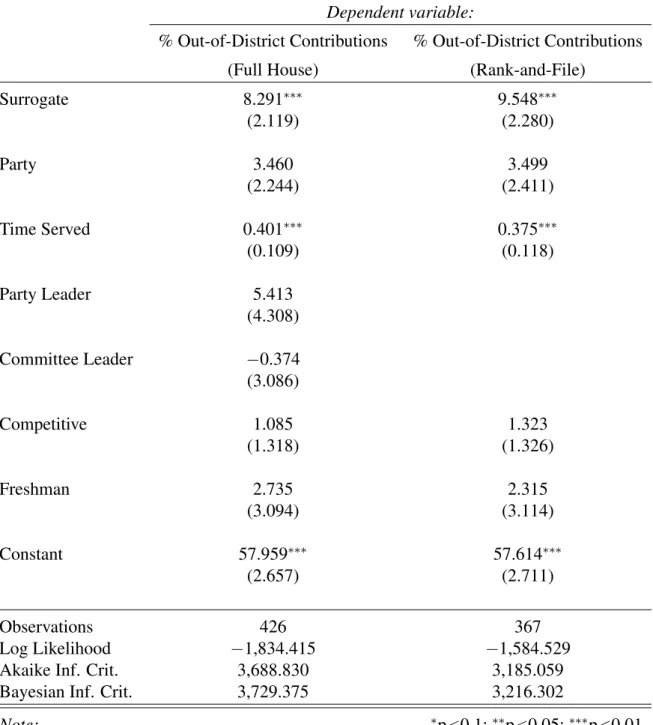
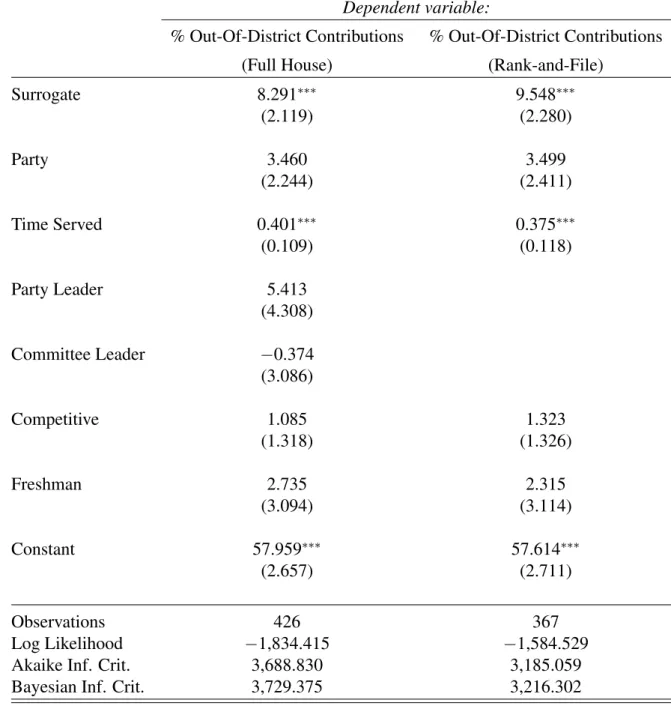
16Looking at Model 1 (column 1) first, surrogate representatives in the U.S. House have a significantly higher percentage of their individual contributions coming from donors out- side of their district (β = 8.29, S.E. = 2.11, p < 0.01). This provides strong support for hy- pothesis 1 as it demonstrates the power of legislative surrogacy for engaging non-territorial constituents, even when controlling for seat competitiveness and leadership positions. In fact, being a surrogate legislator produces a larger effect than holding a leadership position, committee leadership position, or seat competitiveness. This result stands in contrast to the findings of Gimpel, Lee and Pearson-Merkowitz (2008) that find no support for identity based inter-district giving.
In column 2, the same model is estimated using only rank-and-file members,
17and even stronger support for hypothesis 1 is found. In the full U.S. House, surrogate legislators see an increase of 8.29 percentage points in their out-of-district donations. Rank-and-file members, though, see an even greater increase in the share of their donations coming from outside their congressional district (β = 9.55, S.E. = 2.28, p < 0.01). This suggests that rank-and-file members of the U.S. House, who are also surrogate legislators, are seeing a sizeable increase in the percentage of their total constituencies that come from outside their district more so than the full House experiences. This finding is particularly interesting given that rank-and-file members have relatively less exposure than party and committee leaders in the U.S. House. Using predicted values produced by the model, the effects of being a surrogate representative on the percent of out-of-district contributions received are
15
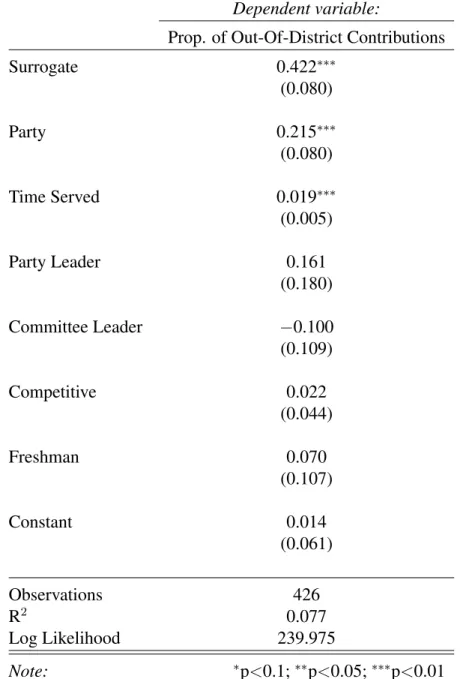
To ensure that my results are not the result of model specification I include a robustness check in Ap- pendix B. Results are substantively and statistically similar regardless of specification.
16
This type of model is chosen to account for variations in state-level contexts that might impact surrogate representatives. For example, some states are more “innovative” in regards to policy creation and diffussion (Gray 1973; Berry and Berry 1990). This creates networks in which some states look to others for policy expertise that creates inequalities in terms of which states are most often looked to by other states. By including fixed effects by state in my model I can better account for variation caused by such factors.
17
Members of the U.S. House are coded as rank-and-file members if they do not hold a party leadership
position or a committee leadership position.
Table 2: OLS Model of the Effect of Surrogacy on Out-of-District Contributions with State Fixed Effects
Dependent variable:
% Out-of-District Contributions % Out-of-District Contributions
(Full House) (Rank-and-File)
Surrogate 8.291
∗∗∗9.548
∗∗∗(2.119) (2.280)
Party 3.460 3.499
(2.244) (2.411)
Time Served 0.401
∗∗∗0.375
∗∗∗(0.109) (0.118)
Party Leader 5.413
(4.308)
Committee Leader −0.374
(3.086)
Competitive 1.085 1.323
(1.318) (1.326)
Freshman 2.735 2.315
(3.094) (3.114)
Constant 57.959
∗∗∗57.614
∗∗∗(2.657) (2.711)
Observations 426 367
Log Likelihood −1,834.415 −1,584.529
Akaike Inf. Crit. 3,688.830 3,185.059
Bayesian Inf. Crit. 3,729.375 3,216.302
Note:
∗p<0.1;
∗∗p<0.05;
∗∗∗p<0.01
presented in Figure 3. Here, it is clear that surrogate representatives see a significantly higher percentage of their total donor base come from outside of their congressional district than non-surrogates. This relationship holds across a member’s entire career in the United States House.
Fig. 3: The Predicted Effect of Surrogate Representation on the Percentage of Out-of-District Con- tributions over Time Served in the U.S. House
Special interest organizations and surrogacy
Given the strong support for the hypothesis that surrogate members of the U.S. House
have a larger portion of their constituents come from outside their district, it is now fruitful
to explore one possible mechanism underlying this process—special interest groups. In the
context of surrogate representation, special interest groups serve the purpose of introducing
their endorsed legislators to members from across the United States. In effect, they inform
potential members of a legislator’s surrogate constituency about the legislator’s qualifica-
tions to fill the surrogate role; in a very real sense they broker the connection between
surrogate constituents and legislators. Here, the role of EMILY’s List is explored as one
such organization.
EMILY’s List (Early Money Is Like Yeast) was founded in 1985 and regularly endorses women candidates in state and federal elections across the United States (Wardle 1995; Day and Hadley 2002; Hannagan, Pimlott and Littvay 2010; Pimlott 2010).
18In 2016, EMILY’s List endorsed 34 candidates for the United State’s House and 12 of those women won in the general election. Those 12 women, who are all included in this analysis, are coded as
‘1’ for receiving an endorsement, and ‘0’ otherwise. Consistent with hypothesis 2, women who are endorsed by EMILY’s List should see greater donations from outside their district than other women surrogates who were not endorsed.
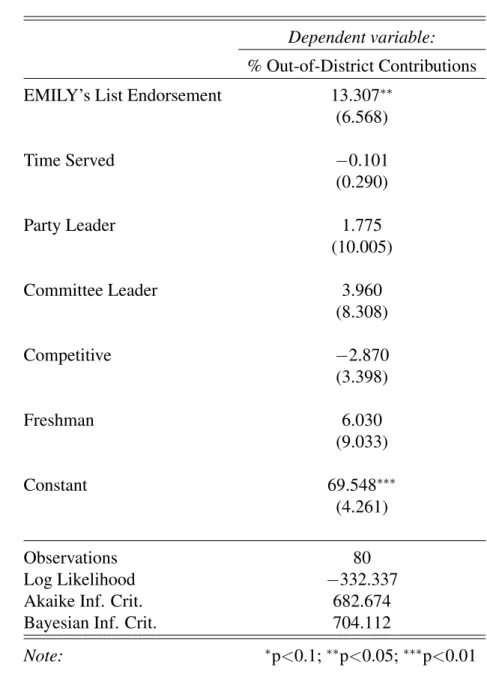
The results from this analysis are presented in Table 3. Focusing on the effects of an endorsement by EMILY’s List, there is a strong significant relationship between receiving an endorsement from EMILY’s List and the percentage of a female surrogate legislator’s contributions that come from outside their district (β = 13.31, S.E. = 6.57, p < 0.05). This suggests that special interest organizations, like EMILY’s List are, indeed, an important mechanism that connects surrogate legislators with surrogate constituents.
19Surrogacy and contemporary American political representation
Surrogate legislators have a larger percentage of their individual contributions com- ing from outside their district than non-surrogate legislators in the United States House.
This evidence supports the argument that the current understanding of constituencies in the United States is incomplete. Neither citizens nor representatives are bound to the territo- rial framework of what representation should look like between citizens and legislators.
Instead, the evidence here suggests that surrogate legislator’s have a higher percentage of their donations coming from outside their congressional district than non-surrogate legisla-
18
For this analysis, I will only examine the role of an endorsement from EMILY’s List for increasing the percentage of a surrogate legislator’s donations that come from out-of-district. Future work will seek to examine other organizations with a similar profile and goals that serve both parties.
19
As a robustness check, I used a difference of means test to compare EMILY’s List endorsed women
to non-endorsed women in just the Democratic Party. Women endorsed by EMILY’s List had significantly
higher percentages of their donations coming from outside their district (a difference of approximately 13
percentage points with a p-value = 0.003.
Table 3: OLS Model of the Effect of EMILY’s
List Endorsement on Out-of-District Contributions
for Women Surrogates in the 114
thCongress with State Fixed Effects
Dependent variable:
% Out-of-District Contributions EMILY’s List Endorsement 13.307
∗∗(6.568)
Time Served −0.101
(0.290)
Party Leader 1.775
(10.005)
Committee Leader 3.960
(8.308)
Competitive −2.870
(3.398)
Freshman 6.030
(9.033)
Constant 69.548
∗∗∗(4.261)
Observations 80
Log Likelihood −332.337
Akaike Inf. Crit. 682.674
Bayesian Inf. Crit. 704.112
Note:
∗p<0.1;
∗∗p<0.05;
∗∗∗p<0.01
tors. This is consistent with the notion that surrogate legislators publicize their willingness to advocate for a group and that surrogate constituents contribute to them because of it. I take this to mean that surrogate constituents are seeking out surrogate legislators that can provide representation in ways that the surrogate constituent’s territorial legislator cannot.
Taken together, the evidence here suggests that the idea of a constituency is in need of a re-examination. Traditional theories of representation and constituencies start with an assumption that privledged the legal framework that defines voting arrangements. This as- sumption may have been more plausible in the earliest days of the United States where legis- lators were elected to districts of smaller communities of interest and geographically com- pact areas where the voting population was far more homogenous(Kromkowski 2002).
20However, these assumptions have certainly broken down with the emergence of new forms of communication, districts that bring together divergent communities of interest, and the proliferation of U.S. House members holding politically marginalized identities in Amer- ica. These findings challenge the conception of what a constituency is in the United States and requires scholars to reconsider theories of represenation that exclude out-of-district constituents and begin to address the role that non-territorial constituents play in American political representation.
These findings also speak to the conclusions of scholars like Mayhew (1974) and Fenno (2002). These early works were less concerned with individuals residing outside a legis- lator’s territorial district and largely ignored them. The theories presented in these works rest on the assumption that constituents are defined as those who reside inside a territorial district. These arguments are missing the role that strong group attachments and salient identities play when influencing human behavior.
Organizations like EMILY’s List are playing a role in re-defining what a constituency is and how Americans engage with legislators in, and out, of their territorial districts. Each election cycle, EMILY’s List endorses candidates they feel embody the goals of their orga-
20