AN APPROACH TO MANAGING THE COMPLEXITY OF KNOWLEDGE INTENSIVE
BUSINESS PROCESSES
PADMAKAR OAK
A thesis submitted in partial fulfilment of the requirements of the University of West of England, Bristol for the degree of PhD
ABSTRACT
AN APPROACH TO MANAGING THE COMPLEXITY OF KNOWLEDGE INTENSIVE
BUSINESS PROCESSES P. R. Oak, March 2013
A thesis submitted in partial fulfilment of the requirements of the University of West of England, Bristol for the degree of PhD
Organisations face ever growing complexity in the business environment and use processes to deliver value in a stable, sustainable and controllable way. However complexity in the business environment is threatening the stability of processes and forcing their continuing evolution in ever shorter time cycles, which then creates significant management challenges. Addressing complexity requires a change in management thinking about processes.
The research explores the nature of complexity, how businesses respond to it, and the consequent impact on process complexity. The research reviews the notion of complexity and its relevance to organisations, business processes and knowledge contexts. The research focuses on knowledge intensive firms, as these exhibit several of the features and allow early application of the approach suggested by this thesis. The research draws upon concepts from several fields including complexity and complex systems, business process management, and knowledge management.
This thesis addresses the question: “How can organisations address the complexity of knowledge intensive business processes?” In answering the question the thesis argues the need to integrate multiple perspectives involved in managing such processes, proposes an approach to complex knowledge intensive business processes that reduces the management challenge, and argues the need to develop an agile shared knowledge context in support of the approach.
through a series of QDS investigations and action research cycles, this thesis tests the hypotheses, further develops the approach and examines its application in different problem domains in multiple organisations. This thesis then discusses the process and the outcomes of applying the approach, identifies its limitations, assesses its contribution to knowledge and suggests directions for further research.
Declaration of originality
The researcher declares that this thesis is his own work and has not been submitted in any form for another degree or diploma at any university or other institute of education. Information derived from the published and unpublished work of others has been acknowledged in the text and a list of references is provideda.
a This copy has been supplied on the understanding that it is copyright material
Table of Contents
Chapter 1: Introduction ... 8
1.1 Justification for research ... 10
1.2 Knowledge Intensive Business Processes ... 11
1.3 Focus of Research ... 12
1.4 Organisation of Thesis ... 12
Chapter 2: Complexity, Complex Systems and Organisations ... 15
2.1 Introduction ... 15
2.2 The Concept of Complexity ... 17
2.3 Complex Systems ... 25
2.4 Organisations as Complex Systems ... 30
2.5 Implications for research ... 43
2.6 Summary of this chapter ... 45
Chapter 3: Business Processes and Knowledge Management ... 47
3.1 Introduction ... 47
3.2 Understanding Business Processes ... 47
3.3 Managing Business Processes ... 55
3.4 Complexity and Business Processes ... 62
3.5 Understanding Knowledge Management ... 63
3.6 Managing Business Knowledge ... 66
3.7 Complexity and Knowledge Management ... 73
3.8 Implications for research ... 75
3.9 Summary of this chapter ... 77
Chapter 4: Towards a Theoretical Framework ... 80
4.1 Introduction ... 80
4.2 Hypothesis ... 81
4.3 Perspective on Complexity ... 95
4.4 Implications for research ... 102
4.5 Review of this chapter ... 105
Chapter 5: Research Methodology and Design ... 107
5.1 Introduction ... 107
5.2 Considerations for selecting methodology and methods ... 107
5.3 Action Research ... 115
5.4 Research Design ... 118
5.5 Methods... 130
5.6 Data Collection and Analysis ... 134
5.7 Role of Researcher ... 137
5.8 Assuring rigour of research ... 139
5.9 Ethics ... 143
5.10 Review of this chapter ... 144
Chapter 6: Pilot Phase ... 146
6.1 Introduction ... 146
6.2 Pilot Phase - QDS Investigation 1 - AB ... 148
6.3 Pilot Phase - QDS Investigation 2 - MN ... 159
6.4 Review of Pilot Phase ... 170
7.1 Background ... 171
7.2 Procedures ... 172
7.3 Problem Description ... 174
7.4 Iteration 1: Process Maturity ... 175
7.5 Iteration 2: Process Optimisation ... 179
7.6 Iteration 3: Managing Constraints ... 183
7.7 Iteration 4: Managing Complexity ... 187
7.8 Reflections ... 195
7.9 Review of Development Phase ... 199
Chapter 8: Validation Phase ... 201
8.1 Validation Phase – QDS Investigation 4 - ST ... 202
8.2 Validation Phase – QDS Investigation 5 - AB ... 212
8.3 Review of Validation Phase ... 223
Chapter 9: Discussion and Conclusions... 224
9.1 Comparison of findings with Literature ... 226
9.2 Review of the Hypotheses ... 228
9.3 Review of the Approach ... 233
9.4 Review of the Framework ... 237
9.5 Review of the Assessment Criteria ... 238
9.6 Reflections ... 239
9.7 Limitations of the Research ... 240
9.8 Implications of the Research ... 242
9.9 Future Directions ... 243
9.10 Contribution to Knowledge ... 243
References ... 245
Appendix I. QDS Investigation 3 - Review Report ... - 1 -
I.1 Background ... - 1 -
I.2 Initiation ... - 11 -
I.3 Iteration 1: Process Maturity ... - 11 -
I.4 Iteration 2: Process Optimisation ... - 19 -
I.5 Iteration 3: Managing Constraints ... - 32 -
I.6 Iteration 4: Managing Complexity ... - 45 -
I.7 Development Review ... - 69 -
Appendix II. Change Assessment Instrument Data ... - 76 -
Table of Figures
Figure 1: Focus of Research 12
Figure 2: Relationships between topics 16
Figure 3: Illustrating Knowledge Entanglement 86
Figure 4: Process Complexity leads to Management Challenge 88
Figure 5: Research Flowchart 106
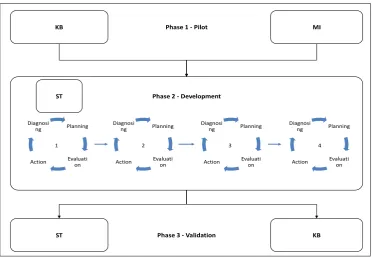
Figure 6: Research Design 145
Figure 7: QDS Investigation 1 - AB - System map pre-intervention 151 Figure 8: QDS Investigation 1 - AB - System map post-intervention 153 Figure 9: QDS Investigation 1 - AB - Change in Assessment 154 Figure 10: QDS Investigation 2 - MN - System map pre-intervention 163 Figure 11: QDS Investigation 2 - MN - System map post-intervention 165 Figure 12: QDS Investigation 2 - MN - Change in Assessment 166 Figure 13: QDS Investigation 3 - ST - System map pre-intervention 175 Figure 14: QDS Investigation 3/1 - ST - Change in Assessment 177 Figure 15: QDS Investigation 3/1 - ST - System map 178 Figure 16: QDS Investigation 3/2 - ST – System map 181 Figure 17: QDS Investigation 3/2 - ST – Change in Assessment 182 Figure 18: QDS Investigation 3/3 - ST - System map 186 Figure 19: QDS Investigation 3/3 - ST – Change in Assessment 187 Figure 20: QDS Investigation 3/4 - ST - System map 193 Figure 21: QDS Investigation 3/4 - ST – Change in Assessment 194 Figure 22: QDS Investigation 4 - ST - System map pre-intervention 207 Figure 23: QDS Investigation 4 - ST - System map post-intervention 208 Figure 24: QDS Investigation 4 - ST - Change in Assessment 209 Figure 25: QDS Investigation 5 - AB - System map pre-intervention 217 Figure 26: QDS Investigation 5 - AB - System map post-intervention 219 Figure 27: QDS Investigation 5 - AB - Change in Complexity Assessment 220
Figure 28: Reflection between QDSs 240
Figure 29: ST Services - 3 -
Figure 30: Key Elements of the Digital Money Ecosystem - 4 -
Figure 31: The Initial Business Model - 8 -
Figure 32: The Initial Operating Model - 9 -
Figure 33: Iteration 1 - Operating Model - 14 -
Figure 34: Iteration 1 - Improvement Area and Strategies - 15 - Figure 35: Iteration 1 - Improvements by Process - 17 - Figure 36: Iteration 2 - Interpretations of Lean Waste in intervention - 22 -
Figure 37: Iteration 2 - Operating Model - 25 -
Figure 38: Iteration 2 - Improvement Strategies - 26 - Figure 39: Iteration 2 - Metrics Identified by Process Group - 27 - Figure 40: Iteration 2 - Improvements by Process - 30 - Figure 41: Iteration 3 - Process Attributes of Complexity - 33 - Figure 42: Iteration 3 - Process Classification - 35 -
Figure 43: Iteration 3 - Research Involved - 40 -
Figure 44: Iteration 3 - Operating Model - 41 -
Figure 46: Iteration 4 - Research Business Process - 57 -
Figure 47: Iteration 4 - Operating Model - 61 -
Figure 48: Iteration 4 - Interfaces - 61 -
Figure 49: Iteration 4 - Seeding the knowledge base - 62 -
Figure 50: Iteration 4 - Impact on processes - 65 -
Figure 51: Iteration 4 - iResources compared to Associates - 67 - Figure 52: Iteration 4 - Impact on Organisation Challenges - 69 -
Figure 53: The New Business Model - 75 -
Table of Tables
Table 1: Regular v/s Knowledge Intensive Business Processes 11 Table 2: Architecture of thesis leading to field research 14
Table 3: Structure of Literature Review 17
Table 4: Review of complexity as a field of study 18
Table 5: Characteristics of complexity 20
Table 6: Categories of complexity thinking 22
Table 7: Organisations as Complex Systems – Implications for research 43 Table 8: Business Processes – Implications for research 75
Table 9: Classifying business processes 88
Table 10: Hypothesis and related research elements 94 Table 11: Issues in choosing a development method 108
Table 12: Research Design 121
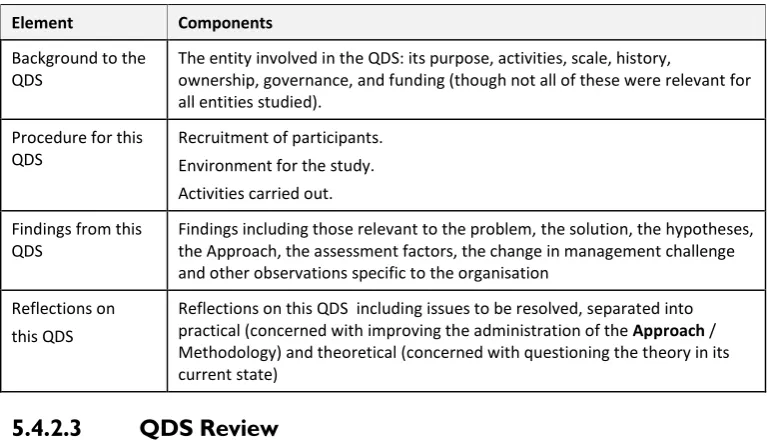
Table 13: QDS Description Components 122
Table 14: QDSs Selected for Research 129
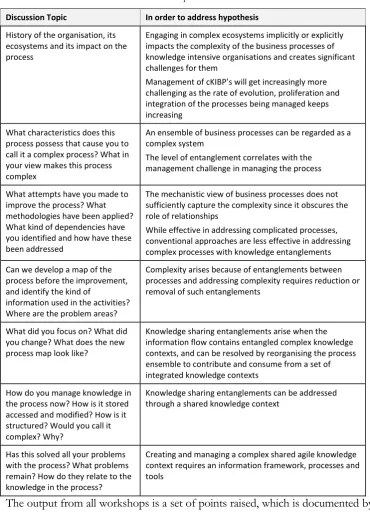
Table 15: Workshop discussion structure 132
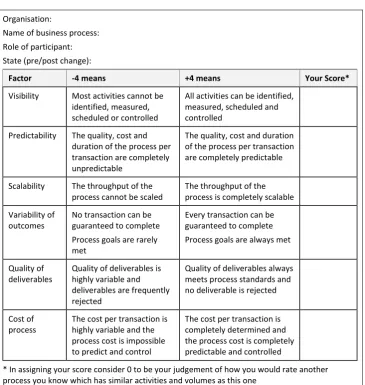
Table 16: Management Challenge Assessment Instrument 133 Table 17: Data Collection and Analysis Statistics 137 Table 18: QDS Investigation 1 - AB - List of participants 149 Table 19: QDS Investigation 2 - MN - List of Participants 160 Table 20: QDS Investigation 3 - ST - List of Participants 172 Table 21: QDS Investigation 4 - ST - List of Participants 203 Table 22: QDS Investigation 5 - AB - List of Participants 213 Table 23: Summary analysis of QDS Investigations 226
Acronyms Used
aKC Agile Knowledge Context BPM Business Process Management CKC Complex Knowledge Context
cKIBP Complex Knowledge Intensive Business Process KC Knowledge Context
KIBP Knowledge Intensive Business Process KM Knowledge Management
KMS Knowledge Management System KYC Know Your Customer
QDS Qualitative Data Source
QDSs Multiple Qualitative Data Sources
Conventions adopted
Footnotes (available at the foot of the page) follow an alphabetic convention (e.g. a, b, c ...) and provide relevant brief information
Endnotes (available in Appendix III) follow a numeric convention (e.g. 1, 2, 3 …) and provide relevant detailed information
Labels are provided for elements of interest in the thesis and are bold faced for readability. These are then referred to in the rest of the thesis.
Research questions are labelled with a prefix “Q” followed by a number Research objectives are labelled with a prefix “O” followed by a number
Literature review observations are labelled with a prefix “L” followed by a number Hypotheses are labelled with a prefix “H” followed by a number, capabilities with a prefix
“C” followed by a number
Chapter 1: Introduction
Organisationsb face ever-growing complexity in the business environment (Areta
& Giachetti, 2004). Possibly as a consequence, business organisations grow ever more complex and managing such organisations is increasingly challenging. This trend may be driven, among other things, by factors such as globalisation, complex value chains, mass-customisation, complex products among othersc.
Organisations use processes to create and deliver value in a stable, sustainable and controllable way. However, complexity in the environment is threatening the stability of processes and forcing their continuing evolution in ever-shorter time cycles. Toffler (1970) refers to a similar phenomenon as future shock, which is a perception of “too much change in too short a period of time.”
A key element of complexity is the notion of relationships between the objects of interest in the organisation. One possible explanation for the growth of organisational complexity is the growth in relationships between internal elements and with external elements that can no longer be isolated or ignored. Organisations must adapt to survive, but the very basis of survival, i.e. the stability of their processes is being threatened. This requires a change in management thinking about processes.
This research addresses one main question and two secondary questions. The main question is:
Q1 How can organisations manage the complexity of their knowledge intensive business processes (KIBP’s)?
The question argues for a management strategy to address complex KIBP’s (cKIBP’s), based upon the hypothesis that the management of cKIBP’s will get increasingly more challenging as the rate of evolution, proliferation and integration of the processes being managed keeps increasing.
b The term “organisation” is used in this thesis in the sense of a social entity, existing within an external
environment, that is structured and managed to meet needs or to pursue collective goals.
c As seen in this statement, the recursive notion of complexity is discussed by Gershenson & Heylighen
The main question gives rise to two secondary questions:
Q1.a What does “business process complexity” mean?
As the research discovers, it is very difficult to provide a precise definition to the term “complexity” that is acceptable to all disciplines (Richardson K. A., 2005). This is true even when restricted for use in Business Process Management. The term is largely used as a metaphor and that makes it at best a partial description and difficult for traditional management to adopt. What is required is a
pragmaticd definition that allows discovery, understanding and addressing of
cKIBP’s.
Q1.b What does it mean to “manage business process complexity”?
As the research discovers, there are many viewpoints as regards management of business processes. Again what is required is a pragmatic operational strategy to address the management challenge of cKIBP’s.
The approach to resolving the question is the development of frameworks that co-evolve in the face of evolution of the processes they manage, and argues the case for agility and integration across process disciplines.
As the research discovers, a key characteristic of cKIBP’s is the knowledge of relationships between the objects of interest in the organisation that are relevant to the process (the complex knowledge context). This is particularly relevant in the management of complex business processes that require the maintenance of a shared complex knowledge context while managing sets of multiple concurrent business processes (the process ensemble).
Consequently, as the research argues, any strategy for managing complex business processes requires (a) an organisation wide shared understanding of the necessary objects and relationships, (b) a mechanism to develop and sustain such understanding, and (c) a process that efficiently co-ordinates the growth of such shared understanding. Such a strategy would allow a multi-minded organisation to dynamically integrate multiple perspectives.
d The Merriam-Webster dictionary defines pragmatic as “… practical as opposed to idealistic”. It is used
There has already been extensive research regarding the nature and impact of complexity on organisations (Lissack, 1999; Stacey R. D., 2001; Burnes, 2005; Richardson K. A., 2005; Lawrimore, 2005). However, there is insufficient research in terms of addressing the management challenges that complexity creates with respect to business processes (Mason, 2007). The research proposes an approach that could help address such management challenges.
The motivation behind this piece of research is to meet the researcher’s two objectives:
O1 To understand the nature of complexity as it relates to complex KIBP’s (cKIBP’s) in order to explain why the current paradigm for managing such processes does not always seem to work, and
O2 To provide practicing managers with a pragmatic way of recognising complexity and identifying and addressing cKIBP’s
1.1 Justification for research
So long as organisations exist they must be managed. Management has always adapted to challenges in the past and should continue to do so. As Hiett (2001) puts it, “It is clear that we do not have any theoretical handle on why the world is complex, how one should act in such a situation, how to make things less complex, and so on. However, through years of experience and sensitivity to situations, various abilities, techniques, and ideas have been developed that seem to work.”
There are at least three reasons to do so. Firstly, there is increasing recognition among practicing managers (KPMG International, 2011) of the fact that complexity in the business environment is increasing dramatically (Cohen M. , 1999), and this is significantly impacts internal business processes (Perona & Miragliotta, 2004). Secondly, there is a growing management perception that complexity is impacting the success of change interventions (Burnes, 2005). And thirdly, continuing on the current course will make certain kinds of organisation insufficiently agile (Areta & Giachetti, 2004). This is particularly relevant to knowledge-intensive firms (discussed in 3.6.1), which can be viewed as organizations that use mainly the knowledge of their individuals to develop and trade immaterial responses to customer requirements.
1.2 Knowledge Intensive Business Processes
Work in knowledge intensive organisations is carried out by means of its business processes (discussed in 3.2), whose every aspect involves a certain amount of knowledge which may be complex depending on the domain of interest. However, a business process is knowledge intensive if its value can only be created through the fulfilment of the knowledge requirements of each of the process participants (Hofstede, Mecella & Sardina, 2012), and activities in the process require contextual knowledge that cannot be completely managed through stable information sources and the information flows between the activities. This distinction is outlined in Table 1: Regular v/s Knowledge Intensive Business Processes:
Table 1: Regular v/s Knowledge Intensive Business Processes
Regular Business Processes Knowledge Intensive Business Processes Distinction Activities do not require additional
contextual knowledge to execute
Activities require additional contextual knowledge to execute
Characteristics Well Defined Predictable Reproducible
Low Creativity / Innovation Stable Structure / Flow
Difficult to define Unpredictable Repeatable
1.3 Focus of Research
Figure 1: Focus of Research
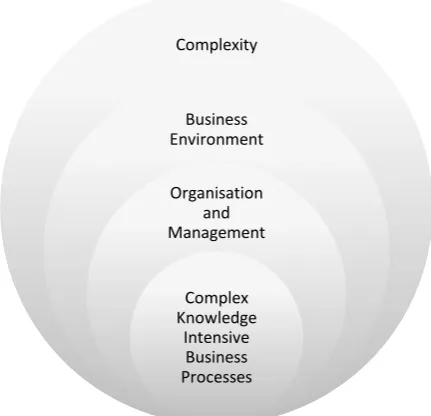
As will become evident in the review of literature, complexity is a broad subject, with a long pedigree, and cuts across many disciplines. Given the many perspectives and interpretations as to its relevance, it is important to focus the research carefully, in order to maximise the chances of producing credible results. Consequently, this research addresses cKIBP’s, in the business environment, as shown in Figure 1. The focus also influences the context of research, the research strategy adopted, content for research, and the opportunities available to carry out the research.
1.4 Organisation of Thesis
This chapter provided the background, motivation and justification for the research, the research questions and the focus of the research.
Chapters 2 and 3 review current literature in relevant areas such as complexity, complex systems, organisations viewed as complex systems, complexity as it relates to business processes, and to business knowledge management, in order to formulate a set of hypotheses and issues to investigate in the Qualitative Data Sources (QDSs). Chapter 4 discusses a research framework that (a) formulates
Complexity Complexity
Business Environment
Business Environment Organisation
and Management Organisation
and Management
Complex Knowledge
Intensive Business Processes
Complex Knowledge
hypotheses relevant to addressing cKIBP’s, (b) identifies issues that arise as a result of those hypotheses, (c) identifies capabilities required to address such issues, and (d) proposes an approach to address cKIBP’s. It then sets out the requirements that the research must fulfil. Chapter 5 describes the research methodology and methods that are appropriate for fulfilling the research requirements, justifies the choice of that methodology and those methods, and then describes the design of the research as consisting of three phases (1) pilot, (2) development, and (3) validation. It goes on to describe the objectives or each phase, the choice of QDSs and the approach to collecting and analysing the data. The architecture of thesis leading to field research is presented in Table 2.
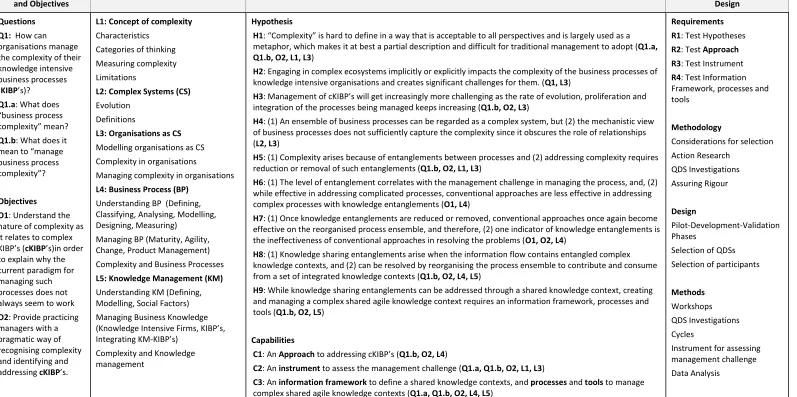
Table 2: Architecture of thesis leading to field research
Research Questions and Objectives
Literature Review Theoretical Framework Research Methodology and
Design Questions
Q1: How can organisations manage the complexity of their knowledge intensive business processes (KIBP’s)?
Q1.a: What does “business process complexity” mean? Q1.b: What does it mean to “manage business process complexity”?
Objectives
O1: Understand the nature of complexity as it relates to complex KIBP’s (cKIBP’s)in order to explain why the current paradigm for managing such processes does not always seem to work O2: Provide practicing managers with a pragmatic way of recognising complexity and identifying and addressing cKIBP’s.
L1: Concept of complexity Characteristics
Categories of thinking Measuring complexity Limitations
L2: Complex Systems (CS) Evolution
Definitions
L3: Organisations as CS Modelling organisations as CS Complexity in organisations
Managing complexity in organisations L4: Business Process (BP)
Understanding BP (Defining, Classifying, Analysing, Modelling, Designing, Measuring)
Managing BP (Maturity, Agility, Change, Product Management) Complexity and Business Processes L5: Knowledge Management (KM) Understanding KM (Defining, Modelling, Social Factors) Managing Business Knowledge (Knowledge Intensive Firms, KIBP’s, Integrating KM-KIBP’s)
Complexity and Knowledge management
Hypothesis
H1: “Complexity” is hard to define in a way that is acceptable to all perspectives and is largely used as a metaphor, which makes it at best a partial description and difficult for traditional management to adopt (Q1.a, Q1.b, O2, L1, L3)
H2: Engaging in complex ecosystems implicitly or explicitly impacts the complexity of the business processes of knowledge intensive organisations and creates significant challenges for them. (Q1, L3)
H3: Management of cKIBP’s will get increasingly more challenging as the rate of evolution, proliferation and integration of the processes being managed keeps increasing (Q1.b, O2, L3)
H4: (1) An ensemble of business processes can be regarded as a complex system, but (2) the mechanistic view of business processes does not sufficiently capture the complexity since it obscures the role of relationships (L2, L3)
H5: (1) Complexity arises because of entanglements between processes and (2) addressing complexity requires reduction or removal of such entanglements (Q1.b, O2, L1, L3)
H6: (1) The level of entanglement correlates with the management challenge in managing the process, and, (2) while effective in addressing complicated processes, conventional approaches are less effective in addressing complex processes with knowledge entanglements (O1, L4)
H7: (1) Once knowledge entanglements are reduced or removed, conventional approaches once again become effective on the reorganised process ensemble, and therefore, (2) one indicator of knowledge entanglements is the ineffectiveness of conventional approaches in resolving the problems (O1, O2, L4)
H8: (1) Knowledge sharing entanglements arise when the information flow contains entangled complex knowledge contexts, and (2) can be resolved by reorganising the process ensemble to contribute and consume from a set of integrated knowledge contexts (Q1.b, O2, L4, L5)
H9: While knowledge sharing entanglements can be addressed through a shared knowledge context, creating and managing a complex shared agile knowledge context requires an information framework, processes and tools (Q1.b, O2, L5)
Capabilities
C1: An Approach to addressing cKIBP’s (Q1.b, O2, L4)
C2: An instrument to assess the management challenge (Q1.a, Q1.b, O2, L1, L3)
C3: An information framework to define a shared knowledge contexts, and processes and tools to manage complex shared agile knowledge contexts (Q1.a, Q1.b, O2, L4, L5)
Requirements R1: Test Hypotheses R2: Test Approach R3: Test Instrument R4: Test Information Framework, processes and tools
Methodology
Considerations for selection Action Research QDS Investigations Assuring Rigour Design Pilot-Development-Validation Phases
Selection of QDSs Selection of participants
Methods Workshops QDS Investigations Cycles
Chapter 2: Complexity, Complex Systems and Organisations
2.1 Introduction
The last chapter set out the research questions, provided the justification for the research, identified the research focus and showed how the thesis is organised. This chapter sets out the purpose and the context for a review of literature in preparation for undertaking the research, and also describes the structure of the literature review. It then reviews complexity and complex systems to gain insights into aspects applicable to the research.
Given the research questions, one approach to take would be to (1) first identify exemplars where the problem of managing process complexity seemed to have been adequately resolved and distil the essentials elements of the solution; (2) then construct a provisional approach out of those distilled elements and develop that approach over several iterations in solving a specific problem; and finally (3) validate that developed approach by applying it to other problems and testing its success and adequacy. However on closer inspection a number of issues come to light.
In order to identify exemplars it becomes necessary to describe the problem adequately in terms of its complexity characteristics. This requires a much deeper understanding of complexity as a concept and ways to describe and measure it from the point of view of its management in the context of business processes. Further, the researcher would need a consistent theoretical framework in order to assess the exemplars in order to (a) select organisations to study; (b) identify the right participants in the research; (c) select the problem space to study; (d) define the problem and the solution; and (e) measure the impact on managing complexity.
and complex systems, organisation and management, business processes and knowledge management, all of which relate to the concept of complexity as illustrated in Figure 2.
Figure 2: Relationships between topics
However these relationships are intricate and are difficult to appreciate in the absence of a logical flow, and it makes sense to work backwards and downwards, starting with (1) a review of complexity in order to understand the concept of complexity, definitions and measures, kinds of complexity, followed by (2) a review of complex systems in order to understand the evolution of complex systems, definitions and essential concepts, followed by (3) a review of organisations in order to understand how complexity and complex systems relate to organisations, followed by (4) a review of business processes in order to understand the concept of business processes, how business processes are managed and how complexity relates to business processes, culminating in (5) a review of knowledge management in order to understand the concept of knowledge management, how knowledge is managed in organisations and how complexity relates to knowledge management.
Consequently, while the process of literature review is itself organic and driven by the research questions and objectives and the need to support the hypotheses in the theoretical framework, in order to provide a logical flow the literature review is structured as shown in Table 3.
Business
Processes Organisations
Complex Systems
Complexity
Knowledge Management
are
involve
enable
are
show
show show
Table 3: Structure of Literature Review
Purpose Review Focus (Relevance) Discussed In
Understand the concept of complexity, definitions and measures, kinds of complexity, the evolution of complex systems concepts, definitions and essential elements
Defining Complexity (Q1, H1) Categorising Complexity (Q1, H1) Measuring Complexity (Q1, H1)
Evolution of Complex Systems (Q1.a, H2) Defining complex systems (Q1.a, H2, H3) Conceptualising complex systems (Q1.a, H4, H5)
Chapter 2:
Understand how complexity and complex systems relate to organisations
Complex systems and organisations (Q1.a, H2) Modelling organisations as complex systems (Q1.a, H3)
Complexity in organisations (Q1.a, H2)
Managing complexity in organisations (Q1.b, H3) Understand the concept,
how business processes are managed and how complexity relates to business processes
Understanding business processes (Q1.a , Q1.b) Managing business processes (Q1.a , Q1.b, H6) Complexity and business processes (Q1.a , Q1.b, H5, H6, H7)
Chapter 3:
Understand the concept, how knowledge is managed and how complexity relates to knowledge management
Understanding knowledge management (Q1, Q1.a, Q1.b, H7, H8, H9)
Managing business knowledge management (Q1, Q1.a, Q1.b, H7, H8, H9)
Complexity and knowledge management (Q1, Q1.a, Q1.b, H7, H8, H9)
2.2 The Concept of Complexity
The original Latin word “complexus” means "entwined", "twisted together". This may be interpreted to mean that anything that is complex has two or more components, which are joined in such a way that it is difficult to disentangle them. Similarly, the Oxford Dictionary defines something as "complex" if it is "made of (usually several) closely connected parts". In practice, common synonyms for the term complex are difficult, complicated, intricate, involved, tangled, and knotty, amongst many others. (Whitt & Maylor, 2008). This is obviously insufficient as a definition for the purpose of this research. The researcher therefore needed to review relevant literature to obtain a better understanding of the concept.
therefore restricted the review to those that were likely to exhibit features of relevance to this research as framed by Q1, which relates to (1) complexity, (2) organisations, (3) business processes, and (4) knowledge and its management.
Table 4: Review of complexity as a field of study
Field Features of interest Reason for interest Sources Systems
Theory
Open and closed systems Controlled and uncontrolled systems
Business processes as complex systems (Boulding, 1956; Bertalanffy, 1968) Ecological systems theory
Multiple levels of scale and interactions between levels
Perspectives at different levels of management of business processes
(Bronfenbrenner, 1979)
Cybernetics Regulated and self-regulating systems, feedback loops and external sensors
Regulation of business processes as complex systems
(Kelly, 1994; Pangaro, 2006)
Artificial Intelligence
Complex data structures as networks to support problem solving, deduction and reasoning Computational complexity and descriptive complexity
Modelling activities and information flows in business processes as network structures
(Turing, 1950)
Distributed Neural Networking
Parallel problem solving Distributed decision making
Decision making by actors in the business process
(Anthony & Bartlett, 2009)
Dynamic Systems Theory
Modelling a complex system including feedback loops, complex relationships between elements, delayed response and sensitivity to history
Modelling business processes as complex systems
(Gros, 2008)
Chaos Theory Extreme sensitivity to initial conditions, making even deterministic systems extremely difficult to predict without perfect knowledge of their original states.
Stability of business processes in response to changes of scale and resourcing
(Thietart & Forgues, 1995)
Complexity Science
Complexity as the order that emerges from a large number of interacting members of a system
Business processes as complex systems
(McDaniel & Driebe, 2001; Cilliers P. , 1998)
Self-Organisation
Simple rules operated by agents in the system lead to a group level behaviour without a central control element
Social systems can be thought of as self-organising
Business process change from within
(Capra, 1996; Waldrop, 1993)
Information Theory
Complexity can be measured by the uncertainty in distribution of the system, as well as the shared information of its components.
Information flows within business processes
This part of the review is summarised in Table 4, and is restricted to only those fields of study that appeared to the researcher to have features of interest (as identified in the table) relevant to this research. An analysis of the table shows that for features relevant to Q1.a and Q1.b, (L1.1) different fields of study approach complexity from different perspectives, for example, (1) business processes as complex systems (systems theory, dynamic systems theory, complexity science), (2) stability and regulation (cybernetics, chaos theory), (3) modelling processes and information (artificial intelligence, information theory), (4) organisation, management and decision making (ecological systems theory, distributed neural networking, self-organisation).
2.2.1 Characteristics of complexity
In order to address Q1, it is first necessary to be able to define complexity. The review of the literature in Table 4 reveals that there have been many attempts to define complexity from various perspectives but none have managed a comprehensive definition. Gershenson and Heylighen (2005) point out that complexity is itself a complex concept as we cannot make an unambiguous distinction between simple and complex systems.
Table 5: Characteristics of complexity
Characteristic Summary Description Relevance to research Failure of
Newtonian Paradigm
The principle of conservation of distinction does not apply. (Something is lost when a system is decomposed into its component parts
Most models of business processes rely on such decomposition
Incommensurability and
Incompressibility
Formal models of complex systems cannot be derived from each other and there is no perfect representation of the system that is smaller than the system itself
Business processes are sometimes repeatable but not reproducible because a complete description is not possible
Distinction and connection
Existence of both variety and
interdependency of components in the system
Business processes are usually composed of distinct operations connected by information flows Symmetry breaking
and scale
Symmetry is broken under scale transformations
Not all business processes appear to scale gracefully, and
perception of apparent complexity varies with the scale Failure of the Newtonian Paradigm: Classical science relies upon making as precise as possible distinctions between the different component properties and states of the system under observation which are assumed to be absolute and objective and which are conserved through the evolution of the system. This paradigm, also known as the Cartesian mode of thinking is based upon the principle of distinction conservation and is based upon the assumptions of reductionism, determinism, dualism, correspondence theory of knowledge and rationality. (Gershenson & Heylighen, 2005). From this perspective, the essence of complexity appears to be in the existence of something that is lost as the system is reduced to its parts. Otherwise, the whole is merely the sum of its parts, but the whole may be a more complicated arrangement of the partse. Incommensurability and Incompressibility: Complexity is the property of a real world system that is manifest in the inability of any single formalism being adequate to capture all its properties. It requires that we find distinctly different ways of interacting with systems in the sense that when we make successful models, the formal systems that are needed to describe each distinct aspect, are NOT derivable from each other i.e. they are not commensurable with each other. Richardson (2005) implies that this is a way of distinguishing the complicated from the complex and suggests that there exists infinitude of equally valid,
overlapping, potentially contradictory descriptions. This is related to the idea of incompressibility which Cilliers (2005) describes as there being no accurate (or rather, perfect) representation of open systems, which is simpler than the system itself. The analysis of the fields of study in Table 4 leads to the same conclusion.
Distinction and Connection: Heylighen (1999) maintains that the aspects of distinction and connection (differentiation and integration) determine two dimensions characterizing complexity. Distinction corresponds to variety, or heterogeneity, and to the fact that different parts of the complex behave differently. Connection corresponds to constraint, to redundancy, to the fact that different parts are not independent, but that the knowledge of one part allows the determination of features of the other parts. Complexity can only exist if both aspects are present: neither perfect disorder (which can be described statistically through the law of large numbers), nor perfect order (which can be described by traditional deterministic methods) are complex.
Symmetry breaking and Scale: Complexity can be characterized by lack of symmetry (invariance under transformation) or "symmetry breaking", by the fact that no part or aspect of a complex entity can provide sufficient information to actually or statistically predict the properties of the others parts. Havel (1995) maintains that scale is just another dimension characterizing space or time, and that invariance under geometrical transformations, like rotations or translations, can be similarly extended to scale transformations.
From the foregoing discussion one can conclude that (L1.2) while complexity has recognisable characteristics, complexity is hard to define.
2.2.2 Categorising complexity thinking
between pretending we know something and knowing we know nothing for sure.
In order to address Q1.a and develop hypothesis H7 in section 4.2, the researcher identified some categories relevant to the research and these are summarised in Table 6 and then discussed further.
Table 6: Categories of complexity thinking
Approach Summary Description Relevance to research Apparent and
Inherent complexity
Apparent complexity is judged while the inherent complexity can be modelled and verified
Lack of transparency, bad design or implementation may make an inherently simple business process appear apparently complex Detail and dynamic
complexity
Detail complexity is a property of the system while dynamic complexity is a property of its behaviour
Some business processes can be complicated but stable, while others appear to be simpler but
unpredictable
Apparent and Inherent Complexity: IEEE Standard Computer Dictionary (1990) defines apparent complexity as the degree to which a system or component has a design or implementation that is difficult to understand and verify. Evans and Marciniak (1987) define inherent complexity as the degree of complication of a system or system component, determined by such factors as the number and intricacy of interfaces, the number and intricacy of conditional branches, the degree of nesting, and the types of data structures.
perpetually changing configurations of relations which are continuously transforming themselves.
2.2.3 Measuring complexity
In order to manage complexity one needs to be able to measure it. Therefore, in order to address Q1, the next step is to look for ways by which complexity can be measured. There have been several attempts to create measures for complexity. Most of them approach complexity from a specific perspective when defining a measure.
Mitchell (2009) describes approaches to understanding complexity from the perspective of size, entropy, algorithmic content, logical depth, thermodynamic depth, computational capacity, statistical complexity, fractal dimension and the degree of hierarchy. Lloyd (2001) proposes three dimensions along which complexity may be measured for an object or a process in terms of (1) How hard it is to describe, (2) How hard it is to create, and (3) What is its degree of organisation which he divides up into two quantities: (a) Effective Complexity; and (b) Mutual Information
computational load. He then makes distinctions in the information space in terms of fathomable and unfathomable phenomena; in the computational space as tractable, intractable and impossible; and finally distinctions based upon interactions between information and computation spaces as simple, complicated and complex. Finally he proposes calling those phenomena as complex “whose representations are informationally deep but computationally light”.
Moldoveanu’s analysis provides a key insight in terms of the distinction between the complexity of a process and difficulty in managing it. If one can consider a business process as an inter-subjectively agreed algorithm, then its informational depth would be characterised by the information structures and flows affecting the process, and computational load by orchestration and execution needs, and therefore (L1.3) the process could be viewed from the perspective of complexity as structural intricacy while the management of it could be viewed from the perspective of complexity as difficulty. Consequently this analysis is used to support the development of hypotheses H4, H5 and H6 insection 4.2 to meet objective O2 of this research
2.2.4 Limitations of Complexity thinking
While much good and detailed work has been done in this field, the researcher discovered that a number of authors express doubts about complexity and the concepts therein, and this does have a bearing on how much reliance can be placed on the concepts discussed for the purpose of the research.
Rosen (1985; 1991) and Cariani (1989) express doubts about the concept of emergence. Rosen (1991) demonstrates that complexity science must effectively satisfy two contradictory conditions: (1) the models of analytic science are (ideally) complete with respect to causation, and (2) the models of analytic science are clearly not complete with respect to causation, since there are further things to explain, which equates to further causes being needed.
complexity science, and suggest that complexity science has “some affinity with sceptical postmodernism” in that it tends to undermine all attempts to fully characterize the world, including its own attempts. Hiett (2001) suggests that it is therefore a “grey” rather than a “black and white” science. In Cohen’s (1999) view, we do not yet have a unified, theoretically coherent account of complexity, only a rapidly growing collection of results, models, and methods. Horgan (1995) describes this state of affairs as perplexity in another guise.
The researcher acknowledges the doubts raised by these authors. However, the purpose of the research is to develop an approach to managing complexity of business processes. Consequently, (L1.4) the researcher is of the view that, whilst not perfect, the thinking around complexity could still serve as a lens through which to understand business processes.
2.3 Complex Systems
While generally modelled as systems, in the researcher’s experience, organisations and business processes, particularly knowledge intensive ones, often display some of the characteristics of complexity. Therefore it is necessary to review the literature on complex systems, in terms of the evolution of thinking, definitions and concepts, in order to understand whether those concepts could be applied to organisations and business processes, and gain insights and identify impacts upon the research.
the kinds of complexity found in complex systems, (L2.2) it is the availability of computers and computational capability that allow us to build complex representations of reality and explore complex behaviours. This is further advanced by research around “systems based methodologies for real-world problem solving” (Checkland P. B., 1972). This has been extended in the 1980’s with analytical frameworks such as “soft system methodology” (Checkland P. B., 1981). The 1990’s saw further developments in terms of analytic frameworks (Jackson & Keys, 1984; Flood R. L., 1995) that explicitly acknowledged the subjectivity and uniqueness of experiencing complexity, a shift that acknowledged that (L2.3) application of method cannot remove subjectivity which must be addressed explicitly. A biological perspective (Cilliers P. , 1998) began to emerge as did the concept of non-linear relationships, particularly in chaos theory, where seemingly small changes in the initial characteristics of an active system can dramatically affect the long-term behaviour of that systemf
(Haigh, 2002). While weather is the classic example of the non-linear world, other examples of non-linearity abound: ecosystems, economic entities, developing embryos, the human brain: ‘each is an example of complex dynamics that defy mathematical analysis…’ (Lewin R. , 1999, p. 11)
2.3.1 Defining complex systems
In order to make the connection between complex systems and organisations, it is necessary to review definitions and properties of complex systems in the literature. Simon (1996) defines a complex system as one that is made up of a large number of parts that have many interactions. Plsek & Greenhalgh (2001) define complex adaptive systems as a collection of individual agents with freedom to act in ways that are not always totally predictable, and whose actions are interconnected so that one agent's action changes the context for other agents. Complexity, then, could be construed as a measure of the inherent difficulty to achieve the desired understanding of a complex system. Or
f This is often referred to as the ‘butterfly effect’ - If a butterfly flaps its wings somewhere in the world today,
alternatively stated it is the amount of information necessary to describe a complex system (Bar-Yam, 2003).
But complexity is a systemic property, and, according to Walker and Avant (1995), a critical component of a conceptual analysis is the identification of defining attributes. Even though there is no sound definition for complexity, there have been efforts to define properties of a complex system. Casti (2003) mentions instability, non-reducibility, adaptation and emergence; Levin (2003) identifies the heterogeneity and uniqueness of components, local interaction between the components, and an autonomous process that uses the outcomes of that interaction to select a group of those components in order to refine and copy them. Holland (1995) states seven characteristics, namely aggregation, non-linearity, flows, diversity, internal models, building blocks and tagging.
Based upon the review of literature the researcher identified (L2.4) characteristics of complex systems that would be relevant to business processes. These characteristics are further discussed below.
Components and Interactions: A complex system consists of real components that are distinct from its parts. Cilliers (2005) calls these “elements”. These functional components are defined by the system and have their ontology dependent on the context of the system. If they are "removed" from the system in any way the system loses its original identity as a whole system. The basic building blocks are the characteristics and activities of the individual components (agents) in the environment under study that are heterogeneous, i.e. differ in important characteristics. The elements interact dynamically by exchanging energy or information, and the effects of these interactions are propagated throughout the system (Cilliers P. , 2005).
Non Fragment-able: Complex systems are often capable of being reduced to parts, but any such reduction destroys important system characteristics irreversibly. If a complex system were fragment-able it would be a machine fitting the Newtonian paradigm. This relates also to the incompressible and incommensurable properties of complexity discussed earlier.
Model-able: These models may be analytic or synthetic models. The analytic models differ from the synthetic. This must be so for consistency with the requirement for non-fragmentabilityg. There can be no "largest model"h. The
system falls outside the Newtonian paradigm in some important ways (Gershenson & Heylighen, 2005). If it could be described by the Newtonian Paradigm it would have a largest model from which all others could be derived. Problem solving in the context of complex systems requires continual translation between the state and process descriptions of the same complex reality (Simon H. A., 1962).
Emergence: What distinguishes a complex system from a merely complicated one is that some behaviours and patterns emerge in complex systems as a result
g When synthetic models can replace analytic models, the system is fragment-able and is therefore a machine.
of the patterns of relationship between the elements. Cilliers (2005) maintains that the behaviour of the system is determined by the nature of the interactions, not by what is contained within the components. Since the interactions are rich, dynamic, fed back, and above all non-linear, the behaviour of the system as a whole cannot be predicted from an inspection of its components which leads to the notion of emergence. The presence of emergent properties does not provide an argument against causality, only against purely deterministic forms of prediction.
Relationships: These are short-range and non-linear with direct and indirect feedback loops (Cilliers P. , 2005). Thus information is normally received from near neighbours. The richness of the connections means that communications will pass across the system but will probably be modified on the way. There are rarely simple cause and effect relationships between elements. A small stimulus may cause a large effect or no effect at all. Both negative (damping) and positive (amplifying) feedback are key ingredients of complex systems. This set of constantly adapting nonlinear relationships is at the heart of what makes a complex system special.
Openness: Complex systems are open systems - that is, energy and information are constantly being imported and exported across system boundaries. Because of this, complex systems are usually far from equilibrium (Cilliers P. , 2005) but there is also the appearance of stability. Boundaries are difficult to determine, and the decision is usually based on the observer's needs and prejudices rather than any intrinsic property of the system itself. Free-market economies are cited as classic examples of complex adaptive systems (Cilliers P. , 1998; Rouse, 2000).
For the purpose of the research, a complex system can thus be defined as a phenomenon that has a significant number of these characteristics. However, Cohen (1999) points out the problems of definition that would apply to this definition as well. (L2.5) Should (1) "complex" mean the same as "complicated," or (2) should the former denote nonlinear dynamic properties and the latter mere multiplicity of moving parts? For this research the second meaning is adopted as doing so distinguishes “complex” models of business processes “complicated” ones. (L2.6) Should "adaptive" denote changes that are improvements as measured on some standard, and if so, on a standard internal or external to the system? Or can "adaptation" be merely change in response to change? Again for this research, the latter meaning is adopted as it denotes the process’ response to change in meeting its goals.
The key insight from this review is that while most knowledge intensive business processes do exhibit most of these characteristics, current modelling practices tend to ignore most of them (see section 3.2.3). Consequently, the resulting design tends towards the Newtonian paradigm, that of a complicated machine, rather than a complex system. This insight leads to the development of H4 in section 4.2, which is tested in the course of the research.
2.4 Organisations as Complex Systems
Is organisation, then, a complex system, and if so what is the role of complexity in organisation theory? Gershenson & Heylighen (2005) define organisation as structure with a function. Complexity implies structure as the combination of distinction (differentiation) and connection (integration). Function means the structure is developed to achieve some goal or purpose.
notion allows us to learn something about business on the basis of the previous knowledge of similar systems in nature and in computer simulations.
Other authors make more explicit connections. Veliyath and Sathian (2005) identify properties of complex systems that are applicable to organisation as: large number of dynamically interacting elements resulting in complex processes and unpredictable outcomes; complexity increasing exponentially with the number of elements, the complexity of each, the number of interactions and the complexity of each interaction; non-linear interaction with many direct and indirect feedback loops; open systems, i.e. open to the external environment; unpredictable causality; and self-organisation.
Cilliers (2005) maintains that complexity theory has important implications for the general framework we use to understand complex organisations and makes the following observations: (1) relationships are vital since the nature of a complex organisation is determined by its members, (2) complex organisations are open systems which means that a lot of energy and information flow through them and that an invariable state is not desirable, (3) along with its context an organisation co-determines its nature which means that two similar looking organisations with different histories are not the same, (4) unpredictable and novel characteristics may emerge from an organisation which may or may not be desirable, but they are not per definition an indication of malfunctioning, (5) because of the non-linearity of the interactions, small causes can have large effects and the reverse is also true, (6) the organisation will self-organise to be critically sensitive to specific issues in the environment that may affect its well-being, and (7) Complex organisations cannot thrive when there is too much central control (as opposed to distributed control) and work best with shallow structures
complex systems theories and in noting three of these Cohen (1999) argues that there are grounds for organizational researchers and practitioners to be intrigued with complex systems. But, human-based systems differ from systems in nature and in computer simulations. Cohen (1999) rightly advocates the sharpening of appraisal of the promise and limitations of complex systems theories in the study of organizations.
Organization theory has often treated complexity as a structural variable that characterizes both organizations and their environments. Daft (1992) equates complexity in organizations with the number of activities or subsystems within the organization, noting that it can be measured along three dimensions: Vertical complexity is the number of levels in an organizational hierarchy, horizontal complexity is the number of job titles or departments across the organization, and spatial complexity is the number of geographical locations. With respect to environments, Scott (1992) equates complexity with the number of different items or elements that must be dealt with simultaneously by the organization. This means that organization design is then the process of matching the complexity of an organization's structure with the complexity of its environment and technology (Galbraith, 1982).
The observations above help develop hypotheses H2 and H3 insection 4.2.
2.4.1 Modelling organisations as complex systems
If, from the foregoing discussion, organisations can indeed be perceived as complex systems, then, in order to develop an approach C1 to meet the research objective O2, it is necessary to understand the ways in which organisations are so perceived, the ways in which organisations could be modelled as complex systems, and the limitations of such approaches.
alternate view that in social systems, equilibrium-seeking behaviour is the norm; such systems can self-organize into hierarchy; disequilibrium is anxiety; organization is a defence against anxiety, and organizations thus tend towards stability.
Yet another way of perceiving organisation can be as a co-ordination between components of the system to maximise their synergy. Self-organisation then is the spontaneous co-ordination of such components. Since each component will perceive different aspects of a situation, this requires both propagation and processing of information as well as integration of information towards a shared goal. According to Hutchins (1995), this process is characterised by distributed cognition with different components participating in different ways to the overall gathering and processing of information, thus collectively solving the problems posed by any perceived deviation between the present situation and the desired situation. The key point is that these components may be a mix of intelligent, cognitive agents such as human beings and purely physical ones, but from the cybernetic perspective, there is no strict boundary between the two.
Is organisation then a form of “mind”? Gershenson and Heylighen (2005) make the point that a fundamental insight of cybernetics is that goal directedness can be understood as a type of negative feedback loop and that the concept of information allows us to model this as a system.
Noting that while scientists have studied complex organizations for many years, complex organizations can exhibit surprising, nonlinear behaviour, and a developing set of conceptual and computational tools makes possible new approaches to modelling nonlinear interactions within and between organizations, Anderson (1999) claims that complex adaptive system models represent a genuinely new way of simplifying the complex.
natural science is to show that complexity, correctly viewed, is only a mask for simplicity. Both social scientists and people in organizations reduce a complex description of a system to a simpler one by a process of abstracting out that which is unnecessary or minor. Building a model is therefore a process of encoding a natural system into a formal system, thus compressing a longer description into a shorter one that is easier to grasp. (Anderson, 1999). While acknowledging the former, the latter approach is more pertinent to the research question Q1, and the research objective O2.
However, there is need for caution in applying these concepts. With complexity being a property of a system, it is natural that complexity theories have arisen on the basis of system theory. However, there are certain differences between these two areas of knowledge. In contrast to system theorists, complexity theory tends to focus more on explanatory analysis, to use agent-based modelling and to consider that complexity to arise from the interaction of agents that use simple rules (Phelan, 1998). But, exploitation of either system theory or complexity theory requires recognition of a system in an organisation or organisation population. If a system is considered to be a combination of interlinked agents, an organisational system may be almost anything varying from a team to a network of organisations. The definition of system depends on the phenomena under study. (L3.1) Choosing the agents and defining the boundary of a certain system is a task the results of which vary according to the observer. This observation has implications on the design of the approach (in terms of defining the boundary) and the choice of the participants in the research (in terms of representing implicated interests in the system).
to the system level, and thus the dynamic complexity does not increase in a similar way as detail complexity increases. This adds support to the rationale for not including the political dimension for the purpose of this research.
2.4.2 Complexity in organisations
Organisations and organisation populations are complex both in their structure and in their behaviour. The researcher therefore reviewed those features of complex systems, such as self-organisation, emergence, innovation, co-evolution and adaptation, three related behaviours which might apply to organisations and organisation populations.
Complexity theory views organizations as “complex adaptive systems” that coevolve with the environment through the self-organizing behaviour of agents navigating fitness landscapes (Kauffman, 1995) of market opportunities and competitive dynamics, and suggests that self-organization is the natural “default” behaviour, while organization studies recognize barriers to such freedom in bureaucratic structure. Self-organisation is basically spontaneous order (Mitleton-Kelly, 2003). According to Deguchi (2004, p. 14), in social sciences “self-organization is explained as an emergence of a new equilibrium pattern of a dynamical system as a time and spatial order through a change of structural parameters.”
Self-organisation is thus a process that produces order bottom-up and takes place if there is “a system of distributed elements which all have random behaviour in the equilibrium state. The system is then brought out of equilibrium, which is usually by the supply of energy in physical systems. A positive feedback loop becomes active, enforcing local fluctuations into coherent global behaviour.” (Steels, 2003, p. 131)
Besides self-organisation, emergence is considered to be a process that creates new order. Emergent features of a system may be properties, qualities, patterns or structures that arise from the interaction of individual elements (Mitleton-Kelly, 2003). Because an emergent feature may be a structure arising bottom-up, emergence may be sometimes another name for self-organisation. It is linked also to co-evolution, which is interaction between individual elements. In addressing Q1, it is possible then to construe the proposed approach as an innovation, a structure that arises from the existing processes in order to reduce the management challenge.
Emergent properties are basically those that are visible on the system level but are not easily predicted by studying the individual elements (Mitleton-Kelly, 2003). Casti (1997, p. 91) considers emergence to be “a process, where complex systems produce unexpected behaviour and properties, which cannot be anticipated on the basis of studying the separate parts of the system”. Thus, emergence is one of those processes that make complex systems non-linear and their development irreversible and path-dependent. Emergent phenomena are difficult to anticipate or predict and may seem to be chaotic or random, and thus puzzle managers and researchers (Houchin & MacLean, 2005).
Innovation is conceived as a means of changing an organization, either as a response to changes in the external environment or as a pre-emptive action to influence the environment. Damanpour (1996) defines innovation at the organizational level, as the adoption of an idea or behaviour new to the adopting organization and the adoption of innovation is conceived as a process that includes the generation, development, and implementation of new ideas or behaviours. The most productive applications of (L3.4) complexity insights have to do with new possibilities for innovation in organizations, but these possibilities require new ways of thinking, and old models of thinking persist long after they are productive (Lissack, 1999).
Complexity creates organizational constraints on incremental innovation because complexity has path-dependent effects over time1. Therefore, over time, the
difficult to effect change when needed. (Ethiraj, Ramababu, & Krishnan, 2012). This observation relates to the resistance encountered in the implementation of the proposed approach.
Emergence may also be a result of other complex processes, like self-organisation or co-evolution. Co-evolution has been defined to happen when “the evolution of one domain or entity is partially dependent on the evolution of other related domains or entities.—or that one domain or entity changes in the context of the other(s).” (Mitleton-Kelly, 2003, p. 29). In the business context a common example is the development of microprocessors and software (Baskin, 1998). In general, coevolution is visible in technological development, where companies collaborate to develop a technology or when the development of a technology enables other technologies to develop.
Adaptation resembles co-evolution to some extent. Holland (1995) extends the biological definition of adaptation that is the process whereby an organism fits itself to its environment, to include learning and related processes. Adaptation describes a case, where one unit changes its behaviour and the other unit(s) stays unchanged, and after that process the changed unit is considered to fit better to its environment. This kind of unilateral relationship where no co-evolution seems to take place may exist e.g. between a company and a government body. Adaptation may also be considered to happen against a stable environment. Thus (L3.5) adaptation seems to happen between a system and its surroundings whereas evolution takes place inside the system. Whether a process is co-evolution or adaptation thereby depends on the definition of a certain system. The proposed approach may be considered to encourage co-evolution within the business process addressed and adaptation to its environment.
2.4.3 Managing complexity in organisations