Scientific Workflow Execution Reproducibility using
Cloud-Aware Provenance
Mian Khawar Hasham Ahmad
The University of the West of England
Faculty of Environment and TechnologyThis thesis is submitted for the degree of
Doctor of Philosophy
Abstract
Scientific experiments and projects such as CMS and neuGRIDforYou (N4U) are annually produ-cing data of the order of Peta-Bytes. They adopt scientific workflows to analyse this large amount of data in order to extract meaningful information. These workflows are executed over distributed resources, both compute and storage in nature, provided by the Grid and recently by the Cloud. The Cloud is becoming the playing field for scientists as it provides scalability and on-demand re-source provisioning. Reproducing a workflow execution to verify results is vital for scientists and have proven to be a challenge. As per a study (Belhajjame et al. 2012) around 80% of workflows cannot be reproduced, and 12% of them are due to the lack of information about the execution environment. The dynamic and on-demand provisioning capability of the Cloud makes this more challenging. To overcome these challenges, this research aims to investigate how to capture the ex-ecution provenance of a scientific workflow along with the resources used to execute the workflow in a Cloud infrastructure. This information will then enable a scientist to reproduce workflow-based scientific experiments on the Cloud infrastructure by re-provisioning the similar resources on the Cloud.
This thesis is dedicated to my loved ones who departed this world during my studies.
Acknowledgements
As is the case with every journey, this PhD journey was not possible without the support and love I received from my supervisory team, family and colleagues. I am thankful to Professor Richard McClatchey, my PhD supervisor, who has been supportive in the funding arrangements and the university administrative procedures throughout this research work. Due to his vast experience in research, his valuable suggestions helped me to pull myself out of some difficult situations.
I really feel indebted to Dr Kamran Munir, my PhD co-supervisor, for being tolerant, and always helpful as a colleague and supervisor. His guidance in general and technical suggestions in particular have really guided me during this study. His calm and friendly demeanour allowed me to discuss and share ideas with him at any time. I am thankful to Dr Jetendr Shamdasani, who joined my supervision team in later half of my PhD but provided friendly and helpful reviews and suggestions. Apart from my current supervision team, I would also like to appreciate the efforts and support provided by Dr Saad Liaquat, who was part of my supervision team before moving to Pakistan.
Contents
List of Figures vi
List of Tables viii
List of Code Listings x
List of Algorithms xi
Acronyms xii
1 Introduction 1
1.1 Background . . . 1
1.2 Motivation . . . 2
1.2.1 N4U: Case Study . . . 3
1.3 Research Problem Area . . . 4
1.4 Hypothesis and Research Questions . . . 5
1.5 Contribution to Knowledge . . . 7
1.6 Research Methodology . . . 8
1.7 Thesis Structure . . . 10
1.8 Publications . . . 11
2 Literature Survey 13 2.1 Scientific Workflows . . . 15
2.1.1 Scientific Workflow and its Life cycle . . . 16
2.1.2 Workflow Provenance Types . . . 17
2.2 Cloud Computing . . . 18
2.2.1 Cloud Architecture . . . 18
2.2.2 Cloud Adoption for Scientific Workflows . . . 19
2.2.3 Benefits of Cloud Computing . . . 19
2.2.4 Difference between the Grid and the Cloud . . . 20
2.2.5 Provenance Challenges in the Cloud . . . 21
2.4 Key Characteristics of Provenance Systems . . . 23
2.4.1 Capturing Mechanism . . . 23
2.4.2 Granularity and Provenance Data Size . . . 24
2.5 Provenance Management in the Grid . . . 24
2.5.1 Chimera . . . 24
2.5.2 VisTrails . . . 25
2.5.3 Taverna . . . 26
2.5.4 CRISTAL . . . 26
2.5.5 Pegasus . . . 27
2.5.6 Kepler . . . 27
2.5.7 Discussion . . . 28
2.6 Provenance Management in the Cloud . . . 30
2.6.1 SciCumulus . . . 31
2.6.2 Pipeline-centric Provenance . . . 31
2.6.3 Swift . . . 31
2.6.4 Matriohska . . . 32
2.6.5 Provenance Framework for the Cloud Environment . . . 33
2.6.6 File system level provenance in Cloud . . . 33
2.6.7 Discussion . . . 34
2.7 Reproducibility Tools and Approaches . . . 35
2.7.1 Experiment Level Approaches . . . 36
2.7.1.1 Using System Calls . . . 36
2.7.1.2 Using Application Container . . . 37
2.7.2 Workflow Level Approaches . . . 38
2.7.2.1 Apt: A Platform for Repeatable Research in Computer Science . 38 2.7.2.2 Semantic driven Approach . . . 38
2.7.2.3 Automation/Deployment Tools: Chef . . . 39
2.7.2.4 Automation/Deployment Tools: PRECIP . . . 40
2.7.3 Discussion . . . 40
2.8 Summary . . . 41
3 Workflow Reproducibility Requirements and the Proposed Architecture 44 3.1 Computational Reproducibility . . . 44
3.2 Levels of Reproducibility . . . 45
3.3 Workflow Reproducibility Requirements for Cloud . . . 46
3.4 Provenance Correctness and Completeness . . . 50
3.5 Case Study: N4U . . . 52
3.5.1 Workflow Provenance Requirements in N4U . . . 52
3.5.2 Workflow Execution in N4U . . . 54
3.7 ReCAP: Architecture Overview . . . 58
3.8 ReCAP: Detailed Architecture . . . 60
3.8.0.1 ReCAP Configuration . . . 60
3.8.1 WMS Wrapper Service . . . 62
3.8.2 WS Client . . . 65
3.8.3 WMS Layer . . . 66
3.8.3.1 Monitor . . . 66
3.8.3.2 Parser . . . 66
3.8.4 Cloud Layer . . . 67
3.8.4.1 Cloud Resource Manager (CRM) . . . 67
3.8.4.2 Cloud Storage Manager (CSM) . . . 67
3.8.5 Aggregator . . . 68
3.8.6 WF-Repeat . . . 68
3.8.7 Comparator . . . 68
3.8.8 Persistency API . . . 68
3.8.9 ReCAP database schema . . . 69
3.9 Summary . . . 71
4 Workflow Reproducibility using Cloud-Aware Provenance (ReCAP) - Implementation 73 4.1 Job-to-Cloud Resource Mapping . . . 73
4.1.1 Static Approach . . . 74
4.1.2 Eager Approach . . . 76
4.1.2.1 Temporary Job-to-Cloud Resource Mapping . . . 76
4.1.2.2 Final Job-to-Cloud Resource Mapping . . . 77
4.1.3 Lazy Approach . . . 77
4.1.4 SNoHi Mapping . . . 81
4.2 Provenance Comparison . . . 82
4.2.1 Workflow Graph Structure Comparison . . . 83
4.2.1.1 Graph Representation . . . 83
4.2.1.2 Provenance Graph Boolean Comparison . . . 85
4.2.1.3 Provenance Graph Numerical Comparison . . . 86
4.2.2 Correctness and Completeness Analysis of Cloud-Aware Provenance . . . 89
4.2.2.1 Correctness Analysis . . . 90
4.2.2.2 Completeness Analysis . . . 90
4.2.3 Workflow Output Comparison . . . 92
4.3 Reproduce Workflow Execution using ReCAP . . . 94
4.4 Cloud-based Workflow Manager . . . 95
4.5 Integration with CRISTAL . . . 97
5 Evaluation and Experimental Environment 100
5.1 Evaluation Process . . . 100
5.1.1 Evaluation Methodology . . . 102
5.2 Experimental Environment . . . 103
5.2.1 Execution Infrastructure . . . 103
5.2.2 Test Workflows . . . 104
5.2.2.1 Montage Workflow . . . 104
5.2.2.2 ReconAll Workflow used in N4U . . . 106
5.2.2.3 Simulated workflows . . . 106
5.2.3 Prepared OS Images . . . 107
5.3 Experiments . . . 108
5.3.1 Experiment 1: Resource Configuration impact on Job . . . 108
5.3.1.1 Resource Configuration impact on Workflow . . . 109
5.3.2 Experiment 2: Job-to-Cloud Resource Mapping Approaches . . . 110
5.3.2.1 Host Information Availability Framework . . . 110
5.3.3 Experiment 3: Provenance Correctness and Completeness . . . 112
5.3.4 Experiment 4: Workflow Reproducibility using ReCAP . . . 112
5.3.5 Experiment 5: Provenance Comparison . . . 114
5.3.6 Experiment 6: Provenance Overhead . . . 114
5.4 Summary . . . 115
6 Results and Analysis 117 6.1 Evaluation Experiments . . . 117
6.2 Experiment 1: Resource Configuration impact on Job . . . 118
6.2.1 Analyse the RAM effect . . . 118
6.2.2 Analyse the CPU effect . . . 119
6.2.3 CPU MIPS Impact on Workflow Execution performance . . . 121
6.2.4 Cloud Resource Configuration impact on Workflow Performance . . . 123
6.2.4.1 Discussion . . . 124
6.3 Experiment 2: Mapping Algorithm Experiment . . . 125
6.4 Experiment 3: Provenance Correctness and Completeness . . . 129
6.4.1 Provenance Correctness Analysis . . . 129
6.4.2 Provenance Completeness Analysis . . . 130
6.4.3 Discussion . . . 131
6.5 Infrastructure Re-provisioning using ReCAP . . . 132
6.5.1 Wordcount Workflow . . . 132
6.5.2 Montage Workflow . . . 135
6.5.3 ReconAll Workflow . . . 135
6.5.4 Discussion . . . 136
6.6.1 Structure Analysis . . . 137
6.6.2 Infrastructure Analysis . . . 138
6.6.3 Workflow Output Analysis . . . 140
6.6.4 Discussion . . . 142
6.7 Workflow Reproducibility using ReCAP . . . 143
6.8 Provenance Overhead Analysis . . . 144
6.8.1 Discussion . . . 146
6.9 Summary . . . 147
7 Conclusion and Future Directions 150 7.1 Conclusions . . . 150
7.2 Key Contributions . . . 156
7.3 Applicability of the Research . . . 158
7.4 Critical Analysis of ReCAP . . . 160
7.5 Future Directions . . . 161
References 166 A Workflow and Configuration files 176 A.1 Wrapper Service Configurations . . . 176
A.2 ReCAP Prototype Configurations . . . 176
A.3 Sample Workflow used for Host availability Test . . . 177
A.4 Example Flavours provided by Amazon EC2 and OSDC . . . 179
B Workflow Outputs 180 B.1 Collected Machine information XML for N4U . . . 180
B.2 ReconAll Output Snippet . . . 181
B.3 Montage Workflow Mosaic Output . . . 182
B.4 ReconAll workflow outputs comparison . . . 183
List of Figures
1.1 Venn Diagram highlighting the areas this research study is focusing on; red font
indicates the research aim . . . 4
1.2 Illustrating the focus of this research study; pink background: research domains, orange background: research aim . . . 5
1.3 Research Phases . . . 9
2.1 Literature survey roadmap . . . 14
2.2 Cloud layered Architecture . . . 18
2.3 Chimera database schema dealing with physical location of transformation . . . . 25
2.4 Literature survey of provenance management systems and approaches in Cloud . . 30
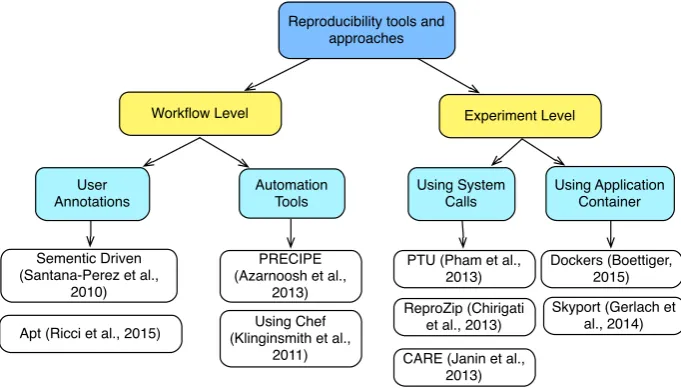
2.5 Literature survey of reproducibility tools and approaches especially in Cloud . . . . 36
3.1 A virtual laboratory for conducting analysis in N4U . . . 53
3.2 A N4U User submitting analysis to N4U infrastructure through CRISTAL . . . . 55
3.3 Workflow Execution on Cloud . . . 57
3.4 An abstract architecture of the proposed system (ReCAP) . . . 58
3.5 Detailed architecture of the ReCAP system . . . 61
3.6 Interaction of Service Wrapper with overall system or its architecture . . . 63
3.7 Flow chart of WMS Wrapper Service to process a workflow submission request . . 64
3.8 Illustrating the interaction between ReCAP components for submitting a user work-flow . . . 65
3.9 Interaction of CRM with the underlying Cloud infrastructure through APIs . . . . 67
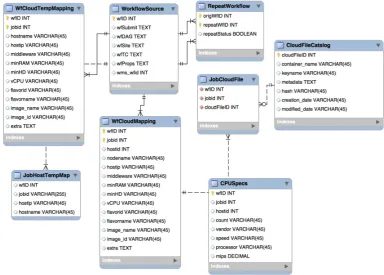
3.10 ReCAP Relational Database Schema . . . 69
4.1 Flowchart of creating job-to-Cloud resource mapping using the Static approach . . 75
4.2 Flowchart to create temporary job-to-Cloud resource mapping using the Dynamic approach . . . 77
4.3 Establish the final mapping between Job and VM on Cloud . . . 79
4.4 Creating Job to Cloud resource mapping using the SNoHi approach . . . 81
4.5 Provenance graph generated from a workflow execution . . . 84
4.6 Example provenance graphs . . . 89
4.8 A simple Cloud-based Workflow Manager . . . 96
4.9 Processing READY jobs in CWManager . . . 97
4.10 GridBroker adds a monitoring process in the job payload of a user analysis . . . 98
5.1 Illustrating the Montage workflow . . . 105
5.2 A graphical illustration of the ReconAll workflow used in N4U . . . 107
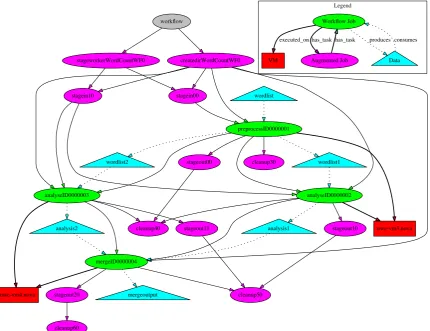
5.3 A test Wordcount workflow showing both split and merge characteristics of a workflow107 5.4 Job to Host monitoring framework . . . 111
6.1 A Cloud resource’s RAM configuration impact on job success . . . 119
6.2 Single process job running on different resource configurations . . . 120
6.3 Single Process vs Multi-process job running on them1.largeresource configuration 121 6.4 Effect of the CPU MIPS on the simulated workflow execution by randomly assign-ing MIPS from a range to the VMs . . . 122
6.5 The effect of the decrease in the average CPU MIPS on the simulated workflow execution . . . 122
6.6 Average workflow execution time for each configuration type . . . 123
6.7 Frequency of a flavour type selected randomly during a workflow execution . . . 124
6.8 Measured Time difference between Job Finish time and Host information availab-ility time . . . 127
6.9 Measured Time difference between Job Finish time and Host information availab-ility time without the Sleep delay . . . 128
6.10 Measured Time difference between Pegasus existing and the Eager Approach . . . 128
6.11 Average workflow execution time for the original workflow execution . . . 133
6.12 Average workflow execution time for the reproduced workflow execution . . . 134
6.13 Combined result showing the original and reproduced workflow execution times . . 134
6.14 Effect of different provenance collection approaches on the workflow execution per-formance . . . 145
7.1 A workflow example with six jobs . . . 161
a A subset of instance flavours provided by Amazon EC2 . . . 179
b Instance flavours provided by OpenStack in Open Science Data Cloud (OSDC)179 A.1 Instance Flavour provided by Amazon EC2 and OSDC . . . 179
B.1 The final Mosaic output (in JPEG) produced by workflow 533 . . . 182
B.2 The final Mosaic output (in JPEG) produced by workflow 534 . . . 183
B.3 The provenance graph of workflow 132 . . . 184
List of Tables
2.1 Summary of Grid-based Workflow Management Systems . . . 29
2.2 Summary of Resource information available in various systems . . . 29
2.3 Summary of Cloud-based Provenance Approaches . . . 35
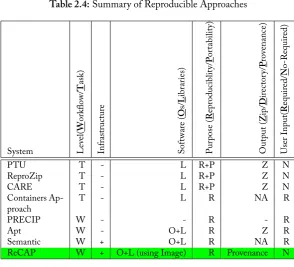
2.4 Summary of Reproducible Approaches . . . 41
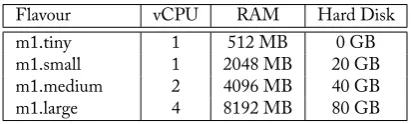
5.1 Cloud Flavours details . . . 108
5.2 Resource information of used Condor Pools . . . 109
6.1 Resource Flavours used to execute the compute intensive job . . . 120
6.2 Workflow used in this experiment . . . 129
6.3 Check Correctness of the provenance information especially Cloud parameters . . . 130
6.4 Workflow used in this experiment . . . 131
6.5 Check Completeness of the collected provenance . . . 131
6.6 Cloud-aware Provenance captured for a given Wordcount workflow . . . 133
6.7 Provenance data of the reproduced workflow showing that ReCAP successfully re-provisioned similar resources on the Cloud . . . 133
6.8 Infrastructure detail captured for the Montage workflow (wfID=533) using ReCAP 135 6.9 Infrastructure detail captured for the reproduced Montage workflow (wfID=534) using ReCAP . . . 135
6.10 Infrastructure detail captured for the ReconAll workflow (wfID=545) using ReCAP 135 6.11 Infrastructure detail captured for the ReconAll reproduced workflow (wfID=547) using ReCAP . . . 135
6.12 Infrastructure details captured for the workflow (wfID=554) using ReCAP . . . 136
6.13 Provenance structural analysis of workflows (132, 134), (132, 161), (161, 165), (316, 207) . . . 138
6.14 Infrastructure details captured for the workflows using ReCAP . . . 138
6.15 Virtual machines used by the jobs of workflow 161 . . . 139
6.16 Virtual machines used by the jobs of workflow 165 . . . 139
6.17 Virtual machines used by the jobs of workflow 316 . . . 139
6.19 Comparing outputs produced by workflows 132 (original workflow) and 134 (repro-duced workflow) . . . 141 6.20 Comparing outputs produced by Montage workflows 533 (original workflow) and
534 (reproduced workflow) . . . 141 6.21 Comparing different aspects of provenance to determine workflow reproducibility . 144 6.22 Average record size to store Cloud-aware provenance . . . 146
Listings
3.1 Workflow job output represented in XML by the GridBroker in N4U . . . 56
A.2 The configurations of WMS WrapperService . . . 176
A.3 ReCAP prototype configurations . . . 177
A.4 Single job sample workflow for the Host information availability time test . . . 178
B.5 Augmented provenance information for N4U using the ReCAP concept . . . 181
B.6 Showing timestamp in a log file (mri_convert) produced by ReconAll . . . 181
List of Algorithms
1 Job-to-Cloud resource mapping in Static Approach . . . 75
2 Job-to-Cloud resource mapping in Eager Approach . . . 78
3 Job-to-Cloud resource mapping in Lazy Approach . . . 80
4 SNoHi Mapping Algorithm for WMS that does not maintain the machine IP/Name 82 5 Graph Structure Comparison Algorithm . . . 87
6 Check Correctness of the collected provenance . . . 90
7 Check Completeness of the collected provenance . . . 91
8 Compare Workflow Outputs Algorithm . . . 93
Acronyms
APIs Application Programming Interfaces. 18
CAP Cloud-aware Provenance. 14, 51, 95
CRM Cloud Resource Manager. vi, 60
CSM Cloud Storage Manager. 60
DAG Directed Acyclic Graph. 12, 23, 56
DAGMan DAG Manager. 24, 56
DAGs Directed Acyclic Graphs. 45
HTTP HyperText Transfer Protocol. 51, 55
IaaS Infrastructure-as-a-Service. 14, 22
JSON JavaScript Object Notation. 56, 63
LRM Local Resource Manager. 17
MIPS Million Instructions per Second. 42, 58
mIR myGrid Information Repository. 22
OSDC Open Science Data Cloud. 89, 91, 94
PaaS Platform-as-a-Service. 14
PM Physical Machine. 30
PRECIP Pegasus Repeatable Experiments in the Cloud. 36, 97
SaaS Software-as-a-Service. 14
SSH Secure Shell. 28
URL Universal Resource Locator. 17
VDC Virtual Data Catalogue. 21
VM Virtual Machine. 6, 16, 27, 51
WMS Workflow Management System. 44, 50, 51
Chapter 1
Introduction
An experiment is reproducible until another laboratory tries to repeat it.
Alexander Kohn
In this chapter, the problem domain is defined and the motivation behind this research study is provided. The research hypothesis, research questions and the research methodology that has been used to investigate the hypothesis in this thesis are also presented. At the end of this chapter, a structure of this thesis is outlined. Finally, a list of papers produced as outcome of this research is also given at the end.
1.1
Background
The scientific community is experiencing a data deluge due to the generation of large amounts of data in modern scientific experiments that include projects such as the Laser Interferometer
Grav-itational Wave Observatory (LIGO) (Abramovici et al. 1992), the Large Hadron Collider (LHC)1,
and projects such as neuGRID (Munir et al. 2013). In particular, the neuGRID community is util-ising scientific workflows to orchestrate the complex processing of its data analysis. A large pool of compute and data resources are required to process this data, which has been available through the Grid (Foster and Kesselman 1999) and is now also being offered by Cloud-based infrastructures.
Cloud computing (Mell and Grance 2011) has emerged as a new computing and storage paradigm, which is dynamically scalable and usually works on a pay-as-you-go cost model. It aims to share re-sources to store data and to host services transparently among users at a massive scale (Mei, Chan and Tse 2008). Its ability to provide an on-demand computing infrastructure with scalability enables
distributed processing of complex scientific workflows for the scientific community (Deelman et al. 2008b). Recent work (Juve and Deelman 2010) is now experimenting with Cloud infrastructures to assess the feasibility of executing workflows on the Cloud.
An important consideration during this data processing is to gather data that can provide detailed information about both the input and the processed output data, and the processes involved to verify and reproduce a workflow execution. Such data are termed as “Provenance” in the scientific literature. Provenance is defined as the derivation history of an object (Simmhan, Plale and Gannon 2005). The Oxford dictionary defines provenance as “the place of origin or earliest known history of something” (Oxford 2015) as provenance would initially be used to provide chronological information about the ownership or location of an object. Different terms such as lineage and pedigree are also used in literature to describe the same concept, however, the term provenance is used in this thesis.
The provenance information can be used to debug and verify the execution of a workflow, to aid in error tracking and reproducibility (Freire et al. 2008). This is of vital importance for scientists in order to make their experiments verifiable and reproducible. The collection and use of provenance information enables them to iterate on the scientific method, to evaluate the process and results of other experiments and to share their own experiments with other scientists (Azarnoosh et al. 2013). Thus, provenance information can be considered as a logbook that captures all the steps that were involved in the actual derivation of the result and also can be used to replay or reproduce the execution that lead to that result for experiment verification (Moreau 2010). The execution of scientific workflows in Clouds, which provide dynamic and on-demand resources, brings to the fore the need to collect provenance information that is necessary to ensure the reproducibility of workflow-based experiments on the Cloud.
1.2 Motivation
possible that jobs will remain in waiting queues or fail during execution if their required hardware dependencies are not met. This becomes more of a challenging issue in the context of the Cloud where resources can be created or destroyed at runtime.
Cloud computing presents a dynamic environment in which resources are provisioned on-demand. For this, a user submits resource configuration information as a resource provision request to the Cloud infrastructure. A resource is allocated to the user if the Cloud infrastructure can meet the submitted resource configuration requirements. Moreover, the pay-as-you-go model in the Cloud puts constraints on the lifetime of a Cloud resource. For instance, one can acquire a resource for a lifetime but one has to pay accordingly for the time used. This means that a resource is released once a task is finished or payment has ceased. In order to acquire the same resource, one needs to know the configuration of that old resource. This is exactly the situation with reproducing a workflow experiment on the Cloud. In order to reproduce a workflow execution, a researcher must know the resource configurations used earlier in the Cloud. This enables him to re-provision similar resources and reproduce the workflow execution.
The dynamic and geographically distributed nature of Cloud computing makes the capturing and processing of provenance information a major research challenge (Zhao et al. 2011; Vouk 2008). Contrary to Grid computing, the resources in Cloud computing are virtualised and provisioned on-demand, and released when a task is complete (Foster et al. 2008). Generally, an execution in Cloud based environments occurs transparently to the scientist, i.e. the Cloud infrastructure behaves like a black box. Therefore, it is critical for scientists to know the parameters that have been used and what data products were generated in each execution of a given workflow (SMS et al. 2011; Shamdasani, Branson and McClatchey 2012). Due to the dynamic nature of the Cloud the exact resource configuration should be known in order to reproduce the execution environment. Due to these reasons, there is a need to capture information about the Cloud infrastructure along with workflow provenance, to aid in the repeatability of experiments.
1.2.1 N4U: Case Study
The N4U2, an EU FP7 project, is a follow-on project to the neuGRID that was aimed to help
neur-oscientists carry out high-throughput imaging research for individual patient diagnosis especially for Alzheimer’s disease. Using its infrastructure in 2009, it was possible to extract an Alzheimer’s dis-ease biomarker (3D cortical thickness with Freesurfer and CIVET) from 6,500 MR scans within 2 weeks whereas the process would have previously taken five years using past computational imaging analysis techniques. To achieve high-throughput imaging analysis of complex design, the N4U uses the concept of pipelines, which are analogous to scientific workflows. These workflows are executed using CRISTAL (Branson et al. 2012) on the N4U Grid infrastructure. The requirements analysis of
create a ‘Virtual Cluster’ (Klinginsmith, Mahoui and Wu 2011) on the Cloud resources, which mimics Grid-based systems, and then capture the provenance information as done on the Grid. However, the Cloud operates on different layers, including application, middleware and virtualization. In this thesis, a workflow management system is placed at the application layer providing the user with set of workflow related operations. The virtual resources i.e. virtual machines and storage used to carry out workflow execution are provided at the infrastructure layer, also called IaaS layer. Due to virtualization, a user does not know where his computing or data resource is hosted and the configurations of the used resources. To provide comprehensive provenance, a Cloud-aware provenance information needs to be captured in a Cloud-based execution environment.
2. How can provenance information be captured at different layers in a Cloud environment and interlinked?
To address this research question, we need to investigate techniques for capturing provenance from different layers in Cloud, where the application layer consists of a workflow management system and the infrastructure layer consists of virtualized resources. Linking this multi-layered or Cloud-aware provenance information is a related research challenge. This will help in ag-gregating the captured provenance information. This also requires investigating the extent to which workflow provenance capture in different layers of a Cloud can be achieved.
3. How can correctness and completeness of the collected provenance be measured?
The complete provenance for an experiment is captured by a set of objects that can identify all the intermediate steps involved during the experiments (Prat and Madnick 2008). This process begins with an abstract description of the workflow (experiment), before it is bound to specific services, tools, data sets, etc., and continues until the end of the execution of the experiment. Moreover, completeness means that all the required elements are present in the captured provenance. The focus of this research study is on the provenance of a workflow in its execution phase over the Cloud infrastructure. Thus, this research question will investigate the ways to determine the correctness and completeness of the captured workflow provenance on Cloud for its reproducibility purpose. In doing so, it will also evaluate the proposed framework and its components to verify in detail their functioning.
4. How can we demonstrate workflow reproducibility on the Cloud infrastructure using Cloud-aware provenance?
i.e. Virtual Machine (VM) on the Cloud and re-execute the workflow. After re-executing the workflow on the Cloud, there should also be a mechanism to compare the two workflow executions in order to determine the reproducibility. With this research question, this re-search study will seek a mechanism to demonstrate the reproducibility of a workflow using Cloud-aware provenance information.
1.5 Contribution to Knowledge
The following are the key contributions of this research study.
• Mapping Workflow Provenance with Cloud infrastructure information: Given the critical analysis of the state of the art and workflow reproducibility on the Cloud, a workflow repro-ducibility framework has been identified for reproducing a workflow execution on the Cloud. The key factors of this framework are the conservation of hardware and software resources used to execute a workflow on the Cloud. In order to capture the Cloud resource informa-tion, different mapping strategies have been devised for two different environments i.e. the
Static and Dynamic in the Cloud. In this regard, an automated and ’outside the Cloud’
ap-proach has been devised to retrieve the configuration of a Cloud resource which was used to execute a job of a workflow. In this approach, no additional job or process needs to be running within a virtual machine. The contributions in this category are listed below. Two use cases of Cloud environments i.e. static and dynamic environment, have been identified and different mapping mechanisms have been designed to mitigate the challenges of these use cases.
1. Mapping approaches in Static Cloud environment: One approach has been presented that captures Cloud-aware provenance in the Static Cloud environment, in which re-sources remain available after a workflow has completed.
2. Mapping approaches in Dynamic Cloud environment:Two approaches have been presen-ted that aid in capturing Cloud-aware provenance in the dynamic Cloud environment, in which resources may not be accessible once a workflow has finished.
1. Provenance Graph Comparison:In this thesis, two graph comparison approaches have been presented that take cloud infrastructure into account while performing the analysis. One algorithm only provides qualitative analysis by providing results in either True (for complete match) or False (for mismatch). In order to determine quantitatively, a nu-merical comparison approach has also been presented that provides quantitative graph comparison i.e. the degree of similarity.
2. Workflow Output Comparison:Since outputs produced by the workflows are also part of the comparison, an approach has been presented in this thesis to compare and verify the reproduced outputs. The results have shown that this approach is applicable for different workflows such as Montage. It can also work with the N4U workflow i.e. ReconAll by including the files related to the brain analysis.
3. Provenance Correctness and Completeness Analysis:Two approaches have been presen-ted in this thesis that verifies the completeness of the captured Cloud-aware provenance. This analysis facilitates trust in the captured provenance by ensuring ReCAP has collec-ted the Cloud infrastructure information correctly for all the jobs in the workflow.
• Workflow based experiment reproducibility on the Cloud: A framework has been presented that is used to re-provision similar resources on the Cloud using the Cloud-aware provenance information captured by the proposed system. After re-provisioning the resources, the work-flow is re-executed and its provenance is captured and compared with the original workwork-flow.
1.6 Research Methodology
As this research deals with a practical problem which requires investigation into existing workflow provenance and reproducibility approaches, particularly, on Cloud, the research methodology util-ised in undertaking this research is a combination of scientific experiment i.e. quantitative and qualitative nature (McCusker and Gunaydin 2015). This means that a subset of the research prob-lem is investigated through prototype and its experiments while another subset is analysed through literature review. In order to understand the practical requirements in real world scenario, a case study method (Myers 1997) of a qualitative approach (O’Brien 1998) has been adopted. The case study method helps in understanding the existing application of workflow in scientific domain and also user requirements towards workflow provenance and reproducibility. This also provides sample workflows which are later used in the prototype evaluation phase. In order to evaluate the pro-posed approaches, a prototype is implemented and various aspects of the architecture are empirically analysed through experiments.
ent Cloud usage models that have resulted in different job-to-Cloud resource mapping algorithms,
which addressesResearch Question 2 i.e. How can provenance information be captured at different
layers in a Cloud environment and interlinked? For implementing and testing the proposed system, a Cloud infrastructure is needed to execute scientific workflows and to capture their provenance. In this study, Pegasus, a workflow management system, has been selected and justified in Section 3.5.2. Pegasus has been used in various studies (e.g. Vöckler et al. 2011; Juve et al. 2009) to execute workflows on Cloud infrastructures. In this research study, it has been used to execute workflows on the configured Cloud infrastructure.
In theEvaluationphase, a set of experiments to test the suitability of the proposed model against the elements of the hypothesis has been identified. In doing so, a detailed evaluation strategy has been devised (presented in Chapter 5) that evaluates different facets of the proposed system. To demonstrate the workflow reproducibility, Cloud-aware provenance is linked with workflow proven-ance using the proposed mapping approaches (discussed in Section 4.1). This interlinked provenproven-ance information has been used to provision similar virtual machine on a Cloud infrastructure in order to provide a similar execution infrastructure for the workflow re-execution. Once it has been achieved, a workflow execution is reproduced on the Cloud using the proposed approach (discussed in Section 4.3). By analysing the provenance graphs, at different levels such as structure, infrastructure and
out-put, workflow execution reproducibility is demonstrated. This aids in answeringResearch Question
4i.e. How can we demonstrate workflow reproducibility on the Cloud infrastructure using Cloud-aware provenance?
In theAnalysis and Reflectionphase, the results generated from the experiments are analysed to evaluate the proposed framework. These results are investigated to verify the theoretical understand-ing of the proposed model. Based on the results, conclusions are drawn which eventually help in answering the main hypothesis, which drives this research. In this phase, the proposed framework is critically analysed to verify the key contributions. The overall approach is reflected upon to identify shortcomings which will then pave the way for future research directions.
1.7
Thesis Structure
• Chapter 2 - Literature Survey
• Chapter 3 - Workflow Reproducibility Requirements and the Proposed Architecture
This chapter discusses the computational reproducibility as proposed in the literature. It also presents a workflow reproducibility model after acquiring knowledge from existing work and also keeping the Cloud context in mind. This chapter also discusses N4U, under which this research study was conducted, its provenance requirements, especially in Cloud context, it current execution environment and the possibility of using existing technologies being used in N4U. This chapter also discusses and justifies an existing workflow execution model in the Cloud, which has been used in research that has been used in the proposed solution.
• Chapter 4 - Reproducing Workflow using Cloud-Aware Provenance (ReCAP) - Implement-ation
It presents and discusses the proposed solution, ReCAP, to capture workflow and Cloud in-frastructure layer information and interlink together. It also presents the Cloud resource to workflow job mapping algorithms and how a workflow can be reproduced by re-provisioning the similar resources on the Cloud using the Cloud-aware provenance information.
• Chapter 5 - Evaluation
This chapter presents a detailed evaluation methodology that has been used to verify this re-search work. The presented methodology evaluates different aspects of the ReCAP system using different experiments which have been designed for this purpose. A complete evalu-ation of the ReCAP system has been performed by evaluating the proposed approaches and using the scientific workflows from different domains.
• Chapter 6 - Results and Analysis
This chapter discusses the results obtained from the experimental results discussed in Chapter 5. The results are analysed and related to the research questions and research hypothesis.
• Chapter 7 - Conclusion and Future work
In this final chapter the conclusions from this thesis are presented. It answers the research questions in the light of this research work. The major contributions from this research are detailed in relation to the previously presented hypothesis and research questions. This chapter then presents directions for future work.
1.8
Publications
The following are the publications achieved as a result of this research study.
Conference on Cloud Computing and Services Science (CLOSER), pp. 49-59, 20 May 2015. DOI: 10.5220/0005452800490059
• Hasham, K., Munir, K., Shamdasani, J., McClatchey, R.(2014). Scientific Workflow Re-peatability through Cloud-Aware Provenance. In Utility and Cloud Computing (UCC), IEEE/ACM 7th International Conference on , vol., no., pp.951,956, 8-11 Dec. 2014, doi: 10.1109/UCC.2014.155
• Munir, K., Ahmad, K. H., and McClatchey, R.(2015). Development of a large-scale neuroim-ages and clinical variables data atlas in the neuGRID4You (N4U) project. Journal of Biomed-ical Informatics, vol. 57, October 2015, pp. 245-262, http://dx.doi.org/10.1016/j.jbi.2015.08.004
Chapter 2
Literature Survey
Scientific workflows have been used to orchestrate complex data processing. These workflows are executed in distributed environments such as the Grid or recently the Cloud. In scientific research, result reproducibility is essential as it validates the claim made by the research. Same is applied to the research conducted through executing workflows. In order to achieve this, provenance data has been recognized as a means to provide the audit trail of the execution, thus it aids in achieving repro-ducibility. Due to the dynamic nature of the Cloud, capturing provenance for workflows executing on the Cloud infrastructure and then using it to reproduce a workflow execution on the Cloud be-comes a challenge, which is the driving force behind this research work. Since this research resolves around three main categories (highlighted in Section 1.3): 1) Scientific Workflows, 2) Cloud and 3) Provenance and their combinations i.e. a) Workflow execution on Cloud, b) Workflow provenance management and c) Reproducibility using provenance, this chapter will attempt to review literature in these areas and highlight the knowledge gap. The analysis of existing literature will be conducted by keeping the main focus of this research, i.e. workflow execution reproducibility on the Cloud, in perspective. Figure 2.1 presents an overview of the literature roadmap carried out in this research work.
In this chapter, an introduction to scientific workflows and its lifecycle is described (Section 2.1.1) to explain different phases of a workflow and to highlight the focus of this research i.e. work-flow execution provenance. This chapter then discusses two types of provenance data (Section 2.1.2) to further narrow down the provenance information that this research is focusing on. It is then fol-lowed by an introduction to the Cloud or Cloud computing, which is now being explored as a new computing platform for executing scientific workflows. Its benefits and related provenance chal-lenges as highlighted in the literature are also presented. Following this, a state-of-the-art survey to collect provenance in the Grid and the Cloud is presented. This helps in understanding the existing approaches and their shortcomings in line with the research objectives. Lastly, it presents the re-producibility tools and approaches discussed in literature. The literature is evaluated in the light of
Scientific W orkflow Literature Overview Cloud W orkflow Provenance Reproducibility
Systems in Cloud
SciCumulus
(de Oliveira et al., 2010)
Imran and Hlavacs,
2012
Muniswamy-Reddy et
al., 2010
Macko et al., 201
1
W
orkflow Lifecycle
(Deelman et al., 2009) Provenance
T
ypes
(Lim et al., 2010)
Hof
fa et al. 2008
Zhao et al. 201
1
Systems in Grid
Chimera CRIST AL V isT rails T averna Pegasus W orkflow level Experiment Level
Santana-Perez et al., 2010
Ricci et al., 2015
Azarnoosh et al., 2013 Klinginsmith et al., 201
1
Chirigati et al., 2013
Pham et al., 2013 Janin et al., 2013 Boettiger
2.1
Scientific Workflows
This section introduces the scientific workflows and their applications in different modern scientific expeirments such as CMS or neuGRID. The life cycle of the workflow has also been presented in order to identify the key area of this research related to the workflow i.e. provenance. It then discusses different types of provenance information that is related to a workflow. This helps in further narrowing down the focus of this research study. The following paragraphs introduces the scientific workflow concept.
Scientific experiments such as CMS, LIGO or DNA analysis and projects such as neuGRID produce and process huge amounts of data. For instance, CMS produces an estimated raw data of size 5 Peta Bytes (PB) per year (Chatrchyan et al. 2008). Similarly, neuGRID’s initial setup (Redolfi et al. 2009) estimated storing 20 Tera-Bytes (TB) of neuro-images. This data is then processed and analyzed using different tools and algorithms, such as neuroimaging algorithms in the case of neuGRID. These analyses require complex orchestration, which is performed using workflows. The workflows enable the researchers to collaboratively design, manage, and obtain results that involve hundreds of jobs or tasks accessing gigabytes of data. Here, a job is defined as an actual executable code/script used to access and process the given data. In this thesis, the terms job and task are used interchangeably.
The workflow concept was coined initially in late 1970s (Workflow-definition 2015). A workflow can be defined as a collection of jobs orchestrated in an order to achieve an overall goal. These tasks are arranged on the basis of their data or control dependency to perform complex data analyses such as the analysis of human brain images or the analysis of physics particles. Since these workflows involve a large number of jobs and require high computation, a distributed environment such as a Grid, and more recently the Cloud, is used for their execution.
2.1.1 Scientific Workflow and its Life cycle
The lifecycle of a workflow has been categorized (Deelman and Gil 2006; Deelman et al. 2009) into four main phases: composition (composing an abstract workflow), planning (mapping to avail-able resources), execution (scheduling and individual job execution), and output retrieval along with provenance data. These four phases are discussed as follows:
1. Composition: Workflow composition allows a user to specify the phases and dependen-cies among tasks in an abstract way. Different authoring languages/tools, such as AWGL (Fahringer, Qin and Hainzer 2005) and Directed Acyclic Graph (DAG), where nodes rep-resents individual jobs and edges represent the inter-job dependencies in XML (DAX), can be used to compose a workflow. The workflow authored at this stage has no computational resource information, it is added in the planning phases. While authoring a workflow, a user can also look into the provenance history to discover which job produced the desired output using a particular data input.
2. Planning:In this phase, a workflow is mapped to computational resources for execution. The mapping and planning procedures transform the given workflow to produce an executable workflow, which can be executed over a given infrastructure such as the Grid or the Cloud.
3. Execution: In this phase, the workflow jobs are scheduled to the execution resources based on the planned information in the workflow. These execution resources are provided through Grid infrastructure or more recently Cloud computing (Vöckler et al. 2011). In the planning phase, a user can specify the resources required to execute their jobs. If it is not specified then run-time resource selection is performed using appropriate scheduling approaches. During this phase, the status of a workflow and its jobs are continuously monitored to detect the job completion or failure. Once a job has finished successfully, its output is retrieved for the user.
Cloud computing provides a paradigm-shifting, utility-oriented computing model in terms of the unprecedented size of data centre-level resource pools and on-demand resource provisioning mechanisms. This enables scientific workflow experiments capable of addressing petabyte-scale sci-entific problems (Zhao et al. 2011). As workflow execution is now being studied on the Cloud infrastructure, the aim of this research study is to capture the provenance of scientific workflows executing on the Cloud in such a manner that enables reproducibility of workflow execution on the Cloud.
2.1.2 Workflow Provenance Types
Provenance information collected for a workflow or its jobs can be divided into two broad categories (Lim et al. 2010; Freire et al. 2008). There is one further study (Freire et al. 2014) that provides a third type of provenance information; this third type is called Workflow Evolution. These categories are discussed below.
• Prospective Provenance: This maintains the description of an experiment which includes the computational job’s specification (whether it’s a script or a workflow) and corresponds to the steps (or recipe) that must be followed to generate a data product or class of data products.
• Retrospective Provenance: This captures the workflow steps executed as well as information about the environment use to derive a specific data product - in other words, this is a detailed log of a computational task’s execution. Retrospective provenance does not depend on the presence of prospective provenance — for example, we can capture information such as which process ran, who ran it, and how long it took without having prior knowledge of the sequence of computational steps involved.
• Workflow Evolution: This captures the evolution history of a workflow structure itself. In doing so, it maintains all the changes applied to a workflow over its lifetime.
IaaS. A computing resource in the Cloud is acquired by specifying resource configurations, which is composed of key parameters - RAM, vCPU, Hard disk and OS image. The platform layer (i.e. PaaS) is built on top of the infrastructure layer (i.e. IaaS) and it consists of an operating system, application middleware etc. It helps the developers to build their applications for the Cloud. It provides an in-terface for software developers to build new or extend existing applications, e.g., Google App Engine and Microsoft Azure (Imran and Hlavacs 2012). The software or application layer (i.e. SaaS) con-tains the set of applications provided by the Cloud provider or user using the Cloud infrastructure.
2.2.2 Cloud Adoption for Scientific Workflows
The possibility of using the Cloud as an execution infrastructure for scientific workflows has been explored (Hoffa et al. 2008) and it is fast becoming the future playing field for e-science research (Juve and Deelman 2010). An advantage of using the Cloud on scientific experiments is to provide scientists with access to a wide variety of resources without having to acquire and configure the computing infrastructure. There are a few initiatives, such as the Sloan Digital Sky Survey project and the Berkeley Water Centre, and high-energy physics community where the Cloud has been adopted (Williamson 2014; CERNVM 2015)
The execution of scientific workflows in the Cloud brings to the fore the need to collect proven-ance metadata, which is necessary to ensure the reproducibility of these experiments and the trust on the data being used in these experiments (Branson et al. 2012). Generally, an execution in Cloud based environments occurs transparently to the scientist, i.e. the Cloud infrastructure behaves like a black box. Therefore it is critical for scientists to know which parameters have been used and what data products were generated in each execution of a given workflow (Shamdasani, Branson and McClatchey 2012). With provenance information, scientists can debug experimental results and incorrect results can be checked in case something changes in their Cloud resources that might have affected the results (Muniswamy-Reddy, Macko and Seltzer 2010). Due to the dynamic nature of the Cloud, where resources are provisioned dynamically, the exact resource configuration should be known in order to reproduce the execution environment. Moreover, the resources on the Cloud are provisioned by specifying the resource configurations. For workflow reproducibility on the Cloud, such information should be known so that similar execution infrastructure can be re-provisioned on the Cloud. Due to these reasons, there is a need to capture and store provenance information for workflows executing in Cloud environments.
2.2.3 Benefits of Cloud Computing
• On-demand resource provision: The on-demand resource allocation mechanism in the Cloud can improve resource utilization and change the experience of end users for improved re-sponsiveness. Cloud-based workflow applications can get resources allocated according to the number of nodes at each workflow stage, instead of reserving a fixed number of nodes up-front. Workflows executing on the Cloud can scale out and scale in dynamically, resulting in a fast turn-around time for end users. Similar findings have been presented by Strijkers et al. (2010). It shows that when applications require more resources at run-time, the Cloud is more flexible than the Grid infrastructure because requesting additional Grid resources by submitting jobs to the resource broker can take uncertain amount of time, which can negat-ively affect a workflow execution performance. However, with the Cloud, new resources can be provisioned instantly on demand.
• Scale of Problem: The scale of scientific problems that can be addressed by scientific workflows can be greatly increased compared to the Cluster/Grid environments, which was previously upbounded by the size of a dedicated resource pool with limited resource sharing extension in the form of virtual organizations.
• Application deployment: Application deployment can be made flexible and convenient. With bare-metal physical servers, it is not easy to change the application deployment and the un-derlying supporting platform. However with virtualization technology in a Cloud platform, different application environments can be either pre-loaded in virtual machine (VM) images, or deployed dynamically onto VM instances. A virtual machine (Goldberg 1974) is a running instance of a computer where resources such as memory and central processing units (CPUs) are allocated through virtualization software.
2.2.4 Difference between the Grid and the Cloud
It is important to highlight the differences here as they will serve as arguments for having a different mechanism for the Cloud environment. It would also serve as an argument-base for analysing the literature for Grid-based workflow management systems and the proposed provenance approaches. The Cloud differs from the Grid on several levels as highlighted by Foster et al. (2008); however this section only discusses the differences from a virtual resource point of view.
out the results to some FTP server. The job would wait in the LRM’s wait queue until the 100 processors were available for 60 minutes, at which point the 100 processors would be allocated and dedicated to the application for the duration of the job. Once the job is finished, the user retrieves the output, however the compute resources will remain intact. On the other hand, in the Cloud where resources are provisioned on-demand, a user will send resource allocation requests, which specify the resource configurations, to the Cloud middleware and acquire the required resources. This makes the Cloud environment more dynamic and responsive. However, once the user job is finished, a user can release the resources and they will no longer exist. Therefore, it is important to capture the Cloud resource information in the collected workflow provenance in order to re-execute a workflow on the Cloud infrastructure.
2.2.5 Provenance Challenges in the Cloud
Provenance has not still been widely explored in Cloud environments, in which we need to deal with even more challenging issues, when compared with the Grid, such as tracking data production across different software and hardware abstraction layers within one provider (Foster et al. 2008). In addition, the scalability of Clouds requires much more scalable provenance systems that can handle the storage and querying of potentially millions of provenance records (Zhang et al. 2011). Consid-ering only a single layer of provenance is not sufficient in many practical scenarios; one such example was at the core of the first provenance challenge3, which required the integration of provenance to answer questions that necessitate an integrated view of provenance.
As the Cloud environment is different from other computing environments such as the Grid or Cluster and is often managed by a third party and is accessible over the Internet, therefore, proven-ance in the Cloud has also been discussed to achieve user trust on internal Cloud operations (Abbadi and Lyle 2011). This raises challenges in collecting provenance for the Cloud’s internal processes. A similar argument has been presented by Kim-Kumar (Muniswamy-Reddy and Seltzer 2010) as he argued for including Provenance as first class data in the Cloud and that it should be stored alongside actual data on Cloud. However, this introduces the challenges of capturing such provenance and then storing and querying it. These arguments presented in (Abbadi and Lyle 2011; Muniswamy-Reddy and Seltzer 2010) are mainly in favour of tracking the services’ activities of the Cloud itself, however this research study aims to track the provenance of a workflow executing on the Cloud infrastructure. Therefore, this research study does not focus on the internal activities of the Cloud services.
Since the scale of the workflow-based experiments has increased and can be supported through on-demand Cloud computing, this affects not only the data sizes that scientific applications need to handle, but also on the complexities of the applications themselves (Zhao et al. 2011). The scientific
workflow applications on the Cloud can obtain resources allocated accordingly (dynamically) with the number of jobs at each stage of the workflow, instead of reserving a fixed number of resources. This necessitates a different mechanism to track provenance information on the Cloud that supports on-demand resource provisioning.
Generally, provenance systems in the Grid, workflow and distributed computing are either strongly part of the enactment engine or they use Application Programming Interfaces (APIs), which are en-actment engine specific (Imran and Hlavacs 2012). Bose and Frew (2005) present a detailed survey of computational models and provenance systems in distributed environment, specifically workflow executions. However, there is a lack of support for provenance information in the Cloud. It has also been argued that in research environments, scientists are more interested in the overall process of execution and use step by step information to keep a log of sub-data and sub-processes to make their experiments verifiable, trust-able, reproducible and to have knowledge of the execution process (Imran and Hlavacs 2013).
Debugging, monitoring, and provenance tracking for workflows become increasingly difficult in a Cloud environment. Since compute resources are usually dynamically assigned and based on virtual machine. The environment that a task is executed on could be destroyed right after the task is finished, and assigned to a complete different user and task. Some workflow management systems also support task migration where tasks can be migrated to another resource (i.e. virtual machine) if there is problem with the resource on which the task was initially running (Zhao et al. 2014b).
Since provenance is also used to achieve reproducibility, it is essential to analyse existing workflow provenance approaches and their capabilities designed/proposed for the Grid as well as for the Cloud. This information has been analysed in the light of the aims of this research study and this aids in
answering theResearch Question 1- discussed in Section 1.4.
2.3
Key Elements in Provenance information
There has been an effort in designing a generic model for provenance data. Ram and Liu (2007) presents the seven Ws of data provenance. In the W7 model (Ram and Liu 2007), provenance is con-ceptualized as a combination of seven interconnected elements including “what”, “when”, “where”, “how”, “who”, “which” and “why”. Each of these components may be used to track events that affect data during its lifetime.Whatdenotes an event that affected data during its lifetime;Whenrefers to the time at which the event occurred;Whereis the location of the event in terms of space;Howis the action leading up to the event;Whoare the agents involved in the event;Whichare the devices used in job execution and they include programs or instruments (e.g. hardware) and application used in the event; andWhyis the reason(s) for the events.
provide information about the resources used to execute workflow jobs. Of these two,Whichprovides more meaningful information about a resource and its configuration. It is important to determine if this information is available in existing approaches for the Grid or the Cloud, and also essen-tial to analyse if the provided information is sufficient to provision a new resource on the Cloud infrastructure.
2.4
Key Characteristics of Provenance Systems
Plenty of research has been done in supplementing provenance from various layers i.e. the workflow level and the system level, especially on the Grid. A few key characteristics suggested in literature (Glavic and Dittrich 2007; Cruz, Campos and Mattoso 2009), has been discussed in the following sections.
2.4.1 Capturing Mechanism
The two major approaches in capturing the provenance information are annotations and inversion
(Cruz, Campos and Mattoso 2009). These are also known as theeager andlazyapproaches. One
approach focuses on computing provenance information when data is created, while the other com-putes provenance data when it is requested. These approaches are defined as follows.
• Annotation: The metadata comprising of the derivation history of a data product as well as process is collected as annotations and descriptions about sources data and processes. This is also known as the eager approach (Simmhan, Plale and Gannon 2005; Tan 2004).
• Inversion:The inversion method uses the property by which some derivations can be inverted to find the input data supplied to derive the output data. This is also termed as the lazy approach (Tan 2004).
2.4.2 Granularity and Provenance Data Size
Provenance information can be collected at different levels. The more granular the provenance in-formation is, the more details are available for debugging and analysis. For example, different gran-ularity levels for a workflow in a Grid can be divided in the Workflow, Process/Task, OS and File levels. Each level captures provenance information to answer different user queries. In the con-text of the Cloud, granularity details can also include different Cloud layers such as Application level and Cloud infrastructure i.e. Virtualization level. The combination of these levels provides a comprehensive provenance view of the data consumed or produced on the Cloud.
Another important aspect of provenance information is its size as it can grow to be many times larger than the actual data (Chapman, Jagadish and Ramanan 2008). For instance, in a provenance use study (Groth et al. 2005), provenance information was collected for an experiment to determine the structure of protein sequences. The actual data used as input to the workflow was about 100Kb, however the provenance size was approximately 1MB, which is ten times the actual data size. There are a few systems (e.g. Barga and Digiampietri 2008; Scheidegger et al. 2007), which propose to reduce the provenance data size by avoiding repetitions and duplication of records or by eliminating the so-called orphan records from the system.
Granularity has a direct influence on the provenance storage size. More granular provenance data requires more storage space. In order to deal with the huge data size, one approach (Rozsnyai, Slominski and Doganata 2011) suggested the use of Cloud storage to store all the data, which is then processed to answer user queries.
2.5
Provenance Management in the Grid
Many workflow management systems have been proposed to execute scientific workflows on the Grid. Since provenance has been identified as a key element, these systems also offer the means to capture provenance information. The following sections provide a brief account of these systems and their approaches. Their collected provenance information has been critically analysed from a Cloud perspective in the light of the main aim of this research study.
2.5.1 Chimera
Chimera (Foster et al. 2002) is designed to manage the derivation and analysis of data for
high-energy physics (Griphyn2014) and astronomy (SDSS) (SDSS2014) communities, which are
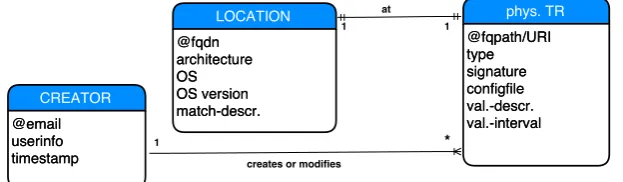
provenance data along with metadata in a catalogue called the Virtual Data Catalogue (VDC), thus it uses a no-coupling storage approach (Glavic and Dittrich 2007). It collects process information along with the parameters used, the input data and produced data. Chimera stores this provenance information in a Chimera schema (a small part of which is shown in Figure 2.3), which is based on a relational database. Although the schema allows storing the physical location of a transformation i.e. the executable and its characteristics, it does not support the information of the hardware and software environment in which a transformation occurred.
Figure 2.3:Chimera database schema dealing with physical location of transformation
2.5.2 VisTrails
VisTrails (Scheidegger et al. 2008) is a workflow and provenance management system that provides support for scientific data exploration and visualization. It not only captures the execution log of a workflow but also the changes a user makes to refine their workflow. It captures provenance in-formation in three layers; (1) workflow evolution layer, (2) workflow layer, and (3) execution layer. The first layer captures the changes made in a workflow. The second layer comprises the workflow specification of an individual workflow and the third layer stores runtime information such as exe-cution time and machine name related to a workflow. VisTrails represents prospective provenance as Python objects that can be serialized into XML and relations; it stores retrospective provenance in a relational database.
2.5.3 Taverna
Taverna (Wolstencroft et al. 2013) is a workflow management system designed for the myGrid pro-ject (Stevens, Robinson and Goble 2003), as a pilot e-science propro-ject in the UK, which has been designed to provide middleware services to automate the execution of workflows in life science ex-periments (Zhao et al. 2004). It stores any prospective provenance information as Scufl specifications (an XML dialect) and retrospective provenance as Resource Description Framework (RDF) triples in a MySQL database. The retrospective provenance is collected in the form of a workflow log centred on the services in the workflow. The workflow execution log contains information regarding the service invocation, parameters being used, start and end times, and data products consumed and produced. This log is used to derive the data provenance of datasets generated during the workflow’s execution.
Along with the metadata of data, it also maintains contextual and organisation metadata such as experiment information, project, and owner. This information helps in providing the context to the data provenance of a workflow. A data service, which is called myGrid Information Repository (mIR), has been designed over a relational database to store the metadata related to an experiment. Taverna does not provide a rich retrospective provenance related to a workflow execution. By ana-lysing its database model, it has been found that it provides some information about the host when it uses SSH internally for remote machine access. However, this host information does not include resource configurations i.e. hardware or software.
2.5.4 CRISTAL
CRISTAL (Branson et al. 2012; McClatchey et al. 2014), developed at UWE and being used at CERN and in the neuGRID and N4U projects, is a provenance aware workflow instantiation system that is designed to orchestrate workflows, and capture and store their provenance information. It stores workflow specifications i.e. workflow descriptions in DAG and their instances, which are the workflows in execution, as its main entities. It uses an object model to express its main entities and an XML format to represent the workflow specifications. All entities within CRISTAL are described as XML and stored into eXist (Meier 2003), an XML database. Workflow orchestration is performed on a task-by-task basis and the provenance of each individual task is captured and recorded in its database. It not only supports the runtime provenance of a workflow, but it also maintains the history of workflow versions. However, it does not provide workflow planning and scheduling operations as these processes are performed outside its domain (discussed later in Section 3.5.2).
used to execute these tasks. This information is particularly important in the context of the Cloud as the configuration and information about the execution environment is required to instantiate new virtual machines with the same specifications that would help in reproducing the results in terms of same performance and outputs.
2.5.5 Pegasus
Pegasus (Deelman et al. 2004) is a workflow management system designed for scientific workflows. It works with task oriented workflows, in which each job depends on an executable that is passed along with the job already configured and accessible on the infrastructure. This is the case with N4U where data and scripts files are available. Pegasus accepts abstract workflows, which are described in an XML based language called DAX, and converts them into executable workflow i.e. concrete workflow. In this conversion, abstract workflow specifications are mapped, via various transforma-tions to a concrete executable workflow (Deelman et al. 2005). The mapping phase adds planning jobs (data management and clean up jobs) in the workflow along with its actual jobs. It then submits the jobs to the Grid or the underlying local submission system such as Condor cluster using DAG Manager (DAGMan) (DAGMan 2014).
For capturing provenance information, it uses a process-based capturing approach. A pegasus-kickstart activity4is used to launch the actual user job on the machine. This kickstart process mon-itors and logs provenance information, which is passed back to Pegasus for later processing. The captured workflow execution provenance includes job execution times, logs (stdout and stderr) and execution host (name or IP) information. Pegasus has also been used to evaluate the usage of Cloud computing for workflow executions (Vöckler et al. 2011; Juve et al. 2009). However, the captured host information is not sufficient to re-provision an execution resource on the Cloud. This will be discussed in detail later in this thesis.
A spin off project Pegasus/Wings (Kim et al. 2008) extends the DAX language for more rich semantic information about abstract workflows and for provenance handling, and is capable of re-cording the evolution of a workflow and storing all edit operations. Using this, Pegasus can also support prospective provenance. However, this research study is focused on the workflow execu-tion provenance, rather than the provenance of a workflow itself (e.g. design changes) and how this information can be used to reproduce a workflow execution on the Cloud.
2.5.6 Kepler
Kepler (Ludäscher et al. 2006), a scientific workflow management system, has been designed to provide a workflow environment in which scientists can design and execute workflows. It aims to
keep track of all aspects of provenance in scientific workflows i.e. workflow evolution, data and process provenance. To enable provenance collection, it provides a Provenance Recorder (PR) com-ponent (Altintas, Barney and Jaeger-Frank 2006). In order to collect information that is generated during a workflow run, the PR implements several event listener interfaces. When something in-teresting happens, the event listeners registered with the specific ‘concern’ in question are notified, and take the appropriate action. For example, when the PR is notified that a data product is created, it can then associate the appropriate data lineage information with this data product and put it in the provenance store. Although, Kepler can track different aspects of provenance, in workflow exe-cution provenance it only records the host_id, which could be an IP or hostname. It does not store other aspects of a machine, which are necessary in the context of the Cloud. In the Cloud, resource provisioning cannot be achieved only by providing the IP or hostname. A certain resource type or flavour (i.e. resource configurations including RAM, CPU, Hard disk) along with the required OS image are specified in a resource provisioning request to the Cloud middleware.
In 2012, Kepler performed an evaluation study (Wang and Altintas 2012) to incorporate the usage of Cloud resources for workflow execution. In doing so, a user needs to provide the type of virtual resource and the image he wants to provision on the Cloud. After provisioning the requested resource on the Cloud, Kepler then starts workflow execution. Though Kepler has this information, its provenance schema does not record it at the moment, which is the aim of this research work. Such information will enable reproducibility of workflow execution
One major disadvantage of using Kepler system is that Kepler users cannot develop workflows in a resource-independent way. Therefore, Kepler system does not provide benefits of workflow port-ability, optimization, and ease of design (Islam 2010). The Cloud resource information it maintains is taken manually from the users. Kepler does not provide a capturing approach that can collect such information from the Cloud.
2.5.7 Discussion
Table 2.1:Summary of Grid-based Workflow Management Systems
System Type
( P rospectiv e/ R etr ospectiv e/) L ev el( W or kflo w/ T ask/ F ile) T ec hnique( A nnotatio n / I<