Abstract—The present work discusses about the physical characteristics (sinter-crystallization phases, density and elemental percentage) of foam glass ceramics prepared from cathode ray tube panel and waste clam shell. Chemical composition of each foam glass samples was determined by XRF. The density of the samples was measured by using Archimedes’ principle. Samples were also evaluated by XRD. A minimum density of 0.301 g/cm3 was found when 10 wt.% clam shell powder is added at the temperature of 750 ᵒC. Samples were confirmed as amorphous by X-ray diffraction analysis.
However, smaples prepared by the addition of relatively high amount of clam shell powder were observed as good crystline in nature. It is identified that the heat treatment temperature and amount of clam shell powder affect the density of the foam glasses.
Keywords— Physical properties, Cathode Ray tube, Clam shell, foam glasses.
I. INTRODUCTION
Waste materials that come from several sectors and industries keep increasing. Effective solutions are needed to overcome the problems. The solution to this problem is to recycling the waste materials into useful materials. Examples of the waste materials that are abundance are like clam shells and cathode ray tube panel glass. These waste materials; clam shells which contains calcium carbonate (CaCO3) and cathode ray tube panel glass which contains silica (SiO2) can be combined to create foam glass. Glass is an amorphous solid material, glasses are brittle and optically transparent.
An amorphous (non-crystalline) materials exhibit a short range order of atoms or ions. Glass exhibits unique properties due to the atoms and ions are not assembled into their regular and periodic arrangement. After the solidification of galss it may acquires a short of crystal nature but their forms and consecutive structures are irregular.
When glass solidifies some crystal may be formed but their Glass forms and connective structure are loose and irregular
temperature, due the crystalline phase the glass has varying physical properties behavior. The bonding structure of glasses, although disordered has the same symmetry as for crystalline materials [2].
Glasses are composed of sand (SiO2), limestone (CaCO3) and sodium carbonate (Na2CO3) at very high temperatures, mixture of dry materials to make glass is known as a batch.
Glass also can have varied compositions, color;, physical, chemical, optical and electric properties depend on the ingredients that added to the dry batch. The addition of the lime (CaO) and soda (Na2CO3) is to prevent the glass from being soluble in water and to lower the melting point of silica.
Broadly speaking, in glasses, silica is the glass or network former, soda and calcium oxide are the qualifiers. The function of glass former is to create and tangled network that gives the liquefied material due its high viscosity and allows it to super cool all the way to the glass transition temperature.
While the function of a modifier is to ease the path to the glass transition and to alter the properties of the glass that is produced and help to ensure the glass former does not crystallize during cooling. Foam glass, also known as cellular or porous glass that can be made from glass industrial waste.
An interest has been evolved to utilize recycling glass into foam glass product, some of the foam properties that make foam glass so useful are easy to handle cut and drill because of its low density. Foam glass is also used for insulation of roofs, piping, house building, walls, road pavements and ceilings under hot or cold conditions. The quantities of waste that can be re-used to produce foam glass are increased; in the present work, cathode ray tube panel glass and clam shells are used for the preparation of foam glass.
One of the major environmental contaminations is the wastage from Cathode Ray Tubes (CRT), which are the key components in TV sets and computer monitors. This wastage can be used as the raw material in glass-ceramic process. In recent times, recycling of electronic industrial wastage (CRT) to prepare foam glass-ceramics is the emerging research across the globe. Cathode Ray Tube (CRT) is the third most
Physical Properties of Foam Glass Ceramics Prepared by Cathode Ray Tube Panel Glass and
Clam Shell
Aivi Vian Lunip
1, Samikannu Kanagesan
1,2,*, Sidek AB Aziz
1,2,#, B. Purna Chandra Rao
31Department of Physics, Faculty of Science, Universiti Putra Malaysia, 43400 UPM Serdang, Selangor, Malaysia
2Materials Synthesis and Characterization Laboratory (MSCL), Institute of Advance Technology (ITMA), Universiti Putra Malaysia 43400 UPM Serdang, Selangor, Malaysia
3Department of Science and Humanities, QIS College of Engineering & Technology,Ongole-523272, Andhra Pradesh, India.
applications of foam glasses are widespread use in industrial field today. Glass foams may be considered a promising way to re-employ panel glass from the dismantled cathode ray tubes. Several combinations of density might be useful in industrial applications. The examples of suitable materials which can use back are clam shell, coral and eggshells. The clamshell is one of the examples of the best waste that can be recycled. Since, it occupies with more percentage of calcium carbonate (CaCO3) in its composition, and it mainly functions as the foaming agent of foam glass. This work is to investigates about the suitable ratio of the cathode ray tube panel glass and clam shell powder to get the best sample of the foam glass. The advantage of foam glass is that, it also acts as a very good heat insulator, to study the same behavior;
we had also investigated the effect of heat treatment on foam glass. The temperature variation in a sintering process is to select the best composition of combination between cathode ray tube panel glass and clam shells to be used as foam glass in the industry. This present work is about the preparation of foam glass using different compositions of clamshell and cathode ray tube panel glass wastes by sintering process.
II. MATERIALS AND METHODOLOGY
Initially, the clam shells were cleaned with tap water, in the second step, clam shells were soaked in a beaker filled with
Clorox for 15 minutes and then rinsed with tap water again, this process used to completely remove all dirt and mud on the clamshell. Next, the CRT panel glass was cleaned using tap water to remove the dust; this is to make sure that the CRT panel glass will not mixed with impurities.
The clam shell was crushed and grind using a plunger and mortar. The clam shells were subjected grind till they acquire powder form. We kept in clean the both mortar and plunger without any impurities, in the next step, the cathode ray tube panel glass was also crushed using hammer and grinded it into powder form using a plunger and mortar to make sure the cathode ray tube panel glass powder sample is as small as possible in the granule size. Next step, the powder form of clam shells and CRT panel glass was sieve using 63 micrometer’s filters.
As prepared clam shell powders were subjected to heat treatment at 400 ᵒC for two hours to make sure that, there is no impurity content present in the powders. However, after the powder undergone for the heat treatment, the powder appears in the form of solid, and it is very hard, and it needs to crush again to obtain a powder form.
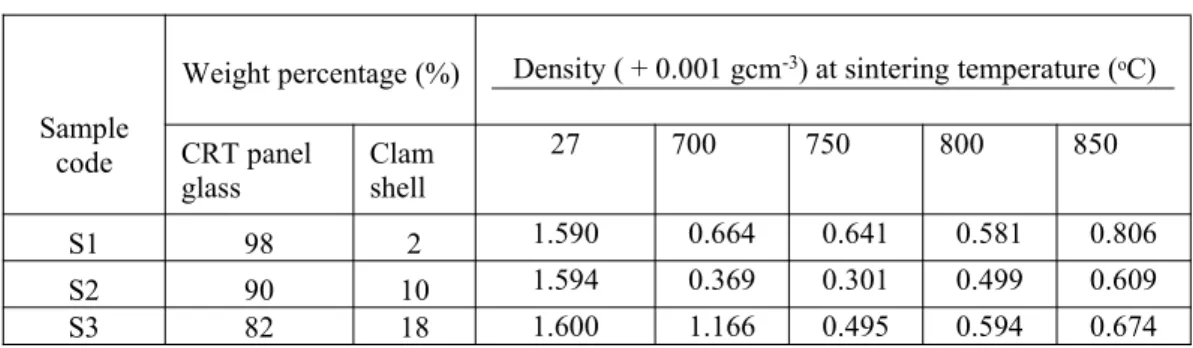
The CRT panel glass and clam shell powders were weighed by using an electronic digital weighing machine to prepare 2, 10 and 18 weight percent of clam shell powders in the total of 30g batch powder. The accuracy of the digital weighing machine is g. The compositions of the glass batches were recorded in Table 1.
Table 1: The batch composition and density of S1, S2and S3samples
Sample code
Weight percentage (%) Density ( + 0.001 gcm-3) at sintering temperature (ᵒC) CRT panel
glass Clam
shell
27 700 750 800 850
S1 98 2 1.590 0.664 0.641 0.581 0.806
S2 90 10 1.594 0.369 0.301 0.499 0.609
S3 82 18 1.600 1.166 0.495 0.594 0.674
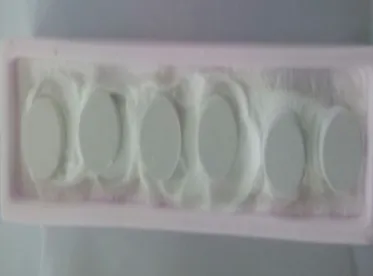
The pellet forms (Figure 1) of the sample powders were prepared by using hand pressing machine. The apparatus was kept cleaned by rinsed with acetone to make sure that there is no impurity contamination presence the apparatus, it is likewise, to prevent the mixture powder mixing up with the other residue left by the former user. The powders were weighed for 1 gram to produce each pellet and the pellets were prepared by using 5 metric tons of force.
The crucible containing batch powder is placed in the furnace, and the furnace is set up in the condition that the temperature will increase to desired temperature, and it holds
for 45 minutes at this desired temperature. The samples in the pellet form were subjected to different heating temperatures like 700 ᵒC, 750 ᵒC, 800 ᵒC and 850 ᵒC in the furnace. After the formation of foam glass during the sintering process, the phase formation, structure and crystal behavior of the samples were characterized by XRD, XRF before and after sintering in the form of powder at room temperature whereas the density of foam glass was measured by using Archimedes method in the form of pellets.
Figure 1: Pellets formed by hand press machine kept in the alumina boat for sintering process.
III. RESULTS AND DISCUSSION
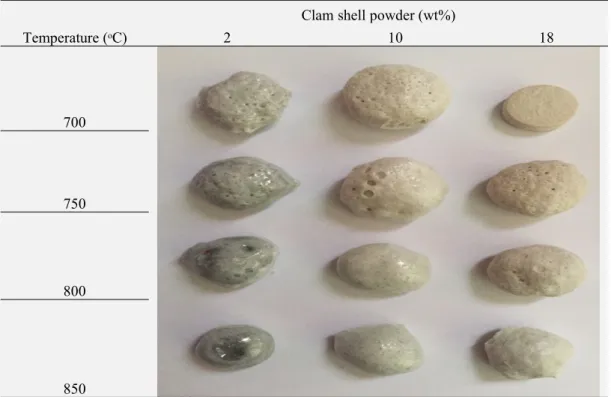
Figure 2 shows the foam glass samples at different heat treated temperatures and with different compositions of clam shell powder. It shows that, the foam glasses were obtained when heating the mixture of clam shells and CRT panel glass in the temperature ranges of 700 ᵒC to 850 ᵒC. The different shapes and sizes of the foam glasses depend on the heat treatment temperatures and the total of added clam shell powder.
A. Density
Table 2 presents the data for density measurement of glass foamed samples. The density of the pellets decreases after the sintering process at room temperature due to the crystalline packed structure of samples. Nevertheless, if the samples are subjected to heat, the crystalline structured closed-pack lattices are partially converted to amorphous structured closed pack-lattices. The density of the sample decreases depends on the sample composition as shown in figure 2. The sintering temperature mainly supports for the formation of glass-ceramic foam, it reflects on density.
Table 2 shows the density measurements for S1, S2 and S3 that undergone for the sintering process starting at 700 ᵒC, 750 ᵒC, 800 ᵒC and 850 ᵒC. In the sintering process, decomposition of CaCO3 begins at about 700 ᵒC and 750ᵒC which is reported by Bernardo (2006) [5], where as the transition temperature of CRT panel glass is closed to 480 ᵒC and 520 ᵒC as reported by Mear et al. [6-8]. For the sample S2, the foam glass exhibits minimum value around 750 ᵒC, with 10 % weight of clam shell, on the other hand, the foam glass density exhibits highest value around 700 ᵒC for S3 sample with 18 % weight of clam shell. From figure 3, it is observed
distributed almost homogeneously throughout the foam glass, and thus the gas can escape easily from the foam glass samples. At low temperature, the decomposition rate of foaming agent is lower due to the decreased glass surface area in contact with the foaming agent whereas, the sintering process proceeds faster and the glass react readily with a foaming agent at higher temperatures.
Scarinci et al., [9] described that during the sintering process, the calcium or sodium carbonate particles decompose to the oxide with simultaneous release of carbon dioxide (CO2). The CO2 gas that released is then trapped in the viscous glass mass and which forcing the molten glass mass to expand and while cooling, the molten glass mass is solidified and their cellular or porous structure is formed.
Based on the measurements of density above, it is identified that the foam glasses that have low density, shows the amorphous nature in the XRD analysis. Hasheminia et al., [10] stated that the commercial glass foams exhibit density of 0.1-0.3 g/cm3. Therefore, it is observed that the foam glasses formed with higher density revealed the formation of wollastonite (CaSiO3) crystal phase in XRD analysis.
B. XRF analysis
Table 2 show that the clam shell is made up of calcium is comparable with the other study of Mohamed et al., [11].
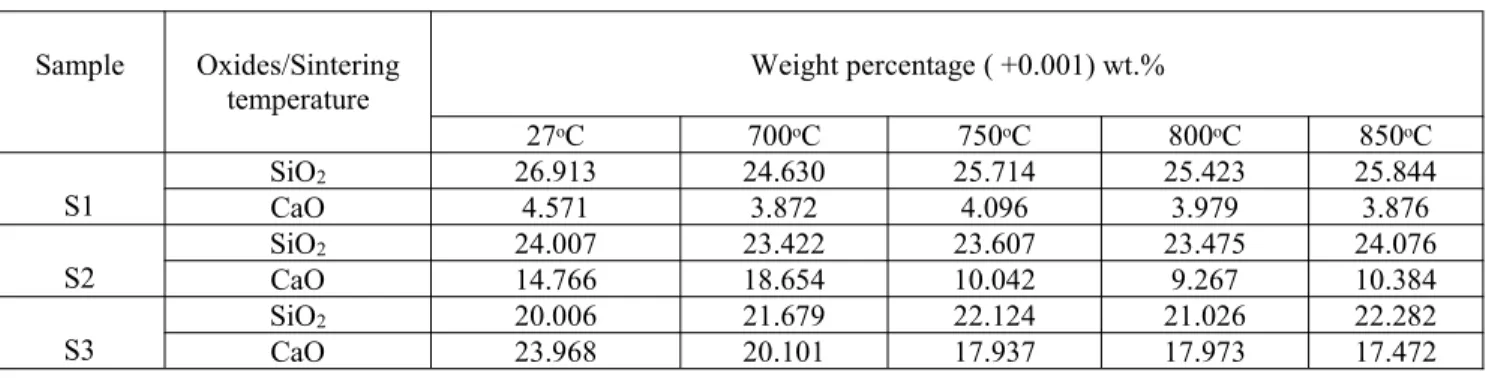
XRF analysis for CRT panel glass revealed the presence of nine compounds like SiO2, SrO, BaO, K2O, ZrO2, CaO, Sb2O3, NiO and CuO. Addition of 2 wt % of CS in S1 reduces the weight percentage of the compound in the CRT panel glass. The addition of 10 wt % of CS in S2 and 18 wt % CS in S3 made changes in the weight percentages of the compound in the CRT panel glass. Addition of CS powder to the CRT panel glass has resulted in the reduction and increasing of the elements in the glass samples. From table 3, for the sample code S1,it is observed that the chemical composition composition of SiO2 has decreased from 26.913 wt% at room temperature to 24.630 wt% at 700 ᵒC. The composition CaO also decreases from 4.571 wt% at room temperature to 3.872 wt% at 750 ᵒC. Also, from table 3, for the sample code S2, it is observed that the composition of SiO2 was decreased from 24.007 wt% at room temperature to 23.475 wt% at 800 ᵒC. However, composition of CaO has increased from 14.766 wt% at room temperature to 18.654 wt% at 700 ᵒC. Finally, it is observed from the results of the table 3,for the sample code S3 that the chemical composition SiO2 increase from 20.006 wt% at room temperature to 22.282 wt% at 850 ᵒC. On the other hand, the composition of CaO decrease from 23.968 wt% at room temperature to 17.472 wt% at 850 ᵒC. XRD observations of the samples predicted that the crystalline and the structural behaviors of the samples were greatly influenced by the weight percentages of the elements presents in the sample . On the other hand, after the sintering process, the comparable composition weight percentages of the both SiO2 and CaO determine the states of the samples in the XRD pattern.
Temperature (ᵒC)
Clam shell powder (wt%)
2 10 18
700
750
800
850
Figure 2: Representative photographs of glass foamed samples at different heat treatment temperatures and with different composition of clam shell powder.
Figure 3: Variation of density against sintering temperature for foam glass ceramic samples.
Table 2: Chemical composition of Nokia Consumer Electronics CRT panel glass, in clam shell at room temperature (27°C) and after heat treatment at 400°C.
Materials Weight percentage, wt(%)
SiO₂
CaO
K₂O/MgO* Fe₂O₃
Cathode ray tube panel glass 28.421 2.189 - -
Clam shell (27 ᵒC) - 97.989 0.619 0.352
Clam shell (at 400 ᵒC) - 95.565 0.148 1.844
Clam shells (Mohamed et al., 2012) [11] 0.078 98.99 0.51* -
Others < 0.1% - - - -
Table 3: Table represents the chemical composition of the samples S1, S2 and S3 by XRF Analysis.
Sample Oxides/Sintering
temperature Weight percentage ( +0.001) wt.%
27ᵒC 700ᵒC 750ᵒC 800ᵒC 850ᵒC
S1 SiO2 26.913 24.630 25.714 25.423 25.844
CaO 4.571 3.872 4.096 3.979 3.876
S2 SiO2 24.007 23.422 23.607 23.475 24.076
CaO 14.766 18.654 10.042 9.267 10.384
S3 SiO2 20.006 21.679 22.124 21.026 22.282
CaO 23.968 20.101 17.937 17.973 17.472
C. XRD analysis
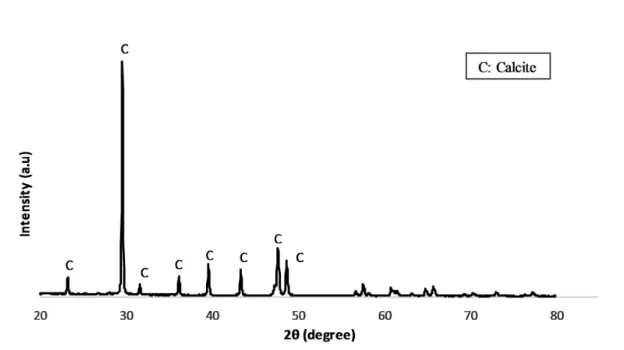
Figure 4(a) represents the XRD pattern for clam shell powder, the sharp peaks represents for the crystalline structure of calcite, which is the crystal form of calcium carbonate according to Mohamed et al., [11]. The XRD pattern for pure CRT panel glass is shown in Figure 4(b) reflected the characteristic of amorphous nature.
Figure 5 shows the XRD pattern of S1, S2 and S3 at room temperature. All the samples exhibits sharp peaks of the calcite. Regardless of the weight percentage of the CS added to CRT panel glass, sharp peaks were observed. The peaks that represents the crystalline structure of CaCO3in the batch as an increment in the amount of CaCO3, because, the CaCO3
still existed as a crystalline phase.
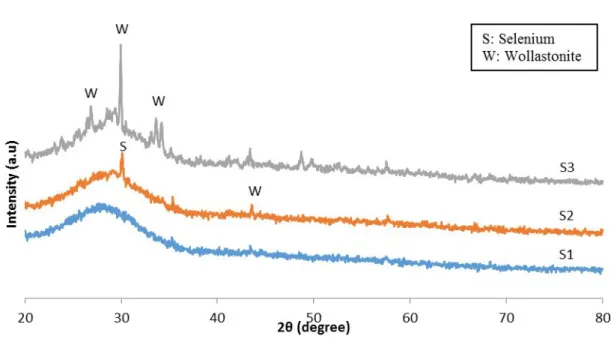
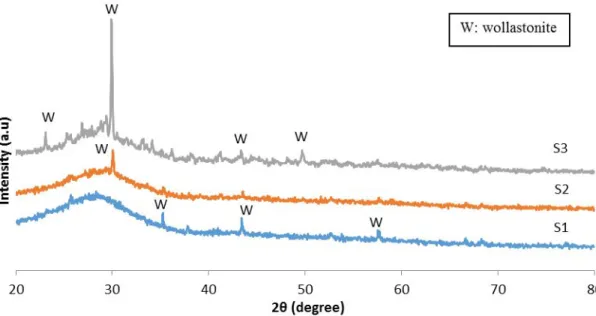
Broad halo peaks were observed for the sample code S1, from figure 6 and figure 7 which reflects the characteristic of the amorphous glass structure, obtained at around 2θ≈30ᵒ.
The absence of sharp, strongly diffracted beams in the XRD pattern from glass indicated that there were no well-defined
atoms were regularly arranged (Khamirul et al. [12]. The XRD results for low weight percentage of CaCO3in the batch shows the amorphous nature and which consistent with the findings of (Petersen et al., 2013 and Bernardo, 2006) [3, 5].
The XRD results shown in Figure 7 - 9 reveal that the crystal form in the glasses/ceramic that prepared with relatively high amounts of clam shell (10 - 18 wt%).
The XRD spectrum reveals the slight formation of CaO-SiO3 which is in crystal phase. From the analysis of chemical composition of S1, S2 and S3, the higher weight percentage of CaO in the samples will tend to form wollastonite crystal in the foam glasses. The increased degree of crystallization was observed in the samples occupying with high amount of clam shell is due to the reason that CaO presents in the sample reaches to its solubility limit and it also supports the crystal to grow its possible maximum size.
Figure 4 (a): The XRD pattern of clam shell powder after heated at 400 ᵒC
Figure 4 (b): The XRD pattern of CRT panel glass
Figure 5: The XRD pattern of the samples S1, S2 and S3 at room temperature
Figure 6: The XRD pattern of the samples S1, S2 and S3 after undergone for sintering process at 700 ᵒC
Figure 7: The XRD pattern of the samples S1, S2 and S3 after undergone for sintering process at 750 ᵒC
Figure 8: The XRD pattern of the samples S1, S2 and S3 after undergone for sintering process at 800 ᵒC
Figure 9: XRD pattern of the samples S1, S2 and S3 after undergone for sintering process at 850ᵒC
IV. CONCLUSION
In the present work, clam shell wastes have been applied to recycle CRT panel glass for the preparation of foam glass materials. Foam glasses in the shape of pellets have been successfully prepared by sintering process. For the XRD analysis, few foam glass samples exhibits broad halo characteristics, which reflects the characteristics of amorphous glass structure. Chemical composition of the foam glass samples was successfully obtained from XRF technique. From the measurement, it is confirmed that the addition of clam shell powder to the CRT panel glass and sintering process leads to the decrease of the base elements in the glass samples. The best foam glasses with low density were obtained when the glass powder was foaming with 2-10 wt% clam shell at a temperature between 700 ᵒC and 750 ᵒC.
The low density of the foam glass obtained is 0.301 g/cm3.
The foam glass densities were found to be extremely dependent on the heat treatment temperature and to a smaller extent also on the clam shells weight percentage.
ACKNOWLEDGMENT
The authors appreciate the financial support from the Ministry of Higher Education of Malaysia under FRGS grant and Geran Putra UPM GPIBT from Universiti Putra Malaysia.
REFERENCES
[5] E. Bernardo, F. Albertini, Glass foams from dismantled cathode ray tubes. Ceramics International, 32(6), 603-608 (2006).
[6] F. Mear, P. Yot, M. Cambon, M. Ribes, The characterization of waste cathode-ray tube glass. Waste Management. 26(12), 1468-1476 (2006).
[7] F. Mear, P. Yot, M. Cambon, R. Caplain, M. Ribes, Characterisation of porous glasses prepared from cathode ray tube (CRT). Powder Technology. 162(1), 59-63 (2006).
[8] F. Mear, P. Yot, R. Viennois, M. Ribes, Mechanical behaviour and thermal and electrical properties of foam glass. Ceramics International. 33(4), 543-550 (2007).
[9] G. Scarinci, G. Brusatin, E. Bernardo, Glass foams. Cellular Ceramics:
Structure, Manufacturing, Properties and Applications. 158-176 (2005).
[10] S. Hasheminia, A. Nemati, B.E. Yekta, P. Alizadeh, Preparation and characterisation of diopside-based glass–ceramic foams. Ceramics International. 38(3), 2005-2010 (2012).
[11] M. Mohamed, S. Yusup, S. Maitra, Decomposition study of calcium carbonate in cockle shell. Journal of Engineering Science and Technology. 7(1), 1-10 (2012).
[12] K.A. Matori, L C. Wah, M. Hashim, I. Ismail, M.H. Zaid, Phase transformations of α-alumina made from waste aluminum via a precipitation technique, Int J Mol Sci. 13(12):16812-1621 (2012).