Golden Key Local Evaluation
Phase 3: System change
Acknowledgements
We are grateful for the support and input of a wide range stakeholders into this work. In particular we would like to thank those who spent time speaking with us during interviews, meetings and workshops to explain their perspectives and experiences of Golden Key. We are also grateful for the support of the Golden Key Programme Team, Partnership Board and Evaluation Advisory Group who helped us gain access to relevant information and evidence and have provided feedback on draft findings. We would also like to acknowledge the contribution of additional colleagues at UWE who are leading on other aspects of the local evaluation research, including Dr Chris Pawson, Dr Richard Kimberlee and Dr Anthony Plumridge.
We hope that you will find this report an accurate account of progress and learning so far, and a valuable opportunity to reflect on your own experience to support the next phase of Golden Key. Should you wish to discuss any aspect of this report, the evaluation process and/or your experience of Golden Key please contact [email protected].
Glossary of terms and abbreviations
Action experiment Part of the GK approach to system change
CCG Clinical Commissioning Group
Fulfilling Lives The National Lottery Community Fund initiative that funds Golden Key
Housing First An approach to housing being piloted in Bristol by Golden Key
GK Golden Key
Independent Futures Lived Experience forum (previously known as the ‘IF Group’)
Manifesto for Change A GK team (recently renamed the Spark Team) that supports the System Change Group and leads on the Trusted Assessment work, etc.
MEAM Making Every Adult Matter
MCN Multiple Complex Needs. Including: homelessness, mental health, substance use, criminal offending
Partnership Board The GK board, with senior representatives from partner organisations
Golden Key Local Evaluation - Phase 3: System Change
Contents
1 Executive Summary ... 2
2 Introduction ... 6
2.1 Evaluation approach and methods ... 6
2.2 Golden Key’s approach to system change ... 8
3 System change progress ... 11
3.1 Purpose and approach ... 11
3.2 Relationships and communication ... 14
3.3 Strategic influence ... 17
3.4 Tools and techniques ... 20
4 Challenges to progressing system change ... 23
4.1 Building focus on service users ... 23
4.2 Working across system boundaries ... 25
4.3 Sustaining and embedding change ... 29
5 Emerging indicators of impact ... 31
5.1 Action experiment report review ... 31
5.2 Stakeholder perceptions of where GK is making a difference ... 33
6 Recommendations and areas for consideration ... 35
6.1 Clarify and articulate strategic approach to system change ... 35
6.2 Strengthen focus on client outcomes ... 35
6.3 Capture and develop action experiment approach ... 36
6.4 Listen to and empower service users ... 36
6.5 Mobilise Service Coordinator learning ... 37
6.6 Plan and build sustainable legacy ... 38
7 Conclusions ... 39
8 Appendices ... 40
8.1 Appendix 1 ... 40
1
Executive Summary
Introduction
1. This report presents findings from Phase 3 of UWE’s Local Evaluation of Golden Key (GK), focused on understanding how GK’s system change activity has developed. The evidence is based on interviews conducted in summer 2018, with a sample of people closest to GK’s system change activity. Interviews were complemented by ongoing fieldwork, a document analysis of action experiment reports and selected GK system change related reports, followed by a small workshop with key system change stakeholders.
2. The UWE Local Evaluation Team has identified four main areas of system change progress, alongside three areas which present challenges to GK. A number of key areas are then proposed for further consideration, along with associated recommendations.
System change progress
Golden Key Local Evaluation - Phase 3: System Change
6. Tools and techniques: Golden Key has focused on developing operational processes and tools to support their system change approach. ‘Action experiments’ have empowered people to initiate change and experiment with new ways of working. Service Coordinators are engaged with system change activity and feel positive about their approach. The System Change Group has been actively involved with directing and initiating change. Support from the Manifesto for Change Team has been valued by those closely involved with action experiments.
System change challenges
7. Building focus on service users: Both the local and national evaluation have focused on
understanding and demonstrating changes in client outcomes as a result of Service Coordinator support. With the range of wider partnership collaborative activity a key challenge is to balance these extensive programme activities with maintaining focus on understanding whether and how changes affect service users. Concerns were also raised around: keeping lived experience at the heart of Golden Key (whether service users, ex-service users, peer support workers or GK clients), providing adequate consistent support, and celebrating involvement.
8. Working across system boundaries: Commissioning continues to be a critical area which
challenges partner’s ability to engage with system change and offers opportunities for Golden Key to influence more widely. Interviewees perceived that ‘siloed thinking’ within services restricted the ability and/or willingness of professionals in engaging with GK to tackle systemic issues collaboratively. Implicit notions of hierarchy reflected in aspects of the GK approach to system change (e.g. tiers, levels) may limit opportunities for transformative change.
Emerging indicators of impact
10. Action experiments are a key mechanism through which Golden Key seeks to initiate system change. The Local Evaluation reviewed 48 completed ‘action experiment’ reports to capture impact and identify emerging indicators of impact. Activity reported as action experiments included: (i) specific change projects, (ii) ongoing client support activity, (iii) ongoing GK activities and processes. Whilst very few reports included evidence of impact, the activity descriptions suggest that some change is being effected. Further evaluation focus and support in this area may help understand whether and how service users have been impacted.
11. Interviewees were limited in their ability to highlight areas where GK had made a direct impact on services and for service users but many felt specific activities did represent positive change (e.g. Criminal Justice activity, PIE (psychologically informed environment) City, Service Coordinator Team, Housing First pilot, Independent Futures, homelessness pathways recommissioning).
Recommendations and areas for consideration
12. Six main areas are identified for consideration by Golden Key, along with associated recommendations. Priority recommendations are summarised below.
Recommendation 1: Clarify and articulate strategic approach to system change
1.a. Clarify programme outcomes, outlining the impact GK wants to have in 3 years’ time and the legacy it would like to leave in Bristol.
1.b. Articulate and map out step-by-step how programme elements and intermediate
outcomes will lead to improved outcomes in specific areas for service users (e.g. theory of change).
1.c. Clarify the conceptual basis for GK’s approach to system change and initiate mechanisms for critical debate and analysis.
Recommendation 2: Strengthen focus on client outcomes
2.a. Strengthen access to, sharing, and use of existing data, information sources and feedback routes for GK core programme activities and across the partnership, ensuring that staff recognise and understand the importance of robust data collection and analysis in informing their practice.
2.b. Draw on experience of multiple complex needs to develop and/or test new alternative approaches and tools to understand service user outcomes.
Golden Key Local Evaluation - Phase 3: System Change
Recommendation 4: Listen to and empower service users
4.a.Ensure that system change priorities are informed by service users.
4.b.Develop best practice approaches and guidance to ensure individuals who engage with services in Bristol to support change are consistently and effectively supported and celebrated so their experience has a positive impact on their lives.
4.c.Review the GK approach to equality, diversity and inclusion to develop a long-term commitment to incorporating multiple perspectives and voices throughout the work and ensure that certain individuals and/or groups are not excluded/marginalised.
Recommendation 5: Mobilise Service Coordinator learning
5.a. Explore how Service Coordinators can be further supported to capture and share their experience and learning about navigating services and supporting multiple complex needs. 5.b. Ensure appropriate mechanisms are in place that important knowledge and relationships
are retained when Service Coordinators and/or other key staff leave/move on.
5.c. Map out current team activities and review scenarios for different ways of achieving the same functions (if necessary) when the National Lottery Community Fund funding ends. Discuss options with other stakeholders and plan how to work towards these aims.
Recommendation 6: Plan and build a sustainable legacy
6.a. Develop and disseminate the GK Theory of Change that will help secure long-term commitment to shared ways of working and evaluation of outcomes for GK partners and other key stakeholders.
6.b. Review the allocation of resources to different aspects of GK work, ensuring that this is allocated where it is most needed and will have the greatest lasting impact on services and outcomes for people with complex multiple needs.
6.c. Review emerging evidence of ‘systems flex’ and develop a strategic approach for how this might be scaled-up to create sustainable system change.
Conclusion
13. There is evidence to suggest that at this mid-stage point, Golden Key is beginning to make good headway towards system change which has potential for impact on service users with multiple complex needs. In order to secure and sustain this progress, however, there are a number of significant challenges that need to be addressed. Significant preparation and a strategic approach is required to maximise the GK legacy and manage the transition once National Lottery
2
Introduction
This report presents findings from Phase 3 of UWE’s Local Evaluation of Golden Key, which has focused on understanding the progress of GK’s system change activity. Whilst it is intended to be widely accessible, it is most likely to be relevant to members of the GK partnership and those engaged with system change activity. We also hope that the findings will be of interest to people working on other UK Fulfilling Lives projects, and for others looking to mobilise system change in complex environments.
2.1
Evaluation approach and methods
2.1.1
About the local evaluation
The UWE Local Evaluation (detailed in this report) complements the overall national evaluation (conducted by CFE Research with the University of Sheffield) of the National Lottery Community Fund Fulfilling Lives initiative. The local evaluation is not intended to duplicate the work of the national evaluators but seeks to support and catalyse further learning and change in Bristol.
This evaluation takes a formative approach which aims to support learning and development in a shifting complex environment. This evaluation is influenced by ‘realist’ approaches seeking to understand how and why particular interventions produce impacts and to reveal unanticipated and unintended consequences. We aim to capture multiple perspectives and acknowledge differing experiences through engaging a wide range of stakeholders, regular feedback and debate.
The UWE Local Evaluation takes a long-term, mixed methods approach to capturing the learning and outcomes of GK. The evaluation framework1 (2015) focused on three key areas of change that the
programme seeks to impact:
1. Client outcomes and experience 2. GK programme team and partnership 3. Citywide influence and engagement.
Golden Key Local Evaluation - Phase 3: System Change
Other ongoing areas of the evaluation not covered in this report, include a review of economic return on investment (ROI) for GK’s client-facing support, evaluation of the Housing First ‘feasibility’ pilot,
evaluation of ‘Trusted Assessments’, and Evaluation of Psychologically Informed Environments (PIE) which will be reported in due course. A more detailed social return on investment (SROI) will be conducted towards the end of the programme to capture evidence of GK’s wider impact.
2.1.2
Phase 3 approach to evaluating system change
Our evaluation in this phase aims to:
• Understand whether and how system change activity is progressing. • Capture emerging learning about GK’s approach to system change.
• Identify promising areas to focus future evaluation research to capture programme impact. The evidence presented within this report is primarily based on a series of 22 semi-structured, in depth interviews of between 45-75 minutes that were conducted by the UWE Local Evaluation Team with key stakeholders involved in system change activities within the GK partnership between mid-July and early September 2018.
Interviewees were selected to provide a cross section of perspectives and experiences from those people most closely involved with the GK system change activity (see Table 1).
Service Coordinator Team 4
System Change Group 3
Programme Team 6
Partnership Board 7
PIE Group 4
Independent Futures 2
Table 1 – Overview of interview sample (note individuals can be members of multiple groups)
The interview framework was developed through determining key areas drawing on our understanding of systems thinking and system change literature, alongside knowledge of GK’s theoretical underpinning to their systems change approach. The evidence gathered is largely qualitative and inductive, given the emergent and adaptive nature of the programme and the fact that the GK’s Theory of Change (TOC), with associated defined outcomes pathway, is still being finalised. This limits the evaluation’s capacity to make definitive evaluative judgements about the effectiveness or impact of particular pieces of work, although is a valid approach to capture learning and highlight areas for further exploration.
2.2
Golden Key’s approach to system change
The notion of system change lies at the heart of GK’s work to improve and transform service provision and support for people with multiple complex needs. GK is still developing and refining its approach to system change and is yet to map out in detail the specific change outcomes expected from this work. However, a number of key conceptual models consistently inform the approach, including systems thinking, complexity and action learning. Martin Sandbrook of the Schumacher Institute was commissioned to run a series of workshops from August 2016, for members of the GK Programme Team, Partnership Board, Service Coordinator Team, System Change Group and wider partnership to develop a shared understanding and approach to this work. A summary of this approach is given in Figure 1 (further details and online resources available at https://systemslearning.org/).
Figure 1 – Principles of systems thinking
There is a substantial body of theory and research underpinning this approach and, alongside the input from Martin Sandbrook, GK has also worked with another consultant, Jeff Matthews, to raise awareness of this literature amongst members of the Partnership Board2. Within this work a number of key
principles have been shared, including:
• Working collaboratively: developing collective solutions, the importance of relationships and involving multiple perspectives.
• Building a learning culture: creating safe supportive spaces for learning and knowledge sharing,
“For me, ‘systems thinking’ is a way of being. It involves a way of seeing or interpreting the world through thought and feeling. It is an attitude of openness, of inquiry, of looking from many perspectives, inner and outer, of holding, or trying to hold, an awareness of my own beliefs and assumptions, of noticing my reaction to things, of understanding the world as an unfolding process where everything is in relation to everything else. It is an attitude of compassion and love, avoiding judgement, seeking to understand rather than be understood. It is an attitude that is always curious, always ready to learn and amend, realising that to truly know something or somebody, is probably never fully possible, that knowing comes in many forms and is often partial or incomplete, that learning is a subjective process involving a relationship between me and what I am seeking to know, which affects both me and the that which I am trying to understand. It means being prepared to let go of the need to be right, or the fear of uncertainty or the illusion of control.”
Golden Key Local Evaluation - Phase 3: System Change
example ‘action experiments’ outlined below), how this is understood and experienced by different stakeholders, and emerging indicators of where change is happening.
2.2.1
Action experiments
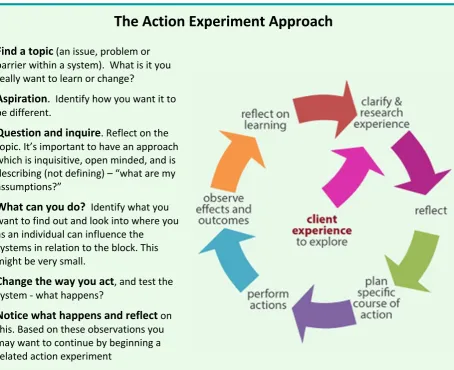
A key way in which GK has attempted to operationalise system change is through the use of ‘action experiments’. This is an approach, informed by principles of action research, experiential learning, and reflective practice, that offers individuals and groups a practical means for initiating change and capturing learning in a conscious and reflective manner3 (see Figure 2).
The Action Experiment Approach
Find a topic
(an issue, problem or barrier within a system). What is it you really want to learn or change?Aspiration
. Identify how you want it to
be different.Question and inquire
. Reflect on the topic. It’s important to have an approach which is inquisitive, open minded, and is describing (not defining) – “what are my assumptions?”What can you do?
Identify what you
want to find out and look into where you as an individual can influence thesystems in relation to the block. This might be very small.
Change the way you act
, and test the system - what happens? [image:11.595.75.530.208.578.2]Notice what happens
and reflect
on this. Based on these observations you may want to continue by beginning a related action experimentFigure 2: GK approach to action experiments4
The concept was introduced by Martin Sandbrook during the GK system change training from autumn 2016 and has subsequently been adopted by members of the System Change Group, Programme Team and Service Coordinator Team. Learning and outcomes from action experiments have been recorded through a series of reports. These are shared with the Partnership Board through the quarterly report paper alongside summary statistics of the number and type of activities completed.
2.2.2
GK system change activities
GK has initiated a range of initiatives and activities to embed its system change work, including: • Service Coordinator Team – action experiments and small projects
• System Change Group – blocks and barriers logging, action experiments • System change champions
• PIE strategy
• Systems thinking training - 76 people have now been on the Systems Thinking workshops/training (next course delivered spring 2019)
• Criminal Justice system change activity • Trusted Assessments change project
• Ad Hoc initiatives (100 beds, Universal Credit train the trainer, working with commissioners, homelessness information portal)
Golden Key Local Evaluation - Phase 3: System Change
3
System change progress
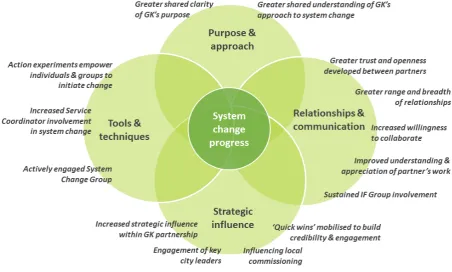
[image:13.595.70.523.230.502.2]Drawing on insights from the interviews this section summarises how GK’s approach to system change has developed since the early stages of the initiative. Four main areas are identified, each with a number of sub-points (as illustrated in Figure 3), which are discussed in turn, along with illustrative quotes from the interviews.
Figure 3 – GK system change progress themes
3.1
Purpose and approach
Stakeholder interviews conducted during Phase 1 of the GK local evaluation5 indicated a fair degree of
uncertainty around the aims and purpose of the initiative, as well as the approach to system change. Interviews during this mid-term evaluation demonstrate far greater understanding and agreement between partners, as well as a growing shared understanding of the GK approach to system change.
3.1.1
Greater shared clarity of GK’s purpose
Interviewees presented a more clearly defined sense of GK’s purpose, which has shifted since the interview findings in 2015 where GK was understood more loosely as a ‘shared way of working’.
Interviewees tended to use more inclusive language than compared with previous interviews, with an increasing shift from focusing on specific members of the programme and Service Coordinator Teams to the wider partnership.
“Golden Key is a partnership, isn’t it? So a way that we’ve progressed quite a lot is that our partners are starting to feel like GK partners instead of feeling like they are working alongside us or getting dragged into these situations or events that GK is telling them to attend. They are participating in being Golden Key which is what is supposed to happen and what will help encourage change.” Programme Team
“… it feels like that has definitely changed from when I started, it feels like there’s much more understanding of working in partnership.” Programme Team
Interviewees generally expressed their understanding of GK’s purpose as a combination of two or three of the following:
• To understand and learn about causes, barriers, and/or gaps for people with complex needs • To think differently, particularly about how the system could change to improve outcomes for
people with complex needs
• To find new and alternative ways of working
“I think Golden Key has looked to place itself as the leader of looking at how joined up thinking, how systems work within Bristol … and trying to, you know, work in a more open way with services across Bristol to make sure there’s one voice around the challenges that we face.” System Change Group
“What we’re trying to do is both establish the culture of system change and have some actual projects that we’re going to deliver on.” Partnership Board
Golden Key Local Evaluation - Phase 3: System Change
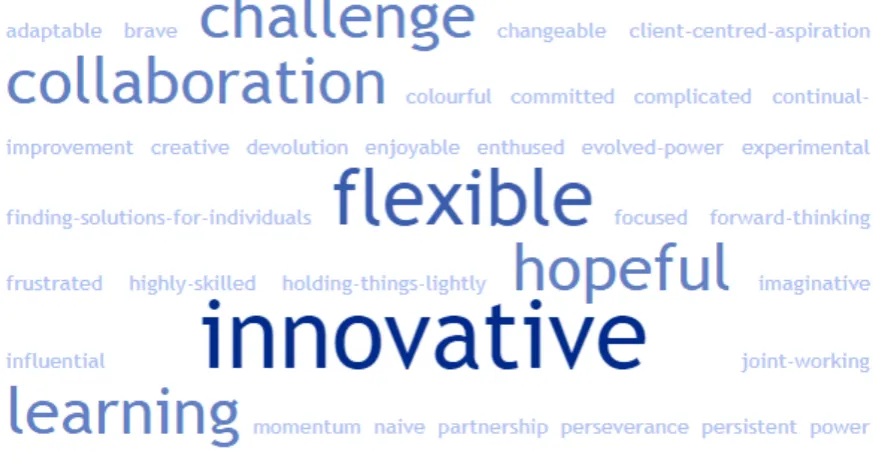
Figure 4 – Word cloud of responses to ‘spirit of GK’
3.1.2
Greater shared understanding of GK’s system change approach
Many interviewees felt that over the past 1-2 years GK partners had developed a greater shared understanding of system change and more clarity of their approach in practice. The Systems Thinking workshops runs by Martin Sandbrook from the Schumacher Institute were mentioned in particular and appeared to have given those who took part a common language and approach.
“We got Martin [Sandbrook] in to do training, and you know and we kind of tried different things and it’s, like piecing all things together that I feel is kind of starting to kind of make a coherent picture.” Service coordinator Team
“Martin yeah, I think was a really helpful opening up on what do we mean by complex systems, what’s our ability to design and make change in complex systems and so forth, so I think that’s, I found that helpful when I talk to other people who have said that that’s helped them.” Partnership Board
This improved understanding and shared language has enabled system change to be discussed more easily, in a more in-depth and informed way, which supports progressing activity both within GK teams and the wider partnership.
Action Experiments have been particularly embraced as a shared practical tool, and now form a key aspect of the work of the System Change Group and Service Coordinator Team (see section 3.4). This shared understanding is also likely to support GK’s work developing a Theory of Change and clarifying how individual behaviours underpin system change activity.
3.2
Relationships and communication
The literature that informs GK’s approach to system change emphasises the importance of relationships and conversations in mobilising enduring system change (see section 2.2). Nearly all interviewees made positive references to how these aspects of the partnership have developed over recent years.
3.2.1
Greater trust and openness has developed between partners
A consistent theme that emerged from all groups of interviewees was that people from different organisations were more trusting of one another and demonstrated a greater degree of openness and willingness to listen to and learn from others.
“… there’s a lot more trust amongst organisations than there has been in the past... I think there’s a much higher degree of confidence and trust between different parts of the local system.” Partnership Board
“[THERE] definitely have been changes in the way the partners engage with each other … it’s kind of more accepting … Obviously the partnership is made up of a load of individuals so they work in different ways and have different personalities and different pressures on them within their own jobs … it feels like there’s an acceptance of that in the way that people communicate with each other, an openness towards that.” Programme Team
“I think they’re different kinds of conversations, I think you would have had little pockets of it, of those conversations, but it would be difficult to get all the people that you need around a table to have that conversation.” Partnership Board
“In [SYSTEM CHANGE] workshops, you see people being much more open about their practice, and their organisations, and their weaknesses than you would have seen…, so there’s definitely been a move in the workshops about people saying, oh that’s really good, we don’t do it like that, it would be really good if we did that and could we learn about that…” Programme Team
Golden Key Local Evaluation - Phase 3: System Change
I’ve had loads of email conversations with them but never met them in person. But even through that contact we’re sort of starting to build a relationship…” PIE Group
“[A GK PROJECT] forced me to build loads of new relationships because I was like I was managing the external relation side of that, so you know I had to build new, I built some stuff I already knew but like building relationships with [SERVICE NAME] I didn’t know already, that was really great.” Service Coordinator Team
“I’ve seen a lot of agencies talking to each other that wasn’t talking before… I’ve seen a lot more like partnership boards, commissioners, people that wasn’t sitting around the table together before and now they’re sitting around a table, engaging with each other, so more communities have been built, we’ve seen more communities being built, we’ve seen more commissioners listening and understanding people with lived experience.” Independent Futures
A key opportunity and challenge for GK is to strengthen links between different parts of the system that provides support and services for people with multiple complex needs. There is good evidence of success in some areas, such as housing and criminal justice, as well as closer engagement with
commissioners (see 3.3.4 for further details). Engagement with business, community and mental health services still has some way to go but is beginning to show promising signs of progress.
“I guess there’s a different dynamic in there now, I think you know I do feel that Golden Key through its promotion has got people maybe talking about complex needs and understanding the different organisations involved with that with those individuals maybe slightly more.” System Change Group
“… in the last two months we have had two really good meetings, one with [SERVICE TEAM NAME] and one with the [SERVICE TEAM NAME], and we are talking about doing some joint assessments and so that’s a sea change in terms of not even being able to get to meet and talk to them, let alone think about doing anything differently.” Partnership Board
“I think the business community have to some degree started to come in. Obviously it’s been a bit tricky on the Golden Key Board with [BUSINESS PARTNER] backing out a bit, but more generally, Business West and others have become more engaged and again, is that because there’s a system change programme operating or is it because actually it’s a very visible issue in the city.” Partnership Board
3.2.3
Improved understanding and appreciation of partner’s work
Interviewees referred to improved awareness and understanding between partners about the nature of their work and appreciation of the challenges faced. Building a better understanding of the context in which partners operate, and the factors influencing their decision-making and engagement, has helped partners become more accepting of one another and provided insights into how they might work more effectively together.
that there’s a significantly higher shared common understanding of how we got to here.” Partnership Board
“I think just an awareness of each other’s roles as well because I think we can get into battlegrounds of 'this is your job', 'no this is your job', 'no this is your job' and that’s why you know gaps came about, and that’s why the programme's come about I think. One of the things I keep hearing is that when people go on training where there’s people from other organisations, it’s just the value of learning from staff in other teams and that not just being team specific training. I think that’s really important and it’s also the start of those relationships as well.” PIE Group
“I guess there’s a different dynamic in there now, I think you know I do feel that, that Golden Key through its promotion has got people maybe talking about complex needs and understanding the different organisations involved with that with those individuals maybe slightly more.” System Change Group
“There’s a common language around you know there’s something here, perhaps we can change something and a member of the System Change Group understands where the service coordinator’s coming from.” Programme Team
3.2.4
Increased willingness to collaborate
The improved quality and breadth of relationships, as well as better insight into the work of partners, appears to have translated into a greater willingness to work in collaboration to address shared challenges. For many this was a marked change from the levels of competition previously experienced within the system.
“I can see people in organisations working more closely with each other… which is probably most notable in the housing pathway because of the way they’ve been
restructured… and that might not be true of other services but it’s, it feels certainly in that sector there’s much more focus on collaboration than competitiveness.” Service
Coordinator Team
“I think there’s certainly been some shift, I think there is a more awareness that
collaboration can be positive because that’s been modelled through various you know so there’s various mechanisms of different groups at different levels in terms of my feedback in meetings and that kind of thing.” PIE Group
Golden Key Local Evaluation - Phase 3: System Change
Independent Futures, whilst others highlighted how Independent Futures members were able to
challenge and raise issues that other stakeholders may not. Given the experience in other Fulfilling Lives initiatives, where expert by experience groups have not always been sustained over time, this is an important achievement in its own right, as is the support given to Independent Futures to develop as an independent entity with a future and remit beyond GK6.
“[Independent Futures] went through sort of ups and downs… but yeah there’s some great people involved in that and, and I think it’s really, really positive.” System Change Group
“When I talk to my team and other colleagues … they’re certainly aware of the Independent Futures and that work and they talk about it a lot… I think things like the Independent Futures have been really helpful about reminding people that these are services for people and that the people that use them, need to you know, benefit from them and there needs to be positive feedback.” Partnership Board
“I’ve been at meetings that they’ve been present where actually they’ve said things that I think a lot of people in the room have wanted to say… because they don’t have that boundary… they’re not working for any of the stakeholders, so they’ve got an impartial voice.” Programme Team
3.3
Strategic influence
A key aim of GK is to exert influence at a strategic level in order to mobilise system change. An important priority from the outset was to build strong and influential relationships with key
stakeholders across the city to raise the profile and influence of GK. This began with the establishment of a Partnership Board comprising senior leaders from key local services working with multiple complex needs and has extended to other important political, community and organisational leaders, as outlined below.
3.3.1
Increased strategic influence within GK partnership
There is an increasing sense of GK’s influence and ability to exert influence and gain buy-in in from partners, clients and other key stakeholders. Interviewees referred to a much stronger sense of shared ownership within the partnership, commitment to working differently and a sense that others (outside GK) were beginning to recognise the value of working with them.
“… for me that’s a big shift in terms of people's narrative about the work that we’re doing as you know moved from, 'they’ve got 10 million pounds and they’re not really telling us what they’re doing with it', moving to, ‘you are a trusted system expert that we, we want your help with what we’re doing', and as a result I can see the next four years as being very different to my experience, when there's open doors, so they're inviting us in to do work that’s got potential for change.” Programme Team
“The example I gave about [ACTION EXPERIMENT] is very much people identifying blocks and barriers with the System Change Group and then using the influence that is, that is
there because of Golden Key and therefore also the Partnership Board to get a working group together to work on that and then that went off and met multiple times.” Programme Team
“We tend to have quite a big voice in the One City Meetings, we are looked to for advice and information, it’s been really interesting especially with our recent involvement with the criminal justice side of things, which is coming from a new direction from how we are used to doing to things.” Programme Team
3.3.2
Engagement of key city leaders
Senior level buy-in to GK and to system change was seen by interviewees as pivotal. The GK Programme Team and Partnership Board have worked hard to secure support and commitment from senior
stakeholders across the city, with some important successes including close collaboration with senior politicians, the Mayor’s ‘One City’ Office, and commissioners. This has also been supported and demonstrated through their lead role in the Bristol Leadership Challenge.
“We seem to have quite a lot of influence in the city at the moment, we have a really positive relationship with Marvin [Mayor of Bristol] and Paul Smith [CABINET MEMBER WITH RESPONSIBILITY FOR HOUSING IN BRISTOL] seems interested in what we have to say.” Programme Team
Regarding conversations with GK about changing the approach to commissioning: “I was very sympathetic to what they [GK] were saying about not de-stabilising the system by pushing it through a period of competitive change. And I think a) I would have been less sympathetic and b) I would not have got very sympathetic hearing in other places, had those relationships not started to be more concrete and more trusting.”
Commissioner
“It’s been really good in the project boards to see Rob Fenwick [Ministry of Justice Commissioner and member of GK Partnership Board] really involved in things changing around custody, which isn’t something that was expected, it seemed that you couldn’t change that in anyway shape or form before.” Programme Team
3.3.3
‘Quick wins’ mobilised to build credibility and engagement
Golden Key Local Evaluation - Phase 3: System Change
to learn about … reduced pressure on A&E across winter, but that was a result of a relationship with some of the board.” Programme Team
“.. part of our work is obviously influencing people’s trust and what we realised early on is that we can’t build trust without doing quick wins… so, for example in the criminal justice work, strategic work would then have to be aligned with specific smaller projects that we were running that showed some of those more short-term outcomes.” Partnership Board
3.3.4
Influencing local commissioning
Commissioning has been identified as a key strategic lever for GK’s system change work to shift thinking and practice and hold new style commissioning conversations. Early in the initiative, partners
highlighted that current commissioning, frequently based on single services and service boundaries, inappropriate KPI’s, and short timeframes, was a key barrier to change. Members of GK programme team and partnership board have coordinated discussions around developing approaches to
commissioning since the launch of GK, as illustrated in the following quotes.
“I got around the table at Bristol prison the governor of the prison, the local delivery unit lead for the national probation service and the local delivery lead for the national probation service, yeah, so those were three key stakeholders in terms of offender outcomes. And you know I said look, normally in terms of the commissioning conversation I would be having separate conversations with all of you, but I’ve been given a brief to think how can we have a collaborative conversation in terms of this commission.” Commissioner
“Some people on the Partnership Board have really taken the initiative, so Rob Fenwick who is a Ministry of Justice commissioner, has seen Golden Key has potential in his area and 18 months ago said he thought there was a real opportunity and that was absolutely fantastic… He took that initiative and now we’re doing work with the criminal justice system because of that, and he’s seen what Golden Key could do. So in terms of system change in that area, we’re working with the police, the criminal justice commissioner, and prisons on reducing reoffending, that’s been fantastic.” Partnership Board
From interviews and the review of action experiment reports, five key areas were identified where GK has played an important role in shaping the commissioning of services in Bristol:
1. The changed approach to homelessness re-commissioning in ‘pathways’ rather than individual services, which some interviewees highlighted as influencing the way partners worked together more collaboratively.
2. The changed approach to homelessness re-commissioning pathways now includes a stipulation for service providers to commit to using trusted assessments which GK is now in the process of piloting. The Trusted Assessments project is not yet at a stage where the evaluation can report findings.
4. Independent Futures’ involvement with Substance Misuse Commissioning processes for Residential Rehab service delivery, for which they received positive feedback from Bristol City Council commissioners.
5. System Change Group members worked to develop re-commissioned mental health service contracts so that they now include KPIs around closer joint working between mental health and substance misuse services.
A fuller picture of GK’s role in these changes and the extent to which this has led to wider changes within services, or the experiences of service users, is unclear at this stage from the evidence available however we will be following these up over coming phases of the local evaluation7.
3.4
Tools and techniques
Whilst GK’s system change approach and activities have been evolving, there has been a focus on: • Engaging individuals
• Developing processes and tools to support the approach
• Developing processes and tools to identify areas to initiate activity • Generating new activity
3.4.1
Action experiments empower individuals and groups to initiate change
As outlined in section 2.2 the action experiments approach was introduced during system change training delivered for some GK partners from autumn 2016. Action experiments draw on action
learning, experiential learning, and reflective practice approaches as a practical guide to how individuals can initiate change in a conscious and reflective manner. Over the past 18 months, with support from the GK’s core Programme Team, many members of the System Change Group, Programme Team and Service Coordinator Team have been using action experiments as an approach to initiate change. Stakeholder interviews and action experiment reports indicate that this approach appears to have had important effects on shaping how people engage with system change, as outlined below. Emerging indicators of more specific areas of impact are included in section 5.
Interviewee comments and the review of completed reports indicate that the approach of action experiments has particular value in:
Golden Key Local Evaluation - Phase 3: System Change
“One of the things we’re trying to do is shift the perspective so we value and understand the operational stuff. This is about leadership and not just strategic as well, so there’s separate roles and they need to be respected equally and the power needs to be dispersed differently across the system to be able to respond to the points of opportunity.”
Programme Team
“… what’s kind of come about now is more empowerment of individuals, and so that systems change can be a really small thing, it can just be like finding like a bit more information or just like you know maybe like being curious in a different way about like why something’s happening, and it can be you know like that example of you know taking a really positive risk with a client and their social worker about you know their housing situation. so, I feel like our focus is about sort of saying to everyone in the team like, everyone can do, everyone can do something and we have like, we have like a rationale and we have support to, just to go and be a bit more open and asking people questions and to just to, to try things.” Service Coordinator Team
3.4.2
Increased Service Coordinator involvement in system change
The Service Coordinators we interviewed felt more engaged with system change (in contrast to the interviews in Autumn 2016) and were very positive about the approach they have developed. The Service Coordinators we spoke with felt the important elements of their approach included:
• Having a specific time allocation for system change work • Support provided by the Manifesto for Change team • Using action experiments as an approach
• Having team structures and processes to facilitate team involvement
• Explicit ownership of specific system change activities from most individual team members
• Working more closely with the programme team, developing relationships and gaining more insight into the wider GK programme activities.
“I feel like we’re definitely very much more involved in as a system change concept which before perhaps felt a bit distant to what we’re doing, but with like action experiments came in as much momentum they have, it feels like we’re, its live like systems change is live for us and we’re working on it daily. So I would say that there’s been quite a shift to the systems change side of things particularly for me.” Service Coordinator Team
“I think it’s the approach but in my opinion it’s the, it’s become more focused…I don’t know, this might just be me, but I feel like everybody’s working more together, so when I’m so a lot of my action experiments stuff I will go and talk to Ali and Mike and I’ll keep them informed, and I make sure that they know what I’m doing and then I’ll get a lot from them about oh you might want to try this, and try doing it this way or this way, but also you know I’ll just go up and I’ll speak to Hannah, and just have a chat with her.” Service Coordinator Team
“Ali and Mike [from the Manifesto for Change Team]… they’re just hot on it… so I send them my write up, send them the template, we record everything on Trello now so they keep an eye on the Trello and then they’ve put it in like the quarterly report, it’s all captured there. It’s fed back to the System Change Group so they’re aware of what’s happens and then lots of it ends up in those info graphics that Liv does as well.” Service Coordinator Team
3.4.3
Actively engaged System Change Group
Members of the System Change Group are encouraged to volunteer to take on areas the individuals themselves choose and feel are important. Several interviewees highlighted the initial struggle to get members to take ownership of activities, as some members felt it was GK’s role to ‘own’ the activity given the resources available. However, many member’s attendance and engagement thus far with action experiments reflects a degree of organisational and individual commitment to change. This is particularly the case given the background context of austerity cuts and no specific funding allocation in many organisations for this activity at present. Interviewees who were members of the System Change Group highlighted the challenges of balancing this work with their professional roles. These
interviewees also highlighted how the support they had from the Manifesto for Change team was helpful to keep track of activity and prompt members to progress their activities.
Golden Key Local Evaluation - Phase 3: System Change
4
Challenges to progressing system change
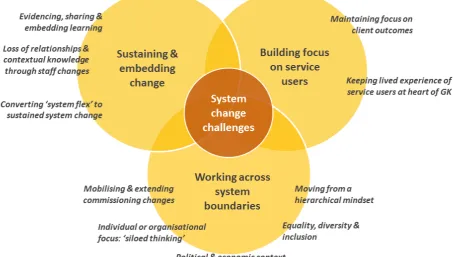
A number of significant challenges to progressing system change in Bristol emerged from the interviews as illustrated in Figure 5. These are raised here by the evaluation as important issues for the GK
[image:25.595.71.525.266.523.2]partnership to consider and respond to. Some challenges are beyond the immediate influence of GK, but will continue to affect the programme’s ability to mobilise and embed lasting change during the remaining National Lottery Community Fund funding (ending in early 2022).
Figure 5 – System change challenges
4.1
Building focus on service users
4.1.1
Maintaining focus on client outcomes
In section 3.2, we noted changes in the quality of relationships and increasing influence, which interviewees closest to the programme saw as important to initiate and progress change. Data is collected on GK client outcomes and the evaluation has supported understand the impact the Service Coordinators have through their client work. However, we identify a challenge for GK in balancing the wider programme activities with understanding how changes caused by these activities affect service users.
having time and energy to build relationships and just see where things go rather than being really focused on set KPIs [KEY PERFORMANCE INDICATORS]” Programme Team
Several interviewees expressed concern that the focus of the System Change Group is being directed primarily by the member’s interests and perspectives on issues, and that more could be done to incorporate: service user’s experiences, Service Coordinator’s experiences, and wider evidence of systematic issues for service users with multiple complex needs.
“… so the idea is first of all these are kind of logged but then there’s, almost a call to someone, who is going to take, look this is a problem, but we’re not going to solve that unless somebody takes responsibility for the solution. So if there’s nobody steps forward and they’re just deleted, because they’ll say, well yeah we all accept this is a problem but nobody wants to work on it. So we only work on the things that people want to work on, so those, those are things which actually could be quite significant.” Partnership Board
“I suppose that would be an overall comment as well about maybe trying to do too much, and the prioritisation of things … people don’t always choose the things that are the most important do they, they choose the things that they’re interested in… it’s just human nature isn’t it to do that.” System Change Group
Many of the action experiment reports contained very little focus on assessing the impact of those changes which had been initiated on service users (with the exception of those action experiments where Service Coordinator were working directly with individual clients). Many interviewees struggled to point to tangible changes in terms of the impact on service users, instead providing examples of the activities GK is coordinating, or the ways in which services are being reconfigured. It is currently unclear whether and how the social capital developed will lead to changes for people with multiple complex needs, although the work that is currently being done on developing a Theory of Change may help in this respect.
4.1.2
Keeping lived experience of service users at the heart of GK
Those interviewees who had more involvement with Independent Futures, peer mentors and GK clients felt there were missed opportunities to strengthen the contribution of lived experience to the system change activity and across the partnership.
Golden Key Local Evaluation - Phase 3: System Change
Concern was raised by a number of interviewees that Independent Futures have not been adequately supported in the past to develop and maintain their input to GK.
“... difficult translating it [SYSTEM CHANGE TRAINING] for IF members into something quite tangible… a lot of the literature and stuff it’s all electronic and it’s all Trello based, which is fine and we’ve tried it with IF but it’s not just something that’s really sinking in with them … that affects a lot of IF’s work in general you know and they do emails and stuff but it’s very hit and miss… it’s difficult but it’s a high expectation to expect them to engage on that level.” Programme Team
There was also concern that Independent Futures’ contributions and the challenges they faced in their involvement were not sufficiently acknowledged or accommodated. Concerns were raised about the long-term viability of this group without significant support and new member recruitment.
"[INDEPENDENT FUTURES] feel like they don’t get that feedback that often, like whether that’s fair or not…I think the members who have been here a lot longer are wanting a lot more… because there’s now an element to say they’ve kind of plateaued, and yeah I’d be pissed off if you don’t get a pay rise and you’re on the same money… it’s very weird, you’re paid to do it but it’s not a job … So I think that compounds the whole celebrating successes and stuff because I guess to them it might just be a bit repetitive.” Programme Team
“I think it is important that we start looking at legacy. Will there be another organisation like us [GK]? What is realistic? Not sure we are paying enough attention to that yet. Also considering the Independent Futures, people with lived in experience, what do they get out of all of this, especially when it’s done. What a downer for them if suddenly it’s just all over and that’s it.” Programme Team
4.2
Working across system boundaries
4.2.1
Mobilising and extending commissioning changes
As we found in the 2015 stakeholder interviews, the competitive processes for tenders was perceived by interviewees as negatively affecting system change progress. This included diverting key people and resources away from GK’s activities when re-tendering is in progress.
Whilst GK has engaged commissioners of some key services, the scope, scale and timeframes of commissioning combined with political pressures mean that commissioning still presents challenges. Where GK has already influenced commissioning and can demonstrate a positive impact from the changes, there is an opportunity for the GK partnership to mobilise this to gain further impact.
4.2.2
Individual or organisational focus: ‘siloed thinking’
Where people working in services would not or could not consider the importance of working across different parts of the system, this was often referred to by interviewees as ‘siloed thinking’. Note that the evaluation interviews at this stage have focused on those closest to the system change activity so cannot validate why others have been less engaged with system change. Interviewees speculated on why others may not engage with system change such as:
• Personal and professional investment in the current structures and systems • Prioritising their own organisation’s overall security or performance
• Prioritising their existing role responsibilities • Lack of focus on service users.
“I would say that the hardest thing that I’ve experienced has been when there’s like a real clear like hierarchy and its people at the top making decisions without consultation with clients without consultation with workers... there’s no way that that system and the way that services are set up now, came from clients or came from frontline workers because that’s a bloody nightmare to navigate.” Service Coordinator Team
“So it’s a combination there I think of not having much time due to contract expectations, a view of risk, and linked to that is what and how you prioritise the use of your time. Then there’s another level I think, which is about professional barriers, so I observe different professions struggling with working outside of their professional boundaries, finding it more or less difficult.” System Change Group
“Sometimes I think it’s quite easy to get quite siloed isn’t it, to get sort of caught up in your organisation and the difficulties there because they’re usually quite a lot and that’s almost enough to take on and it’s hard to see outside of that.” Programme Team
Some interviewees expressed concern that sometimes people in senior roles are saying the right words but are not necessarily invested in system change and because of their positions may be a block to change happening.
“I think there’s still obviously the people who, there are people in a hierarchical system who hold the power, so if they do not give resource to allow people to do system change, they still hold the power.” Programme Team
“My view always is in those kinds of things… that you need a group of managers together who are empowered by senior people to be there and you need everyone to be in the room, because it’s very easy when you’re all working in your organisation to say ‘this isn’t my problem’.” System Change Group
4.2.3
Moving from a hierarchical mindset
Golden Key Local Evaluation - Phase 3: System Change
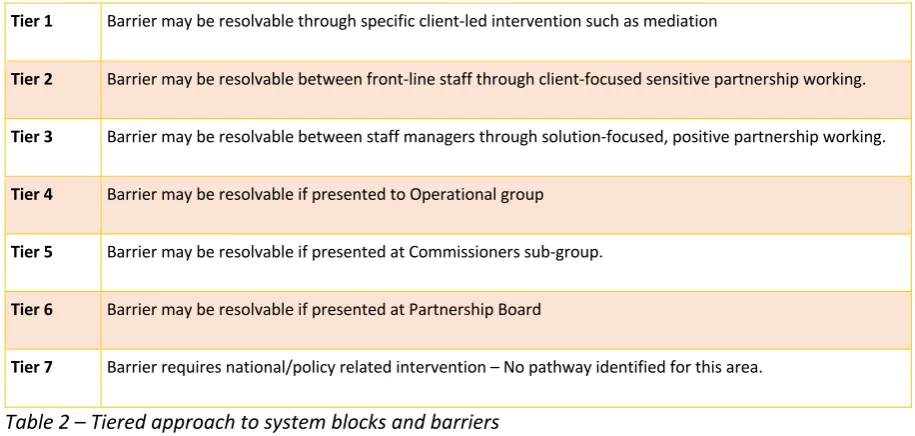
Tier 1 Barrier may be resolvable through specific client-led intervention such as mediation
Tier 2 Barrier may be resolvable between front-line staff through client-focused sensitive partnership working.
Tier 3 Barrier may be resolvable between staff managers through solution-focused, positive partnership working.
Tier 4 Barrier may be resolvable if presented to Operational group
Tier 5 Barrier may be resolvable if presented at Commissioners sub-group.
Tier 6 Barrier may be resolvable if presented at Partnership Board
[image:29.595.62.520.70.288.2]Tier 7 Barrier requires national/policy related intervention – No pathway identified for this area.
Table 2 – Tiered approach to system blocks and barriers
Interviewees referred to an understanding of ‘transactional’ change being completed at an operational level and ‘transformational’ change requiring strategic or senior management direction. The source of this categorisation is unclear and not directly identifiable in the systems change literature8. One
interviewee highlighted how the line between different ‘levels’ of change was less clear. “…there are other levels that will be escalated to the partnership board and then there are other levels that even the partnership board couldn’t deal with and have to be escalated up… there’s a discussion at Golden Key about it being transactional and transformational, although I’m not clear where that line changes and I’m not sure that its ever quite clear where that line changes but theoretically it will be one, probably one of those levels.” System Change Group
Whilst action experiment reports are included in meeting papers, the Partnership Board currently have little exposure to the learning emerging from action experiments and their role is unclear in this area. Though the process outlined in Table 2 indicates that higher tiers would be referred to the Partnership Board, some interviewees reported the frustration of Partnership Board members feeling that they were not being engaged with tackling substantial system change issues.
Whilst hierarchy is undoubtedly an important feature of any system a hierarchical mindset is likely to constrain the degree to which service-users and client facing professionals are empowered to direct and initiate change and help to sustain power in the current structures.
4.2.4
Political and economic context
Several interviewees noted the impact of national and regional policy and practice on the wider service provision landscape and the difficulty of establishing causality in this context of continual and complex
change. Several key areas were highlighted by interviewees as critical contextual factors which affected GK’s ability to progress their system change priorities.
The severe shortage of suitable housing in Bristol
“…it’s kind of always been the elephant in the room. How can we make this system work for people with complex needs when there’s no housing.” System Change Group
Government austerity programme
“...real constraints exist from national government, at a national policy level that are impacting on people’s lives” Partnership Board
Government policy and organisational structures maintaining statutory services in a state of constant change
"The organisations that have national imperatives, what we’ve noticed that they spend a lot of their time swimming around in this kind of blame slash scapegoat culture of 'I can’t do anything because of the system's constantly changing and I’ve got no power'. And that’s from an operational to a strategic level because all of the powers actually have been taken up to some kind of central point... there are national imperatives driving these cultures, that means that they can’t respond positively...” Programme Team
“The CCG in their wisdom decided to remove that commissioned body which meant there’s be no coordination between Bristol mental health services at all… so there’s nothing to hold people to account to the commitment to partnership working across Bristol mental health…” PIE Group
4.2.5
Equality, diversity and inclusion
When asked about the diversity of GK, several interviewees voiced concern that the GK is reproducing the homogeneity found across Bristol Services, particularly at management levels in terms of BME and women’s services representation.
Golden Key Local Evaluation - Phase 3: System Change
4.3
Sustaining and embedding change
4.3.1
Evidencing, sharing, and embedding learning
When interviewees were asked about their learning from GK many drew attention to what they had learnt from the programme in the following areas, reinforcing progress areas identified in section 3:
• Personal growth
• Seeing and understanding different perspectives (e.g. the needs of other services) • Greater understanding of the wider system and the challenges that exist in other services
“You know to what extent Golden Key have had an influence is hard to determine but they will have had an influence, they have had an influence, they did have an influence on what is in the contracts and but the whole set up really I think was the commissioners sort of, I think he, either he saw that it was working somewhere else or he thought it up himself, but he came up with that concept of those pathways…” System Change Group
Whilst individual learning is critical to system change progress, the challenge is how to consolidate and embed this learning so it is sustained over the long-term. More attention could also be given to specific learning and insights relating to providing services and supporting clients with multiple complex needs.
4.3.2
Loss of relationships and contextual knowledge through staff changes
Loss of relationships and knowledge was cited as a disabler of system change, whether triggered by cut backs, people changing jobs/leaving, or re-organisations.
“...well money and poccupation with restructuring departments and people and re-commissioning which just kind of takes huge chunks of time out of services because they’re all sort of pre-occupied with processes rather than a vision of the future.... we’ve lost some people, with the restructuring at a strategic level, at a senior management level within the [SERVICE NAME]…we’ve lost some very knowledgeable allies…I mean there are still some of those people around but lots of those have disappeared.” Partnership Board
There are particular risks for GK to the gains in GK’s ability to influence, through senior leaders and influential key personnel moving on (e.g. Bristol Mayoral elections take place in 2020). One interviewee, for example, referred to a period of time where there were many interim managers in place at Bristol City Council as being a challenging context for developing relationships.
4.3.3
Converting ‘system flex’ to sustained system change
The Service Coordinator role remains a distinctive feature of the GK approach to system change. Interviewees highlighted the positive work of the Service Coordinator Team and the respect they have earnt from many professionals. Service Coordinators we interviewed discussed how their role now also involved being contacted by other professionals for expert advice or signposting.
“I have issues with the term/concept of system flex because it can be very short term. If you have a good relationship with a colleague you will always flex the system for them if you can because it’s easy for a once off. So you help out your mate one time, that doesn’t have any real impact on the system, and even if it changes things temporarily as soon as that person leaves their job, nothing is left, nothing is in place and the system is as messed up as it always was. ” Programme Team
Golden Key Local Evaluation - Phase 3: System Change
5
Emerging indicators of impact
The themes emerging from the interviews discussed in section 3, suggest that GK is beginning to have significant influence within the city. They are, however, inevitably qualitative assessments rather than objective measures of impact per se. As explained in Section 2, GK is yet to lay out its ‘Theory of
Change’ with a clear outcomes pathway and associated indicators, against which the programme can be evaluated. Therefore, the evaluation to date has been largely inductive (informed by the available evidence) and limited in terms of its analytic rigour with regards to causality of outcomes. There are a number of aspects of the evaluation that will help address this shortcoming, including the economic return on investment (ROI) analysis (currently in process) and the Social Return on Investment (SROI) analysis (to be conducted towards the end of the project). The sub-evaluations of specific GK initiatives, including Housing First, Trusted Assessments and Psychologically Informed Environment, will also provide greater precision in terms of which aspects of GK are having greatest impact, for whom, and why, however these initiatives are also still in progress and hence yet to report.
With an awareness of the need to capture and monitor change over time, this section outlines some specific areas where the evaluation has identified indicators which suggest GK has made or is likely to make changes that can be further explored over the next phase of evaluation activity. This analysis draws on the stakeholder interviews, a review of action experiment reports, and discussion with the Manifesto for Change Team.
5.1
Action experiment report review
Completed action experiment reports are produced by GK, consisting of a 2-4 page summary of the action experiment objectives, activity, observations and outcomes. Completed action experiment activities are written up in a standardised report format as each action experiment ‘cycle’ completes. The action experiment reports are high level summaries containing little empirical evidence that can be used to evaluate their impact at this stage. They do, however, offer a useful starting point for
understanding the broad range of activities that are being supported by GK and highlighting areas for future monitoring and evaluation.
At this stage of the evaluation, we have concentrated on identifying patterns of activity and potential areas for further research. We reviewed all available 48 completed reports of action experiments to understand patterns of engagement from the partnership, the nature of the activity reported (including service user involvement), and the nature of the changes reported.
5.1.1
Understanding the nature of action experiment activity
From the reports compiled by GK (via the Manifesto for Change team), we can see that action experiments encompass a wide range of activities. These can be broadly categorised as:
• Specific change projects (e.g. improving online information for homeless support services in Bristol)
• Ongoing GK activity/processes (e.g. delivering system change training, running GK partnership groups)
The extent of service user involvement varied. Whilst the majority involved service users in
representing or shaping the activity, a quarter of all reports (12 out of 48) made no reference to service user involvement. Only one report referred to an action experiment that had been led by an
Independent Futures member.
Reports did not always include information about the impact on services, and aside from the GK clients involved, the impact on service users was often unclear or unknown. Five action experiment reports specifically identify changes which were reported to affect wider service user’s experience beyond GK clients. Whilst many reports suggested that the activity held potential for wider impact on service users, further details were generally not included.
5.1.2
Service Coordinator’s engagement with action experiments
Following the system change training in Autumn 2016 up to November 2018 the Service Coordinator Team have completed 27 action experiments (over half of all those completed) either as individuals or in small groups and there are 11 action experiments currently ongoing. SCT system change activity has been mainly focused on developing action experiments, which mostly (though not exclusively) stem from their client casework, largely around housing and/or and mental health. These action experiments have tended to draw on:
• Experience walking alongside the client
• Areas where they have developed a strong knowledge base • Relationships across services.
The majority of the Service Coordinator’s completed action experiments we reviewed were reported to have resulted in instances of services of making individual exceptions to the rules (‘system flex’) to better support an individual client. Whilst this would almost certainly have improved that client’s experience of services there is often little evidence of these changes being sustained for other service users within or beyond GK. There are, however, several powerful examples of reports where an interaction with a service to enable ‘flex’ for a particular GK client has triggered further change within/between services which is likely to be sustained and have a beneficial effect for other service users. These examples could potentially be used to identify areas where services may be prepared to revise/adapt their provision to benefit a wider population of service users.
Golden Key Local Evaluation - Phase 3: System Change
meetings. One interviewee suggested that engagement varied across the group and there appeared to be only a smaller number of individuals committed to taking on actions whereas some attended sporadically without taking on specific actions. Several members expressed concern that the group is not sustainable in its current form and that without continued GK funding and facilitation organisations may well revert to solo initiatives.
5.1.4