Al
0.5Nb
1.5(PO
4)
3Dan Zhao,* Peng Liang, Ling Su, Huan Chang and Shi Yan
Department of Physics and Chemistry, Henan Polytechnic University, Jiaozuo, Henan 454000, People’s Republic of China
Correspondence e-mail: [email protected] Received 9 January 2011; accepted 31 January 2011
Key indicators: single-crystal X-ray study;T= 293 K; mean(P–O) = 0.004 A˚; some non-H atoms missing; disorder in main residue;Rfactor = 0.027;wRfactor = 0.064; data-to-parameter ratio = 11.2.
Single crystals of the title compound, aluminium niobium triphosphate, Al0.5Nb1.5(PO4)3, have been synthesized by a high-temperature reaction in a platinium crucible. The AlIII
and NbV atoms occupy the same site on the 3 axis, with
disorder in the ratio of 1:3. The fundamental building units of the title structure are isolated Al/NbO6 octahedra and PO4 tetrahedra (. 2 symmetry), which are further interlocked by corner-sharing O atoms, leading to a three-dimensional framework structure with infinite channels along theaaxis.
Related literature
For related structures, see: Aatiq & Bakri, (2007); Boilotet al. (1987); Chakir et al. (2006); Hong (1976); Masquelier et al. (2000); Trubachet al.(2004); Rodrigoet al.(1989); Zatovskiiet
al. (2006); Zhaoet al.(2009). For compounds with the same
structure type, see: Benmokhtar et al. (2007); Leclaire et al. (1989). For related structures, see: Brochuet al.(1997).
Experimental
Crystal data
Al0.5Nb1.5(PO4)3 Mr= 437.76
Trigonal,R3c a= 8.5679 (6) A˚ c= 21.898 (2) A˚ V= 1392.14 (19) A˚3
Z= 6
MoKradiation = 2.51 mm 1 T= 293 K
0.150.050.05 mm
Bruker SMART 1K CCD area-detector diffractometer Absorption correction: multi-scan
(SADABS; Bruker, 1997) Tmin= 0.704,Tmax= 0.885
2295 measured reflections 302 independent reflections 298 reflections withI> 2(I) Rint= 0.029
Refinement
R[F2> 2(F2)] = 0.027 wR(F2) = 0.064 S= 1.39 302 reflections
27 parameters
max= 0.45 e A˚ 3 min= 0.39 e A˚ 3
Data collection:SMART(Bruker, 1997); cell refinement:SAINT
(Bruker, 1997); data reduction:SAINT; program(s) used to solve structure:SHELXS97(Sheldrick, 2008); program(s) used to refine structure: SHELXL97 (Sheldrick, 2008); molecular graphics:
DIAMOND(Brandenburg, 2004); software used to prepare material for publication:SHELXTL(Sheldrick, 2008).
The authors acknowledge the Doctoral Foundation of Henan Polytechnic University (B2010–92, 648483).
Supplementary data and figures for this paper are available from the IUCr electronic archives (Reference: FJ2384).
References
Aatiq, A. & Bakri, R. (2007).Powder Diffr.22, 47–54.
Benmokhtar, S., El Jazouli, A., Aatiq, A., Chaminade, J. P., Gravereau, P., Wattiaux, A., Fournes, L. & Grenier, J. C. (2007).J. Solid State Chem.180, 2004–2012.
Boilot, J. P., Collin, G. & Colomban, Ph. (1987).Mater. Res. Bull.22, 669–676. Brandenburg, K. (2004).DIAMOND.Crystal Impact GbR, Bonn, Germany. Brochu, R., Louer, M., Alami, M., Alqaraoui, M. & Louer, D. (1997).Mater.
Res. Bull.32, 113–122.
Bruker (1997).SMART,SAINTandSADABS.Bruker AXS Inc., Madison, Wisconsin, USA.
Chakir, M., El Jazouli, A. & de Waal, D. (2006).J. Solid State Chem.179, 1883– 1891.
Hong, H. Y. P. (1976).Mater. Res. Bull.11, 173–182.
Leclaire, A., Borel, M.-M., Grandin, A. & Raveau, B. (1989).Acta Cryst.C45, 699–701.
Masquelier, C., Wurm, C., Rodriguez-Carvajal, J., Gaubicher, J. & Nazar, L. (2000).Chem. Mater.12, 525–532.
Rodrigo, J. L., Carrasco, M. P. & Alamo, J. (1989).Mater. Res. Bull.24, 611– 618.
Sheldrick, G. M. (2008).Acta Cryst.A64, 112–122.
Trubach, I. G., Orlova, A. I., Beskrovnyi, A. I., Koryttseva, A. K., Zharinova, M. V., Kurazhkovskaya, V. S. & Lipatova, E. V. (2004).Crystallogr. Rep.49, 396–400.
Zatovskii, I. V., Ushchapovskaya, T. I., Slobodyanik, N. S. & Ogorodnik, I. V. (2006).Zh. Neorg. Khim.51, 41–46.
Zhao, D., Xie, Z., Hu, J. M., Zhang, H., Zhang, W. L., Yang, S. L. & Cheng, W. D. (2009).J. Mol. Struct.922, 127–134.
Structure Reports
Online
supporting information
Acta Cryst. (2011). E67, i23 [doi:10.1107/S1600536811003886]
Al
0.5Nb
1.5(PO
4)
3Dan Zhao, Peng Liang, Ling Su, Huan Chang and Shi Yan
S1. Comment
The mixed phosphates AM2(PO4)3 family (A = alkali metals; M = Ti, Zr, Ge, Sn) which usually belong to the NASICON
(Na3Zr2Si2PO12: Boilot, et al., 1987) or the NZP (NaZr2(PO4)3: Hong, 1976) structure-type have been extensively
investigated for the low thermal expansion behavior of some members. The crystal structure that features a flexible
three-dimensional framework of PO4 tetrahedra sharing comers with MO6 octahedra, is amenable to a wide variety of chemical
substitutions at the various crystallographic positions, thus yielding a large number of closely related compounds, such as
Na3MgZr(PO4)3 (Chakir, et al., 2006), Na3Fe2(PO4)3 (Masquelier, et al., 2000), NaFeNb(PO4)3 (Zatovskii, et al., 2006),
NaTi2(PO4)3 (Rodrigo, et al., 1989) and NaGe2P3O12 (Zhao et al., 2009). The three-dimensional network consisting of
PO4 and MO6 octahedra delimit two different types of channels in which the A atoms are usually located to compensate
the negative charges. It is reported that the A atoms can completely empty in some areas, such as Fe0.5Nb1.5(PO4)3
(Trubach, et al., 2004) and Fe0.5Sb1.5(PO4)3 (Aatiq & Bakri, 2007), Nb2(PO4)3(Leclaire, et al.,1989) and
Fe0.5Ti2(PO4)3(Benmokhtar, et al., 2007), etc. In order to inrich this type of compounds, we synthesis the compound
Al0.5Nb1.5(PO4)3 by a high-temperature reaction and determine the crystal structure from single-crystal X-ray diffraction
analysis.
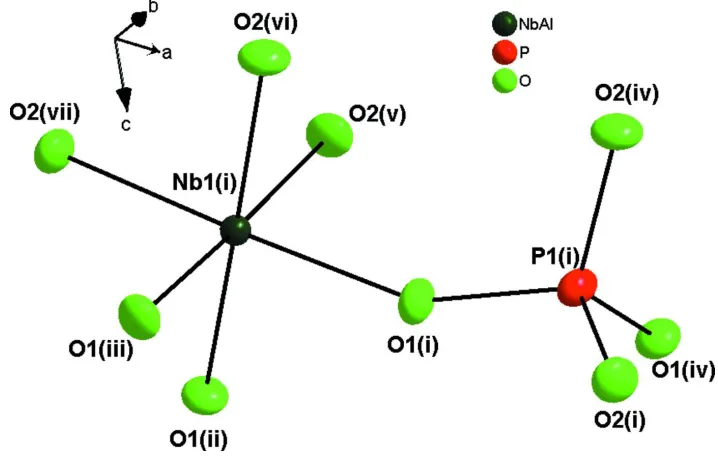
As shown in Fig. 1, the asymmetric unit of Al0.5Nb1.5(PO4)3 contains a single P and Al/Nb atoms. The P atom is four
coordinated by four oxygen atoms, forming isolated PO4 tetrahedron. Al and Nb atoms are in mixed occupancy disorder
locating at the 3 axes with the moral ratio of 1: 3, being coordinated by six oxygen atoms to form Al/NbO6 octahedra.
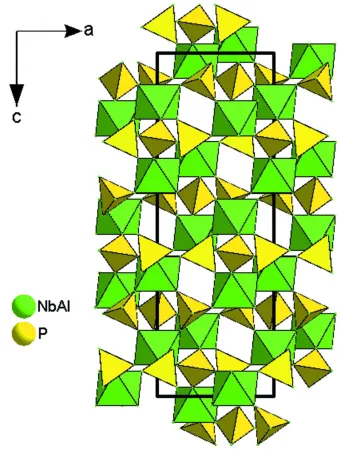
Al/NbO6 octahedra and PO4 tetrahedra are further interconnected via corner-sharing O atoms to form the
three-dimensional framework of Al0.5Nb1.5(PO4)3, as shown in Fig. 2. The Al/Nb—O bonds have two groups of different
distances, that is, 1.913 (3) and 1.949 (3) Å. The PO4 tetrahedra are regular with two groups of P–O bond distances of
1.521 (3) and 1.529 (3) Å, and O–P–O bond angles weak dispersion from 107.91 (16) to 111.3 (2)o, which is about the
ideal value of 109.48°. On the other hand, this structure can be viewed as a NZP structure, in which the Na atom sites
empty and the Zr atoms site are replaced by Al and Nb atoms in disordered manner on the principle of aliovalent pair
combination Zr4+ → 0.25 A l3+ + 0.73 N b5+.
S2. Experimental
The finely ground reagents K2CO3, Al2O3, Nb2O5 and NH4H2PO4 were mixed in the molar ratio K: Al: Nb: P = 1: 3: 10:
20, were placed in a Pt crucible, and heated at 573 K for 4 h. The mixture was then re-ground and heated at 1473 K for 20
h, then cooled to 973 K at a rate of 3 K h-1, and finally quenched to room temperature. A few colorless crystals of the title
The structure contains substitutional disorder in which Al1 and Nb1 occupy the same position. The atomic positional and
anisotropic displacement parameters of Al1 and Nb1 atoms were constrained to be identical by using EADP and EXYZ
constraint instructions (SHELXL97; Sheldrick, 2008). The ratio of Al1 and Nb1 was fixed to 1: 3 to achieve charge
[image:3.610.124.483.154.386.2]balance.
Figure 1
The expanded asymmetric unit of Al0.5Nb1.5(PO4)3 showing the coordination environments of the P and Al/Nb atoms. The
displacement ellipsoids are drawn at the 50% probability level.[Symmetry codes: (i) x, y, z; (ii) -x + y, -x, z; (iii) -y, x-y, z;
(iv) 0.66667 - x, 0.33333 - x + y, 0.83333 - z; (v) 0.66667 - y, 0.33333 - x, -0.16667 + z; (vi) -1/3 + x, 1/3 + x-y, -0.16667
Figure 2
View of the crystal structure of Al0.5Nb1.5(PO4)3 along [010]. PO4 and Al/NbO6 units are given in the polyhedral
representation.
aluminium(III) triniobium(V) phosphate(V)
Crystal data Al0.5Nb1.5(PO4)3 Mr = 437.76 Trigonal, R3c Hall symbol: -R 3 2"c a = 8.5679 (6) Å
Dx = 3.133 Mg m−3
Mo Kα radiation, λ = 0.71073 Å Cell parameters from 247 reflections θ = 2.6–25.0°
Bruker SMART 1K CCD area-detector diffractometer
Radiation source: fine-focus sealed tube Graphite monochromator
ω scans
Absorption correction: multi-scan (SADABS; Bruker, 1997) Tmin = 0.704, Tmax = 0.885
2295 measured reflections 302 independent reflections 298 reflections with I > 2σ(I) Rint = 0.029
θmax = 25.7°, θmin = 3.3° h = −7→10
k = −10→8 l = −26→21
Refinement Refinement on F2 Least-squares matrix: full R[F2 > 2σ(F2)] = 0.027 wR(F2) = 0.064 S = 1.39 302 reflections 27 parameters 0 restraints
Primary atom site location: structure-invariant direct methods
Secondary atom site location: difference Fourier map
w = 1/[σ2(F
o2) + (0.0163P)2 + 17.3988P] where P = (Fo2 + 2Fc2)/3
(Δ/σ)max < 0.001 Δρmax = 0.45 e Å−3 Δρmin = −0.39 e Å−3
Special details
Geometry. All e.s.d.'s (except the e.s.d. in the dihedral angle between two l.s. planes) are estimated using the full covariance matrix. The cell e.s.d.'s are taken into account individually in the estimation of e.s.d.'s in distances, angles and torsion angles; correlations between e.s.d.'s in cell parameters are only used when they are defined by crystal symmetry. An approximate (isotropic) treatment of cell e.s.d.'s is used for estimating e.s.d.'s involving l.s. planes.
Refinement. Refinement of F2 against ALL reflections. The weighted R-factor wR and goodness of fit S are based on F2, conventional R-factors R are based on F, with F set to zero for negative F2. The threshold expression of F2 > σ(F2) is used only for calculating R-factors(gt) etc. and is not relevant to the choice of reflections for refinement. R-factors based on F2 are statistically about twice as large as those based on F, and R- factors based on ALL data will be even larger.
Fractional atomic coordinates and isotropic or equivalent isotropic displacement parameters (Å2)
x y z Uiso*/Ueq Occ. (<1)
Nb1 0.0000 0.0000 0.35896 (3) 0.0091 (2) 0.75
Al1 0.0000 0.0000 0.35896 (3) 0.0091 (2) 0.25
P1 0.3333 0.38482 (17) 0.4167 0.0143 (4)
O1 0.1675 (4) 0.1984 (4) 0.40796 (12) 0.0173 (6)
O2 0.3025 (4) 0.4696 (4) 0.47305 (12) 0.0194 (7)
Atomic displacement parameters (Å2)
U11 U22 U33 U12 U13 U23
Nb1 0.0092 (3) 0.0092 (3) 0.0090 (4) 0.00460 (14) 0.000 0.000
Al1 0.0092 (3) 0.0092 (3) 0.0090 (4) 0.00460 (14) 0.000 0.000
P1 0.0179 (8) 0.0126 (5) 0.0141 (7) 0.0089 (4) −0.0043 (6) −0.0022 (3)
O1 0.0172 (15) 0.0132 (14) 0.0183 (14) 0.0053 (13) −0.0039 (12) −0.0051 (11)
Geometric parameters (Å, º)
Nb1—O1 1.913 (3) P1—O2 1.521 (3)
Nb1—O1i 1.913 (3) P1—O2vi 1.521 (3)
Nb1—O1ii 1.913 (3) P1—O1vi 1.529 (3)
Nb1—O2iii 1.949 (3) P1—O1 1.529 (3)
Nb1—O2iv 1.949 (3) O2—Al1vii 1.949 (3)
Nb1—O2v 1.949 (3) O2—Nb1vii 1.949 (3)
O1—Nb1—O1i 91.63 (12) O1ii—Nb1—O2v 89.81 (12)
O1—Nb1—O1ii 91.63 (12) O2iii—Nb1—O2v 88.66 (12)
O1i—Nb1—O1ii 91.63 (12) O2iv—Nb1—O2v 88.66 (12)
O1—Nb1—O2iii 89.81 (12) O2—P1—O2vi 111.3 (2)
O1i—Nb1—O2iii 89.86 (12) O2—P1—O1vi 110.32 (15)
O1ii—Nb1—O2iii 177.90 (12) O2vi—P1—O1vi 107.91 (16)
O1—Nb1—O2iv 177.90 (12) O2—P1—O1 107.91 (16)
O1i—Nb1—O2iv 89.81 (12) O2vi—P1—O1 110.32 (15)
O1ii—Nb1—O2iv 89.86 (12) O1vi—P1—O1 109.1 (2)
O2iii—Nb1—O2iv 88.66 (12) P1—O1—Nb1 152.96 (18)
O1—Nb1—O2v 89.86 (12) P1—O2—Al1vii 155.8 (2)
O1i—Nb1—O2v 177.90 (12) P1—O2—Nb1vii 155.8 (2)