1
Multi-Document Discourse Parsing
Using Traditional and Hierarchical Machine Learning
Erick Galani Maziero and Thiago Alexandre Salgueiro Pardo
Núcleo Interinstitucional de Linguística Computacional (NILC)
Instituto de Ciências Matemáticas e de Computação, Universidade de São Paulo
{erickgm,taspardo}@icmc.usp.br
Abstract. Multi-document handling is essential today, when many documents on the same topic are produced, especially considering the Web. Both readers and computer applications can benefit from a discourse analysis of this multi-document content, since it demonstrates clearly the relations among portions of these documents. This work aims to identify such relations automatically using machine learning techniques. Particularly, this work focuses on the identification of relations predicted by the Cross-document Structure Theory (CST). The obtained results improve the state of the art.
1. Introduction
In the electronic media, there are many sources reporting the same topic from the same or different perspectives. Online newspapers are an example: the same event is reported on different news portals. In general, these documents are produced soon after the event and, subsequently, other documents are generated to update the news. Therefore, readers interested on a current event will find an endless number of texts, and it will be crucial to pick just a few to read. This requires a great effort on the part of readers. Since these texts are produced by different sources at different moments, they may contain contradictory or redundant portions. For instance, the two sentences below, S1 and S2, from different documents, are contradictory regarding the number of bombs in an attack, but both also present overlapping information (that there was a bomb):
S1: The downtown Public Finance Department building was hit by three homemade bombs. S2: The Public Finance Department was also hit by a bomb.
It is believed that, when readers know how the parts of multiple documents are related, they can, for example, ignore redundancy, find contradictions, and understand the temporal evolution of a fact or event, which would allow them to approach the information in which they are interested in a more organized way. In another vein, this type of knowledge might also be useful for several computer applications, such as web browsers and automatic summarizers, which would have more information available to produce their results and meet the users’ needs more efficiently. Some theories or models on multi-document relationships have been proposed for this purpose. One of the most used is the Cross-document Structure Theory (CST) (Radev, 2000).
classifiers improved the state of the art. It is also demonstrated that the task in question can be characterized as a hierarchical problem.
In Section 2, related work on multi-document parsing is briefly presented. In Section 3, we describe the proposed architecture for the multi-document parser and discuss the methodology for identifying multi-document relations, introducing the experiments carried out with machine learning. Finally, Section 4 provides conclusions and future work.
2. Related work
Although useful, not many researchers have defined and applied multi-document representation models, since instantiating such models with real texts is a difficult task. Pioneer work was carried out by Trigg (1983) and Trigg & Weiser (1987). They employed a set of relations to (manually) structure scientific text portions and their relations in semantic networks. Radev & Mckeown (1998) used relations among parts of several texts to perform multi-document summarization. These previous works and the work of Mann & Thompson (1987) were the basis for the CST discourse model proposed by Radev (2000). In a different line, Afantenos et al. (2004) proposed a methodology to define and identify multi-document relations, using an ontology and a set of related semantic templates.
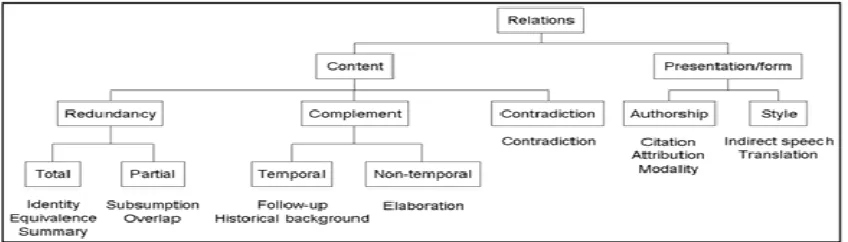
[image:2.595.85.509.445.566.2]Using CST, Aleixo & Pardo (2008a) developed the first step of multi-document parsing for the Portuguese language, when they detected pairs of sentences to be associated. Later, these and other authors (Aleixo & Pardo, 2008b; Cardoso et al., 2011) built an annotated corpus of news texts, which is called CSTNews and is used in this paper. During the manual parsing of this corpus, it was perceived that the relations could be organized in a typology that takes into account some features that the defined relation groups have in common (Maziero et al., 2010). This typology is illustrated in Figure 1, where the relations are at the lowest level of the hierarchy.
Figure 1. Typology of CST relations
Some relations deal mainly with the “content” of sentences. In this group, the “contradiction” among contents, the “redundancy”, which can be “total” or “partial”, and the “complementarity” among contents are analyzed, taking into consideration the “temporal” or “non-temporal” aspect of this feature. Other relations deal mainly with the “form” of sentences, i.e., how they convey information, considering their “source/authorship” and the writing “style”. The relations in this group can occur jointly with some other relation from the “content” group, since the sentence pair under analysis will always have a similar content.
obtained average values of 45% for precision, 31% for coverage, and 35% for f-measure. Several other works tried to identify some relations for varied purposes. Miyabe et al. (2008) tried to identify Equivalence and Transition (very similar to the CST Contradiction) relations between sentence pairs, using a Support Vector Machine (SVM) classifier, and obtained an f-measure of 75.5% for Equivalence and of 45.6% for Transition. Zahri & Fukumoto (2011) also used SVM to identify the relations Identity, Paraphrase,
Subsumption, Overlap, and Elaboration, but did not report any evaluation. Ohki et al. (2011) dealt with the identification of the relations Entailment, Contradiction, Confinement
(which represents the union of Entailment and Contradiction relations) and Unknown for Japanese. Interpreting semantic templates extracted from the sentences, these authors reported that the Confinement relation is recognized with an f-measure of 61%. Maziero et al. (2010) reported state of the art results with the application of a decision tree algorithm (J48) to identify a large group of relations (the “content” group in the CST typology reproduced in Figure 1), achieving average precision, recall and f-measure of 44%. This last work is the basis for this paper, which builds on it by proposing new ways of exploring machine learning techniques.
3. The multi-document parser
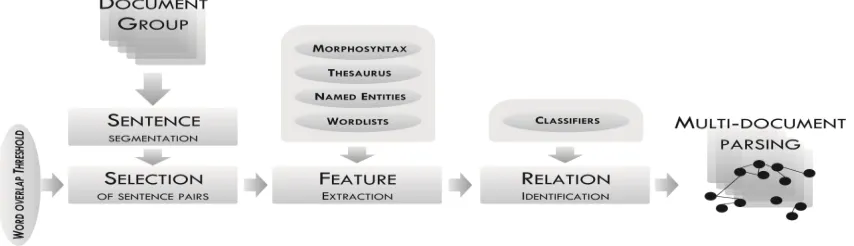
[image:3.595.87.514.380.503.2]In this work, a multi-document parser was developed following CST. Figure 2 illustrates its initial architecture.
Figure 2. Multi-document Parser Architecture
A group of texts on the same topic (coming from web portals, as GoogleNews, for instance) is the input of the process. These texts are automatically segmented in sentences. As this work considers CST relations among pairs of sentences, any combination between sentences in the several documents is checked in accordance with the measure word overlap
documents under analysis and the edges are the identified relations. It is interesting to notice that this graph is probably not fully connected, since not all sentence pairs present CST relations.
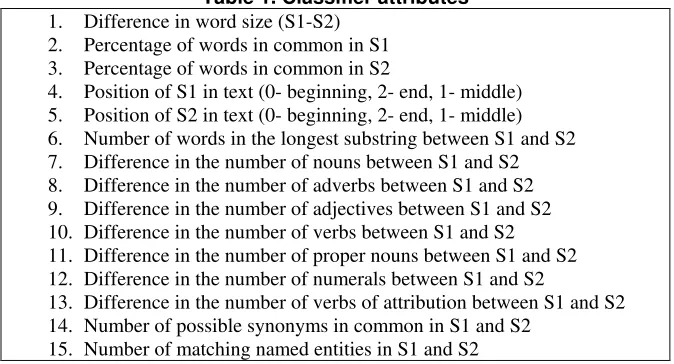
[image:4.595.130.467.224.406.2]Several machine learning techniques with different configurations for producing classifiers have been explored, so that it was possible to choose the best scenario for the task. Table 1 shows the features/attributes extracted from each sentence pair used to generate the classifiers. After this extraction, all features are normalized to avoid possible classification discrepancies.
Table 1. Classifier attributes
1. Difference in word size (S1-S2)
2. Percentage of words in common in S1
3. Percentage of words in common in S2
4. Position of S1 in text (0- beginning, 2- end, 1- middle) 5. Position of S2 in text (0- beginning, 2- end, 1- middle)
6. Number of words in the longest substring between S1 and S2
7. Difference in the number of nouns between S1 and S2
8. Difference in the number of adverbs between S1 and S2
9. Difference in the number of adjectives between S1 and S2
10. Difference in the number of verbs between S1 and S2
11. Difference in the number of proper nouns between S1 and S2
12. Difference in the number of numerals between S1 and S2
13. Difference in the number of verbs of attribution between S1 and S2
14. Number of possible synonyms in common in S1 and S2
15. Number of matching named entities in S1 and S2
The first six features were obtained using only text surface information, working with the words from the sentences. These features help to identify information overlap between sentences, since sentences with redundant information present word overlap. To extract features 7 to 12, it was employed a part of speech tagger for Brazilian Portuguese (Aires et al., 2000), with a precision of more than 96%. These features do not check the word itself, but the amount of words in the same class that has been found in the sentences as a sign that there is a content relation between sentences in a pair. The features 13 and 14 were obtained using the syntactic parser Palavras (Bick, 2000), which lemmatize verbs as well. The lemmatization was necessary to perform a search in a list of verbs of attribution to calculate the value of the attribute 13. This feature aims particularly at identifying the relations
Attribution and Citation, where there is an attribution indicator, especially a verb of attribution or other indicator of attribution, such as “according to…”, “as stated by…”, etc. As to the feature 14, a synonym database was used (Maziero et al., 2008). In this feature, a list of synonym identifiers was compiled for each word, ignoring the stopwords. After matching the lists for each word from each sentence, the feature value was generated. The synonym database is fundamental to identify overlap when the words are not identical, but belong to the same set of synonyms. It is important to notice that, at this moment, the syntactic parser could be replaced by a part of speech tagger and a lemmatizer. However, in future work, we envision the creation of syntax-based symbolic rules for identifying some relations. So, the syntactic analysis, used to generate some features, is stored to be used in the future. The last feature was calculated after the processing performed by the named entity recognizer Rembrandt (Cardoso, 2008), which identified in each sentence pair under analysis the common named entities to generate the feature value. This sharing of named entities may indicate that the sentences are about the same topic.
according the CST by four experts and the kappa agreement values (Carletta, 1996) for this task were computed for the following 3 items: relations, directionality of relations and type of relations (according to the typology shown in Figure 1). The results were 0.50, 0.44 and 0.61, respectively (zero represents the worst case and 1 the optimal agreement). Given the subjectivity of this task, such values are considered good.
In each experiment that was carried out in this paper, classifiers were developed and compared using the tool WEKA (Witten & Frank, 2005). In this comparison, a paired T-test was applied (with a 95% confidence interval) to point out the best classifier. The techniques to develop the classifiers were: NaiveBayes, Support Vector Machine (SVM), and decision tree (J48). NaiveBayes is a probabilistic technique; SVM is mathematical; and J48 is symbolic. In this paper we show the results only for the techniques that produced the best results.
Some scenarios have been explored during the development of classifiers. Two multi-class classifiers (they seek to identify one among several classes for each instance) were created: one considering all CST relations and other with just some content relations – the most frequent ones. Given that more than one relation may happen for a sentence pair, a multi-label classifier (it identifies more than one class for the same instance) was developed. The typology of CST relations also allowed for the development of two hierarchical classifiers (they take into consideration the hierarchy). Finally, we explored the development of binary classifiers (they consider only two classes in the decision process) for the most frequent relations in the corpus. In this paper we show the results for only three experiments, namely, the multi-class classifier for content relations, the hierarchical classifiers, and the binary classifiers. These classifiers produced the best results. We used ten-fold cross-validation over the CSTNews corpus.
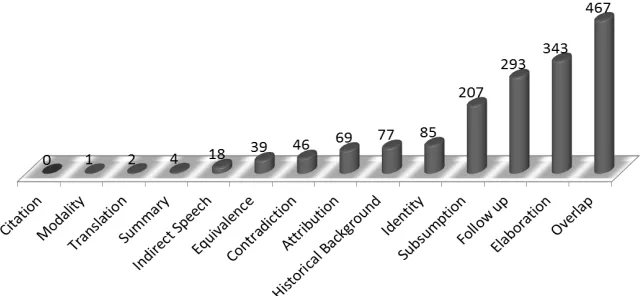
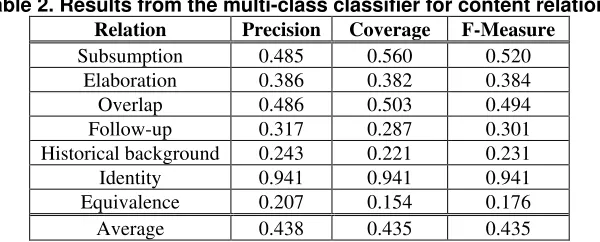
The decision for developing some classifiers that considered only the content relations – which were the most frequent ones in the corpus – was due to the unbalanced data found in the corpus (the frequency of relations is shown in Figure 3). Table 2 displays the results from the classifier for each content relation (using the algorithm J48), except for
[image:5.595.138.459.504.652.2]Summary, and Contradiction, given their low frequency in the corpus.
Figure 3. Frequency of relations in the CSTNews corpus
Table 2. Results from the multi-class classifier for content relations Relation Precision Coverage F-Measure
Subsumption 0.485 0.560 0.520
Elaboration 0.386 0.382 0.384
Overlap 0.486 0.503 0.494
Follow-up 0.317 0.287 0.301
Historical background 0.243 0.221 0.231
Identity 0.941 0.941 0.941
Equivalence 0.207 0.154 0.176
Average 0.438 0.435 0.435
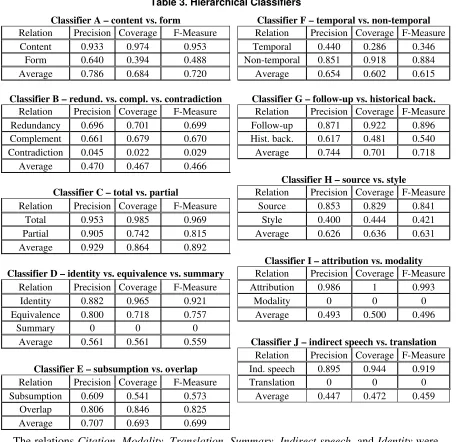
Exploring the hierarchy of the typology of relations, two hierarchical classifiers have been developed according to the Top-Down and Big-Bang approaches. For a comparison between these approaches, see Freitas & Carvalho (2007). In the Top-Down approach, a classifier is used at each level of the typology. For example, at the first level, a classifier is used to choose between “content” and “form” groups. Supposing that the “content” is the selected group, another classifier is then used to choose between “redundancy”, “complement” and “contradiction” subgroups, and so on for each typology branch. When the lowest level of the hierarchy is reached, the process ends with the choice of a CST relation. Table 3 shows the results for each classifier produced according to the Top-Down approach, using the J48 technique. One may see, for instance, that the first classifier (classifier A) decides if a sentence pair contains a “content” or a “form” relation with measures of 95.3% and 48.8% for each of these classes, respectively. All average f-measures were higher than 45%. This proves the potential of this approach to identify relations and corroborates that the CST typology makes sense. However, some relations still produced very low results, such as Modality, Translation and Summary.
Regarding the unbalanced data for CST relations, when these are grouped according to the typology discussed, the scenario becomes better. When “form” group is chosen, for instance, the examples in this branch will not be so unbalanced, since the relations of this type will be judged separately from the content relations (by another classifier). It is interesting to notice that, when the “form” branch is followed and one relation of this group is chosen, it is worth following the “content” group too, since “form” relations usually happen with “content” relations. This Top-Down method allows such strategy to be applied. Following the presented procedure, the classifiers were combined and evaluated, obtaining 35.3% of general accuracy (differently from the numbers in Table 3, which were computed for each class independently).
The alternative hierarchical method – Big-Bang – performs the relation identification in just one step, taking into account the relation hierarchy as a whole. This approach consists of an alteration in the C4.5 algorithm (Quinlan, 1993), described by Clare (2003). Using this method, a general accuracy of 58.7% was obtained for the classification. However, differently from the previous approach, the Big-Bang technique may not reach the leaves of the hierarchy, stopping the classification when it is more advantageous. At the moment, this strategy does not fit well with our intended task, but is nonetheless interesting, since it may indicate a relation type instead of the relations themselves.
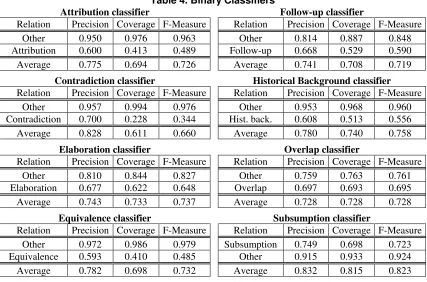
is used in the choice of a class, and the option will be for the highest. The results for each binary classifier (using the J48 machine learning method) are shown in Table 4.
Table 3. Hierarchical Classifiers
Classifier A – content vs. form Classifier F – temporal vs. non-temporal
Relation Precision Coverage F-Measure Relation Precision Coverage F-Measure
Content 0.933 0.974 0.953 Temporal 0.440 0.286 0.346
Form 0.640 0.394 0.488 Non-temporal 0.851 0.918 0.884
Average 0.786 0.684 0.720 Average 0.654 0.602 0.615
Classifier B – redund. vs. compl. vs. contradiction Classifier G – follow-up vs. historical back.
Relation Precision Coverage F-Measure Relation Precision Coverage F-Measure
Redundancy 0.696 0.701 0.699 Follow-up 0.871 0.922 0.896
Complement 0.661 0.679 0.670 Hist. back. 0.617 0.481 0.540
Contradiction 0.045 0.022 0.029 Average 0.744 0.701 0.718
Average 0.470 0.467 0.466
Classifier H – source vs. style
Classifier C – total vs. partial Relation Precision Coverage F-Measure
Relation Precision Coverage F-Measure Source 0.853 0.829 0.841
Total 0.953 0.985 0.969 Style 0.400 0.444 0.421
Partial 0.905 0.742 0.815 Average 0.626 0.636 0.631
Average 0.929 0.864 0.892
Classifier I – attribution vs. modality Classifier D – identity vs. equivalence vs. summary Relation Precision Coverage F-Measure
Relation Precision Coverage F-Measure Attribution 0.986 1 0.993
Identity 0.882 0.965 0.921 Modality 0 0 0
Equivalence 0.800 0.718 0.757 Average 0.493 0.500 0.496
Summary 0 0 0
Average 0.561 0.561 0.559 Classifier J – indirect speech vs. translation
Relation Precision Coverage F-Measure
Classifier E – subsumption vs. overlap Ind. speech 0.895 0.944 0.919
Relation Precision Coverage F-Measure Translation 0 0 0
Subsumption 0.609 0.541 0.573 Average 0.447 0.472 0.459
Overlap 0.806 0.846 0.825
Average 0.707 0.693 0.699
selected for a sentence pair, it would be possible to select the “content” relation that was best scored.
Table 4. Binary Classifiers
Attribution classifier Follow-up classifier
Relation Precision Coverage F-Measure Relation Precision Coverage F-Measure
Other 0.950 0.976 0.963 Other 0.814 0.887 0.848
Attribution 0.600 0.413 0.489 Follow-up 0.668 0.529 0.590
Average 0.775 0.694 0.726 Average 0.741 0.708 0.719
Contradiction classifier Historical Background classifier
Relation Precision Coverage F-Measure Relation Precision Coverage F-Measure
Other 0.957 0.994 0.976 Other 0.953 0.968 0.960
Contradiction 0.700 0.228 0.344 Hist. back. 0.608 0.513 0.556
Average 0.828 0.611 0.660 Average 0.780 0.740 0.758
Elaboration classifier Overlap classifier
Relation Precision Coverage F-Measure Relation Precision Coverage F-Measure
Other 0.810 0.844 0.827 Other 0.759 0.763 0.761
Elaboration 0.677 0.622 0.648 Overlap 0.697 0.693 0.695
Average 0.743 0.733 0.737 Average 0.728 0.728 0.728
Equivalence classifier Subsumption classifier
Relation Precision Coverage F-Measure Relation Precision Coverage F-Measure
Other 0.972 0.986 0.979 Subsumption 0.749 0.698 0.723
Equivalence 0.593 0.410 0.485 Other 0.915 0.933 0.924
Average 0.782 0.698 0.732 Average 0.832 0.815 0.823
Nowadays, the classifiers are attributing only one relation to each sentence pair. This is the cause for the low general accuracy values (despite of the good values for precision and recall for each class), since sentence pairs with more than one relation (which is usual) will have only one relation detected (the other possible relations will be considered as misclassified instances).
Compared with the results obtained by Zhang et al. (2003) and Zhang & Radev (2004), the values of the classifiers investigated in this research were better, demonstrating the potential of the developed methodology. It is worth emphasizing that these are results obtained for different languages and training corpora, even though this comparison may show possible paths to improve results in the field, also giving an idea of the state of the art in the area. The results of this work also show that the hierarchical classification of multi-document relations is promising. Its results, as well as the results for the binary classifiers, were better than the ones reported by Maziero et al. (2010). It is also worth noticing that decision trees (J48) produced the best results in all the cases. SVM also did well in some cases, with statistical tests showing that the differences were not significant.
Table 5. General accuracies for unbalanced and balanced data Classification strategy Unbalanced data Balanced data
Multi-class 40.2% 72.5%
Hierarchical 35.3% 75.6%
Binary 27.5% 72.4%
For comparison and validation procedures, we also simulated a baseline method for parsing that simply assigns the most frequent relation (Overlap) to every sentence pair. It produces a general accuracy of 28.3%, which is outperformed by some classifiers explored in this work. Finally, we also performed attribute selection before generating the classifiers, but only some attributes were ignored and the results were the same.
5. Conclusions and future work
This work will allow for the automatic handling of multiple documents in Portuguese. Both users and computer applications will benefit from it. Regarding the techniques employed to develop the parser, as some relations have a low frequency in the corpus, symbolic rules to identify these relations are being manually prepared. Some rules look simple to develop, since some relations have clear signals in text. For instance, the Indirect speech relation might be identified by finding its direct counterpart, usually marked by a dash symbol in the text, and the Translation relation might be easily detected by using a multi-lingual dictionary. We believe that approaching the problem with classifiers and rules in a hybrid approach may produce better results. In fact, we think that the best approach is to use classification for the “content” relations and the rules to “form” relations and some low frequency “content” relations (e.g., the Contradiction relation). This way, the multi-label problem might be naturally solved, since these two strategies might be simultaneously applied.
Acknowledgments
The authors are grateful to FAPESP for supporting this work.
References
Afantenos, S.D.; Doura, I.; Kapellou, E.; Karkaletsis, V. (2004). Exploiting Cross-Document
Relations for Multi-document Evolving Summarization. In the Proceedings of SETN, pp.
410-419.
Aires, R.V.X.; Aluísio, S.M.; Kuhn, D.C.S.; Andreeta, M.L.B.; Oliveira Jr., O.N. (2000). Combining Multiple Classifiers to Improve Part of Speech Tagging: A Case Study for
Brazilian Portuguese. In the Proceedings of the Brazilian AI Symposium, pp. 20-22.
Aleixo, P. and Pardo, T.A.S. (2008a). Finding Related Sentences in Multiple Documents for
Multi-document Discourse Parsing of Brazilian Portuguese Texts. In Anais do VI Workshop
em Tecnologia da Informação e da Linguagem Humana – TIL, pp. 298-303. Vila Velha, Espírito Santo.
Aleixo, P. and Pardo, T.A.S. (2008b). CSTNews: Um Córpus de Textos Jornalísticos Anotados
segundo a Teoria Semântico-Discursiva Multi-documento CST (Cross-document Structure Theory). Série de Relatórios Técnicos do Instituto de Ciências Matemáticas e de Computação, Universidade de São Paulo, no. 326. São Carlos-SP, May, 12p.
Bick, E. (2000). The Parsing System "Palavras": Automatic Grammatical Analysis of
Portuguese in a Constraint Grammar Framework. PhD thesis. Aarhus University. Denmark University Press.
Cardoso, N. (2008). REMBRANDT – Reconhecimento de Entidades Mencionadas Baseado em
Relações e Análise Detalhada do Texto. In C. Mota e D. Santos (eds.), Desafios na avaliação
Cardoso, P.C.F.; Maziero, E.G.; Jorge, M.L.C.; Seno, E.M.R.; Di Felippo, A.; Rino, L.H.M.; Nunes, M.G.V.; Pardo, T.A.S. (2011). CSTNews - A Discourse-Annotated Corpus for Single and Multi-Document Summarization of News Texts in Brazilian Portuguese. In the Proceedings of the 3rd RST Brazilian Meeting, pp. 1-18. October 26, Cuiabá/MT, Brazil. Carletta, J. (1996). Assessing Agreement on Classification Tasks: the Kappa Statistic.
Computational Linguistics, Vol. 22, N. 2, pp. 249-254.
Clare, A. (2003). Machine learning and data mining for yeast functional genomics. PhD thesis.
University of Wales Aberystwyth.
Freitas, A. and Carvalho, A.C.P.F. (2007). A Tutorial on Hierarchical Classification with
Applications in Bioinformatics. In D. Taniar (ed.), Research and Trends in Data Mining
Technologies and Applications: Advances in Data Warehousing and Mining, pp. 176-209.
Mann, W.C. and Thompson, S.A. (1987). Rhetorical Structure Theory: A Theory of Text
Organization. Technical Report ISI/RS-87-190.
Maziero, E.G.; Jorge, M.L.C.; Pardo, T.A.S. (2010). Identifying Multi-document Relations. In the Proceedings of the 7th International Workshop on Natural Language Processing and Cognitive Science - NLPCS, pp. 60-69.
Maziero, E.G.; Pardo, T.A.S.; Di Felippo, A.; Dias-da-Silva, B.C. (2008). A Base de Dados Lexical e a Interface Web do TeP 2.0 - Thesaurus Eletrônico para o Português do Brasil. In Anais do VI Workshop em Tecnologia da Informação e da Linguagem Humana – TIL, pp. 390-392. Vila Velha, Espírito Santo. October, 26-28.
Miyabe, Y.; Takamura, H.; Okumura, M. (2008). Identifying cross-document relations between
sentences. In the Proceedings of the 3rd International Joint Conference on Natural Language
Processing, pp 141-148.
Ohki, M.; Nichols, E.; Matsuyoshi, S.; Murakami, K.; Mizuno, J.; Masuda, S.; Inui, K.;
Matsumoto, Y. (2011). Recognizing Confinement in Web Texts. In the Proceedings of the
Ninth International Conference on Computational Semantics, pp. 215-224.
Quinlan, R. (1993). C4.5: Programs for Machine Learning. Morgan Kaufmann.
Radev, D.R. (2000). A common theory of information fusion from multiple text sources, step
one: Cross-document structure. In the Proceedings of the 1st ACL SIGDIAL Workshop on
Discourse and Dialogue.
Radev, D.R. and McKeown, K. (1998). Generating natural language summaries from multiple
on-line sources. Computational Linguistics, Vol. 24, N. 3, pp. 469-500.
Trigg, R. (1983). A Network-Based Approach to Text Handling for the Online Scientific
Community. PhD dissertation. Department of Computer Science, University of Maryland.
Trigg, R. and Weiser, M. (1987). TEXTNET: A network-based approach to text handling. ACM
Transactions on Office Information Systems, Vol. 4, N. 1, pp. 1-23.
Witten, I.H. and Frank, E. (2005). Data Mining: Practical machine learning tools and
techniques. Morgan Kaufmann.
Zahri, N. and Fukumoto, F. (2011). Multi-document Summarization Using Link Analysis Based
on Rhetorical Relations between Sentences. Computational Linguistics and Intelligent Text
Processing. Lecture Notes in Computer Science, Vol. 6609, pp. 328-338.
Zhang, Z.; Otterbacher, J.; Radev, D.R. (2003). Learning Cross-document Structural
Relationships using Boosting. In the Proceedings of the Twelfth International Conference on
Information and knowledge Management, pp. 124-130.
Zhang, Z. and Radev, D.R. (2004). Combining Labeled and Unlabeled Data for Learning