Large-Scale Corpus-Driven PCFG Approximation of an HPSG
Yi Zhang
LT-Lab, DFKI GmbH Saarbr¨ucken, Germany
Hans-Ulrich Krieger
LT-Lab, DFKI GmbH Saarbr¨ucken, Germany
Abstract
We present a novel corpus-driven approach towards grammar approximation for a lin-guistically deep Head-driven Phrase Struc-ture Grammar. With an unlexicalized prob-abilistic context-free grammar obtained by Maximum Likelihood Estimate on a large-scale automatically annotated corpus, we are able to achieve parsing accuracy higher than the originalHPSG-based model. Dif-ferent ways of enriching the annotations car-ried by the approximating PCFG are pro-posed and compared. Comparison to the state-of-the-art latent-variablePCFGshows that our approach is more suitable for the grammar approximation task where train-ing data can be acquired automatically. The best approximatingPCFG achieved ParsE-val F1 accuracy of 84.13%. The high
ro-bustness of thePCFGsuggests it is a viable way of achieving full coverage parsing with the hand-written deep linguistic grammars.
1 Introduction
Deep linguistic processing technologies have been evolving closely around the development of rich formalisms which typically introduce mild context-sensitivity. Examples of well-adopted frameworks include various Tree Adjoin-ing Grammars, Combinatory Categorial Gram-mars, Lexical Functional Grammars (with untyped Features Structures in F-structures), and Head-Driven Phrase Structure Grammars (with Typed Featured Structures). Such formalisms have been successfully powering the modern formal linguis-tic studies. However, the intrinsic complexity ofdeeper formalisms1 hinders the deployment of
1
In the context of this paper, by deeper formalism we mean formalisms which are at least mildly context-sensitive,
such resources in language technology applica-tions.
TakeHPSG for example. The linguistic frame-work is built on top of the typed feature logic for-malisms (e.g., Carpenter (1992)). The monostratal representation integrates various syntactic and se-mantic information concerning a linguistic object (and all its sub-components) in a single typed fea-tures structure. And the integration of information and compatibility checking is achieved by the uni-ficationoperation. Such a formalism is especially suitable for developing and implementing a lin-guistic theory. But the lack of a polynomial upper-bound time complexity in unification-based pars-ing raises concerns of the processpars-ing efficiency.
Meanwhile, from the grammar engineering per-spective we see grammar developers constantly joggling between two somewhat conflicting goals: on the one hand, to describe the linguistic phenom-ena in a precisely constrained way; on the other hand, to achieve broad coverage when parsing un-seen real-world texts. As a result, many of these large-scale grammar implementations are forced to choose to either compromise the linguistic pre-ciseness, or to accept the low coverage in parsing. In this paper, we propose PCFG approxima-tion as a way to alleviate some of these issues in HPSG processing. While HPSG framework is great for linguistic description, we show that when carefully designed, a much simpler approximat-ing probabilistic context-free grammar can be ex-tracted automatically, and is capable of achieving good parsing accuracy while maintaining high ro-bustness and efficiency.
The rest of the paper is organized as the fol-lowing: Section 2 gives an overview ofHPSG as an linguistic theory and its application in parsing;
in a comparative sense to the context-free grammars.
Section 3 reviews the previous related work on
CFG approximation of HPSG; Section 4 presents the corpus-drivenPCFGapproximation with both internal and external annotations; Section 5 de-scribes the evaluation setup and results; Section 6 compares our approach with other related work on parsing (such as self-training), and foresees the ap-plication of the approximatingPCFGs; Section 7 concludes the paper.
2 Parsing with Head-Driven Phrase Structure Grammars
Head-Driven Phrase Structure Grammar (Pol-lard and Sag, 1994) is a constraint-based highly lexicalized non-derivational generative grammar framework. Based on a typed feature structures formalism, theHPSGtheory describes a small set of highly generalized linguistic principles, with which the rich information derived from the de-tailed lexical types interacts to produce precise lin-guistic interpretations.
Several large-scale HPSG-based NLP parsing systems have been built in the past decade. Among them are the Enju English & Chinese parser (Miyao et al., 2004; Yu et al., 2010), the
Alpinoparser for Dutch (van Noord, 2006), and the LKB & PET (Copestake, 2002; Callmeier, 2000) for English, German, Japanese and a dozen more other DELPH-IN2 grammars of various languages. These systems are successful show-cases of where modern grammar engineering con-tributes to the state-of-the-art parsing systems. With the modern processing techniques such as quasi-destructive unification (Tomabechi, 1991), quick check (Kiefer et al., 1999), ambiguity pack-ing (Oepen and Carroll, 2000) and selective un-packing (Zhang et al., 2007), the practical parsing efficiency has been greatly improved. But none of these changes the underlying formalism, there-fore the parser still can run into exponential pars-ing time in theory.
Another disadvantage of deep grammar lies in the difficulty of proper statistical modeling of the richer representation. For example, Abney (1997) shows that na¨ıve MLE is not consistent for unification-based grammars, and proposes ran-dom fields as an alternative. In practice, we see most HPSG parsing systems opt for a discrimi-native Maximum Entropy Model (MEM) for parse ranking on top of the hypothesis space licensed by
2http://www.delph-in.net/
theHPSGgrammar (Miyao and Tsujii, 2002; Mal-ouf and van Noord, 2004; Toutanova et al., 2005). For further efficiency, the hypothesis space of the
HPSGparses is pruned with supertagging or sym-bolicCFGfiltering rules (Matsuzaki et al., 2007) at early stages. It is however unclear how these sep-arate models can be unified to guide the best-first construction of HPSG parses without an exhaus-tive creation of the (packed) parse forest or ad hoc pruning.
Moreover, the heavily constraint-based nature of the grammar poses a difficult choice between linguistic preciseness and practical parsing robust-ness. As a result, manyHPSGparser implementa-tions have to sacrifice on the linguistic side in trade for a decent parsing coverage.
3 Related Work
Previous work in the direction ofHPSG approxi-mation has seen two major approaches: grammar-based approach and the corpus-driven approach.
The grammar-based approach (Kiefer and Krieger, 2004) tries to compile out a huge set of categories by flattening theTFSes into atomic symbols. This approach can in theory guarantee the equivalence of the grammars in both parsing and generation. However, in practice it generates billions ofCFGproductions. Even when carefully choosing a subset of theHPSGfeatures, the result-ing grammar is too large to be useful for parsresult-ing or generation.
The corpus-based approach (Krieger, 2007), on the other hand, builds the approximatingCFG by observing the growth of the chart when parsing texts with the HPSG. Passive edges on the chart represent the successful application ofHPSGrules, hence are modeled by an approximatingCFG pro-duction. Also, the symbols in CFG only carry partial information from a small set of feature-paths used inquick check(Kiefer et al., 1999), i.e., the frequently failed feature-paths in unification, hence the most discriminating ones.
Both approaches are symbolic in the sense that there is no probabilistic model produced to disam-biguate the CFG parses. In the case of corpus-based approach, one can also acquire frequency counts for eachCFGrule. But since not all passive edges occur in a full parse tree, and not all parses are correct, the statistics obtained is not suitable for the parsing task.
two-stage parsing setup, where thePCFGpredicts derivations in the first step, followed by the replay of unification. The experiment was carried out on a relatively small grammar. And due to the availability of large-scale treebank at the time, un-supervised Inside-Outside algorithm was used for the probability estimation.
Cahill et al. (2004) reported an application of the PCFG approximation technique in LFG pars-ing and the recovery of long distance dependen-cies on the f-structures. Two main differences be-tween their work and the one presented in this pa-per should be noted. First, the approximation tar-get for Cahill et al. (2004) is a treebank-induced grammar, while this paper targets for a large-scale hand-crafted grammar. Second, the monos-tratal representation in HPSG entails that a cor-rect derivation tree will also guarantee the corcor-rect recovery of unbounded dependencies represented by the underlying feature structures, while in the
LFG universe these have to be resolved on the f-structures instead of the c-f-structures.
4 Probabilistic Context-Free Approximation ofHPSG
Unlike the approaches in previous work which approximates the symbolic HPSG alone, we pro-pose a PCFG approach which approximates the combination of the grammar and its disambigua-tion model. This allows us to closely model the deep parser behavior with a single approximation
PCFG.
For the experiments in this paper, we use the English Resource Grammar (ERG; Flickinger (2002)) and the accompanying treebanks (see Sec-tion 5.1 for detailed descripSec-tions). But the tech-nique presented in this section can be easily ap-plied to other languages andHPSG grammar im-plementations.
4.1 Derivation Normalization
A completeHPSGanalysis is recorded in a deriva-tion tree. The terminals of the tree are surface tokens in the sentence. The preterminals are the names of the activated lexical entries. The non-(pre)terminal nodes (except for the root) corre-spond to grammar rules applied to create theHPSG
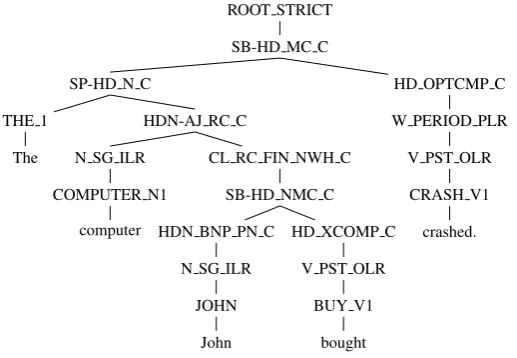
signs. An extra root node denotes the“root” con-dition fulfilled to license a completeHPSGparse. An example derivation ofERGis given in Figure 1. Before extracting the approximation grammar,
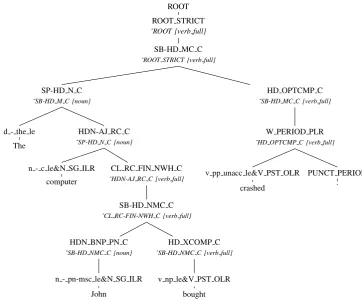
we perform several normalizing transformations on the original derivations. First, in order to ac-quire an unlexicalized grammar, we replace the lexical entry names on the preterminal with their corresponding lexical type defined in theERG lex-icon. Second, we collapse the unary chain of mor-phological rules together with the preterminal lex-ical types to form the so-called “supertag”. As shown in Figure 1, these unary rules always oc-cur above the preterminals and below any syntac-tic constructional rules. Pracsyntac-tice shows that this helps improve the parsing accuracy of thePCFG. The last normalization concerns with the treatment of punctuations. In ERG (as for release 1010), punctuations are treated as affixes instead of in-dependent tokens by themselves. For better com-patibility with other annotations, we convert the original punctuation-attaching unary rule (applied above the morphological rules and below the syn-tactic rules) into a binary branch. The normalized derivation tree of the previous example is shown in Figure 2. It is worth noting that all the normalizing steps can be reversed without introducing ambigu-ity. The approximatingPCFGs will be extracted from the normalized derivations, while the evalu-ation will be reported on the original derivevalu-ations (though the tagging accuracy will be calculated on the lexical types).
4.2 PCFGwith External Annotation
Although the derivation tree records all necessary information to recover the complete HPSG anal-ysis (i.e. carrying out unification on each node of the tree with corresponding grammar rules and lexical entries), it does not always encode the nec-essary information in an explicit way, due to the fact that rules inHPSGare highly generalized (see Section 2). For example, the rule “hd-cmp u c”
inERGcan be used to express a head-complement composition without specifying the syntactic cat-egory of the head. Thus a node marked only with
infor-ROOT STRICT
SB-HD MC C
SP-HD N C
THE 1
The
HDN-AJ RC C
N SG ILR
COMPUTER N1
computer
CL RC FIN NWH C
SB-HD NMC C
HDN BNP PN C
N SG ILR
JOHN
John
HD XCOMP C
V PST OLR
BUY V1
bought
HD OPTCMP C
W PERIOD PLR
V PST OLR
CRASH V1
crashed.
Figure 1: Example of an originalERGderivation tree
ROOT
ROOT STRICT
SB-HD MC C
SP-HD N C
d - the le
The
HDN-AJ RC C
n - c le&N SG ILR
computer
CL RC FIN NWH C
SB-HD NMC C
HDN BNP PN C
n - pn-msc le&N SG ILR
John
HD XCOMP C
v np le&V PST OLR
bought
HD OPTCMP C
W PERIOD PLR
v pp unacc le&V PST OLR
crashed
PUNCT PERIOD
[image:4.595.171.430.134.313.2].
mation coming from theHPSGsign.3
For the external annotation, we mark each non-terminal node with up tongrandparents. This is an effective technique used in both PCFG pars-ing (Klein and Mannpars-ing, 2003)4 andHPSGparse disambiguation (Toutanova et al., 2005). AsERG
rules are either unary or binary, we do not an-notate nodes with sibling information, though for a grammar with flat rules this could potentially help, as shown by Klein and Manning (2003) (so-calledhorizontal markovization). We choose not to annotate the preterminal supertags with grand-parents, for the overly fine-grained tagset hurts the parsing coverage.
4.3 PCFGwith Internal Annotation
While the external annotation enrich the derivation tree by gathering context information, the internal annotation explores the detailedHPSGsign asso-ciated with the tree node. Note that an average
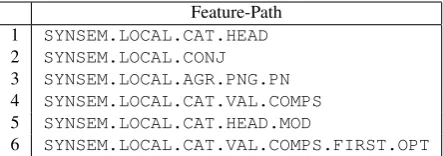
ERG sign contains hundreds of feature-paths and their corresponding values, it is important to pick a suitable small yet effective subset of them as anno-tation. Following the practice of (Krieger, 2007), we choose to use up to six top-rankedquick-check
paths (see Table 1), which are the most frequently failed feature-path in unification.
To access theHPSGsign, feature structures are reconstructed by unifying the correspondingTFS
of theHPSGrule with the instantiatedTFSes of its daughters. This can be done efficiently even with na¨ıve unification algorithms, for there is no search involved. And the unification never fails when the original derivation tree is produced by the ERG. Next, the value of the annotation is determined by the type of theTFS at the end of each given feature-path (or*undef*in case the path was not defined in theTFS). For example, for feature-path
SYNSEM.LOCAL.CAT.COMPS (the remaining list of complements for the sign), value*null*denotes an empty list, while*olist*denotes a list with only optional complements. Figure 3 shows an exam-ple of an annotated tree with 1-level grandparent andHEADfeature-path annotation.
3
Our notion ofinternalandexternalannotation is slightly different to that of (Klein and Manning, 2003). In our notion, internalannotation refers to the information from the local HPSGsign.
4
This technique is calledvertical markovizationin (Klein and Manning, 2003).
Feature-Path 1 SYNSEM.LOCAL.CAT.HEAD 2 SYNSEM.LOCAL.CONJ 3 SYNSEM.LOCAL.AGR.PNG.PN 4 SYNSEM.LOCAL.CAT.VAL.COMPS 5 SYNSEM.LOCAL.CAT.HEAD.MOD
[image:5.595.308.530.62.140.2]6 SYNSEM.LOCAL.CAT.VAL.COMPS.FIRST.OPT
Table 1: Top feature-paths used for internal annotation
4.4 Grammar Extraction & Probability Estimation
To extract the approximatingPCFG, we need a dis-ambiguated treebank annotated withHPSG deriva-tions. The treebank is constructed by first parsing the input sentences with theHPSGparser, then dis-ambiguated either manually or automatically by the parse selection model. TheCFGsymbols and production rules are extracted directly from the an-notation enriched derivation trees from the tree-bank. Each tree node contributes to one frequency count of the correspondingCFGrule with the par-ent’s symbol as the LHS, and the symbols of its daughters as theRHS. For the experiments in this paper, we do not prune theCFGsymbols or rules. The rule probability is calculated with Maximum Likelihood Estimate(MLE) without smoothing.
Pr(A→β) =P(A→β|A) =
#(A→β)
#A (1)
The lexical model, however, does receive smoothing for unknown word handling. More specifically, words are assigned a signature (sig(w)) based on their capitalization, suffix, digit and other character features. We then use theMLE
estimate ofP(T|sig(w))as a prior against which observed taggingsT were taken:
P(T|w) = #(T, w) +α·P(T|sig(w))
#T+α (2)
P(T|w)is then inverted to giveP(w|T).
The grammar extraction procedure is very ef-ficient. The time required is linear to the size of the treebank. Even with the richest annota-tions (with unification operaannota-tions involved), the procedure marches through thousands of trees per minute. This allows us to scale up the extraction with millions of trees.
4.5 Hierarchically Split-MergePCFG
ROOT
ROOT STRICT ˆROOT [verb full]
SB-HD MC C
ˆROOT STRICT [verb full]
SP-HD N C
ˆSB-HD M C [noun]
d - the le
The
HDN-AJ RC C
ˆSP-HD N C [noun]
n - c le&N SG ILR computer
CL RC FIN NWH C
ˆHDN-AJ RC C [verb full]
SB-HD NMC C
ˆCL RC-FIN-NWH C [verb full]
HDN BNP PN C
ˆSB-HD NMC C [noun]
n - pn-msc le&N SG ILR
John
HD XCOMP C
ˆSB-HD NMC C [verb full]
v np le&V PST OLR
bought
HD OPTCMP C
ˆSB-HD MC C [verb full]
W PERIOD PLR
ˆHD OPTCMP C [verb full]
v pp unacc le&V PST OLR
crashed
[image:6.595.120.483.62.363.2]PUNCT PERIOD .
Figure 3: Example tree with 1-level grandparent andHEADfeature-path annotation
approach has proven to deliver state-of-the-art parsing performance for multiple languages. The key advantage is that it automatically induces sub-categories from the treebank and produces a finer grained grammar without manual intervention. On treebanks with coarse-grained categories (which is typical for manually annotated treebanks), this is particularly effective.
In our experiment, we train the split-merge latent-variable PCFG on the derivation trees. TheExpectation-Maximizationtraining process is much more expensive than our MLE-basedPCFG
extraction. Also, given that the categories in the normalized derivations are already quite fine-grained (hundreds of non-terminal symbols and thousands of tags), the grammar stopped improv-ing after only three rounds of split-merge itera-tions.
5 Experiments
5.1 Grammar & Data
We use the 1010 release of the English Re-source Grammar for the approximation experi-ments. This version of the ERG contains a total of 200 syntactic constructional rules, and 50
lex-ical/inflectional rules. 145 of the 200 syntactic rules are binary, while the remaining 55 are unary. All lexical/inflectional rules are unary. In addi-tion, the grammar contains a hand-compiled lex-icon with around 1000 leaf lexical types and over 35K base-form entries.
Several large treebanks have been developed with theERG. Unlike the traditional manually an-notated treebanks, these are referred to as the Redwoods-style dynamic treebanks (Oepen et al., 2002). Sentences from the corpus are first parsed by the ERG, and then manually disambiguated (mostly by the grammarian himself). For the experiments in this paper, we use the manually disambiguated WeScience Treebank (Ytrestoel et al., 2009), which currently contains a to-tally of over 11K sentences from a selection of Wikipedia articles in the domain of Natural Lan-guage Processing with an average length of 18 to-kens per sentence, pre-processed to strip irrelevant markups, and divided into 13 sections. Of all the sentences, about 78% received exactly one “gold” analysis. The rest either fail to be parsed by the
ERG, or there is no single acceptable reading. We will only use the subset of sentences with a“gold”
keep“ws12”for development and“ws13”for the final testing. Sections“ws01”to“ws11”contain a total of 7,636 “gold” trees, which are used for training.
Apart from the WeScience, we also use the large-scale automatically disambiguated
WikiWoods Treebank (Flickinger et al., 2010). Currently, WikiWoods contains about 55M English sentences extracted from the English Wikipedia articles. The corpus is parsed with the 1010 version of the ERG, and automatically disambiguated with a Maximum Entropy model trained with the manually disambiguated trees. Only 1 top-ranked reading is preserved. Since the correctness of the parse is unchecked, the dataset is potentially noisy. The total amount of trees available for training is about 48M.
5.2 The Parser
The approximating PCFG tends to grow huge when rich annotations and large corpora are used. For efficient application of the resulting gram-mar, we implemented aCKY-style parser with bit-vector-based algorithm as the one proposed by Schmid (2004). The algorithm shows its strength in extensibility for grammars with millions of rules and hundreds of thousands of non-terminal symbols.
A slight deviation of our implementation from the BitParalgorithm is that, after constructing the bit-vector-based recognition chart, we do not apply the top-down filtering routine before cal-culating the Viterbi probabilities. Practice shows that in our case the recognition chart is normally sparse, and the filtering routine itself costs more time than what it saves from the additional calcu-lations in the Viterbi step.
For correctness checking, we reproduced the unlexicalizedPCFGparsing accuracy reported by Klein and Manning (2003) onPTB with our bit-vector parser while achieving better efficiency (in both training and testing) than the Stanford Parser. Even though our parser is implemented in Java (for better cross-platform compatibility), the low-level bit-vector-based operations make our system competitive even in comparison to the BitPar
implemented in C++.
As mentioned early, we do not prune thePCFG
rules during parsing. For the lexical look-up, we allow the lexical model to propose multiple tags (cut by certain probability threshold). In case a
full parse is not found, a partial parsing model tries to recover fragmented analysis according to the Viterbi probabilities of the constituents. With careful design of the PCFG and sufficient train-ing data, the parser normally delivers close to full parsing coverage even without the fragmented par-tial parsing mode.
5.3 Evaluation & Results
For the evaluation of our approximating PCFGs, we compare the top-1 parses produced by the
PCFGwith the manually disambiguated gold trees in“ws13”. We assume the inputs have been pre-tokenized but not tagged. All comparisons are done on the original derivations. Several accuracy measures are used, including the ParsEval labeled bracketing precision, recall, F1 and exact match
ratio. Since the ParsEval scores ignore the preter-minal nodes, we also report the (lexical type) tag-ging accuracy. Several different training sets are used.
WS contains 7636 “gold” trees from the sec-tions“ws01-ws11”of theWeScience. TheMEM
parse selection model is trained with this dataset. The dataset is too small to acquire high coverage
PCFGs with heavy annotations. Therefore, only
PCFG(0) andPCFG(FP1) results are reported here.
WW000 contains 85,553 automatically parsed and disambiguated trees from the WikiWoods
(all fragments with 000 as suffix). This is less than 0.2% of the entireWikiWoods, but close to the limit for the latent-variablePCFGtraining with the Berkeley Parser.
WW00 contains about 482K sentences (all frag-ments with 00 as suffix), roughly 1% of the entire
WikiWoods. We were able to successfully train
PCFGs with relatively rich annotations.
WW contains the complete WikiWoods with ∼48M parsed tress. With feature-path annota-tions, the training of the models takes too long. Also, excessive annotation makes it difficult to parse with the resulting huge grammar. We stop at two levels of grandparent annotation, a PCFG
with almost 4M rules and over 128K non-terminal symbols.
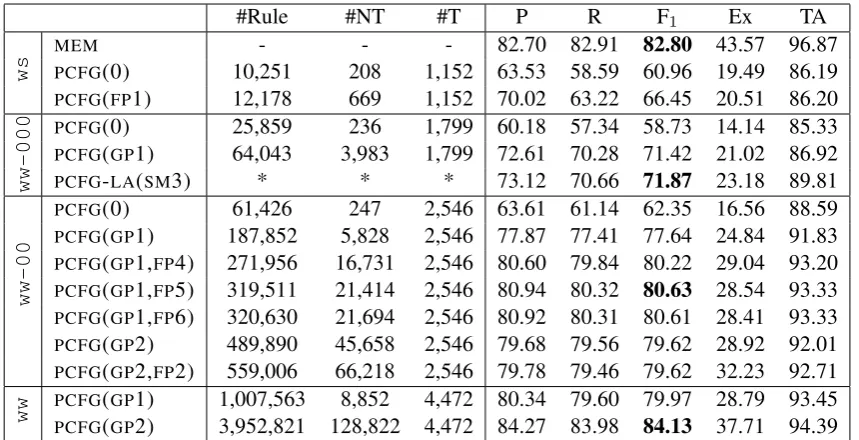
Table 2 summarizes the results of the accu-racy evaluation. All results are reported on the 785 trees from the section “ws13” of the
parser disambiguation model given the candidate parse forest. PCFG(0) is the unannotated PCFG
read off the bare (normalized) derivation trees.
PCFG(GPm,FPn) is the annotated PCFG model withm-levels of grandparents andnfeature-paths. And PCFG-LA(SM3) is the latent-variable PCFG
after three split-merge iterations.
With the small WS training set, the baseline PCFG without annotation achieved F1 of merely
60.96. Even one level of grandparent annotation, the parsing coverage drops by over 10%. With 1 feature-path annotation, F1improved significantly
to 66.45.
On the largerWW-000, the performance of the baselinePCFG decreases by two 2% of F1, most
likely due to the noise introduced by the auto-matic disambiguation. However, the larger train-ing set enables 1-level grandparent annotation, which brings F1 up to 71.42. The latent-variable
PCFG also performs well, delivering the best F1
at 71.87 after three split-merge iterations. But the learning curve of the Berkeley parser has already flatten out at this point, and we were unsuccessful in further scaling up the training set.
With our annotatedPCFGs, significant improve-ments are achieved on the even largerWW-00. The baselinePCFGseems to have recovered from the previous drop, and outperforms the one trained with the “gold” trees. With the mixture of 1-level of grandparent and some feature-path anno-tations, F1reached over 80. The best performance
on WW-00 is achieved with PCFG(GP1,FP5). 2-levels of grandparents alone outperforms 1-level of grandparent, but the grammar quickly reaches its size limit on this training set and starts to loose coverage when more feature-path annotations are added.
Finally, with the complete WikiWoods, both
PCFG(GP1) and PCFG(GP2) improved further,
withPCFG(GP2) reaching the highest F1at 84.13.
It is interesting to note that this is even higher than the F1 of theMEMdisambiguation model. This is
partially due to the self-training effect on the huge corpus. Another explanation is that the objective function of the discriminativeMEMwas optimized on the complete parse match instead of individ-ual constituents, which will explain its high exact match ratio at 43.57%.
6 Discussion
It is important to note that the grammar approxi-mation task we take on in this paper is different from the traditional treebank-based parsing. Al-though the accuracy evaluation for both tasks are done on a fixed set of“gold”trees, in the grammar approximation task we have access to the theoret-ically infinite pool of training data automattheoret-ically generated by the original grammar. Some com-plex grammar extraction algorithms which work fine on a small training corpus fail to scale up to handle millions of trees. On the other hand, our
MLE-based PCFG extraction shows its advantage in extensibility.
The approach of training aPCFGwith automat-ically annotated treebank is in a sense similar to the self-training approach in semi-supervised pars-ing (McClosky et al., 2006). However, instead of parsing the unlabeled data with thePCFGdirectly, we rely on the HPSG grammar and its disambigua-tion model. The highly constrained ERG analy-ses on unseen data allow us to obtain high quality trees. And the penalty on introducing noisy data is quickly compensated by the huge amount of data. The approximating PCFG is much less con-strained than the ERG. From the linguistic point of view, it is difficult to interpret the huge set of
PCFGrules. And unlike theERG, thePCFGis un-suited in making grammaticality judgment. How-ever, for the parsing task, the approximatingPCFG
has its advantage in being flexible and robust, needless to mention its cubic parsing time com-plexity. One can choose various combinations of annotations for a balanced efficiency, accuracy and coverage. Although the experiments reported in Section 5 are only testing on sentences which the
#Rule #NT #T P R F1 Ex TA
ws
MEM - - - 82.70 82.91 82.80 43.57 96.87
PCFG(0) 10,251 208 1,152 63.53 58.59 60.96 19.49 86.19
PCFG(FP1) 12,178 669 1,152 70.02 63.22 66.45 20.51 86.20
ww-000
PCFG(0) 25,859 236 1,799 60.18 57.34 58.73 14.14 85.33
PCFG(GP1) 64,043 3,983 1,799 72.61 70.28 71.42 21.02 86.92
PCFG-LA(SM3) * * * 73.12 70.66 71.87 23.18 89.81
ww-00
PCFG(0) 61,426 247 2,546 63.61 61.14 62.35 16.56 88.59
PCFG(GP1) 187,852 5,828 2,546 77.87 77.41 77.64 24.84 91.83
PCFG(GP1,FP4) 271,956 16,731 2,546 80.60 79.84 80.22 29.04 93.20
PCFG(GP1,FP5) 319,511 21,414 2,546 80.94 80.32 80.63 28.54 93.33
PCFG(GP1,FP6) 320,630 21,694 2,546 80.92 80.31 80.61 28.41 93.33
PCFG(GP2) 489,890 45,658 2,546 79.68 79.56 79.62 28.92 92.01
PCFG(GP2,FP2) 559,006 66,218 2,546 79.78 79.46 79.62 32.23 92.71
ww PCFG(GP1) 1,007,563 8,852 4,472 80.34 79.60 79.97 28.79 93.45
[image:9.595.85.515.61.281.2]PCFG(GP2) 3,952,821 128,822 4,472 84.27 83.98 84.13 37.71 94.39
Table 2: Parsing Accuracy on‘ws13’with various models and training sets. Reported are grammar size (#Rule, #NT, #T); ParsEval precision (P), recall (R), F1, and exact match ratio (Ex) on the original derivation tree; and
tagging accuracy (TA) on the lexical types.
Looking at the specific annotation strategies, we compared the internal annotations with the ex-ternal ones. Experiment result shows that when the grandparent annotation is added, the grammar size grows quickly. On a huge training set, this is rewarded with significant accuracy gain. On the smaller training set though, over-annotating with grandparents results in a decrease in accu-racy due to data sparseness. Instead, annotating with feature-path information increases the gram-mar size moderately, allowing one to approach the optimal granularity of thePCFG.
In comparison to the linguistic annotations used by Klein and Manning (2003) for PTB parsing, our annotations are less language or treebank spe-cific. This is due to the fact that the ERG rules are relatively fine-grained in treating various lin-guistic constructions. And the most relevant anno-tations can be gathered from either the grandpar-ents or the internal feature structure. Such general design allows us to experiment with other deep
HPSGgrammars in the near future.
For the clarity of the experiment, we have cho-sen not to do constructional pruning or smooth-ing, and focused our evaluation mostly on parsing accuracy. This leaves much room for future in-vestigation. For instance, we observe that a large portion of the grammar rules have very low fre-quency counts and almost no impact on the parsing accuracy. On the other hand, even with the
sim-plePCFG(GP1), after training with 45M sentences, the grammar continues to pick up new rules at a rate of one rule per 160 sentences. Most of these new rules are the combination of low frequency supertags.
Last but not the least, given the promising pars-ing accuracy of the approximatpars-ingPCFG, we be-lieve it is worth reconsidering the role of the hand-written grammars in the deep linguistic process-ing. In the past, manual grammar engineering has been taking on the dual role of offering con-cise and accurate linguistic description on the one hand, while attending the efficiency and robust-ness in parsing on the other. The conflicting goal has hindered the development of large-scale lin-guistic grammars. The technique as the one pre-sented in this paper shows one way of liberating grammarians from the concerns over the process-ing difficulties.
7 Conclusion
We presented a corpus-driven approach to ap-proximate a large-scale hand-written HPSG with a PCFG for robust and accurate parsing. Differ-ent annotations are used to enrich the derivation trees. And with the 48M sentence from the En-glish Wikipedia automatically parsed and disam-biguated by theERG, aMLE-basedPCFGachieved F1 of 84.13, higher than the performance of the
has access to the candidate HPSG parse forest). The obvious robustness and potential efficiency advantages of the approximatingPCFGsuggest its promising applications in deep linguistic process-ing.
Acknowledgments
We thank Stepehn Oepen, Bernd Kiefer and Dan Flickinger for enlightening discussions related to the work presented in this paper. We also thank the anonymous reviewers for their comments. The first author thanks the DFG-funded Excellence Cluster of MMCI and the Deependance project funded by the BMBF for their support of the work. The second author thanks project CogX (FP7 ICT 215181), NIFTi (FP7 ICT 247870) and Monnet (FP7 ICT 248458) for their support.
References
Steven Abney. 1997. Stochastic attribute-value grammars. Computational Linguistics, 23:597– 618.
Aoife Cahill, Michael Burke, Ruth O’Donovan, Josef Van Genabith, and Andy Way. 2004. Long-distance dependency resolution in auto-matically acquired wide-coverage PCFG-based LFG approximations. In Proceedings of the 42nd Meeting of the Association for Compu-tational Linguistics (ACL’04), Main Volume, pages 319–326, Barcelona, Spain.
Ulrich Callmeier. 2000. PET – a platform for ex-perimentation with efficient HPSG processing techniques. Journal of Natural Language Engi-neering, 6(1):99–108.
Bob Carpenter. 1992. The Logic of Typed Feature Structures. Cambridge University Press, Cam-bridge, UK.
Ann Copestake. 2002. Implementing Typed Feature Structure Grammars. CSLI, Stanford, USA.
Dan Flickinger, Stephan Oepen, and Gisle Ytrestl. 2010. WikiWoods: Syntacto-semantic annota-tion for English Wikipedia. InProceedings of the Seventh conference on International Lan-guage Resources and Evaluation (LREC’10), Valletta, Malta.
Dan Flickinger. 2002. On building a more effi-cient grammar by exploiting types. In Stephan Oepen, Dan Flickinger, Jun’ichi Tsujii, and Hans Uszkoreit, editors, Collaborative Lan-guage Engineering, pages 1–17. CSLI Publica-tions.
Frederik Fouvry. 2003. Robust processing for constraint-based grammar formalisms. Ph.D. thesis, Gradudate School, University of Essex, Colchester, UK.
Bernd Kiefer and Hans-Ulrich Krieger. 2004. A context-free superset approximation of unification-based grammars. In New De-velopments in Parsing Technology. Kluwer. http://www.wkap.nl/prod/b/1-4020-2293-X.
Bernd Kiefer, Hans-Ulrich Krieger, John Carroll, and Rob Malouf. 1999. A Bag of Useful Tech-niques for Efficient and Robust Parsing. In Pro-ceedings of the 37th Annual Meeting of the As-sociation for Computational Linguistics, pages 473–480, Maryland, USA.
Bernd Kiefer, Hans-Ulrich Krieger, and Detlef Prescher. 2002. A novel disambiguation method for unification-based grammars using probabilistic context-free approximations. In
Proceedings of the 19th International Con-ference on Computational Linguistics (COL-ING’02), Taipei, Taiwan.
Dan Klein and Christopher D. Manning. 2003. Accurate unlexicalized parsing. InProceedings of the 41st Annual Meeting of the Association for Computational Linguistics, pages 423–430, Sapporo, Japan.
Hans-Ulrich Krieger. 2007. From UBGs to CFGs: A practical corpus-driven approach. Natural Language Engineering, 13(4):317–351. Pub-lished online in April 2006.
Robert Malouf and Gertjan van Noord. 2004. Wide coverage parsing with stochastic at-tribute value grammars. In Proceedings of the IJCNLP-04 Workshop: Beyond Shallow Anal-yses - Formalisms and Statistical Modeling for Deep Analyses, Hainan Island, China.
on Artificial Intelligence (IJCAI 2007), pages 1671–1676, Hyderabad, India.
David McClosky, Eugene Charniak, and Mark Johnson. 2006. Effective self-training for parsing. InProceedings of HLT-NAACL-2006, pages 152–159, New York, USA.
Yusuke Miyao and Jun’ichi Tsujii. 2002. Maxi-mum entropy estimation for feature forests. In
Proceedings of the Human Language Technol-ogy Conference, San Diego, USA.
Yusuke Miyao, Takashi Ninomiya, and Jun’ichi Tsujii. 2004. Corpus-oriented grammar de-velopment for acquiring a Head-Driven Phrase Structure Grammar from the Penn Treebank. In Proceedings of the 1st International Joint Conference on Natural Language Processing (IJCNLP 2004), pages 684–693, Hainan Island, China.
Stephan Oepen and John Carroll. 2000. Am-biguity packing in constraint-based parsing — practical results. InProceedings of the 1st An-nual Meeting of the North American Chapter of Association for Computational Linguistics (NAACL 2000), pages 162–169, Seattle, USA.
Stephan Oepen, Kristina Toutanova, Stuart Shieber, Christopher Manning, Dan Flickinger, and Thorsten Brants. 2002. The LinGO Red-woods treebank: motivation and preliminary applications. InProceedings of COLING 2002: The 17th International Conference on Compu-tational Linguistics: Project Notes, Taipei, Tai-wan.
Slav Petrov, Leon Barrett, Romain Thibaux, and Dan Klein. 2006. Learning accurate, com-pact, and interpretable tree annotation. In Pro-ceedings of the 21st International Conference on Computational Linguistics and 44th Annual Meeting of the Association for Computational Linguistics, pages 433–440, Sydney, Australia.
Carl J. Pollard and Ivan A. Sag. 1994. Head-Driven Phrase Structure Grammar. University of Chicago Press, Chicago, USA.
Helmut Schmid. 2004. Efficient parsing of highly ambiguous context-free grammars with bit vec-tors. In Proceedings of Coling 2004, pages 162–168, Geneva, Switzerland.
Hideto Tomabechi. 1991. Quasi-destructive graph unification. In Proceedings of the 29th Annual Meeting of the Association for Com-putational Linguistics (ACL 1991), pages 315– 322, Berkeley, USA.
Kristina Toutanova, Christoper D. Manning, Dan Flickinger, and Stephan Oepen. 2005. Stochas-tic HPSG parse selection using the Redwoods corpus. Journal of Research on Language and Computation, 3(1):83–105.
Gertjan van Noord. 2006. At Last Parsing Is Now Operational. In Actes de la 13e Conference sur le Traitement Automatique des Langues Na-turelles (TALN 2006), pages 20–42, Leuven, Belgium.
Gisle Ytrestoel, Dan Flickinger, and Stephan
Oepen. 2009. Extracting and
annotat-ing Wikipedia sub-domains: Towards a new escience community resource. In Proceedings of the Seventh International Workshop on Tree-banks and Linguistic Theory, pages 185–197, Groningen, the Netherlands.
Kun Yu, Miyao Yusuke, Xiangli Wang, Takuya Matsuzaki, and Junichi Tsujii. 2010. Semi-automatically developing chinese hpsg gram-mar from the penn chinese treebank for deep parsing. In Proceedings of the 23rd Interna-tional Conference on ComputaInterna-tional Linguis-tics (Coling 2010), pages 1417–1425, Beijing, China.