Corpus development for machine translation between
standard and dialectal varieties
Barry Haddow1, Adolfo Hern´andez Huerta2, Friedrich Neubarth2, Harald Trost3 1)ILCC, School of Informatics, University of Edinburgh
2)Austrian Research Institute f. Artificial Intelligence (OFAI)
{adolfo.hernandez, friedrich.neubarth}@ofai.at
3) Institute for Artificial Intelligence, Medical University of Vienna
Abstract
In this paper we describe the construction of a paral-lel corpus between the standard and a non-standard language variety, specifically standard Austrian German and Viennese dialect. The resulting par-allel corpus is used for statistical machine transla-tion (SMT) from the standard to the non-standard variety. The main challenges to our task are data scarcity and the lack of an authoritative orthogra-phy. We started with the generation of a base corpus of manually transcribed and translated data from spoken text encoded in a specifically developed or-thography. This data is used to train a first phrase-based SMT. To deal with out-of-vocabulary items we exploit the strong proximity between source and target variety with a backoff strategy that uses character-level models. To arrive at the necessary size for a corpus to be used for SMT, we em-ploy a boot-strapping approach. Integrating addi-tional available sources (comparable corpora, such as Wikipedia) necessitates to identify parallel sen-tences out of substantially differing parallel docu-ments. As an additional task, the spelling of the texts has to be transformed into the above men-tioned orthography of the target variety.
1 Introduction
Statistical machine translation between dialectal varieties and their cognate standard variety is a challenge quite different from translation between major languages with large resources on both sides. Instead of having huge corpora at hand that offer themselves for machine learning tech-niques, substantial written corpora of dialectal lan-guage varieties are rare. In addition, there is no authoritative orthography, which calls for methods to normalize the spelling of existing written texts. Parallel resources for a standard language and a dialectal variety thereof are even less common. But such parallel data is the workhorse of mod-ern machine translation systems and key to pro-ducing sufficiently natural utterances. On the posi-tive side, the relaposi-tive proximity between a standard language and its varieties opens up new possibili-ties to gather parallel data, despite data sparsity.
In this paper we will outline methods to ac-quire such data, developed for a specific pair of varieties, Austrian German (AG), the standard va-riety, and a dialectal variety spoken in the capi-tal, Viennese dialect (VD) (Schikola, 1954), (Hor-nung, 1998).1 From a linguistic perspective, it has to be noted that dialects generally are not really homogenous. Lacking standardization initiatives, reinforcement by education or public media and predominantly being confined to oral usage, di-alects most often form a dynamic continuum be-tween different varieties and speaker groups. Be-ing defined by social group rather than geograph-ical regions, the Viennese variety is a sociolect in the strict sense, where dialects in urban regions are generally associated with lower social classes (Labov, 2001). Also, speakers with native com-petence usually adapt the register to the commu-nicative situation as well as to the content of the utterances in a very dynamic way. Switching be-tween varieties and subtle gradual shifts are a very natural phenomenon in such a linguistic situation. While being aware that the linguistic conception of a dialect is not uncontroversial, we still think that it is feasible and appropriate to model a di-alectal variety that conforms to a stereotype of that dialect.
The paper focuses on the generation of the re-sources necessary for statistical machine transla-tion between a standard variety with rich resources (AG) and a dialectal variety (VD) with almost no resources. The strategy is to create a minimal base corpus comprising bilingual data in a standardized orthography for VD, and in a second step apply-ing a bootstrappapply-ing strategy in order to gain a
suf-1The work presented in this paper is based on the project
‘Machine Learning Techniques for Modeling of Language Varieties’ (MLT4MLV - ICT10-049) funded by the Vienna Science and Technology Fund (WWTF).
ficient amount of bilingual lexical resources and to increase the data on the basis of automatically generated translations. As proximity between the varieties works on our side, we give detailed de-scriptions of how the linguistic closeness can be exploited to bootstrap the required resources.
2 Background
Pairs of closely related languages (or language va-rieties) offer themselves to exploit the linguistic proximity in order to overcome the usual scarcity of parallel data. Nakov and Tiedemann (2012) take advantage of the great overlap in vocabu-lary and the strong syntactic and lexical similar-ity between Bulgarian and Macedonian. They de-velop an SMT system for this language pair by employing a combination of character and word level translation models, outperforming a phrase-based word-level baseline. Regarding MT of dialects, Zbib et al. (2012) use crowdsourcing to build Levantine-English and Egyptian-English parallel corpora; while Sawaf (2010) normalizes non-standard, spontaneous and dialect Arabic into Modern Standard Arabic to achieve translations into English.
A considerable amount of work has been done on extracting parallel sentences from compara-ble corpora, i.e. a set of documents in dif-ferent languages that contains similar informa-tion. Munteanu and Marcu (2005) use a Max-imum Entropy classifier trained on parallel sen-tences to determine if a sentence pair is parallel or not. Based on techniques of Information Re-trieval, Abdul-Rauf and Schwenk (2011) use the translations of a SMT system in order to find the corresponding parallel sentences from the target-language side of the comparable corpus. Smith et al. (2010) explore Wikipedia to extract paral-lel sentences where, once they achieve an align-ment at the docualign-ment level by taking advantage of the structure of this online encyclopedia, they train Conditional Random Fields to tackle the task of sentence alignment. Tillmann and Xu (2009) extract sentence pairs by a model based on the IBM Model-1 (Brown et al., 1993) and perform training on parallel data. With the exception of Munteanu and Marcu (2005), where bootstrapping techniques find application, these methods require (and presuppose the existence of) a certain amount of resources (i.e. parallel data or lexicon coverage) not available for some languages or varieties.
3 Constructing a Parallel Corpus
For Standard German to Viennese dialect, there were no existing parallel data sets and, moreover, most monolingual text sources that exist are writ-ten in an inconsiswrit-tent way, oscillating between standard conventions and free attempts to encode the phonetic realization in the dialect. The first step was to design an orthographic standard for the target language that would be consistent, un-ambiguous and phonologically transparent. In the light of applicability in language technology, accu-racy towards phonological properties seemed the most important criterion, on a par with the neces-sity to minimize lexical ambiguities. This is dif-ferent from producing literary texts, where read-ability might be a more prominent issue, and the orientation towards the standard orthography may have a higher priority.
A second problem with initial data acquisition is the fact that dialect speakers in Vienna very of-ten switch between the dialect and the standard va-riety, depending on the communicative situation, but also on the content that may invite to use a higher register. Text data with a bias towards the standard by virtue of standard orthography quite often also reflects such switching processes. In order to circumvent such biases, we carefully se-lected colloquial data of VD that are as authen-tic to the dialect as possible. The basic material consists of transcripts of TV documentaries and free interview recordings of dialect speakers. The transcripts were manually translated into both AG and VD, the latter being vacuous in most cases. This way we could ensure that (rarely occurring) switchings into the standard would not end up in the target model. A typical example looks as fol-lows, where AG and VD refer to the standard and the Viennese orthography of a sentence from our corpus.
(1) AG:Ja, ich weiß es doch. VD:J˚a, i waas s e.
‘yes, I know it anyway.’
re-ordering and/or n-to-n correspondences, and also that many corresponding words are ’cognates’, meaning that they are lexically (and morpholog-ically) the same in both varieties, with differ-ent phonology and spelling (e.g., AG‘weiß’ cor-responds to VD ‘waas’ ”(I) know”), we boot-strapped a word-alignment routine that very soon provided promising results.
The core idea was to use the string edit distance (Levenshtein algorithm) to determine whether two words should be aligned or not. Because it mat-ters if one or more editing steps (errors) occur in a short or in a long word, we normalized the string edit distance by a factor consisting of the logarithm of the average string length or a special penalty factor for very short strings). However, the orthographic forms may differ substantially while referring to identical words. So, the second in-gredient was to train a character based transla-tion model between AG and VD, using the data-driven grapheme-to-phoneme converter Sequitur G2P (Bisani and Ney, 2008). These automatically generated strings of dialect words (VD*) are then compared to the words of the target (VD). Given that the initial data is very limited, the results of the G2P translation are not reliable as a transla-tion, but still very useful to determine the distance measure. Since the full set of extracted word pairs (after validation) is used to re-train the models in an iterative way, the word alignment gets better the more data is added. In a way, over-fitting, generally carefully avoided in statistical modeling, works to our advantage.
The alignment algorithm in a first step linearly searches for the best path of matches. If the score provided by the string edit distance is above a given threshold, insertions and deletions are the less costly options, and the words will not be aligned. By this method, we would only align cog-nates and miss the more interesting cases where words of AG are translated into different words that may be typical for the dialect (e.g., VD has a special word for AG‘Polizist’”policeman”: VD ‘kibara’). Therefore two more iterations over the set of aligned pairs try to find these non-cognate pairs. First, adjacent insertions and deletions are aligned regardless of the distance measure. This guarantees that word pairs that are not cognates (with a high degree of similarity), but different lex-ical items, are also captured by the word align-ment, given that the syntactic structure of the
source and the target sentence are approximately the same. Second, non-adjacent insertion-deletion pairs with a distance measure below the threshold are marked as valid alignments. That way the al-gorithm that by itself provides only linear align-ments is also capable to capture some non-local alignments resulting from syntactic re-ordering.
With regard to SMT and contemplating the im-manent problem of data sparsity, it seems obvi-ous that a factorized translation model (Koehn and Hoang, 2007) will have certain advantages over a translation model that only considers full word forms. This, however, requires the generation of lexical resources for both language varieties. For the source language (AG) such resources already exist. The question is, if and how the lexical infor-mation stemming from the source language can be transferred onto the target language.
Our word alignment is capable of identifying cognates. However, these cognates will only cover certain word forms out of more complex morpho-logical paradigms. Given that for AG, the lemma and the information about the paradigm can be au-tomatically retrieved from the word form, the task is to identify lemma and the paradigm from the VD word form. In many cases it will suffice to strip off the inflectional endings and to transfer the morphological information from the AG en-try. However, there are many deviations (from AG to VD) as well as exceptions, also only real cog-nates can be treated that way, so there has to be done some manual validation in order to create a VD lexicon that in the end covers all word forms.
(2)
INPUT: haus NN Neut . -I-a OUTPUT: haus haus+NN+Neut+Sg+NDA
heisa haus+NN+Neut+Pl+NDA sg./pl. forms of VD ‘haus’ (AG ’Haus’‘house’)
When the lemma, the major category and the relevant morphological information are identified, this is sufficient to generate all word forms to-gether with morphological features in a given lan-guage variety.
4 Machine Translation Experiments
In this section we report on some experiments us-ing the data set described in the previous section to build statistical machine translation systems, using Moses (Koehn et al., 2007).
4.1 Corpus
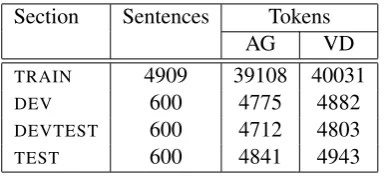
The corpus was split into four sections, TRAIN,
for estimation of phrase tables and language mod-els, the second for tuning the MT system param-eters and the third for testing during system de-velopment. The last was reserved for final testing. The relative sizes of the three section is shown in Table 1.
Section Sentences Tokens AG VD
TRAIN 4909 39108 40031
DEV 600 4775 4882
DEVTEST 600 4712 4803
TEST 600 4841 4943
Table 1: Corpus sizes (untokenised)
4.2 Word-level Models
The word-level models are standard phrase-based models built using Moses. The parallel text is tokenised using the Moses tokeniser for German, then it is all lowercased. This parallel text is then aligned in both directions using GIZA++ (Och and Ney, 2000) and the alignments are symmetrised using the ”grow-diag-final-and” heuristic. The aligned parallel text is then used to estimate a translation table using the standard Moses heuris-tics, and a 3-gram language model built on the target side of the parallel text using SRILM with Kneser-Ney smoothing. The translation and lan-guage models are then combined with a distance-based reordering model and their weights opti-mised for BLEU using MERT on theDEVcorpus.
4.3 Character-level Models
In earlier work on MT for closely-related lan-guages (Vilar et al., 2007; Tiedemann, 2009; Nakov and Tiedemann, 2012), it has been shown that character-level translation models can be ef-fective. These character-level models are also built using phrase-based Moses, but allowing it to treat single characters or groups of characters as “to-kens”. In the unigram character-level model, we treat each character as a separate token by insert-ing a space between each of them, and usinsert-ing a spe-cial character (||) to indicate word boundaries. For the bigram character-level model, the “tokens” are pairs of adjacent characters, with the same word boundary character as in the unigram model. Ta-ble 1 shows examples of a German sentence con-verted into suitable formats for the character-level unigram and bigram models.
After decoding with one of the character-level models, converting back to word-level text is straightforward in the unigram case; it is just a matter of removing spaces then replacing the spe-cial word-boundary character with a space. For the bigram-level model, we remove the first character in each bigram then proceed as for the unigram-level models.
Other than the word-to-character conversion of all data, the character-based models are trained us-ing the standard Moses trainus-ing pipeline. We use the default maximum phrase-length of 7, and a 7-gram language model, parameters that were ob-served to work best in early experiments. During tuning, we maximise word-level BLEU with re-spect to the reference.
4.4 Backoff Models
After observing the performance of word and character-level models, we decided to try to com-bine them into a backoff model, which would use the word-level translation wherever possible, but apply the character-level model for unknown words. In (Nakov and Tiedemann, 2012), they found that a similar model combination gave the best results when translating between closely re-lated languages.
Firstly, we experimented with different varia-tions of the character-level model for the unknown words (OOVs). Each of these models is trained and tuned on theTRAIN andDEVsets, and we re-port accuracies on the OOVs in DEVTEST (OOV according to the phrase-table built on DEV). The
translations of the OOVs were extracted from the word alignments of the base corpus, and out of 330 OOVs, 325 have gold translations.
The first two character-level models are just the unigram and bigram baseline models from Sec-tion 4.3. We then built further models by attempt-ing to extract the cognates from the training set. The idea here is that the character-level models are built from “noisy” training data, containing many German-Viennese word-pairs which either repre-sent lexical differences, or are the result of bad alignments. In order to extract the cognates we ran GIZA++ alignment on the combined TRAIN
word-level: und f¨ur die tipps
character-level (unigram): || u n d || f ¨u r || d i e || t i p p s ||
character-level (bigram): ||u un nd d|| ||f f¨u ¨ur r|| ||d di ie e|| ||t ti ip pp ps s||
Figure 1: Conversion of a German sentence into forms suitable for training the character-level models
Model Correct Accuracy (%) Pass-through 21 6.5
Unigram 154 47.4
Bigram 150 46.2
Unigram cognate 154 47.4 Bigram cognate 150 46.2 Unigram cognate (freq) 160 49.2 Bigram cognate (freq) 145 44.6
Table 2: Comparison of accuracy of character-level models on the OOVs inDEVTEST. The plain unigram/bigram models are trained on complete sentences, whereas the cognate models are trained on cognate pairs (unique or frequency weighted) extracted from these sentences.
With this list of cognate pairs, we trained both unigram and bigram models, firstly from a list of the unique cognate pairs and secondly from the same list with frequencies adjusted to match their corpus frequencies. These models were trained using the usual Moses pipeline, estimating phrase tables and language models from 90% of the cog-nate pairs and tuning on the other 10%.
The OOV accuracies (on DEVTEST) of all 6
character-level models, as well as a pass-through baseline are shown in Table 2. We can see that, in general, the cognate models offer small improve-ments on the models trained on the whole sen-tences, and the unigram models are slightly better than the bigram models.
Finally, we show a comparison of the word-level and character-word-level systems, with the back-off system (using the unigram cognate frequency adjusted model) in Table 3. The backoff systems are implemented by first examining the tuning and test data for OOVs, then translating these using the character-level model, and creating a second phrase-table with the character-level model. This second phrase table is used in Moses as a backoff table.
For both test sets, the character-level transla-tion outperforms the word-level translatransla-tion, but the backoff offers the best performance of all. The BLEU scores are relatively high compared to the
Model DEVTEST TEST
Word-level 63.28 60.04 Character-level (unigram) 65.00 63.17 Character-level (bigram) 64.98 63.43 Backoff to char-level 68.30 66.13
Table 3: BLEU scores for all translation systems
typical values reported in the MT literature, re-flecting the restricted vocabulary of the data set.
5 Comparable Corpora
Wikipedia is a multilingual free online encyclope-dia with currently 285 language versions. Adafre and de Rijke (2006) investigated the potential of this resource to generate parallel corpora by ap-plying different methods for identifying similar texts across multiple languages. We explore this resource as it contains a relatively large bilingual corpus of articles in (Standard) German (DE) and Bavarian dialects (BAR). There are 5135 paral-lel articles (status from July 2012), of which 219 are explicitly tagged as ”Viennese dialect”. It can be assumed that the parallel articles refer to the same content, but texts often differ substantially in style and detail. Articles in Bavarian are gen-erally shorter, containing less information than the corresponding German ones, with an average ratio of about 1:6. The challenge of finding correspond-ing sentence pairs is met by a sentence alignment method that crucially exploits the phonetic simi-larity between the German standard and Bavarian dialects, specifically Viennese.
5.1 Sentence Extraction
equal – with a ratio of 1:6 it was not possible to achieve any reliable results at all. Additionally, the sentences in the parallel texts are presupposed to occur in the same order, which does not apply to the Wikipedia articles under consideration. Simi-lar requirements hold for the Hunalign tool (Varga et al., 2005). Finally, LEXACC (Stefanescu et al., 2012) is a parallel sentence extractor for compa-rable corpora based on Information Retrieval, but again, certain resources are required beforehand, such as a GIZA++ dictionary created from existing parallel documents. The main obstacle to using any of these algorithms is that the texts in the BAR Wikipedia obey widely differing and mostly ad-hoc orthographic conventions, which are not con-sistent for a given dialectal variety, even within a single article. In our situation, we had to develop an alignment method that relies only on the lin-guistic proximity between the two varieties.
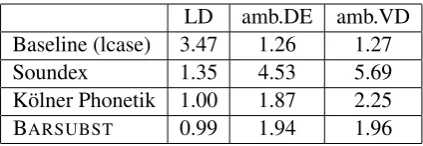
Comparing strings of DE that occur in stan-dard orthography with strings of BAR in varying non-standard orthography directly does not make sense, unless both forms are transformed into a phonetically based common form. Inspired by Soundex and the K¨olner Phonetik algorithm (Pos-tel, 1969), we developed an algorithm (henceforth BARSUBST) that takes into account some charac-teristics of the Bavarian dialect family (liquid vo-calization: i.e., DE‘viel’corresponds to VD:‘f¨u’; vowels are retained as one class of characters; the character for ’dark a’ <˚a> had to be included). This ensures that cognate words will have a very low string edit distance. Just to give an impres-sion, we calculated the average values of Leven-shtein string edit distance and the average ambigu-ity of particular word forms of AG and VD from the data of the word aligned base corpus. As am-biguity we counted the number of occurrences of a given word in a distinct word pair. The base-line value of 1.26/1.27 relates to the fact that for a given word there may be more than one valid translations. When the ambiguity is much higher this indicates that the distance measure is less re-liable (words that should not relate turn out to be identical).
The average LD significantly drops down from 3.47 of the baseline (lowercase word forms) to ap-prox. 1.0 for both, K¨olner Phonetik and BAR -SUBST. The average ambiguity is almost equal for both BAR and DE - slightly below a value of 2 with BARSUBST; the K¨olner Phonetik algorithm
LD amb.DE amb.VD Baseline (lcase) 3.47 1.26 1.27 Soundex 1.35 4.53 5.69 K¨olner Phonetik 1.00 1.87 2.25
[image:6.595.307.519.61.134.2]BARSUBST 0.99 1.94 1.96
Table 4: Average distance and ambiguity values
fares better with DE word forms, but worse with BAR word forms, which shows that it is justified to adapt the K¨olner Phonetik algorithm to our pur-poses.
Applying this algorithm to words of both DE and BAR, we defined a scoring function that eval-uates possible word alignments against each other in order to find the optimal sentence pairs from related articles. The alignment algorithm works as follows: after creating a matrix of all sentence pairs, each potential alignment is evaluated by the scoring function that takes into account the sum of (positive and negative) scores resulting from a non-linear word alignment based on the trans-formed character sequences (best matches aligned first), the number of not-aligned words (negative scores) and a penalty for crossing alignments and extra short word sequences. We selected a set of approx. 50 sentences to manually test the effects of the different parameters of the scoring func-tion. After fine-tuning the parameters, a threshold of above zero proved to be a good indicator for a correct alignment between two sentences. From this matrix, sentence pairs are extracted in the or-der of their scores (best scores aligned first) until a defined threshold is reached.
We used only articles that are explicitly tagged as ‘Viennese’ (approx. 200). From these we extracted and aligned 4414 sentences with 40.1k word tokens that correspond to 12.9k word types. Unlike the texts extracted from sponta-neous speech recordings, the Wikipedia texts seem to contain many more word types, which is due to the fact that Wikipedia texts tend to contain a large number of named entities. Unfortunately, these are not very useful for SMT by themselves, but still the amount of parallel data can be signifi-cantly increased.
5.2 Orthography Normalization
cor-pus of parallel sentences from Wikipedia articles can in principle provide ample training data for a character-level translation algorithm between non-standard orthography of BAR and our specifically designed, standardized orthography for VD. Given a 1-to-1 word alignment based on the Levenshtein distance of BARSUBSTtransformed word forms of
sufficient quality, we can extract a list of BAR-DE word pairs, but the target, words in VD orthogra-phy, is missing.
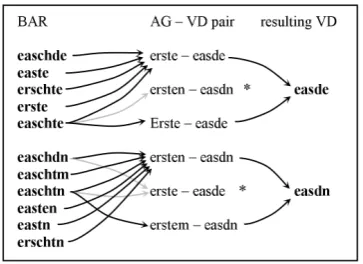
[image:7.595.91.273.349.481.2]To tackle this problem, we used the data from our speech-based corpus of aligned AG-VD word pairs. (We take Austrian German (AG) and Ger-man Standard (DE) to refer to the same variety). We filtered the list of word pairs gained from BAR-DE word alignment for only those DE-BAR pairs where we have an AG-VD word pair in our base corpus. That way, the AG/DE standard is used as an anchor to link non-standardized BAR orthography to our standard of DE orthography.
Figure 2: Correspondences between BAR ortho-graphic forms, AG-VD pairs and VD forms.
As can be seen in Figure 2, the correspondences can be manifold. In order to decide which VD form is the correct one to be associated with cer-tain BAR variants, we apply a weighted Leven-shtein distance measure, where the weights are chosen in such a way that plausible and frequent substitutions are assigned less costs than others. When more data is available, these weights can be re-estimated on a statistical basis, for a start we just stipulated them based on the linguistic knowl-edge about the two varieties. The matches are not symmetrical under this approach, for example BAR<m>matching with VD<n>(which often occurs when dative endings in BAR are written ac-cording to the standard of DE, while they are pro-nounced and written as /n/ in VD) is assigned a cost of 0.6, while the reverse match is not defined
and receives the default cost value of 1.)
Having gathered some initial training data this way, we experimented to train a character level translation using again Sequitur G2P. Of all the pairs, we spared 25% for testing and used the rest for training, which proved to be very little – approx. 1500 instances of BAR-VD pairs. To increase this number in a sensible way, we cre-ated two more sets by adding the set of AG-VD pairs from the base corpus and adding the set of VD-VD pairs, simulating a situation where the BAR input is already in the correct orthography. The results are not fully compelling (50 % cor-rect spellings in the optimal case). This may be due to the rather small amount of training data, but also to the high degree of variance in the in-put data. To enhance the quality of orthography normalization we foresee a combination of mod-elling character-level BAR-VD correspondences with the character-level translation models of AG to VD that hopefully will make it possible to achieve a automatically normalized parallel cor-pus from the Wikipedia data that conforms to the same standards as the base corpus.
6 Discussion and Outlook
References
Sadaf Abdul-Rauf and Holger Schwenk. 2011. Paral-lel sentence generation from comparable corpora for improved SMT. Machine Transl., 25(4):341–375.
Sisay Fissaha Adafre and Maarten de Rijke. 2006. Finding similar sentences across multiple languages in wikipedia. InProceedings of the 11th Conference of the European Association for Computational Lin-guistics (EACL), pages 62–69.
Maximilian Bisani and Hermann Ney. 2008. Joint-sequence models for grapheme-to-phoneme conver-sion.Speech Communication, 50(5):434–451.
Peter F. Brown, Vincent J. Della Pietra, Stephen A. Della Pietra, and Robert L. Mercer. 1993. The mathematics of statistical machine translation: pa-rameter estimation. Comp. Ling., 19(2):263–311.
Maria Hornung. 1998. W¨orterbuch der Wiener
Mundart. ¨OBV, P¨adagogischer Verlag.
Philipp Koehn and Hieu Hoang. 2007. Factored trans-lation models. In Proceedings of the 2007 Joint Conference on Empirical Methods in Natural guage Processing and Computational Natural Lan-guage Learning (EMNLP-CoNLL), pages 868–876, Prague, Czech Republic, June.
Philipp Koehn, Hieu Hoang, Alexandra Birch, Chris Callison-Burch, Marcello Federico, Nicola Bertoldi, Brooke Cowan, Wade Shen, Christine Moran, Richard Zens, Chris Dyer, Ondrej Bojar, Alexan-dra Constantin, and Evan Herbst. 2007. Moses: open source toolkit for statistical machine transla-tion. In Proceedings of the 45th Annual Meet-ing of the Association for Computational LMeet-inguis- Linguis-tics (ACL), demonstration session, pages 177–180, Prague, Czech Republic.
William Labov. 2001. Principles of linguistic change (ii): social factors. Blackwell, Massachusetts.
Robert C. Moore. 2002. Fast and accurate sentence alignment of bilingual corpora. In Proceedings of the 5th Conference of the Association for Machine Translation in the Americas (AMTA), pages 135– 144, Tiburon, CA.
Dragos Stefan Munteanu and Daniel Marcu. 2005. Im-proving machine translation performance by exploit-ing non-parallel corpora. Computational Linguis-tics, 31(4):477–504.
Preslav Nakov and J¨org Tiedemann. 2012. Combin-ing word-level and character-level models for ma-chine translation between closely-related languages. InProceedings of the 50th Annual Meeting of the As-sociation for Computational Linguistics, pages 301– 305, Jeju, Korea.
Franz Josef Och and Hermann Ney. 2000.
Im-proved Statistical Alignment Models. In Proceed-ings of the 38th Annual Meeting of the Association
for Computational Linguistics (ACL00), pages 440– 447, Hongkong, China.
Hans Joachim Postel. 1969. Die K¨olner Phonetik. Ein Verfahren zur Identifizierung von Personenna-men auf der Grundlage der Gestaltanalyse. IBM-Nachrichten, 19:925–931.
Hassan Sawaf. 2010. Arabic dialect handling in hybrid machine translation. InProceedings of the 9th Con-ference of the Association for Machine Translation in the Americas (AMTA), Denver, Colorado.
Hans Schikola. 1954. Schriftdeutsch und Wienerisch. ¨
Osterr. Bundesverlag f¨ur Unterricht, Wissenschaft und Kunst.
Jason R. Smith, Chris Quirk, and Kristina Toutanova. 2010. Extracting parallel sentences from compa-rable corpora using document level alignment. In Proceedings of Human Language Technologies: The 2010 Annual Conference of the North American Chapter, pages 403–411, Los Angeles, California.
Dan Stefanescu, Radu Ion, and Sabine Hunsicker. 2012. Hybrid parallel sentence mining from com-parable corpora. InProceedings of the 16th Annual Conference of the European Association for Ma-chine Translation (EMAT), pages 137–144, Trento, Italy.
J¨org Tiedemann. 2009. Character-based {PSMT}
for closely related languages. In Llu´ıs Marqu´es and Harold Somers, editors, Proceedings of 13th Annual Conference of the European Association for Machine Translation (EAMT’09), pages 12–19, Barcelona, Spain.
Christoph Tillmann and Jian-Ming Xu. 2009. A sim-ple sentence-level extraction algorithm for compara-ble data. InProceedings of Human Language Tech-nologies: The 2009 Annual Conference of the North American Chapter of the Association for Computa-tional Linguistics, pages 93–96, Boulder, Colorado.
D´aniel Varga, P´eter Hal´acsy, Andr´as Kornai, Viktor Nagy, L´aszlo N´emeth, and Viktor Tr´on. 2005. Par-allel corpora for medium density languages. In Pro-ceedings of the RANLP, pages 590–596.
David Vilar, Jan-Thorsten Peter, and Hermann Ney. 2007. Can we translate letters? InProceedings of the Second Workshop on Statistical Machine Trans-lation, pages 33–39, Prague, Czech Republic. Asso-ciation for Computational Linguistics.