An Unsupervised and Data-Driven Approach for Spell Checking in
Vietnamese OCR-scanned Texts
Cong Duy Vu HOANG & Ai Ti AW
Department of Human Language Technology (HLT) Institute for Infocomm Research (I2R)
A*STAR, Singapore
{cdvhoang,aaiti}@i2r.a-star.edu.sg
Abstract
OCR (Optical Character Recognition) scan-ners do not always produce 100% accuracy in recognizing text documents, leading to spelling errors that make the texts hard to process further. This paper presents an in-vestigation for the task of spell checking for OCR-scanned text documents. First, we conduct a detailed analysis on characteris-tics of spelling errors given by an OCR scanner. Then, we propose a fully auto-matic approach combining both error detec-tion and correcdetec-tion phases within a unique scheme. The scheme is designed in an un-supervised & data-driven manner, suitable for resource-poor languages. Based on the evaluation on real dataset in Vietnamese language, our approach gives an acceptable performance (detection accuracy 86%, cor-rection accuracy 71%). In addition, we also give a result analysis to show how accurate our approach can achieve.
1 Introduction and Related Work
Documents that are only available in print re-quire scanning from OCR devices for retrieval or e-archiving purposes (Tseng, 2002; Magdy and Darwish, 2008). However, OCR scanners do not always produce 100% accuracy in rec-ognizing text documents, leading to spelling er-rors that make the texts texts hard to process fur-ther. Some factors may cause those errors. For instance, shape or visual similarity forces OCR scanners to misunderstand some characters; or in-put text documents do not have good quality, caus-ing noises in resultcaus-ing scanned texts. The task of spell checking for OCR-scanned text documents proposed aims to solve the above situation.
Researchers in the literature used to approach this task for various languages such as: English (Tong and Evans, 1996; Taghva and Stofsky, 2001; Kolak and Resnik, 2002),Chinese(Zhuang et al., 2004), Japanese (Nagata, 1996; Nagata, 1998), Arabic(Magdy and Darwish, 2006), and Thai(Meknavin et al., 1998).
The most common approach is to involve users for their intervention with computer support. Taghva and Stofsky (2001) designed an interac-tivesystem (called OCRSpell) that assists users as many interactive features as possible during their correction, such as: choose word boundary, mem-orize user-corrected words for future correction, provide specific prior knowledge about typical er-rors. For certain applications requiring automa-tion, the interactive scheme may not work.
Unlike (Taghva and Stofsky, 2001), non-interactive(or fully automatic) approaches have been investigated. Such approaches need pre-specified lexicons & confusion resources (Tong and Evans, 1996), language-specific knowledge (Meknavin et al., 1998) or manually-created pho-netic transformation rules (Hodge and Austin, 2003) to assist correction process.
Other approaches used supervised mecha-nisms for OCR error correction, such as: statis-tical language models (Nagata, 1996; Zhuang et al., 2004; Magdy and Darwish, 2006), noisy chan-nel model (Kolak and Resnik, 2002). These ap-proaches performed well but are limited due to requiring large annotated training data specific to OCR spell checking in languages that are very hard to obtain.
Further, research in spell checking for Vietnamese language has been understudied.
Hunspell−spellcheck−vn1 & Aspell2 are inter-active spell checking tools that work based on pre-defined dictionaries.
According to our best knowledge, there is no work in the literature reported the task of spell checking for Vietnamese OCR-scanned text doc-uments. In this paper, we approach this task in terms of 1) fully automatic scheme; 2) without us-ing any annotated corpora; 3) capable of solvus-ing both non-word & real-word spelling errors simul-taneously. Such an approach will be beneficial for a poor-resource language like Vietnamese.
2 Error Characteristics
First of all, we would like to observe and analyse the characteristics of OCR-induced errors in com-pared with typographical errors in a real dataset.
2.1 Data Overview
We used a total of 24 samples of Vietnamese OCR-scanned text documents for our analysis. Each sample contains real & OCR texts, referring to texts without & with spelling errors, respec-tively. Our manual sentence segmentation gives a result of totally 283 sentences for the above 24 samples, with 103 (good, no errors) and 180 (bad, errors existed) sentences. Also, the number of syl-lables3in real & OCR sentences (over all samples) are 2392 & 2551, respectively.
2.2 Error Classification
We carried out an in-depth analysis on spelling errors, identified existing errors, and then man-ually classified them into three pre-defined error classes. For each class, we also figured out how an error is formed.
As a result, we classified OCR-induced spelling errors into three classes:
Typographic or Non-syllable Errors (Class 1): refer to incorrect syllables (not included in a standard dictionary). Normally, at least one character of a syllable is expected misspelled.
1http://code.google.com/p/
hunspell-spellcheck-vi/
2
http://en.wikipedia.org/wiki/GNU_ Aspell/
3
In Vietnamese language, we will use the word “sylla-ble” instead of “token” to mention a unit that is separated by spaces.
Real-syllable or Context-based Errors (Class 2): refer to syllables that arecorrectin terms of their existence in a standard dictionary but incorrect in terms of their meaning in the context of given sentence.
Unexpected Errors (Class 3): are accidentally formed by unknown operators, such as: insert non-alphabet characters, do incorrect upper-/lower- case, split/merge/remove syllable(s), change syllable orders, . . .
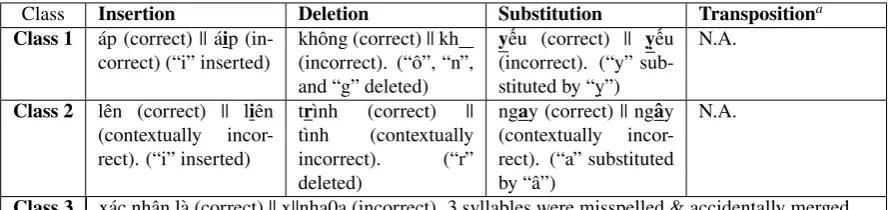
Note that errors inClass 1 & 2can be formed by applying one of 4 operators4(Insertion, Dele-tion, SubstituDele-tion, Transposition). Class 3is ex-clusive, formed by unexpected operators. Table 1 gives some examples of 3 error classes.
An important note is that an erroneous syllable can contain errors across different classes. Class 3can appear withClass 1orClass 2butClass 1 never appears withClass 2. For example:
[image:2.595.312.506.390.499.2]−hoàn (correct) ||Hòan (incorrect) (Class 3 & 1) −bắt (correct) || bặt’(incorrect) (Class 3 & 2)
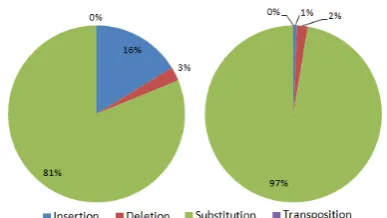
Figure 1: Distribution of operators used inClass 1(left) &Class 2(right).
2.3 Error Distribution
Our analysis reveals that there are totally 551 rec-ognized errors over all 283 sentences. Each error is classified into three wide classes (Class 1, Class 2, Class 3). Specifically, we also tried to identify operators used inClass 1&Class 2. As a result, we have totally 9 more fine-grained error classes (1A..1D, 2A..2D, 3)5.
We explored the distribution of 3 error classes in our analysis. Class 1distributed the most, fol-lowing by Class 3 (slightly less) and Class 2.
4Their definitions can be found in (Damerau, 1964). 5
A, B, C, and D represent for Insertion, Deletion, Sub-stitution, and Transposition, respectively. For instance,1A
Class Insertion Deletion Substitution Transpositiona
Class 1 áp (correct) || áip (in-correct) (“i” inserted)
không (correct) || kh (incorrect). (“ô”, “n”, and “g” deleted)
yếu (correct) || ỵếu (incorrect). (“y” sub-stituted by “ỵ”)
N.A.
Class 2 lên (correct) || liên (contextually incor-rect). (“i” inserted)
trình (correct) || tình (contextually incorrect). (“r” deleted)
ngay (correct) || ngây (contextually incor-rect). (“a” substituted by “â”)
N.A.
Class 3 xác nhận là (correct) || x||nha0a (incorrect). 3 syllables were misspelled & accidentally merged.
[image:3.595.72.517.73.178.2]aOur analysis reveals no examples for this operator.
Table 1: Examples of error classes.
Generally, each class contributed a certain quan-tity of errors (38%, 37%, & 25%), making the correction process of errors more challenging. In addition, there are totally 613 counts for 9 fine-grained classes (over 551 errors of 283 sentences), yielding an average & standard deviation 3.41 & 2.78, respectively. Also, one erroneous syllable is able to contain the number of (fine-grained) error classes as follows: 1(492), 2(56), 3(3), 4(0) ((N) is count of cases).
We can also observe more about the distribu-tion of operators that were used within each error class in Figure 1. TheSubstitutionoperator was used the most in bothClass 1&Class 2, holding 81% & 97%, respectively. Only a few other oper-ators (Insertion,Deletion) were used. Specially, theTranspositionoperator were not used in both Class 1&Class 2. This justifies the fact that OCR scanners normally have ambiguity in recognizing similar characters.
3 Proposed Approach
The architecture of our proposed approach (namely(VOSE)) is outlined in Figure 2. Our pur-pose is to develop VOSE as an unsupervised data-driven approach. It means VOSE will only use textual data (un-annotated) to induce the detection & correction strategies. This makes VOSE unique and generic to adapt to other languages easily.
In VOSE, potential errors will be detected lo-cally within each error class and will then be cor-rected globally under a ranking scheme. Specif-ically, VOSE implements two different detectors (Non-syllable Detector & Real-syllable Detec-tor) for two error groups of Class 1/3 & Class 2, respectively. Then, a corrector combines the outputs from two above detectors based on
rank-ing scheme to produce the final output. Currently, VOSE implements two different correctors, a Contextual Corrector and a Weighting-based Corrector. Contextual Correctoremploys lan-guage modelling to rank a list of potential can-didates in the scope of whole sentence whereas Weighting-based Corrector chooses the best candidate for each syllable that has the highest weights. The following will give detailed descrip-tions for all components developed in VOSE.
3.1 Pre-processor
Pre-processor will take in the input text, do tokenization & normalization steps. Tokeniza-tion in Vietnamese is similar to one in En-glish. Normalization step includes: normal-ize Vietnamese tone & vowel (e.g. hòa –> hoà), standardize upper-/lower- cases, find num-bers/punctuations/abbreviations, remove noise characters, . . .
This step also extracts unigrams. Each of them will then be checked whether they exist in a pre-built list of unigrams (from large raw text data). Unigrams that do not exist in the list will be re-garded asPotential Class 1 & 3 errorsand then turned into Non-syllable Detector. Other uni-grams will be regarded as Potential Class 2 er-rorspassed intoReal-syllable Detector.
3.2 Non-syllable Detector
Non-syllable Detectoris to detect errors that do not exist in a pre-built combined dictionary (Class 1 & 3) and then generate a top-k list of poten-tial candidates for replacement. A pre-built com-bined dictionary includes all syllables (unigrams) extracted from large raw text data.
Figure 2: Proposed architecture of our approach
Detector. This approach aims to retrieve all n-gram patterns (n can be 2,3) from textual data, check approximate similarity with original erro-neous syllables, and then produce a top list of po-tential candidates for replacement.
We believe that this approach will be able to not only handle errors with arbitrary changes on syllables but also utilize contexts (within 2/3 win-dow size), making possible replacement candi-dates more reliable, and more semantically to some extent.
This idea will be implemented in theN-gram Enginecomponent.
3.3 Real-syllable Detector
Real-syllable Detector is to detect all possible real-syllable errors (Class 2) and then produce the top-K list of potential candidates for replace-ment. The core idea ofReal-syllable Detectoris to measure the cohesion of contexts surrounding a target syllable to check whether it is possibly erro-neous or not. The cohesion is measured by counts & probabilities estimated from textual data.
Assume that a K-size contextual window with a target syllable at central position is chosen.
s1s2 · · · [sc] · · · sK−1sK(Ksyllables,scto
be checked, K is an experimental odd value (can be 3, 5, 7, 9).)
The cohesion of a sequence of syllablessK1 bi-ased to central syllablesccan be measured by one
of three following formulas: Formula 1:
cohesion1(sK1 ) = log(P(sK1 ))
= log(P(sc)∗ K Y
i6=c,i=1
P(si|sc))
(1)
Formula 2:
cohesion2(sK1 ) =countexist?(sc−2sc−1sc,
sc−1scsc+1, scsc+1sc+2, sc−1sc, scsc+1)
(2)
Formula 3:
cohesion3(sK1 ) =countexist?(sc−2∗sc,
sc−1sc, sc∗sc+2, scsc+1)
(3)
where: −cohesion(sK
− P(sc) is estimated from large raw text data
com-puted by c(sc)
C , whereasc(sc)is unigram count andC
is total count of all unigrams from data. −P(si|sc)is computed by:
P(si|sc) =
P(si, sc) P(sc)
=c(si, sc,|i−c|)
c(sc)
(4)
where:
−c(si, sc,|i−c|)is a distance-sensitive count of two
unigramssi andsc co-occurred and the gap between
them is|i−c|unigrams.
For Formula 1, if cohesion(sK1 ) < Tc with
Tcis a pre-defined threshold, the target syllable is
possibly erroneous.
For Formula 2, instead of probabilities as in Formula 1, we use counting on existence of n-grams within a context. It’s maximum value is 5. Formula 3is a generalized version of Formula 2 (the wild-card “*” means any syllable). It’s maxi-mum value is 4.
N-gram Engine. The N-gram Engine compo-nent is very important in VOSE. All detectors & correctors use it.
Data Structure. It is worthy noting that in or-der to compute probabilities likec(si, sc,|i−c|)
or query the patterns from data, an efficient data structure needs to be designed carefully. It MUST satisfy two criteria: 1)space to suit memory re-quirements 2) speed to suit real-time speed re-quirement. In this work,N-gram Engineemploys inverted index (Zobel and Moffat, 2006), a well-known data structure used in text search engines.
Pattern Retrieval. After detecting poten-tial errors, both Non-syllable Detector and Real-syllable Detector use N-gram Engine to find a set of possible replacement syllables by querying the textual data using 3-gram patterns (sc−2sc−1[s∗c],sc−1[sc∗]sc+1, and[sc∗]sc+1sc+2) or
2-gram patterns (sc−1[s∗c],[sc∗]sc+1), where[s∗c]is a potential candidate. To rank a list of top candi-dates, we compute the weight for each candidate using the following formula:
weight(si) =α×Sim(si, s∗c)+(1−α)×F req(si)
(5) where:
−Sim(si, s∗c)is the string similarity between
candi-date syllablesiand erroneous syllables∗c.
−F req(si)is normalized frequency ofsi over a
re-trieved list of possible candidates.
−αis a value to control the weight biased to string similarity or frequency.
In order to compute the string similarity, we followed a combined weighted string similarity (CWSS) computation in (Islam and Inkpen, 2009) as follows:
Sim(si, s∗c) =β1×N LCS(si, s∗c)
+β2×N CLCS1(si, s∗c) +β3×N CLCSn(si, s∗c)
+β4×N CLCSz(si, s∗c)
(6)
where:
−β1,β2,β3, andβ4are pre-defined weights for each similarity computation. Initially, allβ are set equal to
1/4.
− N LCS(si, s∗c) is normalized length of longest
common subsequence betweensiands∗c.
− N CLCS1(si, s∗c), N CLCSn(si, s∗c), and N CLCSz(si, s∗c) is normalized length of maximal
consecutive longest common subsequence between
si ands∗c starting from the first character, from any
character, and from the last character, respectively. −Sim(si, s∗c)has its value in range of[0,1].
We believe that the CWSS method will ob-tain better performance than standard meth-ods (e.g. Levenshtein-based String Matching (Navarro, 2001) or n-gram based similarity (Lin, 1998)) because it can exactly capture more infor-mation (beginning, body, ending) of incomplete syllables caused by OCR errors. As a result, this step will produce a ranked top-k list of potential candidates for possibly erroneous syllables. In ad-dition, N-gram Engine also stores computation utilities relating the language models which are then provided toContextual Corrector.
3.4 Corrector
InVOSE, we propose two possible correctors:
Weighting-based Corrector
Given a ranked top-K list of potential can-didates from Non-syllable Detector and Real-syllable Detector, Weighting-based Corrector simply chooses the best candidates based on their weights (Equation 5) to produce the final output.
Contextual Corrector
Specifically, Contextual Corrector employs the language modelling based scheme which chooses the combination of candidates(sn1)∗ that makes P P((sn
1)∗) maximized over all
combina-tions as follows:
(sn1)∗best= arg max(sn
1)∗P P((s n 1)
∗
) (7)
where:P P(.)is a language modelling score or per-plexity (Jurafsky and Martin, 2008; Koehn, 2010).
In our current implementation, we used Depth-First Traversal (DFS) strategy to examine over all combinations. The weakness of DFS strategy is the explosion of combinations if the number of nodes (syllables in our case) grows more than 10. In this case, the speed of DFS-basedContextual Correctoris getting slow. Future work can con-sider beam search decoding idea in Statistical Machine Translation (Koehn, 2010) to adapt for Contextual Corrector.
3.5 Prior Language-specific Knowledge
SinceVOSEis an unsupervised & data-driven ap-proach, its performance depends on the quality and quantity of raw textual data. VOSE’s cur-rent design allows us to integrate prior language-specific knowledge easily.
Some possible sources of prior knowledge could be utilized as follows:
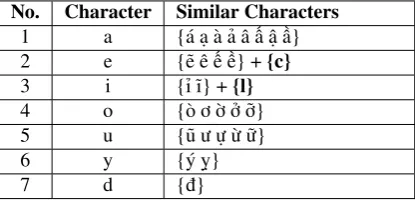
−Vietnamese Character Fuzzy Matching- In Vietnamese language, some characters look very similar, forcing OCR scanners mis-recognition. Thus, we created a manual list of highly similar characters (as shown in Table 2) and then inte-grate this into VOSE. Note that this integration takes place in the process of string similarity com-putation.
− English Words & Vietnamese Abbrevia-tions Filtering - In some cases, there exist En-glish words or Vietnamese abbreviations. VOSE may suggest wrong replacements for those cases. Thus, a syllable in either English words or Viet-namese abbreviations will be ignored in VOSE.
4 Experiments
4.1 Baseline Systems
According to our best knowledge, previous sys-tems that are able to simultaneously handle both non-syllable and real-syllable errors do not exist, especially apply for Vietnamese language. We be-lieve that VOSE is the first one to do that.
No. Character Similar Characters
1 a {á ạ à ả â ấ ậ ầ} 2 e {ẽ ê ế ề} +{c}
3 i {ỉ ĩ} +{l}
4 o {ò ơ ờ ở ỡ} 5 u {ũ ư ự ừ ữ}
6 y {ý ỵ}
[image:6.595.307.515.74.177.2]7 d {đ}
Table 2: Vietnamese similar characters.
4.2 N-gram Extraction Data
In VOSE, we extracted ngrams from the raw tex-tual data. Table 3 shows data statistics used in our experiments.
4.3 Evaluation Measure
We used the following measure to evaluate the performance of VOSE:
- ForDetection:
DF = 2×DR×DP
DR+DP (8)
Where:
−DR (Detection Recall) = the fraction of errors correctly detected.
−DP (Detection Precision) = the fraction of de-tected errors that are correct.
−DF (Detection F-Measure) = the combination of detection recall and precision.
- ForCorrection:
CF = 2×CR×CP
CR+CP (9)
Where:
−CR (Correction Recall) = the fraction of errors correctly amended.
− CP (Correction Precision) = the fraction of amended errors that are correct.
−CF (Correction F-Measure) = the combination of correction recall and precision.
4.4 Results
We carried out our evaluation based on the real dataset as described in Section 2. In our evalua-tion, we intend:
−To evaluate whether VOSE can benefit from ad-dition of more data, meaning that VOSE is actu-ally a data-driven system.
N-grams
No Dataset NumOfSents Vocabulary 2-gram 3-gram 4-gram 5-gram
1 DS1 1,328,506 102,945 1,567,045 8,515,894 17,767,103 24,700,815 2 DS2a 2,012,066 169,488 2,175,454 12,610,281 27,961,302 40,295,888
3 DS3b 283 1,546 6,956 9,030 9,671 9,946
4 DS4c 344 1,755 6,583 7,877 8,232 8,383
aincludes DS1 and more
b
annotated test data (not included in DS1 & DS2) as described in Section 2 c
[image:7.595.74.509.73.152.2]web contexts data (not included in others) crawled from the Internet
Table 3: Ngram extraction data statistics.
based corrector.
− To evaluate whether prior knowledge specific to Vietnamese language can help VOSE.
The overall evaluation result (in terms of detec-tion & correcdetec-tion accuracy) is shown in Table 4. In our experiments, all VOSE(s) except of VOSE 6 used contextual corrector (Section 3.4). Also, Real-syllable Detector (Section 3.3) used Equa-tion 3 which revealed the best result in our pre-evaluation (we do not show the results because spaces do not permit).
We noticed the tone & vowel normalization step inPre-processormodule. This step is impor-tant specific to Vietnamese language. VOSE 2a in Table 4 shows that VOSE using that step gives a significant improvement (vs. VOSE 1) in both de-tection & correction.
We also tried to assess the impact of language modelling order factor in VOSE. VOSE using 3-gram language modelling gives the best result (VOSE 2a vs. VOSE 2b & 2c). Because of this, we chose 3-gram for next VOSE set-ups.
We experiment how data addition affects VOSE. First, we used bigger data (DS2) for ngram extraction and found the significant improvement (VOSE 3a vs. VOSE 2a). Second, we tried an interesting set-up in which VOSE utilized ngram extraction data with annotated test data (Dataset DS3) only in order to observe the recall ability of VOSE. Resulting VOSE (VOSE 3b) performed extremely well.
As discussed in Section 3.5, VOSE allows in-tegrated prior language-specific knowledge that helps improve the performance (VOSE 4). This justifies that statistical method in combined with such prior knowledge is very effective.
Specifically, for each error in test data, we crawled the web sentences containing contexts in which that error occurs (called web contexts). We
added such web contexts into ngram extraction data. With this strategy, we can improve the per-formance of VOSE significantly (VOSE 5), ob-taining the best result. Again, we’ve proved that more data VOSE has, more accurate it performs.
The result of VOSE 6 is to show the superiority of VOSE using contextual corrector in compared with using weighting-based corrector (VOSE 6 vs. VOSE 4). However, weighting-based corrector has much faster speed in correction than contex-tual corrector which is limited due to DFS traver-sal & language modelling ranking.
Based on the above observations, we have two following important claims:
− First, the addition of more data in ngram ex-traction process is really useful for VOSE.
− Second, prior knowledge specific to Viet-namese language helps to improve the perfor-mance of VOSE.
−Third, contextual corrector with language mod-elling is superior than weighting-based corrector in terms of the accuracy.
4.5 Result Analysis
Based on the best results produced by our ap-proach (VOSE), we recognize & categorize cases that VOSE is currently unlikely to detect & cor-rect properly.
Consecutive Cases (Category 1)
When there are 2 or 3 consecutive errors, their contexts are limited or lost. This issue will af-fect the algorithm implemented in VOSE utilizing the contexts to predict the potential replacements. VOSE can handle such errors to limited extent.
Merging Cases (Category 2)
Detection Accuracy Correction Accuracy
Set-up Recall Precision F1 Recall Precision F1 Remark
VOSE 1 0.8782 0.5954 0.7097 0.6849 0.4644 0.5535 w/o TVN + 3-LM + DS1 VOSE 2a 0.8782 0.6552 0.7504 0.6807 0.5078 0.5817 w/ TVN + 3-LM + DS1 VOSE 2b 0.8782 0.6552 0.7504 0.6744 0.5031 0.5763 w/ TVN + 4-LM + DS1 VOSE 2c 0.8782 0.6552 0.7504 0.6765 0.5047 0.5781 w/ TVN + 5-LM + DS1 VOSE 3a 0.8584 0.7342 0.7914 0.6829 0.5841 0.6296 w/ TVN + 3-LM + DS2 VOSE 3b 0.9727 0.9830 0.9778 0.9223 0.9321 0.9271 w/ TVN + 3-LM + DS3
[image:8.595.82.509.73.209.2]VOSE 4 0.8695 0.7988 0.8327 0.7095 0.6518 0.6794 VOSE 3a + PK VOSE 5 0.8674 0.8460 0.8565 0.7200 0.7023 0.7110 VOSE 4 + DS4 VOSE 6 0.8695 0.7988 0.8327 0.6337 0.5822 0.6069 VOSE 4 but uses WC
Table 4: Evaluation results. Abbreviations: TVN(Tone & Vowel Normalization);N-LM(N-order Language Modelling);DS(Dataset);PK(Prior Knowledge);WC(Weighting-based Corrector).
handle such cases. We aim to investigate this in our future work.
Proper Noun/Abbreviation/Number Cases (both in English, Vietnamese) (Category 3)
Abbreviations or proper nouns or numbers are unknown (for VOSE) because they do not appear in ngram extraction data. If VOSE marks them as errors, it could not correct them properly.
Ambiguous Cases (Category 4)
Ambiguity can happen in:
−cases in which punctuation marks (e.g. comma, dot, dash, . . . ) are accidentally added between two different syllable or within one syllable.
−cases never seen in ngram extraction data.
−cases relating to semantics in Vietnamese.
− cases where one Vietnamese syllable that is changed incorrectly becomes an English word.
Lost Cases (Category 5)
This case happens when a syllable which is ac-cidentally lost most of its characters or too short becomes extremely hard to correct.
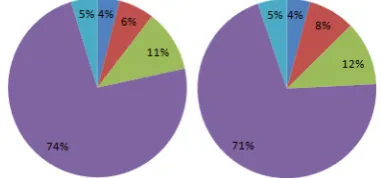
Additionally, we conducted to observe the dis-tribution of the above categories (Figure 3). As can be seen, Category 4 dominates more than 70% cases that VOSE has troubles for detection & cor-rection.
5 Conclusion & Future Work
In this paper, we’ve proposed & developed a new approach for spell checking task (both detection and correction) for Vietnamese OCR-scanned text documents. The approach is designed in an un-supervised & data-driven manner. Also, it allows
Figure 3: Distribution of categories in the result of VOSE 4 (left) & VOSE 5 (right).
to integrate the prior language-specific knowledge easily.
Based on the evaluation on a real dataset, the system currently offers an acceptable perfor-mance (best result: detection accuracy 86%, cor-rection accuracy 71%). With just an amount of small n-gram extraction data, the obtained re-sult is very promising. Also, the detailed error analysis in previous section reveals that cases that current systemVOSEcannot solve are extremely hard, referring to the problem of semantics-related ambiguity in Vietnamese language.
Further remarkable point of proposed approach is that it can perform the detection & correction processes inreal-timemanner.
[image:8.595.313.504.271.360.2]References
Fred J. Damerau. 1964. A technique for computer de-tection and correction of spelling errors. Commun. ACM, 7:171–176, March.
Victoria J. Hodge and Jim Austin. 2003. A com-parison of standard spell checking algorithms and a novel binary neural approach. IEEE Trans. on Knowl. and Data Eng., 15(5):1073–1081, Septem-ber.
Aminul Islam and Diana Inkpen. 2009. Real-word spelling correction using google web it 3-grams. InProceedings of the 2009 Conference on Empir-ical Methods in Natural Language Processing: Vol-ume 3 - VolVol-ume 3, EMNLP ’09, pages 1241–1249, Stroudsburg, PA, USA. Association for Computa-tional Linguistics.
Daniel Jurafsky and James H. Martin. 2008. Speech and Language Processing: An Introduction to Nat-ural Language Processing, Computational Linguis-tics and Speech Recognition. Prentice Hall, second edition, February.
Philipp Koehn. 2010.Statistical Machine Translation. Cambridge University Press.
Okan Kolak and Philip Resnik. 2002. Ocr error correction using a noisy channel model. In Pro-ceedings of the second international conference on Human Language Technology Research, HLT ’02, pages 257–262, San Francisco, CA, USA. Morgan Kaufmann Publishers Inc.
Dekang Lin. 1998. An information-theoretic def-inition of similarity. In Proceedings of the Fif-teenth International Conference on Machine Learn-ing, ICML ’98, pages 296–304, San Francisco, CA, USA. Morgan Kaufmann Publishers Inc.
Walid Magdy and Kareem Darwish. 2006. Arabic ocr error correction using character segment correction, language modeling, and shallow morphology. In
Proceedings of the 2006 Conference on Empirical Methods in Natural Language Processing, EMNLP ’06, pages 408–414, Stroudsburg, PA, USA. Asso-ciation for Computational Linguistics.
Walid Magdy and Kareem Darwish. 2008. Effect of ocr error correction on arabic retrieval. Inf. Retr., 11:405–425, October.
Surapant Meknavin, Boonserm Kijsirikul, Ananlada Chotimongkol, and Cholwich Nuttee. 1998. Com-bining trigram and winnow in thai ocr error cor-rection. InProceedings of the 36th Annual Meet-ing of the Association for Computational LMeet-inguis- Linguis-tics and 17th International Conference on Compu-tational Linguistics - Volume 2, ACL ’98, pages 836–842, Stroudsburg, PA, USA. Association for Computational Linguistics.
Masaaki Nagata. 1996. Context-based spelling cor-rection for japanese ocr. InProceedings of the 16th conference on Computational linguistics - Volume
2, COLING ’96, pages 806–811, Stroudsburg, PA, USA. Association for Computational Linguistics. Masaaki Nagata. 1998. Japanese ocr error correction
using character shape similarity and statistical lan-guage model. In Proceedings of the 36th Annual Meeting of the Association for Computational Lin-guistics and 17th International Conference on Com-putational Linguistics - Volume 2, ACL ’98, pages 922–928, Stroudsburg, PA, USA. Association for Computational Linguistics.
Gonzalo Navarro. 2001. A guided tour to approximate string matching. ACM Comput. Surv., 33(1):31–88, March.
Kazem Taghva and Eric Stofsky. 2001. Ocrspell: an interactive spelling correction system for ocr errors in text. International Journal of Document Analysis and Recognition, 3:2001.
Xian Tong and David A. Evans. 1996. A statistical approach to automatic ocr error correction in con-text. In Proceedings of the Fourth Workshop on Very Large Corpora (WVLC-4, pages 88–100. Yuen-Hsien Tseng. 2002. Error correction in a
chi-nese ocr test collection. InProceedings of the 25th annual international ACM SIGIR conference on Re-search and development in information retrieval, SIGIR ’02, pages 429–430, New York, NY, USA. ACM.
Li Zhuang, Ta Bao, Xioyan Zhu, Chunheng Wang, and S. Naoi. 2004. A chinese ocr spelling check approach based on statistical language models. In
Systems, Man and Cybernetics, 2004 IEEE Interna-tional Conference on, volume 5, pages 4727 – 4732 vol.5.