The IPP effect in Afrikaans: a corpus analysis
Liesbeth Augustinus
1, Peter Dirix
1,2(1) Centre for Computational Linguistics, University of Leuven (2) Nuance Communications, Inc.
{liesbeth,peter}@ccl.kuleuven.be
A
BSTRACTCompared to well-resourced languages such as English and Dutch, NLP tools for linguistic analysis in Afrikaans are still not abundant. In order to facilitate corpus-based linguistic research for Afrikaans, we are creating a treebank based on theTaalkommissiecorpus. We adapted a tokenizer and a shallow parser, while using a TnT tagger to do part-of-speech annotation. A first linguistic phenomenon we are investigating is the occurrence ofinfinitivus pro participio (IPP) in Afrikaans. IPP refers to constructions with a perfect auxiliary, in which an infinitive appears instead of the expected past participle. The phenomenon has been studied extensively in Dutch and German, but studies on Afrikaans IPP triggers are sparse. In contrast to the former two languages, it is often mentioned in the literature that in Afrikaans, IPP occurs optionally. We want to check this statement doing a corpus analysis.
K
EYWORDS:
Afrikaans, tokenizer, parser, chunker, corpus search tool, IPP.1 Introduction
Afrikaans is a West Germanic language spoken as a first language by about 7 million people in South Africa and Namibia and by many millions more as a second language. It can be considered a daughter language of Dutch, as it originates in 17th-century Dutch dialects, brought to southern Africa by settlers from the Netherlands. Although there are some influences from Malay, Portuguese, Bantu, and Khoisan languages, Dutch and Afrikaans are still more or less mutually comprehensible. One of the main features of Afrikaans is a simplification of Dutch morphology, e.g. dropping the nominal gender distinction and only keeping two verb forms for all but the most common verbs (present/infinitive and past participle).
In recent years, several NLP tools were created for Afrikaans, cf. Grover et al. (2011) for an overview of the available tools. Compared to well-resourced languages such as English and Dutch, however, it seems that the tools which are available for Afrikaans are less well-performing.
The purpose of our research is twofold. As a starting point, we describe the NLP tools that were used to process and query the data, as well as the first step towards the creation of a treebank based on an Afrikaans text corpus (theTaalkommissiecorpus1) (cf. section 2).
In the second part of this paper we investigate whether and how the tools and resources that are currently available can be used as a means for descriptive linguistics. As a case study, we will look for the occurrence ofinfinitivus pro participio, a.k.a. the IPP effect, in theTaalkommissiecorpus. In this linguistic study we compare the IPP phenomenon as it is described in the literature (cf. section 3) to its occurrence in the data (cf. section 4 and 5). Besides improving the performance of the existing annotation tools, we intend to include the parsed corpus into a user-friendly query engine in order to facilitate corpus-based linguistic research for Afrikaans (cf. section 6).
2 Tools
In order to investigate the linguistic case study described in sections 3 to 5, we automatically annotated theTaalkommissiecorpus. This section describes the tools used to annotate and query the corpus. We adapted a tokenizer and a shallow parser, while using a TnT tagger (Brants, 2000) trained on Afrikaans to do part-of-speech (PoS) annotation. We furthermore added a search engine to facilitate corpus exploitation.
2.1 Tokenizer
The Dutch tokenizer (Dirix et al., 2005) used in the METIS-II project is rule-based, using regular expressions which model the finite-state characteristics of tokenization and gives only one tokenization per sentence, so the output does not contain any ambiguities. The tokenizer basically splits on white space and detaches punctuation marks from the adjacent words. We adapted the Dutch rules to Afrikaans in order to deal with abbrevations that include a period and the ones to deal with words containing apostrophes (e.g. the indefinite article’n).
2.2 Tagger and tag set
We used the TnT Tagger (Brants, 2000), a Hidden Markov Model basedn-gram tagger, which was trained by CTexT2to tag the corpus (further referred to as the CTexT tagger). The tag
set consists of 139 different tags, based mainly on morphosyntactic features (Pilon, 2005). In the case of verbs, which is the most relevant PoS for our research (cf. sections 3 and 5), a distinction is made between transitive and intransitive verbs, between separable and inseparable verbs, and also between main verbs, modal verbs, temporal auxiliaries and passivizing auxiliaries. Marked forms (ge-marking or simple past in the case of a few auxiliaries) and unmarked forms are also distinguished. Altogether, there are 17 verbal tags, as shown in Table 1.
Tag Value
VTHOG inseparable transitive main verb, unmarked
VVHOG inseparable transitive main verb, marked
VTHOO inseparable intransitive main verb, unmarked
VVHOO inseparable intransitive main verb, marked
VTHOV inseparable intransitive main verb requiring preposition, unmarked
VVHOK inseparable intransitive main verb requiring preposition, marked
VTHOK copula, unmarked
VVHOK copula, marked
VTHSG separable transitive main verb, unmarked, marked
VTHSO separable intransitive main verb, unmarked
VTUOM modal auxiliary, present
VVUOM modal auxiliary, past
VTUOA aspectual auxiliary, present
VVUOA aspectual auxiliary, past
VTUOP passive auxiliary, present
VVUOA passive auxiliary, past
[image:3.420.75.353.154.330.2]VUOT temporal auxiliary
Table 1: Verbal tags in the CTexT tagger.
The author of the tagger claims an accuracy of 85.87% on a small data set, which is rather low compared to state-of-the-art PoS taggers for well-resourced languages.3 Although there
are some other taggers trained for Afrikaans, they did not seem to meet our research goals. For example, Schlünz (2010) reports an accuracy of 94.64%, but with a tag set reduced to only 17 different tags. The TiMBL-based tagger for Afrikaans (Puttkammer, 2006) is not usable for our purpose, because it mainly identifies different categories of named entities instead of the regular PoS tags.
2.3 Parser
We aim to create a treebank for Afrikaans. As a starting point for syntactic annotations, we used ShaRPa, a shallow rule-based parser (Vandeghinste, 2008) coming with grammars for English and Dutch. In order to parse theTaalkommissiecorpus, we created an Afrikaans grammar. The different steps can either be defined as context-free grammars, using the PoS tags as preterminals or as Perl subroutines, defined in a Perl module. Note that the grammars are not automatically processed in a recursive mode. The module allows the application of rules which cannot be formulated in the context-free grammar formalism. An
2Centre for Text Technology, North-West University, Potchefstroom, South Africa.
option file defines the application order of the different grammars and subroutines. Both grammars and subroutines can be applied more than once.
Since this is a shallow parser, there is not much depth in the resulting parse tree. It uses the tagged corpus as input, and returns the parsed structure, with marked NPs, PPs, verb groups (VG), and some APs and VPs. The head of a phrase is also marked (
/M
). Each phrase is presented on one line. Each line is divided into three columns: the phrase tokens, the phrase name (assigned by ShaRPa), and the phrase structure, representing the parse building history (containing the PoS tags assigned by the tagger).An example parse for the sentence Dis haar handpalms wat begin sweet het, besef sy.(It is the palms of her hands that had started to sweat, she noticed.):
<s>
dis NP NP[NSE0[NSE]]
haar handpalms NP NP[P00B[PDVEB] NSE0[NSE]/M]
wat PB PB
begin sweet het VG VG[VP[VTHOO] VP[VVHOO] VUOT/M]
, ZM ZM
besef NP NP[NA]
sy P00B P00B[PDHEB]
. ZE ZE
</s>
Note that dis, a shortened form ofdit is(it is), is mistagged as the far more infrequent homograph noun (a formal word for ‘table’) and thatbesef, which can be both a verb (to notice) and a noun (notion), is mistagged as noun.
The verb groups, however, do not give more information than the sequence of tags. As our shallow parser currently does not identify discontinuous verb groups, we will need to introduce a full parse in order to be able to use this information. The quality of the tagging also influences the quality of the parse, so we need to improve the tagger results in order to achieve better results.
2.4 Corpus search tool
In order to look for linguistic constructions in theTaalkommissiecorpus, we have created a corpus search tool.
The preprocessing consisted of tokenizing and tagging the corpus with the tokenizer and PoS tagger described in section 2.1 and 2.2 respectively. Next, we assigned a unique identifier to each sentence. Then we stored the complete corpus into a PostgreSQL database.4 For each
sentence, we included the following information in the database:
ID | sentence | PoS string | token-PoS string
Since theTaalkommissiecorpus is rather large, we used the (built-in) B-tree indexing aiming to speed up corpus search.
In order to facilitate querying the corpus, we added a search interface on top of the database. The interface is a combination of PHP scripts and HTML, resulting in a web-based search
tool which allows users to query the corpus without any local installation of corpora and/or software.
As input, the user provides a query which could be a string of tokens, e.g.
het kom kuier
(lit. ‘have come visit’), a string of PoS tags, e.g.
[VUOT] [VTUOA] [VTHOG]
(base form of temporal auxiliary, aspectual verb, main verb), or a combination of both tokens and tags, e.g.het[VUOT] kom[VTUOA] kuier[VTHOG]
. Note that PoS tags should be put between square brackets. It is furthermore possible to use a wildcard for the PoS tags. For example, if one wants to look for any verb form,[V*]
can be used; if one want to differentiate between base forms and inflected verb forms,[VT*]
and[VV*]
can be used respectively.Furthermore, there is an option to include some context before and after the matching sentences. This might be useful to disambiguate homonyms in the case of short sentences, or if one is interested in discourse phenomena.
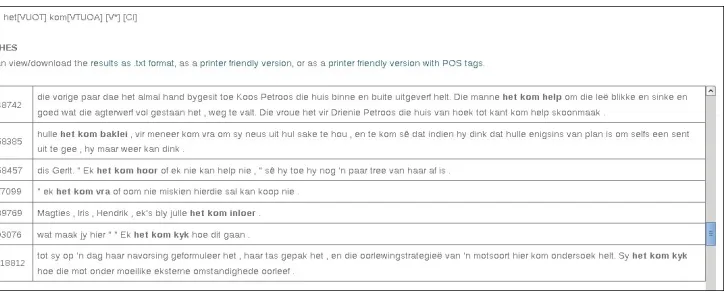
[image:5.420.38.401.243.389.2]After querying the corpus, the results are presented to the user (see screenshot in Figure 1). At the top of the page, the search instruction is repeated. Below the query, a list of matching sentences is displayed. The constructions matching the query are highlighted in each sentence. It is also possible to view/save the results as plain text format (with and without PoS tags).
Figure 1: Corpus search tool interface
At the bottom of the page, a grid with the corpus results is printed. It indicates how many hits in how many matching sentences were found. Furthermore, the ratio (matching sentences/sentences in the corpus) is given.
At the moment, it is not possible to query the corpus partially. It might be interesting to look into specific parts of the corpus (e.g. newspaper texts only), but unfortunately the corpus lay-out did not allow us to divide the corpus along those lines.
3 Infinitivus pro participio
3.1 IPP in double infinitive constructions
Infinitivus pro participio(IPP) orErsatzinfinitivis a linguistic phenomenon occurring in a subset of the West Germanic languages, such as Dutch, German, and Afrikaans. IPP refers to constructions with a perfect auxiliary, in which an infinitive appears instead of the expected past participle. In Afrikaans, one expects the temporal auxiliary for the perfect tense to select
a past participle, marked in various ways, most generally by a prefixge-and sometimes an ending (usually either-d/-tor-en), cf. geblyin example (1a).5 However, when a verb
occurring in the perfect tense selects another verb, it commonly occurs as an infinitive, cf.
blyin example (1b), instead of the expected past participle, as illustrated in example (1c).6
(1) (a) Hy
he hethave:PRES stilsilent geblystay:PP. ‘He remained silent.’
(b) Hy
he hethave:PRES blystay:INF praat.talk:INF ‘He kept on talking.’
(c) Hy
he hethave:PRES geblystay:PP praat.talk:INF ‘He kept on talking.’
While Dutch and German grammars mention general types of verbs (e.g. modal verbs) for which IPP is either required or optional, none of our Afrikaans sources do. Nevertheless, Ponelis (1979), Zwart (2007), and De Vos (2001) report that the IPP effect appears option-ally in Afrikaans. This contrasts with Dutch and German, as in those languages the IPP phenomenon is obligatory for certain verbs, see amongst others Haeseryn et al. (1997), and Dudenredaktion (2006). Donaldson (1993) mentions however that IPP is triggered in most cases, such as in example (1b). Constructions with a past participle such as (1c) do occur, but Donaldson considers them non-standard Afrikaans. A similar construction as (1c) in Dutch is not possible, as the cognate verbblijven(stay) always triggers IPP.
De Vos (2001) also reports that some of the IPP triggers, esp.laat(let), tend to passivize fairly productively (2). This phenomenon is ungrammatical in Dutch and German.
(2) Hierdie
This huishouse isbe:PRES deurby mymy oomuncle (ge)laatlet:PRES/PP bou.build:PRES ‘My uncle had this house built.’
3.2 IPP in progressive constructions
Apart fromdouble infinitiveconstructions, there is a second construction in which IPP can be triggered. Afrikaans has a serialization pattern using the conjunctionen(and) in order to express the continuous or progressive aspect of the verb, as in example (3a). Such constructions also exist in English (e.g. He sits and reads), but not in Dutch nor German. In the perfect of this construction, the first main verb has optionalge-marking, so it optionally triggers IPP, while the second main verb always occurs in the infinitive, as shown for the verb
staan(stand) in examples (3b-c). Both forms are considered standard Afrikaans by Ponelis (1979), Zwart (2007), Donaldson (1993), and Verdoolaege and Van Keymeulen (2010).
5Some verbs have noge-prefix though, so the past participle might actually be the same as the infinitive, e.g. bestuur(drive),begin(start, begin).
(3) (a) Ons
we staanstand:PRES stilstill enand luister.listen:PRES ‘We are standing and listening.’
(b) Ons
we hethave:PRES stilstill staanstand:INF enand luister.listen:INF ‘We were standing and listening.’
(c) Ons
he hethave:PRES stilstill gestaanstand:PP enand luister.listen:INF ‘We were standing and listening.’
De Vos (2001) reports that, although speaker judgments might vary, it is generally difficult to passivize indirect linking verbs (4), while Breed (2012) considers them grammatical.
(4) Die
The appelapple wordbecome:PRES deurby homhim gesitsit:PP enand eet.eat:PRES ‘The apple was being eaten by him.’
This construction is also impossible in both Dutch and German.
4 Hypothesis, data, and methodology
Based on the literature, the hypothesis is that, in contrast to Dutch and German, IPP occurs optionally in Afrikaans. We will test the hypothesis through a corpus-based study, using a PoS-tagged version of theTaalkommissiecorpus.7 The corpus, which is compiled by the
Afrikaans language committee of the South African Academy for Science and Arts, contains about 58 million words of formal, written Afrikaans. It comprises many different text types, including newspaper articles, magazines, Bible texts, scientific articles, and study guides. In order to query the corpus, we have created a corpus search tool (cf. section 2.4), which enables us to look for IPP constructions and their counterexamples with a past participle. We aim to find out whether IPP is actually optional or required in both double infinitive constructions and progressive constructions. Furthermore, we will investigate which verbs occur as IPP triggers in Afrikaans. The results of the corpus study are presented in section 5.
5 Results and discussion
5.1 IPP in double infinitive constructions
In order to retrieve IPP in double infinitive constructions and counterexamples with past participles in theTaalkommissiecorpus, we extracted all combinations in which the verb formhet(have) was followed or preceded by two verbs.8 In addition, we also look at the
sequence where there is one other word betweenhetand the two other verbs. Although it is possible that more than one word occurs betweenhetand the verbal group, we limited our research to constructions with zero or one word betweenhetand the two verb forms.9 This
7Taalkommissie van die Suid-Afrikaanse Akademie vir Wetenskap en Kuns (2011).
8We used the queryhet[VUOT] [VT*] [VT*]to retrieve double infinitive constructions. Discontinuous
constructions as well as counterexamples were found using variations of this query.
9Since we only have a ‘flat’ corpus, it is hard to retrieve discontinuous structures. Using a treebank should solve
this problem.
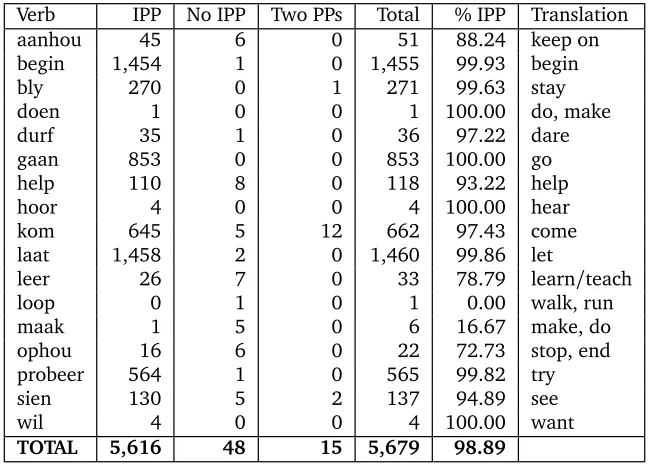
results in 9,880 hits, which were manually checked and categorized. We threw out the false positives due to wrong tagging and cases that did not involve main verbs that are triggering an infinitive. We also ignored the modal verbskan(can),mag(could) andmoet(must), as in those cases it is often hard to distinguish the matrix verb from the embedded verb. We retained 5,679 matches for the infinitive selecting verbs, of which 5,616 occur as IPP triggers (98.89% of the constructions under consideration). The results are shown in Table 2.
Verb IPP No IPP Two PPs Total % IPP Translation
aanhou 45 6 0 51 88.24 keep on
begin 1,454 1 0 1,455 99.93 begin
bly 270 0 1 271 99.63 stay
doen 1 0 0 1 100.00 do, make
durf 35 1 0 36 97.22 dare
gaan 853 0 0 853 100.00 go
help 110 8 0 118 93.22 help
hoor 4 0 0 4 100.00 hear
kom 645 5 12 662 97.43 come
laat 1,458 2 0 1,460 99.86 let
leer 26 7 0 33 78.79 learn/teach
loop 0 1 0 1 0.00 walk, run
maak 1 5 0 6 16.67 make, do
ophou 16 6 0 22 72.73 stop, end
probeer 564 1 0 565 99.82 try
sien 130 5 2 137 94.89 see
wil 4 0 0 4 100.00 want
[image:8.420.48.372.102.337.2]TOTAL 5,616 48 15 5,679 98.89
Table 2: IPP in double infinitive constructions.
Although some verbs are used rather infrequently in this construction, it is clear that in most of the cases, IPP is actually applied. Only formaakand the separable verbsaanhouand
ophou, we see a slightly higher percentage of cases that do not have IPP. Verbs likebegin,
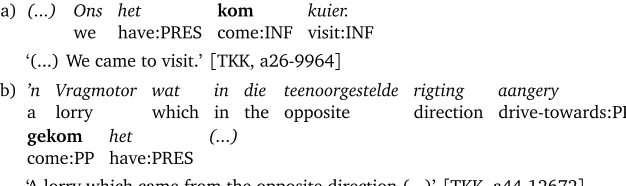
bly,durf,gaan,help,hoor,kom,laat,probeer, andsienseem to require IPP, cf. examples (5) and (7a), while we could consider it optional at least forleer, cf. example (6). We also see a few cases, esp. forkom, in which both the main verb and the verb triggered by it appear as past participles, cf. example (7b). This is not allowed by any of the Afrikaans grammars we consulted (cf. section 3.1). In general, we can conclude that there is a clear tendency for infinitive-selecting verbs to trigger IPP. We have only found 63 sentences in which the selecting verb receivesge-marking, which might explain why Donaldson considers such constructions substandard. De Vos (2001) links the optionality to the level of formality.
(5) My
my maagstomach hethave:PRES beginbegin:INF draai.turn:INF ‘My stomach has started to turn.[TKK, a00-2487]’
(6) (a) Hoe
(b) Dink
think terugback hoehow jyyou geleerlearned:PP bestuurdrive:INF hethave:PRES (...) ‘Think about the time you learned to drive (...)’[TKK, a16-20128]
(7) (a) (...) Ons
we hethave:PRES komcome:INF kuier.visit:INF ‘(...) We came to visit.’[TKK, a26-9964]
(b) ’n
a Vragmotorlorry watwhich inin diethe teenoorgesteldeopposite rigtingdirection aangerydrive-towards:PP gekom
come:PP hethave:PRES (...)
‘A lorry which came from the opposite direction (...)’[TKK, a44-12672]
As De Vos (2001) claimed, we found some passivized constructions with these selecting verbs (see Table 3), but they are far less frequent than the active variant. We investigated both the present form withwordand the perfect form withis. Of the selecting verbs used in the passive,laatis by far the most frequent. There is only one counterexample using a past participle instead of the IPP construction.
Verb IPP
present No IPPpresent IPPperfect No IPPperfect Total % IPP Translation
begin 2 0 5 0 7 100.00 begin
help 0 0 1 0 1 100.00 help
laat 11 1 43 0 55 98.18 let
probeer 8 0 3 0 11 100.00 try
[image:9.420.48.361.64.157.2]TOTAL 21 1 52 0 74 98.65
Table 3: IPP in passive double infinitive constructions.
5.2 IPP in progressive constructions
In a second test, we looked at IPP triggers in the serialized form of progressive construc-tions.10 We again selected cases withhet, but now with the conjunctionen(and) between
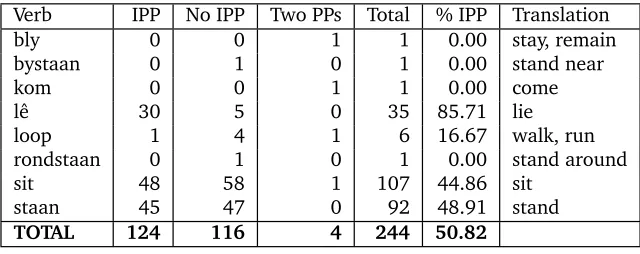
the two content verbs. This resulted in 1,743 hits, which were again categorized manually. We only retained 244 positive examples, of which 50.82% appeared as IPP triggers. The results are shown in Table 4.
It is clear that the construction as such is only frequent usinglê,sitandstaanas IPP triggers. IPP occurs in slightly less than half of the cases forsitandstaan, so we can agree with the grammars that IPP is optionally triggered in progressive constructions, cf. example (8). For
lêhowever, there seems to be a clear preference for the IPP construction. The progressive also occurs a few times withloop, but in that case the past participle seems to be preferred. We encounter again a few cases of two past participles, cf. example (9b). Similar to the constructions with double participles in section 5.1, such constructions seem less preferred. If we compare the results with the frequencies of a verb being the trigger for the progressive construction in this corpus (Breed, 2012), we see that verbs using the progressive frequently 10We used the queryhet[VUOT] [VT*] en[KN] [VT*]to retrieve double infinitive constructions.
Discontin-uous constructions as well as counterexamples were found using variations of this query.
(sit,staan, andlê) are more likely to apply IPP thenloop, which is less likely to occur in this construction.
Verb IPP No IPP Two PPs Total % IPP Translation
bly 0 0 1 1 0.00 stay, remain
bystaan 0 1 0 1 0.00 stand near
kom 0 0 1 1 0.00 come
lê 30 5 0 35 85.71 lie
loop 1 4 1 6 16.67 walk, run
rondstaan 0 1 0 1 0.00 stand around
sit 48 58 1 107 44.86 sit
staan 45 47 0 92 48.91 stand
[image:10.420.50.370.48.175.2]TOTAL 124 116 4 244 50.82
Table 4: IPP in progressive/continuous constructions.
Note that most of the verbs that use this construction do not occur in the double infinitive construction (cf. Table 2), while their Dutch cognates do (e.g. Afrikaanslêvs. Dutchliggen
(to lie)). We can conclude that both constructions are in general mutually exclusive.
(8) (a) (...) waar
where hyhe diethe spulstuf onderunder ’na soetdoringsweet thorn tree sitsit:INF enand dophouwatch:INF
het
have:PRES (...)
‘ (...) where he was watching the stuff under a sweet thorn tree (...)’[TKK, a25-14908]
(b) Ek
I hethave:PRES daarthere gesitsit:PP enand wagwait:INF opfor BrettBrett (...) ‘I was waiting there for Brett (...)’[TKK, a34-8014]
(9) (a) Hy
he verteltell:PRES hoehow hyhe (...) virfor diethe hysbaklift staanstand:INF enand wagwait:INF
het
have:PRES (...)
‘He tells how he (...) waited in front of the lift (...)’[TKK, a34-1063]
(b) (...) ’n
a paarcouple metermetre vanfrom waarwhere ekI nogstill soso rustigquiet gestaanstand:PP enand geselschat:INF
het.
have:PRES
‘(...) a couple of metres from where I was chatting (...)’[TKK, a34-1086]
According to Breed (2012) passive constructions with indirect linking verbs are possible, but she was, like us, not able to find any examples in theTaalkommissiecorpus.
6 Conclusions and future work
and in progressive constructions). The corpus results, however, reveal that infinitive-selecting verbs in double infinitive constructions trigger IPP in almost 99% of the constructions under investigation. The results of the progressive constructions are more consistent with the current literature, since the IPP phenomenon optionally occurs in such constructions (i.e. in ca. 50% of the cases). Moreover, we can conclude that verbs that occur as IPP triggers in the double infinitive construction, do not occur as IPP triggers in the progressive construction and vice versa.
Although we obtained some nice results from the present study, we had to do a lot of (semi-)manual filtering of the results. In order to reduce such tasks, as well as to improve the quality of the annotated data, we will improve the output of the annotation tools in future research. As the CTexT tagger still contains a lot of errors which could be corrected by a simple rule-based extension, we will create a rule-based tag corrector based on the Brill tagger (Brill, 1992).
We also want to extend the parser in order to have different options from the current shallow parsing (including updating and improving the current grammars) to a full parse tree. The parser will then be used to find constructions with more tokens intervening between the relevant items (i.e. between the auxiliaryhetand the infinitives and past participles in our case study). We will need to adapt the search tool to be able to search for chunks as well. Of course, this includes dealing with issues like efficient querying, indexing, and the representation of the trees in the tool. Besides improving existing tools, we will run a lemmatizer on the data, in order to include lemmas in the search tool as well.
Finally, all of this will be integrated in an Afrikaans equivalent of GrETEL (Augustinus et al., 2012), a query engine in which linguists can use a natural language example as a starting point for searching a treebank with limited knowledge about tree representations and formal query languages.
Using all these tools, we want to further investigate the IPP effect in Afrikaans. For example, it would be interesting to investigate whether the number of tokens occurring between the auxiliary and the other verb(s) have an influence on the construction used. Those results can also be useful for a cross-linguistic comparison with similar work in Dutch and German.
Acknowledgments
We wish to thank the people of the Taalkommissie and CTexT for providing us with the
Taalkommissiecorpus and the PoS tagger.
References
Augustinus, L., Vandeghinste, V., and Van Eynde, F. (2012). Example-Based Treebank Querying. InProceedings of the 8th International Conference on Language Resources and Evaluation (LREC 2012), Istanbul.
Brants, T. (2000). TnT – A Statistical Part-of-Speech Tagger. InProceedings of the Sixth Applied Natural Language Processing Conference (ANLP-2000), pages 224–231, Seattle. Breed, A. (2012). Die grammatikalisering van aspek in Afrikaans: semantiese studie van perifrastiese progressiewe konstruksies. PhD thesis, North-West University, Potchefstroom. Brill, E. (1992). A simple rule-based part of speech tagger. InProceedings of the third conference on Applied natural language processing (ANLC 42), pages 152–155, Stroudburg, PA.
De Vos, M. (2001). Afrikaans Verb Clusters: A Functional-Head Analysis. Master’s thesis, University of Tromsø, Tromsø.
Dirix, P., Vandeghinste, V., and Schuurman, I. (2005). METIS-II: Example-based machine translation using monolingual corpora – System description. InProceedings of MT Summit X, Workshop on Example-Based Machine Translation, pages 43–50, Phuket.
Donaldson, B. C. (1993).A Grammar of Afrikaans. Mouton de Gruyter, Berlin/New York. Dudenredaktion (2006). DUDEN. Die Grammatik. Unentbehrlich für richtiges Deutsch.
Dudenverlag, Mannheim/Leipzig/Vienna/Zürich.
Grover, A. S., van Huyssteen, G. B., and Pretorius, M. W. (2011). A Technology Audit: The State of Human Language Technologies (HLT) R&D in South Africa. InProceedings of PICMET’11: Technology Management In The Energy-Smart World (PICMET), pages 1693– 1706.
Haeseryn, W., , Romijn, K., Geerts, G., de Rooij, J., and van den Toorn, M. (1997).Algemene Nederlandse Spraakkunst. Martinus Nijhoff/Wolters Plantyn, Groningen/Deurne, second edition.
Pilon, S. (2005). Outomatiese Afrikaanse woordsoortetikettering. Master’s thesis, North-West University, Potchefstroom.
Ponelis, F. A. (1979). Afrikaanse Sintaksis. J.L. van Schaik, Pretoria.
Puttkammer, M. J. (2006). Outomatiese Afrikaanse tekseenheididentifisering. Master’s thesis, North-West University, Potchefstroom.
Schlünz, G. I. (2010). The effects of part-of-speech tagging on text-to-speech synthesis for resource-scarce languages. Master’s thesis, North-West University, Potchefstroom.
Taalkommissie van die Suid-Afrikaanse Akademie vir Wetenskap en Kuns (2011). Taalkom-missiekorpus 1.1., CTexT, North West University, Potchefstroom.
Verdoolaege, A. and Van Keymeulen, J. (2010). Grammatica van het Afrikaans. Academia Press, Ghent.
Zwart, J.-W. (2007). Some notes on the origin and distribution of the IPP-effect. Groninger Arbeiten zur Germanistischen Linguistik, 45:77–99.