7a,7 'a-Bis(l-methyl-3-oxoprop-l-eno)-6,14-end~ethenotetra- hydrothebaine. Repeated chromatographic purification of the ketol XVI o n alumina plates in ether solution led to the isolation also of a small quantity
of
a new base, mp 234", v m X 1690 cm-I. This was also obtained by heating the ketol (70 mg) with 98-100z formic acid (1 ml) at 100" for 10 min. The solution was diluted with water, basified with ammonia, and extracted with ether, when the unsaturated ketone (50 mg) was obtained as white prisms, mp 234", from methanol.Anal. Calcd for C46HS2N207: C, 74.2; H, 7.0. Found:
c,
74.0; H, 7.1.Charge-Transfer Complex, Thebaine Methiodide-Benzoquinone. Thebaine methiodide (5 g) and benzoquinone (1.5 g) were heated on the water bath in chloroform (25 ml) until separation of an orange crystalline solid began. The mixture was cooled, and the orange complex was collected (5.0 g), mp 205-206", on rapid heating (1it.l' mp 205 ").
Reduction of Complex.
A
solution of sodium borohydride (0.1 g) in water (2 ml) was added to a warm stirred solution of the com- plex (1 g) in ethanol (15 rnl).A
transient violet color developed, and the solution rapidly became almost colorless. On cooling the solution, thebaine methiodide (0.6 g), mp 224", was recovered, and on filtration and dilution of the solution with dilute ammonium chloride hydroquinone (0.12 g), mp 170", was obtained.Similar results were obtained when the complex in aqueous ethanol was reduced with sulfur dioxide.
Acknowledgments,
The authors wish to thank Dr.
D.
E. Webster of the University of Hull, England, for
the determination of nmr spectra, Mr.
A.
C. Young
for chromatographic studies
on thin and thick layer
plates, and the following for experimental assistance:
Mr. J. Fulstow, Mr. J.
F.
Saville, Mr. N. M. Scollick,
Mrs.
E.
W.
Walker, Mr.
G. R. Young, and the late
Mr.
S .
R.
Duff.
Anal. Calcd for C2J-L9N04: C, 75.8; H, 6.6. Found: C, 75.6; H , 6.5.
In a similar manner, the following ketones were prepared in poor yield from 0- and p-tolylmagnesium bromide: 6,14-endo- etheno-7a-(2-methylbenzoyl)tetrahydrothebaine (prisms, mp 223 O , vmax 1690 cm-1. Anal. Calcd for C29H31NO4: C, 76.1; H , 6.8. Found: C, 75.7; H, 7.1); 6,14-endo-etheno-7a-(4methyl- benzoy1)tetrahydrothebaine (prisms, mp 196", vmax 1690 cm-1. A m / . Calcd for C29H31N04: C, 76.1; H, 6.8. Found: C, 75.8; H, 6.7).
7a,7 'a-Bis(l-hydroxy-1-methyl-3-oxopropano)-6,14-endo-etheno- tetrahydrothebaine (IX, R = H). 'Ia-Acetyl-6,14-endo-etheno- tetrahydrothebaine (11, R = Me) (5 g) in anhydrous benzene (20 ml) was added with vigorous stirring to a solution of anhydrous magnesium iodide (3.6 g) in ether (50 ml) and benzene (20 ml) at room temperature.
A
white precipitate formed almost immedi- ately. After 15 min the mixture was decomposed by the addition of aqueous ammonium chloride. The ether-benzene layer was separated, dried, and evaporated, when a viscous gum was obtained. Chromatographic separation of this product on silica plates using a system of a 7: 4: 1 mixture of ethyl acetate, 2-propanol, and water showed it to contain three components in the ratio of approximately 3: 6: 1 . Preparative plate chromatography using the same system afforded specimens of the two major components. The component with greatestRi
value (30z) was identified as 7a-acetyl-6,14-endo- ethenotetrahydrothebaine (11, R = Me). The 60% component (intermediateRi
value) was obtained as off-white prisms, mp 150-151',
from methanol, vmax 1715 and 3490cm-1, andwas identi- fied as 7a,7 'a- bis( 1 -hydroxy- 1 methyl- 3-oxopropano)-6,14-endo-eth- enotetrahydrothebaine (IX, R = H).Anal. Calcd for C46HS4N?O~: C, 72.4; H, 7.1. Found: C, 72.3; H , 7.0.
Separation of this ketol was also achieved on alumina plates using ether as solvent, and from these plates the minor component (1Oz) was also isolated. This has been identified as a product of rearrangement of the ketone I1 (R = Me) and is described in detail in another publication?
Novel Analgesics and Molecular Rearrangements in the
Morphine-Thebaine Group.
11.' Alcohols Derived from
6,14-endo-Etheno- and
6,14-endo-Ethanotetrahydrothebaine
K. W.
B e n t l e y ,D. G .
H a r d y ,and B. Meek
Contribution fr o m the Research Laboratories, Reckitt and Sons Lid.,
Kingston-upon-Hull, England. Receiced Septem ber
26,1966
Abstract:
A
series of secondary and tertiary alcohols have been prepared
by
the reduction and reaction with Grignard
reagents
of
the aldehyde I
(R
=H),
the ketones I
(R
=Me, Et, n-Pr, and Ph), and their 6,14-ethano analogs. The
stereospecificity of the reactions is explained.
In
this way analgesics
of
very high potency,
up
to
500
times that
of
morphine, have been obtained.
he high analgesic activity of the ketone
I
(R
=Me)
T
and its C-7 epimer, reported in the preceding paper,
contrasts with the inactivity of the related esters
I
(R
=OMe or OEt). The effects on the activity of fur-
ther modifications of the keto group, involving removal
of the electron deficiency at the carbon atom, were ac-
cordingly studied. Reduction of the ketone I ( R
=Me) with aluminum isopropoxide affords a product
consisting of
9 5 %
of one isomer of the secondary
alcohol I1 ( R
=H,
R'
=Me), whereas reduction with
(1) (a) Part I : K. W. Bentley and D. G. Hardy, J . Am. Chem. SOC., 89, 3267 (1967). (b) A preliminary report of part of this work has been made by K. W. Bentley and D. G. Hardy, Proc. Chem. SOC., 220 (1963). (c) This work is covered by British Patent 925,723.
sodium borohydride yields an approximately
1
:
1
mixture of this and the diastereoisomeric alcohol
I1
( R
=Me, R'
=H), which was resolved into its com-
ponents by preparative thin layer chromatography.
Since there is more or less free rotation about the bond
linking the carbonyl group t o C-7, both sides of this
group are almost equally accessible t o attack by a hy-
dride ion, but in the Meerwein-Pondorff reduction,
which proceeds through hydrogen transfer in a cyclic
transition state,2 steric hindrance in the transition state
results in the preferential transfer of hydrogen t o one
(2) L. M. Jackman, A . K. Macbeth, and J. A. Mills, J . Chem. SOC., 2641 (1949).
An excess
of
methylmagnesium iodide converts the
ketone
I (R
=Me) in high yield into the tertiary al-
cohol I1 (R
=R’
=Me), which is also readily prepared
from the esters I
(R
=OMe or OEt), and the nmr
spectrum of this alcohol shows that the stereochemical
disposition of groups at
C-7
is the same as that in the
parent ketone.3a The tertiary alcohol epimeric at
C-7
with I1 (R
=R ’
=Me) was prepared in the same way
from the
7 p
isomer of the ketone I
(R
=Me). The
carbinols prepared in this way were all found t o be po-
tent analgesics. Accordingly, the variation in analgesic
activity within a series of alcohols
of general structure
I1
was studied, and during the course of this work many
compounds were obtained with analgesic activities
never previously approached in the morphine series, in
which hitherto the most active members have been
14-acetoxydihydrocodeinone
and 5methyldihydromor-
p h i n ~ n e , ~
both of which are about 12 times as active
as morphine.
I
I1
Meon
O
p
Me0
t!
“C4 /
‘CHs
Et
111
The alcohols of general structure I1 were prepared
by the action of Grignard reagents or lithium alkyls
o n the aldehyde
I (R
=H),
the ketones
I
( R
=Me,
Et, n-Pr, and Ph), and the ester
I
(R
=OEt). The
reactions of the ketones
I with Grignard reagents
R’MgX are generally complex and lead to the formation
of a number of products resulting from the following
processes: (a) normal Grignard reaction with R’MgX
to give the tertiary carbinol I1 (major reaction); (b)
normal Grignard reaction with R’MgX t o give the
tertiary alcohol diastereoisomeric with I1 (minor reac-
tion); (c) Grignard reduction where possible,
i.e.,
when R ’ contains a ,&hydrogen atom, t o give the sec-
ondary alcohol
I1
(R’
=H)
(major reaction in many
(3) (a)
W.
Fulmor, J. E. Lancaster, G. 0. Morton, J. J. Brown, C. H. Howell, C. T. Nora, andR. A. Hardy, Jr., J . A m . Chem. SOC., 89, 3322 (1967); (b) J. H. van den Hende and R. Nelson, private communication;J . A m . Chem. SOC., 89,2901 (1967).
58, 1457 (1936); G. Stork and L. Bauer, ibid., 75, 4373 (1953). (4) R.
E.
Lutz and L. F. Small, J . Org. Chem., 4, 220 (1939). (5) L. F. Small, H. M. Fitch, and W. E. Smith, J . A m . Chem. SOC.,group (minor reaction). Of these processes the base-
catalyzed rearrangement is
of minor importance and
will be discussed in detail together with other topics
in a subsequent communication.6b
The normal Grignard reaction in this series shows a
remarkably high degree of stereoselectivity, and in
those cases in which Grignard reduction does not
compete with the normal reaction a high yield of an
almost pure diastereoisomer
of the tertiary carbinol
is obtained. For example, the ketone I
(R
=Me)
with phenylmagnesium bromide afforded almost en-
tirely the alcohol I1 ( R
=Me,
R’
=Ph), whereas the
diastereoisomeric alcohol I1
(R
=Ph,
R’
=Me) was the
almost sole product of the action of methylmagnesium
iodide on the phenyl ketone I (R
=Ph). The presence
of a trace of the second isomer in the product in each
case was demonstrated by thin layer chromatography.
The stereochemical assignments
of structures t o these
isomeric carbinols, at first tentatively made after a study
of models, were rigorously confirmed by nmr spectro-
scopic studies.3a
Similarly the tertiary carbinol I1
(R
=Me,
R ’
=n-Pr), resulting from the normal Grignard reaction
of
n-propylmagnesium iodide with the methyl ketone
I (R
=Me), is diastereoisomeric with the principal
product I1 (R
=n-Pr, R’
=Me) of the interaction of
methylmagnesium iodide and the n-propyl ketone
I
(R
=n-Pr). The seat of the isomerism was clearly
shown in this case t o be the alcoholic group since both
carbinols were dehydrated t o the same olefin 111, which
gave propionaldehyde on o z o n ~ l y s i s . ~
The structure
of the carbinol I1
(R
=Me,
R’
=n-Pr) has been con-
firmed by X-ray crystallographic analysis of the hydro-
bromide.3b
Grignard reduction is, where possible, a process
seriously competitive with the normal Grignard reac-
tion, and in some cases accounts for up t o 30% of the
total product. Like the normal reaction, it shows a
remarkably high degree of stereoselectivity, and the
product consists almost entirely
of the alcohol I1 (R’
=
H),
though the presence of about
5
%
of the diastereo-
isomer I1
(R
=H)
can be detected on thin layer chro-
matographic plates. Both the Grignard and Meer-
wein-Pondorff reduction processes are generally be-
lieved t o proceed by hydrogen transfer in similarly con-
stituted transition
IV and
V, and might thus
in the case of the ketone
I
(R
=Me) be expected t o lead
t o the same product. This expectation is not borne
out in practice.
Grignard reduction
of
the ketone with n-propyl- or
isobutylmagnesium halides affords the secondary al-
cohol diastereoisomeric with that obtained in the
Meerwein-Pondorff reduction, and identical with the
(6) (a) This reaction was first reported to us by C. F. Howell, J. J .
Brown, W. Fulmor, G. 0. Morton, and R. A. Hardy, Jr., of Lederle Laboratories, Pearl River, N. Y . , whom we thank also for much helpful discussion of the mechanisms of the reaction of the ketones I with Grignard reagents. (b) Part VI: I<. W. Bentley, D. G. Hardy, H. P. Crocker, D. I. Haddlesey, and P. A. Mayor, J . Am. Chem. SOC., 89, 3312 (1967).
(7) Part IV: K. W. Bentley, D. G. Hardy, and B. Meek, ibid., 89,
3293 (1967).
( 8 ) M. S. Kharasch and 0. Reinmuth, “Grignard Reactions of Non-
Metallic Substances,” Constable and Co. Ltd., London, 1954, p 147.
I V
V
second component of the product of reduction of the
ketone with sodium borohydride. If the Meerwein-
Pondorff reduction leads, as postulated above, t o the
alcohol I1 (R
=H, R’
=Me), the product of Grignard
reduction must have the structure I1
(R
=Me,
R’
=
H), and these structural assignments have been
confirmed in the following way. The Meerwein-
Pondorff reaction product in chloroform solution
shows hydroxyl absorption at 3504 cm-1, indicating
strong hydrogen bonding between the hydroxyl and the
spatially proximate C-6 methoxyl group, which results
in an arrangement involving disposition of the hydrogen
atom in the carbinol system of the alcohol I1
(R
=H,
R’
=Me) “downward” toward the 6,14-etheno bridge.
In agreement with such a representation, in which steric
hindrance of the etheno bridge is minimal, this alcohol
is very readily hydrogenated at room temperature and
pressure. Hydrogen bonding of a similar kind in the
isomeric alcohol I1
(R
=Me, R’
=H)
would, however,
involve disposition of the larger CH3 group “down-
ward” toward the etheno bridge, and this would be ex-
pected t o result in some hindrance t o hydrogenation of
the bridge and also to a weakening of the hydrogen
bond or even to the establishment of an alternative
arrangement with a weak bond between the hydroxyl
group and the
Torbitals of the etheno bridge. In
agreement with this, the Grignard reduction product
of
the ketone I (R
=Me) is resistant t o hydrogenation
at room temperature, and shows hydroxyl absorption
at 3540 cm-‘ (weaker hydrogen bond than in the iso-
meric carbinol) and also at 3605 cm-I (feeble bond t o
the etheno bridge)
Thus, both Grignard reaction with and Grignard
reduction of the ketone I
(R
=Me) afford products
belonging to the same stereochemical series I1
(R
=Me). This asymmetric induction may be explained
on the basis
of a model similar t o those outlined by
Cram and his co-workers.9 If the Cram five-membered
transition state is replaced in this series by a six-mem-
bered intermediate in which a complex is formed by
coordination of the magnesium atom with oxygen
atoms of both C-7 carbonyl and C-6 methoxyl groups
(thus completing the outer electron shell of the mag-
nesium), then an inspection of models shows that
“top-side” approach of the group
R’ t o the carbonyl
carbon, as depicted in VI, leading to VI1 is much less
hindered than approach from below (the vicinity of the
6,14-etheno bridge). In the same complex, if the group
R’
is one in which /3-hydrogen transfer can occur then
Grignard reduction (VIII) would lead t o alcohol IX
[identical with the complete structure I1 (R
=Me,
R’
=
H)] belonging t o the same stereochemical series as
the products of the normal reaction.
In the Meerwein-Pondorff reduction, however, the
aluminium atom can complete its valency shell by
co-(9) D. J. Cram, F. Ahmed, and A. Elhatez, J . Am. Chem. SOC., 74, 5828 (1952).
il
cH3
x
k
dH3
VI
VI1
B
dH3
VI11
k
CH3
IX
ordination with the carbonyl oxygen atom alone, and
the establishment of a more rigid cyclic arrangement
involving the C-6 methoxyl group is not necessary. In
such a case, free rotation about the carbonyl-C-7 bond
is still possible and hydrogen transfer in the complex
would be expected to occur with the groups in the dis-
position involving least steric hindrance. This arrange-
ment is that in which the coordinated carbonyl group is
most remote from the group with the greatest effective
size, namely the C-6 methoxyl group. This arrange-
ment is shown in part structure X, which is a Newman
projection
of part of the ketone I (R
=Me) looking
along the line of the carbonyl-C-7 bond, and least
hindered hydrogen transfer t o the carbonyl group would
occur as shown, from above, t o give the secondary
alcohol XI which is identical with XII. This alcohol
is diastereoisomeric with that obtained by Grignard
reduction, and is represented in full by structure
I1
(R
=H, R’
=Me).
Me2
H
X
A
XI
Ik
CH3
XI1
The reaction of the ketone
I (R
=Me) with lithium
alkyls involves, in the cases studied, more base-catalyzed
rearrangement than does the reaction with Grignard
reagents, but this still remains a minor side reaction
(<lo%),
and the formation of tertiary carbinol is
somewhat less stereoselective. Secondary alcohol for-
mation is not observed, however, and in those cases in
which Grignard reduction is troublesome the use of the
corresponding lithium alkyl is to be preferred.
H Me H H H H H H H H H Me Me Et Me n-Pr Me Me Me Me Me Me Me Me Me Me Me Ph Me Me Me Me Me Me Me Me Me Me Me Me Me Me Me Me Me Me Et Et n-Pr Il-BU CHPPh Ph Ph Ph Ph Me H Et n-Pr Ph 11- C8H 17
CHsPh CHSCHzPh (CHd30Et
( C U G
-0
Me Et Me n-Pr Me i-Pr n-Bu i-Bu ti-Am i-Am t-Am t-BU n-CsH18 tl-C7Hi,j n-CsH17 Ph Me CHzPh (CHzhPh ( C H M h 0-Tolyl p-TolylC H Z C ~ H ~ F - p CHzC6HaCI-p
CHn=CHPh CH=CHz
C H P C H = C H ~ CHzCsH40Me-p CECH Cyclohexyl Cyclopentyl (CHzIzOEt (CHdzOPh
( C H h
9
C H Z G
Et Ph ti-Pr n-Bu Ph n-Pr CHzPh CHzPh Cyclohexyl
Ph CH*CH=CHz
82 81 . . .
. . .
78 210 95 80. . .
114 98 166 165 176 148 165 150 150 216 103 12674 (1 32)
. . .
.I.
. . .
, . . 208 152 187 146 94 239 197 148 180 117 92 155 186 160 20 1 86 107 221 128 140 152 166 209 190 220 177 210 232 21 7. . .
72.1 72.1 54.3 56.5 74.9 75.4 15.8 76.0 56.9 69.8 74.4 72.5 73.1 73.1 73.3 73.3 73.3 73.8 73.8 13.8 74.1 74.1 6 4 . 0 6 3 . 0 64.9 75.5 75.8 75.8 76.1 76.4 72.3 76.1 76.1 7 3 . 3 70.9 71.6 71.2 7 3 . 3 73.7 73.6 74.8 74.6 6 6 . 5 7 3 . 372.5
71.1
1 3 . 3 76.1 1 4 . 2 61.1 78.7 78.2 76.5 78.5 77.6 76.6
7 . 6 7 . 6 7 . 1 7 . 1 8 . 9 7.1 7 . 2 7 . 4 7.5
8 . 2
8 . 3
7.9 8 . 1 8.1 8 . 2 8 . 2 8 . 2 8 . 4 8 . 4 8 . 4 8 . 6 8 . 6 8 . 4 8 . 7 8 . 6 9 . 1 7 . 2 7 . 2 7 . 4 1 . 6 8 . 0 1 . 4 7 . 4 7 . 0 6 . 1 7 . 5 7 . 1 1 . 6 7 . 1 7 . 8 8 . 4 8 . 2 8 . 5 7 . 8
8 . 6
8 . 1
8 . 1 7 . 4 8 . 7 7 . 9 7 . 2 6 . 7 7 . 6 6 . 9 7 . 8 7 . 2
72.0 71.8 54.6 5 6 . 4 74.6 75.6 1 5 . 6 75.6 56.8
7 0 . 0
74.1
72.5 72.9 7 2 . 9 73.3 73.2 73.0 73.9 73.8 73.8 73.8 74.0 63.8 6 2 . 7 65.0 7 5 . 3
1 5 . 5
75.6 76.1 76.1 72.5 76.1 76.0 7 3 . 0 7 0 . 7 1 1 . 8 71.2 7 3 . 3 7 3 . 6 73.6 74.8 7 4 . 3 6 6 . 3 73.1
72.6
71 .O
73.0 7 6 . 2 73.9 61.2 78.5 77.9 7 6 . 2 7 8 . 3 7 7 . 3 76.5
7 . 5 8 . 0 7 . 1 7.1 8 . 6 7 . 1 7 . 3 7 . 4 7 . 2
8 . 1
8 . 3
7 . 7 8.1 8 . 2 8 . 2 8 . 4 8 . 3 8 . 4 8 . 6 8 . 5 8 . 4 8 . 4 8 . 2 8 . 7 8 . 6 8 . 9 7 . 2 7 . 2 7 . 3 7 . 8 7 . 9 7 . 3 7 . 4 7 . 3 6 . 9 7 . 3 6 . 9 7 . 6 7 . 2 7 . 8 8 . 3 8 . 0 8 . 3 7 . 5
8 . 4
8 . 0
8 . 0 7 . 4 8 . 7 7 . 8 7.2 6.7 7 . 6 7 . 0 7 . 9 7 . 0
210 240 90b 1 76c 15Y 12S 166 1ooc 221 245 217 218 188 250 258 188 270 256 262 194 230 236 235 190 250 248 260 202 240 248 260 185 130 186 6ZC 190 266 210 220 239
1
.o
0 . 9 0 . 8 5 . 3 0 . 2 0.01 1 . 6 80 1224
9 . 0
2 . 7 20
96
10 24
2 . 5 0 . 1 15 30
0 . 6 2 . 0 1 . 2 0 . 3 0.07 0 . 0 9 150 500
2 . 1 0 . 1 5 0 . 1 0
1 . 5 4 . 0 1 . 4 0 . 2 0.41
1
.o
6 . 0 0.05 5992
2 . 5
3 . 1 3 . 0 0 0 0 . 2 0 0.04 0.53
a Morphine = 1. Hydrobromide. Bitartrate.
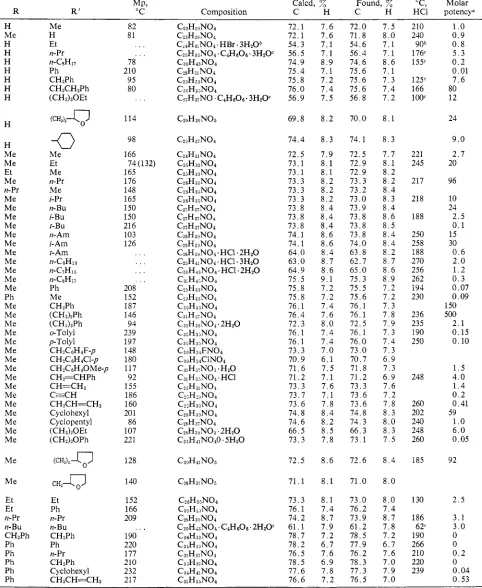
The alcohols
of general structure I1 prepared in this
way are listed, together with their analgesic potencies,
in Table I. The analgesic activities were determined by
the tail pressure method in rats, with administration
of
aqueous solution by the subcutaneous route, and this
work will be reported in detail elsewhere, together with
the results
of other pharmacological studies.
loThe
highest activities are observed in those alcohols in which
there
is
a moderate disparity in size between
R and
R’,
macol., 1 6 , 3 6 4 (1964).
the
as their
in
(10) Some details are briefly given by R. E. Lister, J . Pharm. Phar- [image:4.616.75.557.70.658.2]base and the methylation of other tertiary alcohols in
the series proved unsuccessful.
Catalytic reduction of the tertiary alcohols was in all
cases achieved only at elevated temperature and pres-
sure. Hydrogen bonding between the hydroxyl and
C-6 methoxyl groups results in conformations in
which one or the other of the alkyl groups R and
R '
in structure 11
is
disposed in the direction of the 6,14-
etheno bridge, with consequent hindrance of the ap-
proach of this bridge t o the catalyst surface. Reduc-
tion is achieved over Raney nickel catalyst at 160-170"
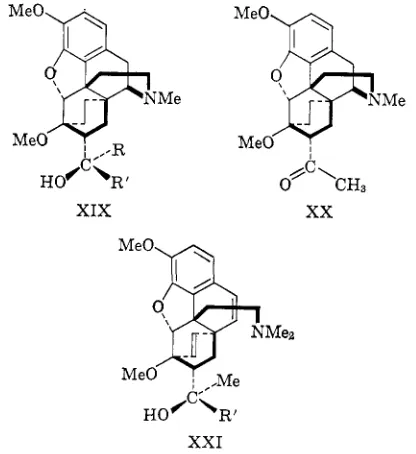
(200 atm) to give bases of general structure XIX. These
6,14-etheno alcohols are also preparable from the
6,14-ethano ketone XX which is obtained from the
etheno ketone I (R
=Me) by reduction under milder
conditions. The effect of the COCH3 group in the
ketone
I
(R
=Me) in shielding the etheno bridge is
much less than the effect of the alcoholic group in the
hydrogen-bonded alcohols 11, and since the shielding
effect on the etheno bridge of the smaller CHO group
is
even less than that of the COCH3 group, the aldehyde
I
(R
=H)
can be reduced under even milder conditions.
In the 7P-acetyl compound, the COCH, group
is dis-
posed on the side of the molecule opposite t o the etheno
bridge, hydrogenation of which is accordingly un-
hindered, and this base can be rapidly reduced at room
temperature. The Grignard reaction with the 6,14-
ethano ketone XX in general follows the same pattern
as that with the etheno analog I1 (R
=Me), giving rise
t o tertiary carbinol XIX, secondary carbinol as a result
[image:5.623.339.547.466.693.2]of
Grignard reduction, and base-catalyzed rearrange-
ment. Base-catalyzed rearrangement is generally more
important in this than in the etheno series, and on
occasions accounts for up t o
3 0 x
of the product.6b
The normal Grignard reaction displays the same stereo-
specificity as in the 6,14-etheno series. The 6,14-ethano
alcohols XIX prepared by these methods are listed in
Table 11.
and in homologous series in which the group R remains
constants as a hydrogen atom or a methyl group peak
activity is reached when
R '
has a size equivalent to that
of a three t o five carbon chain, and further lengthening
of the chain results in a steady decrease in activity.
The preferred constant substituent
R
is a methyl
group, and the most potent analgesic in this series is the
alcohol I1 (R
=Me, R '
=CH2CH2Ph).
The alcoholic hydroxyl group
of the secondary
alcohols was rcadily esterified, but this modification has
little effect on the analgesic potency. The tertiary
alcohols, however, are very resistant to esterification.
The two diastereoisomeric secondary alcohols I1 (R
=
H, R '
=Me and R
=Me, R '
=H) were esterified
with phenylglyoxalyl chloride and, following Prelog's
method,I1 the resulting esters were treated with methyl-
magnesium iodide and the products hydrolyzed t o
atrolactic acid. With the alcohol I1 (R
=H,
R '
=Me), the three conformations of the phenylglyoxalyl
ester are XIII, XIV, and XV, in which
0
represents the
tetrahydrothebaine unit, and in these the size of groups
is in the order
0
>
Me
>
H and, as in the cases studied
by Prelog, attack by the Grignard reagent on XI11
would be from below and on XIV and XV would be
from above. However, the examination of models of
0
XI11
XIV
xv
XVI
XVII
XVIII
these three conformations reveals that nonbonded
interactions are very much less in the form represented
by XI11 than in the other two, and the ester would be
expected to adopt predominantly this form, attack of
which by the Grignard reagent would lead, after hy-
drolysis, t o an excess of (+)-atrolactic acid. With the
ester from the diastereoisomeric alcohol
I1
(R
=Me,
R '
=H) the conformation XVI would be expected t o
be heavily favored over XVII and XVIII, and the same
process with this ester would be expected to lead t o an
excess of (-)-atrolactic acid. In this event this sequence
of reactions on the alcohol obtained by Meerwein-
Pondorff reduction of the ketone
I
(R
=Me) gave
atrolactic acid,
[CY]*~D+4.8
O,whereas the product of
Grignard reduction of the ketone in the same way
afforded atrolactic acid,
[ c Y ] ~ O D-5.4", and these results
support the structures assigned above t o these bases.
0-Alkylation
of the tertiary alcohols was also very
difficult, but the base I1
(R
=R '
=Me) was methylated
with potassamide and methyl iodide in liquid ammonia
t o its methyl ether. Other attempted alkylations of this
(11) V. Prelog, Helc. Chim. Acta, 36, 308 (1953).
Meom
I
OHC\CH3
XIX
xx
w
I.,Me
As
in the parent Diels-Alder adducts I (R
=Me and
OEt), quaternary salt formation with the alcohols I1
proceeded only very slowly, good yields being obtained
only after several days under reflux with methyl iodide
in acetone.
In the cases examined, Hofmann degra-
H Me 51 C2aHziN04 71.6 8.1 71.5 8 . 2
Me Me 142 C24HauN04 72.1 8 . 3 71.9 8.2 2.9
Me Et 146 C2jHajNOa 72.6 8.5 72.6 8.3
Me n-Pr 187 C I B H K N O ~ 73.1 8.7 72.8 9.1
Me i-Pr 158 CuH37N04 73.1 8.7 73.4
8.7
34Me /l-Bu 147 GH3rjN04 73.4 8.9 73.5 8.9 240
Me sec-Bu 164 C-xHa'~N04 73.4 8.9 73.1 8 . 8
Me i-Bu 170 CziHasNOa 73.4 8.9 73.3 8.9 20
Me t-Bu 188 C2iHuN04 73.4 8.9 73.2 9.0 30
Me n-Am 113 C ~ ~ I N O ~ 73.8 9.1 73.6 9.6 36
Me
i-Am 126 C?~H.iiN04 73.8 9.1 73.6 9.0 150Me CHZPh 146 CmHxN04 75.8 7.8 75.6 8.0 110
Me 202 C23H36N04 75.5 7.6 75.0 7.7 0
Me
6
195 G&iN04 74.5 8.8 74.4 9.1 15Morphine = 1.
dation of the quaternary salts proceeded very readily
t o give the expected methine bases XXI.
Nomenclature.
The systematic nomenclature for
the bases in this series, based on the 6,14-endo-etheno-
tetrahydrothebaine system, is cumbersome and, since
many degradation and rearrangement products of
thebaine, codeine, and morphine already have simple
trivial names, a simpler system, based on a trivial name
for a key intermediate, would be an advantage. The
trivial name nepenthone was assigned t o the phenyl
ketone I ( R
=Ph) in order to facilitate the naming of
derivatives. The intermediates that have been most
widely used in this work are the aldehyde I
(R
=H)
and the ketones I
(R
=Me and Ph) and of these the
ketone I (R
=Me) is much the most actike as an anal-
gesic and gices rise to
a
kery wide series of alcohols of
structure I1 (R
=Me) of high activity. These alcohols
are more easily prepared and of much greater pharma-
cological interest than the corresponding bases
I1
(R
#
Me). Accordingly, a tricial name has been assigned
to the ketone
I (R
=Me). This ketone
is the adduct
of thebaine and methyl vinyl ketone and by a suitable
selection of syllables from the names of these com-
pounds the name
rheciriorie
emerges for the ketone
I
(R
=Me). The related secondary alcohol I1
(R
=Me, R '
=H) then becomes
thecznoI,
and the other
bases in the series I1
(R
=Me), being obviously hom-
olog of I1
(R
=Me,
R '
=H), may be named as alkyl-
thevinols,
e.g.,the alcohol 11 (R
=Me, R '
=n-Pr)
beconiespropj,/thecinoi and I1 ( R
=Me,
R '
=CH2CH2-
Ph) becomes plieriethq.lthecirio1.
As
will be seen in the following paper, most of the
alcohols of the series
I1 have been demethylated t o
phenolic 3-hydroxy analogs, and bases of this series
corresponding to those of structure I1 ( R
=Me),
being derivatives of tetrahydrooripavine rather than
tetrahydrothebaine, can be termed alkylorvinols, e.g.,
the 3-hydroxy analog of the base
I1
(R
=Me,
R '
=cyclohexyl) would be cjdohexyiorcinol.
The acid
I (R
=OH),
being an oxidized form of
thevinone, can be named thecitioic acid and the ester
I
(R
=OEt) then becomes ethyl theoinoate and the
acid chloride I
(R
=Cl)
thecinoyl chloride. (The
term thevinic acid is avoided as this leads t o the acid
chloride being named thevinyl chloride, which should
be reserved for the halide corresponding to thevinol.)
Since a series of 6,14-ethano alcohols
XIX
derived
from the ketone
XX is known, this last base can be
termed hydrothevinone and the alcohols thus become
alkylhydrotheuinols, or hydroorvinols after O-demeth-
ylation. Relatively simple extensions of this nomen-
clature permit rational names to be assigned to other
bases resulting from transformations of the ketone
I (R
=Me) and the alcohols I1
(R
=Me), and these
will be discussed where necessary in subsequent pub-
lications.
Experimental Section
Examples only of representative Grignard reactions and reduc- tions are given in this section t o show the general processes used.
7a-(l-Hydroxy-l-methylethyl)-6,14-endo-ethenotetrahydrothe- baine (19-Methylthevinol) (11, R = R ' = Me). a. A solution of 7a-acetyl-6,14-endo-ethenotetrahydrothebaine (thevinone) (I, R = Me) (10 g) in dry ether (500 ml) or in dry benzene (50 ml) h a s added slowly with vigorous stirring to a refluxing solution of methyl- magnesium iodide, prepared from magnesium (1.67 g) and methyl iodide (9.9 g) in ether (100 ml), and the mixture was stirred and heated under reflux for 2 hr. The mixture was then shaken with aqueous ammonium chloride, and the organic layer was separated, dried, and evaporated, leaving a crystalline base (10 g), which was recrystallized from ethanol. The base was obtained in this way as plates, mp 166".
Anal. Calcd for C24H31N01: C, 72.5; H, 7.9. Found: C, 72.5; H, 7.7.
b. 6,14-endo-Etheno-7a-ethoxycarbonyltetrahydrothebaine (ethyl thevinoate) (I, R = OEt) (10 g) was extracted from a Soxhlet extractor into a boiling stirred solution of methylmagnesium iodide (from 1.67 g of magnesium and 9.9 g of methyl iodide) in ether (100 ml). The mixture was boiled under reflux for 3 hr, and the product isolated as in a above, when it was obtained (9.8 g) as white prisms, mp 166", alone or mixed with material prepared from the ketone.
7~-(l-Hydroxy-l-methylethyl)-6,14-er2do-ethenotetrahydrothe- baine (19-Methyl-P-thevinol) (C-7 Epimer of 11, R = R ' = Me). a. A solution of 7P-acetyl-6,14-endo-ethenotetrahydrothebaine (0.5 g) in ether (100 ml) was added to a stirred refluxing solution of methylmagnesium iodide (from 0.17 g of magnesium and 1 g of methyl iodide), and the mixture was boiled under reflux for 1 hr. Isolation of the product in the usual way afforded a mixture of two nonketonic products. These were separated on thick alumina plates, and the base, having the greater
R f
value, was obtained as prisms, mp 190", on recrystallizationfrom
ethanol. It was identi- fied as the alcohol epimeric at c-7 with I1(R
= R ' = Me) by its nmr and infrared spectra, which were very similar to but not iden- tical with those of I1 (R = R1 = Me).Anal. Calcd for C2,H3,NO4:
C,
72.5; H, 7.9. Found: C, 72.5;H,
7.7.The second product, of lower
R f
value, was phenolic and has been identified as a product of base-catalyzed rearrangement of theto a stirred solution
of
methylmagnesium iodide (from 2 g of mag- nesium and 6 ml of methyl iodide) in ether (150 ml), and the mixture was boiled under reflux for 1 hr. Isolation of the product in the usual way afforded 10.1 g ofa
base containing about 10% of the alcohol I1 (R = Me,R'
= n-Pr). After several recrystallizations from methanol the alcohol I1 (R = n-Pr,R'
= Me) was obtained almost pure, as prisms, mp 144-145", and a pure specimen, mp 148-149", for spectral studies was obtained by layer chromato- graphic separation on alumina.Anal. Calcd for C26H35N04: C, 73.3; H , 8.2. Found: C, 73.2; H , 8.4.
7~-(1-(R)-Hydroxy-l-methyIpropyl)-6,14-eildo-ethenotetrahydro- thebaine (19-ethylthevinol) (11, R = Me, R ' =
Et)
was obtained by the above general method from the ketone I (R = Me) and ethyl- magnesium bromide as prisms, mp 74", with resolidification and parent ketone followed by Grignard reaction and is described indetail in a later paper.6b
Reduction of 7~~-Acetyl-6,14-endo-ethenotetrahydrothebaine (The- vinone) (I, R = Me). The ketone I (R = Me) (10 g) was boiled with aluminum isopropoxide (10 g) and 2-propanol (100 ml) with slow distillation of the solvent through a 36-plate fractionating column until the distillate no longer gave a precipitate with a solution of 2,4-dinitrophenylhydrazine in aqueous hydrochloric acid. On completion of the reaction, the mixture was evaporated to small bulk and poured into dilute hydrochloric acid. The acid solution was saturated with potassium sodium tartrate and basified with am- monia, and the precipitated base was isolated by ether extraction, when the carbinol I1
(R
= H , R' = Me) was obtained as a viscous gum that was crystallized from aqueous methanol, being then ob- tained as white prisms, mp 78-80", raised to 82" by further recrys- tallization from aqueous methanol or ether at low temperatures.A m l . Calcd for C23H29N04: C, 72.1: H , 7.6. Found: C, 72.0; H , 7.5.
Thin layer chromatographic studies showed that the base, mp 78-80", first obtained contained about 5 of the isomeric carbinol
I1
(R = Me, R ' = H), which is the main product of Grignard re- duction of the ketone.The 0-formyl ester was prepared by heating the alcohol with 9 8 - 1 0 0 z formic acid at 100" for 1 hr and was obtained as plates, mp 110", from aqueous methanol.
A m / . Calcd for C D ~ H ~ ~ N O ~ : C, 70.1; H, 7.1. Found: C, 70.3; H , 7.2.
The 0-acetyl ester, prepared from the alcohol and acetic anhydride in pyridine, was obtained as plates, mp 170", from aqueous ethanol.
A m / . Calcd for CZjH31NOj: C, 70.7; H, 7.3. Found: C, 70.9; H , 7 . 5 .
b. The ketone I
(R
= Me) (10 g) was boiled under reflux in methanol (50 ml) with sodium borohydride (1 g) for 30 min. The solution was concentrated by evaporation and poured into water and the precipitated base was isolated by ether extraction, when it was obtained as a viscous gum, shown by thin layer chromatography to consist of a n approximately 1 : l mixture of the products of Meerwein-Pondorff and Grignard reduction of the ketone.7cu-(l-(R)-Hydroxy-l-methylbutyl)-6,14-e~~do-ethenotetrahydro- thebaine (19-Propylthevinol) (11, R = M e , R ' = n-Pr)a nd Grignard Reduction of the Ketone I (R = CH,). 7cu-Acetyl-6,14-endo-etheno- tetrahydrothebaine (I, R = CHI) (50 g) in dry benzene (250 ml) was added to a vigorously stirred refluxing solution of n-propylmag- nesium iodide (from 8.35 g of magnesium and 58.5 g of l-iodopro- pane) in ether (500 ml), and the mixture was boiled under reflux for 2 hr. The product, isolated in the usual way, was a viscous gum which crystallized on trituration with methanol (100 ml). The solid was collected and recrystallized from ethanol, when the alcohol I1
(R
= Me, R ' = u-Pr) was obtained as white prisms, mp 176" (24.0 g).A d . Calcd for C26H35N04: C, 73.3; H , 8.2. Found: C, 73.2; H, 8.2.
The mother liquors were diluted with methanol (50 mi) and water was added until precipitation of gummy material began. The solution was allowed to stand for 15 min, decanted from the gummy material, and then kept in the refrigerator, when the Grignard re- duction product, 7 4 l-(S)-hydroxyethyl)-6,14-e11do-ethenotetrahy- drothebaine (thevinol) (11, R = Me, R ' = H ) (12 g) was obtained as needles, mp 76-78", raised to 81" on recrystallization from aqueous methanol.
A m / . Calcd for C23H2'JN04: C, 72.1; H , 7.6. Found: C, 71.8; H , 8.0.
The 0-formyl ester, prepared by heating the secondary alcohol with 9 8 - 1 0 0 z formic acid at 100" for 1 hr, was obtained as prisms, mp 148", from aqueous methanol.
A/ial. Calcd for C24H2DNOi.0.5H20: C, 68.6; H, 7.2. Found: C, 68.7; H, 7.3.
The 0-acetyl ester, prepared from the alcohol, acetic anhydride, and pyridine, was obtained as prisms, mp 120°, from aqueous methanol.
Anal. Calcd for C25H3,NOe: C, 70.7; H, 7.3. Found: C, 70.8; H, 7.5.
A third base has been isolated from the residues of separation of the Grignard reduction product. This was a phenol, mp 201- 203
',
and is a product of base-catalyzed rearrangement of the parent ketone followed by normal Grignard reaction with propylmag- nesium iodide; it is described fully in a later paper.6b7cu-(l-(S)-Hydroxy-l-methylbutyl)-6,14-e~~do-ethenotetrahydro- thebaine (11, R = n-Pr, R ' = Me). 7cu-Butyryl-6,14-erzdo-etheno- tetrahydrothebaine (I, R = n-Pr) (15 g) in ether (500 ml) was added
a.
f i n 2 melting at 135".
Anal. Calcd for CW,HHNOI: C. .. .. . , 73.1: I H , _8.1. Found: C. 72.9; H, 8.1.
It was also obtained by the reduction of the vinylcarbinol I1 (R = Me,
R'
= CH=CH2);7cu-(l-(S)-Hydroxy-l-methylpropyl)-6,14-end~-ethenotetrat1y- drothebaine (11, R = Et, R ' = Me) was prepared by the general method from the ketone I
(R
= Et) and methylmagnesium iodide, when it was obtained as prisms, mp 165".Anal, Calcd for C25Hj3N04: C, 73.1; H, 8.1. Found: C, 72.9; H, 8.2.
It was also obtained by the reduction of the acetylenic carbinol I1 (R = C=CH, R ' = Me); see below.
7cu-(l-(R-Hydroxy-l-methylprop-2-enyl)-6,14-endo-ethenotetra- hydrothebaine (19-Vinylthevinol) (11, R = M e , R ' = CH=CHy). A solution of 7~~-acetyl-6,14-endo-ethenotetrahydrothebaine (I, R
= Me) (19 g) in dry tetrahydrofuran (30 ml) was added to a reflux- ing solution of vinylmagnesium bromide (from 3.0 g of magnesium and 13.4 g of vinyl bromide) in tetrahydrofuran, and the mixture was boiled under reflux for 2 hr. Saturated aqueous ammonium chloride was added, and the organic layer was separated, dried, and evaporated. The residual brown gum was crystallized from methanol when the alcohol was obtained as white prisms, mp 155
'.
Anal. Calcd for C25H317d04: C, 73.3; H, 7.6. Found: C, 73.3; H , 7 . 6 .
Reduction. The alcohol I1 (R = Me, R ' = CH=CH*) ( 5 g) in ethanol (100 ml) was shaken under hydrogen at 22" (750 mm) in the presence of platinum oxide (100 mg). Hydrogen (300 ml) was ab- sorbed over 30 min, after which reduction ceased. Filtration and evaporation of the solution gave 5.0 g of material which on crystal- lization from ethanol gave prisms, mp 74 and 135', unaltered on mixing with the alcohol I1 (R = Me,
R'
= Et), obtained from the action of ethylmagnesium bromide on the ketone I (R = Me). The infrared spectra and chromatographic behavior on alumina plates of the bases from the two sources were also identical.7cu-(l-(S)-Hydroxy-l-methylprop-2-ynyl)-6,14-e~1~o-ethenote~ra- thebaine (19-Ethynylthevinol) (11, R = C=CH, R ' = Me). 7a- Acetyl-6,14-endc-ethenotetrahydrothebaine (I, R = Me) (38 g) in dry tetrahydrofuran (200 ml) was added with stirring to a solution of lithium acetylide-ethylenediamine complex (10 g) under an at- mosphere of argon. The mixture was stirred at 3 5 " for 3 hr and poured into water (200 ml). The mixture was extracted three times with ether, and the combined extracts were dried and evap- orated. The residue crystallized in part on trituration with meth- anol (20 ml), and the solid (10.5 g) was collected and recrystallized from methanol when the alcohol I1 (R = C=CH,
R'
= Me) was obtained as prisms, mp 185-186".Anal. Calcd for C25H29N04: C, 73.7; H , 7.1. Found: C, 73.6; H, 7.2.
A further 4.1 g of material, mp 183-184", was obtained on corL- centration of the mother liquors. Final evaporation of these liquors afforded a gum shown by thin layer chromatography to consist of an approximately 1 : 1 mixture of the above base and a second compound, presumably the diastereoisomeric alcohol I1
(R
= Me, R ' = C=CH), since the infrared spectrum of the mixture was almost identical with that of the pure base, mp 185-186".Reduction. The acetylenic alcohol I1 (R = C=CH, R ' = Me) (4.0 g) was hydrogenated over platinum oxide (100 mg) in ethanol at 22" (760 mm). Hydrogen (449 mi, 2 moles) was absorbed over 20 min, and isolation of the product afforded the alcohol I1
(R
= Et, R' = Me), mp 165", identical in melting point, mixture melting point, infrared absorption, and RI value with the product of the action of methylmagnesium iodide on the ketone I (R = Et).Study of the Stereochemistry at C-19 of the Alcohols I1 (R = H , R ' = M e and R = Me, R ' = H). A so!ution of 7a-(l-(R)-hydroxy-
see below.
(3.5 g) and recrystallized from methanol when the phenylglyoxalyl ester was obtained as off-white plates, mp 206".
A d . Calcd for CJ-I33NO6.H?O: C, 69.85; H, 6.7. Found: C, 70.0; H , 7.0.
A
solution of methylmagnesium iodide (from 0.95 g of magnesium and 25 ml of methyl iodide) in ether (30 ml) was added to a solution of the phenylglyoxalyl ester ( 5 g) in dry benzene (100 ml), and the mixture was kept at room temperature for 3 hr and then boiled under reflux for 3 hr. The mixture was poured into aqueous am- monium chloride; the organic layer was separated and the aqueous layer extracted twice with chloroform. The combined ether- benzene and chloroform solutions were evaporated, and the residue was boiled under reflux with 5%
methanolic potassium hydroxide (200 ml) for 5 hr. Most of the methanol was evaporated, and the mixture was diluted with water (200 ml) and extracted four times with ether to remove the organic base. The aqueous layer was acidified with hydrochloric acid and extracted continuously with ether for 3 days. The ether extract on evaporation afforded a gum from which atrolactic acid, mp 114-115", [ ~ ] * O D +4.8", was ob-tained as white needles on extraction with light petroleum (bp
Repetition of the above reactions using 7a-(l-(S)-hydroxyethyl)- 6.14-er?do-ethenotetrahydrothebaine (11, R = Me, R 1 = H) as starting material afforded the phenylglyoxalyl ester as prisms, mp 96 and 170", and atrolactic acid, mp 114-115", [ O ] * ~ D -5.4".
Am[. Calcd for C 3 1 H 3 3 N 0 6 . H 2 0 : C, 69.85; H , 6.7. Found: C, 70.2; H, 7.0.
7a-Acetgl-6,14-e/ido-ethanotetrahydrothebaine (Dihydrothevinone) (XX). 7a-Acetyl-6,14-er?do-ethenotetrahydrothebaine (I, R = Me) (5 g) in ethanol (200 ml) was shaken with 10
%
palladium on charcoal (0.5 g) under hydrogen at 58 psi at 50" for 10 hr. The mixture was filtered from the catalyst and evaporated. The residue was crystal- lized from ethanol when the 6,14-endo-ethano-7a-ketone (3.8 g) was obtained as white prisms, mp 134-136", urnax 1710 cm-'.A/ia/. Calcd for C?3H?,N04: C, 72.0; H , 7.6. Found: C, 71.6; H, 7.6.
7~-Acetyl-6,14-endo-ethanotetrahydrothebaine (P-Dihydrothevi- none) ((2-7 Epimer of XX). 7/3-Acetyl-6,14-endo-ethenotetrahydro- thebaine (0.38 g) was hydrogenated over 10% palladium on char- coal (0.20 g) in ethanol (100 ml) at 22" (755 mm). Hydrogen (22 ml) was absorbed over 7 min. The solution was filtered and evaporated, and the residue was crystallized from ethanol when the 6,14-ethano-7P-ketone was obtained as prisms, mp 166".
A/ra/. Calcd for C 2 3 H ~ B N 0 4 : C, 72.0; H, 7.6. Found: C, 71.8; H , 7.6.
6,14-e/ido-Ethano-7a-formyltetrahydrothehaine (XX, CH3 = H). 6.14-c~~rdo-Etheno-7a-formyltetrahydrothebaine
(I,
R = H ) (1.84 g) was hydrogenated over 10% palladium on charcoal (0.3 g) in ethanol (50 ml) at 22" (760 mm). Hydrogen (1 12 ml) was absorbed over 2.5 hr. The isolated product was crystallized from ethanol when the 6.14-endo-ethano-7a-aldehyde was obtained as prisms, nip 98", vmnx 1740 cm-l.A m i / , Calcd for C22H?;N04: C, 71.5; H , 7.4. Found: C, 71.2; H, 7.2.
6,14-endo-Ethano-70-(l-(R)-hydroxyethyl)tetrahydrothebaine (XIX, R =
H,
R'
=Me).
6,14-ertdo-Etheno-7cu-(l-(R)-hydroxy- 80-100").Anal. Calcd for C23H31N04: C, 71.6; H, 8.1. Found: C, 71.5; H, 8.2.
The 0-p-toluenesulfonate was obtained as prisms, mp 157", from benzene-methanol.
Anal. Calcd for C30H3iN06S.0.5H20: C, 65.6; H, 7.0; S,5.8. Found: C,65.3; H,7.0; S, 5.7.
The diastereoisomeric alcohol 11 ( R = Me, R ' = H), from the Grignard reduction of the ketone I (R = Me), was resistant to hydrogenation under the above conditions and at temperatures up to 60".
6,14-e~ido-Ethano-7a-(l-hydroxy-l-methylethyl)tetrahydrothe- baine (Dihydro-19-methylthevinol) (XIX, R = R ' = Me). a. 6,14-endo-Etheno-7a
-
(1-hydroxy-
1- methylethy1)tetrahydrothebaine (11, R = R ' = Me) (40 g) was hydrogenated in ethanol (300 ml) over W4 Raney nickel (10 g) at 16&165" (164-182 atm) for 4 hr. The solution was filtered and concentrated to yield the 6,14-ethano alcohol as white prisms, mp 142", after recrystallization from ethanol.A d . Calcd for C24H33N04: C, 72.2; H, 8.3; N, 3.5. Found: C, 71.8; H, 8.2; N, 3.5.
b. The same base was obtained by the action of methylmag- nesium iodide (from 0.83 g of magnesium and 5.2 g of methyl iodide) on 7a-acetyl-6,14-erzdo-ethanotetrahydrothebaine (dihydrothevi- none) (4.8 g) in ether solution.
Hofman Degradation of the Alcohols I1
(R
=Me,
R'
= rz-Pr and R = Me, R ' = Ph). 19-Propylthevinol (11, R = Me, R ' = n-Pr) and 19-phenylthevinol(II, R = Me,R 1
= Ph) (2 g) were separately boiled under reflux with methyl iodide (10 ml) and acetone (20 ml) for 7 days. The solvent was evaporated, and the residue was recrystallized from ethanol to give 19-propylthevinol methiodide (white prisms, mp 188-190". Anal. Calcd for C ? ; H ~ R N O ~ I . 0.5H20: C, 56.3; H, 6.8. Found: C, 56.4; H, 5.8) and 19- phenylthevinol methiodide (white prisms, mp 194-196'. A d .Calcd for C30H36N041.0.5H20: C, 59.0; H, 6.1. Found: C, 58.7; H , 6.1).
The methiodides (1 g) were degraded by boiling under reflux with 20% aqueous potassium hydroxide for 15 min. The solution was diluted and the product collected at the pump and recrystallized from aqueous ethanol to give 19-propylthevinol methine (XXI, R ' = iz-Pr; white needles, mp 90-95", ,,,A 230, 279, 308, 318 mp (emax 12,000, 7000, 3000, 2300). A/ia/. Calcd for C2;H3;N04. H 2 0 : C, 70.9; H, 8.5. Found: C, 71.2; H, 8.3) and 19-phenyl- thevinol methine (XXI, R ' = Ph, white plates, mp 160", ,,A, 279 and 310 mp (emsx 8050 and 3500). Anal. Calcd for CaoH30N04. H 2 0 : C, 73.4; H, 7.5. Found: C, 73.2; H, 7.6).