Using Centroids of Word Embeddings and Word Mover’s Distance for
Biomedical Document Retrieval in Question Answering
Georgios-Ioannis Brokos1, Prodromos Malakasiotis1,2 and Ion Androutsopoulos1,2
1Department of Informatics, Athens University of Economics and Business, Greece
Patission 76, GR-104 34 Athens, Greece
http://nlp.cs.aueb.gr
2Institute for Language and Speech Processing, Research Center ‘Athena’, Greece
Artemidos 6 & Epidavrou, GR-151 25 Maroussi, Athens, Greece
http://www.ilsp.gr
Abstract
We propose a document retrieval method for question answering that represents documents and questions as weighted cen-troids of word embeddings and reranks the retrieved documents with a relax-ation of Word Mover’s Distance. Using biomedical questions and documents from
BIOASQ, we show that our method is
com-petitive with PUBMED. With a top-k
ap-proximation, our method is fast, and easily portable to other domains and languages.
1 Introduction
Biomedical experts (e.g., researchers, clinical doc-tors) routinely need to search the biomedical lit-erature to support research hypotheses, treat rare syndromes, follow best practices etc. The most widely used biomedical search engine isPUBMED,
with more than 24 million biomedical references and abstracts, mostly of journal articles.1 To
im-prove their performance, biomedical search en-gines often use large, manually curated ontolo-gies, e.g., to identify biomedical terms and expand queries with related terms.2 Biomedical experts,
however, report that search engines often miss rel-evant documents and return many irrelrel-evant ones.3
There is also growing interest for biomedical question answering (QA) systems (Athenikos and
Han, 2010; Bauer and Berleant, 2012; Tsatsaro-nis et al., 2015), which allow their users to specify their information needs more precisely, as natural language questions rather than Boolean queries,
1Seehttp://www.ncbi.nlm.nih.gov/pubmed.
2PUBMEDusesUMLS(http://www.nlm.nih.gov/
research/umls/). See also the GoPubMed search engine (http://www.gopubmed.com/).
3Malakasiotis et al. (2014) summarize the findings of in-terviews that investigated how biomedical experts search.
and aim to produce more concise answers. Docu-ment retrieval is particularly important in biomed-icalQA, since most of the information sought
re-sides in documents and is essential in later stages. We propose a new document retrieval method. Instead of representing documents and questions as bags of words, we represent them as the cen-troids of their word embeddings (Mikolov et al., 2013; Pennington et al., 2014) and retrieve the documents whose centroids are closer to the cen-troid of the question. This allows retrieving rele-vant documents that may have no common terms with the question without query expansion. Using biomedical questions from the BIOASQ
competi-tion (Tsatsaronis et al., 2015), we show that our method combined with a relaxation of the recently proposed Word Mover’s Distance (WMD) (Kusner
et al., 2015) is competitive withPUBMED. We also
show that with a top-kapproximation, our method is particularly fast, with no significant decrease in effectiveness. Given that it does not require ontologies, term extractors, or manually labeled training data, our method could be easily ported to other domains (e.g., legal texts) and languages.
2 The proposed method
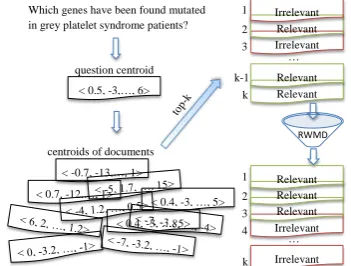
The word embeddings and document centroids are pre-computed. For each question, its centroid is computed and the documents with the top-k near-est (in terms of cosine similarity) centroids are re-trieved (Fig. 1). The rere-trieved documents are then optionally reranked using a relaxation ofWMD.
2.1 Centroids of documents and questions
In the simplest case, the centroid~tof a text tis the sum of the embeddings of the tokens oft di-vided by the number of tokens in t. Previous work on hierarchical biomedical document clas-sification (Kosmopoulos et al., 2016) reported
Irrelevant Relevant Relevant Relevant Irrelevant
< 0.4, -3, …, 5> Which genes have been found mutated in grey platelet syndrome patients?
…
RWMD
< 0.5, -3,…, 6>
< 0.7, -12,…, 1>
Relevant Relevant Irrelevant
…
Irrelevant Relevant
< 0.4, -3, …, 5> < -0.7, -13,…, 1>
1
2 3
k-1 k
1
2 3 4
k question centroid
[image:2.595.93.269.65.198.2]centroids of documents
Figure 1: Illustration of the proposed method.
proved performance when theIDFscores of the
to-kens are also taken into account as follows:
~t=
|V| P
j=1~wj ·TF(wj, t)·IDF(wj)
|V| P
j=1TF(wj, t)·IDF(wj)
(1)
where|V|is the vocabulary size (approx. 1.7 mil-lion words, ignoring stop words), wj is the j-th
vocabulary word, ~wj its embedding, TF(wj, t)the
term frequency ofwjint, and IDF(wj)the inverse
document frequency ofwj(Manning et al., 2008).
We use the 200-dimensional word embeddings of BIOASQ, obtained by applying WORD2VEC
(Mikolov et al., 2013) to approx. 11 million ab-stracts from PubMed.4 The IDF scores are
com-puted on the 11 million abstracts.
2.2 Document retrieval and reranking
Given a question with centroid~q, identifying the documents with the k nearest centroids requires computing the distance between~qand each docu-ment centroid, which is impractical for large doc-ument collections. Efficient approximate top-k al-gorithms, however, exist. They divide the vector space into subspaces and use trees to index the in-stances in each subspace (Arya et al., 1998; In-dyk and Motwani, 1998; Andoni and InIn-dyk, 2006; Muja and Lowe, 2009). We show that with an approximate top-k algorithm, document retrieval is very fast, with no significant decrease in per-formance. The top-k retrieved documents di are
ranked by decreasing (cosine) similarity of their centroids to~q. We call this methodCent when the 4The skipgram model ofWORD2VECwas used, with hier-archical softmax, 5-word windows, and default other param-eters. See http://participants-area.bioasq. org/info/BioASQword2vec/for further details.
simple (no IDF) centroids are used, and CentIDF
when theIDF-weighted centroids (Eq. 1) are used.
The top-k documents are optionally reranked with an approximation of theWMDdistance.WMD
measures the total distance the word embeddings of two texts (in our case, question and document) have to travel to become identical. In its full form,
WMDallows each word embedding to be partially
aligned (travel) to multiple word embeddings of the other text, which requires solving a linear pro-gram and is too slow for our purposes. Kusner et al. (2015) reported promising results in text classi-fication usingWMDas the distance of ak-NN
clas-sifier. They also introduced relaxed, much faster
WMD versions. In our case, the first relaxation
(RWMD-Q) sums the distances the word
embed-dings ~wof the questionqhave to travel to the clos-est word embeddings ~w0of the documentd:
RWMD-Q(q, d) =X
w∈q min
w0∈ddist(~w, ~w
0) (2)
Following Kusner et al., we use the Euclidean dis-tance asdist(~w, ~w0). Similarly, the second relaxed
form (RWMD-D) sums the distances of the word
embeddings ofdto the closest embeddings ofq. If we setdist(~w, ~w0) = 1ifw, w0are identical and0
otherwise,RWMD-Q counts how many words ofq
are present ind, andRWMD-Dcounts the words of dthat are present inq. Kusner et al. found the max-imum ofRWMD-QandRWMD-D(RWMD-MAX) to
be the best relaxation ofWMD. In our case, where q is much shorter than d, RWMD-Q works much
better, because dcontains many irrelevant words that have no close counter-parts in q, and their long distances dominate inRWMD-D andRWMD -MAX.5 We call CentIDF-RWMD-Q and CentIDF -RWMD-D theCentIDFmethod with the additional
reranking byRWMD-QorRWMD-D, respectively.
3 Experiments 3.1 Data
We used the 1,307 training questions and the gold relevantPUBMEDdocument ids of the fourth year
ofBIOASQ (Task 4b).6 The questions were
writ-ten by biomedical experts, who also identified the
5We do not report results withRWMD-MAXreranking, be-cause they are as bad as results withRWMD-D.
6The questions and gold document ids are available from
Recall
0 0.1 0.2 0.3 0.4 0.5 0.6 0.7 0.8 0.9 1
M
IP
0 0.05 0.1 0.15 0.2 0.25 0.3 0.35 0.4 0.45 0.5
[image:3.595.304.525.61.242.2]c c idf p m se c idf rwmd q c idf rwmd d p m se rwmd q h
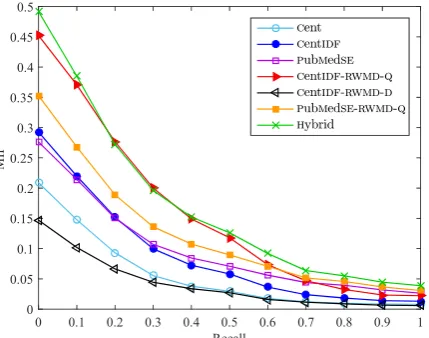
Figure 2: Mean Interpolated Precision at 11 recall points, fork(documents to retrieve) set to 1,000.
gold relevant documents using PUBMED, and
re-flect real needs (Tsatsaronis et al., 2015). We pass each question to our methods (after tokenization and stop-word removal) or the PUBMED search
engine (hereafterPubMedSE), which performs its
own tokenization and query expansion.7
The document collection that we search con-tains approx. 14 million article abstracts and titles from the November 2015 PUBMEDdump, which
was also used in the fourth year ofBIOASQ.8 Our
methods view each document as a concatenation of the title and abstract of an article.9 The titles
and abstracts have an average length of approx. 13 and 143 tokens, respectively. When comparing againstPubMedSE, we ignore documents returned
byPubMedSEthat are not in the dump, but this is
very rare and does not affect the results.
3.2 Experimental results
Figures 2–4 show Mean Interpolated Precision (MIP) at 11 recall levels, Mean Average
Interpo-lated Precision (MAIP), Mean Average Precision
(MAP), and Normalized Discounted Cumulative
Gain (nDCG).10 Roughly speaking, MAIP is the
area under the MIP curve, MAP is the same area
without interpolation, and nDCG is an alternative 7We use relevance ranking (not recency) inPubMedSE. 8The dump is available from https://www.nlm.
nih.gov/databases/license/license.html. The 14 million articles do not include approx. 10 million articles for which only titles are provided. There are hardly any title-only gold relevant documents, andPubMedSEvery
rarely returns title-only documents.
9It is unclear to us ifPUBMEDalso searches the full texts of the articles, which may put our methods at a disadvantage. 10All measures are widely used (Manning et al., 2008). We use binary relevance in nDCG, as in theBIOASQdataset.
5.
71
%
4.
94
%
9.
09
%
8.
02
%
10
.0
0%
8.
66
%
16
.0
4%
14
.3
5%
15
.9
6%
14
.2
8%
4.
26
%
3.
68
%
12
.5
3%
11
.1
6%
17
.4
3%
15
.5
4%
17
.3
7%
15
.4
9%
MAIP MAP
c c idf p m se c idf rwmd q ann c idf rwmd q c idf rwmd d p m se rwmd q h
ann h
Figure 3: MAIPandMAPscores, fork(documents
to retrieve) set to 1,000.
toMAIP. Unless otherwise stated, the number of
retrieved documents is set tok=1,000.
Figure 2 shows thatCent performs much worse
than CentIDF. At low recall, CentIDF is as good
asPubMedSE, butPubMedSEoutperformsCentIDF
at high recall. Reranking the top-k documents ofCentIDFby RWMD-Q has a significant impact,
leading to a system (CentIDF-RWMD-Q) that
per-forms better or as good asPubMedSEup to 0.7
re-call. Reranking the top-kdocuments ofPubMedSE
byRWMD-Q(PubMedSE-RWMD-Q) also improves
the performance of PubMedSE. Reranking the
top-k documents of CentIDF by RWMD-D (or RWMD-MAX, not shown) leads to much worse
re-sults (CentIDF-RWMD-D), for reasons already
ex-plained.11 Similar conclusions are reached by
ex-amining theMAIP,MAP, and nDCGscores.
Keyword-based information retrieval may miss relevant documents that use different terms than the question, even with query expan-sion. PubMedSE retrieves no documents for
35% (460/1307) of our questions.12 Further
ex-periments (not reported), however, indicate that
PubMedSE has higher precision than CentIDF -RWMD-Q, whenPubMedSEreturns documents, at
the expense of lower recall. Hence, there is scope to combine PubMedSE with our methods. As a
first, crude step, we tested a method (Hybrid) that
returns the documents ofCentIDF-RWMD-Qwhen PubMedSE retrieves no documents, and those of 11The same holds when the top-kdocuments ofPubMedSE are reranked byRWMD-DorRWMD-MAX(not shown).
12The experts that identified the gold relevant documents used simple keyword, Boolean, and advanced PubMedSE
[image:3.595.76.291.63.232.2]nDCG@20 nDCG@100
9.
38
% 13.5 12.45%
8% 17.2
7%
13
.6
3%
15
.3
3%
23
.2
3% 27.0
4%
23
.1
4% 26.9
3%
6.
97
% 10.9
3%
17
.2
0%
18
.1
7%
24
.3
2% 26.60%
24
.2
6%
26
.5
2%
cent
centidf pubmedse centidf-rwmd-q ann-centidf-rwmd-q centidf-rwmd-d pubmedse-rwmd-q hybrid
[image:4.595.72.290.61.244.2]ann-hybrid
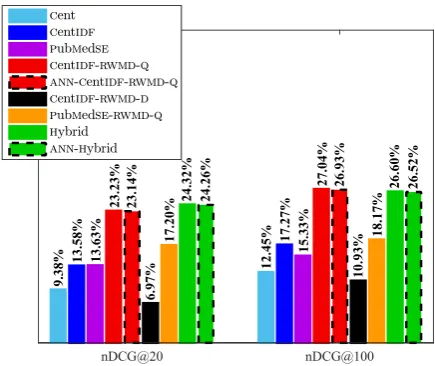
Figure 4: nDCG@k, fork= 20 andk= 100.
System Search Reranking Total
CentIDF-RWMD-Q (±47.411.22) (±14.456.15) 61.86 ANN-CentIDF-RWMD-Q (±0.360.04) (±14.246.06) 14.60
Table 1: Average times (in seconds) over all the questions of the dataset (k= 1000).
PubMedSE-RWMD-Q otherwise. Hybrid had the
best results in our experiments; the only excep-tion was its nDCG@100score, which was slightly
lower than the score ofCentIDF-RWMD-Q.
Table 1 shows that an approximate top-k algo-rithm (ANN) inCentIDF-RWMD-Q(ANN-CentIDF -RWMD-Q) reduces dramatically the time to obtain
the top-kdocuments, with a very small decrease in
MAIP,MAP, and nDCGscores (Figures 3 and 4).13
We also compared against the other participants of the second year ofBIOASQ; the participant
re-sults of later years are not yet available.14 The
official BIOASQ score is MAP; MIP, MAIP, and
nDCG scores are not provided. Our best method
was againHybrid (avg.MAPover the five batches
of the second year 16.18%). It performed over-all better than the BIOASQ ‘baselines’ (best avg. MAP15.60%) and all eight participants, except for
the best one (avg. MAP 28.20%). The best
sys-tem (Choi and Choi, 2014) used dependency IR
models (Metzler and Croft, 2005), combined with
UMLSand query expansion heuristics (e.g., adding 13We use Annoy (https://github.com/spotify/
annoy), 100 trees, 1,000 neighbors, search-k=10· |trees| · |neighbors|. Times on a server with 4 Intel Xeon E5620 CPUs (16 cores total), at 2.4 GHz, with 128 GB RAM.
14We used the evaluation platform ofBIOASQ(http://
participants-area.bioasq.org/oracle).
the titles of the top-kinitially retrieved documents to the query). The ‘baselines’ are actually very competitive; no system beat them in the first year, and only one was better in the second year. They arePubMedSE, but usingBIOASQ-specific
heuris-tics (e.g., instructingPubMedSEto ignore types of
articles the experts did not consider). Our system is simpler and does not use heuristics; hence, it can be ported more easily to other domains.
4 Other related work
Kosmopoulos et al. (2016) reports that a k-NN
classifier that represents articles as IDF-weighted
centroids (Eq. 1) of 200-dimensional word embed-dings (200 features) is as good at assigning seman-tic labels (MeSHheadings) to biomedical articles
as when using millions of bag-of-word features, reducing significantly the training and classifica-tion times. To our knowledge, our work is the first attempt to useIDF-weighted centroids of word
em-beddings in information retrieval, and the first to useWMDto rerank the retrieved documents. More
elaborate methods to encode texts as vectors have been proposed (Le and Mikolov, 2014; Kiros et al., 2015; Hill et al., 2016) and they could be used as alternatives to centroids of word embeddings, though the latter are simpler and faster to compute. The OHSUMED dataset (Hersh et al., 1994) is
often used in biomedical information retrieval ex-periments. It is much smaller (101 queries, ap-prox. 350K documents) than the BIOASQ dataset
that we used, but we plan to experiment with
OHSUMEDin future work for completeness.
5 Conclusions and future work
We proposed a newQAdriven document retrieval
method that represents documents and questions as IDF-weighted centroids of word embeddings.
Combined with a relaxation of theWMDdistance,
our method is competitive withPUBMED, without
ontologies and query expansion. Combined with
PUBMED, it performs better than PUBMED on its
own. With a top-kapproximation, it is fast, and easily portable to other domains and languages.
We plan to consider alternative dense vector en-codings of documents and queries, textual entail-ment (Bowman et al., 2015; Rockt¨aschel et al., 2016), and full-text documents, where it may be necessary to extendRWMD-Qto take into account
Acknowledgments
The work of the second author was funded by the Athens University of Economics and Business Research Support Program 2014-2015, “Action 2: Support to Post-doctoral Researchers”.
References
A. Andoni and P. Indyk. 2006. Near-optimal hashing algorithms for approximate nearest neighbor in high
dimensions. InProc. of the 47th Annual IEEE
Sym-posium on Foundations of Computer Science, pages
459–468, Washington, DC.
S. Arya, D. M. Mount, N. S. Netanyahu, R. Silverman, and A. Y. Wu. 1998. An optimal algorithm for ap-proximate nearest neighbor searching fixed
dimen-sions. Journal of the ACM, 45(6):891–923.
S. J. Athenikos and H. Han. 2010. Biomedical
ques-tion answering: A survey. Computer Methods and
Programs in Biomedicine, 99(1):1–24.
M. A. Bauer and D. Berleant. 2012. Usability survey
of biomedical question answering systems. Human
Genomics, 6(1)(17).
S. R. Bowman, G. Angeli, C. Potts, and C. D. Manning. 2015. A large annotated corpus for learning
natu-ral language inference. InProc. of the 2015
Con-ference on Empirical Methods in Natural Language
Processing, Lisbon, Portugal.
S. Choi and J. Choi. 2014. Classification and retrieval of biomedical literatures: SNUMedinfo at CLEF
QA track BioASQ 2014. In Proc. of the QA Lab
of the 5th Conference and Labs of the Evaluation
Forum, pages 1283–1295, Valencia, Spain.
W. Hersh, C. Buckley, T. J. Leone, and D. Hickam. 1994. OHSUMED: An interactive retrieval evalu-ation and new large test collection for research. In Proc. of the 17th Annual International ACM SIGIR Conference on Research and Development in
Infor-mation Retrieval, pages 192–201, Dublin, Ireland.
F. Hill, K. Cho, and A. Korhonen. 2016. Learning distributed representations of sentences from
unla-belled data. arXiv preprint 1602.03483.
P. Indyk and R. Motwani. 1998. Approximate nearest neighbors: Towards removing the curse of
dimen-sionality. InProc. of the 30th Annual ACM
Sympo-sium on Theory of Computing, pages 604–613,
Dal-las, TX.
R. Kiros, Y. Zhu, R. R. Salakhutdinov, R. Zemel, R. Ur-tasun, A. Torralba, and S. Fidler. 2015.
Skip-thought vectors. InAdvances in Neural Information
Processing Systems 28, pages 3276–3284. Montr´eal,
Canada.
A. Kosmopoulos, I. Androutsopoulos, and
G. Paliouras. 2016. Biomedical semantic
in-dexing using dense word vectors in BioASQ. Journal Of Biomedical Semantics, Supplement On
Biomedical Information Retrieval. To appear.
M. Kusner, Y. Sun, N. Kolkin, and K. Q. Weinberger. 2015. From word embeddings to document
dis-tances. In Proc. of the 32nd International
Confer-ence on Machine Learning, pages 957–966, Lille,
France.
Q. Le and T. Mikolov. 2014. Distributed
representa-tions of words and phrases. InProc. of the 31st
In-ternational Conference on Machine Learning, pages
1188–1196, Beijing, China.
P. Malakasiotis, I. Androutsopoulos, A. Bernadou, N. Chatzidiakou, E. Papaki, P. Constantopoulos, I. Pavlopoulos, A. Krithara, Y. Almyrantis, D. Poly-chronopoulos, A. Kosmopoulos, G. Balikas, I. Parta-las, G. Tsatsaronis, and N. Heino. 2014. Challenge Evaluation Report 2 and Roadmap. BioASQ deliv-erable D5.4.
C.D. Manning, P. Raghavan, and H. Sch¨utze. 2008.
Introduction to Information Retrieval. Cambridge
University Press.
D. Metzler and W.B. Croft. 2005. A Markov
Ran-dom Field model for term dependencies. InProc. of
the 28th Annual International ACM SIGIR confer-ence on Research and Development in Information
Retrieval, pages 472–479, Salvador, Brazil.
T. Mikolov, W. Yih, and G. Zweig. 2013. Distributed representations of words and phrases and their
com-positionality. InProc. of the Conference on Neural
Information Processing Systems, Lake Tahoe, NV.
M. Muja and D. G. Lowe. 2009. Fast approximate nearest neighbors with automatic algorithm
config-uration. In Proc. of the International Conference
on Computer Vision Theory and Applications, pages
331–340, Lisboa, Portugal.
J. Pennington, R. Socher, and C. D. Manning. 2014. GloVe: Global vectors for word representation. In Proc. of the Conference on Empirical Methods on
Natural Language Processing, Doha, Qatar.
T. Rockt¨aschel, E. Grefenstette, K. M. Hermann, T. Koˇcisk`y, and P. Blunsom. 2016. Reasoning about
entailment with neural attention. In International
Conference on Learning Representations, San Juan,
Puerto Rico.
G. Tsatsaronis, G. Balikas, P. Malakasiotis, I. Parta-las, M. Zschunke, M.R. Alvers, D. Weissenborn, A. Krithara, S. Petridis, D. Polychronopoulos, Y. Almirantis, J. Pavlopoulos, N. Baskiotis, P. Galli-nari, T. Artieres, A. Ngonga, N. Heino, E. Gaussier, L. Barrio-Alvers, M. Schroeder, I. Androutsopou-los, and G. Paliouras. 2015. An overview of the BioASQ large-scale biomedical semantic indexing
and question answering competition. BMC