The Fewer, the Better? A Contrastive Study about Ways to Simplify
Ruslan Mitkov and Sanja ˇStajner Research Group in Computational Linguistics Research Institute of Information and Language Processing
University of Wolverhampton, UK
{R.Mitkov, SanjaStajner}@wlv.ac.uk
Abstract
Simplified texts play an important role in providing accessible and easy-to-understand informa-tion for a whole range of users who, due to linguistic, developmental or social barriers, would have difficulty in understanding materials which are not adapted and/or simplified. However, the production of simplified texts can be a time-consuming and labour-intensive task. In this paper we show that the employment of a short list of simple simplification rules could result in texts of comparable readability to those written as a result of applying a long list of more fine-grained rules. We also prove that the simplification process based on the short list of simple rules is more time efficient and consistent.
1 Rationale
Simplified texts play an important role in providing accessible and easy-to-understand information for a whole range of users who, due to linguistic, developmental or social barriers, would have difficulty in understanding materials which are not adapted and/or simplified. Such users include but are not limited to people with insufficient knowledge of the language in which the document is written, people with specific language disorders and people with low literacy levels. However, while the production of simplified texts is certainly an indispensable activity, it often proves to be a time-consuming and labour-intensive task. Various methodologies and simplification strategies have been developed which are often employed by authors to simplify original texts. Most methods involve a high number of rules which could result not only in the simplification task being time-consuming but also in the authors getting confused as to which rules to apply. We hypothesise that it is possible to achieve a comparable simplification effect by using a small set of simple rules similar to the ones used in Controlled Languages which, in addition, enhances the productivity and reliability of the simplification process.
In order to test our hypothesis we conduct the following experiments. First, we propose six Controlled Language-inspired rules which we believe are simple and easy enough for writers of simplified texts to understand and apply. We then ask two writers to apply these rules to a selection of newswire texts and also to produce simplified versions of these texts using the 28 rules used in the Simplext project (Saggion et al., 2011). Both sets of texts are compared in terms of readability. In both simplification tasks the time efficiency is assessed and the inter-annotator agreement is evaluated. In an additional experiment, we seek to investigate the possible effect of familiarisation in simplification. In this experiment a third writer simplifies a sample of the texts used in the previous experiments by applying each set of rules in a mixed sequence pattern which does not offer any familiarisation nor the advantage of one set of rules over the other. Using these samples, three-way inter-annotator agreement is reported.
The rest of the paper is structured as follows. Section 2 outlines related work on simplification rules. Section 3 introduces our proposal for a small set of easy-to-understand and easy-to-apply rules and contrasts them with the longer and more elaborate rules employed in the Simplext proposal. Section 4 details the experiments conducted in order to validate or refute our hypothesis, and outlines the data used for the experiments. Section 5 presents and discusses the results, while the last section of the paper summarises the main conclusions of this study.
This work is licensed under a Creative Commons Attribution 4.0 International Licence. Page numbers and proceedings footer are added by the organisers. Licence details:http://creativecommons.org/licenses/by/4.0/
2 Related work
Since the late 1990s, several initiatives which proposed guidelines for producing plain, easy-to-read and more accessible documents have emerged. These include the “Federal Plain Language Guidelines”, “Make it Simple, European Guidelines for the Production of Easy-to-Read Information for people with Learning Disability”, and “Am I making myself clear? Mencap’s guidelines for accessible writing”.
The Plain Language Action and Information Network (PLAIN)1 developed the first version of the
“Federal Plain Language Guidelines” (PlainLanguage, 2011) in the mid-90s and have revised it every few years since then. Their original idea was to help writers of governmental documents (primarily regulations) to write in a clear and and simple manner so that the users can: “find what they need; under-stand what they find; and use what they find to meet their needs.” (PlainLanguage, 2011). The “Make it Simple” European Guidelines for the Production of Easy-to-Read Information for people with Learning Disability (Freyhoff et al., 1998) were produced by Inclusion Europe2in order to assist writers in
devel-oping texts, publications and videos that are more accessible to people with intellectual disabilities and other people who cannot read complex texts, and thus enable those people to be better protected from discrimination and social injustice. The “Am I making myself clear?” Mencap’s guidelines for accessi-ble writing (Mencap, 2002) were produced by the UK’s leading organisation working with people with a learning disability.3 Their goal is to help in editing and writing accessible material for that specific
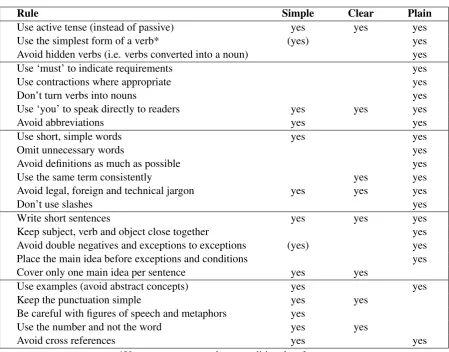
target population. All of these guidelines are concerned with both verbal content of documents and their layout. As we are interested in text simplification and not in text representation, we will concentrate only on the former. All three guidelines share similar instructions for accessible writing, some of them more detailed than others. Table 1 allows us to have a quick overview of intersecting rules suggested by these guidelines which were intended for slightly different purposes and target audiences.. For example, they all advise the writer to use active voice instead of passive, use short, simple words and omit unnecessary words, write short sentences and cover only one main idea per sentence, etc. However, the “Federal Plain Language Guidelines” also instruct writers to use contractions where appropriate, avoid hidden verbs (i.e. verbs converted into a noun), and place the main idea before exceptions and conditions, while the other two guidelines do not go into many details. Some of the instructions, e.g. to use the simplest form of a verb (present and not conditional or future), or to avoid double negatives and exceptions to exceptions, are not present in the Mencap’s guidelines for accessible writing, while they are at the same time implicitly present in the “Make it Simple” guidelines, and explicitly present in the “Federal Plain Language Guidelines”.
Karreman et al. (2007) investigated whether the application of the “Make it Simple” guidelines to the website’s content would enhance its usability for users with intellectual disabilities. Additionally, they investigated whether the application of these guidelines would have a negative effect on users without disabilities, as Web Accessibility Initiative (WAI) guidelines4 state that creation of multiple versions of
the same website should be avoided whenever possible. The authors prepared two versions of a website, the original one and the one adapted according to the “Make it Simple” guidelines. These two versions were then tested for efficiency (searching and reading time) and effectiveness (comprehension) by 40 participants, 20 with diagnosed intellectual disabilities and 20 without. The results demonstrated that the adaptation of the website according to the guidelines enhanced the efficiency and effectiveness for both groups of participants.
There has been a body of work associated with the development and use of Controlled Languages for simplification purposes. The original idea of developing a Controlled Language arose during the 1930s when influential scholars sought to establish a ‘minimal’ variety of English, a variety specifically designed to make English accessible to and usable by the largest possible number of people worldwide (Arnold et al., 1994). This variety was called Basic English and one of the central ideas was to use a few hundred general-purpose words only. Operator verbs were to be used with a set of nouns and
1http://www.plainlanguage.gov/ 2http://inclusion-europe.org/
Rule Simple Clear Plain
Use active tense (instead of passive) yes yes yes
Use the simplest form of a verb* (yes) yes
Avoid hidden verbs (i.e. verbs converted into a noun) yes
Use ‘must’ to indicate requirements yes
Use contractions where appropriate yes
Don’t turn verbs into nouns yes
Use ‘you’ to speak directly to readers yes yes yes
Avoid abbreviations yes yes
Use short, simple words yes yes
Omit unnecessary words yes
Avoid definitions as much as possible yes
Use the same term consistently yes yes
Avoid legal, foreign and technical jargon yes yes yes
Don’t use slashes yes
Write short sentences yes yes yes
Keep subject, verb and object close together yes
Avoid double negatives and exceptions to exceptions (yes) yes Place the main idea before exceptions and conditions yes Cover only one main idea per sentence yes yes
Use examples (avoid abstract concepts) yes yes
Keep the punctuation simple yes yes
Be careful with figures of speech and metaphors yes
Use the number and not the word yes yes
Avoid cross references yes yes
[image:3.595.74.524.56.408.2]*Use present tense and not conditional or future
Table 1: Rules for verbal content of documents (the three columns ‘Simple’, ‘Clear’, and ‘Plain’ contain ‘yes’ if this rule is present in the corresponding guidelines: “Make it Simple”, “Am I making myself clear?” and “Federal Plain Language Guidelines”, respectively; value ‘(yes)’ is used when the rule is not explicitly present in the corresponding guidelines, only implicitly)
adjectives to replace most of the derived verbs. The Controlled Language writing rules included various rules such as ‘Keep it short and simple’ (Keep sentences short, Omit redundant words, Order the parts of the sentence logically, Don’t change constructions in mid-sentence, Take care with the logic of and and or) and ‘Make it explicit’ (Avoid elliptical constructions, Don’t omit conjunctions or relatives, Adhere to the PACE dictionary, Avoid strings of nouns, Do not use -ing unless the word appears thus in the PACE dictionary) (Arnold et al., 1994). The concept of controlled languages evolved and developed further and they have been regarded as a prerequisite part of successful Machine Translation. Controlled Languages have been also employed in a number of critical situations where ambiguity could be a problem.5
3 Simplification strategies: contrasting two sets of rules
The Simplext guidelines were written under the Simplext project, with the aim of helping the authors to produce texts which would be accessible to people with Down syndrome. They follow the same main ideas as those in “Make it Simple, European Guidelines for People with Intellectual Disability” but they adapt the rules to their specific target population and the Spanish language. The Simplext guidelines contain 28 main rules6 concerned with the verbal content of documents. Those rules cover the same
main ideas as our rules (see below), e.g. to keep sentences short, use only the most frequent words,
5The reader is referred to (Kittredge, 2003), (Cardey, 2009) and (Temnikova, 2012) for more details.
6The Simplext guidelines actually provide even more sub-rules for most of the main rules, but in this study we use only the
remove redundant words, use a simpler paraphrase if applicable. However, the Simplext rules are more fine-grained, thus providing several more specific rules instead of our more general rules. For example, they explicitly instruct the writer to use frequent words, use non-ambiguous words, and not use words with more than six syllables whenever it is possible.
On the other hand, the six simple rules selected for our study have been inspired from the rules in Controlled Languages7. We conjecture that there is a small set of simple, to-understand and
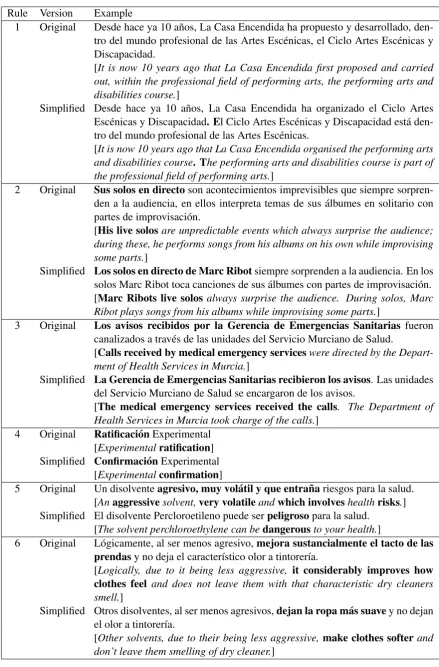
easy-to-apply rules which can be equally efficient in terms of simplicity (readability) and yet their employment is less time-consuming and less contentious in practice. The rules which we propose are as follows (examples are presented in Table 2):
1. Use simple sentences
We have selected this rule to ensure that the simplified version of the document features sufficiently short and simple sentences only so that the reader does not have to process longer complex sen-tences.
2. Remove anaphors
This rules caters for replacing the anaphors such as pronouns and one-anaphors with their antecedent to minimise the risk of anaphoric ambiguity but also makes sure that the texts does not feature any elliptical constructions which may be more difficult to understand.
3. Use active voice only
We have included this rule as active voice is generally easier to process.
4. Use the most frequent words only
Similarly to the practice recommended in Basic English, we recommend the use of the 1,000 most frequent words in Spanish as documented by RAE (Real Academia Espa˜nola)8. If this is not
pos-sible, then words from the list of the 5,000 most frequent Spanish words are resorted to9. We have
allowed the following exception for this rule. There are cases where a specific technical word occurs in the text and which is unlikely to be on the list of 1,000 (or 5,000) basic / most frequent words in Spanish. By way of example, in the sentence ‘Ana Juan gan´o el Premio Nacional de Ilustraci´on de 2010’ (Ana Juan won the national prize for illustration in 2010) the wordIlustraci´onis considered as technical and is not replaced with a basic word.
5. Remove redundant words
Our rules recommend the removal of redundant words or phrases which do not really contribute to the understanding of the text.
6. Use a simpler paraphrase, if applicable
There are cases where the sentence is difficult to read or understand due among other things, to its syntax. Our rules recommend that in such cases the original sentence or part of the sentence is paraphrased.
4 Experiments and data
In order to test our hypothesis we conducted several experiments. We selected 10 newswire texts in Spanish and asked two writers who are native speakers of Spanish and who have a language/linguistics background, to apply both our six rules and the 28 Simplext rules in order to simplify these newswire texts. The writers familiarised themselves with the rules beforehand, had an induction with the authors
7We shall often refer to these rules throughout the paper as ‘our rules’ 8http://corpus.rae.es/frec/1000 formas.TXT
Rule Version Example
1 Original Desde hace ya 10 a˜nos, La Casa Encendida ha propuesto y desarrollado, den-tro del mundo profesional de las Artes Esc´enicas, el Ciclo Artes Esc´enicas y Discapacidad.
[It is now 10 years ago that La Casa Encendida first proposed and carried out, within the professional field of performing arts, the performing arts and disabilities course.]
Simplified Desde hace ya 10 a˜nos, La Casa Encendida ha organizado el Ciclo Artes Esc´enicas y Discapacidad. El Ciclo Artes Esc´enicas y Discapacidad est´a den-tro del mundo profesional de las Artes Esc´enicas.
[It is now 10 years ago that La Casa Encendida organised the performing arts and disabilities course. The performing arts and disabilities course is part of the professional field of performing arts.]
2 Original Sus solos en directoson acontecimientos imprevisibles que siempre sorpren-den a la audiencia, en ellos interpreta temas de sus ´albumes en solitario con partes de improvisaci´on.
[His live solosare unpredictable events which always surprise the audience; during these, he performs songs from his albums on his own while improvising some parts.]
Simplified Los solos en directo de Marc Ribotsiempre sorprenden a la audiencia. En los solos Marc Ribot toca canciones de sus ´albumes con partes de improvisaci´on. [Marc Ribots live solos always surprise the audience. During solos, Marc Ribot plays songs from his albums while improvising some parts.]
3 Original Los avisos recibidos por la Gerencia de Emergencias Sanitarias fueron canalizados a trav´es de las unidades del Servicio Murciano de Salud.
[Calls received by medical emergency serviceswere directed by the Depart-ment of Health Services in Murcia.]
Simplified La Gerencia de Emergencias Sanitarias recibieron los avisos. Las unidades del Servicio Murciano de Salud se encargaron de los avisos.
[The medical emergency services received the calls. The Department of Health Services in Murcia took charge of the calls.]
4 Original Ratificaci´onExperimental [Experimentalratification] Simplified Confirmaci´onExperimental
[Experimentalconfirmation]
5 Original Un disolventeagresivo, muy vol´atil y que entra˜nariesgos para la salud. [Anaggressivesolvent,very volatileandwhich involveshealthrisks.] Simplified El disolvente Percloroetileno puede serpeligrosopara la salud.
[The solvent perchloroethylene can bedangerousto your health.]
6 Original L´ogicamente, al ser menos agresivo,mejora sustancialmente el tacto de las prendasy no deja el caracter´ıstico olor a tintorer´ıa.
[Logically, due to it being less aggressive, it considerably improves how clothes feel and does not leave them with that characteristic dry cleaners smell.]
Simplified Otros disolventes, al ser menos agresivos,dejan la ropa m´as suavey no dejan el olor a tintorer´ıa.
[image:5.595.78.518.60.728.2][Other solvents, due to their being less aggressive,make clothes softerand don’t leave them smelling of dry cleaner.]
of this paper and were asked to have sessions no longer than 1 hour so that potential fatigue did not com-promise the experiments. In order to minimise potential familiarity effect (texts which already have been simplified are expected to be simplified faster and more efficiently as they are familiar to the writers), we allowed a few days interval between each time a specific text was simplified using different rules. We applied the Spauldings Spanish Readability index – SSR (Spaulding, 1956) as well as the Lexical Complexity index – LC (Anula, 2007) to assess the readability of the simplified texts. Both metrics have shown a good correlation with the possible reading obstacles for various target populations (ˇStajner and Saggion, 2013), and were used for the evaluation of the automatic TS system in Simplext (Drndarevi´c et al., 2013). We also asked a third writer to simplify samples from the texts used by the first two writers which were pre-assessed to be of comparable complexity, with a view to establishing whether familiari-sation has an effect on the output. The results of these readability experiments are presented in Tables 4 and 5 of the following section. We also recorded the time needed to simplify each text as an indication of, among other things, ease of use of (and clarity for) each set of rules and its productivity in general; these results are reported in Tables 6 and 7 of the following section.
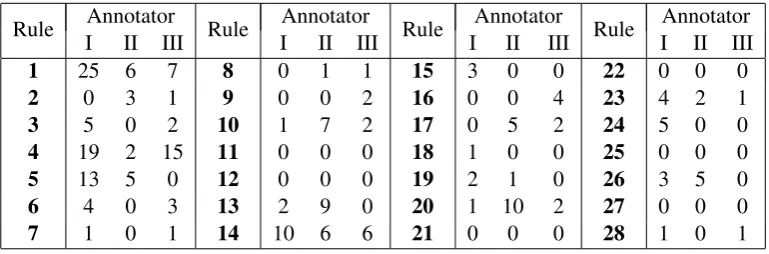
Several experiments were conducted to assess the annotator agreement. We believe that the inter-annotator agreement is another good indicator as to how straightforward it is to apply a specific set of simplification rules and how reliable the simplification process is in general. We compute the inter-annotator agreement in terms of the BLEU score (Papineni et al., 2002). BLEU score is widely used in MT to compare the reference translation with the output of the system (translation hypothesis). Here we use the BLEU score to compare the simple sentences produced by one annotator with the corresponding sentences of another annotator. We measure the inter-annotator agreement for all three pairs of annotators (Table 8). In addition, we examined how many times each of the rules was selected by each writer which in our view would be not only a way of accounting for agreement and but also assessing the usefulness of every rule and how balanced a set of rules is in general. Tables 9 and 10 report the results of this study on the texts simplified by all three annotators.
While in the above experiments (which involved only two writers) we made sure that there was at least a few days’ span between applying the different sets of rules on the same text, we felt that the risk of familiarity effect could not be removed completely. It is expected that a text which has already been simplified would take less time to be simplified for a second time, even if different rules are applied. Also, as Simplext rules were always applied after our simple rules, we felt that additional experiments were needed where (i) there would be no risk of familiarisation effect and (ii) the rules were applied in a mixed order so that any experience gained from simplification in general cannot serve as unfair advantage to one of the sets of rules. In an experiment seeking to investigate the possible effect of familiarisation in simplification, a third writer simplified a selection of the texts used in the previous experiments by applying each set of rules in a mixed sequence pattern which does not offer any familiarisation nor any advantage of one set of rules over the other. In other words, instead of this writer simplifying the same text twice using different rules, different texts of comparable level of simplicity, informed by the input of the first two writers, were selected and simplified. Based on the results of the time efficiency experiment (Table 6, next section), we chose three pairs (Pair 1, Pair 2 and Pair 3) of texts where for each pair the texts are deemed to be of comparable complexity. By way of example, in Pair 1 which consists of Text 1 and Text 2, Annotator 1 needed the same time for both texts with Simplext rules, and similar time with our simple rules, Annotator 2 needed the same time with our rules, and similar time with Simplext rules. Pair 2 consists of Text 3 and Text 4 and Pair 3 is made of Text 9 and Text 10 for the same reasons as above. The simplification performed by a third writer makes it possible to report readability indices for the text simplified by the third writer, as well as the time taken to simplify, and three-way agreement.
The 10 texts made available by the Spanish news agency Servimedia10 belong to one of the four
following domains: international news (Texts 2, 6, and 10), national news (Texts 4 and 8), society (Texts 3 and 7), or culture (Texts 1, 5, and 9). The sizes of these samples (in sentences and words) are listed in Table 3.
Size Text 1 Text 2 Text 3 Text 4 Text 5 Text 6 Text 7 Text 8 Text 9 Text 10
Sentences 7 7 5 5 6 4 7 6 5 5
[image:7.595.156.443.592.705.2]Words 166 183 172 193 176 167 197 180 156 169
Table 3: Size of the texts used for this study
5 Results and discussion
This section presents the results of a study on the readability of texts simplified with our rules as well as with the Simplext rules. It also reports on a time efficiency experiment whose objective is to identify the rules which are less time-consuming to apply. Next, interannotator agreement in terms of BLEU score and selection of rules is discussed and finally, an interpretation of the results of an experiment seeking to establish any familiarisation effect in simplification is provided.
5.1 Readability study
As can be observed from Table 4, simplification performed by our rules improves the readability of texts in almost all cases (note the values in column ‘original’ with those in columns A-I and A-II for both indices LC and SSR). This improvement was statistically significant in terms of both indices when the texts were simplified by the second annotator, and in terms of the SSR index when the texts were simplified by the first annotator (lower readability indices indicate text which is easier to read).11.
Text original A - I A - IILC B - I B - II original A - I SSRA - II B - I B - II 1 12.00 5.27 6.00 5.57 6.25 183.07 154.67 170.64 147.67 165.70 2 9.76 12.52 9.20 9.74 8.98 174.66 169.07 159.88 161.76 155.99 3 12.95 9.19 8.92 9.04 10.10 176.91 161.30 153.78 157.23 154.80 4 10.74 7.78 7.59 6.53 7.62 179.19 148.27 143.77 133.36 159.26 5 11.79 7.80 9.57 9.47 9.94 196.94 180.05 182.25 164.50 181.99 6 7.23 4.83 4.77 2.00 4.63 177.40 153.22 159.99 130.42 162.19 7 10.23 13.35 8.54 8.29 7.48 175.72 175.11 153.96 137.15 151.34 8 15.14 12.07 11.75 8.96 11.77 191.13 175.42 168.08 155.17 162.59 9 12.86 9.93 10.77 8.87 12.08 178.91 160.47 166.74 142.78 171.08 10 13.52 13.31 10.48 12.03 12.24 166.91 146.96 140.94 152.58 152.94
Table 4: Readability: two readability indices LC and SSR (lower readability indices indicate texts which are easier to read; I and II refer to the two annotators who simplified all 10 texts; A and B refers to the rules which are used: A – ours, B – Simplext)
Text original A - III B - III original A - IIILC SSR B - III
1 12.00 4.92 183.07 170.64
2 9.76 8.00 174.66 172.58
3 12.95 6.38 176.91 153.78
4 10.74 7.82 179.19 175.80
9 12.86 10.57 178.91 166.74
10 13.52 12.15 166.91 154.12
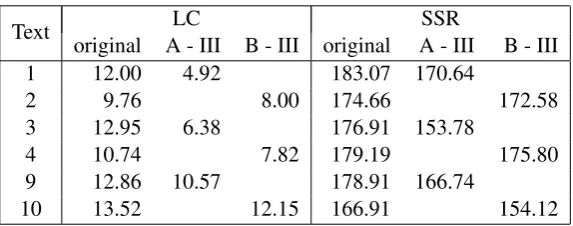
Table 5: Readability of texts simplified by Annotator III (A and B refers to the rules which are used: A – ours, B – Simplext)
The differences in readability between the texts written by employing our simplification rules (columns A-I and A-II) and those written by following the Simplext rules (columns B-I and B-II), were not sta-tistically significant when the simplification was performed by the second annotator, while they were significant when the simplification was performed by the first annotator. When interpreting these results, it is also important to bear in mind that the LC index measures only the lexical complexity of a text, while the SSR index measures general complexity of a text, including both its lexical and its syntactic complexity. We also benefited from the familiarity experiment in which a third annotator was involved, to assess the readability of the simplified versions of the texts of comparable complexity, as produced by the third additional annotator. The results, which are reported in Table 5, suggest that in fact the texts simplified by the third annotator with our rules are easier to read. On the basis of these readability results, it can be concluded that the application of Simplext rules does not necessarily result in a (significantly) simpler version than the one produced by our rules and comparable results are likely to be achieved. 5.2 Time efficiency experiment
The results from the time efficiency experiment (Table 6) show that in all cases, the simplification with our rules is done in shorter (or equal) time. This is also confirmed by the time needed by the third annotator in the additional experiment seeking to establish any familiarity effect (Table 7), where texts of comparable complexity simplified by our rules were simplified faster than the texts simplified with the Simplext rules. In our view, the results of these experiments are indicative not only of the time and cost savings when using our rules but also of our rules being simpler for writers and more straightforward to employ.
Ann. Set Text 1 Text 2 Text 3 Text 4 Text 5 Text 6 Text 7 Text 8 Text 9 Text 10 I AB 4860 4160 3040 4439 4455 1829 2932 1943 1524 2416
II AB 1530 1520 1020 1512 1530 1030 1020 1015 1010 1010
Table 6: Time efficiency in simplification
Set Text 1 – Text 2 Text 3 – Text 4 Text 9 – Text 10
A 12 15 11
B 16 16 14
Table 7: Time efficiency in simplification (Annotator III only)
5.3 Inter-annotator agreement and selection of rules
Table 8 presents the inter-annotator agreement in terms of BLEU score. This score accounts for the agreement during the simplification process and the higher the value, the more similar the simplifications performed by the annotators are. In both cases where the difference is significant our rules exhibited a higher degree of agreement among the annotators than the Simplext rules.
Rules I – II II – III I – III
A (Ours) 44.00 52.85 48.27
B (Simplext) 30.46 55.12 33.13
Table 8: Pair-wise inter-annotator agreement in terms of BLEU score
agreement. Tables 9 and 10 report the frequency of selection of each of our simple rules as well as the Simplext rules for all three annotators (measured only on the texts simplified by all three annotators).
Annotator Rule 1 Rule 2 Rule 3 Rule 4 Rule 5 Rule 6
I 12 12 5 33 13 9
II 17 14 6 31 10 4
[image:9.595.107.492.206.333.2]III 15 22 5 16 7 8
Table 9: Frequency of selection of each of our rules (texts 1, 3, and 9)
Rule IAnnotatorII III Rule IAnnotatorII III Rule IAnnotatorII III Rule AnnotatorI II III 1 25 6 7 8 0 1 1 15 3 0 0 22 0 0 0 2 0 3 1 9 0 0 2 16 0 0 4 23 4 2 1 3 5 0 2 10 1 7 2 17 0 5 2 24 5 0 0
4 19 2 15 11 0 0 0 18 1 0 0 25 0 0 0
5 13 5 0 12 0 0 0 19 2 1 0 26 3 5 0 6 4 0 3 13 2 9 0 20 1 10 2 27 0 0 0 7 1 0 1 14 10 6 6 21 0 0 0 28 1 0 1
Table 10: Frequency of selection of each of the Simplext rules (texts 2, 4, and 10).
It can be seen that there is less difference/discrepancy in the selection of our rules as opposed to the Simplext rules and hence the simplification process can be regarded as more consistent and reliable. Here again, there is higher agreement on our rules as opposed to the Simplext ones. This phenomenon is illustrated in the following example where the annotators used the Simplext rules:
Original: “Esta reforma prev´e que todos los delitos relacionados con la seguridad vial (como exceso de velocidad o conducir bajo los efectos del alcohol, las drogas, sin carn´e o sin puntos) pueden conllevar el decomiso del veh´ıculo, si bien la decisi´on depender´a del juez.”
[This reform will envisage that all crimes related to road safety (such as speeding, driving while under the effects of alcohol or drugs or driving without a licence or points) could result in confiscation of the vehicle, although the decision to do so depends on the judge.]
Annotator 1: “El cambio del C´odigo Penal dice que la decisi´on de embargar el coche o moto depender´a del juez.” (rules used: 5,4,1,4,4)
[The change of the penal code says that the decision to confiscate the car or motorbike depends on the judge.]
Annotator 2: “Esta reforma prev´e que todos los delitos relacionados con la seguridad vial como exceso de velocidad o conducir bajo los efectos del alcohol, las drogas, sin carn´e o sin puntos. Los delitos pueden conllevar la retirada del veh´ıculo pero la decisi´on depender´a del juez.” (rules used: 26,17,20,1,8)
[This reform will envisage that all crimes related to road safety such as speeding or driving under the effects of alcohol, drugs, without a license or points. The crimes could result in confiscation of the vehicle but the decision depends on the judge.]
Annotator 3: “La reforma del C´odigo Penal prev´e que todos los delitos relacionados con la seguridad vial pueden dar lugar a la p´erdida del veh´ıculo, aunque la decisi´on depender´a del juez.” (rules used: 4,16,4,9)
5.4 Familiarisation experiment
From the above results, it can be seen that the simplified texts written by the third annotator using a mixed pattern indicate clearer preference to our simple rules in terms of better readability, time efficiency and reliability as opposed to the simplified texts written by Annotator 1 and Annotator 2 where the Simplext texts were applied only at the end. On the basis of this, we conjecture that this difference may be strongly connected with the lingering familiarisation of the annotators when they simplify texts they have already simplified.
6 Conclusions
Simplified texts play an important role in providing accessible and easy-to-understand information for a whole range of users who, due to linguistic, developmental or social barriers, would have difficulty in understanding materials which are not adapted and/or simplified. However, the production of simplified texts can be a time-consuming and labour-intensive task. The results of this study show that a small set of six simple rules, inspired by the concept of Controlled Languages, could produce simplified texts of comparable readability to those produced using a long list of more fine-grained rules such as the ones used in the Simplext project. In addition, the results of this study suggest that our simple rules could be more time-efficient and reliable.
Acknowledgements
We would like to express our gratitude to Horacio Saggion for his help with the resources.
References
A. Anula. 2007. Tipos de textos, complejidad ling¨u´ıstica y facilicitaci´on lectora. InActas del Sexto Congreso de Hispanistas de Asia, pages 45–61.
D. Arnold, L. Balkan, R. Lee Humphreys, S. Meijer, and L. Sadler, 1994. Machine Translation. An Introductory guide., chapter 8, Input, pages 139–155. Blackwell publishers.
S. Cardey. 2009. Controlled Languages for More Reliable Human Communication in Safety Critical Domains. In
Proceedings of the 11th International Symposium on Social Communication, Santiago de Cuba, Cuba, 19-23 January 2009, pages 330–336.
B. Drndarevi´c, S. ˇStajner, S. Bott, S. Bautista, and H. Saggion. 2013. Automatic Text Simplication in Spanish:
A Comparative Evaluation of Complementing Components. InProceedings of the 12th International
Confer-ence on Intelligent Text Processing and Computational Linguistics. Lecture Notes in Computer SciConfer-ence. Samos, Greece, 24-30 March, 2013., pages 488–500.
G. Freyhoff, G. Hess, L. Kerr, B. Tronbacke, and K. Van Der Veken, 1998. Make it Simple, European
Guide-lines for the Production of Easy-toRead Information for People with Learning Disability. ILSMH European Association, Brussels.
J. Karreman, T. van der Geest, and E. Buursink. 2007. Accessible website content guidelines for users with intellectual disabilities.Journal of Applied Research in Intellectual Disabilities, 20:510–518.
R. I. Kittredge, 2003. Oxford Handbook of Computational Linguistics, chapter 23, Sub-languages and controlled languages.
Mencap, 2002. Am I making myself clear? Mencap’s guidelines for accessible writing.
K. Papineni, S. Roukos, T. Ward, and W. Zhu. 2002. BLEU: a method for automatic evaluation of machine translation. InProceedings of ACL, pages 311–318.
PlainLanguage. 2011. Federal plain language guidelines.
S. Spaulding. 1956. A Spanish Readability Formula.Modern Language Journal, 40:433–441.
I. Temnikova. 2012. Text Complexity and Text Simplification in the Crisis Management domain. Ph.D. thesis, University of Wolverhampton, UK.