Exploring Normalization Techniques for Human Judgments of Machine
Translation Adequacy Collected Using Amazon Mechanical Turk
Michael Denkowski and Alon Lavie
Language Technologies Institute School of Computer Science
Carnegie Mellon University Pittsburgh, PA 15232, USA
{mdenkows,alavie}@cs.cmu.edu
Abstract
This paper discusses a machine translation evaluation task conducted using Amazon Me-chanical Turk. We present a translation ade-quacy assessment task for untrained Arabic-speaking annotators and discuss several tech-niques for normalizing the resulting data. We present a novel 2-stage normalization tech-nique shown to have the best performance on this task and further discuss the results of all techniques and the usability of the resulting adequacy scores.
1 Introduction
Human judgments of translation quality play a vital role in the development of effective machine trans-lation (MT) systems. Such judgments can be used to measure system quality in evaluations (Callison-Burch et al., 2009) and to tune automatic metrics such as METEOR(Banerjee and Lavie, 2005) which act as stand-ins for human evaluators. However, col-lecting reliable human judgments often requires sig-nificant time commitments from expert annotators, leading to a general scarcity of judgments and a sig-nificant time lag when seeking judgments for new tasks or languages.
Amazon’s Mechanical Turk (MTurk) service fa-cilitates inexpensive collection of large amounts of data from users around the world. However, Turk-ers are not trained to provide reliable annotations for natural language processing (NLP) tasks, and some Turkers attempt to game the system by submitting random answers. For these reasons, NLP tasks must be designed to be accessible to untrained users and
data normalization techniques must be employed to ensure that the data collected is usable.
This paper describes a MT evaluation task for translations of English into Arabic conducted us-ing MTurk and compares several data normaliza-tion techniques. A novel 2-stage normalizanormaliza-tion tech-nique is demonstrated to produce the highest agree-ment between Turkers and experts while retaining enough judgments to provide a robust tuning set for automatic evaluation metrics.
2 Data Set
Our data set consists of human adequacy judgments for automatic translations of 1314 English sentences into Arabic. The English source sentences and Ara-bic reference translations are taken from the AraAra-bic- Arabic-English sections of the NIST Open Machine Trans-lation Evaluation (Garofolo, 2001) data sets for 2002 through 2005. Selected sentences are between 10 and 20 words in length on the Arabic side. Arabic machine translation (MT) hypotheses are obtained by passing the English sentences through Google’s free online translation service.
2.1 Data Collection
Human judgments of translation adequacy are col-lected for each of the 1314 Arabic MT output hy-potheses. Given a translation hypothesis and the corresponding reference translation, annotators are asked to assign an adequacy score according to the following scale:
3 – Hypothesis captures more than half of meaning of the reference translation.
2 – Hypothesis captures less than half of meaning of the reference translation.
1 – Hypothesis captures no meaning of the refer-ence translation.
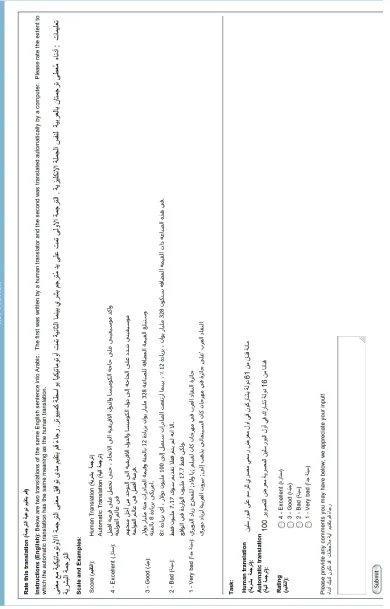
Adequacy judgments are collected from untrained Arabic-speaking annotators using Amazon’s Me-chanical Turk (MTurk) service. We create a human intelligence task (HIT) type that presents Turkers with a MT hypothesis/reference pair and asks for an adequacy judgment. To make this task accessi-ble to non-experts, the traditional definitions of ad-equacy scores are replaced with the following: (4) excellent, (3) good, (2) bad, (1) very bad. Each rat-ing is accompanied by an example from the data set which fits the corresponding criteria from the tradi-tional scale. To make this task accessible to the Ara-bic speakers we would like to complete the HITs, the instructions are provided in Arabic as well as En-glish.
To allow experimentation with various data nor-malization techniques, we collect judgments from 10 unique Turkers for each of the translations. We also ask an expert to provide “gold standard” judg-ments for 101 translations drawn uniformly from the data. These 101 translations are recombined with the data and repeated such that every 6th translation has a gold standard judgment, resulting in a total of 1455 HITs. We pay Turkers $0.01 per HIT and Ama-zon fees of $0.005 per HIT, leading to a total cost of $218.25 for data collection and an effective cost of $0.015 per judgment. Despite requiring Arabic speakers, our HITs are completed at a rate of 1000-3000 per day. It should be noted that the vast ma-jority of Turkers working on our HITs are located in India, with fewer in Arabic-speaking countries such as Egypt and Syria.
3 Normalization Techniques
We apply multiple normalization techniques to the data set and evaluate their relative performance. Several techniques use the following measures:
• ∆: For judgments (J =j1...jn) and gold stan-dard (G=g1...gn), we define average distance:
∆(J, G) =
Pn
i=1|gi−ji|
n
• K: For two annotators, Cohen’s kappa coeffi-cient (Smeeton, 1985) is defined:
K= P(A)−P(E)
1−P(E)
whereP(A)is the proportion of times that an-notators agree and P(E) is the proportion of times that agreement is expected by chance.
3.1 Straight Average
The baseline approach consists of keeping all judg-ments and taking the straight average on a per-translation basis without additional normalization.
3.2 Removing Low-Agreement Judges
Following Callison-Burch et al. (2009), we calcu-late pairwise inter-annotator agreement (P(A)) of each annotator with all others and remove judgments from annotators withP(A)below some threshold. We set this threshold such that the highest overall agreement can be achieved while retaining at least one judgment for each translation.
3.3 Removing Outlying Judgments
For a given translation and human judgments (j1...jn), we calculate the distance (δ) of each judg-ment from the mean (¯j):
δ(ji) =|ji−¯j|
We then remove outlying judgments withδ(ji) ex-ceeding some threshold. This threshold is also set such that the highest agreement is achieved while retaining at least one judgment per translation.
3.4 Weighted Voting
3.5 Scaling Judgments
To account for the notion that some annotators judge translations more harshly than others, we apply per-annotator scaling to the adequacy judgments based on annotators’ signed distance from gold standard judgments. For judgments (J = j1...jn) and gold standard (G=g1...gn), an additive scaling factor is calculated:
λ+(J, G) = Pn
i=1gi−ji
n
Adding this scaling factor to each judgment has the effect of shifting the judgments’ center of mass to match that of the gold standard.
3.6 2-Stage Technique
We combine judgment scaling with weighted vot-ing to produce a 2-stage normalization technique addressing two types of divergence in Turker judg-ments from the gold standard. Divergence can be either consistent, where Turkers regularly assign higher or lower scores than experts, or random, where Turkers guess blindly or do not understand the task.
Stage 1: Given a gold standard (G = g1...gn), consistent divergences are corrected by calculat-ingλ+(J, G) for each annotator’s judgments (J =
ji...jn) and applyingλ+(J, G)to eachjito produce adjusted judgment setJ0. If∆(J0, G) < ∆(J, G), where∆(J, G)is defined in Section 3, the annotator is considered consistently divergent andJ0 is used in place ofJ. Inconsistently divergent annotators’ judgments are unaffected by this stage.
Stage 2: All annotators are considered in a weighted voting scenario. In this case, annotator contribution is determined by a distance measure similar to the kappa coefficient. For judgments (J =
j1...jn) and gold standard (G=g1...gn), we define:
K∆(J, G) = (max ∆−∆(J, G))−E(∆)
max ∆−E(∆)
wheremax ∆is the average maximum distance be-tween judgments andE(∆)is the expected distance between judgments. Perfect agreement with the gold standard producesK∆= 1while chance agreement producesK∆ = 0. Annotators withK∆ ≤0are re-moved from the voting pool and final scores are cal-culated as the weighted averages of judgments from all remaining annotators.
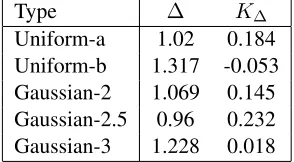
Type ∆ K∆
Uniform-a 1.02 0.184
[image:3.612.352.499.59.140.2]Uniform-b 1.317 -0.053 Gaussian-2 1.069 0.145 Gaussian-2.5 0.96 0.232 Gaussian-3 1.228 0.018
Table 2: Weights assigned to random data
4 Results
Table 1 outlines the performance of all normaliza-tion techniques. To calculateP(A)andKwith the gold standard, final adequacy scores are rounded to the nearest whole number. As shown in the table, re-moving low-agreement annotators or outlying judg-ments greatly improves Turker agreement and, in the case of removing judgments, decreases distance from the gold standard. However, these approaches remove a large portion of the judgments, leaving a skewed data set. When removing judgments, 1172 of the 1314 translations receive a score of 3, making tasks such as tuning automatic metrics infeasible.
Weighing votes by agreement with the gold stan-dard retains most judgments, though neither Turker agreement nor agreement with the gold standard im-proves. The scaling approach retains all judgments and slightly improves correlation and∆, thoughK
decreases. As scaled judgments are not whole num-bers, TurkerP(A)andKare not applicable.
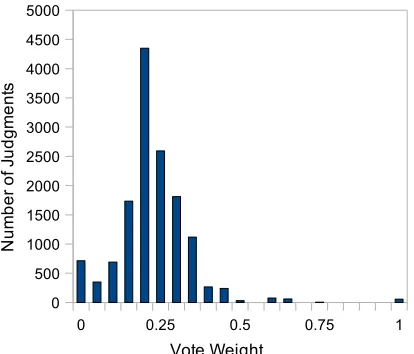
The 2-stage approach outperforms all other tech-niques when compared against the gold standard, being the only technique to significantly raise cor-relation. Over 90% of the judgments are used, as shown in Figure 1. Further, the distribution of fi-nal adequacy scores (shown in Figure 2) resembles a normal distribution, allowing this data to be used for tuning automatic evaluation metrics.
4.1 Resistance to Randomness
Ta-Gold Standard Turker
Technique Retained Correlation ∆ P(A) K P(A) K
Straight Average 14550 0.078 0.988 0.356 0.142 0.484 0.312
Remove Judges 6627 -0.152 1.002 0.347 0.129 0.664 0.552
Remove Judgments 9250 0 0.891 0.356 0.142 0.944 0.925
Weighted Voting 14021 0.152 0.968 0.356 0.142 0.484 0.312
Scale Judgments 14550 0.24 0.89 0.317 0.089 N/A N/A
[image:4.612.110.506.57.168.2]2-Stage Technique 13621 0.487 0.836 0.366 0.155 N/A N/A
Table 1: Performance of normalization techniques
0 0.25 0.5 0.75 1
0 500 1000 1500 2000 2500 3000 3500 4000 4500 5000
Vote Weight
N
u
mb
e
r
o
f J
u
d
g
me
n
ts
Figure 1: Distribution of weights for judgments
ble 2, only Gaussian-2.5 receives substantial weight while the others receive low or zero weight. This fol-lows from the fact that the actual data folfol-lows a sim-ilar distribution, and thus the random Turkers have negligible impact on the final distribution of scores.
5 Conclusions and Future Work
We have presented an Arabic MT evaluation task conducted using Amazon MTurk and discussed several possibilities for normalizing the collected data. Our 2-stage normalization technique has been shown to provide the highest agreement between Turkers and experts while retaining enough judg-ments to avoid problems of data sparsity and appro-priately down-weighting random data. As we cur-rently have a single set of expert judgments, our fu-ture work involves collecting additional judgments from multiple experts against which to further test our techniques. We then plan to use normalized
1 2 3 4
0 50 100 150 200 250
Adequacy Score
N
u
mb
e
r
o
f S
e
g
m
e
n
[image:4.612.86.293.211.388.2]ts
Figure 2: Distribution of adequacy scores after 2-stage normalization
Turker adequacy judgments to tune an Arabic ver-sion of the METEOR(Banerjee and Lavie, 2005) MT evaluation metric.
References
Satanjeev Banerjee and Alon Lavie. 2005. METEOR: An Automatic Metric for MT Evaluation with Im-proved Correlation with Human Judgments. InProc.
ACL WIEEMMTS.
Chris Callison-Burch, Philipp Koehn, Christof Monz, and Josh Schroeder. 2009. Findings of WMT09. In
Proc. WMT09.
Chris Callison-Burch. 2009. Fast, cheap, and creative: Evaluating translation quality using Amazon’s Me-chanical Turk. InProc. EMNLP09.
John Garofolo. 2001. NIST Open Machine Translation Evaluation. http://www.itl.nist.gov/iad/mig/tests/mt/. N. C. Smeeton. 1985. Early History of the Kappa
[image:4.612.320.529.213.389.2]Figure
3:
Example
HIT
as
seen
by
T
urk
[image:5.612.103.493.76.685.2]