State-Split for Hypergraphs with an Application to Tree-Adjoining
Grammars
Johannes Osterholzer and Torsten St¨uber Department of Computer Science
Technische Universit¨at Dresden D-01062 Dresden
{johannes.osterholzer,torsten.stueber}@tu-dresden.de
Abstract
In this work, we present a generalization of the state-split method to probabilistic hyper-graphs. We show how to represent the deriva-tional stucture of probabilistic tree-adjoining grammars by hypergraphs and detail how the generalized state-split procedure can be applied to such representations, yielding a state-split procedure for tree-adjoining gram-mars.
1 Introduction
Thestate-splitmethod (Petrov et al., 2006) allows the successive refinement of a probabilistic context-free grammar (PCFG) for the purpose of natural language processing (NLP). It employs automatic subcategorization of nonterminal symbols: in an iteration of a split-merge cycle, every nontermi-nal of the PCFG is split into two, along with the corresponding grammar rules, whose probabilities are distributed uniformly to the split rules. The re-sulting PCFG’s rule probabilities are then trained on an underlying treebank using the Expectation-Maximization algorithm (Dempster et al., 1977) for maximum-likelihood estimation on incomplete data. Finally, split nonterminal symbols which do not contribute to a significant increase in likelihood are merged back together. This counteracts an ex-ponential blowup in the number of nonterminals and prevents, to some degree, the phenomenon of overfitting.
The in-house developed statistical machine trans-lation toolkitVanda(B¨uchse et al., 2012) offers state-splitting for the refinement of its language models. Vanda’s internal representation of the various weighted tree grammar, automaton and transducer formalisms utilized for translation is by means of probabilistichypergraphs,i.e., graphs
consisting ofverticesandhyperedges, where each of the latter connects a (possibly empty) sequence oftail verticesto ahead vertexand is assigned a probability. Hence, our implementation of state-split operates on such hypergraphs as underlying data structures. The connection between parsing and hypergraphs is well-known in the field of NLP (Klein and Manning, 2004), where a hypergraph represents the derivation forest of a certain word. In our system, however, we use such a probabilistic hy-pergraph to represent thewholederivational struc-ture of a grammar, with a one-to-one correspon-dence between hyperpaths and grammar deriva-tions. We apply well-known product constructions from the theory of weighted automata, going back to Bar-Hillel et al. (1961) and generalized to the case of weighted tree automata by Maletti and Satta (2009), to restrict them to the derivations of a given word.
The mildly context-sensitive generative capacity oftree-adjoining grammars (TAG)is well-suited to the purpose of NLP (Joshi and Schabes, 1991). tree-adjoining grammars allow two basic operations to rewrite and derive trees:substitution,where a tree’s leaf node is replaced with another tree, and adjoining,which can be seen as the second-order substitution of a context (called an auxiliary tree) into another tree.
Probabilistic tree-adjoining grammars (PTAG) (Schabes, 1992; Resnik, 1992) assign to every de-rived tree an associated probability. They can also be incorporated into Vanda by an appropriate rep-resentation with hypergraphs. Such PTAGs can be extracted from treebank corpora, as detailed by Chen et al. (2006). The idea to refine these gram-mars furthermore by executing the already imple-mented state-split procedure on their hypergraph representations arises naturally. The main contribu-tion of the work at hand is a formalizacontribu-tion of this
idea. However, one should note that our proposed method does not just apply to PTAG, but should carry over to many grammar formalisms that can be represented by hypergraphs. In our formalization, we have to deal with a complication, introduced by the nature of adjunction in TAG. For this purpose, we introducesplit relations.
An alternative to our approach to state-splitting PTAG is the one taken by Shindo et al. (2012), where a method for symbol refinement of proba-bilistic tree substitution grammars is presented. Since tree substitution grammars are just tree-adjoining grammars without tree-adjoining sites (and indeed, adjoining can be simulated by the combina-tion of a tree substitucombina-tion grammar which encodes adjoining explicitly, and a yield function which performs these encoded operations, cf. (Maletti, 2010)), it is possible that their technique can be adapted to the more general setting. This would have the additional advantage that smoothing by backoff to simpler context-free grammar rules is in-corporated in their system, increasing performance in the case of sparse data, while we do not cover smoothing in the work at hand.
Note that, although most of the preliminaries may be safely skimmed, we want to point out that our definitions of first- and second-order substitu-tion are slightly non-standard (but they enable a concise formalization of TAG).
2 Preliminaries
In the following, we will denote the set of non-negative integers byN. The set{1, . . . , k}shall be abbreviated by[k]. The set of the non-negative real numbers will be denoted byR≥0, and the closed
interval between two realsaandbby[a, b]. The set of finite words over a setAis written as A∗,ε∈A∗is the empty word andA+=A∗\ {ε}. The reflexive-transitive closure of a binary relation Rshall be denoted byR∗.
2.1 Unranked Trees
We call a finite setΣofsymbolsanalphabet.Given a finite setAand alphabetΣ, letΣA denote the
alphabet of allσa withσ ∈ Σ,a ∈A. Note that
the new symbolσais merely a syntactic construct
and should be identified neither withσnora. Presuming an alphabet Σ and set A, the set UΣ(A) of unranked trees over Σ indexed by A
is the smallest setU such that A ⊆ U and for every n ∈ N,t1, . . . , tn ∈ U, andσ ∈ Σ, also
σ(t1, . . . , tn) ∈ U. For a tree σ() we will just
write σ and UΣ(∅) will be denoted by UΣ. The
set ofpositionspos(t)of a treet∈UΣ(A)is
de-fined bypos(σ(t1, . . . , tn)) = {ε} ∪ {iw | i ∈
[n], w∈pos(ti)}andt(w)denotes thelabeloft
at positionw.
Throughout the rest of the paper, let X = {x1, x2, . . .} denote an infinite set of variables
and, forn ∈ N, let Xn = {x1, . . . , xn}.
Simi-larly, letY ={y1, y2, . . .}, letYn={y1, . . . , yn}
forn ∈ N, andZ = {z}. Givenk ∈ N, we call a treet ∈ UΣ(A∪∆X) (resp.t ∈ UΣ∪∆Y(A))
proper inXk (resp.Yk)if for everyi > k, there
is no appearance ofδxi (resp. ofδyi) int, and for
every i ∈ [k], there is exactly one position in t labeled withδxi(resp.δyj), for someδ∈∆. This
unique δ ∈ ∆will be denoted bylbt(xi) (resp.
lbt(yj)).
For an alphabetΣandk ∈N, we denote first-order substitution of the treess1, . . . ,sk∈UΣinto
t ∈ UΣ(ΣXk)byt[x1/s1, . . . , xk/sk] ∈ UΣ,
ab-breviated byt[x/s]. The treet[x/s]is the result of replacing every node intwhich is labeled byσxi,
fori∈ [k]and someσ ∈Σ, by the treesi.
Sim-ilarly, fors ∈ UΣ(A)andt ∈ UΣ(Z), lett[z/s]
denote the tree obtained fromtby replacing every node that is labelled withzbys.
For every alphabet Σ and k ∈ N, second-order substitution of the trees s1, . . . , sk ∈
UΣ(Z) into the tree t ∈ UΣ∪ΣYk will be
de-noted bytJy1/s1, . . . , yk/skK ∈ UΣ, or shorter,
by tJy/sK. For every symbol σ ∈ Σ and vari-ableyi ∈ Yk, we defineσyi(t1, . . . , tn)Jy/sK =
si[z/σ(t1Jy/sK, . . . , tnJy/sK)], and we define
σ(t1, . . . , tn)Jy/sK = σ(t1Jy/sK, . . . , tnJy/sK)
forσ∈Σ.
2.2 Hypergraphs
A hypergraph is a tuple (V, E, µ, g) where the setV contains the graph’sverticesandEthe hy-peredges(or justedges). Edge connectivity is de-noted by the functionµ: E → V+ andg ∈ V is the graph’s goal vertex. For a hyperedge e withµ(e) = a0a1· · ·an, we define its head as
hd(e) = a0, itstailas tl(e) = a1· · ·an and its
arityasar(e) = n. The set ofa-hyperpathsHGa of a hypergraphG = (V, E, µ, g),a∈ V, is the largest set of treesH ⊆ UE such that for every
A
By1
Cx2 c
Cx1
C
c
B
[image:3.595.310.510.71.164.2]z b
Figure 1: PTAGGwith treesα1,α2andβ
n = |tl(e)|. The hyperpaths of G are its g -hyperpaths:HG=HGg.
A tuple(V, E, µ, g, p)is called aprobabilistic hypergraph (phg)if(V, E, µ, g) is a hypergraph andp:E → [0,1]assigns aprobabilityto every hyperedge. We will denote the class of all proba-bilistic hypergraphs byHand assume definitions for unweighted hypergraphs to carry over to the probabilistic case. Theprobabilityof a derivation d∈HGis defined to be
P(d|G) =Y
w∈pos(d)
p(d(w)).
In the following, we will fix the phgG (resp. G0, G00) to be of the form (V, E, µ, g, p) (resp. (V0, E0, µ0, g0, p0),
etc.).
2.3 Tree-Adjoining Grammars
In our definition of tree-adjoining grammars, the variablexi (resp.yj) in a symbolσxi (resp.σyj)
will be used to tagσ with the information that it labels theith substitution (resp.jth adjoining) site of the respective tree. The variablezin an auxiliary tree denotes the tree’s foot node. This formalization allows us, among others, to give a straightforward definition of derived trees.
A tree-adjoining grammar (TAG) is a tuple G = (Σ, S,S,A)whereΣis an alphabet,S ∈Σ is called thestart symbol,S ⊆ UΓ(∆)the set of
initial trees, andA ⊆UΓ(∆∪Z)the set of
aux-iliary trees, withΓ = Σ∪ΣY and∆ = ΣX. We
demand for everyt ∈ S ∪ Athatt(ε) ∈ Σ, and that there aren,m∈Nsuch thattis proper inXn
and inYm. In the following, we will denote these
uniquenandmbyrk1(t), resp.rk2(t). Moreover,
we require that for everyt∈ A,zappears exactly once int.
Aprobabilistic tree-adjoining grammar (PTAG) is then a tuple G = (Σ, S,S,A, P, Q) such that (Σ, S,S,A) is a TAG,P: S ∪ A → [0,1] maps trees to their probabilities and Q = (Qt:Yrk2(t) → [0,1])t∈S∪Aassigns to adjoining
A
s
(
α1
)
/
0
.
9
C
S(α1, y1)
n
(
α1
,y
1
)
/
0
.
3
y
(
α
1
,y
1)
/
0
.
7
B?
[image:3.595.102.263.75.132.2]a(β)/0.6 s(α2)/0.5
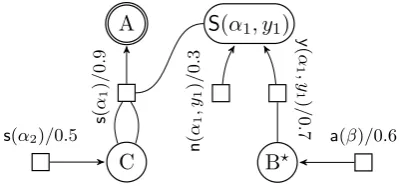
Figure 2: Hypergraph representation ofG
sites the probability of their activation. We will denote the class of all PTAG byT.
In the following, the PTAG G (resp. G0) will be assumed to be of the form (Σ, S,S,A, P, Q) (resp. (Σ0, S0,S0,A0, P0, Q0)).
Let us examine an example PTAGG, withΣ = {A,B,C,c,b},S = A, initial treesS ={α1, α2},
and an auxiliary treeA = {β}. Refer to Fig. 1, which depicts the tree α1 with two substitution
sites labeled, resp., with symbols A and C, as well as one adjoining site, labeled with B. To the right are the initial treeα2 and the auxiliary treeβ, both
with no substitution or adjoining sites. The foot node ofβis indicated byz.
We denote the conditional probability that an elementary treetwith root symbolA is used to rewrite substitution or adjoining sites that are la-beled withAbyP(t). ForG, e.g., letP(α1) = 0.9,
P(α2) = 0.5, and P(β) = 0.6. The
probabil-ity that the adjoining site inα1, tagged withy1,
is activated during a derivation, is denoted by Qα1(y1). In the case of this running example, let Qα1(y1) = 0.7.
3 Hypergraph Representations
For every PTAGG, we can construct a hypergraph G= hg(G), whose hyperpaths stand in a one-to-one correspondence to the grammar’s derivations. Hence, we will callGahypergraph representation ofG.
trees with respective root symbols. Other, irrelevant, vertices of this form are omitted from the figure.
The second vertex type helps in the derivation of auxiliary trees. For eachA∈Σ, the hypergraph contains a corresponding vertexA?. In Fig. 2, the only relevant vertex of this form isB?, whose
hy-perpaths represent derivations of auxiliary trees with root symbolB.
Lastly, for every adjoining site that appears in an elementary treetand is tagged withyi, we include
a vertexS(t, yi). This vertex is used to explicitly
model the decision to activate or not to activate the corresponding adjoining site. In the figure, there is only one such vertex,S(α1, y1).
The hyperedges ofhg(G)can also be classified by their intended meaning: a hyperedge of the form
s(α) signifies the substitution of the initial tree α during a derivation. Its head vertex is its root symbol. Its tail vertices are, in order, the labels of α’s substitution sites (indicating that the derivation must continue with derivations of trees with the respective symbols at their root) and the vertices
S(α, yi)modelling its adjoining sites (these
indi-cate the necessary decision on activating the sites). In Fig. 2, we see, among others,s(α1), whose head
vertexAcorresponds toα1’s root symbol, while
its two tail verticesCstand for its respective sub-stitution sites, andS(α1, y1)for its adjoining site.
Hyperedges of the forma(β), withβ an elemen-tary auxiliary tree, possess essentially the same structure as the former, but signify derivation of auxiliary trees. In the figure, the only edge of this form isa(β). Its head vertex isB?becauseβ’s root symbol isB, and it has no tail vertices, since there are no sites inβ.
Finally, the hyperedge y(t, yi) (resp. n(t, yi))
encodes the information that an adjoining site in twas activated (deactivated). Both have S(t, yi)
as head, and whilen(t, yi)has no tail, the tail of
y(t, yi)signifies that the derivation should continue
with the adjoining of an auxiliary tree. In Fig. 2, e.g., y(α1, y1) models the activation of the site
that corresponds to its head vertexS(α1, y1), and
has the tail vertexB?, because that site is labeled withB.
The probabilities of these hyperedges are taken over fromP andQin the obvious way. Formally, we definehg(G) =Gwith
V ={A, A? |A∈Σ}
∪ {S(t, yi)|t∈ S ∪ A, i∈[rk2(t)]},
E={s(t)|t∈ S} ∪ {a(t)|t∈ A}
∪ {y(t, yi),n(t, yi)|t∈ S ∪A, i∈[rk2(t)]},
goal vertexg=S, and
µ(s(t)) =A B1· · ·BnS(t, y1)· · ·S(t, ym),
µ(a(t)) =A?B1· · ·BnS(t, y1)· · ·S(t, ym),
µ(y(t, yj)) =S(t, yj)Cj?,
µ(n(t, yj)) =S(t, yj),
wheren= rk1(t),m = rk2(t),A = t(ε),Bi =
lbt(xi)fori∈[n], andCj = lbt(yj)forj∈[m],
while
p(s(t)) =P(t), p(y(t, yj)) =Qt(yj),
p(a(t)) =P(t), p(n(t, yj)) = 1−Qt(yj).
Note that for our simple running example from Fig. 1, there are only two possible derivations of trees with root symbol A: in the first one, we sub-stitute two instances ofα2intoα1, and, after
ac-tivation of the adjoining site inα1, adjoinβ into
this site. The corresponding A-hyperpath in Fig. 2 is d1 = s(α1) s(α2),s(α2),y(α1, y1) a(β)
. Alternatively, we can ignore the adjoining site, and arrive at the corresponding derivationd2 =
s(α1) s(α2),s(α2),n(α1, y1)
.
Given such a hyperpath that represents a PTAG derivation, we can compute the derivation’s de-rived tree in a bottom-up manner with the function yd : Hhg(G)→UΣ(X∪Z)defined by
yd(s(t)(d1, . . . , dn, d01, . . . , d0m))
=t[x/yd(d)]Jy/yd(d0)K yd(a(t)(d1, . . . , dn, d01, . . . , d0m))
=t[x/yd(d)]Jy/yd(d0)K yd(y(t, yj)(d)) = yd(d)
yd(n(t, yj)) =z,
where againn = rk1(t),m = rk2(t), andyd(d)
denotes the element-wise application ofydto all d1, . . . ,dn, analogously foryd(d0).
For example, ford1from above, we can compute
its derived tree as
yd(d1) =α1[x1/α2, x2/α2]Jy1/βK
= A C(c),By1(c,C(c))
Jy1/βK
= A C(c), βz/B(c,C(c)) = A C(c),B b,B(c,C(c)).
4 State-Split Hypergraphs
S(α1, y1)h1i
y(α1, y1)h21i
S(α1, y1)h2i
y(α1, y1)h12i
B?h1i B?h2i
y
(
α1
,y
1
)
h
11
i y(α
1
,y
1)
h
22
[image:5.595.96.264.73.196.2]i
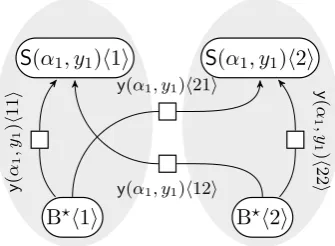
Figure 3: Crossing hyperedges
As explained in the introduction, the state-split algorithm proceeds in three distinct phases: first of all, it splits every vertex into two, and then it trains the probabilities of the resulting hyperedges on a given treebank corpus, using the EM algorithm. In a third step, vertices which do not increase likelihood are merged back together. However, due to the nature of adjunction in tree-adjoining grammar, the splits and merges cannot be quite as liberal as in the case of context-free grammars.
The reason for this will be shown immediately, but first and foremost, let us define how to represent split vertices. Given a hypergraphG, for anya∈V, andb∈ {0,1,2}, define
ahbi=
(
(a, b) ifb∈ {1,2} a ifb= 0.
For a vertexa, the so-definedah1iandah2iwill denote the two vertices which result from splitting a, whileah0iis just a notation for the merged-back-together vertexa. We will also have to annotate split hyperedges in this way: for a hyperedgee∈E withar(e) =n, as well as a tupleb∈ {0,1,2}n+1,
we introduce the syntax ehbi, which stands for (e,b).
Given this notation, we can examine the men-tioned complication of the state-split procedure, which arises when splitting hyperedges of the form
y(t, yj). Let us assume that the verticesS(α1, y1),
B?, as well as the hyperedgey(α1, y1)from Fig. 2
are to undergo subcategorization.
If we split the vertices and hyperedges indiscrim-inately, we arrive at the situation displayed in Fig. 3: each of the vertices has been split into two copies, and four newy-hyperedges were introduced. What
is the meaning of these hyperedges? In a hyperpath representing a PTAG derivation, the appearance of the hyperedgey(α1, y1)h11isignifies that the
adjoining site inα1, labeled with the split symbol
Bh1i, is activated, and next, an auxiliary tree with equal root symbol must be adjoined into it.
However, there is a problem with the hyperedge
y(α1, y1)h21iwhich crosses the shaded ellipses in
the figure (and, analogously, withy(α1, y1)h12i).
This hyperedge can be interpreted as activation of the mentioned adjoining site, labeled withBh1i, and preparation of adjoining an auxiliary tree with root symbolBh2i. This stands in conflict to the concept of adjoining, where the label of the node to be replaced must be identical to the symbol at the root of the auxiliary tree.
There are several distinct possibilities to handle this complication. First of all, one could just do away with the above condition regarding adjoining. Actually, such a relaxation of the formalism was already proposed by Rogers (2003), resulting in non-stricttree-adjoining grammars.
As a second option, the formalism of TAG could be extended by introducing states (cf. (B¨uchse et al., 2011) for synchronous TAG). In this modifica-tion, the derivational structure of the grammar is no longer dependent on the labels of adjoining and sub-stitution sites, this information is instead encoded into the states, which only appear as intermediate symbols in a derivation. Performing the splits and merges on such states, instead of symbols, could also remedy the problem.
However, for this work, we chose to stick to a conceptually simpler solution, thus staying close to the established notion of tree-adjoining grammar: we just disallow the creation of such crossing hyper-edges during the split-merge cycle; or, to put it dif-ferently, we only introduce a hyperedgey(t, y)hi ji into the split hypergraph if i = j. Hence, in Fig. 3, only the two hyperedgesy(α1, y1)h11iand
y(α1, y1)h22i, which are both “within” the two
shaded ellipses, would be generated.
To formalize this idea, we augment the state-split method with what we callsplit relations. Given a hypergraphGwhich is to undergo a split-merge cycle, a split relation onGis a symmetric relation R⊆V ×V on the graph’s vertices. If a hyperedge efromGconnects, among others, two verticesa1
anda2 such thata1Ra2, then the idea is to split
eonly into such hyperedges which connect either onlya1h1ianda2h1i, or onlya1h2ianda2h2i, but
not, e.g.,a1h1ianda2h2i.
a1h1ianda1h2ibut leavea2h1ianda2h2isplit at
the same time. Hence, what we must consider is merging all elements which are (in-)directly related byRsimultaneously together. More succinctly, the objects considered to be merged must be the equiv-alence classes of the reflexive-transitive closureR∗ ofR, which we also callsplit classes.
4.1 Splitting
When we split the vertices of a hypergraph, we must take care that the created hyperedges respect the supplied split relationR, as explained above.
This is achieved by the following function splitR, which splits every node and introduces new hyperedges respecting R. Given a hyper-graph Gand split relation R ⊆ V ×V, we let splitR(G) =G0with
V0 ={ahbi |a∈V, b∈ {1,2}},
E0 ={ehb0, . . . , bki | e∈E, µ(e) =a0· · ·ak,
b0, . . . , bk∈ {1,2},
aiRaj impliesbi =bj},
µ0(ehb0, . . . , bki) =a0hb0i · · ·akhbki,
whereµ(e) =a0· · ·ak,
g0 =gh1i, and
p0(ehb0, . . . , bki) =
p(e) 2c
where c=|{ehb0i ∈E0|b0 =b0· · ·bk}|.
Note that the probabilities of hyperedges are dis-tributed uniformly to their split copies inG0. In an implementation, these should be slightly random-ized to give starting values for the EM algorithm, as mentioned by Petrov et al. (2006).
The split hypergraph’s number of hyperedges is exponential in their arity. We can try to mitigate the problem of this exponential blowup by binarizing the trees of the TAG which was initially extracted from a corpus, following the description of Lang (1994).
4.2 Merging
As explained above, we have to merge all elements of a split class back together simultaneously. This will be denoted with the following function. Let G0 = splitR(G)be a hypergraph resulting from a split,R⊆V ×V a split relation, andC∈V /R∗ one of its split classes. The hypergraph which re-sults from mergingCback together is denoted by G00= mergeCR(G0)with
V00=V0\ {ahbi |a∈C, b∈ {1,2}} ∪C,
E00={ehb00, . . . , bk0i | ehb0, . . . , bki ∈E0,
µ(e) =a0· · ·ak,
ai ∈Cimpliesb0i = 0,
ai 6∈Cimpliesb0i =bi},
where we writeo(ehb00, . . . , b0ki) =ehb0, . . . , bki
for the relation ofehb00, . . . , b0kitoehb0, . . . , bki,
µ00(ehb0, . . . , bki) =a0hb0i · · ·akhbki,
whereµ(e) =a0· · ·ak,
g00=
(
g ifg∈C g0 otherwise, and
p00(e00) =
X
e0∈o−1(e00)
p0(e0)/2 ifhd(e)∈C
X
e∈o−1(e00)
p0(e0) otherwise
Note that the probabilities of hyperedges which are merged back together are summed up. In the case that a hyperedge’s head vertex is merged, we have to normalize the resulting probability.
4.3 Treebank Corpora and Likelihood
During the split-merge procedure, we want to train the split hypergraph representations on a supplied treebank. Following the presentation of Prescher (2005), we will abstract away from the concrete data structures which might be used to represent a collection of trees, and just define a treebank corpus as a functionK:UΣ→R≥0, assigning to
every tree over an alphabetΣa certainfrequency, such that the set of trees with non-zero frequency is finite.
Let us assume thatG0 = hg(G) is the
hyper-graph representation of a PTAGGandGnis the
result ofnsplit-merge cycles onG0. Then we can
define the likelihood of a corpusK:UΣ →R≥0
onGnas
L(K |Gn) =
Y
t∈UΣ
X
d∈HGn yd(un(d))=t
P(d|Gn)
K(t)
=Y
t∈UΣ
X
d0∈HG 0
yd(d0)=t
X
d∈HGn un(d)=d0
P(d|Gn) K(t)
. (1)
Hereby, the functionun removesn levels of
an-notation from an annotated derivation, for every n ∈ N. It is defined as the homomorphic exten-sion of the functionu˜non hyperedges to unranked
trees, whereu˜is defined for every hyperedgeeby ˜
Algorithm 1The state-split algorithm
Require: phgG,n∈N, corpusK:UΣ→R≥0 1: functionSTATESPLIT(G, n, K)
2: G0 ←G
3: computesplit relationR0 4: for alli∈[n]do
5: Gi←SPLITMERGE(Gi−1, Ri−1, K) 6: updatesplit relationRi−1toRi−1 7: end for
8: returnGn
9: end function
Note that in (1), for everyt∈UΣwith non-zero
frequency, there are only finitely many derivations d0∈HG0, which can be determined by employing a TAG parser at the beginning of the state-split process. For each of thesed0we can compute the value of the innermost sum in a bottom-up manner, similarly to the computation of inside probabilities as described by Petrov et al. (2006).
In the following, given a hypergraphGn,n >0,
we will identifyyd(d)withyd(un(d)), for every
d∈HGn.
4.4 Overview of the Algorithm
Now we can denote the state-split algorithm for hypergraphs in pseudocode, cf. Alg. 1. After com-puting the initial split relation, the algorithm’s outer loop (ll. 4–7) executesnsplit-merge cycles onG using the treebank corpusKfor training. Addition-ally, in each step it updates the split relation to the newly generated hypergraph.
Note that the concrete computation of split classes depends strongly on the grammar formal-ism represented by the hypergraph, hence we leave it abstract in the general formulation of the algo-rithm. In our case, where we use tree-adjoining grammars as underlying formalism, we can instanti-ate it as follows:R0is defined as the finest
symmet-ric relationRsuch that, for every vertex of the form
S(t, yi) in G0, we have (S(t, yi),lbt(yi)?) ∈ R.
Similarly, given a split relationRi−1, the updated
split relationRiis the finest symmetric relationR
such that, for everyb ∈ {0,1,2} and paira1hbi,
a2hbi, ifa1hbianda2hbi are vertices inGi such
thata1Ri−1a2, thena1hbiR a2hbi.
The split-merge cycle (cf. Alg. 2) can be consid-ered as the core of the state-split algorithm. Sup-plied with a phg G, split relation R on G, and treebank corpusK, SPLITMERGEfirst of all splits
the nodes ofG, as defined in section 4.1. Then it
Algorithm 2A split-merge cycle
Require: phgG,R⊆V ×V, corpus K:UΣ →R≥0
1: functionSPLITMERGE(G, R, K)
2: G0 ←splitR(G)
3: G0 ←EMTRAIN(G0, K) 4: for allC∈V /R∗do 5: G00 ←mergeCR(G0)
6: ifL(G00|K)/L(G0 |K)≥λthen
7: G0 ←G00
8: end if 9: end for 10: returnG0 11: end function
uses the EM algorithm for maximum likelihood es-timation on incomplete data to train the newly-split phg on the treebankK. Finally, in ll. 4–9, each split class is tentatively merged back together, and if the concomitant loss in likelihood does not fall below a certain factorλ∈[0,1], this merge is taken over permanently. As noted by Petrov et al., this com-bats the exponential blow-up of the hypergraph, as well as the phenomenon of overfitting.
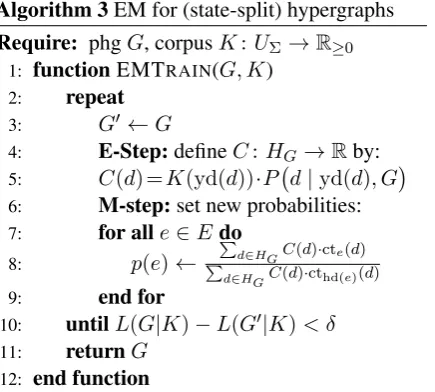
For the sake of completeness, let us give a rough sketch of the EM algorithm for training state-split hypergraphs on treebank corpora, following the exposition of Prescher (2005). Given a phg G and a treebank corpusK, the EM algorithm al-ternatingly repeats two computations, called the Expectation step (E-step)and the Maximization step (M-step), until the increase in likelihood of the newly-computed hypergraph on the corpusKfalls beneath a certain thresholdδ∈R.
Note that the EM algorithm is not guaranteed to find the actual global maximum of the likeli-hood, however, as already shown by Dempster et al. (1977), the likelihoods of the respective grammars are monotonically non-decreasing, and so at least a local maximum can be approximated.
In the algorithm’s E-step, a complete-data cor-pus C: HG → R≥0 on the hyperpaths of Gis
generated by distributing the frequencies of every derived treet∈UΣin the corpusKto the
hyper-paths representing derivations oft, weighted by their conditional probability givent. The M-step then uses this complete-data corpus to compute hyperedge probabilities by relative frequency es-timation. Thereby,cte(d) denotes the number of
Algorithm 3EM for (state-split) hypergraphs
Require: phgG, corpusK:UΣ →R≥0 1: functionEMTRAIN(G, K)
2: repeat
3: G0 ←G
4: E-Step:defineC:HG→Rby:
5: C(d) =K(yd(d))·P d|yd(d), G 6: M-step:set new probabilities: 7: for alle∈E do
8: p(e)←
P
d∈HGC(d)·cte(d) P
d∈HGC(d)·cthd(e)(d) 9: end for
10: untilL(G|K)−L(G0|K)< δ 11: returnG
12: end function
andcthd(e)(d)the number of appearing hyperedges with the same head vertex ase.
One might remark that this concise, but formu-laic presentation of EM is not immediately suitable for implementation, but, using the derivation em-ployed by Gupta and Chen (2011), it is straightfor-ward to bring it into the form of the well-known Inside-Outside algorithm, which has been adapted to PTAG by Schabes (1992).
5 State-Split preserves Hypergraph Representations
After all these definitions, we might ask ourselves the following question: given a hypergraph repre-sentationGof some PTAGG, does the hypergraph which results from an application of the split-merge cycle toGstill represent a PTAG? This question indeed arises quite naturally, after all it is an im-portant requirement for the correctness of the state-split procedure for PTAGs with hypergraphs.
If we denote the result of a split-merge cy-cle on a phg G by sm(G), and the class of all hypergraph representations of probabilistic tree-adjoining grammars byHT, then this question can
essentially be answered by proving the inclusion
sm(HT)⊆ HT. (2)
But the validity of this inclusion does certainly depend on the formal definition ofHT. Indeed, for
the definition which comes to mind first, in which we just fixHT to be the set{hg(G)| G ∈ T }, i.e.
the image of the class of all PTAGs underhg, the inclusion isnotvalid! This is due to the annotation of vertices and hyperedges in a split-merge cycle: hypergraphs that contain, for example, a vertex
G G
G0 G00 G0
sm hg
hg ∼
[image:8.595.74.292.74.270.2]Φ
∃
?
Figure 4: Proof idea
Ah2i, which was generated by splitting a vertexA, are arguably not in the image ofhg!
However, one can show that thestructureof a split-and-merged hypergraph still corresponds to the image of a PTAGGunderhg. We will capture this structural identity by means of hypergraph isomorphisms.
A hypergraph isomorphism Φ : G −→∼ G0 is a tuple (Φ1,Φ2), where Φ1: V → V0 and
Φ2:E →E0are bijections such thatΦ1(g) =g0
and µ0(Φ2(e)) = Φ1(a0)· · ·Φ1(an) if µ(e) =
a0· · ·an. We writeG∼=G0if there is an
isomor-phismΦ :G−→∼ G0.
We define the set of all possible hypergraph rep-resentations of PTAG as
HT ={G∈ H | ∃G ∈ T.hg(G)∼=G}.
Obviously, for every PTAGG,hg(G)∈ HT, i.e.,
it is indeed a hypergraph representation accord-ing to this definition. As visualized in Fig. 4, the core of the proof of (2) is then as follows: Given
G ∈ T,G ∈ H, andG0 = sm(G), we have to
construct a PTAGG0and hypergraph isomorphism Φ : hg(G0)−→∼ G0.
We constructG0so that the trees ofG0are
relabel-ings of those inG, generated by incorporating the annotations to the hyperedges inGto substitution and adjoining sites:
S0 ={thbi |s(t)hbi ∈E0}, A0 ={thbi |a(t)hbi ∈E0},
wheretha b1· · ·brk1(t)c1· · ·crk2(t)iis the result of replacing the root symbolA oftbyAhai, every substitution siteAxiintbyAhbiixi, and every
ad-joining siteAyj byAhcjiyj, fori ∈ [rk1(t)]and
j ∈ [rk2(t)]. The probabilities P(t) of
elemen-tary treest, as well as the activation probabilities Qt(yi)are just read off fromp(s(t)),p(a(t)), resp.
p(y(t, yi)).
trees and moves them “to the back”, i.e., Φ1(Ahbi) =Ahbi, Φ1 (Ahbi)?
=A?hbi,
Φ1 S(thbi, yi)
=S(t, yi)hb(i)i
and
Φ2 s(thbi)=s(t)hbi,
Φ2 s(thbi)=s(t)hbi,
Φ2 y(thbi, yi)
=y(t, yi)hb(i)b(i)i,
Φ2 n(thbi, yi)
=n(t, yi)hb(i)i,
where, in all three cases,b(i)=b(rk1(t) +i).
Now,Φcan indeed be proven to be a hypergraph isomorphism betweenG0andsm(G), but for rea-sons of space, we will omit these details from this work. Note that the construction ofG0andΦcan alternatively be interpreted as the definition of a read-off procedure, which allows our systemVanda to convert back its internal state-split hypergraph representation into a probabilistic tree-adjoining grammar, e.g. to display the resulting grammars for means of debugging. Thus, it also has a hands-on relevance for implementation.
Acknowledgements We thank the anonymous reviewers for their valuable comments, and our colleagues Toni Dietze and Matthias B¨uchse for fruitful discussions.
References
Yehoshua Bar-Hillel, Micha A Perles, and Eli Shamir. 1961. On formal properties of simple phrase struc-ture grammars.Zeitschrift f¨ur Phonetik, Sprachwis-senschaft und Kommunikationsforschung, 14:143– 172.
Matthias B¨uchse, Mark-Jan Nederhof, and Heiko Vogler. 2011. Tree Parsing with Synchronous Tree-Adjoining Grammars. InProceedings of the 12th International Conference on Parsing Technologies, pages 14–25, Dublin, Ireland, October. Association for Computational Linguistics.
Matthias B¨uchse, Toni Dietze, Johannes Osterholzer, Anja Fischer, and Linda Leuschner. 2012. Vanda – A Statistical Machine Translation Toolkit. In Pro-ceedings of the 6th International Workshop Weighted Automata: Theory and Applications, pages 36–37. John Chen, Srinivas Bangalore, and K Vijay-Shanker.
2006. Automated Extraction of Tree-Adjoining Grammars from Treebanks. Natural Language Engi-neering, 12(3):251.
Arthur P Dempster, Nan McKenzie Laird, and Donald B Rubin. 1977. Maximum Likelihood from Incom-plete Data via the EM Algorithm. Journal of the Royal Statistical Society, B(39):1–38.
Maya R Gupta and Yihua Chen. 2011. Theory and Use of the EM Algorithm. Foundations and Trends in Signal Processing, 4(3):223–296.
Aravind K Joshi and Yves Schabes. 1991. Tree-Adjoining Grammars and Lexicalized Grammars. In Maurice Nivat and Andreas Podelski, editors, Defin-ability and RecognizDefin-ability of Sets of Trees, pages 409–431. Elsevier.
Dan Klein and Christopher D Manning. 2004. Parsing and Hypergraphs. In Harry Bunt, John Carroll, and Giorgio Satta, editors,New Developments in Parsing Technology, volume 23 ofText, Speech and Language Technology, pages 351–372. Springer Netherlands. Bernard Lang. 1994. Recognition can be Harder than
Parsing. Computational Intelligence, 10(4):486–494. Andreas Maletti and Giorgio Satta. 2009. Parsing Algo-rithms based on Tree Automata. In Harry Bunt, edi-tor,Proceedings of the 11th International Conference on Parsing Technologies, pages 1–12. Association for Computational Linguistics.
Andreas Maletti. 2010. A Tree Transducer Model for Synchronous Tree-Adjoining Grammars. In Proceed-ings of the 48th Annual Meeting of the Association for Computational Linguistics, pages 1067–1076. As-sociation for Computational Linguistics.
Slav Petrov, Leon Barrett, Romain Thibaux, and Dan Klein. 2006. Learning Accurate, Compact, and Inter-pretable Tree Annotation. InProceedings of the 21st International Conference on Computational Linguis-tics and 44th Annual Meeting of the Association for Computational Linguistics, pages 433–440, Sydney, Australia. Association for Computational Linguistics. Detlef Prescher. 2005. A Tutorial on the Expectation-Maximization Algorithm Including Maximum-Likelihood Estimation and EM Training of Prob-abilistic Context-Free Grammars. Technical report, 15th European Summer School in Logic, Language, and Information.
Philip Resnik. 1992. Probabilistic Tree-Adjoining Grammar As A Framework For Statistical Natural Language Processing. InProceedings of the 14th Conference on Computational Linguistics, pages 418– 424.
James Rogers. 2003. wMSO theories as grammar for-malisms. Theoretical Computer Science, 293(2):291– 320, February.
Yves Schabes. 1992. Stochastic Tree-Adjoining Gram-mars. InProceedings of the Workshop on Speech and Natural Language, HLT ’91, pages 140–145, Stroudsburg, PA, USA. Association for Computa-tional Linguistics.
Hiroyuki Shindo, Yusuke Miyao, Akinori Fujino, and Masaaki Nagata. 2012. Bayesian Symbol-Refined Tree Substitution Grammars for Syntactic Parsing. In