Algebraic Approaches to Compositional Distributional Semantics
Daoud Clarke University of Hertfordshire
David Weir University of Sussex [email protected]
Rudi Lutz University of Sussex [email protected]
Abstract
The question of how to compose meaning in distributional representations of meaning has re-cently been recognised as a central issue in computational linguistics. In this paper we describe three general and powerful tools that can be used to describe composition in distributional seman-tics: quotient algebras, learning of finite dimensional algebras, and the construction of algebras from semigroups.
1
Introduction
Vector based representations of meaning have wide application in natural language processing. While these techniques work well at the word level, for longer strings, data becomes extremely sparse. The question of how the principle of compositionality might apply for such representations has thus been recognised as an important one (Widdows, 2008; Clark et al., 2008).
Context-theoretic semantics (Clarke, 2007) is a framework for composing meanings in vector based semantics, in which the composition of the meaning of strings is described by a multiplication on a real vector spaceAthat is bilinear with respect to the addition of the vector space, i.e.
x(y+z) =xy+xz (x+y)z=xz+yz (αx)(βy) =αβxy
wherex, y, z∈ Aandα, β∈R. It is assumed that the multiplication is associative, butnotcommutative. The resulting structure is an associative algebra over a field — or simply an algebra when there is no ambiguity. Clarke (2007) gives a mathematical model of meaning as context, and shows that under this model, the meaning of natural language expressions can be described by an algebra. The framework is also applied to models of textual entailment, and logical and ontological representations of natural language meaning.
In this paper, we identify three general techniques for constructing algebras.
• Using quotient algebras to impose relations on a free algebra, as described in (Clarke et al., 2010).
• Defining finite-dimensional algebras using matrices. Any finite-dimensional algebra can be de-scribed in this way; we have investigated the possibility of learning such algebras using least squares regression.
• Constructing algebras from a semigroup to give it vector space properties. We sketch a possible method of using this technique, identified by Clarke (2007), to endow logical semantics with a vector space nature.
apple big
apple
red
apple
city big
city
red
city
book big
book
red
book
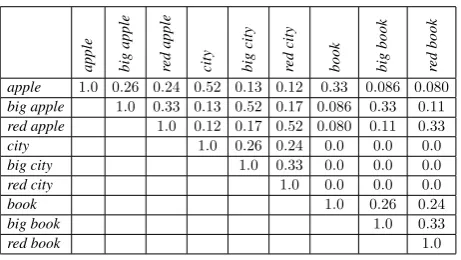
apple 1.0 0.26 0.24 0.52 0.13 0.12 0.33 0.086 0.080
big apple 1.0 0.33 0.13 0.52 0.17 0.086 0.33 0.11
red apple 1.0 0.12 0.17 0.52 0.080 0.11 0.33
city 1.0 0.26 0.24 0.0 0.0 0.0
big city 1.0 0.33 0.0 0.0 0.0
red city 1.0 0.0 0.0 0.0
book 1.0 0.26 0.24
big book 1.0 0.33
red book 1.0
Figure 1: Cosine similarity values between phrases
see red apple see big city
buy apple visit big apple
read big book modernise city
throw old small red book see modern city
[image:2.595.71.302.76.206.2]buy large new book
Figure 2: The corpus used to compute the vectors that formed the generating set for the ideal.
2
Quotient Algebras
One commonly used bilinear multiplication operator on vector spaces is the tensor product (denoted⊗), whose use as a method of combining meaning was first proposed by Smolensky (1990), and has been considered more recently by Clark and Pulman (2007) and Widdows (2008), who also looked at the direct sum (which Widdows calls the direct product, denoted⊕).
The tensor algebra on a vector spaceV (whereV is a space of context features) is defined as:
T(V) =R⊕V ⊕(V ⊗V)⊕(V ⊗V ⊗V)⊕ · · ·
Any element ofT(V) can be described as a sum of components with each in a different tensor power ofV. Multiplication is defined as the tensor product on these components, and extended linearly to the whole ofT(V).
Previous work has not made full use of the tensor product space; only tensor products are used, not sums of tensor products, giving us the equivalent of the product states of quantum mechanics. Our approach imposes relations on the vectors of the tensor product space that causes some product states to become equivalent to entangled states, containing sums of tensor products of different degrees. This allows strings of different lengths to share components. We achieve this by constructing a quotient algebra.
An idealI of an algebraAis a sub-vector space ofAsuch thatxa ∈ I andax ∈ I for all a∈ A and allx∈I. An ideal introduces a congruence≡onAdefined byx ≡yif and only ifx−y∈I. For any set of elementsΛ⊆Athere is a unique minimal idealIΛcontaining all elements ofΛ; this is called the ideal generated byΛ. The quotient algebraA/Iis the set of all equivalence classes defined by this congruence. Multiplication is defined onA/Iby the multiplication onA, since≡is a congruence.
Elements that are congruent with respect to the ideal have equivalence classes that are equal in the quotient algebra. The construction is thus a way of imposing relations between vector elements: we simply choose a set of pairs that we wish to be equal, and put their difference in the generating setΛ.
3
Learning Finite-dimensional Algebras
Quotient algebras are useful constructions when we have a small number of relations which we wish to impose on the tensor algebra. In highly lexicalised grammars, the number of relations we wish to impose may become so large that the ideal generates the whole vector space, and is thus useless, since the resulting quotient space will be trivial. An alternative to this is to restrict the space of exploration to finite-dimensional algebras. In this case, we can explore the space of possible products in relation to the set of relations we wish to hold; in other words, we can view this as an optimisation problem in which we want to find the best possible product given the required relations.
We apply this to the situation where we obtain a vector xˆ for each individual word and pair of words in sequence. We then find the product that best fits these observed vectors. Given a set W =
{w1, w2. . . wm}of words, we want to define a product⊙to minimise the difference betweenwˆi ⊙wˆj
andw[iwj, for1≤i, j ≤m. Specifically, we can define this as minimising X
i,j
kw[iwj−wˆi⊙wˆjk
If word vectors havendimensions, then⊙is defined by ann3dimensional vector, which we denotef
rst
for1≤r, s, t≤n, where(er⊙es)t =frstandeis the vector with 1 in every component, andvtis the
tth component ofv.
We can view this as a linear model:
(w[iwj)t=ǫijt+ n X
r,s=1
( ˆwi)r( ˆwj)sfrst
where we have m2 statistical units to learnn2 parameters relating to thetth component of the vector space. Since these parameters are independent for each value oft, each set ofn2parameters can be learnt in parallel. We are currently exploring ways of learning these parameters. The form of the equation above suggests the use of least squares, and we have performed some experiments using this method using a corpus extracted from the ukWaC corpus (Ferraresi et al., 2008). We extracted a list of verb adjective∗
noun sequences, and used latent semantic analysis (Deerwester et al., 1990) to generate n-dimensional vectors for the160most common adjectives and nouns, and pairs of these adjectives and nouns. Our initial results indicate that the learnt parameters tend to get very large when using least squares to find the parameters, leading to poor results; we plan to investigate other methods such as linear optimisation.
Guevara (2010) proposed a related method of learning composition which used linear regression to learn how components compose. His model is however much more restrictive than ours in that the value of a component in the product depends only on that same component in the composed vectors, whereas in our model, the value of the component can depend on all components in the composed vectors.
Baroni and Zamparelli (2010) took a similar approach, in which adjectives are modelled as matrices acting on the space of nouns, and the matrices are learnt using least squares regression. The algebra products we propose learning are more general than matrix products; in addition we do not need to distinguish between words which are represented as matrices and words which are represented as vectors.
4
Constructing Algebras from Semigroups
Term Context vector
fish (0,0,1)
big (1,2,0)
Figure 3: Example context vectors for terms.
ni = (N, λxnouni(x))
ai = (N/N, λpλyadji(y)∧p.y)
Figure 4: Equations describing syntax and semantics of adjectives and nouns.
In related work, Clark et al. (2008) described a method of composing meanings which they noted was a generalisation of Montague semantics. However, their version of Montague semantics assumed a particular model, and thus effectively mapped sentences to truth values. This omits much of the power of Montague semantics in which sentences are mapped to logical forms which then provide restrictions on the set of allowable models, allowing, for example, entailments to be computed between sentences.
We will sketch a method by which Montague semantics can be described within the context-theoretic framework. We follow a standard method of representing logic in language, but instead of representing words using logic, we represent an individual dimension of meaning of a word by a logical form — we call this dimension a “aspect”. The general scheme is to represent aspects as elements of a semigroup, from which we form an algebra. Words are then represented as weighted sums over individual aspects.
We define a setS of all aspects as the set of pairs(s, σ), wheresis the syntactic type of an aspect (for example in the Lambek calculus) and σ is the semantics of the aspect (for example described in the lambda calculus). We can extendS by defining a product on such pairs reducing each element to a normal form. This defines a semigroup: the Lambek calculus can be described in terms of a residuated lattice, which is a partially ordered semigroup (Lambek, 1958), and the lambda calculus is equivalent to a Cartesian closed category underβ-equivalence (Lambek, 1985), which can be considered as a semigroup with additional structure.
Given any semigroupSwe can construct an algebraL1(S)of real-valued functions onSwhich are finite under theL1norm with multiplication defined by convolution:
(u·v)(x) = X
y,z∈S:yz=x
u(y)v(z).
For example, suppose we have context vectors for the terms big and fish as described in Figure 3. We represent the syntax and semantics of adjectives and nouns by elements ai andni respectively
of a semigroup S (Figure 4), where we assume equivalence under β-reduction is accounted for. The predicatesadji andnounj correspond to aspects, in this case each dimensioniof the three dimensions in the context vectors has a correspondingadjiandnouni. We may then represent the vectors for these
terms as elements of the algebrabigc = a1+ 2a2 andfishd = n3, where we equate an elementuof the semigroup with the function in the algebraL1(S)which mapsuto 1 and every other element to zero. Thenbigc fishd=a1n3+ 2a2n3, where
ainj = (N, λx(nounj(x)∧adji(x))).
Note that the elementsaiform a commutative, idempotent subsemigroup ofS, so they have a semilattice
structure. In order for this structure to carry over to the vector structure in the algebra, we would need a more sophisticated construction, such as a C∗ enveloping algebra; we leave the investigation of this possibility to further work.
5
Discussion
hope that with further work, these methods will lead to a true synthesis between logical and distributional approaches to natural language semantics.
6
Acknowledgments
We are grateful to Peter Hines, Stephen Clark and Peter Lane for useful discussions. The first author also wishes to thank Metrica for supporting this research.
References
Baroni, M. and R. Zamparelli (2010). Nouns are vectors, adjectives are matrices: Representing adjective-noun constructions in semantic space. InProceedings of the Conference on Empirical Methods in Natural Language Processing (EMNLP 2010), East Stroudsburg PA: ACL, pp. 1183–1193.
Clark, S., B. Coecke, and M. Sadrzadeh (2008). A compositional distributional model of meaning. In Proceedings of the Second Quantum Interaction Symposium (QI-2008), Oxford, UK, pp. 133–140.
Clark, S. and S. Pulman (2007). Combining symbolic and distributional models of meaning. In Proceed-ings of the AAAI Spring Symposium on Quantum Interaction, Stanford, CA, pp. 52–55.
Clarke, D. (2007). Context-theoretic Semantics for Natural Language: an Algebraic Framework. Ph. D. thesis, Department of Informatics, University of Sussex.
Clarke, D., R. Lutz, and D. Weir (2010, July). Semantic composition with quotient algebras. In Proceed-ings of the 2010 Workshop on GEometrical Models of Natural Language Semantics, Uppsala, Sweden, pp. 38–44. Association for Computational Linguistics.
Deerwester, S., S. Dumais, G. Furnas, T. Landauer, and R. Harshman (1990). Indexing by latent semantic analysis.Journal of the American Society for Information Science 41(6), 391–407.
Ferraresi, A., E. Zanchetta, M. Baroni, and S. Bernardini (2008). Introducing and evaluating ukwac, a very large web-derived corpus of english. InWorkshop Programme, pp. 47.
Guevara, E. (2010). A Regression Model of Adjective-Noun Compositionality in Distributional Seman-tics.ACL 2010, 33.
Harris, Z. (1968). Mathematical Structures of Language. Wiley, New York.
Lambek, J. (1958). The mathematics of sentence structure. American Mathematical Monthly 65, 154– 169.
Lambek, J. (1985, May). Cartesian closed categories and typed lambda-calculi. In G. Cousineau, P.-L. Curien, and B. Robinet (Eds.),Combinators and Functional Programming Languages, Lecture Notes in Computer Science. Springer-Verlag.
Montague, R. (1973). The proper treatment of quantification in ordinary English. Dordrecht, Holland: D. Reidel Publishing Co.
Smolensky, P. (1990, November). Tensor product variable binding and the representation of symbolic structures in connectionist systems.Artificial Intelligence 46(1-2), 159–216.