Not all links are equal: Exploiting Dependency Types for the Extraction of
Protein-Protein Interactions from Text
Philippe Thomas1, Stefan Pietschmann1, Ill´es Solt2, Domonkos Tikk1,2and Ulf Leser1 1Knowledge Management in Bioinformatics, Institute for Computer Science,
Humboldt-University of Berlin, Unter den Linden 6, 10099 Berlin, Germany
2Department of Telecommunications and Media Informatics,
Budapest University of Technology and Economics, Magyar tud´osok k¨or´utja 2, 1117 Budapest, Hungary
{thomas,pietschm,solt,tikk,leser}@informatik.hu-berlin.de
Abstract
The extraction of protein-protein interactions (PPIs) reported in scientific publications is one of the most studied topics in Text Mining in the Life Sciences, as such algorithms can sub-stantially decrease the effort for databases cu-rators. The currently best methods for this task are based on analyzing the dependency tree (DT) representation of sentences. Many approaches exploit only topological features and thus do not yet fully exploit the informa-tion contained in DTs. We show that incor-porating the grammatical information encoded in the types of the dependencies in DTs no-ticeably improves extraction performance by using a pattern matching approach. We au-tomatically infer a large set of linguistic pat-terns using only information about interact-ing proteins. Patterns are then refined based on shallow linguistic features and the seman-tics of dependency types. Together, these lead to a total improvement of 17.2 percent points in F1, as evaluated on five publicly available
PPI corpora. More than half of that improve-ment is gained by properly handling depen-dency types. Our method provides a general framework for building task-specific relation-ship extraction methods that do not require an-notated training data. Furthermore, our obser-vations offer methods to improve upon rela-tion extracrela-tion approaches.
1 Introduction
Insights about protein-protein interactions (PPIs) are vital to understand the biological processes within organisms. Accordingly, several databases, such as
IntAct, DIP, or MINT, contain detailed information about PPIs. This information is often manually har-vested from peer reviewed publications (Ceol et al., 2010). However, it is assumed that a high amount of PPIs is still hidden in publications. Therefore, the automated extraction of PPIs from text has attracted considerable attention from biology research.
A number of different techniques have been pro-posed to solve the problem of extracting PPIs from
natural language text. These can be roughly
or-ganized into one of three classes: co-occurrence, machine learning, and pattern matching (for a re-cent survey, see (Zhou and He, 2008)). The co-occurrence based approaches use only information on the co-existence of protein mentions in a given scope. They are easy to implement and allow for efficient processing of huge amounts of texts, but they are also prone to generate many false positives because they cannot distinguish positive from neg-ative pairs. The second class is based on machine learning. Here, a statistical model is learned from a set of positive and negative examples and then ap-plied to unseen texts. In general, machine learning-based methods to relation extraction perform very well for any task where sufficient, representative and high quality training data is available (Kazama et al., 2002). This need for training data is their ma-jor drawback, as annotated texts are, especially in the Life Sciences, rather costly to produce. Fur-thermore, they are prone to over-fit to the training corpus, which renders evaluation results less infer-able to real applications. A third class of methods is based on pattern matching. Such methods work with patterns constructed from linguistically
tated text, which are matched against unseen text to detect relationships. Patterns can either be in-ferred from examples (Hakenberg et al., 2010; Liu et al., 2010) or can be defined manually (Fundel et al., 2007). Systems based on manually defined pat-terns typically use few patpat-terns, leading to high pre-cision but low recall (Blaschke et al., 2002). In con-trast, systems that learn patterns automatically often produce more patterns and exhibit a better recall, at the cost of a decrease in precision. To circumvent this penalty, several works have tried to improve patterns. E.g., SPIES (Hao et al., 2005) filters pat-terns using the minimum description length (MDL)
method which improves its F1by 6.72%.
Another classification of PPI extraction methods is based on the sentence representation that is ap-plied. The simplest such representation is the bag of words (BoW) that occur in the sentence; more com-plex representations are constituent trees, capturing the syntactic structure of the sentence, and depen-dency trees (DTs), which represent the main gram-matical entities and their relationships to each other. PPI extraction methods use various sentence repre-sentation, e.g., are based only on BoW (Bunescu and Mooney, 2006; Giuliano et al., 2006), use only DTs (Erkan et al., 2007), or combine representa-tions (Airola et al., 2008; Miwa et al., 2008).
In the last years, dependency trees have become the most popular representation for relation extrac-tion. DTs characterize, via their dependency links, grammatical relationships among words. They are particularly favored by kernel-based learning ap-proaches, see e.g. (Culotta and Sorensen, 2004; Erkan et al., 2007; Airola et al., 2008; Miwa et al., 2008; Kim et al., 2010) but also graph matching ap-proaches using DTs have been proposed (Liu et al., 2010). However, these methods do not further utilize the grammatical information encoded in the depen-dency types (edge labels). Recently proposed meth-ods like (Buyko et al., 2009; Rinaldi et al., 2010) modify the DTs by e.g. trimming irrelevant depen-dencies. In contrast to these approaches, our method
exploitsthe dependency types of DTs and performs basic transformations on DTs; we use Stanford de-pendencies, which are presumably the most often used DT representation in PPI extraction.
The rest of this paper is organized as follows. We describe our novel method for extracting PPIs from
text that is based on pattern matching in dependency graphs. We evaluate our method against benchmark PPI corpora, and discuss results with a focus on de-pendency type information based methods.
2 Methods
Our approach consists of a series of steps: First, we extract sentences from Medline and PMC open ac-cess that contain pairs of genes/proteins known to interact. Second, we convert each of those sentences into DTs and derive putative tree patterns for each pair. Having a set of such patterns, we apply a num-ber of generalization methods to improve recall and filtering methods to improve precision. We discern between methods that are purely heuristic (termed shallow) and steps that incorporate dependency type information (termed grammatical). To predict PPIs in unseen text, the resulting patterns are matched against the corresponding DTs.
2.1 Extraction of PPI sentences
We apply the method described in (Hakenberg et al., 2006) to extract a set of sentences from Medline and PMC potentially describing protein interactions. Es-sentially, this method takes a database of PPIs (here IntAct; (Aranda et al., 2010)) and searches all sen-tences in Medline and PMC containing any of those pairs. Proteins were tagged and normalized using GNAT (Hakenberg et al., 2008). To avoid a possible bias, articles contained in any of the five evaluation corpora are excluded. This resulted in 763,027 in-teracting protein pairs.
2.2 Pattern generation and matching
For each protein pair we generate a new sentence and apply entity blinding, meaning that named enti-ties are replaced by placeholders to avoid systemic bias. Specifically, the mentions of the two proteins known to interact are replaced by the placeholder
ENTITY Aand any additional proteins in the same
sentence are replaced by ENTITY B. Tokens are
con-tain the most valuable information about their mu-tual relationship. Therefore, we generate a pattern from each DT by extracting the shortest, undirected
path between the two occurrences of ENTITY A.
The set of initial patterns is denoted by SIP.
We employ several methods to improve the
qual-ity of this initial set of patterns. We
systemati-cally evaluated possible constellations and identified those that help in improving performance of PPI ex-traction. The modifications are of two kinds. Pattern generalizers are intended to elevate recall, whereas pattern filters should raise precision. We present two types of methods: Shallow methods are simple heuristics whereas grammatical methods are rules that exploit the information in dependency types.
We use a strict graph matching approach for pat-tern matching. We consider a patpat-tern to match a sub-graph of a DT iff all their nodes and edges match exactly, including edge labels and edge directions.
2.3 Pattern generalization
It is a common practice in NLP to apply some pre-processing on patterns to reduce corpus-specificity.
In particular, we perform stemming (GST),
re-moval of common protein name prefixes and suf-fixes (GPN), and replacement of interaction phrases by single words (GIW). We summarize these steps as
shallow generalizationsteps. We only describe the latter two (GPN, GIW) in more detail.
Protein names are often modified by suffixes like
-kinase, -receptor or -HeLa or by prefixes like
phospho- or anti-. These affixes are usually not covered by entity blinding as the entity recognition method does not consider them as part of the pro-tein name. As such affixes are not relevant for rela-tion extracrela-tion but do interfere with our exact graph
matching approach, we apply the GPN heuristic to
remove them.
Interactions between proteins can be expressed very diversely in natural language. In almost all cases there is at least one word that specifies the in-teraction semantically, called the interaction word; this is often a verb, such as “binds” or “phospho-rylates”, but can as well be a noun, such as “[in-duced] phosphorylation”, or an adjective, such as
“binding”. The GIW heuristic generalizes patterns
by substituting all contained interaction words with generic placeholders. We assembled a list of 851
in-teraction words (including inflection variants) based on (Temkin and Gilder, 2003; Hakenberg et al., 2006) that was further enriched manually. Based on their POS-tags, interaction words are assigned to
one of the three placeholdersIVERB,INOUN,
IAD-JECTIVE. We also experimented with a single
inter-action word placeholder,IWORD, handling the case
of incorrect POS-tags.
Unifying dependency types (GUD): The
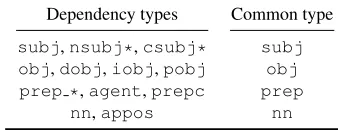
Stan-ford typed dependency format contains 55 grammat-ical relations organized in a generalization hierar-chy. Therefore, it is a natural idea to treat simi-lar (e.g., sibling) dependency types equally by re-placing them with their common parent type. We manually evaluated all dependency types to assess whether such replacements are viable. The final list of replacements is listed in Table 1. Note that we used the so-called collapsed representation of de-pendency types of the Stanford scheme. This means that prepositional and conjunctive dependencies are collapsed to form a single direct dependency be-tween content words, and the type of this depen-dency is suffixed with the removed word. In the GUD generalizer, these dependency subtypes are substi-tuted by their ancestors (e.g.,prep,conj).
Dependency types Common type
subj,nsubj*,csubj* subj obj,dobj,iobj,pobj obj prep *,agent,prepc prep
[image:3.612.339.508.409.474.2]nn,appos nn
Table 1: Unification of specific dependency types to
a single common type by the generalizer GUD. Note
thatagentis merged with dependency typeprep
as it is inferred for the preposition “by”.
Collapsing dependency links (GCD): In
addi-tion to the collapsing performed by Stanford con-verter, we remove edges that likely are irrelevant for PPIs. We focused on removing the
dependen-ciesnn(noun compound modifier) andappos
the interaction itself, the dependency itself and the corresponding noun can be removed, as long as the noun is not an entity itself. As an example, this generalizer is applied on the dependency parse tree
of the sentence “ENTITY Aprotein recognized
anti-body (ENTITY A)” shown on Figure 1a. The
modi-fied parse tree is depicted on Figure 1b.
ENTITY-A p r o t e i n
n n
r e c o g n i z e d
n s u b j
a n t i b o d y dobj
ENTITY-A a p p o s
(a) Original pattern
ENTITY_A r e c o g n i z e d
n s u b j
ENTITY_A dobj
[image:4.612.79.293.162.263.2](b) Generalized pattern
Figure 1: Dependency pattern before and after
col-lapsingnnandapposdependency links using the
generalizer GCD.
2.4 Pattern constraints
Due to the automatic construction method, our set of patterns also contains samples derived from sen-tences that do not actually describe an interaction between proteins, although it does contain a pair of interacting proteins. Such patterns lead to wrong
matches. As a countermeasure, we define
con-straints an extracted pattern has to fulfill. Patterns not adhering to these constraints are removed from the pattern set, thus increasing precision. Standard (shallow) heuristics for doing so are the exclusion of negation words (CNW) and the restriction to patterns containing interaction-related words from a prede-fined set (CIW). Patterns containing negations po-tentially match two negative protein pairs. Such pat-tern can be removed to prevent wrong extractions. For negation words, the list described in (Fundel et al., 2007) was used. Additionally, patterns
con-taining the dependency type conj no*, conj or, or
prep withoutare also removed. On top of those pre-viously known approaches, we developed two new filter to leverage the semantic richness of the DTs.
Dependency combination (CDC): Interaction
words are organized into the following categories:
verb, adjectiveandnoun. Based on linguistic con-siderations we define “dependency patterns” for the different word types. For example we assume that
interaction verbs describe an action that originates in one protein and affects the other protein. Obviously,
the dependency combinationsubjwithobjfulfills
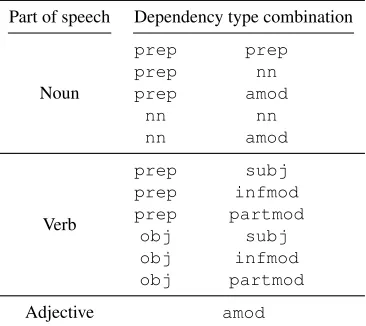
this consideration (for an example see Figure 1b). We manually evaluated a few DTs containing PPI for each interaction word category (verb, noun, ad-jective) and determined all combinations of depen-dency types that are valid for the given category. The resulting combinations are listed in Table 2.
Part of speech Dependency type combination
Noun
prep prep prep nn prep amod
nn nn
nn amod
Verb
prep subj prep infmod prep partmod
obj subj obj infmod obj partmod
[image:4.612.335.518.195.358.2]Adjective amod
Table 2: Allowed dependency type combinations
based on classes of POS classes (constraint CDC).
subj = {nsubj, nsubjpass, xsubj, csubj,
csubjpass}, obj ={dobj, pobj, iobj}and
prep={prep *,agent}
Syntax Filter (CSF): A particular case in PPI
ex-traction are sentences with enumerations, as shown in Figure 2. Such (possibly quite long; the longest enumeration we found contains not less than 9 pro-teins) enumerations greatly increase the number of protein pairs.
We observed that sentences in which the common
dependency type isprep betweenornnoften do
describe an association between the connected pro-teins. Accordingly, such patterns are retained.
ENTITY_B a c t i v a t e s
n s u b j
ENTITY_B dobj
ENTITY_A a p p o s
[image:5.612.125.250.55.141.2]ENTITY_A a p p o s
Figure 2: Dependency tree (DT) for the entity
blinded sentence “ENTITY B activates ENTITY B,
ENTITY A, ENTITY A.” with the initial pattern highlighted in bold red. Application of CSFremoves this pattern.
3 Results
For evaluation we use five manually annotated benchmark corpora: AIMed, BioInfer, HPRD50, IEPA, and LLL. Those have been unified to the “greatest common factors” by Pyysalo et al. (2008). This means that protein names in the corpora are tagged and that interactions are undirected and bi-nary. A basic overview of the corpora can be found in Table 1 of (Airola et al., 2008).
A sentence withnentities contains n2different undirected entity pairs. For each entity pair in a sentence, we generate a separate evaluation exam-ple, apply entity blinding and generate the DT in the same manner as previously described for gen-erating the pattern set. All patterns are then matched against the DTs of the sentences from the evalua-tion corpora. If at least one pattern matches, the pair
is counted as positiveotherwise asnegative. From
this information we calculate precision, recall, and F1scores.
Table 3 shows results using the initial pattern set and the different configurations of generalized / fil-tered pattern sets. We evaluate the impact of shallow and grammar-based methods separately. Recall that
Sshallow encompasses stemming (GST), substitution
of interaction words (GIW), suffix/prefix removal at entity names (GPN), and interaction (CIW) and nega-tion word filtering (CNW), while Sgrammar-based
en-compasses unification of dependency types (GUD),
collapsing dependency links (GCD), the dependency
combination constraint (CDC) and the syntax
fil-ter (CSF). In addition, results after application of all generalizers Sgeneralizers, all constraints Sconstraints
0.0 0.2 0.4 0.6 0.8 1.0
AIMed BioInfer HPRD50 IEPA LLL
[image:5.612.351.502.59.174.2]Precision Recall F1
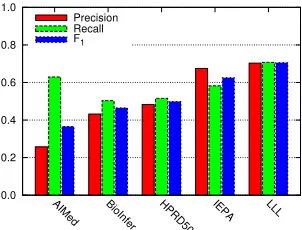
Figure 3: Results for the five corpora using the set-ting achieving highest overall F1(Sall).
and the combination of both Sall are also included. Corpus-specific results for the best setting in terms of F1(Sall) are shown in Figure 3.
Setting P R F1 #
Baseline Sinitial 23.2 34.8 27.8 478 k
Generalizers
GPN 23.4 37.0 28.7 423 k
GIW 26.2 45.3 33.2 453 k
GST 24.1 37.4 29.3 471 k
GUD 24.0 38.3 29.5 467 k
GCD 26.3 48.9 34.2 418 k
Constraints
CNW 23.4 34.8 28.0 455 k
CIW 42.5 17.2 24.5 322 k
CDC 39.5 15.9 22.7 318 k
CSF 28.2 32.6 30.3 419 k
Combinations
Sgeneralizers 28.2 69.0 39.9 290 k
Sconstraints 68.3 12.7 21.4 224 k
Sshallow 40.9 31.4 35.5 253 k
Sgrammar-based 33.2 42.1 37.2 264 k
[image:5.612.313.547.274.498.2]Sall 38.2 54.8 45.0 152 k
Table 3: Performance of pattern sets on the ensem-ble of all five corpora. # denotes the pattern set size.
4 Discussion
We presented a pattern-based approach to extract
protein-protein interactions from text. Our main
contribution in this paper was a systematic study on the usage of dependency types within this approach.
We showed that using such knowledge, F1on
aver-age improves by 9.4 percentaver-age points (pp) (27.8 % to 37.2 %) as measured on the five benchmark PPI corpora.
also has a number advantageous features: First, pat-terns are learned from co-mentions of pairs of pro-teins known to interact, and hence no annotated cor-pus is necessary. This does not only make an ap-plication of the method for new tasks easier and cheaper, but also prevents over-fitting to a training corpus. Note, that as shown recently by (Airola et al., 2008; Tikk et al., 2010), essentially all state-of-the-art machine learning methods show large per-formance differences depending on whether or not the evaluation and training examples are drawn from the same corpus. In particular, cross-validation re-sults of those are consistently more optimistic than the more realistic cross-learning results. In contrast, a pattern-based approach like ours is not prone to over-fitting. Furthermore, debugging our method is rather simple. Unlike when using a black-box ma-chine learning method, whenever a false positive match is found, one can pinpoint the specific pattern producing it and take action.
The work most closely related to ours is RelEx (Fundel et al., 2007). RelEx uses a small set of fixed rules to extract directed PPIs from de-pendency trees. Some of these rules also take ad-vantage of dependency types, for instance, to
prop-erly treat enumerations. A reimplementation of
RelEx (Pyysalo et al., 2008) was recently evalu-ated on the same corpora we used (see Table 7) and was found to be on par with other systems, though some of its measures were considerably worse than
those reported in the original publication.
Com-pared to our approach, RelEx is similar in that it performs pattern matching on DTs using informa-tion encoded in dependency types, however, there are some notable differences: First, RelEx rules were defined manually and are highly specific to protein-protein interactions. It is not clear how these could be adapted to other applications; in contrast, we described a general method that performs pat-tern learning from automatically generated
exam-ples. Second, it is not clear how RelEx results
could be further improved except by trial-and-error with more rules. In contrast, our pattern learning method offers a natural way of improvement by sim-ply increasing the number of examples and hence the number of patterns. We compared the results of our approach using an increasingly larger pattern set and observed a continuous increase in F1, due to a
con-tinuous improvement in recall. Consequently, using more PPI databases would likely produce better re-sults. Third, our generalization methods can be seen as graph rewriting rules. The result of applying them to a DT is, again, a DT; thus, they can easily be used as pre-processing coupled with other PPI extraction methods (a direction we are currently exploring). In contrast, RelEx matches patterns against DTs, but cannot be used to transform DTs.
In the following, we discuss the impact of the re-finement methods individually and provide a brief error analysis based on a random sample of false negative pairs and a random sample of low preci-sion patterns. We also compare our best results with those of several state-of-the-art methods.
4.1 Generalizers and constraints
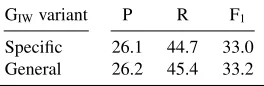
As can be seen in Table 3, all of the generalizers in-creased recall and even provide minor improvement in precision. For the combination of all five general-izers (Sgeneralizers), an overall increase of 34.2 pp in recall and 5 pp in precision was observed. From the shallow generalizers, merging interaction phrases (GIW) was proven to be the most effective, account-ing for an increase of 10.5 pp in recall and 3 pp in precision. As shown in Table 4, the general variant, which merges all interaction phrases to a common word, is slightly superior to the variant in which in-teraction words are merged class-wise.
GIWvariant P R F1
[image:6.612.362.494.463.506.2]Specific 26.1 44.7 33.0 General 26.2 45.4 33.2
Table 4: Results for collapsing interaction word variants (GIW).
For the grammar-based generalizer unifying de-pendency types (GUD), each of the different variants was evaluated separately (see Table 5). The com-bination of the all different variants leads to an in-crease of 3.5 pp in recall. As shown in Table 6,
col-lapsing the dependency typesnnandappos(GCD)
also provides the highest improvement when applied in combination.
GUDvariant P R F1
subj 23.4 35.1 28.1
obj 23.3 34.9 27.9
prep 24.0 37.0 29.1
nn 23.1 35.6 28.1
[image:7.612.118.255.55.133.2]sopn 24.0 38.3 29.5
Table 5: Dependency type aggregations used in
gen-eralizer GUD. sopncombines the dependency
ag-gregations forsubj,obj,prep, andnn.
GCDvariant P R F1
appos 23.6 38.1 29.2
nn 25.8 45.3 32.9
appos+nn 26.3 48.9 34.2
Table 6: Impact of collapsing the dependency types
apposandnnusing generalizer GCD.
(Sconstraints) leads to an increase in precision of
45.1 pp at the cost of 22.1 pp reduced recall. The shallow constraint that disallows patterns
with negation words (CNW) has comparably little
impact and removes only 5 % of the patterns. In con-trast, the interaction word constraint (CIW) is less conservative and removes more than 32.6 % of the patterns, trading off an increase of 19.3 pp in preci-sion to a decrease of 17.6 pp in recall.
Among the grammar-based constraints, the
de-pendency combination constraint CDCis superseded
by the syntax filter constraint (CSF) that removes 12 % of the patterns and increases precision about 5 pp while recall drops by only 2.2 pp. Note that CSF is the only constraint substantially increasing F1.
As seen in Table 3, combinations of generalizers and constraints yield almost fully additive improve-ments. The combination of all shallow refinements only (Sshallow) leads to an increase of 7.7 pp in F1, whereas with the addition of our grammar-based re-finements (Sall) a total increase of 17.2 pp in F1 is achieved. We justify that the inclusion of depen-dency type information adds a source of knowledge that further improves on conventional methods such as stemming or negation filtering.
4.2 Comparison with other methods
We compare the results of our best setting (Sall) with the results of the recently published analysis of nine
state-of-the-art machine learning methods for PPI extraction (Tikk et al., 2010). For these methods, a cross-learning evaluation by training each kernel on the ensemble of four corpora and evaluating it on the fifth has been performed. Detailed results are given
in Table 7. In terms of F1 we achieve on BioInfer,
the corpus with most protein pairs, the second-best result. On IEPA and LLL we achieve mid-range re-sults and on AIMed and HPRD50 we yield rere-sults below average. Overfitting remains a severe prob-lem in ML based methods as these results are infe-rior to those measured in cross-validation (Tikk et al., 2010), though there are suggestions to overcome this issue even in a ML setting (Miwa et al., 2009).
4.3 Error analysis
We randomly picked 30 gold standard sentences (all corpora) containing false negatives pairs and investi-gated all 72 false negative pairs included therein. For 29 positive pairs, possibly matching pattern were
re-moved by CDC, as the corresponding dependency
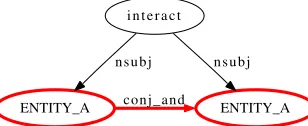
combination was not covered in our rule set. Fur-ther 16 graphs passed the filtering, but our set of sentences contained no adequate pattern. The third largest fraction of errors (13 cases) are pairs which, by our understanding, hardly describe an interaction. In 11 cases, the dependency parse trees are incorrect and therefore they do not provide the correct syntac-tic information. For 7 pairs, the shortest path covers insufficient syntactic information to decide whether two proteins interact. For instance Figure 4 pro-vides not enough information on the shortest path, whereas the second shortest path would provide suf-ficient information. Finally, three pairs were filtered
by the CIW filter, as their interaction words were
missing from our list.
We conclude that some constraints (especially
CDC and CIW) are too aggressive. Relaxation of
[image:7.612.120.255.202.257.2]Method AIMed BioInfer HPRD50 IEPA LLL
P R F1 P R F1 P R F1 P R F1 P R F1
Shallow linguistic (Giuliano et al., 2006) 28.3 86.6 42.6 62.8 36.5 46.2 56.9 68.7 62.2 71.0 52.5 60.4 79.0 57.3 66.4
Spectrum tree (Kuboyama et al., 2007) 20.3 48.4 28.6 38.9 48.0 43.0 44.7 77.3 56.6 41.6 9.6 15.5 48.2 83.5 61.2
k-band shortest path (Tikk et al., 2010) 28.6 68.0 40.3 62.2 38.5 47.6 61.7 74.2 67.4 72.8 68.7 70.7 83.7 75.0 79.1
Cosine distance (Erkan et al., 2007) 27.5 59.1 37.6 42.1 32.2 36.5 63.0 56.4 59.6 46.3 31.6 37.6 80.3 37.2 50.8
Edit distance (Erkan et al., 2007) 26.8 59.7 37.0 53.0 22.7 31.7 58.1 55.2 56.6 58.1 45.1 50.8 68.1 48.2 56.4
All-paths graph (Airola et al., 2008) 30.5 77.5 43.8 58.1 29.4 39.1 64.2 76.1 69.7 78.5 48.1 59.6 86.4 62.2 72.3
RelEx reimpl. (Pyysalo et al., 2008) 40.0 50.0 44.0 39.0 45.0 41.0 76.0 64.0 69.0 74.0 61.0 67.0 82.0 72.0 77.0
[image:8.612.349.503.223.286.2]Our method (Sall) 25.8 62.9 36.6 43.4 50.3 46.6 48.3 51.5 49.9 67.5 58.2 62.5 70.3 70.7 70.5
Table 7: Cross-learning results. Classifiers are trained on the ensemble of four corpora and tested on the fifth one (except for the rule-based RelEx). Best results are typeset in bold.
of this pattern leading to a total amount of 732 false positives while only 172 true positives. This phe-nomenon is caused by the way in which generaliz-ers and constraints are currently applied. The
unifi-cation of differentprep *dependency types to the
generalprep(GUD) makes some dependency type
combinations indistinguishable, e.g. (prep to,
prep to) and (prep to,prep of). The
depen-dency type combination constraint (CDC) would dis-allow a pattern containing the first combination, but as it is not applied in the matching phase, its benefits cannot be realized. A lesson learned from this exam-ple is that constraints should also be applied in the matching step as follows. After a successful match, the constraints should be applied to the original un-generalized counterparts of the matching subgraphs. Similar conclusions can be drawn from examining the verb pattern producing the most false positives shown in Figure 5b.
5 Conclusion
We presented a pattern-based approach to extract PPIs from literature. Its unique features are the ca-pability of learning patterns from ”cheap” training data, i.e., co-mentions of proteins known to inter-act, and the use of linguistically motivated refine-ments on the dependency structures of the DT it op-erates on. We utilized the fact that not all depen-dency types are of equal importance for relation ex-traction; for instance, collapsing dependency links (GCD) or unifying dependencies (GUD) considerably improved extraction performance. However, as our error analysis shows, especially our filtering meth-ods deserve further study. Even without manually annotated training data, our approach performs on
ENTITY_A conj_and ENTITY_A i n t e r a c t
[image:8.612.324.530.352.416.2]n s u b j n s u b j
Figure 4: Example dependency parse where the in-formation extracted by the shortest path (highlighted in bold red) is insufficient.
ENTITY_A i n o u n
p r e p
ENTITY_A p r e p
(a) Noun pattern
ENTITY_A iverb
subj
ENTITY_A p r e p
(b) Verb pattern
Figure 5: Patterns producing the most false posi-tives. Depicted dependency types are generalized according to GUDand GIW.
par with state-of-the-art machine learning methods when evaluated in a cross-learning setting. In par-ticular, it reaches the second best performance (in terms of F-measure) of all approaches on the largest PPI corpus.
Apart from presenting a volatile and elegant new method for relationship extraction, we believe that our study on using dependency type information also will be helpful for advancing the performance of other methods. For instance, we are currently experimenting with using our DT-rewrite rules as a preprocessor for a kernel-based extraction method.
Acknowledgments
References
A. Airola, S. Pyysalo, F Ginter J. Bj¨orne, and T. Pahikkala. 2008. All-paths graph kernel for protein-protein interaction extraction with evaluation of cross-corpus learning. BMC Bioinformatics, 9:S2. B. Aranda, P. Achuthan, Y. Alam-Faruque, I. Armean,
A. Bridge, C. Derow, M. Feuermann, et al. 2010. The IntAct molecular interaction database in 2010. Nu-cleic Acids Res, 38:D525–D531, Jan.
DM. Bikel. 2002. Design of a Multi-lingual, Parallel-processing Statistical Parsing Engine. In In Human Language Technology Conference, pages 24–27. C. Blaschke, L. Hirschman, and A. Valencia. 2002.
In-formation extraction in molecular biology. Briefings in Bioinformatics, 3(2):154–165.
R. Bunescu and R. Mooney. 2006. Subsequence Kernels for Relation Extraction. In Y. Weiss, B. Sch¨olkopf, and J. Platt, editors, Advances in Neural Information Processing Systems 18, pages 171–178. MIT Press, Cambridge, MA.
E. Buyko, E. Faessler, J. Wermter, and U. Hahn. 2009. Event extraction from trimmed dependency graphs. In BioNLP’09, pages 19–27.
A. Ceol, Chatr AA., L. Licata, D. Peluso, L. Briganti, L. Perfetto, L. Castagnoli, and G. Cesareni. 2010. MINT, the molecular interaction database: 2009 up-date.Nucl. Acids Res., 38(suppl1):D532–539. A. Culotta and JS. Sorensen. 2004. Dependency Tree
Kernels for Relation Extraction. In ACL’04, pages 423–429.
MC. De Marneffe, B.Maccartney, and CD. Manning. 2006. Generating typed dependency parses from phrase structure parses. InIn LREC 2006.
G. Erkan, A. ¨Ozg¨ur, and DR. Radev. 2007. Semi-Supervised Classification for Extracting Protein Inter-action Sentences using Dependency Parsing. InProc. of EMNLP–CoNLL’07, pages 228–237.
K. Fundel, R. K¨uffner, and R. Zimmer. 2007. RelEx – re-lation extraction using dependency parse trees. Bioin-formatics, 23(3):365–371, February.
A. Giuliano, A. Lavelli, and L. Romano. 2006. Ex-ploiting Shallow Linguistic Information for Relation Extraction from Biomedical Literature. In Proc. of EACL’06, pages 401–408, Trento, Italy. The Associ-ation for Computer Linguistics.
J. Hakenberg, U. Leser, H. Kirsch, and D. Rebholz-Schuhmann. 2006. Collecting a large corpus from all of Medline. InSMBM’06, pages 89–92, April. J. Hakenberg, C. Plake, R. Leaman, M. Schroeder,
and G. Gonzalez. 2008. Inter-species normaliza-tion of gene mennormaliza-tions with GNAT. Bioinformatics, 24(16):i126–132.
J. Hakenberg, R. Leaman, NH. Vo, S.Jonnalagadda, R. Sullivan, C. Miller, L. Tari, C. Baral, and G. Gon-zalez. 2010. Efficient extraction of protein-protein interactions from full-text articles. IEEE/ACM Trans Comput Biol Bioinform, 7(3):481–494.
Y. Hao, X. Zhu, M. Huang, and M. Li. 2005. Discov-ering patterns to extract protein-protein interactions from the literature: Part II. Bioinformatics, 21:3294– 3300.
J. Kazama, T. Makino, Y. Ohta, and J. Tsujii. 2002. Tuning support vector machines for biomedical named entity recognition. In Proc. of BioNLP at ACL’02, page 8.
S. Kim, J. Yoon, J Yang, and S. Park. 2010. Walk-weighted subsequence kernels for proteprotein in-teraction extraction. BMC Bioinformatics, 11(1):107. R. Kuboyama, K. Hirata, H. Kashima, KF.
Aoki-Kinoshita, and H. Yasuda. 2007. A spectrum tree ker-nel. Information and Media Technologies, 2(1):292– 299.
H. Liu, V. Keselj, and C. Blouin. 2010. Biological Event Extraction using Subgraph Matching. In SMBM’10, October.
M. Miwa, R. Sætre, Y. Miyao, T. Ohta, and J. Tsujii. 2008. Combining multiple layers of syntactic infor-mation for protein-protein interaction extraction. In SMBM’08, pages 101–108.
M. Miwa, R. Sætre, Y. Miyao, and J. Tsujii. 2009. A Rich Feature Vector for Protein-Protein Interaction Extraction from Multiple Corpora. In EMNLP’09, pages 121–130.
S. Pyysalo, A. Airola, J. Heimonen, J. Bjrne, F. Gin-ter, and T. Salakoski. 2008. Comparative analysis of five protein-protein interaction corpora. BMC Bioin-formatics, 9 Suppl 3:S6.
F. Rinaldi, G. Schneider, K. Kaljurand, S. Clematide, T. Vachon, and M. Romacker. 2010. Ontogene in biocreative ii.5.IEEE/ACM Trans Comput Biol Bioin-form, 7(3):472–480.
L. Smith, T. Rindflesch, and W. J. Wilbur. 2004. Med-Post: a part-of-speech tagger for bioMedical text. Bioinformatics, 20(14):2320–2321, Sep.
JM. Temkin and MR. Gilder. 2003. Extraction of protein interaction information from unstructured text using a context-free grammar. Bioinformatics, 19(16):2046– 2053, Nov.
D. Tikk, P. Thomas, P. Palaga, J. Hakenberg, and U. Leser. 2010. A comprehensive benchmark of kernel methods to extract protein-protein interactions from literature. PLoS Comput Biol, 6:e1000837. D. Zhou and Y. He. 2008. Extracting interactions