Reducing the Need for Double Annotation
Dmitriy Dligach
Department of Computer Science University of Colorado at Boulder [email protected]
Martha Palmer Department of Linguistics University of Colorado at Boulder [email protected]
Abstract
The quality of annotated data is crucial for supervised learning. To eliminate errors in single annotated data, a second round of an-notation is often used. However, is it abso-lutely necessary to double annotate every ex-ample? We show that it is possible to reduce the amount of the second round of annotation by more than half without sacrificing the per-formance.
1 Introduction
Supervised learning has become the dominant paradigm in NLP in recent years thus making the creation of high-quality annotated corpora a top pri-ority in the field. A corpus where each instance is annotated by a single annotator unavoidably con-tains errors. To improve the quality of the data, one may choose to annotate each instance twice and ad-judicate the disagreements thus producing the gold standard. For example, the OntoNotes (Hovy et al., 2006) project opted for this approach.
However, is it absolutely necessary to double an-notate every example? In this paper, we demonstrate that it is possible to double annotate only a subset of the single annotated data and still achieve the same level of performance as with full double annotation. We accomplish this task by using the single anno-tated data to guide the selection of the instances to be double annotated.
We propose several algorithms that accept sin-gle annotated data as input. The algorithms select a subset of this data that they recommend for an-other round of annotation and adjudication. The sin-gle annotated data our algorithms work with can po-tentially come from any source. For example, it can
be the single annotated output of active learning or the data that had been randomly sampled from some corpus and single annotated. Our approach is ap-plicable whenever a second round of annotation is being considered to improve the quality of the data.
Our approach is similar in spirit to active learn-ing but more practical in a double annotation multi-tagger environment. We evaluate this approach on OntoNotes word sense data. Our best algorithm de-tects 75% of the errors, while the random sampling baseline only detects less than a half of that amount. We also show that this algorithm can lead to a 54% reduction in the amount of annotation needed for the second round of annotation.
The rest of this paper is structured as follows: we discuss the relevant work in section 2, we explain our approach in section 3, we evaluate our approach in section 4, we discuss the results and draw a con-clusion in section 5, and finally, we talk about our plans for future work in section 6.
2 Related Work
Active Learning (Settles, 2009; Olsson, 2009) has been the traditional avenue for reducing the amount of annotation. However, in practice, serial active learning is difficult in a multi-tagger environment (Settles, 2009) when many annotators are working in parallel (e.g. OntoNotes employs tens of tag-gers). At the same time, several papers recently ap-peared that used OntoNotes data for active learning experiments (Chen et al., 2006; Zhu, 2007; Zhong et al., 2008). These works all utilized OntoNotes gold standard labels, which were obtained via double an-notation and adjudication. The implicit assumption, therefore, was that the same process of double
tation and adjudication could be reproduced in the process of active learning. However, this assumption is not very realistic and in practice, these approaches may not bring about the kind of annotation cost re-duction that they report. For example, an instance would have to be annotated by two taggers (and each disagreement adjudicated) on each iteration before the system can be retrained and the next instance se-lected. Active learning tends to select ambiguous ex-amples (especially at early stages), which are likely to cause an unusually high number of disagreements between taggers. The necessity of frequent manual adjudication would slow down the overall process. Thus, if the scenarios of (Chen et al., 2006; Zhu, 2007; Zhong et al., 2008) were used in practice, the taggers would have to wait on each other, on the ad-judicator, and on the retraining, before the system can select the next example. The cost of annotator waiting time may undermine the savings in annota-tion cost.
The rationale for our work arises from these dif-ficulties: because active learning is not practical in a double annotation scenario, the data is single
annotated first (with the instances selected via ac-tive learning, random sampling or some other tech-nique). After that, our algorithms can be applied to select a subset of the single annotated data for the second round of annotation and adjudication. Our algorithms select the data for repeated labeling in a single batch, which means the selection can be done off-line. This should greatly simplify the application of our approach in a real life annotation project.
Our work also borrows from the error detection literature. Researchers have explored error detec-tion for manually tagged corpora in the context of pos-tagging (Eskin, 2000; Kvˇetoˇn and Oliva, 2002; Nov´ak and Raz´ımov´a, 2009), dependency parsing (Dickinson, 2009), and text-classification (Fukumoto and Suzuki, 2004). The approaches to error detection include anomaly detection (Eskin, 2000), finding inconsistent annotations (van Hal-teren, 2000; Kvˇetoˇn and Oliva, 2002; Nov´ak and Raz´ımov´a, 2009), and using the weights assigned by learning algorithms such as boosting (Abney et al., 1999; Luo et al., 2005) and SVM (Nakagawa and Matsumoto, 2002; Fukumoto and Suzuki, 2004) by exploiting the fact that errors tend to concentrate among the examples with large weights. Some of
these works eliminate the errors (Luo et al., 2005). Others correct them automatically (Eskin, 2000; Kvˇetoˇn and Oliva, 2002; Fukumoto and Suzuki, 2004; Dickinson, 2009) or manually (Kvˇetoˇn and Oliva, 2002). Several authors also demonstrate en-suing performance improvements (Fukumoto and Suzuki, 2004; Luo et al., 2005; Dickinson, 2009). All of these researchers experimented with single annotated data such as Penn Treebank (Marcus et al., 1993) and they were often unable to hand-examine all the data their algorithms marked as errors be-cause of the large size of their data sets. Instead, to demonstrate the effectiveness of their approaches, they examined a selected subset of the detected ex-amples (e.g. (Abney et al., 1999; Eskin, 2000; Nak-agawa and Matsumoto, 2002; Nov´ak and Raz´ımov´a, 2009)). In this paper, we experiment with fully dou-ble annotated and adjudicated data, which allows us to evaluate the effectiveness of our approach more precisely. A sizable body of work exists on us-ing noisy labelus-ing obtained from low-cost annota-tion services such as Amazon’s Mechanical Turk (Snow et al., 2008; Sheng et al., 2008; Hsueh et al., 2009). Hsueh et al. (2009) identify several cri-teria for selecting high-quality annotations such as noise level, sentiment ambiguity, and lexical uncer-tainty. (Sheng et al., 2008) address the relationships between various repeated labeling strategies and the quality of the resulting models. They also propose a set of techniques for selective repeated labeling which are based on the principles of active learn-ing and an estimate of uncertainty derived from each example’s label multiset. These authors focus on the scenario where multiple (greater than two) labels can be obtained cheaply. This is not the case with the data we experiment with: OntoNotes data is double annotated by expensive human experts. Also, unfor-tunately, Sheng et al. simulate multiple labeling (the noise is introduced randomly). However, human an-notators may have a non-random annotation bias re-sulting from misreading or misinterpreting the direc-tions, or from genuine ambiguities. The data we use in our experiments is annotated by humans.
3 Algorithms
double annotating only the examples selected by our algorithms instead of double annotating the entire data set. If we can find most or all the errors made during the first round of labeling and show that dou-ble annotating only these instances does not sacri-fice performance, we will consider the outcome of this study positive. We propose three algorithms for selecting a subset of the single annotated data for the second round of annotation.
Ourmachine taggeralgorithm draws on error de-tection research. Single annotated data unavoidably contains errors. The main assumption this algorithm makes is that a machine learning classifier can form a theory about how the data should be labeled from a portion of the single annotated data. The classifier can be subsequently applied to the rest of the data to find the examples that contradict this theory. In other words, the algorithm is geared toward detecting in-consistent labeling within the single annotated data. The machine tagger algorithm can also be viewed as using a machine learning classifier to simulate the second human annotator. The machine tagger al-gorithm accepts single annotated data as input and returns the instances that it believes are labeled in-consistently.
Ourambiguity detectoralgorithm is inspired by uncertainty sampling (Lewis and Gale, 1994), a kind of active learning in which the model selects the instances for which its prediction is least certain. Some instances in the data are intrinsically ambigu-ous. The main assumption the ambiguity detector algorithm makes is that a machine learning classifier trained using a portion of the single annotated data can be used to detect ambiguous examples in the rest of the single annotated data. The algorithm is geared toward finding hard-to-classify instances that are likely to cause problems for the human annota-tor. The ambiguity detector algorithm accepts single annotated data as input and returns the instances that are potentially ambiguous and thus are likely to be controversial among different annotators.
It is important to notice that the machine tagger and ambiguity detector algorithms target two differ-ent types of errors in the data: the former detects inconsistent labeling that may be due to inconsistent views among taggers (in a case when the single an-notated data is labeled by more than one person) or the same tagger tagging inconsistently. The latter
finds the examples that are likely to result in dis-agreements when labeled multiple times due to their intrinsic ambiguity. Therefore, our goal is not to compare the performance of the machine tagger and ambiguity detector algorithms, but rather to provide a viable solution for reducing the amount of annota-tion on the second round by detecting as much noise in the data as possible. Toward that goal we also consider ahybridapproach, which is a combination of the first two.
Still, we expect some amount of overlap in the examples detected by the two approaches. For ex-ample, the ambiguous instances selected by the sec-ond algorithm may also turn out to be the ones that the first one will identify because they are harder to classify (both by human annotators and machine learning classifiers). The three algorithms we exper-iment with are therefore (1) the machine tagger, (2) the ambiguity detector, and (3) the hybrid of the two. We will now provide more details about how each of them is implemented.
3.1 General Framework
All three algorithms accept single annotated data as input. They output a subset of this data that they rec-ommend for repeated labeling. All algorithms be-gin by splitting the single annotated data intoNsets of equal size. They proceed by training a classifier onN −1sets and applying it to the remaining set, which we will call thepool1. The cycle repeats N
times in the style ofN-fold cross-validation. Upon completion, each single annotated instance has been examined by the algorithm. A subset of the single annotated data is selected for the second round of an-notation based on various criteria. These criteria are what sets the algorithms apart. Because of the time constraints, for the experiments we describe in this paper, we setN to 10. A larger value will increase the running time but may also result in an improved performance.
1
3.2 Machine Tagger Algorithm
The main goal of the machine tagger algorithm is finding inconsistent labeling in the data. This al-gorithm operates by training a discriminative clas-sifier and making a prediction for each instance in the pool. Whenever this prediction disagrees with the human-assigned label, the instance is selected for repeated labeling.
For classification we choose a support vector ma-chine (SVM) classifier because we need a high-accuracy classifier. The state-of-the art system we use for our experiments is SVM-based (Dligach and Palmer, 2008). The specific classification software we utilize is LibSVM (Chang and Lin, 2001). We accept the default settings (C = 1 and linear ker-nel).
3.3 Ambiguity Detector Algorithm
The ambiguity detector algorithm trains a proba-bilistic classifier and makes a prediction for each instance in the pool. However, unlike the previous algorithm, the objective in this case is to find the in-stances that are potentially hard to annotate due to their ambiguity. The instances that lie close to the decision boundary are intrinsically ambiguous and therefore harder to annotate. We hypothesize that a human tagger is more likely to make a mistake when annotating these instances.
We can estimate the proximity to the class bound-ary using a classifier confidence metric such as the prediction margin, which is a simple metric often used in active learning (e.g. (Chen et al., 2006)). For an instancex, we compute the prediction margin as follows:
M argin(x) =|P(c1|x)−P(c2|x)| (1)
Wherec1andc2are the two most probable classes
of x according to the model. We rank the single annotated instances by their prediction margin and selectselectsizeinstances with the smallest margin. Theselectsizesetting can be manipulated to increase the recall. We experiment with the settings of select-sizeof 20% and larger.
While SVM classifiers can be adapted to produce a calibrated posterior probability (Platt and Platt, 1999), for simplicity, we use a maximum entropy
classifier, which is an intrinsically probabilistic clas-sifier and thus has the advantage of being able to output the probability distribution over the class la-bels right off-the-shelf. The specific classification software we utilize is the python maximum entropy modeling toolkit (Le, 2004) with the default options.
3.4 Hybrid Algorithm
We hypothesize that both the machine tagger and ambiguity detector algorithms we just described se-lect the instances that are appropriate for the second round of human annotation. The hybrid algorithm simply unions the instances selected by these two algorithms. As a result, the amount of data selected by this algorithm is expected to be larger than the amount selected by each individual algorithm.
4 Evaluation
For evaluation we use the word sense data annotated by the OntoNotes project. The OntoNotes data was chosen because it is fully double-blind annotated by human annotators and the disagreements are adjudi-cated by a third (more experienced) annotator. This type of data allows us to: (1) Simulate single anno-tation by using the labels assigned by the first an-notator, (2) Simulate the second round of annotation for selected examples by using the labels assigned by the second annotator, (3) Evaluate how well our algorithms capture the errors made by the first anno-tator, and (4) Measure the performance of the cor-rected data against the performance of the double annotated and adjudicated gold standard.
We randomly split the gold standard data into ten parts of equal size. Nine parts are used as a pool
Sense Definition Sample Context Accept as true without
verification
I assumehis train was late
Take on a feature, po-sition, responsibility, right
When will the new President assume of-fice?
Take someone’s soul into heaven
This is the day when Mary was assumed
[image:5.612.73.300.59.188.2]into heaven
Table 1: Senses ofto assume
is double annotated allows us to be reasonably sure that most of the errors made by the first annotator were caught (as disagreements with the second an-notator) and resolved. Even though other errors may still exist in the data (e.g. when the two annotators made the same mistake), we assume that there are very few of them and we ignore them for the pur-pose of this study.
4.1 Task
The task we are using for evaluating our approach is word sense disambiguation (WSD). Resolution of lexical ambiguities has for a long time been viewed as an important problem in natural language pro-cessing that tests our ability to capture and represent semantic knowledge and and learn from linguistic data. More specifically, we experiment with verbs. There are fewer verbs in English than nouns but the verbs are more polysemous, which makes the task of disambiguating verbs harder. As an example, we list the senses of one of the participating verbs, to assume, in Table 1.
The goal of WSD is predicting the sense of an am-biguous word given its context. For example, given a sentenceWhen will the new President assume of-fice?, the task consists of determining that the verb
assumein this sentence is used in theTake on a fea-ture, position, responsibility, right, etc.sense.
4.2 Data
We selected the 215 most frequent verbs in the OntoNotes data and discarded the 15 most frequent ones to make the size of the dataset more manage-able (the 15 most frequent verbs have roughly as many examples as the next 200 frequent verbs). We
Inter-annotator agreement 86%
Annotator1-gold standard agreement 93% Share of the most frequent sense 71% Number of classes (senses) per verb 4.44
Table 2: Evaluation data at a glance
ended up with a dataset containing 58,728 instances of 200 frequent verbs. Table 2 shows various impor-tant characteristics of this dataset averaged across the 200 verbs.
Observe that even though the annotator1-gold standard agreement is high, it is not perfect: about 7% of the instances are the errors the first annota-tor made. These are the instances we are target-ing. OntoNotes double annotatedall the instances to eliminate the errors. Our goal is finding them au-tomatically.
4.3 System
Our word sense disambiguation system (Dligach and Palmer, 2008) includes three groups of features. Lexical features include open class words from the target sentence and the two surrounding sentences; two words on both sides of the target verb and their POS tags. Syntactic features are based on con-stituency parses of the target sentence and include the information about whether the target verb has a subject/object, what their head words and POS tags are, whether the target verb has a subordinate clause, and whether the target verb has a PP adjunct. The semantic features include the information about the semantic class of the subject and the object of the target verb. The system uses Libsvm (Chang and Lin, 2001) software for classification. We train a single model per verb and average the results across all 200 verbs.
4.4 Performance Metrics
number of errors in the data. To compute baseline precision and recall for an algorithm, we count how many instances it selected and randomly draw the same number of instances from the single annotated data. We then compute precision and recall for the randomly selected data.
We also evaluate each algorithm in terms of clas-sification accuracy. For each algorithm, we measure the accuracy on the test set when the model is trained on: (1) Single annotated data only, (2) Single tated data with a random subset of it double anno-tated2 (of the same size as the data selected by the algorithm), (3) Single annotated data with the in-stances selected by the algorithm double annotated, and (4) Single annotated data with all instances dou-ble annotated.
4.5 Error Detection Performance
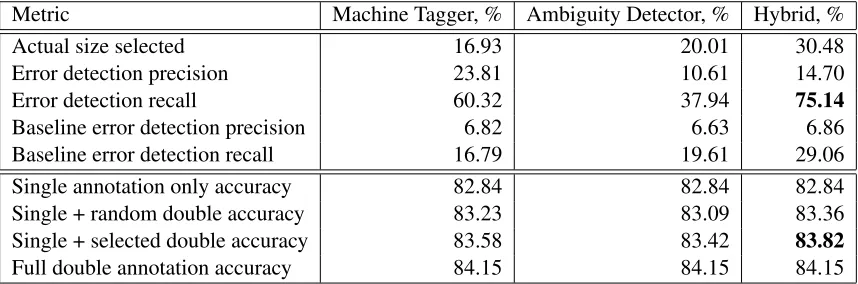
In this experiment we evaluate how well the three algorithms detect the errors. We split the data for each word into 90% and 10% parts as described at the beginning of section 4. We relabel the 90% part with the labels assigned by the first tagger and use it as a pool in which we detect the errors. We pass the pool to each algorithm and compute the precision and recall of errors in the data the algorithm returns. We also measure the random baseline performance by drawing the same number of examples randomly and computing the precision and recall. The results are in the top portion of Table 3.
Consider the second column, which shows the performance of the machine tagger algorithm. The algorithm identified as errors 16.93% of the total number of examples that we passed to it. These se-lected examples contained 60.32% of the total num-ber of errors found in the data. Of the selected ex-amples, 23.81% were in fact errors. By drawing the same number of examples (16.93%) randomly we recall only 16.79% of the single annotation errors. The share of errors in the randomly drawn examples is 6.82%. Thus, the machine tagger outperforms the random baseline both with respect to precision and recall.
The ambiguity detector algorithm selected 20% of the examples with the highest value of the prediction
2Random sampling is often used as a baseline in the active
learning literature (Settles, 2009; Olsson, 2009).
margin and beat the random baseline both with re-spect to precision and recall. The hybrid algorithm also beat the random baselines. It recalled 75% of errors but at the expense of selecting a larger set of examples, 30.48%. This is the case because it selects both the data selected by the machine tagger and the ambiguity detector. The size selected, 30.48%, is smaller than the sum, 16.93% + 20.01%, because there is some overlap between the instances selected by the first two algorithms.
4.6 Model Performance
In this experiment we investigate whether double annotating and adjudicating selected instances im-proves the accuracy of the models. We use the same pool/test split (90%-10%) as was used in the previ-ous experiment. The results are in the bottom por-tion of Table 3.
Let us first validate empirically an assumption this paper makes: we have been assuming that full dou-ble annotation is justified because it helps to correct the errors the first annotator made, which in turn leads to a better performance. If this assumption does not hold, our task is pointless. In general re-peated labeling does not always lead to better per-formance (Sheng et al., 2008), but it does in our case. We train a model using only the single an-notated data and test it. We then train a model using the double annotated and adjudicated version of the same data and evaluate its performance.
As expected, the models trained on fully double annotated data perform better. The performance of the fully double annotated data, 84.15%, is the ceil-ing performance we can expect to obtain if we detect all the errors made by the first annotator. The perfor-mance of the single annotated data, 82.84%, is the hard baseline. Thus, double annotating is beneficial, especially if one can avoid double annotating every-thing by identifying the single annotated instances where an error is suspected.
Metric Machine Tagger, % Ambiguity Detector, % Hybrid, %
Actual size selected 16.93 20.01 30.48
Error detection precision 23.81 10.61 14.70
Error detection recall 60.32 37.94 75.14
Baseline error detection precision 6.82 6.63 6.86
Baseline error detection recall 16.79 19.61 29.06
Single annotation only accuracy 82.84 82.84 82.84
Single + random double accuracy 83.23 83.09 83.36
Single + selected double accuracy 83.58 83.42 83.82
[image:7.612.92.521.60.202.2]Full double annotation accuracy 84.15 84.15 84.15
Table 3: Results of performance evaluation. Error detection performance is shown at the top part of the table. Model performance is shown at the bottom.
algorithms (p <0.05).
Even though the accuracy gains over the random baseline are modest in absolute terms, the reader should keep in mind that the maximum possible ac-curacy gain is 84.15% - 82.84% = 1.31% (when all the data is double annotated). The hybrid algorithm came closer to the target accuracy than the other two algorithms because of a higher recall of errors, 75.14%, but at the expense of selecting almost twice as much data as, for example, the machine tagger algorithm.
4.7 Reaching Double Annotation Accuracy
The hybrid algorithm performed better than the baselines but it still fell short of reaching the accu-racy our system achieves when trained on fully dou-ble annotated data. However, we have a simple way of increasing the recall of error detection. One way to do it is by increasing the number of instances with the smallest prediction margin the ambiguity detec-tor algorithm selects, which in turn will increase the recall of the hybrid algorithm. In this series of exper-iments we measure the performance of the hybrid al-gorithm at various settings of the selection size. The goal is to keep increasing the recall of errors until the performance is close to the double annotation accu-racy.
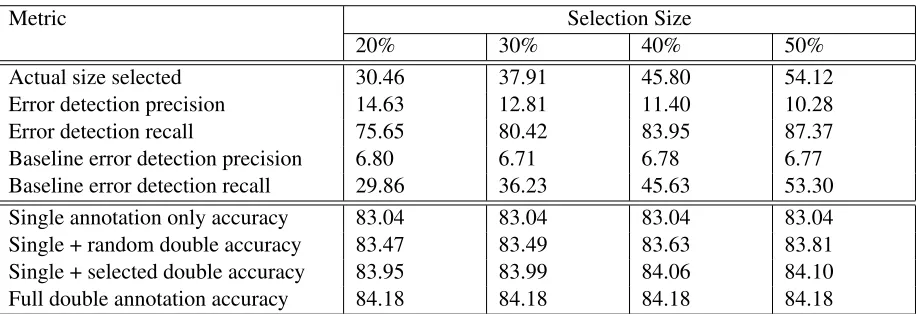
Again, we split the data for each word into 90% and 10% parts. We relabel the 90% part with the labels assigned by the first tagger and pass it to the hybrid algorithm. We vary the selection size setting between 20% and 50%. At each setting, we com-pute the precision and recall of errors in the data
the algorithm returns as well as in the random base-line. We also measure the performance of the mod-els trained on on the single annotated data with its randomly and algorithm-selected subsets double an-notated. The results are in Table 4.
As we see at the top portion of the Table 4, as we select more and more examples with a small predic-tion margin, the recall of errors grows. For exam-ple, at the 30% setting, the hybrid algorithm selects 37.91% of the total number of single annotated ex-amples, which contain 80.42% of all errors in the single annotated data (more than twice as much as the random baseline).
As can be seen at the bottom portion of the Ta-ble 4, with increased recall of errors, the accuracy on the test set also grows and nears the double an-notation accuracy. At the 40% setting, the algorithm selects 45.80% of the single annotated instances and the accuracy with these instances double annotated reaches 84.06% which is not statistically different (p <0.05) from the double annotation accuracy.
5 Discussion and Conclusion
al-Metric Selection Size
20% 30% 40% 50%
Actual size selected 30.46 37.91 45.80 54.12
Error detection precision 14.63 12.81 11.40 10.28
Error detection recall 75.65 80.42 83.95 87.37
Baseline error detection precision 6.80 6.71 6.78 6.77
Baseline error detection recall 29.86 36.23 45.63 53.30
Single annotation only accuracy 83.04 83.04 83.04 83.04
Single + random double accuracy 83.47 83.49 83.63 83.81
Single + selected double accuracy 83.95 83.99 84.06 84.10
[image:8.612.78.538.58.215.2]Full double annotation accuracy 84.18 84.18 84.18 84.18
Table 4: Performance at various sizes of selected data.
gorithms outperformed the random sampling base-line both with respect to error recall and model per-formance.
By progressively increasing the recall of errors, we showed that the hybrid algorithm can be used to replacefulldouble annotation. The hybrid algo-rithm reached accuracy that is not statistically dif-ferent from the full double annotation accuracy with approximately 46% of data double annotated. Thus, it can potentially save 54% of the second pass of an-notation effort without sacrificing performance.
While we evaluated the proposed algorithms only on word sense data, the evaluation was performed using 200 distinct word type datasets. These words each have contextual features that are essentially unique to that word type and consequently, 200 distinct classifiers, one per word type, are trained. Hence, these could loosely be considered 200 dis-tinct annotation and classification tasks. Thus, it is likely that the proposed algorithms will be widely applicable whenever a second round of annotation is being contemplated to improve the quality of the data.
6 Future Work
Toward the same goal of reducing the cost of the sec-ond round of double annotation, we will explore sev-eral research directions. We will investigate the util-ity of more complex error detection algorithms such as the ones described in (Eskin, 2000) and (Naka-gawa and Matsumoto, 2002). Currently our algo-rithms select the instances to be double annotated in one batch. However it is possible to frame the
selection more like batch active learning, where the next batch is selected only after the previous one is annotated, which may result in further reductions in annotation costs.
Acknowledgements
We gratefully acknowledge the support of the Na-tional Science Foundation Grant NSF-0715078, Consistent Criteria for Word Sense Disambiguation, and the GALE program of the Defense Advanced Research Projects Agency, Contract No. HR0011-06-C-0022, a subcontract from the BBN-AGILE Team. Any opinions, findings, and conclusions or recommendations expressed in this material are those of the authors and do not necessarily reflect the views of the National Science Foundation.
References
Steven Abney, Robert E. Schapire, and Yoram Singer. 1999. Boosting applied to tagging and pp attachment. In Proceedings of the Joint SIGDAT Conference on Empirical Methods in Natural Language Processing and Very Large Corpora, pages 38–45.
Chih-Chung Chang and Chih-Jen Lin, 2001. LIBSVM: a library for support vector machines.
Jinying Chen, Andrew Schein, Lyle Ungar, and Martha Palmer. 2006. An empirical study of the behavior of active learning for word sense disambiguation. In
Markus Dickinson. 2009. Correcting dependency anno-tation errors. InEACL ’09: Proceedings of the 12th Conference of the European Chapter of the Associ-ation for ComputAssoci-ational Linguistics, pages 193–201, Morristown, NJ, USA. Association for Computational Linguistics.
Dmitriy Dligach and Martha Palmer. 2008. Novel se-mantic features for verb sense disambiguation. In
HLT ’08: Proceedings of the 46th Annual Meeting of the Association for Computational Linguistics on Human Language Technologies, pages 29–32, Morris-town, NJ, USA. Association for Computational Lin-guistics.
Eleazar Eskin. 2000. Detecting errors within a corpus using anomaly detection. In Proceedings of the 1st North American chapter of the Association for Com-putational Linguistics conference, pages 148–153, San Francisco, CA, USA. Morgan Kaufmann Publishers Inc.
Fumiyo Fukumoto and Yoshimi Suzuki. 2004. Correct-ing category errors in text classification. InCOLING ’04: Proceedings of the 20th international conference on Computational Linguistics, page 868, Morristown, NJ, USA. Association for Computational Linguistics. Eduard Hovy, Mitchell Marcus, Martha Palmer, Lance
Ramshaw, and Ralph Weischedel. 2006. Ontonotes: the 90% solution. In NAACL ’06: Proceedings of the Human Language Technology Conference of the NAACL, Companion Volume: Short Papers on XX, pages 57–60, Morristown, NJ, USA. Association for Computational Linguistics.
Pei-Yun Hsueh, Prem Melville, and Vikas Sindhwani. 2009. Data quality from crowdsourcing: a study of annotation selection criteria. InHLT ’09: Proceedings of the NAACL HLT 2009 Workshop on Active Learning for Natural Language Processing, pages 27–35, Mor-ristown, NJ, USA. Association for Computational Lin-guistics.
Pavel Kvˇetoˇn and Karel Oliva. 2002. (semi-)automatic detection of errors in pos-tagged corpora. In Proceed-ings of the 19th international conference on Compu-tational linguistics, pages 1–7, Morristown, NJ, USA. Association for Computational Linguistics.
Zhang Le, 2004. Maximum Entropy Modeling Toolkit for Python and C++.
David D. Lewis and William A. Gale. 1994. A sequential algorithm for training text classifiers. In SIGIR ’94: Proceedings of the 17th annual international ACM SI-GIR conference on Research and development in in-formation retrieval, pages 3–12, New York, NY, USA. Springer-Verlag New York, Inc.
Dingsheng Luo, Xinhao Wang, Xihong Wu, and Huisheng Chi. 2005. Learning outliers to refine a
cor-pus for chinese webpage categorization. InICNC (1), pages 167–178.
Mitchell P. Marcus, Mary Ann Marcinkiewicz, and Beat-rice Santorini. 1993. Building a large annotated cor-pus of english: the penn treebank. Comput. Linguist., 19(2):313–330.
Tetsuji Nakagawa and Yuji Matsumoto. 2002. Detect-ing errors in corpora usDetect-ing support vector machines. In Proceedings of the 19th international conference on Computational linguistics, pages 1–7, Morristown, NJ, USA. Association for Computational Linguistics. V´aclav Nov´ak and Magda Raz´ımov´a. 2009.
Unsu-pervised detection of annotation inconsistencies using apriori algorithm. InACL-IJCNLP ’09: Proceedings of the Third Linguistic Annotation Workshop, pages 138–141, Morristown, NJ, USA. Association for Com-putational Linguistics.
Fredrik Olsson. 2009. A literature survey of active machine learning in the context of natural language processing. InTechnical Report, Swedish Institute of Computer Science.
John C. Platt and John C. Platt. 1999. Probabilistic out-puts for support vector machines and comparisons to regularized likelihood methods. InAdvances in Large Margin Classifiers, pages 61–74. MIT Press.
Burr Settles. 2009. Active learning literature survey. In
Computer Sciences Technical Report 1648 University of Wisconsin-Madison.
Victor S. Sheng, Foster Provost, and Panagiotis G. Ipeiro-tis. 2008. Get another label? improving data qual-ity and data mining using multiple, noisy labelers. In
KDD ’08: Proceeding of the 14th ACM SIGKDD in-ternational conference on Knowledge discovery and data mining, pages 614–622, New York, NY, USA. ACM.
Rion Snow, Brendan O’Connor, Daniel Jurafsky, and An-drew Y. Ng. 2008. Cheap and fast—but is it good?: evaluating non-expert annotations for natural language tasks. InEMNLP ’08: Proceedings of the Conference on Empirical Methods in Natural Language Process-ing, pages 254–263, Morristown, NJ, USA. Associa-tion for ComputaAssocia-tional Linguistics.
Hans van Halteren. 2000. The detection of inconsistency in manually tagged text. InProceedings of LINC-00, Luxembourg.
Z. Zhong, H.T. Ng, and Y.S. Chan. 2008. Word sense disambiguation using OntoNotes: An empirical study. InProceedings of the Conference on Empirical Meth-ods in Natural Language Processing, pages 1002– 1010. Association for Computational Linguistics. Jingbo Zhu. 2007. Active learning for word sense