Munich Personal RePEc Archive
On the Selection of Common Factors for
Macroeconomic Forecasting
Giovannelli, Alessandro and Proietti, Tommaso
30 November 2014
Online at
https://mpra.ub.uni-muenchen.de/60673/
On the Selection of Common Factors for
Macroeconomic Forecasting
Alessandro Giovannelli
Universit`a di Roma “Tor Vergata”
Tommaso Proietti
Universit`a di Roma “Tor Vergata” and CREATES
Abstract
We address the problem of selecting the common factors that are relevant for forecasting macroeconomic variables. In economic forecasting using diffusion indexes the factors are or-dered, according to their importance, in terms of relative variability, and are the same for each variable to predict, i.e. the process of selecting the factors is not supervised by the predictand. We propose a simple and operational supervised method, based on selecting the factors on the basis of their significance in the regression of the predictand on the predictors. Given a potentially large number of predictors, we consider linear transformations obtained by prin-cipal components analysis. The orthogonality of the components implies that the standard
t-statistics for the inclusion of a particular component are independent, and thus applying a se-lection procedure that takes into account the multiplicity of the hypotheses tests is both correct and computationally feasible. We focus on three main multiple testing procedures: Holm’s sequential method, controlling the family wise error rate, the Benjamini-Hochberg method, controlling the false discovery rate, and a procedure for incorporating prior information on the ordering of the components, based on weighting thep-values according to the eigenval-ues associated to the components. We compare the empirical performances of these methods with the classical diffusion index (DI) approach proposed by Stock and Watson, conducting a pseudo-real time forecasting exercise, assessing the predictions of 8 macroeconomic variables using factors extracted from an U.S. dataset consisting of 121 quarterly time series. The over-all conclusion is that nature is tricky, but essentiover-ally benign: the information that is relevant for prediction is effectively condensed by the first few factors. However, variable selection, lead-ing to exclude some of the low order principal components, can lead to a sizable improvement in forecasting in specific cases. Only in one instance, real personal income, we were able to detect a significant contribution from high order components.
Keywords: Variable selection; Multiple testing;p-value weighting.
1
Introduction
The focus of much recent theoretical and applied econometric research has concentrated on the ability to predict key macroeconomic variables, such as output and inflation, using a large number of potential predictors, with little or no a priori guidance over their relevance. This theme, which developed contextually to the statistical and machine learning literature on data mining and discov-ery, has received a very distinctive solution, hinging upon the idea that the wealth of information on macroeconomic variables can be distilled by a limited number of common factors.
The common factors capture the comovements among the economic variables and can be con-sistently estimated by principal components analysis (PCA), as in the static factorial approach proposed by Stock and Watson (2002a), or by dynamic principal components analysis, using fre-quency domain methods, as proposed by Forni et al. (2005). Quoting from Stock and Watson (2006), the availability of a factor structure and of closed form inferences has turned the high dimensionality of the information set from a curse to a blessing.
Once the factors are extracted, they can be used for forecasting the variables of interest, by aug-menting an observation driven model, such as an autoregression, by the estimated factors. This ap-proach, known as the diffusion index (DI), or factor augmented autoregressive (FAR), forecasting methodology, has become mainstream, owing its success to the ability to incorporate information carried by a large number of potential predictors in a simple and parsimonious way. Applied eco-nomic forecasting has shown that the consideration of the factors as potential predictors has proved successful in macroeconomic forecasting using large datasets; it would be impossible to provide a list of references that could be representative of the research carried out in this field. The reviews in Stock and Watson (2006), Breitung and Eickmeier (2006) and Stock and Watson (2010), as well as Ng (2013), provide ample coverage of the main issues.
As it is well known, the principal components, arising from the spectral decomposition of the sample covariance matrix of the predictors, are ranked according to the size of the corresponding eigenvalue. The current forecasting practice selects the first components according to an infor-mation criterion, such as Bai and Ng (2002) and Onatski (2010), and uses them as explanatory variable in the forecasting model en lieu of the original predictors. A potential limitation of this procedure is that the selection of factors is blind on the predictive ability of the principal com-ponents, as no consideration is given to their relationship with the predictand by the information criteria commonly used.
The selection of the factors that are relevant for the prediction of macroeconomic variables has attracted a lot of interest and several solutions have been proposed in the literature for supervising the factors, taking into account their ability to predict a specific dependent variable. Bai and Ng (2008) propose distilling the factors, referred to as “targeted predictors”, by performing a PCA on a subset of the original predictors, that are selected according to the strength of the relationship with the variable to be predicted in a marginal regression framework. This is an instance of the method of supervised PCA Bair et al. (2006), aiming at finding linear combinations of the predictors that have high correlation with the outcome. Bai and Ng (2009) considered bootstrap aggregation of the predictions arising from a FAR framework, that retains only the significant factors. A compre-hensive review of variable selection in predictive regression is Ng (2013).
The research question addressed by this paper is whether many predictors can be replaced by a reduced number of principal components selected according to the strength of the relationship with the predictand, and whether components beyond the firsts carry useful information for improving the predictive ability. We propose a simple and operational supervised method based on selecting the factors on the basis of their significance in the regression of the predictand on the predictors. Given a potentially large number of predictors, we consider linear transformations obtained by principal components analysis. The orthogonality of the components implies that the standard
t statistics for the inclusion of a particular component in the multiple regression framework are independent, and thus applying a multiple testing procedure to select the components that are significant at a particular level is both correct and computationally feasible.
The selection of the principal components can be seen as a decision problem involving multiple-testing, where a single null hypothesis claims that a specific component ought to be excluded from the model. There are several multiple testing procedures available that focus on controlling some type of error rate, namely the familywise error rate, such as the Bonferroni and Holm (1979) proce-dure, or the false discovery rate, which is the expected proportion of wrong rejections. Among the procedures controlling for the false discovery rate, we focus on the Benjamini-Hochberg procedure (see Benjamini and Hochberg (1995)) and on a weighted procedure that allows to incorporate prior information about the ordering of the components; see Genovese et al. (2006).
In summary, our methodology has three steps:
1. Orthogonalise the originalN predictors by computing theN standardised PCs.
2. Selectr principal components on the basis of their correlation with the predictand, taking into account the multiplicity of the testing problem and controlling for the error rate of the selection procedure.
3. Use the selected components in a factor augmented autoregressive predictive regression.
We validate our procedure using a dataset consisting of 121 quarterly U.S. macroeconomic time series observed from 1959-I to 2011-II. A pseudo real-time rolling forecast experiment is conducted to compare the performance of our selection method to that of a benchmark autoregres-sive predictor, with order selected by an information criterion, and to the standard DI forecasts based on the first five components.
The paper is structured as follows. In section 2 we provide a brief review of the diffusion index methodology. Section 3 considers the issue of estimating supervised factors and reviews the main solutions available in the literature. In section 4 we present principal components regression as a shrinkage methods and discuss the issues posed by the selection of the components and the consequences in terms of forecasting accuracy. Section 5 exposes our supervised method using a multiple testing approach to the selection of the principal components in the FAR predictor.
2
Forecasting using principal components
LetXt = (X1t, . . . , XN t)′denote anN×1vector of predictors observed at timest= 1, . . . T, and
letyt(+h)h denote the predictand, whereh >0is the forecast lead, andydenotes a transformation of the original variableY, which depends on its order of integration.
The Diffusion Index (DI) forecasting methodology, originally proposed by Stock and Watson (2002), provides a simple and parsimonious way of incorporating a highly dimensional information set; it is based on the assumption that the predictors have an approximate factor structure, such that the unobserved factors can be estimated consistently by principal component analysis (PCA). The factor model is formulated as follows:
Xt = ΛFt+ξt, (1)
whereFt= (F1t, . . . , Frt)withr < N are the unobserved common factors,Λis then×rmatrix
of factor loadings andξtis the idiosyncratic disturbance not explained by the factors.
LettingS =T−1P
tXtXt′and denoting the spectral decomposition of the covariance matrix by
S =V D2V′, whereV = (v1, . . . , v
N)is the(N ×N)matrix of eigenvectors,V′V =V V′ =IN,
and D = diag(d1, . . . , dN) is the matrix containing the square root of the ordered eigenvalues,
d1 ≥d2 ≥ · · · ≥dN, as in Stock and Watson (2002a), the common factorsFtare estimated by the
firstrstandardised principal components
ˆ
Ft=Dr−1/2Vr′Xt, (2)
whereDr =diag(d1, . . . , dr)andVr = (v1, . . . , vr).
We assume that we are interested in predicting a variableyt(which may as well be included in
the setXt) at the at horizonh > 0, by using all the information contained in Xt. For instance, if
we are interested in forecasting quarterly industrial production, denotedYt, h quarters ahead, we
set yt(+h)h = 400(lnYt−lnYt−1), which assumes that lnyt is difference stationary. In predicting
factor augmented autoregressive (FAR) model:
yt(+h)h =µ+
p
X
j=1
φ(jh)yt−j+1+
r
X
k=1
βk(h)Fˆkt+εt+h, (3)
whereεt+his the forecasting error with varianceσ2.
The DI forecasts are obtained according to a two step procedure: in the first stepr factors are extracted from the set of predictors by performing a PCA and selecting the number of common factors according to information criteria proposed by Bai and Ng (2002), such as
ICp1(r) = lnV(r) +r
N +T N T
ln
N T N +T
,
ICp2(r) = lnV(r) +r
N +T N T
ln min{N, T},
where V(r) = N T1 PT
t=1(Xt −ΛˆrFˆt)′(Xt−ΛˆrFˆt),Λ =ˆ VrD
1/2
r . Bai and Ng (2002) show that
the value ofrthat minimizesICp1(r)orICp1(r)is a consistent estimator, forN, T → ∞, of the
number of common factors. In the second step, the estimated factors are used as predictors in (3). As shown in Bai and Ng (2006), we can treatFˆtas observed regressors.
Since the factors are selected according to an information criterion that operates on the eigen-structure of Xt, then the method is unsupervised. The selection methodology assumes that the
factors are ordered according to the size of the corresponding eigenvalue. However, there is no reason why a predictand should not depend on a higher order component or different predictand, such as output and inflation, should depend on the same factors.
3
Approaches to the supervision of the factors
Several proposals have been made for supervising the factors, so that the selected factors carry information that is useful for predicting the specific variable under consideration. In this section we sketch a brief survey of the literature, ignoring the shrinkage and model averaging approaches that are applied directly to the observable predictors, rather than the principal components. For an account of these approaches, see De Mol et al. (2008), Bai and Ng (2008) and Stock and Watson (2006).
In the supervised PC method proposed by Bair et al. (2006) a subset of predictors is first selected on the basis of their correlation with the response variable; more specifically all the predictors for which the estimated regression coefficients are larger than a thresholdcare considered
√ T P
tXity(t+h)h
P
tXit2
> c, i= 1,2, . . . , N,
to be used for prediction. The method clearly depends on the thresholdc, which is estimated by cross-validation.
Bai and Ng (2008) construct supervised principal components, that they nametargeted predic-tors, by pre-selecting a subset of predictors with predictive power for a specific predictand, and conducting a PCA on those. They explore hard thresholding rules constructed on thet-statistics of the regression of y(yh+)h on a single predictor Xit (after controlling for a set of predetermined
variables, such as the lags of the dependent variables), sayt∗
i, selecting those variables for which
|t∗
i| > c, calternatively being equal to 1.28, 1.65 and 2.58. Their selection rule does not consider
the issue of multiple testing. In page 306 they state however that application of Holm’s procedure (see section 5) did not lead to different results. Other soft thresholding methods are considered, such as the lasso, least angle regression, and the elastic net are considered and compared. The pa-per concludes that targeting the predictors to the economic variable to be predicted, they consider inflation in particular, leads to a gain in forecasting accuracy.
Bai and Ng (2009) proposed componentwise and block-wise boosting algorithms for isolating the predictors in FAR models that are most helpful in predicting a variable of interest. The algo-rithms do not rely on the ordering of the variables (and in the componentwise case do not rely on the ordering of their lags). Starting from the null model including only a constant, the algorithms perform incremental forward stagewise fitting of the mean square prediction error, by a sequence of Newton-Raphson iterations that iteratively improve the fit. At each step, a single explanatory variable (e.g. a PC), or a block consisting of a regressor and its lags, is fitted by ordinary least squares regression, and selected according to the reduction in the residual sum of squares. The se-lected variable contributes to the current predictor with a coefficient which is shrunk towards zero by a fraction known as the learning rate. The algorithm is iterated until a stopping rule is found. Bai and Ng (2009) propose an information criterion for selecting the number of boosting iterations that takes into account the estimation error in the estimation of the factors, which isO(N−1).
Inoue and Kilian (2008) present an application of bootstrap aggregation (bagging) of predictors of U.S. inflation usingN = 30variables. Among the predictors, they consider selecting by pretest-ing the PCs among the firstK, whereK ranges from 1 to 8. Several critical values for selection pretest are considered. Stock and Watson (2012b) and Kim and Swanson (2014) also consider averaging the FAR predictors obtained from independent bootstrap samples with factors selected according to the rule that their (robust)t-statistic must be larger than 1.96 in modulus.
Fuentes et al. (2014) propose the use of sparse partial least squares to select a small subset of supervised factors, extending to a dynamic setting the static methodology of Chun and Keles¸ (2010). The candidate factors arise from the spectral decomposition of the matrixT−1X˜′yy′X˜,
wherey has generic elementy(t+h)h and X is a matrix with rows composed of the elements of X′
t,
augmented by the lags of the predictand. The loadings are shrunk towards zero by a LASSO type penalty, aiming at the extraction of sparse supervised components.
Finally, an important class of supervision methods is based on inverse regression. Let (y, X)
denote the observable predictand and predictors and let f(y, X) denote their joint density. DI forecasting starts from the factorizationf(y, X) = f(y|X)f(X), assuming a factor structure for
f(X|y)f(y), using the first conditional density for obtaining a reduced set of predictors incorpo-rating information concerning y, achieving a substantial dimensionality reduction. The reduced set is then used in the prediction of y, according to a maintained model for f(y|X). One such methodology is sliced inverse regression (SIR, Li (1991)): the range ofyis partitioned into slices, within which the centroids of theX’s are computed; a singular value decomposition of the matrix of centroids is performed to obtain a few effective dimension-reduction directions. The method of principal fitted components (PFC) analysis, proposed by Cook (2007) and Cook and Forzani (2008), is based on inverse regression ofXonyto obtain a dimension reduction that preserves the information that is relevant for predictingy; in Cook (2007) the conditional meanE(X|Y = y)
is estimated by projecting theX’s on polinomial terms inyand a principal component analysis is conducted on the conditional mean estimates to obtain the PCFs.
4
Principal components regression and components selection
as shrinkage methods
Our approach is a particular case of the generalised shrinkage model considered in Stock and Watson (2012b). In the sequel we will assume that the forecasting model does not contain lags of the predictand and that the DI predictor results exclusively from principal component regression. In particular, the data are generated as
yt(+h)h =x′tδ+ǫt+h,
whereǫt+h has mean zero and Var(ǫt+h) = σ2. We also assume thatT observations are available
foryt+h, t = 1, . . . , T), and focus on the predictor
ˆ
y(t+h)h|t=
N
X
i=1
ψiβˆiFˆit, (4)
whereFˆt =D−1/2Λ′Xt, denotes theN ×1vector containing the standardised PC scoresFˆit, i =
1, . . . , N, such that T1 P
tFˆtFˆt′ =I, ordered according to the eigenvalues of the matrixS.
More-over,βˆi = T1 PtFityt+h,is the least squares estimator of the regression coefficient ofyon thei-th
PC, andψi is the indicator for the inclusion of thei-th PC. The decision whether to include it or
not depends on the strength of the relationship with the predictand and will be discussed shortly. AsFˆit =x′tvi/di, whered2i is thei-th eigenvalue ofSandviis the corresponding eigenvector,
the predictor (4) can be writtenyˆ(t+h)h|t=x′
tδˆ, for
ˆ δ = N X i=1 vi di ˆ
βi,
The lack of supervision of the ordering of the components, see cautionary note 2 in Hadi and Ling (1998), can be evidenced by a plot of d2
i, the i-th eigenvalue, versus the increase of the
regression residual sum of squares arising from the deletion of thei-th component, measured by
Tβˆ2
i =T−1
P
tFˆity
(h)
t+h
2 .
The mean square error (MSE) of the above predictor, treating the factors as observed variables, is
MSE(ˆyt(+h)h|t) = [B(ˆyt(+h)h|t)]2+Var(ˆyt(+h)h|t),
where the bias and the variance are given respectively by
B(ˆy(t+h)h|t) =
N
X
i=1
(1−ψi) ˆFitdivi′δ, Var(ˆy
(h)
t+h|t) = σ
2 1 + 1 T
X
i
ψiFˆit2
!
.
These simple expressions underlie the usual bias-variance trade-off: removing one factor from the set of predictors (i.e. settingψi = 0) reduces the variance, but increases the bias. The bias term
features the singular value di, which implies that the bias increase is potentially larger if cœteris
paribus a component with highdi is removed. The bias resulting from the omission of a particular
PC further depends onv′
iδ; this term depends on the population relationship betweenyand thex’s
and on the loadings of thei-th PC1. The main message, conveyed by the above expression for the
MSE is that omitting a PC loading heavily on important variables ((v′
iδ)2 is large) will have more
impact if the PC corresponds to a large eigenvalue. Note also that Var(ˆyt+h|t)depends solely onσ2
and the Mahalanobis squared distance ofxT from 0 in thexspace,x′T (
P
tXtXt′)
−1
xT =PiFˆit2;
recalling thatFˆit =x′Tvi/di, the variance will be inflated by the presence of components with small
di and for which the inner productx′Tvi is large. The broad conclusion arising from this analysis
is that discarding the first PCs is not in general a good idea, and the ordering of the components should be taken seriously. We see this simple result as a possible explanation for the failure of alternative shrinkage methods to outperform the DI approach documented in Stock and Watson (2012b).
In principle, we could determine the optimal set of indicators {ψi, i = 1, . . . , N}, which
min-imises the above MSE of prediction, e.g. parameterising
ψi =ψi( ˆβi;γ, c) =
1
1 + exp[−γ(|βˆi| −ci)]
,
1Omitting a component loading onxvariables with no effect on the predictand makes a zero contribution to the
where e.g. ci =c/di for an unknown positive constantc, and thinking about replacingδ andσ by
some estimate, perhaps iteratively. Stock and Watson (2012b) estimateci =cby cross-validation
and setγ → ∞. Hwang and Nettleton (2003) propose a general approach to the problem. We do not pursue this here and consider strategies such that ψi is the indicator function that the p-value
of the significance test for thei-th regression coefficient is below a given threshold.
Before exposing our methodology, it is perhaps useful to remark that PCR conducted using only the firstr principal components, chosen according to an information criterion, poses ψi =
I(i ≤r). Another popular regularisation method, ridge regression, yields the predictor (4) where the shrinkage factor ψi vary with i: letting ρ ≥ 0denote the penalty parameter in the criterion
S(ρ, δ) =P
t(yt+h −xt′δ)2+ρδ′δ, then
ψi =
d2
i
d2
i +ρ
.
See Hastie et al. (2009) for a general reference and discussion.
5
The selection of the common factors as a multiple testing
problem
Consider the set of null hypothesesH0i :βi = 0, i= 1, . . . , N, in the predictive regression model,
yt(+h)h =PN
i=1βiFˆit+ǫt, and letpidenote the two-sidedp-value, based on thet-statistictiassociated
to thei- th principal components regression coefficient,
ti =
√
Tβˆi
ˆ
σ. (5)
An issue is posed by the estimation of the regression standard errorσbyσˆin the denominator. The usual estimator, the square root of
ˆ
σ2 = RSS
T −N, RSS =
X
t
yt(+h)2h −T X
i
ˆ
βi2,
is either infeasible, ifN ≥T, or severely downward biased due to the overfitting whenN is large. We address the issue of estimatingσ in subsection 5.1.
The testing strategy based on the ti statistics is multivariate, i.e. it treats all the remaining
variables as nuisance parameters, when testing for the significance of a particular effect. An alter-native strategy, that avoids estimation ofσ, is componentwise, being based on the marginal linear regressiont∗
i statistics,
t∗i =
s
T(T −1)
RSSi
ˆ
βi, RSSi =
X
t
The twot-statistics are related by
ti =t∗i
s
RSSi/(T −1)
RSS/(T −N),
i.e. the univariate t∗
i is multiplied by the root mean square ratio. The componentwise approach
is fairly popular in genomics and in hyper-dimensional contexts such that N > T. It has been adopted by Bai and Ng (2008) for estimating the targeted predictors.
ForT large, the null distribution of the statistic isti ∼ N(0,1), and the p-value is computed as
pi = 2(1−Φ(|ti|)). Here, in fact, the alternative is two-sided, that is H1i : βi 6= 0, i = 1, . . . N.
Let us consider the re-ordering of the components according to the nonincreasing values of |ti|,
and let us denote by Fˆ(i),t the (i)-th component in the new ordering. The corresponding ordered
p-values will be denoted by
p(1) ≤p(2) ≤ · · · ≤p(i)≤ · · · ≤p(K).
The inclusion of a thei-th PC is based on a multiple testing procedure, which provides a decision rule aiming at controlling overall error rates when performing simultaneous hypotheses tests. The procedures can be distinguished according to the error that is controlled. For this purpose, consider the following confusion matrix:
Decision
Actual Accept Reject Total
H0i :βi = 0 T N F P N0
H1i :βi 6= 0 F N T P N1
Total A R N
R = F P +T P is the total number of hypotheses rejected; F P is the number of false rejections (Type I errors(, i.e. of falsely rejected hypothesis. There areN0 true nulls andN1 false nulls. T N
in the number of correctly accepted true nulls, etc. F N is the number of false positive decisions, i.e. type II errors andT P (true positives) is the number of correct rejections.
The per comparison error rate (PCER) approach controls for the expected number of trueH0i
rejected overN, the total number of tests,
PCER= E(F P)
N .
It amounts to ignoring the multiplicity problem altogether, and uses the critical value correspond-ing to a preselected significance levelα, and thus rejects all hypotheses for which pi < α. This
guarantees thatα is an upper bound for PCER, as when N0 = N (all null hypotheses are true) E(F P) = αN.
The problem with this approach is that the probability of a false rejection increases rapidly with
N; in particular, ifN0 = N, P(R ≥ 1) = 1−(1−α)N. This has led to developing multiple
a given level. Definining the family wise error rate (FWER) as the probability of rejecting any true H0i, FWER = P(F P ≥ 1), the aim is defining decision rules guaranteeing FWER ≤ α.
The simplest procedure controlling the FWER is the Bonferroni rule, rejecting allH0i for which
pi < Nα. However, the power of this rule is typically very low, whenN > N0is large.
A more powerful method for controlling the FWER at levelαis due to Holm (1979). Holm’s method is a step-down procedure rejecting the(i)-th null hypothesisH0,(i)if
p(j) ≤ α
N −j+ 1, j = 1,2, . . . , i.
Note thatp(1) ≤ α/N and p(N) ≤ α, so that at the initial step we apply Bonferroni’s rule, while
at the final step we get the PCER approach. Thus, ifp(1) > α/N, all nulls are accepted and the procedure stops. Else, we rejectH0,(1) and test the remaining hypotheses at level α/(N −1). In
such case, we accept all H0,(i),(i) > 1 if p(2) > α/(N −1), else we reject H0,(2) and test the
remaining hypotheses at level α/(N −2), in which case we iterate the procedure, until all the remaining hypotheses are accepted.
Procedures that control for the FWER have unduly conservative whenN is very large, despite the improvements offered by step-down procedures such as Holm’s. A less conservative approach is offered by procedures that control for the false discovery rate (FDR), which is the expected proportion of falsely rejected nulls:
FDR=E
F P R
.
The main procedure is due to Benjamini and Hochberg (BH, Benjamini and Hochberg (1995)). Letαdenote a control rate in the range (0,1). A decision rule that has FDR=αN0/N ≤αrejects allHo,(i), i= 1, . . . , r, for which
p(i) ≤α i
N, i= 1, . . . , r, p(r+1) > α r+ 1
N .
In high dimensional settings BH has been proved to achieve a better balance between multiplicity control and power. Another advantage is that whenN =N0BH controls also the FWER at levelα. Adaptive variants and refinements are available in the literature that address the issue of correlation in the tests statistics. See Efron (2010) for a review.
As stated in in the introduction, if we can think that nature is benign and that the ordering of the factors carries important information, then the selection should incorporate information on the factor structure. This can be achieved by weighting thep-values,pi, according to the indexiof the
factor. A procedure that allows forp-value weighting and achieves control over the FDR is due to Genovese et al. (2006), and it works as follows:
1. Assign weightswi >0to eachH0iso thatw¯ =N−1Piwi = 1.
3. Apply the BH procedure at levelαtoqi.
A natural choice for the weights in our context is setting wi = d2i; as a matter of fact, if the
predictors are standardised, then S is a correlation matrix with eigenvalues 0 ≤ d2
i ≤ N, and
N−1P
id2i = 1.
5.1
Estimation of
σ
Fan et al. (2012) propose a refitted cross-validatory (RCV) estimator of the error variance which is consistent when the number of factors grows at a faster rate than the number of observations. The procedure has two stages: the sample is split into two independent subsamples. In the first stage variable selection is carried out on the two subsamples by a consistent pretest selection procedure, based on the marginaltstatisticst∗
i, i= 1, . . . , N, yielding two sets of selected variables, denoted
M1 and M2. In the second stage, the two models are estimated on the other subsample (i.e. M1
is estimated on the second andM2 on the first subsample), yielding two estimates, s2
1 and s22, of
the error variance. The RCV estimator is the average of the two. Refitting aims at eliminating the influence of variable that have been spuriously selected in the first stage.
5.2
Controlling for the lags of the dependent variable
So far we have considered the regression of a predictand on the principal components. If lags of the predictand have to be incorporated, as in the FAR approach, the above variable selection procedures are applied to the regression of the residuals of the regression of y(t+h)h on{yt, yt−1, . . . , yt−p} on
the principal components computed on the set {X˜it, i = 1, . . . , N}, whereX˜it is the residual of
the regression ofXiton{yt, yt−1, . . . , yt−p}.
6
Empirical Analysis
6.1
Data and methods
The dataset used in empirical analysis is derived from that employed by Stock and Watson (2012a), and consists of 211 U.S. macroeconomic time series, available at the quarterly observation fre-quency from 1959-I to 2011-II. Of the 211 series, 121 were considered for our empirical analysis2.
The series are all transformed to induce stationarity by taking first or second differences, loga-rithms or first or second differences of logaloga-rithms. The series are grouped into 12 categories; for a complete list of variables and their transformation see the Appendix A.
We consider a transformation yt of the original variable Yt, depending on the order of
inte-gration. Real activity variables are typically integrated of order 1, denoted Yt ∼ I(1); defining
2As in Stock and Watson (2012b), we exclude series at high aggregate level. We decided to exclude also series
yt = ∆ lnYt, the predictand is
yt(+h)h = 400×∆hlnYt+h
h , ∆hlnYt+h = lnYt+h−lnYt,
theh-period growth at an annual rate. For nominal price and wage series we assume Yt ∼ I(2),
and, in accordance to Stock and Watson (2002b), the series to be predicted is
yt(+h)h = 400×
∆hlnYt+h
h −∆1lnYt
.
The predictors are represented by the 121 standardized principal components obtained from the spectral decomposition of the covariance matrix of the original indicators. A heat map of the squared factor loadings for the 121 quarterly series is provided by figure 1. The vertical axis is the series categories reported in A; in the horizontal axis the order of the principal component. The plot evidences that the first factor loads principally on the growth rates of the the indicators of real activity; the second has rather sparse loadings on both real and nominal variables, whereas the third loads eminently on price and wage inflation rates.
The forecasts are obtained using a pseudo real-time forecasting procedure3. The data from
1960:II to 1984:IV are used as a training sample. A PCA on theN standardized indicators is con-ducted to extract the factors, represented by the standardized principal components. The PCA are selected and the estimated regression coefficients are used at time 1984:IV to forecastyˆT(h+)h,h = 1,
2, and4quarters ahead. Then, the estimation sample is updated by one quarterly observations and downdated by removing the initial one, so that the second set of observations ranges from from 1960:III to 1985:I, and so forth. For each rolling window, consisting ofT = 100observations, a PCA is conducted to extract theNcomponents, variable selection is performed and the predictor is formed. The process continues until the end of the sample is reached. In our case the last available data is 2010:II whenh = 4. The experiment delivers around 100 forecasts for each forecasting method, that can be compared with the observed values.
The predictors that are compared are:
• The pure autoregressive (AR) predictor
ˆ
yt(h+)h = ˆφ(1h)yt+· · ·+ ˆφ(ph)yt−p,
where the order is selected according to the Schwarz Information criterion (SIC) and the AR coefficients are estimated by ordinary least squares.
• The dynamic factor model predictor (DFM5)
ˆ
y(t+h)h = ˆβ1(h)F1ˆt+· · ·+ ˆβr(h)Fˆrt,
3As reported in D’Agostino and Giannone (2012), the exercise is pseudo real-time because we use the last vintage
Figure 1: Heat map of the squared factor loadings for the 121 quarterly series as given in table 1. The vertical axis is the series categories as reported in A; the horizontal axis is the order of the principal component.
whereFˆit, i= 1, . . . , r, are the firstr = 5principal components. This number is selected by
the Bai and Ng (2002) criteria and coincides with the factor model benchmark proposed in Stock and Watson (2012b). When lags of the predictand are included, as in (4), the orderp
is that selected for the previous case (AR predictor).
• The supervised factor predictor
ˆ
y(t+h)h = ˆβ1(h)Fˆ(1)t+· · ·+ ˆβr(h)Fˆ(r)t,
withrfactors, ranked according to theirp-values, selected according to
– Holm’s multiple comparison procedure, controlling the FWER at the 5% level;
– The Benjamini-Hochberg procedure, controlling the FDR at the 10% level4;
– The Genovese et al. (2006) procedure with p-values weighted according to the corre-sponding eigenvalue.
If the lags of the predictand are considered, as in the FAR approach, then the factors are selected from the principal components computed on the residuals of the projection of the original predictors on the linear space spanned by the firstplags of the dependent variable.
We consider two implementations of the variable selection procedure, the first based on the marginalt∗
i statistics and the second based on theti statistics computed using the Fan et al.
(2012) estimator of the regression error variance.
The performance of the different methods is evaluated using the mean square forecast error (MSFE), defined as follows: letT0 be the first point in time for out of sample evaluation andT1 be the last point in time for which we compute the MSFE forh = 1,2, and4
M SF E = 1
T1−T0
T1
X
τ=T0
ˆ
y(τh+)h−yτ+h
2
.
The results are presented in terms of mean square error (MSFE) relative to the AR (SIC) benchmark
Rj =
M SF Ej(h)
M SF EAR(h)
wherej ∈ {DFM5,Holm,BH,GRW}. A value below one indicates that the specified method is superior to the AR (SIC) forecast.
6.2
Empirical Results
The rolling forecast experiment was conducted for the following series:
4This is the target value most often considered in applications; see Efron (2010). Controlling the FDR at the 5%
• Industrial Production Index (IPI)
• Total employment: Non farm Payroll (NPE)
• Unemployment Rate (UR)
• Housing Starts (HS)
• Consumer Price Index (CPI)
• Treasury Bill 10-years (TB)
• Real Personal Income (RPI)
• Gross National Product (GNP).
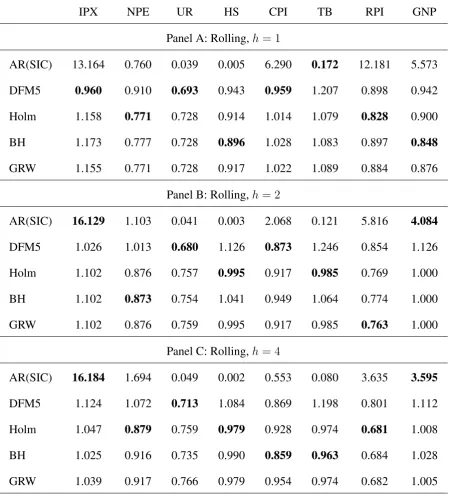
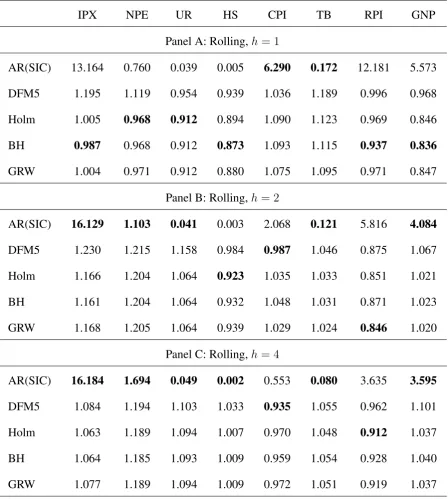
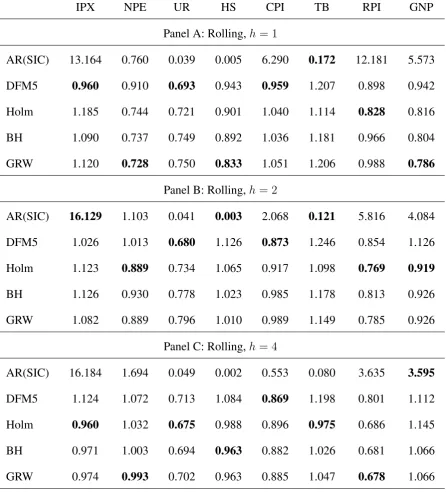
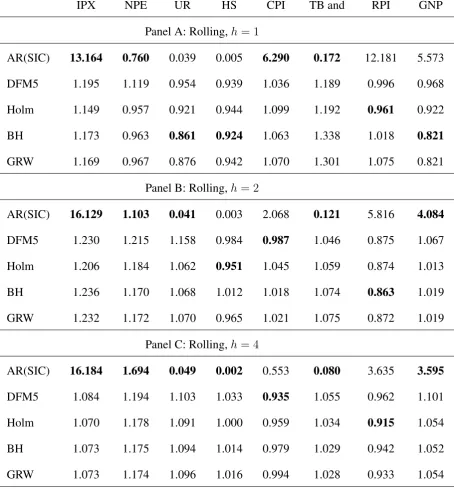
Tables 1 - 4 report the relative MSFEs for the five alternative forecasting models under consid-eration. In particular, Table 1 refers to the case when lags of the predictand are not considered for forecasting using DI and the selection of the PCs is based on the p-values computed on the marginal t∗
i statistics; Table 2 refers to the case when p lags are considered and the selection is
based on the marginalt∗
i statistics. Tables 3 and 4 deal with the selection based on theti statistics
withσestimated according to the RCV method by Fan et al. (2012): in 3 no lags of the predictands were considered, whereas in 4 they were.
There are several conclusions that can be drawn from the empirical evidence summarised in the tables. The first broad consideration is that forecasting methods based on factor models provide accurate forecasts and improve over the AR benchmark in the majority of the cases across all horizons, when the lags of the dependent variable are not considered (which is the case considered in Tables 1 and 3).
The second general conclusion is that pre-selection of the components by the multiple testing procedures considered leads to several improvements in forecasting accuracy (when no lags of the predictand are considered). The three procedures show the best performances for 52% of the cases across horizons/variables combinations in tables 1 and 3, whereas DFM5 and AR(SIC) have the best performances only for 21% and 27% of the occurrences, respectively.
Thirdly, when the lags of the target variables are considered in the forecasting model, the pre-dictors based on the factors, regardless of their selection, are more systematically outperformed by the benchmark AR predictor. The combined evidence of Tables 2 and 4 is that the AR predictor is ranked best in 58% of the cases. The last finding has already been reported and investigated in previous studies, among which we mention D’Agostino and Giannone (2012) and Stock and Watson (2002a). A possible explanation is that factor models have the ability to capture efficiently not only the information that is common to other cross-sectional variables, but also the specific dynamic features of each variable to predict. Also, after conditioning for the role of lagged values, the factors computed on the residual variation contribute more to the variability of the forecasts, leading to an increase in the MSFE.
Personal Income (RPI). For NPE, HS, TB and RPI they produce the minimum MSFEe across all horizons (panels A, B and C of table 1), with the exception of TB at horizon h = 1, for which the AR predictor ranks best. Finally, DFM5 is ranked best for UR, achieving a 20% reduction in the MSFE over the AR predictor and a 4% reduction over the multiple testing procedures, across all horizons. For the other variables the results are less sharp and depend basically on the forecast horizon. In Table 1 for IPX and GNP we observe a slight improvement of 4% of DFM5 and 15% of BH over AR only forh= 1, whereas forh= 2andh= 4both multiple testing procedures and DFM5 do not outperform the benchmark.
The choice of the reference test statistics (marginal t∗
i or multiple regression ti, with RCV
estimation ofσ) does not seem to affect the results of the multiple testing procedures. The previous results are confirmed examining Table 2. We observe a further improvement only for GNP, where now the best performing predictor is GRW, achieving a 24% MSFE reduction with respect to the benchmark, also for h = 2 (Panel B) where the gain in forecasting accuracy amounts to about 10%.
Among the multiple testing procedures, weighting the p-values according to the eigenvalues does not lead to an improvement, with a few exceptions. Holm’s sequential procedure clearly out-performs the other predictors in terms of MSFE in 27% of the cases when no lags of the dependent variable are in use, whereas BH and GRW are ranked best in 19% and 6% of the cases, respec-tively. This result seems to depend exclusively by the conservative nature of the Holm method, compared to the procedures controlling the FDR.
6.3
Assessment of real time performance
Following D’Agostino and Giannone (2012), we evaluate how the forecasting performance of the predictors evolved over time. In figure 2 we plot the time series pattern of the MSFEs of the DFM5 predictor (black solid line) and the predictor resulting from Holm’s selection of the factors (blue dashed line), relative to the AR benchmark (red line). We consider only 3 series, namely NPE, TB and RPI, for which the Holm’s selection provided sizable improvements. The relative MSFEs were smoothed over time with a centered moving window spanning 2 years. The shaded areas are the NBER recessions.
Interestingly, the factor based methods perform best during the great recession, and present no substantial gain during the great moderation. This empirical findings is consistent with the literature, as during the recession the comovements among economic variables are more prominent and thus the factors become more useful for forecasting. The selection of the factor leads to greater MSFE reductions in the last five years of the sample, including the great recession.
Table 1: Relative Mean Square Forecast Errors of 5 alternative predictors at horizonsh = 1,2,and
h = 4. The selection of the factors is based on the marginalt∗
i statistics and prediction occurs by
principal component regression on the selected factors with no lags of the predictand.
IPX NPE UR HS CPI TB RPI GNP
Panel A: Rolling,h= 1
AR(SIC) 13.164 0.760 0.039 0.005 6.290 0.172 12.181 5.573
DFM5 0.960 0.910 0.693 0.943 0.959 1.207 0.898 0.942
Holm 1.158 0.771 0.728 0.914 1.014 1.079 0.828 0.900
BH 1.173 0.777 0.728 0.896 1.028 1.083 0.897 0.848
GRW 1.155 0.771 0.728 0.917 1.022 1.089 0.884 0.876
Panel B: Rolling,h= 2
AR(SIC) 16.129 1.103 0.041 0.003 2.068 0.121 5.816 4.084
DFM5 1.026 1.013 0.680 1.126 0.873 1.246 0.854 1.126
Holm 1.102 0.876 0.757 0.995 0.917 0.985 0.769 1.000
BH 1.102 0.873 0.754 1.041 0.949 1.064 0.774 1.000
GRW 1.102 0.876 0.759 0.995 0.917 0.985 0.763 1.000
Panel C: Rolling,h= 4
AR(SIC) 16.184 1.694 0.049 0.002 0.553 0.080 3.635 3.595
DFM5 1.124 1.072 0.713 1.084 0.869 1.198 0.801 1.112
Holm 1.047 0.879 0.759 0.979 0.928 0.974 0.681 1.008
BH 1.025 0.916 0.735 0.990 0.859 0.963 0.684 1.028
GRW 1.039 0.917 0.766 0.979 0.954 0.974 0.682 1.005
Table 2: Relative Mean Square Forecast Errors of 5 alternative predictors at horizonsh = 1,2,and
h = 4. The selection of the factors is based on the marginalt∗
i statistics and prediction occurs by
the principal component regression on the selected factors includingplags of the predictand.
IPX NPE UR HS CPI TB RPI GNP
Panel A: Rolling,h= 1
AR(SIC) 13.164 0.760 0.039 0.005 6.290 0.172 12.181 5.573
DFM5 1.195 1.119 0.954 0.939 1.036 1.189 0.996 0.968
Holm 1.005 0.968 0.912 0.894 1.090 1.123 0.969 0.846
BH 0.987 0.968 0.912 0.873 1.093 1.115 0.937 0.836
GRW 1.004 0.971 0.912 0.880 1.075 1.095 0.971 0.847
Panel B: Rolling,h= 2
AR(SIC) 16.129 1.103 0.041 0.003 2.068 0.121 5.816 4.084
DFM5 1.230 1.215 1.158 0.984 0.987 1.046 0.875 1.067
Holm 1.166 1.204 1.064 0.923 1.035 1.033 0.851 1.021
BH 1.161 1.204 1.064 0.932 1.048 1.031 0.871 1.023
GRW 1.168 1.205 1.064 0.939 1.029 1.024 0.846 1.020
Panel C: Rolling,h= 4
AR(SIC) 16.184 1.694 0.049 0.002 0.553 0.080 3.635 3.595
DFM5 1.084 1.194 1.103 1.033 0.935 1.055 0.962 1.101
Holm 1.063 1.189 1.094 1.007 0.970 1.048 0.912 1.037
BH 1.064 1.185 1.093 1.009 0.959 1.054 0.928 1.040
Table 3: Relative Mean Square Forecast Errors of 5 alternative predictors at horizonsh = 1,2,
and h = 4. The selection of the factors is based on the ti statistics with RCV estimation of σ
and prediction occurs by principal component regression on the selected factors and no lags of the predictand.
IPX NPE UR HS CPI TB RPI GNP
Panel A: Rolling,h= 1
AR(SIC) 13.164 0.760 0.039 0.005 6.290 0.172 12.181 5.573
DFM5 0.960 0.910 0.693 0.943 0.959 1.207 0.898 0.942
Holm 1.185 0.744 0.721 0.901 1.040 1.114 0.828 0.816
BH 1.090 0.737 0.749 0.892 1.036 1.181 0.966 0.804
GRW 1.120 0.728 0.750 0.833 1.051 1.206 0.988 0.786
Panel B: Rolling,h= 2
AR(SIC) 16.129 1.103 0.041 0.003 2.068 0.121 5.816 4.084
DFM5 1.026 1.013 0.680 1.126 0.873 1.246 0.854 1.126
Holm 1.123 0.889 0.734 1.065 0.917 1.098 0.769 0.919
BH 1.126 0.930 0.778 1.023 0.985 1.178 0.813 0.926
GRW 1.082 0.889 0.796 1.010 0.989 1.149 0.785 0.926
Panel C: Rolling,h= 4
AR(SIC) 16.184 1.694 0.049 0.002 0.553 0.080 3.635 3.595
DFM5 1.124 1.072 0.713 1.084 0.869 1.198 0.801 1.112
Holm 0.960 1.032 0.675 0.988 0.896 0.975 0.686 1.145
BH 0.971 1.003 0.694 0.963 0.882 1.026 0.681 1.066
Table 4: Relative Mean Square Forecast Errors of 5 alternative predictors at horizonsh = 1,2,
andh= 4. The selection of the factors is based on theti statistics with RCV estimation ofσ and
prediction occurs by principal component regression on the selected factors includingplags of the predictand.
IPX NPE UR HS CPI TB and RPI GNP
Panel A: Rolling,h= 1
AR(SIC) 13.164 0.760 0.039 0.005 6.290 0.172 12.181 5.573
DFM5 1.195 1.119 0.954 0.939 1.036 1.189 0.996 0.968
Holm 1.149 0.957 0.921 0.944 1.099 1.192 0.961 0.922
BH 1.173 0.963 0.861 0.924 1.063 1.338 1.018 0.821
GRW 1.169 0.967 0.876 0.942 1.070 1.301 1.075 0.821
Panel B: Rolling,h= 2
AR(SIC) 16.129 1.103 0.041 0.003 2.068 0.121 5.816 4.084
DFM5 1.230 1.215 1.158 0.984 0.987 1.046 0.875 1.067
Holm 1.206 1.184 1.062 0.951 1.045 1.059 0.874 1.013
BH 1.236 1.170 1.068 1.012 1.018 1.074 0.863 1.019
GRW 1.232 1.172 1.070 0.965 1.021 1.075 0.872 1.019
Panel C: Rolling,h= 4
AR(SIC) 16.184 1.694 0.049 0.002 0.553 0.080 3.635 3.595
DFM5 1.084 1.194 1.103 1.033 0.935 1.055 0.962 1.101
Holm 1.070 1.178 1.091 1.000 0.959 1.034 0.915 1.054
BH 1.073 1.175 1.094 1.014 0.979 1.029 0.942 1.052
nature is benign in this case as the information that is essential for forecasting is well represented in the first three factors.
Nature is less benign in the TB case (second row panels). No factors is selected at the beginning and most noticeably at the end of the sample period. High order components are selected and the intermediate ones receive zero weight. Nature is even more bizarre for the RPI variable (bottom panels); the number of selected factors never exceeds the four, but order of selected factors is surprising. For predicting one-step-ahead the Holm’s procedure, more or less regularly, selects the16-th, 18-th and24-th factors. This selection could never be contemplated in a classic factors model.
7
Conclusions
The paper has proposed a method for supervising the diffusion index methodology, originally proposed by Stock and Watson (2002a), which is based on the simple idea of selecting the relevant factors using a multiple testing procedure, achieving control over either the family wise error rate or the false discovery rate. Prior information about the order of the components may be introduced by weighting thep-values of the test statistics for variable exclusion with weights proportional to the eigenvalues.
Can we conclude that nature is tricky, but essentially benign? The answer is a qualified yes. The information that is needed for forecasting the eight macroeconomic variables considered in the paper is effectively condensed by the first few factors. However, variable selection, leading to exclude some of the low order principal components, can lead to a sizable improvement in forecasting in specific cases. Only in one instance, real personal income, we were able to detect a significant contribution from high order components.
Acknowledgements
Figure 2: Time varying performance of forecasting methods.
Figure 3: Selected factors using the Holm procedure.
Q1−2000 Q1−2010
0.5 1 1.5
Time
Selected Factors
Total civilian Employment Non Farm 1−steps ahead
Q1−2000 Q1−2010
0.5 1 2 3 Time Selected Factors
Total civilian Employment Non Farm 2−steps ahead
Q1−2000 Q1−2010
0.5 1 1.5 2 2.5 3 3.5 4 Time Selected Factors
Total civilian Employment Non Farm 4−steps ahead
Q1−2000 Q1−2010
2 4 6 8 10 12 14 16 Time Selected Factors
10 Year Bond 1−steps ahead
Q1−2000 Q1−2010
1 2 3 4 5 6 7 Time Selected Factors
10 Year Bond 2−steps ahead
Q1−2000 Q1−2010
5 10 15 20 Time Selected Factors
10 Year Bond 4−steps ahead
Q1−2000 Q1−2010
5 10 15 20 25 Selected Factors
Real Personal Income 1−steps ahead
Q1−2000 Q1−2010
2 4 6 8 10 Selected Factors
Real Personal Income 2−steps ahead
Q1−2000 Q1−2010
2 4 6 8
Selected Factors
Real Personal Income 4−steps ahead
References
Bai, J. and Ng, S. (2002). “Determining the Number of Factors in Approximate Factor Models.”
Econometrica, 70(1):191–221.
Bai, J. and Ng, S. (2006). “Confidence Intervals for Diffusion Index Forecasts and Inference with Factor-Augmented Regressions.” Econometrica, 74(4):1133–1150.
Bai, J. and Ng, S. (2008). “Forecasting Economic Time Series Using Targeted Predictors.”Journal of Econometrics, 146(2):304–317.
Bai, J. and Ng, S. (2009). “Boosting Diffusion Indices.” Journal of Applied Econometrics, 24(4):607–629.
Bair, E., Hastie, T., Debashis, P., and Tibshirani, R. (2006). “Prediction by Supervised Principal Components.” Journal of the American Statistical Association, 101(473):119–137.
Benjamini, Y. and Hochberg, Y. (1995). “Controlling the False Discovery Rate: a Practical and Powerful Approach to Multiple Testing.” Journal of the Royal Statistical Society. Series B (Methodological), 289–300.
Breitung, J. and Eickmeier, S. (2006). “Dynamic Factor Models.” InModern Econometric Analy-sis, 25–40. Springer.
Chun, H. and Keles¸, S. (2010). “Sparse Partial Least Squares Regression for Simultaneous Di-mension Reduction and Variable Selection.” Journal of the Royal Statistical Society: Series B (Statistical Methodology), 72(1):3–25.
Cook, R. D. (2007). “Fisher lecture: Dimension Reduction in Regression.” Statistical Science, 1–26.
Cook, R. D. and Forzani, L. (2008). “Principal Fitted Components for Dimension Reduction in Regression.” Statistical Science, 52:485–501.
Cox, D. (1968). “Notes on Some Aspects of Regression Analysis.” Journal of the Royal Statistical Society, Series A, 131(3):265–279.
D’Agostino, A. and Giannone, D. (2012). “Comparing Alternative Predictors Based on Large-Panel Factor Models.” Oxford Bulletin of Economics and Statistics, 74(2):306–326.
De Mol, C., Giannone, D., and Reichlin, L. (2008). “Forecasting Using a Large Number of Predic-tors: Is Bayesian Shrinkage a Valid Alternative to Principal Components?” Journal of Econo-metrics, 146(2):318–328.
Fan, J., Guo, S., and Hao, N. (2012). “Variance Estimation Using Refitted Cross-Validation in Ul-trahigh Dimensional Regression.” Journal of the Royal Statistical Society: Series B (Statistical Methodology), 74(1):37–65.
Forni, M., Hallin, M., Lippi, M., and Reichlin, L. (2005). “The Generalized Dynamic Factor Model: One-Sided Estimation and Forecasting.”Journal of the American Statistical Association, 100:830–840.
Fuentes, J., Poncela, P., and Rodr´ıguez, J. (2014). “Sparse Partial Least Squares in Time Series for Macroeconomic Forecasting.” Journal of Applied Econometrics.
Genovese, C. R., Roeder, K., and Wasserman, L. (2006). “False Discovery Control with p-value Weighting.” Biometrika, 93(3):509–524.
Hadi, A. S. and Ling, R. F. (1998). “Some Cautionary Notes on the Use of Principal Components Regression.” The American Statistician, 52(1):15–19.
Hastie, T., Tibshirani, R., and Friedman, J. (2009). The Elements of Statistical Learning: Data Mining, Inference, and Prediction. Springer series in statistics. Springer.
Holm, S. (1979). “A Simple Sequentially Rejective Multiple Test Procedure.” Scandinavian jour-nal of statistics, 65–70.
Hwang, J. G. and Nettleton, D. (2003). “Principal Components Regression with Data Chosen Components and Related Methods.” Technometrics, 45(1).
Inoue, A. and Kilian, L. (2008). “How Useful is Bagging in Forecasting Economic Time Series? A Case Study of U.S. Consumer Price Inflation.” Journal of the American Statistical Association, 103:511–522.
Joliffe, I. T. (1982). “A Note on the Use of Principal Components in Regression.”Applied Statistics, 31(3):300–303.
Kim, H. H. and Swanson, N. R. (2014). “Forecasting Financial and Macroeconomic Variables Us-ing Data Reduction Methods: New Empirical Evidence.”Journal of Econometrics, 178(2):352– 367.
Li, K.-C. (1991). “Sliced Inverse Regression for Dimension Reduction.” Journal of the American Statistical Association, 86:316–327.
Mosteller, F. and Tukey, J. W. (1977). “Data Analysis and Regression: a Second Course in Statis-tics.” Addison-Wesley Series in Behavioral Science: Quantitative Methods.
Onatski, A. (2010). “Determining the Number of Factors from Empirical Distribution of Eigen-values.” The Review of Economics and Statistics, 92(4):1004–1016.
Stock, J. H. and Watson, M. W. (2002a). “Forecasting Using Principal Components From a Large Number of Predictors.” Journal of the American Statistical Association, 97:1167–1179.
Stock, J. H. and Watson, M. W. (2002b). “Macroeconomic Forecasting Using Diffusion Indexes.”
Journal of Business & Economic Statistics, 20(2):147–62.
Stock, J. H. and Watson, M. W. (2006). “Forecasting with Many Predictors.” In Elliott, G., Granger, C., and Timmermann, A. (eds.), Handbook of Economic Forecasting, volume 1, chapter 10, 515–554. Elsevier.
Stock, J. H. and Watson, M. W. (2010). “Dynamic Factor Models.” In Clements, M. P. and Hendry, D. F. (eds.),Oxford Handbook of Economic Forecasting, volume 1, chapter 2. Oxford University Press, USA.
Stock, J. H. and Watson, M. W. (2012a). “Disentangling the Channels of the 2007—09 Recession.”
Brookings Papers on Economic Activity: Spring 2012, 81.
A
List of the time series used in the empirical illustration
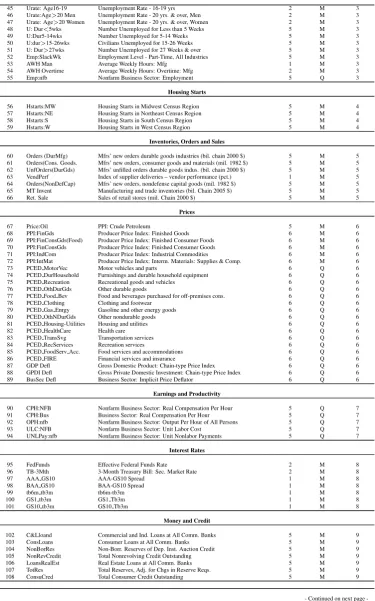
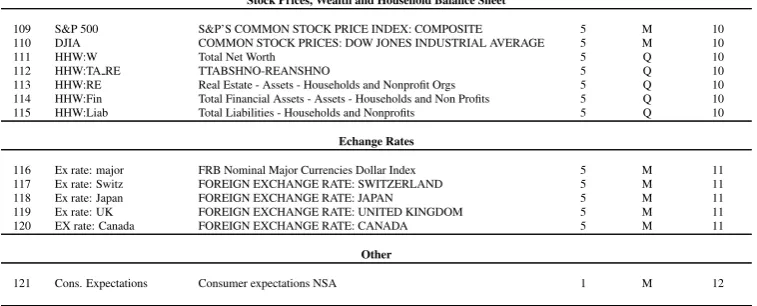
This Appendix reports the time series in the dataset used in the application, the transformation type, the observations frequency (M= monthly and Q = quarterly) and the group to which they belong.
LettingZtdenote the raw series, the following transformations are adopted:
Xt=
Zt if Tcode=1
∆Zt if Tcode=2
∆2Z
t if Tcode=3
ln(Zt) if Tcode=4
∆ lnZt if Tcode=5
∆2lnZ
t if Tcode=6
Table 5: List of the predictors.
N Short Description Long Description Tcode Frequency Category
NIPA
1 Disp-Income Real Disposable Personal Income 5 Q 1
2 FixedInv Real Private Fixed Investment 5 Q 1
3 Gov.Spending Real Government Consumption Expenditures & Gross Investment 5 Q 1
4 GDP Real Gross Domestic Product 5 Q 1
5 Investment Real Gross Private Domestic Investment 5 Q 1
6 Consumption Real Personal Consumption Expenditures 5 Q 1
7 Inv:Equip&Software Real Nonresidential Investment: Equipment & Software 5 Q 1
8 Exports Real Exports of Goods & Services 5 Q 1
9 Gov Receipts Government Current Receipts (Nominal) 5 Q 1
10 Gov:Fed Real Federal Consumption Expenditures & Gross Investment 5 Q 1
11 Imports Real Imports of Goods & Services 5 Q 1
12 Cons:Dur Real Personal Consumption Expenditures: Durable Goods 5 Q 1
13 Cons:Svc Real Personal Consumption Expenditures: Services 5 Q 1
14 Cons:NonDur Real Personal Consumption Expenditures: Nondurable Goods 5 Q 1
15 FixInv:NonRes Real Private Nonresidential Fixed Investment 5 Q 1
16 FixedInv:Res Real Private Residential Fixed Investment 5 Q 1
17 Gov:State&Local Real State & Local Cons. Exp. & Gross Investment 5 Q 1
18 Inv:Inventories Real Change in Private Inventories 5 Q 1
19 Inv:Inventories Ch. Inv/GDP 1 Q 1
20 Output:Bus Business Sector: Output 5 Q 1
21 Ouput:NFB Nonfarm Business Sector: Output 5 Q 1
Industrial Production
22 IP: Dur gds materials Industrial Production: Durable Materials 5 M 2 23 IP: Nondur gds materials Industrial Production: nondurable Materials 5 M 2 24 Capu Man. Capu Man. (Fred post 1972, Older series before 1972) 1 M 2 25 IP: Dur Cons. Goods Industrial Production: Durable Consumer Goods 5 M 2
26 IP: Auto IP: Automotive products 5 M 2
27 IP:NonDur Cons God Industrial Production: Nondurable Consumer Goods 5 M 2
28 IP: Bus Equip Industrial Production: Business Equipment 5 M 2
29 IP: Energy Prds IP: Consumer Energy Products 5 M 2
Employment and Unemployment
30 Emp: Gov(Fed) Federal 5 M 3
31 Emp: Gov (State) State government 5 M 3
32 Emp: Gov (Local) Local government 5 M 3
33 Emp: DurGoods All Employees: Durable Goods Manufacturing 5 M 3
34 Emp: Const All Employees: Construction 5 M 3
35 Emp: Edu&Health All Employees: Education & Health Services 5 M 3
36 Emp: Finance All Employees: Financial Activities 5 M 3
37 Emp: Infor All Employees: Information Services 5 M 3
38 Emp:Leisure All Employees: Leisure & Hospitality 5 M 3
39 Emp: Mining/NatRes All Employees: Natural Resources & Mining 5 M 3 40 Emp: Bus Serv All Employees: Professional & Bus. Services 5 M 3
41 Emp:OtherSvcs All Employees: Other Services 5 M 3
42 Emp:Trade&Trans All Employees: Trade, Transp. & Utilities 5 M 3
43 Emp:Retail All Employees: Retail Trade 5 M 3
44 Emp:Wholesal All Employees: Wholesale Trade 5 M 3
Continued on next page
Table 5 – continued from previous page
45 Urate: Age16-19 Unemployment Rate - 16-19 yrs 2 M 3
46 Urate:Age>20 Men Unemployment Rate - 20 yrs. & over, Men 2 M 3 47 Urate: Age>20 Women Unemployment Rate - 20 yrs. & over, Women 2 M 3
48 U: Dur<5wks Number Unemployed for Less than 5 Weeks 5 M 3
49 U:Dur5-14wks Number Unemployed for 5-14 Weeks 5 M 3
50 U:dur>15-26wks Civilians Unemployed for 15-26 Weeks 5 M 3
51 U: Dur>27wks Number Unemployed for 27 Weeks & over 5 M 3
52 Emp:SlackWk Employment Level - Part-Time, All Industries 5 M 3
53 AWH Man Average Weekly Hours: Mfg 1 M 3
54 AWH Overtime Average Weekly Hours: Overtime: Mfg 2 M 3
55 Emp:nfb Nonfarm Business Sector: Employment 5 Q 3
Housing Starts
56 Hstarts:MW Housing Starts in Midwest Census Region 5 M 4
57 Hstarts:NE Housing Starts in Northeast Census Region 5 M 4
58 Hstarts:S Housing Starts in South Census Region 5 M 4
59 Hstarts:W Housing Starts in West Census Region 5 M 4
Inventories, Orders and Sales
60 Orders (DurMfg) Mfrs’ new orders durable goods industries (bil. chain 2000 $) 5 M 5 61 Orders(Cons. Goods. Mfrs’ new orders, consumer goods and materials (mil. 1982 $) 5 M 5 62 UnfOrders(DurGds) Mfrs’ unfilled orders durable goods indus. (bil. chain 2000 $) 5 M 5 63 VendPerf Index of supplier deliveries – vendor performance (pct.) 1 M 5 64 Orders(NonDefCap) Mfrs’ new orders, nondefense capital goods (mil. 1982 $) 5 M 5 65 MT Invent Manufacturing and trade inventories (bil. Chain 2005 $) 5 M 5
66 Ret. Sale Sales of retail stores (mil. Chain 2000 $) 5 M 5
Prices
67 Price:Oil PPI: Crude Petroleum 5 M 6
68 PPI:FinGds Producer Price Index: Finished Goods 6 M 6
69 PPI:FinConsGds(Food) Producer Price Index: Finished Consumer Foods 6 M 6 70 PPI:FinConsGds Producer Price Index: Finished Consumer Goods 6 M 6
71 PPI:IndCom Producer Price Index: Industrial Commodities 6 M 6
72 PPI:IntMat Producer Price Index: Interm. Materials: Supplies & Comp. 6 M 6
73 PCED MotorVec Motor vehicles and parts 6 Q 6
74 PCED DurHousehold Furnishings and durable household equipment 6 Q 6
75 PCED Recreation Recreational goods and vehicles 6 Q 6
76 PCED OthDurGds Other durable goods 6 Q 6
77 PCED Food Bev Food and beverages purchased for off-premises cons. 6 Q 6
78 PCED Clothing Clothing and footwear 6 Q 6
79 PCED Gas Enrgy Gasoline and other energy goods 6 Q 6
80 PCED OthNDurGds Other nondurable goods 6 Q 6
81 PCED Housing-Utilities Housing and utilities 6 Q 6
82 PCED HealthCare Health care 6 Q 6
83 PCED TransSvg Transportation services 6 Q 6
84 PCED RecServices Recreation services 6 Q 6
85 PCED FoodServ Acc. Food services and accommodations 6 Q 6
86 PCED FIRE Financial services and insurance 6 Q 6
87 GDP Defl Gross Domestic Product: Chain-type Price Index 6 Q 6
88 GPDI Defl Gross Private Domestic Investment: Chain-type Price Index 6 Q 6
89 BusSec Defl Business Sector: Implicit Price Deflator 6 Q 6
Earnings and Productivity
90 CPH:NFB Nonfarm Business Sector: Real Compensation Per Hour 5 Q 7
91 CPH:Bus Business Sector: Real Compensation Per Hour 5 Q 7
92 OPH:nfb Nonfarm Business Sector: Output Per Hour of All Persons 5 Q 7
93 ULC:NFB Nonfarm Business Sector: Unit Labor Cost 5 Q 7
94 UNLPay:nfb Nonfarm Business Sector: Unit Nonlabor Payments 5 Q 7
Interest Rates
95 FedFunds Effective Federal Funds Rate 2 M 8
96 TB-3Mth 3-Month Treasury Bill: Sec. Market Rate 2 M 8
97 AAA GS10 AAA-GS10 Spread 1 M 8
98 BAA GS10 BAA-GS10 Spread 1 M 8
99 tb6m tb3m tb6m-tb3m 1 M 8
100 GS1 tb3m GS1 Tb3m 1 M 8
101 GS10 tb3m GS10 Tb3m 1 M 8
Money and Credit
102 C&Lloand Commercial and Ind. Loans at All Comm. Banks 5 M 9
103 ConsLoans Consumer Loans at All Comm. Banks 5 M 9
104 NonBorRes Non-Borr. Reserves of Dep. Inst. Auction Credit 5 M 9
105 NonRevCredit Total Nonrevolving Credit Outstanding 5 M 9
106 LoansRealEst Real Estate Loans at All Comm. Banks 5 M 9
107 TotRes Total Reserves, Adj. for Chgs in Reserve Reqs. 5 M 9
108 ConsuCred Total Consumer Credit Outstanding 5 M 9
-Table 5 – continued from previous page Stock Prices, Wealth and Household Balance Sheet
109 S&P 500 S&P’S COMMON STOCK PRICE INDEX: COMPOSITE 5 M 10
110 DJIA COMMON STOCK PRICES: DOW JONES INDUSTRIAL AVERAGE 5 M 10
111 HHW:W Total Net Worth 5 Q 10
112 HHW:TA RE TTABSHNO-REANSHNO 5 Q 10
113 HHW:RE Real Estate - Assets - Households and Nonprofit Orgs 5 Q 10 114 HHW:Fin Total Financial Assets - Assets - Households and Non Profits 5 Q 10
115 HHW:Liab Total Liabilities - Households and Nonprofits 5 Q 10
Echange Rates
116 Ex rate: major FRB Nominal Major Currencies Dollar Index 5 M 11
117 Ex rate: Switz FOREIGN EXCHANGE RATE: SWITZERLAND 5 M 11
118 Ex rate: Japan FOREIGN EXCHANGE RATE: JAPAN 5 M 11
119 Ex rate: UK FOREIGN EXCHANGE RATE: UNITED KINGDOM 5 M 11
120 EX rate: Canada FOREIGN EXCHANGE RATE: CANADA 5 M 11
Other
[image:31.595.116.495.41.194.2]