Bridging the gap between sign language machine translation
and sign language animation using sequence classification
Sarah Ebling
1, Matt Huenerfauth
21
Institute of Computational Linguistics
University of Zurich
Zurich, Switzerland
[email protected]2
Rochester Institute of Technology (RIT)
Golisano College of Computing and Information Sciences
Rochester, NY, USA
Abstract
To date, the non-manual components of signed utterances have rarely been considered in automatic sign language translation. However, these components are capable of carrying important linguistic information. This paper presents work that bridges the gap between the output of a sign language translation system and the input of a sign language animation system by incorpo-rating non-manual information into the final output of the trans-lation system. More precisely, the generation of non-manual information is scheduled after the machine translation step and treated as a sequence classification task. While sequence classi-fication has been used to solve automatic spoken language pro-cessing tasks, we believe this to be the first work to apply it to the generation of non-manual information in sign languages. All of our experimental approaches outperformed lower base-line approaches, consisting of unigram or bigram models of non-manual features.
1. Introduction
Sign languages are often the preferred means of communication of deaf and hard-of-hearing persons, making it vital to provide access to information in these languages. Technologies for au-tomatically translating written text (in a spoken language1) into a sign language would therefore increase the accessibility of in-formation sources for many people.
Sign languages are natural languages and, as such, fully de-veloped linguistic systems. While there are a variety of sign lan-guages used internationally, they share several key properties: Utterances in sign languages are produced with the hands/arms (themanual activity) and the shoulders, head, and face (the non-manual activity). Manual and non-manual components together form thesublexical components.
1.1. Sign language production pipeline
While the input to a translation system such as the one outlined above would be a written text, the output is less obvious: Ul-timately, the goal would be to produce an animation of a vir-tual human character performing sign language, i.e., asign lan-guage avatar. Most sign language machine translation systems 1The termspoken languagerefers to a language that is not signed,
whether it is represented in its spoken or written form.
produce some form of symbolic output. In the ideal case, this output should be suitable to serve as theinputfor an animation-synthesis system.
Unfortunately, to date, this sign language production pipeline is often left incomplete, in that the output of many ma-chine translation systems consists of strings of sign language glosses,2i.e., information about the manual activity of a signed utterance, only.
This paper presents work thatbridges the gapbetween the output of a sign language translation system and the input of a sign language animation system by incorporating non-manual information into the final output of the translation system. More precisely, the generation of non-manual information is sched-uled after the machine translation step and treated as a sequence classification task. To our knowledge, this is the first work to apply sequence classification to the generation of non-manual information in sign languages. We show that all of our experi-mental approaches outperformed lower baseline approaches, in-cluding unigram and bigram models of non-manual component sequences.
1.2. Linguistic background and prior work
Experimental research with sign language users has shown that the absence of non-manual information in synthesized signing (sign language animation) leads to lower comprehension scores and lower subjective ratings of the animations [1]. This is be-cause non-manual components in sign languages are capable of assuming functions at all linguistic levels [2]. As an exam-ple, in Swiss German Sign Language (Deutschschweizerische Gebärdensprache, DSGS), raised eyebrows are used to express supposition, contrast, or emphasis [3]. A combination of a head movement forward and raised eyebrows is used to mark topical-ized constituents. Conditionalif/whenutterances have the head tilt and move forward slightly and the eyebrows go up at the start of the condition part. For rhetorical questions in DSGS, the head tilts and moves forward slightly and the eyebrows are furrowed on the question sign [4].
Non-manual components have been omitted, for example, in a statistical machine translation system that translates be-tween German and German Sign Language [5] and one that
2Glosses are semantic representations of signs that typically take on
translates between English, German, Irish Sign Language, and German Sign Language [6]. Massó and Badia [7] took into ac-count mouth morphemes in a statistical machine translation sys-tem translating from Catalan into Catalan Sign Language; such mouth movements convey adverbial or aspectual modifications to the meaning of manual signs in that language.
In contrast, in this paper, we deal with multiple types of non-manual components, taking into account the multilinear na-ture of sign languages. Our work is inspired by linguistic mod-els that represent both the manual and non-manual components of signed utterances [8, 9].
The remainder of the paper is structured as follows: Sec-tion 2 introduces the project as part of which the machine trans-lation system is being developed. In particular, the data that served as a basis for the sequence classification experiments is described. In Section 3, we specify our sequence classification approaches, provide further information on the data used for the experiments, explain the experiment configurations, and present as well as discuss the results.
2. Non-manual components in a corpus of
DSGS train announcements
We are developing a system that automatically translates writ-ten German train announcements of the Swiss Federal Railways into DSGS. Our team includes Deaf3and hearing researchers. Example 1 below shows an announcement of the Swiss Federal Railways.
(1) Ausfallmeldung zur S1 nach Luzern: Die S1 nach Luzern, Abfahrt um 6 Uhr 10, fällt aus.(‘Notice of cancellation regarding the S1 to Lucerne: The S1 to Lucerne, scheduled to leave at 6:10am, has been cancelled.’)
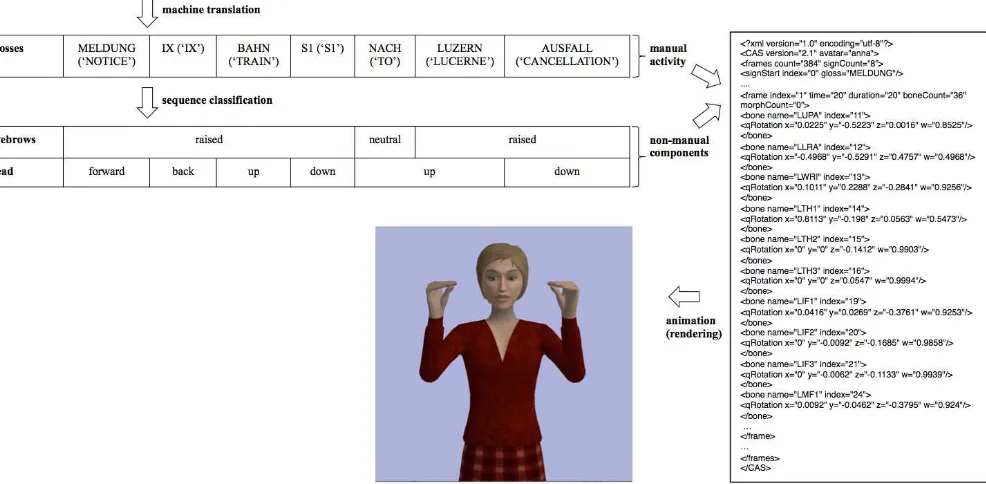
The resulting DSGS announcements are presented by means of an avatar. A state-of-the art avatar system, JASigning [11], is used for this. The JASigning characterAnnais shown in Figure 1.
The train announcements of the Swiss Federal Railways are parametrized in that they are based on templates with slots, where slots are, e.g., the names of train stations, types of trains, or reasons for delays. When automatically translating these an-nouncements, one possibility is to take account precisely of their parametrized nature. However, our goal is to build a translation system that can later be extended to other domains with more lexical and syntactic variation. Hence, a more trans-ferrable translation approach is applied, namely statistical ma-chine translation.
Statistical machine translation systems require parallel cor-pora as their training, development, and test data. To build a parallel corpus, the Deaf and hearing members of our team man-ually translated 3000 written German train announcements into DSGS. The DSGS side of the resulting parallel corpus consists of information arranged on three tiers:
1. sign language glosses 2. head, with 13 possible values 3. eyebrows, with 3 possible values
3It is a widely recognized convention to use the upper-cased word
Deaf for describing members of the linguistic community of sign lan-guage users and, in contrast, to use the lower-cased worddeaf when describing the audiological state of a hearing loss [10].
The non-manual components in the DSGS side of our par-allel corpus serve various linguistic functions. For example, in our domain of train announcements, we have observed that furrowed eyebrows often occurred during signs with negative polarity, such as the sign BESCHRÄNKEN (‘LIMIT’). Raised eyebrows often occurred during signs that express a warning or emphasis, e.g., the signs VORSICHT (‘CAUTION’) or SO-FORT (‘IMMEDIATELY’). The syntactic functions mentioned in Section 1.2, topicalization and rhetorical question, also occur frequently in the corpus; a few instances of conditional expres-sions are also present. Many of these syntactic non-manuals relate to specific words in the sentence (e.g., rhetorical question non-manual components co-occur with question words, such as “WHAT”). Within this paper, we focus on suchlexically-cued non-manuals. (As discussed in Section 4, we are aware that not all non-manual components are predictable based on the se-quence of lexical items in the sentence alone, and we propose to investigate such non-manuals in future work.)
Table 1 shows the DSGS translation of the first part of the train announcement introduced in Example 1, Ausfallmel-dung zur S1 nach Luzern(‘Notice of cancellation regarding the S1 to Lucerne’). Note that the starting and ending times of the non-manual components align with the boundaries of man-ual activities (as represented through glosses). This has been shown to be the case for non-manual components with linguis-tic functions; non-manual components that serve purely affec-tive purposes, e.g., expressing anger or disgust, are known to start slightly earlier than the surrounding manual components [12, 13, 14, 15, 16, 17, 18, 19, 20, 21].
3. Generating non-manual information
through sequence classification
The goal of our work was to include non-manual information in the process of translating written German train announce-ments into DSGS. Traditionally, glosses have been the sole rep-resentation of sign language in an automatic translation task (cf. Section 1). One way of considering non-manual compo-nents in this task is to simply append them to the glosses. This representation is shown in Example 2 for the announcement in-troduced in Example 1. The non-manual features are printed in bold.
(2) Ausfallmeldung zur S1 nach Luzern:
MELDUNG__Head_forward__Eyebrows_raised
IX__Head_back__Eyebrows_raised
BAHN__Head_up__Eyebrows_raised
S1__Head_down__Eyebrows_raised
NACH__Head_up__Eyebrows_neutral
LUZERN__Head_up__Eyebrows_raised
AUSFALL__Head_down__Eyebrows_raised
However, such a representation aggravates the issue of data sparseness, since the size of the vocabulary is not only equiva-lent to the number of unique glosses but to the number of unique combinations of glosses and non-manual features. This in-creases the likelihood that tokens appear in the decoding phase that have not been seen during training (out-of-vocabulary items, OOV). Such a representation also does not accommodate the multimodal nature of sign languages: Three tiers (glosses, head, and eyebrow information) are collapsed into one.
Glosses MELDUNG IX BAHN S1 NACH LUZERN AUSFALL (‘NOTICE’) (‘IX’) (‘TRAIN’) (‘S1’) (‘TO’) (‘LUCERNE’) (‘CANCELLATION’)
Eyebrows raised neutral raised
[image:3.595.103.494.73.125.2]Head forward back up down up down
Table 1: DSGS translation ofAusfallmeldung zur S1 nach Luzern(‘Notice of cancellation regarding the S1 to Lucerne’)
serve linguistic functions, which means their boundaries align with those of manual components (cf. Section 2). Hence, the process of generating non-manual components can be regarded as a task of labeling glosses (as representations of the manual components) with non-manual features.
Figure 1 visualizes the overall pipeline that transforms a written German train announcement into a DSGS animation: The machine translation system receives as input a German an-nouncement like the one introduced in Example 1. With the help of models learned from our parallel corpus, the system translates the German announcement into DSGS glosses. The glosses in turn serve as input for the sequence classification sys-tem. The output of the machine translation and the sequence classification system is then combined and converted into mo-tion data for the avatar. The process of generating the momo-tion data is not illustrated further in the figure, as it is outside of the scope of this paper.
3.1. Conditional Random Fields
Sequence classification has been used to solve various natu-ral language processing problems, such as part-of-speech tag-ging and chunking (shallow parsing). In contrast to standard classifiers, sequence classifiers are capable of taking into ac-count the sequential nature of data. Sequential Conditional Ran-dom Fields (CRFs) [22] are a state-of-the-art approach for this. Given one or more sequences of tokens (theevidence), CRFs compute the probability of a sequence of labels (theoutcome). While multiple evidence layers are permitted, CRFs only allow the prediction of one outcome layer.
The Wapiti toolkit [23] provides an efficient implementa-tion of CRFs.4 Sequence classification with Wapiti follows a train–test–evaluate cycle. Handcraftedfeature templatesare created to specify which tokens of the evidence are considered for the prediction of the outcome labels. In addition, the emis-sion orderis declared, indicating whether the evidence is condi-tioned on label unigrams (emission order 1) or bigrams (emis-sion order 2). During the training step, the feature templates are instantiated with the training data. Wapiti offers a model dump function, which allows the user to investigate the quality of the resulting features.
3.2. Data
To perform the sequence classification experiments in Wapiti, the parallel corpus of 3000 German/DSGS train announcements described in Section 2 was randomly divided into ten folds of 300 sentences each to enable ten-fold cross validation. For each validation round, eight folds were used for training, one was used for development, and one for testing. Using the ground truth as opposed to the machine translation output (cf. Section 2) as data was motivated by our interest in investigating the po-tential of sequence classification in isolation, without possible error propagation from the preceding machine translation step.
4http://wapiti.limsi.fr/manual.html
3.3. Experiment configurations
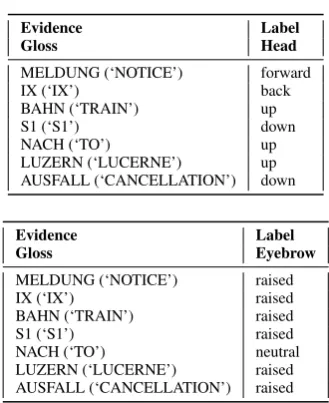
The goal of the experiments described here was to predict the most probable sequence of non-manual features for a sequence of glosses output by the machine translation system (cf. Figure 1). As stated in Section 3.1, CRFs allow the prediction of one outcome layer at a time. Hence, the two label layers head and eyebrows in our corpus (cf. Section 2) could either be collapsed into a single label (Configuration G→H+E, Table 2), or a
sep-arate classifier could be trained for each feature (Configura-tions G→H and G→E, Table 3). A downside of Configuration
G→H+E is that there is a potential for data sparseness, as the
number of possible outcome labels is equivalent to the number of cross-combinations of head and eyebrow labels occurring in the training data. However, even with this approach, the risk of data sparseness is lower than that of appending the non-manual features to the sign language glosses during the machine trans-lation task, as described at the beginning of Section 3.
Evidence Label
Gloss Non-manual
MELDUNG (‘NOTICE’) forward_raised
IX (‘IX’) back_raised
BAHN (‘TRAIN’) up_raised
S1 (‘S1’) down_raised
NACH (‘TO’) up_neutral
[image:3.595.335.518.359.449.2]LUZERN (‘LUCERNE’) up_raised AUSFALL (‘CANCELLATION’) down_raised
Table 2: Configuration G→H+E
Evidence Label
Gloss Head
MELDUNG (‘NOTICE’) forward
IX (‘IX’) back
BAHN (‘TRAIN’) up
S1 (‘S1’) down
NACH (‘TO’) up
LUZERN (‘LUCERNE’) up AUSFALL (‘CANCELLATION’) down
Evidence Label
Gloss Eyebrow
MELDUNG (‘NOTICE’) raised
IX (‘IX’) raised
BAHN (‘TRAIN’) raised
S1 (‘S1’) raised
NACH (‘TO’) neutral
LUZERN (‘LUCERNE’) raised AUSFALL (‘CANCELLATION’) raised
[image:3.595.343.508.486.688.2]Figure 1: Sign language production pipeline: machine translation, sequence classification, and animation
With Configurations G→H and G→E, each label layer
(head and eyebrows, respectively) is treated in isolation, which means that dependencies between the two are not captured. However, conceptually, dependencies between these two types of non-manual features exist in that they assume specific lin-guistic functions together, e.g., topicalization, rhetorical ques-tions, or conditional expressions in DSGS. These dependencies can be accounted for by introducing a cascaded approach, i.e., by using the output of one classifier as additional input for the other. More precisely, the output of the head information classi-fier can be used as additional evidence for the eyebrow informa-tion classifier and vice versa. This is shown as Configurainforma-tions G_E→H and G_H→E in Table 4. Note that such a
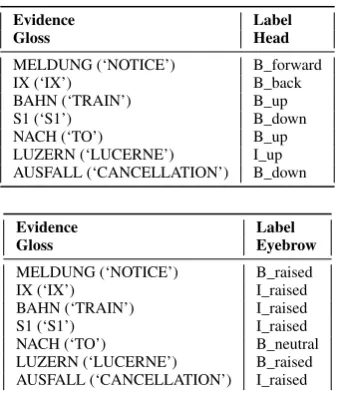
representa-tion accommodates the multi-tier nature of sign languages. To better model the sequential dependencies in a given data set, anIOBrepresentation [24] could be used. In this format,B
denotes the first token of a label sequence,Ia sequence-internal token, andOis used for tokens that are not part of a sequence of a label under consideration. This format is applied as Configu-rations G→HIOBand G→EIOB(Table 5). Note that in the case
at hand,Odoes not occur, since the data contains multi-class as opposed to binary annotations andneutralis one of the possible class labels.
For our experiments, we applied all of the above seven con-figurations, as summarized in Table 6.
Among the strengths of CRFs is their ability to handle a large amount of features as well as to cope with redundancy [23]. We provided 26 feature templates for each evidence layer, guided by a template provided by Roth and Clematide [25]. Ta-ble 7 lists the 12 context windows used. The taTa-ble shows that the overall context considered ranged from the three previous tokens to the three following tokens relative to the current po-sition. Each window was included with both emission order 1 (unigram) and 2 (bigram). In addition, raw unigram output dis-tribution and bigram output disdis-tribution were included.
Evidence Label
Gloss Eyebrows Head
MELDUNG (‘NOTICE’) raised forward
IX (‘IX’) raised back
BAHN (‘TRAIN’) raised up
S1 (‘S1’) raised down
NACH (‘TO’) neutral up
LUZERN (‘LUCERNE’) raised up AUSFALL (‘CANCELLATION’) raised down
Evidence Label
Gloss Head Eyebrows
MELDUNG (‘NOTICE’) forward raised
IX (‘IX’) back raised
BAHN (‘TRAIN’) up raised
S1 (‘S1’) down raised
NACH (‘TO’) up neutral
LUZERN (‘LUCERNE’) up raised AUSFALL (‘CANCELLATION’) down raised
Table 4: Configurations G_E→H (top) and G_H→E (bottom)
3.4. Results
[image:4.595.322.531.373.567.2]Evidence Label
Gloss Head
MELDUNG (‘NOTICE’) B_forward
IX (‘IX’) B_back
BAHN (‘TRAIN’) B_up
S1 (‘S1’) B_down
NACH (‘TO’) B_up
LUZERN (‘LUCERNE’) I_up AUSFALL (‘CANCELLATION’) B_down
Evidence Label
Gloss Eyebrow
MELDUNG (‘NOTICE’) B_raised
IX (‘IX’) I_raised
BAHN (‘TRAIN’) I_raised
S1 (‘S1’) I_raised
NACH (‘TO’) B_neutral
[image:5.595.87.256.71.268.2]LUZERN (‘LUCERNE’) B_raised AUSFALL (‘CANCELLATION’) I_raised
Table 5: Configurations G→HIOB(top) and G→EIOB(bottom)
Configuration Evidence Label
G→H+E glosses head and eyebrows
G→H glosses head
G→E glosses eyebrows
G_E→H – glosses head
– eyebrows
G_H→E – glosses eyebrows
– head
G→HIOB glosses headIOB
[image:5.595.314.547.75.219.2]G→EIOB glosses eyebrowsIOB
Table 6: Overview of configurations
approach, Table 8 provides the following numerical informa-tion, in analogy to previous work in classification for natural language processing [26, 25, 27]:
• Number of labels
• Token error: This is the mean of the token errors of the ten rounds of a 10-fold cross validation. The token er-ror for an individual validation round is calculated as the percentage of incorrectly predicted labels.
• Standard deviation of token error for the ten rounds • Confidence interval of token error: This is the confidence
interval at a confidence level of 95% calculated over the mean of the token errors using Student’s t-test.
• Sequence error: This is the mean of the sequence errors of a 10-fold cross validation. The sequence error for an individual validation round is calculated as the percent-age of incorrectly predicted sequences, i.e., sequences containing at least one token error.
• Standard deviation of sequence error
• Confidence interval of sequence error: This is the con-fidence interval at a concon-fidence level of 95% calculated
Relative position Description
0 current token
-1 to +1 previous, current, following token -1 to 0 previous and current token 0 to +1 current and following token -1 previous token
1 following token
-2 to 0 two previous and current token -2 to +1 two previous, current, following token -3 to 0 three previous and current token -2 to +2 two previous, current, following token -1 to +2 previous, current, two following tokens -1 to +3 previous, current, three following tokens
Table 7: Context windows used for the feature templates
over the mean of the sequence errors using Student’s t-test.
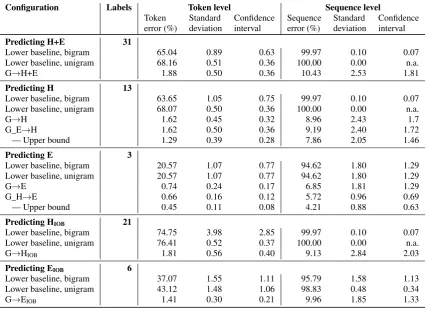
The results in Table 8 show that all experimental ap-proaches outperformed their lower baselines (unigram and bi-gram output distribution); in all cases, the magnitude of the dif-ference was greater than the confidence interval of the values. The error rates of the experimental approaches are notably low, which is at least partly due to the nature of the data used for the experiments: As described in Section 2, the train announce-ments are highly parametrized in that they are based on a lim-ited set of phrasal templates. As shown in the table, there is a tendency for the bigram baseline to perform better than the uni-gram baseline, a result that underlines the inherently sequential nature of the data.
3.4.1. Cascaded vs. non-cascaded
Between Configuration G→H (non-cascaded) and G_E→H
(cascaded), both predicting head information, Configuration G→H exhibits a lower sequence error rate. Between
Configu-ration G→E (non-cascaded) and G_H→E (cascaded), both
pre-dicting eyebrow information, Configuration G_H→E achieved
a lower sequence error rate.
To examine the theoretical potential of the cascaded proach, we determined the upper bound, i.e., the result of ap-plying the model learned from the training data on the ground-truth data. In other words, as data for the additional evi-dence layer (eyebrow information for Configuration G_E→H
and head information for Configuration G_H→E), we used the
gold-standard annotations of these layers instead of the output of Configurations G→H and G→E, respectively. The resulting
numbers are shown in the table as “Upper bound” for Configu-rations G_E→H and G_H→E: Configuration G_E→H/Upper
bound achieved a lower sequence error rate than Configura-tion G→H. Configuration G_H→E/Upper bound also achieved
a lower sequence error rate than Configuration G→E; here, the
[image:5.595.70.271.300.443.2]Configuration Labels Token level Sequence level
Token Standard Confidence Sequence Standard Confidence error (%) deviation interval error (%) deviation interval
Predicting H+E 31
Lower baseline, bigram 65.04 0.89 0.63 99.97 0.10 0.07 Lower baseline, unigram 68.16 0.51 0.36 100.00 0.00 n.a.
G→H+E 1.88 0.50 0.36 10.43 2.53 1.81
Predicting H 13
Lower baseline, bigram 63.65 1.05 0.75 99.97 0.10 0.07 Lower baseline, unigram 68.07 0.50 0.36 100.00 0.00 n.a.
G→H 1.62 0.45 0.32 8.96 2.43 1.7
G_E→H 1.62 0.50 0.36 9.19 2.40 1.72
— Upper bound 1.29 0.39 0.28 7.86 2.05 1.46
Predicting E 3
Lower baseline, bigram 20.57 1.07 0.77 94.62 1.80 1.29 Lower baseline, unigram 20.57 1.07 0.77 94.62 1.80 1.29
G→E 0.74 0.24 0.17 6.85 1.81 1.29
G_H→E 0.66 0.16 0.12 5.72 0.96 0.69
— Upper bound 0.45 0.11 0.08 4.21 0.88 0.63
Predicting HIOB 21
Lower baseline, bigram 74.75 3.98 2.85 99.97 0.10 0.07 Lower baseline, unigram 76.41 0.52 0.37 100.00 0.00 n.a.
G→HIOB 1.81 0.56 0.40 9.13 2.84 2.03
Predicting EIOB 6
Lower baseline, bigram 37.07 1.55 1.11 95.79 1.58 1.13 Lower baseline, unigram 43.12 1.48 1.06 98.83 0.48 0.34
[image:6.595.86.514.71.380.2]G→EIOB 1.41 0.30 0.21 9.96 1.85 1.33
Table 8: Sequence classification experiments: Results
3.4.2. IOBvs. non-IOB
Between Configuration G→H (non-IOBformat) and G→HIOB
(IOB format), both predicting head information, Configura-tion G→H produced a lower sequence error rate. Between
Configuration G→E (non-IOB format) and G→EIOB (IOB
format), both predicting eyebrow information, Configuration G→E yielded a lower sequence error rate. In this case, the
mag-nitude of the difference was greater than the confidence interval of the values. These results show that applying anIOBformat was not beneficial for the task at hand, most likely due to data sparseness: Introducing the IOBformat doubled the number of labels for Configuration G→EIOBcompared to Configuration
G→E (6 vs. 3 labels), while the relative increase was lower
for Configuration G→HIOB compared to Configuration G→H
(21 vs. 13 labels), indicating that five head information features appeared sequence-initially only, i.e., spanned over one gloss.
3.4.3. Analysis of features
We examined the 50 highest-weighted (instantiated) features in the models of the experimental approaches of Configurations G→H+E, G_E→H, and G_H→E for the first round of the
10-fold cross validation: Among the highest-weighted features for Configuration G→H+E were 31 bigram features and 19
uni-gram features. The most frequently occurring feature context window (cf. Table 7) consisted of the current token of the (gloss) evidence layer (i.e., relative position 0). Thus, the identity of a lexical item contributed to the model’s prediction of the non-manual feature that co-occurs with it. The second- and third-best performing feature context windows contained the previous token (-1) and the following token (+1) of an evidence layer,
re-spectively, and this was followed by a window containing the current and the following token (0 to +1). Thus, the neighbor-ing lexical items contributed to the prediction of the non-manual feature.
For Configuration G_E→H (predicting head information),
the 50 top-weighted features consisted of 26 bigram and 24 un-igram features. 48 features used tokens from the gloss evidence layer, while 2 used tokens from the added eyebrow information layer. For Configuration G_H→E (predicting eyebrow
infor-mation), this number was considerably higher: Among the 50 best-scoring features were 27 that used tokens from the head information layer. Again, this serves as evidence that head in-formation is valuable when predicting eyebrow inin-formation in DSGS.
4. Conclusion and outlook
We have presented work that bridges the gap between the output of a sign language machine translation system and the input of a sign language animation system by incorporating non-manual information into the final output of the translation system. This is in contrast to many prior statistical sign language machine translation approaches that did not include non-manual com-ponents in their output. The inclusion of such non-manual in-formation enables the final animation-synthesis component of a translation system to control the head and face of a signing avatar.
those of manual components, rendering the process of generat-ing non-manual components a gloss-labelgenerat-ing task.
Sequence classification is a technique commonly used in the automatic processing of spoken languages. The work we have reported on in this paper is presumably the first to apply it to the generation of non-manual information in sign languages. We have shown that all of our experimental approaches out-performed their lower baselines. The experimental approaches consisted of: predicting head and eyebrow information together in one label, predicting head and eyebrow information sepa-rately, predicting head information by using eyebrow informa-tion as addiinforma-tional evidence and vice versa (cascaded approach), and applying anIOBformat. We have demonstrated the poten-tial of applying a cascaded approach, and we did not observe any benefit from utilizing anIOBformat in our task.
As a next step, we intend to apply our experimental ap-proaches to a parallel English/American Sign Language (ASL) corpus from a domain with greater semantic and syntactic va-riety [28]. In this way, we hope to determine, for a different sign language and for a more diverse corpus, if the key findings of this paper are replicable, namely: (a) that the non-manual components of a sign language sentence may be successfully predicted using a sequence classification approach and (b) that some orderings of cascading the sequential predictions are more successful than others (e.g., for DSGS, we found that head formation was useful to consider when predicting eyebrow in-formation).
In contrast to the train announcement DSGS corpus used in this paper, the ASL corpus is known to contain instances of non-manual information that are not lexically-cued, i.e., they are not recoverable from the glosses alone. For example, ayes/no ques-tion in ASL can have the same surface form (gloss order) as a declarative sentence.5 Thus, we anticipate investigating how to best exploit information contained in the (English) source sentence, e.g., to include question marks as absolute features. Leveraging information from the source sentence will also al-low us to capture instances in which a syntactic function is ex-pressed non-manually only on the ASL side: e.g., in ASL, it is possible to convey negation solely via headshake, without the use of any manual sign to indicate the negation [29].
5. References
[1] H. Kacorri, P. Lu, and M. Huenerfauth, “Effect of Displaying Hu-man Videos During an Evaluation Study of American Sign Lan-guage Animation,”ACM Transactions on Accessible Computing, vol. 5, 2013.
[2] O. Crasborn, “Nonmanual Structures in Sign Language,” in En-cyclopedia of Language & Linguistics, 2nd ed., K. Brown, Ed. Oxford: Elsevier, 2006, vol. 8, pp. 668–672.
[3] C. Steiner, Über die Funktion des Anhebens der Augenbrauen in der Deutschschweizerischen Gebärdensprache DSGS, ser. Informationsheft. Zürich: Verein zur Unterstützung des Forschungszentrums für Gebärdensprache, 2000, vol. 35. [4] P. Boyes Braem, Einführung in die Gebärdensprache und ihre
Erforschung, 3rd ed., ser. Internationale Arbeiten zur Gebärden-sprache und Kommunikation Gehörloser. Hamburg: Signum, 1995, vol. 11.
[5] D. Stein, C. Schmidt, and H. Ney, “Analysis, preparation, and op-timization of statistical sign language machine translation,” Ma-chine Translation, vol. 26, pp. 325–357, 2012, published online: 18 March 2012.
5The same is true for DSGS, but such cases do not appear in the train
announcement data used for the experiments reported in this paper.
[6] S. Morrissey, “Data-Driven Machine Translation for Sign Lan-guages,” Ph.D. dissertation, Dublin City University, Dublin, Ire-land, 2008.
[7] G. Massó and T. Badia, “Dealing with Sign Language Morphemes in Statistical Machine Translation,” inLREC 2010: 4th Workshop on the Representation and Processing of Sign Languages: Cor-pora and Sign Language Technologies, La Valetta, Malta, 2010, pp. 154–157.
[8] M. Huenerfauth, “Generating American Sign Language Classifier Predicates for English-to-ASL Machine Translation,” Ph.D. dis-sertation, University of Pennsylvania, 2006.
[9] M. Filhol, “Combining two synchronisation methods in a linguis-tic model to describe sign language,” inGesture and Sign Lan-guage in Human-Computer Interaction and Embodied Communi-cation, ser. LNCS/LNAI. Springer, 2012, vol. 7206.
[10] G. Morgan and B. Woll, Eds.,Directions in sign language acqui-sition – Trends in language acquiacqui-sition research. Amsterdam: John Benjamins Publishing Company, 2002.
[11] V. Jennings, R. Elliott, R. Kennaway, and J. Glauert, “Require-ments For A Signing Avatar,” in4th Workshop on the Repre-sentation and Processing of Sign Languages: Corpora and Sign Language Technologies, N. Calzolari, K. Choukri, B. Maegaard, J. Mariani, J. Odijk, S. Piperidis, M. Rosner, and D. Tapias, Eds. Valletta, Malta: European Language Resources Associa-tion (ELRA), may 2010, pp. 133–136.
[12] C. Baker and C. Padden, “Focusing on the non-manual compo-nents of ASL,” inUnderstanding language through sign language research, P. Siple, Ed. New York: Academic Press, 1978, pp. 27–57.
[13] G. Coulter, “Raised eyebrows and wrinkled noses: The grammat-ical function of facial expression in relative clauses and related constructions,” inASL in a bilingual, bicultural context. Proceed-ings of the Second National Symposium on Sign Language Re-search and Teaching, F. Caccamise and D. Hicks, Eds. Coron-ado, CA: National Association of the Deaf, 1978, pp. 65–74. [14] S. Liddell, “Non-manual signals and relative clauses in American
Sign Language,” inUnderstanding language through sign lan-guage research, P. Siple, Ed. New York: Academic Press, 1978, pp. 59–90.
[15] ——,American Sign Language syntax. The Hague: Mouton, 1980.
[16] C. Baker-Shenk, “A Micro-Analysis of the Nonmanual Compo-nents of Questions in American Sign Language,” Ph.D. disserta-tion, University of California, Berkeley, 1983.
[17] J.S. Reilly and M. McIntire and U. Bellugi, “The acquisition of conditionals in American Sign Language: Grammaticized facial expressions,” Applied Psycholinguistics, vol. 11, pp. 369–392, 1990.
[18] J. Reilly and U. Bellugi, “Competition on the face: Affect and language in ASL motherese,”Journal of Child Language, vol. 23, pp. 219–239, 1996.
[19] D. Anderson and J. Reilly, “PAH! the acquisition of adverbials in ASL,”Sign Language & Linguistics, vol. 1, pp. 3–28, 1998. [20] R. Wilbur, “Phonological and Prosodic Layering of Nonmanuals
in American Sign Language,” inThe Signs of Language Revisited, K. Emmorey and H. Lane, Eds. Mahwah, New Jersey: Lawrence Erlbaum Associates, 2000, pp. 215–244.
[21] J. Reilly and D. Anderson, “Faces: The acquisition of non-manual morphology in ASL,” inDirections in Sign Language Acquisition, G. Morgan and B. Woll, Eds. Amsterdam: John Benjamins, 2002, pp. 159–181.
[22] C. Sutton and A. McCallum, “An introduction to conditional ran-dom fields,”Foundations and Trends in Machine Learning, vol. 4, pp. 267–373, 2012.
[24] E. F. T. K. Sang and J. Veenstra, “Representing Text Chunks,” inProceedings of the Ninth Conference on European Chapter of the Association for Computational Linguistics, ser. EACL ’99. Stroudsburg, PA, USA: Association for Computational Linguis-tics, 1999, pp. 173–179.
[25] L. Roth and S. Clematide, “Tagging Complex Non-Verbal Ger-man Chunks with Conditional Random Fields,” inProceedings of the 12th Konvens, Hildesheim, Germany, 2014, pp. 48–57. [26] D.-K. Kang, A. Silvescu, and V. Honavar, “RNBL-MN: A
Re-cursive Naive Bayes Learner for Sequences Classification,” in PAKDD’06, 2006.
[27] A. Savkov, J. Carroll, and J. Cassell, “Chunking Clinical Text Containing Non-Canonical Language,” in Proceedings of the 2014 Workshop on Biomedical Natural Language Processing (BioNLP 2014), Baltimore, Maryland USA, 2014, pp. 77–82. [28] C. Neidle and C. Vogler, “A new web interface to facilitate
ac-cess to corpora: Development of the asllrp data acac-cess interface,” inProceedings of the 5th Workshop on the Representation and Processing of Sign Languages: Interactions between Corpus and Lexicon, LREC 2012, Istanbul, Turkey, 2012.